


EN ISO 13004:2023
(Main)Sterilization of health care products - Radiation - Substantiation of selected sterilization dose: Method VDmaxSD (ISO 13004:2022)
General Information
- Abstract
Adoption of ISO 13004:2022 – This is currently in FDIS and will be publishing in October 2022.
This document describes a method for substantiating a selected sterilization dose of 17,5,
20, 22,5, 27,5, 30, 32,5 or 35 kGy that achieves a sterility assurance level (SAL) of 10−6 or less for radiation
sterilization of health care products. This Technical Specification also specifies a method of sterilization
dose audit used to demonstrate the continued effectiveness of the substantiated sterilization dose.
NOTE Selection and substantiation of the sterilization dose is used to meet the requirements for establishing
the sterilization dose within process definition in ISO 11137-1.
- Status
- Published
- Publication Date
- 27-Jun-2023
- Technical Committee
- CEN/TC 204 - Sterilization of medical devices
- Drafting Committee
- CEN/TC 204 - Sterilization of medical devices
- Current Stage
- 6060 - Definitive text made available (DAV) - Publishing
- Start Date
- 28-Jun-2023
- Due Date
- 28-Mar-2025
- Completion Date
- 28-Jun-2023


Overview
EN ISO 13004:2023 (adoption of ISO 13004:2022) specifies the VDmaxSD method for substantiating a selected radiation sterilization dose for health care products. It covers substantiation of fixed sterilization doses of 17.5, 20, 22.5, 27.5, 30, 32.5, or 35 kGy to achieve a sterility assurance level (SAL) of 10−6 or better. The standard also defines a sterilization dose audit procedure to demonstrate continued effectiveness of the substantiated dose and is used to meet sterilization dose requirements in ISO 11137-1.
Key Topics
- VDmaxSD method scope: Substantiation for selected discrete doses (listed above) to ensure SAL ≤ 10−6.
- Product family definition and maintenance: Rules for grouping products, designation of representative (master/equivalent/simulated) products, and record keeping.
- Sampling and testing: Guidance on sample selection, Sample Item Portion (SIP) concepts, microbiological testing and irradiation of test specimens.
- Bioburden determination: Frequency and procedures for measuring average bioburden as input to dose substantiation and audits.
- Verification dose experiments: Staged procedure (obtain samples → determine bioburden → select dose → obtain VD → perform verification experiments → interpret results) including confirmatory verification when required.
- Sterilization dose audit: Procedures and frequencies for periodic audits, pass/fail outcomes, and required corrective actions on failure.
- Supporting materials: Tables of SIP values and worked examples to aid application.
Applications
EN ISO 13004:2023 is intended for organizations involved in radiation sterilization of medical and health care products who need to substantiate and maintain a validated sterilization dose. Typical users:
- Medical device manufacturers and contract sterilization service providers
- Sterilization process engineers and microbiologists
- Quality assurance, regulatory and compliance professionals responsible for sterilization validation and process control
- R&D teams designing product families and test protocols
Practical benefits include a standardized, auditable approach to selecting fixed sterilization doses, clearer requirements for bioburden-based dose substantiation, and defined audit methods to maintain SAL targets across production.
Related Standards
- ISO 11137-1 - referenced for establishing sterilization dose within the process definition.
- EN ISO 13004:2023 supersedes CEN ISO/TS 13004:2014 and reflects ISO 13004:2022 content as adopted by CEN.
Keywords: EN ISO 13004:2023, ISO 13004:2022, VDmaxSD, radiation sterilization, sterilization dose, SAL 10−6, bioburden, sterilization dose audit, medical device sterilization.
Relations
- Effective Date
- 19-Jan-2023
Get Certified
Connect with accredited certification bodies for this standard

BSI Group
BSI (British Standards Institution) is the business standards company that helps organizations make excellence a habit.

TÜV Rheinland
TÜV Rheinland is a leading international provider of technical services.

TÜV SÜD
TÜV SÜD is a trusted partner of choice for safety, security and sustainability solutions.
Sponsored listings
Frequently Asked Questions
EN ISO 13004:2023 is a standard published by the European Committee for Standardization (CEN). Its full title is "Sterilization of health care products - Radiation - Substantiation of selected sterilization dose: Method VDmaxSD (ISO 13004:2022)". This standard covers: Adoption of ISO 13004:2022 – This is currently in FDIS and will be publishing in October 2022. This document describes a method for substantiating a selected sterilization dose of 17,5, 20, 22,5, 27,5, 30, 32,5 or 35 kGy that achieves a sterility assurance level (SAL) of 10−6 or less for radiation sterilization of health care products. This Technical Specification also specifies a method of sterilization dose audit used to demonstrate the continued effectiveness of the substantiated sterilization dose. NOTE Selection and substantiation of the sterilization dose is used to meet the requirements for establishing the sterilization dose within process definition in ISO 11137-1.
Adoption of ISO 13004:2022 – This is currently in FDIS and will be publishing in October 2022. This document describes a method for substantiating a selected sterilization dose of 17,5, 20, 22,5, 27,5, 30, 32,5 or 35 kGy that achieves a sterility assurance level (SAL) of 10−6 or less for radiation sterilization of health care products. This Technical Specification also specifies a method of sterilization dose audit used to demonstrate the continued effectiveness of the substantiated sterilization dose. NOTE Selection and substantiation of the sterilization dose is used to meet the requirements for establishing the sterilization dose within process definition in ISO 11137-1.
EN ISO 13004:2023 is classified under the following ICS (International Classification for Standards) categories: 11.080.01 - Sterilization and disinfection in general. The ICS classification helps identify the subject area and facilitates finding related standards.
EN ISO 13004:2023 has the following relationships with other standards: It is inter standard links to CEN ISO/TS 13004:2014. Understanding these relationships helps ensure you are using the most current and applicable version of the standard.
EN ISO 13004:2023 is available in PDF format for immediate download after purchase. The document can be added to your cart and obtained through the secure checkout process. Digital delivery ensures instant access to the complete standard document.
Standards Content (Sample)
SLOVENSKI STANDARD
01-september-2023
Nadomešča:
SIST-TS CEN ISO/TS 13004:2014
Sterilizacija izdelkov za zdravstveno nego - Sevanje - Utemeljitev izbrane doze
sterilizacije: metoda VDmaxSD (ISO 13004:2022)
Sterilization of health care products - Radiation - Substantiation of selected sterilization
dose: Method VDmaxSD (ISO 13004:2022)
Sterilisation von Produkten für die Gesundheitsfürsorge - Strahlen - Bestätigung der
gewählten Sterilisationsdosis: Methode VDmaxSD (ISO 13004:2022)
Stérilisation des produits de santé - Irradiation - Justification de la dose stérilisante
choisie: Méthode DVmaxDS (ISO 13004:2022)
Ta slovenski standard je istoveten z: EN ISO 13004:2023
ICS:
11.080.01 Sterilizacija in dezinfekcija na Sterilization and disinfection
splošno in general
2003-01.Slovenski inštitut za standardizacijo. Razmnoževanje celote ali delov tega standarda ni dovoljeno.
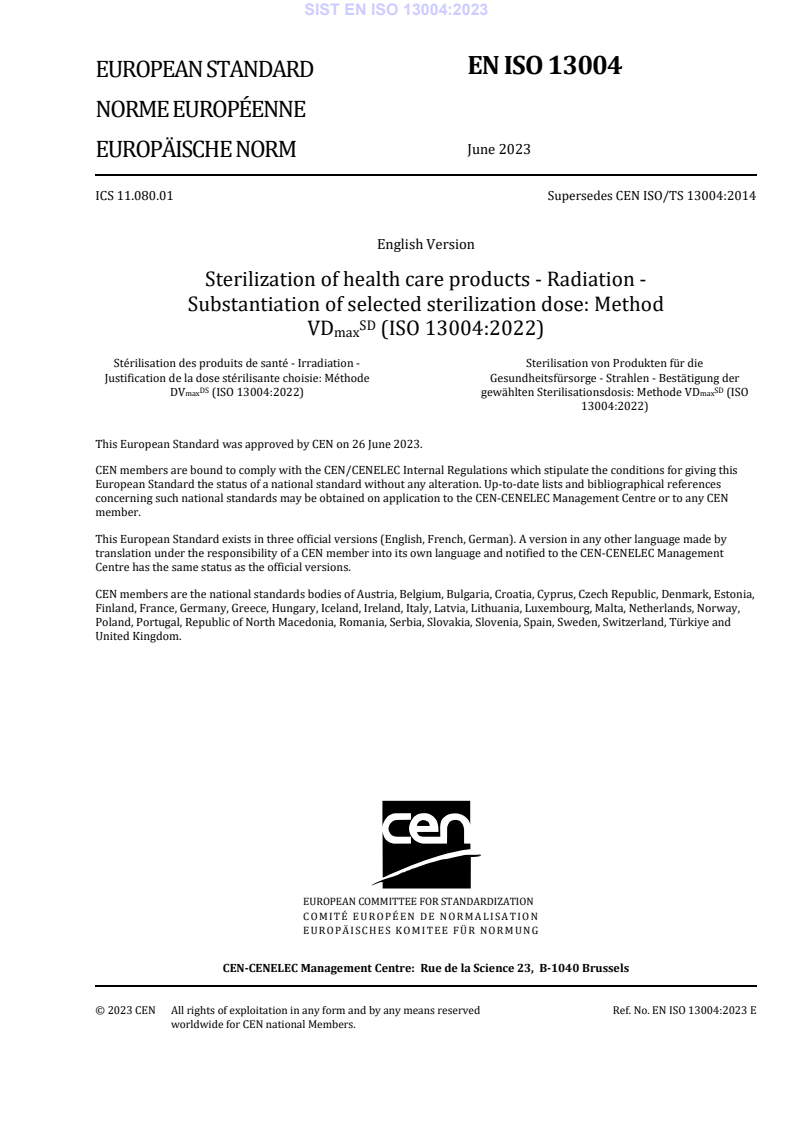
EN ISO 13004
EUROPEAN STANDARD
NORME EUROPÉENNE
June 2023
EUROPÄISCHE NORM
ICS 11.080.01 Supersedes CEN ISO/TS 13004:2014
English Version
Sterilization of health care products - Radiation -
Substantiation of selected sterilization dose: Method
SD
VD (ISO 13004:2022)
max
Stérilisation des produits de santé - Irradiation - Sterilisation von Produkten für die
Justification de la dose stérilisante choisie: Méthode Gesundheitsfürsorge - Strahlen - Bestätigung der
DS SD
DV (ISO 13004:2022) gewählten Sterilisationsdosis: Methode VD (ISO
max max
13004:2022)
This European Standard was approved by CEN on 26 June 2023.
CEN members are bound to comply with the CEN/CENELEC Internal Regulations which stipulate the conditions for giving this
European Standard the status of a national standard without any alteration. Up-to-date lists and bibliographical references
concerning such national standards may be obtained on application to the CEN-CENELEC Management Centre or to any CEN
member.
This European Standard exists in three official versions (English, French, German). A version in any other language made by
translation under the responsibility of a CEN member into its own language and notified to the CEN-CENELEC Management
Centre has the same status as the official versions.
CEN members are the national standards bodies of Austria, Belgium, Bulgaria, Croatia, Cyprus, Czech Republic, Denmark, Estonia,
Finland, France, Germany, Greece, Hungary, Iceland, Ireland, Italy, Latvia, Lithuania, Luxembourg, Malta, Netherlands, Norway,
Poland, Portugal, Republic of North Macedonia, Romania, Serbia, Slovakia, Slovenia, Spain, Sweden, Switzerland, Türkiye and
United Kingdom.
EUROPEAN COMMITTEE FOR STANDARDIZATION
COMITÉ EUROPÉEN DE NORMALISATIO N
EUROPÄISCHES KOMITEE FÜR NORMUN G
CEN-CENELEC Management Centre: Rue de la Science 23, B-1040 Brussels
© 2023 CEN All rights of exploitation in any form and by any means reserved Ref. No. EN ISO 13004:2023 E
worldwide for CEN national Members.
Contents Page
European foreword . 3
European foreword
The text of ISO 13004:2022 has been prepared by Technical Committee ISO/TC 198 "Sterilization of
health care products” of the International Organization for Standardization (ISO) and has been taken
over as EN ISO 13004:2023 by Technical Committee CEN/TC 204 “Sterilization of medical devices” the
secretariat of which is held by BSI.
This European Standard shall be given the status of a national standard, either by publication of an
identical text or by endorsement, at the latest by December 2023, and conflicting national standards
shall be withdrawn at the latest by December 2023.
Attention is drawn to the possibility that some of the elements of this document may be the subject of
patent rights. CEN shall not be held responsible for identifying any or all such patent rights.
This document supersedes CEN ISO/TS 13004:2014.
Any feedback and questions on this document should be directed to the users’ national standards body.
A complete listing of these bodies can be found on the CEN website.
According to the CEN-CENELEC Internal Regulations, the national standards organizations of the
following countries are bound to implement this European Standard: Austria, Belgium, Bulgaria,
Croatia, Cyprus, Czech Republic, Denmark, Estonia, Finland, France, Germany, Greece, Hungary, Iceland,
Ireland, Italy, Latvia, Lithuania, Luxembourg, Malta, Netherlands, Norway, Poland, Portugal, Republic of
North Macedonia, Romania, Serbia, Slovakia, Slovenia, Spain, Sweden, Switzerland, Türkiye and the
United Kingdom.
Endorsement notice
The text of ISO 13004:2022 has been approved by CEN as EN ISO 13004:2023 without any modification.
INTERNATIONAL ISO
STANDARD 13004
First edition
2022-10
Sterilization of health care products —
Radiation — Substantiation of
selected sterilization dose: Method
SD
VD
max
Stérilisation des produits de santé — Irradiation — Justification de la
DS
dose stérilisante choisie: Méthode DV
max
Reference number
ISO 13004:2022(E)
ISO 13004:2022(E)
© ISO 2022
All rights reserved. Unless otherwise specified, or required in the context of its implementation, no part of this publication may
be reproduced or utilized otherwise in any form or by any means, electronic or mechanical, including photocopying, or posting on
the internet or an intranet, without prior written permission. Permission can be requested from either ISO at the address below
or ISO’s member body in the country of the requester.
ISO copyright office
CP 401 • Ch. de Blandonnet 8
CH-1214 Vernier, Geneva
Phone: +41 22 749 01 11
Email: copyright@iso.org
Website: www.iso.org
Published in Switzerland
ii
ISO 13004:2022(E)
Contents Page
Foreword .v
Introduction . vi
1 Scope . 1
2 Normative references . 1
3 Terms and definitions . 1
4 Definition and maintenance of product families for sterilization dose substantiation
and sterilization dose auditing.5
4.1 General . 5
4.2 Defining product families . 5
4.3 Designation of product to represent a product family . 6
4.3.1 Product to represent a product family . 6
4.3.2 Master product . 7
4.3.3 Equivalent product . 7
4.3.4 Simulated product . 7
4.4 Maintaining product families . 8
4.4.1 Periodic review . 8
4.4.2 Modification to either product or manufacturing process, or both . 8
4.4.3 Records . 8
4.5 Consequence of failure of sterilization dose substantiation or sterilization dose
audit. 8
5 Selection and testing of product for substantiating and auditing a selected
sterilization dose . 8
5.1 Nature of product . 8
5.2 Sample item portion (SIP) . 9
5.3 Manner of sampling . 10
5.4 Microbiological testing . 11
5.5 Irradiation . 11
SD
6 Method VD — Substantiation of a selected sterilization dose of 17,5 kGy,
max
20 kGy, 22,5 kGy, 27,5 kGy, 30 kGy, 32,5 kGy or 35 kGy .12
6.1 Rationale .12
SD
6.2 Procedure for Method VD for multiple production batches .12
max
6.2.1 General .12
6.2.2 Stage 1: Obtain samples of product . 13
6.2.3 Stage 2: Determine average bioburden .13
6.2.4 Stage 3: Obtain the selected sterilization dose .13
SD
6.2.5 Stage 4: Obtain VD . 14
max
6.2.6 Stage 5: Perform verification dose experiment . 15
6.2.7 Stage 6: Interpretation of results . 15
6.2.8 Confirmatory verification dose experiment . 16
SD
6.3 Procedure for Method VD for a single production batch . 17
max
6.3.1 Rationale . 17
6.3.2 General . 17
6.3.3 Stage 1: Obtain samples of product . 17
6.3.4 Stage 2: Determine average bioburden . 18
6.3.5 Stage 3: Obtain the selected sterilization dose . 18
SD
6.3.6 Stage 4: Obtain VD . 19
max
6.3.7 Stage 5: Perform verification dose experiment . 19
6.3.8 Stage 6: Interpretation of results . 19
6.3.9 Confirmatory verification dose experiment . 20
7 Maintaining process effectiveness .21
iii
ISO 13004:2022(E)
7.1 General . 21
7.2 Frequency of determination of bioburden . 21
7.3 Sterilization dose audit . 21
7.3.1 Frequency . 21
7.3.2 Outcome .22
7.3.3 Procedure for auditing a sterilization dose substantiated using Method
SD
VD . 22
max
7.3.4 Failure of a sterilization dose audit . 25
8 Tables of values for SIP . .26
9 Worked examples .51
9.1 Substantiation of a selected sterilization dose of 17,5 kGy (SIP less than 1,0) . 51
9.2 Substantiation of a selected sterilization dose of 30 kGy (SIP equal to 1,0) . 52
9.3 Sterilization dose audit for a sterilization dose substantiated using . 52
22,5
9.4 Method VD . 52
max
Bibliography .54
iv
ISO 13004:2022(E)
Foreword
ISO (the International Organization for Standardization) is a worldwide federation of national standards
bodies (ISO member bodies). The work of preparing International Standards is normally carried out
through ISO technical committees. Each member body interested in a subject for which a technical
committee has been established has the right to be represented on that committee. International
organizations, governmental and non-governmental, in liaison with ISO, also take part in the work.
ISO collaborates closely with the International Electrotechnical Commission (IEC) on all matters of
electrotechnical standardization.
The procedures used to develop this document and those intended for its further maintenance are
described in the ISO/IEC Directives, Part 1. In particular, the different approval criteria needed for the
different types of ISO documents should be noted. This document was drafted in accordance with the
editorial rules of the ISO/IEC Directives, Part 2 (see www.iso.org/directives).
Attention is drawn to the possibility that some of the elements of this document may be the subject of
patent rights. ISO shall not be held responsible for identifying any or all such patent rights. Details of
any patent rights identified during the development of the document will be in the Introduction and/or
on the ISO list of patent declarations received (see www.iso.org/patents).
Any trade name used in this document is information given for the convenience of users and does not
constitute an endorsement.
For an explanation of the voluntary nature of standards, the meaning of ISO specific terms and
expressions related to conformity assessment, as well as information about ISO's adherence to
the World Trade Organization (WTO) principles in the Technical Barriers to Trade (TBT), see
www.iso.org/iso/foreword.html.
This document was prepared by Technical Committee ISO/TC 198, Sterilization of health care products.
This first edition cancels and replaces ISO/TS 13004:2013.
The main changes are as follows:
— guidance is offered for determination of an SIP for bulk materials such as powders, liquids and gels;
— 5.3.3 and 5.3.4 have been reworded to match language in ISO 11137-2;
— the NOTE in 5.4.1 has been removed;
— 7.2 has been replaced with a reference to requirements in ISO 11137-1;
— guidance has been added for when to re-substantiate the sterilization dose based on shifts in
bioburden.
Any feedback or questions on this document should be directed to the user’s national standards body. A
complete listing of these bodies can be found at www.iso.org/members.html.
v
ISO 13004:2022(E)
Introduction
This document is intended to be used in conjunction with ISO 11137-1. One of the activities encompassed
within process definition in ISO 11137-1 is the option to select and substantiate a sterilization dose to
be applied to health care products.
SD
ISO 11137-2 includes Method VD for the substantiation of 25 kGy as a sterilization dose (termed
max
Method VD ) for product with an average bioburden less than or equal to 1 000 and Method
max
VD for the substantiation of 15 kGy as a sterilization dose for product with an average bioburden
max
less than or equal to 1,5.
This document extends the methods of selection and substantiation of a sterilization dose specified in
ISO 11137-2. It provides a methodology for the substantiation of selected sterilization doses of 17,5 kGy,
20 kGy, 22,5 kGy, 27,5 kGy, 30 kGy, 32,5 kGy and 35 kGy, each of which is valid only for a specified upper
limit of average bioburden.
NOTE Selected sterilization doses of 25 kGy and 15 kGy are not included in this document. The seven
methods in this document follow the same technical steps as the methods given in ISO 11137-2 for selection
and substantiation of sterilization doses of 25 kGy and 15 kGy. However, the descriptive text in this document
has been modified to better communicate the methods and hence the text occasionally differs from that in
ISO 11137-2.
The method described in this document is for substantiation of a selected sterilization dose to achieve a
−6 20
sterility assurance level (SAL) of 10 or less at that dose (e.g. Method VD for a selected sterilization
max
dose of 20 kGy). The application of the method is not limited by production batch size or production
frequency, and the number of product items irradiated in the verification dose experiment remains
constant. The method is founded on and embodies the following three principles:
— existence of a direct link between the outcome of the verification dose experiment and the attainment
−6
of an SAL of 10 at the selected sterilization dose;
— possession of a level of conservativeness at least equal to that of the standard distribution of
resistances (SDR);
— for a given bioburden, use of a maximal verification dose (VD ) corresponding to substantiation
max
of a selected sterilization dose.
[7]
This approach to sterilization dose substantiation was first outlined by Kowalski and Tallentire
and, from subsequent evaluations involving computational techniques (Kowalski, Aoshuang and
[8] [9]
Tallentire ) and field evaluations (Kowalski et al. ), it was concluded that the method is soundly
based. An overview of the method and aspects of implementation are provided in Kowalski and
[10][11] SD
Tallentire. Application of the Method VD approach to doses other than 25 kGy is discussed
max
[12][13]
in Kowalski and Tallentire .
SD
The method described here and designated Method VD procedurally comprises elements that
max
closely parallel those of dose setting Method 1 described in ISO 11137-2. One key area of difference
is the number of product items used in the verification dose experiment. In the computer evaluations
referred to above, changing the verification SAL value had little effect on the substantiation outcome
and this finding led to a sample size of 10 product items being chosen for subsequent field evaluations
and, ultimately, for inclusion in this document.
Manufacturers of health care products who intend to use this specification are reminded that the
requirements contained in the ISO 11137 series apply to the manufacture and control of production
batches destined for radiation sterilization. In particular, one requirement states that products have
to be manufactured in circumstances such that the bioburden is controlled. The control of the quality
of raw materials, the manufacturing environment, the health, hygiene and attire of personnel and for
establishing the basic properties of packaging material should be maintained.
vi
INTERNATIONAL STANDARD ISO 13004:2022(E)
Sterilization of health care products — Radiation —
Substantiation of selected sterilization dose: Method
SD
VD
max
1 Scope
This document describes a method for substantiating a selected sterilization dose of 17,5 kGy, 20 kGy,
−6
22,5 kGy, 27,5 kGy, 30 kGy, 32,5 kGy or 35 kGy that achieves a sterility assurance level (SAL) of 10
or less for radiation sterilization of health care products. This document also specifies a method
of sterilization dose audit used to demonstrate the continued effectiveness of the substantiated
sterilization dose.
NOTE 1 Selection and substantiation of the sterilization dose is used to meet the requirements for establishing
the sterilization dose within process definition in ISO 11137-1.
This document does not apply to other sterilization doses than the substantiation of a selected
sterilization dose of 17,5 kGy, 20 kGy, 22,5 kGy, 27,5 kGy, 30 kGy, 32,5 kGy or 35 kGy. The method is
not used for the substantiation of a selected sterilization dose if the average bioburden of the entire
product item exceeds the limit specified for the selected sterilization dose (see Table 3).
NOTE 2 The methods for substantiation of selected sterilization doses of 25 kGy and 15 kGy are not included
in this document. They are described in ISO 11137-2.
If the decision is made to use this method of sterilization dose establishment, the method is intended to
be followed in accordance with the requirements (shall) and guidance (should) stipulated herein.
2 Normative references
The following documents are referred to in the text in such a way that some or all of their content
constitutes requirements of this document. For dated references, only the edition cited applies. For
undated references, the latest edition of the referenced document (including any amendments) applies.
ISO 11137-1:2006, Sterilization of health care products — Radiation — Part 1: Requirements for
development, validation and routine control of a sterilization process for medical devices
ISO 11737-1:2018, Sterilization of health care products — Microbiological methods — Part 1: Determination
of a population of microorganisms on products
ISO 11737-2, Sterilization of health care products — Microbiological methods — Part 2: Tests of sterility
performed in the definition, validation and maintenance of a sterilization process
3 Terms and definitions
For the purposes of this document, the following terms and definitions apply.
ISO and IEC maintain terminology databases for use in standardization at the following addresses:
— ISO Online browsing platform: available at https:// www .iso .org/ obp
— IEC Electropedia: available at https:// www .electropedia .org/
ISO 13004:2022(E)
3.1
absorbed dose
dose
quantity of ionizing radiation energy imparted per unit mass of a specified material
Note 1 to entry: The unit of absorbed dose is the gray (Gy), where 1 Gy is equivalent to the absorption of 1 J/kg.
Note 2 to entry: For the purposes of this document, the term dose is used to mean absorbed dose.
[SOURCE: ISO 11139:2018, 3.3, modified — The term "dose" was added. Notes 1 to 2 to entry were
added.]
3.2
batch
defined quantity of a product intended or purported to be uniform in character and quality produced
during a specified cycle of manufacture
[SOURCE: ISO 11139:2018, 3.21]
3.3
bioburden
population of viable microorganisms (3.11) on or in a product and/or sterile barrier system (3.16)
[SOURCE: ISO 11139:2018, 3.23]
3.4
correction
action to eliminate a detected nonconformity
Note 1 to entry: A correction can be made in conjunction with corrective action (3.5).
[SOURCE: ISO 11139:2018, 3.64, modified — In the Note 1 to entry, "in advance of, in conjunction with,
or after" has been replaced by "in conjunction with".]
3.5
corrective action
action to eliminate the cause of a nonconformity and to prevent recurrence
Note 1 to entry: There can be more than one cause for a nonconformity.
Note 2 to entry: Corrective action is taken to prevent recurrence whereas preventive action is taken to prevent
occurrence.
Note 3 to entry: There is a distinction between correction (3.4) and corrective action (3.5).
[SOURCE: ISO 11139:2018, 3.65, modified — Note 3 to entry has been added.]
3.6
dose mapping
measurement of dose distribution and variability in material irradiated under specified conditions
[SOURCE: ISO 11139:2018, 3.87]
3.7
false positive
test result interpreted as growth arising from product, or portion thereof, tested when either growth
resulted from extraneous microbial contamination or turbidity occurred from interaction between the
product, or portions thereof, and the test medium
[SOURCE: ISO 11137-2:2013, 3.1.3]
ISO 13004:2022(E)
3.8
health care product(s)
medical device (3.9), including in vitro diagnostic medical device, or medicinal product, including
biopharmaceutical
[SOURCE: ISO 11139:2018, 3.132]
3.9
medical device
instrument, apparatus, implement, machine, appliance, implant, reagent for in vitro use, or software
material, or other similar or related article, intended by the manufacturer to be used, alone or in
combination, for human beings, for one or more of the specific medical purpose(s) of:
— diagnosis, prevention, monitoring, treatment, or alleviation of disease;
— diagnosis, monitoring, treatment, alleviation of, or compensation for an injury;
— investigation, replacement, modification, or support of the anatomy, or of a physiological process;
— supporting or sustaining life;
— control of conception;
— disinfection of medical devices;
— providing information by means of in vitro examination of specimens derived from the human
body;
and does not achieve its primary intended action by pharmacological, immunological, or metabolic
means, but which may be assisted in its intended function by such means
[SOURCE: ISO 11139:2018, 3.166, modified — Note 1 to entry has been deleted.]
3.10
Method VD
max
procedure for sterilization dose substantiation that uses the maximal verification dose (3.23) for a given
−6
bioburden (3.3), consistent with the attainment of a sterility assurance level (SAL) of 10 at a selected
sterilization dose
SD
Note 1 to entry: The substantiation method is generally referred to as Method VD , where SD takes the value
max
of the selected sterilization dose.
SD
Note 2 to entry: VD is the maximal verification dose (3.23) for a particular selected sterilization dose (SD)
max
SD
obtained in using Method VD .
max
SD Dster
Note 3 to entry: The term VD may be used interchangeably with the term VD .
max max
3.11
microorganism
entity of microscopic size, encompassing bacteria, fungi, protozoa and viruses
Note 1 to entry: A specific standard might not require demonstration of the effectiveness of the sterilization
process in inactivating all types of microorganisms, identified in the definition above, for validation and/or
routine control of the sterilization process.
[SOURCE: ISO 11139:2018, 3.176, modified — Note 1 to entry was added.]
3.12
packaging system
combination of the sterile barrier system (3.16) and protective packaging
[SOURCE: ISO 11139:2018, 3.192]
ISO 13004:2022(E)
3.13
positive test of sterility
test result for which there is detectable microbial growth from product, or portion thereof, subjected to
a test of sterility (3.22)
[SOURCE: ISO 11137-2:2013, 3.1.8]
3.14
product
tangible result of a process
EXAMPLE Raw material(s), intermediate(s), sub-assembly(ies), health care product(s) (3.8).
[SOURCE: ISO 11139:2018, 3.217]
3.15
sample item portion
SIP
specified part of a health care product (3.8) that is tested
[SOURCE: ISO 11139:2018, 3.240]
3.16
sterile barrier system
minimum package that minimizes the risk of ingress of microorganisms (3.11) and allows aseptic
presentation of the sterile contents at the point of use
[SOURCE: ISO 11139:2018, 3.272]
3.17
sterility
state of being free from viable microorganisms (3.11)
Note 1 to entry: In practice, no such absolute statement regarding the absence of microorganisms can be proven
[see sterilization (3.19)].
[SOURCE: ISO 11139:2018, 3.274]
3.18
sterility assurance level
SAL
probability of a single viable microorganism (3.11) occurring on an item after sterilization
Note 1 to entry: It is expressed as the negative exponent to the base 10.
[SOURCE: ISO 11139:2018, 3.275
3.19
sterilization
validated process used to render product free from viable microorganisms (3.11)
Note 1 to entry: In a sterilization process, the nature of microbial inactivation is exponential and thus the survival
of a microorganism on an individual item can be expressed in terms of probability. While this probability can be
reduced to a very low number it can never be reduced to zero [see sterility assurance level (3.18)].
[SOURCE: ISO 11139:2018, 3.277]
ISO 13004:2022(E)
3.20
sterilization dose
SD
D
ster
minimum dose to achieve the specified requirements for sterility (3.17)
[SOURCE: ISO 11139:2018, 3.280]
3.21
sterilization dose audit
exercise undertaken to confirm the appropriateness of an established sterilization dose
[SOURCE: ISO 11139:2018, 3.281]
3.22
test of sterility
technical operation performed as part of development, validation or requalification to determine the
presence or absence of viable microorganisms (3.11) on product or portion thereof
[SOURCE: ISO 11139:2018, 3.299]
3.23
verification dose
dose of radiation predicted to give a predetermined sterility assurance level (SAL) (3.18) greater than or
−2
equal to 10 used in establishing the sterilization dose
−1
Note 1 to entry: For the purpose of this document, this predetermined SAL is 10 .
[SOURCE: ISO 11139:2018, 3.315, modified — Note 1 to entry was added.]
4 Definition and maintenance of product families for sterilization dose
substantiation and sterilization dose auditing
4.1 General
The establishment of a sterilization dose, for which sterilization dose selection and substantiation can
be undertaken, and the carrying out of sterilization dose audits are activities that are part of process
definition and maintaining process effectiveness (see ISO 11137-1). For these activities, product may
be grouped into families. Definition of product families is based principally on the numbers and types
of microorganisms on or in product (the bioburden), the type being indicative of the microorganism’s
resistance to radiation (see ISO 11737-1). Variables such as density and product configuration within its
packaging system are not considered in the establishment of these product families because they are
not factors that influence bioburden.
In using product families for establishing the sterilization dose and for carrying out sterilization
dose audits, it is important to be aware of the reduction in the ability to detect an inadvertent change
within the manufacturing process that influences the effectiveness of sterilization. Furthermore, with
the use of a single product to represent the product family, it is possible that changes that occur in
other members of the product family will not be detected. The effect of a reduction on ability to detect
changes in other members of the product family should be evaluated and a plan for maintaining product
families developed and implemented before proceeding.
4.2 Defining product families
4.2.1 The criteria for defining a product family shall be documented. Product shall be assessed
against these criteria and the similarities between potential product family members considered.
ISO 13004:2022(E)
Consideration shall include all product-related variables that affect bioburden, including, but not limited
to:
a) nature and sources of raw materials, including the effect, if any, of raw materials that can be
sourced from more than one location;
b) components;
c) product design and size;
d) manufacturing processes;
e) manufacturing equipment;
f) manufacturing environment;
g) manufacturing location.
The outcome of the assessment and considerations shall be recorded in accordance with
ISO 11137-1:2006, 4.1.2.
4.2.2 Product shall only be included in a product family if it is demonstrated that the product-related
variables (see 4.2.1) are similar and under control.
4.2.3 To include product within a product family, it shall be demonstrated that bioburden comprises
similar numbers and types of microorganisms.
4.2.4 Inclusion of product from more than one manufacturing location in a product family shall be
specifically justified and recorded in accordance with ISO 11137-1:2006, 4.1.2. Consideration shall be
given to the effect on bioburden of:
a) geographic and/or climatic differences between locations;
b) any differences in the control of the manufacturing processes or environment;
c) sources of raw materials and processing adjuvants (e.g. water).
4.3 Designation of product to represent a product family
4.3.1 Product to represent a product family
4.3.1.1 The number and types of microorganisms on or in product shall be used as the basis for
selecting product to represent a product family.
4.3.1.2 A product family shall be represented by:
a) a master product (see 4.3.2), or
b) an equivalent product (see 4.3.3), or
c) a simulated product (see 4.3.4).
4.3.1.3 A formal, documented assessment shall be undertaken to decide which of the three potential
representative products in 4.3.1.2 is appropriate. In this assessment, consideration shall be given to the
following:
a) number of microorganisms comprising the bioburden;
b) types of microorganisms comprising the bioburden;
ISO 13004:2022(E)
c) environment in which the microorganisms occur;
d) size of product;
e) number of components;
f) complexity of product;
g) degree of automation during manufacture;
h) manufacturing environment.
4.3.2 Master product
A member of a product family shall only be considered a master product if assessment (see 4.3.1.3)
indicates that the member presents a challenge to the sterilization process that is greater than that of
all other product family members. In some situations, there can be several products within the product
family, each of which can be considered as the master product. In such circumstances, any one of these
products may be selected as the master product to represent the family, either
a) at random, or
b) according to a documented procedure to include the different products each of which can be
considered as the master product.
4.3.3 Equivalent product
A group of product shall only be considered equivalent if assessment (see 4.3.1.3) indicates that group
members require the same sterilization dose. Selection of the equivalent product to represent the
family shall be either
a) at random, or
b) in accordance with a documented procedure to include different members of the product family.
The manufacturing volume and availability of product should be considered in the selection of the
equivalent product to represent the product family.
4.3.4 Simulated product
A simulated product shall only represent a product family if it constitutes an equivalent or greater
challenge to the sterilization process than that provided by members of the product family. Simulated
product shall be packaged in a manner and with materials used for the actual product.
NOTE A simulated product is not intended for clinical use; it is fabricated solely for the establishment or
maintenance of the sterilization dose.
A simulated product may be:
a) one that is similar to the actual product in terms of materials and size, and subjected to similar
manufacturing processes, e.g. a piece of the material, used for implants, that goes through the
entire manufacturing process, or
b) a combination of components from product within the product family that would not typically
be combined for use, e.g. a tubing set containing multiple filters, clamps and stopcocks that are
components of other products within the product family.
ISO 13004:2022(E)
4.4 Maintaining product families
4.4.1 Periodic review
Review shall be performed at a specified frequency to ensure that product families and product used to
represent each product family remain valid. Responsibility for reviews of either product or processes,
or both that can affect membership of product families shall be allocated to competent personnel. Such
review shall be performed at least annually. The outcome of the review shall be recorded in accordance
with ISO 11137-1:2006, 4.1.2.
4.4.2 Modification to either product or manufacturing process, or both
Modifications to product, such as raw materials (nature and source), components or product design
(including size), and/or modifications to the manufacturing process, e.g. equipment, environment or
location, shall be assessed through a formal, documented change control system. Such modifications
can alter the basis on which the product family was defined or the basis on which the selection of
product to represent the product family was made. Significant changes can require definition of a new
product family or the selection of a different representative product.
4.4.3 Records
Records of product families shall be retained in accordance with ISO 11137-1:2006, 4.1.2.
4.5 Consequence of failure of sterilization dose substantiation or sterilization dose
audit
In the event of failure during substantiation of a selected sterilization dose or performance of the
sterilization dose audit for a product family, all members of that family shall be considered to be
affected. Subsequent actions shall apply to all members comprising the product family.
5 Selection and testing of product for substantiating and auditing a selected
sterilization dose
5.1 Nature of product
5.1.1 Product for sterilization can consist of:
a) an individual health care product in its packaging system;
b) a set of components presented in a packaging system, which are assembled at the point of use to
form the health care product, together with accessories required to use the assembled product;
c) a number of identical health care products in their packaging system;
d) a kit comprising a variety of procedure-related health care products.
Product items for sterilization dose substantiation and for sterilization dose auditing shall be taken in
accordance with Table 1.
ISO 13004:2022(E)
Table 1 — Nature of product items for sterilization dose substantiation and for sterilization
dose auditing
Item for bioburden determination
Product type Rationale
and verification dose experiment
Individual health care product in its Each health care product is used
Individual health care product
packaging system independently in clinical practice.
Components are assembled as a
Set of components in a packaging Combination of all components of
product and used together in clini-
system the product
cal practice.
Each health care product is used
independently in clinical practice;
the SAL of an individual health
Number of identical health care Single health care product taken care product within the packaging
products in their packaging system from the packaging system system meet
...