

prEN 1015-18
(Main)Methods of test for mortar for masonry - Part 18: Determination of water absorption coefficient due to capillary action of hardened mortar
- Abstract
This document specifies a method for determining the water absorption coefficient due to capillary action of hardened mortars containing mineral binders and normal, recycled and as well as light weight aggregates.
- Status
- Not Published
- Publication Date
- 11-Jan-2028
- Technical Committee
- CEN/TC 125 - Masonry
- Drafting Committee
- CEN/TC 125/WG 4 - Test methods
- Current Stage
- 4020 - Submission to enquiry - Enquiry
- Start Date
- 08-Oct-2026
- Due Date
- 30-Sep-2026
- Completion Date
- 08-Oct-2026

prEN 1015-18 is a CEN draft European Standard in the Methods of test for mortar for masonry series. It specifies a laboratory method for determining the water absorption coefficient due to capillary action of hardened mortar, including mortars with mineral binders and normal, recycled or lightweight aggregates. The document is aimed at testing and reporting mortar absorption behaviour, with separate result paths for renovation mortars and other mortars.
What does prEN 1015-18 specify?
prEN 1015-18 specifies the scope of the capillary water absorption test and the sequence of clauses used to carry it out. The document is organized into scope, normative references, terms, principle, symbols, apparatus, materials, sampling and specimen preparation, procedure, calculation and expression of results, and test report.
The method is for hardened mortars, not fresh mortar. In practice, that means the laboratory prepares prism specimens, dries and seals them, immerses one face under controlled conditions, and then reports the mass uptake in the format required for the mortar type under test.
What are the key requirements of prEN 1015-18?
Clause 4 states the basic test principle: the specimen is dried to constant mass, broken to create the test specimen, the four long faces are sealed, and one face is immersed in 5 to 10 mm of water at atmospheric pressure while mass increase is measured. This matters because the method depends on controlled capillary uptake rather than free soaking.
Clause 6 and Clause 7 define the test setup and materials. The apparatus includes a tray with a constant water level, support pads, a stopwatch, a weighing instrument accurate to 0.1 % of dry mass, a ventilated oven at 60 °C ± 5 °C, and a conditioning chamber or room. Water may be demineralized, distilled, or fresh tap water, and the filter papers and sealing material have specified characteristics. Laboratories need these controls to make results comparable.
Clause 8 sets specimen preparation. Three prisms of 160 mm x 40 mm x 40 mm are prepared in accordance with EN 1015-11, with filter papers used for all mortars. The document gives different curing conditions depending on mortar type, then requires drying to constant mass, breaking the prisms, and sealing the long faces before testing. This is the point where specimen handling can change the result, so preparation has to be consistent.
Clause 9 defines the immersion procedure. The broken face is placed downward, the specimens are supported clear of the tray base, and the water depth is kept constant at 5 to 10 mm - or 10 mm for heavily textured surfaces. The test is stopped if visible wetting appears on the free surface, and the specimen is checked for full saturation. That prevents reporting an invalid result from an improperly sealed specimen.
Clause 10 splits the calculation into two result paths:
- Renovation mortars - report standardized water absorption after 24 h and the height of water penetration.
- Mortars other than renovation mortars - report the water absorption coefficient from the 10 min and 90 min measurements, and also the standardized water absorption at 10 min.
Clause 11 requires the report to identify the standard, the sample origin and timing, the mortar designation to EN 998-1 or EN 998-2, preparation and curing conditions, the flow value, the test time, and the individual and mean results. In practice, this is the record needed for traceability and comparison between batches.
What terms does prEN 1015-18 define?
Clause 3 does not list defined terms, but Clause 5 uses key symbols and result terms that are central to the method.
- Renovation mortar - the mortar category for which the result is reported as standardized water absorption after 24 h and water penetration depth.
- Water absorption coefficient due to capillary action - the rate-style result used for mortars other than renovation mortars, based on the mass increase between 10 min and 90 min.
- Standardized water absorption - the mass uptake expressed per unit area, used for renovation mortars and also at 10 min for other mortars.
- Flow value - the consistency value of the mortar, determined in accordance with EN 1015-3 and reported with the test.
- M0 - the dry mass of the test specimen at time zero.
- M1 / M2 / M3 - the masses after soaking for 10 min, 90 min, and 24 h respectively.
- C / CR - the mean water absorption coefficient and mean standardized water absorption reported from the test series.
Who uses prEN 1015-18?
prEN 1015-18 is used by mortar testing laboratories, mortar manufacturers, and quality control teams working with masonry mortars. It is also relevant to engineers, technical specifiers, and buyers who need a standard method to compare hardened mortar absorption performance. The method applies to mortars used as rendering and plastering mortar, masonry mortar, and renovation mortar.
What changed in prEN 1015-18 from the previous edition?
prEN 1015-18 will supersede EN 1015-18:2002. The European foreword states these significant changes:
- the document has been adapted to the new template for test standards;
- the distinction between renovation mortar and other mortars is retained;
- the symbols are defined in greater detail;
- the specimen preparation sequence is specified as drying, breaking and sealing;
- the test report now includes standardized water absorption at t = 10 min.
Which standards are used with prEN 1015-18?
prEN 1015-18 cites these normative references:
- EN 998-1 - identifies rendering and plastering mortar in the report.
- EN 998-2 - identifies masonry mortar in the report.
- EN 1015-2 - covers bulk sampling and preparation of test mortars.
- EN 1015-3 - provides the method for determining flow value.
- EN 1015-11 - provides the prism preparation and hardened mortar strength test framework used for the specimen geometry.
What does the prEN 1015-18 document contain?
Clause 6 lists the apparatus needed for the test, including the tray, supports, oven, conditioning equipment, weighing instrument, and moulds. Clause 8 gives the sample preparation and curing route, including a curing table that varies with mortar type. Clause 9 gives the immersion and weighing procedure, and Figure 1 shows the specimen position during measurement.
Clause 10 contains the calculation paths, including the separate reporting formats for renovation mortars and other mortars. It also gives the symbols used for mass measurements and result expressions. Clause 11 provides the reporting items needed to document the sample, the test conditions, and the numerical results.
Relations
- Effective Date
- 12-Nov-2025
Get Certified
Connect with accredited certification bodies for this standard

DIBt (Deutsches Institut für Bautechnik)
German Institute for Building Technology.

DIN CERTCO
DIN Group product certification.

Aboma Certification B.V.
Specialized in construction, metal, and transport sectors.
Sponsored listings
Frequently Asked Questions
prEN 1015-18 is a draft published by the European Committee for Standardization (CEN). Its full title is "Methods of test for mortar for masonry - Part 18: Determination of water absorption coefficient due to capillary action of hardened mortar". This standard covers: This document specifies a method for determining the water absorption coefficient due to capillary action of hardened mortars containing mineral binders and normal, recycled and as well as light weight aggregates.
This document specifies a method for determining the water absorption coefficient due to capillary action of hardened mortars containing mineral binders and normal, recycled and as well as light weight aggregates.
prEN 1015-18 is classified under the following ICS (International Classification for Standards) categories: 91.100.10 - Cement. Gypsum. Lime. Mortar. The ICS classification helps identify the subject area and facilitates finding related standards.
prEN 1015-18 has the following relationships with other standards: It is inter standard links to EN 1015-18:2002. Understanding these relationships helps ensure you are using the most current and applicable version of the standard.
prEN 1015-18 is associated with the following European legislation: EU Directives/Regulations: 305/2011; Standardization Mandates: M/116. When a standard is cited in the Official Journal of the European Union, products manufactured in conformity with it benefit from a presumption of conformity with the essential requirements of the corresponding EU directive or regulation.
prEN 1015-18 is available in PDF format for immediate download after purchase. The document can be added to your cart and obtained through the secure checkout process. Digital delivery ensures instant access to the complete standard document.
Standards Content (Sample)
SLOVENSKI STANDARD
01-december-2026
Metode preskušanja zidarske malte - 18. del: Določanje koeficienta kapilarnega
vpijanja vode strjene malte
Methods of test for mortar for masonry - Part 18: Determination of water absorption
coefficient due to capillary action of hardened mortar
Prüfverfahren für Mörtel für Mauerwerk - Teil 18: Bestimmung der kapillaren
Wasseraufnahme von erhärtetem Mörtel (Festmörtel)
Méthodes d'essai des mortiers pour maçonnerie - Partie 18: Détermination du coefficient
d'absorption d'eau par capillarité du mortier durci
Ta slovenski standard je istoveten z: prEN 1015-18
ICS:
91.100.10 Cement. Mavec. Apno. Malta Cement. Gypsum. Lime.
Mortar
2003-01.Slovenski inštitut za standardizacijo. Razmnoževanje celote ali delov tega standarda ni dovoljeno.
DRAFT
EUROPEAN STANDARD
NORME EUROPÉENNE
EUROPÄISCHE NORM
October 2026
ICS 91.100.10 Will supersede EN 1015-18:2002
English Version
Methods of test for mortar for masonry - Part 18:
Determination of water absorption coefficient due to
capillary action of hardened mortar
Méthodes d'essai des mortiers pour maçonnerie - Prüfverfahren für Mörtel für Mauerwerk - Teil 18:
Partie 18: Détermination du coefficient d'absorption Bestimmung der kapillaren Wasseraufnahme von
d'eau par capillarité du mortier durci erhärtetem Mörtel (Festmörtel)
This draft European Standard is submitted to CEN members for enquiry. It has been drawn up by the Technical Committee
CEN/TC 125.
If this draft becomes a European Standard, CEN members are bound to comply with the CEN/CENELEC Internal Regulations
which stipulate the conditions for giving this European Standard the status of a national standard without any alteration.
This draft European Standard was established by CEN in three official versions (English, French, German). A version in any other
language made by translation under the responsibility of a CEN member into its own language and notified to the CEN-CENELEC
Management Centre has the same status as the official versions.
CEN members are the national standards bodies of Austria, Belgium, Bulgaria, Croatia, Cyprus, Czech Republic, Denmark, Estonia,
Finland, France, Germany, Greece, Hungary, Iceland, Ireland, Italy, Latvia, Lithuania, Luxembourg, Malta, Netherlands, Norway,
Poland, Portugal, Republic of North Macedonia, Romania, Serbia, Slovakia, Slovenia, Spain, Sweden, Switzerland, Türkiye and
United Kingdom.
Recipients of this draft are invited to submit, with their comments, notification of any relevant patent rights of which they are
aware and to provide supporting documentation.
Warning : This document is not a European Standard. It is distributed for review and comments. It is subject to change without
notice and shall not be referred to as a European Standard.
EUROPEAN COMMITTEE FOR STANDARDIZATION
COMITÉ EUROPÉEN DE NORMALISATION
EUROPÄISCHES KOMITEE FÜR NORMUNG
CEN-CENELEC Management Centre: Rue de la Science 23, B-1040 Brussels
© 2026 CEN All rights of exploitation in any form and by any means reserved Ref. No. prEN 1015-18:2026 E
worldwide for CEN national Members.
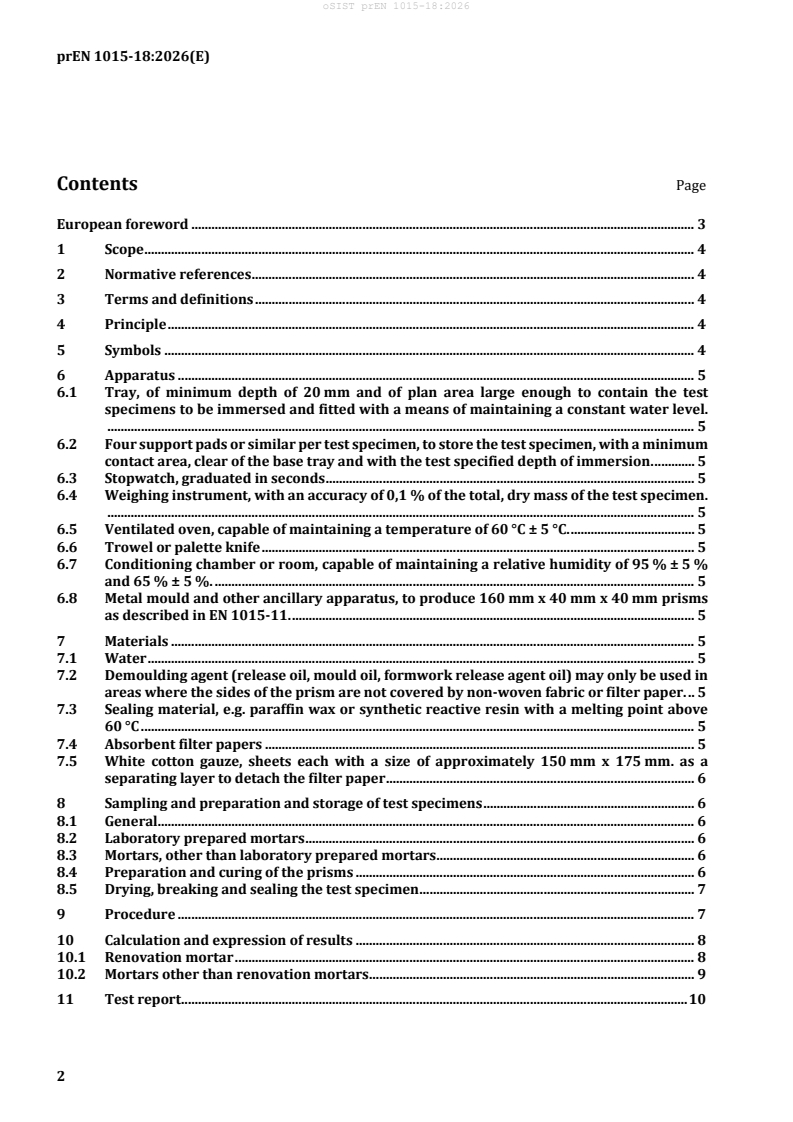
Contents Page
European foreword . 3
1 Scope . 4
2 Normative references . 4
3 Terms and definitions . 4
4 Principle . 4
5 Symbols . 4
6 Apparatus . 5
6.1 Tray, of minimum depth of 20 mm and of plan area large enough to contain the test
specimens to be immersed and fitted with a means of maintaining a constant water level.
............................................................................................................................................................................... 5
6.2 Four support pads or similar per test specimen, to store the test specimen, with a minimum
contact area, clear of the base tray and with the test specified depth of immersion. . 5
6.3 Stopwatch, graduated in seconds . 5
6.4 Weighing instrument, with an accuracy of 0,1 % of the total, dry mass of the test specimen.
............................................................................................................................................................................... 5
6.5 Ventilated oven, capable of maintaining a temperature of 60 °C ± 5 °C. . 5
6.6 Trowel or palette knife . 5
6.7 Conditioning chamber or room, capable of maintaining a relative humidity of 95 % ± 5 %
and 65 % ± 5 %. . 5
6.8 Metal mould and other ancillary apparatus, to produce 160 mm x 40 mm x 40 mm prisms
as described in EN 1015-11. . 5
7 Materials . 5
7.1 Water . 5
7.2 Demoulding agent (release oil, mould oil, formwork release agent oil) may only be used in
areas where the sides of the prism are not covered by non-woven fabric or filter paper. . 5
7.3 Sealing material, e.g. paraffin wax or synthetic reactive resin with a melting point above
60 °C . 5
7.4 Absorbent filter papers . 5
7.5 White cotton gauze, sheets each with a size of approximately 150 mm x 175 mm. as a
separating layer to detach the filter paper . 6
8 Sampling and preparation and storage of test specimens . 6
8.1 General. 6
8.2 Laboratory prepared mortars . 6
8.3 Mortars, other than laboratory prepared mortars . 6
8.4 Preparation and curing of the prisms . 6
8.5 Drying, breaking and sealing the test specimen . 7
9 Procedure . 7
10 Calculation and expression of results . 8
10.1 Renovation mortar . 8
10.2 Mortars other than renovation mortars . 9
11 Test report . 10
European foreword
This document (prEN 1015-18:2026) has been prepared by Technical Committee CEN/TC 125
“Masonry”, the secretariat of which is held by BSI.
This document is currently submitted to the CEN Enquiry.
This document will supersede EN 1015-18:2002.
EN 1015-18:2026 includes the following significant technical changes with respect to EN 1015-18:2002:
• the content of the test standard has been adapted to the new template for test standards.
• the distinction between ‘renovation mortar’ and ‘other than renovation mortar’ has been
retained.
• the symbols have been defined in greater detail.
• the sequence for preparing the individual test specimens has been specified as: drying, breaking
and sealing the test specimen.
• the test report has been expanded to include the reporting of a standardized water absorption
(kg/m ) at t = 10 min.
1 Scope
This document specifies a method for determining the water absorption coefficient due to capillary action
of hardened mortars containing mineral binders and normal, recycled and as well as light weight
aggregates.
2 Normative references
This document incorporates by dated or undated reference, provisions from other publications. These
normative references are cited at the appropriate places in the text, and the publications are listed
hereafter. For dated references, subsequent amendments to or revisions of any of these publications
apply to this document only when incorporated in it by amendment or revision. For undated references
the latest edition of the publication referred to applies (including amendments).
EN 998-1, Specification for mortar for masonry — Part 1: Rendering and plastering mortar
EN 998-2, Specification for mortar for masonry — Part 2: Masonry mortar
EN 1015-2, Methods of test for mortar for masonry — Part 2: Bulk sampling of mortars and preparation of
test mortars
EN 1015-3, Methods of test for mortar for masonry — Part 3: Determination of consistence of fresh mortar
(by flow table)
EN 1015-11, Methods of test for mortar for masonry — Part 11: Determination of flexural and compressive
strength of hardened mortar
3 Terms and definitions
No terms and definitions are listed in this document.
4 Principle
The water absorption coefficient due to capillary action is measured using mortar prism specimens under
prescribed conditions at atmospheric pressure. After drying to constant mass, breaking the prism to
create test specimen and sealing four
...