

EN 4159:2011
(Main)Aerospace series - Paints and varnishes - Determination of resistance to microbial growth
- Abstract
This European Standard specifies a method to assess the ability of biocide-containing coatings to prevent the germination of conidiospores of certain fungi known to be capable of proliferating in fuel systems for aerospace applications.
- Status
- Published
- Publication Date
- 13-Dec-2011
- Withdrawal Date
- 29-Jun-2012
- Technical Committee
- ASD-STAN - Aerospace
- Drafting Committee
- ASD-STAN/D 5 - Non-Metallic
- Current Stage
- 9093 - Decision to confirm - Review Enquiry
- Start Date
- 01-Jun-2017
- Completion Date
- 07-Oct-2026

Overview
EN 4159:2011 is a European Standard developed by CEN under the Aerospace series that specifies a standardized method for determining the resistance of aerospace paints and varnishes to microbial growth, specifically fungal proliferation. This standard focuses on evaluating biocide-containing coatings' ability to inhibit the germination of conidiospores – the spores responsible for fungal growth – commonly found in fuel systems used in aerospace applications. Microbial growth in such fuel systems can lead to corrosion, blockages, and system failures, making this testing standard crucial for aerospace safety and reliability.
Key Topics
Purpose and Scope
EN 4159:2011 targets the assessment of coatings that contain biocides to prevent fungal growth under controlled laboratory conditions. It evaluates coating effectiveness against fungi known to proliferate in aerospace fuel systems, such as Amorphotheca resinae and Aspergillus niger.Microbial Growth Mechanism
The standard focuses on the germination of conidiospores – fungal dispersal cells – which if prevented, halts fungal proliferation and subsequent damage to fuel system components.Test Methodology
- Preparation of a nutrient gel (agarose + glucose) that simulates growth conditions.
- Application of the gel to coated test panels.
- Introduction of a precise concentration of fungal conidiospores to the gel.
- Incubation at a controlled temperature (25 ± 1 °C) to encourage germination.
- Microscopic examination (100× magnification) at set intervals (0, 24, 48 hours, and beyond if necessary) to quantify germination rates.
Assessment Metrics
The success rate of germination is calculated by the ratio of germinated spores to total spores examined, enabling a quantitative determination of fungistatic activity in coatings.Test Apparatus and Materials
Detailed specifications include incubators, autoclaves, microscopy equipment, microbiological tools, and culture media such as Rose Bengal Chloramphenicol Agar.Test Samples
Coated panels measuring approximately 10 mm × 20 mm are tested alongside control panels without biocidal additives. The standard mandates testing multiple replicates for validity.Reporting Requirements
Test reports must document detailed coating information, fungal strains used, germination success rates in test and control samples, test conditions, observations, and inspector identities.
Applications
Aerospace Fuel System Safety
EN 4159:2011 is essential for ensuring that protective coatings applied within fuel tanks, ducts, and lines resist fungal contamination, thus preventing blockages and corrosion that could compromise system functionality.Quality Control for Aerospace Coatings
Manufacturers of aerospace paints and varnishes can use this standard to validate the fungistatic properties of new or improved coating formulations before deployment in service environments.Microbiological Evaluation in Material Science
Laboratories specializing in aerospace material testing can adopt EN 4159 to conduct routine assessments of antifungal efficacy, supporting regulatory compliance and product certification.Research and Development
Researchers developing advanced biocidal coatings benefit from standardized germination tests to benchmark performance against established coatings, facilitating innovation in aerospace protective coatings.
Related Standards
EN 2334 – Aerospace series guidance on chromic-sulphuric acid pickle for aluminium alloys, relevant for surface preparation before coating application.
EN 2802 – Aerospace series specification covering aluminium alloy sheets used in aerospace structures that might be substrates for coatings tested by EN 4159.
Keywords
- Aerospace paint testing
- Coating resistance to microbial growth
- Biocide-containing coatings
- Fungal germination prevention
- Aerospace fuel system protection
- EN 4159 standard
- Microbial growth inhibition
- Fungistatic activity measurement
- Aerospace surface coatings
- Microbiological testing in aerospace
Relations
- Referred By
EN 13832-1:2006 - Footwear protecting against chemicals - Part 1: Terminology and test methods - Effective Date
- 28-Jan-2026
- Effective Date
- 28-Jan-2026
- Effective Date
- 28-Jan-2026
- Effective Date
- 28-Jan-2026
- Effective Date
- 28-Jan-2026
- Effective Date
- 28-Jan-2026
- Effective Date
- 28-Jan-2026
- Effective Date
- 28-Jan-2026
- Effective Date
- 28-Jan-2026
- Effective Date
- 28-Jan-2026
- Effective Date
- 28-Jan-2026
- Effective Date
- 28-Jan-2026
- Effective Date
- 28-Jan-2026
- Effective Date
- 28-Jan-2026
- Effective Date
- 28-Jan-2026
Get Certified
Connect with accredited certification bodies for this standard

BUREAU VERITAS Certification Germany
Bureau Veritas certification in Germany.

Element Materials Technology
Materials testing and product certification.

AQMS Ltd.
AQMS provides ISO certification to SMEs across the UK.
Sponsored listings
Frequently Asked Questions
EN 4159:2011 is a standard published by the European Committee for Standardization (CEN). Its full title is "Aerospace series - Paints and varnishes - Determination of resistance to microbial growth". This standard covers: This European Standard specifies a method to assess the ability of biocide-containing coatings to prevent the germination of conidiospores of certain fungi known to be capable of proliferating in fuel systems for aerospace applications.
This European Standard specifies a method to assess the ability of biocide-containing coatings to prevent the germination of conidiospores of certain fungi known to be capable of proliferating in fuel systems for aerospace applications.
EN 4159:2011 is classified under the following ICS (International Classification for Standards) categories: 49.040 - Coatings and related processes used in aerospace industry. The ICS classification helps identify the subject area and facilitates finding related standards.
EN 4159:2011 has the following relationships with other standards: It is inter standard links to EN 13832-1:2006, EN 3840:2007, EN ISO 8307:2007, EN ISO 7326:2008, EN ISO 14113:2008, EN ISO 1798:2008, EN 15807:2011, EN ISO 8033:2006, EN ISO 6179:2010, EN ISO 8031:2009, EN ISO 2439:2008, EN ISO 8029:2010, EN ISO 5999:2007, EN ISO 4080:2009, EN ISO 2440:1999. Understanding these relationships helps ensure you are using the most current and applicable version of the standard.
EN 4159:2011 is available in PDF format for immediate download after purchase. The document can be added to your cart and obtained through the secure checkout process. Digital delivery ensures instant access to the complete standard document.
Standards Content (Sample)
2003-01.Slovenski inštitut za standardizacijo. Razmnoževanje celote ali delov tega standarda ni dovoljeno.Aeronavtika - Barve in laki - Ugotavljanje odpornosti proti razvoju plesniLuft- und Raumfahrt - Anstrichstoffe - Bestimmung der Widerstandsfähigkeit gegen SchimmelwachstumSérie aérospatiale - Peintures et vernis - Détermination de la résistance à l'action des microorganismesAerospace series - Paints and varnishes - Determination of resistance to microbial growth49.040Prevleke in z njimi povezani postopki, ki se uporabljajo v letalski in vesoljski industrijiCoatings and related processes used in aerospace industryICS:Ta slovenski standard je istoveten z:EN 4159:2011SIST EN 4159:2012en01-februar-2012SIST EN 4159:2012SLOVENSKI
STANDARD
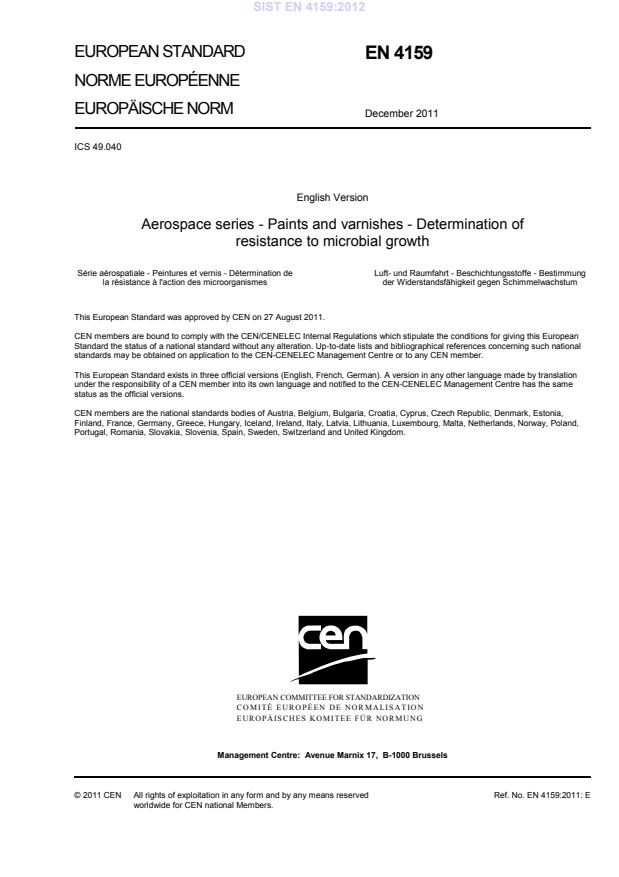
EUROPEAN STANDARD NORME EUROPÉENNE EUROPÄISCHE NORM
EN 4159
December 2011 ICS 49.040 English Version
Aerospace series - Paints and varnishes - Determination of resistance to microbial growth
Série aérospatiale - Peintures et vernis - Détermination de la résistance à l'action des microorganismes
Luft- und Raumfahrt - Beschichtungsstoffe - Bestimmung der Widerstandsfähigkeit gegen Schimmelwachstum This European Standard was approved by CEN on 27 August 2011.
CEN members are bound to comply with the CEN/CENELEC Internal Regulations which stipulate the conditions for giving this European Standard the status of a national standard without any alteration. Up-to-date lists and bibliographical references concerning such national standards may be obtained on application to the CEN-CENELEC Management Centre or to any CEN member.
This European Standard exists in three official versions (English, French, German). A version in any other language made by translation under the responsibility of a CEN member into its own language and notified to the CEN-CENELEC Management Centre has the same status as the official versions.
CEN members are the national standards bodies of Austria, Belgium, Bulgaria, Croatia, Cyprus, Czech Republic, Denmark, Estonia, Finland, France, Germany, Greece, Hungary, Iceland, Ireland, Italy, Latvia, Lithuania, Luxembourg, Malta, Netherlands, Norway, Poland, Portugal, Romania, Slovakia, Slovenia, Spain, Sweden, Switzerland and United Kingdom.
EUROPEAN COMMITTEE FOR STANDARDIZATION
COMITÉ EUROPÉEN DE NORMALISATION EUROPÄISCHES KOMITEE FÜR NORMUNG
Management Centre:
Avenue Marnix 17,
B-1000 Brussels © 2011 CEN All rights of exploitation in any form and by any means reserved worldwide for CEN national Members. Ref. No. EN 4159:2011: ESIST EN 4159:2012
...