

prEN 10303
(Main)Magnetics materials - Thin magnetic steel strip and sheet for use at medium frequencies
- Abstract
This document defines the grades of thin non-oriented magnetic steel strip and sheet in nominal thicknesses of 0,10 mm, 0,15 mm, 0,20 mm, 0,25 mm, 0,27 mm, 0,30 mm and 0,35 mm, and of thin grain-oriented magnetic steel strip and sheet in nominal thicknesses of 0,10 mm, 0,15 mm and 0,18 mm. In particular, it gives general requirements, magnetic properties, geometric characteristics and tolerances and technological characteristics, as well as inspection procedure.
This document applies to magnetic steel strip and sheet supplied in the finally annealed condition in coils and intended for the construction of magnetic circuits used at frequencies equal to or higher than 100 Hz.
- Status
- Not Published
- Publication Date
- 06-Feb-2028
- Technical Committee
- CEN/TC 459/SC 8 - Steel sheet and strip for electrical applications
- Current Stage
- 4060 - Closure of enquiry - Enquiry
- Start Date
- 10-Sep-2026
- Due Date
- 18-Jan-2027
- Completion Date
- 18-Jan-2027

prEN 10303 is a CEN draft European Standard for thin magnetic steel strip and sheet for use at medium frequencies. It specifies grades, magnetic properties, geometric tolerances, technological characteristics and inspection for non-oriented and grain-oriented material supplied in coils for magnetic circuits used at frequencies of 100 Hz and above.
What does prEN 10303 specify?
prEN 10303 covers thin non-oriented magnetic steel strip and sheet in nominal thicknesses from 0,10 mm to 0,35 mm, and thin grain-oriented magnetic steel strip and sheet in nominal thicknesses from 0,10 mm to 0,18 mm. The document is built so the buyer, producer and inspector use the same grade names, test methods and acceptance basis.
The standard is organized into clauses on scope, normative references, terms and definitions, classification and designation, purchaser information, general requirements, technical requirements, inspection, marking and packaging, and complaints. It is followed by four informative annexes that give supporting guidance for coating, loss values, density and mechanical properties.
| Annex | What it covers |
|---|---|
| Annex A | Minimum stacking factor for non-oriented coated products |
| Annex B | Maximum specific total loss for non-oriented products at 1,0 T and 700 Hz, and at 1,5 T and 400 Hz |
| Annex C | Density determination |
| Annex D | Mechanical properties for non-oriented products |
What are the key requirements of prEN 10303?
prEN 10303 links the product designation, supply condition, measured properties and inspection results. In practice, that means the order has to identify the exact grade and the purchaser has to agree the test and delivery details that affect performance in electrical machines.
Grade designation and ordering
Clause 4 classifies the grades by maximum specific total loss and nominal thickness, and Clause 5 sets the information that has to be supplied by the purchaser. The designation uses NO for non-oriented strip and sheet and GO for grain-oriented strip and sheet, followed by thickness and, where relevant, the loss grade.
For the buyer, this is the part that fixes what is being ordered: product form, coil direction, coil internal diameter, package limits, insulation coating, dimensions and the inspection procedure.
General supply conditions
Clause 6 says the steel and chemical composition are left to the manufacturer, but the material is supplied in coils and in the finally annealed condition. It also covers coil build, welds or interleaves when agreed, and surface condition.
That matters because coil form, winding quality and annealed delivery condition affect handling, cutting and the magnetic result in service. The surface has to be smooth and clean, and coated products have to keep their coating attached during manufacturing operations.
Magnetic properties
Clause 7.1 sets the magnetic property requirements and says they are measured by the Epstein frame method for power frequencies or by IEC 60404-10 for medium frequencies. The standard distinguishes between magnetic polarization and specific total loss, and the required values are given for each grade in Tables 1 and 2.
For grain-oriented material, the values apply at the stated frequency and at H = 800 A/m. For non-oriented material, the polarization values are given at H = 2 500 A/m, 5 000 A/m and 10 000 A/m. In practice, this is the core performance data used to compare grades for transformer and machine design.
Geometric characteristics and tolerances
Clause 7.3 gives tolerances on thickness, width and several shape features. It also separates requirements for grain-oriented and non-oriented products, and in some cases for slit edges, trimmed edges or as-rolled edges.
This part matters because geometric variation affects winding, stacking, punching and the fit of assembled magnetic circuits. The standard also limits edge camber, edge wave, residual curvature and burr height where those checks apply.
Technological characteristics
Clause 7.4 covers density, stacking factor and number of bends. The stacking factor values in Tables 1 and 2 apply to products without insulation coating, while coated non-oriented products may use agreed values from Annex A.
The number of bends is a ductility check. For users, that is a practical way to confirm the material can be formed without early cracking, which matters when parts are bent or punched during fabrication.
Inspection and acceptance
Clause 8 sets sampling, test specimen preparation, test methods and retests. Specific inspection may be ordered, and the delivery is then split into acceptance units, normally one coil processed as one unit through the relevant production steps.
That system matters because test results are tied to a defined production lot. Clause 8 also explains how to sample coils, how to prepare Epstein strips, how to test thickness, width, edge shape, stacking factor and bending, and what happens if a test fails.
What terms does prEN 10303 define?
- Edge wave - Variation of flatness at the slit edge of strip or sheet that forms waves after trimming or slitting.
- Residual curvature - Permanent curvature in the rolling direction of an unwound strip or sheet.
- Edge camber - The largest distance between a longitudinal edge and the straight line joining the two ends of the measured length.
- Number of bends - The number of alternating bends possible before the first visible crack appears in the base metal.
- NO - The designation prefix for non-oriented strip and sheet.
- GO - The designation prefix for grain-oriented strip and sheet.
Who uses prEN 10303?
prEN 10303 is used by steel producers, electrical steel processors, coil suppliers, inspectors, test laboratories and buyers of electrical steel. It is also used by manufacturers of magnetic circuits and electrical machines that need defined magnetic performance at medium frequencies.
In practice, producers use it to make and identify grades, labs use it to measure magnetic and geometric properties, and buyers use it to specify order details, coating options and inspection documents.
What changed in prEN 10303 from the previous edition?
prEN 10303 will supersede EN 10303:2015. The foreword lists these significant technical changes:
- updated normative references and definitions
- a more detailed list of options in Clause 5.2
- replacement of the term “defects” with “imperfections”
- technical changes to improve the tolerances supplied
- removal of 0,05 mm thickness for both grain-oriented and non-oriented grades
- editorial changes to improve the text
Which standards are used with prEN 10303?
- EN 10021 - sets general technical delivery conditions and complaint handling referenced by the standard.
- EN 10204 - defines inspection documents such as the 3.1 report mentioned in the ordering example.
- EN 10251:2024 - gives the methods for geometrical characteristics such as edge camber, edge wave, residual curvature and burr height.
- EN 10342 - classifies surface insulation and is used for coated delivery conditions.
- EN 60404-2 - specifies the Epstein-frame method for magnetic property measurement.
- EN IEC 60404-10 - gives medium-frequency magnetic property measurement methods.
- EN IEC 60404-11 - covers surface insulation resistance measurement.
- EN IEC 60404-12 - covers thermal endurance testing of surface insulation coatings.
- EN IEC 60404-13 - covers resistivity, density and stacking factor measurement.
- EN ISO 377 - covers sampling and preparation for mechanical testing.
- EN ISO 6892-1 - gives room-temperature tensile testing.
- EN ISO 7799 - gives the reverse bend test method.
- IEC 60050-121 and IEC 60050-221 - provide the electrical and magnetic vocabulary used in the document.
- CEN/TR 17856 and CEN/TR 18048 - are cited for coating-property evaluation and self-bonding coating mechanical properties.
What does the prEN 10303 document contain?
prEN 10303 contains the grade system, order information, delivery conditions, property tables and inspection rules needed to specify thin magnetic steel strip and sheet for medium-frequency use. It includes Tables 1 to 6 for magnetic, technological and geometric requirements, plus Tables A.1, B.1 and D.1 in the informative annexes.
The document also includes Figure 1 and Figure 2 to illustrate edge wave and edge camber, and it gives a worked order example in Clause 5.3. Annex C adds a density formula, while Clause 8 describes the sampling, Epstein-frame testing, tensile testing, thickness and width measurement, and retest procedure used for quality control and acceptance.
Relations
- Effective Date
- 19-Nov-2025
Get Certified
Connect with accredited certification bodies for this standard

Element Materials Technology
Materials testing and product certification.

Inštitut za kovinske materiale in tehnologije
Institute of Metals and Technology. Materials testing, metallurgical analysis, NDT.
Sponsored listings
Frequently Asked Questions
prEN 10303 is a draft published by the European Committee for Standardization (CEN). Its full title is "Magnetics materials - Thin magnetic steel strip and sheet for use at medium frequencies". This standard covers: This document defines the grades of thin non-oriented magnetic steel strip and sheet in nominal thicknesses of 0,10 mm, 0,15 mm, 0,20 mm, 0,25 mm, 0,27 mm, 0,30 mm and 0,35 mm, and of thin grain-oriented magnetic steel strip and sheet in nominal thicknesses of 0,10 mm, 0,15 mm and 0,18 mm. In particular, it gives general requirements, magnetic properties, geometric characteristics and tolerances and technological characteristics, as well as inspection procedure. This document applies to magnetic steel strip and sheet supplied in the finally annealed condition in coils and intended for the construction of magnetic circuits used at frequencies equal to or higher than 100 Hz.
This document defines the grades of thin non-oriented magnetic steel strip and sheet in nominal thicknesses of 0,10 mm, 0,15 mm, 0,20 mm, 0,25 mm, 0,27 mm, 0,30 mm and 0,35 mm, and of thin grain-oriented magnetic steel strip and sheet in nominal thicknesses of 0,10 mm, 0,15 mm and 0,18 mm. In particular, it gives general requirements, magnetic properties, geometric characteristics and tolerances and technological characteristics, as well as inspection procedure. This document applies to magnetic steel strip and sheet supplied in the finally annealed condition in coils and intended for the construction of magnetic circuits used at frequencies equal to or higher than 100 Hz.
prEN 10303 is classified under the following ICS (International Classification for Standards) categories: 77.140.40 - Steels with special magnetic properties; 77.140.50 - Flat steel products and semi-products. The ICS classification helps identify the subject area and facilitates finding related standards.
prEN 10303 has the following relationships with other standards: It is inter standard links to EN 10303:2015. Understanding these relationships helps ensure you are using the most current and applicable version of the standard.
prEN 10303 is available in PDF format for immediate download after purchase. The document can be added to your cart and obtained through the secure checkout process. Digital delivery ensures instant access to the complete standard document.
Standards Content (Sample)
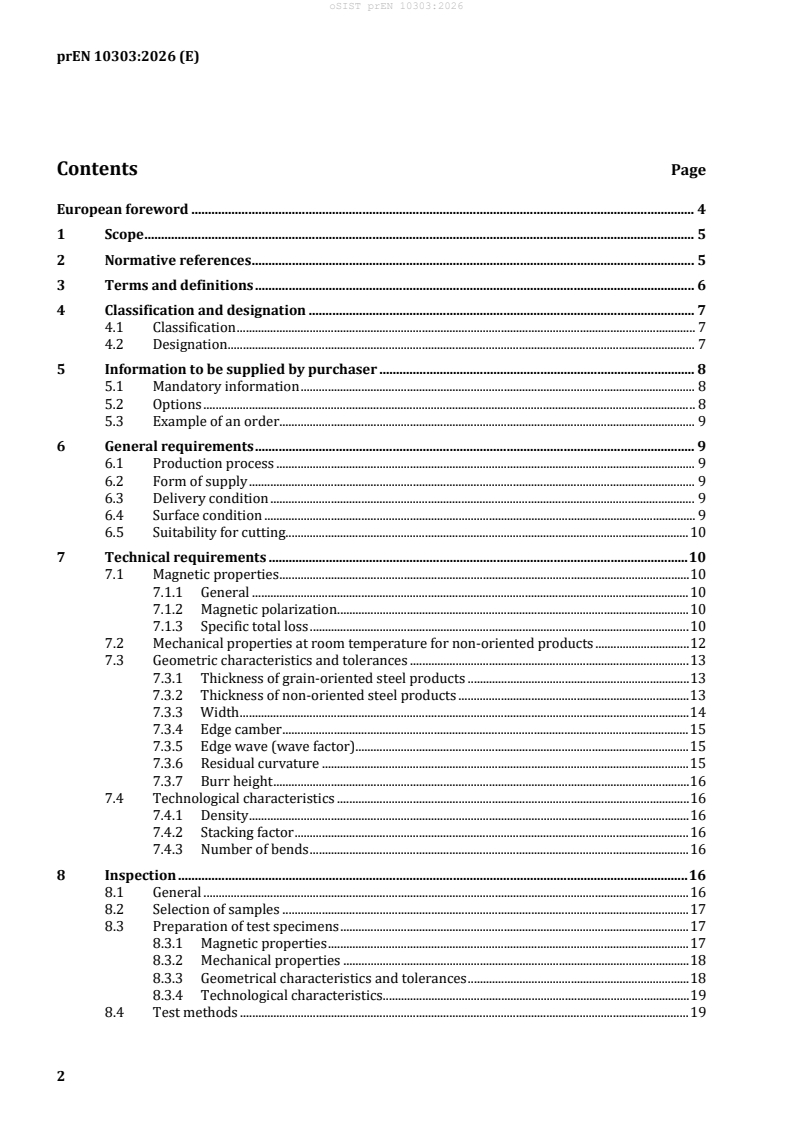
Contents
- 1 Scope
- 2 Normative references
- 3 Terms and definitions
- 3.1 edge wave
- 3.2 residual curvature
- 3.3 edge camber
- 3.4 number of bends
- 4 Classification and designation
- 4.1 Classification
- 4.2 Designation
- 5 Information to be supplied by purchaser
- 5.1 Mandatory information
- 5.2 Options
- 5.3 Example of an order
- 6 General requirements
- 6.1 Production process
- 6.2 Form of supply
- 6.3 Delivery condition
- 6.4 Surface condition
- 6.5 Suitability for cutting
- 7 Technical requirements
- 7.1 Magnetic properties
- 7.2 Mechanical properties at room temperature for non-oriented products
- 7.3 Geometric characteristics and tolerances
- 7.4 Technological characteristics
- 8 Inspection
- 8.1 General
- 8.2 Selection of samples
- 8.3 Preparation of test specimens
- 8.4 Test methods
- 9 Marking, labelling and packaging
- 10 Complaints
- Annex A
- Annex B
- Annex C
- Annex D
- Bibliography
1 Scope
This document defines the grades of thin non-oriented magnetic steel strip and sheet in nominal thicknesses of 0,10 mm, 0,15 mm, 0,20 mm, 0,25 mm, 0,27 mm, 0,30 mm and 0,35 mm, and of thin grainoriented magnetic steel strip and sheet in nominal thicknesses of 0,10 mm, 0,15 mm and 0,18 mm. In particular, it gives general requirements, magnetic properties, geometric characteristics and tolerances and technological characteristics, as well as inspection procedure. This document applies to magnetic steel strip and sheet supplied in the finally annealed condition in coils and intended for the construction of magnetic circuits used at frequencies equal to or higher than 100 Hz.
2 Normative references
The following documents are referred to in the text in such a way that some or all of their content constitutes requirements of this document. For dated references, only the edition cited applies. For undated references, the latest edition of the referenced document (including any amendments) applies. EN 10021, General technical delivery conditions for steel products EN 10204, Metallic products — Types of inspection documents EN 10251:2024, Magnetic materials — Methods of determination of the geometrical characteristics of electrical steel sheet and strip EN 10342, Magnetic materials — Classification of surface insulations of electrical steel sheet, strip and laminations EN 60404-2, Magnetic materials — Part 2: Methods of measurement of the magnetic properties of electrical steel strip and sheet by means of an Epstein frame (IEC 60404-2) EN IEC 60404-11, Magnetic materials — Part 11: Methods of measurement of the surface insulation resistance of electrical steel strip and sheet (IEC 60404-11) EN IEC 60404-12, Magnetic materials — Part 12: Methods of test for the assessment of the thermal endurance of surface insulation coatings on electrical steel strip and sheet (IEC 60404-12) EN IEC 60404-13, Magnetic materials — Part 13: Methods of measurement of resistivity, density and stacking factor of electrical steel strip and sheet (IEC 60404-13) EN ISO 377, Steel and steel products — Location and preparation of samples and test pieces for mechanical testing (ISO 377) EN ISO 6892-1, Metallic materials — Tensile testing — Part 1: Method of test at room temperature (ISO 6892-1) EN ISO 7799, Metallic materials — Sheet and strip 3 mm thick or less — Reverse bend test (ISO 7799) IEC 60050-121, International Electrotechnical Vocabulary — Chapter 121: Electromagnetism IEC 60050-221, International Electrotechnical Vocabulary — Chapter 221: Magnetic materials and components IEC 60404-10, Magnetic materials — Part 10: Methods of measurement of magnetic properties of electrical steel strip and sheet at medium frequencies
oSIST prEN 10303:2026 prEN 10303:2026 (E)
3 Terms and definitions
For the purposes of this document, the terms and definitions given in IEC 60050-121, IEC 60050-221 and the following apply.
ISO and IEC maintain terminology databases for use in standardization at the following addresses:
- ISO Online browsing platform: available at https://www.iso.org/obp/
- IEC Electropedia: available at https://www.electropedia.org/
3.1 edge wave
wave factor variation of flatness of a length of strip or sheet taking a form of waves at the slit edge of the product after longitudinal side trimming or slitting of the product; characterised by the wave factor, i.e. by the relation of the height of the wave to its length Note 1 to entry: For examples of waves, see Figure 1.
[SOURCE: EN 10251:2024, definition 3.1]
Key 1 flat surface 2 sheet 3 rolling direction h height of wave (mm) l length of wave (mm) Figure 1 — Example of wave
3.2 residual curvature
variations of flatness of a length of unwound strip or a sheet taking a permanent curvature in the direction of rolling of the product
oSIST prEN 10303:2026 prEN 10303:2026 (E) [SOURCE: EN 10251:2024, definition 3.2]
3.3 edge camber
greatest distance between a longitudinal edge of a length of strip or a sheet and the line joining the two extremities of the measured length of this edge Note 1 to entry: See Figure 2.
[SOURCE: EN 10251:2024, definition 3.3]
Figure 2 — Verification of the edge camber
3.4 number of bends
number of alternate bends possible before the appearance of the first crack in the base metal visible to the naked eye indicating the ductility of the material
4 Classification and designation
4.1 Classification
The grades covered by this document are classified according to the value of the maximum specific total loss, in watts per kilogram, and according to the nominal thickness of the material (0,10 mm, 0,15 mm, 0,20 mm, 0,25 mm, 0,27 mm, 0,30 mm and 0,35 mm for non-oriented steel, respectively 0,10 mm, 0,15 mm and 0,18 mm for grain-oriented steel).
4.2 Designation
For the steel grades covered by this document, the conventional designation of the different grades comprises the following in the order:
a) the characteristic letters:
1) NO for non-oriented strip and sheet; 2) GO for grain-oriented strip and sheet; b) one hundred times the nominal thickness of the material, in millimetres; EXAMPLE NO 20: non-oriented strip in thickness of 0,20 mm.
c) number of the specified value of maximum specific total loss by given frequency, in watts per kilogram and corresponding to the nominal product thickness, in cases where steel grades with different values for maximum specific total loss per nominal thickness are stated (see Table 2).
oSIST prEN 10303:2026 prEN 10303:2026 (E)
5 Information to be supplied by purchaser
5.1 Mandatory information
For material to adequately comply with the requirements of this document, the purchaser shall include the following information in his enquiry or order:
a) the quantity required (see 6.2); b) the type of product (strip or sheet); c) the number of this document, i.e. EN 10303; d) the grade designation of the material (see 4.2); e) the direction of coils, axis horizontal (h) or vertical (v) (see 6.2); f) the internal diameter of coil (see 6.2); g) any limitation on the mass of a bundle of sheets or of a coil or limitation of external diameter (see 6.2); h) any limitation of the mass of the packing unit (6.2); i) the presence and type of insulation coating (see 6.3); j) the dimensions of strips or sheets required, including any limitations of the internal and external diameter of a coil-(see 6.2 and 7.3.3); k) the inspection procedure required including the nature of the related documents (see 8.1).
5.2 Options
The following options may be agreed at the time of enquiry and order. lf the purchaser does not indicate his wish to implement one of these options, the products shall be supplied in accordance with the basis specification of this document (see 6.1).
1) smaller value of the internal diameter (see 6.2); 2) permissibility of welds or interleaves and their optional marking (see 6.2); 3) insulation coating properties (see 6.3); d 4) density determination (see Table 2, Footnote and Annex C); 5) minus or plus tolerances for nominal width (see Table 4 or Table 5); 6) stacking factor values of non-oriented products supplied with insulation coating (see 7.4.2); 7) specific inspection (see 8.1); 8) type of acceptance unit (see 8.1); 9) higher number of strips for Epstein test (see Table 6); 10) marking of the products (see Clause 9);
oSIST prEN 10303:2026 prEN 10303:2026 (E) 11) mechanical properties for non-oriented products (see Table D.1).
5.3 Example of an order
18 t strip with 0,30 mm thickness in accordance with EN 10303, made of steel grade NO 27-15, delivered in coils with a width of 1 000 mm and a maximum mass of 3 500 kg, vertical coil axis (v), with specific inspection, inspection report 3.1 in accordance with EN 10204:
18 t – strip – EN 10303 — NO 27-15 – 1000 mm – max. 3500 kg – v – 3.1
6 General requirements
6.1 Production process
The production process of the steel and its chemical composition are left to the discretion of the manufacturer.
6.2 Form of supply
The material is supplied in coils.
The mass of coils and/or the external diameter shall be agreed at the time of enquiry and order. The mass of the package unit shall be agreed at the time of enquiry and order. The recommended value for the internal diameter of coils is approximately 508 mm or 610 mm. Smaller internal diameters can be agreed between the manufacturer and the purchaser at the time of enquiry and order (see 5.2, option 1).
The strip shall be of constant width and wound in such a manner that the edges are superimposed in a regular manner and that the side faces of the coil are substantially flat. The coils shall be sufficiently tightly wound so that they do not collapse under their own weight. The strip may exhibit welds or interleaves resulting from the removal of defective zones, if agreed between the manufacturer and the purchaser at the time of enquiry and order (see 5.2, option 2). If necessary, the marking of welds or interleaves may be agreed between the manufacturer and the purchaser at the time of enquiry and order form the subject of a special agreement. For coils containing repair welds or interleaves, each part of the strip shall be of the same grade material. The edges of parts welded together shall not be so much out of alignment as to affect further processing of the product.
6.3 Delivery condition
The products are usually supplied either without insulation or with insulation in accordance with EN 10342. When the product is supplied with insulation, the nature of the insulation, its thickness and properties, the stacking factor and their verification shall be agreed at the time of enquiry and order (see 5.2, Option 3) and in accordance with the values stated in Table A.1.
6.4 Surface condition
1) The surfaces shall be smooth and clean and free from grease and rust. Dispersed imperfections such as scratches, blisters, cracks, etc. are only permitted if the products are within the tolerances on thickness and if these imperfections are not detrimental to the correct use of the supplied material.
1) This should not be confused with some coloration of the insulating coating inherent in the manufacturing process.
oSIST prEN 10303:2026 prEN 10303:2026 (E) For products supplied with insulation coating, the coating shall be sufficiently adherent so that it does not to become detached during manufacturing operations. During the reverse bend test (see 8.4.4.2), the coating shall not become detached after a bend of 90°. If the coating becomes detached during the test, the piece from which the sample of the product from which the test specimen was taken shall be subjected to a shearing test. By shearing the sample with well sharpened tools, a detachment of large pieces of the coating shall not be admissible. However, some slight chipping of the coating at the sheared edges shall be tolerated.
If the product is to be immersed in a fluid or is to be given an additional coating or impregnation, an agreement initiated by the purchaser should be reached with the supplier to ensure compatibility between the fluid and the surface insulation coating.
For non-oriented products, CEN/TR 17856 and CEN/TR 18048 describe all the relevant measurement procedures for coating properties.
6.5 Suitability for cutting
The product shall be suitable for cutting or punching without causing premature wear of the tools. The product shall be suitable for cutting or punching accurately into the usual shapes when appropriate cutting or punching tools and technologies are used.
7 Technical requirements
7.1 Magnetic properties
7.1.1 General
The properties defined in 8.1.2 to 8.1.4 are applicable to products in the delivery conditions defined in 7.3. The magnetic properties shall be measured in accordance with EN 60404-2 for power frequencies or IEC 60404-10 for medium frequencies.
For products supplied with insulation coating, the mass of the coating should be taken into account to determine the magnetic properties.
7.1.2 Magnetic polarization
The specified minimum values of magnetic polarization at the peak magnetic field strength H of 800 A/m and at the frequency specified in Table 1 for grain-oriented material shall be as given in Table 1. The specified minimum values of magnetic polarization at a peak magnetic field strength of H 2 500 A/m, 5 000 A/m and 10 000 A/m and at the frequency specified in Table 2 for non-oriented material shall be as given in Table 2.
7.1.3 Specific total loss
The specified values of maximum specific total loss shall be as given in Tables 1 and 2. The values in Tables 1 and 2 reflect the aged conditions (see 9.3.1). For grain-oriented electrical steel they also apply to test specimens that have received, after cutting, a stress relief heat treatment under conditions specified by the manufacturer.
Depending on the thicknesses, the values are specified at 1,0 T for the non-oriented steel and at 1,0 T or 1,5 T for the grain-oriented material and at the frequency specified in Tables 1 and 2. Annex B gives, for guidance only, the maximum specific total loss for a magnetic polarization of 1,0 T at 700 Hz and for a magnetic polarization of 1,5 T at 400 Hz for non-oriented products.
...