

EN 12520:2024/FprA1
(Amendment)Furniture - Safety, strength and durability - Requirements for domestic seating
- Abstract
This document specifies the minimum requirements for the safety, strength and durability of all types of domestic seating for adults. It also specifies additional test methods for seat side-to-side durability as well as finger entrapment and shear and compression.
It does not apply to ranked seating, seating for non-domestic use, office work chairs, chairs for educational institutions, outdoor seating and to links for linked seating for which European Standards exist.
It does not include requirements for the durability of upholstery materials, castors, reclining and tilting mechanisms and seat height adjustment mechanisms.
It does not include requirements for electrical safety.
It does not include requirements for the resistance to ageing, degradation, flammability and ergonomics.
The requirements are based on use by persons weighing up to 110 kg.
Annex A (normative) specifies the seat side-to-side durability test in D-G points.
Annex B (informative) gives rationales for some of the tests referred to in Table 1.
Annex C (normative) specifies the test methods for finger entrapment and shear and compression.
Annex D (normative) specifies the seat loading point for seating with suspended flexible material.
- Status
- Not Published
- Publication Date
- 31-Jan-2027
- Technical Committee
- CEN/TC 207 - Furniture
- Drafting Committee
- CEN/TC 207/WG 1 - Domestic furniture
- Current Stage
- 5020 - Submission to Vote - Formal Approval
- Start Date
- 08-Oct-2026
- Due Date
- 06-Mar-2027
- Completion Date
- 08-Oct-2026

EN 12520:2024/prA1:2026 is a CEN draft amendment to the European standard for furniture safety, strength and durability for domestic seating. It updates EN 12520:2024 for adult domestic seating, with a particular focus on finger entrapment and the related shear/compression terminology and test references.
What does EN 12520:2024/prA1:2026 specify?
EN 12520:2024/prA1:2026 modifies EN 12520:2024, which sets minimum safety, strength and durability requirements for adult domestic seating. The base standard is aimed at seating used in homes and uses a design basis for persons weighing up to 110 kg.
The underlying standard excludes ranked seating, non-domestic seating, office work chairs, chairs for educational institutions, outdoor seating, and links for linked seating where European Standards already exist. It also leaves out upholstery durability, castors, reclining and tilting mechanisms, seat height adjustment mechanisms, electrical safety, ageing, degradation, flammability and ergonomics. In practice, that means the standard is for the seating item itself and not for every accessory or performance characteristic around it.
The document is organized as a draft amendment with targeted changes to Clause 1, Clause 3, Clause 5, Annex A and Annex C.
| Annex | What it covers |
|---|---|
| Annex A | Seat side-to-side durability test in D-G points |
| Annex B | Rationales for some tests referred to in Table 1 |
| Annex C | Test methods for finger entrapment |
| Annex D | Seat loading point for seating with suspended flexible material |
What are the key requirements of EN 12520:2024/prA1:2026?
EN 12520:2024/prA1:2026 mainly tightens how the base standard treats finger entrapment and shear/compression-related hazards. It also clarifies which movements are treated as setting up and folding, and how some durability test loads are interpreted.
Scope and hazard definitions
Clause 1 changes the scope wording so Annex C is limited to finger entrapment. This matters because the amendment separates finger entrapment from shear and compression handling in the test structure.
Clause 3 adds definitions for shear point and compression point. In practice, this gives a clearer basis for deciding where moving parts create cutting or squeezing hazards during use.
Requirements for accessible parts and moving mechanisms
Clause 5.1.2 adds a cross-reference to the definition of accessible parts. For users and test labs, that helps keep hole and access checks aligned with the standard's defined terminology.
Clause 5.1.3.2 adds a rule for adjustable backrests when changing inclination requires the user to leave the product. The amendment treats that change as a setting up and folding operation, so the hazard assessment follows the same route as other folding actions.
Clause 5.1.3.2 also adds references to the new shear point and compression point definitions. This helps the reader tie the text to the exact locations where hazards are assessed.
Clause 5.1.3.3 removes the former hazard statement linked to testing in C.2.3. Clause 5.1.3.4 also removes that wording and states that the loads and application points used for durability tests 6 and 7 in Table 1 are representative of normal use. In practice, this tells the user which durability test conditions are intended to stand in for everyday loading.
Test methods and annex changes
Annex A.2.1 deletes the paragraph that positioned the seating according to EN 1728:2012, 5.2 and Table A.1 components. That change affects how the side-to-side durability test setup is read and applied.
Annex C is retitled so it now covers finger entrapment only. Clause C.1.2 revises the finger-entrapment test method, including the 7 mm test probe decision rule and the flow through Table C.1 and Figures C.1 to C.3. For users, this is the part that determines how an opening is checked and how the test outcome is judged.
Clause C.2, which covered shear and compression, is deleted in full. That means the amendment removes the separate Annex C method set for those hazards from this draft text.
What terms does EN 12520:2024/prA1:2026 define?
- Shear point - a location where two moving parts pass by each other and can act like a scissor, creating a cutting hazard.
- Compression point - a location where two surfaces move toward each other without crossing and reduce the gap or volume between them.
- Finger entrapment - a hazard addressed by Annex C when fingers can be caught in an opening or moving part.
- Setting up and folding - a product movement state used in clause 5.1.3.2 to classify certain adjustable backrest actions.
- Accessible parts - the parts of the seating that are considered reachable for the checks in clause 5.1.2.
- Test probe - the probe used in Annex C.1.2, including the 7 mm probe referenced in the decision rule.
- Durability tests 6 and 7 - the loading tests in Table 1 that the amendment treats as representative of normal use.
Who uses EN 12520:2024/prA1:2026?
EN 12520:2024/prA1:2026 is used by furniture manufacturers, test laboratories, product designers, quality teams and buyers who need to check domestic seating against European safety, strength and durability requirements. It is also relevant when planning hazard checks for finger entrapment and when selecting the correct durability and loading test setup for adult seating.
What changed in EN 12520:2024/prA1:2026 from the previous edition?
EN 12520:2024/prA1:2026 modifies EN 12520:2024. The amendment:
- changes Clause 1 so Annex C covers finger entrapment only
- adds definitions for shear point and compression point in Clause 3
- adds a cross-reference to accessible parts in Clause 5.1.2
- clarifies how adjustable backrests are treated in Clause 5.1.3.2
- removes former C.2.3 hazard wording from Clause 5.1.3.3 and 5.1.3.4
- states that the loads and application points for durability tests 6 and 7 represent normal use
- deletes the Annex A.2.1 paragraph that cited EN 1728:2012, 5.2
- revises Annex C, including the finger-entrapment test method, figures and Table C.1
- deletes Annex C.2 in full
What does the EN 12520:2024/prA1:2026 document contain?
The document contains a clause-by-clause set of amendments rather than a full rewritten standard. It updates the scope text, adds two hazard definitions, revises the wording for holes in tubular or rigid components, and adjusts the treatment of shear and compression points in use and during setup or folding.
It also revises Annex A test setup text and reworks Annex C for finger entrapment, including the decision flow in Table C.1 and the associated figures. The deleted Annex C.2 shows that the draft is narrowing the annex to finger entrapment rather than keeping a separate shear/compression method.
Relations
- Amends
EN 12520:2024 - Furniture - Safety, strength and durability - Requirements for domestic seating - Effective Date
- 26-Mar-2025
Frequently Asked Questions
EN 12520:2024/FprA1 is a draft published by the European Committee for Standardization (CEN). Its full title is "Furniture - Safety, strength and durability - Requirements for domestic seating". This standard covers: This document specifies the minimum requirements for the safety, strength and durability of all types of domestic seating for adults. It also specifies additional test methods for seat side-to-side durability as well as finger entrapment and shear and compression. It does not apply to ranked seating, seating for non-domestic use, office work chairs, chairs for educational institutions, outdoor seating and to links for linked seating for which European Standards exist. It does not include requirements for the durability of upholstery materials, castors, reclining and tilting mechanisms and seat height adjustment mechanisms. It does not include requirements for electrical safety. It does not include requirements for the resistance to ageing, degradation, flammability and ergonomics. The requirements are based on use by persons weighing up to 110 kg. Annex A (normative) specifies the seat side-to-side durability test in D-G points. Annex B (informative) gives rationales for some of the tests referred to in Table 1. Annex C (normative) specifies the test methods for finger entrapment and shear and compression. Annex D (normative) specifies the seat loading point for seating with suspended flexible material.
This document specifies the minimum requirements for the safety, strength and durability of all types of domestic seating for adults. It also specifies additional test methods for seat side-to-side durability as well as finger entrapment and shear and compression. It does not apply to ranked seating, seating for non-domestic use, office work chairs, chairs for educational institutions, outdoor seating and to links for linked seating for which European Standards exist. It does not include requirements for the durability of upholstery materials, castors, reclining and tilting mechanisms and seat height adjustment mechanisms. It does not include requirements for electrical safety. It does not include requirements for the resistance to ageing, degradation, flammability and ergonomics. The requirements are based on use by persons weighing up to 110 kg. Annex A (normative) specifies the seat side-to-side durability test in D-G points. Annex B (informative) gives rationales for some of the tests referred to in Table 1. Annex C (normative) specifies the test methods for finger entrapment and shear and compression. Annex D (normative) specifies the seat loading point for seating with suspended flexible material.
EN 12520:2024/FprA1 is classified under the following ICS (International Classification for Standards) categories: 97.140 - Furniture. The ICS classification helps identify the subject area and facilitates finding related standards.
EN 12520:2024/FprA1 has the following relationships with other standards: It is inter standard links to EN 12520:2024. Understanding these relationships helps ensure you are using the most current and applicable version of the standard.
EN 12520:2024/FprA1 is available in PDF format for immediate download after purchase. The document can be added to your cart and obtained through the secure checkout process. Digital delivery ensures instant access to the complete standard document.
Standards Content (Sample)
SLOVENSKI STANDARD
SIST EN 12520:2025/oprA1:2026
01-februar-2026
Pohištvo - Varnost, trdnost in trajnost - Zahteve za sedežno pohištvo za domačo
uporabo - Dopolnilo A1
Furniture - Safety, strength and durability - Requirements for domestic seating
Möbel - Sicherheit, Festigkeit und Dauerhaltbarkeit - Anforderungen an Sitzmöbel für
den Wohnbereich
Meubles - Sécurité, résistance et durabilité - Exigences relatives aux sièges à usage
domestique
Ta slovenski standard je istoveten z: EN 12520:2024/prA1
ICS:
97.140 Pohištvo Furniture
SIST EN 12520:2025/oprA1:2026 en,fr,de
2003-01.Slovenski inštitut za standardizacijo. Razmnoževanje celote ali delov tega standarda ni dovoljeno.
SIST EN 12520:2025/oprA1:2026
SIST EN 12520:2025/oprA1:2026
DRAFT
EUROPEAN STANDARD
EN 12520:2024
NORME EUROPÉENNE
EUROPÄISCHE NORM
prA1
January 2026
ICS 97.140
English Version
Furniture - Safety, strength and durability - Requirements
for domestic seating
Meubles - Sécurité, résistance et durabilité - Exigences Möbel - Sicherheit, Festigkeit und Dauerhaltbarkeit -
relatives aux sièges à usage domestique Anforderungen an Sitzmöbel für den Wohnbereich
This draft amendment is submitted to CEN members for enquiry. It has been drawn up by the Technical Committee CEN/TC 207.
This draft amendment A1, if approved, will modify the European Standard EN 12520:2024. If this draft becomes an amendment,
CEN members are bound to comply with the CEN/CENELEC Internal Regulations which stipulate the conditions for inclusion of
this amendment into the relevant national standard without any alteration.
This draft amendment was established by CEN in three official versions (English, French, German). A version in any other
language made by translation under the responsibility of a CEN member into its own language and notified to the CEN-CENELEC
Management Centre has the same status as the official versions.
CEN members are the national standards bodies of Austria, Belgium, Bulgaria, Croatia, Cyprus, Czech Republic, Denmark, Estonia,
Finland, France, Germany, Greece, Hungary, Iceland, Ireland, Italy, Latvia, Lithuania, Luxembourg, Malta, Netherlands, Norway,
Poland, Portugal, Republic of North Macedonia, Romania, Serbia, Slovakia, Slovenia, Spain, Sweden, Switzerland, Türkiye and
United Kingdom.
Recipients of this draft are invited to submit, with their comments, notification of any relevant patent rights of which they are
aware and to provide supporting documentation.
Warning : This document is not a European Standard. It is distributed for review and comments. It is subject to change without
notice and shall not be referred to as a European Standard.
EUROPEAN COMMITTEE FOR STANDARDIZATION
COMITÉ EUROPÉEN DE NORMALISATION
EUROPÄISCHES KOMITEE FÜR NORMUNG
CEN-CENELEC Management Centre: Rue de la Science 23, B-1040 Brussels
© 2026 CEN All rights of exploitation in any form and by any means reserved Ref. No. EN 12520:2024/prA1:2026 E
worldwide for CEN national Members.
SIST EN 12520:2025/oprA1:2026
EN 12520:2024/prA1:2026 (E)
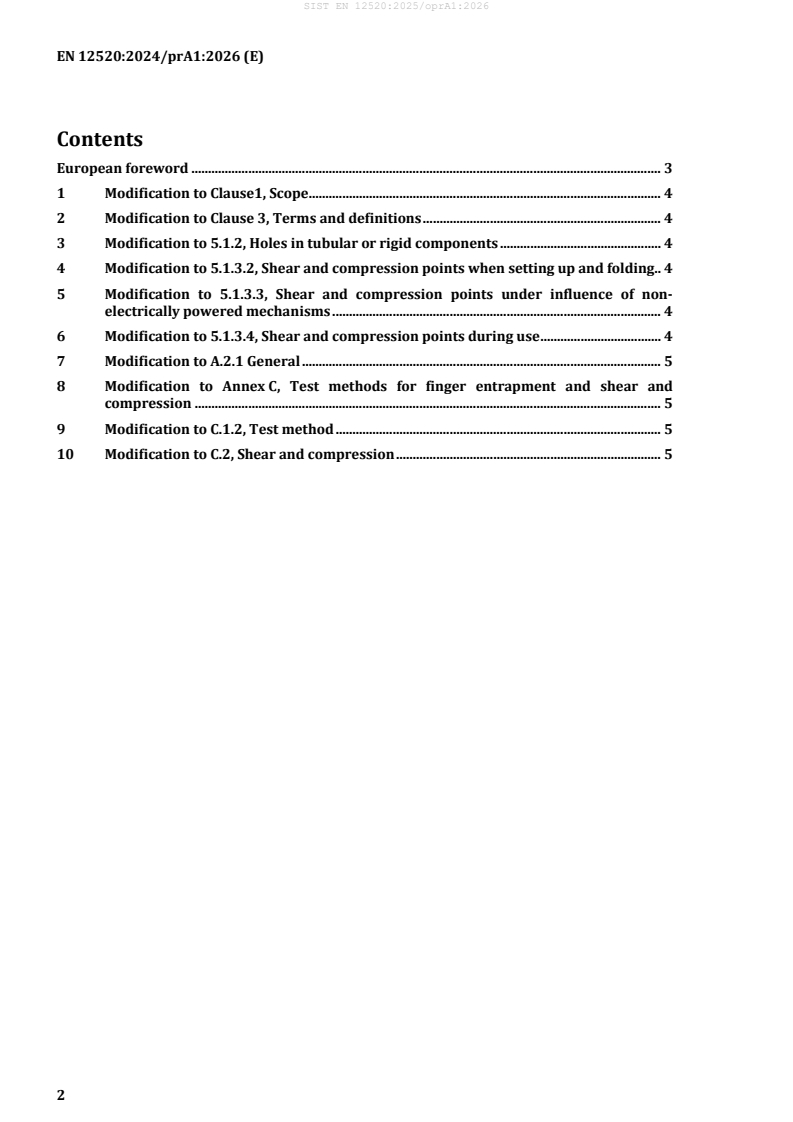
Contents
European foreword . 3
1 Modification to Clause1, Scope. 4
2 Modification to Clause 3, Terms and definitions . 4
3 Modification to 5.1.2, Holes in tubular or rigid components . 4
4 Modification to 5.1.3.2, Shear and compression points when setting up and folding. 4
5 Modification to 5.1.3.3, Shear and compression points under influence of non-
electrically powered mechanisms . 4
6 Modification to 5.1.3.4, Shear and compression points during use . 4
7 Modification to A.2.1 General . 5
8 Modification to Annex C, Test methods for finger entrapment and shear and
compression .
...