

EN 13953:2026
(Main)LPG equipment and accessories - Pressure relief valves for transportable refillable cylinders for Liquefied Petroleum Gas (LPG)
- Abstract
This document specifies the design, testing and marking requirements for spring loaded pressure relief valves (PRV), for use in liquefied petroleum gas (LPG) cylinders of water capacity of 0,5 l up to and including 150 l.
These PRVs can be either an integral part of a cylinder valve (see EN ISO 14245 [4] and EN ISO 15995 [5]) or a separate device.
- Status
- Not Published
- Publication Date
- 27-Oct-2026
- Technical Committee
- CEN/TC 286 - Liquefied petroleum gas equipment and accessories
- Current Stage
- 6055 - CEN Ratification completed (DOR) - Publishing
- Start Date
- 31-Aug-2026
- Due Date
- 24-Sep-2026
- Completion Date
- 31-Aug-2026

Overview
EN 13953:2026 – LPG Equipment and Accessories: Pressure Relief Valves for Transportable Refillable Cylinders for LPG is a European Standard published by CEN. This standard details the design, testing, and marking requirements for spring-loaded pressure relief valves (PRVs) used in transportable refillable cylinders containing liquefied petroleum gas (LPG), with water capacities ranging from 0.5 liters up to and including 150 liters. PRVs may either be integrated into the cylinder valve or provided as separate devices.
Pressure relief valves are a critical safety component in LPG cylinders, ensuring that excess pressure is vented automatically and reliably. The standard underpins safety in storage and transportation of LPG, aligning with regulatory requirements such as ADR and RID and supporting harmonized practices across Europe.
Key Topics
- Scope and Applicability: Covers PRVs for LPG cylinders with specified water capacities, both as part of cylinder valves or as independent devices.
- Design Requirements: Includes provisions for materials (metallic and non-metallic), resilience to temperature extremes (−20 °C to +65 °C, and down to −40 °C for severe conditions), and mechanical strengths.
- Testing and Verification: Outlines procedures for type testing, including hydraulic proof pressure testing, leak tightness, endurance, and dimensional checks, ensuring valve reliability under specified conditions.
- Marking and Traceability: Stipulates clear marking of PRVs with manufacturer details, nominal set pressure, discharge capacity, temperature rating (if applicable), and standard reference, ensuring traceability and regulatory compliance.
- Material Compatibility: Emphasizes that all materials in contact with LPG must meet compatibility requirements, referencing standards such as EN ISO 11114-1 and EN ISO 11114-2, and mandates age and performance testing for rubber and non-metallic components.
- Production Testing: Requires quality assurance procedures and batch testing in accordance with ISO 2859-1 to deliver consistent performance across all PRVs.
- Documentation: Specifies the need for comprehensive documentation, including material certificates, drawings, testing records, and operating instructions.
Applications
The requirements outlined in EN 13953:2026 are essential for manufacturers, testers, and users of LPG cylinders in a variety of sectors:
- LPG Storage and Transport: Applicability to refillable cylinders used in industrial, commercial, domestic, and recreational settings, enhancing safety during cylinder handling, storage, and road or rail transport.
- Cylinder Manufacturing: Guidance for design engineers and quality managers to select appropriate PRVs, incorporate compliant safety devices, and demonstrate regulatory conformity.
- Inspection and Maintenance: Clear procedures for conformity assessment and regular inspection help operators and inspection bodies ensure equipment remains fit for purpose.
- Safety Compliance: Facilities using LPG must fit compliant PRVs to cylinders for operational safety and compliance with European legislation and international recommendations (such as ADR/RID).
Related Standards
- EN ISO 14245: Cylinder valves for LPG - Specification and testing.
- EN ISO 15995: Cylinder valves for LPG - Additional requirements for testing.
- EN 549: Rubber materials for seals and diaphragms for gas appliances and gas equipment.
- EN 751-1/2/3: Sealing materials for metallic threaded joints in contact with gases and hot water.
- EN 837-1: Pressure gauges - Requirements and testing.
- EN ISO 11114-1/2: Material compatibility with gases for cylinders and valves.
- ISO 2859-1: Sampling procedures for inspection by attributes (used for batch testing in production).
EN 13953:2026 ensures the safe use of LPG cylinders by mandating robust engineering, precise testing, and clear documentation for pressure relief valves. Adhering to these requirements supports safe LPG applications and harmonized compliance throughout the gas industry.
Relations
- Effective Date
- 11-Sep-2024
Get Certified
Connect with accredited certification bodies for this standard

Institut za varilstvo d.o.o. (Welding Institute)
Slovenia's leading welding institute since 1952. ISO 3834, EN 1090, pressure equipment certification, NDT personnel, welder qualification. Only IIW Au
Sponsored listings
Frequently Asked Questions
EN 13953:2026 is a draft published by the European Committee for Standardization (CEN). Its full title is "LPG equipment and accessories - Pressure relief valves for transportable refillable cylinders for Liquefied Petroleum Gas (LPG)". This standard covers: This document specifies the design, testing and marking requirements for spring loaded pressure relief valves (PRV), for use in liquefied petroleum gas (LPG) cylinders of water capacity of 0,5 l up to and including 150 l. These PRVs can be either an integral part of a cylinder valve (see EN ISO 14245 [4] and EN ISO 15995 [5]) or a separate device.
This document specifies the design, testing and marking requirements for spring loaded pressure relief valves (PRV), for use in liquefied petroleum gas (LPG) cylinders of water capacity of 0,5 l up to and including 150 l. These PRVs can be either an integral part of a cylinder valve (see EN ISO 14245 [4] and EN ISO 15995 [5]) or a separate device.
EN 13953:2026 is classified under the following ICS (International Classification for Standards) categories: 23.060.40 - Pressure regulators. The ICS classification helps identify the subject area and facilitates finding related standards.
EN 13953:2026 has the following relationships with other standards: It is inter standard links to EN 13953:2020. Understanding these relationships helps ensure you are using the most current and applicable version of the standard.
EN 13953:2026 is associated with the following European legislation: EU Directives/Regulations: 2008/68/EC; Standardization Mandates: M/TDG. When a standard is cited in the Official Journal of the European Union, products manufactured in conformity with it benefit from a presumption of conformity with the essential requirements of the corresponding EU directive or regulation.
EN 13953:2026 is available in PDF format for immediate download after purchase. The document can be added to your cart and obtained through the secure checkout process. Digital delivery ensures instant access to the complete standard document.
Standards Content (Sample)
SLOVENSKI STANDARD
oSIST prEN 13953:2025
01-september-2025
Oprema in pribor za utekočinjeni naftni plin (UNP) - Varnostni ventili za premične,
ponovno polnljive jeklenke za UNP
LPG equipment and accessories - Pressure relief valves for transportable refillable
cylinders for Liquefied Petroleum Gas (LPG)
Flüssiggas-Geräte und Ausrüstungsteile - Druckentlastungsventile für ortsbewegliche,
wiederbefüllbare Flaschen für Flüssiggas (LPG)
Équipements et accessoires GPL - Soupapes de sécurité des bouteilles transportables
et rechargeables pour gaz de pétrole liquéfiés (GPL)
Ta slovenski standard je istoveten z: prEN 13953
ICS:
23.020.35 Plinske jeklenke Gas cylinders
23.060.40 Tlačni regulatorji Pressure regulators
oSIST prEN 13953:2025 en,fr,de
2003-01.Slovenski inštitut za standardizacijo. Razmnoževanje celote ali delov tega standarda ni dovoljeno.
oSIST prEN 13953:2025
oSIST prEN 13953:2025
DRAFT
EUROPEAN STANDARD
prEN 13953
NORME EUROPÉENNE
EUROPÄISCHE NORM
July 2025
ICS 23.060.40 Will supersede EN 13953:2020
English Version
LPG equipment and accessories - Pressure relief valves for
transportable refillable cylinders for Liquefied Petroleum
Gas (LPG)
Équipements et accessoires GPL - Soupapes de sécurité Flüssiggas-Geräte und Ausrüstungsteile -
des bouteilles transportables et rechargeables pour gaz Druckentlastungsventile für ortsbewegliche,
de pétrole liquéfiés (GPL) wiederbefüllbare Flaschen für Flüssiggas (LPG)
This draft European Standard is submitted to CEN members for enquiry. It has been drawn up by the Technical Committee
CEN/TC 286.
If this draft becomes a European Standard, CEN members are bound to comply with the CEN/CENELEC Internal Regulations
which stipulate the conditions for giving this European Standard the status of a national standard without any alteration.
This draft European Standard was established by CEN in three official versions (English, French, German). A version in any other
language made by translation under the responsibility of a CEN member into its own language and notified to the CEN-CENELEC
Management Centre has the same status as the official versions.
CEN members are the national standards bodies of Austria, Belgium, Bulgaria, Croatia, Cyprus, Czech Republic, Denmark, Estonia,
Finland, France, Germany, Greece, Hungary, Iceland, Ireland, Italy, Latvia, Lithuania, Luxembourg, Malta, Netherlands, Norway,
Poland, Portugal, Republic of North Macedonia, Romania, Serbia, Slovakia, Slovenia, Spain, Sweden, Switzerland, Türkiye and
United Kingdom.
Recipients of this draft are invited to submit, with their comments, notification of any relevant patent rights of which they are
aware and to provide supporting documentation.
Warning : This document is not a European Standard. It is distributed for review and comments. It is subject to change without
notice and shall not be referred to as a European Standard.
EUROPEAN COMMITTEE FOR STANDARDIZATION
COMITÉ EUROPÉEN DE NORMALISATION
EUROPÄISCHES KOMITEE FÜR NORMUNG
CEN-CENELEC Management Centre: Rue de la Science 23, B-1040 Brussels
© 2025 CEN All rights of exploitation in any form and by any means reserved Ref. No. prEN 13953:2025 E
worldwide for CEN national Members.
oSIST prEN 13953:2025
prEN 13953:2025 (E)
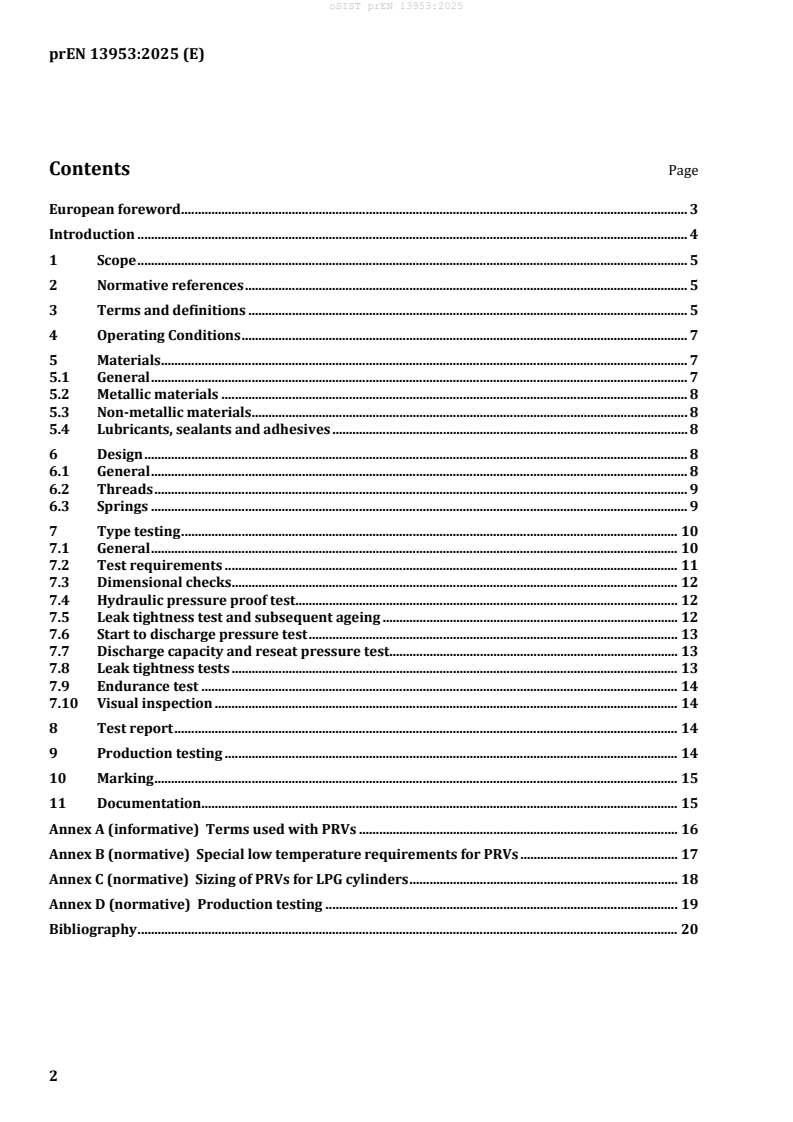
Contents Page
European foreword . 3
Introduction . 4
1 Scope . 5
2 Normative references . 5
3 Terms and definitions . 5
4 Operating Conditions . 7
5 Materials . 7
5.1 General . 7
5.2 Metallic materials . 8
5.3 Non-metallic materials . 8
5.4 Lubricants, sealants and adhesives . 8
6 Design . 8
6.1 General . 8
6.2 Threads . 9
6.3 Springs . 9
7 Type testing . 10
7.1 General . 10
7.2 Test requirements . 11
7.3 Dimensional checks . 12
7.4 Hydraulic pressure proof test. 12
7.5 Leak tightness test and subsequent ageing . 12
7.6 Start to discharge pressure test . 13
7.7 Discharge capacity and reseat pressure test . 13
7.8 Leak tightness tests . 13
7.9 Endurance test . 14
7.10 Visual inspection . 14
8 Test report . 14
9 Production testing . 14
10 Marking . 15
11 Documentation . 15
Annex A (informative) Terms used with PRVs . 16
Annex B (normative) Special low temperature requirements for PRVs . 17
Annex C (normative) Sizing of PRVs for LPG cylinders . 18
Annex D (normative) Production testing . 19
Bibliography . 20
oSIST prEN 13953:2025
prEN 13953:2025 (E)
European foreword
This document (prEN 13953:2025) has been prepared by Technical Committee CEN/TC 286 “LPG
Equipment and accessories”, the secretariat of which is held by NSAI.
This document is currently submitted to the CEN Enquiry.
This document will supersede EN 13953:2020.
This document has been prepared under a standardization request addressed to CEN by the European
Commission. The Standing Committee of the EFTA States subsequently approves these requests for its
Member States.
The major changes to this revision include:
— addition of water capacity range in the scope;
— addition of requirements for rubber material;
— change to the nominal set pressure;
— clarification to discharge capacity test;
— clarification to endurance test
This document has been submitted for reference in
— the RID and/or
— the technical annexes of the ADR
NOTE These regulations take precedence over any clause of this standard. It is emphasized that RID/ADR are
being revised regularly at intervals of two years which may lead to temporary non-compliances with the clauses of
this standard.”
oSIST prEN 13953:2025
prEN 13953:2025 (E)
Introduction
This document calls for the use of substances and procedures that may be injurious to health and/or the
environment if adequate precautions are not taken. It refers only to technical suitability. It does not
absolve the user from their legal obligations at any stage.
Protection of the environment is a key political issue in Europe and elsewhere around the world.
Protection of the environment in this document is understood in a very broad sense. The phrase is used,
for example, in relation to the total life-cycle aspects of a product on the environment, including
expenditure of energy, and during all phases of its existence, from mining of raw materials, to fabrication,
packaging, distribution, use, scrapping, recycling of materials, etc.
It is essential that provisions be restricted to a general guidance. Limit values are specified in national
laws.
Protection of the environment is a key political issue in Europe and elsewhere, for CEN/TC 286 this is
covered in CEN/TS 16765 [2] and this Technical Specification should be read in conjunction with this
document.
It has been assumed in the drafting of this document that the execution of its provisions is entrusted to
appropriately qualified and experienced people.
All pressures are gauge pressures unless otherwise stated.
In this document, the unit bar is used due to its universal use in the field of technical gases. However, it is
to be noted that bar is not an SI unit, and that the corresponding SI unit for pressure is Pa (1 bar = 10
5 2
Pa = 10 N/m ).
NOTE This document requires measurement of material properties, dimensions and pressures. All such
measurements are subject to a degree of uncertainty due to tolerances in measuring equipment, etc. It can be
beneficial to refer to the leaflet “measurement uncertainty leaflet” SP INFO 2000 27 [3].
oSIST prEN 13953:2025
prEN 13953:2025 (E)
1 Scope
This document specifies the design, testing and marking requirements for spring loaded pressure relief
valves (PRV), for use in liquefied petroleum gas (LPG) cylinders of water capacity of 0,5 l up to and
including 150 l.
These PRVs can be either an integral part of a cylinder valve (see EN ISO 14245 [4] and EN ISO 15995
[5]) or a separate device.
2 Normative references
The following documents are referred to in the text in such a way that some or all of their content
constitutes requirements of this document. For dated references, only the edition cited applies. For
undated references, the latest edition of the referenced document (including any amendments) applies.
EN 549:2019+A2:2024, Rubber materials for seals and diaphragms for gas appliances and gas equipment
EN 751-1, Sealing materials for metallic threaded joints in contact with 1st, 2nd and 3rd family gases and
hot water - Part 1: Anaerobic jointing compounds
EN 751-2, Sealing materials for metallic threaded joints in contact with 1st, 2nd and 3rd family gases and
hot water - Part 2: Non-hardening jointing compounds
EN 751-3, Sealing materials for metallic threaded joints in contact with 1st, 2nd and 3rd family gases and
hot water - Part 3: Unsintered PTFE tapes
EN 837-1, Pressure gauges - Part 1: Bourdon tube pressure gauges - Dimensions, metrology, requirements
and testing
EN 12164, Copper and copper alloys - Rod for free machining purposes
EN 12165, Copper and copper alloys - Wrought and unwrought forging stock
EN 12420, Copper and copper alloys - Forgings
EN 13906-1, Cylindrical helical springs made from round wire and bar - Calculation and design - Part 1:
Compression springs
EN ISO 11114-1, Gas cylinders - Compatibility of cylinder and valve materials with gas contents - Part 1:
Metallic materials (ISO 11114-1)
EN ISO 11114-2, Gas cylinders - Compatibility of cylinder and valve materials with gas contents - Part 2:
Non-metallic materials (ISO 11114-2)
ISO 2859-1:1999, Sampling procedures for inspection by attributes — Part 1: Sampling schemes indexed by
acceptance quality limit (AQL) for lot-by-lot inspection
3 Terms and definitions
For the purposes of this document, the following terms and definitions apply.
ISO and IEC maintain terminology databases for use in standardization at the following addresses:
— ISO Online browsing platform: available at https://www.iso.org/obp
— IEC Electropedia: available at https://www.electropedia.org/
oSIST prEN 13953:2025
prEN 13953:2025 (E)
3.1
liquefied petroleum gas
LPG
low pressure liquified gas composed of one or more light hydrocarbons which are assigned to UN 1011,
UN 1075, UN 1965, UN 1969 or UN 1978 only and which consists mainly of propane, propene, butane,
butane isomers, butene with traces of other hydrocarbon gases
3.2
pressure relief valve
PRV
self-closing valve which automatically, without the assistance of any energy other than that of the vapour
concerned, discharges vapour at a predetermined pressure
Note 1 to entry: This is known as a “safety valve” in ADR.
3.3
nominal set pressure
predetermined pressure of the pressure relief valve at which the valve is set to start to discharge
3.4
start to discharge pressure
inlet pressure at which a steady stream of bubbles appear at the outlet of a pressure relief valve through
a water seal of not more than 50 mm water column, or other equivalent method
3.5
pop action
rapid opening of the pressure relief valve sealing element so that the pressure relief valve is fully open,
resulting from an increase of inlet pressure creating a sudden increase in force and compression of the
spring
3.7
reseat pressure
inlet pressure at which the sealing element effects a seal with the valve seat after the valve has been
subjected to pop action
3.8
flow rating pressure
inlet pressure at which the discharge capacity is measured
3.9
discharge capacity
capacity at the flow rating pressure of a pressure relief valve expressed in m /min of free air at STP
3.10
nominal discharge capacity
minimum discharge capacity at the flow rating pressure expressed in m /min of free air at STP rounded
down to one decimal place
3.11
sealing element
non-metallic resilient component which affects a seal by contact with the valve seat
oSIST prEN 13953:2025
prEN 13953:2025 (E)
3.12
valve seat
normally raised area of the valve body on to which the sealing element effects a seal
3.13
cylinder valve
primary shutoff device intended for liquid filling and liquid or vapour service fitted to LPG cylinders
Note 1 to entry: The valve can also include additional devices e.g. liquid level indicator, excess flow device,
pressure relief valve, sediment tube, non-return valve and eduction tube.
3.14
leak tightness
resistance to leakage to atmosphere across the valve seat or any other pressure containing component
when the valve is closed
3.15
standard temperature and pressure
STP
15,6 °C (288,7 K), 1,013 bar absolute (0,101 3 MPa absolute)
4 Operating Conditions
4.1 Terms used with PRVs are described graphically in Annex A.
4.2 Valves designed in accordance with this document shall be suitable for:
— a minimum operating temperature of −20 °C.
— a minimum operating temperature of −40 °C for those parts of Europe where valves are subject to
more severe temperature conditions. The material and design shall be shown to be satisfactory for
operations under these conditions and shall meet the requirements of Annex B. Where the PRV is
integral with a cylinder valve suitable for temperature of −40 °C, the PRV shall also be designed and
tested for a temperature of −40 °C; and
— a maximum operating temperature of 65 °C.
5 Materials
5.1 General
5.1.1 Materials in contact with LPG shall be physically and chemically compatible with LPG under all
normal operating conditions for which the valve is intended and shall meet the requirements in
accordance with EN ISO 11114-1 and EN ISO 11114-2.
5.1.2 Materials for valve components shall be selected to give adequate strength in service.
Consideration should be given to all modes of failure including atmospheric corrosion, brass
dezincification, stress corrosion, impact or material failure.
5.1.3 Alternative materials to those listed in 5.2 are not precluded, providing they can be shown to be
equivalent.
oSIST prEN 13953:2025
prEN 13953:2025 (E)
5.2 Metallic materials
5.2.1 Hot stamped brass shall be non-porous and shall be suitable for machining or other processes.
Sand-cast brass shall not be used.
Leaded brass shall be CW614N, in accordance with EN 12164, or CW617N in accordance with EN 12420
or EN 12165.
Cold drawn brass rods up to 45 mm wide in cross-section shall only be used after heat treatment and
testing for internal cracking. Cold drawn brass rods greater than 45 mm wide in cross-section shall not
be used.
Components produced from stamping brass shall not exhibit cold shuts, also known as folds, or surface
defects such as a crack which may lead to leakage or component failure.
5.2.2 Springs shall be manufactured from stainless steel wire and shall contain not less than 16 %
chromium and not less than 6 % nickel.
5.3 Non-metallic materials
Non-metallic materials in contact with LPG shall be compatible with LPG and shall not fail during the
valve service life. They shall not distort, harden, swell or adhere to the body or seat face to such an extent
as to impair the function of the valve.
Non-metallic materials which are exposed to UV shall be UV resistant as confirmed by the material
manufacturer.
Rubber materials in contact with LPG, for temperatures of –20 °C (−40 °C for low temperature
applications) to + 65 °C, shall meet the requirements of EN 549 for resistance to:
a) a gas (n-
...