


EN 13611:2019
(Main)Safety and control devices for burners and appliances burning gaseous and/or liquid fuels - General requirements
Safety and control devices for burners and appliances burning gaseous and/or liquid fuels - General requirements
This European Standard specifies the general safety, design, construction, and performance requirements and testing of safety, control or regulating devices (hereafter referred to as controls) for burners and appliances burning one or more gaseous fuels or liquid fuels. This European Standard is applicable to controls with declared maximum inlet pressure up to and including 500 kPa and of nominal connection sizes up to and including DN 250.
This European standard specifies general product requirements for the following controls:
— automatic shut-off valves;
— automatic burner control systems;
— flame supervision devices;
— gas/air ratio controls;
— pressure regulators;
— manual taps;
— mechanical thermostats;
— multifunctional controls;
— pressure sensing devices;
— valve proving systems;
— automatic vent valves.
This European standard applies for control functions that are not covered by a specific control standard for burners and appliances burning one or more gaseous fuels or liquid fuels.
This European Standard applies also for safety accessories and pressure accessories with a product of the maximum allowable pressure PS and the volume V of less than 600 000 kPa · dm3 (6 000 bar · L) or with a product of PS and DN of less than 300 000 kPa (3 000 bar).
This European Standard applies for AC and DC supplied controls (for controls supplied by stand-alone battery system, battery systems for mobile applications or systems which are intended to be connected to DC supply networks controls see Annex I).
This European Standard is applicable to reset functions used for reset from lockout, e.g. due to ignition failure or temperature cut-out in burners and appliances (see Annex M).
This European Standard establishes methodologies for the determination of a Safety Integrity Level (SIL) and the determination of a Performance Level (PL) (see Annex J, Annex K and Annex L).
This European Standard gives guidelines for environmental aspects (see Annex N).
This European Standard does not apply to mechanical controls for use with liquid fuels.
The protection against environmental impact in open air (i.e. capable of withstanding UV radiation, wind, rain, snow, dirt deposits, condensation, ice and hoar frost (see IEV 441-11-05:2005), earthquake and external fire) is not covered by this standard.
This European Standard should be used in conjunction with the specific control standard (see Bibliography).
Sicherheits- und Regeleinrichtungen für Brenner und Brennstoffgeräte für gasförmige und/oder flüssige Brennstoffe - Allgemeine Anforderungen
Diese Europäische Norm legt die allgemeinen Sicherheits-, Auslegungs-, Konstruktions- und Leistungs-anforderungen sowie die Prüfung von Sicherheits-, Regel- oder Steuereinrichtungen (im Folgenden als Regel- und Steuergeräte [RS] bezeichnet) für Brenner und Brennstoffgeräte für einen oder mehrere gasförmige(n) Brennstoff(e) oder flüssige Brennstoffe fest. Diese Europäische Norm gilt für Regel- und Steuergeräte mit einem angegebenen höchsten Eingangsdruck bis einschließlich 500 kPa und mit Anschlussnennweiten bis einschließlich DN 250.
Diese Europäische Norm legt die allgemeinen Produktanforderungen für folgende Regel- und Steuergeräte fest:
— automatische Absperrventile;
— Feuerungsautomaten;
— Flammenüberwachungseinrichtungen;
— Gas-Luft-Verbundregler;
— Druckregler;
— handbetätigte Einstellgeräte;
— mechanische Temperaturregler;
— Mehrfachstellgeräte;
— Druckwächter;
— Ventilüberwachungssysteme;
— automatische Abblaseventile.
Diese Europäische Norm gilt für Regel- und Steuerfunktionen, die nicht durch eine spezifische RS-Norm für Brenner und Brennstoffgeräte, die einen oder mehrere gasförmige(n) Brennstoff(e) oder flüssige Brennstoffe verbrennen, abgedeckt sind.
Diese Europäische Norm gilt auch für Ausrüstungsteile mit Sicherheitsfunktion und druckhaltende Ausrüstungsteile, bei denen das Produkt aus dem maximal zulässigen Druck PS und dem Volumen V kleiner als 600 000 kPa · dm3 (6 000 bar · L) oder das Produkt aus PS und DN kleiner als 300 000 kPa (3 000 bar) ist.
Diese Europäische Norm gilt für mit Wechsel- und Gleichspannung betriebene RS (für RS, die durch unabhängige Batteriesysteme, Batteriesysteme für die Anwendung in Fahrzeugen oder Systemen für den Anschluss an Gleichspannungsnetze betrieben werden, siehe Anhang I).
Diese Europäische Norm ist auf Rückstellfunktionen anwendbar, die für die Rückstellung aus einer durch z. B. einen Ausfall der Zündung oder Temperaturabschaltung in Brennern und Brennstoffgeräten verursachten Störabschaltung angewendet werden (siehe Anhang M).
Diese Europäische Norm legt Verfahrensweisen zur Bestimmung des Sicherheits-Integritätslevels (SIL) und zur Bestimmung des Performance Levels (PL) fest (siehe Anhang J, Anhang K und Anhang L).
Diese Europäische Norm enthält Anleitungen in Bezug auf umweltbezogene Aspekte (siehe Anhang N).
Diese Europäische Norm gilt nicht für mechanische Regel- und Steuergeräte zur Anwendung mit flüssigen Brennstoffen.
Der Schutz gegen Umwelteinflüsse im Freien (d. h. die Fähigkeit UV-Strahlung, Wind, Regen, Schnee, Schmutzablagerungen, Kondensation, Eis und Raureif (siehe IEV 441-11-05:2005), Erdbeben und Brandbeanspruchung von außen standzuhalten) ist durch diese Norm nicht abgedeckt.
Diese Europäische Norm sollte in Verbindung mit der jeweiligen spezifischen RS-Norm (siehe Literaturhinweise) angewendet werden.
Équipements auxiliaires pour brûleurs et appareils utilisant des combustibles gazeux ou liquides - Exigences générales
La présente Norme européenne spécifie les exigences générales en matière de sécurité, de conception, de construction et de performance, ainsi que les essais applicables aux dispositifs de sécurité, de commande ou de réglage (désignés ci-après par le terme « équipements ») pour brûleurs et appareils utilisant un ou plusieurs combustibles gazeux ou liquides. La présente Norme européenne s'applique aux équipements d'une pression amont maximale déclarée inférieure ou égale à 500 kPa et d'un diamètre nominal de raccordement inférieur ou égal à DN 250.
La présente Norme européenne spécifie les exigences générales relatives aux équipements suivants :
les robinets automatiques de sectionnement ;
les systèmes automatiques de commande de brûleur ;
les dispositifs de surveillance de flamme ;
les dispositifs de régulation du rapport air/gaz ;
les régulateurs de pression ;
les robinets manuels ;
les thermostats mécaniques ;
les équipements multifonctionnels ;
les dispositifs de surveillance de pression ;
les dispositifs de vérification d'étanchéité des robinets ;
les robinets d'évent automatiques.
La présente Norme européenne s'applique aux fonctions de commande qui ne sont pas couvertes par une norme d'équipement particulière applicable aux brûleurs et appareils utilisant un ou plusieurs combustibles gazeux ou liquides.
La présente Norme européenne s'applique également aux accessoires de sécurité et aux accessoires de pression pour lesquels le produit de la pression maximale admissible PS par le volume V est inférieur à 600 000 kPa · dm3 (6 000 bar l) ou pour lesquels le produit de PS par DN est inférieur à 300 000 kPa (3 000 bar).
La présente Norme européenne s'applique aux dispositifs alimentés en courant alternatif et en courant continu (pour les dispositifs alimentés par des systèmes de batterie autonomes, des systèmes de batterie pour applications mobiles ou des systèmes destinés à être connectés aux dispositifs du réseau d'alimentation en courant continu, voir l'Annexe I).
La présente Norme européenne s'applique aux fonctions de réinitialisation utilisées pour le déverrouillage, par exemple du fait d'un défaut d'allumage ou d'une coupure de la température dans les brûleurs et les appareils (voir Annexe M).
La présente Norme européenne définit des méthodes de détermination du niveau d'intégrité de sécurité (SIL) et du niveau de performance (PL) (voir Annexes J, K et L).
La présente Norme européenne donne des lignes directrices sur les aspects environnementaux (voir Annexe N).
La présente Norme européenne ne s'applique pas aux dispositifs mécaniques fonctionnant avec des combustibles liquides.
La protection contre l'impact environnemental à l'air libre (c'est-à-dire la capacité à résister aux rayonnements UV, au vent, à la pluie, à la neige, aux dépôts de saleté, à la condensation, à la glace et au givre (voir IEV 441-11-05:2005), aux tremblements de terre et aux incendies extérieurs) n'est pas couverte par la présente norme.
Il convient d'utiliser la présente Norme européenne en relation avec la norme particulière applicable à l'équipement (voir Bibliographie).
Varnostne in nadzorne naprave za gorilnike in aparate na plin in/ali tekoča goriva - Splošne zahteve
Ta evropski standard določa splošne varnostne, projektne in konstrukcijske zahteve ter zahteve glede zmogljivosti in preskušanja naprav za varnost, nadzor ali uravnavanje (v nadaljnjem besedilu: nadzorne naprave) za gorilnike in aparate na eno ali več plinskih ali tekočih goriv. Ta evropski standard se uporablja za nadzorne naprave z deklariranim najvišjim vhodnim tlakom do vključno 500 kPa in nazivnimi velikostmi priključkov do vključno DN 250.
Ta evropski standard določa splošne zahteve za izdelke za naslednje nadzorne naprave:
– samodejni zaporni ventili;
– samodejni sistemi za nadzor gorilnikov;
– naprave za nadzor plamena;
– naprave za nadzor razmerja med plinom/zrakom;
– tlačni regulatorji;
– ročne pipe;
– mehanski termostati;
– večfunkcijske nadzorne naprave;
– naprave za zaznavanje tlaka;
– sistemi za preverjanje ventilov;
– samodejni oddušni ventili.
Ta evropski standard se uporablja za funkcije nadzora, ki jih ne zajema poseben standard za nadzor gorilnikov in aparatov na eno ali več plinskih ali tekočih goriv.
Ta evropski standard se uporablja tudi za varnostne in tlačne pripomočke z izdelkom z največjim dovoljenim tlakom PS ter prostornino V, manjšo od 600.000 kPa • dm3 (6000 bar• litrov) ali z izdelkom s PS in DN, ki znaša manj kot 300.000 kPa (3000 barov).
Ta evropski standard se uporablja za nadzorne naprave, ki se napajajo z izmeničnim ali enosmernim tokom (za nadzorne naprave, ki se napajajo s samostojnim akumulatorskim sistemom, akumulatorskimi sistemi za premične aplikacije ali s sistemi, ki so namenjeni za priključitev na omrežja z enosmernim tokom, glej dodatek I).
Ta evropski standard se uporablja za funkcije ponastavitve, ki se uporabljajo za ponastavitev po zaklepu, npr. zaradi napake pri vžigu ali izklopnih stikal za temperaturo v gorilnikih in aparatih (glej dodatek M).
Ta evropski standard določa metodologije za določanje stopnje varnostne celovitosti (SIL) in ravni zmogljivosti (PL) (glej dodatke J, K in L).
V tem evropskem standardu so podane smernice za okoljske vidike (glej prilogo N).
Ta evropski standard se ne uporablja za mehanske nadzorne naprave za uporabo s tekočimi gorivi.
Ta standard ne zajema zaščite pred okoljskimi vplivi na odprtem (tj. odpornost na ultravijolično sevanje, veter, dež, sneg, umazanijo, kondenzacijo, led in ivje (glej IEV 441-11-05:2005)), potresi in zunanjimi požari.
Ta evropski standard se mora uporabljati skupaj s posebnim standardom za nadzorno napravo (glej bibliografijo).
General Information
- Status
- Published
- Publication Date
- 26-Mar-2019
- Withdrawal Date
- 29-Sep-2019
- Technical Committee
- CEN/TC 58 - Safety and control devices for burners and appliances burning gaseous or liquid fuels
- Drafting Committee
- CEN/TC 58/WG 11 - Generics
- Current Stage
- 9092 - Decision on results of review/2YR ENQ - revise - Review Enquiry
- Start Date
- 01-Jan-2025
- Completion Date
- 14-Apr-2025
Relations
- Effective Date
- 03-Apr-2019
- Effective Date
- 19-Apr-2017
- Effective Date
- 03-Jun-2020
- Effective Date
- 20-Jan-2021
Overview
EN 13611:2019 - "Safety and control devices for burners and appliances burning gaseous and/or liquid fuels - General requirements" - is a European standard that sets out general safety, design, construction, performance and testing requirements for controls used on burners and fuel-burning appliances. It applies to controls for gaseous and/or liquid fuels with declared maximum inlet pressure up to 500 kPa and nominal connection sizes up to DN 250. This edition supersedes EN 13611:2015 (and its 2016 amendment).
Key topics and technical requirements
- Scope of controls covered: automatic shut-off valves, automatic burner control systems, flame supervision devices, gas/air ratio controls, pressure regulators, manual taps, mechanical thermostats, multifunctional controls, pressure sensing devices, valve proving systems, and automatic vent valves.
- Design & construction: mechanical parts, housings, sealing, joints, moving parts, materials, and connection types (threads, flanges, compression fittings).
- Performance & testing: leak-tightness, torsion/bending resistance, rated flow rate, durability, and long-term performance - including specific tests for electronic controls and environmental/EMC considerations.
- Electrical & EMC requirements: protection by enclosure, immunity to voltage dips, surges, radio‑frequency disturbances and electrostatic discharge.
- Functional safety: methodologies for determining Safety Integrity Level (SIL) and Performance Level (PL) are provided (see Annex J, K and L), plus requirements for protection against internal faults.
- Additional guidance: reset functions (Annex M), DC/battery supplied controls (Annex I), and environmental aspects (Annex N).
- Limits & exclusions: not applicable to mechanical controls for liquid fuels; open-air environmental protection (UV, rain, snow, earthquake, external fire) is excluded.
Practical applications and who uses this standard
- Manufacturers of safety and control devices (pressure regulators, flame detectors, gas/air ratio controls) use EN 13611:2019 to design and test products for compliance with European market expectations.
- Appliance and burner designers, system integrators, and testing laboratories rely on this standard for type testing, performance verification and certification.
- Safety engineers and compliance officers use the standard to assess risk, determine required SIL/PL for control functions, and prepare technical documentation and instructions.
- Regulators and notified bodies reference the standard when evaluating conformity of controls for heating, industrial burners, commercial boilers and similar gas/liquid fuel appliances.
Related standards
- EN 13611:2019 should be used in conjunction with specific control standards for particular control functions and with relevant national/regional regulations. See the standard’s bibliography for specific referenced control standards.
Keywords: EN 13611:2019, safety and control devices, burners, gaseous fuels, liquid fuels, pressure regulators, flame supervision, SIL, Performance Level, EMC, control testing.



Frequently Asked Questions
EN 13611:2019 is a standard published by the European Committee for Standardization (CEN). Its full title is "Safety and control devices for burners and appliances burning gaseous and/or liquid fuels - General requirements". This standard covers: This European Standard specifies the general safety, design, construction, and performance requirements and testing of safety, control or regulating devices (hereafter referred to as controls) for burners and appliances burning one or more gaseous fuels or liquid fuels. This European Standard is applicable to controls with declared maximum inlet pressure up to and including 500 kPa and of nominal connection sizes up to and including DN 250. This European standard specifies general product requirements for the following controls: — automatic shut-off valves; — automatic burner control systems; — flame supervision devices; — gas/air ratio controls; — pressure regulators; — manual taps; — mechanical thermostats; — multifunctional controls; — pressure sensing devices; — valve proving systems; — automatic vent valves. This European standard applies for control functions that are not covered by a specific control standard for burners and appliances burning one or more gaseous fuels or liquid fuels. This European Standard applies also for safety accessories and pressure accessories with a product of the maximum allowable pressure PS and the volume V of less than 600 000 kPa · dm3 (6 000 bar · L) or with a product of PS and DN of less than 300 000 kPa (3 000 bar). This European Standard applies for AC and DC supplied controls (for controls supplied by stand-alone battery system, battery systems for mobile applications or systems which are intended to be connected to DC supply networks controls see Annex I). This European Standard is applicable to reset functions used for reset from lockout, e.g. due to ignition failure or temperature cut-out in burners and appliances (see Annex M). This European Standard establishes methodologies for the determination of a Safety Integrity Level (SIL) and the determination of a Performance Level (PL) (see Annex J, Annex K and Annex L). This European Standard gives guidelines for environmental aspects (see Annex N). This European Standard does not apply to mechanical controls for use with liquid fuels. The protection against environmental impact in open air (i.e. capable of withstanding UV radiation, wind, rain, snow, dirt deposits, condensation, ice and hoar frost (see IEV 441-11-05:2005), earthquake and external fire) is not covered by this standard. This European Standard should be used in conjunction with the specific control standard (see Bibliography).
This European Standard specifies the general safety, design, construction, and performance requirements and testing of safety, control or regulating devices (hereafter referred to as controls) for burners and appliances burning one or more gaseous fuels or liquid fuels. This European Standard is applicable to controls with declared maximum inlet pressure up to and including 500 kPa and of nominal connection sizes up to and including DN 250. This European standard specifies general product requirements for the following controls: — automatic shut-off valves; — automatic burner control systems; — flame supervision devices; — gas/air ratio controls; — pressure regulators; — manual taps; — mechanical thermostats; — multifunctional controls; — pressure sensing devices; — valve proving systems; — automatic vent valves. This European standard applies for control functions that are not covered by a specific control standard for burners and appliances burning one or more gaseous fuels or liquid fuels. This European Standard applies also for safety accessories and pressure accessories with a product of the maximum allowable pressure PS and the volume V of less than 600 000 kPa · dm3 (6 000 bar · L) or with a product of PS and DN of less than 300 000 kPa (3 000 bar). This European Standard applies for AC and DC supplied controls (for controls supplied by stand-alone battery system, battery systems for mobile applications or systems which are intended to be connected to DC supply networks controls see Annex I). This European Standard is applicable to reset functions used for reset from lockout, e.g. due to ignition failure or temperature cut-out in burners and appliances (see Annex M). This European Standard establishes methodologies for the determination of a Safety Integrity Level (SIL) and the determination of a Performance Level (PL) (see Annex J, Annex K and Annex L). This European Standard gives guidelines for environmental aspects (see Annex N). This European Standard does not apply to mechanical controls for use with liquid fuels. The protection against environmental impact in open air (i.e. capable of withstanding UV radiation, wind, rain, snow, dirt deposits, condensation, ice and hoar frost (see IEV 441-11-05:2005), earthquake and external fire) is not covered by this standard. This European Standard should be used in conjunction with the specific control standard (see Bibliography).
EN 13611:2019 is classified under the following ICS (International Classification for Standards) categories: 23.060.40 - Pressure regulators. The ICS classification helps identify the subject area and facilitates finding related standards.
EN 13611:2019 has the following relationships with other standards: It is inter standard links to EN 13611:2015/AC:2016, EN 13611:2015, EN 13611:2019/prA1, EN 13611:2019/AC:2021. Understanding these relationships helps ensure you are using the most current and applicable version of the standard.
EN 13611:2019 is associated with the following European legislation: EU Directives/Regulations: 2009/142/EC, 2014/68/EU, 2016/426; Standardization Mandates: M/BC/CEN/89/6. When a standard is cited in the Official Journal of the European Union, products manufactured in conformity with it benefit from a presumption of conformity with the essential requirements of the corresponding EU directive or regulation.
You can purchase EN 13611:2019 directly from iTeh Standards. The document is available in PDF format and is delivered instantly after payment. Add the standard to your cart and complete the secure checkout process. iTeh Standards is an authorized distributor of CEN standards.
Standards Content (Sample)
SLOVENSKI STANDARD
01-junij-2019
Nadomešča:
SIST EN 13611:2015
SIST EN 13611:2015/AC:2016
Varnostne in nadzorne naprave za gorilnike in aparate na plin in/ali tekoča goriva -
Splošne zahteve
Safety and control devices for burners and appliances burning gaseous and/or liquid
fuels - General requirements
Sicherheits- und Regeleinrichtungen für Brenner und Brennstoffgeräte für gasförmige
und/oder flüssige Brennstoffe - Allgemeine Anforderungen
Équipements auxiliaires pour brûleurs et appareils utilisant des combustibles gazeux ou
liquides - Exigences générales
Ta slovenski standard je istoveten z: EN 13611:2019
ICS:
23.060.40 Tlačni regulatorji Pressure regulators
27.060.20 Plinski gorilniki Gas fuel burners
2003-01.Slovenski inštitut za standardizacijo. Razmnoževanje celote ali delov tega standarda ni dovoljeno.
EN 13611
EUROPEAN STANDARD
NORME EUROPÉENNE
March 2019
EUROPÄISCHE NORM
ICS 23.060.40 Supersedes EN 13611:2015
English Version
Safety and control devices for burners and appliances
burning gaseous and/or liquid fuels - General
requirements
Équipements auxiliaires pour brûleurs et appareils Sicherheits- und Regeleinrichtungen für Brenner und
utilisant des combustibles gazeux ou liquides - Brennstoffgeräte für gasförmige und/oder flüssige
Exigences générales Brennstoffe - Allgemeine Anforderungen
This European Standard was approved by CEN on 17 June 2018.
CEN members are bound to comply with the CEN/CENELEC Internal Regulations which stipulate the conditions for giving this
European Standard the status of a national standard without any alteration. Up-to-date lists and bibliographical references
concerning such national standards may be obtained on application to the CEN-CENELEC Management Centre or to any CEN
member.
This European Standard exists in three official versions (English, French, German). A version in any other language made by
translation under the responsibility of a CEN member into its own language and notified to the CEN-CENELEC Management
Centre has the same status as the official versions.
CEN members are the national standards bodies of Austria, Belgium, Bulgaria, Croatia, Cyprus, Czech Republic, Denmark, Estonia,
Finland, Former Yugoslav Republic of Macedonia, France, Germany, Greece, Hungary, Iceland, Ireland, Italy, Latvia, Lithuania,
Luxembourg, Malta, Netherlands, Norway, Poland, Portugal, Romania, Serbia, Slovakia, Slovenia, Spain, Sweden, Switzerland,
Turkey and United Kingdom.
EUROPEAN COMMITTEE FOR STANDARDIZATION
COMITÉ EUROPÉEN DE NORMALISATION
EUROPÄISCHES KOMITEE FÜR NORMUNG
CEN-CENELEC Management Centre: Rue de la Science 23, B-1040 Brussels
© 2019 CEN All rights of exploitation in any form and by any means reserved Ref. No. EN 13611:2019 E
worldwide for CEN national Members.
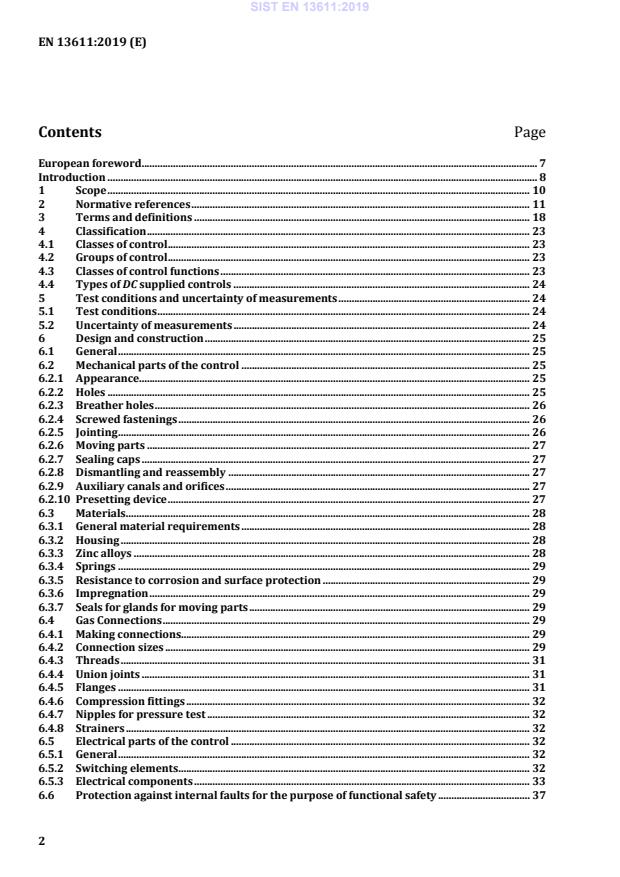
Contents Page
European foreword . 7
Introduction . 8
1 Scope . 10
2 Normative references . 11
3 Terms and definitions . 18
4 Classification . 23
4.1 Classes of control . 23
4.2 Groups of control . 23
4.3 Classes of control functions . 23
4.4 Types of DC supplied controls . 24
5 Test conditions and uncertainty of measurements . 24
5.1 Test conditions . 24
5.2 Uncertainty of measurements . 24
6 Design and construction . 25
6.1 General . 25
6.2 Mechanical parts of the control . 25
6.2.1 Appearance . 25
6.2.2 Holes . 25
6.2.3 Breather holes . 26
6.2.4 Screwed fastenings . 26
6.2.5 Jointing . 26
6.2.6 Moving parts . 27
6.2.7 Sealing caps . 27
6.2.8 Dismantling and reassembly . 27
6.2.9 Auxiliary canals and orifices . 27
6.2.10 Presetting device . 27
6.3 Materials . 28
6.3.1 General material requirements . 28
6.3.2 Housing . 28
6.3.3 Zinc alloys . 28
6.3.4 Springs . 29
6.3.5 Resistance to corrosion and surface protection . 29
6.3.6 Impregnation . 29
6.3.7 Seals for glands for moving parts . 29
6.4 Gas Connections . 29
6.4.1 Making connections. 29
6.4.2 Connection sizes . 29
6.4.3 Threads . 31
6.4.4 Union joints . 31
6.4.5 Flanges . 31
6.4.6 Compression fittings . 32
6.4.7 Nipples for pressure test . 32
6.4.8 Strainers . 32
6.5 Electrical parts of the control . 32
6.5.1 General . 32
6.5.2 Switching elements . 32
6.5.3 Electrical components . 33
6.6 Protection against internal faults for the purpose of functional safety . 37
6.6.1 Design and construction requirements . 37
6.6.2 Class A . 39
6.6.3 Class B . 39
6.6.4 Class C . 40
6.6.5 Circuit and construction evaluation . 42
7 Performance . 43
7.1 General . 43
7.2 Leak-tightness . 43
7.2.1 Requirements . 43
7.2.2 Tests . 44
7.3 Torsion and bending . 45
7.3.1 General . 45
7.3.2 Torsion and bending moments . 45
7.4 Rated flow rate . 49
7.4.1 Requirement . 49
7.4.2 Test . 49
7.4.3 Conversion of air flow rate . 51
7.5 Durability. 51
7.5.1 Elastomers in contact with gas . 51
7.5.2 Durability of marking . 51
7.5.3 Resistance to scratching . 51
7.5.4 Resistance to humidity . 52
7.5.5 Lubricants in contact with gas . 52
7.6 Performance tests for electronic controls . 53
7.6.1 At ambient temperature . 53
7.6.2 At minimum temperature. 53
7.6.3 At maximum temperature . 53
7.7 Long-term performance for electronic controls . 53
7.7.1 General . 53
7.7.2 Stress test . 53
7.7.3 Long-term performance tests. 55
7.8 Data exchange . 55
7.8.1 General . 55
7.8.2 Type of data . 55
7.8.3 Communication of safety related data . 56
8 Electrical requirements . 58
8.1 General . 58
8.2 Protection by enclosure . 58
9 Electromagnetic compatibility (EMC) . 58
9.1 Protection against environmental influences . 58
9.2 Supply voltage variations below 85 % of rated voltage. 58
9.3 Voltage dips and interruptions . 59
9.4 Supply frequency variations . 59
9.5 Surge immunity tests . 59
9.6 Electrical fast transient/burst . 60
9.7 Immunity to conducted disturbances induced by radio frequency fields . 60
9.8 Immunity to radiated disturbances induced by radio frequency fields . 60
9.9 Electrostatic discharge tests . 60
9.10 Power frequency magnetic field immunity tests . 60
9.11 Harmonics and interharmonics including mains signalling at a. c. power port, low
frequency immunity tests . 60
10 Marking, instructions . 60
10.1 Marking . 60
10.2 Instructions . 60
10.3 Warning Notice . 60
Annex A (informative) Abbreviations and Symbols . 61
A.1 Abbreviations . 61
A.2 Symbols . 62
Annex B (informative) Leak-tightness tests for gas controls — volumetric method . 64
B.1 Apparatus . 64
B.2 Test method . 64
Annex C (informative) Leak-tightness tests for gas controls — pressure loss method . 66
C.1 Apparatus . 66
C.2 Test method . 66
Annex D (normative) Calculation of pressure loss into leakage rate . 67
Annex E (normative) Electrical/electronic component fault modes . 68
Annex F (normative) Additional requirements for safety accessories and pressure
accessories as defined in EU Directive 2014 /68/EU . 71
F.1 Introduction . 71
F.6.1 General . 71
F.6.2 Mechanical parts of the control . 71
F.6.3 Materials . 71
F.7 Performance. 75
F.7.9 Pressure strength test . 76
F.10 Marking, instructions . 76
F.10.1 Marking . 76
F.10.2 Instructions . 76
Annex G (normative) Materials for pressurized parts . 78
Annex H (normative) Additional materials for pressurized parts . 80
Annex I (normative) Requirements for controls used in DC supplied burners and
appliances burning gaseous or liquid fuels . 89
I.1 Introduction . 89
I.7.1 General . 89
I.9.2 Supply voltage variations below 85 % of rated voltage . 89
I.9.3 Voltage interruptions and dips . 89
I.9.4 Supply frequency variations . 90
I.9.5 Surge immunity tests . 90
I.9.6 Electrical fast transient/burst . 90
I.9.7 Immunity to conducted disturbances . 90
Annex J (normative) Method for the determination of a Safety integrity level (SIL) . 92
J.1 Scope . 92
J.2 Normative references . 92
J.3 Terms and definitions . 92
J.4 Symbols . 93
J.5 Special requirements to determine a Safety Integrity Level (SIL) . 93
J.5.1 Functional safety . 93
J.5.2 Management of functional safety . 94
J.5.3 Software requirements . 100
J.5.4 Hardware requirements . 100
Annex K (normative) Method for the determination of a Performance Level (PL). 120
K.1 Scope . 120
K.2 Normative references . 120
K.3 Terms and definitions . 120
K.4 Performance . 121
K.4.1 Operation mode . 121
K.4.2 PL and field data evaluation . 121
K.4.3 Hardware failure tolerance (HFT) . 122
K.4.4 Common cause failure (CCF) . 122
K.4.5 Safe failure fraction (SFF) . 123
K.4.6 Determination of the B value . 124
10d
K.4.7 Determination of performance level (PL) . 128
K.4.8 PFH values for structures consisting of two controls . 128
D
K.5 Marking, instructions . 129
Annex L (informative) Relationship between Safety Integrity Level (SIL) and Performance
Level (PL) . 130
Annex M (normative) Reset functions . 131
M.1 Scope . 131
M.2 Normative references . 131
M.3 Terms and definitions . 131
M.4 Classification . 131
M.5 Units of measurement and test conditions . 131
M.6 Construction requirements. 132
M.6.1 General . 132
M.6.2 Mechanical parts of the control . 132
M.6.3 Materials . 132
M.6.4 Gas Connections . 132
M.6.5 Electrical parts of the control . 132
M.6.6 Protection against internal faults for the purpose of functional safety . 132
M.7 Performance . 132
M.7.1 General . 132
M.7.2 Leak-tightness . 133
M.7.3 Torsion and bending . 133
M.7.4 Rated flow rate . 133
M.7.5 Durability. 133
M.7.6 Performance tests for electronic controls . 133
M.7.7 Long-term performance for electronic controls . 133
M.7.8 Data exchange . 133
M.8 Electrical requirements . 133
M.9 Electromagnetic compatibility (EMC) . 133
M.10 Marking, instructions . 133
M.10.1Marking . 133
M.10.2Instructions . 133
Annex N (informative) Guidance document on Environmental Aspects . 134
N.1 General . 134
N.2 Guidance on Environmental Aspects in standards . 134
N.2.1 General . 134
Annex O (normative) Seals of elastomer, cork and synthetic fibre mixtures . 136
O.1 Scope . 136
O.2 Normative references . 136
O.3 Terms and Definitions . 136
O.4 Materials . 136
O.4.1 General . 136
O.4.2 Thickness tolerances . 137
O.5 Performance . 137
O.5.1 Cork/Elastomer/Synthetic fibres material in contact with gas . 137
Annex ZA (informative) Relationship between this European Standard and the essential
requirements of Directive 2009/142/EC aimed to be covered . 143
Annex ZB (informative) Relationship between this European Standard and the essential
requirements of Regulation (EU) 2016/426 aimed to be covered . 146
Annex ZC (informative) Relationship between this European Standard and the essential
requirements of Directive 2014/68/EU aimed to be covered . 149
Bibliography . 151
European foreword
This document (EN 13611:2019) has been prepared by Technical Committee CEN/TC 58 “Safety and
control devices for burners and appliances burning gaseous or liquid fuels”, the secretariat of which is
held by BSI.
This European Standard shall be given the status of a national standard, either by publication of an
identical text or by endorsement, at the latest by September 2019, and conflicting national standards
shall be withdrawn at the latest by September 2019.
Attention is drawn to the possibility that some of the elements of this document may be the subject of
patent rights. CEN shall not be held responsible for identifying any or all such patent rights.
This document supersedes EN 13611:2015.
It should be noted that the following significant changes compared to the previous edition have been
incorporated in this European Standard:
a) Clause 2 “Normative references” has been updated;
b) In Clause 3 “Terms and definitions” the definition for “instructions” was added;
c) In the whole standard the term “installation and operating instructions” was replaced by
“instructions”;
d) Annex ZA has been updated with respect to Directive 2009/142/EC relating to appliances burning
gaseous fuels (GAD);
e) Annex ZB has been added with respect to Regulation (EU) 2016/426 on appliances burning
gaseous fuels (GAR);
f) The Bibliography has been updated.
This document has been prepared under a mandate given to CEN by the European Commission and the
European Free Trade Association, and supports essential requirements of EU Directives.
For relationship with EU Directives, see informative Annex ZA, ZB and ZC, which are an integral part of
this document.
Product specific control standards of CEN/TC 58 make use of this standard by adapting this standard
and stating “addition”, “modification” or “replacement” in their corresponding clauses.
According to the CEN-CENELEC Internal Regulations, the national standards organisations of the
following countries are bound to implement this European Standard: Austria, Belgium, Bulgaria,
Croatia, Cyprus, Czech Republic, Denmark, Estonia, Finland, Former Yugoslav Republic of Macedonia,
France, Germany, Greece, Hungary, Iceland, Ireland, Italy, Latvia, Lithuania, Luxembourg, Malta,
Netherlands, Norway, Poland, Portugal, Romania, Serbia, Slovakia, Slovenia, Spain, Sweden, Switzerland,
Turkey and the United Kingdom.
Introduction
This standard recognizes the safety level specified by CEN/TC 58 and is regarded as a horizontal
standard dealing with the safety, construction and performance of controls for burners and appliances
burning gaseous and/or liquid fuels and to their testing.
The general requirements for controls are given in this document, and methods for classification and
assessment for new controls and control functions are given in EN 14459:2015 (see Figure 1). EN 126
(see Figure 1) specifies multifunctional controls combining two or more controls and Application
Control Functions, one of which is a mechanical control function. The requirements for controls and
Application Control Functions are given in the specific control standard (see Figure 1, control
functions).
Figure 1 — Interrelation of control standards
This European Standard should be used in conjunction with the specific standard for a specific type of
control, (e.g. EN 88-1:2011, EN 88-2:2007, EN 125:2010, EN 126:2012, EN 161:2011+A3:2013,
EN 257:2010, EN 298:2012, EN 1106:2010, EN 1643:2014, EN 1854:2010, EN 12067-2:2004,
EN 16304:2013 and EN 16340:2014), or for controls for specific applications. This standard can also be
applied, so far as reasonable, to controls not mentioned in a specific standard and to controls designed
on new principles, in which case additional requirements can be necessary. EN 14459:2015 provides
methods for classification and assessment of new control principles.
Primarily in industrial applications it is common practice to rate the safety of a plant based on values
describing the likelihood of a dangerous failure. These values are being used to determine Safety
Integrity Levels or Performance Levels when the system is being assessed in its entirety.
CEN/TC 58 standards for safety relevant controls do go beyond this approach, because for a certain life
time for which the product is specified, designed and tested a dangerous failure is not allowed at all.
Failure modes are described and assessed in greater detail.
Measures to prevent from dangerous situations are defined. Field experience over many decades is
reflected in the CEN/TC 58 standards. Requirements of these standards can be considered as proven in
practice.
To be able to provide values for the parameters that are needed for the determination of a Safety
Integrity Level (SIL) or of a Performance Level (PL), Annex J and Annex K of this document specify a
possible methodology to derive values for the relevant parameters from the requirements of this
European Standard. Only controls that conform to the relevant CEN/TC 58 control standard can be
assessed for SIL or PL classification according to these Annexes.
It cannot be presumed that any Safety Integrity Level or Performance Level assessment alone would
imply that requirements of a CEN/TC 58 standard have been met.
1 Scope
This European Standard specifies the general safety, design, construction, and performance
requirements and testing of safety, control or regulating devices (hereafter referred to as controls) for
burners and appliances burning one or more gaseous fuels or liquid fuels. This European Standard is
applicable to controls with declared maximum inlet pressure up to and including 500 kPa and of
nominal connection sizes up to and including DN 250.
This European standard specifies general product requirements for the following controls:
— automatic shut-off valves;
— automatic burner control systems;
— flame supervision devices;
— gas/air ratio controls;
— pressure regulators;
— manual taps;
— mechanical thermostats;
— multifunctional controls;
— pressure sensing devices;
— valve proving systems;
— automatic vent valves.
This European standard applies for control functions that are not covered by a specific control standard
for burners and appliances burning one or more gaseous fuels or liquid fuels.
This European Standard applies also for safety accessories and pressure accessories with a product of
the maximum allowable pressure PS and the volume V of less than 600 000 kPa · dm (6 000 bar · L) or
with a product of PS and DN of less than 300 000 kPa (3 000 bar).
This European Standard applies for AC and DC supplied controls (for controls supplied by stand-alone
battery system, battery systems for mobile applications or systems which are intended to be connected
to DC supply networks controls see Annex I).
This European Standard is applicable to reset functions used for reset from lockout, e.g. due to ignition
failure or temperature cut-out in burners and appliances (see Annex M).
This European Standard establishes methodologies for the determination of a Safety Integrity Level
(SIL) and the determination of a Performance Level (PL) (see Annex J, Annex K and Annex L).
This European Standard gives guidelines for environmental aspects (see Annex N).
This European Standard does not apply to mechanical controls for use with liquid fuels.
The protection against environmental impact in open air (i.e. capable of withstanding UV radiation,
wind, rain, snow, dirt deposits, condensation, ice and hoar frost (see IEV 441-11-05:2005), earthquake
and external fire) is not covered by this standard.
This European Standard should be used in conjunction with the specific control standard (see
Bibliography).
2 Normative references
The following documents are referred to in the text in such a way that some or all of their content
constitutes requirements of this document. For dated references, only the edition cited applies. For
undated references, the latest edition of the referenced document (including any amendments) applies.
1)
EN 377:1993, Lubricants for applications in appliances and associated controls using combustible gases
except those designed for use in industrial processes
EN 485-2:2016, Aluminium and aluminium alloys - Sheet, strip and plate - Part 2: Mechanical properties
EN 549:1994,
...
이 기사는 유럽 표준 EN 13611:2019에 대해 다루고 있으며, 가스 및/또는 액체 연료를 태우는 버너와 가전제품에 대한 안전 및 제어 요구 사항을 명시하고 있습니다. 이 표준은 최대입구압력이 500 kPa 이하이고 소켓 연결 사이즈가 DN 250 이하인 제어 장치(이하 제어기)에 적용됩니다. 이 표준은 다음과 같은 제어기에 대한 일반적인 제품 요구 사항을 명시합니다: 자동 차단 밸브, 자동 버너 제어 시스템, 화염 감시 장치, 가스/공기 비율 제어기, 압력 조절기, 수동 밸브, 기계식 온도 조절기, 다기능 제어기, 압력 감지 장치, 밸브 검증 시스템, 자동 환기 밸브. 이 표준은 가스 및/또는 액체 연료를 태우는 버너와 가전제품을 위해 특정한 제어기 표준으로 다루지 않는 제어 기능에도 적용됩니다. 이 표준은 최대 허용 압력 PS와 부피 V의 곱이 600,000 kPa · dm3 미만(6,000 bar · L) 또는 PS와 DN의 곱이 300,000 kPa (3,000 bar) 미만인 안전 액세서리 및 압력 액세서리에도 적용됩니다. 이 표준은 교류 및 직류로 공급되는 제어기에 적용됩니다(독립형 배터리 시스템으로 공급되는 제어기, 이동용 배터리 시스템 또는 직류 공급망에 연결될 예정인 시스템에 공급되는 제어기는 부록 I를 참조하십시오). 이 표준은 버너와 가전제품에서의 재시동 기능(점화 실패 또는 온도 차단으로 인한 잠금 해제)에도 적용됩니다(부록 M 참조). 이 표준은 안전 무결성 수준(SIL)과 성능 수준(PL)을 결정하기 위한 방법론을 정립합니다(부록 J, 부록 K, 부록 L 참조). 환경 측면에 대한 지침도 제공합니다(부록 N 참조). 이 표준은 액체 연료에 사용되는 기계 제어기에는 적용되지 않습니다. 환경 영향으로부터의 보호(즉, 자외선, 바람, 비, 눈, 먼지 침전, 응결, 얼음, 서리 기)는 이 표준에서 다루지 않습니다. 이 표준은 특정한 제어기 표준과 함께 사용해야 함을 권장합니다(문헌 중 참고).
この記事は、EN 13611:2019というヨーロッパ規格について述べており、ガスおよび/または液体燃料を燃焼するバーナーと機器に対する安全性と制御要件を規定しています。この規格は、最大入口圧力が500 kPa以下で、ノミナル接続サイズがDN 250以下の制御デバイス(以下、コントロールと呼ぶ)に適用されます。この規格では、次のコントロールに対する一般的な製品要件を定めています:自動シャットオフ弁、自動バーナー制御システム、炎監視デバイス、ガス/空気比制御、圧力調整器、手動蛇口、機械式温度調節器、多機能コントロール、圧力センサーデバイス、弁確認システム、自動排気弁。この規格は、ガスや液体燃料を燃焼するバーナーや機器に適用されるが、特定のコントロール規格でカバーされていない制御機能にも適用されます。また、最大許容圧力PSと体積Vの積が600,000 kPa・dm3未満(6,000 bar・L)またはPSとDNの積が300,000 kPa(3,000 bar)未満の安全アクセサリーおよび圧力アクセサリーにも適用されます。この規格は、ACおよびDCで供給されるコントロールに適用されます(独立したバッテリーシステム、モバイルアプリケーション用のバッテリーシステム、またはDC電源ネットワークに接続するシステムで供給されるコントロールについては、付録Iを参照してください)。この規格は、ロックアウトからのリセット機能(点火の失敗や温度カットアウトなどによる)にも適用されます(付録Mを参照)。この規格では、安全整合性レベル(SIL)とパフォーマンスレベル(PL)の決定方法も明示されています(付録J、付録K、付録Lを参照)。環境面に関するガイドラインも提供しており(付録Nを参照)、液体燃料用の機械的な制御には適用されません。屋外環境への保護(紫外線、風、雨、雪、汚れの堆積、結露、氷、霜、地震、外部の火災などに耐える能力)は、この規格では扱われていません。この規格は、特定の制御規格と併用することが推奨されています(参考文献を参照)。
The article discusses the European Standard EN 13611:2019, which outlines the safety and control requirements for burners and appliances that use gaseous and/or liquid fuels. The standard applies to controls with maximum inlet pressure up to 500 kPa and nominal connection sizes up to DN 250. It specifies requirements for various controls, such as automatic shut-off valves, burner control systems, flame supervision devices, gas/air ratio controls, pressure regulators, manual taps, mechanical thermostats, multifunctional controls, pressure sensing devices, valve proving systems, and automatic vent valves. It also covers safety accessories and pressure accessories with specific conditions. The standard applies to AC and DC supplied controls, reset functions, and provides methodologies for determining Safety Integrity Level (SIL) and Performance Level (PL). It provides guidelines for environmental aspects and does not apply to mechanical controls for liquid fuels. The article mentions that protection against environmental factors and open-air conditions is not included in the standard and suggests using it alongside specific control standards.
Questions, Comments and Discussion
Ask us and Technical Secretary will try to provide an answer. You can facilitate discussion about the standard in here.
Loading comments...