

EN 197-1:2011
(Main)Cement - Part 1: Composition, specifications and conformity criteria for common cements
- Abstract
This European Standard defines and gives the specifications of 27 distinct common cements, 7 sulfate resisting common cements as well as 3 distinct low early strength blast furnace cements and 2 sulfate resisting low early strength blast furnace cements and their constituents. The definition of each cement includes the proportions in which the constituents are to be combined to produce these distinct products in a range of nine strength classes. The definition also includes requirements which the constituents have to meet. It also includes mechanical, physical, and chemical requirements. Furthermore, this standard states the conformity criteria and the related rules. Necessary durability requirements are also given.
In addition to those sulfate resisting cements defined in the present document, other cements conforming either to this standard or to other standards, European or national, have been nationally demonstrated to have sulfate resisting properties. These cements which are listed in Annex A, are considered by different CEN Member countries as sulfate resisting within the limits of their territory.
NOTE 1 In addition to the specified requirements, an exchange of additional information between the cement manufacturer and user can be helpful. The procedures for such an exchange are not within the scope of this standard but should be dealt with in accordance with national standards or regulations or can be agreed between the parties concerned.
NOTE 2 The word "cement" in EN 197-1 is used to refer only to common cements unless otherwise specified.
This European Standard does not cover:
- very low heat special cement covered by EN 14216;
- supersulfated cement covered by EN 15743;
- calcium aluminate cement covered by EN 14647;
masonry cement covered by EN 413-1.
- Status
- Published
- Publication Date
- 13-Sep-2011
- Withdrawal Date
- 29-Jun-2013
- Technical Committee
- CEN/TC 51 - Cement and building limes
- Drafting Committee
- CEN/TC 51/WG 6 - Definitions and terminology of cement
- Current Stage
- 9093 - Decision to confirm - Review Enquiry
- Start Date
- 05-Sep-2022
- Completion Date
- 21-Oct-2026
- Directive
- 305/2011 - Regulation (eu) No 305/2011 of the European Parliament and of the Council of 9 march 2011 laying down harmonised conditions for the marketing of construction products and repealing council directive 89/106/eecOJ Ref: C, C 259 OJ Date: 08-Aug-2014
89/106/EEC - Construction productsOJ Ref: C, C 176 OJ Date: 19-Jun-2012
Buy Documents




Overview
EN 197-1:2011 - "Cement. Part 1: Composition, specifications and conformity criteria for common cements" (CEN) is the European harmonized standard that defines the composition, performance and conformity rules for a wide range of common cements used in concrete and mortar. The standard specifies:
- 27 distinct common cements, plus
- 7 sulfate resisting common cements,
- 3 low early strength blast furnace cements, and
- 2 sulfate resisting low early strength blast furnace cements,
each defined across nine strength classes and by the permitted proportions of their constituents.
EN 197-1:2011 sets mechanical, physical, chemical and durability requirements and gives conformity criteria and related rules. It applies to “common cements” only (unless otherwise stated) and excludes several special cements covered by other standards.
Key Topics and Requirements
- Composition and constituents: Defines allowed constituents and proportions (Clause 5) including Portland clinker, granulated blast furnace slag, pozzolans, fly ash, burnt shale, limestone, silica fume, calcium sulfate and minor additives.
- Strength classes: Cement classification by 28‑day strength with associated early strength provisions; includes low early strength variants.
- Mechanical & physical requirements: Standard and early strength, initial setting time, soundness and heat of hydration are specified.
- Chemical & durability requirements: Chemical limits and durability provisions including sulfate resistance for designated cements; Annex A lists additional nationally recognized sulfate‑resisting cements.
- Conformity criteria: Statistical and single‑result conformity procedures are given for composition and properties (with evaluation schemes referenced in EN 197-2).
- Test basis: Requirements are based on test methods in the EN 196 series (EN 196‑1 to EN 196‑9).
- Regulatory link: Annex ZA addresses the standard’s relationship to the EU Construction Products Directive and CE marking/attestation requirements.
Applications and Who Uses It
EN 197-1:2011 is essential for:
- Cement manufacturers - formulation, production control and declaring conformity of common cements.
- Testing laboratories - performing EN 196 tests to verify compliance.
- Concrete and mortar specifiers, structural engineers and architects - selecting appropriate cement type/strength class for durability and exposure conditions (e.g., sulfate environments).
- Construction product certifiers and regulators - conformity assessment and CE marking processes. Practical uses include selecting sulfate‑resisting cements for aggressive soils, choosing blast‑furnace blended cements for sustainability, and ensuring product compliance for procurement and building approvals.
Related Standards
- EN 197-2 (conformity evaluation and factory production control)
- EN 196 series (test methods referenced)
- EN 14216, EN 15743, EN 14647, EN 413-1 (standards covering special cements excluded from EN 197-1)
Keywords: EN 197-1:2011, common cements, sulfate resisting cements, cement composition, conformity criteria, strength classes, cement standard, CEN, durability, heat of hydration.
Relations
- Effective Date
- 17-Sep-2011
- Effective Date
- 17-Sep-2011
- Effective Date
- 17-Sep-2011
- Effective Date
- 17-Sep-2011
- Effective Date
- 17-Sep-2011
- Effective Date
- 22-Dec-2008
- Refers
ISO 9277:2010 - Determination of the specific surface area of solids by gas adsorption — BET method - Effective Date
- 09-Feb-2026
- Effective Date
- 09-Feb-2026
- Effective Date
- 28-Jan-2026
- Effective Date
- 28-Jan-2026
- Effective Date
- 28-Jan-2026
- Effective Date
- 28-Jan-2026
- Refers
EN 451-1:2017 - Method of testing fly ash - Part 1: Determination of free calcium oxide content - Effective Date
- 28-Jan-2026
- Refers
EN 196-3:2016 - Methods of testing cement - Part 3: Determination of setting times and soundness - Effective Date
- 28-Jan-2026
- Effective Date
- 28-Jan-2026
Buy Documents
Get Certified
Connect with accredited certification bodies for this standard

DIBt (Deutsches Institut für Bautechnik)
German Institute for Building Technology.
DIN CERTCO
DIN Group product certification.

Aboma Certification B.V.
Specialized in construction, metal, and transport sectors.
Sponsored listings
Frequently Asked Questions
EN 197-1:2011 is a standard published by the European Committee for Standardization (CEN). Its full title is "Cement - Part 1: Composition, specifications and conformity criteria for common cements". This standard covers: This European Standard defines and gives the specifications of 27 distinct common cements, 7 sulfate resisting common cements as well as 3 distinct low early strength blast furnace cements and 2 sulfate resisting low early strength blast furnace cements and their constituents. The definition of each cement includes the proportions in which the constituents are to be combined to produce these distinct products in a range of nine strength classes. The definition also includes requirements which the constituents have to meet. It also includes mechanical, physical, and chemical requirements. Furthermore, this standard states the conformity criteria and the related rules. Necessary durability requirements are also given. In addition to those sulfate resisting cements defined in the present document, other cements conforming either to this standard or to other standards, European or national, have been nationally demonstrated to have sulfate resisting properties. These cements which are listed in Annex A, are considered by different CEN Member countries as sulfate resisting within the limits of their territory. NOTE 1 In addition to the specified requirements, an exchange of additional information between the cement manufacturer and user can be helpful. The procedures for such an exchange are not within the scope of this standard but should be dealt with in accordance with national standards or regulations or can be agreed between the parties concerned. NOTE 2 The word "cement" in EN 197-1 is used to refer only to common cements unless otherwise specified. This European Standard does not cover: - very low heat special cement covered by EN 14216; - supersulfated cement covered by EN 15743; - calcium aluminate cement covered by EN 14647; masonry cement covered by EN 413-1.
This European Standard defines and gives the specifications of 27 distinct common cements, 7 sulfate resisting common cements as well as 3 distinct low early strength blast furnace cements and 2 sulfate resisting low early strength blast furnace cements and their constituents. The definition of each cement includes the proportions in which the constituents are to be combined to produce these distinct products in a range of nine strength classes. The definition also includes requirements which the constituents have to meet. It also includes mechanical, physical, and chemical requirements. Furthermore, this standard states the conformity criteria and the related rules. Necessary durability requirements are also given. In addition to those sulfate resisting cements defined in the present document, other cements conforming either to this standard or to other standards, European or national, have been nationally demonstrated to have sulfate resisting properties. These cements which are listed in Annex A, are considered by different CEN Member countries as sulfate resisting within the limits of their territory. NOTE 1 In addition to the specified requirements, an exchange of additional information between the cement manufacturer and user can be helpful. The procedures for such an exchange are not within the scope of this standard but should be dealt with in accordance with national standards or regulations or can be agreed between the parties concerned. NOTE 2 The word "cement" in EN 197-1 is used to refer only to common cements unless otherwise specified. This European Standard does not cover: - very low heat special cement covered by EN 14216; - supersulfated cement covered by EN 15743; - calcium aluminate cement covered by EN 14647; masonry cement covered by EN 413-1.
EN 197-1:2011 is classified under the following ICS (International Classification for Standards) categories: 91.100.10 - Cement. Gypsum. Lime. Mortar. The ICS classification helps identify the subject area and facilitates finding related standards.
EN 197-1:2011 has the following relationships with other standards: It is inter standard links to EN 197-1:2000/A1:2004, EN 197-1:2000/A3:2007, EN 197-1:2000/prA2, EN 197-4:2004/prA1, EN 197-4:2004, EN 197-1:2000, ISO 9277:2010, ISO 9286:1997, EN 196-8:2010, EN 196-9:2010, EN 196-7:2007, EN 196-1:2016, EN 451-1:2017, EN 196-3:2016, EN 196-5:2011. Understanding these relationships helps ensure you are using the most current and applicable version of the standard.
EN 197-1:2011 is associated with the following European legislation: EU Directives/Regulations: 305/2011, 89/106/EEC; Standardization Mandates: M/114, M/128. When a standard is cited in the Official Journal of the European Union, products manufactured in conformity with it benefit from a presumption of conformity with the essential requirements of the corresponding EU directive or regulation.
EN 197-1:2011 is available in PDF format for immediate download after purchase. The document can be added to your cart and obtained through the secure checkout process. Digital delivery ensures instant access to the complete standard document.
Standards Content (Sample)
2003-01.Slovenski inštitut za standardizacijo. Razmnoževanje celote ali delov tega standarda ni dovoljeno.Zement - Teil 1: Zusammensetzung, Anforderungen und Konformitätskriterien für NormalzementCiment - Partie 1: Composition, spécifications et critères des conformité des ciments courantsCement - Part 1: Composition, specifications and conformity criteria for common cements91.100.10Cement. Mavec. Apno. MaltaCement. Gypsum. Lime. MortarICS:Ta slovenski standard je istoveten z:EN 197-1:2011SIST EN 197-1:2011en,fr,de01-december-2011SIST EN 197-1:2011SLOVENSKI
STANDARDSIST EN 197-1:2001/oprA2:2006SIST EN 197-4:2004SIST EN 197-4:2004/oprA1:2006SIST EN 197-1:2001SIST EN 197-1:2001/A1:2004SIST EN 197-1:2001/A3:20081DGRPHãþD
EUROPEAN STANDARD NORME EUROPÉENNE EUROPÄISCHE NORM
EN 197-1
September 2011 ICS 91.100.10 Supersedes EN 197-1:2000, EN 197-4:2004English Version
Cement - Part 1: Composition, specifications and conformity criteria for common cements
Ciment - Partie 1 : Composition, spécifications et critères des conformité des ciments courants
Zement - Teil 1: Zusammensetzung, Anforderungen und Konformitätskriterien von Normalzement This European Standard was approved by CEN on 6 August 2011.
CEN members are bound to comply with the CEN/CENELEC Internal Regulations which stipulate the conditions for giving this European Standard the status of a national standard without any alteration. Up-to-date lists and bibliographical references concerning such national standards may be obtained on application to the CEN-CENELEC Management Centre or to any CEN member.
This European Standard exists in three official versions (English, French, German). A version in any other language made by translation under the responsibility of a CEN member into its own language and notified to the CEN-CENELEC Management Centre has the same status as the official versions.
CEN members are the national standards bodies of Austria, Belgium, Bulgaria, Croatia, Cyprus, Czech Republic, Denmark, Estonia, Finland, France, Germany, Greece, Hungary, Iceland, Ireland, Italy, Latvia, Lithuania, Luxembourg, Malta, Netherlands, Norway, Poland, Portugal, Romania, Slovakia, Slovenia, Spain, Sweden, Switzerland and United Kingdom.
EUROPEAN COMMITTEE FOR STANDARDIZATION
COMITÉ EUROPÉEN DE NORMALISATION EUROPÄISCHES KOMITEE FÜR NORMUNG
Management Centre:
Avenue Marnix 17,
B-1000 Brussels © 2011 CEN All rights of exploitation in any form and by any means reserved worldwide for CEN national Members. Ref. No. EN 197-1:2011: ESIST EN 197-1:2011
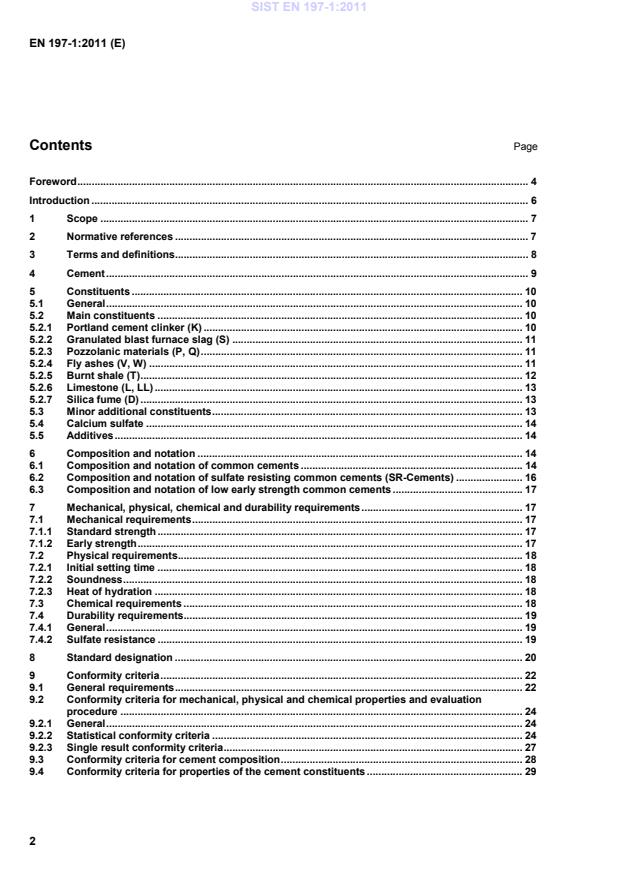
Page Foreword . 4Introduction . 61 Scope . 72 Normative references . 73 Terms and definitions . 84 Cement . 95 Constituents . 105.1 General . 105.2 Main constituents . 105.2.1 Portland cement clinker (K) . 105.2.2 Granulated blast furnace slag (S) . 115.2.3 Pozzolanic materials (P, Q) . 115.2.4 Fly ashes (V, W) . 115.2.5 Burnt shale (T) . 125.2.6 Limestone (L, LL) . 135.2.7 Silica fume (D) . 135.3 Minor additional constituents . 135.4 Calcium sulfate . 145.5 Additives . 146 Composition and notation . 146.1 Composition and notation of common cements . 146.2 Composition and notation of sulfate resisting common cements (SR-Cements) . 166.3 Composition and notation of low early strength common cements . 177 Mechanical, physical, chemical and durability requirements . 177.1 Mechanical requirements . 177.1.1 Standard strength . 177.1.2 Early strength . 177.2 Physical requirements . 187.2.1 Initial setting time . 187.2.2 Soundness . 187.2.3 Heat of hydration . 187.3 Chemical requirements . 187.4 Durability requirements . 197.4.1 General . 197.4.2 Sulfate resistance . 198 Standard designation . 209 Conformity criteria . 229.1 General requirements . 229.2 Conformity criteria for mechanical, physical and chemical properties and evaluation procedure . 249.2.1 General . 249.2.2 Statistical conformity criteria . 249.2.3 Single result conformity criteria . 279.3 Conformity criteria for cement composition . 289.4 Conformity criteria for properties of the cement constituents . 29SIST EN 197-1:2011
List of common cements considered as sulfate resisting by National Standards in different CEN member countries but not included in Table 2 or not fulfilling the requirements given in Table 5 . 30Annex ZA (informative)
Clauses of this European standard addressing the provisions of the EU Construction Products Directive . 31ZA.1 Scope and relevant characteristics . 31ZA.2 Procedure for the attestation of conformity of products . 33ZA.2.1 System of attestation of conformity . 33ZA.2.2 EC certificate of conformity . 34ZA.3 CE marking and labelling . 35Bibliography . 38 SIST EN 197-1:2011
Foreword This document (EN 197-1:2011) has been prepared by Technical Committee CEN/TC 51 “Cement and building limes”, the secretariat of which is held by NBN. This European Standard shall be given the status of a national standard, either by publication of an identical text or by endorsement, at the latest by March 2012, and conflicting national standards shall be withdrawn at the latest by June 2013. Attention is drawn to the possibility that some of the elements of this document may be the subject of patent rights. CEN [and/or CENELEC] shall not be held responsible for identifying any or all such patent rights. This document supersedes EN 197-1:2000, EN 197-4:2004. This document has been prepared under a mandate given to CEN by the European Commission and the European Free Trade Association, and supports essential requirements of EU Directive(s). For relationship with EU Directive(s), see informative Annex ZA, which is an integral part of EN 197-1. Annexes A and ZA are informative. In addition to consolidating EN 197-1:2000/A1:2004, EN 197-1:2000/prA2, EN 197-1:2000/A3:2007, EN 197-4:2004 and EN 197-4:2004/prA1 into a single standard, the principal changes from EN 197-1:2000 are the introduction of additional requirements for common cements with a low heat of hydration and common cements with sulfate resisting properties. The preparation of a standard for cement was initiated by the European Economic Community (EEC) in 1969 and, at the request of a member state later in 1973, the work was given to the European Committee for Standardization (CEN). The Technical Committee CEN/TC 51 was entrusted with the task of preparing a cement standard for the countries of Western Europe, comprising the EEC and EFTA members. In the early eighties, CEN/TC 51 decided to include in the standard for cement only those cements which are intended for use in any plain and reinforced concrete and which are familiar in most countries in Western Europe because they have been produced and used in these countries for many years. The EU Construction Products Directive (89/106/EEC) requires the incorporation of all traditional and well-tried cements in order to remove technical barriers to trade in the construction field. There are currently no criteria for the descriptions "traditional" and "well tried" and it was considered necessary to separate the “common cements” from special cements, i.e. those with additional or special properties. The requirements in this standard are based on the results of tests on cement in accordance with EN 196-1, EN 196-2, EN 196-3, EN 196-5, EN 196-6, EN 196-7, EN 196-8, and EN 196-9. The scheme for the evaluation of conformity of common cements including common cements with low heat of hydration and common cements generally accepted as being sulfate resisting are specified in EN 197-2. In order to find out which common cements are generally accepted as being sulfate resisting and should be included in EN 197-1, there was an investigation within CEN/TC 51 comprising all national specifications and recommendations in the European Union. The review of these investigations led to the following results: a wide variety of cements has been classified in the EU Member States as sulfate resisting. This is due to the different geographical and climatic conditions under which sulfate attacks on mortar and concrete occur at the place of use and the traditionally different rules governing the production and use of sulfate resistant mortars and concretes; sulfate resistance is an additional property and therefore sulfate resisting cements have first to conform to the requirements of the standards which define the product, e.g. EN 197-1 for common cements; SIST EN 197-1:2011
having satisfied the local requirements for various cement types many countries apply further restrictions to the production of concrete to be used in a sulfate environment, such as minimum cement contents and/or maximum water/cement ratio that vary depending on the cement type and the type and intensity of the sulfate conditions. Based on the above results common cement types to be harmonized at the European level have been chosen. The predominant part of the common cements considered to be sulfate resisting in the market is covered by this selection. It was not possible to take into account national particularities the use of which is laid down within national standards, national application rules and regulations/provisions. The strength attained at 28 days is the important criterion in classifying cement for most uses. In order to achieve a specific strength class at 28 days the early strength, at 2 days or at 7 days, can vary and some types of cement may not attain the minimum early strengths specified in EN 197-1 for common cements. The heat of hydration is linked to the early reactivity and lower early strengths indicate lower heat evolution and lower temperatures in concrete. For these cements additional precautions in use can be necessary to ensure adequate curing and safety in construction. The purpose of this standard is to specify the composition requirements and conformity requirements for common cements, including common cements with low heat of hydration and common cements with adequate sulfate resistance as well as low early strength blast furnace cements and low early strength blast furnace cements with low heat of hydration. Cement types and strength classes defined in this European Standard allow the specifier and/or the user to fulfil objectives of sustainability for cement based constructions. Cement types produced by using constituents listed and defined in Clause 5 allow the manufacturer to minimize the use of natural resources in accordance with local conditions of production. According to the CEN/CENELEC Internal Regulations, the national standards organizations of the following countries are bound to implement this European Standard: Austria, Belgium, Bulgaria, Croatia, Cyprus, Czech Republic, Denmark, Estonia, Finland, France, Germany, Greece, Hungary, Iceland, Ireland, Italy, Latvia, Lithuania, Luxembourg, Malta, Netherlands, Norway, Poland, Portugal, Romania, Slovakia, Slovenia, Spain, Sweden, Switzerland and the United Kingdom.
NOTE See EN 196-7. 3.15 heat of hydration quantity of heat developed by the hydration of a cement within a given period of time 3.16 low heat common cement common cement with a limited heat of hydration 3.17 sulfate resisting common cement common cement which fulfils the requirements for sulfate resisting properties
3.18 low heat low early strength blast furnace cement low early strength blast furnace cement with a limited heat of hydration 3.19 sulfate resisting low early strength blast furnace cement low early strength blast furnace cement which fulfils the requirements for sulfate resisting properties 4 Cement Cement is a hydraulic binder, i.e. a finely ground inorganic material which, when mixed with water, forms a paste which sets and hardens by means of hydration reactions and processes and which, after hardening, retains its strength and stability even under water. SIST EN 197-1:2011
0 %, 3 % or 5 % as appropriate (see 6.2) For CEM IV/A and CEM IV/B:
9 %. 5.2.2 Granulated blast furnace slag (S) Granulated blast furnace slag is made by rapid cooling of a slag melt of suitable composition, as obtained by smelting iron ore in a blast furnace and contains at least two-thirds by mass of glassy slag and possesses hydraulic properties when suitably activated. Granulated blast furnace slag shall consist of at least two-thirds by mass of the sum of calcium oxide (CaO), magnesium oxide (MgO) and silicon dioxide (SiO2). The remainder contains aluminium oxide (Al2O3) together with small amounts of other compounds. The ratio by mass (CaO + MgO)/(SiO2) shall exceed 1,0. 5.2.3 Pozzolanic materials (P, Q) 5.2.3.1 General Pozzolanic materials are natural substances of siliceous or silico-aluminous composition or a combination thereof. Although fly ash and silica fume have pozzolanic properties, they are specified in separate subclauses (see 5.2.4 and 5.2.7). Pozzolanic materials do not harden in themselves when mixed with water but, when finely ground and in the presence of water, they react at normal ambient temperature with dissolved calcium hydroxide (Ca(OH)2) to form strength-developing calcium silicate and calcium aluminate compounds. These compounds are similar to those which are formed in the hardening of hydraulic materials. Pozzolanas consist essentially of reactive silicon dioxide (SiO2) and aluminium oxide (Al2O3). The remainder contains iron oxide (Fe2O3) and other oxides. The proportion of reactive calcium oxide for hardening is negligible. The reactive silicon dioxide content shall be not less than 25,0 % by mass. Pozzolanic materials shall be correctly prepared, i.e. selected, homogenised, dried, or heat-treated and comminuted, depending on their state of production or delivery. 5.2.3.2 Natural pozzolana (P) Natural pozzolanas are usually materials of volcanic origin or sedimentary rocks with suitable chemical and mineralogical composition and shall conform to 5.2.3.1. 5.2.3.3 Natural calcined pozzolana (Q) Natural calcined pozzolanas are materials of volcanic origin, clays, shales or sedimentary rocks, activated by thermal treatment and shall conform to 5.2.3.1. 5.2.4 Fly ashes (V, W) 5.2.4.1 General Fly ash is obtained by electrostatic or mechanical precipitation of dust-like particles from the flue gases from furnaces fired with pulverised coal.
NOTE 1 For definition of fly ash see EN 450-1. Ash obtained by other methods shall not be used in cement that conforms to this standard. SIST EN 197-1:2011
Calcium sulfate can be gypsum (calcium sulfate dihydrate, CaSO4 ⋅ 2H2O), hemihydrate (CaSO4 ⋅ ½H2O), or anhydrite (anhydrous calcium sulfate, CaSO4) or any mixture of them. Gypsum and anhydrite are found naturally. Calcium sulfate is also available as a by-product of certain industrial processes. 5.5 Additives Additives for the purpose of EN 197-1 are constituents not covered in 5.2 to 5.4 which are added to improve the manufacture or the properties of the cement. The total quantity of additives shall not exceed 1,0 % by mass of the cement (except for pigments). The quantity of organic additives on a dry basis shall not exceed 0,2 % by mass of the cement. A higher quantity may be incorporated in cements provided that the maximum quantity, in %, is declared on the packaging and/or the delivery note. These additives shall not promote corrosion of the reinforcement or impair the properties of the cement or of the concrete or mortar made from the cement. When admixtures for concrete, mortar or grouts conforming to the EN 934 series are used in cement the standard notation of the admixture shall be declared on bags or delivery documents. 6 Composition and notation 6.1 Composition and notation of common cements The products in the family of common cements, covered by EN 197-1, and their notation are given in Table 1. They are grouped into five main cement types as follows: CEM I Portland cement, CEM II Portland-composite cement, CEM III Blast furnace cement, CEM IV Pozzolanic cement, CEM V Composite cement. The composition of each of the products in the family of common cements shall be in accordance with Table 1. NOTE For clarity in definition, the requirements for the composition refer to the sum of all main and minor additional constituents. The final cement is to be understood as the main and minor additional constituents plus the necessary calcium sulfate (see 5.4) and any additives (see 5.5). SIST EN 197-1:2011
— The 27 products in the family of common cements
Main types Notation of the 27 products (types of common cement) Composition (percentage by massa) Main constituents Minor additional constituents Clinker
Blast-furnace slag
Silica fume
Pozzolana
Fly ash Burnt shale Limestone natural natural calcinedsiliceous calca- reous K S Db P Q V W T L LL CEM I Portland cement CEM I 95-100 – – – – – – – – – 0-5
Portland-slag CEM II/A-S 80-94 6-20 – – – – – – – – 0-5
cement CEM II/B-S 65-79 21-35 – – – – – – – – 0-5
Portland-silica fume cement CEM II/A-D 90-94 – 6-10 – – – – – – – 0-5
CEM II/A-P 80-94 – – 6-20 – – – – – – 0-5
Portland-pozzolana CEM II/B-P 65-79 – – 21-35 – – – – – – 0-5
cement CEM II/A-Q 80-94 – – – 6-20 – – – – – 0-5
CEM II/B-Q 65-79 – – – 21-35 – – – – – 0-5
CEM II/A-V 80-94 – – – – 6-20 – – – – 0-5 CEM II Portland-fly ash CEM II/B-V 65-79 – – – – 21-35 – – – – 0-5
cement CEM II/A-W 80-94 – – – – – 6-20 – – – 0-5
CEM II/B-W 65-79 – – – – – 21-35 – – – 0-5
Portland-burnt CEM II/A-T 80-94 – – – – – – 6-20 – – 0-5
shale cement CEM II/B-T 65-79 – – – – – – 21-35 – – 0-5
Portland- limestone cement CEM II/A-L 80-94 – – – – – – – 6-20 – 0-5
CEM II/B-L 65-79 – – – – – – – 21-35 – 0-5
CEM II/A-LL 80-94 – – – – – – – – 6-20 0-5
CEM II/B-LL 65-79 – – – – – – – – 21-35 0-5
Portland-composite cementc CEM II/A-M 80-88 ‹---------------------------------------------------- 12-20 ---------------------------------------------------› 0-5 CEM II/B-M 65-79 ‹----------------------------------------------------- 21-35 --------------------------------------------------›
Blast furnace cement
CEM III/A 35-64 36-65 – – – – – – – – 0-5 CEM III
CEM III/B 20-34 66-80 – – – – – – – – 0-5
CEM III/C 5-19 81-95 – – – – – – – – 0-5 CEM IV
Pozzolanic CEM IV/A 65-89 – <------------------- 11-35 --------------------> – – – 0-5 cementc CEM IV/B 45-64 – <------------------- 36-55 --------------------> – – – 0-5 CEM V Composite CEM V/A 40-64 18-30 – <-------- 18-30 --------> – – – – 0-5 cementc CEM V/B 20-38 31-49 – <-------- 31-49 --------> – – – – 0-5 a The values in the table refer to the sum of the main and minor additional constituents. b The proportion of silica fume is limited to 10 %. c In Portland-composite cements CEM II/A-M and CEM II/B-M, in pozzolanic cements CEM IV/A and CEM IV/B and in composite cements CEM V/A and CEM V/B the main constituents other than clinker shall be declared by designation of the cement (for examples, see Clause 8). SIST EN 197-1:2011
Sulfate resisting Portland cement (C3A content of the clinker = 0 %), CEM I-SR 3
Sulfate resisting Portland cement (C3A content of the clinker ≤ 3 %), CEM I-SR 5
Sulfate resisting Portland cement (C3A content of the clinker ≤ 5 %), Sulfate resisting blast furnace cement: CEM III/B-SR Sulfate resisting blast furnace cement (no requirement on C3A content of the clinker), CEM III/C-SR Sulfate resisting blast furnace cement (no requirement on C3A content of the clinker), Sulfate resisting pozzolanic cement: CEM IV/A-SR Sulfate resisting pozzolanic cement (C3A content of the clinker ≤ 9 %), CEM IV/B-SR Sulfate resisting pozzolanic cement (C3A content of the clinker ≤ 9 %). The composition of each of the seven produc
...
SLOVENSKI SIST EN 197-1
STANDARD
december 2011
Cement – 1. del: Sestava, zahteve in merila skladnosti za običajne cemente
Cement – Part 1: Composition, specifications and conformity criteria for
common cements
Ciment – Partie 1: Composition, spécifications et critéres de conformité de
ciments courants
Zement – Teil 1: Zusammensetzung, Anforderungen und Konformitäts-kriterien
von allgemeinem Zement
Referenčna oznaka
ICS 91.100.10 SIST EN 197-1:2011 (sl)
Nadaljevanje na straneh II in III ter od 1 do 36
© 2012-09. Slovenski inštitut za standardizacijo. Razmnoževanje celote ali delov tega standarda ni dovoljeno.
SIST EN 197-1 : 2011
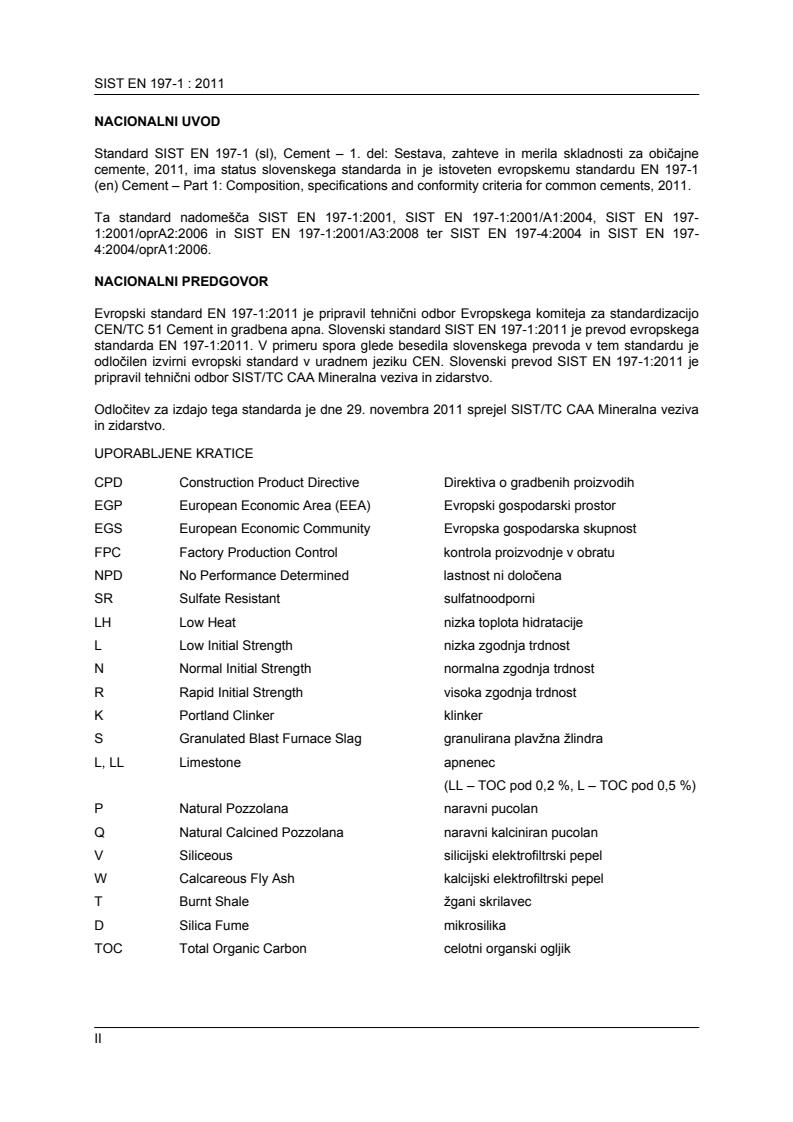
NACIONALNI UVOD
Standard SIST EN 197-1 (sl), Cement – 1. del: Sestava, zahteve in merila skladnosti za običajne
cemente, 2011, ima status slovenskega standarda in je istoveten evropskemu standardu EN 197-1
(en) Cement – Part 1: Composition, specifications and conformity criteria for common cements, 2011.
Ta standard nadomešča SIST EN 197-1:2001, SIST EN 197-1:2001/A1:2004, SIST EN 197-
1:2001/oprA2:2006 in SIST EN 197-1:2001/A3:2008 ter SIST EN 197-4:2004 in SIST EN 197-
4:2004/oprA1:2006.
NACIONALNI PREDGOVOR
Evropski standard EN 197-1:2011 je pripravil tehnični odbor Evropskega komiteja za standardizacijo
CEN/TC 51 Cement in gradbena apna. Slovenski standard SIST EN 197-1:2011 je prevod evropskega
standarda EN 197-1:2011. V primeru spora glede besedila slovenskega prevoda v tem standardu je
odločilen izvirni evropski standard v uradnem jeziku CEN. Slovenski prevod SIST EN 197-1:2011 je
pripravil tehnični odbor SIST/TC CAA Mineralna veziva in zidarstvo.
Odločitev za izdajo tega standarda je dne 29. novembra 2011 sprejel SIST/TC CAA Mineralna veziva
in zidarstvo.
UPORABLJENE KRATICE
CPD Construction Product Directive Direktiva o gradbenih proizvodih
EGP European Economic Area (EEA) Evropski gospodarski prostor
EGS European Economic Community Evropska gospodarska skupnost
FPC Factory Production Control kontrola proizvodnje v obratu
NPD No Performance Determined lastnost ni določena
SR Sulfate Resistant sulfatnoodporni
LH Low Heat nizka toplota hidratacije
L Low Initial Strength nizka zgodnja trdnost
N Normal Initial Strength normalna zgodnja trdnost
R Rapid Initial Strength visoka zgodnja trdnost
K Portland Clinker klinker
S Granulated Blast Furnace Slag granulirana plavžna žlindra
L, LL Limestone apnenec
(LL – TOC pod 0,2 %, L – TOC pod 0,5 %)
P Natural Pozzolana naravni pucolan
Q Natural Calcined Pozzolana naravni kalciniran pucolan
V Siliceous silicijski elektrofiltrski pepel
W Calcareous Fly Ash kalcijski elektrofiltrski pepel
T Burnt Shale žgani skrilavec
D Silica Fume mikrosilika
TOC Total Organic Carbon celotni organski ogljik
II
SIST EN 197-1 : 2011
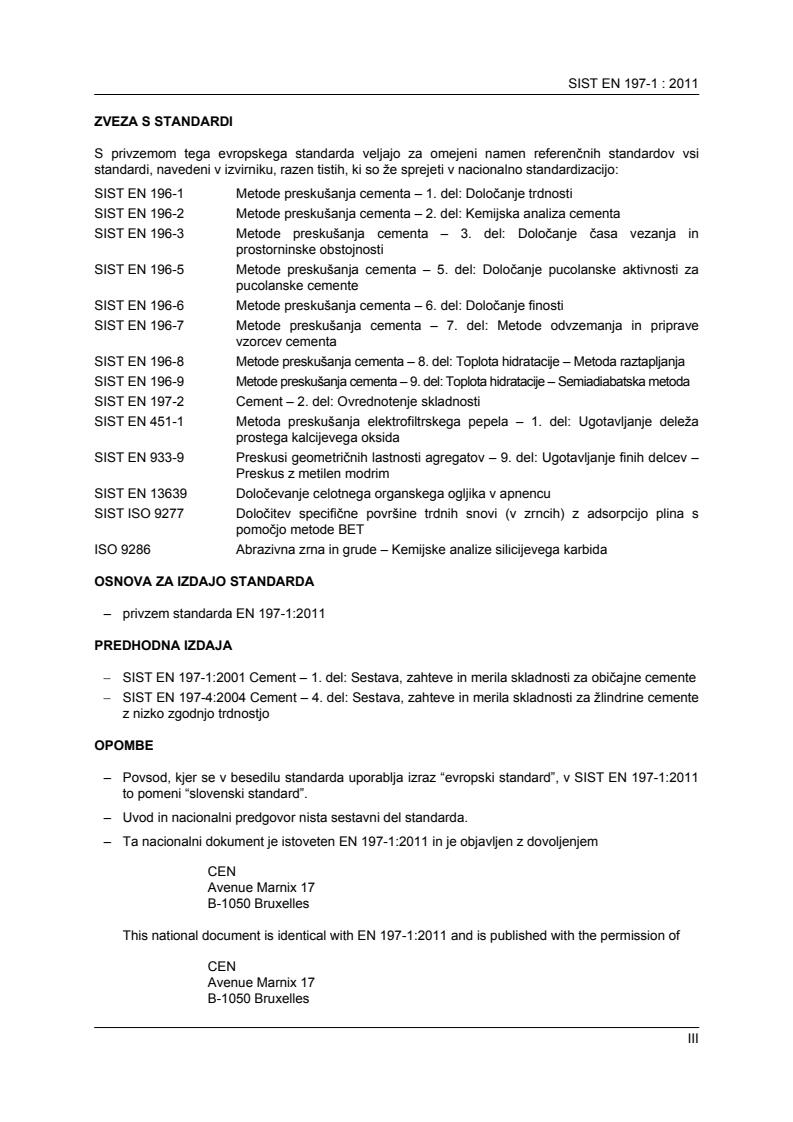
ZVEZA S STANDARDI
S privzemom tega evropskega standarda veljajo za omejeni namen referenčnih standardov vsi
standardi, navedeni v izvirniku, razen tistih, ki so že sprejeti v nacionalno standardizacijo:
SIST EN 196-1 Metode preskušanja cementa – 1. del: Določanje trdnosti
SIST EN 196-2 Metode preskušanja cementa – 2. del: Kemijska analiza cementa
SIST EN 196-3 Metode preskušanja cementa – 3. del: Določanje časa vezanja in
prostorninske obstojnosti
SIST EN 196-5 Metode preskušanja cementa – 5. del: Določanje pucolanske aktivnosti za
pucolanske cemente
SIST EN 196-6 Metode preskušanja cementa – 6. del: Določanje finosti
SIST EN 196-7 Metode preskušanja cementa – 7. del: Metode odvzemanja in priprave
vzorcev cementa
SIST EN 196-8 Metode preskušanja cementa – 8. del: Toplota hidratacije – Metoda raztapljanja
SIST EN 196-9 Metode preskušanja cementa – 9. del: Toplota hidratacije – Semiadiabatska metoda
SIST EN 197-2 Cement – 2. del: Ovrednotenje skladnosti
SIST EN 451-1 Metoda preskušanja elektrofiltrskega pepela – 1. del: Ugotavljanje deleža
prostega kalcijevega oksida
SIST EN 933-9 Preskusi geometričnih lastnosti agregatov – 9. del: Ugotavljanje finih delcev –
Preskus z metilen modrim
SIST EN 13639 Določevanje celotnega organskega ogljika v apnencu
SIST ISO 9277 Določitev specifične površine trdnih snovi (v zrncih) z adsorpcijo plina s
pomočjo metode BET
ISO 9286 Abrazivna zrna in grude – Kemijske analize silicijevega karbida
OSNOVA ZA IZDAJO STANDARDA
– privzem standarda EN 197-1:2011
PREDHODNA IZDAJA
– SIST EN 197-1:2001 Cement – 1. del: Sestava, zahteve in merila skladnosti za običajne cemente
– SIST EN 197-4:2004 Cement – 4. del: Sestava, zahteve in merila skladnosti za žlindrine cemente
z nizko zgodnjo trdnostjo
OPOMBE
– Povsod, kjer se v besedilu standarda uporablja izraz “evropski standard”, v SIST EN 197-1:2011
to pomeni “slovenski standard”.
– Uvod in nacionalni predgovor nista sestavni del standarda.
– Ta nacionalni dokument je istoveten EN 197-1:2011 in je objavljen z dovoljenjem
CEN
Avenue Marnix 17
B-1050 Bruxelles
This national document is identical with EN 197-1:2011 and is published with the permission of
CEN
Avenue Marnix 17
B-1050 Bruxelles
III
EVROPSKI STANDARD EN 197-1
EUROPEAN STANDARD
NORME EUROPÉENNE
EUROPÄISCHE NORM september 2011
ICS 91.100.10 Nadomešča EN 197-1:2000, EN 197-4:2004
Slovenska izdaja
Cement - 1. del: Sestava, zahteve in merila skladnosti za običajne cemente
Cement – Part 1: Composition Ciment – Partie 1: Composition Zement – Teil 1: Zusammensetzung
specifications and conformity spécifications et critéres de Anforderungen und Konformitäts-
criteria for common cements conformité de ciments courants kriterien von allgemeinem Zement
Ta evropski standard je CEN sprejel 6. avgusta 2011.
Člani CEN morajo izpolnjevati notranje predpise CEN/CENELEC, s katerimi je predpisano, da mora
biti ta standard brez kakršnih koli sprememb sprejet kot nacionalni standard. Najnovejši seznami teh
nacionalnih standardov z njihovimi bibliografskimi podatki se na zahtevo lahko dobijo pri Upravnem
centru CEN-CENELEC ali katerem koli članu CEN.
Ta evropski standard obstaja v treh uradnih izdajah (angleški, francoski in nemški). Izdaje v drugih
jezikih, ki jih člani CEN na lastno odgovornost prevedejo in izdajo ter prijavijo pri Upravnem centru
CEN, veljajo kot uradne izdaje.
Člani CEN so nacionalni organi za standarde Avstrije, Belgije, Bolgarije, Cipra, Češke republike,
Danske, Estonije, Finske, Francije, Grčije, Hrvaške, Irske, Islandije, Italije, Latvije, Litve, Luksemburga,
Madžarske, Malte, Nemčije, Nizozemske, Norveške, Poljske, Portugalske, Romunije, Slovaške,
Slovenije, Španije, Švedske, Švice in Združenega kraljestva.
CEN
Evropski komite za standardizacijo
European Committee for Standardization
Comité Européen de Normalisation
Europäisches Komitee für Normung
Centalni sekretariat: Avenue Marnix 17, B-1000 Bruselj
© 2011 CEN Lastnice avtorskih pravic so vse države članice CEN Ref. oznaka EN 197-1:2011: E
SIST EN 197-1 : 2011
VSEBINA Stran
Predgovor .4
Uvod .6
1 Obseg in področje uporabe .7
2 Zveze s standardi .7
3 Izrazi in definicije .8
4 Cement .9
5 Sestavine.10
5.1 Splošno.10
5.2 Glavne sestavine.10
5.2.1 Portlandskocementni klinker (K).10
5.2.2 Granulirana plavžna žlindra (S).11
5.2.3 Pucolanski materiali (P, Q).11
5.2.4 Elektrofiltrski pepeli (V, W) .11
5.2.5 Žgani skrilavec (T).12
5.2.6 Apnenec (L, LL).13
5.2.7 Mikrosilika (D).13
5.3 Manj pomembne sestavine .13
5.4 Kalcijev sulfat.13
5.5 Dodatki cementu.14
6 Sestava in označevanje.14
6.1 Sestava in označevanje običajnih cementov .14
6.2 Sestava in označevanje sulfatnoodpornih običajnih cementov (SR-cementi) .16
6.3 Sestava in označevanje običajnih cementov z nizko zgodnjo trdnostjo.16
7 Mehanske, fizikalne in kemijske zahteve ter zahteve za trajnost.17
7.1 Mehanske zahteve .17
7.1.1 Standardna trdnost.17
7.1.2 Zgodnja trdnost.17
7.2 Fizikalne zahteve.17
7.2.1 Čas začetka vezanja .17
7.2.2 Prostorninska obstojnost .17
7.2.3 Toplota hidratacije .17
7.3 Kemijske zahteve .18
7.4 Zahteve za trajnost.18
7.4.1 Splošno.18
7.4.2 Sulfatna odpornost .19
8 Standardno označevanje.19
9 Merila skladnosti.21
9.1 Splošne zahteve.21
9.2 Merila skladnosti za mehanske, fizikalne in kemijske lastnosti ter postopki vrednotenja .23
SIST EN 197-1 : 2011
9.2.1 Splošno.23
9.2.2 Statistična merila skladnosti .23
9.2.3 Merila skladnosti za posamezen rezultat .25
9.3 Merila skladnosti za sestavo cementa.26
9.4 Merila skladnosti za lastnosti sestavin cementa .27
Dodatek A (informativni): Seznam običajnih cementov, ki po nacionalnih standardih različnih držav
članic CEN veljajo za sulfatno odporne, a niso vključeni v preglednico 2 ali ne izpolnjujejo zahtev
iz preglednice 5.28
Dodatek ZA (informativni): Točke tega evropskega standarda, ki se nanašajo na določila
Direktive EU o gradbenih proizvodih .29
ZA.1 Obseg in pomembne lastnosti .29
ZA.2 Postopki potrjevanja skladnosti proizvodov.31
ZA.2.1 Sistem potrjevanja skladnosti .31
ZA.2.2 EC-certifikat (ES-certifikat) o skladnosti .32
ZA.3 CE-označevanje in etiketiranje .33
Literatura.36
SIST EN 197-1 : 2011
Predgovor
Ta dokument (EN 197-1:2011) je pripravil tehnični odbor CEN/TC 51 Cement in gradbena apna,
katerega sekretariat vodi NBN.
Ta evropski standard mora dobiti status nacionalnega standarda bodisi z objavo istovetnega besedila
ali z razglasitvijo najpozneje do marca 2012, nasprotujoče nacionalne standarde pa je treba
razveljaviti najpozneje do junija 2013.
Opozoriti je treba na možnost, da so nekateri elementi tega dokumenta lahko predmet patentnih
pravic. CEN (in/ali CENELEC) ne prevzema odgovornosti za ugotavljanje katere koli ali vseh takšnih
pravic.
Ta evropski standard nadomešča EN 197-1:2000 in EN 197-4:2004.
Ta dokument je bil pripravljen na podlagi mandata, ki sta ga Evropska komisija ter Evropsko združenje
za prosto trgovino dala CEN, in upošteva bistvene zahteve direktiv(-e) ES ali EU.
Za zvezo z direktivo(-ami) EU glej informativni dodatek ZA, ki je sestavni del EN 197-1.
Dodatka A in ZA sta informativna.
Poleg združitve EN 197-1:2000/A1:2004, EN 197-1:2000/prA2, EN 197-1:2000/A3:2007, EN 197-
4:2004 in EN 197-4:2004/prA1 v en standard so glavne spremembe glede na EN 197-1:2000 v uvedbi
dodatnih zahtev za običajne cemente z nizko toploto hidratacije in uvedbi običajnih cementov s
sulfatnoodpornimi lastnostmi.
Pobudo za pripravo standarda za cement je dala leta 1969 Evropska gospodarska skupnost (EGS).
Na zahtevo ene od držav članic je bilo delo leta 1973 oddano Evropskemu komiteju za standardizacijo
(CEN). Izdelava standarda za cement za zahodnoevropske države, države EGS in EFTA je bila
zaupana tehničnemu odboru CEN/TC 51.
Zato je CEN/TC 51 v zgodnjih osemdesetih letih sklenil, da v standard vključi samo tiste cemente, ki
se uporabljajo za vsak nearmirani in armirani beton in jih pozna večina držav zahodne Evrope, ker jih
proizvajajo in uporabljajo že veliko let. Direktiva EU o gradbenih proizvodih (89/106/EGS) zahteva, da
se vključijo vsi tradicionalni in dobro preskušeni cementi, da se tako odstranijo tehnične ovire pri
trgovanju na področju gradbeništva. Ker še vedno ni bilo meril za opredelitev "tradicionalen" in "dobro
preskušen", se je pokazala potreba po ločitvi "običajnih cementov" od “posebnih cementov”, ki imajo
posebne ali dodatne lastnosti.
Zahteve v tem standardu temeljijo na rezultatih preskusov cementa, opravljenih v skladu z EN 196-1,
EN 196-2, EN 196-3, EN 196-5, EN 196-6, EN 196-7, EN 196-8 in EN 196-9. Shema za ovrednotenje
skladnosti običajnih cementov, vključno z običajnimi cementi z nizko toploto hidratacije in običajnimi
cementi, splošno sprejetimi kot sulfatno odporni, je predpisana v EN 197-2.
Z namenom ugotoviti, kateri običajni cementi so sprejeti kot sulfatno odporni in bi morali biti vključeni v
EN 197-1, je bila izvedena raziskava znotraj CEN/TC 51, ki je vključevala vse nacionalne specifikacije
in priporočila v Evropski uniji. Pregled teh raziskav je privedel do naslednjih rezultatov:
– raznolikost cementov v državah članicah EU, ki so klasificirani kot sulfatno odporni, je velika.
Vzrok so različne geografske in podnebne razmere, pri katerih pride do sulfatnega napada
(sulfatne agresije) na malto ali beton, ter tradicionalno različni predpisi pri vodenju proizvodnje in
uporabi sulfatnoodpornih malt in betonov;
– sulfatna odpornost je dodatna lastnost in zato mora sulfatnoodporni cement najprej ustrezati
zahtevam standardov, ki definirajo produkt, npr. EN 197-1 za običajne cemente;
– izpolnjene morajo biti dodatne zahteve, ki jih predpisujejo nacionalne zahteve za sulfatnoodporne
cemente in se nanašajo na izbrane lastnosti, za katere so zahteve za mejne vrednosti strožje
glede na običajne cemente;
SIST EN 197-1 : 2011
– da se zadostijo lokalne zahteve za različne vrste cementov, so mnoge države dodale omejitve pri
proizvodnji betona, ki se uporablja v sulfatnem okolju, kot npr. najmanjša vsebnost cementa in/ali
največje dovoljeno razmerje voda-cement, ki je odvisno od vrste cementa ter od vrste in stopnje
sulfatnih pogojev.
Na podlagi zgoraj omenjenih rezultatov so bile izbrane vrste običajnih cementov, ki bodo
harmonizirane na evropski ravni. Prevladujoči del običajnih cementov, ki na trgu veljajo za sulfatno
odporne, je bil zajet s tem izborom. Upoštevati pa ni bilo mogoče nacionalnih posebnosti za uporabo,
ki se nanašajo na nacionalne standarde, pravila uporabe in regulativo/predpise.
Za večino namenov uporabe je pomembno merilo pri klasifikaciji cementa dosežena 28-dnevna
trdnost. Z namenom doseči določen trdnostni razred po 28 dneh lahko zgodnje trdnosti po 2 dneh ali
po 7 dneh variirajo in za nekatere vrste cementov je dovoljeno, da ne dosežejo najnižjih zgodnjih
trdnosti, določenih v EN 197-1 za običajne cementa.
Toplota hidratacije je povezana z začetno reaktivnostjo. Nizke zgodnje trdnosti razvijejo nizko toploto
hidratacije in prav tako nizke temperature v betonu. Za tovrstne cemente so potrebni dodatni ukrepi pri
uporabi, da se zagotovita ustrezna nega in varnost konstrukcije.
Namen tega standarda je predpisati zahteve za sestavo in skladnost za običajne cemente, vključno z
običajnimi cementi z nizko toploto hidratacije in običajnimi cementi s primerno sulfatno odpornostjo,
prav tako pa tudi za žlindrine cemente z nizko zgodnjo trdnostjo ter žlindrine cemente z nizko zgodnjo
trdnostjo in nizko toploto hidratacije.
Vrste cementov in trdnostni razredi, opredeljeni v tem evropskem standardu, omogočajo
predpisovalcu in/ali uporabniku izpolniti zahteve trajnosti cementnih konstrukcij. Vrste cementov s
sestavinami, navedenimi in opredeljenimi v točki 5, omogočajo proizvajalcem, da zmanjšajo uporabo
naravnih virov v skladu z lokalnimi pogoji proizvodnje.
Po določilih notranjih predpisov CEN/CENELEC so ta evropski standard dolžne privzeti nacionalne
organizacije za standarde naslednjih držav: Avstrije, Belgije, Bolgarije, Cipra, Češke republike,
Danske, Estonije, Finske, Francije, Grčije, Hrvaške, Irske, Islandije, Italije, Latvije, Litve, Luksemburga,
Madžarske, Malte, Nemčije, Nizozemske, Norveške, Poljske, Portugalske, Romunije, Slovaške,
Slovenije, Španije, Švedske, Švice in Združenega kraljestva.
SIST EN 197-1 : 2011
Uvod
Upoštevati je treba, da imajo različni cementi različne lastnosti in da se različno obnašajo v uporabi. V
ta standard so vključeni tisti preskusi obnašanja v uporabi, ki so že na voljo (npr. čas vezanja, trdnost,
prostorninska obstojnost in toplota hidratacije). CEN/TC 51 pripravlja še dodatne preskuse, ki so
potrebni za predpisovanje obnašanja cementa v uporabi. Dokler le-ti niso na voljo, mora biti izbira
cementa, posebej njegove vrste in/ali trdnostnega razreda v zvezi z zahtevami za trajnost, ki so
odvisne od stopnje izpostavljenosti in vrste konstrukcije, v katero se cement vgrajuje, v skladu z
ustreznimi standardi in/ali predpisi za beton ali malto, ki veljajo v kraju uporabe.
SIST EN 197-1 : 2011
1 Obseg in področje uporabe
Ta evropski standard določa in postavlja zahteve za 27 različnih običajnih cementov, 7 sulfatnoodpornih
običajnih cementov, prav tako pa tudi za 3 različne žlindrine cemente z nizko zgodnjo trdnostjo in
2 žlindrina sulfatnoodporna cementa z nizko zgodnjo trdnostjo ter njihove sestavine. Definicija
vsakega cementa vključuje deleže, v katerih je treba sestavine mešati, da bi se proizvedli ti različni
proizvodi, ki obsegajo devet trdnostnih razredov. Definicija vključuje tudi zahteve, katerim morajo
ustrezati sestavine. Vključuje tudi mehanske, fizikalne in kemijske zahteve. Nadalje ta standard določa
tudi merila skladnosti in s tem povezana pravila. Podane so tudi potrebne zahteve za trajnost.
Poleg sulfatnoodpornih cementov, opredeljenih v tem dokumentu, so kot odporni proti sulfatni agresiji
potrjeni na nacionalni ravni še drugi cementi, ki so skladni bodisi s tem standardom ali z drugimi
standardi, evropskimi ali nacionalnimi. Cementi, navedeni v dodatku A, so po mnenju predstavnikov
CEN iz različnih držav sulfatno odporni z omejitvami glede na mesto uporabe.
OPOMBA 1: Poleg predpisanih zahtev je pomembna tudi izmenjava dodatnih informacij med proizvajalcem cementa in
uporabnikom. Postopki za takšno izmenjavo v tem standardu niso obravnavani, temveč naj bi bili obravnavani
skladno z nacionalnimi standardi ali predpisi, lahko pa se zanje dogovorita zainteresirani stranki.
OPOMBA 2: Beseda “cement” se v EN 197-1 uporablja samo v zvezi z običajnimi cementi, če ni določeno drugače.
Ta standard ne vključuje:
– specialnih cementov z zelo nizko toploto hidratacije, ki so vključeni v EN 14216,
– supersulfatnih cementov, vključenih v EN 15743,
– kalcijevega aluminatnega cementa, vključenega v EN 14647,
– zidarskega cementa, vključenega v EN 413-1.
2 Zveze s standardi
Za uporabo tega standarda so nujno potrebni spodaj navedeni dokumenti. Pri datiranih dokumentih
velja samo navedena izdaja. Pri nedatiranih dokumentih velja najnovejša izdaja dokumenta (vključno z
morebitnimi spremembami).
EN 196-1 Metode preskušanja cementa – 1. del: Določanje trdnosti
EN 196-2 Metode preskušanja cementa – 2. del: Kemijska analiza cementa
EN 196-3 Metode preskušanja cementa – 3. del: Določanje časa vezanja in
prostorninske obstojnosti
EN 196-5 Metode preskušanja cementa – 5. del: Določanje pucolanske aktivnosti za
pucolanske cemente
EN 196-6 Metode preskušanja cementa – 6. del: Določanje finosti
EN 196-7 Metode preskušanja cementa – 7. del: Metode odvzemanja in priprave
vzorcev cementa
EN 196-8 Metode preskušanja cementa – 8. del: Toplota hidratacije – Metoda raztapljanja
EN 196-9 Metode preskušanja cementa – 9. del: Toplota hidratacije – Semiadiabatska
metoda
EN 197-2 Cement – 2. del: Ovrednotenje skladnosti
EN 451-1 Metoda preskušanja elektrofiltrskega pepela – 1. del: Ugotavljanje deleža
prostega kalcijevega oksida
EN 933-9 Preskusi geometričnih lastnosti agregatov – 9. del: Ugotavljanje finih delcev –
Preskus z metilen modrim
EN 13639 Določevanje celotnega organskega ogljika v apnencu
SIST EN 197-1 : 2011
ISO 9277 Določitev specifične površine trdnih snovi (v zrncih) z adsorpcijo plina s
pomočjo metode BET
ISO 9286 Abrazivna zrna in grude – Kemijske analize silicijevega karbida
3 Izrazi in definicije
V tem dokumentu se uporabljajo naslednji izrazi in definicije:
3.1
reaktivni kalcijev oksid (CaO)
delež kalcijevega oksida, ki pri normalnih pogojih strjevanja lahko tvori kalcijeve silikat hidrate ali
kalcijeve aluminat hidrate
OPOMBA: Za izračun tega deleža se od celotnega deleža kalcijevega oksida (glej EN 196-2) odštejeta delež, vezan v
kalcijevem karbonatu (CaCO ), izračunan na podlagi izmerjene količine ogljikovega dioksida (CO ) (glej EN
3 2
196-2), ter delež, vezan v kalcijevem sulfatu (CaSO ), izračunan na podlagi izmerjene količine sulfata (SO )
4 3
(glej EN 196-2), brez upoštevanja SO , vezanega z alkalijami.
3.2
reaktivni silicijev dioksid (SiO )
delež silicijevega dioksida, ki je po obdelavi s solno kislino (HCl) in vrelo raztopino kalijevega
hidroksida (KOH) topen
OPOMBA: Količina reaktivnega silicijevega dioksida se določi tako, da se od celotne vsebnosti silicijevega dioksida (glej
EN 196-2) odšteje tisti delež, ki ga vsebuje ostanek, netopen v solni kislini in kalijevem hidroksidu (glej EN 196-2),
oba pa sta preračunana na suho snov.
3.3
glavna sestavina
posebej izbrani neorganski material, katerega masni delež znaša več kot 5 % vsote vseh glavnih in
manj pomembnih sestavin
3.4
manj pomembna sestavina
posebej izbrani neorganski material, katerega masni delež ni večji od 5 % vsote vseh glavnih in manj
pomembnih sestavin
3.5
vrsta običajnega cementa
eden od 27 proizvodov (glej preglednico 1) v družini običajnih cementov
3.6
trdnostni razred cementa
razred tlačne trdnosti
3.7
notranje kontrolno preskušanje
stalno preskušanje vzorcev cementa, odvzetih na mestu(-ih) odpreme iz obrata ali odpremne postaje,
ki ga izvaja proizvajalec
3.8
obdobje kontrole
časovno obdobje proizvodnje in odpreme, določeno za ovrednotenje rezultatov notranjega kontrolnega
preskušanja
3.9
karakteristična vrednost
vrednost za predpisano lastnost, izven katere leži določen odstotek P vseh vrednosti populacije
k
SIST EN 197-1 : 2011
3.10
predpisana karakteristična vrednost
karakteristična vrednost neke mehanske, fizikalne ali kemijske lastnosti, ki ne sme biti višja od zgornje
mejne vrednosti oziroma ne nižja od spodnje mejne vrednosti
3.11
mejna vrednost posameznega rezultata
vrednost neke mehanske, fizikalne ali kemijske lastnosti, ki – pri nobenem posameznem preskusnem
rezultatu – ne sme biti višja od zgornje mejne vrednosti oziroma ne nižja od spodnje mejne vrednosti
3.12
dovoljena verjetnost sprejemljivosti CR
dovoljena verjetnost sprejemljivosti za prevzem cementa, ki ima karakteristično vrednost izven
predpisane mejne karakteristične vrednosti, pri danem planu vzorčenja
3.13
plan vzorčenja
poseben načrt, ki določa (statistično) velikost(-i) vzorca, ki mora biti uporabljen, odstotek P in
k
dovoljeno verjetnost sprejemljivosti CR
3.14
naključni vzorec
vzorec, vzet ob istem času na istem mestu za nameravano preskušanje. Dobi se lahko iz enega ali
več posameznih vzorcev, odvzetih neposredno drug za drugim
OPOMBA: Glej EN 196-7.
3.15
toplota hidratacije
količina toplote, sproščene pri hidrataciji cementa v določenem času
3.16
običajni cement z nizko toploto hidratacije
običajni cement z omejeno toploto hidratacije
3.17
sulfatnoodporni običajni cement
običajni cement, ki izpolnjuje zahteve za sulfatno odpornost
3.18
žlindrin cement z nizko toploto hidratacije in nizko zgodnjo trdnostjo
žlindrin cement z nizko zgodnjo trdnostjo in omejeno toploto hidratacije
3.19
sulfatnoodporni žlindrin cement z nizko zgodnjo trdnostjo
žlindrin cement z nizko zgodnjo trdnostjo, ki izpolnjuje zahteve za sulfatno odpornost
4 Cement
Cement je hidravlično vezivo, tj. fino zmlet neorganski material, ki zmešan z vodo tvori pasto, ta pa na
podlagi reakcij in procesov hidratacije veže in strjuje ter po strditvi ohrani trdnost in stabilnost tudi v vodi.
Cement, skladen s tem standardom, imenovan cement CEM, mora dati, če je pravilno odmerjen in
zmešan z agregatom in vodo, beton ali malto, ki ostaneta dovolj dolgo primerno obdelavna. Po
določenem času morata doseči predpisano trdnost in morata biti dolgo prostorninsko stabilna.
Hidravlično strjevanje cementa CEM temelji predvsem na hidrataciji kalcijevih silikatov; v procesu
strjevanja lahko sodelujejo tudi druge kemijske spojine, npr. aluminati. Vsota deležev reaktivnega
SIST EN 197-1 : 2011
kalcijevega oksida (CaO) in reaktivnega silicijevega dioksida (SiO ) v cementu CEM mora biti vsaj 50 %
mase, če so deleži izračunani po EN 196-2.
Cementi CEM sestojijo iz različnih materialov in so statistično homogene sestave, kar je zagotovljeno
s postopki za zagotavljanje kakovosti proizvodnje in za ravnanje z materiali. Povezava med postopki
proizvodnje in postopki ravnanja z materiali ter skladnostjo cementa s tem standardom je
obravnavana v EN 197-2.
OPOMBA: Obstajajo tudi cementi, ki se strjujejo zaradi hidratacije drugih spojin, npr. kalcijevega aluminata v kalcijevem
aluminatnem cementu.
5 Sestavine
5.1 Splošno
Zahtevane lastnosti sestavin, opisanih v 5.2 do 5.5, morajo biti praviloma ugotovljene po metodah
preskušanja, opisanih v EN 196, razen če ni določeno drugače.
5.2 Glavne sestavine
5.2.1 Portlandskocementni klinker (K)
Portlandskocementni klinker je proizveden s sintranjem natančno predpisane mešanice surovin
(surovinska moka, pasta ali blato), ki vsebujejo elemente, ponavadi izražene v obliki oksidov CaO,
SiO , Al O , Fe O , in majhne količine drugih snovi. Surovinska moka, pasta ali blato morajo biti
2 2 3 2 3
drobnozrnati, dobro premešani in zato homogeni.
Portlandskocementni klinker je hidravlični material, ki mora vsebovati najmanj dve tretjini mase
kalcijevih silikatov (3CaO ⋅ SiO in 2CaO ⋅ SiO ), ostanek pa sestoji iz klinkerjevih faz, ki vsebujejo
2 2
aluminij in železo, ter iz drugih spojin. Masno razmerje (CaO)/(SiO ) ne sme biti manjše od 2,0.
Vsebnost magnezijevega oksida (MgO) ne sme presegati 5,0 % mase.
Portlandskocementni klinker, ki je sestavni del sulfatnoodpornega portlandskega cementa (CEM I) in
sulfatnoodpornega pucolanskega cementa (CEM IV), mora izpolniti dodatne zahteve za vsebnost
trikalcijevega aluminata (C A). Vsebnost trikalcijevega aluminata (C A) v klinkerju se izračuna po
3 3
naslednji enačbi:
C A = 2,65 A – 1,69 F
kjer sta:
A odstotek mase aluminijevega oksida (Al O ) v klinkerju, določen skladno z EN 196-2
2 3
F odstotek mase železovega (III) oksida (Fe O ) v klinkerju, določen skladno z EN 196-2
2 3
OPOMBA: Zgodi se lahko, da je izračunana vrednost za C A negativna. V tem primeru se zabeleži vrednost 0 %.
Preskusna metoda za določanje C A v klinkerju za naključni vzorec cementa je v razvoju pod okriljem CEN/TC
51. Dokler metoda ne bo na voljo, se vsebnost C A določi neposredno v klinkerju. V posebnih primerih za CEM I
je dovoljeno izračunati vsebnost C A v klinkerju iz kemijske analize cementa. Najmanjša pogostost določanja in
uporabe alternativnih metod za neposredno in posredno ovrednotenje C A naj bo vključena v kontrolo
proizvodnje (glej EN 197-2). Običajna pogostost določanja je dvakrat mesečno v rutinskem obdobju.
Sulfatnoodporni portlandski cementi in sulfatnoodporni pucolanski cementi so pripravljeni iz
portlandskocementnega klinkerja, v katerem vsebnost C A ne sme preseči:
– za CEM I: 0 %, 3 % ali 5 %, kot je primerno (glej 6.2),
– za CEM IV/A ali CEM IV/B: 9 %.
SIST EN 197-1 : 2011
5.2.2 Granulirana plavžna žlindra (S)
Granulirana plavžna žlindra se dobi s hitrim hlajenjem žlindrine taline s primerno sestavo, ki je taka,
kot se dobi s taljenjem železove rude v plavžu, in vsebuje najmanj dve tretjini mase steklaste žlindre in
ima hidravlične lastnosti, če je primerno aktivirana.
Seštevek mas kalcijevega oksida (CaO), magnezijevega oksida (MgO) in silicijevega dioksida (SiO )
mora znašati najmanj dve tretjini mase granulirane plavžne žlindre. Ostanek vsebuje aluminijev oksid
(Al O ) in manjše količine drugih sestavin. Masno razmerje (CaO + MgO)/(SiO ) mora biti večje od 1,0.
2 3 2
5.2.3 Pucolanski materiali (P, Q)
5.2.3.1 Splošno
Pucolanski materiali so naravne snovi s silikatno ali silikatno-aluminatno sestavo ali kombinacijo obeh.
Čeprav imata elektrofiltrski pepel in mikrosilika pucolanske lastnosti, sta predpisana v posebnih točkah
(glej 5.2.4 in 5.2.7).
Pucolanski materiali, zmešani z vodo, se sami ne strjujejo, toda fino zmleti v prisotnosti vode in pri
normalni zunanji temperaturi reagirajo z raztopljenim kalcijevim hidroksidom (Ca(OH) ). Pri tem
nastanejo spojine kalcijevih silikatov in kalcijevih aluminatov, ki dajejo trdnost. Te spojine so podobne
tistim, ki nastanejo pri hidrataciji hidravličnih materialov. Pucolani vsebujejo predvsem reaktivni silicijev
dioksid (SiO ) in aluminijev oksid (Al O ). Ostanek vsebuje železov oksid (Fe O ) in druge okside.
2 2 3 2 3
Delež reaktivnega kalcijevega oksida za hidratacijo je zanemarljiv. Delež reaktivnega silicijevega
dioksida ne sme biti manjši od 25,0 % mase.
Pucolanski materiali morajo biti pravilno pripravljeni, kar pomeni, da morajo biti primerno izbrani,
homogenizirani, osušeni ali toplotno obdelani in zdrobljeni ali zmleti, odvisno od tega, v kakšnem
stanju so pridobljeni ali dostavljeni.
5.2.3.2 Naravni pucolan (P)
Naravni pucolani so ponavadi snovi vulkanskega izvora ali sedimentne kamnine s primerno kemijsko
in mineraloško sestavo. Skladni morajo biti s 5.2.3.1.
5.2.3.3 Naravni kalcinirani pucolan (Q)
Naravni kalcinirani pucolani so snovi vulkanskega izvora, gline, skrilavci ali sedimentne kamnine,
aktivirani s termično obdelavo. Skladni morajo biti s 5.2.3.1.
5.2.4 Elektrofiltrski pepeli (V, W)
5.2.4.1 Splošno
Elektrofiltrski pepel se dobi z elektrostatičnim ali mehanskim izločanjem prašnih delcev iz dimnih
plinov peči, ki so kurjene z uprašenim premogom.
OPOMBA 1: Za definicijo elektrofiltrskega pepela glej EN 450-1.
Pepel, dobljen na druge načine, se ne sme uporabljati za cement, ki je skladen s tem standardom.
Elektrofiltrski pepel je po naravi lahko silicijski ali kalcijski. Prvi ima pucolanske lastnosti, drugi ima
lahko dodatno še hidravlične lastnosti. Žarilna izguba elektrofiltrskega pepela, preskušena po EN 196-
2 z enournim žarjenjem, ne sme biti večja od naslednjih mej:
a) 0 % do 5,0 % mase,
b) 2,0 % do 7,0 % mase,
c) 4,0 % do 9,0 % mase.
SIST EN 197-1 : 2011
Zgornja mejna vrednost žarilne izgube elektrofiltrskega pepela, ki se uporablja kot glavna sestavina pri
proizvodnji cementa, mora biti navedena na embalaži in/ali spremnem dokumentu.
OPOMBA 2: Namen zahteve za žarilno izgubo je omejiti ostanek nezgorelega ogljika v elektrofiltrskem pepelu. Dovolj je, da
se dokaže z neposrednim merjenjem ostanka nezgorelega ogljika, da je vsebnost nezgorelega ogljika znotraj
zgoraj podanih mej za žarilno izgubo. Vsebnost nezgorelega ogljika se določi skladno z ISO 10694.
5.2.4.2 Silicijski elektrofiltrski pepel (V)
Silicijski elektrofiltrski pepel je fin prah iz pretežno kroglastih delcev, ki imajo pucolanske lastnosti.
Vsebuje predvsem reaktivni silicijev dioksid (SiO ) in aluminijev oksid (Al O ). Ostanek vsebuje
2 2 3
železov oksid (Fe O ) in druge spojine.
2 3
Delež reaktivnega kalcijevega oksida mora biti manjši od 10,0 % mase, delež prostega kalcijevega
oksida, določenega po metodi, opisani v EN 451-1, ne sme biti večji od 1,0 % mase. Sprejemljiv je tudi
elektrofiltrski pepel, ki vsebuje več kot 1,0 % mase in manj od 2,5 % mase prostega kalcijevega
oksida, ob predpostavki, da ekspanzija (prostorninska obstojnost), preskušena po EN 196-3 na
mešanici iz 30 % mase silicijskega elektrofiltrskega pepela in 70 % mase cementa CEM I, skladnega z
EN 197-1, ni večja od 10 mm.
Delež reaktivnega silicijevega dioksida mora biti najmanj 25,0 % mase.
5.2.4.3 Kalcijski elektrofiltrski pepel (W)
Kalcijski elektrofiltrski pepel je fin prah, ki ima hidravlične in/ali pucolanske lastnosti. Vsebuje predvsem
reaktivni kalcijev oksid (CaO), reaktivni silicijev dioksid (SiO ) in aluminijev oksid (Al O ). Ostanek
2 2 3
vsebuje železov oksid (Fe O ) in druge spojine. Delež reaktivnega kalcijevega oksida ne sme biti manjši
2 3
od 10,0 % mase. Kalcijski elektrofiltrski pepeli, ki vsebujejo od 10,0 % do 15,0 % mase reaktivnega
kalcijevega oksida, morajo vsebovati najmanj 25,0 % mase reaktivnega silicijevega dioksida.
Primerno zmleti kalcijski elektrofiltrski pepel, ki vsebuje več kot 15,0 % mase reaktivnega kalcijevega
oksida, mora imeti tlačno trdnost po 28 dneh, preskušeno po EN 196-1, najmanj 10,0 MPa. Pred
preskušanjem je treba elektrofiltrski pepel zmleti tako, da je finost, izražena kot masni delež ostanka
pepela po mokrem sejanju na situ z velikostjo odprtin 40 µm, med 10 % in 30 % mase. Preskusno
malto je treba namesto s cementom pripraviti samo z zmletim kalcijskim elektrofiltrskim pepelom.
Preskušance je treba razkalupiti 48 ur po pripravi in nato do preskušanja negovati v prostoru z
relativno vlažnostjo najmanj 90 %.
Ekspanzija (prostorninska obstojnost) kalcijskega elektrofiltrskega pepela, preskušena po EN 196-3
na mešanici iz 30 % mase kalcijskega elektrofiltrskega pepela, zmletega, kot je opisano zgoraj, in
70 % mase cementa CEM I, skladnega z EN 197-1, mora biti manjša od 10 mm.
OPOMBA: Če je vsebnost sulfata (SO ) v elektrofiltrskem pepelu večja od dovoljene zgornje mejne vrednosti za vsebnost
sulfata v cementu, je treba to pri proizvodnji cementa upoštevati z ustreznim zmanjšanjem količine sestavin, ki
vsebujejo kalcijev sulfat.
5.2.5 Žgani skrilavec (T)
Žgani skrilavec, zlasti žgani oljni skrilavec, se proizvaja v posebnih pečeh pri temperaturi približno 800 °C.
Zaradi sestave naravnega materiala in proizvodnega procesa vsebuje žgani skrilavec faze klinkerja,
pretežno dikalcijev silikat in monokalcijev aluminat. Žgani skrilavec vsebuje poleg majhnih količin
prostega kalcijevega oksida in kalcijevega sulfata tudi večji delež pucolansko aktivnih oksidov, zlasti
silicijevega dioksida. Zato ima fino zmleti žgani skrilavec hidravlične lastnosti tako kot portlandski
cement in poleg teh tudi pucolanske lastnosti.
Primerno zmleti žgani skrilavec mora imeti tlačno trdnost po 28 dneh, preskušeno po EN 196-1,
najmanj 25,0 MPa. Malto je treba namesto s cementom pripraviti samo s fino zmletim žganim
skrilavcem. Preskušance je treba razkalupiti 48 ur po pripravi in nato do preskušanja negovati v
prostoru z najmanj 90-odstotno relativno vlažnostjo.
SIST EN 197-1 : 2011
Ekspanzija (prostorninska obstojnost) žganega skrilavca, preskušena po EN 196-3 na mešanici iz 30 %
mase mletega žganega skrilavca in 70 % mase cementa CEM I, skladnega z EN 197-1, mora biti
manjša od 10 mm.
OPOMBA: Če je vsebnost sulfata (SO ) v žganem skrilavcu večja od dovoljene zgornje mejne vrednosti za vsebnost
sulfata v cementu, je treba to pri proizvodnji cementa upoštevati z ustreznim zmanjšanjem količine sestavin, ki
vsebujejo kalcijev sulfat.
5.2.6 Apnenec (L, LL)
Apnenec mora zadovoljiti naslednje zahteve:
a) vsebnost kalcijevega karbonata (CaCO ), izračunana iz vsebnosti kalcijevega oksida, mora biti
najmanj 75 % mase;
b) vsebnost gline, ugotovljena s preskusom z metilen modrim po EN 933-9, ne sme biti večja od
1,20 g/100 g. Za ta preskus mora biti apnenec zmlet na finost okoli 5 000 cm /g, določeno kot
specifična površina po EN 196-6;
c) vsebnost celotnega organskega ogljika (TOC), preskušena po EN 13639, mora ustrezati enemu
od teh meril:
1) LL: ne sme biti večja od 0,20 % mase,
2) L: ne sme biti večja od 0,50 % mase.
5.2.7 Mikrosilika (D)
Mikrosilika nastaja v proizvodnji silicijevih in ferosilicijevih zlitin v elektropečeh pri redukciji zelo čistega
kremena s premogom in sestoji iz zelo drobnih kroglastih delcev, ki vsebujejo najmanj 85 % mase
amorfnega silicijevega dioksida. Vsebnost elementarnega silicija (Si) ne sme biti večja od 0,4 % mase,
določena skladno z ISO 9286.
Mikrosilika mora zadovoljiti naslednji zahtevi:
a) žarilna izguba ne sme biti večja od 4,0 % mase, določena po EN 196-2 z enournim žarjenjem;
b) specifična površina (BET) neobdelane mikrosilike mora biti pri preskusu po ISO 9277 najmanj
15,0 m /g.
Mikrosilika, ki se melje skupaj s klinkerjem in kalcijevim sulfatom, je lahko v originalnem stanju
stisnjena ali granulirana (z vodo) ali enakovredno pripravljena.
5.3 Manj pomembne sestavine
Manj pomembne sestavine so posebej izbrani neorganski naravni mineralni materiali, neorganski
mineralni materiali, dobljeni pri proizvodnih procesih klinkerja, ali sestavine, določene v 5.2, če v
cementu niso glavne sestavine.
S primerno pripravo in zaradi svoje porazdelitve velikosti zrn manj pomembne sestavine izboljšajo fizikalne
lastnosti cementa (kot sta obdelovalnost ali zadrževanje vode). Lahko so inertne ali pa imajo neizrazite
hidravlične, latentno hidravlične ali pucolanske lastnosti. Za te njihove lastnosti ni zahtev.
Manj pomembne sestavine morajo biti pravilno pripravljene, to pomeni, da morajo biti primerno
izbrane, homogenizirane, osušene in zdrobljene ali zmlete, odvisno od tega, v kakšnem stanju so
pridobljene ali dostavljene. Ne smejo znatno povečati potrebe cementa po vodi, nikakor pa ne smejo
poslabšati odpornosti betona ali malte proti propadanju ali zmanjšati korozijske zaščite armature.
OPOMBA: Proizvajalec mora na zahtevo dati podatke o manj pomembnih sestavinah v cementu.
5.4 Kalcijev sulfat
Med proizvodnjo cementa se za kontrolo vezanja dodaja k drugim sestavinam cementa kalcijev sulfat.
SIST EN 197-1 : 2011
Kalcijev sulfat je lahko sadra (kalcijev sulfat dihidrat, CaSO ⋅ 2H O), polhidrat (CaSO ⋅ 1/2H O),
4 2 4 2
anhidrit (brezvodni kalcijev sulfat, CaSO ) ali kakršna koli mešanica le-teh. Sadra in anhidrit se
nahajata v naravi. Kalcijev sulfat je tudi stranski proizvod nekaterih industrijskih procesov.
5.5 Dodatki cementu
Po EN 197-1 so dodatki cementu sestavine, ki niso zajete v točkah od 5.2 do 5.4 in se dodajajo zato,
da bi se izboljšal proces proizvodnje ali lastnosti cementa.
Celotna količina dodatkov cementu (razen pigmentov) ne sme presegati 1,0 % mase cementa.
Količina organskih dodatkov ne sme presegati 0,2 % mase cementa na suhi osnovi. Cementi lahko
vsebujejo višjo vsebnost, v takem primeru mora biti na embalaži in/ali spremnem dokumentu
navedena največja vsebnost v %.
Ti dodatki cementu ne smejo pospeševati korozije armature ali poslabšati lastnosti cementa ali betona
ali malte, ki sta pripravljena s tem cementom.
Če so pri proizvodnji cementa uporabljeni kemijski dodatki za beton, malto ali injekci
...