

EN IEC 61000-3-2:2019
(Main)Electromagnetic compatibility (EMC) - Part 3-2: Limits - Limits for harmonic current emissions (equipment input current ≤16 A per phase)
General Information
- Abstract
NEW!IEC 61000-3-2:2018 is available as IEC 61000-3-2:2018 RLV which contains the International Standard and its Redline version, showing all changes of the technical content compared to the previous edition.IEC 61000-3-2:2018 deals with the limitation of harmonic currents injected into the public supply system. It specifies limits of harmonic components of the input current which can be produced by equipment tested under specified conditions. It is applicable to electrical and electronic equipment having a rated input current up to and including 16 A per phase, and intended to be connected to public low‑voltage distribution systems. Arc welding equipment which is not professional equipment, with a rated input current up to and including 16 A per phase, is included in this document. Arc welding equipment intended for professional use, as specified in IEC 60974-1, is excluded from this document and can be subject to installation restrictions as indicated in IEC 61000-3-12. The tests according to this document are type tests. For systems with nominal voltages less than but not equal to 220 V (line-to-neutral), the limits have not yet been considered. This fifth edition cancels and replaces the fourth edition published in 2014. This edition constitutes a technical revision. This edition includes the following significant technical changes with respect to the previous edition: a) an update of the emission limits for lighting equipment with a rated power ≤ 25 W to take into account new types of lighting equipment; b) the addition of a threshold of 5 W under which no emission limits apply to all lighting equipment; c) the modification of the requirements applying to the dimmers when operating non‑incandescent lamps; d) the addition of test conditions for digital load side transmission control devices; e) the removal of the use of reference lamps and reference ballasts for the tests of lighting equipment; f) the simplification and clarification of the terminology used for lighting equipment; g) the classification of professional luminaires for stage lighting and studios under Class A; h) a clarification about the classification of emergency lighting equipment; i) a clarification for lighting equipment including one control module with an active input power ≤ 2 W; j) an update of the test conditions for television receivers; k) an update of the test conditions for induction hobs, taking also into account the other types of cooking appliances; l) for consistency with IEC 61000-3-12, a change of the scope of IEC 61000-3-2 from equipment with an input current ≤ 16 A to equipment with a rated input current ≤ 16 A. Keywords: harmonic currents
- Status
- Published
- Publication Date
- 28-Feb-2019
- Technical Committee
- CLC/TC 210 - Electromagnetic Compatibility (EMC)
- Drafting Committee
- IEC/SC 77A - IEC_SC_77A
- Current Stage
- 6060 - Document made available - Publishing
- Start Date
- 01-Mar-2019
- Completion Date
- 01-Mar-2019
Buy Documents


Overview
EN IEC 61000-3-2:2019 (IEC 61000-3-2:2018 Edition 5) is the European adoption of the international standard that sets limits for harmonic current emissions from electrical and electronic equipment with a rated input current up to and including 16 A per phase. It specifies type-test procedures and measurement arrangements for assessing how much harmonic current equipment injects into public low-voltage distribution systems. The 2019 edition is a technical revision that updates emission limits and test conditions, especially for modern lighting, dimmers and household appliances.
Key topics and requirements
- Scope and applicability
- Equipment intended to connect to public low‑voltage systems with input current ≤ 16 A per phase.
- Includes non‑professional arc welding equipment (≤16 A); excludes professional welding equipment (see IEC 60974-1 / IEC 61000-3-12).
- Harmonic current limits
- Defines harmonic limits by equipment class (Class A, B, C, D). Limits and compliance procedures are given in Clause 7 and associated tables.
- Measurement & test methods
- Type tests only; measurement circuit and supply source details are normative (Annex A).
- Measurement techniques and harmonics/interharmonics guidance referenced (e.g., IEC 61000-4-7).
- Test observation periods and procedures specified to ensure repeatable results.
- Updated technical changes (not exhaustive)
- Revised emission limits for lighting equipment ≤ 25 W and introduction of a 5 W threshold below which lighting equipment is exempt from limits.
- Modified requirements for dimmers when driving non‑incandescent lamps.
- Added test conditions for digital load-side transmission (DLT) control devices.
- Removed requirement to use reference lamps/ballasts for lighting tests; clarified lighting terminology and classifications.
- Updated test conditions for television receivers, induction hobs and other cooking appliances.
- Supporting normative content
- Annex B contains detailed type-test conditions for many appliance categories (TV, audio, lighting, vacuum cleaners, washing machines, induction hobs, refrigerators, etc.).
Applications and users
- Useful for:
- Design and compliance engineers for consumer electronics, lighting, household appliances, cooktops, TVs and power supplies.
- EMC laboratories conducting type tests and manufacturers preparing technical files for CE marking.
- Product managers and regulatory specialists ensuring conformity to European harmonics limits.
- Practical benefits:
- Ensures products do not cause unacceptable harmonic currents on public networks.
- Guides test configuration and measurement to support market access in EU/EFTA and other regions adopting EN IEC 61000-3-2.
Related standards
- IEC 61000-4-7 (harmonics/interharmonics measurement techniques)
- IEC 61000-3-12 (professional welding equipment / higher currents)
- IEC 60974-1 / IEC 60974-6 (arc welding equipment safety/requirements)
- National/adopted EN versions (EN IEC 61000-3-2:2019)
Keywords: harmonic currents, EMC, harmonic current emissions, IEC 61000-3-2, limits, lighting equipment, dimmers, type tests, low-voltage distribution.
Relations
- Effective Date
- 05-Mar-2019
- Effective Date
- 09-Feb-2026
- Effective Date
- 03-Feb-2026
- Effective Date
- 03-Feb-2026
- Effective Date
- 03-Feb-2026
- Effective Date
- 03-Feb-2026
- Effective Date
- 03-Feb-2026
- Effective Date
- 09-Jun-2026
- Effective Date
- 05-May-2026
- Effective Date
- 28-Apr-2026
- Effective Date
- 09-Feb-2026
- Effective Date
- 09-Feb-2026
- Effective Date
- 09-Feb-2026
- Effective Date
- 09-Feb-2026
- Effective Date
- 09-Feb-2026
Buy Documents
Get Certified
Connect with accredited certification bodies for this standard

ANCE
Mexican certification and testing association.

Intertek Slovenia
Intertek testing, inspection, and certification services in Slovenia.

LNE (Laboratoire National de Métrologie et d'Essais)
French national laboratory for metrology and testing.
Sponsored listings
Frequently Asked Questions
EN IEC 61000-3-2:2019 is a standard published by CLC. Its full title is "Electromagnetic compatibility (EMC) - Part 3-2: Limits - Limits for harmonic current emissions (equipment input current ≤16 A per phase)". This standard covers: NEW!IEC 61000-3-2:2018 is available as IEC 61000-3-2:2018 RLV which contains the International Standard and its Redline version, showing all changes of the technical content compared to the previous edition.IEC 61000-3-2:2018 deals with the limitation of harmonic currents injected into the public supply system. It specifies limits of harmonic components of the input current which can be produced by equipment tested under specified conditions. It is applicable to electrical and electronic equipment having a rated input current up to and including 16 A per phase, and intended to be connected to public low‑voltage distribution systems. Arc welding equipment which is not professional equipment, with a rated input current up to and including 16 A per phase, is included in this document. Arc welding equipment intended for professional use, as specified in IEC 60974-1, is excluded from this document and can be subject to installation restrictions as indicated in IEC 61000-3-12. The tests according to this document are type tests. For systems with nominal voltages less than but not equal to 220 V (line-to-neutral), the limits have not yet been considered. This fifth edition cancels and replaces the fourth edition published in 2014. This edition constitutes a technical revision. This edition includes the following significant technical changes with respect to the previous edition: a) an update of the emission limits for lighting equipment with a rated power ≤ 25 W to take into account new types of lighting equipment; b) the addition of a threshold of 5 W under which no emission limits apply to all lighting equipment; c) the modification of the requirements applying to the dimmers when operating non‑incandescent lamps; d) the addition of test conditions for digital load side transmission control devices; e) the removal of the use of reference lamps and reference ballasts for the tests of lighting equipment; f) the simplification and clarification of the terminology used for lighting equipment; g) the classification of professional luminaires for stage lighting and studios under Class A; h) a clarification about the classification of emergency lighting equipment; i) a clarification for lighting equipment including one control module with an active input power ≤ 2 W; j) an update of the test conditions for television receivers; k) an update of the test conditions for induction hobs, taking also into account the other types of cooking appliances; l) for consistency with IEC 61000-3-12, a change of the scope of IEC 61000-3-2 from equipment with an input current ≤ 16 A to equipment with a rated input current ≤ 16 A. Keywords: harmonic currents
NEW!IEC 61000-3-2:2018 is available as IEC 61000-3-2:2018 RLV which contains the International Standard and its Redline version, showing all changes of the technical content compared to the previous edition.IEC 61000-3-2:2018 deals with the limitation of harmonic currents injected into the public supply system. It specifies limits of harmonic components of the input current which can be produced by equipment tested under specified conditions. It is applicable to electrical and electronic equipment having a rated input current up to and including 16 A per phase, and intended to be connected to public low‑voltage distribution systems. Arc welding equipment which is not professional equipment, with a rated input current up to and including 16 A per phase, is included in this document. Arc welding equipment intended for professional use, as specified in IEC 60974-1, is excluded from this document and can be subject to installation restrictions as indicated in IEC 61000-3-12. The tests according to this document are type tests. For systems with nominal voltages less than but not equal to 220 V (line-to-neutral), the limits have not yet been considered. This fifth edition cancels and replaces the fourth edition published in 2014. This edition constitutes a technical revision. This edition includes the following significant technical changes with respect to the previous edition: a) an update of the emission limits for lighting equipment with a rated power ≤ 25 W to take into account new types of lighting equipment; b) the addition of a threshold of 5 W under which no emission limits apply to all lighting equipment; c) the modification of the requirements applying to the dimmers when operating non‑incandescent lamps; d) the addition of test conditions for digital load side transmission control devices; e) the removal of the use of reference lamps and reference ballasts for the tests of lighting equipment; f) the simplification and clarification of the terminology used for lighting equipment; g) the classification of professional luminaires for stage lighting and studios under Class A; h) a clarification about the classification of emergency lighting equipment; i) a clarification for lighting equipment including one control module with an active input power ≤ 2 W; j) an update of the test conditions for television receivers; k) an update of the test conditions for induction hobs, taking also into account the other types of cooking appliances; l) for consistency with IEC 61000-3-12, a change of the scope of IEC 61000-3-2 from equipment with an input current ≤ 16 A to equipment with a rated input current ≤ 16 A. Keywords: harmonic currents
EN IEC 61000-3-2:2019 is classified under the following ICS (International Classification for Standards) categories: 33.100.10 - Emission. The ICS classification helps identify the subject area and facilitates finding related standards.
EN IEC 61000-3-2:2019 has the following relationships with other standards: It is inter standard links to EN 61000-3-2:2014, EN 13589:2003, EN 60335-2-24:2010, EN 60155:1995, EN IEC 60268-3:2018, EN 61000-4-7:2002, EN 61000-4-7:2002/A1:2009, EN IEC 60947-10:2026, EN IEC 61000-6-3:2026, EN IEC 61326-2-7:2026, EN 14637:2007, EN 12182:2012, EN 12015:2020, EN 15194:2009+A1:2011, EN 12098-3:2002. Understanding these relationships helps ensure you are using the most current and applicable version of the standard.
EN IEC 61000-3-2:2019 is associated with the following European legislation: EU Directives/Regulations: 2014/30/EU, 2014/53/EU; Standardization Mandates: M/536, M/552. When a standard is cited in the Official Journal of the European Union, products manufactured in conformity with it benefit from a presumption of conformity with the essential requirements of the corresponding EU directive or regulation.
EN IEC 61000-3-2:2019 is available in PDF format for immediate download after purchase. The document can be added to your cart and obtained through the secure checkout process. Digital delivery ensures instant access to the complete standard document.
Standards Content (Sample)
SLOVENSKI STANDARD
01-junij-2019
Nadomešča:
SIST EN 61000-3-2:2014
Elektromagnetna združljivost (EMC) - 3-2. del: Mejne vrednosti - Mejne vrednosti
za oddajanje harmonskih tokov (vhodni tok opreme do vključno 16 A na fazo)
Electromagnetic compatibility (EMC) - Part 3-2: Limits - Limits for harmonic current
emissions (equipment input current ≤ 16 A per phase)
Elektromagnetische Verträglichkeit (EMV) - Teil 3-2: Grenzwerte - Grenzwerte für
Oberschwingungsströme (Geräte-Eingangsstrom ≤ 16 A je Leiter)
Compatibilité électromagnétique (CEM) - Partie 3-2: Limites – Limites pour les émissions
de courant harmonique (courant appelé par les appareils ≤ 16 A par phase)
Ta slovenski standard je istoveten z: EN IEC 61000-3-2:2019
ICS:
33.100.10 Emisija Emission
2003-01.Slovenski inštitut za standardizacijo. Razmnoževanje celote ali delov tega standarda ni dovoljeno.
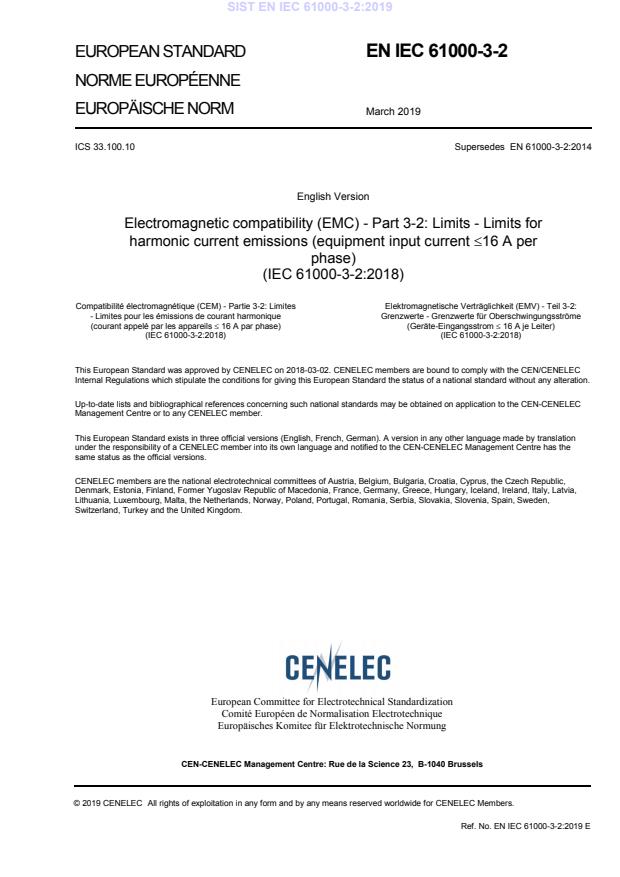
EUROPEAN STANDARD EN IEC 61000-3-2
NORME EUROPÉENNE
EUROPÄISCHE NORM
March 2019
ICS 33.100.10 Supersedes EN 61000-3-2:2014
English Version
Electromagnetic compatibility (EMC) - Part 3-2: Limits - Limits for
harmonic current emissions (equipment input current ≤16 A per
phase)
(IEC 61000-3-2:2018)
Compatibilité électromagnétique (CEM) - Partie 3-2: Limites Elektromagnetische Verträglichkeit (EMV) - Teil 3-2:
- Limites pour les émissions de courant harmonique Grenzwerte - Grenzwerte für Oberschwingungsströme
(courant appelé par les appareils ≤ 16 A par phase) (Geräte-Eingangsstrom ≤ 16 A je Leiter)
(IEC 61000-3-2:2018) (IEC 61000-3-2:2018)
This European Standard was approved by CENELEC on 2018-03-02. CENELEC members are bound to comply with the CEN/CENELEC
Internal Regulations which stipulate the conditions for giving this European Standard the status of a national standard without any alteration.
Up-to-date lists and bibliographical references concerning such national standards may be obtained on application to the CEN-CENELEC
Management Centre or to any CENELEC member.
This European Standard exists in three official versions (English, French, German). A version in any other language made by translation
under the responsibility of a CENELEC member into its own language and notified to the CEN-CENELEC Management Centre has the
same status as the official versions.
CENELEC members are the national electrotechnical committees of Austria, Belgium, Bulgaria, Croatia, Cyprus, the Czech Republic,
Denmark, Estonia, Finland, Former Yugoslav Republic of Macedonia, France, Germany, Greece, Hungary, Iceland, Ireland, Italy, Latvia,
Lithuania, Luxembourg, Malta, the Netherlands, Norway, Poland, Portugal, Romania, Serbia, Slovakia, Slovenia, Spain, Sweden,
Switzerland, Turkey and the United Kingdom.
European Committee for Electrotechnical Standardization
Comité Européen de Normalisation Electrotechnique
Europäisches Komitee für Elektrotechnische Normung
CEN-CENELEC Management Centre: Rue de la Science 23, B-1040 Brussels
© 2019 CENELEC All rights of exploitation in any form and by any means reserved worldwide for CENELEC Members.
Ref. No. EN IEC 61000-3-2:2019 E
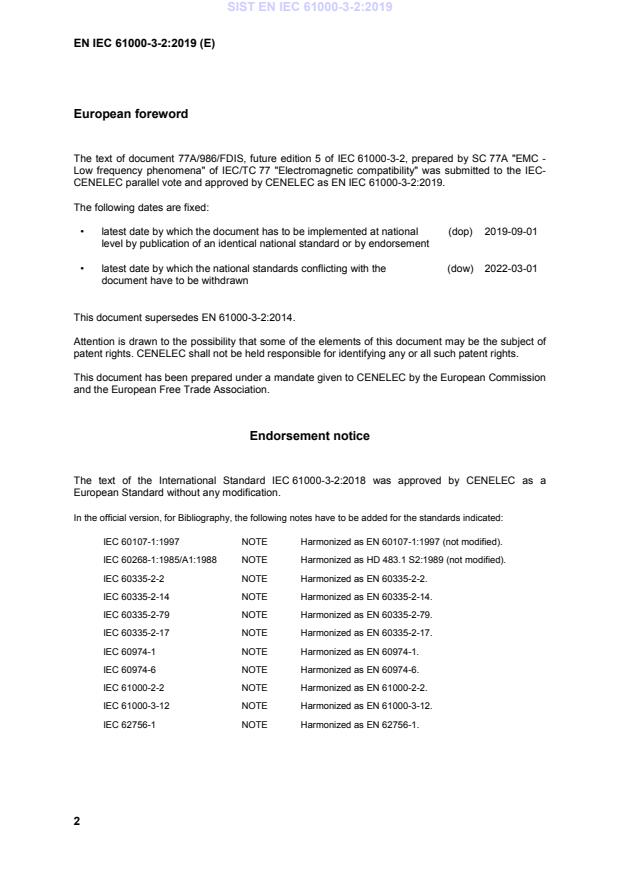
European foreword
The text of document 77A/986/FDIS, future edition 5 of IEC 61000-3-2, prepared by SC 77A "EMC -
Low frequency phenomena" of IEC/TC 77 "Electromagnetic compatibility" was submitted to the IEC-
CENELEC parallel vote and approved by CENELEC as EN IEC 61000-3-2:2019.
The following dates are fixed:
• latest date by which the document has to be implemented at national (dop) 2019-09-01
level by publication of an identical national standard or by endorsement
• latest date by which the national standards conflicting with the (dow) 2022-03-01
document have to be withdrawn
This document supersedes EN 61000-3-2:2014.
Attention is drawn to the possibility that some of the elements of this document may be the subject of
patent rights. CENELEC shall not be held responsible for identifying any or all such patent rights.
This document has been prepared under a mandate given to CENELEC by the European Commission
and the European Free Trade Association.
Endorsement notice
The text of the International Standard IEC 61000-3-2:2018 was approved by CENELEC as a
European Standard without any modification.
In the official version, for Bibliography, the following notes have to be added for the standards indicated:
IEC 60107-1:1997 NOTE Harmonized as EN 60107-1:1997 (not modified).
IEC 60268-1:1985/A1:1988 NOTE Harmonized as HD 483.1 S2:1989 (not modified).
IEC 60335-2-2 NOTE Harmonized as EN 60335-2-2.
IEC 60335-2-14 NOTE Harmonized as EN 60335-2-14.
IEC 60335-2-79 NOTE Harmonized as EN 60335-2-79.
IEC 60335-2-17 NOTE Harmonized as EN 60335-2-17.
IEC 60974-1 NOTE Harmonized as EN 60974-1.
IEC 60974-6 NOTE Harmonized as EN 60974-6.
IEC 61000-2-2 NOTE Harmonized as EN 61000-2-2.
IEC 61000-3-12 NOTE Harmonized as EN 61000-3-12.
IEC 62756-1 NOTE Harmonized as EN 62756-1.
Annex ZA
(normative)
Normative references to international publications
with their corresponding European publications
The following documents are referred to in the text in such a way that some or all of their content
constitutes requirements of this document. For dated references, only the edition cited applies. For
undated references, the latest edition of the referenced document (including any amendments)
applies.
NOTE 1 Where an International Publication has been modified by common modifications, indicated by (mod), the relevant
EN/HD applies.
NOTE 2 Up-to-date information on the latest versions of the European Standards listed in this annex is available here:
www.cenelec.eu.
Publication Year Title EN/HD Year
IEC 60050-161 - International Electrotechnical Vocabulary. - -
Chapter 161: Electromagnetic compatibility
IEC 60155 - Glow-starters for fluorescent lamps EN 60155 -
IEC 60268-3 - Sound system equipment -- Part 3: EN 60268-3 -
Amplifiers
IEC 60335-2-24 2010 Household and similar electrical appliances EN 60335-2-24 2010
- Safety - Part 2-24: Particular
requirements for refrigerating appliances,
ice-cream appliances and ice makers
IEC 61000-4-7 2002 Electromagnetic compatibility (EMC) - Part EN 61000-4-7 2002
4-7: Testing and measurement techniques
- General guide on harmonics and
interharmonics measurements and
instrumentation, for power supply systems
and equipment connected thereto
+ A1 2008 + A1 2009
IEC 61000-3-2 ®
Edition 5.0 2018-01
INTERNATIONAL
STANDARD
NORME
INTERNATIONALE
colour
inside
Electromagnetic compatibility (EMC) –
Part 3-2: Limits – Limits for harmonic current emissions (equipment input
current ≤ 16 A per phase)
Compatibilité électromagnétique (CEM) –
Partie 3-2: Limites – Limites pour les émissions de courant harmonique (courant
appelé par les appareils ≤ 16 A par phase)
INTERNATIONAL
ELECTROTECHNICAL
COMMISSION
COMMISSION
ELECTROTECHNIQUE
INTERNATIONALE
ICS 33.100.10 ISBN 978-2-8322-5250-5
– 2 – IEC 61000-3-2:2018 © IEC 2018
CONTENTS
FOREWORD . 4
INTRODUCTION . 6
1 Scope . 7
2 Normative references . 7
3 Terms and definitions . 8
4 General . 11
5 Classification of equipment . 12
5.1 General . 12
5.2 Description of lighting equipment . 12
6 General requirements . 13
6.1 General . 13
6.2 Control methods . 13
6.3 Harmonic current measurement . 14
6.3.1 Test configuration . 14
6.3.2 Measurement procedure . 15
6.3.3 General requirements . 15
6.3.4 Test observation period . 17
6.4 Equipment in a rack or case . 17
7 Harmonic current limits . 17
7.1 General . 17
7.2 Limits for Class A equipment. 18
7.3 Limits for Class B equipment. 19
7.4 Limits for Class C equipment . 19
7.4.1 General . 19
7.4.2 Rated power > 25 W . 19
7.4.3 Rated power ≥ 5 W and ≤ 25 W . 20
7.5 Limits for Class D equipment . 21
Annex A (normative) Measurement circuit and supply source . 23
A.1 Test circuit . 23
A.2 Supply source . 23
Annex B (normative) Type test conditions . 26
B.1 General . 26
B.2 Test conditions for television receivers (TV) . 26
B.2.1 General requirements . 26
B.2.2 Measurement conditions . 26
B.2.3 Test report . 27
B.3 Test conditions for audio amplifiers . 27
B.3.1 Conditions . 27
B.3.2 Input signals and loads . 27
B.4 Test conditions for video-cassette recorders . 28
B.5 Test conditions for lighting equipment . 28
B.5.1 General conditions . 28
B.5.2 Lamps . 28
B.5.3 Luminaires . 28
B.5.4 Lighting control gear . 28
IEC 61000-3-2:2018 © IEC 2018 – 3 –
B.5.5 DLT control devices . 29
B.6 Test conditions for independent phase control dimmers for lighting
equipment . 29
B.7 Test conditions for vacuum cleaners . 29
B.8 Test conditions for washing machines . 29
B.9 Test conditions for microwave ovens . 30
B.10 Test conditions for information technology equipment (ITE) . 30
B.10.1 General conditions . 30
B.10.2 Optional conditions for measuring emissions of IT equipment with
external power supplies or battery chargers . 31
B.11 Test conditions for cooking appliances . 31
B.11.1 Induction hobs and hotplates . 31
B.11.2 Hobs and hotplates other than induction cooking appliances . 32
B.12 Test conditions for air conditioners . 32
B.13 Test conditions for kitchen machines as defined in IEC 60335-2-14 . 32
B.14 Test conditions for arc welding equipment which is not professional
equipment . 32
B.15 Test conditions for high pressure cleaners which are not professional
equipment . 33
B.16 Test conditions for refrigerators and freezers . 33
B.16.1 General . 33
B.16.2 Refrigerators and freezers with VSD . 33
B.16.3 Refrigerators and freezers without VSD . 34
Bibliography . 35
Figure 1 – Flowchart for determining conformity . 18
Figure 2 – Illustration of the relative phase angle and current parameters described in
7.4.3 . 20
Figure A.1 – Measurement circuit for single-phase equipment. 24
Figure A.2 – Measurement circuit for three-phase equipment . 25
Table 1 – Limits for Class A equipment . 21
a
Table 2 – Limits for Class C equipment . 21
Table 3 – Limits for Class D equipment . 22
Table 4 – Test observation period . 22
Table B.1 – Conventional load for arc welding equipment tests . 33
– 4 – IEC 61000-3-2:2018 © IEC 2018
INTERNATIONAL ELECTROTECHNICAL COMMISSION
____________
ELECTROMAGNETIC COMPATIBILITY (EMC) –
Part 3-2: Limits – Limits for harmonic current emissions
(equipment input current ≤ 16 A per phase)
FOREWORD
1) The International Electrotechnical Commission (IEC) is a worldwide organization for standardization comprising
all national electrotechnical committees (IEC National Committees). The object of IEC is to promote
international co-operation on all questions concerning standardization in the electrical and electronic fields. To
this end and in addition to other activities, IEC publishes International Standards, Technical Specifications,
Technical Reports, Publicly Available Specifications (PAS) and Guides (hereafter referred to as “IEC
Publication(s)”). Their preparation is entrusted to technical committees; any IEC National Committee interested
in the subject dealt with may participate in this preparatory work. International, governmental and
non-governmental organizations liaising with the IEC also participate in this preparation. IEC collaborates
closely with the International Organization for Standardization (ISO) in accordance with conditions determined
by agreement between the two organizations.
2) The formal decisions or agreements of IEC on technical matters express, as nearly as possible, an international
consensus of opinion on the relevant subjects since each technical committee has representation from all
interested IEC National Committees.
3) IEC Publications have the form of recommendations for international use and are accepted by IEC National
Committees in that sense. While all reasonable efforts are made to ensure that the technical content of IEC
Publications is accurate, IEC cannot be held responsible for the way in which they are used or for any
misinterpretation by any end user.
4) In order to promote international uniformity, IEC National Committees undertake to apply IEC Publications
transparently to the maximum extent possible in their national and regional publications. Any divergence
between any IEC Publication and the corresponding national or regional publication shall be clearly indicated in
the latter.
5) IEC itself does not provide any attestation of conformity. Independent certification bodies provide conformity
assessment services and, in some areas, access to IEC marks of conformity. IEC is not responsible for any
services carried out by independent certification bodies.
6) All users should ensure that they have the latest edition of this publication.
7) No liability shall attach to IEC or its directors, employees, servants or agents including individual experts and
members of its technical committees and IEC National Committees for any personal injury, property damage or
other damage of any nature whatsoever, whether direct or indirect, or for costs (including legal fees) and
expenses arising out of the publication, use of, or reliance upon, this IEC Publication or any other IEC
Publications.
8) Attention is drawn to the Normative references cited in this publication. Use of the referenced publications is
indispensable for the correct application of this publication.
9) Attention is drawn to the possibility that some of the elements of this IEC Publication may be the subject of
patent rights. IEC shall not be held responsible for identifying any or all such patent rights.
International Standard IEC 61000-3-2 has been prepared by sub-committee 77A: EMC – Low
frequency phenomena, of IEC technical committee 77: Electromagnetic compatibility.
It forms part 3-2 of the IEC 61000 series. It has the status of a product family standard.
This fifth edition cancels and replaces the fourth edition published in 2014. This edition
constitutes a technical revision.
This edition includes the following significant technical changes with respect to the previous
edition:
a) an update of the emission limits for lighting equipment with a rated power ≤ 25 W to take
into account new types of lighting equipment;
b) the addition of a threshold of 5 W under which no emission limits apply to all lighting
equipment;
IEC 61000-3-2:2018 © IEC 2018 – 5 –
c) the modification of the requirements applying to the dimmers when operating
non-incandescent lamps;
d) the addition of test conditions for digital load side transmission control devices;
e) the removal of the use of reference lamps and reference ballasts for the tests of lighting
equipment;
f) the simplification and clarification of the terminology used for lighting equipment;
g) the classification of professional luminaires for stage lighting and studios under Class A;
h) a clarification about the classification of emergency lighting equipment;
i) a clarification for lighting equipment including one control module with an active input
power ≤ 2 W;
j) an update of the test conditions for television receivers;
k) an update of the test conditions for induction hobs, taking also into account the other
types of cooking appliances;
l) for consistency with IEC 61000-3-12, a change of the scope of IEC 61000-3-2 from
equipment with an input current ≤ 16 A to equipment with a rated input current ≤ 16 A.
The text of this standard is based on the following documents:
FDIS Report on voting
77A/986/FDIS 77A/990/RVD
Full information on the voting for the approval of this standard can be found in the report on
voting indicated in the above table.
This publication has been drafted in accordance with the ISO/IEC Directives, Part 2.
A list of all parts in the IEC 61000 series, published under the general title, Electromagnetic
compatibility (EMC), can be found on the IEC website.
The committee has decided that the contents of this publication will remain unchanged until
the stability date indicated on the IEC web site under "http://webstore.iec.ch" in the data
related to the specific publication. At this date, the publication will be
• reconfirmed,
• withdrawn,
• replaced by a revised edition, or
• amended.
IMPORTANT – The 'colour inside' logo on the cover page of this publication indicates
that it contains colours which are considered to be useful for the correct
understanding of its contents. Users should therefore print this document using a
colour printer.
– 6 – IEC 61000-3-2:2018 © IEC 2018
INTRODUCTION
IEC 61000 is published in separate parts, according to the following structure:
Part 1: General
General considerations (introduction, fundamental principles)
Definitions, terminology
Part 2: Environment
Description levels
Classification of the environment
Compatibility levels
Part 3: Limits
Emission limits
Immunity limits (in so far as they do not fall under the responsibility of the product
committees)
Part 4: Testing and measurement techniques
Measurement techniques
Testing techniques
Part 5: Installation and mitigation guidelines
Installation guidelines
Mitigation methods and devices
Part 6: Generic standards
Part 9: Miscellaneous
Each part is further subdivided into several parts, published either as international standards
or as technical specifications or technical reports, some of which have already been published
as sections. Others will be published with the part number followed by a dash and a second
number identifying the subdivision (example: IEC 61000-6-1).
IEC 61000-3-2:2018 © IEC 2018 – 7 –
ELECTROMAGNETIC COMPATIBILITY (EMC) –
Part 3-2: Limits – Limits for harmonic current emissions
(equipment input current ≤ 16 A per phase)
1 Scope
This part of IEC 61000 deals with the limitation of harmonic currents injected into the public
supply system.
It specifies limits of harmonic components of the input current which can be produced by
equipment tested under specified conditions.
This part of IEC 61000 is applicable to electrical and electronic equipment having a rated
input current up to and including 16 A per phase, and intended to be connected to public
low-voltage distribution systems.
Arc welding equipment which is not professional equipment, with a rated input current up to
and including 16 A per phase, is included in this document. Arc welding equipment intended
for professional use, as specified in IEC 60974-1, is excluded from this document and can be
subject to installation restrictions as indicated in IEC 61000-3-12.
The tests according to this document are type tests.
For systems with nominal voltages less than but not equal to 220 V (line-to-neutral), the limits
have not yet been considered.
NOTE The words apparatus, appliance, device and equipment are used throughout this document. They have the
same meaning for the purposes of this document.
2 Normative references
The following documents are referred to in the text in such a way that some or all of their
content constitutes requirements of this document. For dated references, only the edition
cited applies. For undated references, the latest edition of the referenced document (including
any amendments) applies.
IEC 60050-161, International Electrotechnical Vocabulary (IEV) – Part 161: Electromagnetic
compatibility (available at www.electropedia.org)
IEC 60155, Glow-starters for fluorescent lamps
IEC 60268-3, Sound system equipment – Part 3: Amplifiers
IEC 60335-2-24:2010, Household and similar electrical appliances – Safety – Part 2-24:
Particular requirements for refrigerating appliances, ice-cream appliances and ice makers
IEC 61000-4-7:2002, Electromagnetic compatibility (EMC) – Part 4-7: Testing and
measurement techniques – General guide on harmonics and interharmonics measurements
and instrumentation, for power supply systems and equipment connected thereto
IEC 61000-4-7:2002/AMD1:2008
– 8 – IEC 61000-3-2:2018 © IEC 2018
3 Terms and definitions
For the purposes of this document, the terms and definitions given in IEC 60050-161 and the
following apply.
ISO and IEC maintain terminological databases for use in standardization at the following
addresses:
• IEC Electropedia: available at http://www.electropedia.org/
• ISO Online browsing platform: available at http://www.iso.org/obp
3.1
portable tool
electrical tool which is hand-held during normal operation and used for a short time (a few
minutes) only
Note 1 to entry: Hand-held means that no part of the tool, except the power cord, rests on the floor during normal
operation.
3.2
lamp
source intended to produce an optical radiation, usually visible
Note 1 to entry: For the purposes of this document, a lamp can also be a solid state lighting module which can
contain further components, for example optical, electrical, mechanical and/or electronic components.
3.3
self-ballasted lamp
unit which cannot be dismantled without being permanently damaged, is provided with a lamp
cap and incorporates a light source and the lighting control gear necessary for the operation
of the light source
3.4
luminaire
apparatus which distributes, filters or transforms the light transmitted from one or more lamps
and which includes, except the lamps themselves, all the parts necessary for fixing and
protecting the lamps and, where necessary, circuit auxiliaries together with the means for
connecting them to the electric supply
[SOURCE: IEC 60050-845:1987, 845-10-01, modified – the existing notes have been
removed]
3.5
input current
current directly supplied to an equipment or a part of equipment by the AC distribution system
3.6
circuit power factor
ratio of the measured active input power to the product of the RMS supply voltage and the
RMS supply current
3.7
active power
mean value of the instantaneous power, taken over 10 (50 Hz systems) or 12 (60 Hz systems)
fundamental periods and measured in accordance with IEC 61000-4-7
Note 1 to entry: The active input power is the active power measured at the input supply terminals of the
equipment under test.
IEC 61000-3-2:2018 © IEC 2018 – 9 –
3.8
balanced three-phase equipment
equipment having rated line current modules which differ by no more than 20 %
3.9
professional equipment
equipment for use in trades, professions or industries and which is not intended for sale to the
general public, as designated by the manufacturer
[SOURCE: IEC 60050-161:1990, 161-05-05, modified – the existing Note has been replaced
by the text added at the end of the definition]
3.10
total harmonic current
THC
total RMS value of the harmonic current components of orders 2 to 40, expressed as:
THC = I
∑ h
h=2
Note 1 to entry: This note applies to the French language only.
3.11
total harmonic distortion
THD
ratio of the RMS value of the sum of the harmonic components (in this context, harmonic
current components I of orders 2 to 40) to the RMS value of the fundamental component,
h
expressed as:
I
h
THD =
∑
I
h =2
Note 1 to entry: This note applies to the French language only.
3.12
partial odd harmonic current
POHC
total RMS value of the odd harmonic current components of orders 21 to 39, expressed as:
POHC = I
∑ h
h=21,23
Note 1 to entry: This note applies to the French language only.
3.13
lighting equipment
equipment with a primary function of generating and/or regulating and/or distributing optical
radiation
Note 1 to entry: See also 5.2.
– 10 – IEC 61000-3-2:2018 © IEC 2018
3.14
stand-by mode
non-operational, low power consumption mode (usually indicated in some way on the
equipment) that can persist for an indefinite time
3.15
repeatability
closeness of the agreement between the results of measurements
of harmonic currents on the same equipment under test, carried out with the same test
system, at the same location, under identical test conditions
3.16
reproducibility
closeness of the agreement between the results of measurements
of harmonic currents on the same equipment under test, carried out with different test
systems under conditions of measurement intended to be the same in each case
Note 1 to entry: The test system and test conditions are assumed to fulfil all normative requirements in the
applicable standards.
3.17
variability
closeness of the agreement between the results of measurements
of harmonic currents on different samples of the same type of equipment under test, having
no intentional differences, carried out with different test systems under conditions of
measurement intended to be the same in each case
Note 1 to entry: The test system and test conditions are assumed to fulfil all normative requirements in the
applicable standards.
Note 2 to entry: In the context of this document, the meaning of the terms can be summarized as follows:
Term Meaning
Repeatability Same equipment under test (EUT), same test system, same test conditions, repeated tests
Reproducibility Same equipment under test (EUT), different but normative test systems, different but
normative test conditions
Variability Different equipments under test (EUTs) of the same type, having no intentional differences,
different but normative test systems, different but normative test conditions
3.18
variable speed drive
VSD
equipment, based on power electronics, which enables the speed and/or torque of a motor to
be continuously controlled
3.19
lighting control gear
device connected between the supply and one or more lamps, enabling the lamp(s) to operate
as intended
Note 1 to entry: The lighting control gear can consist of one or more separate components. It can include means
for dimming, correcting the power factor and suppressing radio interference, and further control functions.
Note 2 to entry: The lighting control gear can be partly or totally integrated in some lamps, such as in the case of
self-ballasted lamps. Any references to lighting control gear include any such integrated lamps.
Note 3 to entry: Examples of lighting control gear are ballasts or electronic control gear for discharge lamps,
step-down converters for incandescent lamps, drivers for solid state lighting modules.
Note 4 to entry: For the purposes of this document, independent phase control dimmers as defined in 3.23 and
3.24 are not considered to be lighting control gear.
IEC 61000-3-2:2018 © IEC 2018 – 11 –
Note 5 to entry: Mechanical switches and relays, and other simple devices providing on/off control only, do not
produce distorted currents and are not considered to be lighting control gear.
3.20
digital load side transmission lighting control device
DLT control device
device to control lighting parameters of electronic lighting equipment, such as light level and
light colour, using data transmission over its load side mains wiring in accordance with
IEC 62756-1
Note 1 to entry: A DLT control device is wired like a phase control dimmer, but does not directly make the supply
power delivered to the connected dedicated lighting equipment vary. It transmits digital signals over the power
cable on the load side to the dedicated lighting equipment, which contains means for receiving and interpreting
control signals as well as built-in means for dimming, colour variation, etc.
Note 2 to entry: This note applies to the French language only.
3.21
dimmer
device to control the light output level of lighting equipment
3.22
built-in dimmer
dimmer which is either contained within the enclosure of a luminaire or mounted in its supply
cable
3.23
independent dimmer
dimmer other than a built-in dimmer
3.24
phase control dimmer
electronic switch producing a leading edge (forward phase) or a trailing edge (reverse phase)
AC waveform
Note 1 to entry: This AC waveform is supplied to one or more loads and its conduction angle is adjustable.
3.25
universal phase control dimmer
phase control dimmer which is capable of switching, automatically or manually, between
producing a leading edge or a trailing edge AC waveform
3.26
professional luminaire for stage lighting and studios
luminaire (outdoor or indoor) for stage lighting or for television, film or photographic studios
within the scope of IEC 60598-2-17 and which is professional equipment
4 General
The objective of this document is to set limits for harmonic emissions of equipment within its
scope, so that, with due allowance for the emissions from other equipment, compliance with
the limits ensures that harmonic disturbance levels do not exceed the compatibility levels
defined in IEC 61000-2-2.
Professional equipment that does not comply with the requirements of this document can be
permitted to be connected to certain types of low voltage supplies, if the instruction manual
contains a requirement to ask the supply utility for permission to connect. Recommendations
concerning this aspect are contained in IEC 61000-3-12.
– 12 – IEC 61000-3-2:2018 © IEC 2018
5 Classification of equipment
5.1 General
For the purpose of harmonic current limitation, equipment is classified as follows:
Class A:
Equipment not specified as belonging to Class B, C or D shall be considered as Class A
equipment.
Some examples of Class A equipment are:
– balanced three-phase equipment;
– household appliances, excluding those specified as belonging to Class B, C or D;
– vacuum cleaners;
– high pressure cleaners;
– tools, excluding portable tools;
– independent phase control dimmers;
– audio equipment;
– professional luminaires for stage lighting and studios.
NOTE 1 Equipment that can be shown to have a significant effect on the supply system might be reclassified in a
future edition of this document, taking into account the following factors:
– number of pieces of equipment in use;
– duration of use;
– simultaneity of use;
– power consumption;
– harmonic spectrum, including phase.
Class B:
– portable tools;
– arc welding equipment which is not professional equipment.
Class C:
– lighting equipment.
Class D:
Equipment having a specified power according to 6.3.2, less than or equal to 600 W, of the
following types:
– personal computers and personal computer monitors;
– television receivers;
– refrigerators and freezers having one or more variable-speed drives to control compressor
motor(s).
NOTE 2 Class D limits are reserved for equipment that, by virtue of the factors listed in note 1, can be shown to
have a pronounced effect on the public electricity supply system.
5.2 Description of lighting equipment
In this document, lighting equipment as defined in 3.13 includes:
– lamps and luminaires;
IEC 61000-3-2:2018 © IEC 2018 – 13 –
– the lighting part of multi-function equipment where one of the primary functions of this is
illumination;
– independent lighting control gear;
– ultraviolet (UV) and infrared (IR) radiation equipment;
– illuminated advertising signs;
– independent dimmers, other than phase control types, for lighting equipment;
– DLT control devices.
In this document, lighting equipment as defined in 3.13 excludes:
– lighting devices built in equipment with another primary purpose, such as photocopiers,
overhead projectors and slide projectors, or employed for scale illumination or indication
purposes;
– household appliances whose primary function is not for generating and/or regulating
and/or distributing optical radiation but which contain one or more lamps with or without a
separate switch (e.g. a range hood with a built-in lamp);
– independent phase control dimmers;
– professional luminaires for stage lighting and studios;
– emergency luminaires that emit light only during emergency mode.
6 General requirements
6.1 General
The restrictions specified in 6.2 also apply to the categories of equipment listed in 7.1 for
which no harmonic current limits apply.
The requirements and limits specified in this document are applicable to the power input
terminals of equipment intended to be connected to 220/380 V, 230/400 V and 240/415 V
systems operating at 50 Hz or 60 Hz. Requirements and limits for other cases are not yet
specified.
A simplified test method is permitted for equipment that undergoes minor changes or updates,
provided that, in previous full compliance tests, it has been shown to have current emissions
below 60 % of the applicable limits and the THD of the supply current is less than 15 %. The
simplified test method consists of verifying that the updated equipment has an active input
power within ±20 % of that of the originally tested product, and that the THD of the supply
current is less than 15 %. Products that fulfill these requirements are deemed to comply with
the applicable limits, but in case of doubt the result of a full compliance test according to
Clauses 6 and 7 takes precedence over this simplified method.
6.2 Control methods
Asymmetrical controls according to IEC 60050-161:1990, 161-07-12, and half-wave
rectification directly on the mains supply may only be used in the following circumstances:
a) where they are the only practical solution permitting the detection of unsafe conditions, or
b) where the controlled active input power is less than or equal to 100 W, or
c) where the controlled appliance is a portable equipment fitted with a two-core flexible cord
and is intended for use for a short period of time, i.e. for a few minutes only.
If one of these three conditions is fulfilled, half-wave rectification may be used for any
purpose, whereas asymmetrical controls may only be used for the control of motors.
NOTE 1 Such equipment includes, but is not limited to, hair dryers, electrical kitchen appliances and portable
tools.
– 14 – IEC 61000-3-2:2018 © IEC 2018
th
Symmetrical control methods which can produce harmonics up to the 40 order in the input
current may be used for the control of the power supplied to heating elements provided that
the full sine-wave input power is less than or equal to 200 W, or that the limits of Table 3 are
not exceeded.
Such symmetrical control methods are also allowed for professional equipment provided that
either
a) one of the above conditions is fulfilled, or
b) the relevant emission limits according to Clause 7 are not exceeded when tested at the
supply input terminals and in addition both the following conditions are fulfilled:
1) it is necessary to control precisely the temperature of a heater whose thermal time
constant is less than 2 s, and
2) there is no other technique economically available.
Professional equipment whose primary purpose, considered as a whole, is not for heating,
shall be tested against the relevant emission limits according to Clause 7.
NOTE 2 An example of a product whose primary purpose is not heating is a photocopier, whereas a cooker is
considered to have heating as its primary purpose.
Domestic equipment with symmetrical control used for a short time (for example hair dryers)
shall be tested under Class A.
Even though asymmetrical controls and half-wave rectification are permitted under the
conditions given above, the equipment shall still comply with the harmonic requirements of
this document.
NOTE 3 When using asymmetrical controls or half-wave rectification under the above circumstances, the input
current has a DC component that can disturb certain types of protection devices in case of an earth fault. See
IEC TR 60755.
6.3 Harmonic current measurement
6.3.1 Test configuration
Harmonic components shall be measured in accordance with the requirements given in
Annex A for the test circuit and the supply source.
Specific test conditions for the measurement of harmonic currents associated with some types
of equipment are given in Annex B.
For equipment not mentioned in Annex B, emission tests shall be conducted with the user's
operation controls or automatic programs set to the mode expected to produce the maximum
total harmonic current (THC) under normal operating conditions. This defines the equipment
set-up during emission tests and not a requirement to measure THC or to conduct searches
for worst-case emissions.
The harmonic current limits specified in Clause 7 apply to line currents and not to currents in
the neutral conductor. Nevertheless, for single-phase equipment, it is permissible to measure
the currents in the neutral conductor instead o
...
ba
SLOVENSKI SIST EN IEC 61000-3-2
STANDARD junij 2019
Elektromagnetna združljivost (EMC) – 3-2. del: Mejne vrednosti –
Mejne vrednosti za oddajanje harmonskih tokov (vhodni tok opreme do
vključno 16 A na fazo)
Electromagnetic compatibility (EMC) – Part 3-2: Limits – Limits for harmonic
current emissions (equipment input current ≤ 16 A per phase)
Compatibilité électromagnétique (CEM) – Partie 3-2: Limites – Limites pour les
émissions de courant harmonique (courant appelé par les appareils ≤ 16 A par
phase)
Elektromagnetische Verträglichkeit (EMV) – Teil 3-2: Grenzwerte – Grenzwerte
für Oberschwingungsströme (Geräte-Eingangsstrom ≤ 16 A je Leiter)
Referenčna oznaka
ICS 33.100.10 SIST EN IEC 61000-3-2:2019 (sl)
Nadaljevanje na straneh II do III in od 1 do 37
© 2020-10. Standard je založil in izdal Slovenski inštitut za standardizacijo. Razmnoževanje celote ali delov tega standarda ni dovoljeno.
SIST EN IEC 61000-3-2 : 2019
NACIONALNI UVOD
Standard SIST EN IEC 61000-3-2 (sl), Elektromagnetna združljivost (EMC) – 3-2. del: Mejne vrednosti
– Mejne vrednosti za oddajanje harmonskih tokov (vhodni tok opreme do vključno 16 A na fazo), 2019,
ima status slovenskega standarda in je istoveten evropskemu standardu EN IEC 61000-3-2 (en),
Electromagnetic compatibility (EMC) – Part 3-2: Limits – Limits for harmonic current emissions
(equipment input current ≤16 A per phase), 2019.
Ta standard nadomešča SIST EN 61000-3-2:2014.
NACIONALNI PREDGOVOR
Evropski standard EN IEC 61000-3-2:2019 je pripravil tehnični odbor Evropske organizacije za
standardizacijo na področju elektrotehnike CENELEC CLC/TC 210 Elektromagnetna združljivost
(EMC). Slovenski standard SIST EN IEC 61000-3-2:2019 je prevod evropskega standarda EN IEC
61000-3-2:2019. V primeru spora glede besedila slovenskega prevoda v tem standardu je odločilen
izvirni evropski standard v angleškem jeziku. Slovensko izdajo standarda je pripravil tehnični odbor
SIST/TC EMC Elektromagnetna združljivost.
Odločitev za privzem tega standarda je v juniju 2019 sprejel tehnični odbor SIST/TC EMC
Elektromagnetna združljivost.
ZVEZE S STANDARDI
S privzemom tega evropskega standarda veljajo za omejeni namen referenčnih standardov vsi
standardi, navedeni v izvirniku, razen tistih, ki so že sprejeti v nacionalno standardizacijo:
SIST IEC 60050-161 Mednarodni elektrotehniški slovar – 161. del: Elektromagnetna združljivost
SIST EN 60155 Tlivni starterji za fluorescenčne sijalke
SIST EN 60268-3 Elektroakustične naprave – 3. del: Ojačevalniki
SIST EN 60335-2-24:2011 Gospodinjski in podobni električni aparati – Varnost – 2-24. del: Posebne
zahteve za hladilnike, zamrzovalnike in aparate za pripravo sladoleda in
ledu
SIST EN 61000-4-7:2003 Elektromagnetna združljivost (EMC) – 4-7. del: Preskusne in merilne
tehnike – Splošno vodilo za meritve in merilno opremo za merjenje
harmonikov in medharmonikov v napajalnih omrežjih in nanje priključeno
opremo
OSNOVA ZA IZDAJO STANDARDA
– EN IEC 61000-3-2:2019
PREDHODNA IZDAJA
– SIST EN 61000-3-2:2014
OPOMBE
– Povsod, kjer se v besedilu standarda uporablja izraz "evropski standard" ali "mednarodni standard"
v SIST EN IEC 61000-3-2:2019 to pomeni "slovenski standard".
– Nacionalni uvod in nacionalni predgovor nista sestavni del standarda.
II
SIST EN 13108-7 : 2017
– Ta nacionalni dokument je istoveten EN IEC 61000-3-2:2019 in je objavljen z dovoljenjem:
Upravni center CEN-CENELEC
Rue de la Science 23
B-1040 Bruselj
This national document is identical with EN IEC 61000-3-2:2019 and is published with the
permission of
CEN-CENELEC Management Centre
Rue de la Science 23
B -1000 Brussels
POMEMBNO: Logotip "v barvah" na platnicah te publikacije opozarja, da vsebuje barve, ki so potrebne
za pravilno razumevanje njene vsebine. Uporabniki naj zato tiskajo ta dokument z barvnim tiskalnikom.
III
SIST EN IEC 61000-3-2 : 2019
(prazna stra)
IV
EVROPSKI STANDARD EN IEC 61000-3-2
EUROPEAN STANDARD
NORME EUROPÉENNE
marec 2019
EUROPÄISCHE NORM
ICS 33.100.10 Nadomešča EN 61-3-2:2014
Slovenska izdaja
Elektromagnetna združljivost (EMC) – 3-2. del: Mejne vrednosti –
Mejne vrednosti za oddajanje harmonskih tokov (vhodni tok opreme
do vključno 16 A na fazo)
Electromagnetic compatibility Compatibilité électromagnétique ktromagnetische Verträglichkeit
(EMC) – Part 3-2: Limits – (CEM) – Partie 3-2: Limites – (EMV) – Teil 3-2: Grenzwerte –
Limits for harmonic current Limites pour les émissions de Grenzwerte für
emissions (equipment input courant harmonique (courant Oberschwingungsströme
current ≤ 16 A per phase) appelé par les appareils ≤ 16 A (Geräte-Eingangsstrom ≤ 16 A
par phase) je Leiter)
Ta evropski standard je CENELEC sprejel 2. marca 2018. Člani CENELEC morajo izpolnjevati notranje
predpise CEN/CENELEC, s katerimi so predpisani pogoji za privzem tega evropskega standarda na
nacionalno raven brez kakršnihkoli sprememb.
Najnovejši seznami teh nacionalnih standardov z njihovimi bibliografskimi podatki se na zahtevo lahko
dobijo pri Upravnem centru CEN-CENELEC ali kateremkoli članu CENELEC.
Ta evropski standard obstaja v treh uradnih izdajah (angleški, francoski in nemški). Izdaje v drugih
jezikih, ki jih člani CENELEC na lastno odgovornost prevedejo in izdajo ter prijavijo pri Upravnem centru
CEN-CENELEC, veljajo kot uradne izdaje.
Člani CENELEC so nacionalni elektrotehniški komiteji Avstrije, Belgije, Bolgarije, Cipra, Češke
republike, Danske, Estonije, Finske, Francije, Hrvaške, Grčije, Irske, Islandije, Italije, Latvije, Litve,
Luksemburga, Malte, Nekdanje jugoslovanske republike Makedonije, Madžarske, Nemčije,
Nizozemske, Norveške, Poljske, Portugalske, Romunije, Slovaške, Slovenije, Srbije, Španije, Švedske,
Švice, Turčije in Združenega kraljestva.
CENELEC
Evropski komite za standardizacijo v elektrotehniki
European Committee for Electrotechnical Standardization
Comité Européen de Normalisation Electrotechnique
Europäisches Komitee für Elektrotechnische Normung
Upravni center CEN-CENELEC: Rue de la Science 23, B1000 Brussels
© 2019 CENELEC Lastnice avtorskih pravic so vse države članice CENELEC. Ref. oznaka EN IEC 61000-3-2:2019 E
SIST EN IEC 61000-3-2 : 2019
Evropski predgovor
Besedilo dokumenta 77A/986/FDIS, prihodnje 5. izdaje IEC 61000-3-2, ki ga je pripravil pododbor SC
77A "EMC – Nizkofrekvenčni pojavi" pri tehničnem odboru IEC/TC 77 "Elektromagnetna združljivost",
je bilo predloženo v vzporedno glasovanje IEC-CENELEC in ga je CENELEC sprejel kot EN IEC 61000-
3-2:2019.
Določena sta bila naslednja datuma:
(dop) 2019-09-01
zadnji datum, do katerega mora EN dobiti status
nacionalnega standarda bodisi z objavo istovetnega
besedila ali z razglasitvijo
(dow) 2022-03-01
zadnji datum, do katerega je treba razveljaviti
nacionalne standarde, ki so v nasprotju z EN
Ta dokument nadomešča EN 61000-3-2:2014.
Opozoriti je treba na možnost, da bi lahko bil kateri od elementov tega dokumenta predmet patentnih
pravic. CEN in CENELEC nista odgovorna za identificiranje nobene od teh patentnih pravic.
Ta dokument je bil pripravljen v okviru mandata, ki sta ga Evropska komisija in Evropsko združenje za
prosto trgovino dala CENELEC.
Razglasitvena objava
Besedilo mednarodnega standarda IEC 61000-3-2:2018 je CENELEC odobril kot evropski standard
brez kakršnihkoli sprememb.
V literaturi, navedeni v uradni izdaji, je treba dodati naslednje opombe k navedenim standardom:
IEC 60107-1:1997 OPOMBA Harmoniziran kot EN 60107-1:1997 (ni spremenjen)
IEC 60268-1:1985/A1:1988 OPOMBA Harmoniziran kot HD 483.1 S2:1989 (ni spremenjen)
IEC 60335-2-2 OPOMBA Harmoniziran kot EN 60335-2-2
IEC 60335-2-14 OPOMBA Harmoniziran kot EN 60335-2-14
IEC 60335-2-79 OPOMBA Harmoniziran kot EN 60335-2-79
IEC 60335-2-17 OPOMBA Harmoniziran kot EN 60335-2-17
IEC 60974-1 OPOMBA Harmoniziran kot EN 60974-1
IEC 60974-6 OPOMBA Harmoniziran kot EN 60974-6
IEC 61000-2-2 OPOMBA Harmoniziran kot EN 61000-2-2
IEC 61000-3-12 OPOMBA Harmoniziran kot EN 61000-3-12
IEC 62756-1 OPOMBA Harmoniziran kot EN 62756-1
SIST EN IEC 61000-3-2 : 2019
Dodatek ZA
(normativni)
Normativna sklicevanja na mednarodne publikacije z njihovimi ustreznimi
evropskimi publikacijami
Naslednji dokumenti so v besedilu navedeni tako, da del ali celotna njihova vsebina predstavlja zahteve
tega dokumenta. Pri datiranih sklicevanjih se uporablja zgolj navedena izdaja. Pri nedatiranih
sklicevanjih se uporablja zadnja izdaja navedenega dokumenta (vključno z dopolnili).
OPOMBA 1: Kadar je neka mednarodna publikacija spremenjena s skupno spremembo, označeno z (mod), je treba uporabiti
ustrezni EN/HD.
OPOMBA 2: Najnovejše informacije o najnovejših izdajah evropskih standardov, naštetih v tem dodatku, so na voljo tukaj:
www.cenelec.eu.
Publikacija Leto Naslov EN/HD Leto
IEC 60050-161 - Mednarodni elektrotehniški slovar – - -
161. del: Elektromagnetna združljivost
IEC 60155 - Tlivni starterji za fluorescenčne sijalke EN 60155 -
IEC 60268-3 - Elektroakustične naprave – 3. del: EN 60268-3 -
Ojačevalniki
IEC 60335-2-24 2010 Gospodinjski in podobni električni EN 60335-2- 2010
aparati – Varnost – 2-24. del: Posebne 24
zahteve za hladilnike, zamrzovalnike
in aparate za pripravo sladoleda in
ledu
IEC 61000-4-7 2002 Elektromagnetna združljivost (EMC) – EN 61000-4-7 2002
4-7. del: Preskusne in merilne tehnike
– Splošno vodilo za meritve in merilno
opremo za merjenje harmonikov in
medharmonikov v napajalnih omrežjih
in nanje priključeno opremo
+ A1 2008 + A1 2009
SIST EN IEC 61000-3-2 : 2019
VSEBINA Stran
Predgovor . 6
Uvod . 8
1 Področje uporabe . 9
2 Zveze s standardi . 9
3 Izrazi in definicije . 9
4 Splošno . 13
5 Razvrstitev opreme . 13
5.1 Splošno . 13
5.2 Opis svetlobne opreme. 14
6 Splošne zahteve . 15
6.1 Splošno . 15
6.2 Krmilne metode . 15
6.3 Meritve harmonskega toka . 16
6.3.1 Konfiguracija preskusa . 16
6.3.2 Merilni postopek . 16
6.3.3 Splošne zahteve . 17
6.3.4 Opazovalno obdobje preskusa . 18
6.4 Oprema v stojalu ali ohišju . 19
7 Mejne vrednosti harmonskega toka . 19
7.1 Splošno . 19
7.2 Mejne vrednosti za opremo razreda A . 21
7.3 Mejne vrednosti za opremo razreda B . 21
7.4 Mejne vrednosti za opremo razreda C . 21
7.4.1 Splošno . 21
7.4.2 Naznačena moč > 25 W . 21
7.4.3 Naznačena moč ≥ 5 W in ≤ 25 W . 22
7.5 Mejne vrednosti za opremo razreda D . 23
Dodatek A (normativni): Merilni tokokrog in vir napajanja . 25
A.1 Preskusno vezje . 25
A.2 Vir napajanja . 25
Dodatek B (normativni): Pogoji za preskus tipa . 28
B.1 Splošno . 28
B.2 Preskusni pogoji za televizijske sprejemnike (TV) . 28
B.2.1 Splošne zahteve . 28
B.2.2 Merilni pogoji . 28
B.2.3 Poročilo o preskusu . 29
B.3 Preskusni pogoji za zvočne ojačevalnike . 29
B.3.1 Pogoji . 29
B.3.2 Vhodni signali in obremenitve . 29
SIST EN IEC 61000-3-2 : 2019
B.4 Preskusni pogoji za videorekorderje . 30
B.5 Preskusni pogoji za svetlobno opremo . 30
B.5.1 Splošni pogoji . 30
B.5.2 Sijalke . 30
B.5.3 Svetilke . 30
B.5.4 Svetlobno krmilje . 30
B.5.5 DLT-krmilne naprave. 30
B.6 Preskusni pogoji za samostojne fazno krmiljene zatemnilnike svetlobne opreme . 31
B.7 Preskusni pogoji za sesalnike . 31
B.8 Preskusni pogoji za pralne stroje . 31
B.9 Preskusni pogoji za mikrovalovne pečice . 32
B.10 Preskusni pogoji za opremo informacijske tehnologije (ITE) . 32
B.10.1 Splošni pogoji . 32
B.10.2 Izbirni pogoji za merjenje oddajanja opreme informacijske tehnologije
z zunanjimi napajalniki ali baterijskimi polnilniki . 33
B.11 Preskusni pogoji za kuhalne aparate . 33
B.11.1 Indukcijske kuhalne plošče in električne kuhalne plošče . 33
B.11.2 Kuhalne plošče in električne kuhalne plošče, razen indukcijskih kuhalnih aparatov . 34
B.12 Preskusni pogoji za klimatske naprave . 34
B.13 Preskusni pogoji za kuhinjske stroje, kot so opredeljeni v IEC 60335-2-14 . 34
B.14 Preskusni pogoji za opremo za obločno varjenje, ki ni profesionalna oprema . 34
B.15 Preskusni pogoji za visokotlačne čistilnike, ki niso profesionalna oprema . 35
B.16 Preskusni pogoji za hladilnike in zamrzovalnike . 35
B.16.1 Splošno . 35
B.16.2 Hladilniki in zamrzovalniki, ki imajo pogon s spremenljivo hitrostjo (VSD) . 35
B.16.3 Hladilniki in zamrzovalniki brez pogona s spremenljivo hitrostjo (VSD) . 36
Literatura. 37
Slika 1: Diagram poteka za ugotavljanje skladnosti . 20
Slika 2: Prikaz relativnega faznega kota in tokovnih parametrov, opisanih v 7.4.3 . 22
Slika A.1: Merilno vezje za enofazno opremo . 26
Slika A.2: Merilno vezje za trifazno opremo . 27
Preglednica 1: Mejne vrednosti za opremo razreda A . 23
Preglednica 2: Mejne vrednosti za opremo razreda C . 23
Preglednica 3: Mejne vrednosti za opremo razreda D . 24
Preglednica 4: Opazovalno obdobje preskusa . 24
Preglednica B.1: Običajna obremenitev pri preskusih opreme za obločno varjenje . 34
SIST EN IEC 61000-3-2 : 2019
MEDNARODNA ELEKTROTEHNIŠKA KOMISIJA
ELEKTROMAGNETNA ZDRUŽLJIVOST (EMC) –
3-2. del: Mejne vrednosti – Mejne vrednosti za oddajanje harmonskih tokov
(vhodni tok opreme do vključno 16 A na fazo)
Predgovor
1) IEC (Mednarodna elektrotehniška komisija) je svetovna organizacija za standardizacijo, ki združuje vse nacionalne
elektrotehnične komiteje (nacionalni komiteji IEC). Cilj IEC je pospeševati mednarodno sodelovanje v vseh vprašanjih
standardizacije s področja elektrotehnike in elektronike. V ta namen poleg drugih aktivnosti izdaja mednarodne standarde,
tehnične specifikacije, tehnična poročila, javnosti dostopne specifikacije (PAS) in vodila (v nadaljevanju: publikacije IEC). Za
njihovo pripravo so odgovorni tehnični odbori. Vsak nacionalni komite IEC, ki ga zanima obravnavana tema, lahko sodeluje v
tem pripravljalnem delu. Prav tako lahko v pripravi sodelujejo mednarodne organizacije ter vladne in nevladne ustanove, ki
so povezane z IEC. IEC deluje v tesni povezavi z mednarodno organizacijo za standardizacijo ISO skladno s pogoji,
določenimi v soglasju med obema organizacijama.
2) Uradne odločitve ali sporazumi IEC o tehničnih vprašanjih, pripravljeni v tehničnih odborih, v katerih so prisotni vsi nacionalni
komiteji, ki jih tema zanima, izražajo, kolikor je mogoče, mednarodno soglasje o obravnavani temi.
3) Publikacije IEC imajo obliko priporočil za njihovo uporabo na mednarodni ravni in jih kot takšne sprejmejo nacionalni komiteji
IEC. Čeprav IEC skuša na vse primerne načine zagotavljati točnost tehničnih vsebin v publikacijah IEC, IEC ne more biti
odgovoren za način, kako se določila uporabljajo, ter za morebitne napačne razlage končnih uporabnikov.
4) Da bi pospeševali mednarodno poenotenje, so se nacionalni komiteji IEC zavezali, da bodo v svojih nacionalnih in regionalnih
standardih čim pregledneje uporabljali mednarodne standarde. Vsako odstopanje med standardom IEC in ustreznim
nacionalnim ali regionalnim standardom je treba v slednjem jasno označiti.
5) IEC ni določil nobenega postopka označevanja, ki bi kazal na njegovo potrditev, in ne more biti odgovoren za katerokoli
opremo, ki bi bila deklarirana kot skladna z eno od njegovih publikacij.
6) Vsi uporabniki naj bi si zagotovili zadnjo izdajo teh publikacij.
7) IEC ali njegovi direktorji, zaposleni, uslužbenci ali agenti, vključno s samostojnimi strokovnjaki ter člani tehničnih odborov in
nacionalnih komitejev IEC, ne prevzemajo nobene odgovornosti za kakršnokoli osebno poškodbo, škodo na premoženju ali
katerokoli drugo škodo kakršnekoli vrste, bodisi posredne ali neposredne, ali za stroške (vključno z zakonitim lastništvom) in
izdatke, povezane s publikacijo, njeno uporabo ali zanašanjem na to publikacijo IEC ali katerokoli drugo publikacijo IEC.
8) Pozornost je treba posvetiti normativnim virom, na katere se sklicuje ta publikacija. Uporaba navedenih publikacij je nujna za
pravilno uporabo te publikacije.
9) Opozoriti je treba na možnost, da bi lahko bil kateri od elementov tega mednarodnega standarda predmet patentnih pravic.
IEC ni odgovoren za identificiranje nobene od teh patentnih pravic.
Mednarodni standard IEC 61000-3-2 je pripravil pododbor SC 77A EMC – Nizkofrekvenčni pojavi pri
tehničnem odboru IEC/TC 77 Elektromagnetna združljivost.
Predstavlja 3-2. del iz skupine standardov IEC 61000. Ima status standarda za družino proizvodov.
Ta peta izdaja razveljavlja in nadomešča četrto izdajo, izdano leta 2014. Ta izdaja pomeni tehnično
revizijo.
Ta izdaja vključuje naslednje pomembne tehnične spremembe glede na prejšnjo izdajo:
a) posodobitev mejnih vrednosti oddajanja za svetlobno opremo z naznačeno močjo ≤ 25 W, ki jih
morajo upoštevati nove vrste svetlobne opreme;
b) dodatek praga 5 W, pod katerim ne veljajo nobene mejne vrednosti oddajanja za vso svetlobno
opremo;
c) sprememba zahtev, ki veljajo za zatemnilnike pri obratovanju z žarnicami brez žarilne nitke;
d) dodatek preskusnih pogojev za omrežno priključene krmilne naprave za prenos digitalnih bremen;
SIST EN IEC 61000-3-2 : 2019
e) odstranitev referenčnih sijalk in referenčnih predstikalnih naprav pri preskušanju svetlobne opreme;
f) poenostavitev in razjasnitev terminologije, ki se uporablja za svetlobno opremo;
g) razvrstitev profesionalnih svetilk za odrsko razsvetljavo in studie v razredu A;
h) pojasnilo o razvrstitvi opreme za zasilno razsvetljavo;
i) pojasnilo o svetlobni opremi, ki vključuje en krmilni modul z vhodno delovno močjo ≤ 2 W;
j) posodobitev preskusnih pogojev za televizijske sprejemnike;
k) posodobitev preskusnih pogojev za indukcijske kuhalne plošče ob upoštevanju drugih vrst kuhalnih
aparatov;
l) zaradi skladnosti z IEC 61000-3-12, sprememba področja uporabe IEC 61000-3-2 z opreme z
vhodnim tokom ≤ 16 A na opremo z naznačenim vhodnim tokom ≤ 16 A.
Besedilo tega standarda temelji na naslednjih dokumentih:
FDIS Poročilo o glasovanju
77A/986/FDIS 77A/990/RVD
Popolna informacija o glasovanju za potrditev tega standarda je v poročilu o glasovanju, ki je navedeno
v zgornji preglednici.
Ta publikacija je bila pripravljena ustrezno z 2. delom Direktiv ISO/IEC.
Seznam vseh delov skupine IEC 61000, izdanih s splošnim naslovom Elektromagnetna združljivost
(EMC), je na voljo na spletni strani IEC.
Odbor je sklenil, da bo ostala vsebina te publikacije nespremenjena do datuma stabilnosti, navedenega
na spletni strani IEC na naslovu "http://webstore.iec.ch" pri podatkih za to publikacijo. Po tem datumu
bo publikacija
ponovno potrjena,
razveljavljena,
zamenjana z novo izdajo ali
dopolnjena.
POMEMBNO: Logotip "v barvah" na platnicah te publikacije opozarja, da vsebuje barve, ki so potrebne
za pravilno razumevanje njene vsebine. Uporabniki naj zato tiskajo ta dokument z barvnim tiskalnikom.
SIST EN IEC 61000-3-2 : 2019
Uvod
IEC 61000 je objavljen v ločenih delih ustrezno z naslednjo strukturo:
1. del: Splošno
Splošni vidiki (uvod, temeljna načela)
Definicije, terminologija
2. del: Okolje
Opis okolja
Klasifikacija okolja
Ravni združljivosti
3. del: Mejne vrednosti
Mejne vrednosti oddajanja
Mejne vrednosti odpornosti
(dokler niso uvrščene v delovno področje odborov za proizvode)
4. del: Preskusne in merilne tehnike
Merilne tehnike
Preskusne tehnike
5. del: Navodila za namestitev in ublažitev
Navodila za namestitev
Metode in naprave za blaženje
6. del: Osnovni standardi
9. del: Razno
Vsak del je v nadaljevanju razdeljen v več delov, ki so objavljeni kot mednarodni standardi ali tehnična
poročila/specifikacije, nekateri od njih so bili tudi objavljeni kot sekcije. Drugi bodo objavljeni s številko
dela, ki ji sledi črtica in druga številka, ki označuje poddelitev (primer: IEC 61000-6-1).
SIST EN IEC 61000-3-2 : 2019
Elektromagnetna združljivost (EMC) – 3-2. del: Mejne vrednosti – Mejne vrednosti za
oddajanje harmonskih tokov (vhodni tok opreme do vključno 16 A na fazo)
1 Področje uporabe
Ta del IEC 61000 obravnava omejevanje harmonskih tokov, ki so vrinjeni v javni sistem napajanja.
Določa mejne vrednosti harmonskih komponent vhodnega toka, ki jih lahko proizvede oprema,
preskušena pod določenimi pogoji.
Ta del IEC 61000 se uporablja za električno in elektronsko opremo z naznačenim vhodnim tokom do
vključno 16 A na fazo in je namenjena priključitvi v javne nizkonapetostne distribucijske sisteme.
V tem dokumentu je vključena oprema za obločno varjenje, ki ni profesionalna oprema, z naznačenim
vhodnim tokom do vključno 16 A na fazo. Oprema za obločno varjenje, namenjena profesionalni
uporabi, kot je določeno v IEC 60974-1, je izključena iz tega dokumenta in lahko zanjo veljajo omejitve
namestitve, kot je navedeno v IEC 61000-3-12.
Preskusi po tem dokumentu so preskusi tipa.
Za sisteme z nazivnimi napetostmi, ki so nižje od 220 V, vendar ne enake tej vrednosti (linijski vodnik-
nevtralni vodnik), mejne vrednosti še niso obravnavane.
OPOMBA: V tem dokumentu se uporabljajo besede aparat, naprava in oprema. Za namene tega dokumenta imajo enak
pomen.
2 Zveze s standardi
Naslednji dokumenti so v besedilu navedeni tako, da del ali celotna njihova vsebina predstavlja zahteve
tega dokumenta. Pri datiranih sklicevanjih se uporablja le navedena izdaja. Pri nedatiranih sklicevanjih
se uporablja zadnja izdaja publikacije (vključno z dopolnili).
IEC 60050-161 Mednarodni elektrotehniški slovar – 161. del: Elektromagnetna združljivost
(na voljo na www.electropedia.org)
IEC 60155 Tlivni starterji za fluorescenčne sijalke
IEC 60268-3-2 Elektroakustične naprave – 3. del: Ojačevalniki
IEC 60335-2-24:2010 Gospodinjski in podobni električni aparati – Varnost – 2-24. del: Posebne
zahteve za hladilnike, zamrzovalnike in aparate za pripravo sladoleda in ledu
IEC 61000-4-7:2002 Elektromagnetna združljivost (EMC) – 4-7. del: Preskusne in merilne tehnike
– Splošno vodilo za meritve in merilno opremo za merjenje harmonikov in
medharmonikov v napajalnih omrežjih in nanje priključeno opremo
IEC 61000-4-7:2002/AMD1:2008
3 Izrazi in definicije
V tem dokumentu se uporabljajo izrazi in definicije iz IEC 60050-161 in spodaj navedeni.
ISO in IEC vzdržujeta terminološke zbirke podatkov za uporabo pri standardizaciji na naslednjih
naslovih:
– IEC Electropedia: na voljo na spletni strani http://www.electropedia.org/
– ISO platforma za brskanje po spletu: na voljo na naslovu http://www.iso.org/obp
SIST EN IEC 61000-3-2 : 2019
3.1
prenosno orodje
električno orodje, ki se med normalno uporabo drži v roki in se uporablja le kratek čas (nekaj minut)
OPOMBA: Da se drži v roki, pomeni, da med normalno uporabo noben del orodja, razen priključnega kabla, ni na tleh.
3.2
sijalka
vir, namenjen proizvajanju optičnega sevanja, navadno vidnega
OPOMBA: V tem dokumentu je sijalka lahko tudi polprevodniški svetleči modul, ki lahko vsebuje dodatne komponente, na
primer optične, električne, mehanske in/ali elektronske komponente.
3.3
sijalka z vgrajenim balastom
enota, ki je ni mogoče razstaviti brez trajnih poškodb, opremljena je z vznožkom ter ima vgrajena
svetlobni vir in svetlobno krmilje, ki sta potrebna za delovanje svetlobnega vira
3.4
svetilka
aparat, ki razdeljuje, filtrira ali transformira svetlobo, ki jo oddaja(-jo) ena ali več sijalk(-), in ki vključuje,
razen samih sijalk, vse potrebne dele za pritrditev in zaščito sijalk ter po potrebi pomožne tokokroge
skupaj s sredstvi za njihovo priključitev na električno napajanje
[VIR: IEC 60050-845:1987, 845-10-01, spremenjen – opombe so odstranjene]
3.5
vhodni tok
tok, s katerim izmenični napajalni sistem neposredno napaja opremo ali del opreme
3.6
faktor moči tokokroga
razmerje izmerjene delovne vhodne moči ter zmnožka efektivne napajalne napetosti in efektivnega
napajalnega toka
3.7
delovna moč
srednja vrednost trenutne moči, zajeta v 10 (50 Hz) ali 12 (60 Hz) temeljnih periodah in merjena v skladu
z IEC 61000-4-7
OPOMBA: Delovna vhodna moč je delovna moč, izmerjena na vhodnih napajalnih priključkih preskušane opreme.
3.8
uravnotežena trifazna oprema
oprema z naznačenimi linijskimi tokovnimi moduli, ki se razlikujejo za največ 20 %
3.9
profesionalna oprema
oprema za uporabo v trgovini, obrti ali industriji, ki ni namenjena za prodajo splošni javnosti; opredelitev
določi proizvajalec
[VIR: IEC 60050-161:1990, 161-05-05, spremenjen – opomba je zamenjana z besedilom, dodanim na
koncu definicije]
3.10
celotni harmonski tok
THC
celotna efektivna vrednost komponent harmonskega toka redov 2 do 40, izražena kot:
SIST EN IEC 61000-3-2 : 2019
OPOMBA: Ta opomba velja samo za francoski jezik.
3.11
celotno harmonsko popačenje
THD
razmerje efektivne vrednosti vsote harmonskih komponent (v tem kontekstu komponent harmonskega
toka I redov 2 do 40) in efektivne vrednosti osnovne komponente, izraženo kot:
h
OPOMBA 1: Ta opomba velja samo za francoski jezik.
3.12
delni lihi harmonski tok
POHC
celotna efektivna vrednost lihih komponent harmonskega toka redov 21 do 39, izražena kot:
OPOMBA: Ta opomba velja samo za francoski jezik.
3.13
svetlobna oprema, oprema za razsvetljavo
oprema s primarno funkcijo generiranja in/ali regulacije in/ali distribucije optičnega sevanja
OPOMBA: Glej tudi 5.2.
3.14
stanje pripravljenosti
stanje, v katerem oprema ne obratuje, z majhno porabo (navadno na določen način prikazano na
opremi), ki lahko traja nedoločen čas
3.15
ponovljivost
bližina rezultatov meritev harmonskih tokov na isti preskušani opremi, ki se izvajajo
z istim preskusnim sistemom, na isti lokaciji, v enakih preskusnih pogojih
3.16
obnovljivost
bližina rezultatov meritev harmonskih tokov na isti preskušani opremi, ki se izvajajo
z različnimi preskusnimi sistemi pod merilnimi pogoji, ki naj bi bili enaki za vsak primer
OPOMBA: Predpostavlja se, da preskusni sistem in preskusni pogoji izpolnjujejo vse normativne zahteve iz veljavnih
standardov.
3.17
spremenljivost
bližina rezultatov meritev harmonskih tokov na različnih vzorcih istega tipa
preskušane opreme brez namernih razlik, ki se izvajajo z različnimi preskusnimi sistemi pod merilnimi
pogoji, ki naj bi bili enaki za vsak primer
SIST EN IEC 61000-3-2 : 2019
OPOMBA 1: Predpostavlja se, da preskusni sistem in preskusni pogoji izpolnjujejo vse normativne zahteve iz veljavnih
standardov.
OPOMBA 2: V tem dokumentu je mogoče pomen izrazov povzeti na naslednji način:
Izraz Pomen
Ponovljivost Ista preskušana oprema (EUT), isti preskusni sistem, isti preskusni pogoji, ponavljanje
preskusov
Obnovljivost Ista preskušana oprema (EUT), različni, vendar normativni preskusni sistemi, različni, vendar
normativni preskusni pogoji
Spremenljivost Različna preskušana oprema iste vrste (EUTs), brez namernih razlik, različni, vendar
normativni preskusni sistemi, različni, vendar normativni preskusni pogoji
3.18
pogon s spremenljivo hitrostjo
VSD
oprema, ki temelji na energetski elektroniki, ki omogoča zvezno krmiljenje hitrosti in/ali navora motorja
3.19
svetlobno krmilje
naprava, povezana med napajanjem in eno ali več sijalkami, ki omogoča, da sijalke delujejo, kot je bilo
predvideno
OPOMBA 1: Svetlobno krmilje je lahko sestavljeno iz ene ali več ločenih komponent. Vključuje lahko elemente za zatemnitev,
popravljanje faktorja moči in dušenje radijskega motenja ter druge krmilne funkcije.
OPOMBA 2: Svetlobno krmilje za razsvetljavo je lahko delno ali v celoti vgrajeno v nekatere sijalke, na primer v sijalke z
vgrajenim balastom. Vsako sklicevanje na svetlobno krmilje vključuje vse take integrirane sijalke.
OPOMBA 3: Primeri svetlobnega krmilja so dušilke ali elektronske krmilne naprave (predstikalne naprave) za sijalke, navzdolnji
pretvorniki za žarnice, gonilniki pretvorniških svetlobnih modulov.
OPOMBA 4: V tem dokumentu se samostojni fazno krmiljeni zatemnilniki, kot so opredeljeni v 3.23 in 3.24, ne štejejo za
svetlobno krmilje.
OPOMBA 5: Mehanska stikala in releji ter druge enostavne naprave, ki omogočajo samo nadzor vklopa/izklopa, ne proizvajajo
motečih tokov in se ne štejejo svetlobno krmilje.
3.20
digitalna naprava za krmiljenje razsvetljave s prenosom podatkov na bremenski strani
DLT-krmilna naprava
naprava za krmiljenje svetlobnih parametrov elektronske svetlobne opreme, kot sta raven svetlobe in
barva svetlobe, z uporabo prenosa podatkov po bremenski strani njene omrežne napeljave v skladu z
IEC 62756-1
OPOMBA 1: DLT-krmilna naprava je priključena kot fazno krmiljen zatemnilnik, vendar neposredno ne spreminja moči, ki jo
dobavlja priključeni namenski svetlobni opremi. Oddaja digitalne signale po energetskem kabla na dovodni strani
v namensko svetlobno opremo, v kateri so sredstva za sprejem in interpretacijo krmilnih signalov ter vgrajeni
elementi za zatemnjevanje, spreminjanje barve itd.
OPOMBA 2: Ta opomba velja samo za francoski jezik.
3.21
zatemnilnik
naprava za krmiljenje ravni izhodne svetlobe svetlobne opreme
3.22
vgrajeni zatemnilnik
zatemnilnik, ki je v ohišju svetilke ali je nameščen v njenem napajalnem kablu
SIST EN IEC 61000-3-2 : 2019
3.23
samostojni zatemnilnik
zatemnilnik, ki ni vgrajeni zatemnilnik
3.24
fazno krmiljen zatemnilnik
elektronsko stikalo, ki proizvaja prednji rob (čelo) ali zadnji rob (hrbet) izmeničnega vala
OPOMBA: Ta izmenična valovna oblika napaja eno ali več bremen in njen kot proženja je nastavljiv.
3.25
univerzalni fazno krmiljen zatemnilnik
fazno krmiljen zatemnilnik, ki lahko samodejno ali ročno preklaplja med proizvajanjem prednjega ali
zadnjega roba valovne oblike izmenične veličine
3.26
profesionalna svetilka za odrsko in studijsko razsvetljavo
svetilka (zunanja ali notranja) za odrsko razsvetljavo ali za televizijsko, filmsko ali fotografsko studijsko
razsvetljavo v okviru uporabe IEC 60598-2-17, ki je profesionalna oprema
4 Splošno
Cilj tega dokumenta je določiti mejne vrednosti za harmonsko oddajanje opreme znotraj njenega
področja uporabe, tako da z upoštevanjem dovoljenega oddajanja iz druge opreme skladno z mejnimi
vrednostmi zagotavlja, da ravni harmonskih motenj ne presegajo ravni združljivosti, določenih v IEC
61000-2-2.
Profesionalni opremi, ki ni skladna z zahtevami tega dokumenta, je mogoče dovoliti priključitev na
nekatere vrste nizkonapetostnega napajanja, če navodila za uporabo vsebujejo zahtevo, da uporabnik
zaprosi upravljavca omrežja za dovoljenje za priključitev. Priporočila v zvezi s tem vidikom so v IEC
61000-3-12.
5 Razvrstitev opreme
5.1 Splošno
Za namene omejevanja harmonskega toka je oprema razdeljena, kot sledi:
Razred A:
Opremo, za katero ni navedeno, da spada v razred B, C ali D, je treba šteti za opremo razreda A.
Nekaj primerov opreme razreda A:
– uravnotežena trifazna oprema,
– gospodinjski aparati, razen tistih, ki spadajo v razred B, C ali D,
– sesalniki,
– visokotlačni čistilniki,
– orodje, razen prenosnega orodja,
– samostojni fazno krmiljeni zatemnilniki,
– zvočna oprema,
– profesionalne svetilke za odrsko in studijsko razsvetljavo.
SIST EN IEC 61000-3-2 : 2019
OPOMBA 1: Oprema, za katero se pokaže, da pomembno vpliva na napajalni sistem, se lahko v prihodnji izdaji tega
dokumenta prerazvrsti ob upoštevanju naslednjih dejavnikov:
– število kosov opreme v uporabi,
– trajanje uporabe,
– hkratnost uporabe,
– poraba moči,
– harmonski spekter, vključno s fazo.
Razred B:
– prenosna orodja,
– oprema za obločno varjenje, ki ni profesionalna oprema.
Razred C:
– svetlobna oprema.
Razred D:
Oprema z močjo, določeno v skladu s 6.3.2, manjšo ali enako 600 W, naslednjih vrst:
– osebni računalniki in zasloni osebnih računalnikov,
– televizijski sprejemniki,
– hladilniki in zamrzovalniki z enim ali več pogoni s spremenljivo hitrostjo za krmiljenje kompresorskih
motorjev.
OPOMBA 2: Omejitve razreda D so rezervirane za opremo, ki lahko zaradi dejavnikov, navedenih v opombi 1, izrazito vpliva
na javni sistem oskrbe z električno energijo.
5.2 Opis svetlobne opreme
V tem dokumentu svetlobna oprema, kot je opredeljena v točki 3.13, vključuje:
– sijalke in svetilke,
– svetlobni del večfunkcijske opreme, pri čemer je ena od glavnih funkcij osvetlitev,
– samostojno svetlobno krmilje,
– opremo, ki seva ultravijolično (UV) in infrardečo (IR) svetlobo,
– osvetljene reklamne znake,
– samostojne zatemnilnike za svetlobno opremo, razen fazno krmiljenih zatemnilnikov,
– DLT-krmilne naprave.
V tem dokumentu svetlobna oprema, kot je opredeljena v točki 3.13, izključuje:
– svetlobne naprave, ki so v opremo vgrajene z drugim osnovnim namenom, npr. fotokopirni stroji,
grafoskopi in diaprojektorji, ali so uporabljene za osvetlitev skale ali indikacijo,
– gospodinjske aparate, katerih osnovna funkcija ni ustvarjanje in/ali uravnavanje in/ali distribucija
optičnega sevanja, ampak vsebujejo eno ali več sijalk s posebnim stikalom ali brez njega (npr.
kuhinjska napa z vgrajeno sijalko),
– samostojne fazno krmiljene zatemnilnike,
– profesionalne svetilke za odrsko in studijsko razsvetljavo,
– svetilke za delovanje v sili, ki oddajajo svetlobo samo v nujnostnem načinu.
SIST EN IEC 61000-3-2 : 2019
6 Splošne zahteve
6.1 Splošno
Omejitve, določene v 6.2, veljajo tudi za kategorije opreme, naštete v 7.1, za katere ne veljajo mejne
vrednosti harmonskega toka.
Zahteve in omejitve, določene v tem dokumentu, veljajo za napajalne priključke opreme, namenjene
priključitvi na sisteme 220/380 V, 230/400 V in 240/415 V, ki delujejo na 50 Hz ali 60 Hz. Zahteve in
omejitve za druge primere še niso določene.
Dovoljena je poenostavljena preskusna metoda za opremo, na kateri so bile opravljene manjše
spremembe ali posodobitve, če je bilo v prejšnjih preskusih popolne skladnosti dokazano, da imajo
trenutno oddajanje pod 60 % veljavnih mejnih vrednosti in je THD napajalnega toka manjši od 15 %.
Poenostavljena preskusna metoda vključuje preverjanje, da ima posodobljena oprema vhodno delovno
moč znotraj ± 20 % od prvotno preskušenega izdelka in da je THD napajalnega toka manjši od 15 %.
Za proizvode, ki izpolnjujejo te zahteve, se šteje, da izpolnjujejo veljavne omejitve, vendar ima v primeru
dvoma rezultat preskusa popolne skladnosti v skladu s točkama 6 in 7 prednost pred to poenostavljeno
metodo.
6.2 Krmilne metode
Asimetrični krmilniki v skladu z IEC 60050-161:1990, 161-07-12, in polvalovnim usmerjanjem, ki so
priključeni neposredno v električno omrežje, se lahko uporabljajo samo v naslednjih okoliščinah:
a) če so edina praktična rešitev, ki omogoča odkrivanje nevarnih pogojev, ali
b) če je krmiljena vhodna delovna moč manjša ali enaka 100 W ali
c) če je krmiljeni aparat prenosna oprema, opremljena z gibkim dvožilnim napajalnim kablom in
namenjena kratkotrajni uporabi, tj. samo nekaj minut.
Če je eden od teh treh pogojev izpolnjen, se lahko v vsakršne namene uporabi polvalovno usmerjanje,
medtem ko se lahko asimetrični krmilniki uporabljajo samo za krmiljenje motorjev.
OPOMBA 1: Takšna oprema vključuje sušilnike za lase, električne kuhinjske aparate in prenosno orodje, vendar ni omejena
nanje.
Simetrične metode krmiljenja, ki lahko v vhodnem toku povzročajo harmonike do 40. reda, se lahko
uporabljajo za krmiljenje moči, ki se dovaja grelnim elementom, če je vhodna moč polnega sinusnega
vala manjša ali enaka 200 W ali če mejne vrednosti iz preglednice 3 niso presežene.
Takšne simetrične metode krmiljenja so dovoljene tudi za profesionalno opremo, če:
a) je izpolnjen eden od zgoraj navedenih pogojev ali
b) ustrezne mejne vrednosti oddajanja v skladu s točko 7 niso presežene, kadar so preskušene na
napajalnih vhodnih sponkah, poleg tega pa sta izpolnjena naslednja pogoja:
1) potrebna je natančna regulacija temperature grelnika
...