

prEN 50385:2026
(Main)Product standard to demonstrate the compliance of a base station with radiofrequency electromagnetic field exposure limits (110 MHz - 300 GHz), when placed on the market
- Status
- Not Published
- Publication Date
- 22-Oct-2024
- Technical Committee
- CLC/TC 106X - Electromagnetic fields in the human environment
- Drafting Committee
- CLC/TC 106X/WG 01 - Mobile phones and base stations
- Current Stage
- 4020 - Enquiry circulated - Enquiry
- Start Date
- 23-Oct-2026
- Due Date
- 26-Jul-2023
- Completion Date
- 23-Oct-2026

Relations
- Effective Date
- 23-Aug-2022
Get Certified
Connect with accredited certification bodies for this standard

ANCE
Mexican certification and testing association.

Intertek Slovenia
Intertek testing, inspection, and certification services in Slovenia.

LNE (Laboratoire National de Métrologie et d'Essais)
French national laboratory for metrology and testing.
Sponsored listings
Frequently Asked Questions
prEN 50385:2026 is a draft published by CLC. Its full title is "Product standard to demonstrate the compliance of a base station with radiofrequency electromagnetic field exposure limits (110 MHz - 300 GHz), when placed on the market". This standard covers: This product standard is related to human exposure to radiofrequency electromagnetic fields transmitted by base station equipment in the frequency range 110 MHz to 100 GHz. The object is to assess the compliance of such equipment with the general public basic restrictions (directly or indirectly via compliance with reference levels) and the workers’ exposure limit values (directly or indirectly via compliance with action levels), when it is placed on the market. For low power devices the applicable product standard is EN 50663:2017.
This product standard is related to human exposure to radiofrequency electromagnetic fields transmitted by base station equipment in the frequency range 110 MHz to 100 GHz. The object is to assess the compliance of such equipment with the general public basic restrictions (directly or indirectly via compliance with reference levels) and the workers’ exposure limit values (directly or indirectly via compliance with action levels), when it is placed on the market. For low power devices the applicable product standard is EN 50663:2017.
prEN 50385:2026 is classified under the following ICS (International Classification for Standards) categories: 33.120.40 - Aerials. The ICS classification helps identify the subject area and facilitates finding related standards.
prEN 50385:2026 has the following relationships with other standards: It is inter standard links to EN 50385:2017. Understanding these relationships helps ensure you are using the most current and applicable version of the standard.
prEN 50385:2026 is associated with the following European legislation: EU Directives/Regulations: 2014/53/EU; Standardization Mandates: M/536. When a standard is cited in the Official Journal of the European Union, products manufactured in conformity with it benefit from a presumption of conformity with the essential requirements of the corresponding EU directive or regulation.
prEN 50385:2026 is available in PDF format for immediate download after purchase. The document can be added to your cart and obtained through the secure checkout process. Digital delivery ensures instant access to the complete standard document.
Standards Content (Sample)
SLOVENSKI STANDARD
01-december-2026
Produktni standard za prikaz skladnosti opreme baznih postaj z mejnimi
vrednostmi v povezavi z izpostavljenostjo elektromagnetnim sevanjem (110 MHz -
300 GHz), ko je dana na trg
Product standard to demonstrate the compliance of a base station with radiofrequency
electromagnetic field exposure limits (110 MHz - 300 GHz), when placed on the market
Produktnorm zum Nachweis der Übereinstimmung von Einrichtungen für Basisstationen
bei ihrer Inverkehrbringung mit Grenzwerten für die Exposition von Personen gegenüber
hochfrequenten elektromagnetischen Feldern (110 MHz bis 100 GHz)
Norme de produit pour démontrer la conformité d’une station de base aux limites
d’exposition aux champs électromagnétiques radiofréquences (110 MHz - 300 GHz), lors
de leur mise sur le marché
Ta slovenski standard je istoveten z: prEN 50385:2026
ICS:
13.280 Varstvo pred sevanjem Radiation protection
33.120.40 Antene Aerials
2003-01.Slovenski inštitut za standardizacijo. Razmnoževanje celote ali delov tega standarda ni dovoljeno.
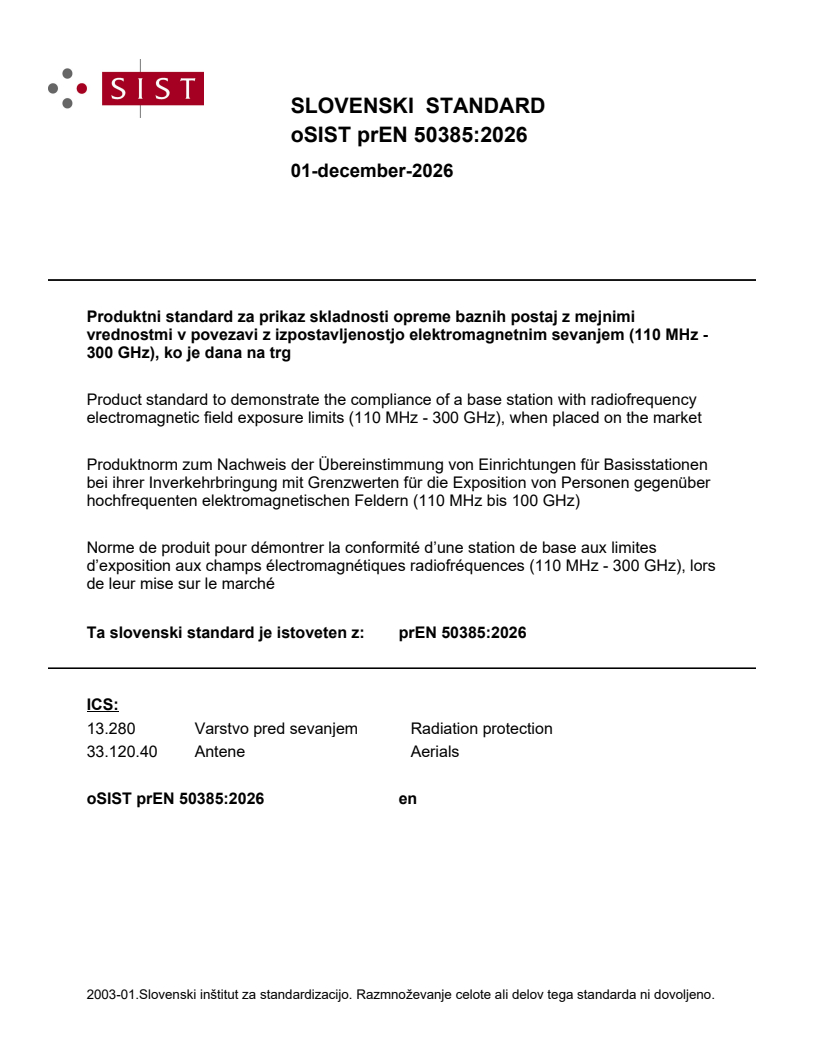
EUROPEAN STANDARD DRAFT
prEN 50385
NORME EUROPÉENNE
EUROPÄISCHE NORM
October 2026
ICS 33.120.40 Will supersede EN 50385:2017
English Version
Product standard to demonstrate the compliance of a base
station with radiofrequency electromagnetic field exposure limits
(110 MHz - 300 GHz), when placed on the market
Norme de produit pour démontrer la conformité d'une Produktnorm zum Nachweis der Übereinstimmung von
station de base aux limites d'exposition aux champs Einrichtungen für Basisstationen bei ihrer Inverkehrbringung
électromagnétiques radiofréquences (110 MHz - 300 GHz), mit Grenzwerten für die Exposition von Personen
lors de leur mise sur le marché gegenüber hochfrequenten elektromagnetischen Feldern
(110 MHz bis 100 GHz)
This draft European Standard is submitted to CENELEC members for enquiry.
Deadline for CENELEC: 2027-01-15.
It has been drawn up by CLC/TC 106X.
If this draft becomes a European Standard, CENELEC members are bound to comply with the CEN/CENELEC Internal Regulations which
stipulate the conditions for giving this European Standard the status of a national standard without any alteration.
This draft European Standard was established by CENELEC in three official versions (English, French, German).
A version in any other language made by translation under the responsibility of a CENELEC member into its own language and notified to
the CEN-CENELEC Management Centre has the same status as the official versions.
CENELEC members are the national electrotechnical committees of Austria, Belgium, Bulgaria, Croatia, Cyprus, the Czech Republic,
Denmark, Estonia, Finland, France, Germany, Greece, Hungary, Iceland, Ireland, Italy, Latvia, Lithuania, Luxembourg, Malta, the
Netherlands, Norway, Poland, Portugal, Republic of North Macedonia, Romania, Serbia, Slovakia, Slovenia, Spain, Sweden, Switzerland,
Türkiye and the United Kingdom.
Recipients of this draft are invited to submit, with their comments, notification of any relevant patent rights of which they are aware and to
provide supporting documentation.
Warning : This document is not a European Standard. It is distributed for review and comments. It is subject to change without notice and
shall not be referred to as a European Standard.
European Committee for Electrotechnical Standardization
Comité Européen de Normalisation Electrotechnique
Europäisches Komitee für Elektrotechnische Normung
CEN-CENELEC Management Centre: Rue de la Science 23, B-1040 Brussels
© 2026 CENELEC All rights of exploitation in any form and by any means reserved worldwide for CENELEC Members.
Project: 76543 Ref. No. prEN 50385:2026 E
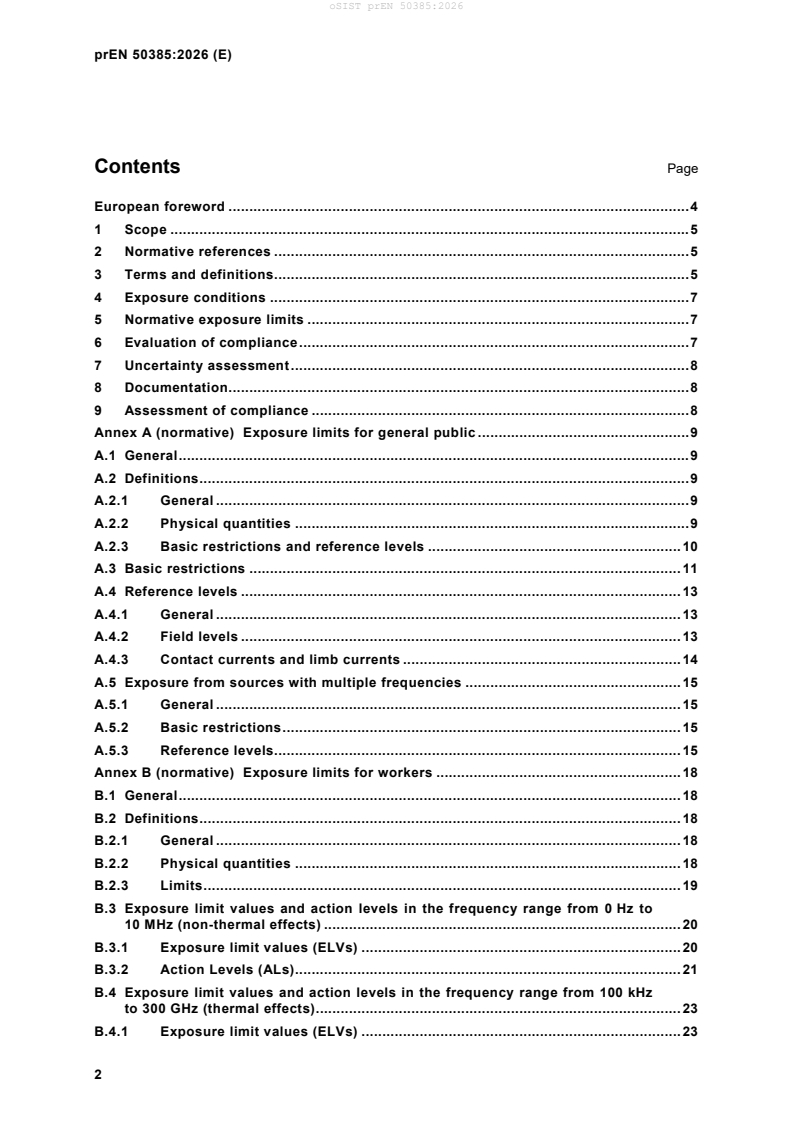
Contents Page
European foreword . 4
1 Scope . 5
2 Normative references . 5
3 Terms and definitions. 5
4 Exposure conditions . 7
5 Normative exposure limits . 7
6 Evaluation of compliance . 7
7 Uncertainty assessment . 8
8 Documentation. 8
9 Assessment of compliance . 8
Annex A (normative) Exposure limits for general public . 9
A.1 General . 9
A.2 Definitions . 9
A.2.1 General . 9
A.2.2 Physical quantities . 9
A.2.3 Basic restrictions and reference levels . 10
A.3 Basic restrictions . 11
A.4 Reference levels . 13
A.4.1 General . 13
A.4.2 Field levels . 13
A.4.3 Contact currents and limb currents . 14
A.5 Exposure from sources with multiple frequencies . 15
A.5.1 General . 15
A.5.2 Basic restrictions . 15
A.5.3 Reference levels. 15
Annex B (normative) Exposure limits for workers . 18
B.1 General . 18
B.2 Definitions . 18
B.2.1 General . 18
B.2.2 Physical quantities . 18
B.2.3 Limits . 19
B.3 Exposure limit values and action levels in the frequency range from 0 Hz to
10 MHz (non-thermal effects) . 20
B.3.1 Exposure limit values (ELVs) . 20
B.3.2 Action Levels (ALs). 21
B.4 Exposure limit values and action levels in the frequency range from 100 kHz
to 300 GHz (thermal effects) . 23
B.4.1 Exposure limit values (ELVs) . 23
B.4.2 Action levels (ALs) . 24
Annex ZZ (informative) Relationship between this European standard and the
essential requirements of Directive 2014/53/EU [2014 OJ L153] aimed to be
covered . 26
Bibliography . 27
European foreword
This document (prEN 50385:2026) has been prepared by CLC/TC 106X “Electromagnetic fields in the
human environment”.
This document is currently submitted to the Enquiry
The following dates are proposed:
— latest date by which the existence of this (doa) dav + 6 months
document has to be announced at national
level
— latest date by which this document has to be (dop) dav + 12 months
implemented at national level by publication of
an identical national standard or by
endorsement
— latest date by which the national standards (dow) dav + 36 months
conflicting with this document have to be (to be confirmed or
withdrawn modified when voting)
This document will supersede EN 50385:2017.
— updates for compatibility with EN IEC 62232:2025, including an extended frequency range up to
300 GHz (Clause 1) and specifications for the implementation of the actual maximum approach
(Clause 6);
— updates about uncertainty assessment (Clause 7);
— inclusion of exposure limits in normative Annex A and Annex B.
This document has been prepared under a standardization request addressed to CENELEC by the
European Commission. The Standing Committee of the EFTA States subsequently approves these
requests for its Member States.
For the relationship with EU Legislation, see informative Annex ZZ, which is an integral part of this
document.
1 Scope
This document is related to human exposure to radiofrequency (RF) electromagnetic fields transmitted
by a base station (BS), operating in the frequency range 110 MHz to 300 GHz. It specifies the methods
to assess the compliance of exposure from a BS with the general public basic restrictions, directly or
indirectly via compliance with reference levels, and the workers’ exposure limit values, directly or
indirectly via compliance with action levels, when the BS is placed on the market.
The term “product” is used in the same sense as BS in this document.
2 Normative references
EN IEC 62232:2025, Determination of RF field strength, power density and SAR in the vicinity of base
stations for the purpose of evaluating human exposure (IEC 62232:2025)
3 Terms and definitions
For the purposes of this document, the following terms and definitions apply.
ISO and IEC maintain terminology databases for use in standardization at the following addresses:
— ISO Online browsing platform: available at https://www.iso.org/obp
— IEC Electropedia: available at https://www.electropedia.org/
3.1
action level
level which is provided for practical exposure assessment purpose and which is derived from an
exposure limit value
Note 1 to entry: Respect of the action level will ensure respect of the relevant exposure limit value. If the action
level is exceeded, it does not necessarily follow that the exposure limit value will be exceeded.
3.2
actual
time-average of the transmitted power or EIRP or exposure
from the equipment under test (EUT) in operation using the actual averaging time
[SOURCE: EN IEC 62232:2025]
3.3
actual maximum
maximum of the actual transmitted power or EIRP or exposure
from the product during a given period (e.g. week or month)
[SOURCE: EN IEC 62232:2025]
3.4
antenna
device that serves as a transducer between a guided wave (e.g. coaxial cable) and a free space wave,
or vice versa, and that can be used either to emit or to receive a radio signal
Note 1 to entry: In the present standard, if not mentioned, the term antenna is used only for emitting antenna(s).
3.5
base station
BS
radio equipment, permanently or temporarily installed, including the radio transmitter and associated
antenna(s) as used in wireless telecommunications networks
EXAMPLE Base stations for mobile communications, radio-relays, wireless local area network access points,
base stations for cordless telephony, etc. that are not normally used in close proximity (i.e. within 20 cm) to the
human body.
Note 1 to entry: Examples of wireless telecommunications networks include those used in mobile
telecommunication systems in accordance with ITU-R M.1224–1 [1], wireless local area networks, public safety
networks and fixed wireless systems (including radio-relay systems, point-to-point communication and point-to
multipoint communication in accordance with ITU-R F.592–4 [2] and ITU-R F.1339–1 [3]).
Note 2 to entry: In the context of this document, radar transmitters, TV and radio broadcast equipment are not
considered to be a BS.
[SOURCE: EN IEC 62232:2025]
3.6
basic restriction
restriction on exposure of the general public to electric, magnetic, and electromagnetic fields that is
based directly on established health effects and biological considerations
3.7
compliance boundary
CB
surface of arbitrary shape defining a volume outside of which the applicable exposure limit is not
exceeded
[SOURCE: EN IEC 62232:2025]
3.8
equivalent isotropic radiated power
EIRP
product of the radiofrequency input power to an antenna and the absolute gain of the antenna in a given
direction
[SOURCE: EN IEC 62232:2025]
3.9
exposure limit value
restriction on exposure of workers to electric, magnetic and electromagnetic fields that is based directly
on established health effects and biological considerations
3.10
power density
power passing through a surface normal to the direction of propagation of energy of an electromagnetic
wave divided by the area of the surface
[SOURCE: EN IEC 62232:2025]
3.11
rated maximum
RMS maximum of the transmitted power or EIRP value as declared by the
manufacturer when placing the product on the market
[SOURCE: EN IEC 62232:2025]
3.12
reference level
level which is provided for practical exposure assessment purpose and which is derived from basic
restrictions
Note 1 to entry: Respect of the reference level will ensure respect of the relevant basic restriction. If the reference
level is exceeded, it does not necessarily follow that the basic restriction will be exceeded.
3.13
worker
person exposed to electromagnetic fields
Note 1 to entry: Directive 2013/35/EU [6] defines conditions for workers exposed to electromagnetic fields.
4 Exposure conditions
RF exposure from the product which meets the exposure limits for the general public specified in
Clause 5 automatically meets the exposure limits for workers specified in Clause 5 without further
testing.
RF exposure from the product which meets the exposure limits for workers does not necessarily meet
the exposure limits for the general public. Unless RF exposure conditions are restricted to workers when
at work, the product shall also be tested against exposure limits for the general public specified in
Clause 5.
RF exposure conditions restricted to workers when at work shall have this condition clearly identified in
the product documentation. This condition shall be identified in the RF exposure assessment report.
All intended operating conditions as well as the reasonably foreseeable conditions of human exposure
from the product shall be taken into account in the RF exposure assessment.
The reasonably foreseeable conditions of exposure shall be based on realistic exposure and/or
installation parameters representative of all readily-predictable human and system behaviour such as
the duration of exposure, time varying of transmitted power, simultaneously operated frequency bands
and time averaging as defined in normative limits.
5 Normative exposure limits
For the assessment of general public exposure from the product, the limits specified in Annex A shall
be applied, with particular attention given to the basic restrictions in Table A.1, or the reference levels
in Table A.2.
As specified in ICNIRP-1998 guidelines [4], when applying general public exposure basic restrictions
specified in Table A.1 to products including a radio-transmitter at frequencies between 10 GHz and
300 GHz:
2 1.05
— power densities shall be averaged over any 20 cm of exposed area and over any 68/f -min
period (where f is in GHz);
— spatial maximum power densities, averaged over 1 cm , shall not exceed 20 times the value in
Table A.1.
For the assessment of workers’ exposure from the product, the limits specified in Annex B shall be
applied, with particular attention given to the exposure limit values in Table B.8 and Table B.10, or the
action levels in Table B.11.
6 Evaluation of compliance
An RF exposure assessment shall be performed using the exposure limits specified in Clause 5 and the
related documentation for the end user of the product shall be developed as specified in Clause 8.
When performing the RF exposure assessment, the product compliance boundary (CB) shall be
evaluated using RF field strength, power density or SAR evaluation methods in accordance with
Clauses 6.1.3, 6.1.4 and 6.1.5 of EN IEC 62232:2025 and the exposure limits specified in Clause 5. The
exposure evaluation method shall be selected in accordance with Clause 7 of EN IEC 62232:2025
including the exposure metric classification specified in Table 3 of Clause 7.2.3 of EN IEC 62232:2025.
The method with the lowest exposure metric class shall take precedence.
The product compliance boundary shall be evaluated for:
a) the rated maximum power or EIRP; and
b) one or more actual maximum transmitted power or EIRP value(s) if the product that is put on the
market is able to implement the actual maximum approach specified in Clauses 6.2.3, 8.4, and B.9
of EN IEC 62232:2025.
The RF exposure assessment of products used with external antennas shall be performed for at least
one typical system configuration consisting of a combination of the base station and a representative
antenna system. When the exposure evaluation is based on measurements, the product shall be
operating in accordance with the manufacturer’s specifications.
The RF exposure assessment shall be documented in an RF exposure assessment report in accordance
with Clause 6.1.7 of EN IEC 62232:2025.
7 Uncertainty assessment
The assessment of uncertainty shall be included in the RF exposure assessment report. Guidance about
uncertainty assessment and comparison with the applicable exposure limits is available in Clause 9 of
EN IEC 62232:2025.
8 Documentation
The following information shall be provided to the end user of the product:
1) for each transmit frequency band, the rated transmitted power or EIRP and, when relevant
according to Clause 6, one or more actual maximum transmitted power or EIRP value(s);
2) description of the product;
3) description of the compliance boundaries applicable to the general public and workers;
4) information related to the radiofrequency exposure evaluation (methods, uncertainties, etc.),
including the relevant parameters related to reasonably foreseeable conditions of radiofrequency
exposure;
5) guidelines on how to install the product or the external antennas in order to ensure that the general
public is outside the applicable compliance boundary specified in Clause 6,
6) installation class according to Table 2 in Clause 6.2.5 of EN IEC 62232:2025, if applicable;
7) guidelines on how to comply with the applicable limits specified in Clause 5 for workers during
installation, maintenance and repair of the product.
The information in 1) to 4) are derived from the RF exposure assessment report, see Clause 6.
9 Assessment of compliance
The product is deemed to fulfil the requirements of this standard if an RF exposure assessment has
been performed according to Clause 6 and Clause 7 using the exposure limits specified in Clause 5,
and the documentation as requested in Clause 8 is available to the end user.
Annex A
(normative)
Exposure limits for general public
A.1 General
The limits in this annex are based on European Council Recommendation of 12 July 1999, 1999/519/EC
[5], which has the objective to provide a high level of health protection against exposure to
electromagnetic fields for the general public.
NOTE The European Council recommends for the purpose of the above-mentioned Council Recommendation
that European Member States assign to the physical quantities listed in 1999/519/EC [5] in Annex I.A (in this Annex:
“Clause A.2”); adopt a framework of basic restrictions and reference levels based on Annex I.B (in this Annex:
“A.2.2”); and, aim to achieve respect of the basic restrictions given in Annex II (in this Annex: “Clause A.3”).
The definitions in Clause A.2 are provided only for usage within Annex A. Unless otherwise specified,
the definitions in Clause 3 apply for the rest of this document.
A.2 Definitions
A.2.1 General
For the purposes of this annex, the term electromagnetic fields (EMF) includes static fields, extremely
low frequency (ELF) fields and radiofrequency (RF) fields, including microwaves, encompassing the
frequency range of 0 Hz to 300 GHz.
A.2.2 Physical quantities
A.2.2.1 General
In the context of EMF exposure, eight physical quantities are commonly used:
A.2.2.2 Contact current (I )
C
Between a person and an object is expressed in amperes (A). A conductive object in an electric field
can be charged by the field.
A.2.2.3 Current density (J)
Is defined as the current flowing through a unit cross section perpendicular to its direction in a volume
−1
conductor such as the human body or part of it, expressed in amperes per square metre (A m ).
A.2.2.4 Electric field strength
Is a vector quantity (E) that corresponds to the force exerted on a charged particle regardless of its
−1
motion in space. It is expressed in volts per metre (V m ).
A.2.2.5 Magnetic field strength
Is a vector quantity (H), which, together with the magnetic flux density, specifies a magnetic field at any
−1
point in space. It is expressed in amperes per metre (A m ).
A.2.2.6 Magnetic flux density
Is a vector quantity (B), resulting in a force that acts on moving charges, it is expressed in teslas (T). In
free space and in biological materials, magnetic flux density and magnetic field strength can be
−7
interchanged using the equivalence 1 A m–1 = 4π 10 T.
A.2.2.7 Power density (S)
Is the appropriate quantity used for very high frequencies, where the depth of penetration in the body is
low. It is the radiant power incident perpendicular to a surface, divided by the area of the surface and is
−2
expressed in watts per square metre (W m ).
A.2.2.8 Specific energy absorption (SA)
Is defined as the energy absorbed per unit mass of biological tissue, expressed in joules per kilogram
−1
(J kg ). In this annex it is used for limiting non-thermal effects from pulsed microwave radiation.
A.2.2.9 Specific energy absorption rate (SAR)
Averaged over the whole body or over parts of the body, is defined as the rate at which energy is
−1
absorbed per unit mass of body tissue and is expressed in watts per kilogram (W kg ). Whole body
SAR is a widely accepted measure for relating adverse thermal effects to RF exposure. Besides the
whole-body average SAR, local SAR values are necessary to evaluate and limit excessive energy
deposition in small parts of the body resulting from special exposure conditions. Examples of such
conditions are a grounded individual exposed to RF in the low MHz range and individuals exposed in
the near field of an antenna.
Of these quantities, magnetic flux density, contact current, electric and magnetic field strengths and
power density can be measured directly.
A.2.3 Basic restrictions and reference levels
A.2.3.1 General
For the application of restrictions based on the assessment of possible health effects of electromagnetic
fields, differentiation shall be made between basic restrictions and reference levels.
NOTE These basic restrictions and reference levels for limiting exposure have been developed following a
thorough review of all published scientific literature. The criteria applied in the course of the review were designed
to evaluate the credibility of the various reported findings; only established effects were used as a basis for the
proposed exposure restrictions. Induction of cancer from long-term EMF exposure was not considered to be
established. However, since there are safety factors of about 50 between the threshold values for acute effects and
the basis restrictions, this annex implicitly covers possible long-term effects in the whole frequency range.
A.2.3.2 Basic restrictions
Restrictions on exposure to time-varying electric, magnetic, and electromagnetic fields which are based
directly on established health effects and biological considerations are termed “basic restrictions”.
Depending upon the frequency of the field, the physical quantities used to specify these restrictions are
magnetic flux density (B), current density (J), specific energy absorption rate (SAR), and power density
(S). Magnetic flux density and power density can be readily measured in exposed individuals.
A.2.3.3 Reference levels
These levels are provided for practical exposure-assessment purposes to determine whether the basic
restrictions are likely to be exceeded. Some reference levels are derived from relevant basic restrictions
using measurements and/or computational techniques and some reference levels address perception
and adverse indirect effects of exposure to EMFs. The derived quantities are electric field strength (E),
magnetic field strength (H), magnetic flux density (B), power density (S), and limb current (I ). Quantities
L
that address perception and other indirect effects are (contact) current (I ) and, for pulsed fields, specific
C
energy absorption (SA). In any particular exposure situation, measured or calculated values of any of
these quantities can be compared with the appropriate reference level. Respect of the reference level
will ensure respect of the relevant basic restriction. If the measured value exceeds the reference level,
it does not necessarily follow that the basic restriction will be exceeded. Under such circumstances,
however, there is a need to establish whether there is respect of the basic restriction.
Quantitative restrictions on static electric fields are not given in this annex. However, it is recommended
that annoying perception of surface electric charges and spark discharges causing stress or annoyance
should be avoided.
Some quantities such as magnetic flux density (B) and power density (S) serve both as basic restrictions
and reference levels, at certain frequencies (see Clause A.3 and Clause A.4).
A.3 Basic restrictions
Depending on frequency, the following physical quantities (dosimetric/exposimetric quantities) are used
to specify the basic restrictions on electromagnetic fields:
— between 0 and 1 Hz basic restrictions are provided for magnetic flux density for static magnetic
fields (0 Hz) and current density for time-varying fields up to 1 Hz, in order to prevent effects on the
cardiovascular and central nervous system;
— between 1 Hz and 10 MHz basic restrictions are provided for current density to prevent effects on
nervous system functions;
— between 100 kHz and 10 GHz basic restrictions on SAR are provided to prevent whole-body heat
stress and excessive localized heating of tissues. In the range 100 kHz to 10 MHz, restrictions on
both current density and SAR are provided;
— between 10 GHz and 300 GHz basic restrictions on power density are provided to prevent heating
in tissue at or near the body surface.
The basic restrictions, given in Table A.1, are set so as to account for uncertainties related to individual
sensitivities, environmental conditions, and for the fact that the age and health status of members of the
public vary.
Table A.1 — Basic restrictions for electric, magnetic and electromagnetic fields (0 Hz to
300 GHz)
Frequency range Magnetic Current Whole Localized Localized Power
flux density body SAR SAR density(W
−2 −2
density (mA m ) average (head (limbs) m )
−1
(mT) (rms) SAR (W and (W kg )
−1
kg ) trunk) (W
−1
kg )
0 Hz 40 - - - - -
> 0–1 Hz - 8 - - - -
1–4 Hz - 8/f - - - -
4–1000 Hz - 2 - - - -
1000 Hz-100 kHz - f /500 - - - -
100 kHz-10 MHz - f /500 0,08 2 4 -
10 MHz-10 GHz - - 0,08 2 4 -
10–300 GHz - - - - - 10
1. ƒ is the frequency in Hz.
2. The basic restriction on the current density is intended to protect against acute exposure effects
on central nervous system tissues in the head and trunk of the body and includes a safety factor.
The basic restrictions for ELF fields are based on established adverse effects on the central
nervous system. Such acute effects are essentially instantaneous and there is no scientific
justification to modify the basic restrictions for exposure of short duration. However, since the
basic restriction refers to adverse effects on the central nervous system, this basic restriction
may permit higher current densities in body tissues other than the central nervous system under
the same exposure conditions.
3. Because of electrical inhomogeneity of the body, current densities shall be averaged over a
cross section of 1 cm perpendicular to the current direction.
4. For frequencies up to 100 kHz, peak current density values can be obtained by multiplying the
rms value by √2 (=1,414). For pulses of duration t the equivalent frequency to apply in the basic
p
restrictions shall be calculated as ƒ = 1/(2tp).
5. For frequencies up to 100 kHz and for pulsed magnetic fields, the maximum current density
associated with the pulses can be calculated from the rise/fall times and the maximum rate of
change of magnetic flux density. The induced current density can then be compared with the
appropriate basic restriction.
6. All SAR values are to be averaged over any six-minute period.
7. Localized SAR averaging mass is any 10 g of contiguous tissue; the maximum SAR so obtained
shall be the value used for the estimation of exposure. These 10 g of tissue are intended to be a
mass of contiguous tissue with nearly homogeneous electrical properties. In specifying a
contiguous mass of tissue, it is recognized that this concept can be used in computational
dosimetry but may present difficulties for direct physical measurements. A simple geometry such
as cubic tissue mass can be used provided that the calculated dosimetric quantities have
conservative values relative to the exposure guidelines.
8. For pulses of duration t the equivalent frequency to apply in the basic restrictions shall be
p
calculated as ƒ = 1/(2tp). Additionally, for pulsed exposures, in the frequency range 0,3 to 10 GHz
and for localized exposure of the head, in order to limit and avoid auditory effects caused by
thermoelastic expansion, an additional basic restriction is recommended. This is that the SA shall
–1
not exceed 2 mJ kg averaged over 10 g of tissue.
A.4 Reference levels
A.4.1 General
Reference levels of exposure are provided for the purpose of comparison with values of measured
quantities. Respect of all recommended reference levels will ensure respect of basic restrictions.
If the quantities of measured values are greater than the reference levels, it does not necessarily follow
that the basic restrictions have been exceeded. In this case, an assessment shall be made as to whether
exposure levels are below the basic restrictions.
The reference levels for limiting exposure are obtained from the basic restrictions for the condition of
maximum coupling of the field to the exposed individual, thereby providing maximum protection. A
summary of the reference levels is given in Table A.2 and Table A.3. The reference levels are generally
intended to be spatially averaged values over the dimension of the body of the exposed individual, but
with the important proviso that the localized basic restrictions on exposure are not exceeded.
In certain situations where the exposure is highly localized, such as with hand-held telephones and the
human head, the use of reference levels is not appropriate. In such cases respect of the localized basic
restriction shall be assessed directly.
A.4.2 Field levels
The field reference levels are presented in Table A.2.
Table A.2 — Reference levels for electric, magnetic and electromagnetic fields (0 Hz to
300 GHz, unperturbed rms values)
Frequency E-field strength H-field strength B-field (µT) Equivalent plane
−1 −1
range (V m ) (A m ) wave power
density Seq (W
−2
m )
0–1 Hz - 3,2 × 10⁴ 4 × 10⁴ -
2 2
1–8 Hz 10 000 3,2 × 10⁴/f 4 × 10⁴/f -
8–25 Hz 10 000 4 000/f 5 000/f -
0,025–0,8 kHz 250/f 4/f 5/f -
0,8–3 kHz 250/f 5 6,25 -
3–150 kHz 87 5 6,25 -
0,15–1 MHz 87 0,73/f 0,92/f -
1/2
1–10 MHz 87/f 0,73/f 0,92/f -
10–400 MHz 28 0,073 0,092 2
400–2 000 MHz 1,375 f 1/2 0,0037 f 1/2 0,0046 f 1/2 f / 200
2–300 GHz 61 0,16 0,20 10
1. ƒ as indicated in the frequency range column.
2 2 2
2. For frequencies between 100 kHz and 10 GHz, S , E , H , and B are to be averaged over any
eq
six-minute period.
2 2 2 1,05
3. For frequencies exceeding 10 GHz, S , E , H , and B are to be averaged over any 68/ƒ -
eq
minute period (ƒ in GHz).
4. No E-field value is provided for frequencies < 1 Hz, which are effectively static electric fields. For
most people the annoying perception of surface electric charges will not occur at field strengths less
−1
than 25 kV m . Spark discharges causing stress or annoyance should be avoided.
No higher reference levels on exposure to ELF fields are provided when exposures are of short duration
(see Note 2 of Table A.1). In many cases, where the measured values exceed the reference level, it
does not necessarily follow that the basic restriction will be exceeded. Provided that adverse health
impacts of indirect effects of exposure (such as microshocks) can be avoided, it is recognized that the
general-public reference levels can be exceeded provided that the basic restriction on the current
density is not surpassed. In many practical exposure situations external ELF fields at the reference
levels will induce current densities in central nervous-system tissues that are below the basic
restrictions. Also it is recognized that a number of common devices emit localized fields in excess of the
reference levels. However, this generally occurs under conditions of exposure where the basic
restrictions are not exceeded because of weak coupling between the field and the body.
−1
For peak values, the following reference levels apply to the E-field strength (V m ), H-field strength (A
−1
m ) and the B-field (µT):
— for frequencies up to 100 kHz, peak reference values are obtained by multiplying the corresponding
rms values by √2 (=1,414). For pulses of duration tp the equivalent frequency to apply shall be
calculated as ƒ = 1 /(2 tp);
— for frequencies between 100 kHz and 10 MHz peak reference values are obtained by multiplying
the corresponding rms values by 10α, where α = (0,665 log(f/105) + 0,176), f in Hz;
— for frequencies between 10 MHz and 300 GHz peak reference values are obtained by multiplying
the corresponding rms values by 32.
Generally, with regard to pulsed and/or transient fields at low frequencies, there are frequency-
dependent basic restrictions and reference levels from which a hazard assessment and exposure
guidelines on pulsed and/or transient sources can be derived. A conservative approach involves
representing a pulsed or transient EMF signal as a Fourier spectrum of its components in each
frequency range, which can then be compared with the reference levels for those frequencies. The
summation formulae for simultaneous exposure to multiple frequency fields can also be applied for the
purposes of determining compliance with the basic restrictions.
Although little information is available on the relation between biological effects and peak values of
pulsed fields, it is suggested that, for frequencies exceeding 10 MHz, Seq as averaged over the pulse
width shall not exceed 1 000 times the reference levels or that field strengths shall not exceed 32 times
the fields strength reference levels. For frequencies between about 0,3 GHz and several GHz and for
localized exposure of the head, in order to limit or avoid auditory effects caused by thermoelastic
expansion, the specific absorption from pulses shall be limited. In this frequency range, the threshold
–1
SA of 4-16 mJ kg for producing this effect corresponds, for 30 µs pulses, to peak SAR values of 130-
–1
520 W kg in the brain. Between 100 kHz and 10 MHz, peak values for the field strengths are obtained
by interpolation from the 1,5-fold peak at 100 kHz to the 32-fold peak at 10 MHz.
A.4.3 Contact currents and limb currents
For frequencies up to 110 MHz additional reference levels are recommended in order to avoid hazards
due to contact currents. The contact current reference levels are presented in Table A.3. The reference
levels on contact current were set to account for the fact that the threshold contact currents that elicit
biological responses in adult women and children are approximately two-thirds and one-half,
respectively, of those for adult men.
Table A.3 — Reference levels for contact currents from conductive objects (f in kHz)
Frequency range Maximum contact current (mA)
0 Hz-2,5 kHz 0,5
2,5 kHz-100 kHz 0,2 f
100 kHz-110 MHz 20
For the frequency range 10 MHz to 110 MHz, a reference level of 45 mA in terms of current through any
limb is recommended. This is intended to limit the localized SAR over any six-minute period.
A.5 Exposure from sources with multiple frequencies
A.5.1 General
In situations where simultaneous exposure to fields of different frequencies occurs, the possibility that
these exposures will be additive in their effects shall be considered. Calculations based on such
additivity shall be performed separately for each effect; thus, separate evaluations shall be made for
thermal and electrical stimulation effects on the body.
A.5.2 Basic restrictions
In the case of simultaneous exposure to fields of different frequencies, the following criteria shall be
satisfied in terms of the basic restrictions.
For electric stimulation, relevant for frequencies from 1 Hz up to 10 MHz, the induced current densities
shall be added according to Formula (A.1):
10 MHz
J
i
≤ 1
∑
J
L,i
i=1 Hz
(A.1)
For thermal effects, relevant from 100 kHz, specific energy absorption rates and power densities shall
be added according to Formula (A.2):
10 GHz 300 GHz
SAR S
ii
+ ≤ 1
∑∑
SAR S
LL
i 100 kHz i>10 GHz
(A.2)
where
Ji is the current density at frequency i;
JL,i is the current density basic restriction at frequency i as given in Table A.1;
SAR is the SAR caused by exposure at frequency i;
i
SAR is the SAR basic restriction given in Table A.1;
L
Si is the power density at frequency i;
S is the power density basic restriction given in Table A.1.
L
A.5.3 Reference levels
For application of the basic restrictions, the following criteria regarding reference levels of field strengths
shall be applied.
For induced current densities and electrical stimulation effects, relevant up to 10 MHz, the two
requirements in Formula (A.3) and Formula (A.4) shall be applied to the field levels:
1MHz 10 MHz
E E
i i
+ ≤ 1
∑∑
E a
ii1Hz L,i>1MHz
(A.3)
and
150 kHz 10 MHz
HH
j j
+≤ 1
∑∑
H b
j 1Hz L, j j>150 kHz
(A.4)
where
=
=
=
E is the electric field strength at frequency i;
i
EL, is the electric field strength reference level from Table A.2;
i
H is the magnetic field strength at frequency j;
j
HL, is the magnetic field strength reference level from Table A.2;
j
−1
a is 87 V m
−1
b is 5 A m (6,25 µT).
Compared to the ICNIRP guidelines[4] which deal with both occupational and general public exposure,
cut off points in the summations correspond to exposure conditions for members of the public.
The use of the constant values (a and b) above 1 MHz for the electric field and above 150 kHz for the
magnetic field is due to the fact that the summation is based on induced current densities, and shall not
be mixed with thermal effect circumstances. The latter forms the basic for EL,i and HL, j above 1 MHz and
150 kHz respectively, found in Table A.2.
For thermal effect circumstances, relevant from 100 kHz, the two requirements in Formula (A.5) and
Formula (A.6) shall be applied to the field levels:
1MHz 300 GHz
EE
ii
+≤ 1
∑∑
c E
L.i
i 100 kHz i>1MHz
(A.5)
and
150 kHz 300 GHz
HH
j j
+ ≤ 1
∑∑
d H
L.j
jj100 kHz >150 kHz
(A.6)
where
Ei is the electric field strengthen at frequency i;
E is the electric field reference level from Table A.2;
L,i
Hj is the magnetic field strength at frequency j;
HL, is the magnetic field reference level derived from Table A.2;
j
1/2 −1
c is 87/f V m ;
−1
d is 0,73/f A m .
Again, compared to the ICNIRP guidelines some cut-off points have been adjusted for public exposure
only.
For limb current and contact current, respectively, the requirements in Formula (A.7) and Formula (A.8)
shall be applied:
110 MHz
I
k
≤ 1
∑
I
k=10 MHz L,k
(A.7)
and
110 MHz
I
n
≤ 1
∑
I
n>1Hz C,n
(A.8)
=
=
where
I is the limb current component at frequency k;
k
IL, is the reference level for limb current, 45 mA;
k
I is the contact current component at frequency n;
n
IC, is the reference level for contact current at frequency n (see Table A.3).
n
The above summation formulae assume worst-case phase conditions among the fields from the multiple
sources. As a result, typical exposure situations may in practice result in less restrictive exposure levels
than indicated by the above formulae for the reference levels.
Annex B
(normative)
...