

EN 50633:2016
(Main)Railway applications - Fixed installations - Protection principles for AC and DC electric traction systems
General Information
- Abstract
This European Standard applies to the electrical protection system, provided for AC and DC electric traction systems. It: - establishes railway specific protection principles; - describes the railway specific protection system functionality; - specifies minimum functional requirements and informative examples of their application; - establishes limitations of the protection system and the acceptability of residual risks; - specifies principles for conformity assessment. It applies to: - railways; - guided mass transport systems, such as tramways, elevated and underground railways, mountain railways, trolleybus systems, and magnetically levitated systems which use a contact line system. This European Standard may also be applied to electrified road traffic with a contact line, such as truck-trolley systems. This European Standard applies to new electric traction systems and may be applied to changes of existing systems. It does not apply to: - underground mine traction systems; - cranes, transportable platforms and similar transportation equipment on rails, temporary structures (e.g. exhibition structures) in so far as these are not supplied directly or via transformers from the contact line system and are not endangered by the traction power supply system; - suspended cable cars; - funicular railways; - magnetic levitated systems (without a contact line system); - railways with an inductive power supply without contact system; - railways with a buried contact system that is required to be energized only below the train to ensure safety. This European Standard does not cover: - technical requirements for products, e.g. protection devices; - rules for maintenance of protection systems.
- Status
- Published
- Publication Date
- 04-Aug-2016
- Technical Committee
- CLC/TC 9X - Electrical and electronic applications for railways
- Current Stage
- 9093 - Decision to confirm - Review Enquiry
- Start Date
- 23-Nov-2022
- Completion Date
- 25-Aug-2026

Overview
EN 50633:2016 - Railway applications - Fixed installations - Protection principles for AC and DC electric traction systems is a CLC (CENELEC) European Standard that defines the protection principles and minimum functional requirements for electrical protection systems used to supply traction power. It establishes railway‑specific protection concepts, describes protection system functionality, gives informative examples, clarifies limitations and residual risks, and sets out principles for conformity assessment.
The standard applies to railways and guided mass transit with a contact line (tramways, underground/elevated railways, mountain railways, trolleybus and maglev systems with contact line) and may be used for electrified road traffic with contact lines (truck‑trolley). It covers new traction systems and changes to existing systems. It excludes underground mine traction, suspended cable cars, funiculars, maglev without contact line, inductive systems without a contact line, buried contact systems energised only beneath vehicles, product technical specs and maintenance rules.
Key Topics
- Protection objectives and system requirements - electrical safety, protection reliability, and acceptable residual risks.
- Protection functionality - roles and interactions of substations, switching stations, feeders, busbars and rolling stock interfaces.
- Reliability methods - redundancy and architectural approaches to meet safety and availability needs.
- Discrimination and selectivity - load discrimination, grading and coordination between protection devices to limit outages.
- Speed of protection - requirements for fault clearance timing and coordination to protect equipment and personnel.
- Specific AC / DC requirements - protections for power conversion infeeds, busbar infeeds, line feeders, autotransformers (AC), frame leakage (DC), and switching station arrangements.
- Fault and abnormal condition handling - definition and treatment of fault types and consequential control actions.
- Limitations and residual risks - documented constraints and scenarios where risk remains acceptable.
- Conformity assessment principles - approach for verifying compliance with the standard.
- Informative annexes - practical protection scheme examples and a sample protection concept for a 25 kV line section.
Applications
Who uses EN 50633:2016:
- Railway infrastructure owners and operators
- Traction power system designers and electrical engineers
- Substation and switching‑station planners
- Safety assessors and conformity auditors
- System integrators and consultants specifying protection architectures
Typical practical uses:
- Specifying protection systems for new AC or DC traction installations
- Designing feeder and busbar protection and coordination schemes
- Performing risk assessment and conformity planning during system upgrades
- Defining interfaces between substations, rolling stock and auxiliary loads
Related standards
Relevant referenced standards include:
- EN 50122-1:2011 (electrical safety, earthing and return circuit)
- EN 50119 (contact lines)
- EN 50388:2012 (coordination between power supply and rolling stock)
- EN 50123 series (DC switchgear)
Keywords: EN 50633:2016, railway protection principles, AC DC electric traction systems, traction power protection, fixed installations, protection system functionality, conformity assessment.
Relations
- Refers
EN 50123-1:2003 - Railway applications - Fixed installations - D.C. switchgear - Part 1: General - Effective Date
- 03-Feb-2026
- Effective Date
- 03-Feb-2026
- Effective Date
- 03-Feb-2026
- Effective Date
- 03-Feb-2026
- Effective Date
- 03-Feb-2026
- Effective Date
- 03-Feb-2026
- Effective Date
- 03-Feb-2026
- Effective Date
- 03-Feb-2026
Get Certified
Connect with accredited certification bodies for this standard

IMQ S.p.A. (Certification)
Italian electrical product certification.

SLG Prüf- und Zertifizierungs GmbH
German testing and certification body.

UL Solutions
Global safety science company with testing, inspection and certification.
Sponsored listings
Frequently Asked Questions
EN 50633:2016 is a standard published by CLC. Its full title is "Railway applications - Fixed installations - Protection principles for AC and DC electric traction systems". This standard covers: This European Standard applies to the electrical protection system, provided for AC and DC electric traction systems. It: - establishes railway specific protection principles; - describes the railway specific protection system functionality; - specifies minimum functional requirements and informative examples of their application; - establishes limitations of the protection system and the acceptability of residual risks; - specifies principles for conformity assessment. It applies to: - railways; - guided mass transport systems, such as tramways, elevated and underground railways, mountain railways, trolleybus systems, and magnetically levitated systems which use a contact line system. This European Standard may also be applied to electrified road traffic with a contact line, such as truck-trolley systems. This European Standard applies to new electric traction systems and may be applied to changes of existing systems. It does not apply to: - underground mine traction systems; - cranes, transportable platforms and similar transportation equipment on rails, temporary structures (e.g. exhibition structures) in so far as these are not supplied directly or via transformers from the contact line system and are not endangered by the traction power supply system; - suspended cable cars; - funicular railways; - magnetic levitated systems (without a contact line system); - railways with an inductive power supply without contact system; - railways with a buried contact system that is required to be energized only below the train to ensure safety. This European Standard does not cover: - technical requirements for products, e.g. protection devices; - rules for maintenance of protection systems.
This European Standard applies to the electrical protection system, provided for AC and DC electric traction systems. It: - establishes railway specific protection principles; - describes the railway specific protection system functionality; - specifies minimum functional requirements and informative examples of their application; - establishes limitations of the protection system and the acceptability of residual risks; - specifies principles for conformity assessment. It applies to: - railways; - guided mass transport systems, such as tramways, elevated and underground railways, mountain railways, trolleybus systems, and magnetically levitated systems which use a contact line system. This European Standard may also be applied to electrified road traffic with a contact line, such as truck-trolley systems. This European Standard applies to new electric traction systems and may be applied to changes of existing systems. It does not apply to: - underground mine traction systems; - cranes, transportable platforms and similar transportation equipment on rails, temporary structures (e.g. exhibition structures) in so far as these are not supplied directly or via transformers from the contact line system and are not endangered by the traction power supply system; - suspended cable cars; - funicular railways; - magnetic levitated systems (without a contact line system); - railways with an inductive power supply without contact system; - railways with a buried contact system that is required to be energized only below the train to ensure safety. This European Standard does not cover: - technical requirements for products, e.g. protection devices; - rules for maintenance of protection systems.
EN 50633:2016 is classified under the following ICS (International Classification for Standards) categories: 29.280 - Electric traction equipment. The ICS classification helps identify the subject area and facilitates finding related standards.
EN 50633:2016 has the following relationships with other standards: It is inter standard links to EN 50123-1:2003, EN 50327:2003, EN 50122-1:2011, EN 50388:2012, EN 50123-7-1:2003, EN 50122-3:2022, EN 50153:2014, CLC/TS 50729:2025. Understanding these relationships helps ensure you are using the most current and applicable version of the standard.
EN 50633:2016 is associated with the following European legislation: Standardization Mandates: M/490. When a standard is cited in the Official Journal of the European Union, products manufactured in conformity with it benefit from a presumption of conformity with the essential requirements of the corresponding EU directive or regulation.
EN 50633:2016 is available in PDF format for immediate download after purchase. The document can be added to your cart and obtained through the secure checkout process. Digital delivery ensures instant access to the complete standard document.
Standards Content (Sample)
2003-01.Slovenski inštitut za standardizacijo. Razmnoževanje celote ali delov tega standarda ni dovoljeno.Railway applications - Fixed installations - Protection principles for AC and DC electric traction systems29.280Electric traction equipmentICS:Ta slovenski standard je istoveten z:EN 50633:2016SIST EN 50633:2016en01-september-2016SIST EN 50633:2016SLOVENSKI
STANDARD
EUROPEAN STANDARD NORME EUROPÉENNE EUROPÄISCHE NORM
EN 50633
August 2016 ICS 29.280
English Version
Railway applications - Fixed installations - Protection principles for AC and DC electric traction systems
Applications ferroviaires - Installations fixes - Principes de protection pour les réseaux de traction électrique à courant alternatif et à courant continu
Bahnanwendungen - Ortsfeste Anlagen - Schutzprinzipien für AC und DC Bahnenergieversorgungssysteme This European Standard was approved by CENELEC on 2016-04-18. CENELEC members are bound to comply with the CEN/CENELEC Internal Regulations which stipulate the conditions for giving this European Standard the status of a national standard without any alteration. Up-to-date lists and bibliographical references concerning such national standards may be obtained on application to the CEN-CENELEC Management Centre or to any CENELEC member.
This European Standard exists in three official versions (English, French, German). A version in any other language made by translation under the responsibility of a CENELEC member into its own language and notified to the CEN-CENELEC Management Centre has the same status as the official versions. CENELEC members are the national electrotechnical committees of Austria, Belgium, Bulgaria, Croatia, Cyprus, the Czech Republic, Denmark, Estonia, Finland, Former Yugoslav Republic of Macedonia, France, Germany, Greece, Hungary, Iceland, Ireland, Italy, Latvia, Lithuania, Luxembourg, Malta, the Netherlands, Norway, Poland, Portugal, Romania, Slovakia, Slovenia, Spain, Sweden, Switzerland, Turkey and the United Kingdom. European Committee for Electrotechnical Standardization
Comité Européen de Normalisation Electrotechnique Europäisches Komitee für Elektrotechnische Normung CEN-CENELEC Management Centre: Avenue Marnix 17,
B-1000 Brussels © 2016 CENELEC All rights of exploitation in any form and by any means reserved worldwide for CENELEC Members.
Ref. No. EN 50633:2016 E SIST EN 50633:2016
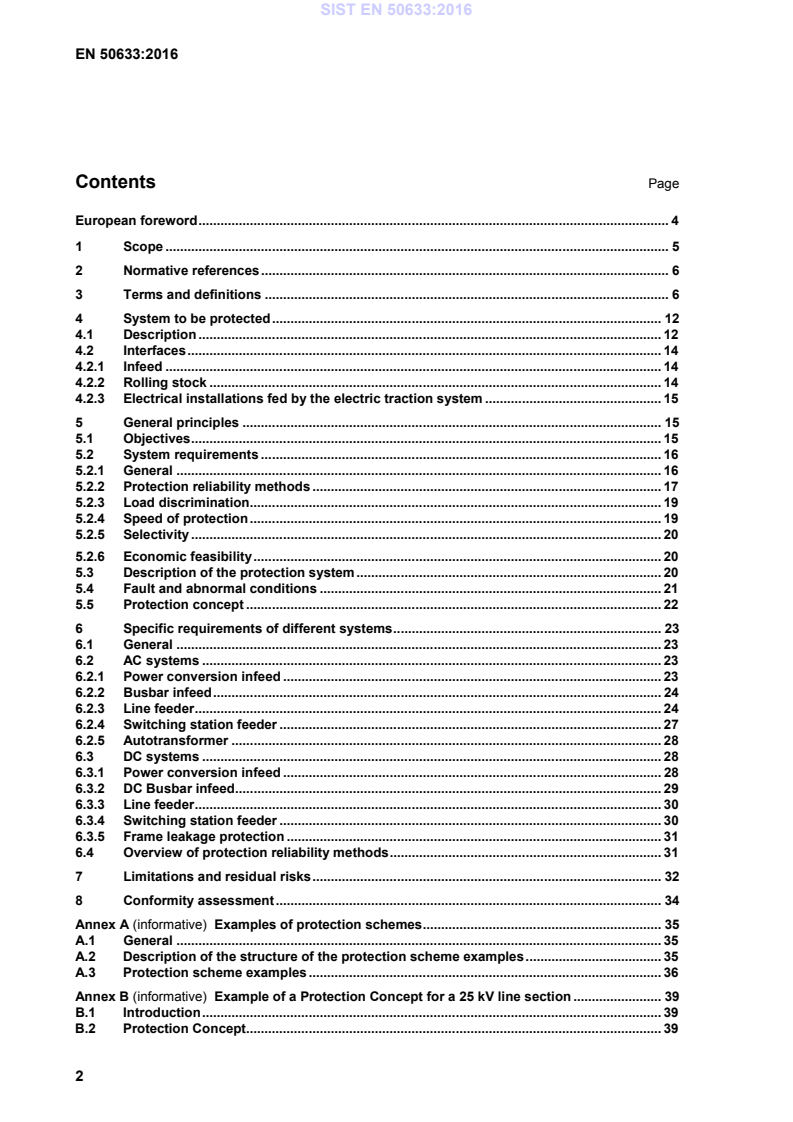
Examples of protection schemes . 35 A.1 General . 35 A.2 Description of the structure of the protection scheme examples . 35 A.3 Protection scheme examples . 36 Annex B (informative)
Example of a Protection Concept for a 25 kV line section . 39 B.1 Introduction . 39 B.2 Protection Concept. 39 SIST EN 50633:2016
Figures Figure 1 — Electric traction system and its interfaces . 14 Figure 2 — Example of a protection system . 21 Figure 3 — Example for single protected line sections . 25 Figure 4 — Example for a grouped protected line section . 26 Figure 5 — Example for an extended protected section of an additional line feeder of a short section by bridged section insulation . 27 Figure A.1— Key for protection scheme, example of protected section ‘busbar’ . 35 Figure A.2 — Example of a protection scheme for AC 50 Hz electric traction systems without busbar infeed circuit breaker . 36 Figure A.3 — Example of a protection scheme for AC 16,7 Hz electric traction systems with busbar infeed circuit breaker . 37 Figure A.4 — Example of a protection scheme for DC electric traction systems with busbar infeed circuit breaker . 38 Figure B.1 — System single line diagram . 39 Figure B.2 — Scheme functional diagram of feeder breakers A1 and A2 . 43 Figure B.3 — Typical scheme sequence diagram – Fault on Feeder A . 44
Tables Table 1 — Overview of reliability methods . 31 Table 2 — Limitations of protection systems and generic residual risks . 33
Ute voltage between conductive parts when touched simultaneously by a person or an animal Note 1 to entry: The value of the effective touch voltage can be appreciably influenced by the impedance of the person or the animal in electric contact with these conductive parts. [SOURCE: IEC 60050-195:1998, 195-05-11] 3.15 fault condition non intended condition caused by short-circuit, whilst the time duration is terminated by the correct function of the protection devices and circuit breakers Note 1 to entry: For the relevant fault duration the correct operation of protection devices and circuit breakers is taken into account. [SOURCE: EN 50122-1:2011, 3.4.5, modified — "Whilst" was added so as to link the sentence "The time duration…" with the rest of the definition.] 3.16 low resistance fault fault condition where the resistance of the fault is sufficiently low that the fault current is of a similar magnitude to that which would flow if the fault resistance were zero Note 1 to entry: The resistance of the fault is typically dominated by the resistance of the power arc. Note 2 to entry: In this definition, resistance will be understood as also being impedance for AC fault currents. 3.17 high resistance fault fault condition where the resistance of the fault is sufficiently high that the fault current is of a substantially different magnitude to that which would flow with a low resistance fault Note 1 to entry: In this definition, resistance will be understood as also being impedance for AC fault currents. 3.18 abnormal operating condition condition where the system is operated beyond its intended capabilities such that damage or reduced life expectancy can be anticipated 3.19 short-circuit accidental or intentional conductive path between two or more conductive parts forcing the electric potential differences between these conductive parts to be equal to or close to zero [SOURCE: IEC 60050-195:1998, 195-04-11] 3.20 current collector equipment fitted to a vehicle and intended to collect current from a contact wire or conductor rail [SOURCE: IEC 60050-811:2015 (CDV), 811-32-01] SIST EN 50633:2016
Note 1 to entry: Substation local backup also extends to switching station local backup where appropriate. [SOURCE: IEC 60050-448:1995, 448-11-16 modified — "Instrument transformers" has been replaced with "a transducer", the definition was reworded to make it more generic and the Note 1 to entry was added.] 3.34 remote backup protection backup protection located in a substation remote from that substation in which the corresponding main protection is located [SOURCE: IEC 60050-448:1995, 448-11-17] 3.35 circuit-breaker failure protection protection which is designed to clear a system fault by initiating tripping of other circuit-breaker(s) in the case of failure to trip of the appropriate circuit-breaker [SOURCE: IEC 60050-448:1995, 448-11-18] 3.36 tripping opening of a circuit-breaker by either manual or automatic control or by protective devices [SOURCE: IEC 60050-448:1995, 448-11-31] 3.37 direct over-current release over-current release directly energized by the current in the main circuit of a mechanical switching device [SOURCE: IEC 60050-441:2000, 441-16-36] 3.38 indirect over-current release over-current release energized by the current in the main circuit of a mechanical switching device through a current transformer or a shunt [SOURCE: IEC 60050-441:2000, 441-16-37] 4 System to be protected 4.1 Description The system to be protected within the scope of this standard is the electric traction system, within the limits set out in Figure 1. The electric traction system comprises: SIST EN 50633:2016
fed by the substation bus bar , e.g. auxiliary powerTraction power conversion infeed circuit breakerBusbar infeed circuit breakerLine feeder circuit
breakercircuit breakergeneral load Figure 1 — Electric traction system and its interfaces Figure 1 shows a traction substation, however it also applies to the relevant parts of a switching station, e.g. with a switching station feeder instead of a line feeder. 4.2 Interfaces 4.2.1 Infeed The interface between the electric traction system and the transmission / distribution system is the feeder circuit-breaker at the infeed to the traction power conversion. The upstream installations are considered to be covered by the protection principles for general transmission and distribution systems, taking into account the following aspects at the interface: • protection coordination; • communication; • automatic reclosure; • direction of power flow (consumption and regeneration). 4.2.2 Rolling stock The interface between the electric traction system and the electric rolling stock is the traction unit circuit breaker. For internal faults within a traction unit (i.e. faults occurring downstream of the traction unit circuit breaker) the requirements of EN 50388:2012, Table 7, apply. SIST EN 50633:2016
...