

EN IEC 62841-3-15:2026
(Main)Electric motor-operated hand-held tools, transportable tools and lawn and garden machinery - Safety - Part 3-15: Particular requirements for transportable magnetic drills
- Abstract
IEC 62841-3-15:2024 is to be used in conjunction with the first edition of IEC 62841-1 (2014). This document supplements or modifies the corresponding clauses in IEC 62841-1:2014, so as to convert it into the IEC Standard: Particular requirements for transportable magnetic drills. Where a particular subclause of IEC 62841-1:2014 is not mentioned in this Part 3-15, that subclause applies as far as relevant. Where this document states "addition", "modification" or "replacement", the relevant text in IEC 62841-1:2014 is to be adapted accordingly. IEC 62841-1:2014, Clause 1 is applicable, except as follows. Addition: This document applies to transportable magnetic drills which can include a liquid system.
- Status
- Published
- Publication Date
- 30-Jul-2026
- Technical Committee
- CLC/TC 116 - Safety of hand-held motor-operated electric tools
- Current Stage
- 6060 - Document made available - Publishing
- Start Date
- 31-Jul-2026
- Completion Date
- 31-Jul-2026

EN IEC 62841-3-15:2026 is a CENELEC European Standard for the safety of transportable magnetic drills. It gives particular requirements for design, marking, instructions and testing, and it is intended for manufacturers, test laboratories, certification bodies and buyers who need to specify or assess this tool category.
This standard is used with EN 62841-1 for the general safety requirements. It also covers transportable magnetic drills that can include a liquid system.
What does EN IEC 62841-3-15:2026 specify?
EN IEC 62841-3-15:2026 specifies the particular safety requirements for transportable magnetic drills. It supplements and modifies the general requirements in EN 62841-1 so that they fit this tool type, including versions with a liquid system.
The document is organized as a Part 3-15 standard with main clauses 1 to 28, followed by annexes for emissions and battery-related cases. In practice, that means the reader gets one part for the base safety rules and separate annexes for special power-supply configurations.
| Annex | What it covers |
|---|---|
| Annex I | Measurement of noise and vibration emissions |
| Annex K | Battery tools and battery packs |
| Annex L | Battery tools and battery packs provided with mains connection or non-isolated sources |
What are the key requirements of EN IEC 62841-3-15:2026?
EN IEC 62841-3-15:2026 focuses on how the tool is identified, tested, controlled and mechanically secured. The most important points are the magnetic hold on the workpiece, the separation between the magnetic means and the power switch, and the extra instructions needed to avoid slips, unintended start-up and electrical shock.
Marking and instructions
Clause 8 requires rating information suited to the tool construction. Magnetic drills with a non-separable stand and separable magnetic drill stands are marked with voltage, supply nature, input or current, class II symbol where applicable, and an IP number when the ingress protection is above IPX0. Drill units for separable stands are marked with their input or current only.
The same clause requires specific safety warnings on the stand, including warnings about pacemakers or other medical implants and the need to use the safety strap. The instructions also have to tell the user how to prepare the workpiece surface, secure the stand, assemble the drill unit if needed, select compatible chucks, bits and cutters, and maintain the supplementary attachment means. In practice, this is the user information that prevents incorrect setup and magnet release.
Test conditions and operating limits
Clause 5 fixes how several tests are set up. When a requirement depends on tool mass, the mass is taken without the supply cord but with the drill unit, chuck and stand, and with liquid containers empty. For tools with both mechanical and electronic speed setting, the test uses the lowest mechanical range and the highest electronic setting within that range.
Clause 12 sets the heating test on a steel plate and applies a continuous torque load for 30 minutes. Clause 17 runs endurance at 1.1 times the highest rated voltage and then at 0.9 times the lowest rated voltage, with the tool in three positions. These tests show whether the tool can run hot and long enough for practical use without unsafe temperature rise or early failure.
Clause 14 deals with moisture and liquid systems. Where the tool is not already protected to at least IPX4, the standard checks leakage current during operation with a salt solution preparation and then requires the electric strength test after drying. For the user, this is the part that addresses cutting fluid, spillage and wet-site risk.
Mechanical safety and control functions
Clause 18 and Table 4 set minimum performance levels for safety-related control functions (SCF). These cover the power switch, the magnetic means actuator, restart prevention and interlocks that stop the spindle unless the magnetic means is active. The practical effect is that the drill should not start, restart or keep running in a way that defeats the magnetic holding system.
Clause 19 adds mechanical protections. Chuck keys, if used, have to drop out when released. The drill unit must not separate unintentionally from the stand, and the magnetic fixing system has to withstand a jammed-bit situation on the specified steel plate without excessive stand rotation. Clause 20 adds a strength test for the supplementary attachment means, such as a safety strap or chain, so the drill remains attached if the magnet loses hold or power.
Clause 21 requires a supplementary attachment means and a magnetic means actuator that is independent of the power switch. The spindle must not run unless the magnetic means is activated, and if the power switch was already on, the spindle must not start just because the magnet is switched on. In practice, the machine needs two distinct actions before it can drill, which reduces accidental movement.
What terms does EN IEC 62841-3-15:2026 define?
EN IEC 62841-3-15:2026 defines the main parts of the tool so that the safety requirements are tied to clear hardware terms.
- Drill unit - the motor assembly with the fitting that attaches to the magnetic drill stand.
- Magnetic drill - the complete tool made up of the drill unit and the magnetic drill stand for cutting ferrous metal.
- Magnetic drill stand - the support that holds the drill unit in position and attaches to the workpiece by a permanent magnet or electromagnet.
- Magnetic means - the device that uses magnetic force to secure the stand to the workpiece.
- Separable magnetic drill stand - a magnetic drill stand that can be separated from the drill unit and supplies the drill unit power.
- Ferrous metal - the material category the magnetic drill is intended to cut, which matters because the magnetic holding system depends on it.
Who uses EN IEC 62841-3-15:2026?
EN IEC 62841-3-15:2026 is used by manufacturers of transportable magnetic drills, including products with liquid systems, when they design the machine, select switches, cords, guards and instructions, and when they prepare conformity tests.
It is also used by test laboratories and certification bodies that check heating, moisture, endurance, mechanical hazard and emission performance. Quality managers, buyers and technical specifiers use it to compare products and to state what safety evidence they need from a supplier.
What changed in EN IEC 62841-3-15:2026 from the previous edition?
EN IEC 62841-3-15:2026 is the European adoption of IEC 62841-3-15:2024 + COR1:2025, approved without modification. The included corrigendum deletes Subclause K.8.14.1.101 in Annex K and carries French-language corrections.
Which standards are used with EN IEC 62841-3-15:2026?
EN IEC 62841-3-15:2026 is read with EN 62841-1:2015 and its amendments and corrigenda, which provide the general safety framework for the whole tool family. IEC 62841-1:2014 is the base international part that this standard modifies.
The standard also names other references used for specific checks and compatibility issues:
- ISO 630-2:2021 - provides the S235 steel used in the jammed-bit test.
- IEC 61032:1997 - provides probe B for access testing.
- IEC 61058-1:2008 - provides switch requirements used for the magnetic means actuator.
- IEC 60884, IEC/TR 60083, IEC 60906-1 and IEC 60320-1 - define plug, socket and connector families that must not be interchangeable where the standard forbids it.
- ISO 7010 - provides the pacemaker warning symbol used in the instructions and markings.
What does the EN IEC 62841-3-15:2026 document contain?
EN IEC 62841-3-15:2026 contains the full clause structure for safety requirements, test conditions and construction rules for transportable magnetic drills. It includes Figure 101, which shows examples of a magnetic drill, and Table 4, which sets the required performance levels for safety-related control functions.
The annexes add the special material the standard needs for practical assessment. Annex I gives the noise test setup for mounted, no-load operation; Annex K adapts the requirements for battery tools and battery packs; and Annex L adapts them for battery tools and battery packs provided with mains connection or non-isolated sources.
The document also gives specific test arrangements for heating, moisture resistance, endurance, abnormal operation and mechanical strength. Those parts are what laboratories and manufacturers use when they verify whether the drill stand, spindle controls, cords, attachment means and liquid system behave safely under expected and fault conditions.
Relations
- Effective Date
- 16-Jun-2026
- Effective Date
- 16-Jun-2026
- Effective Date
- 26-Jul-2022
Get Certified
Connect with accredited certification bodies for this standard

DVS-ZERT GmbH
German welding certification society.
CARES (UK Certification Authority for Reinforcing Steels)
UK certification for reinforcing steels and construction.
EWF/IIW (European/International Welding Federation)
International welding personnel certification.
Sponsored listings
Frequently Asked Questions
EN IEC 62841-3-15:2026 is a standard published by CLC. Its full title is "Electric motor-operated hand-held tools, transportable tools and lawn and garden machinery - Safety - Part 3-15: Particular requirements for transportable magnetic drills". This standard covers: IEC 62841-3-15:2024 is to be used in conjunction with the first edition of IEC 62841-1 (2014). This document supplements or modifies the corresponding clauses in IEC 62841-1:2014, so as to convert it into the IEC Standard: Particular requirements for transportable magnetic drills. Where a particular subclause of IEC 62841-1:2014 is not mentioned in this Part 3-15, that subclause applies as far as relevant. Where this document states "addition", "modification" or "replacement", the relevant text in IEC 62841-1:2014 is to be adapted accordingly. IEC 62841-1:2014, Clause 1 is applicable, except as follows. Addition: This document applies to transportable magnetic drills which can include a liquid system.
IEC 62841-3-15:2024 is to be used in conjunction with the first edition of IEC 62841-1 (2014). This document supplements or modifies the corresponding clauses in IEC 62841-1:2014, so as to convert it into the IEC Standard: Particular requirements for transportable magnetic drills. Where a particular subclause of IEC 62841-1:2014 is not mentioned in this Part 3-15, that subclause applies as far as relevant. Where this document states "addition", "modification" or "replacement", the relevant text in IEC 62841-1:2014 is to be adapted accordingly. IEC 62841-1:2014, Clause 1 is applicable, except as follows. Addition: This document applies to transportable magnetic drills which can include a liquid system.
EN IEC 62841-3-15:2026 is classified under the following ICS (International Classification for Standards) categories: 25.140.20 - Electric tools. The ICS classification helps identify the subject area and facilitates finding related standards.
EN IEC 62841-3-15:2026 has the following relationships with other standards: It is inter standard links to ISO 630-2:2021, EN 62841-1:2015, EN IEC 62841-3-15:2026/A11:2026. Understanding these relationships helps ensure you are using the most current and applicable version of the standard.
EN IEC 62841-3-15:2026 is associated with the following European legislation: EU Directives/Regulations: 2006/42/EC, 2023/1230; Standardization Mandates: M/396, M/605. When a standard is cited in the Official Journal of the European Union, products manufactured in conformity with it benefit from a presumption of conformity with the essential requirements of the corresponding EU directive or regulation.
EN IEC 62841-3-15:2026 is available in PDF format for immediate download after purchase. The document can be added to your cart and obtained through the secure checkout process. Digital delivery ensures instant access to the complete standard document.
Standards Content (Sample)
SLOVENSKI STANDARD
01-oktober-2026
Elektromotorna ročna orodja, prenosna orodja ter stroji za trato in vrt - Varnost - 3-
15. del: Posebne zahteve za prenosne magnetne vrtalnike
Electric motor-operated hand-held tools, transportable tools and lawn and garden
machinery - Safety - Part 3-15: Particular requirements for transportable magnetic drills
Elektrische motorbetriebene handgeführte Werkzeuge, transportable Werkzeuge und
Rasen- und Gartenmaschinen – Sicherheit – Teil 3-15: Besondere Anforderungen für
transportable Magnetbohrmaschinen
Outils électroportatifs à moteur, outils portables et machines pour jardins et pelouses –
Sécurité – Partie 3-15: Exigences particulières pour les perceuses magnétiques
portables
Ta slovenski standard je istoveten z: EN IEC 62841-3-15:2026
ICS:
25.080.40 Vrtalniki Drilling machines
25.140.20 Električna orodja Electric tools
2003-01.Slovenski inštitut za standardizacijo. Razmnoževanje celote ali delov tega standarda ni dovoljeno.
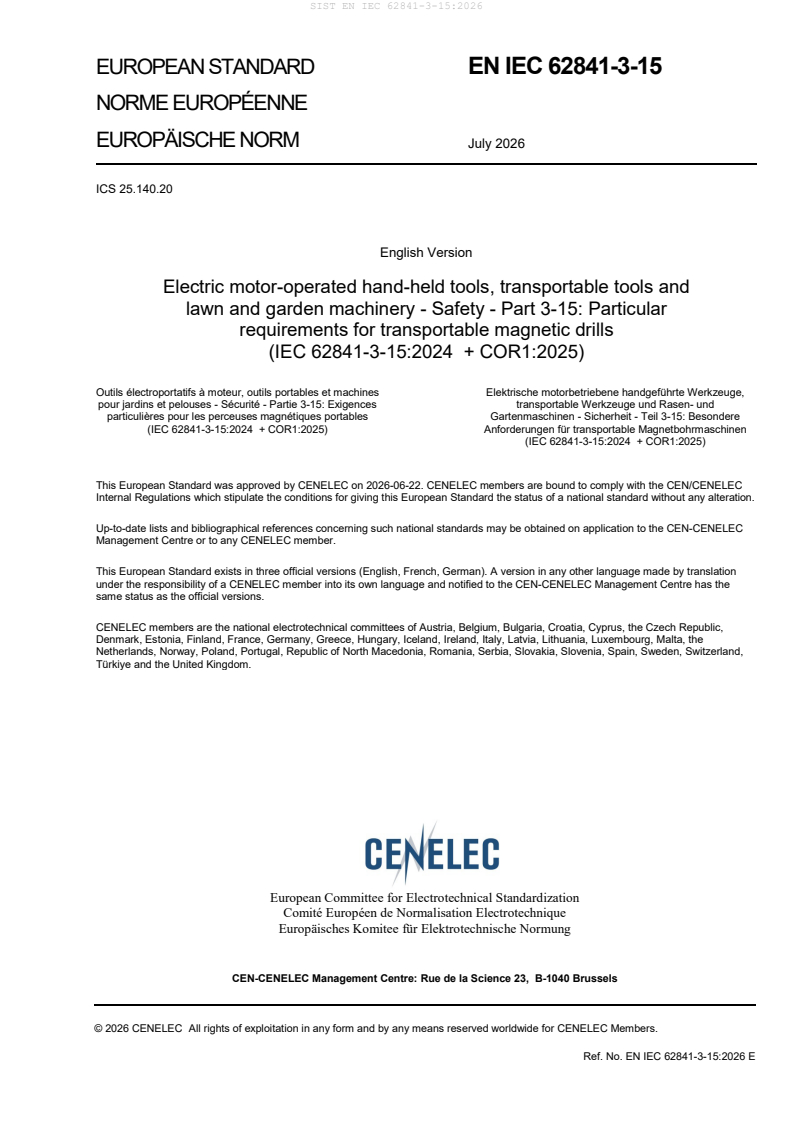
EUROPEAN STANDARD EN IEC 62841-3-15
NORME EUROPÉENNE
EUROPÄISCHE NORM July 2026
ICS 25.140.20
English Version
Electric motor-operated hand-held tools, transportable tools and
lawn and garden machinery - Safety - Part 3-15: Particular
requirements for transportable magnetic drills
(IEC 62841-3-15:2024 + COR1:2025)
Outils électroportatifs à moteur, outils portables et machines Elektrische motorbetriebene handgeführte Werkzeuge,
pour jardins et pelouses - Sécurité - Partie 3-15: Exigences transportable Werkzeuge und Rasen- und
particulières pour les perceuses magnétiques portables Gartenmaschinen - Sicherheit - Teil 3-15: Besondere
(IEC 62841-3-15:2024 + COR1:2025) Anforderungen für transportable Magnetbohrmaschinen
(IEC 62841-3-15:2024 + COR1:2025)
This European Standard was approved by CENELEC on 2026-06-22. CENELEC members are bound to comply with the CEN/CENELEC
Internal Regulations which stipulate the conditions for giving this European Standard the status of a national standard without any alteration.
Up-to-date lists and bibliographical references concerning such national standards may be obtained on application to the CEN-CENELEC
Management Centre or to any CENELEC member.
This European Standard exists in three official versions (English, French, German). A version in any other language made by translation
under the responsibility of a CENELEC member into its own language and notified to the CEN-CENELEC Management Centre has the
same status as the official versions.
CENELEC members are the national electrotechnical committees of Austria, Belgium, Bulgaria, Croatia, Cyprus, the Czech Republic,
Denmark, Estonia, Finland, France, Germany, Greece, Hungary, Iceland, Ireland, Italy, Latvia, Lithuania, Luxembourg, Malta, the
Netherlands, Norway, Poland, Portugal, Republic of North Macedonia, Romania, Serbia, Slovakia, Slovenia, Spain, Sweden, Switzerland,
Türkiye and the United Kingdom.
European Committee for Electrotechnical Standardization
Comité Européen de Normalisation Electrotechnique
Europäisches Komitee für Elektrotechnische Normung
CEN-CENELEC Management Centre: Rue de la Science 23, B-1040 Brussels
© 2026 CENELEC All rights of exploitation in any form and by any means reserved worldwide for CENELEC Members.
Ref. No. EN IEC 62841-3-15:2026 E
European foreword
The text of document 116/801/FDIS, future edition 1 of IEC 62841-3-15 + COR1:2025, prepared by
TC 116 "Safety of motor-operated electric tools" was submitted to the IEC-CENELEC parallel vote and
approved by CENELEC as EN IEC 62841-3-15:2026.
The following dates are fixed:
• latest date by which the document has to be implemented at national (dop) 2027-07-31
level by publication of an identical national standard or by endorsement
• latest date by which the national standards conflicting with the (dow) 2030-07-31
document have to be withdrawn
Attention is drawn to the possibility that some of the elements of this document may be the subject of
patent rights. CENELEC shall not be held responsible for identifying any or all such patent rights.
This document is read in conjunction with EN 62841-1:2015 and all of its amendments and corrigenda
(if any).
This document has been prepared under a standardization request addressed to CENELEC by the
European Commission. The Standing Committee of the EFTA States subsequently approves these
requests for its Member States.
For the relationship with EU Legislation, see informative Annex ZZ, which is an integral part of
Any feedback and questions on this document should be directed to the users’ national committee. A
complete listing of these bodies can be found on the CENELEC website.
Endorsement notice
The text of the International Standard IEC 62841-3-15:2024 + COR1:2025 was approved by
CENELEC as a European Standard without any modification.
IEC 62841-3-15 ®
Edition 1.0 2024-08
INTERNATIONAL
STANDARD
NORME
INTERNATIONALE
Electric motor-operated hand-held tools, transportable tools and lawn and
garden machinery – Safety –
Part 3-15: Particular requirements for transportable magnetic drills
Outils électroportatifs à moteur, outils portables et machines pour jardins et
pelouses – Sécurité –
Partie 3-15: Exigences particulières pour les perceuses magnétiques portables
INTERNATIONAL
ELECTROTECHNICAL
COMMISSION
COMMISSION
ELECTROTECHNIQUE
INTERNATIONALE
ICS 25.140.20 ISBN 978-2-8322-9548-9
– 2 – IEC 62841-3-15:2024 © IEC 2024
CONTENTS
FOREWORD . 4
1 Scope . 6
2 Normative references . 6
3 Terms and definitions . 6
4 General requirements . 8
5 General conditions for the tests . 8
6 Radiation, toxicity and similar hazards . 8
7 Classification . 8
8 Marking and instructions . 8
9 Protection against access to live parts . 11
10 Starting . 11
11 Input and current . 11
12 Heating . 11
13 Resistance to heat and fire . 11
14 Moisture resistance . 12
15 Resistance to rusting . 12
16 Overload protection of transformers and associated circuits . 12
17 Endurance . 12
18 Abnormal operation . 13
19 Mechanical hazards . 13
20 Mechanical strength . 14
21 Construction . 15
22 Internal wiring . 17
23 Components . 17
24 Supply connection and external flexible cables and cords . 17
25 Terminals for external conductors . 18
26 Provision for earthing . 18
27 Screws and connections . 18
28 Creepage distances, clearances and distances through insulation . 18
Annexes . 19
Annex I (informative) Measurement of noise and vibration emissions . 19
Annex K (normative) Battery tools and battery packs . 20
Annex L (normative) Battery tools and battery packs provided with mains connection
or non-isolated sources . 23
Bibliography . 25
Figure 101 – Examples of a magnetic drill . 7
Table 4 – Required performance levels . 13
Table I.101 – Test conditions for noise. 19
Table 4 – Required performance levels . 20
Table K.301 – Pull and torque value . 22
IEC 62841-3-15:2024 © IEC 2024 – 3 –
Table 4 – Required performance levels . 23
– 4 – IEC 62841-3-15:2024 © IEC 2024
INTERNATIONAL ELECTROTECHNICAL COMMISSION
____________
ELECTRIC MOTOR-OPERATED HAND-HELD TOOLS, TRANSPORTABLE
TOOLS AND LAWN AND GARDEN MACHINERY – SAFETY –
Part 3-15: Particular requirements for transportable magnetic drills
FOREWORD
1) The International Electrotechnical Commission (IEC) is a worldwide organization for standardization comprising
all national electrotechnical committees (IEC National Committees). The object of IEC is to promote international
co-operation on all questions concerning standardization in the electrical and electronic fields. To this end and
in addition to other activities, IEC publishes International Standards, Technical Specifications, Technical Reports,
Publicly Available Specifications (PAS) and Guides (hereafter referred to as “IEC Publication(s)”). Their
preparation is entrusted to technical committees; any IEC National Committee interested in the subject dealt with
may participate in this preparatory work. International, governmental and non-governmental organizations liaising
with the IEC also participate in this preparation. IEC collaborates closely with the International Organization for
Standardization (ISO) in accordance with conditions determined by agreement between the two organizations.
2) The formal decisions or agreements of IEC on technical matters express, as nearly as possible, an international
consensus of opinion on the relevant subjects since each technical committee has representation from all
interested IEC National Committees.
3) IEC Publications have the form of recommendations for international use and are accepted by IEC National
Committees in that sense. While all reasonable efforts are made to ensure that the technical content of IEC
Publications is accurate, IEC cannot be held responsible for the way in which they are used or for any
misinterpretation by any end user.
4) In order to promote international uniformity, IEC National Committees undertake to apply IEC Publications
transparently to the maximum extent possible in their national and regional publications. Any divergence between
any IEC Publication and the corresponding national or regional publication shall be clearly indicated in the latter.
5) IEC itself does not provide any attestation of conformity. Independent certification bodies provide conformity
assessment services and, in some areas, access to IEC marks of conformity. IEC is not responsible for any
services carried out by independent certification bodies.
6) All users should ensure that they have the latest edition of this publication.
7) No liability shall attach to IEC or its directors, employees, servants or agents including individual experts and
members of its technical committees and IEC National Committees for any personal injury, property damage or
other damage of any nature whatsoever, whether direct or indirect, or for costs (including legal fees) and
expenses arising out of the publication, use of, or reliance upon, this IEC Publication or any other IEC
Publications.
8) Attention is drawn to the Normative references cited in this publication. Use of the referenced publications is
indispensable for the correct application of this publication.
9) IEC draws attention to the possibility that the implementation of this document may involve the use of (a)
patent(s). IEC takes no position concerning the evidence, validity or applicability of any claimed patent rights in
respect thereof. As of the date of publication of this document, IEC had not received notice of (a) patent(s), which
may be required to implement this document. However, implementers are cautioned that this may not represent
the latest information, which may be obtained from the patent database available at https://patents.iec.ch. IEC
shall not be held responsible for identifying any or all such patent rights.
IEC 62841-3-15 has been prepared by IEC technical committee 116: Safety of motor-operated
electric tools. It is an International Standard.
The text of this International Standard is based on the following documents:
Draft Report on voting
116/801/FDIS 116/823/RVD
Full information on the voting for its approval can be found in the report on voting indicated in
the above table.
The language used for the development of this International Standard is English.
IEC 62841-3-15:2024 © IEC 2024 – 5 –
This document was drafted in accordance with ISO/IEC Directives, Part 2, and developed in
accordance with ISO/IEC Directives, Part 1 and ISO/IEC Directives, IEC Supplement, available
at www.iec.ch/members_experts/refdocs. The main document types developed by IEC are
described in greater detail at www.iec.ch/standardsdev/publications.
This Part 3-15 is to be used in conjunction with the first edition of IEC 62841-1 (2014).
This Part 3-15 supplements or modifies the corresponding clauses in IEC 62841-1:2014, so as
to convert it into the IEC Standard: Particular requirements for transportable magnetic drills.
Where a particular subclause of IEC 62841-1:2014 is not mentioned in this Part 3-15, that
subclause applies as far as relevant. Where this document states "addition", "modification" or
"replacement", the relevant text in IEC 62841-1:2014 is to be adapted accordingly.
The following print types are used:
– requirements: in roman type;
– test specifications: in italic type;
notes: in small roman type;
–
– terms defined in Clause 3: in bold typeface.
Subclauses, notes, tables and figures which are additional to those in IEC 62841-1:2014,
except as described below for Annex K and Annex L, are numbered starting from 101.
Subclauses, notes, tables and figures in Annex K and Annex L which are additional to those in
the main body of this document are numbered starting from 301.
A list of all parts of the IEC 62841 series, under the general title: Electric motor-operated hand-
held tools, transportable tools and lawn and garden machinery – Safety, can be found on the
IEC website.
The committee has decided that the contents of this document will remain unchanged until the
stability date indicated on the IEC website under webstore.iec.ch in the data related to the
specific document. At this date, the document will be
• reconfirmed,
• withdrawn, or
• revised.
NOTE The attention of National Committees is drawn to the fact that equipment manufacturers and testing
organizations may need a transitional period following publication of a new, amended or revised IEC publication in
which to make products in accordance with the new requirements and to equip themselves for conducting new or
revised tests.
It is the recommendation of the committee that the content of this publication be adopted for implementation nationally
not earlier than 36 months from the date of publication.
The content of the corrigendum 1 (2025-02) has been included in this copy.
– 6 – IEC 62841-3-15:2024 © IEC 2024
ELECTRIC MOTOR-OPERATED HAND-HELD TOOLS, TRANSPORTABLE
TOOLS AND LAWN AND GARDEN MACHINERY – SAFETY –
Part 3-15: Particular requirements for transportable magnetic drills
1 Scope
IEC 62841-1:2014, Clause 1 is applicable, except as follows.
Addition:
This document applies to transportable magnetic drills which can include a liquid system.
2 Normative references
IEC 62841-1:2014, Clause 2 is applicable, except as follows.
Addition:
IEC 62841-1:2014, Electric motor-operated hand-held tools, transportable tools and lawn and
garden machinery – Safety – Part 1: General requirements
ISO 630-2:2021, Structural steels – Part 2: Technical delivery conditions for structural steels
for general purposes
3 Terms and definitions
IEC 62841-1:2014, Clause 3 is applicable, except as follows.
Addition:
3.101
drill unit
assembly consisting of a motor and a fitting for attachment to a magnetic drill stand
3.102
magnetic drill
tool consisting of an assembly of a drill unit and a magnetic drill stand designed to cut ferrous
metal by means of a cutter (e.g. drill bit, hole saw or linear cutter)
Note 101 to entry: See Figure 101.
3.103
magnetic drill stand
device for supporting the drill unit in its operating position which is attached to the workpiece
by means of a permanent magnet or an electromagnet
3.104
magnetic means
device using magnetic force to secure the magnetic drill stand to the workpiece
IEC 62841-3-15:2024 © IEC 2024 – 7 –
3.105
separable magnetic drill stand
magnetic drill stand intended to be separated from the drill unit and where the drill unit
supply is provided by the magnetic drill stand
a) Example of a magnetic drill using an electromagnet as a magnetic means
b) Example of a magnetic drill using a permanent magnet as a magnetic means
Key
1 drill unit
2 magnetic drill stand
3 magnetic means
4 magnetic means actuator (electromagnet)
5 magnetic means actuator (permanent magnet)
6 drill unit power switch
7 drill unit feed handle
8 transportation (carry) handle
9 lubrication bottle
10 supply cord
Figure 101 – Examples of a magnetic drill
– 8 – IEC 62841-3-15:2024 © IEC 2024
4 General requirements
IEC 62841-1:2014, Clause 4 is applicable.
5 General conditions for the tests
IEC 62841-1:2014, Clause 5 is applicable, except as follows.
5.5 Addition:
For drill units which have both a mechanical means of setting different ranges of speed and
an electronic means of setting the speed within a given range, the mechanical device is adjusted
to the lowest range possible and the electronic device is adjusted to the highest setting within
the given range.
5.17 Replacement:
If a requirement is based upon the mass of the tool, the mass shall be determined without the
supply cord, but shall include the drill unit, the drill chuck and the magnetic drill stand. Liquid
containers, if any, shall be empty.
6 Radiation, toxicity and similar hazards
IEC 62841-1:2014, Clause 6 is applicable.
7 Classification
IEC 62841-1:2014, Clause 7 is applicable.
8 Marking and instructions
IEC 62841-1:2014, Clause 8 is applicable, except as follows.
8.1 Replacement:
Magnetic drills with a magnetic drill stand that is not a separable magnetic drill stand and
separable magnetic drill stands shall be marked with rating information as follows:
– rated voltage(s) or rated voltage range, in volts. Tools for star-delta connection shall be
clearly marked with the two rated voltages (for example 230 ∆/ 400 Y). A tool that complies
with this standard for a voltage range, may also be marked with any single voltage or smaller
voltage range within that range;
– symbol for nature of supply, unless the rated frequency(ies) or rated frequency range is
marked. The symbol for nature of supply shall be placed next to the marking for rated
voltage;
– rated input, in watts or rated current, in amperes. The rated input or rated current to be
marked on the tool is the total maximum input or current that can be drawn from external
circuit at the same time. If a tool has alternative components which can be selected by a
control device, the rated input or rated current is that corresponding to the highest
loading possible;
– symbol for class II construction, for class II tools only;
IEC 62841-3-15:2024 © IEC 2024 – 9 –
– IP number according to degree of protection against ingress of water other than IPX0. If the
first numeral for the IP numbering is omitted, the omitted numeral shall be replaced by the
letter X, for example IPX5.
Drill units intended to be used with a separable magnetic drill stand shall be marked with
rating information as follows:
– input, in watts or current, in amperes. The input or current to be marked on the drill unit is
the total maximum input or current that can be drawn from the magnetic drill stand.
Drill units intended to be used with a separable magnetic drill stand shall not be marked as
a class II tool.
8.2 Modification:
This subclause of IEC 62841-1:2014 is applicable for
– magnetic drills with a magnetic drill stand that is not a separable magnetic drill stand;
and
– separable magnetic drill stands; and
– drill units intended to be used with a separable magnetic drill stand.
Addition:
Magnetic drill stands shall be marked with the following safety warnings:
– " WARNING – Do not use this tool if you or any bystanders have a cardiac pacemaker or
other medical implants" or symbol P007 of ISO 7010; and
– “ WARNING – Always use the safety strap when operating the tool” or a symbol that is
described in the instruction manual.
8.14.1 Addition:
The additional safety instructions as specified in 8.14.1.101 shall be given. This part may be
printed separately from the "General Power Tool Safety Warnings".
8.14.1.101 Safety instructions for magnetic drills
a) Do not use this tool if you or any bystanders have a cardiac pacemaker or other
medical implants. Cardiac pacemakers and other medical implants may malfunction due
to magnetic fields emitted by the tool, which may result in personal injury.
b) Always check the safety strap for wear or damage before each use. A worn or damaged
safety strap may fail unexpectedly during use and may result in personal injury.
NOTE 101 It is possible to replace the term "strap" with "chain" or another descriptive term in the warning in
item b) above.
c) Only attach the magnetic drill to ferrous metal. The magnetic base will not secure
properly to non-ferrous metals, such as non-magnetic grades of stainless steel.
d) Clean the surface before attaching the drill stand to the work surface. Paint, rust or
scale decrease the holding strength of the magnet. Chips, burrs, dirt and other foreign
matter on the surface of the magnetic base will also decrease holding power.
e) Always secure the magnetic base on a smooth, flat work surface. If the workpiece is
uneven and not smooth or flat, the magnetic base may release from the workpiece, causing
unexpected movement of the tool or workpiece and personal injury.
f) Use clamps or other practical ways to secure and support the workpiece to a stable
platform. It is important to support the workpiece properly to minimise body exposure,
binding, or loss of control.
– 10 – IEC 62841-3-15:2024 © IEC 2024
g) Always use the safety strap provided or recommended to secure the tool to the
workpiece before turning on the drill motor. The magnetic base may release from the
workpiece, causing unexpected movement of the tool or workpiece and personal injury.
NOTE 102 It is possible to replace the term "strap" with "chain" or another descriptive term in the warning in
item g) above.
h) Always activate the magnetic base and make sure it is securely attached to the
workpiece before turning on the drill motor. Failure to secure the magnetic base to the
workpiece may cause unexpected movement of the tool or workpiece and personal injury.
i) Always ensure the workpiece is in a fixed or stable position. Unexpected movement of
the workpiece may result in personal injury.
j) Make sure you are in a stable position and able to control the tool while releasing the
tool from the workpiece. A loss of control upon releasing the tool from the workpiece may
result in personal injury.
k) Keep your hands out of the drilling area while the tool is running. Contact with rotating
parts or chips may result in personal injury.
l) Make sure the bit is rotating before feeding into the workpiece. Otherwise the accessory
may become jammed in the workpiece causing unexpected movement of the workpiece and
personal injury.
m) Do not use excessive feed force while drilling. Use of excessive feed force may cause
the magnetic base to release from the workpiece, causing unexpected movement of the tool
or workpiece and personal injury.
n) Avoid generating long chips by regularly interrupting downward pressure. Sharp metal
chips may cause entanglement and personal injuries.
o) Never remove chips from the drilling area while the tool is running. To remove chips,
move the bit away from the workpiece, switch off the drill motor and wait for the bit
to stop moving. Use tools such as a brush or hook to remove chips. Contact with
rotating parts or chips may result in personal injury.
p) When performing drilling that requires the use of cutting fluid, route the cutting fluid
away from the operator’s work area or use a liquid collection device. Such
precautionary measures keep the operator’s work area dry and reduce the risk of electric
shock.
q) When the bit is jammed, stop applying downward pressure and turn off the tool.
Investigate and take corrective actions to eliminate the cause of bit jamming.
r) When restarting a drill in the workpiece, check that the bit rotates freely before
starting. If the bit is bound it may not start, may overload the tool, or may cause the drill
stand release from the workpiece.
s) Do not deactivate the magnetic base until the tool is turned off and the bit has come
to a complete stop. Premature deactivation of the magnetic base may cause unexpected
movement of the tool or workpiece and personal injury.
8.14.2 a) Addition:
101) For separable magnetic drill stands, instructions indicating the appropriate drill
unit(s) for use, such as by a catalog number, series identification or the equivalent;
102) Instruction for surface preparation of the workpiece and the base of the magnetic drill
stand;
103) Instructions for securing the magnetic drill stand to the workpiece;
104) Instruction for assembling the drill unit to the magnetic drill stand, if applicable.
IEC 62841-3-15:2024 © IEC 2024 – 11 –
8.14.2 b) Addition:
101) Information about which drill chucks may be used with the tool and instruction on how to
fit them;
102) Information about which drill bits and cutters may be used with the tool;
103) Information on how to use the supplementary means of attachment between the
magnetic drill stand and the workpiece as required in 21.101.
8.14.2 c) Addition:
101) Information about maintenance and replacement of the supplementary means of
attachment between the magnetic drill stand and the workpiece.
9 Protection against access to live parts
IEC 62841-1:2014, Clause 9 is applicable.
10 Starting
IEC 62841-1:2014, Clause 10 is applicable.
11 Input and current
IEC 62841-1:2014, Clause 11 is applicable.
12 Heating
IEC 62841-1:2014, Clause 12 is applicable, except as follows.
12.1 Addition:
Prior to the test, the magnetic drill stand is placed on a steel plate with
– a thickness of (12 ± 2) mm; and
– a length and width of at least the same size as the base of the magnetic drill stand.
The test may be conducted with the drill unit mechanically separat
...