

prEN IEC 62053-24:2026
(Main)Electricity metering equipment - Particular requirements - Part 24: Static meters for fundamental component reactive energy (classes 0,5S, 1S, 1, 2 and 3)
- Status
- Not Published
- Publication Date
- 14-Nov-2027
- Technical Committee
- CLC/TC 13 - Electrical energy measurement and control
- Current Stage
- 4060 - Enquiry results established and sent to TC, SR, BTTF - Enquiry
- Start Date
- 28-Aug-2026
- Due Date
- 28-Aug-2026
- Completion Date
- 28-Aug-2026
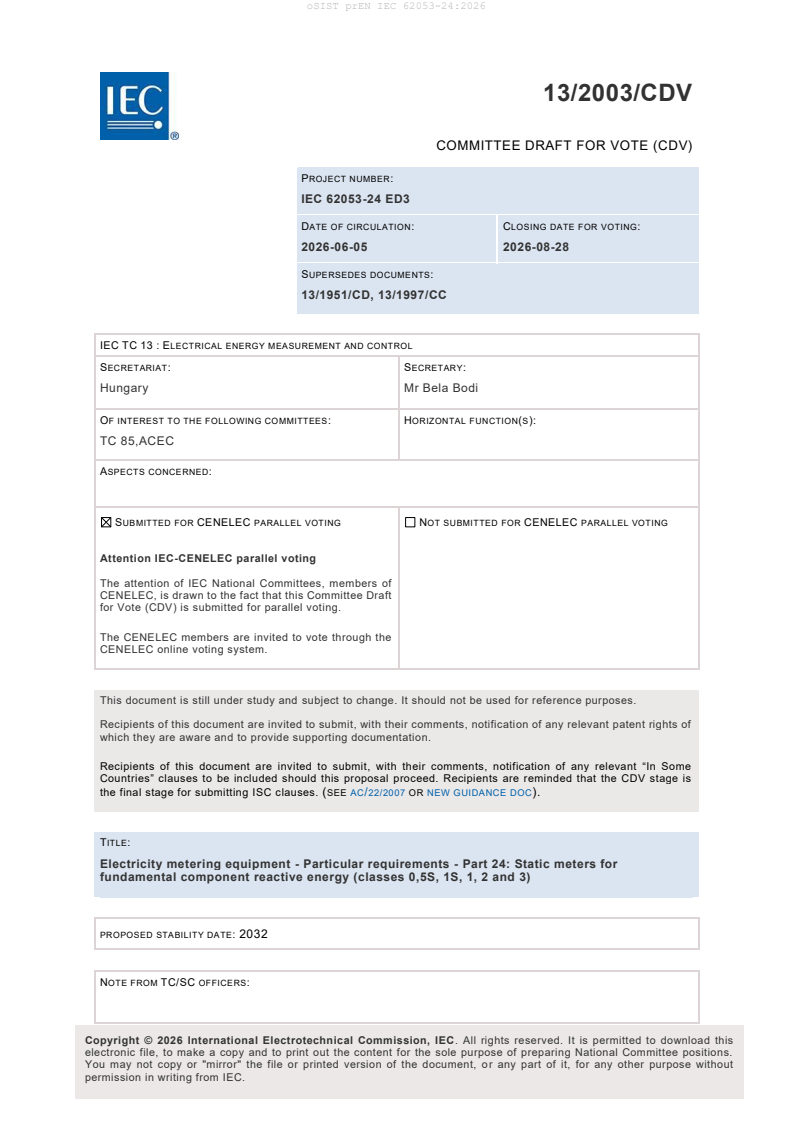

prEN IEC 62053-24:2026 is an IEC/CENELEC draft for static meters that measure AC fundamental component reactive energy. It sets particular requirements, type tests and accuracy limits for classes 0,5S, 1S, 1, 2 and 3, mainly for meter manufacturers, test laboratories and users who need a defined basis for evaluating reactive energy meters.
What does prEN IEC 62053-24:2026 specify?
prEN IEC 62053-24:2026 specifies requirements for static var-hour meters used on 50 Hz or 60 Hz AC networks, and it applies to type tests only. It is organized into Clauses 1 to 10 plus three informative annexes that help explain error limits, transformer phase displacement and harmonic testing.
| Annex | What it covers |
|---|---|
| Annex A | Comparison of relative error limits at reference conditions for the meter classes |
| Annex B | Influence of current and voltage transformer phase displacement on reactive energy measurement |
| Annex C | Treatment of harmonics and tests for harmonics, including the fifth harmonic test |
The standard covers meters installed indoors or outdoors, with all functional elements in one meter case except the indicating display, and with integrated, detached or no indicating display. It also covers meters with optional additional functions, as long as the energy-measurement requirements remain in scope.
What are the key requirements of prEN IEC 62053-24:2026?
prEN IEC 62053-24:2026 combines general meter requirements from IEC 62052-11 with specific limits for reactive energy meters. In practice, it tells you which meter types are covered, how they are tested, and what error shifts are acceptable under normal and disturbed conditions.
1. The meter type and measurement definition are tightly defined
Clause 1 limits the document to static var-hour meters of classes 0,5S, 1S, 1, 2 and 3. It uses a conventional definition of reactive energy based on the fundamental frequency components of current and voltage only, so harmonics are handled separately from the main reactive-energy result.
2. Class 0,5S and 1S are only for transformer-operated and transducer-operated meters
Clause 1 states that classes 0,5S and 1S are only defined for transformer-operated and transducer-operated meters. For buyers and test labs, that means these classes are not for directly connected meters.
3. Transducer-operated meters may be assessed in two ways
Clause 1 allows meters designed for external transducers to be tested either as directly connected meters, when meter and transducers are tested together, or as transducer-operated meters, when tested without transducers. This matters because the chosen method affects the reference measurement setup and the test uncertainty budget.
4. Standard electrical values and current signals are class-dependent
Clause 4 sets the electrical values by reference to IEC 62052-11, then defines starting current, minimum current, transitional current and maximum current signals for the different meter types. In practice, this tells manufacturers which operating thresholds the meter must detect and which current ranges must still meet the accuracy rules.
5. Accuracy at reference conditions is checked against class limits
Clause 7.9 requires the relative error at reference conditions to stay within the limits in Table 5. For meters that measure energy in both directions, the limits apply in each direction, and for meters with multiple connection modes, accuracy can only be claimed for the connection modes actually tested.
6. Influence quantities are tested one at a time
Clause 7.10 requires the meter to stay within the relative error shift limits in Table 6 when a single influence quantity is applied at a time, with the meter otherwise at reference conditions. The table covers effects such as electromagnetic disturbance, magnetic fields, harmonics, voltage variation, temperature, phase-voltage interruption, frequency variation, reversed phase sequence, auxiliary voltage, ripple on DC supply voltage, auxiliary devices, short-time overcurrents, self-heating, fast load variations and earth fault.
7. Harmonics and transformer effects are treated explicitly
Annex C explains why the standard measures fundamental component reactive energy and requires harmonic testing to show that harmonics do not drive the result outside the allowed shift limits. Annex B shows how phase displacement in current transformers and voltage transformers can add measurement error, which is why the document points users toward suitable transformer accuracy classes for low-error systems.
8. Type-test behavior is the main focus
Clause 10 refers the type-test requirements to IEC 62052-11, so the document is aimed at design verification rather than routine field checking. That means the standard is most useful when a meter design is being approved, compared or certified.
What terms does prEN IEC 62053-24:2026 define?
prEN IEC 62053-24:2026 uses the terms and definitions from IEC 62052-11, and several of them are central to reading the document.
- Static var-hour meter - a static meter that measures reactive energy, not an electromechanical meter.
- Fundamental component reactive energy - reactive energy calculated from the fundamental components of current and voltage only.
- Transformer-operated meter - a meter intended to work with instrument transformers.
- Transducer-operated meter - a meter intended to work with external transducers, and tested without them when required.
- Starting current signal - the current level used to verify that the meter starts operating correctly.
- Transitional current signal - the current point used as the reference for several current-related limits in this document.
- Reference conditions - the test conditions used as the baseline for accuracy verification and error-shift testing.
- Type test - a design verification test for a meter type, not a routine acceptance check on every unit.
Who uses prEN IEC 62053-24:2026?
prEN IEC 62053-24:2026 is used by meter manufacturers, test laboratories, conformity-assessment bodies and utility or procurement teams that specify reactive energy meters. It is especially relevant for electrical energy measurement and control, electricity supply systems, and projects using current transformers or voltage transformers.
It helps these users decide whether a meter design is suitable for type testing, how to set up verification, and which accuracy class and connection mode apply to a given application. It is also relevant where harmonics, phase displacement or multiple connection modes can affect billing accuracy.
What changed in prEN IEC 62053-24:2026 from the previous edition?
prEN IEC 62053-24:2026 cancels and replaces the second edition published in 2020 and is described as a technical revision. The changes named in the document are:
- updated normative references
- inclusion of transducer-operated meters in scope, tested without transducers
- introduction of the transitional current
- expression of starting current, minimum current and maximum current as fractions of the transitional current
- introduction of the ripple on DC supply voltage test
- revised figures in Annex A
Which standards are used with prEN IEC 62053-24:2026?
The document is intended to be used with IEC 62052-11 edition 3 CDV:2026, and it gives it precedence where both documents cover the same item. The introduction also names companion parts from related IEC series that support metering, testing, payment and dependability work.
| Standard or group | What it contributes |
|---|---|
| IEC 62052-11 edition 3 CDV:2026 | General metering equipment requirements, tests and test conditions; also the normative reference |
| IEC 62052-31:2024 | Product safety requirements and tests |
| IEC 62052-41:2022 | Energy registration methods and requirements for multi-energy and multi-rate meters |
| IEC 62053-21 / IEC 62053-22 / IEC 62053-23 / IEC 62053-41 | Other accuracy-class standards for active, reactive and DC energy meters |
| IEC 62055-31:2022 | Static payment meters for active energy |
| IEC 62057-1 and IEC 62057-3 | Test equipment, techniques and procedures |
| IEC 62058-11 and IEC 62058-31 | Acceptance inspection methods |
| IEC TR 62059-11, IEC TR 62059-21, IEC 62059-32-1 | Dependability and durability guidance |
What does the prEN IEC 62053-24:2026 document contain?
prEN IEC 62053-24:2026 contains the clause structure for scope, references, terms, electrical values, construction, marking, accuracy, climatic requirements, external influences and type tests. It also contains Tables 1 to 6 for current signals and error limits, plus Annex A figures, Annex B transformer-error tables and Annex C harmonic-test guidance.
The document gives the test conditions and acceptance criteria for starting, no-load, repeatability, influence quantities, time-keeping accuracy and harmonic behavior. For testing teams, the annexes and tables show where to find the comparison plots, transformer phase-displacement examples and the fifth harmonic test overview.
Relations
- Effective Date
- 08-Apr-2025
- Effective Date
- 08-Apr-2025
Get Certified
Connect with accredited certification bodies for this standard

DIBt (Deutsches Institut für Bautechnik)
German Institute for Building Technology.

DIN CERTCO
DIN Group product certification.

Aboma Certification B.V.
Specialized in construction, metal, and transport sectors.
Sponsored listings
Frequently Asked Questions
prEN IEC 62053-24:2026 is a draft published by CLC. Its full title is "Electricity metering equipment - Particular requirements - Part 24: Static meters for fundamental component reactive energy (classes 0,5S, 1S, 1, 2 and 3)". This standard covers: Electricity metering equipment - Particular requirements - Part 24: Static meters for fundamental component reactive energy (classes 0,5S, 1S, 1, 2 and 3)
Electricity metering equipment - Particular requirements - Part 24: Static meters for fundamental component reactive energy (classes 0,5S, 1S, 1, 2 and 3)
prEN IEC 62053-24:2026 is classified under the following ICS (International Classification for Standards) categories: 17.220.20 - Measurement of electrical and magnetic quantities; 91.140.50 - Electricity supply systems. The ICS classification helps identify the subject area and facilitates finding related standards.
prEN IEC 62053-24:2026 has the following relationships with other standards: It is inter standard links to EN IEC 62053-24:2021/A11:2021, EN IEC 62053-24:2021. Understanding these relationships helps ensure you are using the most current and applicable version of the standard.
prEN IEC 62053-24:2026 is associated with the following European legislation: EU Directives/Regulations: 2014/30/EU; Standardization Mandates: M/441, M/552. When a standard is cited in the Official Journal of the European Union, products manufactured in conformity with it benefit from a presumption of conformity with the essential requirements of the corresponding EU directive or regulation.
prEN IEC 62053-24:2026 is available in PDF format for immediate download after purchase. The document can be added to your cart and obtained through the secure checkout process. Digital delivery ensures instant access to the complete standard document.
Standards Content (Sample)
Contents
- 1 Scope
- 2 Normative references
- 3 Terms and definitions
- 4 Standard electrical values
- 4.1 Voltages
- 4.2 Currents
- 4.3 Frequencies
- 4.4 Power consumption
- 5 Construction requirements
- 6 Meter marking and documentation
- 7 Accuracy requirements
- 7.1 General test conditions
- 7.2 Methods of accuracy verification
- 7.3 Measurement uncertainty
- 7.4 Meter constant
- 7.5 Initial start-up of the meter
- 7.6 Test of no-load condition
- 7.7 Starting current test
- 7.8 Repeatability test
- 7.9 Limits of error due to variation of the current signal
- 7.10 Limits of error shift due to influence quantities
- 9.4.3 variation
- 9.4.4 d 2 I ≤ I ≤ I
- 9.4.11 Self-heating
- 7.11 Time-keeping accuracy
- 8 Climatic requirements
- 9 The effects of external influences
- 10 Type test
- Annex A
- Annex B
- Annex C
- Bibliography
INTRODUCTION This part of IEC 62053 is to be used with relevant parts of the IEC 62052, IEC 62058 and IEC 62059 series, Electricity metering equipment, with the IEC 62055 series, Electricity metering – Payment systems and with the IEC 62057 series, Electrical energy meters:
IEC 62052-11 edition 3 CDV:2026 , Electricity metering equipment – General requirements, tests and test conditions – Part 11: Metering equipment IEC 62052-31:2024, Electricity metering equipment – General requirements, tests and test conditions – Part 31: Product safety requirements and tests IEC 62052-41:2022, Electricity metering equipment – General requirements, tests and test conditions – Part 41: Energy registration methods and requirements for multi-energy and multirate meters IEC 62053-21:202X, Electricity metering equipment – Particular requirements – Part 21: Static meters for AC active energy (classes 0,5, 1 and 2) IEC 62053-22:202X, Electricity metering equipment – Particular requirements – Part 22: Static meters for AC active energy (classes 0,1 S, 0,2 S and 0,5 S) IEC 62053-23:202X, Electricity metering equipment – Particular requirements – Part 23: Static meters for reactive energy (classes 2 and 3) IEC 62053-41:2021, Electricity metering equipment – Particular requirements – Part 41: Static meters for DC energy (classes 0,5 and 1) IEC 62055-31:2022, Electricity metering – Payment systems – Part 31: Particular requirements - Static payment meters for active energy (classes 1 and 2) IEC 62057-1:2023, Electrical energy meters – Test equipment, techniques and procedures – Part 1: Stationary meter test units (MTUs) IEC 62057-3:2024, Electrical energy meters – Test equipment, techniques and procedures – Part 3: Automatic meter testing system (AMTS) IEC 62058-11:2008, Electricity metering equipment (AC) – Acceptance inspection – Part 11:
General acceptance inspection methods IEC 62058-31:2008, Electricity metering equipment (AC) – Acceptance inspection – Part 31:
Particular requirements for static meters for active energy (classes 0,2 S, 0,5 S, 1 and 2) IEC TR 62059-11:2002, Electricity metering equipment – Dependability – Part 11: General concepts IEC TR 62059-21:2002, Electricity metering equipment – Dependability – Part 21: Collection of meter dependability data from the field IEC 62059-32-1:202X, Electricity metering equipment – Dependability – Part 32-1: Durability – Testing of the stability of metrological characteristics by applying elevated temperature This part is a standard for type testing electricity meters. It covers the particular requirements for meters, being used indoors and outdoors in large quantities worldwide. It does not deal with special implementations (such as metering-part and/or displays in separate housings).
oSIST prEN IEC 62053-24:2026
This document is intended to be used in conjunction with IEC 62052-11 edition 3 CDV:2026 and with IEC 62052-31:2024. When any requirement in this document concerns an item already covered in IEC 62052-11 edition 3 CDV:2026 or in IEC 62052-31:2024, the requirements of this document take precedence over the requirements of IEC 62052-11 edition 3 CDV:2026 or of IEC 62052-31:2024.
The specifications and test levels in this document are regarded as minimum values for the proper functioning of electricity measurement and load control equipment under normal working conditions. For special applications, additional or extended specificat ions or test levels might be necessary and are permitted but are neither identified nor prescribed in this document.
oSIST prEN IEC 62053-24:2026
1 Scope
This part of IEC 62053 applies only to static var-hour meters of accuracy classes 0,5 S, 1 S, 1, 2 and 3 for the measurement of alternating current electrical reactive energy in 50 Hz or 60 Hz networks and it applies to their type tests only.
Classes 0,5 S and 1 S are only defined for transformer-operated and transducer-operated meters.
This document uses a conventional definition of reactive energy where the reactive power and energy is calculated from the fundamental frequency components of the currents and voltages only (see Clause 3).
NOTE 1 This differs from IEC 62053-23, where reactive power and energy is only defined for sinusoidal signals. In this document reactive power and energy is defined for all periodic signals. Reactive power and energy is defined in this way to achieve proper reproducibility of measurements with meters of different designs. With this definition, reactive power and energy reflects the generally unnecessary current which can be compensated with capacitors rather than the total unnecessary current.
NOTE 2 For other general requirements, such as safety, dependability, etc., see the relevant standards in the IEC 62052 or IEC 62059 series.
This document applies to electricity metering equipment designed to:
- measure and control electrical energy on electrical networks (mains) with voltage up to 1 000 V AC; NOTE 3 For AC electricity meters, the voltage mentioned above is the line-to-neutral voltage derived from nominal voltages. See IEC 62052-31:2024, Table 7.
- have all functional elements, including add-on modules, enclosed in, or forming a single meter case with exception of indicating displays;
- operate with integrated or detached indicating displays, or without an indicating display;
- be installed in a specified matching socket or rack;
- optionally, provide additional functions other than those for measurement of electrical energy.
Meters designed for operation with external transducers may be tested for compliance with this document:
- as directly connected meters, when such meters and their transducers are tested together; - as transducer-operated meters when such meters are tested without transducers. NOTE 4 When transducer-operated meters are tested without transducers, the reference measurements may be performed at the input terminals of the meter. This may require, for example, a traceable reference standard meter (standard, French: étalon) with inputs compatible with mV or mA level transducer output signals. Another practical way to test transducer-operated meters is to perform the reference measurement at the input terminals of calibrated reference transducers. This way, the reference standard meters, and test current sources may be the same as those used for testing of transformer-operated meters. The transformation ratio, metrological characteristics and uncertainty of the reference transducers are known and their influence can be removed by post -processing the test data. The determination of the appropriate test methodology is left to the expertise of the testing laboratory. NOTE 5 Modern electricity meters typically contain additional functions such as measurement of voltage magnitude, current magnitude, power, frequency, power factor, etc.; measurement of power quality parameters; load control functions; delivery, time, test, accounting, recording functions; data communication interfaces and associated data security functions. The relevant standards for these functions may apply in addition to the requirements of this document. However, the requirements for such functions are outside the scope of this document. NOTE 6 Product requirements for power metering and monitoring devices (PMDs) and measurement functions such as voltage magnitude, current magnitude, power, frequency, etc., are covered in IEC 61557-12. However, devices compliant with IEC 61557-12 are not intended to be used as billing meters unless they are also compliant with IEC 62052-11 edition 3 CDV:2026 and one or more relevant IEC 62053-xx accuracy class standards. NOTE 7 Product requirements for power quality instruments (PQIs) are covered in IEC 62586-1. Requirements for power quality measurement techniques (functions) are covered in IEC 61000-4-30. Requirements for testing of the power quality measurement functions are covered in IEC 62586-2.
oSIST prEN IEC 62053-24:2026
This document does not apply to:
- meters for which the voltage line-to-neutral derived from nominal voltages exceeds 1 000 V AC; - metering systems comprising multiple devices (except transducers) physically remote from one another; - portable meters; NOTE 8 Portable meters are meters that are not permanently connected. - meters used in rolling stock, vehicles, ships and airplanes; - laboratory and meter test equipment; - reference standard meters; - data interfaces to the register of the meter; - matching sockets or racks used for installation of electricity metering equipment; - any additional functions provided in electrical energy meters. This document does not cover measures for the detection and prevention of fraudulent attempts to compromise a meter’s performance (tampering).
NOTE 9 Nevertheless, specific tampering detection and prevention requirements, and test methods, as relevant for a particular market are subject to the agreement between the manufacturer and the purchaser. NOTE 10 Specifying requirements and test methods for fraud detection and prevention would be counterproductive, as such specifications would provide guidance for potential fraudsters. NOTE 11 There are many types of meter tampering reported from various markets; therefore, designing meters to detect and prevent all types of tampering could lead to unjustified increase in costs of meter design, verification and validation.
NOTE 12 Billing systems, such as, smart metering systems, are capable of detecting irregular consumption patterns and irregular network losses which enable discovery of suspected meter tampering. NOTE 13 For transformer-operated meters paired with current transformers (CTs) according to IEC 61869-2:
- the standard CT measuring range is specified from 0,05 I to I for accuracy classes 0,1, 0,2, 0,5 and 1 and n max these CTs are used for meters of class 2 and 3 according to IEC 62053-23;
- the special CT measuring range is specified from 0,01 I to I for accuracy classes 0,2 S and 0,5 S and these n max CTs are used for meters of class 0,5 S and 1 S according to this document;
- combinations of standard CTs and meters of class 0,5 S and 1 S are subject to an agreement between manufacturers and purchasers.
NOTE 14 This document does not specify emission requirements, these are specified in IEC 62052 -11 edition 3 CDV:2026, 9.3.14.
2 Normative references
The following documents are referred to in the text in such a way that some or all of their content constitutes requirements of this document. For dated references, only the edition cited applies. For undated references, the latest edition of the referenced document (including any amendments) applies.
IEC 62052-11 edition 3 CDV:2026, Electricity metering equipment – General requirements, tests and test conditions – Part 11: Metering equipment
3 Terms and definitions
For the purposes of this document, the terms and definitions given in IEC 62052-11 edition 3 CDV:2026 apply.
oSIST prEN IEC 62053-24:2026
ISO and IEC maintain terminological databases for use in standardization at the following addresses:
- IEC Electropedia: available at http://www.electropedia.org/ - ISO Online browsing platform: available at http://www.iso.org/obp NOTE 1 The actual algorithm used for the calculation of reactive power is not of importance as long as the meter meets requirements of this document. See also Annex C.
NOTE 2 While meters for active energy measure active energy including harmonic components, reactive energy meters according to this document measure fundamental component reactive energy, with minimum influence from harmonics.
...