

FprEN IEC 61009-2-1:2026/FprAA:2026
(Amendment)Residual current operated circuit-breakers with integral overcurrent protection for household and similar uses (RCBOs) - Part 2-1: RCBOs according to classification 4.1.1
- Abstract
IEC 61009-1:2024, Clause 1 is applicable except for the first paragraph and the last paragraph, which are replaced by the following, respectively: This document applies to residual current operated circuit-breakers with integral overcurrent protection for household and similar uses (hereafter referred to as RCBOs), classified according to IEC 61009-1:2024, 4.1.1. RCBOs according to this document are intended for voltages not exceeding 440 V AC with frequencies of 50 Hz, 60 Hz or 50/60 Hz and currents not exceeding 125 A and rated short-circuit capacities not exceeding 25 000 A for operation at 50 Hz or 60 Hz. This document applies in conjunction with IEC 61009-1:2024. It specifies requirements, tests and test sequences to verify compliance and is used for certification purposes.
- Status
- Not Published
- Publication Date
- 04-Feb-2027
- Technical Committee
- CLC/TC 23E - Circuit breakers and similar devices for household and similar applications
- Drafting Committee
- CLC/TC 23E/WG 01 - Maintenance of TC23E standards
- Current Stage
- 5020 - Vote circulated - Formal Approval
- Start Date
- 16-Oct-2026
- Due Date
- 23-Apr-2027
- Completion Date
- 16-Oct-2026

FprEN IEC 61009-2-1:2026/FprAA:2026 is a CENELEC draft amendment for residual current operated circuit-breakers with integral overcurrent protection for household and similar uses (RCBOs). It applies to RCBOs classified according to IEC 61009-1:2024, 4.1.1, and sets out requirements, test methods and test sequences used to verify compliance for certification. In practice, it is aimed at product designers, test laboratories, certification bodies and buyers who need to check RCBO suitability up to 440 V AC, 125 A and 25 000 A short-circuit capacity.
What does FprEN IEC 61009-2-1:2026/FprAA:2026 specify?
FprEN IEC 61009-2-1:2026/FprAA:2026 specifies how RCBOs classified as 4.1.1 are tested and assessed when used with IEC 61009-1:2024. The amendment focuses on operating characteristics, low-temperature behaviour, and the way samples are assigned to test sequences.
The document applies to RCBOs for voltages up to 440 V AC at 50 Hz, 60 Hz or 50/60 Hz, currents up to 125 A, and rated short-circuit capacities up to 25 000 A at 50 Hz or 60 Hz. It is used in conjunction with IEC 61009-1:2024, so readers need both parts when preparing product testing or certification files.
| Annex | What it covers |
|---|---|
| Annex ZA | Normative references and their European publications |
| Annex ZB | Special national conditions |
The document is organised as a set of amendments to clause 9, Figure 2 and Annex A, plus the two normative annexes.
What are the key requirements of FprEN IEC 61009-2-1:2026/FprAA:2026?
Test circuit and general conditions
FprEN IEC 61009-2-1:2026/FprAA:2026 changes the test circuit and the general test conditions in 9.9.1.1 and 9.15.1. For users, this means the test set-up and environmental assumptions in the base part are not applied exactly as before, so laboratories need to follow the amended procedure.
Low-temperature verification
The new 9.Z1 adds a verification of correct operation at low ambient air temperatures for RCBOs used between -25 °C and +40 °C. Enclosed RCBOs are tested in their own enclosure, and unenclosed RCBOs are mounted in an IP55 enclosure, which matters because the low-temperature test is done in a controlled chamber and includes repeated cooling and recovery cycles.
During 9.Z1, the RCBO stays energised in the ON position without load, must not trip during the conditioning cycles, and is then checked with residual current at the low-temperature point. Type A RCBOs are also tested with pulsating DC residual currents, and the post-test check includes visual inspection and the ability to switch on again at -25 °C.
Figure 2 and Figure Z6
Figure 2 is retitled so it covers operating characteristics, trip-free mechanism and low-temperature behaviour for RCBOs classified according to 4.1.1. Figure Z6 gives the cycle for the low-temperature test, which helps test houses reproduce the temperature sequence correctly.
Annex A test sequences and samples
Tables A.1 to A.5 are revised to align the test sequences and sample numbers with the amended tests. For practical work, this affects how many samples are needed and which tests are run for full and simplified procedures, including RCBOs with different instantaneous tripping currents and different classifications according to IEC 61009-1:2024, 4.3.
National conditions
Annex ZB makes special national conditions normative where they apply. Germany does not permit the use of type AC RCBOs, and Ireland and the United Kingdom retain specified Table A.3 and Table A.5 wording and footnotes.
What terms does FprEN IEC 61009-2-1:2026/FprAA:2026 define?
- RCBOs - Residual current operated circuit-breakers with integral overcurrent protection for household and similar uses.
- Classification 4.1.1 - The product classification named in this document and used to select the RCBOs covered by the amendment.
- Type A - An RCBO type that is additionally checked with pulsating DC residual currents in the low-temperature verification.
- Type S - An RCBO type used in the test sequences with the selective timing conditions stated in the document.
- Type AC - An RCBO type that is subject to the German special national condition in Annex ZB.
- Special national condition - A national practice that remains normative where it applies, even in a harmonised European document.
Who uses FprEN IEC 61009-2-1:2026/FprAA:2026?
FprEN IEC 61009-2-1:2026/FprAA:2026 is used by RCBO manufacturers, test laboratories, certification bodies and technical teams that prepare conformity evidence. It is also relevant to quality managers and purchasers who need to specify RCBO test coverage for household and similar uses, especially where low-temperature operation or national restrictions matter.
What changed in FprEN IEC 61009-2-1:2026/FprAA:2026 from the previous edition?
FprEN IEC 61009-2-1:2026/FprAA:2026 modifies prEN IEC 61009-2-1:2026 and states that only the essential common changes existing in EN 61009-2-1:1994 and its amendments and corrigenda are maintained. The main changes are:
- deletion of the last paragraph in 9.9.1.1
- deletion of the second paragraph in 9.15.1
- addition of 9.Z1 for low ambient air temperature verification
- retitling of Figure 2
- addition of Figure Z6
- revisions to Tables A.1 to A.5 on test sequences and sample numbers
- addition of Annex ZA and Annex ZB
Which standards are used with FprEN IEC 61009-2-1:2026/FprAA:2026?
- IEC 61009-1:2024 - the base general rules that this document applies with.
- prEN 61009-1:2026 + prAA 2026 - the European publication corresponding to IEC 61009-1:2024 in Annex ZA.
- IEC 61543:2022 / EN IEC 61543:2023 - the electromagnetic compatibility reference for residual current-operated protective devices.
- IEC 62873-2 - the vocabulary reference for residual current devices (RCDs).
What does the FprEN IEC 61009-2-1:2026/FprAA:2026 document contain?
The document contains the amended test circuit and test procedure, including the revised Figure 2. It adds a dedicated low-temperature test cycle in Figure Z6 and a new clause 9.Z1 for operation between -25 °C and +40 °C.
It also updates the test sequences and sample allocation rules in Tables A.1 to A.5, so laboratories know which tests apply to which RCBO configurations. Annex ZA maps the normative references to European publications, and Annex ZB lists the special national conditions that affect use in certain countries.
Get Certified
Connect with accredited certification bodies for this standard

IMQ S.p.A. (Certification)
Italian electrical product certification.

SLG Prüf- und Zertifizierungs GmbH
German testing and certification body.

UL Solutions
Global safety science company with testing, inspection and certification.
Sponsored listings
Frequently Asked Questions
FprEN IEC 61009-2-1:2026/FprAA:2026 is a draft published by CLC. Its full title is "Residual current operated circuit-breakers with integral overcurrent protection for household and similar uses (RCBOs) - Part 2-1: RCBOs according to classification 4.1.1". This standard covers: IEC 61009-1:2024, Clause 1 is applicable except for the first paragraph and the last paragraph, which are replaced by the following, respectively: This document applies to residual current operated circuit-breakers with integral overcurrent protection for household and similar uses (hereafter referred to as RCBOs), classified according to IEC 61009-1:2024, 4.1.1. RCBOs according to this document are intended for voltages not exceeding 440 V AC with frequencies of 50 Hz, 60 Hz or 50/60 Hz and currents not exceeding 125 A and rated short-circuit capacities not exceeding 25 000 A for operation at 50 Hz or 60 Hz. This document applies in conjunction with IEC 61009-1:2024. It specifies requirements, tests and test sequences to verify compliance and is used for certification purposes.
IEC 61009-1:2024, Clause 1 is applicable except for the first paragraph and the last paragraph, which are replaced by the following, respectively: This document applies to residual current operated circuit-breakers with integral overcurrent protection for household and similar uses (hereafter referred to as RCBOs), classified according to IEC 61009-1:2024, 4.1.1. RCBOs according to this document are intended for voltages not exceeding 440 V AC with frequencies of 50 Hz, 60 Hz or 50/60 Hz and currents not exceeding 125 A and rated short-circuit capacities not exceeding 25 000 A for operation at 50 Hz or 60 Hz. This document applies in conjunction with IEC 61009-1:2024. It specifies requirements, tests and test sequences to verify compliance and is used for certification purposes.
FprEN IEC 61009-2-1:2026/FprAA:2026 is classified under the following ICS (International Classification for Standards) categories: 29.120.50 - Fuses and other overcurrent protection devices. The ICS classification helps identify the subject area and facilitates finding related standards.
FprEN IEC 61009-2-1:2026/FprAA:2026 is available in PDF format for immediate download after purchase. The document can be added to your cart and obtained through the secure checkout process. Digital delivery ensures instant access to the complete standard document.
Standards Content (Sample)
SLOVENSKI STANDARD
01-februar-2026
Odklopniki na preostali (residualni) tok brez vgrajene nadtokovne zaščite za
gospodinjsko in podobno rabo (RCBOs) - 2-1. del: RCBO v skladu s klasifikacijo
4.1.1
Residual current operated circuit-breakers with integral overcurrent protection for
household and similar uses (RCBOs) - Part 2-1: RCBOs according to classification 4.1.1
Fehlerstrom-/Differenzstrom-Schutzschalter mit eingebauten Überstromschutz für
Hausinstallationen und für ähnliche Anwendungen (RCBOs) - Teil 2-1: RCBOs nach
Klassifikation 4.1.1
Ta slovenski standard je istoveten z: prEN IEC 61009-2-1:2026/prAA:2026
ICS:
29.120.50 Varovalke in druga Fuses and other overcurrent
nadtokovna zaščita protection devices
oSIST prEN IEC 61009-2- en
1:2026/oprAA:2026
2003-01.Slovenski inštitut za standardizacijo. Razmnoževanje celote ali delov tega standarda ni dovoljeno.
EUROPEAN STANDARD DRAFT
prEN IEC 61009-2-1:2026
NORME EUROPÉENNE
EUROPÄISCHE NORM
prAA
January 2026
ICS 29.120.50 -
English Version
Residual current operated circuit-breakers with integral
overcurrent protection for household and similar uses (RCBOs) -
Part 2-1: RCBOs according to classification 4.1.1
To be completed Fehlerstrom-/Differenzstrom-Schutzschalter mit
eingebauten Überstromschutz für Hausinstallationen und
für ähnliche Anwendungen (RCBOs) - Teil 2-1: RCBOs
nach Klassifikation 4.1.1
This draft amendment prAA, if approved, will modify the European Standard prEN IEC 61009-2-1:2026; it is submitted to CENELEC
members for enquiry.
Deadline for CENELEC: 2026-04-24.
It has been drawn up by CLC/TC 23E.
If this draft becomes an amendment, CENELEC members are bound to comply with the CEN/CENELEC Internal Regulations which
stipulate the conditions for giving this amendment the status of a national standard without any alteration.
This draft amendment was established by CENELEC in three official versions (English, French, German).
A version in any other language made by translation under the responsibility of a CENELEC member into its own language and notified to
the CEN-CENELEC Management Centre has the same status as the official versions.
CENELEC members are the national electrotechnical committees of Austria, Belgium, Bulgaria, Croatia, Cyprus, the Czech Republic,
Denmark, Estonia, Finland, France, Germany, Greece, Hungary, Iceland, Ireland, Italy, Latvia, Lithuania, Luxembourg, Malta, the
Netherlands, Norway, Poland, Portugal, Republic of North Macedonia, Romania, Serbia, Slovakia, Slovenia, Spain, Sweden, Switzerland,
Türkiye and the United Kingdom.
Recipients of this draft are invited to submit, with their comments, notification of any relevant patent rights of which they are aware and to
provide supporting documentation.
Warning : This document is not a European Standard. It is distributed for review and comments. It is subject to change without notice and
shall not be referred to as a European Standard.
European Committee for Electrotechnical Standardization
Comité Européen de Normalisation Electrotechnique
Europäisches Komitee für Elektrotechnische Normung
CEN-CENELEC Management Centre: Rue de la Science 23, B-1040 Brussels
© 2026 CENELEC All rights of exploitation in any form and by any means reserved worldwide for CENELEC Members.
Project: 82334 Ref. No. prEN IEC 61009-2-1:2026/prAA:2026 E
prEN IEC 61009-2-1:2026/prAA:2026 (E)
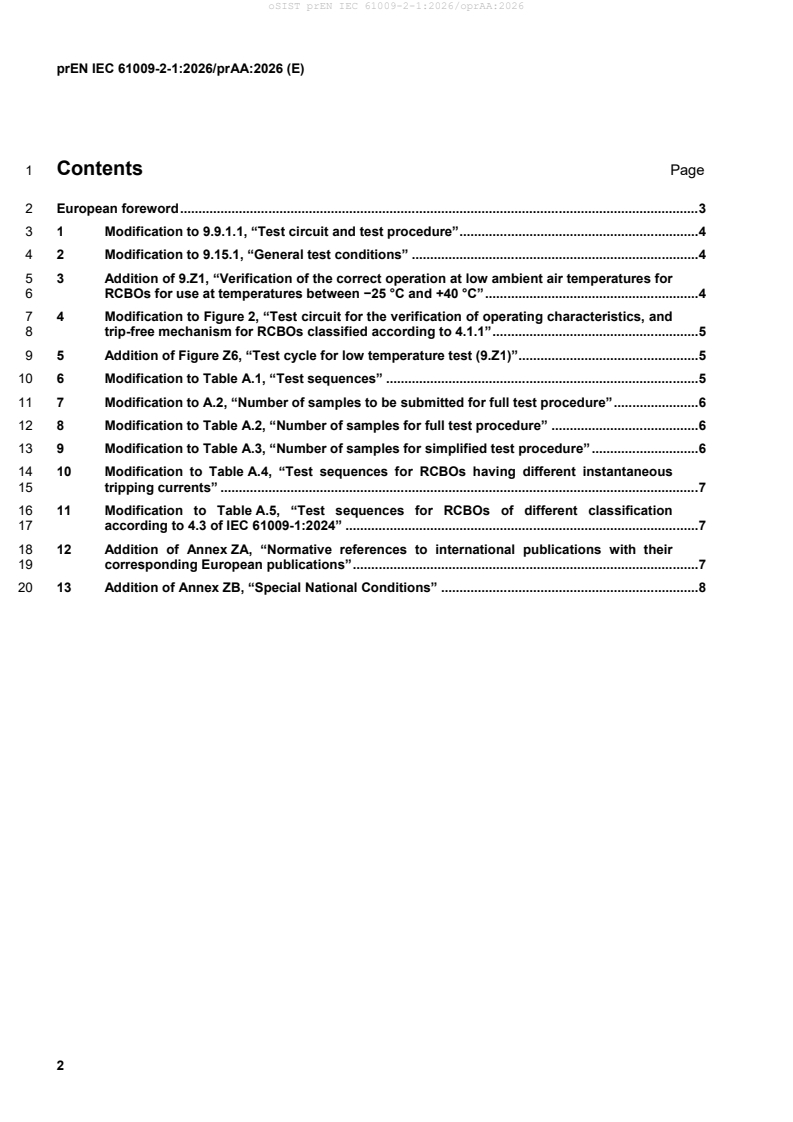
1 Contents Page
2 European foreword . 3
3 1 Modification to 9.9.1.1, “Test circuit and test procedure” . 4
4 2 Modification to 9.15.1, “General test conditions” . 4
5 3 Addition of 9.Z1, “Verification of the correct operation at low ambient air temperatures for
6 RCBOs for use at temperatures between −25 °C and +40 °C” . 4
7 4 Modification to Figure 2, “Test circuit for the verification of operating characteristics, and
8 trip-free mechanism for RCBOs classified according to 4.1.1” . 5
9 5 Addition of Figure Z6, “Test cycle for low temperature test (9.Z1)”. 5
10 6 Modification to Table A.1, “Test sequences” . 5
11 7 Modification to A.2, “Number of samples to be submitted for full test procedure” . 6
12 8 Modification to Table A.2, “Number of samples for full test procedure” . 6
13 9 Modification to Table A.3, “Number of samples for simplified test procedure” . 6
14 10 Modification to Table A.4, “Test sequences for RCBOs having different instantaneous
15 tripping currents” . 7
16 11 Modification to Table A.5, “Test sequences for RCBOs of different classification
17 according to 4.3 of IEC 61009-1:2024” . 7
18 12 Addition of Annex ZA, “Normative references to international publications with their
19 corresponding European publications” . 7
20 13 Addition of Annex ZB, “Special National Conditions” . 8
prEN IEC 61009-2-1:2026/prAA:2026 (E)
21 European foreword
22 This document (prEN IEC 61009-2-1:2026/prAA:2026) has been prepared by CLC/TC 23E “Circuit breakers
23 and similar devices for household and similar applications”.
24 This document is currently submitted to the Enquiry.
25 The following dates are proposed:
• latest date by which the existence of this (doa) dav + 6 months
document has to be announced at national
level
• latest date by which this document has to be (dop) dav + 12 months
implemented at national level by publication of
an identical national standard or by
endorsement
• latest date by which the national standards (dow) dav + 60 months (to
conflicting with this document have to be be confirmed or
withdrawn modified when voting)
26 This document is read in conjunction with prEN IEC 61009-2-1:2026.
27 This document includes the following significant technical modifications with respect to
28 prEN IEC 61009-2-1:2026:
29 — Only the essential common changes existing in EN 61009-2-1:1994 and all of its amendments and
30 corrigenda (if any) are maintained in this document.
prEN IEC 61009-2-1:2026/prAA:2026 (E)
32 1 Modification to 9.9.1.1, “Test circuit and test procedure”
33 Delete the last paragraph
34 2 Modification to 9.15.1, “General test conditions”
35 Delete the 2nd paragraph.
36 3 Addition of 9.Z1, “Verification of the correct operation at low ambient air
37 temperatures for RCBOs for use at temperatures between −25 °C and +40 °C”
38 Add the following subclause:
39 “9.Z1 Verification of the correct operation at low ambient air temperatures for RCBOs for use at
40 temperatures between −25 °C and +40 °C
41 Enclosed-type RCBOs are tested in their enclosure, unenclosed-type RCBOs are mounted in an individual
42 enclosure with a degree of protection IP55, and are connected as for normal use (see Figure 2).
43 No drain hole in the enclosure shall be opened for this test.
44 NOTE RCBOs tested in enclosures IP55 are suitable to be used in enclosures of a degree of protection other than
45 IP55 within the temperature range of –25 °C to +40 °C.
46 The RCBO (including the enclosure) is brought into a suitable test chamber with an ambient air temperature of
47 (23 ± 2) °C and a relative humidity of (93 ± 3) %. The volume ratio of the test chamber to the test samples
48 (including enclosures) shall be greater than 50.
49 The RCBO is in the ON-position without load and shall be subjected to the following cycle (see Figure Z6).
50 For the first 6 h (stabilization period) the temperature is kept at (23 ± 2) °C and the humidity at (93 ± 3) %.
51 Within the next 6 h the ambient air temperature is decreased to (−25 ± 2) °C without any supply of humidity.
52 This temperature of (−25 ± 2) °C is kept for 6 h. Within the next 6 h the temperature is increased to (+
53 23 ± 2) °C and the relative humidity is increased to (93 ± 3) % (end of the first cycle). This cycle is performed
54 five times.
55 During these cycles the RCBO shall not trip.
56 During the fifth cycle, at the end of the period at (−25 ± 2) °C, an AC residual current is passed through one
57 pole of the RCBO (see Figure 2)
58 — for RCB
...