

FprEN 50600-2-3:2026
(Main)Information technology - Data centre facilities and infrastructures - Part 2-3: Environmental control
- Abstract
This document addresses environmental control within data centres based upon the criteria and classifications for “availability”, “security” and “resource and energy efficiency enablement” within EN 50600-1. This document specifies requirements and recommendations for the following: a) temperature control; b) fluid movement control; c) relative humidity control; d) particulate control; e) vibration; f) granularity level for energy efficiency enablement; g) physical security of environmental control systems.
- Status
- Not Published
- Publication Date
- 31-Jan-2027
- Technical Committee
- CLC/TC 215 - Electrotechnical aspects of telecommunication equipment
- Drafting Committee
- CLC/TC 215/WG 03 - Facilities and infrastructures
- Current Stage
- 5020 - Vote circulated - Formal Approval
- Start Date
- 09-Oct-2026
- Due Date
- 26-May-2026
- Completion Date
- 26-May-2026

FprEN 50600-2-3:2026 is a draft European Standard from CLC for environmental control in data centres. It specifies requirements and recommendations for temperature control, fluid movement control, relative humidity control, particulate control, vibration, granularity level for energy efficiency enablement, and physical security of environmental control systems.
The document is written for the design and operation of data centre facilities and infrastructures, using the availability, security, and resource and energy efficiency enablement criteria from EN 50600-1.
What does FprEN 50600-2-3:2026 specify?
FprEN 50600-2-3:2026 specifies environmental control within data centres and how that control is tied to EN 50600-1 classifications. It covers both the technical functions of environmental control and the monitoring points used to assess performance.
The document is organized into clauses on scope, normative references, terms, conformance, environmental control within data centres, availability, physical security, and energy and resource efficiency enablement. It also includes three informative annexes with summaries and liquid-cooling guidance.
| Annex | What it covers |
|---|---|
| Annex A | Overview of the requirements for environmental conditions |
| Annex B | Overview of the requirements for granularity levels |
| Annex C | Liquid cooling |
The EN 50600 series does not address the selection of information technology and network telecommunications equipment, software, or associated configuration issues.
What are the key requirements of FprEN 50600-2-3:2026?
FprEN 50600-2-3:2026 requires the environmental control design to match the data centre’s availability class, security needs, and energy efficiency enablement level. In practice, the designer has to choose a control approach that fits the risk assessment and the intended operating model, not just the cooling load.
Environmental control must be designed as part of the whole data centre
Clause 5 links environmental control to power supply and distribution, data centre layout, outside conditions, and maintenance. The design shall take into account available technology, sustainability, energy efficiency, physical security, availability, maintenance, and future extension.
This matters because the document treats cooling and environmental control as infrastructure decisions that affect uptime and operating cost. It also requires consideration of vibration, noise, friction or obstruction in fluid pathways, and climate conditions at the site.
Different spaces have different environmental needs
Clause 5.2 gives space-specific requirements for generator spaces, transformer spaces, electrical spaces, UPS spaces, telecommunications spaces, computer room spaces, mechanical spaces, control rooms, office spaces, and storage or holding spaces. Some spaces have no specific requirements, while others have temperature, humidity, ventilation, filtration, or monitoring requirements.
This matters because a data centre is not controlled as one uniform room. The standard distinguishes between spaces that house ICT equipment, power equipment, batteries, and personnel areas, so the design can match the equipment in each space.
Availability classes define redundancy and fault tolerance
Clause 6 defines four environmental control classes, from Class 1 to Class 4. Class 1 is a single-path solution, Class 2 adds redundancy in devices, Class 3 uses multiple paths for concurrent repair and operation, and Class 4 is fault tolerant except during maintenance.
For a reader, this is the core choice that determines how a failure affects service. The clause also states that all paths in Class 3 and Class 4 solutions shall be designed to sustain maximum load.
Power supply and distribution must match the class
Clause 6.2 ties environmental control classes to the corresponding power supply class in prEN 50600-2-2:2026. The required power class increases with the environmental control class, and the designer has to decide how control and other functional elements are powered.
In practice, this means the cooling plant cannot be designed in isolation from the electrical infrastructure. If the power support is weaker than the cooling class, the environmental control system cannot deliver the intended availability.
Direct liquid cooling is explicitly addressed
Clause 6.2.2.7 and 6.2.2.9 cover direct liquid cooling (DLC) and cooling distribution units (CDU). The document distinguishes between cases where a CDU serves more than one DLC CFR and where it serves only one DLC CFR, because the demarcation point changes.
This matters for system boundaries, responsibility, and resilience planning. If a failure or maintenance action in the CDU can affect both paths, the design must address that risk.
Security and environmental events are part of the design
Clause 7 requires controls and equipment of the environmental control system to be in areas of Protection Class 3 or above, or to be monitored if they run through lower-protection areas. Clause 7.3 adds leakage detection for computer room space, UPS space, and electrical space where the risk is not otherwise mitigated.
For the reader, this means the standard treats environmental control as a security-sensitive system. It is not enough to cool the room - the controls, routes, and exposed spaces must also be protected.
Measurement and granularity drive energy and resource reporting
Clause 8 requires measurement to support the KPIs from EN 50600-4-6, EN 50600-4-7, and EN 50600-4-9 where applicable. It covers temperature, relative humidity, air pressure, coolant flow, heat removal, heat reuse, outside air, and water usage.
This matters because the standard does not only ask for control - it also asks for measurable control. The granularity level determines whether measurements are taken per system, per group, or per device, which affects how well the operator can analyse efficiency and local problems.
What terms does FprEN 50600-2-3:2026 define?
- Comfort environmental control - Control that creates conditions suitable for personnel to work effectively in a space.
- Cooling distribution unit (CDU) - A system with one or more outlets used to connect direct liquid cooled ICT equipment.
- Direct fresh air cooling - A cooling system that uses filtered outside air directly to cool ICT equipment; it is also known as direct free cooling.
- Dew point - The temperature at which water vapour in a gas starts to condense into liquid or ice.
- Relative humidity - The percentage ratio of water vapour pressure in moist air to the saturation vapour pressure at the same temperature.
- Supply air temperature - The temperature of air leaving the environmental control system for cooling.
- Rotary UPS - A rotary uninterruptible power system that produces its output waveform using a rotating machine.
- DRUPS - Dynamic rotary uninterruptible power system.
Who uses FprEN 50600-2-3:2026?
FprEN 50600-2-3:2026 is intended for people who design, specify, install, operate, maintain, or audit data centre facilities. The introduction names owners, operators, facility managers, ICT managers, project managers, main contractors, consulting engineers, architects, building designers, system and installation designers, auditors, test and commissioning agents, integrators, suppliers, installers, and maintainers.
In practice, the document is especially relevant to architects, building designers, builders, and system and installation designers because it links building conditions, cooling equipment, monitoring points, and resilience choices. Operators and facility managers use it to understand what must be monitored and maintained in day-to-day operation.
What changed in FprEN 50600-2-3:2026 from the previous edition?
FprEN 50600-2-3:2026 will supersede EN 50600-2-3:2019. The foreword lists these significant technical changes:
- the whole document has been revised technically and editorially
- resource enablement aspects were included
- Clause 3 was updated, including added terminology for water usage
- Clause 5 was updated, including EN 50600-4-X KPI requirements and a rearranged subclause 5.2
- Clause 6 was revised to address direct liquid cooling and to align terminology with EN 50600-2-2
- a new 7.3 was added for protection against environmental events other than fire
- Clause 8 was updated, including EN 50600-4-X KPI requirements and new requirements for water-usage granularity
- Annex A was updated
- Annex B and Annex C were added
Which standards are used with FprEN 50600-2-3:2026?
FprEN 50600-2-3:2026 makes these documents normative or explicitly relied on in the text:
- EN 50600-1 - provides the general concepts and the classification framework for availability, security, and resource and energy efficiency enablement
- prEN 50600-2-2:2026 - provides the power supply and distribution classes that environmental control has to match
- EN 50600-2-5 - supports the physical security requirements and the discussion of gaseous fire suppression systems
- EN 50600-3-1 - supports management and operational information, including monitoring and operational controls
- EN 50600-4-2 - provides Power Usage Effectiveness (PUE) for designed values
- EN 50600-4-6 - provides Energy Reuse Factor (ERF)
- EN 50600-4-7 - provides Cooling Efficiency Ratio (CER)
- EN 50600-4-9 - provides Water Usage Effectiveness (WUE)
- EN 60076-1 - provides transformer temperature limits when the manufacturer is not known
- EN IEC 61439-1 - provides limits for electrical spaces when the equipment manufacturer is not known
- EN IEC 62040-3 - applies to static UPS and rotary UPS when vendor data is not available
- EN ISO 14644-8 - applies to chemical air cleanliness classification
- EN 16798-3 - supports selection of ventilation and room-conditioning values and outside air filter class
- EN ISO 16890-1 - supports the minimum outside air filter class
- EN 378-3 - applies to refrigerating systems and heat pumps in mechanical space
What does the FprEN 50600-2-3:2026 document contain?
FprEN 50600-2-3:2026 contains a detailed technical structure for specifying and checking environmental control in data centres. It includes the main requirement clauses, summary tables in Annex A and Annex B, and a liquid-cooling annex with circuit-based guidance.
The document includes figures for the relationship within the EN 50600 series, the logical model of environmental control, class-based cooling supply and distribution topologies, measuring points for granularity levels, and liquid cooling layouts. Those figures support design reviews and help teams agree where resilience boundaries and sensor points sit.
It also includes tables for supply and distribution elements, measurement requirements by granularity level, environmental conditions by space type, and liquid-cooling measurement recommendations. In practice, these tables are used for design, monitoring, commissioning, and operational planning rather than for general description.
Relations
- Effective Date
- 09-Apr-2024
Get Certified
Connect with accredited certification bodies for this standard

BSI Group
BSI (British Standards Institution) is the business standards company that helps organizations make excellence a habit.

NYCE
Mexican standards and certification body.
Sponsored listings
Frequently Asked Questions
FprEN 50600-2-3:2026 is a draft published by CLC. Its full title is "Information technology - Data centre facilities and infrastructures - Part 2-3: Environmental control". This standard covers: This document addresses environmental control within data centres based upon the criteria and classifications for “availability”, “security” and “resource and energy efficiency enablement” within EN 50600-1. This document specifies requirements and recommendations for the following: a) temperature control; b) fluid movement control; c) relative humidity control; d) particulate control; e) vibration; f) granularity level for energy efficiency enablement; g) physical security of environmental control systems.
This document addresses environmental control within data centres based upon the criteria and classifications for “availability”, “security” and “resource and energy efficiency enablement” within EN 50600-1. This document specifies requirements and recommendations for the following: a) temperature control; b) fluid movement control; c) relative humidity control; d) particulate control; e) vibration; f) granularity level for energy efficiency enablement; g) physical security of environmental control systems.
FprEN 50600-2-3:2026 is classified under the following ICS (International Classification for Standards) categories: 35.020 - Information technology (IT) in general; 35.110 - Networking; 35.160 - Microprocessor systems. The ICS classification helps identify the subject area and facilitates finding related standards.
FprEN 50600-2-3:2026 has the following relationships with other standards: It is inter standard links to EN 50600-2-3:2019. Understanding these relationships helps ensure you are using the most current and applicable version of the standard.
FprEN 50600-2-3:2026 is associated with the following European legislation: Standardization Mandates: M/462. When a standard is cited in the Official Journal of the European Union, products manufactured in conformity with it benefit from a presumption of conformity with the essential requirements of the corresponding EU directive or regulation.
FprEN 50600-2-3:2026 is available in PDF format for immediate download after purchase. The document can be added to your cart and obtained through the secure checkout process. Digital delivery ensures instant access to the complete standard document.
Standards Content (Sample)
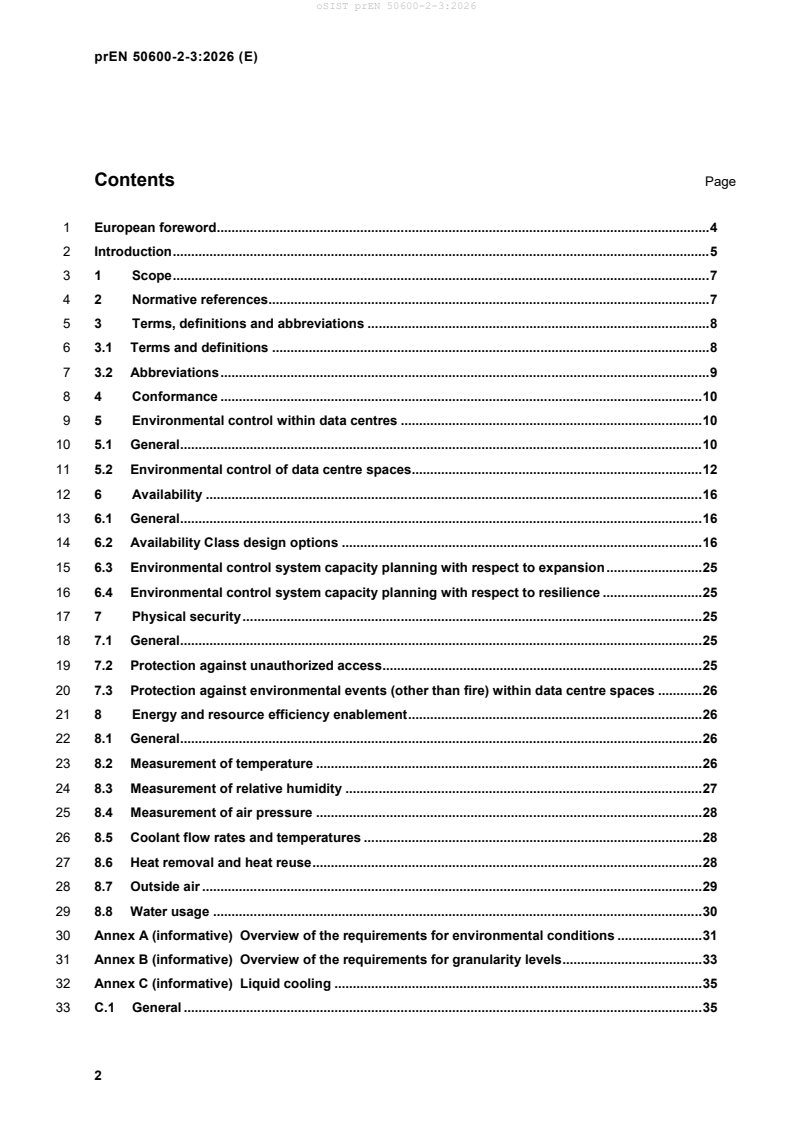
Contents
- 82 Introduction
- 8.4 Pressure Computer room As needed As needed As needed M If a raised access floor with
- 8.6 Heat All cooled rooms Per system Per group of Per device M
- 8.6 Energy used All cooled rooms Per system Per group of Per device in M
82 Introduction
83 The unrestricted access to internet-based information demanded by the information society has led to an 84 exponential growth of both internet traffic and the volume of stored/retrieved data. Data centres are housing 85 and supporting the information technology and network telecommunications equipment for data processing, 86 data storage and data transport. They are required both by network operators (delivering those services to 87 customer premises) and by enterprises within those customer premises. 88 Data centres usually need to provide modular, scalable and flexible facilities and infrastructures to easily 89 accommodate the rapidly changing requirements of the market. In addition, energy consumption of data 90 centres has become critical both from an environmental point of view (reduction of environmental footprint) 91 and with respect to economical considerations (cost of energy) for the data centre operator. 92 The implementation of data centres varies in terms of:
93 a) purpose (enterprise, co-location, co-hosting or network operator facilities); 94 b) security level; 95 c) physical size; 96 d) accommodation (mobile, temporary and permanent constructions). 97 The needs of data centres also vary in terms of availability of service, the provision of security and the 98 objectives for energy efficiency. These needs and objectives influence the design of data centres in terms of 99 building construction, power distribution, environmental control, telecommunications cabling and physical 100 security as well as the operation of the data centre. Effective management and operational information is 101 required to monitor achievement of the defined needs and objectives. 102 Recognizing the substantial resource consumption, particularly of energy, of larger data centres, it is also 103 important to provide tools for the assessment of that consumption both in terms of overall value and of source 104 mix and to provide Key Performance Indicators (KPIs) to evaluate trends and drive performance 105 improvements.
106 At the time of publication of this document, the EN 50600 series have been designed as a framework of 107 standards, technical specifications and technical reports covering the design, the operation and management, 108 the key performance indicators for energy efficient operation of the data centre as well as a maturity model for 109 energy management and environmental sustainability.
110 This series of documents specifies requirements and recommendations to support the various parties involved 111 in the design, planning, procurement, integration, installation, operation and maintenance of facilities and 112 infrastructures within data centres. These parties include:
113 1) owners, operators, facility managers, ICT managers, project managers, main contractors; 114 2) consulting engineers, architects, building designers and builders, system and installation designers, 115 auditors, test and commissioning agents; 116 3) facility and infrastructure integrators, suppliers of equipment; 117 4) installers, maintainers.
118 This document is intended for use by and collaboration between all parties involved, however, at least by 119 consulting engineers, architects, building designers and builders, system and installation designers. 120 The inter-relationship of the documents within the EN 50600 series is shown in Figure 1.
oSIST prEN 50600-2-3:2026 prEN 50600-2-3:2026 (E)
122 Figure 1 — Schematic relationship between EN 50600 series of documents 123 EN 50600-1 introduces the general concepts relevant for the design and operation of data centres. 124 EN 50600-2-X documents define the requirements for the data centre design and specify requirements and 125 recommendations for particular facilities and infrastructures to support the relevant classification for 126 “availability”, “physical security” and “energy efficiency enablement” selected from EN 50600-1. 127 EN 50600-3-1 specifies requirements and recommendations for data centre operations, processes and 128 management.
129 EN 50600-4-X documents specify requirements and recommendations for key performance indicators (KPIs) 130 used to assess and improve the resource usage efficiency and effectiveness, respectively, and criteria of 131 resilience of a data centre.
132 CLC/TS 50600-5-1 specifies the maturity model for energy management and environmental sustainability and 133 refers amongst others to EN 50600-4-X for KPIs as appropriate. 134 At the time of publication of this document, the EN 50600-2 series comprises the following documents:
135 EN 50600-2-1: Information technology — Data centre facilities and infrastructures — Part 2-1: Building 136 construction; 137 EN 50600-2-2: Information technology — Data centre facilities and infrastructures — Part 2-2: Power supply 138 and distribution; 139 EN 50600-2-3: Information technology — Data centre facilities and infrastructures — Part 2-3: Environmental 140 control; 141 EN 50600-2-4: Information technology — Data centre facilities and infrastructures — Part 2-4:
142 Telecommunications cabling infrastructure; 143 EN 50600-2-5: Information technology — Data centre facilities and infrastructures — Part 2-5: Security 144 systems; 145 CLC/TS 50600-2-10: Information technology — Data centre facilities and infrastructures — Part 2-10:
146 Earthquake risk and impact analysis.
147 This document, EN 50600-2-3, addresses the environmental control facilities and infrastructure within data 148 centres together with the interfaces for monitoring the performance of those facilities and infrastructures in line 149 with EN 50600-3-1 (in accordance with the requirements of EN 50600-1). 150 This document is intended for use by and collaboration between architects, building designers and builders, 151 system and installation designers.
152 This series of European Standards does not address the selection of information technology and network 153 telecommunications equipment, software and associated configuration issues.
oSIST prEN 50600-2-3:2026 prEN 50600-2-3:2026 (E) 154 1 Scope 155 This document addresses environmental control within data centres based upon the criteria and classifications 156 for “availability”, “security” and “resource and energy efficiency enablement” within EN 50600-1. 157 This document specifies requirements and recommendations for the following:
158 a) temperature control; 159 b) fluid movement control; 160 c) relative humidity control; 161 d) particulate control; 162 e) vibration; 163 f) granularity level for energy efficiency enablement; 164 g) physical security of environmental control systems.
165 2 Normative references 166 The following documents are referred to in the text in such a way that some or all of their content constitutes 167 requirements of this document. For dated references, only the edition cited applies. For undated references, 168 the latest edition of the referenced document (including any amendments) applies. 169 EN 50600-1, Information technology - Data centre facilities and infrastructures - Part 1: General concepts
170 prEN 50600-2-2:2026, Information technology - Data centre facilities and infrastructures - Part 2-2: Power 171 supply and distribution 172 EN 50600-2-5, Information technology - Data centre facilities and infrastructures - Part 2-5: Security systems 173 EN 50600-3-1, Information technology - Data centre facilities and infrastructures - Part 3-1: Management and 174 operational information 175 EN 50600-4-2, Information technology - Data centre facilities and infrastructures - Part 4-2: Power Usage 176 Effectiveness 177 EN 50600-4-6, Information technology - Data centre facilities and infrastructures - Part 4-6: Energy Reuse 178 Factor 179 EN 50600-4-7, Information technology - Data centre facilities and infrastructures - Part 4-7: Cooling Efficiency 180 Ratio 181 EN 50600-4-9, Information technology - Data centre facilities and infrastructures - Part 4-9: Water Usage 182 Effectiveness 183 EN 60076-1, Power transformers - Part 1: General 184 EN IEC 61439-1, Low-voltage switchgear and controlgear assemblies - Part 1: General rules
Currently at enquiry stage.
oSIST prEN 50600-2-3:2026 prEN 50600-2-3:2026 (E) 185 EN IEC 62040-3, Uninterruptible power systems (UPS) - Part 3: Method of specifying the performance and 186 test requirements 187 EN ISO 14644-8, Cleanrooms and associated controlled environments - Part 8: Assessment of air cleanliness 188 by chemical concentration (ACC) (ISO 14644-8:2022) 189 EN 16798-3, Energy performance of buildings - Ventilation for buildings - Part 3: For non-residential buildings 190 - Performance requirements for ventilation and room-conditioning systems (Modules M5-1, M5-4) 191 EN ISO 16890-1, Air filters for general ventilation - Part 1: Technical specifications, requirements and 192 classification system based upon particulate matter efficiency (ePM) (ISO 16890-1) 193 EN 378-3, Refrigerating systems and heat pumps - Safety and environmental requirements - Part 3: Installation 194 site and personal protection 195 3 Terms, definitions and abbreviations 196 3.1 Terms and definitions 197 For the purposes of this document, the terms and definitions in EN 50600-1 and the following apply. 198 ISO and IEC maintain terminology databases for use in standardization at the following addresses:
199 — IEC Electropedia: available at https://www.electropedia.org/ 200 — ISO Online browsing platform: available at https://www.iso.org/obp 201 3.1.1 202 comfort environmental control 203 control which produces an environment which is appropriate for the effective performance of personnel in a 204 given space 205 3.1.2 206 cooling distribution unit 207 system with one or multiple outlets to connect direct liquid cooled ICT equipment 208 Note 1 to entry: For Availability Class 3 and Availability Class 4 the cooling distribution unit can contain switch over valves 209 if redundancy is not provided on ICT equipment level.
210 3.1.3 211 dew point 212 temperature at which the water vapour in a gas begins to deposit as a liquid or ice, under standardized 213 conditions 214 3.1.4 215 direct fresh air cooling 216 cooling system that uses the external air that can be filtered to directly cool the ICT equipment in the data 217 centre 218 Note 1 to entry: Also known as direct free cooling.
219 3.1.5 220 diesel rotary UPS 221 diesel rotary uninterruptible power system 222 system where the output waveform is produced by a rotating machine that is mechanically connected to a 223 flywheel stored energy source, and the flywheel stored energy source is coupled to a backup engine with an 224 electro-magnetic clutch
oSIST prEN 50600-2-3:2026 prEN 50600-2-3:2026 (E) 225 3.1.6 226 inlet air temperature 227 temperature of the air entering the rack or IT equipment for cooling 228 3.1.7 229 thermal load 230 room or a CFR holding equipment or a technical device or a technical system which needs active cooling 231 3.1.8 232 raised access floor 233 system consisting of completely removable and interchangeable floor panels that are supported on adjustable 234 pedestals connected by stringers to allow the area beneath the floor to be used by building services 235 3.1.9 236 relative humidity 237 ratio, expressed as a percentage, of the vapour pressure of water vapour in moist air to the saturation vapour 238 pressure with respect to water or ice at the same temperature 239 [SOURCE: IEC 60050-705:1995, 705-05-09] 240 3.1.10 241 return air temperature 242 temperature of the heated air re-entering the environmental control system 243 3.1.11 244 rotary uninterruptible power system 245 rotary UPS 246 rotating machine, which produces an output waveform, using either batteries or flywheel as stored energy 247 source 248 3.1.12 249 static uninterruptible power system 250 static UPS 251 the output waveform is produced by electronic circuits, using either batteries or flywheel as stored energy 252 source 253 3.1.13 254 supply air temperature 255 temperature of the air for cooling leaving the environmental control system 256 Note 1 to entry: An environmental control system is e.g. the CRAC/CRAH. 257 3.1.14 258 ventilation 259 supply of air motion in a space by circulation or by moving air through the space 260 Note 1 to entry: Ventilation can be produced by any combination of natural or mechanical supply and exhaust. 261 3.2 Abbreviations 262 For the purposes of this document, the abbreviations given in EN 50600-1 and the following apply. CDU cooling distribution unit CFR cabinet/frame/rack DLC direct liquid cooling DRUPS dynamic rotary uninterruptible power system
oSIST prEN 50600-2-3:2026 prEN 50600-2-3:2026 (E) 263 4 Conformance 264 For a data centre to conform to this document:
265 a) it shall feature an environmental control solution that meets the requirements of Clauses 5 and 6; 266 b) it shall feature an approach to physical security in relation to the environmental control solution that meets 267 the requirements of Clause 7; 268 c) it shall feature an energy efficiency enablement solution that meets the requirements of the relevant 269 Granularity Level of Clause 8; 270 NOTE local regulations, including those regarding safety, can exist. 271 The required Class of the environmental control system of a data centre is based on the required Availability 272 Class of the data centre.
273 5 Environmental control within data centres 274 5.1 General 275 5.1.1 Design input 276 Power supply and distribution and environmental control are important primary facilities and infrastructures of 277 a data centre and have inter-related design aspects (see Figure 2):
278 a) power supplied to ICT equipment which is converted to heat output; 279 b) power supplied to the environmental control system to remove the heat output.
281 Figure 2 — Logical representation of environmental control of data centre spaces 282 5.1.2 Functional elements 283 The environmental control system is one of the most important parts of the data centre infrastructure. 284 Excessive fluctuations in air temperature, water temperatures for liquid-cooled components or relative humidity 285 can directly affect the functionality of the data centre.
286 The system for controlling the ambient conditions should not be set to rigid values but should be regulated 287 depending on the permissible system temperatures and the relative humidity of the ICT equipment as well as 288 the prevailing conditions outside the data centre in order to achieve an increase in energy efficiency.
oSIST prEN 50600-2-3:2026 prEN 50600-2-3:2026 (E) 289 The functional elements of the environmental control system are divided into supply and distribution elements. 290 The division of environmental control systems into supply and distribution reflects energy efficiency where data 291 centres use multiple cooling sources in various combinations (e.g. cold water from public grids, non-dedicated 292 central cooling plants, geothermal systems, rivers, and compressor systems). 293 Supply elements relate to the supply of temperature-controlled fluids. Distribution elements relate to the 294 distribution of fluids supplied by the supply elements. It is divided into devices (systems) and paths. Examples 295 of the supply and distribution elements are listed in Table 1. 296 Some environmental systems combine the function of supply and distribution elements. 297 Measurements are requested at various points in this document to provide insight, the ability to analyse and 298 ultimately to improve energy efficiency.
299 Table 1 — Examples of supply and distribution elements Area Fluid Functional element Device / Functional Path / Functional element element Supply Water/Refrigerant External water supply, Pipe system chiller, pump, condensing unit Air Outside air intake, filter, Duct/Plenum system heat exchanger Distribution Water/Refrigerant Pump, heat exchanger, Pipe system Air CRAC, CRAH, louvres Duct/Plenum system 300 For further information on liquid cooling systems see Annex C. 301 5.1.3 Requirements 302 The approach taken for the design of the environmental control system shall take into account available 303 technology, sustainability, energy efficiency, physical security, data centre availability, maintenance and future 304 extension (continuity of service).
305 The design of the environmental control system and the selection and installation of functional elements shall 306 take into consideration the effect of vibration on the data centre spaces and the noise level within the data 307 centre space and outside the building that houses the data centre. 308 The physical data centre location and external conditions (minimum, median and maximum external 309 temperature and humidity rate) and the effect of climate change on these conditions shall be taken into account 310 for the selection of the functional elements.
311 The design of the environmental control system and the selection and installation of functional elements shall 312 take into consideration the effect of friction and/or obstruction in the pathways for temperature controlled fluids. 313 Operational controls shall be provided to ensure no degradation of fluid flow due to changes in the pathways 314 according to EN 50600-3-1.
315 During the design phase the requirement for the number of air changes per unit time and air pressure 316 differences shall be established. EN 16798-3 can provide support when selecting these values. 317 In all data centre spaces the requirements for air quality shall be considered. 318 In all spaces with a risk of damage to static-sensitive equipment from electro-static discharge the relative 319 humidity shall be maintained in accordance with the instructions of the supplier of the equipment to be 320 accommodated. Where no information exists or where the equipment manufacturer is not specified, a minimum 321 dew point of 5,5 °C shall be maintained.
322 Where direct fresh air cooling solutions are chosen the requirements analysis and the resulting methodology 323 of monitoring and control is of prime importance. In these circumstances particular consideration shall be given 324 to the control of contaminants and relative and absolute humidity.
oSIST prEN 50600-2-3:2026 prEN 50600-2-3:2026 (E) 325 Spaces with gaseous fire suppression systems require a concept for removing the gas after an activation of 326 the fire suppression system (e.g. mechanical ventilation system). For requirements and recommendation for 327 gaseous fire suppression systems see EN 50600-2-5.
328 An overview of the requirements on environmental conditions is given in Annex A. 329 The designed PUE, in accordance with EN 50600-4-2, and designed CER, in accordance with EN 50600-4-7, 330 shall be calculated for different load levels, e.g. 10 %, 25 %, 50 %, 75 % and 100 %. Alternatively, it may be 331 calculated according to the provisioning forecast as described in ISO/IEC TS 8236-1 and ISO/IEC TS 8236-2. 332 For detailed information on the requirements of the maturity level selection see EN 50600-1. 333 The use of waste heat e.g. to heat building spaces, generators, or the supply of waste heat for external usage 334 shall be considered.
335 5.1.4 Recommendations 336 The use of wider tolerances of temperature and relative humidity in defined data centre spaces (see 337 CLC/TS 50600-5-1) should be considered. Deploying groups of ICT equipment with substantially different 338 environmental requirements and / or equipment airflow direction in separate areas should be considered. For 339 additional options to be considered see CLC/TS 50600-5-1.
340 Controlling relative humidity within a wider range can reduce humidification and dehumidification loads and 341 therefore energy consumption.
...