

EN IEC 61300-2-50:2026
(Main)Fibre optic interconnecting devices and passive components - Basic test and measurement procedures - Part 2-50: Tests - Fibre optic connector proof test with static load
- Status
- Not Published
- Publication Date
- 12-Nov-2026
- Current Stage
- 5060 - Voting results sent to TC, SR - Formal Approval
- Start Date
- 17-Jul-2026
- Completion Date
- 17-Jul-2026

EN IEC 61300-2-50:2026 is a test standard for fibre optic connector proof testing with static load. It specifies how to assess whether a connector terminated to a reinforced cable or a buffered fibre can withstand static pulling loads without uncoupling, physical damage, or permanent degradation of optical performance.
What does EN IEC 61300-2-50:2026 specify?
EN IEC 61300-2-50:2026 specifies a proof test for fibre optic connectors under static load and is written for single-mode and multimode connectors. The document is organized into clauses for scope, normative references, terms and definitions, apparatus, test setup, procedure, severity, and reporting, with figures showing the test arrangement and load application.
The test is intended to reflect abrupt mechanical stress that can happen during installation and maintenance. In practice, that means the document tells users how to set up the connector, apply the load in defined directions, check optical performance before and after the load, and record the outcome.
What are the key requirements of EN IEC 61300-2-50:2026?
EN IEC 61300-2-50:2026 requires the device under test (DUT) to be examined, preconditioned, tested under a defined static load, and then remeasured for optical performance. The central idea is to compare the connector’s condition before and after loading and confirm that it still meets the relevant performance limits.
Test preparation and optical checks
Clause 7 requires visual examination of the DUT, cleaning of the mechanical and optical alignment parts, and inspection of the optical interfaces before the test. It also requires preconditioning for at least 2 h at standard atmospheric conditions, followed by initial measurements such as attenuation and return loss.
This matters because the starting condition becomes the reference for judging any change caused by the load.
Mounting and loading directions
Clause 7 distinguishes between straight pull and side pull configurations for the adaptor - plug - cable arrangement, and it also includes a pulling cap - plug - cable configuration for hardened connectors where applicable. The relevant performance standard or reliability document specifies whether straight pull, side pull, or both directions are required.
This matters because the connector may behave differently depending on how the force is applied, so the test must match the intended use case.
Load application and test setup
Clause 5 describes the apparatus, including the mounting fixture, mandrel, and force generator. The load must be applied smoothly, reach the required force within 20 s or less, and use a load rate suited to the cable type.
This matters because the test is designed to be repeatable and to avoid artificial shock loading that could distort the result.
Non-circular cables and hardened connectors
For non-circular cable forms such as ribbon or duplex cordage, the load is not doubled, and the cordage is bent in the minor-axis direction. For hardened connectors, the document adds a straight pull test in the pulling cap - plug - cable configuration, unless the design has no dedicated pulling cap for attaching the pulling gear.
This matters because special connector and cable constructions need special handling if the test is to remain realistic.
Final evaluation
Clause 7 requires final optical measurements after the load is removed, and the change from the initial values must remain within the limits set by the relevant performance or reliability document. The plug must stay connected until the final measurements are complete.
This matters because the test is not only about surviving the pull mechanically - it also checks whether optical performance stays acceptable.
Sealing and visual condition after test
After the load test, the DUT is visually examined for damage and, for hardened connectors, sealing checks are performed as specified. The document also lists likely failure modes such as broken parts, damaged strain relief elements, or uncoupling during the test.
This matters because a connector can fail mechanically even if it still appears to function optically, or vice versa.
What terms does EN IEC 61300-2-50:2026 define?
- Device under test (DUT) - The connector assembly being evaluated in the proof test.
- Pulling cap - A detachable component that protects the optical parts of the connector plug and can accept pulling gear.
- Reinforced cable - The cable type used for one of the test applications described in the scope and procedure.
- Buffered fibre - The fibre type covered by the scope when the connector is terminated to buffered fibre.
- Hardened connectors - Connectors for which the procedure adds dedicated handling and sealing checks.
- Performance category - The category used to link the test severity to the intended product performance level.
Who uses EN IEC 61300-2-50:2026?
EN IEC 61300-2-50:2026 is used by fibre optic connector designers, cable assembly manufacturers, test laboratories, and quality teams that qualify or verify connector robustness. It is also relevant to organizations working to IEC 61753 performance standards and IEC 62005 reliability documents, because those documents define the load, duration, and acceptance limits used with this test.
In practice, buyers and approval teams use it when they need a repeatable proof test for connector pull resistance and post-test optical stability.
What changed in EN IEC 61300-2-50:2026 from the previous edition?
EN IEC 61300-2-50:2026 cancels and replaces the first edition published in 2007 and is described as a technical revision. The document states these significant changes:
- a normative references clause was added;
- a terms and definitions clause was added;
- a straight pull test for the pulling cap - plug - cable configuration was added;
- the procedure was modified, including provisions for hardened connectors;
- the severity was updated according to the component and performance category;
- a details to be specified and reported clause was added.
Which standards are used with EN IEC 61300-2-50:2026?
EN IEC 61300-2-50:2026 depends on several IEC documents that define the supporting methods and the acceptance context:
- IEC 60529 - used for ingress protection-related sealing checks.
- IEC 61300-1 - gives general guidance and atmospheric conditioning.
- IEC 61300-2-38 - provides the sealing test method used for sealed hardened connectors.
- IEC 61300-3-1 - provides visual examination.
- IEC 61300-3-3 - provides active optical measurement of attenuation and return loss.
- IEC 61300-3-35 - provides visual inspection of fibre optic connectors and fibre-stub transceivers.
- IEC 61753 (all parts) - provides performance standards that define the applicable limits and severities.
- IEC 62005 (all parts) - provides reliability documents that also define applicable limits and severities.
- IEC TR 62627-01 - gives cleaning methods for optical alignment parts.
- IEC TS 63334 - supports sealing tests for passive optical protective housings and hardened fibre optic connectors.
What does the EN IEC 61300-2-50:2026 document contain?
EN IEC 61300-2-50:2026 contains a general description of the proof test, the apparatus needed, and the test setup shown in Figure 1. It also includes a second load application case for duplex cordage in Figure 2 and a severity table that links performance categories to load and duration.
The procedure covers preparation, preconditioning, initial optical measurements, mounting, straight pull testing, side pull testing, and final measurements. It also defines what must be reported, including DUT characteristics, mounting conditions, load application details, orientation, observed uncoupling or damage, severity, additional pass-fail criteria, and any deviations from the procedure.
Relations
- Effective Date
- 27-Oct-2026
- Effective Date
- 27-Oct-2026
- Effective Date
- 27-Oct-2026
- Effective Date
- 27-Oct-2026
- Effective Date
- 27-Oct-2026
- Effective Date
- 27-Oct-2026
- Effective Date
- 27-Oct-2026
- Effective Date
- 27-Oct-2026
- Effective Date
- 27-Oct-2026
- Effective Date
- 27-Oct-2026
- Effective Date
- 27-Oct-2026
- Effective Date
- 27-Oct-2026
- Effective Date
- 27-Oct-2026
- Effective Date
- 27-Oct-2026
- Effective Date
- 13-Aug-2024
Get Certified
Connect with accredited certification bodies for this standard

ANCE
Mexican certification and testing association.

Intertek Slovenia
Intertek testing, inspection, and certification services in Slovenia.

LNE (Laboratoire National de Métrologie et d'Essais)
French national laboratory for metrology and testing.
Sponsored listings
Frequently Asked Questions
EN IEC 61300-2-50:2026 is a draft published by CLC. Its full title is "Fibre optic interconnecting devices and passive components - Basic test and measurement procedures - Part 2-50: Tests - Fibre optic connector proof test with static load". This standard covers: Fibre optic interconnecting devices and passive components - Basic test and measurement procedures - Part 2-50: Tests - Fibre optic connector proof test with static load
Fibre optic interconnecting devices and passive components - Basic test and measurement procedures - Part 2-50: Tests - Fibre optic connector proof test with static load
EN IEC 61300-2-50:2026 is classified under the following ICS (International Classification for Standards) categories: 33.180.20 - Fibre optic interconnecting devices. The ICS classification helps identify the subject area and facilitates finding related standards.
EN IEC 61300-2-50:2026 has the following relationships with other standards: It is inter standard links to EN 62005-1:2001, EN IEC 61300-3-35:2022, EN 62005-2:2001, EN IEC 61300-2-38:2023, EN 62005-4:1999, EN IEC 61300-1:2022, EN IEC 61753-021-03:2026, EN 62005-3:2001, EN 62005-7:2004, EN IEC 61753-021-06:2023, EN 61300-3-1:2005, EN IEC 61753-021-02:2023, IEC TR 62627-01:2010, EN 61300-3-3:2009, EN 61300-2-50:2007/AC:2015. Understanding these relationships helps ensure you are using the most current and applicable version of the standard.
EN IEC 61300-2-50:2026 is available in PDF format for immediate download after purchase. The document can be added to your cart and obtained through the secure checkout process. Digital delivery ensures instant access to the complete standard document.
Standards Content (Sample)
SLOVENSKI STANDARD
oSIST prEN IEC 61300-2-50:2025
01-maj-2025
Optični spojni elementi in pasivne komponente - Osnovni postopki preskušanja in
merjenja - 2-50. del: Preskusi - Preskus preverjanja optičnih konektorjev s statično
obremenitvijo
Fibre optic interconnecting devices and passive components - Basic test and
measurement procedures - Part 2-50: Tests - Fibre optic connector proof test with static
load
Dispositifs d'interconnexion et composants passifs à fibres optiques - Méthodes
fondamentales d'essais et de mesures - Partie 2-50: Essais - Essai de résistance des
connecteurs à fibres optiques sous charge statique
Ta slovenski standard je istoveten z: prEN IEC 61300-2-50:2025
ICS:
33.180.20 Povezovalne naprave za Fibre optic interconnecting
optična vlakna devices
oSIST prEN IEC 61300-2-50:2025 en
2003-01.Slovenski inštitut za standardizacijo. Razmnoževanje celote ali delov tega standarda ni dovoljeno.
oSIST prEN IEC 61300-2-50:2025
oSIST prEN IEC 61300-2-50:2025
86B/5004/CDV
COMMITTEE DRAFT FOR VOTE (CDV)
PROJECT NUMBER:
IEC 61300-2-50 ED2
DATE OF CIRCULATION: CLOSING DATE FOR VOTING:
2025-03-21 2025-06-13
SUPERSEDES DOCUMENTS:
86B/4948/CD, 86B/4960A/CC
IEC SC 86B : FIBRE OPTIC INTERCONNECTING DEVICES AND PASSIVE COMPONENTS
SECRETARIAT: SECRETARY:
Japan Mr Ryo Koyama
OF INTEREST TO THE FOLLOWING COMMITTEES: HORIZONTAL FUNCTION(S):
ASPECTS CONCERNED:
SUBMITTED FOR CENELEC PARALLEL VOTING NOT SUBMITTED FOR CENELEC PARALLEL VOTING
Attention IEC-CENELEC parallel voting
The attention of IEC National Committees, members of
CENELEC, is drawn to the fact that this Committee Draft
for Vote (CDV) is submitted for parallel voting.
The CENELEC members are invited to vote through the
CENELEC online voting system.
This document is still under study and subject to change. It should not be used for reference purposes.
Recipients of this document are invited to submit, with their comments, notification of any relevant patent rights of
which they are aware and to provide supporting documentation.
Recipients of this document are invited to submit, with their comments, notification of any relevant “In Some
Countries” clauses to be included should this proposal proceed. Recipients are reminded that the CDV stage is
the final stage for submitting ISC clauses. (SEE AC/22/2007 OR NEW GUIDANCE DOC).
TITLE:
Fibre optic interconnecting devices and passive components - Basic test and measurement
procedures - Part 2-50: Tests - Fibre optic connector proof test with static load
PROPOSED STABILITY DATE: 2033
NOTE FROM TC/SC OFFICERS:
electronic file, to make a copy and to print out the content for the sole purpose of preparing National Committee positions.
You may not copy or "mirror" the file or printed version of the document, or any part of it, for any other purpose without
permission in writing from IEC.
oSIST prEN IEC 61300-2-50:2025
IEC CDV 61300-2-50 IEC 2025 2 86B/5004/CDV
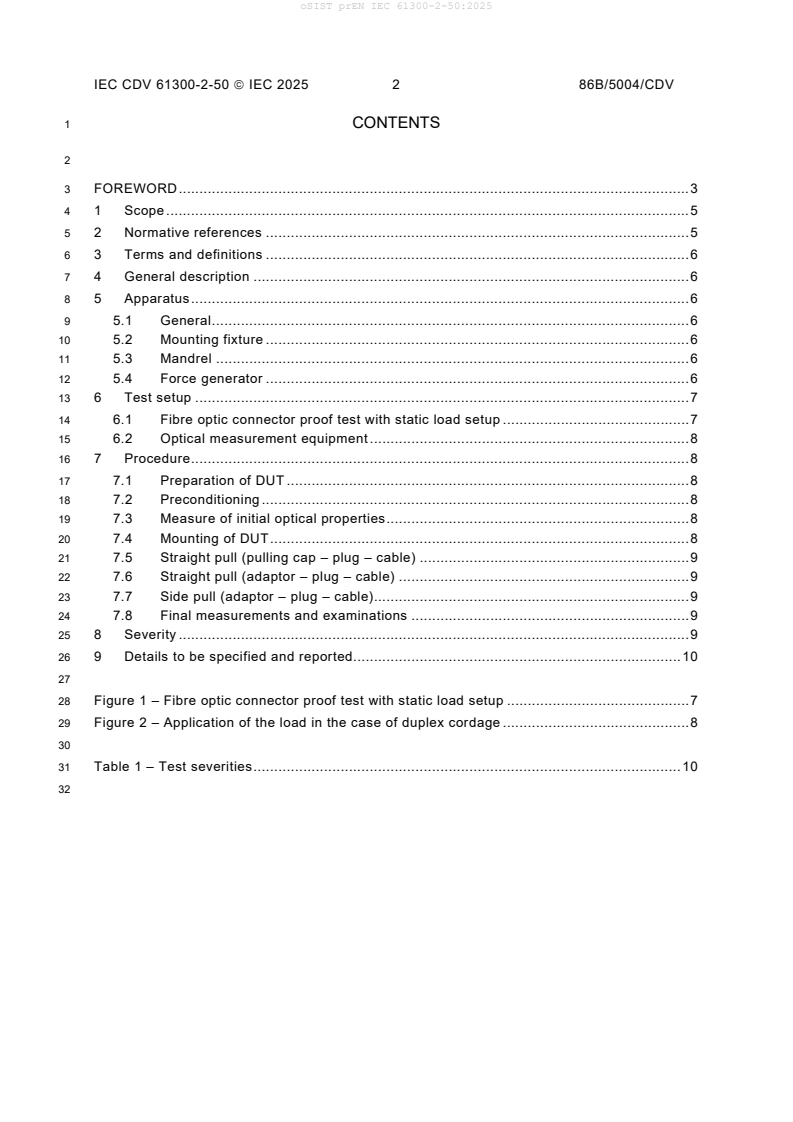
1 CONTENTS
3 FOREWORD . 3
4 1 Scope . 5
5 2 Normative references . 5
6 3 Terms and definitions . 6
7 4 General description . 6
8 5 Apparatus . 6
9 5.1 General . 6
10 5.2 Mounting fixture . 6
11 5.3 Mandrel . 6
12 5.4 Force generator . 6
13 6 Test setup . 7
14 6.1 Fibre optic connector proof test with static load setup . 7
15 6.2 Optical measurement equipment . 8
16 7 Procedure . 8
17 7.1 Preparation of DUT . 8
18 7.2 Preconditioning . 8
19 7.3 Measure of initial optical properties . 8
20 7.4 Mounting of DUT . 8
21 7.5 Straight pull (pulling cap – plug – cable) . 9
22 7.6 Straight pull (adaptor – plug – cable) . 9
23 7.7 Side pull (adaptor – plug – cable). 9
24 7.8 Final measurements and examinations . 9
25 8 Severity . 9
26 9 Details to be specified and reported. 10
28 Figure 1 – Fibre optic connector proof test with static load setup . 7
29 Figure 2 – Application of the load in the case of duplex cordage . 8
31 Table 1 – Test severities . 10
oSIST prEN IEC 61300-2-50:2025
IEC CDV 61300-2-50 IEC 2025 3 86B/5004/CDV
33 INTERNATIONAL ELECTROTECHNICAL COMMISSION
34 ____________
36 FIBRE OPTIC INTERCONNECTING
37 DEVICES AND PASSIVE COMPONENTS –
38 BASIC TEST AND MEASUREMENT PROCEDURES –
40 Part 2-50: Tests – Fibre optic connector proof test with static load
42 FOREWORD
43 1) The International Electrotechnical Commission (IEC) is a worldwide organization for standardization comprising
44 all national electrotechnical committees (IEC National Committees). The object of IEC is to promote international
45 co-operation on all questions concerning standardization in the electrical and electronic fields. To this end and
46 in addition to other activities, IEC publishes International Standards, Technical Specifications, Technical Reports,
47 Publicly Available Specifications (PAS) and Guides (hereafter referred to as “IEC Publication(s)”). Their
48 preparation is entrusted to technical committees; any IEC National Committee interested in the subject dealt with
49 may participate in this preparatory work. International, governmental and non-governmental organizations liaising
50 with the IEC also participate in this preparation. IEC collaborates closely with the International Organization for
51 Standardization (ISO) in accordance with conditions determined by agreement between the two organizations.
52 2) The formal decisions or agreements of IEC on technical matters express, as nearly as possible, an international
53 consensus of opinion on the relevant subjects since each technical committee has representation from all
54 interested IEC National Committees.
55 3) IEC Publications have the form of recommendations for international use and are accepted by IEC National
56 Committees in that sense. While all reasonable efforts are made to ensure that the technical content of IEC
57 Publications is accurate, IEC cannot be held responsible for the way in which they are used or for any
58 misinterpretation by any end user.
59 4) In order to promote international uniformity, IEC National Committees undertake to apply IEC Publications
60 transparently to the maximum extent possible in their national and regional publications. Any divergence between
61 any IEC Publication and the corresponding national or regional publication shall be clearly indicated in the latter.
62 5) IEC itself does not provide any attestation of conformity. Independent certification bodies provide conformity
63 assessment services and, in some areas, access to IEC marks of conformity. IEC is not responsible for any
64 services carried out by independent certification bodies.
65 6) All users should ensure that they have the latest edition of this publication.
66 7) No liability shall attach to IEC or its directors, employees, servants or agents including individual experts and
67 members of its technical committees and IEC National Committees for any personal injury, property damage or
68 other damage of any nature whatsoever, whether direct or indirect, or for costs (including legal fees) and
69 expenses arising out of the publication, use of, or reliance upon, this IEC Publication or any other IEC
70 Publications.
71 8) Attention is drawn to the Normative references cited in this publication. Use of the referenced publications is
72 indispensable for the correct application of this publication.
73 9) IEC draws attention to the possibility that the implementation of this document may involve the use of (a)
74 patent(s). IEC takes no position concerning the evidence, validity or applicability of any claimed patent rights in
75 respect thereof. As of the date of publication of this document, IEC had not received notice of (a) patent(s), which
76 may be required to implement this document. However, implementers are cautioned that this may not represent
77 the latest information, which may be obtained from the patent database available at https://patents.iec.ch. IEC
78 shall not be held responsible for identifying any or all such patent rights.
79 IEC 61300-2-50 has been prepared by subcommittee 86B: Fibre optic interconnecting devices
80 and passive components, of IEC technical committee 86: Fibre optics. It is an International
81 Standard.
82 This second edition cancels and replaces the first edition published in 2007. This edition
83 constitutes a technical revision.
84 This edition includes the following significant technical changes with respect to the previous
85 edition:
86 a) added normative references clause;
87 b) added terms and definitions clause;
88 c) added the straight pull test of pulling cap – plug – cable configuration;
oSIST prEN IEC 61300-2-50:2025
IEC CDV 61300-2-50 IEC 2025 4 86B/5004/CDV
89 d) the test procedure was modified including previsions for hardened connectors;
90 e) the severity of the test was updated according to the component and performance category;
91 f) added details to be specified and reported clause.
92 The text of this standard is based on the following documents:
Draft Report on voting
86B/XX/FDIS 86B/XX/RVD
94 Full information on the voting for its approval can be found in the report on voting indicated in
95 the above table.
96 The language used for the development of this International Standard is English.
97 This document was drafted in accordance with ISO/IEC Directives, Part 2, and developed in
98 accordance with ISO/IEC Directives, Part 1 and ISO/IEC Directives, IEC Supplement, available
99 at www.iec.ch/members_experts/refdocs. The main document types developed by IEC are
100 described in greater detail at www.iec.ch/publications.
101 A list of all parts of IEC 61300 series, published under the general title Fibre optic
102 interconnecting devices and passive components – Basic test and measurement procedures,
103 can be found on the IEC website.
104 The committee has decided that the contents of this document will remain unchanged until the
105 stability date indicated on the IEC website under webstore.iec.ch in the data related to the
106 specific document. At this date, the document will be
107 • reconfirmed,
108 • withdrawn,
109 • replaced by a revised edition, or
110 • amended.
oSIST prEN IEC 61300-2-50:2025
IEC CDV 61300-2-50 IEC 2025 5 86B/5004/CDV
113 FIBRE OPTIC INTERCONNECTING
114 DEVICES AND PASSIVE COMPONENTS –
115 BASIC TEST AND MEASUREMENT PROCEDURES –
117 Part 2-50: Tests – Fibre optic connector proof test with static load
120 1 Scope
121 This part of IEC 61300 describes a test to quantitatively assess the capability of a connector
122 terminated to a reinforced cable of any diameter or a buffered fibre, both single-mode and
123 multimode, to withstand static loads without uncoupling of the connector, physical damage to
124 the assembly or permanent degradation of optical performance.
125 2 Normative references
126 The following documents are referred to in the text in such a way that some or all of their content
127 constitutes requirements of this document. For dated references, only the edition cited applies.
128 For undated references, th
...