


ISO/IEC TR 24704:2004
(Main)Information technology - Customer premises cabling for wireless access points
Information technology - Customer premises cabling for wireless access points
Describes the use of generic cabling for customer premises, as specified in international standard ISO/IEC 11801, for connection to wireless access points. The customer premises may encompass one or more buildings or may be within a building that contains more than one enterprise. This TR, intended to guide new installations and renovations, specifies an ISO/IEC compliant implementation methodology that enables connection to information and communications technology (ICT) equipment that is specifically deployed to provide a grid of wireless coverage areas within buildings. The cabling may be installed prior to the selection of specific equipment or the wireless application to be used. This TR was created because the infrastructure specified in cabling standard ISO/IEC 11801 does not specifically cover infrastructure for connections to wireless access points. Supplementary information is provided here on the number of outlets and outlet placement for wireless access points that may optionally receive both power and information transfer through the IT cabling.
General Information
- Status
- Withdrawn
- Publication Date
- 28-Jul-2004
- Withdrawal Date
- 04-Nov-2021
- Technical Committee
- ISO/IEC JTC 1/SC 25 - Interconnection of information technology equipment
- Current Stage
- WPUB - Publication withdrawn
- Start Date
- 05-Nov-2021
- Completion Date
- 05-Nov-2021

Get Certified
Connect with accredited certification bodies for this standard

BSI Group
BSI (British Standards Institution) is the business standards company that helps organizations make excellence a habit.

NYCE
Mexican standards and certification body.
Sponsored listings
Frequently Asked Questions
ISO/IEC TR 24704:2004 is a technical report published by the International Electrotechnical Commission (IEC). Its full title is "Information technology - Customer premises cabling for wireless access points". This standard covers: Describes the use of generic cabling for customer premises, as specified in international standard ISO/IEC 11801, for connection to wireless access points. The customer premises may encompass one or more buildings or may be within a building that contains more than one enterprise. This TR, intended to guide new installations and renovations, specifies an ISO/IEC compliant implementation methodology that enables connection to information and communications technology (ICT) equipment that is specifically deployed to provide a grid of wireless coverage areas within buildings. The cabling may be installed prior to the selection of specific equipment or the wireless application to be used. This TR was created because the infrastructure specified in cabling standard ISO/IEC 11801 does not specifically cover infrastructure for connections to wireless access points. Supplementary information is provided here on the number of outlets and outlet placement for wireless access points that may optionally receive both power and information transfer through the IT cabling.
Describes the use of generic cabling for customer premises, as specified in international standard ISO/IEC 11801, for connection to wireless access points. The customer premises may encompass one or more buildings or may be within a building that contains more than one enterprise. This TR, intended to guide new installations and renovations, specifies an ISO/IEC compliant implementation methodology that enables connection to information and communications technology (ICT) equipment that is specifically deployed to provide a grid of wireless coverage areas within buildings. The cabling may be installed prior to the selection of specific equipment or the wireless application to be used. This TR was created because the infrastructure specified in cabling standard ISO/IEC 11801 does not specifically cover infrastructure for connections to wireless access points. Supplementary information is provided here on the number of outlets and outlet placement for wireless access points that may optionally receive both power and information transfer through the IT cabling.
ISO/IEC TR 24704:2004 is classified under the following ICS (International Classification for Standards) categories: 35.200 - Interface and interconnection equipment. The ICS classification helps identify the subject area and facilitates finding related standards.
ISO/IEC TR 24704:2004 is available in PDF format for immediate download after purchase. The document can be added to your cart and obtained through the secure checkout process. Digital delivery ensures instant access to the complete standard document.
Standards Content (Sample)
TECHNICAL ISO/IEC
REPORT TR 24704
First edition
2004-07
Information technology –
Customer premises cabling for
wireless access points
Reference number
TECHNICAL ISO/IEC
REPORT TR 24704
First edition
2004-07
Information technology –
Customer premises cabling for
wireless access points
” ISO/IEC 2004
All rights reserved. Unless otherwise specified, no part of this publication may be reproduced or utilized in any form or by any
means, electronic or mechanical, including photocopying and microfilm, without permission in writing from the publisher.
ISO/IEC Copyright Office Case postale 56 CH-1211 Genève 20 Switzerland
•
PRICE CODE
F
For price, see current catalogue
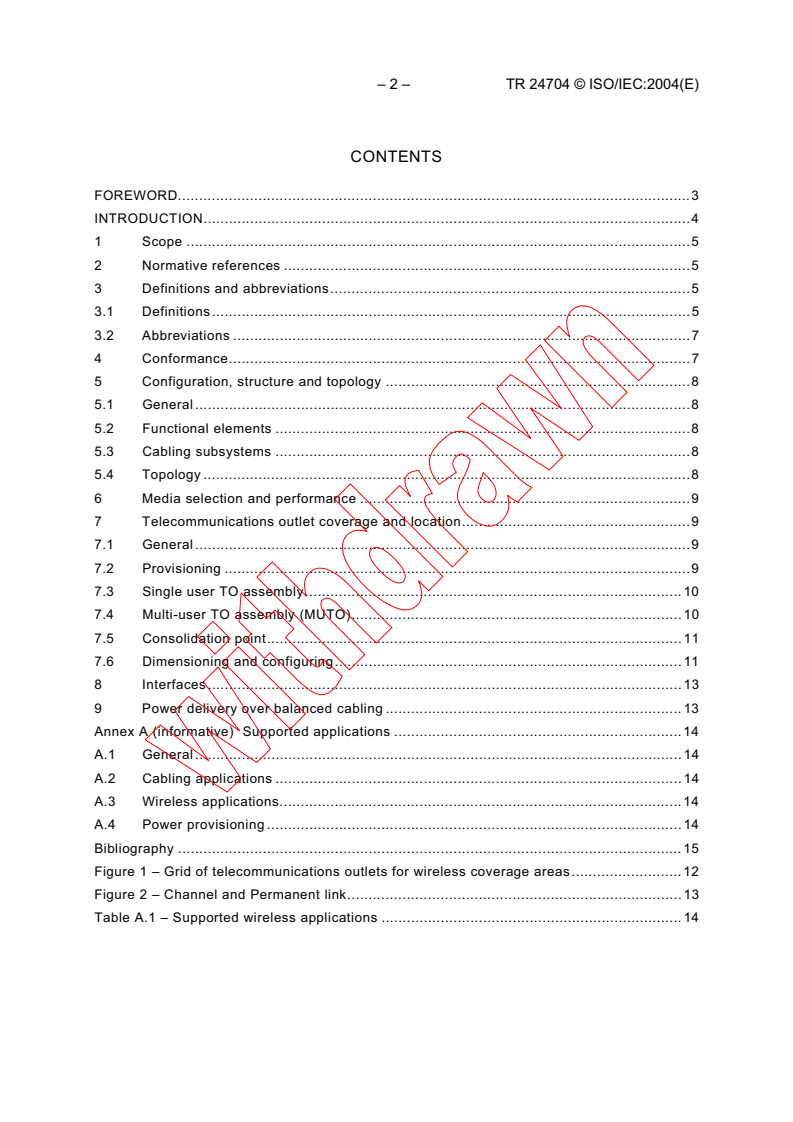
– 2 – TR 24704 © ISO/IEC:2004(E)
CONTENTS
FOREWORD.3
INTRODUCTION.4
1 Scope .5
2 Normative references .5
3 Definitions and abbreviations.5
3.1 Definitions.5
3.2 Abbreviations .7
4 Conformance.7
5 Configuration, structure and topology .8
5.1 General.8
5.2 Functional elements .8
5.3 Cabling subsystems .8
5.4 Topology .8
6 Media selection and performance .9
7 Telecommunications outlet coverage and location.9
7.1 General.9
7.2 Provisioning .9
7.3 Single user TO assembly.10
7.4 Multi-user TO assembly (MUTO).10
7.5 Consolidation point.11
7.6 Dimensioning and configuring.11
8 Interfaces.13
9 Power delivery over balanced cabling .13
Annex A (informative) Supported applications .14
A.1 General.14
A.2 Cabling applications .14
A.3 Wireless applications.14
A.4 Power provisioning .14
Bibliography .15
Figure 1 – Grid of telecommunications outlets for wireless coverage areas.12
Figure 2 – Channel and Permanent link.13
Table A.1 – Supported wireless applications .14
TR 24704 © ISO/IEC:2004(E) – 3 –
INFORMATION TECHNOLOGY –
CUSTOMER PREMISES CABLING FOR
WIRELESS ACCESS POINTS
FOREWORD
1) ISO (International Organization for Standardization) and IEC (International Electrotechnical Commission) form
the specialized system for worldwide standardization. National bodies that are members of ISO or IEC
participate in the development of International Standards through technical committees established by the
respective organization to deal with particular fields of technical activity. ISO and IEC technical committees
collaborate in fields of mutual interest. Other international organizations, governmental and non-governmental,
in liaison with ISO and IEC, also take part in the work.
2) In the field of information technology, ISO and IEC have established a joint technical committee,
ISO/IEC JTC 1. Draft International Standards adopted by the joint technical committee are circulated to
national bodies for voting. Publication as an International Standard requires approval by at least 75 % of the
national bodies casting a vote.
3) Attention is drawn to the possibility that some of the elements of this Technical Report may be the subject of
patent rights. ISO and IEC shall not be held responsible for identifying any or all such patent rights.
The main task of IEC and ISO technical committees is to prepare International Standards. In
exceptional circumstances, a technical committee may propose the publication of a technical
report of one of the following types:
x type 1, when the required support cannot be obtained for the publication of an
International Standard, despite repeated efforts;
x type 2, when the subject is still under technical development or where, for any other
reason, there is the future but not immediate possibility of an agreement on an
International Standard;
x type 3, when the technical committee has collected data of a different kind from that
which is normally published as an International Standard, for example ‘state of the art’.
Technical reports of types 1 and 2 are subject to review within three years of publication to
decide whether they can be transformed into International Standards. Technical reports of
type 3 do not necessarily have to be reviewed until the data they provide are considered to
be no longer valid or useful.
ISO/IEC TR 24704, which is a technical report of type 2, was prepared by subcommittee 25:
Interconnection of information technology equipment, of ISO/IEC joint technical committee 1:
Information technology.
This publication has been drafted in accordance with ISO/IEC directives, Part 2.
This document is issued in the type 2 technical report series of publications (according to
15.2.2 of the Procedures for the technical work of ISO/IEC JTC 1 (1998)) as a prospective
standard for provisional application in the field of Customer Premises Cabling, because there
is an urgent requirement for guidance on how standards in this field should be used.
This document is not to be regarded as an International Standard. It is proposed for
provisional application so that information and experience of its use in practice may be
gathered. Comments on the content of this document should be sent to IEC Central Office.
A review of this type 2 technical report will be carried out not later than three years after its
publication with the option of extension for a further three years, conversion into an
International Standard or withdrawal.
– 4 – TR 24704 © ISO/IEC:2004(E)
INTRODUCTION
This document specifies the use of generic cabling for customer premises, as specified in
international standard ISO/IEC 11801, for connection to wireless access points. It is intended
to guide new installations and renovations. The customer premises may encompass one or
more buildings or may be within a building that contains more than one enterprise.
This Technical Report specifies an ISO/IEC compliant implementation methodology that
enables connection to information and communications technology (ICT) equipment that is
specifically deployed to provide a grid of wireless coverage areas within buildings. The
cabling may be installed prior to the selection of specific equipment or the wireless
application to be used.
International standard ISO/IEC 11801 specifies a structure and performance requirements for
cabling subsystems that support a wide range of applications. It provides appropriate
equipment interfaces to the cabling infrastructure in equipment rooms, telecommunications
rooms and work areas.
A growing number of enterprises employ equipment at the “edge” of the network that rely on
both physical connections to the cabling infrastructure at the work area, while also having the
ability to maintain untethered network access at other locations. This Technical Report was
created because the infrastructure specified in cabling standard ISO/IEC 11801 does not
specifically cover infrastructure for connections to wireless access points. Supplementary
information is provided here on the number of outlets and outlet placement for wireless
access points that may optionally receive both power and information transfer through the IT
cabling.
This Technical Report specifies a cabling system infrastructure based upon balanced and
optical fibre cabling that provides:
x users with requirements for a supplemental cabling infrastructure that enables reliable
deployment of wireless ICT equipment without the costs associated with the installation of
additional IT or mains power cabling,
x users with a flexible cabling scheme such that changes to the wireless access points are
both easy and economical;
x building professionals (for example, architects) with guidance for accommodating cabling
before specific requirements are known, i.e. in the initial planning either for construction
or refurbishment;
x industry and applications standardization bodies (for example ITU-T,
ISO/IEC JTC 1/SC 6, ISO/IEC JTC 1/SC 25/WG 1, IEC TC 100) with a cabling system that
supports current products and provides a basis for future product development;
x users, designers, and manufacturers of wireless access points with advice on interfacing
to the generic cabling;
x suppliers of cabling components and installers of cabling with relevant requirements.
A number of wireless applications have been analysed to determine the requirements
specified herein. Propagation of microwave energy indoors is complex and the operating
range of communications devices will depend on carrier frequency, transmission power,
building geometry and materials. Consult the application standard and equipment manuals for
guidance on factors that should be taken into account during design of the wireless grid and
prior to deployment of wireless access points.
TR 24704 © ISO/IEC:2004(E) – 5 –
1 Scope
The cabling specified in this Technical Report is considered to be in addition to and not in
place of the infrastructure specified in ISO/IEC 11801. This Technical Report specifies a
customer premises cabling system infrastructure for an array of coverage areas that form a
wireless network grid within a building. It is applicable to all of the balanced and optical fibre
cabling classes specified in ISO/IEC 11801.
This Technical Report specifies design and configuration of an ISO/IEC 11801 compliant
horizontal cabling subsystem. Requirements and guidelines are provided with respect to
a) minimum configuration, structure and topology,
b) performance requirements for permanent links and channels,
c) coverage and location of telecommunications outlets,
d) interfaces to wireless access points,
e) power delivery over balanced cabling.
While placement and security of wireless access points are outside the scope of this
Technical Report, placement of telecommunications outlets (TOs) is specified to enable
flexible deployment of wireless services.
Safety (electrical, fire, etc.) and electromagnetic compatibility (EMC) requirements are
outside the scope of this Technical Report.
2 Normative references
The following referenced documents are indispensable for the application of this document.
The latest edition of the referenced document (including any amendments) applies.
ISO/IEC 11801, Information technology – Generic cabling for customer premises
ISO/IEC 14763-1, Information technology – Implementation and operation of customer
premises cabling – Part 1: Administration
ISO/IEC 18010, Information technology – Pathways and spaces for customer premises
cabling
3 Definitions and abbreviations
3.1 Definitions
For the purposes of this document, the terms and definitions given in ISO/IEC 11801,
ISO/IEC 18010 and the following apply.
– 6 – TR 24704 © ISO/IEC:2004(E)
3.1.1
channel
end-to-end transmission path connecting any two pieces of application-specific equipment
[3.1.15 of ISO/IEC 11801:2002]
NOTE A transmission path may use one or more pairs, may share a pair with another path, for example power
feeding and information may run over the same pair.
3.1.2
coverage area
area served by terminal equipment connected to a telecommunications outlet
3.1.3
coverage area cord
cord connecting the telecommunications outlet to terminal equipment that serves a coverage
area (for example, wireless access point)
3.1.4
grid
arrangement of multiple contiguous coverage areas
3.1.5
information and communications technologies (ICT)
group of applications using information and communications (telecommunications) tech-
nologies
3.1.6
link
transmission path between two cabling system interfaces
3.1.7
permanent link
transmission path between the telecommunications outlet and the floor distributor
[3.1.52 of ISO/IEC 11801:2002]
NOTE The permanent link does not include work area cords, coverage area cords, equipment cords, patch
cords and jumpers, but includes the connection at each end. It can include a CP link.
3.1.8
remote power feeding
supply of power different from mains power to application-specific equipment via balanced
cabling
3.1.9
space (telecommunications)
area used for housing the installation and termination of telecommunications equipment (IT)
and cabling [3.1.25 of ISO/IEC 18010:2002]
NOTE Examples of spaces are equipment rooms, telecommunications rooms, work areas, coverage areas and
maintenance holes/handholes.
3.1.10
terminal equipment
equipment that provides access to an application / service at a telecommunications outlet
3.1.11
wireless access point
terminal equipment that provides service to wireless end point devices
TR 24704 © ISO/IEC:2004(E) – 7 –
3.2 Abbreviations
C Connection
CP Consolidation Point
DTE Data Terminal Equipment
EMC Electromagnetic Compatibility
EQP Transmission Equipment
ffs for further study
FD Floor Distributor
ICT Information and Communications Technology
IT Information Technology
MUTO Multi-user telecommunications outlet
TE Terminal Equipment
TO Telecommunications Outlet
4 Conformance
For a cabling installation intended for use with wireless applications to conform to this
Technical Report, the following shall apply.
a) The configuration, structure and topology of cabling shall conform to Clause 5.
b) The entire system shall be composed of channels and links that meet the necessary level
of performance specified in Clause 6.
c) The coverage and location of the telecommunications outlet shall conform to Clause 7.
d) The cabling interfaces to the wireless access points shall conform to Clause 8.
e) When used, power delivery over balanced cabling shall conform to Clause 9.
f) System administration shall meet the requirements of ISO/IEC 14763-1.
g) System pathways and spaces shall meet the requirements of ISO/IEC 18010.
h) Regulations concerning safety and EMC shall be met as applicable to the location of the
installation.
In all other respects, the cabling infrastructure shall be in full compliance with ISO/IEC 11801.
No portion of this Technical Report shall be used to negate or replace the minimum
requirements of ISO/IEC 11801.
– 8 – TR 24704 © ISO/IEC:2004(E)
5 Configuration, structure and topology
5.1 General
This clause identifies the functional elements, configuration and topology of a horizontal
system to support wireless access points.
5.2 Functional elements
The functional elements of the horizontal cabling system are as follows:
x floor distributor (FD);
x horizontal cable;
x consolidation point (CP) - optional;
x telecommunications outlet (TO).
The type and number of functional elements u
...
Questions, Comments and Discussion
Ask us and Technical Secretary will try to provide an answer. You can facilitate discussion about the standard in here.
Loading comments...