

IEC 61097-12:1996
(Main)Global maritime distress and safety system (GMDSS) - Part 12: Survival craft portable two-way VHF radiotelephone apparatus - Operational and performance requirements, methods of testing and required test results
General Information
- Abstract
IEC 61097-12:1996 specifies the minimum performance requirements, technical characteri stics and methods of testing of survival craft portable two-way radiotelephone apparatus as required by the 1988 amendments to the 1974 International Convention for the Safety of Life at Sea (SOLAS).
- Status
- Published
- Publication Date
- 22-Nov-2023
- Technical Committee
- TC 80 - Maritime navigation and radiocommunication equipment and systems
- Drafting Committee
- WG 8 - TC 80/WG 8
- Current Stage
- PPUB - Publication issued
- Start Date
- 19-Nov-1996
- Completion Date
- 31-Dec-1996
Buy Documents
IEC 61097-12:1996 - Global maritime distress and safety system (GMDSS) - Part 12: Survival craft portable two-way VHF radiotelephone apparatus - Operational and performance requirements, methods of testing and required test results Released:12/2/1996
IEC 61097-12:1996 - Systeme mondial de détresse et de sécurité en mer (SMDSM) - Partie 12: Radiotéléphone émetteur-récepteur portable VHF pour embarcation de sauvetage - Exigences d'exploitation et de fonctionnement, méthodes d'essai et résultats d'essai exigés Released:12/2/1996
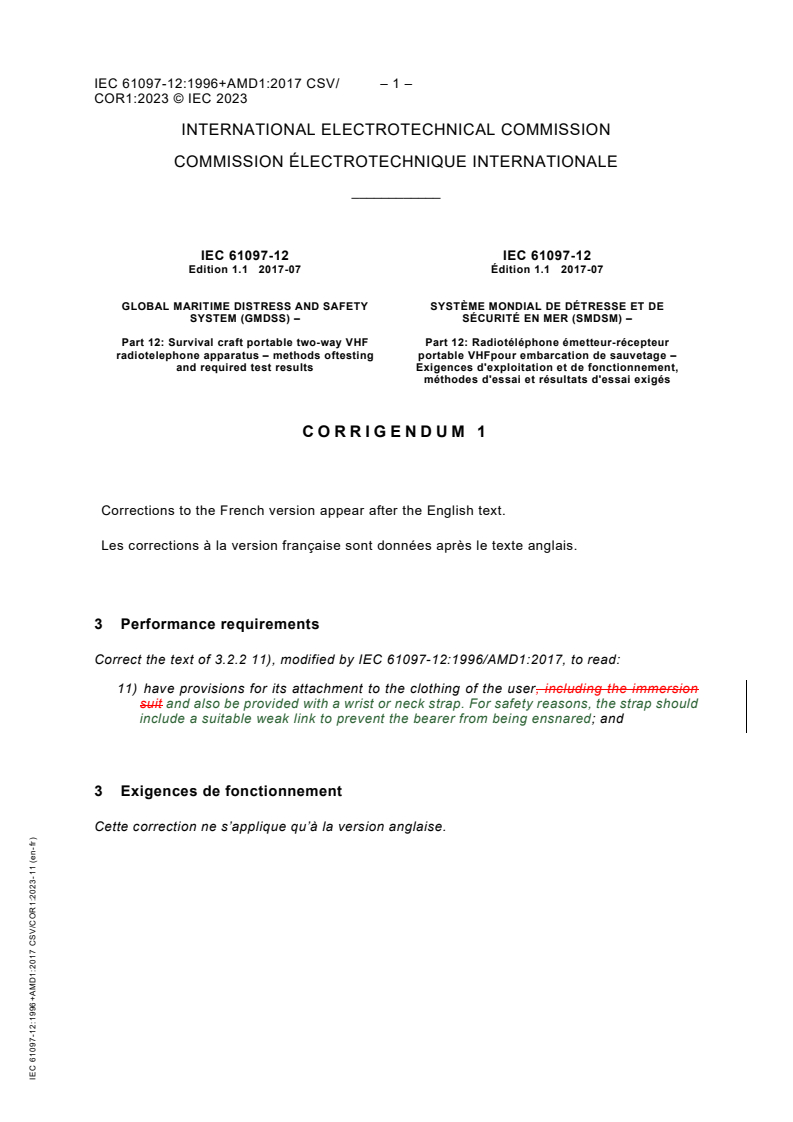


IEC 61097-12:1996+AMD1:2017 CSV/COR1:2023 - Corrigendum 1 - Global maritime distress and safety system (GMDSS) - Part 12: Survival craft portable two-way VHF radiotelephone apparatus - Operational and performance requirements, methods of testing and required test results Released:11/23/2023

IEC 61097-12:1996+AMD1:2017+AMD2:2023 CSV - Global maritime distress and safety system (GMDSS) - Part 12: Survival craft portable two-way VHF radiotelephone apparatus - Operational and performance requirements, methods of testing and required test results Released:11/20/2023

IEC 61097-12:1996+AMD1:2017 CSV - Global maritime distress and safety system (GMDSS) - Part 12: Survival craft portable two-way VHF radiotelephone apparatus - Operational and performance requirements, methods of testing and required test results Released:7/13/2017
Overview
IEC 61097-12:1996 - Global Maritime Distress and Safety System (GMDSS) Part 12 - defines the operational and performance requirements, testing methods and required test results for survival craft portable two‑way VHF radiotelephone apparatus. The standard implements SOLAS (1974, as amended 1988) GMDSS requirements and incorporates relevant IMO resolutions and ITU recommendations to ensure reliable on‑scene communications from lifeboats, life‑rafts and other survival craft.
Key topics and technical requirements
- Scope and purpose: Minimum performance requirements, technical characteristics and methods of testing for portable two‑way VHF survival craft radios.
- Portability & usability: Equipment must be portable, small/light, operable by unskilled personnel and usable while wearing immersion‑suit gloves. Single‑handed operation is required except for channel selection.
- Visibility & durability: Units shall be highly visible (yellow/orange or marked accordingly) and resistant to deterioration from prolonged sunlight exposure.
- Basic composition: Must include an integral transmitter/receiver with antenna and battery, a control unit with press‑to‑transmit switch, internal microphone and loudspeaker.
- Controls & indicators: On/off switch with positive visual indication, manual volume control, squelch (mute), clear channel selection and guaranteed indication of Channel 16 (156.800 MHz) in all ambient light conditions.
- Antenna & RF: Vertically polarized, broadly omnidirectional antenna optimized for the operating frequency; required operation on Channel 16 and at least one additional channel; emission class G3E (voice).
- Safety: Must tolerate antenna open‑ or short‑circuiting without damage and have no sharp projections that could damage survival craft.
- Testing & conformity: Detailed methods of testing cover transmitter and receiver performance, environmental endurance, electromagnetic compatibility (EMC), battery and charger behaviour, and required test results. Test conditions and measurement procedures are specified to confirm compliance.
Applications and users
This standard is essential for:
- Manufacturers designing and certifying GMDSS survival craft VHF radios
- Maritime equipment test laboratories performing type approval and compliance testing
- Classification societies, flag administrations and procurement officers enforcing SOLAS/GMDSS equipment rules
- Shipyards and maritime safety officers selecting life‑saving communication equipment for vessels and survival craft
Compliance with IEC 61097-12 helps ensure reliable, easy‑to‑use VHF communications during search and rescue operations and on‑scene coordination.
Related standards and references
- IMO SOLAS Chapter III and Resolutions A.694(17), A.809(19)
- ITU‑R M.489‑2, ITU‑R M.542‑1 and ITU Radio Regulations
- IEC 945 (marine navigational equipment general requirements), IEC 529 (IP code)
Keywords: GMDSS, survival craft VHF, IEC 61097-12, survival craft radiotelephone, SOLAS compliance, maritime radio testing.
Relations
- Effective Date
- 05-Sep-2023
- Effective Date
- 05-Sep-2023
Buy Documents
IEC 61097-12:1996 - Global maritime distress and safety system (GMDSS) - Part 12: Survival craft portable two-way VHF radiotelephone apparatus - Operational and performance requirements, methods of testing and required test results Released:12/2/1996
IEC 61097-12:1996 - Systeme mondial de détresse et de sécurité en mer (SMDSM) - Partie 12: Radiotéléphone émetteur-récepteur portable VHF pour embarcation de sauvetage - Exigences d'exploitation et de fonctionnement, méthodes d'essai et résultats d'essai exigés Released:12/2/1996
IEC 61097-12:1996+AMD1:2017 CSV/COR1:2023 - Corrigendum 1 - Global maritime distress and safety system (GMDSS) - Part 12: Survival craft portable two-way VHF radiotelephone apparatus - Operational and performance requirements, methods of testing and required test results Released:11/23/2023
IEC 61097-12:1996+AMD1:2017+AMD2:2023 CSV - Global maritime distress and safety system (GMDSS) - Part 12: Survival craft portable two-way VHF radiotelephone apparatus - Operational and performance requirements, methods of testing and required test results Released:11/20/2023
IEC 61097-12:1996+AMD1:2017 CSV - Global maritime distress and safety system (GMDSS) - Part 12: Survival craft portable two-way VHF radiotelephone apparatus - Operational and performance requirements, methods of testing and required test results Released:7/13/2017
Get Certified
Connect with accredited certification bodies for this standard

DNV
DNV is an independent assurance and risk management provider.

Lloyd's Register
Lloyd's Register is a global professional services organisation specialising in engineering and technology.

FSC International
Forest Stewardship Council certification.
Sponsored listings
Frequently Asked Questions
IEC 61097-12:1996 is a standard published by the International Electrotechnical Commission (IEC). Its full title is "Global maritime distress and safety system (GMDSS) - Part 12: Survival craft portable two-way VHF radiotelephone apparatus - Operational and performance requirements, methods of testing and required test results". This standard covers: IEC 61097-12:1996 specifies the minimum performance requirements, technical characteri stics and methods of testing of survival craft portable two-way radiotelephone apparatus as required by the 1988 amendments to the 1974 International Convention for the Safety of Life at Sea (SOLAS).
IEC 61097-12:1996 specifies the minimum performance requirements, technical characteri stics and methods of testing of survival craft portable two-way radiotelephone apparatus as required by the 1988 amendments to the 1974 International Convention for the Safety of Life at Sea (SOLAS).
IEC 61097-12:1996 is classified under the following ICS (International Classification for Standards) categories: 33.060.20 - Receiving and transmitting equipment; 47.020.70 - Navigation and control equipment. The ICS classification helps identify the subject area and facilitates finding related standards.
IEC 61097-12:1996 has the following relationships with other standards: It is inter standard links to IEC 61097-12:1996/AMD1:2017, IEC 61097-12:1996/AMD2:2023. Understanding these relationships helps ensure you are using the most current and applicable version of the standard.
IEC 61097-12:1996 is available in PDF format for immediate download after purchase. The document can be added to your cart and obtained through the secure checkout process. Digital delivery ensures instant access to the complete standard document.
Standards Content (Sample)
INTERNATIONAL
IEC
STANDARD
1097-12
First edition
1996-11
Global maritime distress and safety
system (GMDSS) –
Part 12:
Survival craft portable two-way
VHF radiotelephone apparatus –
Operational and performance requirements,
methods of testing and required test results
Système mondial de détresse et de sécurité
en mer (SMDSM) –
Partie 12:
Radiotéléphone émetteur-récepteur portable VHF
pour embarcation de sauvetage –
Exigences d’exploitation et de fonctionnement,
méthodes d’essai et résultats d’essai exigés
Reference number
IEC 1097-12: 1996 (E)
Validité de la présente publication Validity of this publication
Le contenu technique des publications de la CEI est cons- The technical content of IEC publications is kept under
tamment revu par la CEI afin qu'il reflète l'état actuel de constant review by the IEC, thus ensuring that the content
la technique. reflects current technology.
Des renseignements relatifs à la date de reconfirmation de Information relating to the date of the reconfirmation of the
la publication sont disponibles auprès du Bureau Central de publication is available from the IEC Central Office.
la CEI.
Les renseignements relatifs à ces révisions, à l'établis- Information on the revision work, the issue of revised
sement des éditions révisées et aux amendements peuvent editions and amendments may be obtained from IEC
être obtenus auprès des Comités nationaux de la CEI et National Committees and from the following IEC
dans les documents ci-dessous: sources:
• Bulletin de la CEI • IEC Bulletin
• Annuaire de la CEI • IEC Yearbook
Publié annuellement Published yearly
• Catalogue des publications de la CEI • Catalogue of IEC publications
Publié annuellement et mis à jour régulièrement Published yearly with regular updates
Terminologie Terminology
En ce qui concerne la terminologie générale, le lecteur se For general terminology, readers are referred to IEC 50:
reportera à la CEI 50: Vocabulaire Electrotechnique Inter- International Electrotechnical Vocabulary (IEV), which is
national (VEI), qui se présente sous forme de chapitres issued in the form of separate chapters each dealing
séparés traitant chacun d'un sujet défini. Des détails with a specific field. Full details of the IEV will be
complets sur le VEI peuvent être obtenus sur demande. supplied on request. See also the IEC Multilingual
Voir également le dictionnaire multilingue de la CEI. Dictionary.
Les termes et définitions figurant dans la présente publi- The terms and definitions contained in the present publi-
cation ont été soit tirés du VEI, soit spécifiquement cation have either been taken from the IEV or have been
approuvés aux fins de cette publication. specifically approved for the purpose of this publication.
Symboles graphiques et littéraux Graphical and letter symbols
Pour les symboles graphiques, les symboles littéraux et les For graphical symbols, and letter symbols and signs
signes d'usage général approuvés par la CEI, le lecteur approved by the IEC for general use, readers are referred to
consultera: publications:
– la CEI 27: Symboles littéraux à utiliser en – IEC 27: Letter symbols to be used in electrical
électro-technique; technology;
– la CEI 417: Symboles graphiques utilisables – IEC 417: Graphical symbols for use on
sur le matériel. Index, relevé et compilation des equipment. Index, survey and compilation of the
feuilles individuelles; single sheets;
– la CEI 617: Symboles graphiques pour schémas; – IEC 617: Graphical symbols for diagrams;
et pour les appareils électromédicaux, and for medical electrical equipment,
– la CEI 878: Symboles graphiques pour – IEC 878: Graphical symbols for electromedical
équipements électriques en pratique médicale. equipment in medical practice.
Les symboles et signes contenus dans la présente publi- The symbols and signs contained in the present publication
cation ont été soit tirés de la CEI 27, de la CEI 417, de la have either been taken from IEC 27, IEC 417, IEC 617
CEI 617 et/ou de la CEI 878, soit spécifiquement approuvés and/or IEC 878, or have been specifically approved for the
aux fins de cette publication. purpose of this publication.
Publications de la CEI établies par le IEC publications prepared by the same
même comité d'études technical committee
L'attention du lecteur est attirée sur les listes figurant à la fin The attention of readers is drawn to the end pages of this
de cette publication, qui énumèrent les publications de la publication which list the IEC publications issued by the
CEI préparées par le comité d'études qui a établi la technical committee which has prepared the present
présente publication. publication.
INTERNATIONAL
IEC
STANDARD
1097-12
First edition
1996-11
Global maritime distress and safety
system (GMDSS) –
Part 12:
Survival craft portable two-way
VHF radiotelephone apparatus –
Operational and performance requirements,
methods of testing and required test results
Système mondial de détresse et de sécurité
en mer (SMDSM) –
Partie 12:
Radiotéléphone émetteur-récepteur portable VHF
pour embarcation de sauvetage –
Exigences d’exploitation et de fonctionnement,
méthodes d’essai et résultats d’essai exigés
CEI 1996 Droits de reproduction réservés Copyright - all rights reserved
Aucune partie de cette publication ne peut être reproduite ni No part of this publication may be reproduced or utilized
utilisée sous quelque forme que ce soit et par aucun procédé, in any form or by any means, electronic or mechanical,
électronique ou mécanique, y compris la photocopie et les including photocopying and microfilm, without permission
microfilms, sans l'accord écrit de l'éditeur. in writing from the publisher
Bureau central de la Commission Electrotechnique Internationale 3, rue de Varembé Genève Suisse
CODE PRIX
Commission Electrotechnique Internationale
PRICE CODE W
International Electrotechnical Commission
Pour prix, voir catalogue en vigueur
For price, see current catalogue
– 2 – 1097-12 © IEC:1996 (E)
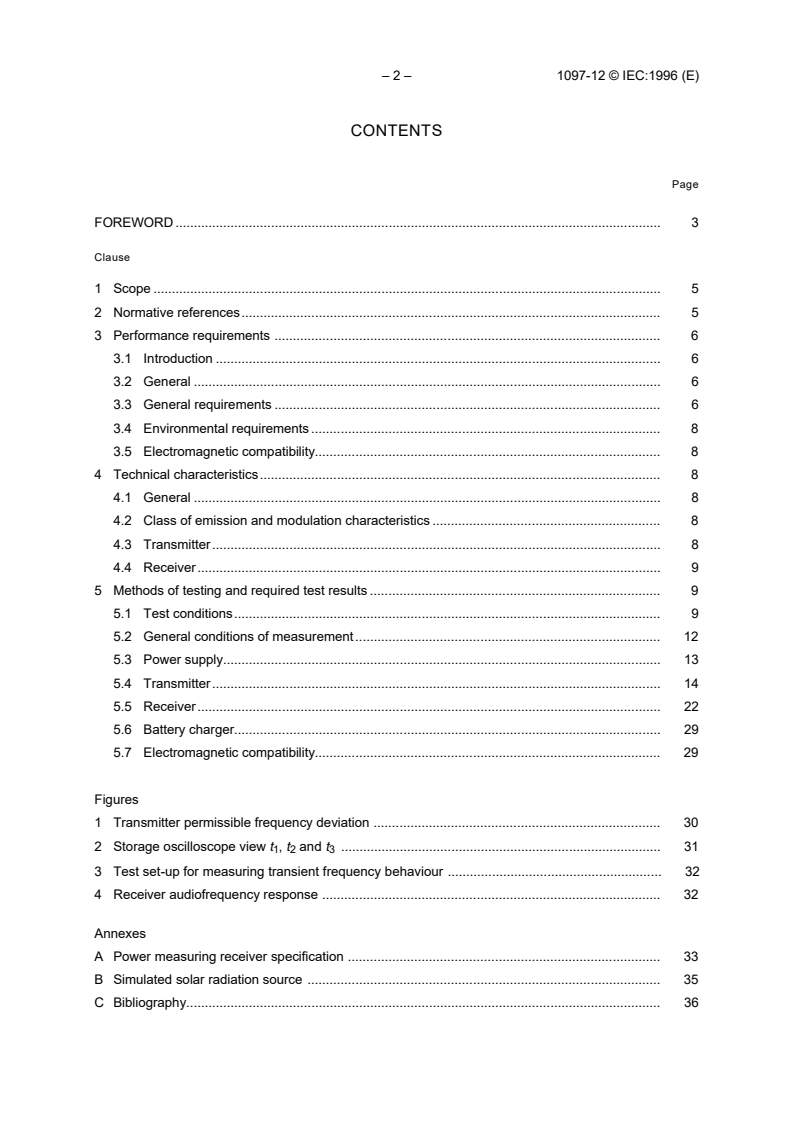
CONTENTS
Page
FOREWORD . 3
Clause
1 Scope. 5
2 Normative references. 5
3 Performance requirements. 6
3.1 Introduction. 6
3.2 General. 6
3.3 General requirements. 6
3.4 Environmental requirements. 8
3.5 Electromagnetic compatibility. 8
4 Technical characteristics. 8
4.1 General. 8
4.2 Class of emission and modulation characteristics . 8
4.3 Transmitter. 8
4.4 Receiver. 9
5 Methods of testing and required test results . 9
5.1 Test conditions. 9
5.2 General conditions of measurement. 12
5.3 Power supply. 13
5.4 Transmitter. 14
5.5 Receiver. 22
5.6 Battery charger. 29
5.7 Electromagnetic compatibility. 29
Figures
1 Transmitter permissible frequency deviation . 30
2 Storage oscilloscope view t , t and t . 31
1 2 3
3 Test set-up for measuring transient frequency behaviour . 32
4 Receiver audiofrequency response . 32
Annexes
A Power measuring receiver specification . 33
B Simulated solar radiation source . 35
C Bibliography. 36
1097-12 © IEC:1996 (E) – 3 –
INTERNATIONAL ELECTROTECHNICAL COMMISSION
________
GLOBAL MARITIME DISTRESS AND SAFETY SYSTEM (GMDSS) –
Part 12: Survival craft portable two-way VHF radiotelephone apparatus –
Operational and performance requirements, methods of
testing and required test results
FOREWORD
1) The IEC (International Electrotechnical Commission) is a worldwide organization for standardization comprising
all national electrotechnical committees (IEC National Committees). The object of the IEC is to promote
international co-operation on all questions concerning standardization in the electrical and electronic fields. To
this end and in addition to other activities, the IEC publishes International Standards. Their preparation is
entrusted to technical committees; any IEC National Committee interested in the subject dealt with may
participate in this preparatory work. International, governmental and non-governmental organizations liaising
with the IEC also participate in this preparation. The IEC collaborates closely with the International Organization
for Standardization (ISO) in accordance with conditions determined by agreement between the two
organizations.
2) The formal decisions or agreements of the IEC on technical matters express, as nearly as possible, an
international consensus of opinion on the relevant subjects since each technical committee has representation
from all interested National Committees.
3) The documents produced have the form of recommendations for international use and are published in the form
of standards, technical reports or guides and they are accepted by the National Committees in that sense.
4) In order to promote international unification, IEC National Committees undertake to apply IEC International
Standards transparently to the maximum extent possible in their national and regional standards. Any
divergence between the IEC Standard and the corresponding national or regional standard shall be clearly
indicated in the latter.
5) The IEC provides no marking procedure to indicate its approval and cannot be rendered responsible for any
equipment declared to be in conformity with one of its standards.
6) Attention is drawn to the possibility that some of the elements of this International Standard may be the subject
of patent rights. The IEC shall not be held responsible for identifying any or all such patent rights.
International Standard IEC 1097-12 has been prepared by IEC technical committee 80:
Maritime navigation and radiocommunication equipment and systems.
The text of this standard is based on the following documents:
FDIS Report on voting
80/126/FDIS 80/136/RVD
Full information on the voting for the approval of this standard can be found in the report on
voting indicated in the above table.
Annexes A and B form an integral part of this standard.
Annex C is for information only.
The French version of this standard will be issued separately.
– 4 – 1097-12 © IEC:1996 (E)
1097-12 © IEC:1996 (E) – 5 –
GLOBAL MARITIME DISTRESS AND SAFETY SYSTEM (GMDSS) –
Part 12: Survival craft portable two-way VHF radiotelephone apparatus –
Operational and performance requirements, methods of
testing and required test results
1 Scope
This part of IEC 1097 specifies the minimum performance requirements, technical charac-
teristics and methods of testing with required test results of survival craft portable two-way
radiotelephone apparatus as required by chapter III of the 1988 amendments to the 1974
International Convention for the Safety of Life at Sea (SOLAS), and which is associated with
IEC 945. When a requirement in this standard is different from IEC 945, the requirement in this
standard shall take precedence.
This standard incorporates the applicable parts of the performance requirements included in
IMO Resolution A.809(19) annex 1 and the technical characteristics included in ITU M.489-2
and ITU-R M.542-1, and takes account of the general requirements contained in IMO
Resolution A.694(17), and conforms with the ITU Radio Regulations where applicable.
NOTE – All text of this standard, whose wording is identical to that in IMO Resolutions A.809(19) and A.694(17)
and ITU-R M.489-2 is printed in italics and the Resolution/Recommendation and paragraph numbers are
indicated in brackets.
2 Normative references
The following normative documents contain provisions which, through reference in this text,
constitute provisions of this part of IEC 1097. At the time of publication, the editions indicated
were valid. All normative documents are subject to revision, and parties to agreements based
on this part of IEC 1097 are encouraged to investigate the possibility of applying the most
recent edition of the normative documents indicated below. Members of IEC and ISO maintain
registers of currently valid International Standards.
IEC 529: 1989, Degrees of protection provided by enclosures (IP code)
IEC 945: 1994, Marine navigational equipment – General requirements – Methods of testing
and required test results
IMO International Convention for the Safety of Life At Sea (SOLAS): 1974, as amended 1988
(GMDSS) – Chapter III: Life-saving appliances and arrangements
IMO Resolution A.694(17): 1991, General requirements for shipborne radio equipment forming
part of the global maritime distress and safety system (GMDSS) and for electronic navigational aids
IMO Resolution A.809(19): 1995, Performance standards for survival craft two-way VHF
radiotelephone apparatus
ITU Radio Regulations: 1995, Appendix S3: Table of maximum permitted spurious emissions
power levels
ITU Radio Regulations: 1990, Appendix 18: Table of transmitting frequencies in the band 156 –
174 MHz for stations in the maritime mobile service
ITU-R M.489-2: 1995, Technical characteristics of radiotelephone equipment operating in the
maritime mobile service in channels spaced by 25 kHz
ITU-R M.542-1: 1982, On-board communications by means of portable radiotelephone equipment
– 6 – 1097-12 © IEC:1996 (E)
3 Performance requirements
3.1 Introduction
Performance requirements described in this clause are specified by referring to IMO
Resolutions and ITU Recommendations. In addition to meeting performance requirements in
this clause, the equipment shall comply with the technical characteristics contained in clause 4
of this standard.
3.2 General
3.2.1 (A.809(19) 1/2.1) The equipment shall be portable and capable of being used for on-
scene communication between survival craft, between survival craft and ship and between
survival craft and rescue unit. It may also be used for on-board communications when capable
of operating on appropriate frequencies.
3.2.2 (A.809(19) 1/2.3) The equipment shall:
1) be capable of being operated by unskilled personnel;
2) be capable of being operated by personnel wearing gloves as specified for immersion
suits in regulation 33 of chapter III of the SOLAS 1974 Convention;
3) be capable of single-handed operation except for channel selection;
9) be of small size and light weight;
10) be capable of operating in the ambient noise level likely to be encountered on board
ships or survival craft;
11) have provisions for its attachment to the clothing of the user, including the immersion
suit; and
12) be resistant to deterioration by prolonged exposure to sunlight.
3.2.3 (A.809(19) 1/2.3.13) The equipment shall be either of a highly visible yellow/orange
colour or marked with a surrounding yellow/orange marking strip.
3.3 General requirements
3.3.1 Composition
(A.809(19) 1/2.2) The equipment shall comprise at least:
1) an integral transmitter/receiver including antenna and battery;
2) an integral control unit including a press-to-transmit switch;
3) an internal microphone and loudspeaker.
3.3.2 Controls and indicators
3.3.2.1 (A.809(19) 1/4.1) An on/off switch shall be provided with positive visual indication that
the radiotelephone is switched on.
3.3.2.2 (A.809(19) 1/4.2) The receiver shall be provided with a manual volume control by
which the audio output may be varied.
3.3.2.3 (A.809(19) 1/4.3) A squelch (mute) control and channel selection switch shall be provided.
3.3.2.4 (A.809(19) 1/4.4) Channel selection shall be easily performed and the channels shall
be clearly discernible.
3.3.2.5 (A.809(19) 1/4.5) Channel indication shall be in accordance with appendix 18 of the
Radio Regulations.
1097-12 © IEC:1996 (E) – 7 –
3.3.2.6 (A.809(19) 1/4.6) It shall be possible to determine that channel 16 has been selected
in all ambient light conditions.
3.3.3 Antenna
(A.809(19) 1/9) The antenna shall be vertically polarized and, as far as practicable, be
omnidirectional in the horizontal plane. The antenna shall be suitable for efficient radiation and
reception of signals at the operating frequency.
3.3.4 Safety precautions
3.3.4.1 (A.809(19) 1/6) The equipment shall not be damaged by the effect of open-circuiting
or short-circuiting the antenna.
3.3.4.2 (A.809(19) 1/2.3.8) The equipment shall have no sharp projections which could damage
survival craft.
3.3.5 Frequency bands and channels
3.3.5.1 (A.809(19) 1/3.1) The two-way radiotelephone shall be capable of operation on the
frequency 156,800 MHz (VHF CH 16) and on at least one additional channel.
3.3.5.2 (A.809(19) 1/3.2) All channels fitted shall be for single-frequency voice communication only.
3.3.5.3 (A.809(19) 1/3.3) The class of emission shall be G3E to comply with appendix 19 of
the Radio Regulations.
3.3.6 Marking and identification
(A.809(19) 1/13) In addition to the items specified in resolution A.694(17) on general require-
ments, as detailed in IEC 945, the following shall be clearly indicated on the exterior of the
equipment:
1) brief operating instructions;
2) expiry date for the primary batteries.
3.3.7 Warming-up period
(A.809(19) 1/5) The equipment shall be operational within 5 s of switching on.
3.3.8 Power supply
3.3.8.1 (A.809(19) 1/12.1) The source of energy shall be integrated in the equipment and may
be replaceable by the user. In addition, provision may be made to operate the equipment using
an external source of electrical energy.
3.3.8.2 (A.809(19) 1/12.2) Equipment intended for the source of energy to be user
replaceable shall be provided with a dedicated primary battery for use in the event of a distress
situation. This battery shall be equipped with a non-replaceable seal to indicate that it has not
been used.
3.3.8.3 (A.809(19) 1/12.3) Equipment intended for the source of energy to be non-user-
shall be provided with a primary battery. The portable two-way radiotelephone
replaceable
equipment shall be equipped with a non-replaceable seal to indicate that it has not been used.
3.3.8.4 (A.809(19) 1/12.4) The primary battery shall have sufficient capacity to ensure 8 h
operation at its highest rated power with a duty cycle of 1: 9. The duty cycle is defined as 6 s
transmission, 6 s reception above squelch opening level and 48 s reception below squelch
opening level.
– 8 – 1097-12 © IEC:1996 (E)
3.3.8.5 (A.809(19) 1/12.5) Primary batteries shall have a shelf life of at least 2 years and if
intended to be user replaceable shall be of a colour or marking as defined in 3.2.3.
3.3.8.6 (A.809(19) 1/12.6) Primary or secondary batteries not intended for the use in the
shall be of a colour or marking so that they cannot be confused
event of a distress situation
with batteries intended for such use.
3.4 Environmental requirements
3.4.1 (A.809(19) 1/11) The equipment shall be so designed as to operate over the tem-
perature range –20 °C to +55 °C. It shall not be damaged in stowage throughout the
temperature range –30 °C to + 70 °C.
3.4.2 (A.809(19) 1/2.3.4) The equipment shall withstand drops on to a hard surface from a
height of 1 m.
3.4.3 (A.809(19) 1/2.3.5) The equipment shall be watertight to a depth of 1 m for at least 5 min.
3.4.4 (A.809(19) 1/2.3.6) The equipment shall maintain watertightness when subjected to a
thermal shock of 45 °C under conditions of immersion.
3.4.5 (A.809(19) 1/2.3.7) The equipment shall not be unduly affected by seawater or oil or both.
3.5 Electromagnetic compatibility
The equipment shall comply with the EMC requirements specified in resolution A.694(17), as
detailed in IEC 945.
4 Technical characteristics
4.1 General
The equipment shall be designed to operate satisfactorily with a channel separation of 25 kHz
in accordance with appendix 18 of the Radio Regulations.
4.2 Class of emission and modulation characteristics
4.2.1 (M.489-2/1.1.1 and .3) The class of emission shall be G3E (frequency modulation with a
pre-emphasis characteristic of 6 dB/Octave).
4.2.2 (M.489-2/1.1.2) The necessary bandwidth shall be 16 kHz.
4.3 Transmitter
4.3.1 (M.489-2/1.2.1) The frequency tolerance for ship station transmitters shall not exceed
10 parts in 10 . For practical reasons, the frequency error shall be within ±1,5 kHz.
4.3.2 (A.809(19) 1/7) The effective radiated power shall be a minimum of 0,25 W. Where the
effective radiated power exceeds 1 W, a power reduction switch to reduce the power to 1 W or
less is required. When this equipment provides for on-board communications, the output power
shall not exceed 1 W on these frequencies.
4.3.3 The frequency deviation corresponding to 100% modulation shall approach ±5 kHz as
nearly as practicable.
4.3.4 (M.489-2/1.2.5) The upper limit of the audiofrequency band shall not exceed 3 kHz.
1097-12 © IEC:1996 (E) – 9 –
4.3.5 (M.489-2/1.2.2) Spurious emissions on discrete frequencies, when measured in a non-
reactive load equal to the nominal output impedance of the transmitter shall be in accordance
with the provisions of Appendix 8 of the Radio Regulations. The power of any conducted
spurious emission on any discrete frequency shall not exceed 0,25 μW.
4.3.6 (M.489-2/1.2.6) The cabinet radiated power shall not exceed 25 μW. In some radio
environments, lower values may be required. The equipment shall meet the requirements of
IEC 945 for radiated interference.
4.4 Receiver
4.4.1 (A.809(19) 1/8.1) The sensitivity of the receiver shall be equal to or better than 2 μV
e.m.f. for a SINAD ratio of 12 dB at the output.
4.4.2 (A.809(19) 1/8.2) The immunity to interference of the receiver shall be such that the
wanted signal is not seriously affected by unwanted signals.
4.4.3 (A.809(19)1/10.1) The audio output shall be sufficient to be heard in the ambient noise
level likely to be encountered on board ships or in a survival craft.
4.4.4 (A.809(19) 1/10.2) In the transmit condition the output of the receiver shall be muted.
4.4.5 (M.489-2/1.3.2) The adjacent channel selectivity shall be at least 70 dB.
4.4.6 (M.489-2/1.3.3) The spurious response rejection ratio shall be at least 70 dB.
4.4.7 (M.489-2/1.3.4) The radio frequency intermodulation response ratio shall be at least 65 dB.
4.4.8 (M.489-2/1.3.5) The power of any conducted spurious emission measured at the antenna
terminals shall not exceed 2,0 nW at any discrete frequency.
5 Methods of testing and required test results
Environmental tests shall be carried out before tests to verify whether the equipment under test
(EUT) meets all technical requirements. Where electrical tests are required, these shall be
done using the normal test voltage as specified in IEC 945 unless otherwise stated.
In each test item indicated below, the related requirement can be identified by referring to the
text with subclause number in brackets.
5.1 Test conditions
For field measurements and performance checks to this standard, the EUT shall be operational
on channel 17.
5.1.1 Normal and extreme test conditions
Tests shall be made under normal test conditions and also, where stated, under extreme test
conditions as specified in IEC 945, of dry heat and the upper limit of supply voltage applied
simultaneously and low temperature and the lower limit of supply voltage applied
simultaneously.
5.1.2 Test power source
During each test the EUT shall be supplied from a test power source, capable of producing
normal and extreme test voltages. For the purpose of tests, the voltage of the power source
shall be measured at the input terminals of the EUT. During tests, the power supply voltages
shall be maintained within ±3 % relative to the voltage level at the beginning of each test.
– 10 – 1097-12 © IEC:1996 (E)
The test power source shall only be used in measurements where the use of the test power
source is mutually agreed between manufacturer and test house. In the event of any
discrepancy, results obtained using the batteries shall take precedence over results obtained
using the test power source.
5.1.3 Procedure for tests at extreme temperatures
For tests at low temperature, the EUT shall be placed in the test chamber and left until thermal
equilibrium is reached and shall then be switched to stand-by or receive position for 5 s after
which the EUT shall meet the requirements of this standard.
5.1.4 Performance check
5.1.4.1 Definition
The performance check means a shortened form of the test required by the relevant standard
under normal test conditions, such as could normally be carried out in no more than 15 min.
5.1.4.2 Method of measurement
After each environmental test a performance check shall be made, which shall include the
following:
– the transmitter frequency error to 5.4.1.2 and the output power of the transmitter to
5.4.3.2 (high power only); and
– the receiver maximum usable sensitivity to 5.5.3.2.
5.1.4.3 Results required
The frequency error shall be less than ±1,5 kHz, the carrier power shall be not less than
0,25 W and the receiver sensitivity shall be better than 12 dBμV.
5.1.5 Environmental tests
Environmental tests are intended to assess the suitability of the construction of the EUT for its
intended physical conditions of use. After environmental tests, and, if specified also during the
test, the EUT shall comply with the requirements of a performance check.
Environmental tests shall be carried out before any other tests. Where electrical tests are
required, these shall be done with the normal test voltage unless otherwise stated.
Environmental tests shall be carried out in the following order.
5.1.5.1 Drop test
This test simulates the effects of a free fall of the EUT onto the deck of a ship resulting from
mishandling.
The drop test shall be performed as specified in IEC 945.
During the test the equipment shall be fitted with a suitable set of batteries and its antenna, but
it shall be switched off.
At the end of the test the EUT shall be subjected to a performance check and shall then be
examined for damage. The findings shall be noted in the test report.
1097-12 © IEC:1996 (E) – 11 –
5.1.5.2 Thermal shock
This test determines the ability of the EUT to function correctly after sudden immersion in water
from storage at high temperature.
The EUT shall be placed in an atmosphere of +65 °C ± 3 °C for 1 h. It shall then be immersed
in water at +20 °C ± 3 °C to a depth of 100 mm ± 5 mm, measured from the highest point of the
equipment to the surface of the water, for a period of 1 h.
At the end of the test the EUT shall be subjected to a performance check and shall then be
examined for damage and for unwanted ingress of water. The findings shall be noted in the test
report.
Following the examination, the EUT shall be resealed in accordance with manufacturer´s
instructions. Alternatively, if there are no external signs of unwanted ingress of water, an
internal examination of the EUT which involves disturbance to seals may be carried out after all
environmental tests have been completed.
5.1.5.3 Immersion test
This test simulates the effects of water pressure on the EUT which although not designed to
float may experience a temporary immersion in water.
The EUT shall be subjected to the test corresponding to IEC 529, table III, second character-
istic numeral 7. The test shall be carried out by completely immersing the EUT in water so that
the following conditions are satisfied:
– the highest point of the EUT is located 1 m below the surface of the water;
– the duration of the test is 5 min; and
– the water temperature does not differ from that of the equipment by more than 5 °C.
At the end of the test the EUT shall be subjected to a performance check and shall then be
examined for damage and for unwanted ingress of water. The findings shall be noted in the test
report.
Following the examination, the EUT shall be resealed in accordance with manufacturer´s
instructions. Alternatively, if there are no external signs of unwanted ingress of water, an
internal examination of the EUT which involves disturbance to seals may be carried out after all
environmental tests have been completed.
5.1.5.4 Dry heat cycle
The dry heat cycle test shall be performed as specified in IEC 945.
5.1.5.5 Damp heat cycle
The damp heat cycle test shall be performed as specified in IEC 945.
5.1.5.6 Low temperature cycle
The low temperature cycle test shall be performed as specified in IEC 945.
5.1.5.7 Vibration
The vibration test shall be performed as specified in IEC 945.
– 12 – 1097-12 © IEC:1996 (E)
5.1.5.8 Oil resistance test
The EUT shall be immersed at a temperature of +19 °C ± 1 °C for 3 h in mineral oil of the
following specification:
Aniline point: 120 °C ± 5 °C
Flash point: minimum 240 °C
Viscosity: 10-25 cSt at 99 °C.
The following oil may be used:
– ASTM oil number 1;
– ASTM oil number 5, or
– ISO oil number 1.
At the end of the test the EUT shall be cleaned and examined for deterioration of the external
structure. The findings shall be noted in the test report.
5.1.5.9 Solar radiation test
The EUT shall be placed in the test enclosure on a suitable support and exposed continuously
to a simulated solar radiation source as specified in annex B, for 80 h.
At the end of the test the EUT shall be cleaned and examined for deterioration of the external
structure. The findings shall be noted in the test report.
5.1.5.10 Mould growth and corrosion test
The manufacturer shall produce evidence that the components, materials and finishes
employed in the equipment satisfy the mould growth and corrosion tests.
5.1.6 Unspecified test conditions
Any requirement in clauses 3 and 4 for which no test is specified in this clause 5 shall be
checked by inspection of the equipment, the manufacturing drawings or other relevant
documents. The result of the inspection shall be stated in the test report.
5.2 General conditions of measurement
5.2.1 Arrangements for test signals applied to the receiver input
The source of test signals for application to the receiver input shall be connected in such a way
that the impedance presented to the receiver input is 50 Ω, irrespective of whether one or more
signals are applied to the receiver simultaneously. The level of the test signals shall be
expressed in terms of the electromotive force (e.m.f) at the terminals to be connected to the
receiver. The nominal frequency of the receiver is the carrier frequency of the selected
channel.
Receiver squelch facility
5.2.2
Unless otherwise specified, the squelch circuit shall be set inoperative for the duration of the test.
Normal test modulation
5.2.3
For normal test modulation, the modulating frequency shall be 1 kHz and the frequency
deviation shall be ±3 kHz. The test signal shall be substantially free from amplitude modulation.
1097-12 © IEC:1996 (E) – 13 –
5.2.4 Artificial antenna
When tests are carried out with an artificial antenna, this shall be a non-reactive, non-radiating
50 Ω load. For these tests the equipment integral antenna shall be substituted by suitable
means for connecting the artificial antenna.
5.2.5 Arrangements for test signals applied to the transmitter input
For the purpose of this standard, the transmitter audiofrequency modulation signal shall be
supplied by a generator to an interface connected to the microphone input and this interface
shall be provided by the manufacturer.
5.2.6 Test channels
Unless otherwise stated, tests to this standard shall be made on channel 16 (156,8 MHz).
Field measurements and performance checks shall be made on channel 17.
5.2.7 Measurement uncertainty
Maximum values of absolute measurement uncertainties shall be as follows:
–7
RF frequency . ±1 x 10
RF power . ±0,75 dB
Maximum frequency deviation:
– within 300 Hz to 6 kHz of audiofrequency . ±5 %
– within 6 kHz to 25 kHz of audiofrequency . ±3 dB
Deviation limitation . ±5 %
Adjacent channel power . ±5 dB
Conducted spurious of transmitter . ±4 dB
Audio output power . ±0,5 dB
Amplitude characteristic of receiver limiter . ±1,5 dB
Sensitivity at 20 dB SINAD . ±3 dB
Conducted emission of receiver . ±3 dB
Two-signal measurement . ±4 dB
Three-signal measurement . ±3 dB
Radiated emission of transmitter . ±6 dB
Radiated emission of receiver . ±6 dB
Receiver desensitization at duplex operation . ±0,5 dB
Transmitter transient time . ±20 %
Transmitter transient frequency. �250 Hz
5.3 (3.3.8) Power supply
5.3.1 Definition
For the purpose of the conformance test the power supply shall be deemed to be the integrated
source of energy for the EUT which shall be a primary battery.
– 14 – 1097-12 © IEC:1996 (E)
5.3.2 Method of measurement
5.3.2.1 (3.3.8.4) Capacity
The equipment with an unused primary battery shall be tested in accordance with the duty cycle
specified in 3.3.8.4 to verify compliance with the capacity requirements of 3.3.8.4 under
extreme low temperature conditions.
5.3.2.2 (3.3.8.5) Expiry date
The manufacturer shall declare the expiry date of the battery which shall be at least 2 years
under stowage temperature conditions.
5.3.2.3 (3.3.8.5, 3.3.8.6) Colour
By inspection.
5.3.3 Required results
a) Capacity
The capacity requirements of 3.3.8.4 shall be met.
b) Expiry date
The EUT or primary battery as applicable shall bear a label indicating the expiry date of the
battery, which shall be no more than the declared shelf life.
c) Colour
The primary battery for use in the event of a distress situation shall have a colour or
marking as defined in 3.2.3. Other batteries shall have a colour or marking so that they
cannot be confused with the primary battery.
5.4 Transmitter
The performance requirements and technical characteristics of this standard shall be verified
according to the test procedures described below.
5.4.1 (4.3.1) Frequency error
5.4.1.1 Definition
The frequency error is the difference between the measured carrier frequency and the
assigned frequency.
5.4.1.2 Method of measurement
The carrier frequency shall be measured in the absence of modulation with the transmitter
connected to an artificial antenna. The measurement shall be carried out under normal test
conditions and extreme test conditions as defined in IEC 945, of dry heat and the upper limit of
supply voltage applied simultaneously and low temperature and the lower limit of supply
voltage applied simultaneously.
5.4.1.3 Results required
The frequency error shall be within ±1,5 kHz.
1097-12 © IEC:1996 (E) – 15 –
5.4.2 (4.3.2) Effective radiated power
5.4.2.1 Definition
The effective radiated power (e.r.p.) is the power radiated in the direction of the maximum field
strength under specified conditions of measurement, in the absence of modulation.
5.4.2.2 Method of measurement
On a suitable test site the EUT shall be placed at a height of 1,5 m on a non-conducting
support and in the configuration closest to normal use as declared by the manufacturer.
A test antenna shall be oriented for vertical polarization and the length of the test antenna shall
be chosen to correspond to the frequency of the transmitter. The output of the test antenna
shall be connected to a measuring receiver.
The transmitter shall be switched on, with the power reduction switch (when provided) in the
maximum position, without modulation and the measuring receiver shall be tuned to the
frequency of the transmitter of the EUT. The test shall be conducted using channel 17.
The substitution antenna shall be raised and lowered to ensure that the maximum signal level
is received.
The EUT shall then be rotated through 360° in the horizontal plane until the maximum level is
detected by the measuring receiver. The maximum signal level shall be recorded.
The EUT shall be replaced by a suitable substitution antenna. The substitution antenna shall be
orientated for vertical polarization and the length of the substitution antenna shall be adjusted
to correspond to the frequency of the transmitter of the EUT. The substitution antenna shall be
connected to a calibrated signal generator.
The input attenuator setting of the measuring receiver shall be adjusted in order to increase the
sensitivity of the measuring receiver.
The test antenna shall be raised and lowered to ensure that the maximum signal is received.
The input signal to the substitution antenna shall be adjusted to the levels that produce levels,
detected by the measuring receiver, that are equal to the levels recorded while the transmitter
effective radiated powers were measured, corrected for the change of input attenuator setting
of the measuring receiver.
The input levels to the substitution antenna shall be recorded as power levels, corrected for the
change of input attenuator setting of the measuring receiver.
The measurements shall be repeated with the test antenna and the substitution antenna
oriented for horizontal polarization.
The measurements shall be conducted under normal test conditions only.
The measure of the e.r.p. is the larger of the two power levels recorded, at the input to the
substitution antenna, corrected for gain of the antenna if necessary.
Results required
5.4.2.3
The measured e.r.p. shall be between 0,25 W and 25 W.
When the e.r.p. exceeds 1 W the EUT shall have a power reduction switch.
– 16 – 1097-12 © IEC:1996 (E)
5.4.3 (4.3.2) Carrier power (referenced to e.r.p.)
5.4.3.1 Definition
The carrier power referenced to e.r.p. is the mean power in the absence of modulation, delivered to
the artificial antenna during one radio frequency cycle, corrected by the antenna gain.
The antenna gain is the difference in decibels between the e.r.p. measured in 5.4.2 and the
carrier power delivered to the artificial antenna.
5.4.3.2 Method of measurement
The transmitter shall be connected to an artificial antenna and the output power delivered to
this artificial antenna shall be measured.
To determine the antenna gain the measurement shall be made using channel 17 under normal
test conditions.
The measurement shall be repeated using channel 16 under extreme test conditions as defined
in IEC 945, of dry heat and the upper limit of supply voltage applied simultaneously and low
temperature and the lower limit of supply voltage applied simultaneously.
The power reduction switch (when provided) shall be in the maximum position.
The carrier power measured, corrected for the antenna gain, shall be recorded as the e.r.p.
The test shall be repeated with the power reduction switch (when provided) in the minimum position.
5.4.3.3 Results required
The carrier power with the power reduction switch set at maximum shall remain between
0,25 W and 25 W.
The carrier power with the power reduction switch set at minimum shall remain between
0,25 W and 1,0 W.
5.4.4 (4.3.3) Frequency deviation
5.4.4.1 Definition
For the purpose of this standard, the frequency deviation is the difference between the
instantaneous frequency of the modulated radio frequency signal and the carrier frequency.
5.4.4.2 Maximum permissible frequency deviation
5.4.4.2.1 Method of measurement
The frequency deviation shall be measured at the output with the transmitter connected to an
artificial antenna, by means of a deviation meter capable of measuring the maximum deviation,
including that due to any harmonics and intermodulation products which may be generated in
the transmitter.
The modulation frequency shall be varied between 100 Hz and 3 kHz. The level of this test
signal shall be 20 dB above the level which produces normal test modulation.
5.4.4.2.2 Results required
The maximum permissible frequency deviation shall be ±5 kHz.
1097-12 © IEC:1996 (E) – 17 –
5.4.4.3 Reduction of frequency deviation at modulation frequencies above 3 kHz
5.4.4.3.1 Method of measurement
The transmitter shall be operated under normal test conditions, and terminated with an artificial
antenna. The transmitter shall be modulated with normal test modulation. With the modulation
signal at a constant input level, the frequency shall be varied from 3 kHz to 25 kHz and the
frequency deviation shall be measured.
5.4.4.3.2 Results required
For modulation frequencies between 3 kHz and 6 kHz the frequency deviation shall not exceed
the frequency deviation with a modulation frequency of 3 kHz.
For a modulation frequency of 6 kHz, the frequency deviation shall not exceed ±1,5 kHz.
For modulation frequencies between 6 kHz and 25 kHz, the frequency deviation shall not
exceed that given by a linear response of frequency deviation (in decibels) against modulation
frequency, starting at the point where the modulation frequency is 6 kHz and the frequency
...
NORME
CEI
INTERNATIONALE
61097-12
Première édition
1997-06
Système mondial de détresse et de sécurité
en mer (SMDSM) –
Partie 12:
Radiotéléphone émetteur-récepteur portable VHF
pour embarcation de sauvetage –
Exigences d'exploitation et de fonctionnement,
méthodes d'essai et résultats d'essai exigés
Global maritime distress and safety system (GMDSS) –
Part 12:
Survival craft portable two-way
VHF radiotelephone apparatus –
Operational and performance requirements,
methods of testing and required test results
Numéro de référence
CEI 61097-12: 1997(F)
Validité de la présente publication Validity of this publication
Le contenu technique des publications de la CEI est The technical content of IEC publications is kept under
constamment revu par la CEI afin qu'il reflète l'état constant review by the IEC, thus ensuring that the
actuel de la technique. content reflects current technology.
Des renseignements relatifs à la date de Information relating to the date of the reconfirmation
reconfirmation de la publication sont disponibles of the publication is available from the IEC Central
auprès du Bureau Central de la CEI. Office.
Les renseignements relatifs à ces révisions, à Information on the revision work, the issue of revised
l'établissement des éditions révisées et aux editions and amendments may be obtained from
amendements peuvent être obtenus auprès des IEC National Committees and from the following IEC
Comités nationaux de la CEI et dans les documents sources:
ci-dessous:
• Bulletin de la CEI • IEC Bulletin
• Annuaire de la CEI • IEC Yearbook
Publié annuellement Published yearly
• Catalogue des publications de la CEI • Catalogue of IEC publications
Publié annuellement et mis à jour régulièrement Published yearly with regular updates
Terminologie Terminology
En ce qui concerne la terminologie générale, le lecteur For general terminology, readers are referred to
se reportera à la CEI 60050: Vocabulaire Electro- IEC 60050: International Electrotechnical Vocabulary
technique International (VEI), qui se présente sous (IEV), which is issued in the form of separate chapters
forme de chapitres séparés traitant chacun d'un sujet each dealing with a specific field. Full details of the
défini. Des détails complets sur le VEI peuvent être IEV will be supplied on request. See also the IEC
obtenus sur demande. Voir également le dictionnaire Multilingual Dictionary.
multilingue de la CEI.
Les termes et définitions figurant dans la présente The terms and definitions contained in the present
publication ont été soit tirés du VEI, soit spéci- publi-cation have either been taken from the IEV or
fiquement approuvés aux fins de cette publication. have been specifically approved for the purpose of this
publication.
Symboles graphiques et littéraux Graphical and letter symbols
Pour les symboles graphiques, les symboles littéraux For graphical symbols, and letter symbols and signs
et les signes d'usage général approuvés par la CEI, le approved by the IEC for general use, readers are
lecteur consultera: referred to publications:
– IEC 60027: Letter symbols to be used in electrical
– la CEI 60027: Symboles littéraux à utiliser en
technology;
électrotechnique;
– IEC 60417: Graphical symbols for use on
– la CEI 60417: Symboles graphiques utilisables sur
equipment. Index, survey and compilation of the
le matériel. Index, relevé et compilation des feuilles
individuelles; single sheets;
Symboles graphiques pour schémas; – IEC 60617: Graphical symbols for diagrams;
– la CEI 60617:
and for medical electrical equipment,
et pour les appareils électromédicaux,
– IEC 60878: Graphical symbols for electromedical
– la CEI 60878: Symboles graphiques pour
equipment in medical practice.
équipements électriques en pratique médicale.
Les symboles et signes contenus dans la présente The symbols and signs contained in the present
publication ont été soit tirés de la CEI 60027, de la publication have either been taken from IEC 60027,
IEC 60417, IEC 60617 and/or IEC 60878, or have
CEI 60417, de la CEI 60617 et/ou de la CEI 60878,
been specifically approved for the purpose of this
soit spécifiquement approuvés aux fins de cette
publication.
publication.
Publications de la CEI établies par le IEC publications prepared by the same
même comité d'études technical committee
The attention of readers is drawn to the end pages of
L'attention du lecteur est attirée sur les listes figurant
this publication which list the IEC publications issued
à la fin de cette publication, qui énumèrent les
by the technical committee which has prepared the
publications de la CEI préparées par le comité
present publication.
d'études qui a établi la présente publication.
NORME
CEI
INTERNATIONALE
61097-12
Première édition
1997-06
Système mondial de détresse et de sécurité
en mer (SMDSM) –
Partie 12:
Radiotéléphone émetteur-récepteur portable VHF
pour embarcation de sauvetage –
Exigences d'exploitation et de fonctionnement,
méthodes d'essai et résultats d'essai exigés
Global maritime distress and safety system (GMDSS) –
Part 12:
Survival craft portable two-way
VHF radiotelephone apparatus –
Operational and performance requirements,
methods of testing and required test results
IEC 1997 Droits de reproduction réservés Copyright - all rights reserved
Aucune partie de cette publication ne peut être reproduite ni No part of this publication may be reproduced or utilized in
utilisée sous quelque forme que ce soit et par aucun any form or by any means, electronic or mechanical,
procédé, électronique ou mécanique, y compris la photo- including photocopying and microfilm, without permission in
copie et les microfilms, sans l'accord écrit de l'éditeur. writing from the publisher.
International Electrotechnical Commission 3, rue de Varembé Geneva, Switzerland
Telefax: +41 22 919 0300 e-mail: inmail@iec.ch IEC web site http: //www.iec.ch
CODE PRIX
Commission Electrotechnique Internationale
PRICE CODE W
International Electrotechnical Commission
Pour prix, voir catalogue en vigueur
For price, see current catalogue
– 2 – 61097-12 CEI:1997 (F)
SOMMAIRE
Pages
AVANT-PROPOS . 3
Articles
1 Domaine d'application. 5
2 Références normatives . 5
3 Exigences de fonctionnement . 6
3.1 Introduction. 6
3.2 Généralités . 6
3.3 Exigences générales. 6
3.4 Exigences d'environnement. 8
3.5 Compatibilité électromagnétique . 8
4 Caractéristiques techniques. 9
4.1 Généralités . 9
4.2 Classes d'émission et caractéristiques de modulation. 9
4.3 Emetteur. 9
4.4 Récepteur. 9
5 Méthodes d'essai et résultats d'essai exigés . 10
5.1 Conditions d'essai. 10
5.2 Conditions générales de mesure . 13
5.3 Alimentation. 14
5.4 Emetteur. 15
5.5 Récepteur. 23
5.6 Chargeur de batterie . 30
5.7 Compatibilité électromagnétique . 30
Tableau 1 – Temps de transition de l'émetteur (ms). 22
Figures
1 Déviation de fréquence autorisée de l'émetteur . 31
2 Oscilloscope à mémoires, images en t , t et t . 32
1 2 3
3 Disposition pour l'essai de comportement aux changement de fréquences . 33
4 Réponse du récepteur en fréquence audio . 33
Annexes
A Spécification de le mesure de puissance du récepteur . 35
B Rayonnement solaire simulé . 37
C Bibliographie . 38
61097-12 CEI:1997 (F) – 3 –
COMMISSION ÉLECTROTECHNIQUE INTERNATIONALE
___________
SYSTÈME MONDIAL DE DÉTRESSE ET DE SÉCURITÉ EN MER (SMDSM) –
Partie 12: Radiotéléphone émetteur-récepteur portable VHF
pour embarcation de sauvetage –
Exigences d'exploitation et de fonctionnement,
méthodes d'essai et résultats d'essai exigés
AVANT-PROPOS
1) La CEI (Commission Electrotechnique Internationale) est une organisation mondiale de normalisation composée
de l'ensemble des comités électrotechniques nationaux (Comités nationaux de la CEI). La CEI a pour objet de
favoriser la coopération internationale pour toutes les questions de normalisation dans les domaines de
l'électricité et de l'électronique. A cet effet, la CEI, entre autres activités, publie des Normes internationales.
Leur élaboration est confiée à des comités d'études, aux travaux desquels tout Comité national intéressé par le
sujet traité peut participer. Les organisations internationales, gouvernementales et non gouvernementales, en
liaison avec la CEI, participent également aux travaux. La CEI collabore étroitement avec l'Organisation
Internationale de Normalisation (ISO), selon des conditions fixées par accord entre les deux organisations.
2) Les décisions ou accords officiels de la CEI concernant les questions techniques représentent, dans la mesure
du possible un accord international sur les sujets étudiés, étant donné que les Comités nationaux intéressés
sont représentés dans chaque comité d’études.
3) Les documents produits se présentent sous la forme de recommandations internationales. Ils sont publiés
comme normes, rapports techniques ou guides et agréés comme tels par les Comités nationaux.
4) Dans le but d'encourager l'unification internationale, les Comités nationaux de la CEI s'engagent à appliquer de
façon transparente, dans toute la mesure possible, les Normes internationales de la CEI dans leurs normes
nationales et régionales. Toute divergence entre la norme de la CEI et la norme nationale ou régionale
correspondante doit être indiquée en termes clairs dans cette dernière.
5) La CEI n’a fixé aucune procédure concernant le marquage comme indication d’approbation et sa responsabilité
n’est pas engagée quand un matériel est déclaré conforme à l’une de ses normes.
6) L’attention est attirée sur le fait que certains des éléments de la présente Norme internationale peuvent faire
l’objet de droits de propriété intellectuelle ou de droits analogues. La CEI ne saurait être tenue pour
responsable de ne pas avoir identifié de tels droits de propriété et de ne pas avoir signalé leur existence.
La Norme internationale CEI 61097-12 a été établie par le comité d'études 80 de la CEI:
Matériels et systèmes de navigation et de radiocommunication maritimes.
Le texte anglais de cette norme est basé sur les documents 80/126/FDIS et 80/136/RVD.
Le rapport de vote 80/136/RVD donne toute information sur le vote ayant abouti à l'approbation
de cette norme.
La version française de cette norme n'a pas été soumise au vote.
Les annexes A et B font partie intégrante de cette norme.
L'annexe C est donnée uniquement à titre d'information.
– 4 – 61097-12 CEI:1997 (F)
61097-12 CEI:1997 (F) – 5 –
SYSTÈME MONDIAL DE DÉTRESSE ET DE SÉCURITÉ EN MER (SMDSM) –
Partie 12: Radiotéléphone émetteur-récepteur portable VHF
pour embarcation de sauvetage –
Exigences d'exploitation et de fonctionnement,
méthodes d'essai et résultats d'essai exigés
1 Domaine d'application
La présente partie de la CEI 61097 spécifie les exigences minimales de fonctionnement, les
caractéristiques techniques et les méthodes d'essai, avec les résultats d'essai exigés pour les
radiotéléphones émetteurs-récepteurs portables VHF pour embarcations de sauvetage, comme
exigé par le chapitre III des amendements de 1988 à la Convention internationale pour la
sauvegarde de la vie humaine en mer (SOLAS) de 1974, qui est associée à la CEI 60945. Si
une exigence de la présente norme diffère de la CEI 60945, l'exigence de la présente norme a
priorité.
La présente norme inclut les parties applicables des exigences de fonctionnement incluses
dans la résolution de l'OMI A.809(19), annexe 1, et les caractéristiques techniques incluses
dans les recommandations UIT-R M.489-2 et UIT-R M.542-1; elle tient compte des exigences
générales de la résolution OMI A.694(17) et se conforme au règlement des
radiocommunications (RR) de l'UIT lorsqu'il s'applique.
NOTE – Tout texte de la présente norme dont les termes sont identiques aux résolutions OMI A.809(19) et
A.694(17) et à la recommandation UIT-R M.489-2 est imprimé en italique et les numéros de la résolution ou de la
recommandation et des articles sont indiqués entre parenthèses.
2 Références normatives
Les documents normatifs suivants contiennent des dispositions qui, par suite de la référence
qui y est faite, constituent des dispositions valables pour la présente partie de la CEI 61097.
Au moment de la publication, les éditions indiquées étaient en vigueur. Tout document normatif
est sujet à révision et les parties prenantes aux accords fondés sur la présente partie de la
CEI 61097 sont invitées à rechercher la possibilité d'appliquer les éditions les plus récentes
des documents normatifs indiqués ci-après. Les membres de la CEI et de l'ISO possèdent le
registre des Normes internationales en vigueur.
CEI 60529: 1989, Degrés de protection procurés par les enveloppes (Code IP)
CEI 60945: 1996,
Appareils de navigation maritime – Spécifications générales – Méthodes
d'essai et résultats exigibles
Convention Internationale OMI pour la sauvegarde de la vie humaine en mer (SOLAS): 1974,
modifiée en 1988 (SMDSM) – Chapitre III: Engins et dispositifs de sauvetage
OMI Résolution A.694(17): 1991, Prescriptions générales applicables au matériel
radioélectrique de bord faisant partie du système mondial de détresse et de sécurité en mer et
aux aides électroniques à la navigation
OMI Résolution A.809(19): 1995, Normes de fonctionnement des émetteurs-récepteurs
radiotéléphoniques à ondes métriques pour embarcations et radeaux de sauvetage
UIT Règlement des radiocommunications: 1995, annexe S3: Tableau des niveaux maximaux
de puissance autorisés pour les émissions parasites
– 6 – 61097-12 CEI:1997 (F)
UIT Règlement des radiocommunications: 1990, annexe 18: Tableau des fréquences
d'émission dans la bande 156-174 MHz pour les stations de service mobile maritime
UIT-R M.489-2: 1995, Caractéristiques techniques des matériels radiotéléphoniques dans le
service mobile maritime en voies espacées de 25 kHz
UIT-R M.542-1; 1982, Communications à bord des navires effectuées au moyen d'appareils
portatifs de radiotéléphone
3 Exigences de fonctionnement
3.1 Introduction
Les exigences de fonctionnement décrites dans le présent article sont spécifiées en se référant
aux résolutions de l'OMI et aux recommandations de l'UIT. De plus, afin de répondre aux
exigences de fonctionnement de cet article, l'équipement doit se conformer aux
caractéristiques techniques de l'article 4 de cette norme.
3.2 Généralités
3.2.1 (A.809(19)1/2.1) L'appareil doit être portatif et pouvoir être utilisé pour les
communications sur place entre les embarcations et radeaux de sauvetage, entre les
embarcations ou radeaux de sauvetage et les navires et entre les embarcations ou radeaux de
sauvetage et les unités de sauvetage. On peut également l'utiliser pour les communications de
bord lorsqu'il peut fonctionner sur les fréquences appropriées.
3.2.2 (A.809(19)1/2.3) L'appareil doit
1) pouvoir être utilisé par du personnel non qualifié;
2) pouvoir être utilisé par du personnel portant des gants, comme précisé pour les
combinaisons d'immersion dans la règle 33 du chapitre III de la Convention SOLAS de
1974;
3) pouvoir être utilisé avec une seule main, sauf pour la sélection de la voie;
9) être compact et léger;
10) pouvoir fonctionner compte tenu du niveau de bruit ambiant susceptible d'exister à bord
des navires ou des embarcations et radeaux de sauvetage;
11) être muni de moyens permettant de l'attacher aux vêtements de l'usager, y compris les
combinaisons d'immersion; et
12) résister aux détériorations résultant d'une exposition prolongée à la lumière solaire.
3.2.3 (A.809(19)1/2.3.13) L'appareil doit être d'une couleur jaune ou orange très visible ou
être entouré d'une bande jaune ou orange.
3.3 Exigences générales
3.3.1 Composition
(A.809(19)1/2.2) L'appareil doit comporter au moins
1) un émetteur-récepteur intégré, antenne et batterie comprises;
2) un organe de commande incorporé, y compris un bouton-poussoir pour l'émission;
3) un microphone et un haut-parleur internes.
61097-12 CEI:1997 (F) – 7 –
3.3.2 Commandes et indicateurs
3.3.2.1 (A.809(19)1/4.1) Un interrupteur doit être prévu et une indication visuelle fournie
lorsque l'appareil radiotéléphonique est sous tension.
3.3.2.2 (A.809(19)1/4.2) Le récepteur doit être doté d'une commande manuelle permettant
d'en régler le volume sonore.
3.3.2.3 (A.809(19)1/4.3) L'appareil doit être pourvu d'une commande de squelch (silencieux)
et d'un sélecteur de voies.
3.3.2.4 (A.809(19)1/4.4) On doit pouvoir sélectionner facilement les voies et les discerner
clairement.
3.3.2.5 (A.809(19)1/4.5) Les voies doivent être numérotées de la manière indiquée à
l'appendice 18 du Règlement des radiocommunications
.
3.3.2.6 (A.809(19)1/4.6) On doit pouvoir déterminer que la voie 16 a été sélectionnée dans
toutes les conditions d'éclairage ambiant.
3.3.3 Antenne
(A.809(19)1/9) L'antenne doit être polarisée verticalement et, dans toute la mesure du
possible, être équidirective dans le plan horizontal. L'antenne doit pouvoir assurer un
rayonnement et une réception efficaces de signaux à la fréquence de fonctionnement.
3.3.4 Mesures de sécurité
3.3.4.1 (A.809(19)1/6) L'appareil ne doit pas être endommagé par les effets d'une mise en
circuit ouvert ou en court-circuit de l'antenne.
3.3.4.2 (A.809(19)1/2.3.8) L'appareil doit ne pas présenter d'aspérités susceptibles
d'endommager l'embarcation ou le radeau de sauvetage.
3.3.5 Bandes de fréquences et voies
3.3.5.1 (A.809(19)1/3.1) L'émetteur-récepteur radiotéléphonique doit pouvoir fonctionner sur
la fréquence 156,800 MHz (voie 16 en ondes métriques) et sur au moins une autre voie.
3.3.5.2 (A.809(19)1/3.2) Toutes les voies dont il est équipé doivent être utilisées uniquement
pour l'acheminement des communications téléphoniques sur une seule fréquence.
3.3.5.3 (A.809(19)1/3.3) La classe d'émission doit être G3E pour satisfaire aux prescriptions
de l'appendice 19 du Règlement des radiocommunications.
3.3.6 Marquage et identification
(A.809(19)1/13) En plus des indications spécifiées dans la résolution A.694(17) sur les
prescriptions générales – comme cela est détaillé dans la CEI 60945 – doivent être clairement
indiqués à l'extérieur de l'appareil:
1) le mode d'emploi (brèves consignes);
2) la date limite d'utilisation des batteries de piles.
– 8 – 61097-12 CEI:1997 (F)
3.3.7 Temps d'échauffement
(A.809(19)1/5) L'appareil doit être opérationnel dans les 5 s qui suivent sa mise en marche.
3.3.8 Tension d'alimentation
3.3.8.1 (A.809(19)1/12.1) La source d'énergie doit être incorporée à l'appareil et pouvoir
être remplacée par l'utilisateur. En outre, des dispositions peuvent être prises pour faire
fonctionner l'appareil à l'aide d'une source d'énergie électrique externe.
3.3.8.2 (A.809(19)1/12.2) L'appareil destiné à la source d'énergie que l'utilisateur peut
remplacer doit être muni d'une batterie de piles spécialisée qui sera utilisée en cas de
détresse. Cette batterie doit comprendre une capsule non remplaçable pour montrer qu'elle n'a
pas servi.
3.3.8.3 (A.809(19)1/12.3) L'appareil destiné à la source d'énergie que l'utilisateur ne peut
pas remplacer doit être muni d'une batterie de piles. L'émetteur-récepteur radiotéléphonique
portatif doit comprendre une capsule non remplaçable pour montrer qu'il n'a pas servi.
3.3.8.4 (A.809(19)1/12.4) La batterie de piles doit avoir une capacité suffisante pour garantir
8 h de fonctionnement à sa puissance nominale la plus élevée, compte tenu d'un facteur
d'utilisation de 1: 9. Ce facteur d'utilisation est défini comme consistant en 6 s d'émission, 6 s
de réception au-delà du seuil de réglage silencieux, et 48 s de réception au-dessous du seuil
de réglage silencieux.
3.3.8.5 (A.809(19)1/12.5) La durée de vie en stock des batteries de piles doit être de 2 ans
au minimum et, lorsqu'elles peuvent être remplacées, ces batteries doivent être en couleur ou
être marquées comme indiqué en 3.2.3.
3.3.8.6 (A.809(19)1/12.6) Les batteries qui ne sont pas destinées à être utilisées en cas de
détresse doivent être en couleur ou marquées de manière à ne pas les confondre avec celles
qui seront utilisées en cas de détresse.
3.4 Exigences d'environnement
3.4.1 (A.809(19)1/11) L'appareil doit être conçu de manière à fonctionner à des
températures comprises entre –20 °C et +55 °C. Il ne doit pas être endommagé, en position
d'arrimage, lorsqu'il est exposé à des températures situées entre –30 °C et +70 °C.
3.4.2 (A.809(19)1/2.3.4) L'appareil doit résister à des chutes sur une surface dure depuis
une hauteur de 1 m.
3.4.3 (A.809(19)1/2.3.5) L'appareil doit être étanche à l'eau jusqu'à une profondeur de 1 m
pendant au moins 5 min.
3.4.4 (A.809(19)1/2.3.6) L'appareil doit conserver son étanchéité à l'eau lorsqu'il subit un
choc thermique de 45 °C dans des conditions d'immersion.
3.4.5 (A.809(19)1/2.3.7) L'appareil ne doit pas être excessivement sensible à l'eau de mer
ou aux hydrocarbures.
3.5 Compatibilité électromagnétique
Le matériel doit satisfaire aux conditions CEM spécifiées dans la résolution A.694(17) comme
précisé dans la CEI 60945.
61097-12 CEI:1997 (F) – 9 –
4 Caractéristiques techniques
4.1 Généralités
Le matériel doit être conçu pour fonctionner de façon satisfaisante avec une séparation entre
voies de 25 kHz, en conformité avec l'appendice 18 du Règlement des radiocommunications.
4.2 Classes d'émission et caractéristiques de modulation
4.2.1 (M.489-2/1.1.1 et .3) Les émissions doivent être de la classe G3E (modulation de
fréquence avec préaccentuation de 6 dB par octave).
4.2.2 (M.489-2/1.1.2) La largeur de bande nécessaire doit être de 16 kHz.
4.3 Emetteur
4.3.1 (M.489-2/1.2.1) La tolérance de fréquence des émetteurs des stations de navire ne
–6
doit pas dépasser 10 × 10 . Pour des raisons pratiques, l'erreur de fréquence doit être dans
l'intervalle ±1,5 kHz.
4.3.2 (A.809(19)1/7) La puissance apparente rayonnée ne doit pas être inférieure à 0,25 W.
Lorsqu'elle est supérieure à 1 W, un commutateur doit permettre de la ramener à 1 W ou en
dessous; si l'appareil permet d'acheminer des communications de bord, la puissance de sortie
ne doit pas être supérieure à 1 W sur ces fréquences.
4.3.3 L'excursion de fréquence correspondant à une modulation de 100 % doit être la plus
proche possible de ±5 kHz.
4.3.4 (M.489-2/1.2.5) La limite supérieure de la bande des audiofréquences ne doit pas
dépasser 3 kHz.
4.3.5 (M.489-2/1.2.2) Le niveau d'émission parasite sur une fréquence discrète quelconque,
mesuré dans une charge non réactive égale à l'impédance de sortie nominale de l'émetteur,
doit être conforme aux clauses de l'appendice 8 du Règlement des radiocommunications. La
puissance de toute émission parasite conduite sur une fréquence déterminée ne doit pas
dépasser 0,25 μW.
4.3.6 (M.489-2/1.2.6) La puissance rayonnée par les coffrets ne doit pas dépasser 25 μW.
Dans certains environnements radioélectriques, des valeurs plus basses peuvent être
nécessaires. Le matériel doit satisfaire aux exigences de la CEI 60945 concernant les
interférences rayonnées.
4.4 Récepteur
4.4.1 (A.809(19)1/8.1) La sensibilité du récepteur doit être égale ou supérieure à 2 μV
(f.é.m.) pour un rapport SINAD à la sortie de 12 dB.
4.4.2 (A.809(19)1/8.2) L'insensibilité du récepteur aux brouillages doit être telle que le signal
utile ne soit pas gravement altéré par des signaux brouilleurs.
4.4.3 (A.809(19)1/10.1) La puissance sonore doit être suffisante pour pouvoir être perçue
compte tenu du niveau de bruit ambiant susceptible d'exister à bord des navires et des
embarcations et radeaux de sauvetage.
4.4.4 (A.809(19)1/10.2) En position d'émission, le récepteur doit être bloqué.
– 10 – 61097-12 CEI:1997 (F)
4.4.5 (M.489-2/1.3.2) La sélectivité des voies adjacentes doit être d'au moins 70 dB.
4.4.6 (M.489-2/1.3.3) L'affaiblissement de la réponse parasite doit être d'au moins 70 dB.
4.4.7 (M.489-2/1.3.4) L'affaiblissement des produits d'intermodulation aux fréquences
radioélectriques doit être d'au moins 65 dB.
4.4.8 (M.489-2/1.3.5) La puissance d'un rayonnement non essentiel, mesurée aux bornes de
l'antenne, ne doit pas dépasser 2,0 nW pour toute fréquence discrète.
5 Méthodes d'essai et résultats d'essai exigés
Les essais d'environnement doivent être effectués avant les essais permettant de vérifier que
le matériel en essai (ME) satisfait à toutes les exigences techniques. Quand des essais
électriques sont exigés, ils doivent être faits sous la tension normale d'essai comme spécifié
dans la CEI 60945, à moins qu'il n'en soit prescrit autrement.
Dans chaque essai indiqué ci-dessous, l'exigence concernée peut être identifiée en se référant
aux paragraphes indiqués entre parenthèses dans le texte.
5.1 Conditions d'essai
En ce qui concerne les mesures de champ et les contrôles de performance relatifs à cette
norme, le ME doit être en service sur le canal 17.
5.1.1 Conditions normales et extrêmes d'essai
Les essais doivent être faits dans les conditions normales d'essai et aussi, quand cela est
prescrit, dans des conditions extrêmes d'essai, comme il est spécifié dans la CEI 60945, c'est-
à-dire d'une part chaleur sèche et tension d'alimentation à la limite supérieure simultanément,
et d'autre part basse température et tension d'alimentation à la limite inférieure simultanément.
5.1.2 Source d'alimentation d'essai
Pendant chaque essai, le ME doit être alimenté par une source d'alimentation d'essai capable
de fournir les tensions normale et extrême d'essai. Pour les essais, la tension de la source
d'alimentation doit être mesurée aux bornes d'entrée du ME. Pendant les essais, les tensions
d'alimentation doivent être maintenues à ±3 % du niveau de tension au début de chaque essai.
La source d'alimentation d'essai ne doit être utilisée pour les mesures que lorsque cela est
mutuellement admis entre le fabricant et le laboratoire d'essai. En cas de divergences, les
résultats obtenus en utilisant la batterie doivent être prioritaires par rapport à ceux obtenus en
utilisant la source d'essais.
5.1.3 Procédure pour les essais aux températures extrêmes
Pour les essais à basse température, le ME doit être placé dans une chambre d'essai et laissé
jusqu'à ce qu'un équilibre thermique ait été obtenu. Le ME doit alors être mis en
fonctionnement en état de veille ou de réception pendant 5 s, après quoi le ME doit satisfaire
aux exigences de la présente norme.
5.1.4 Vérification de bon fonctionnement
5.1.4.1 Définition
La vérification de bon fonctionnement constitue une forme abrégée des essais exigés par les
normes concernées, dans les conditions normales d'essai, de façon qu'elle puisse être faite
normalement en moins de 15 min.
61097-12 CEI:1997 (F) – 11 –
5.1.4.2 Méthode de mesure
Après chaque essai d'environnement, une vérification de bon fonctionnement doit être faite, en
comprenant ce qui suit:
– l'erreur de fréquence de l'émetteur comme indiqué en 5.4.1.2 et la puissance de sortie de
l'émetteur comme indiqué en 5.4.3.2 (haute puissance seulement); et
– la sensibilité maximale utilisable du récepteur comme indiqué en 5.5.3.2.
5.1.4.3 Résultats exigés
L'erreur de fréquence doit être inférieure à ±1,5 kHz, la puissance de la porteuse ne doit pas
être inférieure à 0,25 W et la sensibilité du récepteur doit être meilleure que 12 dBμV.
5.1.5 Essais d'environnement
Les essais d'environnement ont pour but de s'assurer de la validité de la construction du ME
dans ses conditions physiques d'emploi. Après les essais d'environnement et pendant un tel
essai, si cela est spécifié, le ME doit satisfaire aux exigences d'une vérification de bon
fonctionnement.
Les essais d'environnement doivent être effectués avant tout autre essai. Si des essais
électriques sont exigés, ils doivent être faits sous la tension normale d'essai à moins qu'il n'en
soit prescrit autrement.
Les essais d'environnement doivent être faits dans l'ordre suivant:
5.1.5.1 Essai de chute
Cet essai simule les effets d'une chute libre du ME sur le pont d'un navire, à la suite d'une
erreur de manipulation.
L'essai de chute doit être effectué comme spécifié dans la CEI 60945.
Au cours de l'essai, l'équipement doit être pourvu d'un jeu de batteries adaptées, et de son
antenne, mais il ne doit pas être en service.
A la fin de l'essai, le ME doit être soumis à une vérification de bon fonctionnement et il doit être
inspecté pour vérifier l'absence de dommage. Les résultats sont consignés dans le rapport
d'essai.
5.1.5.2 Choc thermique
Cet essai détermine l'aptitude du ME à fonctionner correctement après une immersion
soudaine dans l'eau après stockage à haute température.
Le ME doit être placé dans une atmosphère à +65 °C ± 3 °C pendant 1 h. Il doit ensuite être
immergé dans l'eau à +20 °C ± 3 °C à une profondeur de 100 mm ± 5 mm mesurée depuis le
point le plus haut du matériel à la surface de l'eau, pendant 1 h.
A la fin de l'essai, le ME doit être soumis à une vérification de fonctionnement et être inspecté
pour vérifier l'absence de dommage et d'entrée d'eau intempestive. Les résultats doivent être
consignés dans le rapport d'essai.
– 12 – 61097-12 CEI:1997 (F)
Après l'inspection, le ME doit être refermé conformément aux instructions du fabricant. En
alternative, s'il n'y a aucun signe extérieur d'entrée d'eau intempestive, une inspection interne
du ME, qui entraîne une perturbation de l'étanchéité, peut n'être effectuée qu'après réalisation
de l'ensemble des essais d'environnement.
5.1.5.3 Essai d'immersion
Cet essai simule les effets de la pression de l'eau sur le ME, qui, bien qu'il soit conçu pour
flotter, peut subir une immersion temporaire dans l'eau.
Le ME doit être soumis à l'essai correspondant de la CEI 60529, tableau III, deuxième chiffre
caractéristique 7. L'essai doit être réalisé par immersion complète du ME dans l'eau de façon à
satisfaire aux conditions suivantes:
– le point le plus haut du ME est situé à 1 m sous la surface de l'eau;
– durée de l'essai: 5 min; et
– température de l'eau ne différant pas de plus de 5 °C de celle du matériel.
A la fin de l'essai, le ME doit être soumis à une vérification de fonctionnement puis inspecté
pour vérifier l'absence de dommage et d'entrée d'eau intempestive. Les résultats doivent être
consignés dans le rapport d'essai.
Après l'inspection, le ME doit être refermé conformément aux instructions du fabricant. En
alternative, s'il n'y a aucun signe extérieur d'entrée d'eau intempestive, une inspection interne
du ME, qui entraîne une perturbation de l'étanchéité, peut n'être effectuée qu'après réalisation
de l'ensemble des essais d'environnement.
5.1.5.4 Cycle de chaleur sèche
Le cycle de chaleur sèche doit être exécuté comme spécifié dans la CEI 60945.
5.1.5.5 Cycle de chaleur humide
Le cycle de chaleur humide doit être exécuté comme spécifié dans la CEI 60945.
5.1.5.6 Cycle à basse température
Le cycle à basse température doit être exécuté comme spécifié dans la CEI 60945.
5.1.5.7 Vibrations
L'essai de vibrations doit être exécuté comme spécifié dans la CEI 60945.
5.1.5.8 Essai de résistance aux hydrocarbures
Le ME doit être immergé à une température de +19 °C ± 1 °C pendant 3 h dans l'huile minérale
répondant à la spécification suivante:
– point d'aniline: 120 °C ± 5 °C;
– point d'éclair: minimum 240 °C;
– viscosité: 10-25 cSt à 99 °C.
L'hydrocarbure suivant peut être utilisé:
– huile ASTM N° 1;
– huile ASTM N° 5;
– huile ISO N° 1.
61097-12 CEI:1997 (F) – 13 –
A la fin de l'essai, le ME doit être nettoyé et inspecté afin de vérifier l'absence de détérioration
de son enveloppe. Les résultats doivent être consignés dans le rapport d'essai.
5.1.5.9 Essai aux radiations solaires
Le ME doit être placé dans une enceinte d'essai sur un support approprié et exposé de façon
continue à un rayonnement solaire simulé comme spécifié dans l'annexe B, pendant 80 h.
A la fin de l'essai, le ME doit être nettoyé et inspecté afin de vérifier l'absence de détérioration
de son enveloppe. Les résultats doivent être consignés dans le rapport d'essai.
5.1.5.10 Essai de corrosion et de résistance aux moisissures
Le constructeur doit être en mesure de prouver que les composants, les matériaux et les
finitions utilisés dans le matériel satisfont aux essais de corrosion et de résistance aux
moisissures.
5.1.6 Conditions d'essais non spécifiées
Toute exigence des articles 3 et 4 pour laquelle aucun essai n'est spécifié dans le présent
article 5 doit être vérifiée par inspection du matériel, des plans de fabrication et autres
documents pertinents. Les résultats de l'inspection doivent être consignés dans le rapport
d'essai.
5.2 Conditions générales de mesure
5.2.1 Dispositions pour l'application des signaux d'essai à l'entrée du récepteur
La source des signaux d'essai appliqués au récepteur doit être connectée de façon que
l'impédance présentée à l'entrée du récepteur soit de 50 Ω, qu'un ou plusieurs signaux soient
appliqués simultanément au récepteur. Le niveau des signaux d'essai doit être exprimé en
force électromotrice (f.é.m.) aux bornes à relier au récepteur. La fréquence nominale du
récepteur est la fréquence porteuse de la voie choisie.
5.2.2 Dispositif de silence entre signaux (squelch) du récepteur
Sauf disposition contraire, le circuit de silence entre signaux doit être rendu inopérant pendant
la durée des essais.
5.2.3 Modulation normale d'essai
La modulation normale d'essai doit être constituée par une fréquence de modulation à 1 kHz et
une déviation de fréquence de ±3 kHz. Le signal d'essai ne doit pas comporter
substantiellement de modulation d'amplitude.
5.2.4 Antenne fictive
Si les essais sont faits avec une antenne fictive, celle-ci doit être une charge de 50 Ω non
réactive et non rayonnante. Pour ces essais, l'antenne intégrale doit être remplacée par
l'antenne fictive connectée de façon appropriée.
5.2.5 Dispositions pour les signaux d'essai appliqués à l'entrée de l'émetteur
Pour l'application de la présente norme, le signal de modulation en audiofréquence de
l'émetteur doit être fourni par un générateur à une interface connectée à l'entrée du
microphone; cette interface doit être fournie par le constructeur.
– 14 – 61097-12 CEI:1997 (F)
5.2.6 Voies d'essai
Sauf disposition contraire, les autres essais de conformité à la présente norme doivent être
faits sur la voie 16 (156,8 MHz).
Les mesures de champ et vérification de fonctionnement doivent être faites sur la voie 17.
5.2.7 Tolérance des mesures
Les valeurs maximales des incertitudes des mesures absolues doivent être les suivantes:
–7
Fréquences radio . ±1 × 10
Puissance radio . ±0,75 dB
Déviation maximale de fréquence:
– avec une audiofréquence de 300 Hz à 6 kHz . ±5 %
– avec une audiofréquence de 6 kHz à 25 kHz . ±3 dB
Limites de déviation . ±5 %
Puissance sur la voie voisine . ±5 dB
Parasites conduits de l'émetteur . ±4 dB
Puissance de sortie en audiofréquence . ±0,5 dB
Caractéristique d'amplitude du limiteur du récepteur . ±1,5 dB
Sensibilité à 20 dB SINAD . ±3 dB
Emission conduite du récepteur . ±3 dB
Mesure relative à 2 signaux . ±4 dB
Mesure relative à 3 signaux . ±3 dB
Emission rayonnée de l'émetteur . ±6 dB
Emission rayonnée du récepteur . ±6 dB
Désensibilisation du récepteur en mode duplex . ±0,5 dB
Temps de changement de fréquence de l'émetteur . ±20 %
Fréquence de l'émetteur après changement de fréquence . ±250 Hz
5.3 (3.3.8) Alimentation
5.3.1 Définition
Pour les besoins de l'essai de conformité, l'alimentation doit être la source d'énergie intégrée
au ME, à savoir la batterie d'origine.
5.3.2 Méthode de mesure
5.3.2.1 (3.3.8.4) Capacité
Le matériel muni d'une batterie d'origine neuve doit être essayé conformément au cycle de
travail spécifié en 3.3.8.4, en vue de vérifier sa conformité aux exigences de capacité
de 3.3.8.4 à la température extrême au niveau bas.
5.3.2.2 (3.3.8.5) Date d'expiration
Le fabricant doit déclarer la date d'expiration de la batterie qui doit être d'au moins 2 ans dans
les conditions de stockage.
61097-12 CEI:1997 (F) – 15 –
5.3.2.3 (3.3.8.5, 3.3.8.6) Couleur
Par inspection.
5.3.3 Résultats exigés
a) Capacité
Les exigences de capacité de 3.3.8.4 doivent être satisfaites.
b) Date d'expiration
Le ME ou la batterie d'origine, si applicable, doivent porter une étiquette indiquant la date
d'expiration de la batterie qui ne doit pas dépasser la durée de vie en stockage.
c) Couleur
La batterie d'origine, pour utilisation en situation de détresse, doit être d'une couleur, ou
marquée conformément à 3.2.3. Les autres batteries doivent avoir une couleur ou un
marquage tels qu'elles ne puissent être confondues avec la batterie d'origine.
5.4 Emetteur
Les exigences de fonctionnement et les caractéristiques techniques de la présente norme
doivent être vérifiées selon les procédures d'essai décrites ci-après.
5.4.1 (4.3.1) Erreur de fréquence
5.4.1.1 Définition
L'erreur de fréquence est la différence entre la fréquence porteuse mesurée et la fréquence
assignée.
5.4.1.2 Méthode de mesure
La fréquence porteuse doit être mesurée en l'absence de modulation, l'émetteur étant
connecté à une antenne fictive. La mesure doit être faite dans les conditions normales d'essai,
et les conditions extrêmes définies par la CEI 60945, c'est-à-dire d'une part chaleur sèche et
tension d'alimentation à sa limite supérieure, simultanément, d'autre part basse température et
tension d'alimentation à sa limite inférieure, simultanément.
5.4.1.3 Résultats exigés
L'erreur de fréquence doit être dans l'intervalle de ±1,5 kHz.
5.4.2 (4.3.2) Puissance d'émission effective
5.4.2.1 Définition
La puissance d'émission effective (p.e.m.) est la puissance émise dans la direction du champ
maximum dans les conditions spécifiées de mesure, sans modulation.
5.4.2.2 Méthode de mesure
Le ME doit être placé sur un emplacement d'essai approprié, à une hauteur de 1,5 m sur un
support non conducteur et dans la configuration la plus proche de l'utilisation normale déclarée
par le fabricant.
Une antenne d'essai doit être orientée pour une polarisation verticale et la longueur de
l'antenne d'essai doit être choisie pour correspondre à la fréquence du transmetteur. La sortie
de l'antenne d'essai doit être connectée à un récepteur de mesure.
– 16 – 61097-12 CEI:1997 (F)
Le transmetteur doit être en fonction, avec le commutateur de réduction de puissance en
position maximum, sans modulation, et le récepteur de mesure doit être accordé à la
fréquence du transmetteur du ME. L'essai doit être effectué sur le canal 17.
L'antenne d'essai doit être élevée et abaissée jusqu'à ce que le signal maximum soit détecté
par le récepteur de mesure.
Le ME doit alors balayer 360° dans le plan horizontal jusqu'à ce que le niveau maximum soit
détecté par le récepteur de mesure. Le niveau maximum du signal doit être enregistré.
Le ME doit être remplacé par une antenne de substitution convenable. Celle-ci doit être
orientée pour la polarisation verticale et sa longueur doit être ajustée pour correspondre à la
fréquence du transmetteur du ME. L'antenne de substitution doit être reliée à un générateur de
signal étalonné.
Le réglage de l'atténuateur d'entrée du récepteur de mesure doit être ajusté pour augmenter la
sensibilité du récepteur de mesure.
L'antenne d'essai doit être élevée et abaissée pour s'assurer que le signal maximum est reçu.
Le signal d'entrée à l'antenne de substitution doit être réglé de façon à produire des niveaux
détectés par le récepteur de mesure égaux aux niveaux enregistrés pendant la mesure des
puissances d'émission effectives du transmetteur, corrigées en fonction des variations du
réglage d'atténuateur d'entrée du récepteur de mesure.
Les niveaux d'entrée à l'antenne de substitution doivent être enregistrés comme niveaux de
puissance corrigés en fonction de la variation du réglage de l'atténuateur d'entrée du récepteur
de mesure.
Les mesures doivent être répétées avec l'antenne d'essai et l'antenne de substitution orientées
pour la polarisation horizontale.
Les mesures doivent être effectuées dans les conditions normales d'essai seulement.
La mesure de la p.e.m. est la plus grande des deux niveaux de puissance enregistrés à
l'entrée de l'antenne de substitution, corrigée du gain de l'antenne si nécessaire.
5.4.2.3 Résultats exigés
La p.e.m. mesurée doit être comprise entre 0,25 W et 25 W.
Lorsque la p.e.m. dépasse 1 W, le ME doit être équipé d'un commutateur de réduction de
puissance.
5.4.3 (4.3.2) Puissance de la porteuse (référencée à la p.e.m.)
5.4.3.1 Définition
La puissance de la porteuse référencée à la p.e.m. est la puissance moyenne, en l'absence de
modulation, fournie à l'antenne fictive pendant un cycle, corrigée du gain d'antenne.
Le gain d'antenne est la différence en décibels entre la p.e.m. mesurée en 5.4.2 et la
puissance de la porteuse fournie à l'antenne fictive.
...
COR1:2023 © IEC 2023
INTERNATIONAL ELECTROTECHNICAL COMMISSION
COMMISSION ÉLECTROTECHNIQUE INTERNATIONALE
____________
IEC 61097-12 IEC 61097-12
Edition 1.1 2017-07 Édition 1.1 2017-07
GLOBAL MARITIME DISTRESS AND SAFETY SYSTÈME MONDIAL DE DÉTRESSE ET DE
SYSTEM (GMDSS) – SÉCURITÉ EN MER (SMDSM) –
Part 12: Survival craft portable two-way VHF Part 12: Radiotéléphone émetteur-récepteur
radiotelephone apparatus – methods oftesting portable VHFpour embarcation de sauvetage –
and required test results Exigences d'exploitation et de fonctionnement,
méthodes d'essai et résultats d'essai exigés
CO RRI G E NDUM 1
Corrections to t
...
IEC 61097-12 ®
Edition 1.2 2023-11
CONSOLIDATED VERSION
INTERNATIONAL
STANDARD
NORME
INTERNATIONALE
colour
inside
Global maritime distress and safety system (GMDSS) –
Part 12: Survival craft portable two-way VHF radiotelephone apparatus –
Operational and performance requirements, methods of testing and required test
results
Système mondial de détresse et de sécurité en mer (SMDSM) –
Partie 12: Radiotéléphone émetteur-récepteur portable VHF pour embarcation de
sauvetage – Exigences d'exploitation et de fonctionnement, méthodes d'essai et
résultats d'essai exigés
All rights reserved. Unless otherwise specified, no part of this publication may be reproduced or utilized in any form
or by any means, electronic or mechanical, including photocopying and microfilm, without permission in writing from
either IEC or IEC's member National Committee in the country of the requester. If you have any questions about IEC
copyright or have an enquiry about obtaining additional rights to this publication, please contact the address below or
your local IEC member National Committee for further information.
Droits de reproduction réservés. Sauf indication contraire, aucune partie de cette publication ne peut être reproduite ni
utilisée sous quelque forme que ce soit et par aucun procédé, électronique ou mécanique, y compris la photocopie et
les microfilms, sans l'accord écrit de l'IEC ou du Comité national de l'IEC du pays du demandeur. Si vous avez des
questions sur le copyright de l'IEC ou si vous désirez obtenir des droits supplémentaires sur cette publication, utilisez
les coordonnées ci-après ou contactez le Comité national de l'IEC de votre pays de résidence.
IEC Secretariat Tel.: +41 22 919 02 11
3, rue de Varembé info@iec.ch
CH-1211 Geneva 20 www.iec.ch
Switzerland
About the IEC
The International Electrotechnical Commission (IEC) is the leading global organization that prepares and publishes
International Standards for all electrical, electronic and related technologies.
About IEC publications
The technical content of IEC publications is kept under constant review by the IEC. Please make sure that you have the
latest edition, a corrigendum or an amendment might have been published.
IEC publications search - webstore.iec.ch/advsearchform IEC Products & Services Portal - products.iec.ch
The advanced search enables to find IEC publications by a Discover our powerful search engine and read freely all the
variety of criteria (reference number, text, technical publications previews. With a subscription you will always have
committee, …). It also gives information on projects, replaced access to up to date content tailored to your needs.
and withdrawn publications.
Electropedia - www.electropedia.org
IEC Just Published - webstore.iec.ch/justpublished
The world's leading online dictionary on electrotechnology,
Stay up to date on all new IEC publications. Just Published
containing more than 22 300 terminological entries in English
details all new publications released. Available online and once
and French, with equivalent terms in 19 additional languages.
a month by email.
Also known as the International Electrotechnical Vocabulary
(IEV) online.
IEC Customer Service Centre - webstore.iec.ch/csc
If you wish to give us your feedback on this publication or need
further assistance, please contact the Customer Service
Centre: sales@iec.ch.
A propos de l'IEC
La Commission Electrotechnique Internationale (IEC) est la première organisation mondiale qui élabore et publie des
Normes internationales pour tout ce qui a trait à l'électricité, à l'électronique et aux technologies apparentées.
A propos des publications IEC
Le contenu technique des publications IEC est constamment revu. Veuillez vous assurer que vous possédez l’édition la
plus récente, un corrigendum ou amendement peut avoir été publié.
Recherche de publications IEC - Découvrez notre puissant moteur de recherche et consultez
webstore.iec.ch/advsearchform gratuitement tous les aperçus des publications. Avec un
La recherche avancée permet de trouver des publications IEC abonnement, vous aurez toujours accès à un contenu à jour
en utilisant différents critères (numéro de référence, texte, adapté à vos besoins.
comité d’études, …). Elle donne aussi des informations sur les
projets et les publications remplacées ou retirées. Electropedia - www.electropedia.org
Le premier dictionnaire d'électrotechnologie en ligne au monde,
IEC Just Published - webstore.iec.ch/justpublished
avec plus de 22 300 articles terminologiques en anglais et en
Restez informé sur les nouvelles publications IEC. Just
français, ainsi que les termes équivalents dans 19 langues
Published détaille les nouvelles publications parues.
additionnelles. Egalement appelé Vocabulaire
Disponible en ligne et une fois par mois par email.
Electrotechnique International (IEV) en ligne.
Service Clients - webstore.iec.ch/csc
Si vous désirez nous donner des commentaires sur cette
publication ou si vous avez des questions contactez-nous:
sales@iec.ch.
IEC Products & Services Portal - products.iec.ch
IEC 61097-12 ®
Edition 1.2 2023-11
CONSOLIDATED VERSION
INTERNATIONAL
STANDARD
NORME
INTERNATIONALE
colour
inside
Global maritime distress and safety system (GMDSS) –
Part 12: Survival craft portable two-way VHF radiotelephone apparatus –
Operational and performance requirements, methods of testing and required
test results
Système mondial de détresse et de sécurité en mer (SMDSM) –
Partie 12: Radiotéléphone émetteur-récepteur portable VHF pour embarcation de
sauvetage – Exigences d'exploitation et de fonctionnement, méthodes d'essai et
résultats d'essai exigés
INTERNATIONAL
ELECTROTECHNICAL
COMMISSION
COMMISSION
ELECTROTECHNIQUE
INTERNATIONALE
ICS 00.000 ISBN 978-2-8322-7925-0
IEC 61097-12 ®
Edition 1.2 2023-11
CONSOLIDATED VERSION
REDLINE VERSION
VERSION REDLINE
colour
inside
Global maritime distress and safety system (GMDSS) –
Part 12: Survival craft portable two-way VHF radiotelephone apparatus –
Operational and performance requirements, methods of testing and required test
results
Système mondial de détresse et de sécurité en mer (SMDSM) –
Partie 12: Radiotéléphone émetteur-récepteur portable VHF pour embarcation de
sauvetage – Exigences d'exploitation et de fonctionnement, méthodes d'essai et
résultats d'essai exigés
– 2 – IEC 61097-12:1996+AMD1:2017
+AMD2:2023 CSV © IEC 2023
CONTENTS
FOREWORD . 3
1 Scope . 5
2 Normative references . 5
3 Performance requirements . 6
3.1 Introduction . 6
3.2 General . 6
3.3 General requirements . 6
3.4 Environmental requirements . 8
3.5 Electromagnetic compatibility . 9
4 Technical characteristics . 9
4.1 General . 9
4.2 Class of emission and modulation characteristics . 9
4.3 Transmitter . 9
4.4 Receiver . 9
5 Methods of testing and required test results . 10
5.1 Test conditions . 10
5.2 General conditions of measurement . 13
5.3 (3.3.8) Power supply . 14
5.4 Transmitter . 15
5.5 Receiver . 22
5.6 Battery charger . 29
5.7 (3.5) Electromagnetic compatibility . 29
Annex A (normative) Power measuring receiver specification . 33
A.1 IF filter . 33
A.2 Attenuation indicator . 34
A.3 RMS value indicator . 34
A.4 Oscillator and amplifier . 34
Annex B (normative) Simulated solar radiation source . 35
Annex C (informative) Bibliography . 36
Figure 1 – Transmitter permissible frequency deviation . 30
Figure 2 – Storage oscilloscope view t , t and t . 31
1 2 3
Figure 3 – Test set-up for measuring transient frequency behaviour . 32
Figure 4 – Receiver audiofrequency response . 32
Figure A.1 – IF filter specification . 33
Table 1 – Transmitter transient timing (ms) . 21
Table A.1 – Selectivity characteristic . 33
Table A.2 – Attenuation points close to carrier . 34
Table A.3 – Attenuation points distant from carrier . 34
Table B.1 – Spectral energy distribution and permitted tolerances . 35
+AMD2:2023 CSV © IEC 2023
INTERNATIONAL ELECTROTECHNICAL COMMISSION
________
GLOBAL MARITIME DISTRESS AND SAFETY SYSTEM (GMDSS) –
Part 12: Survival craft portable two-way VHF radiotelephone apparatus –
Operational and performance requirements, methods of
testing and required test results
FOREWORD
1) The International Electrotechnical Commission (IEC) is a worldwide organization for standardization comprising
all national electrotechnical committees (IEC National Committees). The object of IEC is to promote
international co-operation on all questions concerning standardization in the electrical and electronic fields. To
this end and in addition to other activities, IEC publishes International Standards, Technical Specifications,
Technical Reports, Publicly Available Specifications (PAS) and Guides (hereafter referred to as “IEC
Publication(s)”). Their preparation is entrusted to technical committees; any IEC National Committee interested
in the subject dealt with may participate in this preparatory work. International, governmental and non-
governmental organizations liaising with the IEC also participate in this preparation. IEC collaborates closely
with the International Organization for Standardization (ISO) in accordance with conditions determined by
agreement between the two organizations.
2) The formal decisions or agreements of IEC on technical matters express, as nearly as possible, an international
consensus of opinion on the relevant subjects since each technical committee has representation from all
interested IEC National Committees.
3) IEC Publications have the form of recommendations for international use and are accepted by IEC National
Committees in that sense. While all reasonable efforts are made to ensure that the technical content of IEC
Publications is accurate, IEC cannot be held responsible for the way in which they are used or for any
misinterpretation by any end user.
4) In order to promote international uniformity, IEC National Committees undertake to apply IEC Publications
transparently to the maximum extent possible in their national and regional publications. Any divergence
between any IEC Publication and the corresponding national or regional publication shall be clearly indicated in
the latter.
5) IEC itself does not provide any attestation of conformity. Independent certification bodies provide conformity
assessment services and, in some areas, access to IEC marks of conformity. IEC is not responsible for any
services carried out by independent certification bodies.
6) All users should ensure that they have the latest edition of this publication.
7) No liability shall attach to IEC or its directors, employees, servants or agents including individual experts and
members of its technical committees and IEC National Committees for any personal injury, property damage or
other damage of any nature whatsoever, whether direct or indirect, or for costs (including legal fees) and
expenses arising out of the publication, use of, or reliance upon, this IEC Publication or any other IEC
Publications.
8) Attention is drawn to the Normative references cited in this publication. Use of the referenced publications is
indispensable for the correct application of this publication.
9) Attention is drawn to the possibility that some of the elements of this IEC Publication may be the subject of
patent rights. IEC shall not be held responsible for identifying any or all such patent rights.
This consolidated version of the official IEC Standard and its amendments has been
prepared for user convenience.
IEC 61097-12 edition 1.2 contains the first edition (1996-12) [documents 80/126/FDIS and
80/136/RVD], its amendment 1 (2017-07) [documents 80/829/CDV and 80/843/RVC] and
its amendment 2 (2023-11) [documents 80/1069/CDV and 80/1085/RVC].
In this Redline version, a vertical line in the margin shows where the technical content
is modified by amendments 1 and 2. Additions are in green text, deletions are in
strikethrough red text. A separate Final version with all changes accepted is available
in this publication.
– 4 – IEC 61097-12:1996+AMD1:2017
+AMD2:2023 CSV © IEC 2023
International Standard IEC 61097-12 has been prepared by IEC technical committee 80:
Maritime navigation and radiocommunication equipment and systems.
Annexes A and B form an integral part of this standard.
Annex C is for information only.
The committee has decided that the contents of this document and its amendments will
remain unchanged until the stability date indicated on the IEC website under webstore.iec.ch
in the data related to the specific document. At this date, the document will be
• reconfirmed,
• withdrawn,
• replaced by a revised edition, or
• amended.
IMPORTANT – The 'colour inside' logo on the cover page of this publication indicates
that it contains colours which are considered to be useful for the correct
understanding of its contents. Users should therefore print this document using a
colour printer.
The contents of the corrigendum 1 (2023-11) have been included in this copy.
+AMD2:2023 CSV © IEC 2023
GLOBAL MARITIME DISTRESS AND SAFETY SYSTEM (GMDSS) –
Part 12: Survival craft portable two-way VHF radiotelephone apparatus –
Operational and performance requirements, methods of
testing and required test results
1 Scope
This part of IEC 61097 specifies the minimum performance requirements, technical charac-
teristics and methods of testing with required test results of survival craft portable two-way
radiotelephone apparatus as required by chapter III of the 1988 amendments to the 1974
International Convention for the Safety of Life at Sea (SOLAS), and which is associated with
IEC 60945. When a requirement in this standard is different from IEC 60945, the requirement
in this standard shall take precedence.
This standard incorporates the applicable parts of the performance requirements included in
IMO Resolution A.809(19) annex 1 MSC.515(105) and the technical characteristics included
in ITU M.489-2 and ITU-R M.542-1, and takes account of the general requirements contained
in IMO Resolution A.694(17), and conforms with the ITU Radio Regulations where applicable.
NOTE – All text of this standard, whose wording is identical to that in IMO Resolutions A.809(19) MSC.515(105)
and A.694(17) and ITU-R M.489-2 is printed in italics and the Resolution/Recommendation and paragraph numbers
are indicated in brackets.
2 Normative references
The following normative documents contain provisions which, through reference in this text,
constitute provisions of this part of IEC 61097. At the time of publication, the editions
indicated were valid. All normative documents are subject to revision, and parties to
agreements based on this part of IEC 61097 are encouraged to investigate the possibility of
applying the most recent edition of the normative documents indicated below. Members of IEC
and ISO maintain registers of currently valid International Standards.
IEC 60529:1989, Degrees of protection provided by enclosures (IP code)
IEC 60945:19942002, Marine navigational Maritime navigation and radiocommunication
equipment and systems – General requirements – Methods of testing and required test results
IMO International Convention for the Safety of Life At Sea (SOLAS):1974, as amended 1988
(GMDSS) – Chapter III: Life-saving appliances and arrangements Chapter IV:
Radiocommunication
IMO Resolution A.694(17):1991, General requirements for shipborne radio equipment forming
part of the global maritime distress and safety system (GMDSS) and for electronic
navigational aids
IMO Resolution A.809(19):1995, Performance standards for survival craft two-way VHF
radiotelephone apparatus
IMO Resolution MSC.515(105):2022, Performance standards for survival craft portable two-
way VHF radiotelephone apparatus
ITU Radio Regulations:19952020, Appendix S3: Table of maximum permitted spurious
emissions power levels
ITU Radio Regulations:19902020, Appendix 18: Table of transmitting frequencies in the band
156 – 174 MHz for stations in the maritime mobile service
ITU-R M.489-2:1995, Technical characteristics of radiotelephone equipment operating in the
maritime mobile service in channels spaced by 25 kHz
– 6 – IEC 61097-12:1996+AMD1:2017
+AMD2:2023 CSV © IEC 2023
ITU-R M.542-1:1982, On-board communications by means of portable radiotelephone
equipment
3 Performance requirements
3.1 Introduction
Performance requirements described in this clause are specified by referring to IMO
Resolutions and ITU Recommendations. In addition to meeting performance requirements in
this clause, the equipment shall comply with the technical characteristics contained in clause
4 of this standard.
3.2 General
3.2.1 (A.809(19) 1MSC.515(105)/2.1) The equipment shall be portable and capable of being
used for on-scene communication between survival craft, between survival craft and ship and
between survival craft and rescue unit. It may also be used for on-board communications
when capable of operating on appropriate frequencies.
3.2.2 (A.809(19) 1MSC.515(105)/2.3) The equipment shall:
1) be capable of being operated by unskilled personnel;
2) be capable of being operated by personnel wearing gloves as specified for immersion
suits in regulation 33 32 of chapter III of the SOLAS 1974 Convention;
3) be capable of single-handed operation except for channel selection;
9) be of small size and light weight;
10) be capable of operating in the ambient noise level likely to be encountered on board
ships or survival craft;
11) have provisions for its attachment to the clothing of the user, including the immersion
suit and also be provided with a wrist or neck strap. For safety reasons, the strap
should include a suitable weak link to prevent the bearer from being ensnared; and
12) be resistant to deterioration by prolonged exposure to sunlight.
3.2.3 (A.809(19) 1MSC.515(105)/2.3.13) The equipment shall be either of a highly visible
yellow/orange colour or marked with a surrounding yellow/orange marking strip.
3.3 General requirements
3.3.1 Composition
(A.809(19) 1MSC.515(105)/2.2) The equipment shall comprise at least:
1) an integral transmitter/receiver including antenna and battery;
2) an integral control unit including a press-to-transmit switch;
3) an internal microphone and loudspeaker.
3.3.2 Controls and indicators
3.3.2.1 (A.809(19) 1MSC.515(105)/4.1) An on/off switch shall be provided with positive
visual indication that the radiotelephone is switched on.
3.3.2.2 (A.809(19) 1MSC.515(105)/4.2) The receiver shall be provided with a manual volume
control by which the audio output may be varied.
3.3.2.3 (A.809(19) 1MSC.515(105)/4.3) A squelch (mute) control and channel selection switch
shall be provided.
+AMD2:2023 CSV © IEC 2023
3.3.2.4 (A.809(19) 1MSC.515(105)/4.4) Channel selection shall be easily performed and the
channels shall be clearly discernible.
3.3.2.5 (A.809(19) 1MSC.515(105)/4.5) Channel indication shall be in accordance with
appendix 18 of the Radio Regulations.
3.3.2.6 (A.809(19) 1MSC.515(105)/4.6) It shall be possible to determine that channel 16 has
been selected in all ambient light conditions.
3.3.3 Antenna
(A.809(19) 1MSC.515(105)/9) The antenna shall be vertically polarized and, as far as
practicable, be omnidirectional in the horizontal plane. The antenna shall be suitable for
efficient radiation and reception of signals at the operating frequency.
3.3.4 Safety precautions
3.3.4.1 (A.809(19) 1MSC.515(105)/6) The equipment shall not be damaged by the effect of
open-circuiting or short-circuiting the antenna.
3.3.4.2 (A.809(19) 1MSC.515(105)/2.3.8) The equipment shall have no sharp projections
which could damage survival craft.
3.3.5 Frequency bands and channels
3.3.5.1 (A.809(19) 1MSC.515(105)/3.1) The two-way radiotelephone shall be capable of
operation on the frequency 156,800 MHz (VHF CH 16) and on at least one additional channel.
3.3.5.2 (A.809(19) 1MSC.515(105)/3.2) All channels fitted shall be for single-frequency voice
communication only.
3.3.5.3 (A.809(19) 1MSC.515(105)/3.3) The class of emission shall be G3E to comply with
appendix 19 of the Radio Regulations Recommendation ITU-R M.489-2.
3.3.6 Marking and identification
(A.809(19) 1MSC.515(105)/13.1) In addition to the items general requirements specified in
resolution A.694(17) on general requirements, as detailed in IEC 60945, the following shall be
clearly indicated on the exterior of the equipment:
1) brief operating instructions;
2) expiry date for the primary batteries; and
3) original equipment manufacturer.
(MSC.515(105)/13.2) The expiry date of the primary battery shall use the date of
manufacture of the cells within the battery as its starting point and be calculated as follows:
expiry date = date of manufacture + shelf life,
where:
4) the shelf life is the period after which a battery that has not yet been used (i.e. seal
unbroken) can still be installed and meet its rated "service life". This is determined by
the original equipment manufacturer, taking into consideration the losses incurred
during storage at the ambient environmental conditions defined in IEC 60945; and
5) the service life is the period for which the battery is operational after its use has been
initiated by switching on the radio in accordance with 3.3.8.4.
– 8 – IEC 61097-12:1996+AMD1:2017
+AMD2:2023 CSV © IEC 2023
(MSC.515(105)/13.3) The original equipment manufacturer shall, in original and indelible
print, clearly mark the date of manufacture and expiry date on the battery such that it is visible
on the exterior of the equipment. The label and its printed data shall meet the relevant
environmental clauses of IEC 60945:2002, Table 3.
(MSC.515(105)/13.4) The battery shall also display a warning that a broken non-replaceable
seal will cause the indicated expiry date to be void.
3.3.7 Warming-up period
(A.809(19) 1MSC.515(105)/5) The equipment shall be operational within 5 s of switching on.
3.3.8 Power supply
3.3.8.1 (A.809(19) 1MSC.515(105)/12.1) The source of energy shall be integrated in the
equipment and may be replaceable by the user. In addition, provision may be made to operate
the equipment using an external source of electrical energy.
3.3.8.2 (A.809(19) 1MSC.515(105)/12.2) Equipment intended for the source of energy to be
user replaceable shall be provided with a dedicated primary battery for use in the event of a
distress situation. This battery shall be equipped with a non-replaceable seal to indicate that it
has not been used.
3.3.8.3 (A.809(19) 1MSC.515(105)/12.3) Equipment intended for the source of energy to be
non-user-replaceable shall be provided with a primary battery. The portable two-way
radiotelephone equipment shall be equipped with a non-replaceable seal to indicate that it has
not been used.
3.3.8.4 (A.809(19) 1MSC.515(105)/12.4) The primary battery shall have sufficient capacity to
ensure 8 h operation at its highest rated power with a duty cycle of 1: 9. The duty cycle is
defined as 6 s transmission, 6 s reception above squelch opening level and 48 s reception
below squelch opening level.
3.3.8.5 (A.809(19) 1MSC.515(105)/12.5) Primary batteries shall have a shelf life of at least 2
years and if intended to be user replaceable shall be of a colour or marking as defined in
3.2.3.
3.3.8.6 (A.809(19) 1MSC.515(105)/12.6) Primary or secondary batteries not intended for the
use in the event of a distress situation shall be of a colour or marking so that they cannot be
confused with batteries intended for such use.
3.4 Environmental requirements
3.4.1 (A.809(19) 1MSC.515(105)/11) The equipment shall be so designed as to operate over
the temperature range –20 °C to +55 °C. It shall not be damaged in stowage throughout the
temperature range –30 °C to + 70 °C.
3.4.2 (A.809(19) 1MSC.515(105)/2.3.4) The equipment shall withstand drops on to a hard
surface from a height of 1 m.
3.4.3 (A.809(19) 1MSC.515(105)/2.3.5) The equipment shall be watertight to a depth of 1 m for at
least 5 min.
3.4.4 (A.809(19) 1MSC.515(105)/2.3.6) The equipment shall maintain watertightness when
subjected to a thermal shock of 45 °C under conditions of immersion.
3.4.5 (A.809(19) 1MSC.515(105)/2.3.7) The equipment shall not be unduly affected by seawater
or oil or both.
+AMD2:2023 CSV © IEC 2023
3.5 Electromagnetic compatibility
The equipment shall comply with the EMC requirements specified in resolution A.694(17), as
detailed in IEC 60945.
4 Technical characteristics
4.1 General
The equipment shall be designed to operate satisfactorily with a channel separation of 25 kHz
in accordance with appendix 18 of the Radio Regulations.
4.2 Class of emission and modulation characteristics
4.2.1 (M.489-2/1.1.1 and .3) The class of emission shall be G3E (frequency modulation
with a pre-emphasis characteristic of 6 dB/Octave).
4.2.2 (M.489-2/1.1.2) The necessary bandwidth shall be 16 kHz.
4.3 Transmitter
4.3.1 (M.489-2/1.2.1) The frequency tolerance for ship station transmitters shall not
exceed 10 parts in 10 . For practical reasons, the frequency error shall be within ±1,5 kHz.
4.3.2 (A.809(19) 1MSC.515(105)/7) The effective radiated power shall be a minimum of
0,25 W. Where the effective radiated power exceeds 1 W, a power reduction switch to reduce
the power to 1 W or less is required. When this equipment provides for on-board
communications, the output power shall not exceed 1 W on these frequencies.
4.3.3 The frequency deviation corresponding to 100% modulation shall approach ±5 kHz as
nearly as practicable.
4.3.4 (M.489-2/1.2.5) The upper limit of the audiofrequency band shall not exceed 3 kHz.
4.3.5 (M.489-2/1.2.2) Spurious emissions on discrete frequencies, when measured in a non-
reactive load equal to the nominal output impedance of the transmitter shall be in accordance
with the provisions of Appendix 8 3 of the Radio Regulations. The power of any conducted
spurious emission on any discrete frequency shall not exceed 0,25 µW.
4.3.6 (M.489-2/1.2.6) The cabinet radiated power shall not exceed 25 µW. In some radio
environments, lower values may be required. The equipment shall meet the requirements of
IEC 60945 for radiated interference.
4.4 Receiver
4.4.1 (A.809(19) 1MSC.515(105)/8.1) The sensitivity of the receiver shall be equal to or
better than 2 µV e.m.f. for a SINAD ratio of 12 dB at the output.
4.4.2 (A.809(19) 1MSC.515(105)/8.2) The immunity to interference of the receiver shall be
such that the wanted signal is not seriously affected by unwanted signals.
4.4.3 (A.809(19) 1MSC.515(105)/10.1) The audio output shall be sufficient to be heard in
the ambient noise level likely to be encountered on board ships or in a survival craft.
4.4.4 (A.809(19) 1MSC.515(105)/10.2) In the transmit condition the output of the receiver
shall be muted.
– 10 – IEC 61097-12:1996+AMD1:2017
+AMD2:2023 CSV © IEC 2023
4.4.5 (M.489-2/1.3.2) The adjacent channel selectivity shall be at least 70 dB.
4.4.6 (M.489-2/1.3.3) The spurious response rejection ratio shall be at least 70 dB.
4.4.7 (M.489-2/1.3.4) The radio frequency intermodulation response ratio shall be at least 65 dB.
4.4.8 (M.489-2/1.3.5) The power of any conducted spurious emission measured at the
antenna terminals shall not exceed 2,0 nW at any discrete frequency.
5 Methods of testing and required test results
Environmental tests shall be carried out before tests to verify whether the equipment under
test (EUT) meets all technical requirements. Where electrical tests are required, these shall
be done using the normal test voltage as specified in IEC 60945 unless otherwise stated.
In each test item indicated below, the related requirement can be identified by referring to the
text with subclause number in brackets.
5.1 Test conditions
For field measurements and performance checks to this standard, the EUT shall be
operational on channel 17.
5.1.1 Normal and extreme test conditions
Tests shall be made under normal test conditions and also, where stated, under extreme test
conditions as specified in IEC 60945, of dry heat and the upper limit of supply voltage applied
simultaneously and low temperature and the lower limit of supply voltage applied
simultaneously.
5.1.2 Test power source
During each test the EUT shall be supplied from a test power source, capable of producing
normal and extreme test voltages. For the purpose of tests, the voltage of the power source
shall be measured at the input terminals of the EUT. During tests, the power supply voltages
shall be maintained within ±3 % relative to the voltage level at the beginning of each test.
The test power source shall only be used in measurements where the use of the test power
source is mutually agreed between manufacturer and test house. In the event of any
discrepancy, results obtained using the batteries shall take precedence over results obtained
using the test power source.
5.1.3 Procedure for tests at extreme temperatures
For tests at low temperature, the EUT shall be placed in the test chamber and left until
thermal equilibrium is reached and shall then be switched to stand-by or receive position for 5
s after which the EUT shall meet the requirements of this standard.
5.1.4 Performance check
5.1.4.1 Definition
The performance check means a shortened form of the test required by the relevant standard
under normal test conditions, such as could normally be carried out in no more than 15 min.
+AMD2:2023 CSV © IEC 2023
5.1.4.2 Method of measurement
After each environmental test a performance check shall be made, which shall include the
following:
– the transmitter frequency error to 5.4.1.2 and the output power of the transmitter to 5.4.3.2
(high power only); and
– the receiver maximum usable sensitivity to 5.5.3.2.
5.1.4.3 Results required
The frequency error shall be less than ±1,5 kHz, the carrier power shall be not less than
0,25 W and the receiver sensitivity shall be better than 12 dBµV.
5.1.5 Environmental tests
Environmental tests are intended to assess the suitability of the construction of the EUT for its
intended physical conditions of use. After environmental tests, and, if specified also during the
test, the EUT shall comply with the requirements of a performance check.
Environmental tests shall be carried out before any other tests. Where electrical tests are
required, these shall be done with the normal test voltage unless otherwise stated.
Environmental tests shall be carried out in the following order.
5.1.5.1 Drop test
This test simulates the effects of a free fall of the EUT onto the deck of a ship resulting from
mishandling.
The drop test shall be performed as specified in IEC 60945.
During the test the equipment shall be fitted with a suitable set of batteries and its antenna,
but it shall be switched off.
At the end of the test the EUT shall be subjected to a performance check and shall then be
examined for damage. The findings shall be noted in the test report.
5.1.5.2 Thermal shock
This test determines the ability of the EUT to function correctly after sudden immersion in
water from storage at high temperature.
The EUT shall be placed in an atmosphere of +65 °C ± 3 °C for 1 h. It shall then be immersed
in water at +20 °C ± 3 °C to a depth of 100 mm ± 5 mm, measured from the highest point of
the equipment to the surface of the water, for a period of 1 h.
At the end of the test the EUT shall be subjected to a performance check and shall then be
examined for damage and for unwanted ingress of water. The findings shall be noted in the
test report.
Following the examination, the EUT shall be resealed in accordance with manufacturer´s
instructions. Alternatively, if there are no external signs of unwanted ingress of water, an
internal examination of the EUT which involves disturbance to seals may be carried out after
all environmental tests have been completed.
– 12 – IEC 61097-12:1996+AMD1:2017
+AMD2:2023 CSV © IEC 2023
5.1.6 Immersion test
This test simulates the effects of water pressure on the EUT which although not designed to
float may experience a temporary immersion in water.
The EUT shall be subjected to the test corresponding to IEC 60529:1989, Table III 3, second
characteristic numeral 7. The test shall be carried out by completely immersing the EUT in
water so that the following conditions are satisfied:
– the highest point of the EUT is located 1 m below the surface of the water;
– the duration of the test is 5 min; and
– the water temperature does not differ from that of the equipment by more than 5 °C.
At the end of the test the EUT shall be subjected to a performance check and shall then be
examined for damage and for unwanted ingress of water. The findings shall be noted in the
test report.
Following the examination, the EUT shall be resealed in accordance with manufacturer´s
instructions. Alternatively, if there are no external signs of unwanted ingress of water, an
internal examination of the EUT which involves disturbance to seals may be carried out after
all environmental tests have been completed.
5.1.6.1 Dry heat cycle
The dry heat cycle test shall be performed as specified in IEC 60945.
5.1.6.2 Damp heat cycle
The damp heat cycle test shall be performed as specified in IEC 60945.
5.1.6.3 Low temperature cycle
The low temperature cycle test shall be performed as specified in IEC 60945.
5.1.6.4 Vibration
The vibration test shall be performed as specified in IEC 60945.
5.1.6.5 Oil resistance test
The EUT shall be immersed at a temperature of +19 °C ± 1 °C for 3 h in mineral oil of the
following specification:
Aniline point: 120 °C ± 5 °C
Flash point: minimum 240 °C
Viscosity: 10-25 cSt at 99 °C.
The following oil may be used:
– ASTM oil number 1;
– ASTM oil number 5, or
– ISO oil number 1.
At the end of the test the EUT shall be cleaned and examined for deterioration of the external
structure. The findings shall be noted in the test report.
+AMD2:2023 CSV © IEC 2023
5.1.6.6 Solar radiation test
The EUT shall be placed in the test enclosure on a suitable support and exposed continuously
to a simulated solar radiation source as specified in annex B, for 80 h.
At the end of the test the EUT shall be cleaned and examined for deterioration of the external
structure. The findings shall be noted in the test report.
5.1.6.7 Mould growth and corrosion test
The manufacturer shall produce evidence that the components, materials and finishes
employed in the equipment satisfy the mould growth and corrosion tests.
5.1.7 Unspecified test conditions
Any requirement in clauses 3 and 4 for which no test is specified in this clause 5 shall be
checked by inspection of the equipment, the manufacturing drawings or other relevant
documents. The result of the inspection shall be stated in the test report.
5.2 General conditions of measurement
5.2.1 Arrangements for test signals applied to the receiver input
The source of test signals for application to the receiver input shall be connected in such a
way that the impedance presented to the receiver input is 50 Ω, irrespective of whether one or
more signals are applied to the receiver simultaneously. The level of the test signals shall be
expressed in terms of the electromotive force (e.m.f) at the terminals to be connected to the
receiver. The nominal frequency of the receiver is the carrier frequency of the selected
channel.
5.2.2 Receiver squelch facility
Unless otherwise specified, the squelch circuit shall be set inoperative for the duration of the test.
5.2.3 Normal test modulation
For normal test modulation, the modulating frequency shall be 1 kHz and the frequency
deviation shall be ±3 kHz. The test signal shall be substantially free from amplitude
modulation.
5.2.4 Artificial antenna
When tests are carried out with an artificial antenna, this shall be a non-reactive,
non-radiating 50 Ω load. For these tests the equipment integral antenna shall be substituted
by suitable means for connecting the artificial antenna.
5.2.5 Arrangements for test signals applied to the transmitter input
For the purpose of this standard, the transmitter audiofrequency modulation signal shall be
supplied by a generator to an interface connected to the microphone input and this interface
shall be provided by the manufacturer.
5.2.6 Test channels
Unless otherwise stated, tests to this standard shall be made on channel 16 (156,8 MHz).
Field measurements and performance checks shall be made on channel 17.
– 14 – IEC 61097-12:1996+AMD1:2017
+AMD2:2023 CSV © IEC 2023
5.2.7 Measurement uncertainty
Maximum values of absolute measurement uncertainties shall be as follows:
–7
RF frequency . ± 1 x 10
RF power . ± 0,75 dB
Maximum frequency deviation:
– within 300 Hz to 6 kHz of audiofrequency . ± 5 %
– within 6 kHz to 25 kHz of audiofrequency . ± 3 dB
Deviation limitation . ± 5 %
Adjacent channel power . ± 5 dB
Conducted spurious of transmitter . ± 4 dB
Audio output power . ± 0,5 dB
Amplitude characteristic of receiver limiter . ± 1,5 dB
Sensitivity at 20 dB SINAD . ± 3 dB
Conducted emission of receiver . ± 3 dB
Two-signal measurement . ± 4 dB
Three-signal measurement . ± 3 dB
Radiated emission of transmitter . ± 6 dB
Radiated emission of receiver . ± 6 dB
Receiver desensitization at duplex operation . ± 0,5 dB
Transmitter transient time . ± 20 %
Transmitter transient frequency . ± 250 Hz
5.3 (3.3.8) Power supply
5.3.1 Definition
For the purpose of the conformance test the power supply shall be deemed to be the
integrated source of energy for the EUT which shall be a primary battery.
5.3.2 Method of measurement
5.3.2.1 (3.3.8.4) Capacity
The equipment with an unused primary battery shall be tested in accordance with the duty
cycle specified in 3.3.8.4 to verify compliance with the capacity requirements of 3.3.8.4 under
extreme low temperature conditions.
5.3.2.2 (3.3.8.5) Expiry date
The manufacturer shall declare the expiry date of the battery which shall be at least 2 years
under stowage temperature conditions.
5.3.2.3 (3.3.8.5, 3.3.8.6) Colour
By inspection.
5.3.3 Required results
a) Capacity
The capacity requirements of 3.3.8.4 shall be met.
b) Expiry date
+AMD2:2023 CSV © IEC 2023
The EUT or primary battery as applicable shall bear a label indicating the expiry date of
the battery, which shall be no more than the declared shelf life.
c) Colour
The primary battery for use in the event of a distres
...
IEC 61097-12 ®
Edition 1.1 2017-07
CONSOLIDATED VERSION
INTERNATIONAL
STANDARD
NORME
INTERNATIONALE
colour
inside
Global maritime distress and safety system (GMDSS) –
Part 12: Survival craft portable two-way VHF radiotelephone apparatus –
Operational and performance requirements, methods of testing and required test
results
Système mondial de détresse et de sécurité en mer (SMDSM) –
Partie 12: Radiotéléphone émetteur-récepteur portable VHF pour embarcation de
sauvetage – Exigences d’exploitation et de fonctionnement, méthodes d’essai et
résultats d’essai exigés
All rights reserved. Unless otherwise specified, no part of this publication may be reproduced or utilized in any form
or by any means, electronic or mechanical, including photocopying and microfilm, without permission in writing from
either IEC or IEC's member National Committee in the country of the requester. If you have any questions about IEC
copyright or have an enquiry about obtaining additional rights to this publication, please contact the address below or
your local IEC member National Committee for further information.
Droits de reproduction réservés. Sauf indication contraire, aucune partie de cette publication ne peut être reproduite
ni utilisée sous quelque forme que ce soit et par aucun procédé, électronique ou mécanique, y compris la photocopie
et les microfilms, sans l'accord écrit de l'IEC ou du Comité national de l'IEC du pays du demandeur. Si vous avez des
questions sur le copyright de l'IEC ou si vous désirez obtenir des droits supplémentaires sur cette publication, utilisez
les coordonnées ci-après ou contactez le Comité national de l'IEC de votre pays de résidence.
IEC Central Office Tel.: +41 22 919 02 11
3, rue de Varembé Fax: +41 22 919 03 00
CH-1211 Geneva 20 info@iec.ch
Switzerland www.iec.ch
About the IEC
The International Electrotechnical Commission (IEC) is the leading global organization that prepares and publishes
International Standards for all electrical, electronic and related technologies.
About IEC publications
The technical content of IEC publications is kept under constant review by the IEC. Please make sure that you have the
latest edition, a corrigenda or an amendment might have been published.
IEC Catalogue - webstore.iec.ch/catalogue Electropedia - www.electropedia.org
The stand-alone application for consulting the entire The world's leading online dictionary of electronic and
bibliographical information on IEC International Standards, electrical terms containing 20 000 terms and definitions in
Technical Specifications, Technical Reports and other English and French, with equivalent terms in 16 additional
documents. Available for PC, Mac OS, Android Tablets and languages. Also known as the International Electrotechnical
iPad. Vocabulary (IEV) online.
IEC publications search - www.iec.ch/searchpub IEC Glossary - std.iec.ch/glossary
The advanced search enables to find IEC publications by a 65 000 electrotechnical terminology entries in English and
variety of criteria (reference number, text, technical French extracted from the Terms and Definitions clause of
committee,…). It also gives information on projects, replaced IEC publications issued since 2002. Some entries have been
and withdrawn publications. collected from earlier publications of IEC TC 37, 77, 86 and
CISPR.
IEC Just Published - webstore.iec.ch/justpublished
Stay up to date on all new IEC publications. Just Published IEC Customer Service Centre - webstore.iec.ch/csc
details all new publications released. Available online and If you wish to give us your feedback on this publication or
also once a month by email. need further assistance, please contact the Customer Service
Centre: csc@iec.ch.
A propos de l'IEC
La Commission Electrotechnique Internationale (IEC) est la première organisation mondiale qui élabore et publie des
Normes internationales pour tout ce qui a trait à l'électricité, à l'électronique et aux technologies apparentées.
A propos des publications IEC
Le contenu technique des publications IEC est constamment revu. Veuillez vous assurer que vous possédez l’édition la
plus récente, un corrigendum ou amendement peut avoir été publié.
Catalogue IEC - webstore.iec.ch/catalogue Electropedia - www.electropedia.org
Application autonome pour consulter tous les renseignements
Le premier dictionnaire en ligne de termes électroniques et
bibliographiques sur les Normes internationales,
électriques. Il contient 20 000 termes et définitions en anglais
Spécifications techniques, Rapports techniques et autres
et en français, ainsi que les termes équivalents dans 16
documents de l'IEC. Disponible pour PC, Mac OS, tablettes
langues additionnelles. Egalement appelé Vocabulaire
Android et iPad.
Electrotechnique International (IEV) en ligne.
Recherche de publications IEC - www.iec.ch/searchpub
Glossaire IEC - std.iec.ch/glossary
La recherche avancée permet de trouver des publications IEC
65 000 entrées terminologiques électrotechniques, en anglais
en utilisant différents critères (numéro de référence, texte,
et en français, extraites des articles Termes et Définitions des
comité d’études,…). Elle donne aussi des informations sur les
publications IEC parues depuis 2002. Plus certaines entrées
projets et les publications remplacées ou retirées.
antérieures extraites des publications des CE 37, 77, 86 et
CISPR de l'IEC.
IEC Just Published - webstore.iec.ch/justpublished
Restez informé sur les nouvelles publications IEC. Just Service Clients - webstore.iec.ch/csc
Published détaille les nouvelles publications parues. Si vous désirez nous donner des commentaires sur cette
Disponible en ligne et aussi une fois par mois par email. publication ou si vous avez des questions contactez-nous:
csc@iec.ch.
IEC 61097-12 ®
Edition 1.1 2017-07
CONSOLIDATED VERSION
INTERNATIONAL
STANDARD
NORME
INTERNATIONALE
colour
inside
Global maritime distress and safety system (GMDSS) –
Part 12: Survival craft portable two-way VHF radiotelephone apparatus –
Operational and performance requirements, methods of testing and required
test results
Système mondial de détresse et de sécurité en mer (SMDSM) –
Partie 12: Radiotéléphone émetteur-récepteur portable VHF pour embarcation
de sauvetage – Exigences d’exploitation et de fonctionnement, méthodes
d’essai et résultats d’essai exigés
INTERNATIONAL
ELECTROTECHNICAL
COMMISSION
COMMISSION
ELECTROTECHNIQUE
INTERNATIONALE
ICS 33.060.20, 47.020.70 ISBN 978-2-8322-4606-1
IEC 61097-12 ®
Edition 1.1 2017-07
CONSOLIDATED VERSION
REDLINE VERSION
VERSION REDLINE
colour
inside
Global maritime distress and safety system (GMDSS) –
Part 12: Survival craft portable two-way VHF radiotelephone apparatus –
Operational and performance requirements, methods of testing and required test
results
Système mondial de détresse et de sécurité en mer (SMDSM) –
Partie 12: Radiotéléphone émetteur-récepteur portable VHF pour embarcation de
sauvetage – Exigences d’exploitation et de fonctionnement, méthodes d’essai et
résultats d’essai exigés
– 2 – IEC 61097-12:1996+AMD1:2017 CSV
© IEC 2017
CONTENTS
FOREWORD . 3
1 Scope . 5
2 Normative references . 5
3 Performance requirements . 6
3.1 Introduction . 6
3.2 General . 6
3.3 General requirements . 6
3.4 Environmental requirements . 8
3.5 Electromagnetic compatibility . 8
4 Technical characteristics . 8
4.1 General . 8
4.2 Class of emission and modulation characteristics . 8
4.3 Transmitter . 8
4.4 Receiver . 9
5 Methods of testing and required test results . 9
5.1 Test conditions . 10
5.2 General conditions of measurement . 12
5.3 (3.3.8) Power supply . 14
5.4 Transmitter . 14
5.5 Receiver . 22
5.6 Battery charger . 29
5.7 (3.5) Electromagnetic compatibility . 29
Annex A (normative) Power measuring receiver specification . 32
Annex B (normative) Simulated solar radiation source . 34
Annex C (informative) Bibliography . 35
Figure 1 – Transmitter permissible frequency deviation . 29
Figure 2 – Storage oscilloscope view t , t and t . 30
1 2 3
Figure 3 – Test set-up for measuring transient frequency behaviour . 31
Figure 4 – Receiver audiofrequency response . 31
Figure A.1 – IF filter specification . 32
Table 1 – Transmitter transient timing (ms) . 21
Table A.1 – Selectivity characteristic . 32
Table A.2 – Attenuation points close to carrier . 33
Table A.3 – Attenuation points distant from carrier . 33
Table B.1 – Spectral energy distribution and permitted tolerances . 34
© IEC 2017
INTERNATIONAL ELECTROTECHNICAL COMMISSION
________
GLOBAL MARITIME DISTRESS AND SAFETY SYSTEM (GMDSS) –
Part 12: Survival craft portable two-way VHF radiotelephone
apparatus –
Operational and performance requirements, methods of
testing and required test results
FOREWORD
1) The International Electrotechnical Commission (IEC) is a worldwide organization for standardization comprising
all national electrotechnical committees (IEC National Committees). The object of IEC is to promote
international co-operation on all questions concerning standardization in the electrical and electronic fields. To
this end and in addition to other activities, IEC publishes International Standards, Technical Specifications,
Technical Reports, Publicly Available Specifications (PAS) and Guides (hereafter referred to as “IEC
Publication(s)”). Their preparation is entrusted to technical committees; any IEC National Committee interested
in the subject dealt with may participate in this preparatory work. International, governmental and non-
governmental organizations liaising with the IEC also participate in this preparation. IEC collaborates closely
with the International Organization for Standardization (ISO) in accordance with conditions determined by
agreement between the two organizations.
2) The formal decisions or agreements of IEC on technical matters express, as nearly as possible, an international
consensus of opinion on the relevant subjects since each technical committee has representation from all
interested IEC National Committees.
3) IEC Publications have the form of recommendations for international use and are accepted by IEC National
Committees in that sense. While all reasonable efforts are made to ensure that the technical content of IEC
Publications is accurate, IEC cannot be held responsible for the way in which they are used or for any
misinterpretation by any end user.
4) In order to promote international uniformity, IEC National Committees undertake to apply IEC Publications
transparently to the maximum extent possible in their national and regional publications. Any divergence
between any IEC Publication and the corresponding national or regional publication shall be clearly indicated in
the latter.
5) IEC itself does not provide any attestation of conformity. Independent certification bodies provide conformity
assessment services and, in some areas, access to IEC marks of conformity. IEC is not responsible for any
services carried out by independent certification bodies.
6) All users should ensure that they have the latest edition of this publication.
7) No liability shall attach to IEC or its directors, employees, servants or agents including individual experts and
members of its technical committees and IEC National Committees for any personal injury, property damage or
other damage of any nature whatsoever, whether direct or indirect, or for costs (including legal fees) and
expenses arising out of the publication, use of, or reliance upon, this IEC Publication or any other IEC
Publications.
8) Attention is drawn to the Normative references cited in this publication. Use of the referenced publications is
indispensable for the correct application of this publication.
9) Attention is drawn to the possibility that some of the elements of this IEC Publication may be the subject of
patent rights. IEC shall not be held responsible for identifying any or all such patent rights.
This consolidated version of the official IEC Standard and its amendment has been
prepared for user convenience.
IEC 61097-12 edition 1.1 contains the first edition (1996-12) [documents 80/126/FDIS and
80/136/RVD] and its amendment 1 (2017-07) [documents 80/829/CDV and 80/843/RVC].
In this Redline version, a vertical line in the margin shows where the technical content
is modified by amendment 1. Additions are in green text, deletions are in strikethrough
red text. A separate Final version with all changes accepted is available in this
publication.
International Standard IEC 61097-12 has been prepared by IEC technical committee 80:
Maritime navigation and radiocommunication equipment and systems.
– 4 – IEC 61097-12:1996+AMD1:2017 CSV
© IEC 2017
Annexes A and B form an integral part of this standard.
Annex C is for information only.
The committee has decided that the contents of the base publication and its amendment will
remain unchanged until the stability date indicated on the IEC web site under
"http://webstore.iec.ch" in the data related to the specific publication. At this date, the
publication will be
• reconfirmed,
• withdrawn,
• replaced by a revised edition, or
• amended.
IMPORTANT – The 'colour inside' logo on the cover page of this publication indicates
that it contains colours which are considered to be useful for the correct
understanding of its contents. Users should therefore print this document using a
colour printer.
The contents of the corrigendum 1 (2023-11) have been included in this copy.
© IEC 2017
GLOBAL MARITIME DISTRESS AND SAFETY SYSTEM (GMDSS) –
Part 12: Survival craft portable two-way VHF radiotelephone apparatus
–
Operational and performance requirements, methods of
testing and required test results
1 Scope
This part of IEC 61097 specifies the minimum performance requirements, technical charac-
teristics and methods of testing with required test results of survival craft portable two-way
radiotelephone apparatus as required by chapter III of the 1988 amendments to the 1974
International Convention for the Safety of Life at Sea (SOLAS), and which is associated with
IEC 945. When a requirement in this standard is different from IEC 945, the requirement in
this standard shall take precedence.
This standard incorporates the applicable parts of the performance requirements included in
IMO Resolution A.809(19) annex 1 MSC.149(77) and the technical characteristics included
in ITU M.489-2 and ITU-R M.542-1, and takes account of the general requirements contained
in IMO Resolution A.694(17), and conforms with the ITU Radio Regulations where applicable.
NOTE – All text of this standard, whose wording is identical to that in IMO Resolutions A.809(19) MSC.149(77) and
A.694(17) and ITU-R M.489-2 is printed in italics and the Resolution/Recommendation and paragraph numbers are
indicated in brackets.
2 Normative references
The following normative documents contain provisions which, through reference in this text,
constitute provisions of this part of IEC 61097. At the time of publication, the editions
indicated were valid. All normative documents are subject to revision, and parties to
agreements based on this part of IEC 61097 are encouraged to investigate the possibility of
applying the most recent edition of the normative documents indicated below. Members of IEC
and ISO maintain registers of currently valid International Standards.
IEC 529:1989, Degrees of protection provided by enclosures (IP code)
IEC 945:1994, Marine navigational equipment – General requirements – Methods of testing
and required test results
IMO International Convention for the Safety of Life At Sea (SOLAS):1974, as amended 1988
(GMDSS) – Chapter III: Life-saving appliances and arrangements
IMO Resolution A.694(17):1991, General requirements for shipborne radio equipment forming
part of the global maritime distress and safety system (GMDSS) and for electronic
navigational aids
IMO Resolution A.809(19):1995, Performance standards for survival craft two-way VHF
radiotelephone apparatus
IMO Resolution MSC.149(77):2003, Revised performance standards for survival craft portable
two-way VHF radiotelephone apparatus
ITU Radio Regulations:1995, Appendix S3: Table of maximum permitted spurious emissions
power levels
ITU Radio Regulations:1990, Appendix 18: Table of transmitting frequencies in the band 156
– 174 MHz for stations in the maritime mobile service
ITU-R M.489-2:1995, Technical characteristics of radiotelephone equipment operating in the
maritime mobile service in channels spaced by 25 kHz
– 6 – IEC 61097-12:1996+AMD1:2017 CSV
© IEC 2017
ITU-R M.542-1:1982, On-board communications by means of portable radiotelephone
equipment
3 Performance requirements
3.1 Introduction
Performance requirements described in this clause are specified by referring to IMO
Resolutions and ITU Recommendations. In addition to meeting performance requirements in
this clause, the equipment shall comply with the technical characteristics contained in clause
4 of this standard.
3.2 General
3.2.1 (A.809(19) 1 MSC.149(77)/2.1) The equipment shall be portable and capable of being
used for on-scene communication between survival craft, between survival craft and ship and
between survival craft and rescue unit. It may also be used for on-board communications
when capable of operating on appropriate frequencies.
3.2.2 (A.809(19) 1 MSC.149(77)/2.3) The equipment shall:
1) be capable of being operated by unskilled personnel;
2) be capable of being operated by personnel wearing gloves as specified for immersion
suits in regulation 33 32 of chapter III of the SOLAS 1974 Convention;
3) be capable of single-handed operation except for channel selection;
9) be of small size and light weight;
10) be capable of operating in the ambient noise level likely to be encountered on board
ships or survival craft;
11) have provisions for its attachment to the clothing of the user, including the immersion
suit and also be provided with a wrist or neck strap. For safety reasons, the strap
should include a suitable weak link to prevent the bearer from being ensnared; and
12) be resistant to deterioration by prolonged exposure to sunlight.
3.2.3 (A.809(19) 1 MSC.149(77)/2.3.13) The equipment shall be either of a highly visible
yellow/orange colour or marked with a surrounding yellow/orange marking strip.
3.3 General requirements
3.3.1 Composition
(A.809(19) 1 MSC.149(77)/2.2) The equipment shall comprise at least:
1) an integral transmitter/receiver including antenna and battery;
2) an integral control unit including a press-to-transmit switch;
3) an internal microphone and loudspeaker.
3.3.2 Controls and indicators
3.3.2.1 (A.809(19) 1 MSC.149(77)/4.1) An on/off switch shall be provided with positive visual
indication that the radiotelephone is switched on.
3.3.2.2 (A.809(19) 1 MSC.149(77)/4.2) The receiver shall be provided with a manual volume
control by which the audio output may be varied.
3.3.2.3 (A.809(19) 1 MSC.149(77)/4.3) A squelch (mute) control and channel selection switch
shall be provided.
© IEC 2017
3.3.2.4 (A.809(19) 1 MSC.149(77)/4.4) Channel selection shall be easily performed and the
channels shall be clearly discernible.
3.3.2.5 (A.809(19) 1 MSC.149(77)/4.5) Channel indication shall be in accordance with
appendix 18 of the Radio Regulations.
3.3.2.6 (A.809(19) 1 MSC.149(77)/4.6) It shall be possible to determine that channel 16 has
been selected in all ambient light conditions.
3.3.3 Antenna
(A.809(19) 1 MSC.149(77)/9) The antenna shall be vertically polarized and, as far as
practicable, be omnidirectional in the horizontal plane. The antenna shall be suitable for
efficient radiation and reception of signals at the operating frequency.
3.3.4 Safety precautions
3.3.4.1 (A.809(19) 1 MSC.149(77)/6) The equipment shall not be damaged by the effect of
open-circuiting or short-circuiting the antenna.
3.3.4.2 (A.809(19) 1 MSC.149(77)/2.3.8) The equipment shall have no sharp projections
which could damage survival craft.
3.3.5 Frequency bands and channels
3.3.5.1 (A.809(19) 1 MSC.149(77)/3.1) The two-way radiotelephone shall be capable of
operation on the frequency 156,800 MHz (VHF CH 16) and on at least one additional
channel.
3.3.5.2 (A.809(19) 1 MSC.149(77)/3.2) All channels fitted shall be for single-frequency voice
communication only.
3.3.5.3 (A.809(19) 1 MSC.149(77)/3.3) The class of emission shall be G3E to comply with
appendix 19 of the Radio Regulations Recommendation ITU-R M.489-2.
3.3.6 Marking and identification
(A.809(19) 1 MSC.149(77)/13) In addition to the items specified in resolution A.694(17) on
general requirements, as detailed in IEC 945, the following shall be clearly indicated on the
exterior of the equipment:
1) brief operating instructions;
2) expiry date for the primary batteries.
3.3.7 Warming-up period
(A.809(19) 1 MSC.149(77)/5) The equipment shall be operational within 5 s of switching on.
3.3.8 Power supply
3.3.8.1 (A.809(19) 1 MSC.149(77)/12.1) The source of energy shall be integrated in the
equipment and may be replaceable by the user. In addition, provision may be made to operate
the equipment using an external source of electrical energy.
3.3.8.2 (A.809(19) 1 MSC.149(77)/12.2) Equipment intended for the source of energy to be
user replaceable shall be provided with a dedicated primary battery for use in the event of a
distress situation. This battery shall be equipped with a non-replaceable seal to indicate that it
has not been used.
– 8 – IEC 61097-12:1996+AMD1:2017 CSV
© IEC 2017
3.3.8.3 (A.809(19) 1 MSC.149(77)/12.3) Equipment intended for the source of energy to be
non-user-replaceable shall be provided with a primary battery. The portable two-way
radiotelephone equipment shall be equipped with a non-replaceable seal to indicate that it has
not been used.
3.3.8.4 (A.809(19) 1 MSC.149(77)/12.4) The primary battery shall have sufficient capacity to
ensure 8 h operation at its highest rated power with a duty cycle of 1: 9. The duty cycle is
defined as 6 s transmission, 6 s reception above squelch opening level and 48 s reception
below squelch opening level.
3.3.8.5 (A.809(19) 1 MSC.149(77)/12.5) Primary batteries shall have a shelf life of at least 2
years and if intended to be user replaceable shall be of a colour or marking as defined in
3.2.3.
3.3.8.6 (A.809(19) 1 MSC.149(77)/12.6) Primary or secondary batteries not intended for the
use in the event of a distress situation shall be of a colour or marking so that they cannot be
confused with batteries intended for such use.
3.4 Environmental requirements
3.4.1 (A.809(19) 1 MSC.149(77)/11) The equipment shall be so designed as to operate over
the temperature range –20 °C to +55 °C. It shall not be damaged in stowage throughout the
temperature range –30 °C to + 70 °C.
3.4.2 (A.809(19) 1 MSC.149(77)/2.3.4) The equipment shall withstand drops on to a hard
surface from a height of 1 m.
3.4.3 (A.809(19) 1 MSC.149(77)/2.3.5) The equipment shall be watertight to a depth of 1 m for at
least 5 min.
3.4.4 (A.809(19) 1 MSC.149(77)/2.3.6) The equipment shall maintain watertightness when
subjected to a thermal shock of 45 °C under conditions of immersion.
3.4.5 (A.809(19) 1 MSC.149(77)/2.3.7) The equipment shall not be unduly affected by seawater
or oil or both.
3.5 Electromagnetic compatibility
The equipment shall comply with the EMC requirements specified in resolution A.694(17), as
detailed in IEC 945.
4 Technical characteristics
4.1 General
The equipment shall be designed to operate satisfactorily with a channel separation of 25 kHz
in accordance with appendix 18 of the Radio Regulations.
4.2 Class of emission and modulation characteristics
4.2.1 (M.489-2/1.1.1 and .3) The class of emission shall be G3E (frequency modulation
with a pre-emphasis characteristic of 6 dB/Octave).
4.2.2 (M.489-2/1.1.2) The necessary bandwidth shall be 16 kHz.
4.3 Transmitter
© IEC 2017
4.3.1 (M.489-2/1.2.1) The frequency tolerance for ship station transmitters shall not
exceed 10 parts in 10 . For practical reasons, the frequency error shall be within ±1,5 kHz.
4.3.2 (A.809(19) 1 MSC.149(77)/7) The effective radiated power shall be a minimum of
0,25 W. Where the effective radiated power exceeds 1 W, a power reduction switch to reduce
the power to 1 W or less is required. When this equipment provides for on-board
communications, the output power shall not exceed 1 W on these frequencies.
4.3.3 The frequency deviation corresponding to 100% modulation shall approach ±5 kHz as
nearly as practicable.
4.3.4 (M.489-2/1.2.5) The upper limit of the audiofrequency band shall not exceed 3 kHz.
4.3.5 (M.489-2/1.2.2) Spurious emissions on discrete frequencies, when measured in a non-
reactive load equal to the nominal output impedance of the transmitter shall be in accordance
with the provisions of Appendix 8 of the Radio Regulations. The power of any conducted
spurious emission on any discrete frequency shall not exceed 0,25 µW.
4.3.6 (M.489-2/1.2.6) The cabinet radiated power shall not exceed 25 µW. In some radio
environments, lower values may be required. The equipment shall meet the requirements of
IEC 945 for radiated interference.
4.4 Receiver
4.4.1 (A.809(19) 1 MSC.149(77)/8.1) The sensitivity of the receiver shall be equal to or
better than 2 µV e.m.f. for a SINAD ratio of 12 dB at the output.
4.4.2 (A.809(19) 1 MSC.149(77)/8.2) The immunity to interference of the receiver shall be
such that the wanted signal is not seriously affected by unwanted signals.
4.4.3 (A.809(19) 1 MSC.149(77)/10.1) The audio output shall be sufficient to be heard in
the ambient noise level likely to be encountered on board ships or in a survival craft.
4.4.4 (A.809(19) 1 MSC.149(77)/10.2) In the transmit condition the output of the receiver
shall be muted.
4.4.5 (M.489-2/1.3.2) The adjacent channel selectivity shall be at least 70 dB.
4.4.6 (M.489-2/1.3.3) The spurious response rejection ratio shall be at least 70 dB.
4.4.7 (M.489-2/1.3.4) The radio frequency intermodulation response ratio shall be at least 65 dB.
4.4.8 (M.489-2/1.3.5) The power of any conducted spurious emission measured at the
antenna terminals shall not exceed 2,0 nW at any discrete frequency.
5 Methods of testing and required test results
Environmental tests shall be carried out before tests to verify whether the equipment under
test (EUT) meets all technical requirements. Where electrical tests are required, these shall
be done using the normal test voltage as specified in IEC 945 unless otherwise stated.
In each test item indicated below, the related requirement can be identified by referring to the
text with subclause number in brackets.
– 10 – IEC 61097-12:1996+AMD1:2017 CSV
© IEC 2017
5.1 Test conditions
For field measurements and performance checks to this standard, the EUT shall be
operational on channel 17.
5.1.1 Normal and extreme test conditions
Tests shall be made under normal test conditions and also, where stated, under extreme test
conditions as specified in IEC 945, of dry heat and the upper limit of supply voltage applied
simultaneously and low temperature and the lower limit of supply voltage applied
simultaneously.
5.1.2 Test power source
During each test the EUT shall be supplied from a test power source, capable of producing
normal and extreme test voltages. For the purpose of tests, the voltage of the power source
shall be measured at the input terminals of the EUT. During tests, the power supply voltages
shall be maintained within ±3 % relative to the voltage level at the beginning of each test.
The test power source shall only be used in measurements where the use of the test power
source is mutually agreed between manufacturer and test house. In the event of any
discrepancy, results obtained using the batteries shall take precedence over results obtained
using the test power source.
5.1.3 Procedure for tests at extreme temperatures
For tests at low temperature, the EUT shall be placed in the test chamber and left until
thermal equilibrium is reached and shall then be switched to stand-by or receive position for 5
s after which the EUT shall meet the requirements of this standard.
5.1.4 Performance check
5.1.4.1 Definition
The performance check means a shortened form of the test required by the relevant standard
under normal test conditions, such as could normally be carried out in no more than 15 min.
5.1.4.2 Method of measurement
After each environmental test a performance check shall be made, which shall include the
following:
– the transmitter frequency error to 5.4.1.2 and the output power of the transmitter to 5.4.3.2
(high power only); and
– the receiver maximum usable sensitivity to 5.5.3.2.
5.1.4.3 Results required
The frequency error shall be less than ±1,5 kHz, the carrier power shall be not less than
0,25 W and the receiver sensitivity shall be better than 12 dBµV.
5.1.5 Environmental tests
Environmental tests are intended to assess the suitability of the construction of the EUT for its
intended physical conditions of use. After environmental tests, and, if specified also during the
test, the EUT shall comply with the requirements of a performance check.
Environmental tests shall be carried out before any other tests. Where electrical tests are
required, these shall be done with the normal test voltage unless otherwise stated.
© IEC 2017
Environmental tests shall be carried out in the following order.
5.1.5.1 Drop test
This test simulates the effects of a free fall of the EUT onto the deck of a ship resulting from
mishandling.
The drop test shall be performed as specified in IEC 945.
During the test the equipment shall be fitted with a suitable set of batteries and its antenna,
but it shall be switched off.
At the end of the test the EUT shall be subjected to a performance check and shall then be
examined for damage. The findings shall be noted in the test report.
5.1.5.2 Thermal shock
This test determines the ability of the EUT to function correctly after sudden immersion in
water from storage at high temperature.
The EUT shall be placed in an atmosphere of +65 °C ± 3 °C for 1 h. It shall then be immersed
in water at +20 °C ± 3 °C to a depth of 100 mm ± 5 mm, measured from the highest point of
the equipment to the surface of the water, for a period of 1 h.
At the end of the test the EUT shall be subjected to a performance check and shall then be
examined for damage and for unwanted ingress of water. The findings shall be noted in the
test report.
Following the examination, the EUT shall be resealed in accordance with manufacturer´s
instructions. Alternatively, if there are no external signs of unwanted ingress of water, an
internal examination of the EUT which involves disturbance to seals may be carried out after
all environmental tests have been completed.
5.1.6 Immersion test
This test simulates the effects of water pressure on the EUT which although not designed to
float may experience a temporary immersion in water.
The EUT shall be subjected to the test corresponding to IEC 529, table III, second character-
istic numeral 7. The test shall be carried out by completely immersing the EUT in water so
that the following conditions are satisfied:
– the highest point of the EUT is located 1 m below the surface of the water;
– the duration of the test is 5 min; and
– the water temperature does not differ from that of the equipment by more than 5 °C.
At the end of the test the EUT shall be subjected to a performance check and shall then be
examined for damage and for unwanted ingress of water. The findings shall be noted in the
test report.
Following the examination, the EUT shall be resealed in accordance with manufacturer´s
instructions. Alternatively, if there are no external signs of unwanted ingress of water, an
internal examination of the EUT which involves disturbance to seals may be carried out after
all environmental tests have been completed.
5.1.6.1 Dry heat cycle
The dry heat cycle test shall be performed as specified in IEC 945.
– 12 – IEC 61097-12:1996+AMD1:2017 CSV
© IEC 2017
5.1.6.2 Damp heat cycle
The damp heat cycle test shall be performed as specified in IEC 945.
5.1.6.3 Low temperature cycle
The low temperature cycle test shall be performed as specified in IEC 945.
5.1.6.4 Vibration
The vibration test shall be performed as specified in IEC 945.
5.1.6.5 Oil resistance test
The EUT shall be immersed at a temperature of +19 °C ± 1 °C for 3 h in mineral oil of the
following specification:
Aniline point: 120 °C ± 5 °C
Flash point: minimum 240 °C
Viscosity: 10-25 cSt at 99 °C.
The following oil may be used:
– ASTM oil number 1;
– ASTM oil number 5, or
– ISO oil number 1.
At the end of the test the EUT shall be cleaned and examined for deterioration of the external
structure. The findings shall be noted in the test report.
5.1.6.6 Solar radiation test
The EUT shall be placed in the test enclosure on a suitable support and exposed continuously
to a simulated solar radiation source as specified in annex B, for 80 h.
At the end of the test the EUT shall be cleaned and examined for deterioration of the external
structure. The findings shall be noted in the test report.
5.1.6.7 Mould growth and corrosion test
The manufacturer shall produce evidence that the components, materials and finishes
employed in the equipment satisfy the mould growth and corrosion tests.
5.1.7 Unspecified test conditions
Any requirement in clauses 3 and 4 for which no test is specified in this clause 5 shall be
checked by inspection of the equipment, the manufacturing drawings or other relevant
documents. The result of the inspection shall be stated in the test report.
5.2 General conditions of measurement
5.2.1 Arrangements for test signals applied to the receiver input
The source of test signals for application to the receiver input shall be connected in such a
way that the impedance presented to the receiver input is 50 Ω, irrespective of whether one or
more signals are applied to the receiver simultaneously. The level of the test signals shall be
expressed in terms of the electromotive force (e.m.f) at the terminals to be connected to the
receiver. The nominal frequency of the receiver is the carrier frequency of the selected
channel.
© IEC 2017
5.2.2 Receiver squelch facility
Unless otherwise specified, the squelch circuit shall be set inoperative for the duration of the test.
5.2.3 Normal test modulation
For normal test modulation, the modulating frequency shall be 1 kHz and the frequency
deviation shall be ±3 kHz. The test signal shall be substantially free from amplitude
modulation.
5.2.4 Artificial antenna
When tests are carried out with an artificial antenna, this shall be a non-reactive,
non-radiating 50 Ω load. For these tests the equipment integral antenna shall be substituted
by suitable means for connecting the artificial antenna.
5.2.5 Arrangements for test signals applied to the transmitter input
For the purpose of this standard, the transmitter audiofrequency modulation signal shall be
supplied by a generator to an interface connected to the microphone input and this interface
shall be provided by the manufacturer.
5.2.6 Test channels
Unless otherwise stated, tests to this standard shall be made on channel 16 (156,8 MHz).
Field measurements and performance checks shall be made on channel 17.
5.2.7 Measurement uncertainty
Maximum values of absolute measurement uncertainties shall be as follows:
–7
RF frequency . ± 1 x 10
RF power . ± 0,75 dB
Maximum frequency deviation:
– within 300 Hz to 6 kHz of audiofrequency . ± 5 %
– within 6 kHz to 25 kHz of audiofrequency . ± 3 dB
Deviation limitation . ± 5 %
Adjacent channel power . ± 5 dB
Conducted spurious of transmitter . ± 4 dB
Audio output power . ± 0,5 dB
Amplitude characteristic of receiver limiter . ± 1,5 dB
Sensitivity at 20 dB SINAD . ± 3 dB
Conducted emission of receiver . ± 3 dB
Two-signal measurement . ± 4 dB
Three-signal measurement . ± 3 dB
Radiated emission of transmitter . ± 6 dB
Radiated emission of receiver . ± 6 dB
Receiver desensitization at duplex operation . ± 0,5 dB
Transmitter transient time . ± 20 %
Transmitter transient frequency . ± 250 Hz
– 14 – IEC 61097-12:1996+AMD1:2017 CSV
© IEC 2017
5.3 (3.3.8) Power supply
5.3.1 Definition
For the purpose of the conformance test the power supply shall be deemed to be the
integrated source of energy for the EUT which shall be a primary battery.
5.3.2 Method of measurement
5.3.2.1 (3.3.8.4) Capacity
The equipment with an unused primary battery shall be tested in accordance with the duty
cycle specified in 3.3.8.4 to verify compliance with the capacity requirements of 3.3.8.4 under
extreme low temperature conditions.
5.3.2.2 (3.3.8.5) Expiry date
The manufacturer shall declare the expiry date of the battery which shall be at least 2 years
under stowage temperature conditions.
5.3.2.3 (3.3.8.5, 3.3.8.6) Colour
By inspection.
5.3.3 Required results
a) Capacity
The capacity requirements of 3.3.8.4 shall be met.
b) Expiry date
The EUT or primary battery as applicable shall bear a label indicating the expiry date of
the battery, which shall be no more than the declared shelf life.
c) Colour
The primary battery for use in the event of a distress situation shall have a colour or
marking as defined in 3.2.3. Other batteries shall have a colour or marking so that they
cannot be confused with the primary battery.
5.4 Transmitter
The performance requirements and technical characteristics of this standard shall be verified
according to the test procedures described below.
5.4.1 (4.3.1) Frequency error
5.4.1.1 Definition
The frequency error is the difference between the measured carrier frequency and the
assigned frequency.
5.4.1.2 Method of measurement
The carrier frequency shall be measured in the absence of modulation with the transmitter
connected to an artificial antenna. The measurement shall be carried out under normal test
conditions and extreme test conditions as defined in IEC 945, of dry heat and the upper limit
of supply voltage applied simultaneously and low temperature and the lower limit of supply
voltage applied simultaneously.
5.4.1.3 Results required
The frequency error shall be within ±1,5 kHz.
© IEC 2017
5.4.2 (4.3.2) Effective radiated power
5.4.2.1 Definition
The effective radiated power (e.r.p.) is the power radiated in the direction of the maximum
field strength under specified conditions of measurement, in the absence of modulation.
5.4.2.2 Method of measurement
On a suitable test site the EUT sha
...