


IEC 60335-2-2:2019
(Main)Household and similar electrical appliances - Safety - Part 2-2: Particular requirements for vacuum cleaners and water-suction cleaning appliances
General Information
- Abstract
IEC 60335-2-2:2019 deals with the safety of electric vacuum cleaners and water suction cleaning appliances for household and similar purposes, including vacuum cleaners for animal grooming, their rated voltage being not more than 250 V. It also applies to centrally-sited vacuum cleaners and automatic battery-operated cleaners.
This standard also applies to motorized cleaning heads and current-carrying hoses associated with a particular vacuum cleaner.
Battery-operated appliances and other DC supplied appliances are within the scope of this standard. Dual supply appliances, either mains-supplied or battery-operated, are regarded as battery-operated appliances when operated in the battery mode.
Appliances not intended for normal household use, but which nevertheless may be a source of danger to the public, such as appliances intended to be used by laymen in shops and other premises for normal housekeeping purposes, are within the scope of this standard.
Examples of such appliances are appliances intended to be used for normal housekeeping purposes in hotels, offices, schools, hospitals and similar premises.
As far as is practicable, this standard deals with the common hazards presented by appliances that are encountered by all persons in and around the home. However, in general, it does not take into account
– persons (including children) whose physical, sensory or mental capabilities or lack of experience and knowledge prevents them from using the appliance safely without supervision or instruction;
– children playing with the appliance.
Attention is drawn to the fact that:
– for appliances intended to be used in vehicles or on board ships or aircraft, additional requirements can be necessary;
– in many countries additional requirements are specified by the national health authorities, the national authorities responsible for the protection of labour, the national water supply authorities and similar authorities.
This standard does not apply to:
– appliances intended exclusively for industrial purposes;
– appliances intended to be used in locations where special conditions prevail, such as the presence of a corrosive or explosive atmosphere (dust, vapour or gas);
– wet and dry vacuum cleaners, including power brush, for commercial use (IEC 60335-2-69).
This seventh edition cancels and replaces the sixth edition published in 2009, Amendment 1:2012 and Amendment 2:2016. This edition constitutes a technical revision.
This edition includes the following significant technical changes with respect to the previous edition:
– some requirements for appliances for animal grooming have been modified (6.1, 25.7)
– the note in 7.101 has been deleted;
– converted some notes to normative text (7.102, 10.1, 11.3, 13.1, 15.2, 15.101, 19.101, 20.1, 20.2, 21.103, 21.105, 22.32, 25.23);
– clarification that the test of 19.7 is applicable to vacuum cleaners with a motorized brush or similar device;
– modified Annex R for alignment with 22.201 of Annex B;
– modified Annex S in accordance with IEC 60335-2-2:2009/ISH1:2016.
This Part 2 is to be used in conjunction with the latest edition of IEC 60335-1 and its amendments. It was established on the basis of the fifth edition (2010) of that standard.
- Status
- Published
- Publication Date
- 13-May-2019
- Technical Committee
- TC 61 - Safety of household and similar electrical appliances
- Drafting Committee
- MT 37 - TC 61/MT 37
Buy Documents
IEC 60335-2-2:2019 RLV - Household and similar electrical appliances - Safety - Part 2-2: Particular requirements for vacuum cleaners and water-suction cleaning appliances Released:5/14/2019
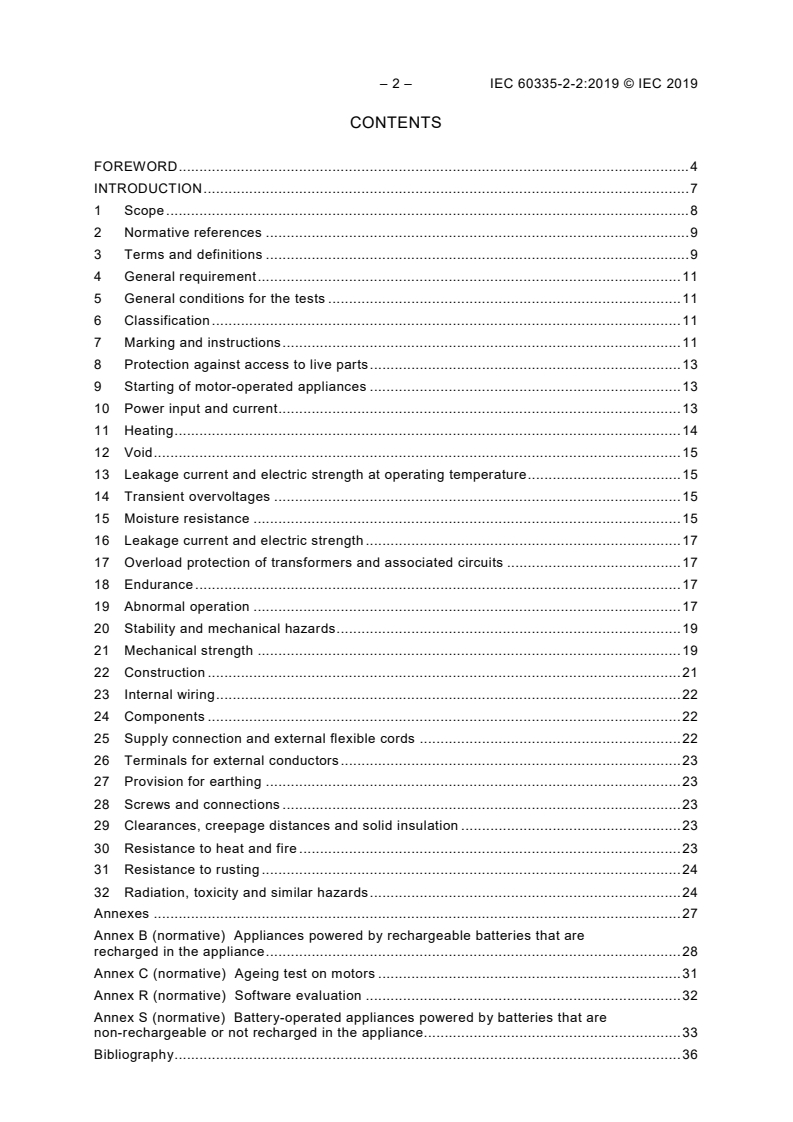
IEC 60335-2-2:2019 - Household and similar electrical appliances - Safety - Part 2-2: Particular requirements for vacuum cleaners and water-suction cleaning appliances Released:5/14/2019
Overview
IEC 60335-2-2:2019 is an internationally recognized safety standard developed by the International Electrotechnical Commission (IEC). It defines specific requirements for the safety of electric vacuum cleaners and water-suction cleaning appliances designed for household and similar purposes, with rated voltages up to 250 V. The standard also encompasses special use cases, including vacuum cleaners for animal grooming, centrally-sited vacuum cleaners, and automatic battery-operated cleaning appliances. As part of the IEC 60335 series, this document aims to enhance the safety of electrical cleaning appliances, providing guidance to manufacturers, certification bodies, and users worldwide.
Key Topics
- Scope of Safety Requirements: The standard applies to a broad range of products, including battery-operated and dual supply devices, motorized cleaning heads, and current-carrying hoses. It specifically excludes industry-only machines and those used in hazardous environments.
- Household and Similar Purposes: While it primarily targets household applications, the standard also covers vacuum cleaners intended for general housekeeping in commercial settings like hotels, offices, schools, and hospitals.
- Common Hazards Addressed: Protection against electrical, thermal, mechanical, fire, and radiation risks typical to the intended usage environment. The standard considers normal operation and foreseeable abnormal conditions, such as blockages and spillage.
- Markings and Instructions: IEC 60335-2-2 details requirements for labeling appliances with essential safety information, correct use instructions, and warnings-especially for applications like animal grooming or ash vacuuming.
- Test Methods: The standard specifies measurement and testing protocols for verifying product safety, including assessment under different supply voltages and settings.
- Technical Revisions: The 2019 edition introduces revisions aimed at improving safety for appliances used for animal grooming, converting notes into normative requirements for greater clarity, and aligning annexes with updates in related standards.
Applications
IEC 60335-2-2:2019 is critical for manufacturers, designers, importers, and certification bodies engaged with electrical cleaning appliances. Its applications include:
- Product Design and Development: Ensures new and existing vacuum cleaners and water-suction devices meet rigorous international safety criteria.
- Certification and Compliance: Assists conformity assessment bodies and national regulators in certifying appliances for market entry and ongoing compliance.
- Risk Mitigation: Reduces the risk of electrical shocks, fires, and other hazards for operators and the public by providing clear requirements for accessible components, insulation, leakage current, and mechanical robustness.
- User Instructions: Establishes guidelines for practical and effective labeling, such as warnings for ash vacuum cleaners and instructions for proper handling of current-carrying hoses.
- Commercial and Institutional Use: Guides safe appliance use in environments ranging from homes to commercial spaces-ensuring consistent safety standards wherever vacuum cleaners are utilized for housekeeping.
Related Standards
IEC 60335-2-2:2019 is intended for use in conjunction with other standards in the IEC 60335 series, particularly:
- IEC 60335-1: General requirements for safety of household and similar electrical appliances, serving as the foundational standard.
- IEC 60335-2-69: Relates to wet and dry vacuum cleaners, including those with power brushes, specifically for commercial use (not covered by 2-2).
- IEC 60312: Methods for measuring household vacuum cleaner performance.
- IEC TS 62885-1: Defines general requirements for test materials and equipment for surface cleaning appliances.
Other referenced standards for testing materials, graphical symbols, and marking include ISO 7010, ISO 216, ISO 6344-2, and IEC 60584-1.
Incorporating the requirements and guidance of IEC 60335-2-2:2019 ensures the safety, reliability, and market acceptance of household vacuum cleaners and water-suction appliances, providing a benchmark for global product safety in both residential and light-commercial contexts.
Relations
- Effective Date
- 14-Mar-2025
- Effective Date
- 05-Sep-2023
- Effective Date
- 05-Sep-2023
- Effective Date
- 05-Sep-2023
- Effective Date
- 05-Sep-2023
Buy Documents
IEC 60335-2-2:2019 RLV - Household and similar electrical appliances - Safety - Part 2-2: Particular requirements for vacuum cleaners and water-suction cleaning appliances Released:5/14/2019
IEC 60335-2-2:2019 - Household and similar electrical appliances - Safety - Part 2-2: Particular requirements for vacuum cleaners and water-suction cleaning appliances Released:5/14/2019
Get Certified
Connect with accredited certification bodies for this standard

CIS Institut d.o.o.
Personal Protective Equipment (PPE) certification body. Notified Body NB-2890 for EU Regulation 2016/425 PPE.

Kiwa BDA Testing
Building and construction product certification.
Kmetijski inštitut Slovenije
Agricultural Institute of Slovenia. Soil testing, plant health, agricultural product analysis.
Sponsored listings
Frequently Asked Questions
IEC 60335-2-2:2019 is a standard published by the International Electrotechnical Commission (IEC). Its full title is "Household and similar electrical appliances - Safety - Part 2-2: Particular requirements for vacuum cleaners and water-suction cleaning appliances". This standard covers: IEC 60335-2-2:2019 deals with the safety of electric vacuum cleaners and water suction cleaning appliances for household and similar purposes, including vacuum cleaners for animal grooming, their rated voltage being not more than 250 V. It also applies to centrally-sited vacuum cleaners and automatic battery-operated cleaners. This standard also applies to motorized cleaning heads and current-carrying hoses associated with a particular vacuum cleaner. Battery-operated appliances and other DC supplied appliances are within the scope of this standard. Dual supply appliances, either mains-supplied or battery-operated, are regarded as battery-operated appliances when operated in the battery mode. Appliances not intended for normal household use, but which nevertheless may be a source of danger to the public, such as appliances intended to be used by laymen in shops and other premises for normal housekeeping purposes, are within the scope of this standard. Examples of such appliances are appliances intended to be used for normal housekeeping purposes in hotels, offices, schools, hospitals and similar premises. As far as is practicable, this standard deals with the common hazards presented by appliances that are encountered by all persons in and around the home. However, in general, it does not take into account – persons (including children) whose physical, sensory or mental capabilities or lack of experience and knowledge prevents them from using the appliance safely without supervision or instruction; – children playing with the appliance. Attention is drawn to the fact that: – for appliances intended to be used in vehicles or on board ships or aircraft, additional requirements can be necessary; – in many countries additional requirements are specified by the national health authorities, the national authorities responsible for the protection of labour, the national water supply authorities and similar authorities. This standard does not apply to: – appliances intended exclusively for industrial purposes; – appliances intended to be used in locations where special conditions prevail, such as the presence of a corrosive or explosive atmosphere (dust, vapour or gas); – wet and dry vacuum cleaners, including power brush, for commercial use (IEC 60335-2-69). This seventh edition cancels and replaces the sixth edition published in 2009, Amendment 1:2012 and Amendment 2:2016. This edition constitutes a technical revision. This edition includes the following significant technical changes with respect to the previous edition: – some requirements for appliances for animal grooming have been modified (6.1, 25.7) – the note in 7.101 has been deleted; – converted some notes to normative text (7.102, 10.1, 11.3, 13.1, 15.2, 15.101, 19.101, 20.1, 20.2, 21.103, 21.105, 22.32, 25.23); – clarification that the test of 19.7 is applicable to vacuum cleaners with a motorized brush or similar device; – modified Annex R for alignment with 22.201 of Annex B; – modified Annex S in accordance with IEC 60335-2-2:2009/ISH1:2016. This Part 2 is to be used in conjunction with the latest edition of IEC 60335-1 and its amendments. It was established on the basis of the fifth edition (2010) of that standard.
IEC 60335-2-2:2019 deals with the safety of electric vacuum cleaners and water suction cleaning appliances for household and similar purposes, including vacuum cleaners for animal grooming, their rated voltage being not more than 250 V. It also applies to centrally-sited vacuum cleaners and automatic battery-operated cleaners. This standard also applies to motorized cleaning heads and current-carrying hoses associated with a particular vacuum cleaner. Battery-operated appliances and other DC supplied appliances are within the scope of this standard. Dual supply appliances, either mains-supplied or battery-operated, are regarded as battery-operated appliances when operated in the battery mode. Appliances not intended for normal household use, but which nevertheless may be a source of danger to the public, such as appliances intended to be used by laymen in shops and other premises for normal housekeeping purposes, are within the scope of this standard. Examples of such appliances are appliances intended to be used for normal housekeeping purposes in hotels, offices, schools, hospitals and similar premises. As far as is practicable, this standard deals with the common hazards presented by appliances that are encountered by all persons in and around the home. However, in general, it does not take into account – persons (including children) whose physical, sensory or mental capabilities or lack of experience and knowledge prevents them from using the appliance safely without supervision or instruction; – children playing with the appliance. Attention is drawn to the fact that: – for appliances intended to be used in vehicles or on board ships or aircraft, additional requirements can be necessary; – in many countries additional requirements are specified by the national health authorities, the national authorities responsible for the protection of labour, the national water supply authorities and similar authorities. This standard does not apply to: – appliances intended exclusively for industrial purposes; – appliances intended to be used in locations where special conditions prevail, such as the presence of a corrosive or explosive atmosphere (dust, vapour or gas); – wet and dry vacuum cleaners, including power brush, for commercial use (IEC 60335-2-69). This seventh edition cancels and replaces the sixth edition published in 2009, Amendment 1:2012 and Amendment 2:2016. This edition constitutes a technical revision. This edition includes the following significant technical changes with respect to the previous edition: – some requirements for appliances for animal grooming have been modified (6.1, 25.7) – the note in 7.101 has been deleted; – converted some notes to normative text (7.102, 10.1, 11.3, 13.1, 15.2, 15.101, 19.101, 20.1, 20.2, 21.103, 21.105, 22.32, 25.23); – clarification that the test of 19.7 is applicable to vacuum cleaners with a motorized brush or similar device; – modified Annex R for alignment with 22.201 of Annex B; – modified Annex S in accordance with IEC 60335-2-2:2009/ISH1:2016. This Part 2 is to be used in conjunction with the latest edition of IEC 60335-1 and its amendments. It was established on the basis of the fifth edition (2010) of that standard.
IEC 60335-2-2:2019 is classified under the following ICS (International Classification for Standards) categories: 13.120 - Domestic safety; 97.080 - Cleaning appliances. The ICS classification helps identify the subject area and facilitates finding related standards.
IEC 60335-2-2:2019 has the following relationships with other standards: It is inter standard links to IEC 60335-2-2:2026, IEC 60335-2-2:2009, IEC 60335-2-2:2009/AMD1:2012, IEC 60335-2-2:2009/AMD2:2016, IEC 60335-2-2:2009/ISH1:2016. Understanding these relationships helps ensure you are using the most current and applicable version of the standard.
IEC 60335-2-2:2019 is available in PDF format for immediate download after purchase. The document can be added to your cart and obtained through the secure checkout process. Digital delivery ensures instant access to the complete standard document.
Standards Content (Sample)
IEC 60335-2-2 ®
Edition 7.0 2019-05
REDLINE VERSION
INTERNATIONAL
STANDARD
colour
inside
Household and similar electrical appliances – Safety –
Part 2-2: Particular requirements for vacuum cleaners and water-suction
cleaning appliances
All rights reserved. Unless otherwise specified, no part of this publication may be reproduced or utilized in any form
or by any means, electronic or mechanical, including photocopying and microfilm, without permission in writing from
either IEC or IEC's member National Committee in the country of the requester. If you have any questions about IEC
copyright or have an enquiry about obtaining additional rights to this publication, please contact the address below or
your local IEC member National Committee for further information.
IEC Central Office Tel.: +41 22 919 02 11
3, rue de Varembé info@iec.ch
CH-1211 Geneva 20 www.iec.ch
Switzerland
About the IEC
The International Electrotechnical Commission (IEC) is the leading global organization that prepares and publishes
International Standards for all electrical, electronic and related technologies.
About IEC publications
The technical content of IEC publications is kept under constant review by the IEC. Please make sure that you have the
latest edition, a corrigendum or an amendment might have been published.
IEC publications search - webstore.iec.ch/advsearchform Electropedia - www.electropedia.org
The advanced search enables to find IEC publications by a The world's leading online dictionary on electrotechnology,
variety of criteria (reference number, text, technical containing more than 22 000 terminological entries in English
committee,…). It also gives information on projects, replaced and French, with equivalent terms in 16 additional languages.
and withdrawn publications. Also known as the International Electrotechnical Vocabulary
(IEV) online.
IEC Just Published - webstore.iec.ch/justpublished
Stay up to date on all new IEC publications. Just Published IEC Glossary - std.iec.ch/glossary
details all new publications released. Available online and 67 000 electrotechnical terminology entries in English and
once a month by email. French extracted from the Terms and Definitions clause of
IEC publications issued since 2002. Some entries have been
IEC Customer Service Centre - webstore.iec.ch/csc collected from earlier publications of IEC TC 37, 77, 86 and
If you wish to give us your feedback on this publication or CISPR.
need further assistance, please contact the Customer Service
Centre: sales@iec.ch.
IEC 60335-2-2 ®
Edition 7.0 2019-05
REDLINE VERSION
INTERNATIONAL
STANDARD
colour
inside
Household and similar electrical appliances – Safety –
Part 2-2: Particular requirements for vacuum cleaners and water-suction
cleaning appliances
INTERNATIONAL
ELECTROTECHNICAL
COMMISSION
ICS 13.120; 97.080 ISBN 978-2-8322-6951-0
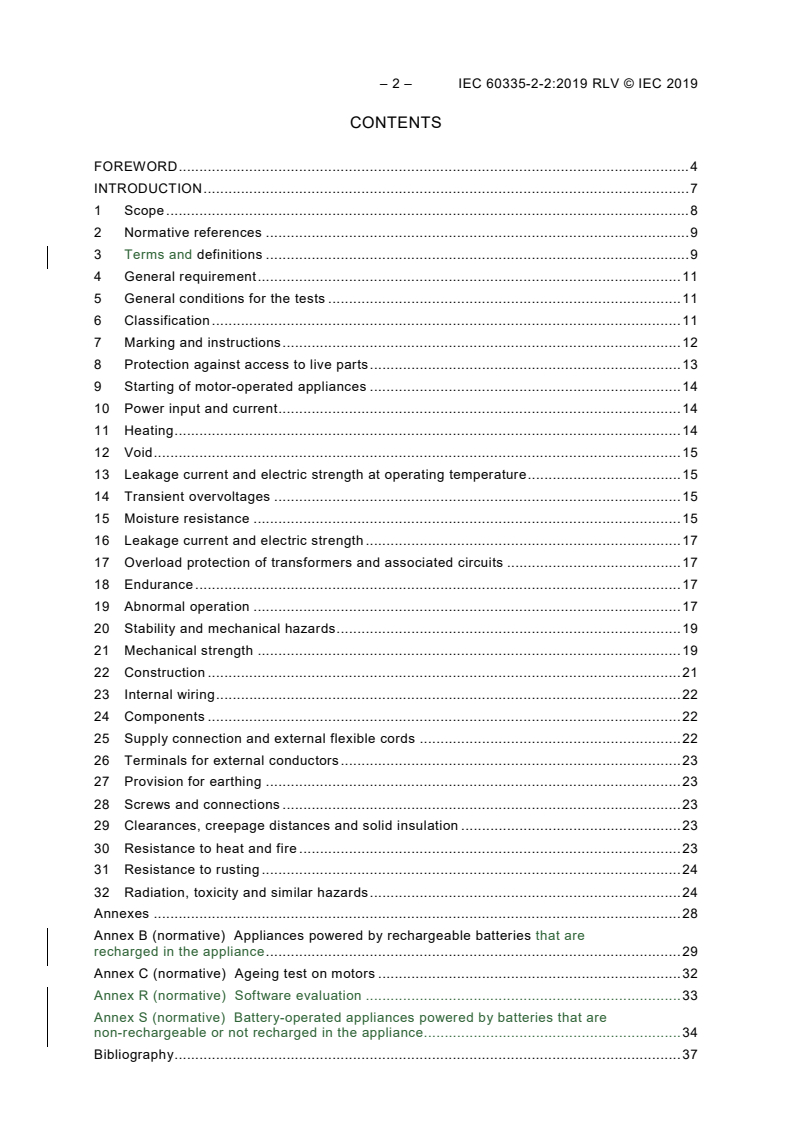
– 2 – IEC 60335-2-2:2019 RLV © IEC 2019
CONTENTS
FOREWORD . 4
INTRODUCTION . 7
1 Scope . 8
2 Normative references . 9
3 Terms and definitions . 9
4 General requirement . 11
5 General conditions for the tests . 11
6 Classification . 11
7 Marking and instructions . 12
8 Protection against access to live parts . 13
9 Starting of motor-operated appliances . 14
10 Power input and current . 14
11 Heating . 14
12 Void . 15
13 Leakage current and electric strength at operating temperature . 15
14 Transient overvoltages . 15
15 Moisture resistance . 15
16 Leakage current and electric strength . 17
17 Overload protection of transformers and associated circuits . 17
18 Endurance . 17
19 Abnormal operation . 17
20 Stability and mechanical hazards . 19
21 Mechanical strength . 19
22 Construction . 21
23 Internal wiring . 22
24 Components . 22
25 Supply connection and external flexible cords . 22
26 Terminals for external conductors . 23
27 Provision for earthing . 23
28 Screws and connections . 23
29 Clearances, creepage distances and solid insulation . 23
30 Resistance to heat and fire . 23
31 Resistance to rusting . 24
32 Radiation, toxicity and similar hazards . 24
Annexes . 28
Annex B (normative) Appliances powered by rechargeable batteries that are
recharged in the appliance . 29
Annex C (normative) Ageing test on motors . 32
Annex R (normative) Software evaluation . 33
Annex S (normative) Battery-operated appliances powered by batteries that are
non-rechargeable or not recharged in the appliance. 34
Bibliography . 37
Figure 101 – Apparatus for testing the abrasion resistance of current-carrying hoses . 25
Figure 102 – Apparatus for testing the resistance to flexing of current-carrying hoses . 26
Figure 103 – Configuration of the hose for the freezing treatment . 26
Figure 104 – Flexing positions for the hose after removal from the freezing cabinet . 27
Figure 105 – Probe for measuring surface temperatures . 27
Table 101 – Maximum temperature rises for specified accessible external surfaces
under normal operating conditions . 15
– 4 – IEC 60335-2-2:2019 RLV © IEC 2019
INTERNATIONAL ELECTROTECHNICAL COMMISSION
____________
HOUSEHOLD AND SIMILAR ELECTRICAL APPLIANCES –
SAFETY –
Part 2-2: Particular requirements for vacuum cleaners
and water-suction cleaning appliances
FOREWORD
1) The International Electrotechnical Commission (IEC) is a worldwide organization for standardization comprising
all national electrotechnical committees (IEC National Committees). The object of IEC is to promote
international co-operation on all questions concerning standardization in the electrical and electronic fields. To
this end and in addition to other activities, IEC publishes International Standards, Technical Specifications,
Technical Reports, Publicly Available Specifications (PAS) and Guides (hereafter referred to as “IEC
Publication(s)”). Their preparation is entrusted to technical committees; any IEC National Committee interested
in the subject dealt with may participate in this preparatory work. International, governmental and non-
governmental organizations liaising with the IEC also participate in this preparation. IEC collaborates closely
with the International Organization for Standardization (ISO) in accordance with conditions determined by
agreement between the two organizations.
2) The formal decisions or agreements of IEC on technical matters express, as nearly as possible, an international
consensus of opinion on the relevant subjects since each technical committee has representation from all
interested IEC National Committees.
3) IEC Publications have the form of recommendations for international use and are accepted by IEC National
Committees in that sense. While all reasonable efforts are made to ensure that the technical content of IEC
Publications is accurate, IEC cannot be held responsible for the way in which they are used or for any
misinterpretation by any end user.
4) In order to promote international uniformity, IEC National Committees undertake to apply IEC Publications
transparently to the maximum extent possible in their national and regional publications. Any divergence
between any IEC Publication and the corresponding national or regional publication shall be clearly indicated in
the latter.
5) IEC itself does not provide any attestation of conformity. Independent certification bodies provide conformity
assessment services and, in some areas, access to IEC marks of conformity. IEC is not responsible for any
services carried out by independent certification bodies.
6) All users should ensure that they have the latest edition of this publication.
7) No liability shall attach to IEC or its directors, employees, servants or agents including individual experts and
members of its technical committees and IEC National Committees for any personal injury, property damage or
other damage of any nature whatsoever, whether direct or indirect, or for costs (including legal fees) and
expenses arising out of the publication, use of, or reliance upon, this IEC Publication or any other IEC
Publications.
8) Attention is drawn to the Normative references cited in this publication. Use of the referenced publications is
indispensable for the correct application of this publication.
9) Attention is drawn to the possibility that some of the elements of this IEC Publication may be the subject of
patent rights. IEC shall not be held responsible for identifying any or all such patent rights.
This redline version of the official IEC Standard allows the user to identify the changes
made to the previous edition. A vertical bar appears in the margin wherever a change
has been made. Additions are in green text, deletions are in strikethrough red text.
International Standard IEC 60335-2-2 has been prepared by IEC technical committee 61:
Safety of household and similar electrical appliances.
This seventh edition cancels and replaces the sixth edition published in 2009, Amendment
1:2012 and Amendment 2:2016. This edition constitutes a technical revision.
This edition includes the following significant technical changes with respect to the previous
edition:
– some requirements for appliances for animal grooming have been modified (6.1, 25.7)
– the note in 7.101 has been deleted;
– converted some notes to normative text (7.102, 10.1, 11.3, 13.1, 15.2, 15.101, 19.101,
20.1, 20.2, 21.103, 21.105, 22.32, 25.23);
– clarification that the test of 19.7 is applicable to vacuum cleaners with a motorized brush
or similar device;
– modified Annex R for alignment with 22.201 of Annex B;
– modified Annex S in accordance with IEC 60335-2-2:2009/ISH1:2016;
– requirements for mechanical strength of handles have been added (21.106).
The text of this International Standard is based on the following documents:
FDIS Report on voting
61/5790/FDIS 61/5807/RVD
Full information on the voting for the approval of this International Standard can be found in
the report on voting indicated in the above table.
This document has been drafted in accordance with the ISO/IEC Directives, Part 2.
A list of all parts of the IEC 60335 series, under the general title: Household and similar
electrical appliances – Safety, can be found on the IEC website.
This Part 2 is to be used in conjunction with the latest edition of IEC 60335-1 and its
amendments. It was established on the basis of the fifth edition (2010) of that standard.
NOTE 1 When “Part 1” is mentioned in this standard, it refers to IEC 60335-1.
This Part 2 supplements or modifies the corresponding clauses in IEC 60335-1, so as to
convert that publication into the IEC standard: Safety requirements for vacuum cleaners and
water-suction cleaning appliances.
When a particular subclause of Part 1 is not mentioned in this Part 2, that subclause applies
as far as is reasonable. When this standard states "addition", "modification" or "replacement",
the relevant text in Part 1 is to be adapted accordingly.
NOTE 2 The following numbering system is used:
– subclauses, tables and figures that are numbered starting from 101 are additional to those in Part 1;
– unless notes are in a new subclause or involve notes in Part 1, they are numbered starting from 101, including
those in a replaced clause or subclause;
– additional annexes are lettered AA, BB, etc.
NOTE 3 The following print types are used:
– requirements: in roman type;
– test specifications: in italic type;
– notes: in small roman type.
– 6 – IEC 60335-2-2:2019 RLV © IEC 2019
Words in bold in the text are defined in Clause 3. When a definition concerns an adjective, the adjective and the
associated noun are also in bold.
The committee has decided that the contents of this document will remain unchanged until the
stability date indicated on the IEC website under "http://webstore.iec.ch" in the data related to
the specific document. At this date, the document will be
• reconfirmed,
• withdrawn,
• replaced by a revised edition, or
• amended.
NOTE 4 The attention of National Committees is drawn to the fact that equipment manufacturers and testing
organizations may need a transitional period following publication of a new, amended or revised IEC publication in
which to make products in accordance with the new requirements and to equip themselves for conducting new or
revised tests.
It is the recommendation of the committee that the content of this publication be adopted for implementation
nationally not earlier than 12 months or later than 36 months from the date of publication.
The following differences exist in the countries indicated below.
– 3.1.9: Normal operation is defined differently and any control operating before 20 s is defeated when
determining Pi (USA).
– 6.1: Class 0 appliances are allowed (Canada, Japan, USA).
– 6.1: Household vacuum cleaners are required to be class II or class III (Denmark and Norway).
– 6.2: IPX4 is not required (USA).
– 7.1: The additional marking for appliance outlets for accessories is not required (USA).
– 7.1: Appliance and outlet ratings are to be marked in amps. (USA).
– 10.1: The power input of booster settings is taken into account (USA).
– 11.3: Surface temperatures are measured with thermocouples (USA).
– 11.5: Booster settings are activated every 2 min out of 8 min (USA).
– 11.7: The test is carried out with one-third of the cord unreeled until steady conditions are established (USA).
– 11.8: Surface temperature limits are different (USA).
– 15.2: The test is carried out differently (USA).
– 16.3: The test is carried out differently (USA).
– 21.106 The test is carried out differently (USA).
IMPORTANT – The 'colour inside' logo on the cover page of this publication indicates
that it contains colours which are considered to be useful for the correct
understanding of its contents. Users should therefore print this document using a
colour printer.
INTRODUCTION
It has been assumed in the drafting of this International Standard that the execution of its
provisions is entrusted to appropriately qualified and experienced persons.
This standard recognizes the internationally accepted level of protection against hazards such
as electrical, mechanical, thermal, fire and radiation of appliances when operated as in
normal use taking into account the manufacturer's instructions. It also covers abnormal
situations that can be expected in practice and takes into account the way in which
electromagnetic phenomena can affect the safe operation of appliances.
This standard takes into account the requirements of IEC 60364 as far as possible so that
there is compatibility with the wiring rules when the appliance is connected to the supply
mains. However, national wiring rules may differ.
If an appliance within the scope of this standard also incorporates functions that are covered
by another part 2 of IEC 60335, the relevant part 2 is applied to each function separately, as
far as is reasonable. If applicable, the influence of one function on the other is taken into
account.
When a part 2 standard does not include additional requirements to cover hazards dealt with
in Part 1, Part 1 applies.
NOTE 1 This means that the technical committees responsible for the part 2 standards have determined that it is
not necessary to specify particular requirements for the appliance in question over and above the general
requirements.
This standard is a product family standard dealing with the safety of appliances and takes
precedence over horizontal and generic standards covering the same subject.
NOTE 2 Horizontal and generic standards covering a hazard are not applicable since they have been taken into
consideration when developing the general and particular requirements for the IEC 60335 series of standards. For
example, in the case of temperature requirements for surfaces on many appliances, generic standards, such as
ISO 13732-1 for hot surfaces, are not applicable in addition to Part 1 or part 2 standards.
An appliance that complies with the text of this standard will not necessarily be considered to
comply with the safety principles of the standard if, when examined and tested, it is found to
have other features that impair the level of safety covered by these requirements.
An appliance employing materials or having forms of construction differing from those detailed
in the requirements of this standard may be examined and tested according to the intent of
the requirements and, if found to be substantially equivalent, may be considered to comply
with the standard.
– 8 – IEC 60335-2-2:2019 RLV © IEC 2019
HOUSEHOLD AND SIMILAR ELECTRICAL APPLIANCES –
SAFETY –
Part 2-2: Particular requirements for vacuum cleaners
and water-suction cleaning appliances
1 Scope
This clause of Part 1 is replaced by the following.
This International Standard deals with the safety of electric vacuum cleaners and
water-suction cleaning appliances for household and similar purposes, including vacuum
cleaners for animal grooming, their rated voltage being not more than 250 V. It also applies
to centrally-sited vacuum cleaners and automatic battery-powered battery-operated
cleaners.
This standard also applies to motorized cleaning heads and current-carrying hoses
associated with a particular vacuum cleaner.
Battery-operated appliances and other DC supplied appliances are within the scope of this
standard. Dual supply appliances, either mains-supplied or battery-operated, are regarded as
battery-operated appliances when operated in the battery mode.
Appliances not intended for normal household use, but which nevertheless may be a source
of danger to the public, such as appliances intended to be used by laymen in shops and other
premises for normal housekeeping purposes, are within the scope of this standard.
NOTE 101 Examples of such appliances are appliances intended to be used for normal housekeeping purposes in
hotels, offices, schools, hospitals and similar premises.
As far as is practicable, this standard deals with the common hazards presented by
appliances that are encountered by all persons in and around the home. However, in general,
it does not take into account
– persons (including children) whose
• physical, sensory or mental capabilities; or
• lack of experience and knowledge
prevents them from using the appliance safely without supervision or instruction;
– children playing with the appliance.
NOTE 102 Attention is drawn to the fact that
– for appliances intended to be used in vehicles or on board ships or aircraft, additional requirements may can
be necessary;
– in many countries additional requirements are specified by the national health authorities, the national
authorities responsible for the protection of labour, the national water supply authorities and similar authorities.
NOTE 103 This standard does not apply to
– appliances intended exclusively for industrial purposes;
– appliances intended to be used in locations where special conditions prevail, such as the presence of a
corrosive or explosive atmosphere (dust, vapour or gas);
– wet and dry vacuum cleaners, including power brush, for commercial use (IEC 60335-2-69).
2 Normative references
This clause of Part 1 is applicable except as follows.
Addition:
IEC 60312, Vacuum cleaners for household use − Methods of measuring the performance
IEC 60584-1, Thermocouples – Part 1: EMF specifications and tolerances
IEC TS 62885-1: 2018, Surface cleaning appliances – Part 1: General requirements on test
material and test equipment
ISO 216, Writing paper and certain classes of printed matter – Trimmed sizes – A and B
series, and indication of machine direction
ISO 6344-2, Coated abrasives – Grain size analysis – Part 2: Determination of grain size
distribution of macrogrits P12 to P220
ISO 7010:2011, Graphical symbols – Safety colours and safety signs – Registered safety
signs
ISO 14688-1, Geotechnical investigation and testing – Identification and classification of soil –
Part 1: Identification and description
3 Terms and definitions
This clause of Part 1 is applicable except as follows.
3.1 Definitions relating to physical characteristics
3.1.4 Addition:
Note 101 to entry: For appliances incorporating a booster setting, the rated power input corresponds to the
operation of the appliance without the booster setting being used.
3.1.9 Replacement:
normal operation
operation of the appliance under the following conditions:
The appliance is supplied at rated voltage and operated continuously with the air inlet
adjusted to give a power input P after 20 s
m
Three minutes later, a final adjustment of the air inlet is made, if necessary.
P is calculated from the formula
m
P = 0,5 (P + P )
m f i
where
P is the power input in watts, after 3 min of operation with the air inlet unobstructed. Any
f
device that ensures a flow of air to cool the motor in the event of a blockage of the main
air inlet is allowed to operate;
– 10 – IEC 60335-2-2:2019 RLV © IEC 2019
P is the power input in watts, after a further 20 s of operation with the air inlet blocked. Any
i
device that is adjustable without the aid of a tool, and which ensures a flow of air to cool
the motor in the event of a blockage of a main air inlet, is rendered inoperative. If P has a
i
rapid non-linear decrease or cannot be measured due to the appliance suction motor
stopping before 20 s, the air inlet is gradually blocked to the extent that the motor stops
+5
after 20 s. In this case, P is the maximum value of power input in the last two
− 0
i
seconds before the motor shuts off.
If the appliance is marked with a rated voltage range, it is supplied at the mean value of the
range if the difference between the limits of the range does not exceed 10 % of the mean
value. If the difference exceeds 10 %, the supply voltage is the upper value of the range.
The measurements are made with the appliance fitted with a clean dust bag and filter, any
water collection container being empty. If the appliance is intended to be used only with a
hose, detachable nozzles and tubes are removed and the hose is laid out straight. If the
appliance is provided with a hose as an accessory, it is operated without the hose.
Rotating brushes and similar devices are in operation but not in contact with any surface.
Motorized cleaning heads are connected by means of the hose or tube and are in operation
but not in contact with any surface.
Appliance outlets for other accessories are loaded with a resistive load in accordance with the
marking.
Automatic battery-powered battery-operated cleaners are operated with a clean dust bag
or filter on the carpet defined in IEC 60312 meeting the construction specifications given in
Table 1 in IEC TS 62885-1:2018. A frame of 1,5 m by 1,5 m is used on the carpet to limit the
area of action. The air inlet is unobstructed.
3.5 Definitions relating to types of appliances
3.5.101
ash vacuum cleaner
vacuum cleaner intended to vacuum cold ash from fireplaces, chimneys, ovens, ash-trays and
similar places of ash accumulation
3.105 3.5.102
automatic battery-powered battery-operated cleaner
automatic vacuum cleaner that operates without human control only within a defined
perimeter, within a pre-programmed area or in an area self-controlled by the appliance
Note 1 to entry: The cleaner consists of the mobile part and may have a docking station.
3.5.103
centrally-sited vacuum cleaner
vacuum cleaner that is connected to a ducting system installed in the building
Note 1 to entry: During use, the nozzle and its associated hose are connected to one of the suction inlets of the
ducting system.
3.101 3.5.104
water-suction cleaning appliance
appliance for aspirating an aqueous solution that may contain foaming detergent
3.6 Definitions relating to parts of an appliance
3.106 3.6.101
docking station
unit that may provide
– manual or automatic battery charging facilities,
– dust removal,
– data processing facility, and
– suction for the mobile part
Note 1 to entry: A docking station is also known as a base unit.
3.104 3.6.102
motorized cleaning head
accessory containing a motor that is supplied from the vacuum cleaner and which is attached
to the end of a hose or tube
3.8 Definitions relating to miscellaneous matters
3.102 3.8.101
booster setting
position of a control resulting in a temporary higher power input that is automatically reduced
to the power input value when the setting is not used
4 General requirement
This clause of Part 1 is applicable.
5 General conditions for the tests
This clause of Part 1 is applicable except as follows.
5.2 Addition:
A new hose is used for each of the tests of 21.101 to 21.105. The test of 19.105 may be
carried out on a separate appliance.
5.101 Current-carrying hoses operating at safety extra-low voltage are not subjected to the
tests of 21.101 to 21.105.
6 Classification
This clause of Part 1 is applicable except as follows.
6.1 Modification:
Vacuum cleaners and water-suction cleaning appliances shall be class I, class II or
class III.
Vacuum cleaners for animal grooming shall be class II or class III.
Vacuum cleaners may be class 0 provided that their rated voltage does not exceed 150 V.
Stationary parts of automatic battery-powered battery-operated cleaners may be class 0 if
the rated voltage does not exceed 150 V.
– 12 – IEC 60335-2-2:2019 RLV © IEC 2019
6.2 Addition:
Vacuum cleaners for animal grooming and water-suction cleaning appliances shall be at
least IPX4.
7 Marking and instructions
This clause of Part 1 is applicable except as follows.
7.1 Addition:
The appliance shall be marked with the sum of its rated power input and the maximum load
of the appliance outlet in watts (if applicable). Ash vacuum cleaners shall be marked with
symbol ISO 7000-0434A (2004-01), symbol ISO 7000-0790 (2004-01) and Warning sign
ISO 7010 W021(2011-06).
7.6 Addition:
[symbol IEC 60417-5935 motorized cleaning head for water
(2002-102012-09)] suction cleaning
[Warning sign ISO 7010
warning; risk of fire/flammable materials
W021(2011-06)]
7.12 Addition:
The instructions for appliances having a current-carrying hose operating at other than safety
extra-low voltage shall include the substance of the following:
CAUTION: This hose contains electrical connections:
– do not use to suck up water (for vacuum cleaners only);
– do not immerse in water for cleaning;
– the hose should be checked regularly and must not be used if damaged.
The instructions for vacuum cleaners incorporating rotating brushes or similar devices, and
water-suction cleaning appliances, shall state that the plug must be removed from the
socket-outlet before cleaning or maintaining the appliance.
If symbol IEC 60417-5935 (2002-102012-09) is used, its meaning shall be explained.
7.12.1 Addition:
The instructions for ash vacuum cleaners shall include the substance of the following:
This appliance is intended to pick up cold ash from fireplaces, chimneys, ovens, ash-trays,
and similar places of ash accumulation.
WARNING: Risk of fire
– do not pick up hot, glowing or burning ash. Pick up cold ash only;
– the dust container must be emptied and cleaned before and after each use;
– do not use paper dust bags or bags made from similar flammable materials;
– do not use any other vacuum cleaner to vacuum ash;
– do not rest the ash vacuum cleaner on flammable or polymeric surfaces, including
carpeting and vinyl tile.
7.14 Addition:
The height of symbol IEC 60417-5935 (2002-102012-09), symbol ISO 7000-0434A (2004-01),
symbol ISO 7000-0790 (2004-01) and Warning sign ISO 7010 W021 (2011-06) shall be at
least
15 mm.
Compliance is checked by measurement.
7.15 Addition:
Symbol ISO 7000-0434A (2004-01) shall be located next to symbol ISO 7000-0790 (2004-01).
7.101 Motorized cleaning heads shall be marked with
– rated voltage or rated voltage range in volts;
– rated power input in watts;
– name, trade mark or identification mark of the manufacturer or responsible vendor;
– model or type reference.
Motorized cleaning heads for water-suction cleaning appliances, except those of class III
construction having a working voltage up to 24 V, shall be marked with symbol IEC 60417-
5935 (2002-102012-09).
NOTE This symbol is an information sign and, except for the colours, the rules of ISO 3864-1 apply.
Compliance is checked by inspection.
7.102 Appliance outlets for accessories shall be marked with the maximum load in watts.
NOTE This marking may be on the appliance close to the appliance outlet.
Compliance is checked by inspection.
8 Protection against access to live parts
This clause of Part 1 is applicable except as follows.
8.1.1 Addition:
If the instructions state that a part is to be removed when replacing a lamp or a drive belt, and
a tool is required for its removal, the part is not considered to be a detachable part provided
that
– an instruction to disconnect the appliance from the supply before opening is marked on
the cover or is visible during its removal; and
– 14 – IEC 60335-2-2:2019 RLV © IEC 2019
– after removal of the cover, access to live parts is prevented by at least basic insulation.
9 Starting of motor-operated appliances
This clause of Part 1 is not applicable.
10 Power input and current
This clause of Part 1 is applicable except as follows.
10.1 Addition:
The power input of motorized cleaning heads is measured separately.
NOTE 101 Appliance outlets are not loaded when measuring the rated power input.
Booster settings are not used during these measurements.
11 Heating
This clause of Part 1 is applicable except as follows.
11.3 Addition:
NOTE 101 When measuring the power input to ensure that the appliance has been correctly
reassembled, the power input P with the air-inlet blocked is measured.
i
Where the external accessible surfaces are suitably flat and access permits, then the test
probe of Figure 105 is used to measure the temperature rises of external accessible
surfaces specified in Table 101. The probe is applied with a force of 4 N ± 1 N to the surface
in such a way that the best possible contact between the probe and the surface is ensured.
The measurement is performed after a contact period of 30 s.
The probe may be held in place using a laboratory stand clamp or similar device. Any
measuring instrument giving the same results as the probe may be used.
11.5 Addition:
Booster settings are activated as often as allowed by the construction.
Docking stations of automatic battery-powered battery-operated cleaners are operated at
0,94 or 1,06 times rated voltage, whichever is the most unfavourable.
If a suction mode is incorporated in docking stations of automatic battery-powered
battery-operated cleaners, the test conditions of 3.1.9 are applied.
11.7 Addition:
Appliances are operated until steady conditions are established.
Appliances incorporating an automatic cord reel are operated with one-third of the total length
of the cord unreeled for 30 min, after which the cord is completely unreeled.
11.8 Addition:
During the test, the temperature rises are monitored continuously and shall not exceed the
values shown in Table 3 and Table 101.
Table 101 – Maximum temperature rises for specified accessible
external surfaces under normal operating conditions
f
Surface
Temperature rise of accessible external surfaces
K
Surfaces of portable Surfaces of hand Surfaces of
appliances situated held appliances and centrally sited
d e
vacuum cleaners
on the floor other appliances
Bare metal 38 42 48
a
42 49 59
Coated metal
Glass and ceramic 51 56 65
b, c 58 62 74
Plastic and plastic coating > 0,4 mm
a
Metal is considered coated when a coating having a minimum thickness of 90 µm made by enamel or
non-substantially plastic coating is used.
b
The temperature rise limit of plastic also applies for plastic material having a metal finish of thickness less
than 0,1 mm.
c
When the thickness of the plastic coating does not exceed 0,4 mm, the temperature rise limits of the coated
metal or of glass and ceramic material apply.
d
Within 25 mm from air outlets, the above values can be increased by 10 K.
e
Within 25 mm from air outlets, the above values can be increased by 5 K.
f
Surfaces that are inaccessible to a 75 mm diameter probe having a hemispherical end, applied with a force
not exceeding 1 N, are not measured.
12 Void
13 Leakage current and electric strength at operating temperature
This clause of Part 1 is applicable except as follows.
13.1 Addition:
NOTE 101 Booster settings are not used.
14 Transient overvoltages
This clause of Part 1 is applicable.
15 Moisture resistance
This clause of Part 1 is applicable except as follows.
15.2 Replacement:
– 16 – IEC 60335-2-2:2019 RLV © IEC 2019
Appliances having a liquid container shall be constructed so that spillage of liquid due to
overfilling, and due to overturning of appliances liable to be overturned in normal use, does
not affect their electrical insulation.
Compliance is checked by the following test.
The liquid container is filled with water to half the level indicated in the instructions. The
appliance is placed on a support inclined at an angle of 10° to the horizontal. A force of 180 N
is applied to the top of the appliance in the most unfavourable horizontal direction. If the
appliance overturns, it is considered to be liable to be overturned in normal use.
Appliances with type X attachment, except those having a specially prepared cord, are fitted
with the lightest permissible type of flexible cord of the smallest cross-sectional area specified
in Table 13.
Appliances incorporating an appliance inlet are tested with or without an appropriate
connector in position, whichever is more unfavourable.
Liquid containers that are filled by hand are completely filled with water containing
approximately 1 % NaCl, and a further quantity, equal to 15 % of the capacity of the container
or 0,25 l, whichever is the greater, is poured in steadily over a period of 1 min.
Containers of hand-held appliances and other appliances liable to be overturned in normal
use are completely filled, the cover being closed. The appliance is then overturned and left in
that position for 5 min, unless it returns automatically to its normal position of use.
Nozzles and motorized cleaning heads of water-suction cleaning appliances are placed in
a container, the base of which is level with the surface supporting the appliance. The
container is filled with a detergent solution to a level of 5 mm above its base, this level being
maintained throughout the test. The solution consists of 20 g of NaCl and 1 ml of a solution of
28 % by mass of dodecyl sodium sulphate in each 8 l of water. The solution is to be stored in
a cool atmosphere and used within seven days of its preparation.
The appliance is operated until its liquid container is completely full and for a further 5 min.
NOTE 101 The solution is to be stored in a cool atmosphere and used within seven days of its preparation.
NOTE 102101 The chemical designation of dodecyl sodium sulphate is C H NaSO .
12 25 4
After each of these tests, the appliance shall withstand the electric strength test of 16.3.
Inspection shall show that there is no trace of liquid on insulation that could result in a
reduction of clearances or creepage distances below the values specified in Clause 29.
15.101 Motorized cleaning heads of water-suction cleaning appliances shall be resistant
to liquids that may come into contact with them.
Compliance is checked by the following tests.
The motorized cleaning head is subjected to an impact test as described in IEC 60068-2-75,
the value of the impact being 2 J. The motorized cleaning head is rigidly supported and
three blows are applied to every point of the enclosure that is likely to be weak.
It is then subjected to the test Free fall – Procedure 1 of IEC 60068-2-3231. It is dropped
4 000 times from a height of 100 mm onto a steel plate having a thickness of not less than
15 mm. It is dropped
– 1 000 times on its right side,
– 1 000 times on its left side,
– 1 000 times on its front face,
– 1 000 times on its cleaning surface.
The motorized cleaning head is then subjected to the test described in 14.2.7 of IEC 60529,
the water containing approximately 1 % NaCl.
The motorized cleaning head shall then withstand the electric strength test of 16.3, the
voltage being applied between the live parts and the solution. Inspection shall show that
there is no trace of saline solution on insulation that could result in a reduction of clearances
or creepage distances below the values specified in Clause 29.
NOTE The test is not carried out on motorized cleaning heads of class III construction
having a working voltage up to 24 V.
16 Leakage current and electric strength
This clause of Part 1 is applicable except as follows.
16.3 Addition:
Current-carrying hoses, except for their electrical connections, are immersed for 1 h in water
containing approximately 1 % NaCl, at a temperature of 20 °C ± 5 °C. While the hose is still
immersed, a voltage of 2 000 V is applied for 5 min between each conductor and all the other
conductors connected together. A voltage of 3 000 V is then applied for 1 min between all the
conductors and the saline solution.
17 Overload protection of transformers and associated circuits
This clause of Part 1 is applicable.
18 Endurance
This clause of Part 1 is not applicable.
19 Abnormal operation
This clause of Part 1 is applicable except as follows.
19.1 Addition:
The test of 19.7 is only carried out on motorized cleaning heads, vacuum cleaners with a
motorized brush or similar device, and separate fan motors of centrally-sited vacuum
cleaners.
Water-suction cleaning appliances having a valve are also subjected to the test of 19.101.
Appliances incorporating a booster setting that is not deactivated electronically are also
subjected to the test of 19.102.
Centrally-sited vacuum cleaners are also subjected to the tests of 19.103, and 19.104 if
applicable.
– 18 – IEC 60335-2-2:2019 RLV © IEC 2019
Vacuum cleaners that stop automatically when there is a blockage are also subject to the test
of 19.4.
19.4 Addition:
The appliance is tested under the conditions specified in Clause 11 with the inlet blocked.
Any control that is allowed to disconnect the suction motor during the P determination of
i
3.1.9 is short-circuited.
19.7 Addition:
Motorized cleaning heads and vacuum cleaners with a motorized brush or similar device are
tested with the rotating brush or similar device locked for 30 s.
Separate fan motors of centrally-sited vacuum cleaners are operated until steady conditions
are reached.
19.9 Replacement:
Docking stations of a
...
IEC 60335-2-2 ®
Edition 7.0 2019-05
INTERNATIONAL
STANDARD
NORME
INTERNATIONALE
colour
inside
Household and similar electrical appliances – Safety –
Part 2-2: Particular requirements for vacuum cleaners and water-suction
cleaning appliances
Appareils électrodomestiques et analogues – Sécurité –
Partie 2-2: Exigences particulières pour les aspirateurs et les appareils
de nettoyage à aspiration d'eau
All rights reserved. Unless otherwise specified, no part of this publication may be reproduced or utilized in any form
or by any means, electronic or mechanical, including photocopying and microfilm, without permission in writing from
either IEC or IEC's member National Committee in the country of the requester. If you have any questions about IEC
copyright or have an enquiry about obtaining additional rights to this publication, please contact the address below or
your local IEC member National Committee for further information.
Droits de reproduction réservés. Sauf indication contraire, aucune partie de cette publication ne peut être reproduite
ni utilisée sous quelque forme que ce soit et par aucun procédé, électronique ou mécanique, y compris la photocopie
et les microfilms, sans l'accord écrit de l'IEC ou du Comité national de l'IEC du pays du demandeur. Si vous avez des
questions sur le copyright de l'IEC ou si vous désirez obtenir des droits supplémentaires sur cette publication, utilisez
les coordonnées ci-après ou contactez le Comité national de l'IEC de votre pays de résidence.
IEC Central Office Tel.: +41 22 919 02 11
3, rue de Varembé info@iec.ch
CH-1211 Geneva 20 www.iec.ch
Switzerland
About the IEC
The International Electrotechnical Commission (IEC) is the leading global organization that prepares and publishes
International Standards for all electrical, electronic and related technologies.
About IEC publications
The technical content of IEC publications is kept under constant review by the IEC. Please make sure that you have the
latest edition, a corrigendum or an amendment might have been published.
IEC publications search - webstore.iec.ch/advsearchform Electropedia - www.electropedia.org
The advanced search enables to find IEC publications by a The world's leading online dictionary on electrotechnology,
variety of criteria (reference number, text, technical containing more than 22 000 terminological entries in English
committee,…). It also gives information on projects, replaced and French, with equivalent terms in 16 additional languages.
and withdrawn publications. Also known as the International Electrotechnical Vocabulary
(IEV) online.
IEC Just Published - webstore.iec.ch/justpublished
Stay up to date on all new IEC publications. Just Published IEC Glossary - std.iec.ch/glossary
details all new publications released. Available online and 67 000 electrotechnical terminology entries in English and
once a month by email. French extracted from the Terms and Definitions clause of
IEC publications issued since 2002. Some entries have been
IEC Customer Service Centre - webstore.iec.ch/csc collected from earlier publications of IEC TC 37, 77, 86 and
If you wish to give us your feedback on this publication or CISPR.
need further assistance, please contact the Customer Service
Centre: sales@iec.ch.
A propos de l'IEC
La Commission Electrotechnique Internationale (IEC) est la première organisation mondiale qui élabore et publie des
Normes internationales pour tout ce qui a trait à l'électricité, à l'électronique et aux technologies apparentées.
A propos des publications IEC
Le contenu technique des publications IEC est constamment revu. Veuillez vous assurer que vous possédez l’édition la
plus récente, un corrigendum ou amendement peut avoir été publié.
Recherche de publications IEC - Electropedia - www.electropedia.org
webstore.iec.ch/advsearchform Le premier dictionnaire d'électrotechnologie en ligne au
La recherche avancée permet de trouver des publications IEC monde, avec plus de 22 000 articles terminologiques en
en utilisant différents critères (numéro de référence, texte, anglais et en français, ainsi que les termes équivalents dans
comité d’études,…). Elle donne aussi des informations sur les 16 langues additionnelles. Egalement appelé Vocabulaire
projets et les publications remplacées ou retirées. Electrotechnique International (IEV) en ligne.
IEC Just Published - webstore.iec.ch/justpublished Glossaire IEC - std.iec.ch/glossary
Restez informé sur les nouvelles publications IEC. Just 67 000 entrées terminologiques électrotechniques, en anglais
Published détaille les nouvelles publications parues. et en français, extraites des articles Termes et Définitions des
Disponible en ligne et une fois par mois par email. publications IEC parues depuis 2002. Plus certaines entrées
antérieures extraites des publications des CE 37, 77, 86 et
Service Clients - webstore.iec.ch/csc CISPR de l'IEC.
Si vous désirez nous donner des commentaires sur cette
publication ou si vous avez des questions contactez-nous:
sales@iec.ch.
IEC 60335-2-2 ®
Edition 7.0 2019-05
INTERNATIONAL
STANDARD
NORME
INTERNATIONALE
colour
inside
Household and similar electrical appliances – Safety –
Part 2-2: Particular requirements for vacuum cleaners and water-suction
cleaning appliances
Appareils électrodomestiques et analogues – Sécurité –
Partie 2-2: Exigences particulières pour les aspirateurs et les appareils
de nettoyage à aspiration d'eau
INTERNATIONAL
ELECTROTECHNICAL
COMMISSION
COMMISSION
ELECTROTECHNIQUE
INTERNATIONALE
ICS 13.120; 97.080 ISBN 978-2-8322-6864-3
– 2 – IEC 60335-2-2:2019 © IEC 2019
CONTENTS
FOREWORD . 4
INTRODUCTION . 7
1 Scope . 8
2 Normative references . 9
3 Terms and definitions . 9
4 General requirement . 11
5 General conditions for the tests . 11
6 Classification . 11
7 Marking and instructions . 11
8 Protection against access to live parts . 13
9 Starting of motor-operated appliances . 13
10 Power input and current . 13
11 Heating . 14
12 Void . 15
13 Leakage current and electric strength at operating temperature . 15
14 Transient overvoltages . 15
15 Moisture resistance . 15
16 Leakage current and electric strength . 17
17 Overload protection of transformers and associated circuits . 17
18 Endurance . 17
19 Abnormal operation . 17
20 Stability and mechanical hazards . 19
21 Mechanical strength . 19
22 Construction . 21
23 Internal wiring . 22
24 Components . 22
25 Supply connection and external flexible cords . 22
26 Terminals for external conductors . 23
27 Provision for earthing . 23
28 Screws and connections . 23
29 Clearances, creepage distances and solid insulation . 23
30 Resistance to heat and fire . 23
31 Resistance to rusting . 24
32 Radiation, toxicity and similar hazards . 24
Annexes . 27
Annex B (normative) Appliances powered by rechargeable batteries that are
recharged in the appliance . 28
Annex C (normative) Ageing test on motors . 31
Annex R (normative) Software evaluation . 32
Annex S (normative) Battery-operated appliances powered by batteries that are
non-rechargeable or not recharged in the appliance. 33
Bibliography . 36
Figure 101 – Apparatus for testing the abrasion resistance of current-carrying hoses . 24
Figure 102 – Apparatus for testing the resistance to flexing of current-carrying hoses . 25
Figure 103 – Configuration of the hose for the freezing treatment . 25
Figure 104 – Flexing positions for the hose after removal from the freezing cabinet . 26
Figure 105 – Probe for measuring surface temperatures . 26
Table 101 – Maximum temperature rises for specified accessible external surfaces
under normal operating conditions . 15
– 4 – IEC 60335-2-2:2019 © IEC 2019
INTERNATIONAL ELECTROTECHNICAL COMMISSION
____________
HOUSEHOLD AND SIMILAR ELECTRICAL APPLIANCES –
SAFETY –
Part 2-2: Particular requirements for vacuum cleaners
and water-suction cleaning appliances
FOREWORD
1) The International Electrotechnical Commission (IEC) is a worldwide organization for standardization comprising
all national electrotechnical committees (IEC National Committees). The object of IEC is to promote
international co-operation on all questions concerning standardization in the electrical and electronic fields. To
this end and in addition to other activities, IEC publishes International Standards, Technical Specifications,
Technical Reports, Publicly Available Specifications (PAS) and Guides (hereafter referred to as “IEC
Publication(s)”). Their preparation is entrusted to technical committees; any IEC National Committee interested
in the subject dealt with may participate in this preparatory work. International, governmental and non-
governmental organizations liaising with the IEC also participate in this preparation. IEC collaborates closely
with the International Organization for Standardization (ISO) in accordance with conditions determined by
agreement between the two organizations.
2) The formal decisions or agreements of IEC on technical matters express, as nearly as possible, an international
consensus of opinion on the relevant subjects since each technical committee has representation from all
interested IEC National Committees.
3) IEC Publications have the form of recommendations for international use and are accepted by IEC National
Committees in that sense. While all reasonable efforts are made to ensure that the technical content of IEC
Publications is accurate, IEC cannot be held responsible for the way in which they are used or for any
misinterpretation by any end user.
4) In order to promote international uniformity, IEC National Committees undertake to apply IEC Publications
transparently to the maximum extent possible in their national and regional publications. Any divergence
between any IEC Publication and the corresponding national or regional publication shall be clearly indicated in
the latter.
5) IEC itself does not provide any attestation of conformity. Independent certification bodies provide conformity
assessment services and, in some areas, access to IEC marks of conformity. IEC is not responsible for any
services carried out by independent certification bodies.
6) All users should ensure that they have the latest edition of this publication.
7) No liability shall attach to IEC or its directors, employees, servants or agents including individual experts and
members of its technical committees and IEC National Committees for any personal injury, property damage or
other damage of any nature whatsoever, whether direct or indirect, or for costs (including legal fees) and
expenses arising out of the publication, use of, or reliance upon, this IEC Publication or any other IEC
Publications.
8) Attention is drawn to the Normative references cited in this publication. Use of the referenced publications is
indispensable for the correct application of this publication.
9) Attention is drawn to the possibility that some of the elements of this IEC Publication may be the subject of
patent rights. IEC shall not be held responsible for identifying any or all such patent rights.
International Standard IEC 60335-2-2 has been prepared by IEC technical committee 61:
Safety of household and similar electrical appliances.
This seventh edition cancels and replaces the sixth edition published in 2009, Amendment
1:2012 and Amendment 2:2016. This edition constitutes a technical revision.
This edition includes the following significant technical changes with respect to the previous
edition:
– some requirements for appliances for animal grooming have been modified (6.1, 25.7)
– the note in 7.101 has been deleted;
– converted some notes to normative text (7.102, 10.1, 11.3, 13.1, 15.2, 15.101, 19.101,
20.1, 20.2, 21.103, 21.105, 22.32, 25.23);
– clarification that the test of 19.7 is applicable to vacuum cleaners with a motorized brush
or similar device;
– modified Annex R for alignment with 22.201 of Annex B;
– modified Annex S in accordance with IEC 60335-2-2:2009/ISH1:2016;
– requirements for mechanical strength of handles have been added (21.106).
The text of this International Standard is based on the following documents:
FDIS Report on voting
61/5790/FDIS 61/5807/RVD
Full information on the voting for the approval of this International Standard can be found in
the report on voting indicated in the above table.
This document has been drafted in accordance with the ISO/IEC Directives, Part 2.
A list of all parts of the IEC 60335 series, under the general title: Household and similar
electrical appliances – Safety, can be found on the IEC website.
This Part 2 is to be used in conjunction with the latest edition of IEC 60335-1 and its
amendments. It was established on the basis of the fifth edition (2010) of that standard.
NOTE 1 When “Part 1” is mentioned in this standard, it refers to IEC 60335-1.
This Part 2 supplements or modifies the corresponding clauses in IEC 60335-1, so as to
convert that publication into the IEC standard: Safety requirements for vacuum cleaners and
water-suction cleaning appliances.
When a particular subclause of Part 1 is not mentioned in this Part 2, that subclause applies
as far as is reasonable. When this standard states "addition", "modification" or "replacement",
the relevant text in Part 1 is to be adapted accordingly.
NOTE 2 The following numbering system is used:
– subclauses, tables and figures that are numbered starting from 101 are additional to those in Part 1;
– unless notes are in a new subclause or involve notes in Part 1, they are numbered starting from 101, including
those in a replaced clause or subclause;
– additional annexes are lettered AA, BB, etc.
NOTE 3 The following print types are used:
– requirements: in roman type;
– test specifications: in italic type;
– notes: in small roman type.
Words in bold in the text are defined in Clause 3. When a definition concerns an adjective, the adjective and the
associated noun are also in bold.
The committee has decided that the contents of this document will remain unchanged until the
stability date indicated on the IEC website under "http://webstore.iec.ch" in the data related to
the specific document. At this date, the document will be
• reconfirmed,
• withdrawn,
• replaced by a revised edition, or
• amended.
– 6 – IEC 60335-2-2:2019 © IEC 2019
NOTE 4 The attention of National Committees is drawn to the fact that equipment manufacturers and testing
organizations may need a transitional period following publication of a new, amended or revised IEC publication in
which to make products in accordance with the new requirements and to equip themselves for conducting new or
revised tests.
It is the recommendation of the committee that the content of this publication be adopted for implementation
nationally not earlier than 12 months or later than 36 months from the date of publication.
The following differences exist in the countries indicated below.
– 3.1.9: Normal operation is defined differently and any control operating before 20 s is defeated when
determining Pi (USA).
– 6.1: Class 0 appliances are allowed (Canada, Japan, USA).
– 6.1: Household vacuum cleaners are required to be class II or class III (Denmark and Norway).
– 6.2: IPX4 is not required (USA).
– 7.1: The additional marking for appliance outlets for accessories is not required (USA).
– 7.1: Appliance and outlet ratings are to be marked in amps. (USA).
– 10.1: The power input of booster settings is taken into account (USA).
– 11.3: Surface temperatures are measured with thermocouples (USA).
– 11.5: Booster settings are activated every 2 min out of 8 min (USA).
– 11.7: The test is carried out with one-third of the cord unreeled until steady conditions are established (USA).
– 11.8: Surface temperature limits are different (USA).
– 15.2: The test is carried out differently (USA).
– 16.3: The test is carried out differently (USA).
– 21.106 The test is carried out differently (USA).
IMPORTANT – The 'colour inside' logo on the cover page of this publication indicates
that it contains colours which are considered to be useful for the correct
understanding of its contents. Users should therefore print this document using a
colour printer.
INTRODUCTION
It has been assumed in the drafting of this International Standard that the execution of its
provisions is entrusted to appropriately qualified and experienced persons.
This standard recognizes the internationally accepted level of protection against hazards such
as electrical, mechanical, thermal, fire and radiation of appliances when operated as in
normal use taking into account the manufacturer's instructions. It also covers abnormal
situations that can be expected in practice and takes into account the way in which
electromagnetic phenomena can affect the safe operation of appliances.
This standard takes into account the requirements of IEC 60364 as far as possible so that
there is compatibility with the wiring rules when the appliance is connected to the supply
mains. However, national wiring rules may differ.
If an appliance within the scope of this standard also incorporates functions that are covered
by another part 2 of IEC 60335, the relevant part 2 is applied to each function separately, as
far as is reasonable. If applicable, the influence of one function on the other is taken into
account.
When a part 2 standard does not include additional requirements to cover hazards dealt with
in Part 1, Part 1 applies.
NOTE 1 This means that the technical committees responsible for the part 2 standards have determined that it is
not necessary to specify particular requirements for the appliance in question over and above the general
requirements.
This standard is a product family standard dealing with the safety of appliances and takes
precedence over horizontal and generic standards covering the same subject.
NOTE 2 Horizontal and generic standards covering a hazard are not applicable since they have been taken into
consideration when developing the general and particular requirements for the IEC 60335 series of standards. For
example, in the case of temperature requirements for surfaces on many appliances, generic standards, such as
ISO 13732-1 for hot surfaces, are not applicable in addition to Part 1 or part 2 standards.
An appliance that complies with the text of this standard will not necessarily be considered to
comply with the safety principles of the standard if, when examined and tested, it is found to
have other features that impair the level of safety covered by these requirements.
An appliance employing materials or having forms of construction differing from those detailed
in the requirements of this standard may be examined and tested according to the intent of
the requirements and, if found to be substantially equivalent, may be considered to comply
with the standard.
– 8 – IEC 60335-2-2:2019 © IEC 2019
HOUSEHOLD AND SIMILAR ELECTRICAL APPLIANCES –
SAFETY –
Part 2-2: Particular requirements for vacuum cleaners
and water-suction cleaning appliances
1 Scope
This clause of Part 1 is replaced by the following.
This International Standard deals with the safety of electric vacuum cleaners and
water-suction cleaning appliances for household and similar purposes, including vacuum
cleaners for animal grooming, their rated voltage being not more than 250 V. It also applies
to centrally-sited vacuum cleaners and automatic battery-operated cleaners.
This standard also applies to motorized cleaning heads and current-carrying hoses
associated with a particular vacuum cleaner.
Battery-operated appliances and other DC supplied appliances are within the scope of this
standard. Dual supply appliances, either mains-supplied or battery-operated, are regarded as
battery-operated appliances when operated in the battery mode.
Appliances not intended for normal household use, but which nevertheless may be a source
of danger to the public, such as appliances intended to be used by laymen in shops and other
premises for normal housekeeping purposes, are within the scope of this standard.
NOTE 101 Examples of such appliances are appliances intended to be used for normal housekeeping purposes in
hotels, offices, schools, hospitals and similar premises.
As far as is practicable, this standard deals with the common hazards presented by
appliances that are encountered by all persons in and around the home. However, in general,
it does not take into account
– persons (including children) whose
• physical, sensory or mental capabilities; or
• lack of experience and knowledge
prevents them from using the appliance safely without supervision or instruction;
– children playing with the appliance.
NOTE 102 Attention is drawn to the fact that
– for appliances intended to be used in vehicles or on board ships or aircraft, additional requirements can be
necessary;
– in many countries additional requirements are specified by the national health authorities, the national
authorities responsible for the protection of labour, the national water supply authorities and similar authorities.
NOTE 103 This standard does not apply to
– appliances intended exclusively for industrial purposes;
– appliances intended to be used in locations where special conditions prevail, such as the presence of a
corrosive or explosive atmosphere (dust, vapour or gas);
– wet and dry vacuum cleaners, including power brush, for commercial use (IEC 60335-2-69).
2 Normative references
This clause of Part 1 is applicable except as follows.
Addition:
IEC 60584-1, Thermocouples – Part 1: EMF specifications and tolerances
IEC TS 62885-1: 2018, Surface cleaning appliances – Part 1: General requirements on test
material and test equipment
ISO 216, Writing paper and certain classes of printed matter – Trimmed sizes – A and B
series, and indication of machine direction
ISO 6344-2, Coated abrasives – Grain size analysis – Part 2: Determination of grain size
distribution of macrogrits P12 to P220
ISO 7010:2011, Graphical symbols – Safety colours and safety signs – Registered safety
signs
ISO 14688-1, Geotechnical investigation and testing – Identification and classification of soil –
Part 1: Identification and description
3 Terms and definitions
This clause of Part 1 is applicable except as follows.
3.1 Definitions relating to physical characteristics
3.1.4 Addition:
Note 101 to entry: For appliances incorporating a booster setting, the rated power input corresponds to the
operation of the appliance without the booster setting being used.
3.1.9 Replacement:
normal operation
operation of the appliance under the following conditions:
The appliance is supplied at rated voltage and operated continuously with the air inlet
adjusted to give a power input P after 20 s
m
Three minutes later, a final adjustment of the air inlet is made, if necessary.
P is calculated from the formula
m
P = 0,5 (P + P )
m f i
where
P is the power input in watts, after 3 min of operation with the air inlet unobstructed. Any
f
device that ensures a flow of air to cool the motor in the event of a blockage of the main
air inlet is allowed to operate;
P is the power input in watts, after a further 20 s of operation with the air inlet blocked. Any
i
device that is adjustable without the aid of a tool, and which ensures a flow of air to cool
the motor in the event of a blockage of a main air inlet, is rendered inoperative. If P has a
i
– 10 – IEC 60335-2-2:2019 © IEC 2019
rapid non-linear decrease or cannot be measured due to the appliance suction motor
stopping before 20 s, the air inlet is gradually blocked to the extent that the motor stops
+5
after 20 s. In this case, P is the maximum value of power input in the last two
− 0
i
seconds before the motor shuts off.
If the appliance is marked with a rated voltage range, it is supplied at the mean value of the
range if the difference between the limits of the range does not exceed 10 % of the mean
value. If the difference exceeds 10 %, the supply voltage is the upper value of the range.
The measurements are made with the appliance fitted with a clean dust bag and filter, any
water collection container being empty. If the appliance is intended to be used only with a
hose, detachable nozzles and tubes are removed and the hose is laid out straight. If the
appliance is provided with a hose as an accessory, it is operated without the hose.
Rotating brushes and similar devices are in operation but not in contact with any surface.
Motorized cleaning heads are connected by means of the hose or tube and are in operation
but not in contact with any surface.
Appliance outlets for other accessories are loaded with a resistive load in accordance with the
marking.
Automatic battery-operated cleaners are operated with a clean dust bag or filter on the
carpet meeting the construction specifications given in Table 1 in IEC TS 62885-1:2018. A frame
of 1,5 m by 1,5 m is used on the carpet to limit the area of action. The air inlet is unobstructed.
3.5 Definitions relating to types of appliances
3.5.101
ash vacuum cleaner
vacuum cleaner intended to vacuum cold ash from fireplaces, chimneys, ovens, ash-trays and
similar places of ash accumulation
3.5.102
automatic battery-operated cleaner
vacuum cleaner that operates without human control only within a defined perimeter, within a
pre-programmed area or in an area self-controlled by the appliance
Note 1 to entry: The cleaner consists of the mobile part and may have a docking station.
3.5.103
centrally-sited vacuum cleaner
vacuum cleaner that is connected to a ducting system installed in the building
Note 1 to entry: During use, the nozzle and its associated hose are connected to one of the suction inlets of the
ducting system.
3.5.104
water-suction cleaning appliance
appliance for aspirating an aqueous solution that may contain foaming detergent
3.6 Definitions relating to parts of an appliance
3.6.101
docking station
unit that may provide
– manual or automatic battery charging facilities,
– dust removal,
– data processing facility, and
– suction for the mobile part
Note 1 to entry: A docking station is also known as a base unit.
3.6.102
motorized cleaning head
accessory containing a motor that is supplied from the vacuum cleaner and which is attached
to the end of a hose or tube
3.8 Definitions relating to miscellaneous matters
3.8.101
booster setting
position of a control resulting in a temporary higher power input that is automatically reduced
to the power input value when the setting is not used
4 General requirement
This clause of Part 1 is applicable.
5 General conditions for the tests
This clause of Part 1 is applicable except as follows.
5.2 Addition:
A new hose is used for each of the tests of 21.101 to 21.105. The test of 19.105 may be
carried out on a separate appliance.
5.101 Current-carrying hoses operating at safety extra-low voltage are not subjected to the
tests of 21.101 to 21.105.
6 Classification
This clause of Part 1 is applicable except as follows.
6.1 Modification:
Vacuum cleaners and water-suction cleaning appliances shall be class I, class II or
class III.
Vacuum cleaners for animal grooming shall be class II or class III.
Stationary parts of automatic battery-operated cleaners may be class 0 if the rated
voltage does not exceed 150 V.
6.2 Addition:
Vacuum cleaners for animal grooming and water-suction cleaning appliances shall be at
least IPX4.
7 Marking and instructions
This clause of Part 1 is applicable except as follows.
– 12 – IEC 60335-2-2:2019 © IEC 2019
7.1 Addition:
The appliance shall be marked with the sum of its rated power input and the maximum load
of the appliance outlet in watts (if applicable). Ash vacuum cleaners shall be marked with
symbol ISO 7000-0434A (2004-01), symbol ISO 7000-0790 (2004-01) and Warning sign
ISO 7010 W021(2011-06).
7.6 Addition:
[symbol IEC 60417-5935 motorized cleaning head for water
(2012-09)] suction cleaning
[Warning sign ISO 7010
warning; risk of fire/flammable materials
W021(2011-06)]
7.12 Addition:
The instructions for appliances having a current-carrying hose operating at other than safety
extra-low voltage shall include the substance of the following:
CAUTION: This hose contains electrical connections:
– do not use to suck up water (for vacuum cleaners only);
– do not immerse in water for cleaning;
– the hose should be checked regularly and must not be used if damaged.
The instructions for vacuum cleaners incorporating rotating brushes or similar devices, and
water-suction cleaning appliances, shall state that the plug must be removed from the
socket-outlet before cleaning or maintaining the appliance.
If symbol IEC 60417-5935 (2012-09) is used, its meaning shall be explained.
7.12.1 Addition:
The instructions for ash vacuum cleaners shall include the substance of the following:
This appliance is intended to pick up cold ash from fireplaces, chimneys, ovens, ash-trays,
and similar places of ash accumulation.
WARNING: Risk of fire
– do not pick up hot, glowing or burning ash. Pick up cold ash only;
– the dust container must be emptied and cleaned before and after each use;
– do not use paper dust bags or bags made from similar flammable materials;
– do not use any other vacuum cleaner to vacuum ash;
– do not rest the ash vacuum cleaner on flammable or polymeric surfaces, including
carpeting and vinyl tile.
7.14 Addition:
The height of symbol IEC 60417-5935 (2012-09), symbol ISO 7000-0434A (2004-01), symbol
ISO 7000-0790 (2004-01) and Warning sign ISO 7010 W021 (2011-06) shall be at least
15 mm.
Compliance is checked by measurement.
7.15 Addition:
Symbol ISO 7000-0434A (2004-01) shall be located next to symbol ISO 7000-0790 (2004-01).
7.101 Motorized cleaning heads shall be marked with
– rated voltage or rated voltage range in volts;
– rated power input in watts;
– name, trade mark or identification mark of the manufacturer or responsible vendor;
– model or type reference.
Motorized cleaning heads for water-suction cleaning appliances shall be marked with
symbol IEC 60417-5935 (2012-09).
Compliance is checked by inspection.
7.102 Appliance outlets for accessories shall be marked with the maximum load in watts.
This marking may be on the appliance close to the appliance outlet.
Compliance is checked by inspection.
8 Protection against access to live parts
This clause of Part 1 is applicable except as follows.
8.1.1 Addition:
If the instructions state that a part is to be removed when replacing a lamp or a drive belt, and
a tool is required for its removal, the part is not considered to be a detachable part provided
that
– an instruction to disconnect the appliance from the supply before opening is marked on
the cover or is visible during its removal; and
– after removal of the cover, access to live parts is prevented by at least basic insulation.
9 Starting of motor-operated appliances
This clause of Part 1 is not applicable.
10 Power input and current
This clause of Part 1 is applicable except as follows.
10.1 Addition:
The power input of motorized cleaning heads is measured separately.
– 14 – IEC 60335-2-2:2019 © IEC 2019
Appliance outlets are not loaded when measuring the rated power input.
Booster settings are not used during these measurements.
11 Heating
This clause of Part 1 is applicable except as follows.
11.3 Addition:
When measuring the power input to ensure that the appliance has been correctly reassembled,
the power input P with the air-inlet blocked is measured.
i
Where the external accessible surfaces are suitably flat and access permits, then the test
probe of Figure 105 is used to measure the temperature rises of external accessible
surfaces specified in Table 101. The probe is applied with a force of 4 N ± 1 N to the surface
in such a way that the best possible contact between the probe and the surface is ensured.
The measurement is performed after a contact period of 30 s.
The probe may be held in place using a laboratory stand clamp or similar device. Any
measuring instrument giving the same results as the probe may be used.
11.5 Addition:
Booster settings are activated as often as allowed by the construction.
Docking stations of automatic battery-operated cleaners are operated at 0,94 or 1,06
times rated voltage, whichever is the most unfavourable.
If a suction mode is incorporated in docking stations of automatic battery-operated
cleaners, the test conditions of 3.1.9 are applied.
11.7 Addition:
Appliances are operated until steady conditions are established.
Appliances incorporating an automatic cord reel are operated with one-third of the total length
of the cord unreeled for 30 min, after which the cord is completely unreeled.
11.8 Addition:
During the test, the temperature rises are monitored continuously and shall not exceed the
values shown in Table 3 and Table 101.
Table 101 – Maximum temperature rises for specified accessible
external surfaces under normal operating conditions
f
Surface
Temperature rise of accessible external surfaces
K
Surfaces of portable Surfaces of hand Surfaces of
appliances situated held appliances and centrally sited
d e
vacuum cleaners
on the floor other appliances
Bare metal 38 42 48
a
42 49 59
Coated metal
Glass and ceramic 51 56 65
b, c 58 62 74
Plastic and plastic coating > 0,4 mm
a
Metal is considered coated when a coating having a minimum thickness of 90 µm made by enamel or
non-substantially plastic coating is used.
b
The temperature rise limit of plastic also applies for plastic material having a metal finish of thickness less
than 0,1 mm.
c
When the thickness of the plastic coating does not exceed 0,4 mm, the temperature rise limits of the coated
metal or of glass and ceramic material apply.
d
Within 25 mm from air outlets, the above values can be increased by 10 K.
e
Within 25 mm from air outlets, the above values can be increased by 5 K.
f
Surfaces that are inaccessible to a 75 mm diameter probe having a hemispherical end, applied with a force
not exceeding 1 N, are not measured.
12 Void
13 Leakage current and electric strength at operating temperature
This clause of Part 1 is applicable except as follows.
13.1 Addition:
Booster settings are not used.
14 Transient overvoltages
This clause of Part 1 is applicable.
15 Moisture resistance
This clause of Part 1 is applicable except as follows.
15.2 Replacement:
Appliances having a liquid container shall be constructed so that spillage of liquid due to
overfilling, and due to overturning of appliances liable to be overturned in normal use, does
not affect their electrical insulation.
Compliance is checked by the following test.
– 16 – IEC 60335-2-2:2019 © IEC 2019
The liquid container is filled with water to half the level indicated in the instructions. The
appliance is placed on a support inclined at an angle of 10° to the horizontal. A force of 180 N
is applied to the top of the appliance in the most unfavourable horizontal direction. If the
appliance overturns, it is considered to be liable to be overturned in normal use.
Appliances with type X attachment, except those having a specially prepared cord, are fitted
with the lightest permissible type of flexible cord of the smallest cross-sectional area specified
in Table 13.
Appliances incorporating an appliance inlet are tested with or without an appropriate
connector in position, whichever is more unfavourable.
Liquid containers that are filled by hand are completely filled with water containing
approximately 1 % NaCl, and a further quantity, equal to 15 % of the capacity of the container
or 0,25 l, whichever is the greater, is poured in steadily over a period of 1 min.
Containers of hand-held appliances and other appliances liable to be overturned in normal
use are completely filled, the cover being closed. The appliance is then overturned and left in
that position for 5 min, unless it returns automatically to its normal position of use.
Nozzles and motorized cleaning heads of water-suction cleaning appliances are placed in
a container, the base of which is level with the surface supporting the appliance. The
container is filled with a detergent solution to a level of 5 mm above its base, this level being
maintained throughout the test. The solution consists of 20 g of NaCl and 1 ml of a solution of
28 % by mass of dodecyl sodium sulphate in each 8 l of water. The solution is to be stored in
a cool atmosphere and used within seven days of its preparation.
The appliance is operated until its liquid container is completely full and for a further 5 min.
NOTE 101 The chemical designation of dodecyl sodium sulphate is C H NaSO .
12 25 4
After each of these tests, the appliance shall withstand the electric strength test of 16.3.
Inspection shall show that there is no trace of liquid on insulation that could result in a
reduction of clearances or creepage distances below the values specified in Clause 29.
15.101 Motorized cleaning heads of water-suction cleaning appliances shall be resistant
to liquids that may come into contact with them.
Compliance is checked by the following tests.
The motorized cleaning head is subjected to an impact test as described in IEC 60068-2-75,
the value of the impact being 2 J. The motorized cleaning head is rigidly supported and
three blows are applied to every point of the enclosure that is likely to be weak.
It is then subjected to the test Free fall – Procedure 1 of IEC 60068-2-31. It is dropped
4 000 times from a height of 100 mm onto a steel plate having a thickness of not less than
15 mm. It is dropped
– 1 000 times on its right side,
– 1 000 times on its left side,
– 1 000 times on its front face,
– 1 000 times on its cleaning surface.
The motorized cleaning head is then subjected to the test described in 14.2.7 of IEC 60529,
the water containing approximately 1 % NaCl.
The motorized cleaning head shall then withstand the electric strength test of 16.3, the
voltage being applied between the live parts and the solution. Inspection shall show that
there is no trace of saline solution on insulation that could result in a reduction of clearances
or creepage distances below the values specified in Clause 29.
The test is not carried out on motorized cleaning heads of class III construction having a
working voltage up to 24 V.
16 Leakage current and electric strength
This clause of Part 1 is applicable except as follows.
16.3 Addition:
Current-carrying hoses, except for their electrical connections, are i
...