IEC 60112:2003/COR2:2003
(Corrigendum)Corrigendum 2 - Method for the determination of the proof and the comparative tracking indices of solid insulating materials
Corrigendum 2 - Method for the determination of the proof and the comparative tracking indices of solid insulating materials
Corrigendum 2 - Méthode de détermination des indices de résistance et de tenue au cheminement des matériaux isolants solides
General Information
Relations
Standards Content (Sample)
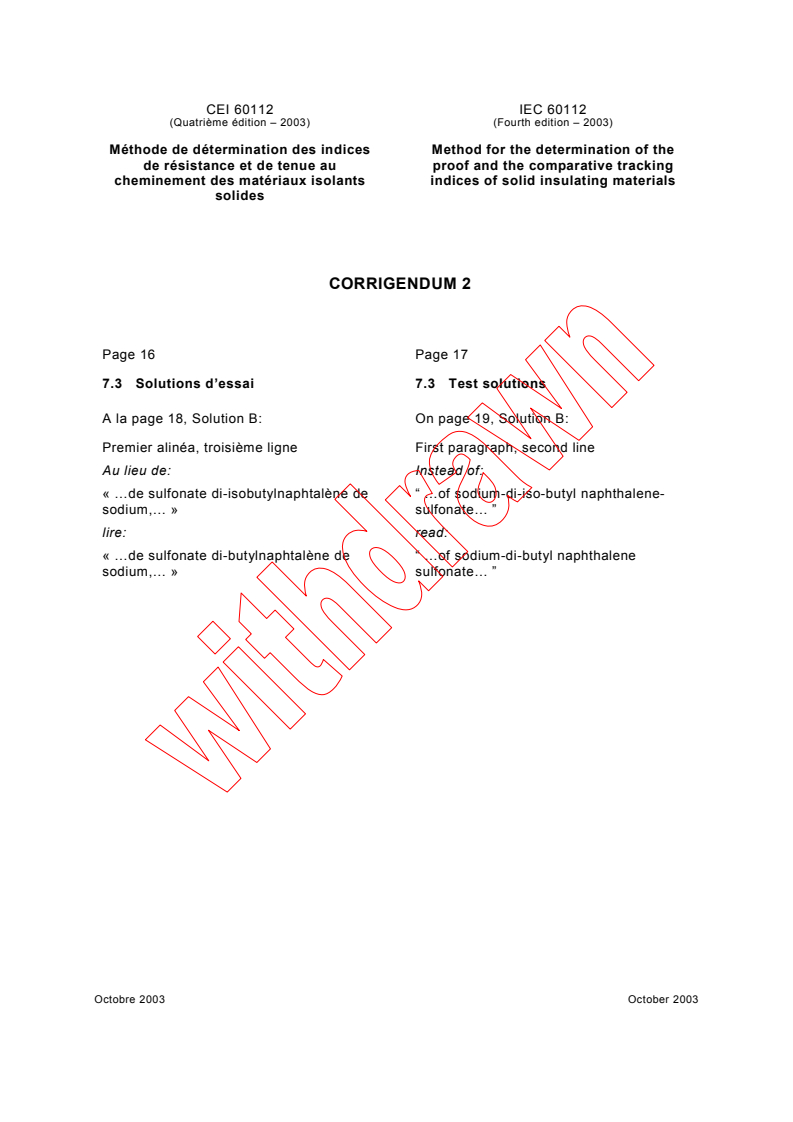
CEI 60112 IEC 60112
(Quatrième édition – 2003) (Fourth edition – 2003)
Méthode de détermination des indices Method for the determination of the
de résistance et de tenue au proof and the comparative tracking
cheminement des matériaux isolants indices of solid insulating materials
solides
CORRIGENDUM 2
Page 16 Page 17
7.3 Solutions d’essai 7.3 Test solutions
A la page 18, Solution
...
This May Also Interest You
IEC 60112:2025 specifies the method of test for the determination of the proof and comparative tracking indices of solid insulating materials on pieces taken from parts of equipment and on plaques of material using alternating voltage. This document provides a procedure for the determination of erosion when required. The proof tracking index is used as an acceptance criterion as well as a means for the quality control of materials and fabricated parts. The comparative tracking index is mainly used for the basic characterization and comparison of the properties of materials. This test method evaluates the composition of the material as well as the surface of the material being evaluated. Both the composition and surface condition directly influence the results of the evaluation and are considered when using the results in material selection process. The described test method is designed for a test voltage up to 600 V AC, because higher test voltages and DC voltage will lead to a reduced test severity. Test results are not directly suitable for the evaluation of safe creepage distances when designing electrical apparatus. The results of this method have been used for insulation coordination of equipment. It is important that use of these results also considers the overvoltage levels, creepage distances, and establishes the pollution degree to which the product insulation system will be expected to be subjected. This is in compliance with IEC 60664-1. This basic safety publication focusing on a safety test method is primarily intended for use by technical committees in the preparation of safety publications in accordance with the principles laid down in IEC Guide 104 and lSO/lEC Guide 51. One of the responsibilities of a technical committee is, wherever applicable, to make use of basic safety publications in the preparation of its publications. This sixth edition cancels and replaces the fifth edition published in 2020. This edition constitutes a technical revision.
This edition includes the following significant technical changes with respect to the previous edition:
- In 7.3, the term "resistivity" has been replaced by "conductivity".
It has the status of a basic safety publication in accordance with IEC Guide 104.
- Standard67 pagesEnglish languagesale 15% off
IEC 60112:2020 specifies the method of test for the determination of the proof and comparative tracking indices of solid insulating materials on pieces taken from parts of equipment and on plaques of material using alternating voltage. This document provides a procedure for the determination of erosion when required.
This test method evaluates the composition of the material as well as the surface of the material being evaluated. Both the composition and surface condition directly influence the results of the evaluation and are considered when using the results in material selection process.
Test results are not directly suitable for the evaluation of safe creepage distances when designing electrical apparatus.
This basic safety publication focusing on a safety test method is primarily intended for use by technical committees in the preparation of safety publications in accordance with the principles laid down in IEC Guide 104 and lSO/lEC Guide 51.
This edition includes the following significant technical changes with respect to the previous edition:
Introduction of a new contaminant, solution C with a surfactant aligned with the test method of IEC 60587. The definition of the solution B was transferred to Annex B for backward reference.
Introduction of a screening test, considering the fact that some materials can withstand high test voltages, but fail at lower test voltages.
It has the status of a basic safety publication in accordance with IEC Guide 104.
- Standard27 pagesEnglish languagesale 15% off
- Standard45 pagesEnglish and French languagesale 15% off
IEC 60112:2003+A1:2009 Specifies the method of test for the determination of the proof and comparative tracking indices of solidinsulating materials on pieces taken from parts of equipment and on plaques of material using alternating voltages. The standard provides for the determination of erosion when required. Test results cannot be used directly for the evaluation of safe creepage distances when designing electrical apparatus. Has the status of a basic safety publication in accordance with IEC Guide 104. Major changes since the previous edition are the following: The selection of a material for a specific application frequently involves compromises in the levels of the individual properties and test criteria. In the previous edition of IEC 60112 the test criteria required "no burning of the specimen", but this gave rise to two issues:
- difficulties in the identification of burning which includes all types of combustion, e.g. flaming, and smouldering in the situation where scintillations had occurred giving rise in many cases to carbon on the surface of the specimen, and
- a situation in which some product committees had found it necessary to dispense with the "no burning" criterion in the tracking tests which they replaced by flame tests on the final product, thereby giving rise to two types of CTI/PTI with different criteria.
The contents of the corrigenda of June 2003 and October 2003 have been included in this copy. This consolidated version consists of the fourth edition (2003) and its amendment 1 (2009). Therefore, no need to order amendment in addition to this publication.
- Standard40 pagesEnglish and French languagesale 15% off
- Standard4 pagesEnglish and French languagesale 15% off
Corrigendum 1
- Standard10 pagesEnglish and French languagesale 15% off
Specifies the method of test for the determination of the proof and comparative tracking indices of solid insulating materials on pieces taken from parts of equipment and on plaques of material using alternating voltages. The standard provides for the determination of erosion when required. Test results cannot be used directly for the evaluation of safe creepage distances when designing electrical apparatus. Major changes since the previous edition are the following: The selection of a material for a specific application frequently involves compromises in the levels of the individual properties and test criteria. In the previous edition of IEC 60112 the test criteria required "no burning of the specimen", but this gave rise to two issues:
- difficulties in the identification of burning which includes all types of combustion, e.g. flaming, and smouldering in the situation where scintillations had occurred giving rise in many cases to carbon on the surface of the specimen, and
- a situation in which some product committees had found it necessary to dispense with the "no burning" criterion in the tracking tests which they replaced by flame tests on the final product, thereby giving rise to two types of CTI/PTI with different criteria.
The contents of the corrigenda of June 2003 and October 2003 have been included in this copy.
- Standard21 pagesEnglish languagesale 15% off
- Standard21 pagesFrench languagesale 15% off
- Standard39 pagesEnglish and French languagesale 15% off
- Standard40 pagesEnglish and French languagesale 15% off
IEC TR 61169-1-8:2025 provides a test method for voltage standing wave ratio (VSWR, hereinafter) of single RF connector by double-connector method. This document is applicable to single RF cable connectors and single microstrip RF connectors as well as single adapters if an estimation of the VSWR of a single completely installed RF-connector is used and a time domain feature is not available on the vector network analyzer.
- Technical report18 pagesEnglish languagesale 15% off
IEC 62541-100:2025 defines the information model associated with Devices. This document describes three models which build upon each other as follows:
• The (base) Device Model is intended to provide a unified view of devices and their hardware and software parts irrespective of the underlying device protocols.
• The Device Communication Model adds Network and Connection information elements so that communication topologies can be created.
• The Device Integration Host Model finally adds additional elements and rules required for host systems to manage integration for a complete system. It enables reflecting the topology of the automation system with the devices as well as the connecting communication networks.
This document also defines AddIns that can be used for the models in this document but also for models in other information models. They are:
• Locking model – a generic AddIn to control concurrent access,
• Software update model – an AddIn to manage software in a Device.
This second edition cancels and replaces the first edition published in 2015. This edition constitutes a technical revision.
This edition includes the following significant technical changes with respect to the previous edition:
a a ComponentType that can be used to model any HW or SW element of a device has been defined and a SoftwareType has been added as subtype of ComponentType;
b the new OPC UA interface concept and defined interfaces for Nameplate, DeviceHealth, and SupportInfo has been added.
c) a new model for Software Update (Firmware Update) has been added;
d) a new entry point for documents where each document is represented by a FileType instance has been specified;
e) a model that provides information about the lifetime, related limits and semantic of the lifetime of things like tools, material or machines has been added.
- Standard152 pagesEnglish languagesale 15% off
- Standard158 pagesFrench languagesale 15% off
- Standard310 pagesEnglish and French languagesale 15% off
IEC 63522-4:2025 is used for testing along with the appropriate severities and conditions for measurements and tests designed to assess the ability of DUTs to perform under expected conditions of transportation, storage and all aspects of operational use.
The object of this test is to define a standard test method for the dielectric strength test.
- Standard10 pagesEnglish languagesale 15% off
- Standard10 pagesFrench languagesale 15% off
- Standard20 pagesEnglish and French languagesale 15% off
IEC TS 63414:2025 is applicable for the determination of the AC and DC pollution flashover and withstand voltage characteristics of insulators with polymeric housing, to be used outdoors in HV applications and exposed to polluted environments. This is also applicable for insulators with hydrophobic coatings. This document refers to AC systems with a rated voltage greater than 1 000 V and DC systems with a rated voltage greater than 1 500 V.
The object of this technical specification is to prescribe standardized test methods, requirements and procedures for artificial pollution tests applicable to polymeric insulators for overhead lines including traction lines, station post and hollow insulators of equipment. Available test experience with polymeric station post and hollow insulators, especially for DC applications, is limited.
The proposed tests are not applicable to ceramic and glass insulators without polymeric housing, to greased insulators or to special types of insulators (e.g., insulators with semiconducting glaze).
Differently to ceramic and glass insulators without polymeric housing:
- The pollution performance of insulators with polymeric housing varies with the hydrophobicity condition of the surface. The specific conditions simulated by standardized tests might not represent the actual dynamic field conditions.
- The determination of the flashover and/or withstand voltage under pollution conditions is not enough for dimensioning. Additional constraints related to possible ageing are also to be considered.
- If the Hydrophobicity Transfer Material (HTM) test according to IEC TR 62039 confirms that an insulator is non-HTM, it can be tested according to IEC 60507 or IEC TS 61245.
- Technical specification39 pagesEnglish languagesale 15% off


Questions, Comments and Discussion
Ask us and Technical Secretary will try to provide an answer. You can facilitate discussion about the standard in here.
Loading comments...