


IEC 61280-2-3:2009
(Main)Fibre optic communication subsystem tets procedures - Part 2-3: Digital systems - Jitter and wander measurements
General Information
- Abstract
IEC 61280-2-3:2009 specifies methods for the measurement of the jitter and wander parameters associated with the transmission and handling of digital signals.
- Status
- Published
- Publication Date
- 13-Jul-2009
- Technical Committee
- SC 86C - Fibre optic systems, sensing and active devices
- Drafting Committee
- WG 1 - TC 86/SC 86C/WG 1
- Current Stage
- PPUB - Publication issued
- Start Date
- 14-Jul-2009
- Completion Date
- 15-Aug-2009
Buy Documents
IEC 61280-2-3:2009 - Fibre optic communication subsystem tets procedures - Part 2-3: Digital systems - Jitter and wander measurements Released:7/14/2009
IEC 61280-2-3:2009 - Fibre optic communication subsystem tets procedures - Part 2-3: Digital systems - Jitter and wander measurements Released:7/14/2009
Overview
IEC 61280-2-3:2009 is an international standard developed by the International Electrotechnical Commission (IEC). It specifies standardized test procedures for measuring jitter and wander in digital fibre optic communication subsystems. These measurements are essential for ensuring the reliable performance of fibre optic digital transmission systems, which are increasingly integral to modern telecommunications networks.
Jitter refers to the short-term variations in the timing of a digital signal, while wander involves long-term timing fluctuations. Both phenomena can impact data integrity, system synchronization, and overall network quality. This standard establishes repeatable methods to assess, characterize, and quantify these parameters under specified conditions.
Key Topics
IEC 61280-2-3:2009 covers a comprehensive range of parameters and measurement techniques related to the performance of digital fibre optic links:
Jitter Measurements
- Jitter tolerance (sinusoidal and stressed eye methods)
- Jitter transfer function
- Output jitter
- Systematic jitter
- Jitter separation
Wander Measurements
- Non-synchronized wander
- TDEV (Time Deviation) tolerance and transfer
- Synchronized wander
Related Definitions and Concepts
- Jitter amplitude and frequency
- Unit interval (UI)
- Bit error ratio (BER)
- Duty cycle distortion
- Data-dependent jitter and inter-symbol interference
- Timing jitter versus alignment jitter
Testing Procedures and Equipment
- General test configurations for the measurements
- Safety considerations and equipment requirements
Applications
Implementing IEC 61280-2-3:2009 brings practical value to fibre optic system designers, manufacturers, and operators:
Performance Verification
- Ensures digital optical subsystems meet required performance thresholds for jitter and wander, reducing the risk of transmission errors and data loss.
Quality Assurance
- Supports quality control processes in production and system integration by providing consistent, repeatable measurement methods.
Network Reliability
- Identifies sources of signal degradation, supporting preventative maintenance and rapid troubleshooting in deployed networks.
Equipment Design and Specification
- Informs the design and specification of receivers, transmitters, and regenerators to tolerate expected jitter and wander levels, improving interoperability across vendors.
Compliance and Certification
- Helps organizations demonstrate conformity with international standards, supporting global trade and regulatory approvals.
These applications are particularly critical for sectors such as telecommunications, data centers, broadcasting, and any environment relying on high-speed, high-integrity optical communication networks.
Related Standards
Ensuring comprehensive system performance and safety may require referencing additional standards alongside IEC 61280-2-3:2009, including:
- IEC 60825-1: Safety of laser products - Key for ensuring safe operation during subsystem testing.
- ITU-T Recommendation G.813: Timing characteristics of SDH equipment slave clocks.
- IEC 61931: Relevant for terminology and additional definitions in fibre optic components and systems.
- Other IEC 61280 Series Standards: For test procedures covering optical power, loss, and other subsystem characteristics.
For detailed implementation and updates, consult the IEC webstore or your national standards body to ensure the latest editions are referenced.
By following IEC 61280-2-3:2009, fibre optic communications professionals can achieve accurate jitter and wander measurements, supporting robust system performance and interoperable global networks.
Relations
- Effective Date
- 05-Sep-2023
Buy Documents
IEC 61280-2-3:2009 - Fibre optic communication subsystem tets procedures - Part 2-3: Digital systems - Jitter and wander measurements Released:7/14/2009
IEC 61280-2-3:2009 - Fibre optic communication subsystem tets procedures - Part 2-3: Digital systems - Jitter and wander measurements Released:7/14/2009
Get Certified
Connect with accredited certification bodies for this standard

ANCE
Mexican certification and testing association.

Intertek Slovenia
Intertek testing, inspection, and certification services in Slovenia.

LNE (Laboratoire National de Métrologie et d'Essais)
French national laboratory for metrology and testing.
Sponsored listings
Frequently Asked Questions
IEC 61280-2-3:2009 is a standard published by the International Electrotechnical Commission (IEC). Its full title is "Fibre optic communication subsystem tets procedures - Part 2-3: Digital systems - Jitter and wander measurements". This standard covers: IEC 61280-2-3:2009 specifies methods for the measurement of the jitter and wander parameters associated with the transmission and handling of digital signals.
IEC 61280-2-3:2009 specifies methods for the measurement of the jitter and wander parameters associated with the transmission and handling of digital signals.
IEC 61280-2-3:2009 is classified under the following ICS (International Classification for Standards) categories: 33.180.01 - Fibre optic systems in general. The ICS classification helps identify the subject area and facilitates finding related standards.
IEC 61280-2-3:2009 has the following relationships with other standards: It is inter standard links to IEC 61280-2-5:1998. Understanding these relationships helps ensure you are using the most current and applicable version of the standard.
IEC 61280-2-3:2009 is available in PDF format for immediate download after purchase. The document can be added to your cart and obtained through the secure checkout process. Digital delivery ensures instant access to the complete standard document.
Standards Content (Sample)
IEC 61280-2-3 ®
Edition 1.0 2009-07
INTERNATIONAL
STANDARD
Fibre optic communication subsystem test procedures –
Part 2-3: Digital systems – Jitter and wander measurements
All rights reserved. Unless otherwise specified, no part of this publication may be reproduced or utilized in any form
or by any means, electronic or mechanical, including photocopying and microfilm, without permission in writing from
either IEC or IEC's member National Committee in the country of the requester.
If you have any questions about IEC copyright or have an enquiry about obtaining additional rights to this publication,
please contact the address below or your local IEC member National Committee for further information.
IEC Central Office
3, rue de Varembé
CH-1211 Geneva 20
Switzerland
Email: inmail@iec.ch
Web: www.iec.ch
About the IEC
The International Electrotechnical Commission (IEC) is the leading global organization that prepares and publishes
International Standards for all electrical, electronic and related technologies.
About IEC publications
The technical content of IEC publications is kept under constant review by the IEC. Please make sure that you have the
latest edition, a corrigenda or an amendment might have been published.
ƒ Catalogue of IEC publications: www.iec.ch/searchpub
The IEC on-line Catalogue enables you to search by a variety of criteria (reference number, text, technical committee,…).
It also gives information on projects, withdrawn and replaced publications.
ƒ IEC Just Published: www.iec.ch/online_news/justpub
Stay up to date on all new IEC publications. Just Published details twice a month all new publications released. Available
on-line and also by email.
ƒ Electropedia: www.electropedia.org
The world's leading online dictionary of electronic and electrical terms containing more than 20 000 terms and definitions
in English and French, with equivalent terms in additional languages. Also known as the International Electrotechnical
Vocabulary online.
ƒ Customer Service Centre: www.iec.ch/webstore/custserv
If you wish to give us your feedback on this publication or need further assistance, please visit the Customer Service
Centre FAQ or contact us:
Email: csc@iec.ch
Tel.: +41 22 919 02 11
Fax: +41 22 919 03 00
IEC 61280-2-3 ®
Edition 1.0 2009-07
INTERNATIONAL
STANDARD
Fibre optic communication subsystem test procedures –
Part 2-3: Digital systems – Jitter and wander measurements
INTERNATIONAL
ELECTROTECHNICAL
COMMISSION
PRICE CODE
W
ICS 33.180.01 ISBN 978-2-88910-475-8
– 2 – 61280-2-3 © IEC:2009(E)
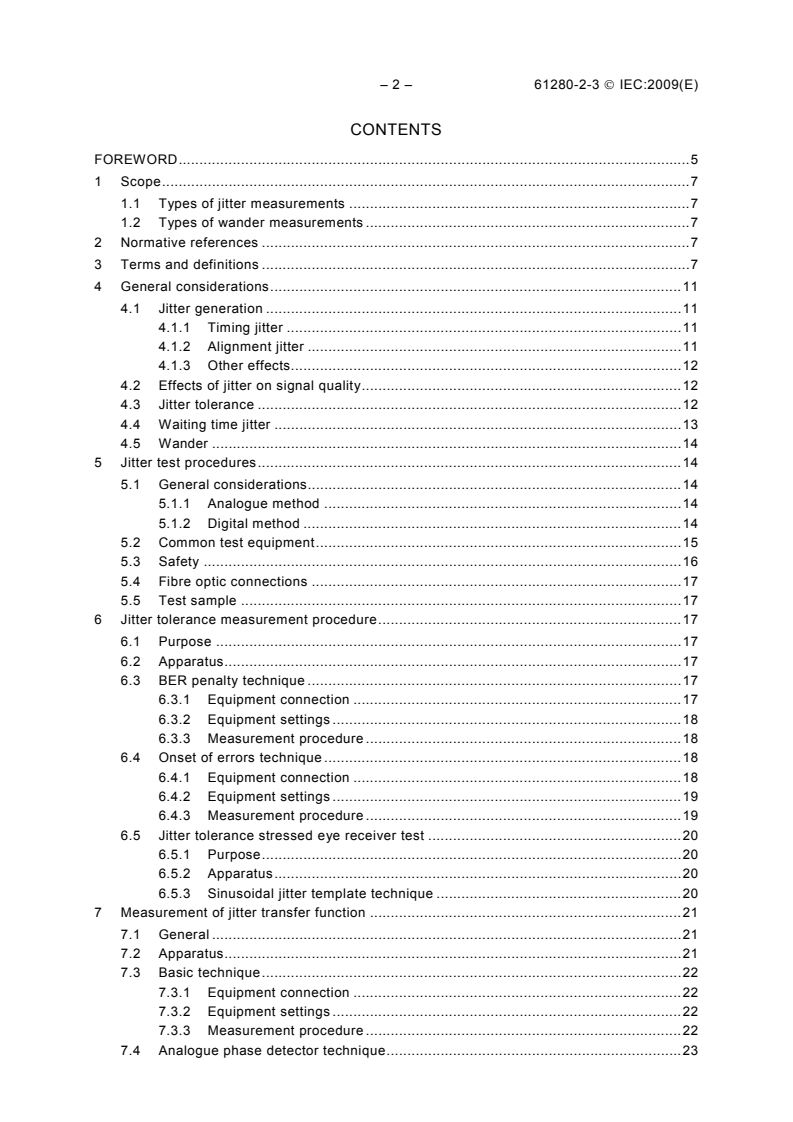
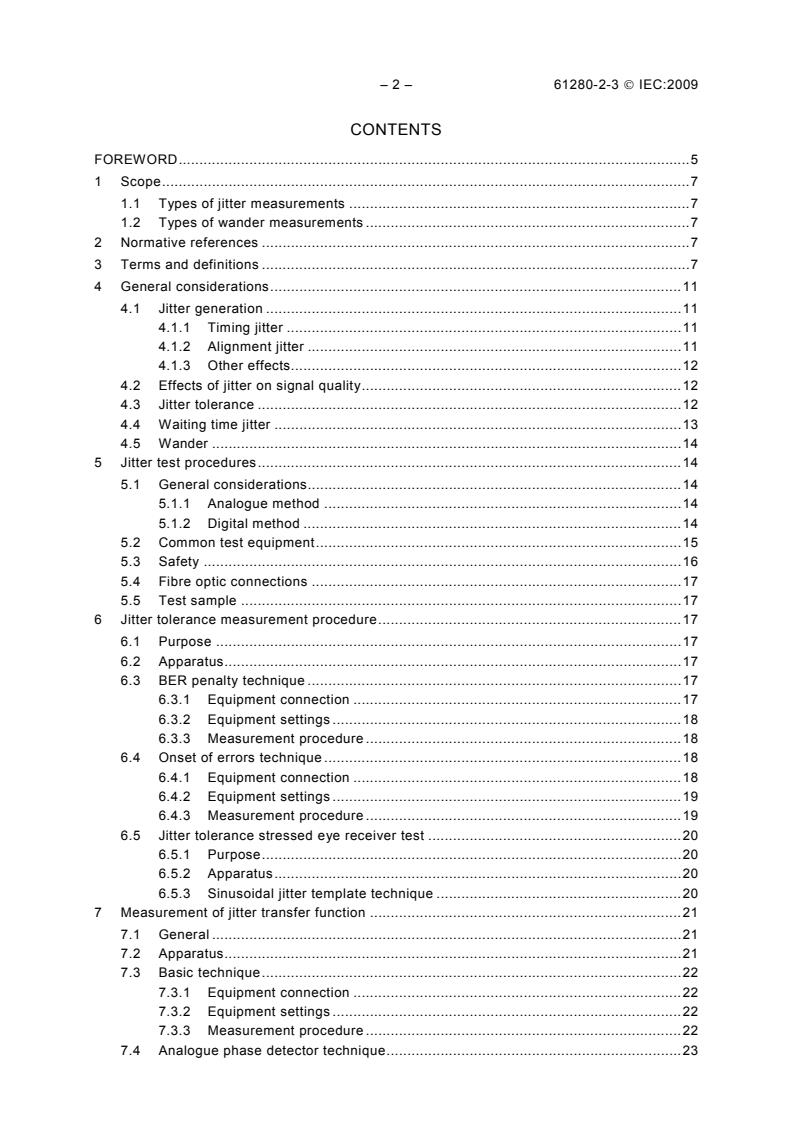
CONTENTS
FOREWORD.5
1 Scope.7
1.1 Types of jitter measurements .7
1.2 Types of wander measurements .7
2 Normative references .7
3 Terms and definitions .7
4 General considerations.11
4.1 Jitter generation .11
4.1.1 Timing jitter .11
4.1.2 Alignment jitter .11
4.1.3 Other effects.12
4.2 Effects of jitter on signal quality.12
4.3 Jitter tolerance .12
4.4 Waiting time jitter .13
4.5 Wander .14
5 Jitter test procedures.14
5.1 General considerations.14
5.1.1 Analogue method .14
5.1.2 Digital method .14
5.2 Common test equipment.15
5.3 Safety .16
5.4 Fibre optic connections .17
5.5 Test sample .17
6 Jitter tolerance measurement procedure.17
6.1 Purpose .17
6.2 Apparatus.17
6.3 BER penalty technique .17
6.3.1 Equipment connection .17
6.3.2 Equipment settings .18
6.3.3 Measurement procedure .18
6.4 Onset of errors technique .18
6.4.1 Equipment connection .18
6.4.2 Equipment settings .19
6.4.3 Measurement procedure .19
6.5 Jitter tolerance stressed eye receiver test .20
6.5.1 Purpose.20
6.5.2 Apparatus.20
6.5.3 Sinusoidal jitter template technique .20
7 Measurement of jitter transfer function .21
7.1 General .21
7.2 Apparatus.21
7.3 Basic technique.22
7.3.1 Equipment connection .22
7.3.2 Equipment settings .22
7.3.3 Measurement procedure .22
7.4 Analogue phase detector technique.23
61280-2-3 © IEC:2009(E) – 3 –
7.4.1 Equipment connections.23
7.4.2 Equipment settings .23
7.4.3 Measurement procedure .24
7.4.4 Measurement calculations .24
8 Measurement of output jitter .24
8.1 General .24
8.2 Equipment connection .24
8.2.1 Equipment settings .24
8.2.2 Measurement procedure .24
8.2.3 Controlled data.25
9 Measurement of systematic jitter .25
9.1 Apparatus.25
9.2 Basic technique.25
9.2.1 Equipment connection .25
9.2.2 Equipment settings .26
9.2.3 Measurement procedure .26
10 BERT scan technique .27
10.1 Apparatus.29
10.2 Basic technique.29
10.2.1 Equipment connection .29
10.2.2 Equipment settings .29
10.2.3 Measurement process .29
11 Jitter separation technique .30
11.1 Apparatus.31
11.2 Equipment connections .31
11.3 Equipment settings.31
11.4 Measurement procedure.32
11.4.1 Sampling oscilloscope: .32
11.4.2 Real-time oscilloscope.32
12 Measurement of wander .33
12.1 Apparatus.33
12.2 Basic technique.33
12.2.1 Equipment connection .33
12.2.2 Equipment settings .34
12.2.3 Measurement procedure .35
13 Measurement of wander TDEV tolerance.35
13.1 Intent.35
13.2 Apparatus.35
13.3 Basic technique.35
13.4 Equipment connection .35
13.4.1 Wander TDEV tolerance measurement for the test signal of EUT .35
13.4.2 Wander TDEV tolerance measurement for timing reference signal of
EUT.36
13.5 Equipment settings.36
13.6 Measurement procedure.37
14 Measurement of wander TDEV transfer .37
14.1 Apparatus.37
14.2 Equipment connection .37
– 4 – 61280-2-3 © IEC:2009(E)
14.2.1 Wander TDEV transfer measurement for the test signal of EUT .37
14.2.2 Wander TDEV transfer measurement for timing reference signal of
EUT.37
14.3 Equipment settings.38
14.4 Measurement procedure.38
15 Test results .38
15.1 Mandatory information.38
15.2 Available information.39
Bibliography.40
Figure 1 – Jitter generation .11
Figure 2 – Example of jitter tolerance.13
Figure 3 – Jitter and wander generator .15
Figure 4 – Jitter and wander measurement .16
Figure 5 – Jitter stress generator .16
Figure 6 – Jitter tolerance measurement configuration: bit error ratio (BER) penalty
technique.18
Figure 7 – Jitter tolerance measurement configuration: Onset of errors technique .19
Figure 8 – Equipment configuration for stressed eye tolerance test.20
Figure 9 – Measurement of jitter transfer function: basic technique.22
Figure 10 – Measurement of Jitter transfer: analogue phase detector technique .23
Figure 11 – Output jitter measurement .25
Figure 12 – Systematic jitter measurement configuration: basic technique .26
Figure 13 – Measurement of the pattern-dependent phase sequence xi .27
Figure 14 – BERT scan bathtub curves (solid line for low jitter, dashed line for high
jitter).28
Figure 15 – Equipment setup for the BERT scan.29
Figure 16 – Dual Dirac jitter model.31
Figure 17 – Equipment setup for jitter separation measurement.31
Figure 18 – Measurement of time interval error.32
Figure 19 – Synchronized wander measurement configuration.34
Figure 20 – Non-synchronized wander measurement configuration .34
Figure 21 – Wander TDEV tolerance measurement configuration for the test signal of
EUT .36
Figure 22 – Wander TDEV tolerance measurement configuration for the timing signal
of EUT .36
Figure 23 – Wander TDEV transfer measurement configuration for the test signal of
EUT .37
Figure 24 – Wander TDEV transfer measurement configuration for the timing signal of
EUT .38
61280-2-3 © IEC:2009(E) – 5 –
INTERNATIONAL ELECTROTECHNICAL COMMISSION
____________
FIBRE OPTIC COMMUNICATION SUBSYSTEM
TEST PROCEDURES –
Part 2-3: Digital systems –
Jitter and wander measurements
FOREWORD
1) The IEC (International Electrotechnical Commission) is a worldwide organization for standardization comprising
all national electrotechnical committees (IEC National Committees). The object of the IEC is to promote
international co-operation on all questions concerning standardization in the electrical and electronic fields. To
this end and in addition to other activities, the IEC publishes International Standards, Technical Specifications,
Technical Reports, Publicly Available Specifications (PAS) and Guides (hereafter referred to as “IEC
Publication(s)”). Their preparation is entrusted to technical committees; any IEC National Committee interested
in the subject dealt with may participate in this preparatory work. International, governmental and non-
governmental organizations liaising with the IEC also participate in this preparation. The IEC collaborates
closely with the International Organization for Standardization (ISO) in accordance with conditions determined
by agreement between the two organizations.
2) The formal decisions or agreements of the IEC on technical matters express, as nearly as possible, an
international consensus of opinion on the relevant subjects since each technical committee has representation
from all interested National Committees.
3) IEC Publications have the form of recommendations for international use and are accepted by IEC National
Committees in that sense. While all reasonable efforts are made to ensure that the technical content of IEC
Publications is accurate, IEC cannot be held responsible for the way in which they are used or for any
misinterpretation by any end user.
4) In order to promote international unification, IEC National Committees undertake to apply IEC International
Standards transparently to the maximum extent possible in their national and regional standards. Any
divergence between the IEC Standard and the corresponding national or regional standard shall be clearly
indicated in the latter.
5) The IEC provides no marking procedure to indicate its approval and cannot be rendered responsible for any
equipment declared to be in conformity with one of its standards.
6) All users should ensure that they have the latest edition of this publication.
7) No liability shall attach to IEC or its directors, employees, servants or agents including individual experts and
members of its technical committees and IEC National Committees for any personal injury, property damage or
other damage of any nature whatsoever, whether direct or indirect, or for costs (including legal fees) and
expenses arising out of the publication, use of, or reliance upon, this IEC Publication or any other IEC
Publications.
8) Attention is drawn to the Normative references cited in this publication. Use of the referenced publications is
indispensable for the correct application of this publication.
9) Attention is drawn to the possibility that some of the elements of this IEC Publication may be the subject of
patent rights. IEC shall not be held responsible for identifying any or all such patent rights.
International Standard IEC 61280-2-3 has been prepared by subcommittee 86C: Fibre optic
systems and active devices, of IEC technical committee 86: Fibre optics.
The text of this standard is based on the following documents:
FDIS Report on voting
86C/885/FDIS 86C/905/RVD
Full information on the voting for the approval of this standard can be found in the report on
voting indicated in the above table.
A list of all parts of the IEC 61280-2 series, published under the general title Fibre optic
communication subsystem test procedures – Digital systems, can be found on the IEC
website.
– 6 – 61280-2-3 © IEC:2009(E)
The committee has decided that the contents of this publication will remain unchanged until
the maintenance result date indicated on the IEC web site under "http://webstore.iec.ch" in
the data related to the specific publication. At this date, the publication will be
• reconfirmed;
• withdrawn;
• replaced by a revised edition, or
• amended.
A bilingual version may be published at a later date.
61280-2-3 © IEC:2009(E) – 7 –
FIBRE OPTIC COMMUNICATION SUBSYSTEM
TEST PROCEDURES –
Part 2-3: Digital systems –
Jitter and wander measurements
1 Scope
This part of IEC 61280 specifies methods for the measurement of the jitter and wander
parameters associated with the transmission and handling of digital signals.
1.1 Types of jitter measurements
This standard covers the measurement of the following types of jitter parameters:
a) jitter tolerance
1) sinusoidal method
2) stressed eye method
b) jitter transfer function
c) output jitter
d) systematic jitter
e) jitter separation
1.2 Types of wander measurements
This standard covers the measurement of the following types of wander parameters:
a) non-synchronized wander
b) TDEV tolerance
c) TDEV transfer
d) synchronized wander
2 Normative references
The following referenced documents are indispensable for the application of this document.
For dated references, only the edition cited applies. For undated references, the latest edition
of the referenced document (including any amendments) applies.
IEC 60825-1, Safety of laser products – Part 1: Equipment classification and requirements
ITU-T Recommendation G.813, Timing characteristics of SDH equipment slave clocks (SEC)
3 Terms and definitions
For the purposes of this document, the following terms and definitions apply.
NOTE See also IEC 61931.
– 8 – 61280-2-3 © IEC:2009(E)
3.1
jitter
the short-term, non-cumulative, variation in time of the significant instances of a digital signal
from their ideal position in time. Short-term variations in this context are jitter components
with a repetition frequency equal to or exceeding 10 Hz
3.2
jitter amplitude
the deviation of the significant instance of a digital signal from its ideal position in time
NOTE For the purposes of this standard the jitter amplitude is expressed in terms of the unit interval (UI). It is
recognized that jitter amplitude may also be expressed in units of time.
3.3
unit interval (UI)
the shortest interval between two equivalent instances in ideal positions in time. In practice
this is equivalent to the ideal timing period of the digital signal
3.4
jitter frequency
the rate of variation in time of the significant instances of a digital signal relative to their ideal
position in time. Jitter frequency is expressed in Hertz (Hz)
3.5
jitter bandwidth
the jitter frequency at which the jitter amplitude has decreased by 3dB relative to its maximum
value
3.6
alignment jitter
jitter created when the timing of a data signal is recovered from the signal itself
3.7
timing jitter
jitter present on a timing source
3.8
systematic jitter
jitter components which are not random and have a predictable rate of occurrence.
Systematic jitter in a digital signal results from regularly recurring features in the digital signal,
such as frame alignment data, and justification control data. This is sometimes referred to as
deterministic jitter and is composed of periodic uncorrelated jitter and data dependent jitter
3.9
periodic uncorrelated jitter
a form of systematic jitter that occurs at a regular rate, but is uncorrelated to the data when
the data pattern repeats. Periodic uncorrelated jitter will be the same independent of which
edge in a pattern is observed over time. Sources of periodic uncorrelated jitter include
switching power supplies phase modulating reference clocks or any form of periodic phase
modulation of clocks that control data rates
3.10
inter-symbol interference jitter
caused by bandwidth limitations in transmission channels. If the channel bandwidth is low,
signal transitions may not reach full amplitude before transitioning to a different logic state.
Starting at a level closer to the midpoint between logic states, the time at which the signal
edge then crosses a specific amplitude threshold can be early compared to consecutive
identical digits which have reached full amplitude and then switch to the other logic state
61280-2-3 © IEC:2009(E) – 9 –
3.11
duty cycle distortion
occurs when the duration of a logic 1 (0-1-0) is different from the duration of a logic 0 (1-0-1).
For example, if the logic 1 has a longer duration, rising edges will occur early relative to
falling edges, compared to their ideal locations in time
3.12
data dependent jitter
represents jitter that is correlated to specific bits in a repeating data pattern. That is, when a
data pattern repeats, the jitter on any given signal edge will manifest itself in the same way for
any repetition of the pattern. It is due to either duty cycle distortion and/or inter-symbol
interference
3.13
waiting time jitter
applies to plesiochronous multiplexing and is defined as the jitter caused by the varying delay
between the demand for justification and its execution
3.14
jitter tolerance
maximum jitter amplitude that a digital receiver can accept for a given penalty or alternatively
without the addition of a given number of errors to the digital signal. The maximum jitter
amplitude tolerated is generally dependent on the frequency of the jitter
3.15
jitter generation
process of adding jitter impairment to a data signal
3.16
input jitter
magnitude of the jitter occurring at a hierarchical interface or the input port of equipment or a
device
3.17
output jitter
magnitude of the jitter occurring at a hierarchical interface or the output port of equipment or a
device
3.18
jitter transfer
amount of jitter transferred from the input to the output of an equipment or device. It is usually
expressed as a ratio (in dB) of the output jitter to the input jitter
3.19
total jitter
the summation (or convolution) of deterministic and random jitter. Total jitter is expressed as
a peak value
3.20
jitter bathtub curve
display of bit-error-ratio as a function of the time location of the BERT error detector sampling
point. The resulting curve is then a display of the probability that a data edge will be
misplaced at or beyond a specific location (closer to the centre of a bit) within a unit interval
3.21
wander
long-term, non-cumulative, variation in time of the significant instances of a digital signal from
their ideal position in time. Long-term variations in this context are jitter components with a
repetition frequency less than 10 Hz
– 10 – 61280-2-3 © IEC:2009(E)
NOTE For the purpose of this document, the wander amplitude is expressed in units of time (s). It is recognised
that wander amplitude may also be expressed in terms of unit interval (UI).
3.22
time interval error
TIE
difference between the measure of a time interval as provided by a clock and the measure of
that same time interval as provided by a reference clock. Mathematically, the time interval
error function TIE (t;τ) can be expressed as:
TIE(t;τ ) =[]T()t + τ −T(t) −[Tref (t + τ ) −Tref (t)] = x(t + τ ) − x(t) (1)
where τ is the time interval, usually called observation interval
3.23
maximum time interval error
MTIE
maximum peak-to-peak delay variation of a given timing signal with respect to an ideal timing
signal within an observation time (τ = nτ ) for all observation times of that length within the
measurement period (T). It is estimated using the following formula:
⎤
⎡
⎥
MTIE(nτ ) ≅ ⎢ − n = 1,2KN − 1 (2)
max maxx minx
i i
⎥
⎢
1≤k≤N −n⎣k≤i≤k+n k≤i≤k+n
⎥
⎦
3.24
time deviation
TDEV or σx
measure of the expected time variation of a signal as a function of integration time. TDEV can
also provide information about the spectral content of the phase (or time) noise of a signal.
TDEV is in units of time. Based on the sequence of time error samples, TDEV is estimated
using the following calculation:
N−3n+1 n+ j−1
⎡ ⎤
1 ⎛ N⎞
⎢ ⎥
TDEV()nτ ≅ ( − 2 + ) n = 1,2K,int part⎜ ⎟
(3)
∑ ∑
x x x
2 i+2n i+n i
⎢ ⎥ 3
6n (N − 3n + 1) ⎝ ⎠
j=1 i=j
⎣ ⎦
where
x denotes time error samples;
i
N denotes the total number of samples;
τ denotes the time error-sampling interval;
τ denotes the integration time, the independent variable of TDEV;
n denotes the number of sampling intervals within the integration time t.
3.25
bit error ratio
BER
number of bits received in error as a ratio of the total number of bits received
3.26
errored second
time of 1 s duration that contains one or more digital errors in a data stream
61280-2-3 © IEC:2009(E) – 11 –
4 General considerations
4.1 Jitter generation
Jitter in a digital signal is generated by three basic processes which are briefly described
below. The mathematical analysis of the jitter processes is complex and not within the scope
of this standard. A comprehensive analysis and early mathematical treatise of the jitter
processes is provided by [1] .
4.1.1 Timing jitter
Jitter impairment of the original data timing clock. Even the most stable timing sources
contain a certain amount of jitter, or unintended phase modulation or phase noise. In primary
timing generators this impairment is exceedingly small, but is increased when such timing
signals are distributed in a system. The effect of noise on the timing signal in a digital system
is demonstrated in an exaggerated degree in Figure 1.
Ideal timing
Noise on timing signal
Detection threshold
Timing signal
p- p Jitter amplitude
IEC 1164/09
Figure 1 – Jitter generation
4.1.2 Alignment jitter
When a digital pattern is presented to a timing recovery circuit, the continuous variation of the
digital pattern results in the creation of jitter in the recovered clock signal relative to the
incoming data (alignment jitter). This effect, first analyzed and described in detail by [2] is the
major cause of jitter generation. It means that the jitter components of the recovered clock
signal are added to the data when they are retimed. The jitter bandwidth created by this
process is the same as the analogue bandwidth of the clock recovery circuit used.
When the process is repeated at a similar equipment, the resultant clock signal shows
increased jitter due to the addition of timing and alignment jitter. Thus, jitter is added to the
data signal, and amplified at the next timing recovery operation. A repetition of this process,
such as occurs in transmission links with many repeaters, or chains of add-drop multiplexers,
can build up substantial jitter amplitudes; but as long as the bandwidth of the timing recovery
process is the same or greater than the jitter bandwidth of the signal, the jitter will always be
accommodated. An analysis of the accumulation of jitter in successive timing recovery
operations was first published by [3]. The jitter buildup can be represented by an equation of
the form:
—————————
Figures in square brackets refer to the Bibliography.
– 12 – 61280-2-3 © IEC:2009(E)
k
n
⎛ 1 ⎞
θn = θ (jω)⎜ ⎟ (4)
∑ 0
⎜ ⎟
1+ j ω / B
⎝ ⎠
k=1
The above equation yields a jitter power density spectrum which can be expressed in the
form:
⎡ n ⎤
sin ω
⎢ ⎥
2 2B
φ ≈ n φ for ω<
⎢ ⎥
n 0
n
⎢ ⎥
ω
⎢ ⎥
2B
⎣ ⎦
where
θ denotes the jitter amplitude after n timing recovery processes
n
θ denotes the jitter amplitude introduced at each individual timing recovery process
n denotes the number of tandem timing recovery processes
ω denotes the angular frequency (2πf) of the jitter component
B denotes the half angular bandwidth of the timing recovery circuit
Ф denotes the jitter power density after n timing recovery processes
n
Ф denotes the jitter power density introduced at each individual timing recovery process
It should be noted that for low values of frequency the power density and hence amplitude of
the jitter increases linearly with the number of tandem timing recovery processes.
In point-to-point communications systems, where transmitter timing is not derived from
incoming data, alignment jitter and jitter build-up is not a significant problem.
4.1.3 Other effects
In the course of the transmission of a digital signal, further impairments such as added noise
and dispersion effects provide additional jitter components when timing is recovered from the
signal. Such effects are more severe when analogue amplification is used rather than digital
regeneration in order to increase the length of a digital link.
4.2 Effects of jitter on signal quality
Jitter has no effect on the transmission of data as long as the equipment can accommodate
the jitter amplitude and rate of deviation (see 4.3). When jitter is large enough or fast enough
such that the receiver decision point is made near or beyond a data edge, a mistake can be
made and BER degraded. Jitter, depending on its amplitude and frequency, can also have
serious effects on analogue services such as music and television which have been
transmitted over digital links. The effect of jitter is to introduce unwanted frequency and phase
modulation products which are audible in music and visible on television pictures.
4.3 Jitter tolerance
In telecommunications systems, jitter tolerance requirements are typically specified in terms
of jitter templates, which cover a specified sinusoidal amplitude/frequency region. Jitter
templates represent the minimum amount of jitter the equipment shall be able to accept
without producing the specified degradation of error performance. A typical relationship
between actual jitter tolerance and its associated tolerance template is illustrated in Figure 2.
The jitter amplitudes that equipment actually tolerates at a given frequency are defined as all
amplitudes up to, but not including, that which causes the designated degradation of error
performance. The designated degradation of error performance may be expressed in terms of
either bit-error-ratio (BER) penalty or the onset of errors criteria. The existence of these two
61280-2-3 © IEC:2009(E) – 13 –
criteria arises because the input jitter tolerance of digital equipment is primarily determined by
the following three factors:
a) ability of the input clock recovery circuit to accurately recover the timing from a jittered
data signal, including the presence of other degradations such as pulse distortion,
crosstalk, noise, and other impairments;
b) ability of the input circuit buffer, for example an elastic store, to accommodate the jitter
amplitude;
c) ability of other components to accommodate dynamically varying input data rates such
as pulse justification capacity and synchronizer and de-synchronizer buffer size in an
asynchronous digital multiplex.
Actual jitter tolerance
Operating jitter margin
Template specification
Acceptable region
dB/decade
Unacceptable region
IEC 1165/09
Figure 2 – Example of jitter tolerance
In data communications systems, jitter tolerance is often determined with signal impairments
that are more complex than simple sinusoidal jitter. The general concept is to verify that the
receiver is capable of achieving the desired BER when presented with the allowable signal it
will encounter in a real system. Thus the jitter tolerance test signal will include impairments
that are allowed for both the transmitter and the channel. For example, a real transmitter may
have periodic jitter, random jitter, and duty cycle distortion. As the signal traverses the
channel, it may be further degraded through a bandwidth limited channel, thus adding inter-
symbol interference jitter. As the receiver shall be able to tolerate such a signal in a real
system, the signal used to verify receiver tolerance shall include all of these impairments.
This method of testing is sometimes referred to as “stressed eye” testing, indicating that the
eye diagram of the signal presented to a receiver has been intentionally degraded or
stressed.
4.4 Waiting time jitter
When asynchronous (plesiochronous) signals are multiplexed, a justification technique (also
known as pulse stuffing) is used which involves the comparison of the phase of the incoming
digital signal with the multiplexer’s tributary timing. When a preset difference is detected a
control signal is transmitted, via the overhead in the multiplex frame structure, to the
demultiplexer. In order to ensure the integrity of the control signal in the presence of errors, it
is repeated 3 or 5 times. At the demultiplexer a majority decision is taken to recognize the
– 14 – 61280-2-3 © IEC:2009(E)
control signal. This delay introduces an uncertainty and varying delay in the time between the
demand for justification and its execution at the demultiplexer, and expresses itself as waiting
time jitter.
4.5 Wander
Wander is essentially caused by periodic variations in the delay of a transmission path and
slow variations in the frequency of data clocks. The boundary between jitter and wander at a
frequency of 10 Hz is somewhat artificial since most significant wander effects occur at
repetition rates of hours, days, months and seasons. In general wander is caused by
temperature changes which affect the delays of the transmission medium or equipment. For
terrestrial transmission, wander components are normally limited to a few tens of
nanoseconds.
In synchronous networks the accommodation of wander is an essential feature since a single
bit slip will initiate a resynchronization process with consequent loss of data. If this occurs at
a high level demultiplexer, all lower levels will also resynchronize which will exacerbate the
loss of data. Wander is normally accommodated by increasing the size of the elastic store
used to accommodate jitter.
A special case is the wander effect that occurs in communications via geostationary satellites.
While the lateral position of such satellites is relatively stable, their mean height of some
35 000 km above the earth’s surface has a diurnal variation which may be up to approximately
±1 000 km. This results in delay variations per hop of approximately 26 ms. At a data rate of
150 Mbit/s this represents a wander rate of some 45 bits/s and requires an elastic store with a
capacity of at least 3,9 Mbits to accommodate it in a synchronous network.
5 Jitter test procedures
5.1 General considerations
In order to measure jitter, analogue and digital methods may be used. Both methods rely on
the phase comparison between a recovered timing signal representing the signal to be
measured, or in some cases the signal itself, and a stable clock signal whose frequency
represents the ideal signal. In telecommunications applications, this ideal signal is derived
from the long-term average frequency of the derived timing signal. In order to obtain
meaningful results, the jitter bandwidth of the derived clock shall be significantly less than 10
Hz. In data communications applications, the reference clock is also typically derived from the
signal, but the jitter bandwidth of the derived signal will often be similar to the clock recovery
bandwidth of the receiver for which a transmitter under test will be paired with. In system use,
jitter that is within the loop bandwidth of the receiver is accommodated by the receiver and of
lower concern. In test, jitter that is common to both the reference signal and the signal to be
measured may intentionally not be observed. This facilitates the ability to observe jitter
outside the jitter bandwidth.
5.1.1 Analogue method
The analogue method uses the analogue output from a phase comparison between the
recovered clock and the stable clock which provides a pulse width modulated signal
presentation of the jitter components in terms of amplitude and frequency. This is
subsequently converted into an analogue output which is used to process the results. Like all
analogue measuring techniques, this method requires careful calibration and is highly
dependant on the performance characteristics, including stability, of the phase comparator.
5.1.2 Digital method
5.1.2.1 Derived clock versus narrow jitter bandwidth clock
The digital method uses a very high speed sampling clock to measure the time difference
between the significant instances of the recovered and the derived stable clock signals. The
61280-2-3 © IEC:2009(E) – 15 –
results are then obtained by digital processing of the measured time intervals. This method is
capable of providing essentially accurate results and is naturally suited for measuring
equipment using digital techniques. The main difficulty with this method is to provide a timing
signal with a sufficiently high rate to obtain sufficient resolution.
5.1.2.2 Data edge versus reference or extracted clock
With a reference clock representing the ideal position of data edges, a population of edge
locations relative to ideal is collected. This population is then post-processed to determine the
jitter performance. Deterministic and random jitter contributions can be isolated. Further
processing allows the estimate of the aggregate jitter (total jitter) to extremely low
probabilities without the long measurement time required to make a direct measurement to
low probabilities. This technique is capable of making very accurate measurements and
estimations. The main difficu
...
IEC 61280-2-3 ®
Edition 1.0 2009-07
INTERNATIONAL
STANDARD
NORME
INTERNATIONALE
colour
inside
Fibre optic communication subsystem test procedures –
Part 2-3: Digital systems – Jitter and wander measurements
Procédures d'essai des sous-systèmes de télécommunications à fibres
optiques –
Partie 2-3: Systèmes numériques – Mesures des gigues et des dérapages
All rights reserved. Unless otherwise specified, no part of this publication may be reproduced or utilized in any form or by
any means, electronic or mechanical, including photocopying and microfilm, without permission in writing from either IEC or
IEC's member National Committee in the country of the requester.
If you have any questions about IEC copyright or have an enquiry about obtaining additional rights to this publication,
please contact the address below or your local IEC member National Committee for further information.
Droits de reproduction réservés. Sauf indication contraire, aucune partie de cette publication ne peut être reproduite
ni utilisée sous quelque forme que ce soit et par aucun procédé, électronique ou mécanique, y compris la photocopie
et les microfilms, sans l'accord écrit de la CEI ou du Comité national de la CEI du pays du demandeur.
Si vous avez des questions sur le copyright de la CEI ou si vous désirez obtenir des droits supplémentaires sur cette
publication, utilisez les coordonnées ci-après ou contactez le Comité national de la CEI de votre pays de résidence.
IEC Central Office
3, rue de Varembé
CH-1211 Geneva 20
Switzerland
Email: inmail@iec.ch
Web: www.iec.ch
About the IEC
The International Electrotechnical Commission (IEC) is the leading global organization that prepares and publishes
International Standards for all electrical, electronic and related technologies.
About IEC publications
The technical content of IEC publications is kept under constant review by the IEC. Please make sure that you have the
latest edition, a corrigenda or an amendment might have been published.
ƒ Catalogue of IEC publications: www.iec.ch/searchpub
The IEC on-line Catalogue enables you to search by a variety of criteria (reference number, text, technical committee,…).
It also gives information on projects, withdrawn and replaced publications.
ƒ IEC Just Published: www.iec.ch/online_news/justpub
Stay up to date on all new IEC publications. Just Published details twice a month all new publications released. Available
on-line and also by email.
ƒ Electropedia: www.electropedia.org
The world's leading online dictionary of electronic and electrical terms containing more than 20 000 terms and definitions
in English and French, with equivalent terms in additional languages. Also known as the International Electrotechnical
Vocabulary online.
ƒ Customer Service Centre: www.iec.ch/webstore/custserv
If you wish to give us your feedback on this publication or need further assistance, please visit the Customer Service
Centre FAQ or contact us:
Email: csc@iec.ch
Tel.: +41 22 919 02 11
Fax: +41 22 919 03 00
A propos de la CEI
La Commission Electrotechnique Internationale (CEI) est la première organisation mondiale qui élabore et publie des
normes internationales pour tout ce qui a trait à l'électricité, à l'électronique et aux technologies apparentées.
A propos des publications CEI
Le contenu technique des publications de la CEI est constamment revu. Veuillez vous assurer que vous possédez
l’édition la plus récente, un corrigendum ou amendement peut avoir été publié.
ƒ Catalogue des publications de la CEI: www.iec.ch/searchpub/cur_fut-f.htm
Le Catalogue en-ligne de la CEI vous permet d’effectuer des recherches en utilisant différents critères (numéro de référence,
texte, comité d’études,…). Il donne aussi des informations sur les projets et les publications retirées ou remplacées.
ƒ Just Published CEI: www.iec.ch/online_news/justpub
Restez informé sur les nouvelles publications de la CEI. Just Published détaille deux fois par mois les nouvelles
publications parues. Disponible en-ligne et aussi par email.
ƒ Electropedia: www.electropedia.org
Le premier dictionnaire en ligne au monde de termes électroniques et électriques. Il contient plus de 20 000 termes et
définitions en anglais et en français, ainsi que les termes équivalents dans les langues additionnelles. Egalement appelé
Vocabulaire Electrotechnique International en ligne.
ƒ Service Clients: www.iec.ch/webstore/custserv/custserv_entry-f.htm
Si vous désirez nous donner des commentaires sur cette publication ou si vous avez des questions, visitez le FAQ du
Service clients ou contactez-nous:
Email: csc@iec.ch
Tél.: +41 22 919 02 11
Fax: +41 22 919 03 00
IEC 61280-2-3 ®
Edition 1.0 2009-07
INTERNATIONAL
STANDARD
NORME
INTERNATIONALE
colour
inside
Fibre optic communication subsystem test procedures –
Part 2-3: Digital systems – Jitter and wander measurements
Procédures d'essai des sous-systèmes de télécommunications à fibres
optiques –
Partie 2-3: Systèmes numériques – Mesures des gigues et des dérapages
INTERNATIONAL
ELECTROTECHNICAL
COMMISSION
COMMISSION
ELECTROTECHNIQUE
PRICE CODE
INTERNATIONALE
W
CODE PRIX
ICS 33.180.01 ISBN 978-2-88910-476-5
– 2 – 61280-2-3 © IEC:2009
CONTENTS
FOREWORD.5
1 Scope.7
1.1 Types of jitter measurements .7
1.2 Types of wander measurements .7
2 Normative references .7
3 Terms and definitions .7
4 General considerations.11
4.1 Jitter generation .11
4.1.1 Timing jitter .11
4.1.2 Alignment jitter .11
4.1.3 Other effects.12
4.2 Effects of jitter on signal quality.12
4.3 Jitter tolerance .12
4.4 Waiting time jitter .13
4.5 Wander .14
5 Jitter test procedures.14
5.1 General considerations.14
5.1.1 Analogue method .14
5.1.2 Digital method .14
5.2 Common test equipment.15
5.3 Safety .16
5.4 Fibre optic connections .17
5.5 Test sample .17
6 Jitter tolerance measurement procedure.17
6.1 Purpose .17
6.2 Apparatus.17
6.3 BER penalty technique .17
6.3.1 Equipment connection .17
6.3.2 Equipment settings .18
6.3.3 Measurement procedure .18
6.4 Onset of errors technique .18
6.4.1 Equipment connection .18
6.4.2 Equipment settings .19
6.4.3 Measurement procedure .19
6.5 Jitter tolerance stressed eye receiver test .20
6.5.1 Purpose.20
6.5.2 Apparatus.20
6.5.3 Sinusoidal jitter template technique .20
7 Measurement of jitter transfer function .21
7.1 General .21
7.2 Apparatus.21
7.3 Basic technique.22
7.3.1 Equipment connection .22
7.3.2 Equipment settings .22
7.3.3 Measurement procedure .22
7.4 Analogue phase detector technique.23
61280-2-3 © IEC:2009 – 3 –
7.4.1 Equipment connections.23
7.4.2 Equipment settings .23
7.4.3 Measurement procedure .24
7.4.4 Measurement calculations .24
8 Measurement of output jitter .24
8.1 General .24
8.2 Equipment connection .24
8.2.1 Equipment settings .24
8.2.2 Measurement procedure .24
8.2.3 Controlled data.25
9 Measurement of systematic jitter .25
9.1 Apparatus.25
9.2 Basic technique.25
9.2.1 Equipment connection .25
9.2.2 Equipment settings .26
9.2.3 Measurement procedure .26
10 BERT scan technique .27
10.1 Apparatus.29
10.2 Basic technique.29
10.2.1 Equipment connection .29
10.2.2 Equipment settings .29
10.2.3 Measurement process .29
11 Jitter separation technique .30
11.1 Apparatus.31
11.2 Equipment connections .31
11.3 Equipment settings.31
11.4 Measurement procedure.32
11.4.1 Sampling oscilloscope: .32
11.4.2 Real-time oscilloscope.32
12 Measurement of wander .33
12.1 Apparatus.33
12.2 Basic technique.33
12.2.1 Equipment connection .33
12.2.2 Equipment settings .34
12.2.3 Measurement procedure .35
13 Measurement of wander TDEV tolerance.35
13.1 Intent.35
13.2 Apparatus.35
13.3 Basic technique.35
13.4 Equipment connection .35
13.4.1 Wander TDEV tolerance measurement for the test signal of EUT .35
13.4.2 Wander TDEV tolerance measurement for timing reference signal of
EUT.36
13.5 Equipment settings.36
13.6 Measurement procedure.37
14 Measurement of wander TDEV transfer .37
14.1 Apparatus.37
14.2 Equipment connection .37
– 4 – 61280-2-3 © IEC:2009
14.2.1 Wander TDEV transfer measurement for the test signal of EUT .37
14.2.2 Wander TDEV transfer measurement for timing reference signal of
EUT.37
14.3 Equipment settings.38
14.4 Measurement procedure.38
15 Test results .38
15.1 Mandatory information.38
15.2 Available information.39
Bibliography.40
Figure 1 – Jitter generation .11
Figure 2 – Example of jitter tolerance.13
Figure 3 – Jitter and wander generator .15
Figure 4 – Jitter and wander measurement .16
Figure 5 – Jitter stress generator .16
Figure 6 – Jitter tolerance measurement configuration: bit error ratio (BER) penalty
technique.18
Figure 7 – Jitter tolerance measurement configuration: Onset of errors technique .19
Figure 8 – Equipment configuration for stressed eye tolerance test.20
Figure 9 – Measurement of jitter transfer function: basic technique.22
Figure 10 – Measurement of Jitter transfer: analogue phase detector technique .23
Figure 11 – Output jitter measurement .25
Figure 12 – Systematic jitter measurement configuration: basic technique .26
Figure 13 – Measurement of the pattern-dependent phase sequence xi .27
Figure 14 – BERT scan bathtub curves (solid line for low jitter, dashed line for high
jitter).28
Figure 15 – Equipment setup for the BERT scan.29
Figure 16 – Dual Dirac jitter model.31
Figure 17 – Equipment setup for jitter separation measurement.31
Figure 18 – Measurement of time interval error.32
Figure 19 – Synchronized wander measurement configuration.34
Figure 20 – Non-synchronized wander measurement configuration .34
Figure 21 – Wander TDEV tolerance measurement configuration for the test signal of
EUT .36
Figure 22 – Wander TDEV tolerance measurement configuration for the timing signal
of EUT .36
Figure 23 – Wander TDEV transfer measurement configuration for the test signal of
EUT .37
Figure 24 – Wander TDEV transfer measurement configuration for the timing signal of
EUT .38
61280-2-3 © IEC:2009 – 5 –
INTERNATIONAL ELECTROTECHNICAL COMMISSION
____________
FIBRE OPTIC COMMUNICATION SUBSYSTEM
TEST PROCEDURES –
Part 2-3: Digital systems –
Jitter and wander measurements
FOREWORD
1) The International Electrotechnical Commission (IEC) is a worldwide organization for standardization comprising
all national electrotechnical committees (IEC National Committees). The object of IEC is to promote
international co-operation on all questions concerning standardization in the electrical and electronic fields. To
this end and in addition to other activities, IEC publishes International Standards, Technical Specifications,
Technical Reports, Publicly Available Specifications (PAS) and Guides (hereafter referred to as “IEC
Publication(s)”). Their preparation is entrusted to technical committees; any IEC National Committee interested
in the subject dealt with may participate in this preparatory work. International, governmental and non-
governmental organizations liaising with the IEC also participate in this preparation. IEC collaborates closely
with the International Organization for Standardization (ISO) in accordance with conditions determined by
agreement between the two organizations.
2) The formal decisions or agreements of IEC on technical matters express, as nearly as possible, an international
consensus of opinion on the relevant subjects since each technical committee has representation from all
interested IEC National Committees.
3) IEC Publications have the form of recommendations for international use and are accepted by IEC National
Committees in that sense. While all reasonable efforts are made to ensure that the technical content of IEC
Publications is accurate, IEC cannot be held responsible for the way in which they are used or for any
misinterpretation by any end user.
4) In order to promote international uniformity, IEC National Committees undertake to apply IEC Publications
transparently to the maximum extent possible in their national and regional publications. Any divergence
between any IEC Publication and the corresponding national or regional publication shall be clearly indicated in
the latter.
5) IEC itself does not provide any attestation of conformity. Independent certification bodies provide conformity
assessment services and, in some areas, access to IEC marks of conformity. IEC is not responsible for any
services carried out by independent certification bodies.
6) All users should ensure that they have the latest edition of this publication.
7) No liability shall attach to IEC or its directors, employees, servants or agents including individual experts and
members of its technical committees and IEC National Committees for any personal injury, property damage or
other damage of any nature whatsoever, whether direct or indirect, or for costs (including legal fees) and
expenses arising out of the publication, use of, or reliance upon, this IEC Publication or any other IEC
Publications.
8) Attention is drawn to the Normative references cited in this publication. Use of the referenced publications is
indispensable for the correct application of this publication.
9) Attention is drawn to the possibility that some of the elements of this IEC Publication may be the subject of
patent rights. IEC shall not be held responsible for identifying any or all such patent rights.
International Standard IEC 61280-2-3 has been prepared by subcommittee 86C: Fibre optic
systems and active devices, of IEC technical committee 86: Fibre optics.
This bilingual version, published in 2010-02, corresponds to the English version.
The text of this standard is based on the following documents:
FDIS Report on voting
86C/885/FDIS 86C/905/RVD
Full information on the voting for the approval of this standard can be found in the report on
voting indicated in the above table.
The French version of this standard has not been voted upon.
– 6 – 61280-2-3 © IEC:2009
A list of all parts of the IEC 61280-2 series, published under the general title Fibre optic
communication subsystem test procedures – Digital systems, can be found on the IEC
website.
The committee has decided that the contents of this publication will remain unchanged until
the maintenance result date indicated on the IEC web site under "http://webstore.iec.ch" in
the data related to the specific publication. At this date, the publication will be
• reconfirmed;
• withdrawn;
• replaced by a revised edition, or
• amended.
IMPORTANT – The 'colour inside' logo on the cover page of this publication indicates
that it contains colours which are considered to be useful for the correct
understanding of its contents. Users should therefore print this document using a
colour printer.
61280-2-3 © IEC:2009 – 7 –
FIBRE OPTIC COMMUNICATION SUBSYSTEM
TEST PROCEDURES –
Part 2-3: Digital systems –
Jitter and wander measurements
1 Scope
This part of IEC 61280 specifies methods for the measurement of the jitter and wander
parameters associated with the transmission and handling of digital signals.
1.1 Types of jitter measurements
This standard covers the measurement of the following types of jitter parameters:
a) jitter tolerance
1) sinusoidal method
2) stressed eye method
b) jitter transfer function
c) output jitter
d) systematic jitter
e) jitter separation
1.2 Types of wander measurements
This standard covers the measurement of the following types of wander parameters:
a) non-synchronized wander
b) TDEV tolerance
c) TDEV transfer
d) synchronized wander
2 Normative references
The following referenced documents are indispensable for the application of this document.
For dated references, only the edition cited applies. For undated references, the latest edition
of the referenced document (including any amendments) applies.
IEC 60825-1, Safety of laser products – Part 1: Equipment classification and requirements
ITU-T Recommendation G.813, Timing characteristics of SDH equipment slave clocks (SEC)
3 Terms and definitions
For the purposes of this document, the following terms and definitions apply.
NOTE See also IEC 61931.
– 8 – 61280-2-3 © IEC:2009
3.1
jitter
the short-term, non-cumulative, variation in time of the significant instances of a digital signal
from their ideal position in time. Short-term variations in this context are jitter components
with a repetition frequency equal to or exceeding 10 Hz
3.2
jitter amplitude
the deviation of the significant instance of a digital signal from its ideal position in time
NOTE For the purposes of this standard the jitter amplitude is expressed in terms of the unit interval (UI). It is
recognized that jitter amplitude may also be expressed in units of time.
3.3
unit interval
UI
the shortest interval between two equivalent instances in ideal positions in time. In practice
this is equivalent to the ideal timing period of the digital signal
3.4
jitter frequency
the rate of variation in time of the significant instances of a digital signal relative to their ideal
position in time. Jitter frequency is expressed in Hertz (Hz)
3.5
jitter bandwidth
the jitter frequency at which the jitter amplitude has decreased by 3dB relative to its maximum
value
3.6
alignment jitter
jitter created when the timing of a data signal is recovered from the signal itself
3.7
timing jitter
jitter present on a timing source
3.8
systematic jitter
jitter components which are not random and have a predictable rate of occurrence.
Systematic jitter in a digital signal results from regularly recurring features in the digital signal,
such as frame alignment data, and justification control data. This is sometimes referred to as
deterministic jitter and is composed of periodic uncorrelated jitter and data dependent jitter
3.9
periodic uncorrelated jitter
a form of systematic jitter that occurs at a regular rate, but is uncorrelated to the data when
the data pattern repeats. Periodic uncorrelated jitter will be the same independent of which
edge in a pattern is observed over time. Sources of periodic uncorrelated jitter include
switching power supplies phase modulating reference clocks or any form of periodic phase
modulation of clocks that control data rates
3.10
inter-symbol interference jitter
caused by bandwidth limitations in transmission channels. If the channel bandwidth is low,
signal transitions may not reach full amplitude before transitioning to a different logic state.
Starting at a level closer to the midpoint between logic states, the time at which the signal
edge then crosses a specific amplitude threshold can be early compared to consecutive
identical digits which have reached full amplitude and then switch to the other logic state
61280-2-3 © IEC:2009 – 9 –
3.11
duty cycle distortion
occurs when the duration of a logic 1 (0-1-0) is different from the duration of a logic 0 (1-0-1).
For example, if the logic 1 has a longer duration, rising edges will occur early relative to
falling edges, compared to their ideal locations in time
3.12
data dependent jitter
represents jitter that is correlated to specific bits in a repeating data pattern. That is, when a
data pattern repeats, the jitter on any given signal edge will manifest itself in the same way for
any repetition of the pattern. It is due to either duty cycle distortion and/or inter-symbol
interference
3.13
waiting time jitter
applies to plesiochronous multiplexing and is defined as the jitter caused by the varying delay
between the demand for justification and its execution
3.14
jitter tolerance
maximum jitter amplitude that a digital receiver can accept for a given penalty or alternatively
without the addition of a given number of errors to the digital signal. The maximum jitter
amplitude tolerated is generally dependent on the frequency of the jitter
3.15
jitter generation
process of adding jitter impairment to a data signal
3.16
input jitter
magnitude of the jitter occurring at a hierarchical interface or the input port of equipment or a
device
3.17
output jitter
magnitude of the jitter occurring at a hierarchical interface or the output port of equipment or a
device
3.18
jitter transfer
amount of jitter transferred from the input to the output of an equipment or device. It is usually
expressed as a ratio (in dB) of the output jitter to the input jitter
3.19
total jitter
the summation (or convolution) of deterministic and random jitter. Total jitter is expressed as
a peak value
3.20
jitter bathtub curve
display of bit-error-ratio as a function of the time location of the BERT error detector sampling
point. The resulting curve is then a display of the probability that a data edge will be
misplaced at or beyond a specific location (closer to the centre of a bit) within a unit interval
3.21
wander
long-term, non-cumulative, variation in time of the significant instances of a digital signal from
their ideal position in time. Long-term variations in this context are jitter components with a
repetition frequency less than 10 Hz
– 10 – 61280-2-3 © IEC:2009
NOTE For the purpose of this document, the wander amplitude is expressed in units of time (s). It is recognised
that wander amplitude may also be expressed in terms of unit interval (UI).
3.22
time interval error
TIE
difference between the measure of a time interval as provided by a clock and the measure of
that same time interval as provided by a reference clock. Mathematically, the time interval
error function TIE (t;τ) can be expressed as:
TIE(t;τ ) =[]T()t + τ − T(t) −[Tref (t + τ ) − Tref (t)] = x(t + τ ) − x(t) (1)
where τ is the time interval, usually called observation interval
3.23
maximum time interval error
MTIE
maximum peak-to-peak delay variation of a given timing signal with respect to an ideal timing
signal within an observation time (τ = nτ ) for all observation times of that length within the
measurement period (T). It is estimated using the following formula:
⎤
⎡
⎥
MTIE(nτ ) ≅ ⎢ − n = 1,2K N − 1 (2)
max max x min x
i i
⎥
⎢
1≤k≤N −n⎣ k≤i≤k+n k≤i≤k+n
⎥
⎦
3.24
time deviation
TDEV or σx
measure of the expected time variation of a signal as a function of integration time. TDEV can
also provide information about the spectral content of the phase (or time) noise of a signal.
TDEV is in units of time. Based on the sequence of time error samples, TDEV is estimated
using the following calculation:
N−3n+1 n+ j−1
⎡ ⎤
1 ⎛ N⎞
⎢ ⎥
TDEV()nτ ≅ ( − 2 + ) n = 1,2K,int part⎜ ⎟
(3)
∑ ∑
x x x
2 i+2n i+n i
⎢ ⎥ 3
6n (N − 3n + 1) ⎝ ⎠
j=1 i= j
⎣ ⎦
where
x denotes time error samples;
i
N denotes the total number of samples;
τ denotes the time error-sampling interval;
τ denotes the integration time, the independent variable of TDEV;
n denotes the number of sampling intervals within the integration time t.
3.25
bit error ratio
BER
number of bits received in error as a ratio of the total number of bits received
3.26
errored second
time of 1 s duration that contains one or more digital errors in a data stream
61280-2-3 © IEC:2009 – 11 –
4 General considerations
4.1 Jitter generation
Jitter in a digital signal is generated by three basic processes which are briefly described
below. The mathematical analysis of the jitter processes is complex and not within the scope
of this standard. A comprehensive analysis and early mathematical treatise of the jitter
processes is provided by [1] .
4.1.1 Timing jitter
Jitter impairment of the original data timing clock. Even the most stable timing sources
contain a certain amount of jitter, or unintended phase modulation or phase noise. In primary
timing generators this impairment is exceedingly small, but is increased when such timing
signals are distributed in a system. The effect of noise on the timing signal in a digital system
is demonstrated in an exaggerated degree in Figure 1.
Ideal timing
Noise on timing signal
Detection threshold
Timing signal
p- p Jitter amplitude
IEC 1164/09
Figure 1 – Jitter generation
4.1.2 Alignment jitter
When a digital pattern is presented to a timing recovery circuit, the continuous variation of the
digital pattern results in the creation of jitter in the recovered clock signal relative to the
incoming data (alignment jitter). This effect, first analyzed and described in detail by [2] is the
major cause of jitter generation. It means that the jitter components of the recovered clock
signal are added to the data when they are retimed. The jitter bandwidth created by this
process is the same as the analogue bandwidth of the clock recovery circuit used.
When the process is repeated at a similar equipment, the resultant clock signal shows
increased jitter due to the addition of timing and alignment jitter. Thus, jitter is added to the
data signal, and amplified at the next timing recovery operation. A repetition of this process,
such as occurs in transmission links with many repeaters, or chains of add-drop multiplexers,
can build up substantial jitter amplitudes; but as long as the bandwidth of the timing recovery
process is the same or greater than the jitter bandwidth of the signal, the jitter will always be
accommodated. An analysis of the accumulation of jitter in successive timing recovery
operations was first published by [3]. The jitter buildup can be represented by an equation of
the form:
—————————
Figures in square brackets refer to the Bibliography.
– 12 – 61280-2-3 © IEC:2009
k
n
⎛ 1 ⎞
θn = θ ( jω)⎜ ⎟ (4)
∑ 0
⎜ ⎟
1+ j ω / B
⎝ ⎠
k=1
The above equation yields a jitter power density spectrum which can be expressed in the
form:
⎡ n ⎤
sin ω
⎢ ⎥
2 2B
φ ≈ n φ for ω<
⎢ ⎥
n 0
n
⎢ ⎥
ω
⎢ ⎥
2B
⎣ ⎦
where
θ denotes the jitter amplitude after n timing recovery processes;
n
θ denotes the jitter amplitude introduced at each individual timing recovery process;
n denotes the number of tandem timing recovery processes;
ω denotes the angular frequency (2πf) of the jitter component;
B denotes the half angular bandwidth of the timing recovery circuit;
Ф denotes the jitter power density after n timing recovery processes;
n
Ф denotes the jitter power density introduced at each individual timing recovery process.
It should be noted that for low values of frequency the power density and hence amplitude of
the jitter increases linearly with the number of tandem timing recovery processes.
In point-to-point communications systems, where transmitter timing is not derived from
incoming data, alignment jitter and jitter build-up is not a significant problem.
4.1.3 Other effects
In the course of the transmission of a digital signal, further impairments such as added noise
and dispersion effects provide additional jitter components when timing is recovered from the
signal. Such effects are more severe when analogue amplification is used rather than digital
regeneration in order to increase the length of a digital link.
4.2 Effects of jitter on signal quality
Jitter has no effect on the transmission of data as long as the equipment can accommodate
the jitter amplitude and rate of deviation (see 4.3). When jitter is large enough or fast enough
such that the receiver decision point is made near or beyond a data edge, a mistake can be
made and BER degraded. Jitter, depending on its amplitude and frequency, can also have
serious effects on analogue services such as music and television which have been
transmitted over digital links. The effect of jitter is to introduce unwanted frequency and phase
modulation products which are audible in music and visible on television pictures.
4.3 Jitter tolerance
In telecommunications systems, jitter tolerance requirements are typically specified in terms
of jitter templates, which cover a specified sinusoidal amplitude/frequency region. Jitter
templates represent the minimum amount of jitter the equipment shall be able to accept
without producing the specified degradation of error performance. A typical relationship
between actual jitter tolerance and its associated tolerance template is illustrated in Figure 2.
The jitter amplitudes that equipment actually tolerates at a given frequency are defined as all
amplitudes up to, but not including, that which causes the designated degradation of error
performance. The designated degradation of error performance may be expressed in terms of
either bit-error-ratio (BER) penalty or the onset of errors criteria. The existence of these two
61280-2-3 © IEC:2009 – 13 –
criteria arises because the input jitter tolerance of digital equipment is primarily determined by
the following three factors:
a) ability of the input clock recovery circuit to accurately recover the timing from a jittered
data signal, including the presence of other degradations such as pulse distortion,
crosstalk, noise, and other impairments;
b) ability of the input circuit buffer, for example an elastic store, to accommodate the jitter
amplitude;
c) ability of other components to accommodate dynamically varying input data rates such
as pulse justification capacity and synchronizer and de-synchronizer buffer size in an
asynchronous digital multiplex.
Actual jitter tolerance
Operating jitter margin
Template specification
Acceptable region
dB/decade
Unacceptable region
IEC 1165/09
Figure 2 – Example of jitter tolerance
In data communications systems, jitter tolerance is often determined with signal impairments
that are more complex than simple sinusoidal jitter. The general concept is to verify that the
receiver is capable of achieving the desired BER when presented with the allowable signal it
will encounter in a real system. Thus the jitter tolerance test signal will include impairments
that are allowed for both the transmitter and the channel. For example, a real transmitter may
have periodic jitter, random jitter, and duty cycle distortion. As the signal traverses the
channel, it may be further degraded through a bandwidth limited channel, thus adding inter-
symbol interference jitter. As the receiver shall be able to tolerate such a signal in a real
system, the signal used to verify receiver tolerance shall include all of these impairments.
This method of testing is sometimes referred to as “stressed eye” testing, indicating that the
eye diagram of the signal presented to a receiver has been intentionally degraded or
stressed.
4.4 Waiting time jitter
When asynchronous (plesiochronous) signals are multiplexed, a justification technique (also
known as pulse stuffing) is used which involves the comparison of the phase of the incoming
digital signal with the multiplexer’s tributary timing. When a preset difference is detected a
control signal is transmitted, via the overhead in the multiplex frame structure, to the
demultiplexer. In order to ensure the integrity of the control signal in the presence of errors, it
is repeated 3 or 5 times. At the demultiplexer a majority decision is taken to recognize the
– 14 – 61280-2-3 © IEC:2009
control signal. This delay introduces an uncertainty and varying delay in the time between the
demand for justification and its execution at the demultiplexer, and expresses itself as waiting
time jitter.
4.5 Wander
Wander is essentially caused by periodic variations in the delay of a transmission path and
slow variations in the frequency of data clocks. The boundary between jitter and wander at a
frequency of 10 Hz is somewhat artificial since most significant wander effects occur at
repetition rates of hours, days, months and seasons. In general wander is caused by
temperature changes which affect the delays of the transmission medium or equipment. For
terrestrial transmission, wander components are normally limited to a few tens of
nanoseconds.
In synchronous networks the accommodation of wander is an essential feature since a single
bit slip will initiate a resynchronization process with consequent loss of data. If this occurs at
a high level demultiplexer, all lower levels will also resynchronize which will exacerbate the
loss of data. Wander is normally accommodated by increasing the size of the elastic store
used to accommodate jitter.
A special case is the wander effect that occurs in communications via geostationary satellites.
While the lateral position of such satellites is relatively stable, their mean height of some
35 000 km above the earth’s surface has a diurnal variation which may be up to approximately
±1 000 km. This results in delay variations per hop of approximately 26 ms. At a data rate of
150 Mbit/s this represents a wander rate of some 45 bits/s and requires an elastic store with a
capacity of at least 3
...