


ISO/IEC 14776-151:2010
(Main)Information technology - Small computer system interface (SCSI) - Part 151: Serial attached SCSI-1.1 (SAS-1.1)
Information technology - Small computer system interface (SCSI) - Part 151: Serial attached SCSI-1.1 (SAS-1.1)
ISO/IEC 14776-151:2010(E) defines the rules for exchanging information between SCSI devices using a serial interconnect. It defines the rules for exchanging information between ATA hosts and ATA devices using the same serial interconnect. It is a functional description. Conforming implementations may employ any design technique that does not violate interoperability.
General Information
- Status
- Published
- Publication Date
- 28-Jul-2010
- Technical Committee
- ISO/IEC JTC 1/SC 25 - Interconnection of information technology equipment
- Current Stage
- PPUB - Publication issued
- Start Date
- 29-Jul-2010
- Completion Date
- 31-Aug-2010
Overview
ISO/IEC 14776-151:2010 (SAS-1.1) - Information technology - Small Computer System Interface (SCSI) - Part 151: Serial Attached SCSI‑1.1 - is an international functional specification that defines rules for exchanging information between SCSI devices using a serial interconnect. The standard also specifies the rules for exchanging information between ATA hosts and ATA devices over the same serial interconnect, and it defines architecture, naming, and behavioral models to ensure interoperability. Conforming implementations may use any design techniques that preserve interoperability.
Key topics and technical requirements
ISO/IEC 14776-151:2010 is a comprehensive functional description covering the Serial Attached SCSI (SAS-1.1) environment. Major technical topics include:
- Architecture and device models: SAS device, port, phy, expander models and service delivery subsystems.
- Physical layer and passive interconnects: definitions for SAS and SATA connectors, cable assemblies, internal/external connectors and pin assignments, backplane and fan‑out cable types.
- State machines and protocol behavior: transmit/receive data path state machines, reset behavior (hard/reset), I_T nexus loss handling and message sequencing.
- Expanders and routing: edge and fanout expander device models, Expander Connection Manager (ECM), Expander Connection Router (ECR), broadcast primitive processor (BPP), routing attributes and route tables.
- Discovery and topology: discovery processes, allowed topologies, discover optimizations and expander route index ordering.
- Names, identifiers and addressing: SAS addresses, hashed addresses, device/port/phy identifiers and naming conventions.
- Test functions and diagnostics: phy test functions and procedures for verifying link integrity and interoperability.
- Interoperation with ATA/SATA: rules enabling ATA hosts and devices to use the same serial interconnect while maintaining compatibility with SAS devices.
Practical applications
This standard is essential for designing, implementing, testing and documenting serial storage subsystems where interoperability and predictable behavior are required:
- Hardware engineers designing SAS controllers, expanders, backplanes and cable assemblies
- Firmware and driver developers implementing SAS state machines, discovery and routing logic
- System integrators and OEMs building storage enclosures and server storage backplanes
- Test labs and QA teams validating connector pinouts, phy tests and protocol compliance
- Data center architects specifying interoperable storage components
Who should use this standard
- Manufacturers of SAS controllers, drives and expanders
- Firmware and driver developers for storage subsystems
- Compliance and interoperability test houses
- Standards professionals and technical writers documenting storage products
Related standards
- Other parts of the ISO/IEC 14776 SCSI series (Serial Attached SCSI parts)
- SATA/ATA interface specifications for related ATA device interoperation
Keywords: ISO/IEC 14776-151:2010, SAS-1.1, Serial Attached SCSI, SCSI, SAS connectors, SAS expanders, SATA compatibility, phy test, storage interconnect.
Get Certified
Connect with accredited certification bodies for this standard

BSI Group
BSI (British Standards Institution) is the business standards company that helps organizations make excellence a habit.

NYCE
Mexican standards and certification body.
Sponsored listings
Frequently Asked Questions
ISO/IEC 14776-151:2010 is a standard published by the International Electrotechnical Commission (IEC). Its full title is "Information technology - Small computer system interface (SCSI) - Part 151: Serial attached SCSI-1.1 (SAS-1.1)". This standard covers: ISO/IEC 14776-151:2010(E) defines the rules for exchanging information between SCSI devices using a serial interconnect. It defines the rules for exchanging information between ATA hosts and ATA devices using the same serial interconnect. It is a functional description. Conforming implementations may employ any design technique that does not violate interoperability.
ISO/IEC 14776-151:2010(E) defines the rules for exchanging information between SCSI devices using a serial interconnect. It defines the rules for exchanging information between ATA hosts and ATA devices using the same serial interconnect. It is a functional description. Conforming implementations may employ any design technique that does not violate interoperability.
ISO/IEC 14776-151:2010 is classified under the following ICS (International Classification for Standards) categories: 35.200 - Interface and interconnection equipment. The ICS classification helps identify the subject area and facilitates finding related standards.
ISO/IEC 14776-151:2010 is available in PDF format for immediate download after purchase. The document can be added to your cart and obtained through the secure checkout process. Digital delivery ensures instant access to the complete standard document.
Standards Content (Sample)
ISO/IEC 14776-151
Edition 1.0 2010-07
INTERNATIONAL
STANDARD
Information technology – Small computer system interface (SCSI) –
Part 151: Serial attached SCSI-1.1 (SAS-1.1)
All rights reserved. Unless otherwise specified, no part of this publication may be reproduced or utilized in any form
or by any means, electronic or mechanical, including photocopying and microfilm, without permission in writing from
either IEC or IEC's member National Committee in the country of the requester.
If you have any questions about ISO/IEC copyright or have an enquiry about obtaining additional rights to this
publication, please contact the address below or your local IEC member National Committee for further information.
IEC Central Office
3, rue de Varembé
CH-1211 Geneva 20
Switzerland
Email: inmail@iec.ch
Web: www.iec.ch
About the IEC
The International Electrotechnical Commission (IEC) is the leading global organization that prepares and publishes
International Standards for all electrical, electronic and related technologies.
About IEC publications
The technical content of IEC publications is kept under constant review by the IEC. Please make sure that you have the
latest edition, a corrigenda or an amendment might have been published.
ƒ Catalogue of IEC publications: www.iec.ch/searchpub
The IEC on-line Catalogue enables you to search by a variety of criteria (reference number, text, technical committee,…).
It also gives information on projects, withdrawn and replaced publications.
ƒ IEC Just Published: www.iec.ch/online_news/justpub
Stay up to date on all new IEC publications. Just Published details twice a month all new publications released. Available
on-line and also by email.
ƒ Electropedia: www.electropedia.org
The world's leading online dictionary of electronic and electrical terms containing more than 20 000 terms and definitions
in English and French, with equivalent terms in additional languages. Also known as the International Electrotechnical
Vocabulary online.
ƒ Customer Service Centre: www.iec.ch/webstore/custserv
If you wish to give us your feedback on this publication or need further assistance, please visit the Customer Service
Centre FAQ or contact us:
Email: csc@iec.ch
Tel.: +41 22 919 02 11
Fax: +41 22 919 03 00
ISO/IEC 14776-151
Edition 1.0 2010-07
INTERNATIONAL
STANDARD
Information technology – Small computer system interface (SCSI) –
Part 151: Serial attached SCSI-1.1 (SAS-1.1)
INTERNATIONAL
ELECTROTECHNICAL
COMMISSION
PRICE CODE
XC
ICS 35.200 ISBN 978-2-88912-092-5
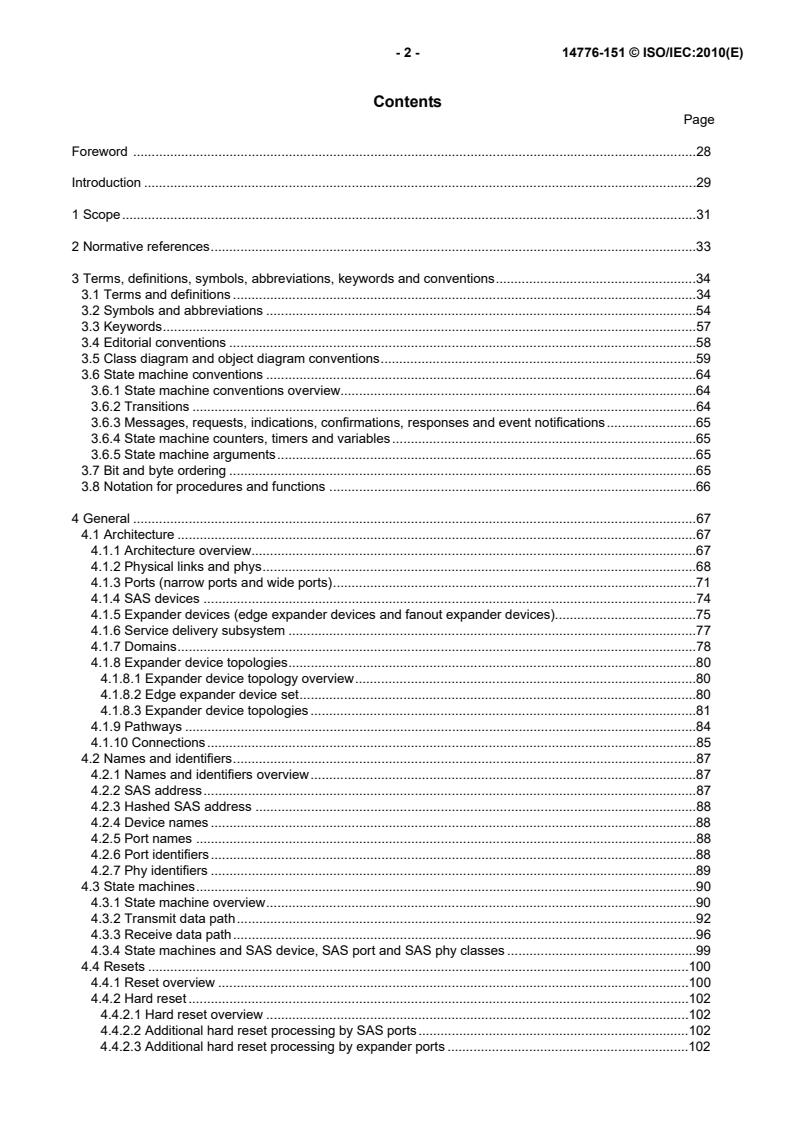
- 2 - 14776-151 © ISO/IEC:2010(E)
Contents
Page
Foreword .28
Introduction .29
1 Scope.31
2 Normative references.33
3 Terms, definitions, symbols, abbreviations, keywords and conventions.34
3.1 Terms and definitions .34
3.2 Symbols and abbreviations .54
3.3 Keywords.57
3.4 Editorial conventions .58
3.5 Class diagram and object diagram conventions.59
3.6 State machine conventions .64
3.6.1 State machine conventions overview.64
3.6.2 Transitions .64
3.6.3 Messages, requests, indications, confirmations, responses and event notifications.65
3.6.4 State machine counters, timers and variables.65
3.6.5 State machine arguments.65
3.7 Bit and byte ordering .65
3.8 Notation for procedures and functions .66
4 General .67
4.1 Architecture .67
4.1.1 Architecture overview.67
4.1.2 Physical links and phys.68
4.1.3 Ports (narrow ports and wide ports).71
4.1.4 SAS devices .74
4.1.5 Expander devices (edge expander devices and fanout expander devices).75
4.1.6 Service delivery subsystem .77
4.1.7 Domains.78
4.1.8 Expander device topologies.80
4.1.8.1 Expander device topology overview.80
4.1.8.2 Edge expander device set.80
4.1.8.3 Expander device topologies .81
4.1.9 Pathways .84
4.1.10 Connections.85
4.2 Names and identifiers.87
4.2.1 Names and identifiers overview.87
4.2.2 SAS address.87
4.2.3 Hashed SAS address .88
4.2.4 Device names .88
4.2.5 Port names .88
4.2.6 Port identifiers.88
4.2.7 Phy identifiers .89
4.3 State machines.90
4.3.1 State machine overview.90
4.3.2 Transmit data path.92
4.3.3 Receive data path.96
4.3.4 State machines and SAS device, SAS port and SAS phy classes .99
4.4 Resets .100
4.4.1 Reset overview .100
4.4.2 Hard reset .102
4.4.2.1 Hard reset overview .102
4.4.2.2 Additional hard reset processing by SAS ports.102
4.4.2.3 Additional hard reset processing by expander ports .102
14776-151 © ISO/IEC:2010(E) - 3 -
4.5 I_T nexus loss .102
4.6 Expander device model.102
4.6.1 Expander device model overview .102
4.6.2 Expander ports .103
4.6.3 Expander connection manager (ECM).104
4.6.4 Expander connection router (ECR).104
4.6.5 Broadcast primitive processor (BPP).104
4.6.6 Expander device interfaces .104
4.6.6.1 Expander device interface overview.104
4.6.6.2 Expander device interfaces detail .106
4.6.6.3 ECM interface.106
4.6.6.4 ECR interface.108
4.6.6.5 BPP interface .110
4.6.7 Expander device routing .110
4.6.7.1 Routing attributes and routing methods .110
4.6.7.2 Connection request routing .111
4.6.7.3 Expander route table.111
4.7 Discover process.112
4.7.1 Discover process overview .112
4.7.2 Allowed topologies.114
4.7.3 Discover process optimization .115
4.7.4 Expander route index order .116
4.8 Phy test functions .121
5 Physical layer.122
5.1 Physical layer overview .122
5.2 Passive interconnect .122
5.2.1 SATA connectors and cable assemblies .122
5.2.2 SAS connectors and cables.122
5.2.3 Connectors .126
5.2.3.1 Connectors overview.126
5.2.3.2 SAS internal connectors.127
5.2.3.2.1 SAS Drive connectors.127
5.2.3.2.1.1 SAS Drive plug connector. 127
5.2.3.2.1.2 SAS Drive cable receptacle connector. 127
5.2.3.2.1.3 SAS Drive backplane receptacle connector. 128
5.2.3.2.1.4 SAS Drive connector pin assignments. 128
5.2.3.2.2 SAS 4i connectors .130
5.2.3.2.2.1 SAS 4i cable receptacle connector . 130
5.2.3.2.2.2 SAS 4i plug connector. 130
5.2.3.2.2.3 SAS 4i connector pin assignments . 131
5.2.3.2.3 Mini SAS 4i connectors.132
5.2.3.2.3.1 Mini SAS 4i cable plug connector . 132
5.2.3.2.3.2 Mini SAS 4i receptacle connector . 133
5.2.3.2.3.3 Mini SAS 4i connector pin assignments. 134
5.2.3.3 SAS external connectors.136
5.2.3.3.1 SAS 4x connectors .136
5.2.3.3.1.1 SAS 4x cable plug connector. 136
5.2.3.3.1.2 SAS 4x receptacle connector. 136
5.2.3.3.1.3 SAS 4x connector pin assignments . 138
5.2.3.3.2 Mini SAS 4x connectors.138
5.2.3.3.2.1 Mini SAS 4x cable plug connector . 138
5.2.3.3.2.2 Mini SAS 4x receptacle connector . 140
5.2.3.3.2.3 Mini SAS 4x connector pin assignments. 143
5.2.4 Cable assemblies .143
5.2.4.1 SAS internal cable assemblies.143
5.2.4.1.1 SAS Drive cable assemblies.143
5.2.4.1.2 SAS internal symmetric cable assemblies.144
5.2.4.1.2.1 SAS internal symmetric cable assemblies overview. 144
5.2.4.1.2.2 SAS internal symmetric cable assembly - SAS 4i. 145
- 4 - 14776-151 © ISO/IEC:2010(E)
5.2.4.1.2.3 SAS internal symmetric cable assembly - Mini SAS 4i . 146
5.2.4.1.2.4 SAS internal symmetric cable assembly - SAS 4i to Mini SAS 4i . 147
5.2.4.1.3 SAS internal fanout cable assemblies .148
5.2.4.1.3.1 SAS internal fanout cable assemblies overview . 148
5.2.4.1.3.2 SAS internal controller-based fanout cable assemblies. 149
5.2.4.1.3.3 SAS internal backplane-based fanout cable assemblies . 151
5.2.4.2 SAS external cable assemblies.152
5.2.4.2.1 SAS external cable assemblies overview.152
5.2.4.2.2 SAS external cable assembly - SAS 4x.153
5.2.4.2.3 SAS external cable assembly - Mini SAS 4x .154
5.2.4.2.4 SAS external cable assembly - SAS 4x to Mini SAS 4x .156
5.2.5 Backplanes .156
5.2.6 Cable assembly and backplane specifications .157
5.3 Transmitter and receiver device electrical characteristics.161
5.3.1 Compliance points .161
5.3.2 Test loads .169
5.3.2.1 Test loads overview.169
5.3.2.2 Zero-length test load .170
5.3.2.3 TCTF test load.171
5.3.2.4 Low-loss TCTF test load .173
5.3.3 General electrical characteristics.174
5.3.4 Transmitter and receiver device transients.177
5.3.5 Eye masks .177
5.3.5.1 Eye masks overview.177
5.3.5.2 Transmitter device eye mask .178
5.3.5.3 Receiver device eye mask .178
5.3.5.4 Receiver device jitter tolerance eye mask.179
5.3.6 Transmitter device characteristics .180
5.3.6.1 Transmitter device characteristics overview.180
5.3.6.2 Transmitter device signal output characteristics as measured with the zero-length test load.181
5.3.6.3 Transmitter device signal output characteristics as measured with each test load.181
5.3.6.4 Transmitter device maximum jitter .183
5.3.6.5 Transmitter device signal output levels for OOB signals.183
5.3.7 Receiver device characteristics .183
5.3.7.1 Receiver device characteristics overview.183
5.3.7.2 Delivered signal (receiver device signal tolerance) characteristics.184
5.3.7.3 Maximum delivered jitter .186
5.3.7.4 Receiver device jitter tolerance .186
5.3.8 Spread spectrum clocking.187
5.3.9 Non-tracking clock architecture.187
5.4 READY LED signal electrical characteristics.187
6 Phy layer .189
6.1 Phy layer overview .189
6.2 8b10b coding.189
6.2.1 8b10b coding overview .189
6.2.2 8b10b coding introduction.189
6.2.3 8b10b coding notation conventions .189
6.3 Character encoding and decoding .190
6.3.1 Introduction .190
6.3.2 Transmission order .190
6.3.3 Data and control characters.190
6.3.4 Encoding characters in the transmitter .197
6.3.5 Decoding characters in the receiver .197
6.4 Dwords, primitives, data dwords and invalid dwords.197
6.5 Bit order.198
6.6 Out of band (OOB) signals .199
6.6.1 OOB signals overview.199
6.6.2 Transmitting OOB signals.200
6.6.3 Receiving OOB signals.202
14776-151 © ISO/IEC:2010(E) - 5 -
6.6.4 Transmitting the SATA port selection signal.204
6.7 Phy reset sequences.204
6.7.1 Phy reset sequences overview .204
6.7.2 SATA phy reset sequence .205
6.7.2.1 SATA OOB sequence .205
6.7.2.2 SATA speed negotiation sequence.205
6.7.3 SAS to SATA phy reset sequence.206
6.7.4 SAS to SAS phy reset sequence .207
6.7.4.1 SAS OOB sequence .207
6.7.4.2 SAS speed negotiation sequence .208
6.7.4.2.1 SAS speed negotiation sequence overview .208
6.7.4.2.2 Speed negotiation window.209
6.7.4.2.3 SAS speed negotiation sequence.210
6.7.5 Phy reset sequence after devices are attached.212
6.8 SP (phy layer) state machine .213
6.8.1 SP state machine overview.213
6.8.2 SP transmitter and receiver .215
6.8.3 OOB sequence states.216
6.8.3.1 OOB sequence states overview.216
6.8.3.2 SP0:OOB_COMINIT state.216
6.8.3.2.1 State description.216
6.8.3.2.2 Transition SP0:OOB_COMINIT to SP1:OOB_AwaitCOMX.217
6.8.3.2.3 Transition SP0:OOB_COMINIT to SP3:OOB_AwaitCOMINIT_Sent.217
6.8.3.2.4 Transition SP0:OOB_COMINIT to SP4:OOB_COMSAS.217
6.8.3.3 SP1:OOB_AwaitCOMX state .217
6.8.3.3.1 State description.217
6.8.3.3.2 Transition SP1:OOB_AwaitCOMX to SP0:OOB_COMINIT.217
6.8.3.3.3 Transition SP1:OOB_AwaitCOMX to SP4:OOB_COMSAS .217
6.8.3.4 SP2:OOB_NoCOMSASTimeout state.218
6.8.3.4.1 State description.218
6.8.3.4.2 Transition SP2:OOB_NoCOMSASTimeout to SP0:OOB_COMINIT.218
6.8.3.4.3 Transition SP2:OOB_NoCOMSASTimeout to SP4:OOB_COMSAS.218
6.8.3.5 SP3:OOB_AwaitCOMINIT_Sent state .218
6.8.3.5.1 State description.218
6.8.3.5.2 Transition SP3:OOB_AwaitCOMINIT_Sent to SP4:OOB_COMSAS .218
6.8.3.6 SP4:OOB_COMSAS state .218
6.8.3.6.1 State description.218
6.8.3.6.2 Transition SP4:OOB_COMSAS to SP5:OOB_AwaitCOMSAS_Sent.218
6.8.3.6.3 Transition SP4:OOB_COMSAS to SP6:OOB_AwaitNoCOMSAS.218
6.8.3.6.4 Transition SP4:OOB_COMSAS to SP7:OOB_AwaitCOMSAS .219
6.8.3.7 SP5:OOB_AwaitCOMSAS_Sent state.219
6.8.3.7.1 State description.219
6.8.3.7.2 Transition SP5:OOB_AwaitCOMSAS_Sent to SP6:OOB_AwaitNoCOMSAS.219
6.8.3.8 SP6:OOB_AwaitNoCOMSAS state.219
6.8.3.8.1 State description.219
6.8.3.8.2 Transition SP6:OOB_AwaitNoCOMSAS to SP0:OOB_COMINIT .219
6.8.3.8.3 Transition SP6:OOB_AwaitNoCOMSAS to SP8:SAS_Start.219
6.8.3.9 SP7:OOB_AwaitCOMSAS state .219
6.8.3.9.1 State description.219
6.8.3.9.2 Transition SP7:OOB_AwaitCOMSAS to SP2:OOB_NoCOMSASTimeout.219
6.8.3.9.3 Transition SP7:OOB_AwaitCOMSAS to SP6:OOB_AwaitNoCOMSAS.219
6.8.3.9.4 Transition SP7:OOB_AwaitCOMSAS to SP16:SATA_COMWAKE.219
6.8.3.9.5 Transition SP7:OOB_AwaitCOMSAS to SP26:SATA _SpinupHold.220
6.8.4 SAS speed negotiation states.220
6.8.4.1 SAS speed negotiation states overview.220
6.8.4.2 SP8:SAS_Start state.221
6.8.4.2.1 State description.221
6.8.4.2.2 Transition SP8:SAS_Start to SP0:OOB_COMINIT .222
6.8.4.2.3 Transition SP8:SAS_Start to SP9:SAS_RateNotSupported.222
6.8.4.2.4 Transition SP8:SAS_Start to SP10:SAS_AwaitALIGN.222
- 6 - 14776-151 © ISO/IEC:2010(E)
6.8.4.3 SP9:SAS_RateNotSupported state.222
6.8.4.3.1 State description.222
6.8.4.3.2 Transition SP9:SAS_RateNotSupported to SP14:SAS_Fail .222
6.8.4.4 SP10:SAS_AwaitALIGN state.222
6.8.4.4.1 State description.222
6.8.4.4.2 Transition SP10:SAS_AwaitALIGN to SP0:OOB_COMINIT .222
6.8.4.4.3 Transition SP10:SAS_AwaitALIGN to SP11:SAS_AwaitALIGN1.222
6.8.4.4.4 Transition SP10:SAS_AwaitALIGN to SP12:SAS_AwaitSNW .222
6.8.4.4.5 Transition SP10:SAS_AwaitALIGN to SP14:SAS_Fail.222
6.8.4.5 SP11:SAS_AwaitALIGN1 state.223
6.8.4.5.1 State description.223
6.8.4.5.2 Transition SP11:SAS_AwaitALIGN1 to SP0:OOB_COMINIT .223
6.8.4.5.3 Transition SP11:SAS_AwaitALIGN1 to SP12:SAS_AwaitSNW .223
6.8.4.5.4 Transition SP11:SAS_AwaitALIGN1 to SP14:SAS_Fail.223
6.8.4.6 SP12:SAS_AwaitSNW state .223
6.8.4.6.1 State description.223
6.8.4.6.2 Transition SP12:SAS_AwaitSNW to SP0:OOB_COMINIT.223
6.8.4.6.3 Transition SP12:SAS_AwaitSNW to SP13:SAS_Pass.223
6.8.4.7 SP13:SAS_Pass state .223
6.8.4.7.1 State description.223
6.8.4.7.2 Transition SP13:SAS_Pass to SP0:OOB_COMINIT.223
6.8.4.7.3 Transition SP13:SAS_Pass to SP8:SAS_Start .223
6.8.4.7.4 Transition SP13:SAS_Pass to SP15:SAS_PHY_Ready .224
6.8.4.8 SP14:SAS_Fail state.224
6.8.4.8.1 State description.224
6.8.4.8.2 Transition SP14:SAS_Fail to SP1:OOB_AwaitCOMX.224
6.8.4.8.3 Transition SP14:SAS_Fail to SP8:SAS_Start.224
6.8.4.9 SP15:SAS_PHY_Ready state.224
6.8.4.9.1 State description.224
6.8.4.9.2 Transition SP15:SAS_PHY_Ready to SP0:OOB_COMINIT .224
6.8.5 SATA host emulation states .225
6.8.5.1 SATA host emulation states overview.225
6.8.5.2 SP16:SATA_COMWAKE state .226
6.8.5.2.1 State description.226
6.8.5.2.2 Transition SP16:SATA_COMWAKE to SP17:SATA_AwaitCOMWAKE.227
6.8.5.3 SP17:SATA_AwaitCOMWAKE state.227
6.8.5.3.1 State description.227
6.8.5.3.2 Transition SP17:SATA_AwaitCOMWAKE to SP0:OOB_COMINIT.227
6.8.5.3.3 Transition SP17:SATA_AwaitCOMWAKE to SP18:SATA_AwaitNoCOMWAKE .227
6.8.5.4 SP18:SATA_AwaitNoCOMWAKE state.227
6.8.5.4.1 State description.227
6.8.5.4.2 Transition SP18:SATA_AwaitNoCOMWAKE to SP0:OOB_COMINIT .227
6.8.5.4.3 Transition SP18:SATA_AwaitNoCOMWAKE to SP19:SATA_AwaitALIGN.227
6.8.5.5 SP19:SATA_AwaitALIGN state.227
6.8.5.5.1 State description.227
6.8.5.5.2 Transition SP19:SATA_AwaitALIGN to SP0:OOB_COMINIT .227
6.8.5.5.3 Transition SP19:SATA_AwaitALIGN to SP20:SATA_AdjustSpeed.227
6.8.5.6 SP20:SATA_AdjustSpeed state.227
6.8.5.6.1 State description.227
6.8.5.6.2 Transition SP20:SATA_AdjustSpeed to SP0:OOB_COMINIT .228
6.8.5.6.3 Transition SP20:SATA_AdjustSpeed to SP21:SATA_TransmitALIGN .228
6.8.5.7 SP21:SATA_TransmitALIGN state.228
6.8.5.7.1 State description.228
6.8.5.7.2 Transition SP21:SATA_TransmitALIGN to SP0:OOB_COMINIT.228
6.8.5.7.3 Transition SP21:SATA_TransmitALIGN to SP22:SATA_PHY_Ready.228
6.8.5.8 SP22:SATA_PHY_Ready state.228
6.8.5.8.1 State description.228
6.8.5.8.2 Transition SP22:SATA_PHY_Ready to SP0:OOB_COMINIT.228
6.8.5.8.3 Transition SP22:SATA_PHY_Ready to SP23:SATA_PM_Partial .228
6.8.5.8.4 Transition SP22:SATA_PHY_Ready to SP24:SATA_PM_Slumber.228
14776-151 © ISO/IEC:2010(E) - 7 -
6.8.5.9 SP23:SATA_PM_Partial state.228
6.8.5.9.1 State description.228
6.8.5.9.2 Transition SP23:SATA_PM_Partial to SP0:OOB_COMINIT .229
6.8.5.9.3 Transition SP23:SATA_PM_Partial to SP16:SATA_COMWAKE.229
6.8.5.9.4 Transition SP23:SATA_PM_Partial to SP18:SATA_AwaitNoCOMWAKE.229
6.8.5.10 SP24:SATA_PM_Slumber state.229
6.8.5.10.1 State description.229
6.8.5.10.2 Transition SP24:SATA_PM_Slumber to SP0:OOB_COMINIT.229
6.8.5.10.3 Transition SP24:SATA_PM_Slumber to SP16:SATA_COMWAKE.229
6.8.5.10.4 Transition SP24:SATA_PM_Slumber to SP18:SATA_AwaitNoCOMWAKE .229
6.8.6 SATA port selector state.229
6.8.6.1 State description .229
6.8.6.2 Transition SP25:SATA_PortSel to SP1:OOB_AwaitCOMX .229
6.8.7 SATA spinup hold state .230
6.8.7.1 State description .230
6.8.7.2 Transition SP26:SATA_SpinupHold to SP0:OOB_COMINIT.230
6.9 SP_DWS (phy layer dword synchronization) state machine .230
6.9.1 SP_DWS state machine overview .230
6.9.2 SP_DWS receiver.
...
Questions, Comments and Discussion
Ask us and Technical Secretary will try to provide an answer. You can facilitate discussion about the standard in here.
Loading comments...