


IEC 62282-8-102:2019
(Main)Fuel cell technologies - Part 8-102: Energy storage systems using fuel cell modules in reverse mode - Test procedures for the performance of single cells and stacks with proton exchange membrane, including reversible operation
Fuel cell technologies - Part 8-102: Energy storage systems using fuel cell modules in reverse mode - Test procedures for the performance of single cells and stacks with proton exchange membrane, including reversible operation
IEC 62282-8-102:2019 deals with PEM cell/stack assembly units, testing systems, instruments and measuring methods, and test methods to test the performance of PEM cells and stacks in fuel cell mode, electrolysis and/or reversible mode.
Technologies des piles à combustible - Partie 8-102: Systèmes de stockage de l’énergie utilisant des modules à piles à combustible en mode inversé - Procédures d'essai pour la performance des cellules élémentaires et des piles à membrane échangeuse de protons, comprenant le fonctionnement réversible
IEC 62282-8-102:2019 traite des entités d'assemblage de cellules/piles à membrane échangeuse de protons (PEM – proton exchange membrane), des systèmes d'essai, des instruments et méthodes de mesure, ainsi que des méthodes d'essai destinées à vérifier la performance des cellules et piles à membrane échangeuse de protons en mode pile à combustible, électrolyse et/ou réversible.
General Information
- Status
- Published
- Publication Date
- 12-Dec-2019
- Technical Committee
- TC 105 - Fuel cell technologies
- Drafting Committee
- MT 206 - TC 105/MT 206
- Current Stage
- PPUB - Publication issued
- Start Date
- 13-Dec-2019
- Completion Date
- 03-Jan-2020
Overview
IEC 62282-8-102:2019 is an international standard published by the International Electrotechnical Commission (IEC) that specifies test procedures for assessing the performance of proton exchange membrane (PEM) fuel cell single cells and stacks. This standard is part 8-102 of the IEC 62282 series, focusing on energy storage systems that utilize fuel cell modules operating in reverse mode, including reversible operation modes such as electrolysis and fuel cell functionality. It defines the methods, instruments, and requirements for evaluating PEM cell/stack assemblies to ensure consistent performance measurement and reliable data for energy storage solutions involving reversible fuel cell technologies.
Key Topics
Scope and Application
Covers PEM cells and stacks used in energy storage systems with reversible operation modes-both fuel cell and electrolysis functions. It applies to single cells, stacks, and modular assemblies.Test Environment and Setup
Detailed requirements on test environments, including fluid flow control, load/power control, measurement instruments, and safety equipment. The standard guides the preparation, stabilization, and control of testing conditions to obtain reproducible and accurate results.Measurement Methods
Defines recommended instruments and methods for key parameters-voltage, current, internal resistance, gas flow rates, temperature, pressure, and humidity-ensuring precise evaluation of PEM cell performance.Test Procedures
Comprehensive test procedures are provided for:- Current-voltage (I-V) characteristic tests
- Steady-state performance
- Durability assessments, including current cycling and pressurized conditions
These protocols facilitate consistent and comparable performance evaluations.
Data Processing and Reporting
Guidelines for post-processing test data, calculation of derived quantities, uncertainty evaluation, and standardized reporting formats are included to support clear documentation and interpretation.
Applications
This standard is essential for manufacturers, testers, and researchers involved with:
- Energy Storage Systems: Designing and validating energy storage solutions that use PEM fuel cells in reversible modes, such as hydrogen production through electrolysis and electricity generation during fuel cell operation.
- Fuel Cell Module Development: Performance testing of single cells and stacks facilitates optimization and quality control of modules for industrial, automotive, or stationary applications.
- Reversible PEM Fuel Cell Technologies: Ensures that modules operating both as fuel cells and electrolyzers meet rigorous performance and durability requirements.
- Laboratory and Field Testing: Provides frameworks for setting up test environments in research and commercial testing facilities.
Related Standards
IEC 62282-8-102:2019 complements and links with other IEC and international standards relevant to fuel cells and energy storage technologies:
- IEC 62282 Series: Covers general requirements and testing of fuel cell technologies, including fuel cell system performance and safety.
- ISO 14687: Specifies hydrogen fuel quality relevant to PEM fuel cell operation.
- IEC 60694: Describes terminology and symbols for electrical, electronic, and related technologies.
- Relevant Electrochemical Testing Standards: For environmental conditions, measurement accuracy, and instrumentation calibration critical to fuel cell testing.
Adopting IEC 62282-8-102:2019 ensures compliance with global best practices for testing PEM fuel cells and stacks used in advanced energy storage systems, enabling innovation, performance validation, and technology integration in the evolving clean energy landscape.
IEC 62282-8-102:2019 - Fuel cell technologies - Part 8-102: Energy storage systems using fuel cell modules in reverse mode - Test procedures for the performance of single cells and stacks with proton exchange membrane, including reversible operation
Frequently Asked Questions
IEC 62282-8-102:2019 is a standard published by the International Electrotechnical Commission (IEC). Its full title is "Fuel cell technologies - Part 8-102: Energy storage systems using fuel cell modules in reverse mode - Test procedures for the performance of single cells and stacks with proton exchange membrane, including reversible operation". This standard covers: IEC 62282-8-102:2019 deals with PEM cell/stack assembly units, testing systems, instruments and measuring methods, and test methods to test the performance of PEM cells and stacks in fuel cell mode, electrolysis and/or reversible mode.
IEC 62282-8-102:2019 deals with PEM cell/stack assembly units, testing systems, instruments and measuring methods, and test methods to test the performance of PEM cells and stacks in fuel cell mode, electrolysis and/or reversible mode.
IEC 62282-8-102:2019 is classified under the following ICS (International Classification for Standards) categories: 27.070 - Fuel cells. The ICS classification helps identify the subject area and facilitates finding related standards.
You can purchase IEC 62282-8-102:2019 directly from iTeh Standards. The document is available in PDF format and is delivered instantly after payment. Add the standard to your cart and complete the secure checkout process. iTeh Standards is an authorized distributor of IEC standards.
Standards Content (Sample)
IEC 62282-8-102 ®
Edition 1.0 2019-12
INTERNATIONAL
STANDARD
NORME
INTERNATIONALE
colour
inside
Fuel cell technologies –
Part 8-102: Energy storage systems using fuel cell modules in reverse mode –
Test procedures for the performance of single cells and stacks with proton
exchange membranes, including reversible operation
Technologies des piles a combustible –
Partie 8-102: Systèmes de stockage de l'énergie utilisant des modules à
piles à combustible en mode inversé – Procédures d'essai pour la
performance des cellules élémentaires et des piles à membrane
échangeuse de protons, comprenant le fonctionnement réversible
All rights reserved. Unless otherwise specified, no part of this publication may be reproduced or utilized in any form
or by any means, electronic or mechanical, including photocopying and microfilm, without permission in writing from
either IEC or IEC's member National Committee in the country of the requester. If you have any questions about IEC
copyright or have an enquiry about obtaining additional rights to this publication, please contact the address below or
your local IEC member National Committee for further information.
Droits de reproduction réservés. Sauf indication contraire, aucune partie de cette publication ne peut être reproduite
ni utilisée sous quelque forme que ce soit et par aucun procédé, électronique ou mécanique, y compris la photocopie
et les microfilms, sans l'accord écrit de l'IEC ou du Comité national de l'IEC du pays du demandeur. Si vous avez des
questions sur le copyright de l'IEC ou si vous désirez obtenir des droits supplémentaires sur cette publication, utilisez
les coordonnées ci-après ou contactez le Comité national de l'IEC de votre pays de résidence.
IEC Central Office Tel.: +41 22 919 02 11
3, rue de Varembé info@iec.ch
CH-1211 Geneva 20 www.iec.ch
Switzerland
About the IEC
The International Electrotechnical Commission (IEC) is the leading global organization that prepares and publishes
International Standards for all electrical, electronic and related technologies.
About IEC publications
The technical content of IEC publications is kept under constant review by the IEC. Please make sure that you have the
latest edition, a corrigendum or an amendment might have been published.
IEC publications search - webstore.iec.ch/advsearchform Electropedia - www.electropedia.org
The advanced search enables to find IEC publications by a The world's leading online dictionary on electrotechnology,
variety of criteria (reference number, text, technical containing more than 22 000 terminological entries in English
committee,…). It also gives information on projects, replaced and French, with equivalent terms in 16 additional languages.
and withdrawn publications. Also known as the International Electrotechnical Vocabulary
(IEV) online.
IEC Just Published - webstore.iec.ch/justpublished
Stay up to date on all new IEC publications. Just Published IEC Glossary - std.iec.ch/glossary
details all new publications released. Available online and 67 000 electrotechnical terminology entries in English and
once a month by email. French extracted from the Terms and Definitions clause of
IEC publications issued since 2002. Some entries have been
IEC Customer Service Centre - webstore.iec.ch/csc collected from earlier publications of IEC TC 37, 77, 86 and
If you wish to give us your feedback on this publication or CISPR.
need further assistance, please contact the Customer Service
Centre: sales@iec.ch.
A propos de l'IEC
La Commission Electrotechnique Internationale (IEC) est la première organisation mondiale qui élabore et publie des
Normes internationales pour tout ce qui a trait à l'électricité, à l'électronique et aux technologies apparentées.
A propos des publications IEC
Le contenu technique des publications IEC est constamment revu. Veuillez vous assurer que vous possédez l’édition la
plus récente, un corrigendum ou amendement peut avoir été publié.
Recherche de publications IEC - Electropedia - www.electropedia.org
webstore.iec.ch/advsearchform Le premier dictionnaire d'électrotechnologie en ligne au
La recherche avancée permet de trouver des publications IEC monde, avec plus de 22 000 articles terminologiques en
en utilisant différents critères (numéro de référence, texte, anglais et en français, ainsi que les termes équivalents dans
comité d’études,…). Elle donne aussi des informations sur les 16 langues additionnelles. Egalement appelé Vocabulaire
projets et les publications remplacées ou retirées. Electrotechnique International (IEV) en ligne.
IEC Just Published - webstore.iec.ch/justpublished Glossaire IEC - std.iec.ch/glossary
Restez informé sur les nouvelles publications IEC. Just 67 000 entrées terminologiques électrotechniques, en anglais
Published détaille les nouvelles publications parues. et en français, extraites des articles Termes et Définitions des
Disponible en ligne et une fois par mois par email. publications IEC parues depuis 2002. Plus certaines entrées
antérieures extraites des publications des CE 37, 77, 86 et
Service Clients - webstore.iec.ch/csc CISPR de l'IEC.
Si vous désirez nous donner des commentaires sur cette
publication ou si vous avez des questions contactez-nous:
sales@iec.ch.
IEC 62282-8-102 ®
Edition 1.0 2019-12
INTERNATIONAL
STANDARD
NORME
INTERNATIONALE
colour
inside
Fuel cell technologies –
Part 8-102: Energy storage systems using fuel cell modules in reverse mode –
Test procedures for the performance of single cells and stacks with proton
exchange membranes, including reversible operation
Technologies des piles a combustible –
Partie 8-102: Systèmes de stockage de l'énergie utilisant des modules à
piles à combustible en mode inversé – Procédures d'essai pour la
performance des cellules élémentaires et des piles à membrane
échangeuse de protons, comprenant le fonctionnement réversible
INTERNATIONAL
ELECTROTECHNICAL
COMMISSION
COMMISSION
ELECTROTECHNIQUE
INTERNATIONALE
ICS 27.070 ISBN 978-2-8322-7675-4
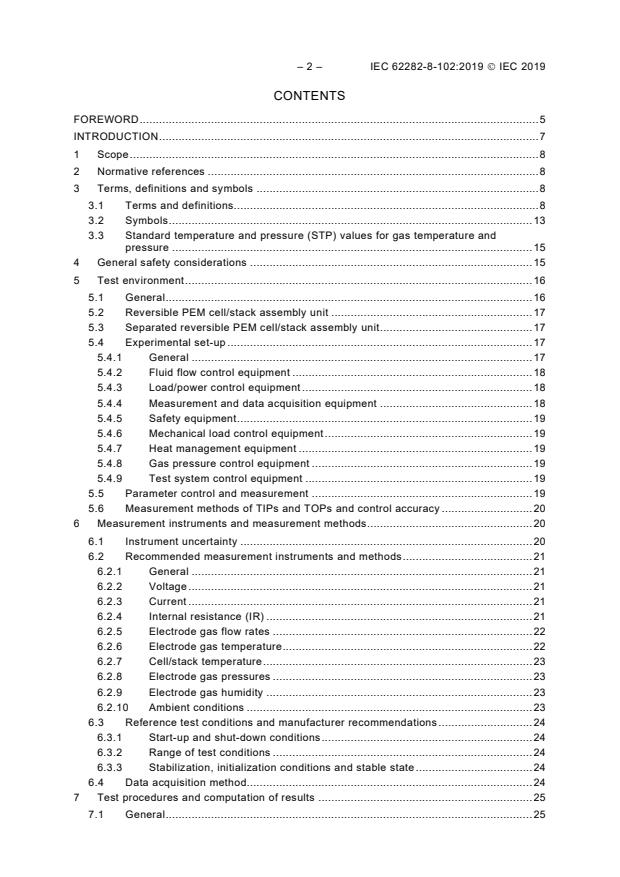
– 2 – IEC 62282-8-102:2019 IEC 2019
CONTENTS
FOREWORD . 5
INTRODUCTION . 7
1 Scope . 8
2 Normative references . 8
3 Terms, definitions and symbols . 8
3.1 Terms and definitions. 8
3.2 Symbols . 13
3.3 Standard temperature and pressure (STP) values for gas temperature and
pressure . 15
4 General safety considerations . 15
5 Test environment . 16
5.1 General . 16
5.2 Reversible PEM cell/stack assembly unit . 17
5.3 Separated reversible PEM cell/stack assembly unit . 17
5.4 Experimental set-up . 17
5.4.1 General . 17
5.4.2 Fluid flow control equipment . 18
5.4.3 Load/power control equipment . 18
5.4.4 Measurement and data acquisition equipment . 18
5.4.5 Safety equipment . 19
5.4.6 Mechanical load control equipment . 19
5.4.7 Heat management equipment . 19
5.4.8 Gas pressure control equipment . 19
5.4.9 Test system control equipment . 19
5.5 Parameter control and measurement . 19
5.6 Measurement methods of TIPs and TOPs and control accuracy . 20
6 Measurement instruments and measurement methods . 20
6.1 Instrument uncertainty . 20
6.2 Recommended measurement instruments and methods . 21
6.2.1 General . 21
6.2.2 Voltage . 21
6.2.3 Current . 21
6.2.4 Internal resistance (IR) . 21
6.2.5 Electrode gas flow rates . 22
6.2.6 Electrode gas temperature . 22
6.2.7 Cell/stack temperature . 23
6.2.8 Electrode gas pressures . 23
6.2.9 Electrode gas humidity . 23
6.2.10 Ambient conditions . 23
6.3 Reference test conditions and manufacturer recommendations . 24
6.3.1 Start-up and shut-down conditions . 24
6.3.2 Range of test conditions . 24
6.3.3 Stabilization, initialization conditions and stable state . 24
6.4 Data acquisition method. 24
7 Test procedures and computation of results . 25
7.1 General . 25
7.2 Current-voltage (I-V) characteristics test . 25
7.2.1 Objective . 25
7.2.2 Test method . 25
7.2.3 Data post-processing . 25
7.3 Steady-state test . 26
7.3.1 Objective . 26
7.3.2 Test methods . 26
7.3.3 Data post-processing . 26
7.4 Durability test. 26
7.4.1 Objective . 26
7.4.2 Test method . 26
7.4.3 Data post-processing . 26
7.5 Internal resistance (IR) measurement . 27
7.5.1 Objective . 27
7.5.2 Test methods . 27
7.5.3 Data post processing . 28
7.6 Current cycling durability test . 28
7.6.1 Objective . 28
7.6.2 Test method . 28
7.6.3 Data post-processing . 28
7.7 Pressurized test . 29
7.7.1 Objective . 29
7.7.2 Test method . 29
7.7.3 Data post-processing . 29
8 Test report . 29
8.1 General . 29
8.2 Report items . 29
8.3 Test unit data description . 30
8.4 Test condition description . 30
8.5 Test data description . 30
8.6 Uncertainty evaluation . 30
Annex A (normative) Test procedure guidelines . 31
A.1 Test objective . 31
A.2 Test set-up . 31
A.3 Current-voltage characteristics test (7.2) . 31
A.3.1 Test input parameters (TIPs) . 31
A.3.2 Test output parameters (TOPs) . 32
A.3.3 Derived quantities . 32
A.4 Steady-state test (7.3) . 33
A.4.1 Test input parameters (TIPs) . 33
A.4.2 Test output parameters (TOPs) . 34
A.4.3 Derived quantities . 34
A.5 Durability test (7.4) . 35
A.5.1 Test input parameters (TIPs) . 35
A.5.2 Test output parameters (TOPs) . 35
A.5.3 Derived quantities . 36
A.5.4 Measurement of durability. 36
A.6 Current cycling durability test . 37
A.6.1 Test input parameters (TIPs) . 37
– 4 – IEC 62282-8-102:2019 IEC 2019
A.6.2 Test output parameters (TOPs) . 37
A.6.3 Derived quantities . 38
A.6.4 Measurement of current cycling durability . 38
A.7 Pressurized test . 39
A.7.1 Test input parameters (TIPs) . 39
A.7.2 Test output parameters (TOPs) . 39
A.7.3 Derived quantities . 39
A.7.4 Measurement of pressurized test . 40
Annex B (normative) Formulary. 41
Bibliography . 42
Figure 1 – Schematic representation of a reversible PEM cell/stack assembly unit . 17
Figure 2 – Schematic representation of a separate reversible PEM cell/stack assembly unit . 17
Figure 3 – Schematic graph of a test environment for a PEM cell/stack assembly unit . 18
Figure 4 – Schematic diagram of PEM cell impedance . 22
Table 1 – Symbols . 14
Table 2 – Instrument uncertainty for each quantity to be measured . 20
Table A.1 – Test input parameters (TIPs) for current-voltage characteristics test . 32
Table A.2 – Test output parameters (TOPs) for current-voltage characteristics test . 32
Table A.3 – Derived quantities for current-voltage characteristics test . 33
Table A.4 – Test input parameters (TIPs) for steady state test . 33
Table A.5 – Test output parameters (TOPs) for steady state test . 34
Table A.6 – Derived quantities for steady state test . 34
Table A.7 – Test input parameters (TIPs) for durability test . 35
Table A.8 – Test output parameters (TOPs) for durability test . 36
Table A.9 – Derived quantities for constant load durability test . 36
Table A.10 – Test input parameters (TIPs) for current cycling durability test within a
single operating mode (fuel cell or electrolysis) . 37
Table A.11 – Test input parameters (TIPs) for current cycling durability test covering
both operating modes (fuel cell and electrolysis) . 37
Table A.12 – Test output parameters (TOPs) for current cycling durability test . 38
Table A.13 – Derived quantities for current cycling durability test. 38
Table A.14 – Test input parameters (TIPs) for pressurized testing . 39
Table A.15 – Test output parameters (TOPs) for pressurized testing . 39
Table A.16 – Derived quantities for pressurized test . 39
INTERNATIONAL ELECTROTECHNICAL COMMISSION
____________
FUEL CELL TECHNOLOGIES –
Part 8-102: Energy storage systems using fuel cell modules in reverse
mode – Test procedures for the performance of single cells and stacks
with proton exchange membranes, including reversible operation
FOREWORD
1) The International Electrotechnical Commission (IEC) is a worldwide organization for standardization comprising
all national electrotechnical committees (IEC National Committees). The object of IEC is to promote
international co-operation on all questions concerning standardization in the electrical and electronic fields. To
this end and in addition to other activities, IEC publishes International Standards, Technical Specifications,
Technical Reports, Publicly Available Specifications (PAS) and Guides (hereafter referred to as "IEC
Publication(s)"). Their preparation is entrusted to technical committees; any IEC National Committee interested
in the subject dealt with may participate in this preparatory work. International, governmental and non-
governmental organizations liaising with the IEC also participate in this preparation. IEC collaborates closely
with the International Organization for Standardization (ISO) in accordance with conditions determined by
agreement between the two organizations.
2) The formal decisions or agreements of IEC on technical matters express, as nearly as possible, an international
consensus of opinion on the relevant subjects since each technical committee has representation from all
interested IEC National Committees.
3) IEC Publications have the form of recommendations for international use and are accepted by IEC National
Committees in that sense. While all reasonable efforts are made to ensure that the technical content of IEC
Publications is accurate, IEC cannot be held responsible for the way in which they are used or for any
misinterpretation by any end user.
4) In order to promote international uniformity, IEC National Committees undertake to apply IEC Publications
transparently to the maximum extent possible in their national and regional publications. Any divergence
between any IEC Publication and the corresponding national or regional publication shall be clearly indicated in
the latter.
5) IEC itself does not provide any attestation of conformity. Independent certification bodies provide conformity
assessment services and, in some areas, access to IEC marks of conformity. IEC is not responsible for any
services carried out by independent certification bodies.
6) All users should ensure that they have the latest edition of this publication.
7) No liability shall attach to IEC or its directors, employees, servants or agents including individual experts and
members of its technical committees and IEC National Committees for any personal injury, property damage or
other damage of any nature whatsoever, whether direct or indirect, or for costs (including legal fees) and
expenses arising out of the publication, use of, or reliance upon, this IEC Publication or any other IEC
Publications.
8) Attention is drawn to the Normative references cited in this publication. Use of the referenced publications is
indispensable for the correct application of this publication.
9) Attention is drawn to the possibility that some of the elements of this IEC Publication may be the subject of
patent rights. IEC shall not be held responsible for identifying any or all such patent rights.
International Standard IEC 62282-8-102 has been prepared by IEC technical committee 105:
Fuel cell technologies.
The text of this International Standard is based on the following documents:
FDIS Report on voting
105/763/FDIS 105/776/RVD
Full information on the voting for the approval of this International Standard can be found in
the report on voting indicated in the above table.
This document has been drafted in accordance with the ISO/IEC Directives, Part 2.
– 6 – IEC 62282-8-102:2019 IEC 2019
A list of all parts in the IEC 62282 series, published under the general title Fuel cell
technologies, can be found on the IEC website.
The committee has decided that the contents of this document will remain unchanged until the
stability date indicated on the IEC website under "http://webstore.iec.ch" in the data related to
the specific document. At this date, the document will be
• reconfirmed,
• withdrawn,
• replaced by a revised edition, or
• amended.
IMPORTANT – The 'colour inside' logo on the cover page of this publication indicates
that it contains colours which are considered to be useful for the correct
understanding of its contents. Users should therefore print this document using a
colour printer.
INTRODUCTION
This part of IEC 62282 describes test methods for a single cell and stack (denoted as
"cell/stack" hereafter) that are intended for use in energy storage systems that use proton
exchange membrane fuel cells (PEMFC) in combination with proton exchange membrane
water electrolysers (PEMWE), or directly using proton exchange membrane cells (Re-PEM).
This document is intended to be used for data exchanges in commercial transactions between
cell/stack manufacturers and system developers or for acquiring data on a cell or stack in
order to estimate the performance of a system based on it. Users of this document can
selectively execute test items suitable for their purposes from those described in this
document.
PEMFCs, PEMWEs and Re-PEMs have a broad range of geometry and size. As such, in
general, peripherals like current collectors and gas manifolds are unique to each cell or stack
and are often incorporated into a cell or stack to form one integrated unit. In addition, they
tend to have a significant effect on the power generation characteristics of the cell or stack.
This document therefore introduces as its subject "cell/stack assembly unit", which are
defined as those units containing not only a cell or a stack, but also peripherals.
IEC 62282-8 (all parts) aims to develop performance test methods for power storage and
buffering systems based on electrochemical modules (combining electrolysis and fuel cells, in
particular reversible fuel cells), taking into consideration both options of re-electrification and
substance (and heat) production for sustainable integration of renewable energy sources.
Under the general title Energy storage systems using fuel cell modules in reverse mode, the
IEC 62282-8 series consists of the following parts:
• IEC 62282-8-101: Test procedures for the performance of solid oxide single cells and
stacks, including reversible operation
• IEC 62282-8-102: Test procedures for the performance of single cells and stacks with
proton exchange membranes, including reversible operation
• IEC 62282-8-103 : Alkaline single cell and stack performance including reversible
operation
• IEC 62282-8-201: Test procedures for the performance of power-to-power systems
• IEC 62282-8-202 : Power-to-power systems – Safety
• IEC 62282-8-300 (all parts) : Power-to-substance systems
As a priority dictated by the emerging needs for industry and opportunities for technological
development, IEC 62282-8-101, IEC 62282-8-102 and IEC 62282-8-201 have been initiated
jointly and as a priority. These parts are presented as a package to highlight the need for an
integrated approach as regards the system application (i.e. a solution for energy storage) and
its fundamental constituent components (i.e. fuel cells operated in reverse or reversing mode).
IEC 62282-8-103, IEC 62282-8-202 and IEC 62282-8-300 (all parts) are suggested but are left
for initiation at a later stage.
____________
Under consideration.
Under consideration.
Under consideration.
– 8 – IEC 62282-8-102:2019 IEC 2019
FUEL CELL TECHNOLOGIES –
Part 8-102: Energy storage systems using fuel cell modules in reverse
mode – Test procedures for the performance of single cells and stacks
with proton exchange membranes, including reversible operation
1 Scope
This part of IEC 62282 deals with PEM cell/stack assembly units, testing systems, instruments
and measuring methods, and test methods to test the performance of PEM cells and stacks in
fuel cell mode, electrolysis and/or reversible mode.
2 Normative references
The following documents are referred to in the text in such a way that some or all of their
content constitutes requirements of this document. For dated references, only the edition
cited applies. For undated references, the latest edition of the referenced document (including
any amendments) applies.
IEC 60050-485:— , International Electrotechnical Vocabulary – Part 485: Fuel cell
technologies
IEC TS 62282-7-1:2017, Fuel cell technologies – Part 7-1: Test methods – Single cell
performance tests for polymer electrolyte fuel cells (PEMFC)
3 Terms, definitions and symbols
3.1 Terms and definitions
For the purposes of this document, the terms and definitions given in IEC 60050-485 and the
following apply.
ISO and IEC maintain terminological databases for use in standardization at the following
addresses:
• IEC Electropedia: available at http://www.electropedia.org/
• ISO Online browsing platform: available at http://www.iso.org/obp
3.1.1
active electrode area
geometric area of the electrode perpendicular to the direction of the current flow
Note 1 to entry: Usually this corresponds to the smaller of the two areas of negative electrode or positive
electrode.
[SOURCE: IEC 60050-485:—, 485-02-08, modified – "electrode" added to the term, the term
"effective area" has been deleted, and the notes to entry have been replaced with a new note
to entry.]
____________
Under preparation. Stage at the time of preparation: IEC FDIS 60050-485:2019.
3.1.2
area-specific resistance
ASR
internal resistivity with respect to the active electrode area, including the change of potential
due to the electrochemical reaction
Note 1 to entry: This note applies to the French language only.
3.1.3
catalyst
substance that accelerates (increases the rate of) a reaction without being consumed itself
Note 1 to entry: The catalyst lowers the activation energy of the reaction, allowing for an increase in the reaction
rate.
3.1.4
catalyst-coated membrane
CCM
polymer membrane whose surfaces are coated with a catalyst layer
(3.1.5) to form the reaction zone of the electrode (3.1.8)
Note 1 to entry: See also membrane electrode assembly (MEA) (3.1.17).
Note 2 to entry: This note applies to the French language only.
[SOURCE: IEC 60050-485:—, 485-04-03]
3.1.5
catalyst layer
surface porous region adjacent to either side of the membrane containing the catalyst (3.1.3),
typically with ionic and electronic conductivity
Note 1 to entry: The catalyst layer comprises the spatial region where the electrochemical reactions can take
place.
3.1.6
current collector
conductive material in a fuel cell (3.1.13) that collects electrons from the negative electrode
(3.1.20) side or conducts electrons to the positive electrode (3.1.25) side
3.1.7
current density
current per unit active area (IEV 485-02-08)
2 2
Note 1 to entry: Current density is expressed in A/m or A/cm .
3.1.8
electrode
electronic conductor (or semi-conductor) through which an electric current enters or leaves
the electrochemical cell as the result of an electrochemical reaction
Note 1 to entry: An electrode is either a positive electrode (3.1.25) or a negative electrode (3.1.20).
3.1.9
electrolyte
liquid or solid substance containing mobile ions that render it ionically conductive
Note 1 to entry: The electrolyte is the main distinctive feature of the different fuel cell technologies (e.g. a liquid,
polymer, molten salt, solid oxide) and determines the usable operating temperature range.
– 10 – IEC 62282-8-102:2019 IEC 2019
3.1.10
end plate
component located on either end of the cell stack in the direction of current flow, serving to
transmit the required compression to the stacked cells
Note 1 to entry: The end plate can comprise ports, ducts, and manifolds for the supply of fluids (reactants,
coolant) to the cell stack.
[SOURCE: IEC 60050-485:—, 485-06-06, modified – The admitted terms have been deleted,
"fuel cell stack" has been replaced by "cell stack in the direction of current flow" in the
definition, and the second sentence of Note 1 to entry has been deleted.]
3.1.11
flow plate
electronically conductive plate which incorporates channels for fuel (3.1.12) or oxidant
(3.1.22) gas flow in fuel cell mode, while for water and gas flow in electrolysis mode and
which comprises an electric contact with an electrode (3.1.8)
Note 1 to entry: The conductive plate material can be metal, a material such as graphite, or a conductive polymer
that can be a carbon-filled composite.
3.1.12
fuel
hydrogen or hydrogen-containing gas that reacts at the negative electrode (3.1.20) in a fuel
cell (3.1.13)
3.1.13
fuel cell
electrochemical device that converts the chemical energy of a fuel (3.1.12) and an oxidant
(3.1.22) to electric energy (direct current (DC) power), heat and reaction products
Note 1 to entry: The fuel and oxidant are typically stored outside the fuel cell and transferred into the fuel cell as
they are consumed.
[SOURCE: IEC 60050-485:—, 485-08-01]
3.1.14
gas diffusion electrode
GDE
type of electrode specifically designed for gaseous reactants or products or both
Note 1 to entry: A gas diffusion electrode usually comprises one or more porous layers, like the gas diffusion
layer (3.1.15) and the catalyst layer (3.1.5).
Note 2 to entry: Gas diffusion electrodes can be negative gas diffusion electrodes and positive gas diffusion
electrodes.
Note 3 to entry: This note applies to the French language only.
[SOURCE: IEC 60050-485:—, 485-02-02, modified – The abbreviated term "GDE" has been
added, and "anodes" and "cathodes" have been replaced by "negative … electrodes" and
"positive … electrodes" in Note 2 to entry.]
3.1.15
gas diffusion layer
GDL
porous substrate placed between the catalyst layer (3.1.5) and the flow plate (3.1.11) to serve
as electric contact and allow the access of reactants to the catalyst layer and the removal of
reaction products
Note 1 to entry: The gas diffusion layer is a component of a gas diffusion electrode (3.1.14).
Note 2 to entry: The gas diffusion layer is also called a porous transport layer (PTL).
Note 3 to entry: This note applies to the French language only.
[SOURCE: IEC 60050-485:—, 485-04-05, modified – "Bipolar plate" has been replaced by
"flow plate" in the definition, and Note 2 to entry has been added.]
3.1.16
internal resistance
ohmic resistance inside a fuel cell (3.1.13), measured between current collectors (3.1.6),
caused by the electronic and ionic resistances of the different components (electrodes,
electrolyte, flow plates and current collectors)
Note 1 to entry: The term ohmic refers to the fact that the relation between voltage drop and current is linear and
obeys Ohm’s law.
[SOURCE: IEC 60050-485:—, 485-15-04]
3.1.17
membrane electrode assembly
MEA
component of a PEMFC (3.1.24) consisting of an electrolyte membrane, electrode and gas
diffusion layer (3.1.15) on either side or a component of a PEMWE (3.1.26) consisting of an
electrolyte membrane with catalyst layers (3.1.5) on either side.
Note 1 to entry: This note applies to the French language only.
[SOURCE: IEC TS 62282-7-1:2017, 3.19, modified – "or a component of a PEMWE…on either
side" has been added.]
3.1.18
minimum cell voltage
lowest permitted fuel cell voltage specified by the manufacturer
3.1.19
maximum cell voltage
highest electrolyser voltage specified by the manufacturer
3.1.20
negative electrode
electrode (3.1.8) at which hydrogen gas is consumed or produced
Note 1 to entry: It is also called hydrogen electrode. In fuel cell mode it is called the anode, where the hydrogen
is oxidized. In electrolysis mode, it is called the cathode, where water is reduced producing hydrogen.
Note 2 to entry: In fuel cell mode, the negative electrode gas is usually hydrogen or a mixture which contains
hydrogen as a principal component mixed with water vapour and/or inert gas.
3.1.21
open circuit voltage
OCV
voltage across the terminals of a fuel cell (3.1.13) with fuel (3.1.12) and an oxidant (3.1.22)
present and in the absence of external current flow
Note 1 to entry: The open circuit voltage is expressed in V.
Note 2 to entry: This note applies to the French language only.
[SOURCE: IEC 60050-485:—, 485-13-02, modified – The term "no-load" voltage has been
deleted.]
– 12 – IEC 62282-8-102:2019 IEC 2019
3.1.22
oxidant
oxygen or oxygen-containing gas (e.g. air) that reacts at the positive electrode (3.1.25) in fuel
cell mode
3.1.23
polymer electrolyte
polymer material containing mobile ions that render it ironically conductive
[SOURCE: IEC 60050-485:—, 485-03-01, modified – In the definition, "liquid or solid
substance" has been replaced by "polymer material".]
3.1.24
proton exchange membrane fuel cell
PEMFC
fuel cell (3.1.13) that employs a polymer with (proton) ionic exchange capability as the
electrolyte (3.1.9)
Note 1 to entry: This note applies to the French language only.
[SOURCE: IEC 60050-485:—, 485-08-08, modified – The admitted term "solid polymer fuel
cell" has been deleted, and the term "polymer electrolyte fuel cell" has been deleted.]
3.1.25
positive electrode
electrode (3.1.8) at which oxygen is consumed or produced
Note 1 to entry: It may also be called oxygen electrode. In fuel cell mode it is called cathode where oxygen is
reduced producing water. In the electrolysis mode, it is called anode where oxygen and protons are formed from
water.
3.1.26
proton exchange membrane water electrolyser
PEMWE
electrolyser that employs a polymer with (proton) ionic exchange capability as the electrolyte
(3.1.9)
Note 1 to entry: This note applies to the French language only.
3.1.27
power density
ratio of the electric power to the active electrode area (3.1.1) of the cell/stack assembly unit
electrodes
3.1.28
rated current density
maximum current density specified by the manufacturer, at which the cell/stack (3.1.32)
assembly has been designed to operate continuously
3.1.29
reactant utilization
ratio of converted substance flow through a given electrode of the cell/stack assembly unit to
the input substance flow of the same electrode
Note 1 to entry: The three types of reactant utilization are:
• fuel (hydrogen) utilization (negative electrode in PEMFC mode);
• oxygen utilization (positive electrode in PEMFC mode);
• water conversion (positive electrode in PEMWE mode).
Note 2 to entry: In PEMFC mode, the effective reactant utilization can also be calculated as the ratio of actual
output current of the cell/stack assembly unit to the theoretical Faradaic current.
3.1.30
reversible proton exchange membrane cell
RPEMC
Re-PEM
cell composed of three functional elements: negative electrode (3.1.20), proton exchange
membrane electrolyte and positive electrode (3.1.25)
Note 1 to entry: Re-PEM can be used in fuel cell mode (PEMFC) or in electrolysis mode (PEMWE).
Note 2 to entry: This note applies to the French language only.
Note 3 to entry: This note applies to the French language only.
3.1.31
stable state
condition of a cell/stack assembly unit stable enough for any controlling parameter and the
output/input voltage or output/input current of the unit to remain within its tolerance range of
variation
3.1.32
stack
assembly of cells, separators, cooling plates, end plates, manifolds and a supporting structure
that is used as a fuel cell (PEMFC) and/or a water electrolyser (PEMWE)
3.1.33
test input parameter
TIP
parameters whose values can be set in order to define the test conditions of the test system
including the operating conditions of the test object
Note 1 to entry: TIPs have to be controllable and measurable. Values of TIPs are known before conducting the
test. TIPs can be either static or variable. Static TIPs shall remain constant and variable TIPs are varied during the
test.
Note 2 to entry: This note applies to the French language only.
3.1.34
test output parameter
TOP
parameters that indicate the response of the test system/test object as a result of variation of
one or more TIPs
Note 1 to entry: Values of TOPs are unknown before conducting the test and will be measured during the test.
TOPs need to be measurable.
Note 2 to entry: This note applies to the French language only.
3.1.35
dwell time
time between changes in the setting of operating conditions
3.2 Symbols
Table 1 shows the symbols and units that are used in this document.
– 14 – IEC 62282-8-102:2019 IEC 2019
Table 1 – Symbols
Symbol Definition Unit
a Error limit specified from specification of instrument -
A Active electrode area of the cell/stack electrode(s) cm
active
F Faraday constant (96485,3) A∙s/mol
F Compression force applied onto the cell/stack N
compr
I Stack current A
J Stack current density A/cm
k Coverage factor
n Number of transferred electrons -
N Number of cells in a series connection -
p Pressure kPa
p Fluid pressure at negative electrode inlet kPa
neg,in
p Fluid pressure at negative electrode inlet kPa
pos,in
p Fluid pressure at negative electrode outlet kPa
neg,out
p Fluid pressure at negative electrode outlet kPa
pos,out
P Power W
P Electric power density W/cm
d
P Electric power W
el
q Volumetric flow rate m /s
V
b 3
q Volumetric flow rate of fluid component i (STP ) m /s
V,i
b 3
q Volumetric flow rate of negative electrode fluid (STP ) m /s
V,neg
b 3
q Volumetric flow rate of positive electrode fluid (STP ) m /s
V,pos
q To
...
The article discusses the IEC 62282-8-102:2019 standard, which focuses on fuel cell technologies. Specifically, it covers the testing procedures for energy storage systems that use fuel cell modules in reverse mode. The standard includes guidelines for testing the performance of single cells and stacks with proton exchange membrane (PEM), including reversible operation. It also addresses the assembly units, testing systems, instruments, and measuring methods required for testing PEM cells and stacks in fuel cell mode, electrolysis, and reversible mode.
記事タイトル:IEC 62282-8-102:2019 - 燃料電池技術 - 第8-102部:逆モードで燃料電池モジュールを使用したエネルギー貯蔵システム - プロトン交換膜を使用した単電池とスタックの性能を試験するためのテスト手順 記事の内容:IEC 62282-8-102:2019は、PEM(プロトン交換膜)セル/スタック組立ユニット、テストシステム、計器および測定方法、および燃料電池モード、電解および/または逆モードでのPEMセルおよびスタックの性能を試験するためのテスト手法について取り扱っています。
기사 제목: IEC 62282-8-102:2019 - 연료전지 기술 - 파트 8-102: 연료전지 모듈을 역 모드로 사용하는 에너지 저장 시스템 - 양극 교환 막을 사용한 단일 셀 및 스택의 성능을 테스트하기 위한 시험 절차 기사 내용: IEC 62282-8-102:2019는 PEM(양극 교환 막) 셀/스택 조립 단위, 시험 시스템, 계기 및 측정 방법, 그리고 연료전지 모드, 전해 및/또는 역 모드에서 PEM 셀 및 스택의 성능을 테스트하기 위한 시험 방법을 다루고 있습니다.
Questions, Comments and Discussion
Ask us and Technical Secretary will try to provide an answer. You can facilitate discussion about the standard in here.
Loading comments...