


IEC 62282-8-201:2020
(Main)Fuel cell technologies - Part 8-201: Energy storage systems using fuel cell modules in reverse mode - Test procedures for the performance of power-to-power systems
General Information
- Abstract
IEC 62282-8-201:2020 defines the evaluation methods of typical performances for electric energy storage systems using hydrogen. This is applicable to the systems that use electrochemical reaction devices for both power charge and discharge. This document applies to systems that are designed and used for service and operation in stationary locations (indoor and outdoor).
The conceptual configurations of the electric energy storage systems using hydrogen are shown in Figure 1 and Figure 2. Figure 1 shows the system independently equipped with an electrolyser module and a fuel cell module. Figure 2 shows the system equipped with a reversible cell module. There are an electrolyser, a hydrogen storage and a fuel cell, or a reversible cell, a hydrogen storage and an overall management system (which may include a pressure management) as indispensable components. There may be a battery, an oxygen storage, a heat management system (which may include a heat storage) and a water management system (which may include a water storage) as optional components. The performance measurement is executed in the area surrounded by the outside thick solid line square (system boundary).
- Status
- Published
- Publication Date
- 09-Jan-2020
- Technical Committee
- TC 105 - Fuel cell technologies
- Drafting Committee
- MT 206 - TC 105/MT 206
- Current Stage
- DELPUB - Deleted Publication
- Start Date
- 10-Jul-2024
- Completion Date
- 31-Jan-2022
Buy Documents
IEC 62282-8-201:2020 - Fuel cell technologies - Part 8-201: Energy storage systems using fuel cell modules in reverse mode - Test procedures for the performance of power-to-power systems Released:1/10/2020
Overview
The IEC 62282-8-201:2020 international standard provides comprehensive test procedures for evaluating the performance of energy storage systems using fuel cell modules operating in reverse mode. These systems primarily utilize hydrogen-based electrochemical devices both for charging (electrolysis) and discharging (fuel cell operation) of electrical energy, facilitating efficient power-to-power conversion. This standard applies specifically to stationary energy storage installations, both indoors and outdoors, featuring configurations such as independent electrolyser and fuel cell modules or reversible cell modules.
The purpose of this standard is to establish rigorous and repeatable measurement methods that assess key performance parameters of hydrogen-based energy storage systems. It addresses components essential for operation, including hydrogen storage units, water and heat management subsystems, oxygen storage, batteries, and system management controls. By standardizing the evaluation methods, IEC 62282-8-201:2020 supports the reliable deployment and integration of hydrogen energy storage technologies in modern power systems.
Key Topics
- System Configurations
- Type with separate electrolyser and fuel cell modules
- Type with reversible cell modules capable of both electrolysis and fuel cell operations
- Performance Parameters
- Electric energy storage capacity
- Rated electric power input and net power output
- Roundtrip electrical efficiency (critical metric for energy storage performance)
- System responsiveness, including step response time and ramp rate
- Minimum switchover time between charging and discharging modes
- Quiescent state loss rates (energy losses when system is idle)
- Heat input and recovered heat output rates
- Acoustic noise level and total harmonic distortion
- Discharge water quality during electrolysis
- Test Procedures and Methods
- Detailed step-by-step measurement plans to ensure accuracy and repeatability
- Normative environmental and operational conditions for testing
- Instrument uncertainty and calibration requirements
- Component-level performance tests for electrolysers, hydrogen storage, fuel cells, water and heat management systems, batteries, and oxygen storage
- Reporting Requirements
- Standardized format to document test results, system data, test conditions, measured values, and uncertainty evaluations
Applications
The IEC 62282-8-201:2020 standard is essential for manufacturers, researchers, and operators involved with hydrogen-based electric energy storage systems. Practical applications include:
- Grid Energy Storage
Supporting renewable energy integration by providing reliable energy buffering, load balancing, and peak shaving through hydrogen power-to-power systems. - Stationary Power Supply
Delivering backup and off-grid power with high efficiency and low emissions using reversible fuel cell technologies. - Performance Verification
Establishing baseline metrics for product certification, quality assurance, and system optimization in industrial and commercial stationary storage solutions. - Technology Development
Enabling standardized testing during R&D phases to accelerate improvements in fuel cell and electrolyser system performance. - Energy Management Systems
Informing control strategies through precise measurements of system response times and efficiency under varying operational conditions.
Related Standards
IEC 62282-8-201:2020 complements the broader series of IEC 62282 Fuel Cell Technologies standards, which cover topics such as fuel cell system design, safety, and specific application interfaces. For enhanced understanding and compliance, stakeholders may also consider:
- IEC 62282-2: Fuel cell modules performance characterization
- IEC 62282-3: Fuel cell systems for stationary applications
- ISO 14687: Hydrogen fuel quality specification
- IEC 60068: Environmental testing for electrical and electronic equipment
- IEC 61709: Reliability data for electronic components
These related standards collectively enable a cohesive approach to developing, testing, and deploying hydrogen fuel cell technologies within sustainable energy infrastructures.
Keywords: IEC 62282-8-201, fuel cell technologies, hydrogen energy storage, power-to-power systems, electrochemical energy storage, electrolyser, reversible fuel cell, performance test procedures, roundtrip efficiency, system responsiveness, hydrogen storage, energy management, stationary applications.
Relations
- Effective Date
- 05-Sep-2023
Buy Documents
IEC 62282-8-201:2020 - Fuel cell technologies - Part 8-201: Energy storage systems using fuel cell modules in reverse mode - Test procedures for the performance of power-to-power systems Released:1/10/2020
Get Certified
Connect with accredited certification bodies for this standard

DNV
DNV is an independent assurance and risk management provider.

Lloyd's Register
Lloyd's Register is a global professional services organisation specialising in engineering and technology.
DNV Energy Systems
Energy and renewable energy certification.
Sponsored listings
Frequently Asked Questions
IEC 62282-8-201:2020 is a standard published by the International Electrotechnical Commission (IEC). Its full title is "Fuel cell technologies - Part 8-201: Energy storage systems using fuel cell modules in reverse mode - Test procedures for the performance of power-to-power systems". This standard covers: IEC 62282-8-201:2020 defines the evaluation methods of typical performances for electric energy storage systems using hydrogen. This is applicable to the systems that use electrochemical reaction devices for both power charge and discharge. This document applies to systems that are designed and used for service and operation in stationary locations (indoor and outdoor). The conceptual configurations of the electric energy storage systems using hydrogen are shown in Figure 1 and Figure 2. Figure 1 shows the system independently equipped with an electrolyser module and a fuel cell module. Figure 2 shows the system equipped with a reversible cell module. There are an electrolyser, a hydrogen storage and a fuel cell, or a reversible cell, a hydrogen storage and an overall management system (which may include a pressure management) as indispensable components. There may be a battery, an oxygen storage, a heat management system (which may include a heat storage) and a water management system (which may include a water storage) as optional components. The performance measurement is executed in the area surrounded by the outside thick solid line square (system boundary).
IEC 62282-8-201:2020 defines the evaluation methods of typical performances for electric energy storage systems using hydrogen. This is applicable to the systems that use electrochemical reaction devices for both power charge and discharge. This document applies to systems that are designed and used for service and operation in stationary locations (indoor and outdoor). The conceptual configurations of the electric energy storage systems using hydrogen are shown in Figure 1 and Figure 2. Figure 1 shows the system independently equipped with an electrolyser module and a fuel cell module. Figure 2 shows the system equipped with a reversible cell module. There are an electrolyser, a hydrogen storage and a fuel cell, or a reversible cell, a hydrogen storage and an overall management system (which may include a pressure management) as indispensable components. There may be a battery, an oxygen storage, a heat management system (which may include a heat storage) and a water management system (which may include a water storage) as optional components. The performance measurement is executed in the area surrounded by the outside thick solid line square (system boundary).
IEC 62282-8-201:2020 is classified under the following ICS (International Classification for Standards) categories: 27.070 - Fuel cells. The ICS classification helps identify the subject area and facilitates finding related standards.
IEC 62282-8-201:2020 has the following relationships with other standards: It is inter standard links to IEC 62282-8-201:2024. Understanding these relationships helps ensure you are using the most current and applicable version of the standard.
IEC 62282-8-201:2020 is available in PDF format for immediate download after purchase. The document can be added to your cart and obtained through the secure checkout process. Digital delivery ensures instant access to the complete standard document.
Standards Content (Sample)
IEC 62282-8-201 ®
Edition 1.0 2020-01
INTERNATIONAL
STANDARD
NORME
INTERNATIONALE
colour
inside
Fuel cell technologies –
Part 8-201: Energy storage systems using fuel cell modules in reverse mode –
Test procedures for the performance of power-to-power systems
Technologies des piles à combustible –
Partie 8-201: Systèmes de stockage de l'énergie utilisant des modules à piles à
combustible en mode inversé – Procédures d'essai pour la performance des
systèmes électriques à électriques
All rights reserved. Unless otherwise specified, no part of this publication may be reproduced or utilized in any form
or by any means, electronic or mechanical, including photocopying and microfilm, without permission in writing from
either IEC or IEC's member National Committee in the country of the requester. If you have any questions about IEC
copyright or have an enquiry about obtaining additional rights to this publication, please contact the address below or
your local IEC member National Committee for further information.
Droits de reproduction réservés. Sauf indication contraire, aucune partie de cette publication ne peut être reproduite
ni utilisée sous quelque forme que ce soit et par aucun procédé, électronique ou mécanique, y compris la photocopie
et les microfilms, sans l'accord écrit de l'IEC ou du Comité national de l'IEC du pays du demandeur. Si vous avez des
questions sur le copyright de l'IEC ou si vous désirez obtenir des droits supplémentaires sur cette publication, utilisez
les coordonnées ci-après ou contactez le Comité national de l'IEC de votre pays de résidence.
IEC Central Office Tel.: +41 22 919 02 11
3, rue de Varembé info@iec.ch
CH-1211 Geneva 20 www.iec.ch
Switzerland
About the IEC
The International Electrotechnical Commission (IEC) is the leading global organization that prepares and publishes
International Standards for all electrical, electronic and related technologies.
About IEC publications
The technical content of IEC publications is kept under constant review by the IEC. Please make sure that you have the
latest edition, a corrigendum or an amendment might have been published.
IEC publications search - webstore.iec.ch/advsearchform Electropedia - www.electropedia.org
The advanced search enables to find IEC publications by a The world's leading online dictionary on electrotechnology,
variety of criteria (reference number, text, technical containing more than 22 000 terminological entries in English
committee,…). It also gives information on projects, replaced and French, with equivalent terms in 16 additional languages.
and withdrawn publications. Also known as the International Electrotechnical Vocabulary
(IEV) online.
IEC Just Published - webstore.iec.ch/justpublished
Stay up to date on all new IEC publications. Just Published IEC Glossary - std.iec.ch/glossary
details all new publications released. Available online and 67 000 electrotechnical terminology entries in English and
once a month by email. French extracted from the Terms and Definitions clause of
IEC publications issued since 2002. Some entries have been
IEC Customer Service Centre - webstore.iec.ch/csc collected from earlier publications of IEC TC 37, 77, 86 and
If you wish to give us your feedback on this publication or CISPR.
need further assistance, please contact the Customer Service
Centre: sales@iec.ch.
A propos de l'IEC
La Commission Electrotechnique Internationale (IEC) est la première organisation mondiale qui élabore et publie des
Normes internationales pour tout ce qui a trait à l'électricité, à l'électronique et aux technologies apparentées.
A propos des publications IEC
Le contenu technique des publications IEC est constamment revu. Veuillez vous assurer que vous possédez l’édition la
plus récente, un corrigendum ou amendement peut avoir été publié.
Recherche de publications IEC - Electropedia - www.electropedia.org
webstore.iec.ch/advsearchform Le premier dictionnaire d'électrotechnologie en ligne au
La recherche avancée permet de trouver des publications IEC monde, avec plus de 22 000 articles terminologiques en
en utilisant différents critères (numéro de référence, texte, anglais et en français, ainsi que les termes équivalents dans
comité d’études,…). Elle donne aussi des informations sur les 16 langues additionnelles. Egalement appelé Vocabulaire
projets et les publications remplacées ou retirées. Electrotechnique International (IEV) en ligne.
IEC Just Published - webstore.iec.ch/justpublished Glossaire IEC - std.iec.ch/glossary
Restez informé sur les nouvelles publications IEC. Just 67 000 entrées terminologiques électrotechniques, en anglais
Published détaille les nouvelles publications parues. et en français, extraites des articles Termes et Définitions des
Disponible en ligne et une fois par mois par email. publications IEC parues depuis 2002. Plus certaines entrées
antérieures extraites des publications des CE 37, 77, 86 et
Service Clients - webstore.iec.ch/csc CISPR de l'IEC.
Si vous désirez nous donner des commentaires sur cette
publication ou si vous avez des questions contactez-nous:
sales@iec.ch.
IEC 62282-8-201 ®
Edition 1.0 2020-01
INTERNATIONAL
STANDARD
NORME
INTERNATIONALE
colour
inside
Fuel cell technologies –
Part 8-201: Energy storage systems using fuel cell modules in reverse mode –
Test procedures for the performance of power-to-power systems
Technologies des piles à combustible –
Partie 8-201: Systèmes de stockage de l'énergie utilisant des modules à piles à
combustible en mode inversé – Procédures d'essai pour la performance des
systèmes électriques à électriques
INTERNATIONAL
ELECTROTECHNICAL
COMMISSION
COMMISSION
ELECTROTECHNIQUE
INTERNATIONALE
ICS 27.070 ISBN 978-2-8322-7685-3
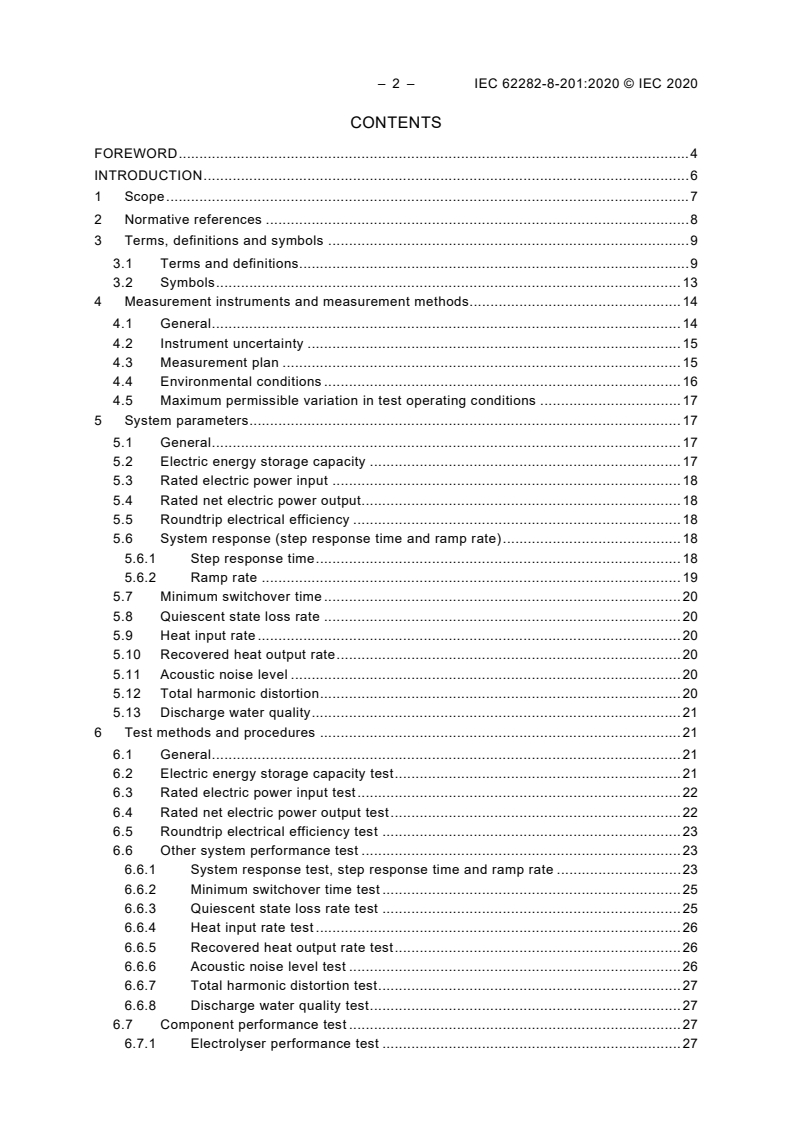
– 2 – IEC 62282-8-201:2020 © IEC 2020
CONTENTS
FOREWORD . 4
INTRODUCTION . 6
1 Scope . 7
2 Normative references . 8
3 Terms, definitions and symbols . 9
3.1 Terms and definitions. 9
3.2 Symbols . 13
4 Measurement instruments and measurement methods . 14
4.1 General . 14
4.2 Instrument uncertainty . 15
4.3 Measurement plan . 15
4.4 Environmental conditions . 16
4.5 Maximum permissible variation in test operating conditions . 17
5 System parameters . 17
5.1 General . 17
5.2 Electric energy storage capacity . 17
5.3 Rated electric power input . 18
5.4 Rated net electric power output. 18
5.5 Roundtrip electrical efficiency . 18
5.6 System response (step response time and ramp rate) . 18
5.6.1 Step response time . 18
5.6.2 Ramp rate . 19
5.7 Minimum switchover time . 20
5.8 Quiescent state loss rate . 20
5.9 Heat input rate . 20
5.10 Recovered heat output rate . 20
5.11 Acoustic noise level . 20
5.12 Total harmonic distortion . 20
5.13 Discharge water quality . 21
6 Test methods and procedures . 21
6.1 General . 21
6.2 Electric energy storage capacity test . 21
6.3 Rated electric power input test . 22
6.4 Rated net electric power output test . 22
6.5 Roundtrip electrical efficiency test . 23
6.6 Other system performance test . 23
6.6.1 System response test, step response time and ramp rate . 23
6.6.2 Minimum switchover time test . 25
6.6.3 Quiescent state loss rate test . 25
6.6.4 Heat input rate test . 26
6.6.5 Recovered heat output rate test . 26
6.6.6 Acoustic noise level test . 26
6.6.7 Total harmonic distortion test . 27
6.6.8 Discharge water quality test . 27
6.7 Component performance test . 27
6.7.1 Electrolyser performance test . 27
6.7.2 Hydrogen storage performance test . 28
6.7.3 Fuel cell performance test . 28
6.7.4 Water management system performance test . 29
6.7.5 Battery performance test . 29
6.7.6 Oxygen storage performance test . 29
7 Test reports . 29
7.1 General . 29
7.2 Report items . 29
7.3 Tested system data description . 30
7.4 Test condition description . 30
7.5 Test data description . 30
7.6 Uncertainty evaluation . 30
Bibliography . 31
Figure 1 – System configuration of electric energy storage system using hydrogen – Type
with electrolyser and fuel cell . 7
Figure 2 – System configuration of electric energy storage system using hydrogen – Type
with reversible cell . 8
Figure 3 – Typical sequence of phases during the system operation . 16
Figure 4 – Step response time and ramp rate of EES system . 19
Figure 5 – Step response test . 24
Figure 6 – Minimum switch over time test . 25
Table 1 – Symbols . 14
Table 2 – Required steps before executing the measurement . 16
Table 3 – Example of document format of roundtrip electrical efficiency . 23
Table 4 – Additional parameters measured on the electrolyser or the reversible cell
module in electrolysis mode . 27
Table 5 – Additional parameters measured on the hydrogen storage component . 28
Table 6 – Additional parameters measured on the fuel cell or the reversible cell module
in fuel cell mode . 28
– 4 – IEC 62282-8-201:2020 © IEC 2020
INTERNATIONAL ELECTROTECHNICAL COMMISSION
____________
FUEL CELL TECHNOLOGIES –
Part 8-201: Energy storage systems using fuel cell modules in reverse
mode – Test procedures for the performance of power-to-power systems
FOREWORD
1) The International Electro technical Commission (IEC) is a worldwide organization for standardization comprising
all national electro technical committees (IEC National Committees). The object of IEC is to promote international
co-operation on all questions concerning standardization in the electrical and electronic fields. To this end and in
addition to other activities, IEC publishes International Standards, Technical Specifications, Technical Reports,
Publicly Available Specifications (PAS) and Guides (hereafter referred to as "IEC Publication(s)"). Their
preparation is entrusted to technical committees; any IEC National Committee interested in the subject dealt with
may participate in this preparatory work. International, governmental and non-governmental organizations liaising
with the IEC also participate in this preparation. IEC collaborates closely with the International Organization for
Standardization (ISO) in accordance with conditions determined by agreement between the two organizations.
2) The formal decisions or agreements of IEC on technical matters express, as nearly as possible, an international
consensus of opinion on the relevant subjects since each technical committee has representation from all
interested IEC National Committees.
3) IEC Publications have the form of recommendations for international use and are accepted by IEC National
Committees in that sense. While all reasonable efforts are made to ensure that the technical content of IEC
Publications is accurate, IEC cannot be held responsible for the way in which they are used or for any
misinterpretation by any end user.
4) In order to promote international uniformity, IEC National Committees undertake to apply IEC Publications
transparently to the maximum extent possible in their national and regional publications. Any divergence between
any IEC Publication and the corresponding national or regional publication shall be clearly indicated in the latter.
5) IEC itself does not provide any attestation of conformity. Independent certification bodies provide conformity
assessment services and, in some areas, access to IEC marks of conformity. IEC is not responsible for any
services carried out by independent certification bodies.
6) All users should ensure that they have the latest edition of this publication.
7) No liability shall attach to IEC or its directors, employees, servants or agents including individual experts and
members of its technical committees and IEC National Committees for any personal injury, property damage or
other damage of any nature whatsoever, whether direct or indirect, or for costs (including legal fees) and expenses
arising out of the publication, use of, or reliance upon, this IEC Publication or any other IEC Publications.
8) Attention is drawn to the normative references cited in this publication. Use of the referenced publications is
indispensable for the correct application of this publication.
9) Attention is drawn to the possibility that some of the elements of this IEC Publication may be the subject of patent
rights. IEC shall not be held responsible for identifying any or all such patent rights.
International Standard IEC 62282-8-201 has been prepared by IEC technical committee 105:
Fuel cell technologies.
The text of this International Standard is based on the following documents:
FDIS Report on voting
105/764/FDIS 105/777/RVD
Full information on the voting for the approval of this International Standard can be found in the
report on voting indicated in the above table.
This document has been drafted in accordance with the ISO/IEC Directives, Part 2.
A list of all parts in the IEC 62282 series, published under the general title Fuel cell technologies,
can be found on the IEC website.
The committee has decided that the contents of this document will remain unchanged until the
stability date indicated on the IEC website under "http://webstore.iec.ch" in the data related to
the specific document. At this date, the document will be
• reconfirmed,
• withdrawn,
• replaced by a revised edition, or
• amended.
IMPORTANT – The 'colour inside' logo on the cover page of this publication indicates
that it contains colours which are considered to be useful for the correct understanding
of its contents. Users should therefore print this document using a colour printer.
– 6 – IEC 62282-8-201:2020 © IEC 2020
INTRODUCTION
This part of IEC 62282 describes performance evaluation methods for electric energy storage
systems using hydrogen that employ electrochemical reactions both for water/steam electrolysis
and electric generation.
This document is intended for power to power systems which typically employ a set of
electrolyser and fuel cell, or a reversible cell for devices of electric charge and discharge.
A typical targeting application of the electric energy storage systems using hydrogen is in the
class of energy intensive electric energy storage. The systems are recognized as critically
useful for the relatively long-term power storage operation, such as efficient storage and supply
of the renewable power derived electric energy and grid stabilization.
IEC 62282-8 (all parts) aims to develop performance test methods for power storage and
buffering systems based on electrochemical modules (combining electrolysis and fuel cells, in
particular reversible cells), taking into consideration both options of re-electrification and
substance (and heat) production for sustainable integration of renewable energy sources.
Under the general title Energy storage systems using fuel cell modules in reverse mode, the
IEC 62282-8 series consists of the following parts:
• IEC 62282-8-101: Test procedures for the performance of solid oxide single cells and stacks,
including reversible operation
• IEC 62282-8-102: Test procedures for the performance of single cells and stacks with proton
exchange membranes, including reversible operation
• IEC 62282-8-103 : Alkaline single cell and stack performance including reversible operation
• IEC 62282-8-201: Test procedures for the performance of power-to-power systems
• IEC 62282-8-202 : Power-to-power systems – Safety
• IEC 62282-8-300 (all parts) : Power-to-substance systems
As a priority dictated by the emerging needs for industry and opportunities for technological
development, IEC 62282-8-101, IEC 62282-8-102 and IEC 62282-8-201 have been initiated
jointly and firstly. These parts are presented as a package to highlight the need for an integrated
approach as regards the system's application (i.e. a solution for energy storage) and its
fundamental constituent components (i.e. fuel cells operated in reverse or reversing mode).
IEC 62282-8-103, IEC 62282-8-202 and IEC 62282-8-300 (all parts) are suggested but are left
for initiation at a later stage.
____________
Under consideration.
Under consideration.
Under consideration.
FUEL CELL TECHNOLOGIES –
Part 8-201: Energy storage systems using fuel cell modules in reverse
mode – Test procedures for the performance of power-to-power systems
1 Scope
This part of IEC 62282 defines the evaluation methods of typical performances for electric
energy storage systems using hydrogen. This is applicable to the systems that use
electrochemical reaction devices for both power charge and discharge. This document applies
to systems that are designed and used for service and operation in stationary locations (indoor
and outdoor).
The conceptual configurations of the electric energy storage systems using hydrogen are shown
in Figure 1 and Figure 2. Figure 1 shows the system independently equipped with an electrolyser
module and a fuel cell module. Figure 2 shows the system equipped with a reversible cell
module. There are an electrolyser, a hydrogen storage and a fuel cell, or a reversible cell, a
hydrogen storage and an overall management system (which may include a pressure
management) as indispensable components. There may be a battery, an oxygen storage, a heat
management system (which may include a heat storage) and a water management system
(which may include a water storage) as optional components. The performance measurement is
executed in the area surrounded by the outside thick solid line square (system boundary).
NOTE In the context of this document, the term "reversible" does not refer to the thermodynamic meaning of an ideal
process. It is common practice in the fuel cell community to call the operation mode of a cell that alternates between
fuel cell mode and electrolysis mode "reversible".
This document is intended to be used for data exchanges in commercial transactions between
the system manufacturers and customers. Users of this document can selectively execute test
items suitable for their purposes from those described in this document.
Figure 1 – System configuration of electric energy storage system using hydrogen
– Type with electrolyser and fuel cell
– 8 – IEC 62282-8-201:2020 © IEC 2020
Figure 2 – System configuration of electric energy storage system using hydrogen
– Type with reversible cell
2 Normative references
The following documents are referred to in the text in such a way that some or all of their content
constitutes requirements of this document. For dated references, only the edition cited applies.
For undated references, the latest edition of the referenced document (including any
amendments) applies.
IEC 61427-1, Secondary cells and batteries for renewable energy storage – General
requirements and methods of test – Part 1: Photovoltaic off-grid application
IEC 61427-2, Secondary cells and batteries for renewable energy storage – General
requirements and methods of test – Part 2: On-grid applications
IEC 62282-3-200, Fuel cell technologies – Part 3-200: Stationary fuel cell power systems –
Performance test methods
IEC 62282-3-201, Fuel cell technologies – Part 3-201: Stationary fuel cell power systems –
Performance test methods for small fuel cell power systems
IEC 62282-8-101, Fuel cell technologies – Part 8-101: Energy storage systems using fuel cell
modules in reverse mode – Solid oxide single cell and stack performance including reversible
operation
IEC 62282-8-102, Fuel cell technologies – Part 8-102: Energy storage systems using fuel cell
modules in reverse mode – Test procedures for PEM single cell and stack performance including
reversible operation
IEC 62933-2-1:2017, Electrical energy storage (EES) systems – Part 2-1: Unit parameters and
testing methods – General specification
ISO/IEC Guide 98-3, Uncertainly of measurement – Part 3: Guide to the expression of
uncertainty in measurement (GUM:1995)
ISO 3746, Acoustics – Determination of sound power levels and sound energy levels of noise
sources using sound pressure – Survey method using an enveloping measurement surface over
a reflecting plane
ISO 4064-1, Water meters for cold potable water and hot water – Part 1: Metrological and
technical requirements
ISO 4064-2, Water meters for cold potable water and hot water – Part 2: Test methods
ISO 7888, Water quality – Determination of electrical conductivity
ISO 9614-1, Acoustics – Determination of sound power levels of noise sources using sound
intensity – Part 1: Measurement at discrete points
ISO 11204, Acoustics – Noise emitted by machinery and equipment – Determination of emission
sound pressure levels at a work station and at other specified positions applying accurate
environmental corrections
ISO 16111, Transportable gas storage devices – Hydrogen absorbed in reversible metal hydride
ISO 19880-1, Gaseous hydrogen – Fuelling stations – Part 1: General requirements
ISO 19881, Gaseous hydrogen – Land vehicle fuel containers
ISO 19882, Gaseous hydrogen – Thermally activated pressure relief devices for compressed
hydrogen vehicle fuel containers
ISO 19884, Gaseous hydrogen – Cylinders and tubes for stationary storage
ISO 22734-1, Hydrogen generators using water electrolysis process – Part 1: Industrial and
commercial applications
ISO 22734-2, Hydrogen generators using water electrolysis process – Part 2: Residential
applications
3 Terms, definitions and symbols
3.1 Terms and definitions
For the purposes of this document, the following terms and definitions apply.
ISO and IEC maintain terminological databases for use in standardization at the following
addresses:
• IEC Electropedia: available at http://www.electropedia.org/
• ISO Online browsing platform: available at http://www.iso.org/obp
3.1.1
electric energy storage
EES
installation able to store electric energy or which converts electric energy into another form of
energy and vice versa, while storing energy
– 10 – IEC 62282-8-201:2020 © IEC 2020
Note 1 to entry: EES can be used also to indicate the activity of an apparatus described in the definition during
performing its own functionality.
Note 2 to entry: This note applies to the French language only.
[SOURCE: IEC 62933-1:2018, 3.1, modified – Definition revised and example and note 2
deleted.]
3.1.2
electric energy storage system
EES system
installation with defined electrical boundaries, comprising at least one EES, whose purpose is to
extract electric energy from the electric power system, store this energy in some manner and
inject electric energy into the electric power system and which includes civil engineering works,
energy conversion equipment and related ancillary equipment
Note 1 to entry: The EES system is controlled and coordinated to provide services to the electric power system
operators or to the electric power system users.
Note 2 to entry: In some cases, an EES system can require an additional energy source during its discharge,
providing more energy to the electric power system than the energy it stores.
Note 3 to entry: This note applies to the French language only.
[SOURCE: IEC 62933-1:2018, 3.2, modified – "grid connected" and "internally" deleted, "whose
purpose is to" added and note 3 deleted.]
3.1.3
EES system using hydrogen
EES system comprising at least one EES using hydrogen, whose purpose is to extract electric
energy from the electric power system, store this energy as hydrogen and inject electric energy
into the electric power system, using hydrogen as a fuel
Note 1 to entry: The conceptual configurations of the EES system using hydrogen are referred to in Clause 1.
3.1.4
battery
device for storing electricity with electricity charge and discharge functions
Note 1 to entry: They are typically employed for absorbing short-term fluctuating electricity input combined with
hydrogen storage of an EES system using hydrogen.
3.1.5
electrolyser
electrochemical device that converts water/steam to hydrogen and oxygen by electrolysis
reaction
Note 1 to entry: They include alkaline water electrolysis device, polymer electrolyte water electrolysis device, solid
oxide electrolysis cell device, and other devices of similar type.
3.1.6
environment
surroundings in which an EES system using hydrogen exists, including air, water, land, natural
resources, flora, fauna, humans, and their interrelation
3.1.7
fuel cell
electrochemical device that converts the chemical energy of a fuel and an oxidant to electric
energy (DC power), heat and reaction products
Note 1 to entry: The fuel and oxidant are typically stored outside of the fuel cell and transferred into the fuel cell as
they are consumed.
[SOURCE: IEC 60050-485:—, 485-08-01]
3.1.8
heat management system
subsystem of the EES system using hydrogen, for controlling the heat storage and flows in the
system and its POCs (if applicable)
Note 1 to entry: Typically, heat is utilized among the various system equipment. An example of the mutual heat
utilization is where the exothermic reaction heat of the fuel cell is conveyed to an electrolysis cell, in particular a solid
oxide electrolysis cell for endothermic consumption.
3.1.9
hydrogen storage
component of the EES system using hydrogen, for storing hydrogen which is produced by
water/steam electrolysis in or supplied to the system
Note 1 to entry: There are several kinds of hydrogen storage equipment depending on the hydrogen storage
principles. They include low/high-pressure gas, liquid, hydrogen-absorbing alloy (hydrogen absorbed in reversible
metal hydride), non-metal hydrides and others.
3.1.10
limit operating conditions
conditions not to be exceeded for operating the system normally and safely
Note 1 to entry: They are recommended by the system manufacturer considering the system characteristics.
3.1.11
net electric energy output
usable electric energy output from the EES system using hydrogen, which is able to serve for the
user’s purpose, excluding internal and external electric energy dissipation of the system
Note 1 to entry: The internal and external electric dissipation of the system is typically electric energy loss from the
equipment operations and connections.
Note 2 to entry: The net electric energy output is the difference between the electric energy outputs and inputs at all
POCs.
3.1.12
net electric power
power output of the electric energy storage system and available for external use
Note 1 to entry: The net electric power output is the difference between the electric power outputs and inputs at all
POCs.
3.1.13
operating conditions
conditions at which the tested system, more specifically each equipment of the tested system, is
operated, as well as physical conditions such as range of ambient temperatures, pressure,
radiation levels, humidity and atmosphere are included
3.1.14
operating state
state at which the tested system, more specifically each equipment of the tested system, is
operated at specified conditions
3.1.15
overall management system
subsystem of the EES system using hydrogen, served for monitoring and controlling the EES
system using hydrogen, by fulfilling all equipment and functions for acquisition, processing,
transmission, and display of the necessary process information
– 12 – IEC 62282-8-201:2020 © IEC 2020
Note 1 to entry: The overall management system also includes a subsystem containing an arrangement of hardware,
software, and propagation media to allow the transfer of messages from one EES system using hydrogen
component/subsystem to another one, including the data interface with external links.
Note 2 to entry: Generally, the control subsystem may be connected to the primary POC (just for data exchange) and
it can comprise the communication subsystem and the protection subsystem.
Note 3 to entry: The protection subsystem includes one or more protection equipment, instrument transformer(s),
transducers, wiring, tripping circuit(s), auxiliary supply(s). Depending upon the principle(s) of the protection system,
it may include one end or all ends of the protected section and, possibly, automatic reclosing equipment.
3.1.16
oxygen storage
one component of the EES system using hydrogen, for storing oxygen, which is produced by
water/steam electrolysis in (or supplied to) the system
Note 1 to entry: Oxygen storage is equipped, if needed.
3.1.17
point of connection
POC
point where an EES system using hydrogen is connected to a supply/extraction exterior to the
system
Note 1 to entry: Generally, POCs are electricity, heat, water, hydrogen and oxygen/air connection points. They are
shown as open circles on the system boundary (thick solid-line square) in Figure 1 and Figure 2.
Note 2 to entry: This note applies to the French language only.
3.1.18
quiescent state
operating state of the EES system, where it is partly or fully charged, and no intended
discharging of the stored energy takes place
3.1.19
quiescent state loss rate
sum of energy loss rate and energy consumption rate of EES system during the quiescent state
3.1.20
rated operating conditions
conditions which are applied for standard operation of equipment and/or system
Note 1 to entry: They are recommended by the equipment and/or system manufacturers considering the respective
characteristics of the equipment/system.
3.1.21
rated input conditions
conditions specified by the manufacturer, at which the tested system absorbs electric power
input at the POC
3.1.22
rated output conditions
conditions specified by the manufacturer, at which the tested system delivers electric power
output at the POC
3.1.23
rated test conditions
specific boundary conditions at which the tested system is operated
Note 1 to entry: They shall be agreed between the system manufacturer and customer.
3.1.24
reversible cell
electrochemical device that is able to operate as a fuel cell or as an electrolyser, alternatively
Note 1 to entry: The term "reversible" in this context does not refer to the thermodynamic principle of an ideal
process.
3.1.25
roundtrip electrical efficiency
electric energy discharged measured on the primary point of connection (POC) divided by the
electric energy absorbed, measured on all the POC (primary and auxiliary), over one EES
system standard charging/discharging cycle in specified operating conditions
Note 1 to entry: Efficiency is generally expressed in percentage.
3.1.26
operation history
record of the operating conditions of the system
3.1.27
switchover time
time that is required to switch an EES system using hydrogen from a specified charging phase to
a specified discharging phase or vice versa
Note 1 to entry: This can be of relevance in case grid service shall be performed with the system. It comprises the
time that is required to go from one operating point in either charging or discharging operation to quiescent state,
purging of gas lines if applicable, setting of auxiliary components (valves, heaters, compressors etc.) if applicable and
to go to an operating point in the opposite operating phase (discharging or charging).
3.1.28
test state
state of the tested system that is consistent with the objective of the evaluation
Note 1 to entry: More specifically, it means the specific operating state for equipment of the tested system.
3.1.29
tested system
system defined by its boundary to the environment, that is in accordance with the objective of the
evaluation
3.1.30
water management system
subsystem of the EES system using hydrogen, for controlling the water and/or steam flows in the
system
Note 1 to entry: It includes the controlling mechanisms of water inlet, transport, purifying (if applicable), and drain.
3.2 Symbols
The symbols and their meanings used in this document are given in Table 1, with the appropriate
units.
– 14 – IEC 62282-8-201:2020 © IEC 2020
Table 1 – Symbols
Symbol Definition Unit Equation
k Coverage factor
n Number of measurements until discharge completion in (3)
P Active power at the POC W in (2)
el
P Quiescent state loss rate W in (5)
el,loss
P Net electric power output W in (3)
el,out
dP/dt Ramp rate W/s in (2)
Time when the system, which is at rest, receives the set
t in (1)
point value
Time when the active power at the POC becomes less than
90 % for negative state or higher than 10 % for positive state
t in (2)
of the set point value
Time when the active power at the POC becomes less than
t 10 % for negative state or higher than 90 % for positive state in (2)
of the set point value
Time when the active power at the POC reaches within 2 %
t in (1)
of the set point value
t Measurement time of self-discharging h in (5)
loss
t Switch over time s
so
t Step response time s in (1)
sr
W Electric energy storage capacity Wh in (3)
el
W Electric energy input Wh in (4), (5)
el,in
W Net electric energy output Wh in (3)
el,out
Δt Sampling time of measurement h in (3)
η Roundtrip electrical efficiency % in (4)
el
4 Measurement instruments and measurement methods
4.1 General
For measuring certain properties of the tested system, the configuration of its components and
the boundary conditions to the environment shall be determined first.
Attention is required to clearly define the tested system. The components which the tested
system includes and the conditions of the test environment at all points of connection (POC)
shall be defined. The POCs are input/output of electricity, heat, water, hydrogen and oxygen/air.
The boundary conditions for all POCs shall be defined.
Secondly, the test state of the system shall be defined. The test state of the system means the
operating levels compared to the maximum capability of either the system or one of its
components at the time of test execution.
Then the operating conditions for the test shall be defined. They shall be agreed between the
system manufacturer and the customer.
It shall be noted that the operation history and the actual operating time of the system affects the
evaluation of system performance values. During execution of the tests, the operating times
shall be noted. They are the electric input time, the electric output time, the input-and-output
quiescent period, and combination patterns thereof. Moreover, the history of the operating times
for the system before executing the test shall also be reported.
4.2 Instrument uncertainty
The expanded uncertainty of each measuring instrument (coverage factor k = 2) at the time of
calibration or that estimated from the class of instrument shall meet the following requirements:
– power: ±2 % of reading;
– ambient temperature: ±1 K;
– ambient pressure: ±0,1 kPa;
– ambient humidity: ±1 % (absolute).
Instruments that satisfy the above requirements shall be used. ISO/IEC Guide 98-3 shall apply.
4.3 Measurement plan
The components' configuration, the boundary conditions to the environment of the tested system
and the test state shall be clearly defined. The test state shall be considered according to the
application and usage. Also, the test phases, which are charge, storage and discharge
illustrated in Figure 3, should be considered.
The rated and the limit operating conditions for the tested system are confirmed between the
system manufacturer and the customer. The rated and the limit operating conditions for each
component shall be established from the component manufacturers’ specifications.
Then the sequence of the measurements shall be planned. It shall be considered that certain
properties of some components relate to the conditions and/or the condition settings for other
components. For example, the operating state of the hydrogen storage capacity relates to the
operating conditions settings of the electrolyser. Also, attention should be paid to the fact that
some properties can change considerably during the measurement. For example, the electric
power input can vary during a charging phase. The test state shall be clearly defined and the
property changes during the measurement shall be identified. For setting up the measurement
methods and instruments, instrument uncertainty and permissible variation shall be checked
and reported. The related regulations shall be considered. The required steps before executing
the measurement are summarized in Table 2.
After confirming that the system is operating under the test state, the measurement for testing
the system performance is executed.
– 16 – IEC 62282-8-201:2020 © IEC 2020
Figure 3 – Typical sequence of phases during the system operation
Table 2 – Required steps before executing the measurement
Step Requirements Remarks
1 Note the system components configuration.
2 Define the system boundary. Ambient conditions shall be defined.
3 Note the initial operating state of the system. The operation history of the system shall be
reported.
4 Confirm the rated and the limit operating conditions The rated and the limit operating conditions for the
for the system. system shall be confirmed between system
manufacturer and customer.
5 Defin
...