

IEC 62127-2:2025
(Main)Ultrasonics - Hydrophones - Part 2: Calibration for ultrasonic fields
General Information
- Abstract
IEC 62127-2:2025 specifies:
- absolute hydrophone calibration methods;
- relative (comparative) hydrophone calibration methods.
Recommendations and references to accepted literature are made for the various relative and absolute calibration methods in the frequency range covered by this document.
This document is applicable to
- hydrophones used for measurements made in water and in the ultrasonic frequency range 50 kHz to 100 MHz;
- hydrophones employing piezoelectric sensor elements, designed to measure the pulsed wave and continuous wave ultrasonic fields generated by ultrasonic equipment;
- hydrophones with or without a hydrophone pre-amplifier.
IEC 62127-2:2025 cancels and replaces the first edition published in 2007, Amendment 1:2013 and Amendment 2:2017. This edition constitutes a technical revision.
This edition includes the following significant technical changes with respect to the previous edition:
a) the upper frequency limit of 40 MHz has been removed;
b) hydrophone sensitivity definitions have been changed to recognize sensitivities as complex-valued quantities;
c) directional response measurement and effective size determination procedures have been updated in 12.5.1 to align with recent changes in IEC 62127-3;
d) Annex F has been amended to comprise a calibration technique for high-frequency complex-valued calibration;
e) the reciprocity method description in Annex K was extended to also comprise focusing transducers.
- Status
- Published
- Publication Date
- 06-Jan-2025
- Technical Committee
- TC 87 - Ultrasonics
- Drafting Committee
- WG 8 - TC 87/WG 8
- Current Stage
- PPUB - Publication issued
- Start Date
- 07-Jan-2025
- Completion Date
- 13-Dec-2024
Overview
IEC 62127-2:2025 is the latest international standard developed by the International Electrotechnical Commission (IEC) focusing on ultrasonics hydrophone calibration for ultrasonic fields. This standard is a comprehensive technical revision of previous editions and amendments, providing up-to-date calibration methodologies that apply to hydrophones used in water-based ultrasonic measurements. It covers both absolute and relative calibration methods within the ultrasonic frequency range of 50 kHz to 100 MHz.
This standard specifically addresses hydrophones equipped with piezoelectric sensor elements, designed to measure pulsed or continuous ultrasonic waves. It applies to hydrophones with or without pre-amplifiers, making it relevant for a wide range of ultrasonic measurement equipment.
Key Topics
Calibration Methods
IEC 62127-2:2025 specifies detailed procedures for both absolute calibration, which establishes a direct reference measurement of hydrophone sensitivity, and relative (comparative) calibration, which compares a hydrophone against a calibrated standard.Frequency Range Extension
The updated standard removes the previous upper frequency limit of 40 MHz, extending effective calibration and measurement capabilities up to 100 MHz. This broad frequency coverage enables applications in advanced ultrasonic testing and research.Complex-Valued Sensitivity
Sensitivity definitions now recognize hydrophone sensitivity as a complex quantity, reflecting both magnitude and phase, essential for accurate characterization of ultrasonic fields.Directional Response and Effective Size
Updated procedures for measuring the hydrophone directional response and its effective size ensure precise field characterization, enhancing measurement reliability.Reciprocity Calibration Methods
Refinements include enhanced descriptions for the reciprocity calibration method, extended to focus on transducers that can concentrate ultrasonic energy, improving calibration accuracy for high-intensity ultrasonic fields.
Applications
IEC 62127-2:2025 is critical in ensuring reliable and accurate ultrasonic field measurements used in multiple applications:
Medical Ultrasound Equipment Testing
Calibrated hydrophones are essential for validating the performance and safety of diagnostic and therapeutic ultrasound devices.Non-Destructive Testing (NDT)
Precise hydrophone calibration supports the detection and characterization of flaws in materials through ultrasonic inspection.Underwater Acoustics and Sonar
Accurate ultrasonic field measurements contribute to sonar system calibration and underwater communication technologies.Industrial Ultrasonics
Applications include precise measurement for cleaning, welding, and processing equipment involving high-frequency ultrasonic fields.Research and Development
Enables ultrasonics researchers to carry out high-precision experiments benefiting from standardized calibration procedures and calibrated instrumentation.
Related Standards
- IEC 62127-1 - General requirements for hydrophones used in ultrasonic measurements.
- IEC 62127-3 - Methods for measuring directional response of hydrophones, which align closely with updates introduced in IEC 62127-2:2025.
- IEC 61161 - Ultrasonic field characterization methods, providing complementary techniques supporting hydrophone calibration.
- ISO/IEC 17025 - General requirements for the competence of testing and calibration laboratories, relevant for labs implementing IEC 62127-2 procedures.
Implementing IEC 62127-2:2025 ensures that ultrasonic measurement systems using hydrophones deliver high accuracy, traceability, and repeatability of results, meeting the rigorous demands of medical, industrial, and research applications worldwide. This standard serves as a key reference for engineers, calibration laboratories, and instrument manufacturers aiming for the highest standards in ultrasonic hydrophone calibration.
Relations
- Effective Date
- 05-Sep-2023
- Effective Date
- 05-Sep-2023
- Effective Date
- 05-Sep-2023
- Effective Date
- 05-Sep-2023
Get Certified
Connect with accredited certification bodies for this standard

BSMI (Bureau of Standards, Metrology and Inspection)
Taiwan's standards and inspection authority.
Sponsored listings
Frequently Asked Questions
IEC 62127-2:2025 is a standard published by the International Electrotechnical Commission (IEC). Its full title is "Ultrasonics - Hydrophones - Part 2: Calibration for ultrasonic fields". This standard covers: IEC 62127-2:2025 specifies: - absolute hydrophone calibration methods; - relative (comparative) hydrophone calibration methods. Recommendations and references to accepted literature are made for the various relative and absolute calibration methods in the frequency range covered by this document. This document is applicable to - hydrophones used for measurements made in water and in the ultrasonic frequency range 50 kHz to 100 MHz; - hydrophones employing piezoelectric sensor elements, designed to measure the pulsed wave and continuous wave ultrasonic fields generated by ultrasonic equipment; - hydrophones with or without a hydrophone pre-amplifier. IEC 62127-2:2025 cancels and replaces the first edition published in 2007, Amendment 1:2013 and Amendment 2:2017. This edition constitutes a technical revision. This edition includes the following significant technical changes with respect to the previous edition: a) the upper frequency limit of 40 MHz has been removed; b) hydrophone sensitivity definitions have been changed to recognize sensitivities as complex-valued quantities; c) directional response measurement and effective size determination procedures have been updated in 12.5.1 to align with recent changes in IEC 62127-3; d) Annex F has been amended to comprise a calibration technique for high-frequency complex-valued calibration; e) the reciprocity method description in Annex K was extended to also comprise focusing transducers.
IEC 62127-2:2025 specifies: - absolute hydrophone calibration methods; - relative (comparative) hydrophone calibration methods. Recommendations and references to accepted literature are made for the various relative and absolute calibration methods in the frequency range covered by this document. This document is applicable to - hydrophones used for measurements made in water and in the ultrasonic frequency range 50 kHz to 100 MHz; - hydrophones employing piezoelectric sensor elements, designed to measure the pulsed wave and continuous wave ultrasonic fields generated by ultrasonic equipment; - hydrophones with or without a hydrophone pre-amplifier. IEC 62127-2:2025 cancels and replaces the first edition published in 2007, Amendment 1:2013 and Amendment 2:2017. This edition constitutes a technical revision. This edition includes the following significant technical changes with respect to the previous edition: a) the upper frequency limit of 40 MHz has been removed; b) hydrophone sensitivity definitions have been changed to recognize sensitivities as complex-valued quantities; c) directional response measurement and effective size determination procedures have been updated in 12.5.1 to align with recent changes in IEC 62127-3; d) Annex F has been amended to comprise a calibration technique for high-frequency complex-valued calibration; e) the reciprocity method description in Annex K was extended to also comprise focusing transducers.
IEC 62127-2:2025 is classified under the following ICS (International Classification for Standards) categories: 17.140.50 - Electroacoustics. The ICS classification helps identify the subject area and facilitates finding related standards.
IEC 62127-2:2025 has the following relationships with other standards: It is inter standard links to IEC 62127-2:2007, IEC 62127-2:2007/AMD2:2017, IEC 62127-2:2007/AMD1:2013, IEC 62127-2:2007/COR1:2008. Understanding these relationships helps ensure you are using the most current and applicable version of the standard.
IEC 62127-2:2025 is available in PDF format for immediate download after purchase. The document can be added to your cart and obtained through the secure checkout process. Digital delivery ensures instant access to the complete standard document.
Standards Content (Sample)
IEC 62127-2 ®
Edition 2.0 2025-01
INTERNATIONAL
STANDARD
NORME
INTERNATIONALE
Ultrasonics – Hydrophones –
Part 2: Calibration for ultrasonic fields
Ultrasons – Hydrophones –
Partie 2: Etalonnage des champs ultrasoniques
All rights reserved. Unless otherwise specified, no part of this publication may be reproduced or utilized in any form
or by any means, electronic or mechanical, including photocopying and microfilm, without permission in writing from
either IEC or IEC's member National Committee in the country of the requester. If you have any questions about IEC
copyright or have an enquiry about obtaining additional rights to this publication, please contact the address below or
your local IEC member National Committee for further information.
Droits de reproduction réservés. Sauf indication contraire, aucune partie de cette publication ne peut être reproduite ni
utilisée sous quelque forme que ce soit et par aucun procédé, électronique ou mécanique, y compris la photocopie et
les microfilms, sans l'accord écrit de l'IEC ou du Comité national de l'IEC du pays du demandeur. Si vous avez des
questions sur le copyright de l'IEC ou si vous désirez obtenir des droits supplémentaires sur cette publication, utilisez
les coordonnées ci-après ou contactez le Comité national de l'IEC de votre pays de résidence.
IEC Secretariat Tel.: +41 22 919 02 11
3, rue de Varembé info@iec.ch
CH-1211 Geneva 20 www.iec.ch
Switzerland
About the IEC
The International Electrotechnical Commission (IEC) is the leading global organization that prepares and publishes
International Standards for all electrical, electronic and related technologies.
About IEC publications
The technical content of IEC publications is kept under constant review by the IEC. Please make sure that you have the
latest edition, a corrigendum or an amendment might have been published.
IEC publications search - webstore.iec.ch/advsearchform IEC Products & Services Portal - products.iec.ch
The advanced search enables to find IEC publications by a Discover our powerful search engine and read freely all the
variety of criteria (reference number, text, technical publications previews, graphical symbols and the glossary.
committee, …). It also gives information on projects, replaced With a subscription you will always have access to up to date
and withdrawn publications. content tailored to your needs.
IEC Just Published - webstore.iec.ch/justpublished
Electropedia - www.electropedia.org
Stay up to date on all new IEC publications. Just Published
The world's leading online dictionary on electrotechnology,
details all new publications released. Available online and once
containing more than 22 500 terminological entries in English
a month by email.
and French, with equivalent terms in 25 additional languages.
Also known as the International Electrotechnical Vocabulary
IEC Customer Service Centre - webstore.iec.ch/csc
(IEV) online.
If you wish to give us your feedback on this publication or need
further assistance, please contact the Customer Service
Centre: sales@iec.ch.
A propos de l'IEC
La Commission Electrotechnique Internationale (IEC) est la première organisation mondiale qui élabore et publie des
Normes internationales pour tout ce qui a trait à l'électricité, à l'électronique et aux technologies apparentées.
A propos des publications IEC
Le contenu technique des publications IEC est constamment revu. Veuillez vous assurer que vous possédez l’édition la
plus récente, un corrigendum ou amendement peut avoir été publié.
Recherche de publications IEC - IEC Products & Services Portal - products.iec.ch
webstore.iec.ch/advsearchform Découvrez notre puissant moteur de recherche et consultez
La recherche avancée permet de trouver des publications IEC gratuitement tous les aperçus des publications, symboles
en utilisant différents critères (numéro de référence, texte, graphiques et le glossaire. Avec un abonnement, vous aurez
comité d’études, …). Elle donne aussi des informations sur les toujours accès à un contenu à jour adapté à vos besoins.
projets et les publications remplacées ou retirées.
Electropedia - www.electropedia.org
IEC Just Published - webstore.iec.ch/justpublished
Le premier dictionnaire d'électrotechnologie en ligne au monde,
Restez informé sur les nouvelles publications IEC. Just
avec plus de 22 500 articles terminologiques en anglais et en
Published détaille les nouvelles publications parues.
français, ainsi que les termes équivalents dans 25 langues
Disponible en ligne et une fois par mois par email.
additionnelles. Egalement appelé Vocabulaire
Electrotechnique International (IEV) en ligne.
Service Clients - webstore.iec.ch/csc
Si vous désirez nous donner des commentaires sur cette
publication ou si vous avez des questions contactez-nous:
sales@iec.ch.
IEC 62127-2 ®
Edition 2.0 2025-01
INTERNATIONAL
STANDARD
NORME
INTERNATIONALE
Ultrasonics – Hydrophones –
Part 2: Calibration for ultrasonic fields
Ultrasons – Hydrophones –
Partie 2: Etalonnage des champs ultrasoniques
INTERNATIONAL
ELECTROTECHNICAL
COMMISSION
COMMISSION
ELECTROTECHNIQUE
INTERNATIONALE
ICS 17.140.50 ISBN 978-2-8327-0091-4
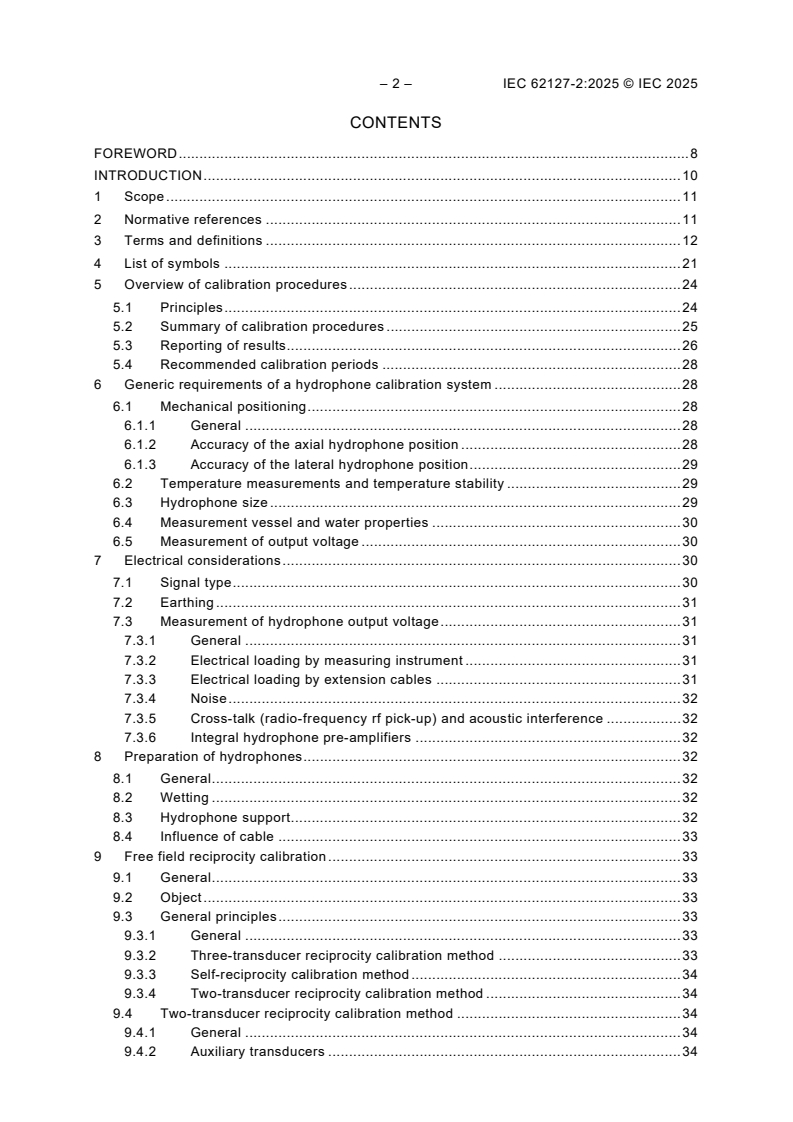
– 2 – IEC 62127-2:2025 © IEC 2025
CONTENTS
FOREWORD . 8
INTRODUCTION . 10
1 Scope . 11
2 Normative references . 11
3 Terms and definitions . 12
4 List of symbols . 21
5 Overview of calibration procedures . 24
5.1 Principles . 24
5.2 Summary of calibration procedures . 25
5.3 Reporting of results . 26
5.4 Recommended calibration periods . 28
6 Generic requirements of a hydrophone calibration system . 28
6.1 Mechanical positioning . 28
6.1.1 General . 28
6.1.2 Accuracy of the axial hydrophone position . 28
6.1.3 Accuracy of the lateral hydrophone position . 29
6.2 Temperature measurements and temperature stability . 29
6.3 Hydrophone size . 29
6.4 Measurement vessel and water properties . 30
6.5 Measurement of output voltage . 30
7 Electrical considerations . 30
7.1 Signal type . 30
7.2 Earthing . 31
7.3 Measurement of hydrophone output voltage . 31
7.3.1 General . 31
7.3.2 Electrical loading by measuring instrument . 31
7.3.3 Electrical loading by extension cables . 31
7.3.4 Noise . 32
7.3.5 Cross-talk (radio-frequency rf pick-up) and acoustic interference . 32
7.3.6 Integral hydrophone pre-amplifiers . 32
8 Preparation of hydrophones . 32
8.1 General . 32
8.2 Wetting . 32
8.3 Hydrophone support . 32
8.4 Influence of cable . 33
9 Free field reciprocity calibration . 33
9.1 General . 33
9.2 Object . 33
9.3 General principles . 33
9.3.1 General . 33
9.3.2 Three-transducer reciprocity calibration method . 33
9.3.3 Self-reciprocity calibration method . 34
9.3.4 Two-transducer reciprocity calibration method . 34
9.4 Two-transducer reciprocity calibration method . 34
9.4.1 General . 34
9.4.2 Auxiliary transducers . 34
9.4.3 Reflector . 35
9.4.4 Measurement field . 35
9.4.5 Reciprocity approach . 35
9.4.6 Measurement procedure . 35
10 Free field calibration by planar scanning . 35
10.1 General . 35
10.2 Object . 36
10.3 General principle . 36
10.4 Procedural requirements . 38
10.4.1 Hydrophone scanning . 38
10.4.2 Power measurement . 38
10.4.3 Transducer mounting . 38
10.4.4 Measurement conditions . 38
10.4.5 Measurements . 39
10.5 Corrections and sources of uncertainty . 39
11 Free field calibration by optical interferometry . 39
11.1 General . 39
11.2 Principle . 39
12 Calibration by comparison using a standard hydrophone . 39
12.1 General . 39
12.2 Object . 39
12.3 Principle . 40
12.4 Procedural requirements . 40
12.4.1 Source transducer . 40
12.4.2 Source transducer drive signal . 40
12.4.3 Measurement system . 40
12.5 Procedure . 41
12.5.1 Measurements (Type I): determination of the directional response of a
hydrophone . 41
12.5.2 Measurements (Type II): calibration by comparison using a standard
hydrophone . 42
12.6 Maximum hydrophone size . 42
Annex A (informative) Assessment of uncertainty in free field calibration of
hydrophones . 43
A.1 General . 43
A.2 Overall (expanded) uncertainty . 43
A.3 Common sources of uncertainty . 43
Annex B (informative) Behaviour of PVDF polymer sensors in high-intensity ultrasonic
fields . 45
B.1 General . 45
B.2 Theoretical background . 45
B.3 Tests . 45
B.4 Results . 46
B.5 Conclusions . 47
Annex C (informative) Electrical loading corrections . 48
C.1 General . 48
C.2 Corrections using complex impedance . 48
C.3 Corrections using only capacitances . 49
– 4 – IEC 62127-2:2025 © IEC 2025
Annex D (informative) Absolute calibration of hydrophones using the planar scanning
technique . 50
D.1 Overview. 50
D.2 Hydrophone scanning methodology. 50
D.3 Corrections and sources of measurement uncertainty . 51
D.3.1 Total power . 51
D.3.2 Received hydrophone signal . 51
D.3.3 Integration . 52
D.3.4 Directional response . 52
D.3.5 Finite size of the hydrophone . 53
D.3.6 Noise . 53
D.3.7 Nonlinear propagation . 54
D.3.8 Planar scanning . 55
D.3.9 Intensity proportional to pressure squared . 55
D.4 Rationale behind the planar scanning technique for calibrating hydrophones . 56
D.4.1 General . 56
D.4.2 Relationship between hydrophone and transducer effective radii . 56
D.4.3 Justification for al/ ≤ 0,5 . 56
t
D.4.4 Derivation of Formula (D.2). 57
D.4.5 Effect of nonlinear propagation, D.3.7 . 58
Annex E (informative) Properties of water . 60
E.1 General . 60
E.2 Attenuation coefficient for propagation in water . 61
Annex F (informative) The absolute calibration of hydrophones by optical
interferometry . 62
F.1 Overview. 62
F.2 Present position . 62
F.2.1 "Magnomic" or nonlinear propagation-based method . 62
F.2.2 Optical interferometry . 63
F.2.3 High-frequency implementations of optical interferometry . 63
Annex G (informative) Waveform concepts . 78
G.1 Overview. 78
G.2 Temporal waveform, frequency concepts and hydrophone positioning for
comparison calibrations of hydrophones . 78
G.3 Temporal waveform and frequency coverage concepts . 79
G.3.1 Using a narrow-band tone-burst (concept a) . 79
G.3.2 Using a broadband waveform resulting from a narrow-band tone-burst
after nonlinear propagation (concept b) . 80
G.3.3 Using a broadband pulse (concept c) . 80
G.3.4 Using a continuous wave frequency sweep with time delay spectrometry
(concept d) . 81
G.3.5 Continuous wave frequency sweep with TGFA (concept e) . 81
G.4 Hydrophone position concepts . 81
G.4.1 Near-field hydrophone position (concept A) . 81
G.4.2 Far field hydrophone position (concept B) . 81
G.4.3 Far field hydrophone position with special reference to a long
propagation path in order to achieve nonlinear distortion (concept C) . 82
G.4.4 Geometric spherical focus position with focusing source transducer (low
voltage or linear excitation) (concept D) . 82
G.4.5 Geometric spherical focus position with focusing source transducer and
high voltage excitation in order to achieve nonlinear distortion (concept
E) . 82
G.5 Special considerations for calibrations close to the face of a transducer . 83
G.5.1 General requirement . 83
G.5.2 Influence of edge waves . 83
G.5.3 Potential influence of head waves . 84
G.5.4 Treatment of head waves close to the transducer . 84
G.5.5 Statements on the usable paraxial plane wave region in the case of a
near-field hydrophone position, considering both edge wave and head
wave contributions . 86
Annex H (informative) Time delay spectrometry – Requirements and a brief review of
the technique . 87
H.1 General . 87
H.2 Calibration and performance evaluation of ultrasonic hydrophones using
time delay spectrometry . 87
H.2.1 Ultrasonic field parameter measured . 87
H.2.2 Ultrasonic frequency range over which the technique is applicable . 87
H.2.3 Ultrasonic field configuration for which the technique is applicable . 87
H.2.4 Spatial resolution . 88
H.2.5 Sensitivity of the technique . 88
H.2.6 Range over which the sensitivity is measured . 88
H.2.7 Reproducibility . 88
H.2.8 Impulse response . 88
H.2.9 Procedure for performing measurements . 88
H.3 Measurement procedure for sensitivity intercomparison . 89
H.4 Measurement procedure (reciprocity calibration) . 89
H.5 Limitations . 89
Annex I (informative) Determination of the phase response of hydrophones . 90
I.1 Overview. 90
I.2 Coherent time delay spectrometry . 91
I.2.1 Principle of operation . 91
I.2.2 Example results . 91
I.2.3 Uncertainties . 92
I.2.4 Limitations . 93
I.3 Pulse calibration technique with optical multilayer hydrophone . 93
I.3.1 Principle of operation . 93
I.3.2 Example of results . 93
I.3.3 Uncertainties . 94
I.3.4 Limitations . 94
I.4 Nonlinear pulse propagation modelling . 95
I.4.1 Principle of operation . 95
I.4.2 Limitations . 95
Annex J (informative) Maximum size considerations for the active element of a
hydrophone . 96
J.1 Maximum hydrophone size in the near field case (Annex G – hydrophone
position concept A) . 96
J.2 Maximum hydrophone size in the far field case (Annex G – hydrophone
position concept B) . 96
– 6 – IEC 62127-2:2025 © IEC 2025
J.3 Maximum hydrophone size in the far field case with special reference to a
long propagation path in order to achieve nonlinear distortion (Annex G –
hydrophone position concept C) . 96
Annex K (informative) Two-transducer reciprocity calibration method . 98
K.1 General . 98
K.2 Fundamentals of reciprocity . 98
K.3 Electrical quantities . 99
K.4 Diffraction correction and loss due to nonlinear sound propagation . 100
K.5 Ultrasonic field . 100
K.6 Experimental set-up . 101
K.6.1 General . 101
K.6.2 Twisting reflector . 101
K.6.3 Translational reflector . 102
K.6.4 Translational auxiliary transducer . 102
K.7 Hydrophone calibration using a calibrated spherically curved auxiliary
transducer based on the self-reciprocity method . 103
Bibliography . 107
Figure F.1 – Experimental set-up of the interferometric foil technique . 65
L
Figure F.2 – End-of-cable open-circuit sensitivity level of a coplanar membrane
M
c
hydrophone . 67
Figure F.3 – Experimental set-up of the heterodyne vibrometer technique . 69
Figure F.4 – Measured frequency-dependent radial profiles of the acoustic pulse field . 71
Figure F.5 – Experimentally determined spatial averaging correction versus frequency
for hydrophones of different effective element diameter, d . 72
eff
Figure F.6 – End-of-cable loaded sensitivity level and sensitivity phase of a coplanar
membrane hydrophone assembly at 50 Ω termination . 73
Figure F.7 – Hydrophone waveform generated by a 9 µm coplanar membrane
hydrophone positioned at the focus of a 5 MHz transducer (focal length 51 mm). 74
Figure F.8 – Interferometer displacement waveform generated with the pellicle
positioned at the focus of the 5 MHz transducer (focal position 51 mm) . 75
Figure F.9 – Frequency spectrum of the displacement waveform (lower curve) and the
differentiated displacement waveform (upper curve) . 75
Figure F.10 – Sensitivity of a 0,2 mm active element diameter of a 9 µm bilaminar
membrane hydrophone determined at 5 MHz intervals over the frequency range 5 MHz
to 60 MHz . 76
Figure G.1 – Coordinates of a field point P in the near field of a plane-circular source
transducer of radius a . 84
t
Figure I.1 – Phase of end-of-cable open-circuit sensitivity for two membrane
hydrophones . 92
Figure I.2 – Phase of end-of-cable open-circuit sensitivity for a 0,2 mm diameter
needle hydrophone . 94
Figure K.1 – Experimental set-up with a twisting reflector [22] . 102
Figure K.2 – Experimental set-up with a translational reflector [23] . 102
Figure K.3 – Experimental set-up with a translational auxiliary transducer [24] . 103
Figure K.4 – Relationship of G and θ (°) for several values of ka . 105
c m h
Table 1 – List of typical uncertainty values (for 95 % coverage) obtained by the
calibration methods specified in this document and for the frequency range listed . 26
Table E.1 – Speed of sound c [54],[55] and specific acoustic impedance, ρc, as a
function of temperature, for propagation in water . 60
Table G.1 – Temporal waveform and hydrophone position concepts described in
Annex G . 78
Table I.1 – Example of uncertainties (where a coverage factor, k = 2, is used) for a
HTDS phase calibration of a needle hydrophone with a diameter of 0,2 mm, expressed
at a confidence level of 95 % . 92
Table K.1 – Values of the correction coefficient G (ka , θ ) for the spatial average
c h m
effect of the free-field acoustic pressure over the hydrophone surface if it were
removed . 105
– 8 – IEC 62127-2:2025 © IEC 2025
INTERNATIONAL ELECTROTECHNICAL COMMISSION
____________
ULTRASONICS – HYDROPHONES –
Part 2: Calibration for ultrasonic fields
FOREWORD
1) The International Electrotechnical Commission (IEC) is a worldwide organization for standardization comprising
all national electrotechnical committees (IEC National Committees). The object of IEC is to promote international
co-operation on all questions concerning standardization in the electrical and electronic fields. To this end and
in addition to other activities, IEC publishes International Standards, Technical Specifications, Technical Reports,
Publicly Available Specifications (PAS) and Guides (hereafter referred to as "IEC Publication(s)"). Their
preparation is entrusted to technical committees; any IEC National Committee interested in the subject dealt with
may participate in this preparatory work. International, governmental and non-governmental organizations liaising
with the IEC also participate in this preparation. IEC collaborates closely with the International Organization for
Standardization (ISO) in accordance with conditions determined by agreement between the two organizations.
2) The formal decisions or agreements of IEC on technical matters express, as nearly as possible, an international
consensus of opinion on the relevant subjects since each technical committee has representation from all
interested IEC National Committees.
3) IEC Publications have the form of recommendations for international use and are accepted by IEC National
Committees in that sense. While all reasonable efforts are made to ensure that the technical content of IEC
Publications is accurate, IEC cannot be held responsible for the way in which they are used or for any
misinterpretation by any end user.
4) In order to promote international uniformity, IEC National Committees undertake to apply IEC Publications
transparently to the maximum extent possible in their national and regional publications. Any divergence between
any IEC Publication and the corresponding national or regional publication shall be clearly indicated in the latter.
5) IEC itself does not provide any attestation of conformity. Independent certification bodies provide conformity
assessment services and, in some areas, access to IEC marks of conformity. IEC is not responsible for any
services carried out by independent certification bodies.
6) All users should ensure that they have the latest edition of this publication.
7) No liability shall attach to IEC or its directors, employees, servants or agents including individual experts and
members of its technical committees and IEC National Committees for any personal injury, property damage or
other damage of any nature whatsoever, whether direct or indirect, or for costs (including legal fees) and
expenses arising out of the publication, use of, or reliance upon, this IEC Publication or any other IEC
Publications.
8) Attention is drawn to the Normative references cited in this publication. Use of the referenced publications is
indispensable for the correct application of this publication.
9) IEC draws attention to the possibility that the implementation of this document may involve the use of (a)
patent(s). IEC takes no position concerning the evidence, validity or applicability of any claimed patent rights in
respect thereof. As of the date of publication of this document, IEC had not received notice of (a) patent(s), which
may be required to implement this document. However, implementers are cautioned that this may not represent
the latest information, which may be obtained from the patent database available at https://patents.iec.ch. IEC
shall not be held responsible for identifying any or all such patent rights.
IEC 62127-2 has been prepared by IEC technical committee 87: Ultrasonics. It is an
International Standard.
This second edition cancels and replaces the first edition published in 2007, Amendment 1:2013
and Amendment 2:2017. This edition constitutes a technical revision.
This edition includes the following significant technical changes with respect to the previous
edition:
a) the upper frequency limit of 40 MHz has been removed;
b) hydrophone sensitivity definitions have been changed to recognize sensitivities as complex-
valued quantities;
c) directional response measurement and effective size determination procedures have been
updated in 12.5.1 to align with recent changes in IEC 62127-3;
d) Annex F has been amended to comprise a calibration technique for high-frequency complex-
valued calibration;
e) the reciprocity method description in Annex K was extended to also comprise focusing
transducers;
The text of this International Standard is based on the following documents:
Draft Report on voting
87/878/FDIS 87/884/RVD
Full information on the voting for its approval can be found in the report on voting indicated in
the above table.
The language used for the development of this International Standard is English.
This document was drafted in accordance with ISO/IEC Directives, Part 2, and developed in
accordance with ISO/IEC Directives, Part 1 and ISO/IEC Directives, IEC Supplement, available
at www.iec.ch/members_experts/refdocs. The main document types developed by IEC are
described in greater detail at www.iec.ch/publications.
A list of all parts of IEC 62127 series, published under the general title Ultrasonics –
Hydrophones, can be found on the IEC website.
NOTE Terms in bold in the text are defined in Clause 3.
The committee has decided that the contents of this document will remain unchanged until the
stability date indicated on the IEC website under webstore.iec.ch in the data related to the
specific document. At this date, the document will be
• reconfirmed,
• withdrawn, or
• revised.
IMPORTANT – The "colour inside" logo on the cover page of this document indicates
that it contains colours which are considered to be useful for the correct understanding
of its contents. Users should therefore print this document using a colour printer.
– 10 – IEC 62127-2:2025 © IEC 2025
INTRODUCTION
The spatial and temporal distribution of acoustic pressure in an ultrasonic field in a liquid
medium is commonly determined using miniature ultrasonic hydrophones. These devices are
not absolute measurement instruments and it is important that they are calibrated. This part of
IEC 62127 specifies the calibration methods to use in determining the response of a
hydrophone in the ultrasonic range, i.e. above 50 kHz. The main hydrophone application in
this context lies in the measurement of ultrasonic fields emitted by medical diagnostic
equipment in water. It is important to understand hydrophone behaviour over a wide frequency
band in order to reliably characterize the acoustic parameters of the applied acoustic field. In
particular, the frequency range above 15 MHz is important to fully characterize this equipment,
primarily due to the increased appearance of high-frequency components in the ultrasonic
signals, caused by nonlinear propagation. In addition, the number of medical ultrasonic systems
that use frequencies above 15 MHz, particularly intra-operative probes, is growing. It has turned
out in recent years that the hydrophone response below 0,5 MHz is also important in order to
reliably determine the peak-negative (rarefactional) acoustic pressure.
While the term "hydrophone" can be used in a wider sense, it is understood here as referring
to miniature piezoelectric hydrophones. It is this instrument type that is used today in various
areas of medical ultrasonics and, in particular, to characterize quantitatively the field structure
of medical diagnostic instruments [1] . With regard to other pressure sensor types, such as
those based on fibre optics, some of the requirements of this document are applicable to these
as well but others are not. If in the future these other "hydrophone" types gain more importance
in field measurement practice, their characteristics and calibration will be dealt with in a future
edition of IEC 62127-2 or in a separate part of IEC 62127.
NOTE 1 This document covers the ultrasonic frequency range, from 50 kHz to an upper frequency of 100 MHz.
Not all techniques described are applicable to the full frequency range. Standards dealing with hydrophone
properties (IEC 62127-3) and hydrophone use (IEC 62127-1) are being maintained in parallel. This will eventually
lead to unified standards covering the whole field of practical hydrophone application.
NOTE 2 Hydrophone calibration in the lower ultrasonic and in the underwater sound frequency range is particularly
addressed in the IEC 60565 series [2],[3].
___________
Numbers in square brackets refer to the Bibliography.
ULTRASONICS – HYDROPHONES –
Part 2: Calibration for ultrasonic fields
1 Scope
This part of IEC 62127 specifies:
• absolute hydrophone calibration methods;
• relative (comparative) hydrophone calibration methods.
Recommendations and references to accepted literature are made for the various relative and
absolute calibration methods in the frequency range covered by this document.
This document is applicable to
• hydrophones used for measurements made in water and in the ultrasonic frequency range
50 kHz to 100 MHz;
NOTE 1 Although some physiotherapy medical applications of medical ultrasound are developing which operate
in the frequency range 40 kHz to 100 kHz, the primary frequency range of diagnostic imaging remains above
2 MHz. It has recently been established that, even in the latter case, the hydrophone response at substantially
lower frequencies can influence measurements made of key acoustic parameters [4].
NOTE 2 Calibration methods for underwater acoustics hydrophones applicable in the frequency range from
200 Hz to 1 MHz are available in IEC 60565-1 [2], and for frequencies from 0,01 Hz to several kilohertz in
IEC 60565-2 [3].
• hydrophones employing piezoelectric sensor elements, designed to measure the pulsed
wave and continuous wave ultrasonic fields generated by ultrasonic equipment;
NOTE 3 Some hydrophones can have non-cir
...