

IEC 60315-4:1997
(Main)Methods of measurement on radio receivers for various classes of emission - Part 4: Receivers for frequency-modulated sound broadcasting emissions
General Information
- Abstract
Applies to radio receives and tuners for the reception of frequency- modulated sound-broadcasting emissions with rated maximum system deviations of ±75 kHz and ±50 kHz in ITU Band 8. Deals mainly with methods of measurement using radiofrequency signals applied to the antenna terminals of the receiver.
- Status
- Published
- Publication Date
- 14-Dec-2025
- Technical Committee
- TC 100 - Audio, video and multimedia systems and equipment
- Current Stage
- PPUB - Publication issued
- Start Date
- 18-Nov-1997
- Completion Date
- 31-Oct-1997
Buy Documents
IEC 60315-4:1997+AMD1:2025 CSV - Methods of measurement on radio receivers for various classes of emission - Part 4: Receivers for frequency-modulated sound broadcasting emissions Released:12/15/2025
IEC 60315-4:1997 - Methods of measurement on radio receivers for various classes of emission - Part 4: Receivers for frequency-modulated sound broadcasting emissions Released:11/18/1997
Overview
IEC 60315-4:1997 (consolidated with AMD1:2025-12) specifies standardized methods of measurement on radio receivers for reception of frequency‑modulated (FM) sound broadcasting emissions. It applies to receivers and tuners designed for ITU Band 8 with rated maximum system deviations of ±75 kHz and ±50 kHz. The standard focuses on laboratory FM receiver test methods using radio‑frequency signals applied to the antenna terminals and defines standard measuring conditions, signal presentation and reporting.
Key topics and technical requirements
The standard defines measurement procedures, accuracy and presentation for FM receiver performance parameters, including:
- Sensitivity and internal noise
- Signal‑to‑noise ratio (weighted/unweighted), SINAD, noise‑limited and gain‑limited sensitivity, usable sensitivity and deviation sensitivity.
- Rejection of unwanted signals
- Capture ratio, selectivity and adjacent/alternate channel rejection (two‑signal methods), rejection of IF/image frequencies, spurious responses, suppression of amplitude modulation and intermodulation products (two‑ and three‑signal methods).
- Tuning and AFC characteristics
- Methods to evaluate tuning behavior and automatic frequency control performance.
- Interference from internal sources
- Single‑signal whistles, modulation hum, self‑oscillations, acoustic feedback.
- Overall audio‑frequency characteristics
- Fidelity, harmonic and intermodulation distortion, inter‑channel characteristics, crosstalk attenuation, residual output and overall audio response.
- Effects of additional modulations
- Rejection of subband signals (16–22 kHz, 54–99 kHz), SCA (62–73 kHz) rejection, RDS interference measurement, suppression of pilot tone/subcarrier components and adjacent‑channel effects for stereophonic receivers.
- Antenna performance
- Sensitivity, antenna gain and directional response for rod/telescopic or built‑in antennas (including measurement by absorbing clamp per CISPR 16‑1).
The document also specifies standard measuring conditions (audio‑frequency output terminals, RF signal levels at antenna terminals), power supply and environmental conditions, preconditioning, test equipment accuracy and result presentation.
Practical applications - who uses this standard
IEC 60315-4 is used by:
- Radio receiver and tuner manufacturers for design validation and production testing
- EMC and radio test laboratories performing FM receiver compliance testing
- Certification bodies and regulators for type approval and conformity assessment in broadcasting bands
- R&D and QA teams verifying sensitivity, selectivity, distortion and immunity (RDS/SCA) performance
- Broadcast equipment integrators assessing antenna gain and receiver directional response
Related standards
- IEC 60315‑1 - referenced for characteristics whose measurement methods are specified there
- CISPR 16‑1 - referenced for the absorbing clamp method used in antenna gain measurements
Keywords: IEC 60315-4, FM receiver test methods, frequency‑modulated sound broadcasting, sensitivity, selectivity, SINAD, antenna gain, RDS interference, stereophonic pilot tone, ITU Band 8.
Relations
- Effective Date
- 05-Sep-2023
Buy Documents
IEC 60315-4:1997+AMD1:2025 CSV - Methods of measurement on radio receivers for various classes of emission - Part 4: Receivers for frequency-modulated sound broadcasting emissions Released:12/15/2025
IEC 60315-4:1997 - Methods of measurement on radio receivers for various classes of emission - Part 4: Receivers for frequency-modulated sound broadcasting emissions Released:11/18/1997
Get Certified
Connect with accredited certification bodies for this standard

ANCE
Mexican certification and testing association.

Intertek Slovenia
Intertek testing, inspection, and certification services in Slovenia.

LNE (Laboratoire National de Métrologie et d'Essais)
French national laboratory for metrology and testing.
Sponsored listings
Frequently Asked Questions
IEC 60315-4:1997 is a standard published by the International Electrotechnical Commission (IEC). Its full title is "Methods of measurement on radio receivers for various classes of emission - Part 4: Receivers for frequency-modulated sound broadcasting emissions". This standard covers: Applies to radio receives and tuners for the reception of frequency- modulated sound-broadcasting emissions with rated maximum system deviations of ±75 kHz and ±50 kHz in ITU Band 8. Deals mainly with methods of measurement using radiofrequency signals applied to the antenna terminals of the receiver.
Applies to radio receives and tuners for the reception of frequency- modulated sound-broadcasting emissions with rated maximum system deviations of ±75 kHz and ±50 kHz in ITU Band 8. Deals mainly with methods of measurement using radiofrequency signals applied to the antenna terminals of the receiver.
IEC 60315-4:1997 is classified under the following ICS (International Classification for Standards) categories: 33.160.20 - Radio receivers. The ICS classification helps identify the subject area and facilitates finding related standards.
IEC 60315-4:1997 has the following relationships with other standards: It is inter standard links to IEC 60315-4:1997/AMD1:2025. Understanding these relationships helps ensure you are using the most current and applicable version of the standard.
IEC 60315-4:1997 is available in PDF format for immediate download after purchase. The document can be added to your cart and obtained through the secure checkout process. Digital delivery ensures instant access to the complete standard document.
Standards Content (Sample)
IEC 60315-4 ®
Edition 2.1 2025-12
INTERNATIONAL
STANDARD
CONSOLIDATED VERSION
Methods of measurement on radio receivers for various classes of emission -
Part 4: Receivers for frequency-modulated sound broadcasting emissions
ICS 33.160.20 ISBN 978-2-8327-0958-0
All rights reserved. Unless otherwise specified, no part of this publication may be reproduced or utilized in any form or
by any means, electronic or mechanical, including photocopying and microfilm, without permission in writing from either
IEC or IEC's member National Committee in the country of the requester. If you have any questions about IEC copyright
or have an enquiry about obtaining additional rights to this publication, please contact the address below or your local
IEC member National Committee for further information.
IEC Secretariat Tel.: +41 22 919 02 11
3, rue de Varembé info@iec.ch
CH-1211 Geneva 20 www.iec.ch
Switzerland
About the IEC
The International Electrotechnical Commission (IEC) is the leading global organization that prepares and publishes
International Standards for all electrical, electronic and related technologies.
About IEC publications
The technical content of IEC publications is kept under constant review by the IEC. Please make sure that you have the
latest edition, a corrigendum or an amendment might have been published.
IEC publications search - IEC Products & Services Portal - products.iec.ch
webstore.iec.ch/advsearchform Discover our powerful search engine and read freely all the
The advanced search enables to find IEC publications by a publications previews, graphical symbols and the glossary.
variety of criteria (reference number, text, technical With a subscription you will always have access to up to date
committee, …). It also gives information on projects, content tailored to your needs.
replaced and withdrawn publications.
Electropedia - www.electropedia.org
The world's leading online dictionary on electrotechnology,
IEC Just Published - webstore.iec.ch/justpublished
Stay up to date on all new IEC publications. Just Published containing more than 22 500 terminological entries in English
details all new publications released. Available online and and French, with equivalent terms in 25 additional languages.
once a month by email. Also known as the International Electrotechnical Vocabulary
(IEV) online.
IEC Customer Service Centre - webstore.iec.ch/csc
If you wish to give us your feedback on this publication or
need further assistance, please contact the Customer
Service Centre: sales@iec.ch.
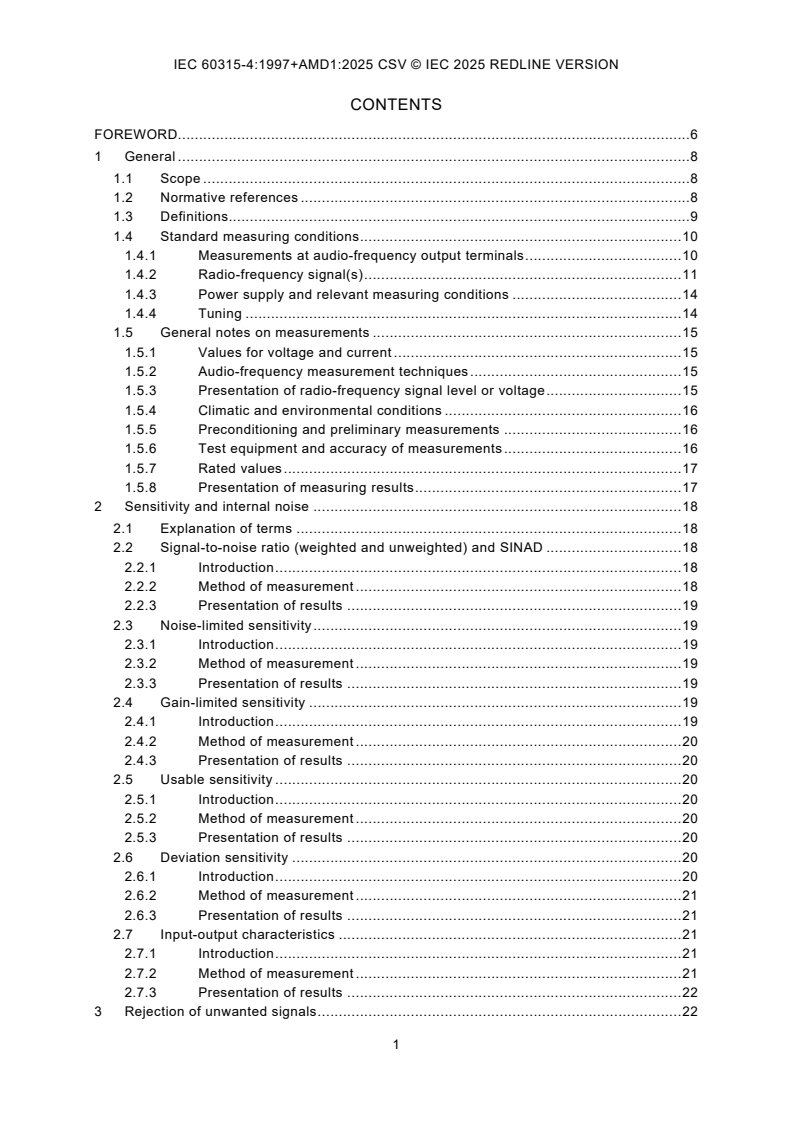
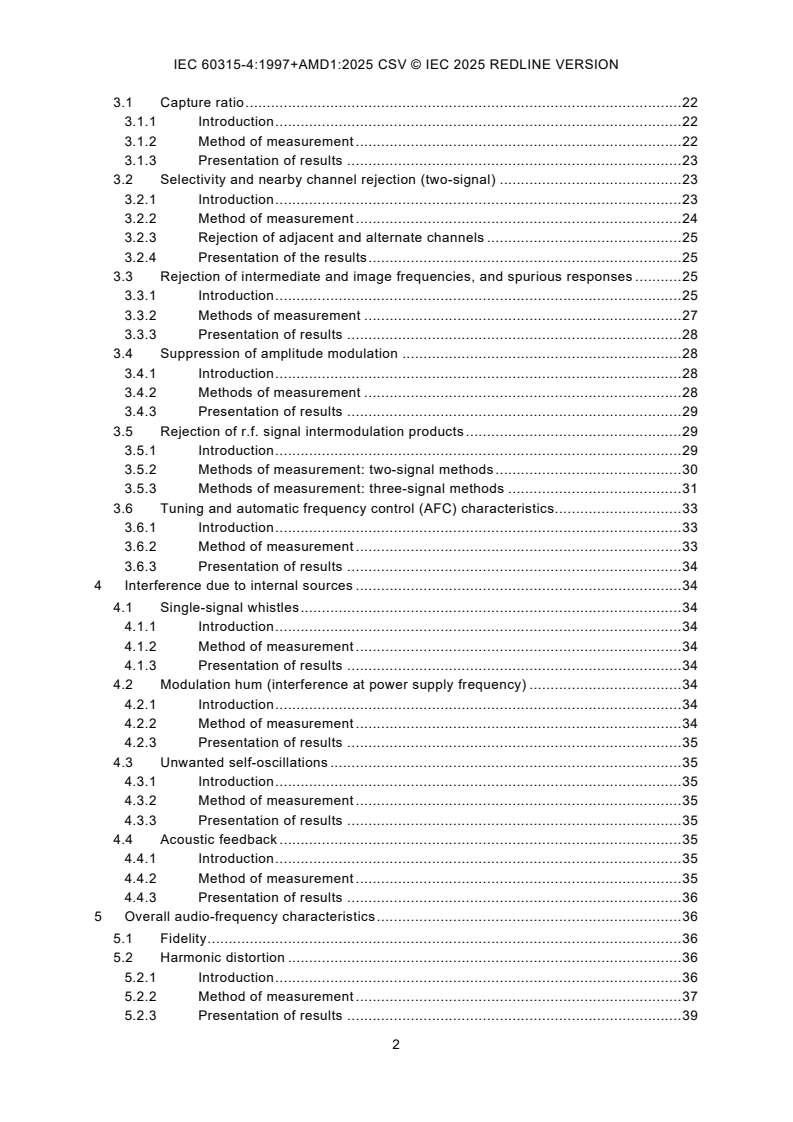
CONTENTS
FOREWORD. 6
1 General . 8
1.1 Scope . 8
1.2 Normative references . 8
1.3 Definitions . 9
1.4 Standard measuring conditions . 10
1.4.1 Measurements at audio-frequency output terminals . 10
1.4.2 Radio-frequency signal(s) . 11
1.4.3 Power supply and relevant measuring conditions . 14
1.4.4 Tuning . 14
1.5 General notes on measurements . 15
1.5.1 Values for voltage and current . 15
1.5.2 Audio-frequency measurement techniques . 15
1.5.3 Presentation of radio-frequency signal level or voltage . 15
1.5.4 Climatic and environmental conditions . 16
1.5.5 Preconditioning and preliminary measurements . 16
1.5.6 Test equipment and accuracy of measurements . 16
1.5.7 Rated values . 17
1.5.8 Presentation of measuring results . 17
2 Sensitivity and internal noise . 18
2.1 Explanation of terms . 18
2.2 Signal-to-noise ratio (weighted and unweighted) and SINAD . 18
2.2.1 Introduction . 18
2.2.2 Method of measurement . 18
2.2.3 Presentation of results . 19
2.3 Noise-limited sensitivity . 19
2.3.1 Introduction . 19
2.3.2 Method of measurement . 19
2.3.3 Presentation of results . 19
2.4 Gain-limited sensitivity . 19
2.4.1 Introduction . 19
2.4.2 Method of measurement . 20
2.4.3 Presentation of results . 20
2.5 Usable sensitivity . 20
2.5.1 Introduction . 20
2.5.2 Method of measurement . 20
2.5.3 Presentation of results . 20
2.6 Deviation sensitivity . 20
2.6.1 Introduction . 20
2.6.2 Method of measurement . 21
2.6.3 Presentation of results . 21
2.7 Input-output characteristics . 21
2.7.1 Introduction . 21
2.7.2 Method of measurement . 21
2.7.3 Presentation of results . 22
3 Rejection of unwanted signals . 22
3.1 Capture ratio . 22
3.1.1 Introduction . 22
3.1.2 Method of measurement . 22
3.1.3 Presentation of results . 23
3.2 Selectivity and nearby channel rejection (two-signal) . 23
3.2.1 Introduction . 23
3.2.2 Method of measurement . 24
3.2.3 Rejection of adjacent and alternate channels . 25
3.2.4 Presentation of the results . 25
3.3 Rejection of intermediate and image frequencies, and spurious responses . 25
3.3.1 Introduction . 25
3.3.2 Methods of measurement . 27
3.3.3 Presentation of results . 28
3.4 Suppression of amplitude modulation . 28
3.4.1 Introduction . 28
3.4.2 Methods of measurement . 28
3.4.3 Presentation of results . 29
3.5 Rejection of r.f. signal intermodulation products . 29
3.5.1 Introduction . 29
3.5.2 Methods of measurement: two-signal methods . 30
3.5.3 Methods of measurement: three-signal methods . 31
3.6 Tuning and automatic frequency control (AFC) characteristics . 33
3.6.1 Introduction . 33
3.6.2 Method of measurement . 33
3.6.3 Presentation of results . 34
4 Interference due to internal sources . 34
4.1 Single-signal whistles . 34
4.1.1 Introduction . 34
4.1.2 Method of measurement . 34
4.1.3 Presentation of results . 34
4.2 Modulation hum (interference at power supply frequency) . 34
4.2.1 Introduction . 34
4.2.2 Method of measurement . 34
4.2.3 Presentation of results . 35
4.3 Unwanted self-oscillations . 35
4.3.1 Introduction . 35
4.3.2 Method of measurement . 35
4.3.3 Presentation of results . 35
4.4 Acoustic feedback . 35
4.4.1 Introduction . 35
4.4.2 Method of measurement . 35
4.4.3 Presentation of results . 36
5 Overall audio-frequency characteristics . 36
5.1 Fidelity . 36
5.2 Harmonic distortion . 36
5.2.1 Introduction . 36
5.2.2 Method of measurement . 37
5.2.3 Presentation of results . 39
5.3 Intermodulation distortion . 40
5.3.1 Introduction . 40
5.3.2 Method of measurement . 40
5.3.3 Presentation of results . 41
5.4 Inter-channel characteristics . 41
5.4.1 Introduction . 41
5.4.2 Method of measurement . 42
5.4.3 Presentation of results . 42
5.5 Characteristics of the volume control . 43
5.5.1 Introduction . 43
5.5.2 Method of measurement . 43
5.5.3 Presentation of results . 43
5.6 Residual output . 43
5.6.1 Introduction . 43
5.6.2 Method of measurement . 43
5.6.3 Presentation of the result . 43
5.7 Crosstalk attenuation . 43
5.7.1 Introduction . 43
5.7.2 Method of measurement . 44
5.7.3 Presentation of results . 44
5.8 Overall audio-frequency response . 44
5.8.1 Introduction . 44
5.8.2 Method of measurement . 44
5.8.3 Presentation of results . 45
6 Effect of additional modulations of the input signal . 45
6.1 Rejection of signals in the ranges 16 kHz to 22 kHz and 54 kHz to 99 kHz . 45
6.1.1 Introduction . 45
6.1.2 Method of measurement . 45
6.1.3 Presentation of the results . 45
6.2 Rejection of signals in the range 62 kHz to 73 kHz (SCA rejection) . 45
6.2.1 Method of measurement . 45
6.2.2 Presentation of the results . 46
6.3 Measurement of interference caused by RDS signals . 46
6.3.1 Introduction . 46
6.3.2 Method of measurement . 46
6.3.3 Presentation of results . 46
6.4 Suppression of the fundamental, harmonics and sidebands of the subcarrier
and the pilot-tone signal . 46
6.4.1 Introduction . 46
6.4.2 Method of measurement . 47
6.4.3 Presentation of the results . 47
6.5 Suppression of interference due to adjacent channel signals with a
stereophonic receiver using the pilot-tone system . 47
6.5.1 Introduction . 47
6.5.2 Method of measurement . 47
6.5.3 Presentation of the results . 47
7 Sensitivity, antenna gain and directional response of receivers using rod,
telescopic or built-in antennas . 48
7.1 Introduction . 48
7.2 Method of measurement of sensitivity and antenna gain for a receiver using
a rod or telescopic antenna by the absorbing clamp described in CISPR 16-
1 . 48
8 Characteristics whose methods of measurement are specified in IEC 60315-1 . 48
8.1 Introduction . 48
8.2 List of characteristics and cross-references . 48
Figure 1 – Frequency response limits of band-pass filter 200 Hz to 15 kHz . 49
Figure 2 – Frequency response limits of band-pass filter 22,4 Hz to 15 kHz . 50
Figure 3 – Frequency response limits of band-pass filter 200 Hz to 1,5 kHz . 50
Figure 4 – Frequency response limits of the 1 kHz band-stop filter . 51
Figure 5 – Weighting filter for converting white noise into special coloured noise for
selectivity measurements . 51
Figure 6 – Arrangement for various measurements with two r.f. input signals . 52
Figure 7 – Antenna substitution networks for injecting one or two signals, for 50 Ω
signal generators and 75 Ω unbalanced and 300 Ω balanced receiver inputs . 53
Figure 8 – Arrangement for various measurements with one r.f. input signal . 54
Figure 9 – Signal-to-noise ratio . 55
Figure 10 – Noise-limited sensitivity as a function of signal frequeny . 55
Figure 11 – Gain-limited sensitivity as a function of signal frequency . 56
Figure 12 – Output/input characteristics and noise output curves showing terms
defined in 1.3 . 57
Figure 13 – Capture ratio . 58
Figure 14a – Mono mode . 59
Figure 14b – Stereo mode . 59
Figure 14 – Selectivity curves . 59
Figure 15 – Image and intermediate frequency rejection ratios . 60
Frequency . 61
Figure 16 – Spurious responses at a tuning frequency of 94 MHz (single-signal
method) . 61
Figure 17 – Arrangement for measuring rejection of unwanted signals simulating cable
reception, using sinusoidal modulation . 62
Figure 18 – Arrangement for various measurements using three r.f. input signals . 63
Figure 19 – Tuning characteristics . 64
Figure 20 – Tuning characteristics obtained by measuring the local oscillator frequency . 65
Figure 21 – Measurement of acoustic feedback . 66
Figure 22 – Arrangement for measuring fidelity . 66
Figure 23 – Overall total harmonic distortion as a function of a.f. output power . 67
Figure 24 – Distortion-limited output power as a function of modulation frequency . 67
Figure 25 – Total harmonic distortion as a function of r.f. input signal level . 68
Figure 26 – Total harmonic distortion as a function of the deviation . 68
Figure 27 – Variation of distortion with detuning . 69
Figure 28 – Total harmonic distortion as a function of the a.f. modulation frequency . 69
Figure 29 – Cross-intermodulation between the channels of a stereo receiver (pilot-
tone system) . 70
Figure A.1 – Example of a passive 1 kHz band-stop filter capable of meeting the limits
shown in figure 4 . 71
Figure D.1 – Arrangement for r.f. signal injection into the antenna with an absorbing
clamp . 75
Figure D.2 – Correction curves for the insertion loss of the absorbing clamp . 75
Table 1 – Audio-frequency filters . 11
Table 2 – Standard values of deviation . 12
Table 3 – Standard measuring frequencies . 13
Table 4 – Presentation of radio-frequency signal level or voltage . 16
INTERNATIONAL ELECTROTECHNICAL COMMISSION
____________
Methods of measurement on radio receivers
for various classes of emission -
Part 4: Receivers for frequency-modulated sound broadcasting emissions
FOREWORD
1) The International Electrotechnical Commission (IEC) is a worldwide organization for standardization comprising
all national electrotechnical committees (IEC National Committees). The object of IEC is to promote
international co-operation on all questions concerning standardization in the electrical and electronic fields. To
this end and in addition to other activities, IEC publishes International Standards, Technical Specifications,
Technical Reports, Publicly Available Specifications (PAS) and Guides (hereafter referred to as "IEC
Publication(s)"). Their preparation is entrusted to technical committees; any IEC National Committee interested
in the subject dealt with may participate in this preparatory work. International, governmental and non-
governmental organizations liaising with the IEC also participate in this preparation. IEC collaborates closely
with the International Organization for Standardization (ISO) in accordance with conditions determined by
agreement between the two organizations.
2) The formal decisions or agreements of IEC on technical matters express, as nearly as possible, an international
consensus of opinion on the relevant subjects since each technical committee has representation from all
interested IEC National Committees.
3) IEC Publications have the form of recommendations for international use and are accepted by IEC National
Committees in that sense. While all reasonable efforts are made to ensure that the technical content of IEC
Publications is accurate, IEC cannot be held responsible for the way in which they are used or for any
misinterpretation by any end user.
4) In order to promote international uniformity, IEC National Committees undertake to apply IEC Publications
transparently to the maximum extent possible in their national and regional publications. Any divergence
between any IEC Publication and the corresponding national or regional publication shall be clearly indicated in
the latter.
5) IEC itself does not provide any attestation of conformity. Independent certification bodies provide conformity
assessment services and, in some areas, access to IEC marks of conformity. IEC is not responsible for any
services carried out by independent certification bodies.
6) All users should ensure that they have the latest edition of this publication.
7) No liability shall attach to IEC or its directors, employees, servants or agents including individual experts and
members of its technical committees and IEC National Committees for any personal injury, property damage or
other damage of any nature whatsoever, whether direct or indirect, or for costs (including legal fees) and
expenses arising out of the publication, use of, or reliance upon, this IEC Publication or any other IEC
Publications.
8) Attention is drawn to the Normative references cited in this publication. Use of the referenced publications is
indispensable for the correct application of this publication.
9) IEC draws attention to the possibility that the implementation of this document may involve the use of (a)
patent(s). IEC takes no position concerning the evidence, validity or applicability of any claimed patent rights in
respect thereof. As of the date of publication of this document, IEC had not received notice of (a) patent(s),
which may be required to implement this document. However, implementers are cautioned that this may not
represent the latest information, which may be obtained from the patent database available at
https://patents.iec.ch. IEC shall not be held responsible for identifying any or all such patent rights.
This consolidated version of the official IEC Standard and its amendment has been prepared
for user convenience.
IEC 60315-4 edition 2.1 contains the second edition (1997-11) [documents 100A/58/FDIS and
100A/60/RVD] and its amendment 1 (2025-12) [documents 100/4290/CDV and
100/4385/RVC].
In this Redline version, a vertical line in the margin shows where the technical content is
modified by amendment 1. Additions are in green text, deletions are in strikethrough red text.
A separate Final version with all changes accepted is available in this publication.
International Standard IEC 60315-4 has been prepared by IEC subcommittee 100A:
Multimedia end-user equipment, of IEC technical committee 100: Audio, video and multimedia
systems and equipment.
This second edition cancels and replaces the first edition published in 1982 and constitutes a
technical revision.
This part of IEC 60315 shall be read in conjunction with IEC 60315-1.
The text of this standard is based on the following documents:
FDIS Report on voting
100A/58/FDIS 100A/60/RVD
Full information on the voting for the approval of this standard can be found in the report on
voting indicated in the above table.
Annexes A, B, C and D are for information only.
IEC 60315 consists of the following parts under the general title: Methods of measurement on
radio receivers for various classes of emission:
– Part 1: 1988, General considerations and methods of measurement, including audio-
frequency measurements
– Part 3: 1989, Receivers for amplitude – modulated sound broadcasting emissions
– Part 4: 1997, Receivers for frequency – modulated sound broadcasting emissions
– Part 5: 1971, Specialized radio-frequency measurements – Measurement on frequency-
modulated receivers of the response to impulsive interference
– Part 6: 1991, General purpose communication receivers
– Part 7: 1995, Methods of measurement on digital satellite radio (DSR) receivers
– Part 8: 1975, Radio-frequency measurements on professional receivers for frequency-
modulated telegraphy systems
– Part 9: 1996, Measurement of the characteristics relevant to radio data system (RDS)
reception
The committee has decided that the contents of this document and its amendment will remain
unchanged until the stability date indicated on the IEC website under webstore.iec.ch in the
data related to the specific document. At this date, the document will be
– reconfirmed,
– withdrawn, or
– revised.
1 General
1.1 Scope
This part of IEC 60315 applies to radio receivers and tuners for the reception of frequency-
modulated sound-broadcasting emissions with rated maximum system deviations of ±75 kHz
and ±50 kHz in ITU Band 8. It deals mainly with methods of measurement using radio-
frequency signals applied to the antenna terminals of the receiver. The measurements and
specified conditions of test are selected to permit the comparison of results obtained by
different observers and on other receivers. Performance requirements are not specified in
this standard.
Radiation and immunity tests and requirements are not included since these are described in
CISPR 13 and CISPR 20.
1.2 Normative references
The following normative documents contain provisions which, through reference in this text,
constitute provisions of this part of IEC 60315. At the time of publication, the editions
indicated were valid. All normative documents are subject to revision, and parties to
agreements based on this part of IEC 60315 are encouraged to investigate the possibility of
applying the most recent editions of the normative documents indicated below. Members of
IEC and ISO maintain registers of currently valid International Standards.
IEC 60098: 1987, Analogue audio disk records and reproducing equipment
IEC 60268-1: 1985, Sound system equipment – Part 1: General
IEC 60268-3: 1988, Sound system equipment – Part 3: Amplifiers
IEC 60315-1: 1988, Methods of measurement on radio receivers for various classes of
emission – Part 1: General considerations and methods of measurement, including audio-
frequency measurements
IEC 60315-3: 1989, Methods of measurement on radio receivers for various classes of
emission – Part 3: Receiver for amplitude-modulated sound-broadcasting emissions
IEC 60315-7: 1995, Methods of measurement on radio receivers for various classes of
emission – Part 7: Methods of measurement on digital satellite radio (DSR) receivers
IEC 60315-9: 1996, Methods of measurement on radio receivers for various class of emission
– Part 9: Measurement of the characteristics relevant to Radio Data System (RDS) reception
IEC 60651: 1979, Sound level meters
IEC 61260: 1995, Electroacoustics – Octave-band and fractional-octave-band filters
CISPR 16-1: 1993, Specification for radio disturbance and immunity measuring apparatus and
methods – Part 1: Radio disturbance and immunity measuring apparatus
CISPR 20: 1996, Limits and methods of measurement of immunity characteristics of sound
and television broadcast receivers and associated equipment
ITU-R Recommendation 468-4: 1990: Measurement of audio-frequency
ITU-R Recommendation 559-2: 1990: Objective measurement of radio-frequency protection
ratios in LF, MF and HF broadcasting
1.3 Definitions
For the purposes of this part of IEC 60315, the following definitions apply.
1.3.1
carrier frequency
the mean value of the instantaneous frequency or the frequency generated in the absence of
modulation. With a perfect modulation system in which no d.c. component and no non-linear
distortion are involved, the two values are the same
1.3.2
instantaneous frequency deviation
the difference between the instantaneous frequency of the modulated radio-frequency signal
and the carrier frequency
1.3.3
peak frequency deviation
the peak value of the instantaneous frequency deviation
1.3.4
peak-to-peak deviation
twice the peak frequency deviation
NOTE 1 – To avoid confusion between "peak frequency deviation" and "peak-to-peak frequency deviation", peak-
to-peak deviation is expressed as, for example, ± 50 kHz.
NOTE 2 – "Peak-to-peak frequency deviation" is generally abbreviated to "deviation" in this standard.
1.3.5
rated maximum system deviation
the maximum peak-to-peak frequency deviation (see 1.3.4) specified for the system under
consideration
1.3.6
modulation factor
the ratio of the peak-to-peak deviation of the signal to the rated maximum system deviation,
usually expressed as a percentage
NOTE – This definition arises by direct analogy with the case of amplitude modulation.
1.3.7
–3 dB limiting level
the input signal level at which the audio-frequency output voltage level is 3 dB below the
value at a specified high r.f. input signal level, preferably 80 dB(fW)
1.3.8
amplification reserve
the attenuation in decibels of the volume control when adjusted to produce rated (distortion-limited)
output voltage or power, with a specified high r.f. input signal level, preferably 80 dB(fW)
NOTE – This characteristic is undefined for a receiver or tuner without a volume control.
1.3.9
deviation sensitivity
the value of deviation required to produce rated (distortion-limited) output voltage or power
with the volume control set at maximum and a specified high r.f. input signal level, preferably
80 dB(fW)
1.3.10
ultimate signal-to-noise ratio
the value of signal-to-noise ratio for r.f. input signal levels sufficiently high that no further
increase in signal-to-noise ratio occurs when the input signal level is increased
1.3.11
stereo threshold
the r.f. input signal level at which the stereo decoder begins to operate
NOTE – A marked decrease in signal-to-noise ratio is usual at this signal level unless signal-strength dependent
cross-talk circuits are included.
1.3.12
stereo indicator threshold
the input signal level at which the visual indicator shows that the receiver is operating in the
stereo mode
NOTE – This level may or may not be identical to the stereo threshold.
1.3.13
muting threshold
the input signal level at which the muting circuits allow the a.f. output signal to appear at the
output terminals
NOTE – The threshold may be different for increasing and decreasing signal levels. This hysteresis is usually
intentional as it prevents unsatisfactory operation with r.f. input signals at or near the threshold level.
1.3.14
muting attenuation
the reduction in a.f. output, selectively measured at 1 kHz, due to an input signal modulated
at 1 kHz at rated maximum system deviation, when muting occurs
1.3.15
50 dB quieting sensitivity
the r.f. input signal level at which an increase in a.f. output of 50 dB occurs under defined
conditions (see 2.3) when the modulation is changed from none (except the pilot-tone if the
measurement is to be made in stereo mode) to the standard value of deviation (see 1.4.2.1)
1.4 Standard measuring conditions
1.4.1 Measurements at audio-frequency output terminals
1.4.1.1 Standard audio-frequency output level
Standard audio-frequency output level is the reference output level for audio-frequency
measurements and shall be 10 dB below the rated output voltage or power. Alternatively, a
stated value of output voltage or power selected from 500 mV, 1 W, 500 mW, 50 mW, 5 mW
or 1 mW may be used (see IEC 60315-1).
1.4.1.2 Audio-frequency substitute load
The audio-frequency substitute load is a stated physical (usually resistive) impedance for
terminating audio-output terminals, (see IEC 60315-1).
1.4.1.3 Audio-frequency filters
When making measurements at audio-frequency output terminals, unless it is specifically
intended to measure low audio-frequency and ultrasonic components in the output voltage, it
is desirable to interpose a band-pass filter between the output terminals and the measuring
instrument. To allow the use of practicable impedances in this filter the substitute load shall
be connected directly to the audio-frequency output terminals. If the filter has significant
insertion loss this shall be allowed for when determining the results.
It is advisable to use the same filter for both monophonic and stereophonic receivers. This
filter prevents errors due to the presence of pilot-tone or subcarrier components in the
receiver output. The pass-band of this filter shall be 200 Hz to 15 kHz, for which frequencies
the attenuation relative to that at 1 kHz shall not exceed 3 dB. Below 200 Hz the attenuation
slope shall tend to at least 18 dB/octave. At 19 kHz the attenuation shall be at least 50 dB,
and above 19 kHz it shall be at least 30 dB (see figure 1). This filter usually prevents the
results of measurements from being affected by hum.
Filters for octave and third-octave band measurements shall comply with the requirements
of IEC 61260.
Table 1 lists the audio-frequency filters which are used in measurements in this standard.
Table 1 – Audio-frequency filters
Type of filter Figure Reference Notes
200 Hz – 15 kHz band-pass 1 1.4.1.3 With 19 kHz notch
22,4 Hz – 15 kHz band-pass 2 2.2.1 With 19 kHz notch
200 Hz – 1,5 kHz band-pass 3 Figure 8 With 19 kHz notch
15 kHz low-pass None 1.4.2.3 60 dB/octave attenuation slope
1 kHz band-stop 4 Figure 8 See also annex A
1 kHz band-pass None Figure 6 / -octave: IEC 61260
A-weighting None Figure 8 See IEC 60651
Weighting filter for measurement Annex A of 2.2.1 Consistent with ITU-R
of noise IEC 60315-1 Recommendation 468-4
Weighting filter for coloured noise 5 1.4.2.3 Consistent with ITU-R
Recommendation 559-2
1.4.2 Radio-frequency signal(s)
1.4.2.1 Standard value of deviation
The standard value of deviation for measurements shall be the rated maximum system
deviation (RMSD) given in table 2. The deviation shall be stated with the results.
Measurements at lower deviations are useful in some cases: where these are carried out the
deviation used shall be stated with the results.
Table 2 – Standard values of deviation
Mode/signal RMSD ±50 kHz RMSD ±75 kHz
Mono ±50 kHz ±75 kHz
Stereo ±45 kHz ±67,5 kHz
Pilot-tone ±4,5 kHz ±6,75 kHz
NOTE 1 – Where a single value for deviation is stated in the text, it applies to a system with RMSD = ±75 kHz. For
a system with RMSD = ±50 kHz, the stated value is reduced in proportion. In some cases, the value for
RMSD = ±50 kHz is given in parentheses: for example, (±50 kHz).
NOTE 2 – The deviations for supplementary services (such as SCA, RDS and ARI), which may vary in
different ITU regions or countries, are given in annex B.
1.4.2.2 Standard modulating frequency
The standard modulating frequency shall be the standard reference frequency (1 000 Hz).
When required, other frequencies may be chosen, if possible, from the one-third octave band
centre frequencies given in table I of IEC 60315-1.
1.4.2.3 Standard modulation using coloured noise
The noise weighting is chosen so that the spectrum of the noise resembles that of modern
(western European) dance music, which is a particularly critical form of modulation in the case
of adjacent channel interference.
The noise signal is obtained from a Gaussian white noise generator by passing the signal
through a weighting filter as specified in figure 5, followed by a low-pass filter with a cut-off
frequency of 15 kHz and a slope of 60 dB/octave, and then through a pre-emphasis network
(50 µs or 75 µs as appropriate).
The audio-frequency amplitude versus frequency characteristic of the modulation stage of the
signal generator should not vary by more than 2 dB up to the cut-off frequency of the low-pass
filter.
The accuracy of the measurement depends very much on the precision with which the
frequency deviation of the signal generators can be set; this is especially true for the
unwanted transmitter. The line-up procedure therefore should be carried out very carefully.
The deviation of the signal shall be adjusted by means of the arrangement shown in figure 6.
The meter V shall be a quasi-peak voltmeter (see annex A of IEC 60315-1). To obtain
the required deviation conditions, the switch S is placed in position 1 and the modulation
at 500 Hz from the audio-frequency generator adjusted to ±32 kHz (±21,3 kHz) deviation. The
meter reading is noted. The switch S is then placed in position 2 and the noise modulation
adjusted to give the same reading on the quasi-peak meter.
NOTE – The deviation with 500 Hz modulation should be checked with a deviation meter unless the deviation
meter, if any, included in the signal generator is known to be accurate.
1.4.2.4 Standard modulating signal
This is the base-band signal with standard modulating frequency (se
...
NORME
CEI
INTERNATIONALE
IEC
60315-4
INTERNATIONAL
Deuxième édition
STANDARD
Second edition
1997-11
Méthodes de mesure applicables aux récepteurs
radioélectriques pour diverses classes d'émission –
Partie 4:
Récepteurs pour émissions de radiodiffusion
en modulation de fréquence
Methods of measurement on radio receivers for
various classes of emission –
Part 4:
Receivers for frequency-modulated
sound broadcasting emissions
Numéro de référence
Reference number
CEI/IEC 60315-4:1997
Numéros des publications Numbering
Depuis le 1er janvier 1997, les publications de la CEI As from the 1st January 1997 all IEC publications are
sont numérotées à partir de 60000. issued with a designation in the 60000 series.
Publications consolidées Consolidated publications
Les versions consolidées de certaines publications de Consolidated versions of some IEC publications
la CEI incorporant les amendements sont disponibles. including amendments are available. For example,
Par exemple, les numéros d’édition 1.0, 1.1 et 1.2 edition numbers 1.0, 1.1 and 1.2 refer, respectively, to
indiquent respectivement la publication de base, la the base publication, the base publication
publication de base incorporant l’amendement 1, et la incorporating amendment 1 and the base publication
publication de base incorporant les amendements 1 incorporating amendments 1 and 2.
et 2.
Validité de la présente publication Validity of this publication
Le contenu technique des publications de la CEI est The technical content of IEC publications is kept under
constamment revu par la CEI afin qu'il reflète l'état constant review by the IEC, thus ensuring that the
actuel de la technique. content reflects current technology.
Des renseignements relatifs à la date de Information relating to the date of the reconfirmation of
reconfirmation de la publication sont disponibles dans the publication is available in the IEC catalogue.
le Catalogue de la CEI.
Les renseignements relatifs à ces révisions, à l'établis- Information on the revision work, the issue of revised
sement des éditions révisées et aux amendements editions and amendments may be obtained from
peuvent être obtenus auprès des Comités nationaux de IEC National Committees and from the following
la CEI et dans les documents ci-dessous: IEC sources:
• Bulletin de la CEI • IEC Bulletin
• Annuaire de la CEI • IEC Yearbook
Accès en ligne* On-line access*
• Catalogue des publications de la CEI • Catalogue of IEC publications
Publié annuellement et mis à jour régulièrement Published yearly with regular updates
(Accès en ligne)* (On-line access)*
Terminologie, symboles graphiques Terminology, graphical and letter
et littéraux symbols
En ce qui concerne la terminologie générale, le lecteur For general terminology, readers are referred to
se reportera à la CEI 60050: Vocabulaire Electro- IEC 60050: International Electrotechnical Vocabulary
technique International (VEI). (IEV).
Pour les symboles graphiques, les symboles littéraux For graphical symbols, and letter symbols and signs
et les signes d'usage général approuvés par la CEI, le approved by the IEC for general use, readers are
referred to publications IEC 60027: Letter symbols to
lecteur consultera la CEI 60027: Symboles littéraux à
utiliser en électrotechnique, la CEI 60417: Symboles be used in electrical technology, IEC 60417: Graphical
graphiques utilisables sur le matériel. Index, relevé et symbols for use on equipment. Index, survey and
compilation des feuilles individuelles, et la CEI 60617: compilation of the single sheets and IEC 60617:
Symboles graphiques pour schémas. Graphical symbols for diagrams.
Publications de la CEI établies par IEC publications prepared by the same
le même comité d'études technical committee
L'attention du lecteur est attirée sur les listes figurant The attention of readers is drawn to the end pages of
à la fin de cette publication, qui énumèrent les this publication which list the IEC publications issued
publications de la CEI préparées par le comité by the technical committee which has prepared the
d'études qui a établi la présente publication. present publication.
* Voir adresse «site web» sur la page de titre. * See web site address on title page.
NORME
CEI
INTERNATIONALE
IEC
60315-4
INTERNATIONAL
Deuxième édition
STANDARD
Second edition
1997-11
Méthodes de mesure applicables aux récepteurs
radioélectriques pour diverses classes d'émission –
Partie 4:
Récepteurs pour émissions de radiodiffusion
en modulation de fréquence
Methods of measurement on radio receivers for
various classes of emission –
Part 4:
Receivers for frequency-modulated
sound broadcasting emissions
IEC 1997 Droits de reproduction réservés Copyright - all rights reserved
Aucune partie de cette publication ne peut être reproduite ni No part of this publication may be reproduced or utilized in
utilisée sous quelque forme que ce soit et par aucun any form or by any means, electronic or mechanical,
procédé, électronique ou mécanique, y compris la photo- including photocopying and microfilm, without permission in
copie et les microfilms, sans l'accord écrit de l'éditeur. writing from the publisher.
International Electrotechnical Commission 3, rue de Varembé Geneva, Switzerland
Telefax: +41 22 919 0300 e-mail: inmail@iec.ch IEC web site http: //www.iec.ch
CODE PRIX
Commission Electrotechnique Internationale
PRICE CODE XB
International Electrotechnical Commission
Pour prix, voir catalogue en vigueur
For price, see current catalogue
– 2 – 60315-4 © CEI:1997
SOMMAIRE
Page
AVANT-PROPOS . 8
Articles
1 Généralités. 12
1.1 Domaine d'application. 12
1.2 Références normatives. 12
1.3 Définitions. 14
1.4 Conditions normalisées de mesure. 16
1.5 Généralités concernant les mesures . 26
2 Sensibilité et bruit interne . 32
2.1 Explication des termes. 32
2.2 Rapport signal sur bruit (pondéré et non pondéré) et SINAD . 32
2.3 Sensibilité limitée par le bruit . 34
2.4 Sensibilité limitée par le gain. 36
2.5 Sensibilité utilisable. 36
2.6 Sensibilité à l'excursion de fréquence. 38
2.7 Caractéristiques entrée-sortie. 38
3 Réjection des signaux perturbateurs . 40
3.1 Rapport de capture . 40
3.2 Sélectivité et réjection du canal voisin (à deux signaux). 42
3.3 Réjection de fréquences-images et intermédiaires, et réponses parasites . 46
3.4 Suppression de la modulation d'amplitude . 52
3.5 Réjection des produits d'intermodulation du signal radio. 54
3.6 Caractéristiques d'accord et de contrôle automatique des fréquences (CAF) . 62
4 Perturbations dues à des sources internes. 64
4.1 Sifflements dus à un seul signal . 64
4.2 Ronflement de modulation (perturbations à la fréquence d'alimentation). 64
4.3 Auto-oscillations perturbatrices. 66
4.4 Réaction acoustique. 68
60315-4 © IEC:1997 – 3 –
CONTENTS
Page
FOREWORD . 9
Clause
1 General. 13
1.1 Scope. 13
1.2 Normative references. 13
1.3 Definitions. 15
1.4 Standard measuring conditions . 17
1.5 General notes on measurements. 27
2 Sensitivity and internal noise. 33
2.1 Explanation of terms . 33
2.2 Signal-to-noise ratio (weighted and unweighted) and SINAD . 33
2.3 Noise-limited sensitivity. 35
2.4 Gain-limited sensitivity. 37
2.5 Usable sensitivity. 37
2.6 Deviation sensitivity. 39
2.7 Input-output characteristics. 39
3 Rejection of unwanted signals. 41
3.1 Capture ratio. 41
3.2 Selectivity and nearby channel rejection (two-signal) . 43
3.3 Rejection of intermediate and image frequencies, and spurious responses . 47
3.4 Suppression of amplitude modulation . 53
3.5 Rejection of r.f. signal intermodulation products . 55
3.6 Tuning and automatic frequency control (AFC) characteristics . 63
4 Interference due to internal sources . 65
4.1 Single-signal whistles. 65
4.2 Modulation hum (interference at power supply frequency). 65
4.3 Unwanted self-oscillations. 67
4.4 Acoustic feedback. 69
– 4 – 60315-4 © CEI:1997
Pages
5 Caractéristiques globales des fréquences acoustiques. 68
5.1 Fidélité. 68
5.2 Distorsion harmonique. 70
5.3 Distorsion d'intermodulation. 78
5.4 Caractéristiques entre voies. 80
5.5 Caractéristiques de la commande de volume. 82
5.6 Niveau de sortie résiduelle. 84
5.7 Affaiblissement de diaphonie . 84
5.8 Réponse audio globale . 86
6 Effet des modulations supplémentaires sur le signal d'entrée . 88
6.1 Réjection des signaux dans les bandes de 16 kHz à 22 kHz et 54 kHz à 99 kHz. 88
6.2 Réjection des signaux dans les bandes de 62 kHz à 73 kHz (réjection SCA). 88
6.3 Mesure du brouillage par des signaux RDS. 88
6.4 Suppression du fondamental, des harmoniques et des bandes latérales de
la sous-porteuse et du signal pilote. 90
6.5 Suppression des perturbations dues aux signaux venant d'un canal adjacent
avec un récepteur stéréophonique utilisant le système à fréquence pilote . 92
7 Sensibilité, gain des antennes et directivité des récepteurs utilisant des antennes-
fouets télescopiques et incorporées . 92
7.1 Introduction. 92
7.2 Méthode de mesure de la sensibilité et du gain des antennes d'un récepteur utilisant
une antenne-fouet ou télescopique, à l'aide de la pince absorbante décrite
dans le CISPR 16-1 . 92
8 Caractéristiques dont les méthodes de mesure sont spécifiées dans la CEI 60315-1 . 94
8.1 Introduction. 94
8.2 Liste des caractéristiques, et renvois correspondants. 94
Figures
1 Limites de la réponse en fréquence du filtre passe-bande 200 Hz à 15 kHz . 96
2 Limites de la réponse en fréquence du filtre passe-bande 22,4 Hz à 15 kHz . 98
3 Limites de la réponse en fréquence du filtre passe-bande 200 Hz à 1,5 kHz . 98
4 Limites de la réponse en fréquence du filtre coupe-bande à 1 kHz . 100
5 Filtre de pondération pour convertir du bruit blanc en bruit coloré spécial pour
les mesures de sélectivité. 100
6 Disposition pour différentes mesures avec deux signaux RF en entrée. 102
7 Réseaux d'antennes fictives pour l'injection d'un ou de deux signaux, pour les générateurs
de signaux 50 Ω et pour les entrées récepteur 75 Ω asymétrique ou 300 Ω symétrique. 104
8 Disposition pour différentes mesures avec un signal RF en entrée . 106
9 Rapport signal sur bruit. 108
60315-4 © IEC:1997 – 5 –
Page
5 Overall audio-frequency characteristics. 69
5.1 Fidelity. 69
5.2 Harmonic distortion. 71
5.3 Intermodulation distortion. 79
5.4 Inter-channel characteristics. 81
5.5 Characteristics of the volume control. 83
5.6 Residual output. 85
5.7 Crosstalk attenuation. 85
5.8 Overall audio-frequency response . 87
6 Effect of additional modulations of the input signal . 89
6.1 Rejection of signals in the ranges 16 kHz to 22 kHz and 54 kHz to 99 kHz. 89
6.2 Rejection of signals in the range 62 kHz to 73 kHz (SCA rejection) . 89
6.3 Measurement of interference caused by RDS signals . 89
6.4 Suppression of the fundamental, harmonics and sidebands of the subcarrier
and the pilot-tone signal . 91
6.5 Suppression of interference due to adjacent channel signals with a
stereophonic receiver using the pilot-tone system. 93
7 Sensitivity, antenna gain and directional response of receivers using rod, telescopic
or built-in antennas . 93
7.1 Introduction. 93
7.2 Method of measurement of sensitivity and antenna gain for a receiver using
a rod or telescopic antenna by the absorbing clamp described in CISPR 16-1. 93
8 Characteristics whose methods of measurement are specified in IEC 60315-1 . 95
8.1 Introduction. 95
8.2 List of characteristics and cross-references. 95
Figures
1 Frequency response limits of band-pass filter 200 Hz to 15 kHz . 97
2 Frequency response limits of band-pass filter 22,4 Hz to 15 kHz . 99
3 Frequency response limits of band-pass filter 200 Hz to 1,5 kHz . 99
4 Frequency response limits of the 1 kHz band-elimination filter. 101
5 Weighting filter for converting white noise into special coloured noise for
selectivity measurements. 101
6 Arrangement for various measurements with two r.f. input signals . 103
7 Antenna substitution networks for injecting one or two signals, for 50 Ω signal
generators and 75 Ω unbalanced and 300 Ω balanced receiver inputs . 105
8 Arrangement for various measurements with one r.f. input signal . 107
9 Signal-to-noise ratio. 109
– 6 – 60315-4 © CEI:1997
Pages
10 Sensibilité limitée par le bruit en fonction de la fréquence du signal. 108
11 Sensibilité limitée par le gain en fonction de la fréquence du signal . 110
12 Caractéristiques d'entrée/sortie et courbes du niveau de bruit en sortie faisant
apparaître les termes définis en 1.3 . 112
13 Rapport de capture. 114
14 Courbes de sélectivité . 116
15 Taux de réjection de fréquence image et intermédiaire. 118
16 Réponses parasites pour une fréquence d'accord de 94 MHz (méthode à signal unique) . 120
17 Disposition pour la mesure de réjection de signaux perturbateurs simulant
une réception par câble, utilisant une modulation sinusoïdale. 122
18 Disposition pour différentes mesures avec trois signaux RF en entrée. 124
19 Caractéristiques d'accord . 126
20 Caractéristique d'accord obtenue par mesure de la fréquence de l'oscillateur local. 126
21 Mesure de la réaction acoustique. 128
22 Disposition pour la mesure de la fidélité. 128
23 Distorsion harmonique totale globale en fonction de la puissance de sortie . 130
24 Puissance de sortie limitée par la distorsion en fonction de la fréquence de modulation . 130
25 Distorsion harmonique totale en fonction du niveau de signal RF en entrée . 132
26 Distorsion harmonique totale en fonction de l'excursion. 132
27 Variation de la distorsion résultant d'un décalage de l'accord . 134
28 Distorsion harmonique totale en fonction de la fréquence de modulation audio . 134
29 Diaphonie d'intermodulation entre les voies d'un récepteur stéréo
(système à fréquence pilote). 136
A.1 Exemple de filtre passif coupe-bande de 1 kHz capable de respecter les limites
représentées à la figure 4 . 138
D.1 Disposition pour l'injection d'un signal RF dans l'antenne à l'aide d'une pince absorbante . 146
D.2 Courbes de correction pour la perte d'insertion de la pince absorbante. 146
Annexes
A Exemple de filtre coupe-bande à 1 kHz . 138
B Excursions normalisées pour les services supplémentaires. 140
C Mesure de la diaphonie entre voies stéréophoniques. 142
D Caractéristiques des antennes-fouets et télescopiques (à l'étude) . 144
60315-4 © IEC:1997 – 7 –
Page
10 Noise-limited sensitivity as a function of signal frequency. 109
11 Gain-limited sensitivity as a function of signal frequency . 111
12 Output/input characteristics and noise output curves showing terms defined in 1.3 . 113
13 Capture ratio . 115
14 Selectivity curves. 117
15 Image and intermediate frequency rejection ratios. 119
16 Spurious responses at a tuning frequency of 94 MHz (single signal method). 121
17 Arrangement for measuring rejection of unwanted signals simulating cable reception,
using sinusoidal modulation . 123
18 Arrangement for various measurements using three r.f. input signals . 125
19 Tuning characteristics. 127
20 Tuning characteristics obtained by measuring the local oscillator frequency . 127
21 Measurement of acoustic feedback . 129
22 Arrangement for measuring fidelity. 129
23 Overall total harmonic distortion as a function of a.f. output power . 131
24 Distortion-limited output power as a function of modulation frequency . 131
25 Total harmonic distortion as a function of r.f. input signal level . 133
26 Total harmonic distortion as a function of the deviation . 133
27 Variation of distortion with detuning. 135
28 Total harmonic distortion as a function of the a.f. modulation frequency . 135
29 Cross-intermodulation between the channels of a stereo receiver (pilot-tone system) . 137
A.1 Example of a passive 1 kHz band-elimination filter capable of meeting the limits
shown in figure 4 . 139
D.1 Arrangement for r.f. signal injection into the antenna with an absorbing clamp. 147
D.2 Correction curves for the insertion loss of the absorbing clamp . 147
Annexes
A Example of a 1 kHz band-elimination filter. 139
B Standard deviations for supplementary services. 141
C Measurement of crosstalk between stereo channels. 143
D Characteristics of rod and telescopic antennas (under consideration) . 145
– 8 – 60315-4 © CEI:1997
COMMISSION ÉLECTROTECHNIQUE INTERNATIONALE
_________
MÉTHODES DE MESURE APPLICABLES AUX RÉCEPTEURS
RADIOÉLECTRIQUES POUR DIVERSES CLASSES D'ÉMISSION –
Partie 4: Récepteurs pour émissions de radiodiffusion
en modulation de fréquence
AVANT-PROPOS
1) La CEI (Commission Electrotechnique Internationale) est une organisation mondiale de normalisation composée
de l'ensemble des comités électrotechniques nationaux (Comités nationaux de la CEI). La CEI a pour objet de
favoriser la coopération internationale pour toutes les questions de normalisation dans les domaines de
l'électricité et de l'électronique. A cet effet, la CEI, entre autres activités, publie des Normes internationales.
Leur élaboration est confiée à des comités d'études, aux travaux desquels tout Comité national intéressé par le
sujet traité peut participer. Les organisations internationales, gouvernementales et non gouvernementales, en
liaison avec la CEI, participent également aux travaux. La CEI collabore étroitement avec l'Organisation
Internationale de Normalisation (ISO), selon des conditions fixées par accord entre les deux organisations.
2) Les décisions ou accords officiels de la CEI concernant les questions techniques représentent, dans la mesure
du possible un accord international sur les sujets étudiés, étant donné que les Comités nationaux intéressés
sont représentés dans chaque comité d’études.
3) Les documents produits se présentent sous la forme de recommandations internationales. Ils sont publiés
comme normes, rapports techniques ou guides et agréés comme tels par les Comités nationaux.
4) Dans le but d'encourager l'unification internationale, les Comités nationaux de la CEI s'engagent à appliquer de
façon transparente, dans toute la mesure possible, les Normes internationales de la CEI dans leurs normes
nationales et régionales. Toute divergence entre la norme de la CEI et la norme nationale ou régionale
correspondante doit être indiquée en termes clairs dans cette dernière.
5) La CEI n’a fixé aucune procédure concernant le marquage comme indication d’approbation et sa responsabilité
n’est pas engagée quand un matériel est déclaré conforme à l’une de ses normes.
6) L’attention est attirée sur le fait que certains des éléments de la présente Norme internationale peuvent faire
l’objet de droits de propriété intellectuelle ou de droits analogues. La CEI ne saurait être tenue pour
responsable de ne pas avoir identifié de tels droits de propriété et de ne pas avoir signalé leur existence.
La Norme internationale CEI 60315-4 a été établie par le sous-comité 100A: Appareils
multimédia utilisateur, du comité d'études 100 de la CEI: Systèmes et appareils audio, vidéo et
multimédia.
Cette deuxième édition annule et remplace la première édition parue en 1982 et constitue une
révision technique:
La présente partie de la CEI 60315 doit être lue avec la CEI 60315-1.
Le texte de cette norme est issu des documents suivants:
FDIS Rapport de vote
100A/58/FDIS 100A/60/RVD
Le rapport de vote indiqué dans le tableau ci-dessus donne toute information sur le vote ayant
abouti à l'approbation de cette norme.
Les annexes A, B, C et D sont données uniquement à titre d’information.
60315-4 © IEC:1997 – 9 –
INTERNATIONAL ELECTROTECHNICAL COMMISSION
_________
METHODS OF MEASUREMENT ON RADIO RECEIVERS FOR
VARIOUS CLASSES OF EMISSION –
Part 4: Receivers for frequency-modulated
sound broadcasting emissions
FOREWORD
1) The IEC (International Electrotechnical Commission) is a worldwide organization for standardization comprising
all national electrotechnical committees (IEC National Committees). The object of the IEC is to promote
international co-operation on all questions concerning standardization in the electrical and electronic fields. To
this end and in addition to other activities, the IEC publishes International Standards. Their preparation is
entrusted to technical committees; any IEC National Committee interested in the subject dealt with may
participate in this preparatory work. International, governmental and non-governmental organizations liaising
with the IEC also participate in this preparation. The IEC collaborates closely with the International Organization
for Standardization (ISO) in accordance with conditions determined by agreement between the two
organizations.
2) The formal decisions or agreements of the IEC on technical matters express, as nearly as possible, an
international consensus of opinion on the relevant subjects since each technical committee has representation
from all interested National Committees.
3) The documents produced have the form of recommendations for international use and are published in the form
of standards, technical reports or guides and they are accepted by the National Committees in that sense.
4) In order to promote international unification, IEC National Committees undertake to apply IEC International
Standards transparently to the maximum extent possible in their national and regional standards. Any
divergence between the IEC Standard and the corresponding national or regional standard shall be clearly
indicated in the latter.
5) The IEC provides no marking procedure to indicate its approval and cannot be rendered responsible for any
equipment declared to be in conformity with one of its standards.
6) Attention is drawn to the possibility that some of the elements of this International Standard may be the subject
of patent rights. The IEC shall not be held responsible for identifying any or all such patent rights.
International Standard IEC 60315-4 has been prepared by IEC subcommittee 100A: Multimedia
end-user equipment, of IEC technical committee 100: Audio, video and multimedia systems and
equipment.
This second edition cancels and replaces the first edition published in 1982 and constitutes a
technical revision.
This part of IEC 60315 shall be read in conjunction with IEC 60315-1.
The text of this standard is based on the following documents:
FDIS Report on voting
100A/58/FDIS 100A/60/RVD
Full information on the voting for the approval of this standard can be found in the report on
voting indicated in the above table.
Annexes A, B, C and D are for information only.
– 10 – 60315-4 © CEI:1997
La CEI 60315 comprend les parties suivantes sous le titre général: Méthodes de mesure
applicables aux récepteurs radioélectriques pour diverses classes d’émission:
– Partie 1: 1988, Considérations générales et méthodes de mesure, y compris mesures aux
fréquences audioélectriques
– Partie 3: 1989, Récepteurs pour émissions de radiodiffusion à modulation d’amplitude
– Partie 4: 1997, Récepteurs pour émissions de radiodiffusion en modulation de fréquence
– Partie 5: 1971, Mesures aux fréquences radioélectriques – Mesures sur les récepteurs pour
émissions à modulation de fréquence de la réponse aux brouillages de caractère impulsif
– Partie 6: 1991, Récepteurs de communications à usage général
– Partie 7: 1995, Méthodes de mesure pour les récepteurs de radiodiffusion sonore
numérique par satellite (DSR)
– Partie 8: 1975, Mesures aux fréquences radioélectriques sur les récepteurs à usages
professionnels pour émissions de télégraphie à modulation de fréquence
– Partie 9: 1996, Méthodes de mesure des caractéristiques relatives à la réception du
système de radiodiffusion de données (RDS)
60315-4 © IEC:1997 – 11 –
IEC 60315 consists of the following parts under the general title: Methods of measurement on
radio receivers for various classes of emission:
– Part 1: 1988, General considerations and methods of measurement, including audio-
frequency measurements
– Part 3: 1989, Receivers for amplitude – modulated sound broadcasting emissions
– Part 4: 1997, Receivers for frequency – modulated sound broadcasting emissions
– Part 5: 1971, Specialized radio-frequency measurements – Measurement on frequency-
modulated receivers of the response to impulsive interference
– Part 6: 1991, General purpose communication receivers
– Part 7: 1995, Methods of measurement on digital satellite radio (DSR) receivers
– Part 8: 1975, Radio-frequency measurements on professional receivers for frequency-
modulated telegraphy systems
– Part 9: 1996, Measurement of the characteristics relevant to radio data system (RDS)
reception
– 12 – 60315-4 © CEI:1997
MÉTHODES DE MESURE APPLICABLES AUX RÉCEPTEURS
RADIOÉLECTRIQUES POUR DIVERSES CLASSES D'ÉMISSION –
Partie 4: Récepteurs pour émissions de radiodiffusion
en modulation de fréquence
1 Généralités
1.1 Domaine d'application
La présente partie de la CEI 60315 est applicable aux récepteurs radio et aux syntoniseurs destinés
à la réception des émissions de radiodiffusion en modulation de fréquence, ayant des excursions
maximales nominales du système de ±75 kHz et de ±50 kHz dans la bande 8 de l'UIT. Elle traite
principalement des méthodes de mesure utilisant des signaux RF appliqués aux bornes
d'antenne du récepteur. Ces mesures ainsi que les conditions d'essai spécifiées sont choisies
afin de permettre la comparaison des résultats obtenus par différents observateurs et sur
d'autres récepteurs. Les exigences de performance ne sont pas indiquées dans cette norme.
Les essais et exigences de rayonnement et d'immunité ne sont pas inclus et sont décrits dans
le CISPR 13 et le CISPR 20.
1.2 Références normatives
Les documents normatifs suivants contiennent des dispositions qui, par suite de la référence
qui y est faite, constituent des dispositions valables pour la présente partie de la CEI 60315.
Au moment de la publication, les éditions indiquées étaient en vigueur. Tout document normatif
est sujet à révision et les parties prenantes aux accords fondés sur la présente partie de
la CEI 60315 sont invitées à rechercher la possibilité d'appliquer les éditions les plus récentes
des documents normatifs indiqués ci-après. Les membres de la CEI et de l'ISO possèdent le
registre des Normes internationales en vigueur.
CEI 60098: 1987, Disques audio analogiques et appareils de lecture
CEI 60268-1: 1985, Equipements pour systèmes électroacoustiques – Partie 1: Généralités
CEI 60268-3: 1988, Equipements pour systèmes électroacoustiques – Partie 3: Amplificateurs
CEI 60315-1: 1988, Méthodes de mesure applicables aux récepteurs radioélectriques pour
diverses classes d'émission – Partie 1: Considérations générales et méthodes de mesure, y
compris mesures aux fréquences audioélectriques
CEI 60315-3: 1989, Méthodes de mesure applicables aux récepteurs radioélectriques pour
diverses classes d'émission – Partie 3: Récepteurs pour émissions de radiodiffusion à
modulation d’amplitude
CEI 60315-7: 1988, Méthodes de mesure applicables aux récepteurs radioélectriques pour
diverses classes d'émission – Partie 7: Méthodes de mesure pour les récepteurs de
radiofiffusion sonore numérique par satellite (DSR)
CEI 60315-9: 1996, Méthodes de mesure applicables aux récepteurs radioélectriques pour
diverses classes d'émission – Partie 9: Méthodes de mesure des caractéristiques relatives à la
réception du système de radiodiffusion de données (RDS)
CEI 60651: 1979, Sonomètres
CEI 61260: 1995, Electroacoustique – Filtres de bande d’octave et de bande d’une fraction d’octave
CISPR 16-1: 1993, Spécifications des méthodes et des appareils de mesure des perturbations
radioélectriques et de l'immunité aux perturbations radioélectriques – Partie 1: Appareils de
mesure des perturbations radioélectriques et de l’immunité aux perturbations radioélectriques
60315-4 © IEC:1997 – 13 –
METHODS OF MEASUREMENT ON RADIO RECEIVERS FOR
VARIOUS CLASSES OF EMISSION –
Part 4: Receivers for frequency-modulated
sound broadcasting emissions
1 General
1.1 Scope
This part of IEC 60315 applies to radio receivers and tuners for the reception of frequency-
modulated sound-broadcasting emissions with rated maximum system deviations of ±75 kHz
and ±50 kHz in ITU Band 8. It deals mainly with methods of measurement using radio-
frequency signals applied to the antenna terminals of the receiver. The measurements and
specified conditions of test are selected to permit the comparison of results obtained by
different observers and on other receivers. Performance requirements are not specified in
this standard.
Radiation and immunity tests and requirements are not included since these are described in
CISPR 13 and CISPR 20.
1.2 Normative references
The following normative documents contain provisions which, through reference in this text,
constitute provisions of this part of IEC 60315. At the time of publication, the editions indicated
were valid. All normative documents are subject to revision, and parties to agreements based
on this part of IEC 60315 are encouraged to investigate the possibility of applying the most
recent editions of the normative documents indicated below. Members of IEC and ISO maintain
registers of currently valid International Standards.
IEC 60098: 1987, Analogue audio disk records and reproducing equipment
IEC 60268-1: 1985, Sound system equipment – Part 1: General
IEC 60268-3: 1988, Sound system equipment – Part 3: Amplifiers
IEC 60315-1: 1988, Methods of measurement on radio receivers for various classes of
emission – Part 1: General considerations and methods of measurement, including audio-
frequency measurements
IEC 60315-3: 1989, Methods of measurement on radio receivers for various classes of
emission – Part 3: Receiver for amplitude-modulated sound-broadcasting emissions
IEC 60315-7: 1995, Methods of measurement on radio receivers for various classes of
emission – Part 7: Methods of measurement on digital satellite radio (DSR) receivers
IEC 60315-9: 1996, Methods of measurement on radio receivers for various class of emission –
Part 9: Measurement of the characteristics relevant to Radio Data System (RDS) reception
IEC 60651: 1979, Sound level meters
IEC 61260: 1995, Electroacoustics – Octave-band and fractional-octave-band filters
CISPR 16-1: 1993, Specification for radio disturbance and immunity measuring apparatus and
methods – Part 1: Radio disturbance and immunity measuring apparatus
– 14 – 60315-4 © CEI:1997
CISPR 20: 1996, Limites et méthodes de mesure des caractéristiques d'immunité des
récepteurs de radiodiffusion et de télévision et équipements associés
UIT-R: Recommandation 468-4: 1990, Mesure du niveau de tension des bruits audiofréquence
en radiodiffusion sonore
UIT-R: Recommandation 559-2: 1990, Mesure objective des rapports de protection RF en
radiodiffusion (B.km, B.hm et B.dam)
1.3 Définitions
Pour les besoins de la présente partie de la CEI 60315, les définitions suivantes s'appliquent.
1.3.1
fréquence de la porteuse
valeur moyenne de la fréquence instantanée ou de la fréquence produite en l'absence de
modulation. Avec un système de modulation parfait, à savoir exempt de toute composante
continue ou de distorsion non linéaire, les deux valeurs sont identiques
1.3.2
excursion de fréquence instantanée
différence entre la fréquence instantanée du signal RF modulé et la fréquence de la porteuse
1.3.3
excursion de fréquence de crête
valeur crête de l'excursion instantanée de fréquence
1.3.4
excursion crête à crête
double de l'excursion de fréquence de crête.
NOTE – 1 Afin d'éviter toute confusion entre «l'excursion de fréquence de crête» et «l'excursion de fréquence crête
à crête», l'excursion crête à crête est exprimée, par exemple, comme étant égale à ±50 kHz.
NOTE – 2 «L'excursion de fréquence crête à crête» est généralement abrégée en «excursion» dans cette norme.
1.3.5
excursion maximale nominale du système
excursion maximale de fréquence crête à crête (voir 1.3.4) spécifiée pour le système considéré
1.3.6
taux de modulation
rapport entre l'excursion crête à crête du signal et l'excursion maximale nominale du système,
généralement exprimé en pourcentage
NOTE – Cette définition découle d'une analogie directe avec le cas de la modulation d'amplitude.
1.3.7
niveau de limitation à –3 dB
niveau du signal d'entrée pour lequel le niveau de tension de sortie audio est inférieur de 3 dB
à la valeur donnée pour un niveau élevé du signal d'entrée RF, de préférence 80 dB(fW)
1.3.8
réserve d'amplification
affaiblissement, en décibels, de la commande de volume lorsqu'elle est réglée de manière à
produire la tension ou la puissance de sortie nominale (limitée par la distorsion), avec une
valeur spécifiée pour un niveau élevé du signal d'entrée RF, de préférence 80 dB(fW)
NOTE – Cette caractéristique n'est pas définie pour un récepteur ou un syntoniseur non muni d'une commande de volume.
60315-4 © IEC:1997 – 15 –
CISPR 20: 1996, Limits and methods of measurement of immunity characteristics of sound and
television broadcast receivers and associated equipment
ITU-R Recommendation 468-4: 1990: Measurement of audio-frequency
ITU-R Recommendation 559-2: 1990: Objective measurement of radio-frequency protection
ratios in LF, MF and HF broadcasting
1.3 Definitions
For the purposes of this part of IEC 60315, the following definitions apply.
1.3.1
carrier frequency
the mean value of the instantaneous frequency or the frequency generated in the absence of
modulation. With a perfect modulation system in which no d.c. component and no non-linear
distortion are involved, the two values are the same
1.3.2
instantaneous frequency deviation
the difference between the instantaneous frequency of the modulated radio-frequency signal
and the carrier frequency
1.3.3
peak frequency deviation
the peak value of the instantaneous frequency deviation
1.3.4
peak-to-peak deviation
twice the peak frequency deviation
NOTE 1 – To avoid confusion between "peak frequency deviation" and "peak-to-peak frequency deviation", peak-to-
peak deviation is expressed as, for example, ± 50 kHz.
NOTE 2 – "Peak-to-peak frequency deviation" is generally abbreviated to "deviation" in this standard.
1.3.5
rated maximum system deviation
the maximum peak-to-peak frequency deviation (see 1.3.4) specified for the system under
consideration
1.3.6
modulation factor
the ratio of the peak-to-peak devia
...