

IEC 61347-2-8:2024
(Main)Controlgear for electric light sources - Safety - Part 2-8: Particular requirements - Ballasts for fluorescent lamps
General Information
- Abstract
IEC 61347-2-8:2024 specifies safety requirements for ballasts, excluding resistance types, for use on AC supplies up to 1 000 V at 50 Hz or 60 Hz, associated with fluorescent lamps with or without pre-heated cathodes operated with or without a starter or starting device and having rated powers, dimensions and characteristics as specified in IEC 60081 and IEC 60901. This second edition cancels and replaces the first edition published in 2000 and Amendment 1:2006. This edition constitutes a technical revision.
This edition includes the following significant technical changes with respect to the previous edition:
a) introduction of dated references where appropriate;
b) alignment of clause numbers with those of IEC 61347-1.
- Status
- Published
- Publication Date
- 13-May-2024
- Technical Committee
- SC 34C - Auxiliaries for lamps
- Drafting Committee
- WG 1 - TC 34/SC 34C/WG 1
- Current Stage
- PPUB - Publication issued
- Start Date
- 14-May-2024
- Completion Date
- 29-May-2024
Buy Documents
IEC 61347-2-8:2024 RLV - Controlgear for electric light sources - Safety - Part 2-8: Particular requirements - Ballasts for fluorescent lamps Released:5/14/2024
IEC 61347-2-8:2024 - Controlgear for electric light sources - Safety - Part 2-8: Particular requirements - Ballasts for fluorescent lamps Released:5/14/2024
Overview
IEC 61347-2-8:2024 is an international standard developed by the International Electrotechnical Commission (IEC) that sets forth safety requirements for ballasts used with fluorescent lamps. This standard applies to ballasts - excluding resistance types - designed for use on alternating current (AC) supplies up to 1,000 V at either 50 Hz or 60 Hz, and is relevant for fluorescent lamps with or without pre-heated cathodes, operated with or without a starter or starting device. The standard covers ballasts associated with lamps that conform to the rated powers, dimensions, and characteristics specified in IEC 60081 and IEC 60901.
This second edition of IEC 61347-2-8 revises and replaces the first edition (2000) and Amendment 1 (2006). Key updates include the introduction of dated references and the alignment of clause numbering with those in IEC 61347-1, ensuring better consistency and easier cross-referencing.
Key Topics
- Scope of Coverage: Safety requirements for non-resistance ballasts used in fluorescent lamp circuits, including components such as reactors, transformers, and capacitors.
- Test Methods: Detailed guidelines for endurance, insulation, and high-voltage impulse testing specific to ballasts.
- Marking and Information: Requirements for mandatory markings and information disclosure to ensure correct ballast identification and safe usage.
- Thermal and Electrical Safety: Procedures for testing thermal endurance and limiting temperatures to avoid electrical hazards.
- Construction and Materials: Requirements for the use of materials-such as types of mouldings and insulating components-to ensure resistance to heat, fire, tracking, and corrosion.
- Compliance with Related IEC Standards: References to companion standards (including IEC 61347-1, IEC 60081, and IEC 60901) for a cohesive and harmonized safety framework.
- Updated Terminology and Definitions: Use and reference of internationally standardized terminology via IEC Electropedia.
Applications
IEC 61347-2-8:2024 is essential for manufacturers, testing laboratories, and certifying organizations involved in producing or assessing ballasts for fluorescent lighting systems. Practical applications include:
- Product Design and Compliance: Ensuring that new and existing ballasts meet international safety requirements, reducing liability and risk.
- Certification and Approval: Providing a verified basis for product certification and market acceptance in regions adhering to IEC standards.
- Quality Assurance: Supporting in-house and third-party product safety verification, including performance against abnormal conditions and durability over time.
- Installation and Maintenance: Informing installers and maintenance personnel about proper use, maximum allowed temperatures, and safety markings for ballasts.
By following IEC 61347-2-8:2024, stakeholders can ensure reliable and safe operation of fluorescent lamp systems, minimize the risk of electrical hazards, support global market access, and achieve sustainability and longevity in lighting applications.
Related Standards
To ensure comprehensive compliance and safety in the use of ballasts for fluorescent lamps, consult the following related standards:
- IEC 61347-1 – Lamp controlgear – General and safety requirements
- IEC 60081 – Double-capped fluorescent lamps – Performance specifications
- IEC 60901 – Single-capped fluorescent lamps – Performance specifications
- IEC 60921 – Ballasts for tubular fluorescent lamps – Performance requirements
- IEC 61048/IEC 61049 – Capacitors for use in ballasts
- IEC 60317-0-1 – Winding wires – General requirements
For stakeholders across the lighting industry, adherence to IEC 61347-2-8:2024 enables the development and use of safer, high-quality fluorescent lamp systems meeting current international requirements.
Relations
- Effective Date
- 05-Sep-2023
- Effective Date
- 05-Sep-2023
- Effective Date
- 05-Sep-2023
Buy Documents
IEC 61347-2-8:2024 RLV - Controlgear for electric light sources - Safety - Part 2-8: Particular requirements - Ballasts for fluorescent lamps Released:5/14/2024
IEC 61347-2-8:2024 - Controlgear for electric light sources - Safety - Part 2-8: Particular requirements - Ballasts for fluorescent lamps Released:5/14/2024
Get Certified
Connect with accredited certification bodies for this standard

IMQ S.p.A. (Certification)
Italian electrical product certification.

SLG Prüf- und Zertifizierungs GmbH
German testing and certification body.

UL Solutions
Global safety science company with testing, inspection and certification.
Sponsored listings
Frequently Asked Questions
IEC 61347-2-8:2024 is a standard published by the International Electrotechnical Commission (IEC). Its full title is "Controlgear for electric light sources - Safety - Part 2-8: Particular requirements - Ballasts for fluorescent lamps". This standard covers: IEC 61347-2-8:2024 specifies safety requirements for ballasts, excluding resistance types, for use on AC supplies up to 1 000 V at 50 Hz or 60 Hz, associated with fluorescent lamps with or without pre-heated cathodes operated with or without a starter or starting device and having rated powers, dimensions and characteristics as specified in IEC 60081 and IEC 60901. This second edition cancels and replaces the first edition published in 2000 and Amendment 1:2006. This edition constitutes a technical revision. This edition includes the following significant technical changes with respect to the previous edition: a) introduction of dated references where appropriate; b) alignment of clause numbers with those of IEC 61347-1.
IEC 61347-2-8:2024 specifies safety requirements for ballasts, excluding resistance types, for use on AC supplies up to 1 000 V at 50 Hz or 60 Hz, associated with fluorescent lamps with or without pre-heated cathodes operated with or without a starter or starting device and having rated powers, dimensions and characteristics as specified in IEC 60081 and IEC 60901. This second edition cancels and replaces the first edition published in 2000 and Amendment 1:2006. This edition constitutes a technical revision. This edition includes the following significant technical changes with respect to the previous edition: a) introduction of dated references where appropriate; b) alignment of clause numbers with those of IEC 61347-1.
IEC 61347-2-8:2024 is classified under the following ICS (International Classification for Standards) categories: 29.140.99 - Other standards related to lamps. The ICS classification helps identify the subject area and facilitates finding related standards.
IEC 61347-2-8:2024 has the following relationships with other standards: It is inter standard links to IEC 61347-2-8:2000, IEC 61347-2-8:2000/AMD1:2006/COR1:2012, IEC 61347-2-8:2000/AMD1:2006. Understanding these relationships helps ensure you are using the most current and applicable version of the standard.
IEC 61347-2-8:2024 is available in PDF format for immediate download after purchase. The document can be added to your cart and obtained through the secure checkout process. Digital delivery ensures instant access to the complete standard document.
Standards Content (Sample)
IEC 61347-2-8 ®
Edition 2.0 2024-05
REDLINE VERSION
INTERNATIONAL
STANDARD
colour
inside
Lamp control gear –
Controlgear for electric light sources – Safety –
Part 2-8: Particular requirements – Ballasts for fluorescent lamps
All rights reserved. Unless otherwise specified, no part of this publication may be reproduced or utilized in any form
or by any means, electronic or mechanical, including photocopying and microfilm, without permission in writing from
either IEC or IEC's member National Committee in the country of the requester. If you have any questions about IEC
copyright or have an enquiry about obtaining additional rights to this publication, please contact the address below or
your local IEC member National Committee for further information.
IEC Secretariat Tel.: +41 22 919 02 11
3, rue de Varembé info@iec.ch
CH-1211 Geneva 20 www.iec.ch
Switzerland
About the IEC
The International Electrotechnical Commission (IEC) is the leading global organization that prepares and publishes
International Standards for all electrical, electronic and related technologies.
About IEC publications
The technical content of IEC publications is kept under constant review by the IEC. Please make sure that you have the
latest edition, a corrigendum or an amendment might have been published.
IEC publications search - webstore.iec.ch/advsearchform IEC Products & Services Portal - products.iec.ch
The advanced search enables to find IEC publications by a Discover our powerful search engine and read freely all the
variety of criteria (reference number, text, technical publications previews, graphical symbols and the glossary.
committee, …). It also gives information on projects, replaced With a subscription you will always have access to up to date
and withdrawn publications. content tailored to your needs.
IEC Just Published - webstore.iec.ch/justpublished
Electropedia - www.electropedia.org
Stay up to date on all new IEC publications. Just Published
The world's leading online dictionary on electrotechnology,
details all new publications released. Available online and once
containing more than 22 500 terminological entries in English
a month by email.
and French, with equivalent terms in 25 additional languages.
Also known as the International Electrotechnical Vocabulary
IEC Customer Service Centre - webstore.iec.ch/csc
(IEV) online.
If you wish to give us your feedback on this publication or need
further assistance, please contact the Customer Service
Centre: sales@iec.ch.
IEC 61347-2-8 ®
Edition 2.0 2024-05
REDLINE VERSION
INTERNATIONAL
STANDARD
colour
inside
Lamp control gear –
Controlgear for electric light sources – Safety –
Part 2-8: Particular requirements – Ballasts for fluorescent lamps
INTERNATIONAL
ELECTROTECHNICAL
COMMISSION
ICS 29.140.99 ISBN 978-2-8322-8916-7
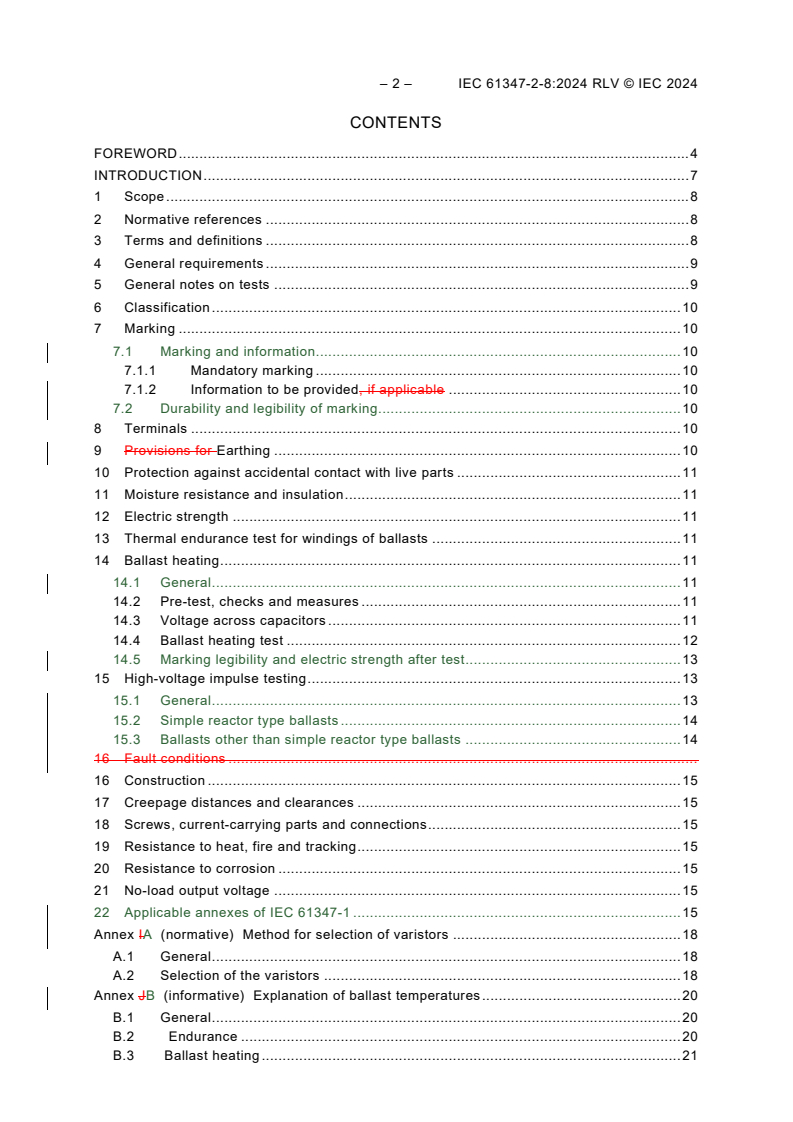
– 2 – IEC 61347-2-8:2024 RLV © IEC 2024
CONTENTS
FOREWORD . 4
INTRODUCTION . 7
1 Scope . 8
2 Normative references . 8
3 Terms and definitions . 8
4 General requirements . 9
5 General notes on tests . 9
6 Classification . 10
7 Marking . 10
7.1 Marking and information . 10
7.1.1 Mandatory marking . 10
7.1.2 Information to be provided, if applicable . 10
7.2 Durability and legibility of marking . 10
8 Terminals . 10
9 Provisions for Earthing . 10
10 Protection against accidental contact with live parts . 11
11 Moisture resistance and insulation . 11
12 Electric strength . 11
13 Thermal endurance test for windings of ballasts . 11
14 Ballast heating . 11
14.1 General . 11
14.2 Pre-test, checks and measures . 11
14.3 Voltage across capacitors . 11
14.4 Ballast heating test . 12
14.5 Marking legibility and electric strength after test . 13
15 High-voltage impulse testing . 13
15.1 General . 13
15.2 Simple reactor type ballasts . 14
15.3 Ballasts other than simple reactor type ballasts . 14
16 Fault conditions .
16 Construction . 15
17 Creepage distances and clearances . 15
18 Screws, current-carrying parts and connections . 15
19 Resistance to heat, fire and tracking . 15
20 Resistance to corrosion . 15
21 No-load output voltage . 15
22 Applicable annexes of IEC 61347-1 . 15
Annex IA (normative) Method for selection of varistors . 18
A.1 General . 18
A.2 Selection of the varistors . 18
Annex JB (informative) Explanation of ballast temperatures . 20
B.1 General . 20
B.2 Endurance . 20
B.3 Ballast heating . 21
B.4 Test arrangement. 21
Annex C (informative) Schedule of more onerous requirements . 24
Bibliography . 25
Figure A.1 – Test circuit for electromagnetic controlgear, for lamps with integral
starting devices. 19
Figure B.1 – Test hood for ballast heating test . 22
Figure B.2 – Test corner for ballast heating . 22
Table 1 – Abnormal conditions – Capacitor test voltages . 11
Table 2 – Maximum temperatures . 12
Table 3 – Limiting temperatures of ballast windings under abnormal operating
conditions and at 110 % of rated voltage for ballasts subjected to an endurance test
duration of 30 days . 13
– 4 – IEC 61347-2-8:2024 RLV © IEC 2024
INTERNATIONAL ELECTROTECHNICAL COMMISSION
____________
LAMP CONTROLGEAR –
CONTROLGEAR FOR ELECTRIC LIGHT SOURCES – SAFETY –
Part 2-8: Particular requirements – Ballasts for fluorescent lamps
FOREWORD
1) The International Electrotechnical Commission (IEC) is a worldwide organization for standardization comprising
all national electrotechnical committees (IEC National Committees). The object of IEC is to promote international
co-operation on all questions concerning standardization in the electrical and electronic fields. To this end and
in addition to other activities, IEC publishes International Standards, Technical Specifications, Technical Reports,
Publicly Available Specifications (PAS) and Guides (hereafter referred to as "IEC Publication(s)"). Their
preparation is entrusted to technical committees; any IEC National Committee interested in the subject dealt with
may participate in this preparatory work. International, governmental and non-governmental organizations liaising
with the IEC also participate in this preparation. IEC collaborates closely with the International Organization for
Standardization (ISO) in accordance with conditions determined by agreement between the two organizations.
2) The formal decisions or agreements of IEC on technical matters express, as nearly as possible, an international
consensus of opinion on the relevant subjects since each technical committee has representation from all
interested IEC National Committees.
3) IEC Publications have the form of recommendations for international use and are accepted by IEC National
Committees in that sense. While all reasonable efforts are made to ensure that the technical content of IEC
Publications is accurate, IEC cannot be held responsible for the way in which they are used or for any
misinterpretation by any end user.
4) In order to promote international uniformity, IEC National Committees undertake to apply IEC Publications
transparently to the maximum extent possible in their national and regional publications. Any divergence between
any IEC Publication and the corresponding national or regional publication shall be clearly indicated in the latter.
5) IEC itself does not provide any attestation of conformity. Independent certification bodies provide conformity
assessment services and, in some areas, access to IEC marks of conformity. IEC is not responsible for any
services carried out by independent certification bodies.
6) All users should ensure that they have the latest edition of this publication.
7) No liability shall attach to IEC or its directors, employees, servants or agents including individual experts and
members of its technical committees and IEC National Committees for any personal injury, property damage or
other damage of any nature whatsoever, whether direct or indirect, or for costs (including legal fees) and
expenses arising out of the publication, use of, or reliance upon, this IEC Publication or any other IEC
Publications.
8) Attention is drawn to the Normative references cited in this publication. Use of the referenced publications is
indispensable for the correct application of this publication.
9) IEC draws attention to the possibility that the implementation of this document may involve the use of (a)
patent(s). IEC takes no position concerning the evidence, validity or applicability of any claimed patent rights in
respect thereof. As of the date of publication of this document, IEC had not received notice of (a) patent(s), which
may be required to implement this document. However, implementers are cautioned that this may not represent
the latest information, which may be obtained from the patent database available at https://patents.iec.ch. IEC
shall not be held responsible for identifying any or all such patent rights.
This redline version of the official IEC Standard allows the user to identify the changes
made to the previous edition IEC 61347-2-8:2000+AMD1:2006 CSV. A vertical bar appears
in the margin wherever a change has been made. Additions are in green text, deletions
are in strikethrough red text.
IEC 61347-2-8 has been prepared by subcommittee 34C: Auxiliaries for lamps, of IEC technical
committee 34: Lighting. It is an International Standard.
This second edition cancels and replaces the first edition published in 2000 and
Amendment 1:2006. This edition constitutes a technical revision.
This edition includes the following significant technical changes with respect to the previous
edition:
a) introduction of dated references where appropriate;
b) alignment of clause numbers with those of IEC 61347-1.
The text of this International Standard is based on the following documents:
Draft Report on voting
34C/1583/CDV 34C/1591/RVC
Full information on the voting for its approval can be found in the report on voting indicated in
the above table.
The language used for the development of this International Standard is English.
This document was drafted in accordance with ISO/IEC Directives, Part 2, and developed in
accordance with ISO/IEC Directives, Part 1 and ISO/IEC Directives, IEC Supplement, available
at www.iec.ch/members_experts/refdocs. The main document types developed by IEC are
described in greater detail at www.iec.ch/publications.
This document is intended to be used in conjunction with IEC 61347-1:2015 and
IEC 61347-1:2015/AMD1:2017. Where the requirements of any of the clauses of
IEC 61347-1:2015 and IEC61347-1:2015/AMD1:2017 are referred to in this document by the
phrase "IEC 61347-1:2015, Clause n and IEC 61347-1:2015/AMD1:2017, Clause n apply", this
phrase is interpreted as meaning that all the requirements of the clause in question of
IEC 61347-1:2015 and IEC 61347-1:2015/AMD1:2017 apply, except any which are clearly
inapplicable to the specific type of controlgear covered by this document.
NOTE In this document, the following print type is used:
– compliance statements: in italic type.
A list of all parts in the IEC 61347 series, published under the general title Controlgear for
electric light sources – Safety, can be found on the IEC website.
Future documents in this series will carry the new general title as cited above. Titles of existing
documents in this series will be updated at the time of the next edition.
– 6 – IEC 61347-2-8:2024 RLV © IEC 2024
The committee has decided that the contents of this document will remain unchanged until the
stability date indicated on the IEC website under webstore.iec.ch in the data related to the
specific document. At this date, the document will be
• reconfirmed,
• withdrawn, or
• revised.
IMPORTANT – The "colour inside" logo on the cover page of this document indicates
that it contains colours which are considered to be useful for the correct understanding
of its contents. Users should therefore print this document using a colour printer.
INTRODUCTION
This first edition of IEC 61347-2-8, published in conjunction with IEC 61347-1, represents an
editorial review of IEC 60920. The formatting into separately published parts provides for ease
of future amendments and revisions. Additional requirements will be added as and when a need
for them is recognized.
This standard, and the parts which make up IEC 61347-2, in referring to any of the clauses of
IEC 61347-1, specify the extent to which such a clause is applicable and the order in which the
tests are to be performed; they also include additional requirements, as necessary. All parts
which make up IEC 61347-2 are self-contained and, therefore, do not include references to
each other.
Where the requirements of any of the clauses of IEC 61347-1 are referred to in this standard
by the phrase "The requirements of clause n of IEC 61347-1 apply", this phrase is interpreted
as meaning that all requirements of the clause in question of part 1 apply, except any which are
clearly inapplicable to the specific type of lamp controlgear covered by this particular part of
IEC 61347-2.
The technical requirements in this document compared to IEC 61347-2-8:2000 and
IEC 61347-2-8:2000/AMD1:2006 are essentially unchanged. Nevertheless, a new edition of this
document could not be avoided, as without the introduction of dated references to
IEC 61347-1:2015 and IEC 61347-1:2015/AMD1:2017, the fourth edition of IEC 61347-1:—
would have been implicitly applicable due to the undated nature of the references to
IEC 61347-1 in IEC 61347-2-8:2000 and IEC 61347-2-12:2000/AMD1:2006.
This document, in referring to any of the clauses of IEC 61347-1:2015 and
IEC 61347-1:2015/AMD1:2017, specifies the extent to which such a clause is applicable.
Additional requirements are also included, as necessary.
___________
Fourth edition under preparation. Stage at the time of publication IEC FDIS 61347-1:2024.
– 8 – IEC 61347-2-8:2024 RLV © IEC 2024
LAMP CONTROLGEAR –
CONTROLGEAR FOR ELECTRIC LIGHT SOURCES – SAFETY –
Part 2-8: Particular requirements– Ballasts for fluorescent lamps
1 Scope
This part of IEC 61347 specifies safety requirements for ballasts, excluding resistance types,
for use on AC supplies up to 1 000 V at 50 Hz or 60 Hz, associated with fluorescent lamps with
or without pre-heated cathodes operated with or without a starter or starting device and having
rated wattages powers, dimensions and characteristics as specified in IEC 60081 and
IEC 60901.
This document applies to complete ballasts and to their component parts such as reactors,
transformers and capacitors. Particular requirements for thermally protected ballasts are given
in annex B. Ballasts for conventional operation of lamps at mains frequency are covered, while
AC supplied electronic ballasts for high-frequency operation are excluded.
Ballasts for conventional operation of lamps at mains frequency are covered, while a.c. supplied
electronic ballasts for highfrequency operation are excluded. These are specified in IEC 61347-
2-3.
Capacitors having a capacitance greater than 0,1 µF are covered by IEC 61048 and IEC 61049.
Capacitors having a capacitance less than or equal to 0,1 µF are specified in IEC 60384-14.
NOTE 1 AC supplied electronic ballasts for high-frequency operation are specified in IEC 61347-2-3.
NOTE 2 Performance requirements are the subject of IEC 60921.
2 Normative references
For the purpose of this part of IEC 61347, the normative references given in clause 2 of
IEC 61374-1 which are mentioned in this standard apply, together with the following normative
references:
The following documents are referred to in the text in such a way that some or all of their content
constitutes requirements of this document. For dated references, only the edition cited applies.
For undated references, the latest edition of the referenced document (including any
amendments) applies.
IEC 60317-0-1:2013, Specifications for particular types of winding wires – Part 0-1: General
requirements – Enamelled round copper wire
IEC 60317-0-1:2013/AMD1:2019
IEC 61347-1:2015, Lamp controlgear – Part 1: General and safety requirements
IEC 61347-1:2015/AMD1:2017
3 Terms and definitions
For the purposes of this document, the terms and definitions given in IEC 61347-1 and the
following apply.
ISO and IEC maintain terminology databases for use in standardization at the following
addresses:
• IEC Electropedia: available at https://www.electropedia.org/
• ISO Online browsing platform: available at https://www.iso.org/obp
3.1
rated temperature rise of the ballast winding
∆t
temperature rise assigned by the manufacturer under the conditions specified in IEC 61347-2-8
Note 1 to entry: The specifications for the supply and mounting conditions of the ballast are given in
IEC 61347-1:2015, Annex H.
3.2
short-circuit power (of a voltage source)
quotient of the square of the voltage produced at its output terminals (in open circuit conditions)
and the internal impedance of the source (as seen from the same terminals)
4 General requirements
IEC 61347-1:2015, Clause 4 applies, together with the following:
– For thermally protected ballasts IEC 61347-1:2015, Annex B applies.
– For capacitors and other components incorporated in ballasts, the appropriate IEC standard
applies.
NOTE Capacitors having a capacitance greater than 0,1 µF are covered by IEC 61048 and IEC 61049. Capacitors
having a capacitance less than or equal to 0,1 µF are specified in IEC 60384-14.
4.1 Capacitors and other components
Capacitors and other components incorporated in ballasts shall comply with the requirements
of the appropriate IEC standard.
4.2 Thermally protected ballasts
Thermally protected ballasts shall comply with the requirements of annex B.
5 General notes on tests
IEC 61347-1:2015, Clause 5 applies, together with the following:
– The type test is carried out on one sample consisting of eight ballasts submitted used for
the purpose of the type test. Seven ballasts are for the endurance test and one for all other
tests. For conditions of compliance for the endurance test, see Clause 13.
In addition, six ballasts are required for the high-voltage impulse testing according to
Clause 15 below, for ballasts intended for circuits in which high-voltage impulse occurs
within the ballast. There shall be no failure during the test.
– The tests are made under the conditions specified in annex H of IEC 61347-1. IEC 61347-
1:2015, Annex H applies.
– In general, all the tests are carried out on each type of ballast or, where a range of similar
ballasts is involved, on each rated wattage power in the range, or on a representative
selection from the range, as agreed with the manufacturer. A reduction in the number of
samples for the endurance test, according to Clause 13 and including the use of constant S
other than 4 500, as shown in IEC 61347-1:2015, Annex E, or even the omission of these
tests, is allowed when ballasts of the same construction but with different characteristics
are submitted together for approval, or when test reports from the manufacturer or other
authority are accepted by the testing station.
– 10 – IEC 61347-2-8:2024 RLV © IEC 2024
For information on requalification of products compliant with the previous edition of this
document, i.e. IEC 61347-2-8:2000 and IEC 61347-2-8:2000/AMD1:2006, refer to Annex C.
6 Classification
IEC 61347-1:2015, Clause 6 applies.
7 Marking
Ballasts which form an integral part of the luminaire need not be marked.
7.1 Marking and information
7.1.1 Mandatory marking
Ballasts, other than integral ballasts, shall be clearly and durably marked, in accordance
with 7.2 of IEC 61347-1, marked with the following mandatory markings:
– items a), b), e), f), g) and r) of IEC 61347-1:2015, 7.1 and IEC 61347-1:2015/AMD1:2017,
7.1;
– the peak value of the voltage produced, if the peak value exceeds 1 500 V, with connections
subjected to this voltage marked as such.
Pulse generated by a glow starter and ballast combination are exempt from this requirement.
7.1.2 Information to be provided, if applicable
In addition to the above mandatory markings, The following information, if applicable, shall be
given either on the ballast, or be made available in the manufacturer's catalogue or similar:
– items c), h), i), j), k), o), p) and q) of IEC 61347-1:2015, 7.1;
– in the case of a ballast consisting of more than one separate unit, the current controlling
inductive element(s), marked with the essential details of the other unit(s) and/or essential
capacitors;
– in the case of an inductive ballast used with a separate series capacitor other than a radio
interference suppression capacitor, repetition of the marking of rated voltage, capacitance
and tolerance.
7.3 Other information
Manufacturers may provide the following non-mandatory information, rated temperature rise of
the ballast winding following the symbol ∆t, values increasing in multiples of 5 K, if available.
7.2 Durability and legibility of marking
IEC 61347-1:2015, 7.2 applies.
8 Terminals
IEC 61347-1:2015, Clause 8 and IEC 61347-1:2015/AMD1:2017, Clause 8 apply.
9 Provisions for Earthing
IEC 61347-1:2015, Clause 9 applies.
10 Protection against accidental contact with live parts
IEC 61347-1:2015, Clause 10 and IEC 61347-1:2015/AMD1:2017, Clause 10 apply.
11 Moisture resistance and insulation
IEC 61347-1:2015, Clause 11 and IEC 61347-1:2015/AMD1:2017, Clause 11 apply.
12 Electric strength
IEC 61347-1:2015, Clause 12 applies.
13 Thermal endurance test for windings of ballasts
IEC 61347-1:2015, Clause 13 applies.
14 Ballast heating
14.1 General
Ballasts, including their mounting surfaces, shall not attain a temperature which would impair
safety which is checked by the following tests.
Compliance is checked by the tests of 14.1 to 14.4.
14.2 Pre-test, checks and measures
Before the test, the following is checked and measured:
a) the ballast starts and operates the lamp(s) normally;
b) the resistance of each ballast winding is measured at the ambient temperature, if required.
14.3 Voltage across capacitors
At rated frequency, the voltage across a capacitor incorporated in a ballast shall comply with
the requirements given in items a) and b) below. Such requirements do not apply to the
capacitors in starters or starting devices or to those having a capacitance less than or equal to
0,1 µF (nominal). Neither do the requirements of item b) apply to self-healing capacitors.
a) Under normal conditions, when the ballast is tested at its rated supply voltage, the voltage
across the capacitor shall not exceed the rated voltage of the latter.
b) Under abnormal conditions (see 14.4) when the ballast is tested at 110 % of its rated supply
voltage, the voltage across the capacitor shall not be greater than the appropriate test
voltage of the capacitor given in Table 1.
Table 1 – Abnormal conditions – Capacitor test voltages
Designation Rated voltage Limiting voltage
U
n
Any Rated voltage of 240 V or less, 50 Hz or 60 Hz and maximum rated 1,25 U
n
temperature less than or equal to 50 °C
Non-self-healing Other ratings, 50 Hz or 60 Hz 1,50 U
n
Self-healing Other ratings, 50 Hz or 60 Hz 1,25 U
n
– 12 – IEC 61347-2-8:2024 RLV © IEC 2024
14.4 Ballast heating test
When the ballast is tested in accordance with the conditions of IEC 61347-1:2015, Annex H and
the information given in Annex BAnnex J, the temperature shall not exceed the appropriate
values given in Table 2 for the tests under normal and abnormal conditions, if applicable.
NOTE Abnormal circuit conditions are detailed in IEC 60598-1:2020, Annex C.
Table 2 – Maximum temperatures
Maximum temperature
°C
Parts
Normal operation Normal operation Abnormal
at 100 % of rated at 106 % of rated operation at 110 %
voltage voltage of rated voltage
Ballast windings with declared temperature
a
rise Δt if ∆t is provided
Ballast windings with declared temperature
b
under abnormal conditions
Ballast case adjacent to capacitor, if any
(incorporated in ballast enclosure)
– without temperature declaration 50
– with indication of t t
c c
Parts made of
– wood-filled phenolic mouldings 110
– mineral-filled phenolic mouldings 145
– urea mouldings 90
– melamine mouldings 100
– laminated, resin bonded paper 110
– rubber 70
c
– thermoplastic materials
a
The measurement of the temperature rise of the ballast windings under normal conditions at 100 % of rated
voltage – i.e. verification of a declared value so as to provide information for luminaire design – is non-
mandatory and its measurement is only performed when marked on the ballast or otherwise required in the
catalogue.
b
This measurement is only mandatory for circuits which may can produce abnormal conditions. The declared
limiting temperature of the ballast windings under abnormal conditions shall not be higher than the value which
corresponds to a number of days equal to at least two-thirds of the theoretical endurance test period (see
Table 3).
c
The temperature of thermoplastic material, other than that used for the insulation of the wiring, which provides
protection against contact with live parts or supporting such parts, is also measured. Values thus obtained
serve to establish the conditions of the test of IEC 61347-1:2015, 18.1.
If materials or manufacturing methods are used other than those indicated in Table 2, they must
shall not be operated at temperatures higher than those which are proved to be permissible for
those materials.
The temperature in Table 2 must shall not be exceeded when the ballast is operated at its
maximum declared ambient temperature, if any. Maximum ambient temperature for a ballast, if
not declared, must shall be considered as the difference between the marked t and the
w
measured ballast winding temperature rise Δt at 100 % rated voltage.
Table 3 – Limiting temperatures of ballast windings under abnormal operating
conditions and at 110 % of rated voltage for ballasts subjected to an endurance test
duration of 30 days
Limiting temperature
Constant S
°C
S4,5 S5 S6 S8 S11 S16
For t =
90 171 161 147 131 119 110
w
95 178 168 154 138 125 115
100 186 176 161 144 131 121
105 194 183 168 150 137 126
110 201 190 175 156 143 132
115 209 198 181 163 149 137
120 217 205 188 169 154 143
125 224 212 195 175 160 149
130 232 220 202 182 166 154
135 240 227 209 188 172 160
140 248 235 216 195 178 166
145 256 242 223 201 184 171
150 264 250 230 207 190 177
NOTE The limiting temperatures specified in column S4,5 apply, unless otherwise indicated on the ballast.
For ballasts which are subjected to an endurance test duration of longer than 30 days, the
limiting temperatures shall be calculated using IEC 61347-1:2015, Clause 13, Equation (2), but
for an objective test life (in days) equal to two-thirds of the theoretical endurance test period.
Table 2 shall be read together with Table 3 where necessary.
14.5 Marking legibility and electric strength after test
After these heating tests, the ballast shall be allowed to cool to room temperature and shall
comply with the following conditions:
a) the ballast marking shall still be legible;
b) the ballast shall withstand without damage a voltage test according to Clause 12, the test
voltage, however, being reduced to 75 % of the values given in IEC 61347-1:2015,
Clause 12, but not less than 500 V.
15 High-voltage impulse testing
15.1 General
Ballasts marked in accordance with 7.1 additional requirement shall be subjected to the test
either in 15.1 or 15.2 below.
Simple reactor type ballasts shall be subjected to the test in 15.1.
Ballasts other than simple reactor type ballasts shall be subjected to the test in 15.2. The
manufacturer shall declare to which test his product has been subjected.
Ballasts marked in accordance with 7.1.2 with a rated temperature rise of the ballast winding
shall be subjected to the test either in 15.2 or 15.3 below according to their type.
– 14 – IEC 61347-2-8:2024 RLV © IEC 2024
The manufacturer shall declare to which test their product has been subjected.
15.2 Simple reactor type ballasts
From the six ballasts specified in Clause 5, three are subjected to the moisture resistance and
insulation test and the electric strength test specified in Clause 11 and Clause 12.
The remaining three ballasts are heated in an oven until they attain the temperature t marked
w
on the ballast.
Immediately following these pre-conditioning tests, all six samples shall withstand the high-
voltage impulse test.
The ballast under test, together with a variable resistor and a suitable circuit breaker with a
closing time (bounce time excluded) between 3 ms and 15 ms – for example, a vacuum switch
type H16 or VR312/412 – is connected to a DC current in such a way that, by adjusting the
current and operating the circuit breaker, voltage pulses will be induced in the ballast. The
current is then adjusted slowly, increasing so that the peak voltage marked on the ballast is
reached. The measurement of the voltage pulses is made directly at the ballast terminations
and in accordance with Annex AAnnex I and Figure A.1Figure I.1.
NOTE 1 If electronic circuit breakers with a very short closing time are used, care must be taken against producing
a very high induced pulse voltage.
WARNING – If electronic circuit breakers with a very short closing time are used, very high
induced pulse voltages can be generated. Measures shall be taken to avoid an electric shock.
The value of the DC current at which the starting voltage is reached is noted. The ballasts are
then operated with this current for 1 h and the current is interrupted during this time, 10 times
for 3 s within every minute.
Immediately after the test all six ballasts shall withstand the moisture resistance and insulation
test and the electric strength test specified in Clause 11 and Clause 12.
NOTE 2 For testing circuits with series capacitors, the capacitor must shall be short-circuited.
15.3 Ballasts other than simple reactor type ballasts
Without connection of the lamp on the output side of the ballast, the supply voltage is adjusted
in order to obtain the pulse voltage, generated by the starter and the ballast, of the marked
value on the ballast. Cathode heating windings of the ballast are loaded with dummy resistors.
Then, the ballast is operated under these conditions without a lamp for a period of 30 days.
The number of ballasts, before-test treatment and conditions after the test are the same as
those prescribed specified in 15.2.
Ballasts which are marked for exclusive use with an ignitor having a time delay device are
subjected to the same test, but for a period consisting of 250 on/off cycles, keeping an off period
of at least 2 min.
16 Fault conditions
The requirements of clause 14 of IEC 61347-1 are not applicable.
16 Construction
IEC 61347-1:2015, Clause 15 applies.
17 Creepage distances and clearances
IEC 61347-1:2015, Clause 16 and IEC 61347-1:2015/AMD1:2017, Clause 16 apply, together
with the following:
In open-core ballasts, enamel, or similar material which forms the insulation for a wire and
withstands the voltage test for grade 1 or grade 2 of IEC 60317-0-1:2013, Clause 13 is judged
to contribute 1 mm to the values given in IEC 61347-1:2015, Table 3 and Table 4 between
enamelled wires of different ballast windings or from enamelled wire to covers, iron cores, etc.
However, this applies only in the situation where creepage distances and clearances are not
less than 2 mm in addition to the enamelled layers.
18 Screws, current-carrying parts and connections
IEC 61347-1:2015, Clause 17 applies.
19 Resistance to heat, fire and tracking
IEC 61347-1:2015, Clause 18, with the exception of 18.5, applies.
20 Resistance to corrosion
IEC 61347-1:2015, Clause 19 applies.
21 No-load output voltage
IEC 61347-1:2015, Clause 20 applies.
22 Applicable annexes of IEC 61347-1
The following annexes of IEC 61347-1:2015 apply:
– Annex A (normative) Test to establish whether a conductive part is a live part which may
cause an electric shock;
– Annex B (normative) Particular requirements for thermally protected lamp controlgear;
– Annex D (normative) Requirements for carrying out the heating tests of thermally protected
lamp controlgear;
– Annex E (normative) Use of constant S other than 4 500 in t tests;
w
– Annex F (normative) Draught-proof enclosure;
– Annex H (normative) Tests.
– 16 – IEC 61347-2-8:2024 RLV © IEC 2024
Annex A
(normative)
Test to establish whether a conductive part is a live part
which may cause an electric shock
The requirements of annex A of IEC 61347-1 apply.
Annex B
(normative)
Particular requirements for thermally protected lamp controlgear
The requirements of annex B of IEC 61347-1 apply.
Annex C
(normative)
Particular requirements for electronic lamp controlgear with means
of protection against overheating
The requirements of annex C of IEC 61347-1 do not apply.
Annex D
(normative)
Requirements for carrying out the heating tests of thermally
protected lamp controlgear
The requirements of annex D of IEC 61347-1 apply.
Annex E
(normative)
Use of constant S other than 4 500 in t tests
w
The requirements of annex E of IEC 61347-1 apply.
Annex F
(normative)
Draught-proof enclosure
The requirements of annex F of IEC 61347-1 apply.
Annex G
(normative)
Explanation of the derivation of the values of pulse voltages
The requirements of annex G of IEC 61347-1 do not apply.
Annex H
(normative)
Tests
The requirements of annex H of IEC 61347-1 apply.
– 18 – IEC 61347-2-8:2024 RLV © IEC 2024
Annex A Annex I
(normative)
Method for selection of varistors
IA.1 General
In order to avoid voltage variations during measurement of voltage pulses, a number of varistors
in series is connected in parallel to the ballast under test.
Given the energy involved, the smallest types of varistors are sufficient for this purpose.
The voltage built up within the ballast depends not only on its inductance, the DC current and
the capacitance C , but also on the quality of the vacuum switch, as part of the energy stored
in the ballast will be discharged via the spark occurring at the switch.
Therefore, it is necessary to select the varistors together with the switch used for the circuit.
Because of the fact that the varistors have tolerances which may add or compensate
themselves, an individual selection is necessary for each type of ballast to be tested.
IA.2 Selection of the varistors
The ballast current is first adjusted so that the voltage across C is approximately 15 % to 20 %
higher than the foreseen test voltage.
The voltage is then reduced to the intended value by means of varistors connected in series.
It is advisable to take two or three high-voltage varistors to cover the greatest part of the test
voltage and to use one or two varistors of lower voltage to cover the rest of the test voltage.
The fine adjustment of the test voltage can then be made by varying the current through the
ballast.
Approximate values for the voltage of the single varistors can be chosen from the voltage
current characteristics given in the relevant varistor data sheets (e.g. voltage value at
I = 10 mA).
Key
1 ammeter for measuring the DC current
2 electrostatic voltmeter with a self-capacitance not exceeding 30 pF for measuring the pulse voltage
3 protection device for power supply
4 supply for switch control: optional
C = 0,66 μF
C = 5 000 pF
C = 50 pF
D = Diode ZD22
D = Diode IN4004
D = Diode (6 pieces) BYV96E
P test sample
adjustable resistor (resistance of approximately 100 Ω)
R
R adjustable resistor: R ≥ ballast resistance × 20
2 2
S vacuum switch
Va varistors (for selection see Annex I)
Figure IA.1 – Test circuit for electromagnetic controlgear,
for lamps with integral starting devices
– 20 – IEC 61347-2-8:2024 RLV © IEC 2024
Annex BAnnex J
(informative)
Explanation of ballast temperatures
B.1 General
NOTE This Annex B does not introduce any new proposal but reflects the current state of the requirements.
The object of ballast temperature requirements is to verify that the ballast functions safely
during its intended life.
Ballast life is determined by the quality of the wire insulation connected with the ballast
construction.
The thermal behaviour of a ballast is thus characterized by the following aspects:
a) endurance;
b) ballast heating;
c) test arrangement.
The following explanation applies to coil type ballasts.
J.1B.2 Endurance
The starting point is the claimed ballast winding temperature t , denoting the temperature which
w
gives a life expectancy of at least 10 years' continuous operation at that temperature. The
relation between ballast winding temperature and ballast life can be calculated from the
following equation:
log L= log L +S ( − )
(B.1)
o
TT
w
where
L is the objective test life in days, 30 days being the standard but the manufacturer may ask
for a longer testing time at a related lower temperature;
L = 3 652 days (10 years);
o
T is the theoretical test temperature (t/°C + 273) K; t being the theoretical ballast winding test
temperature in °C;
T is the rated maximum operating temperature (t /°C + 273) K;
w w
S is the constant depending on the design of the ballast and the ballast winding insulation
used. If no claim is made to the contrary, S is taken to be 4 500 but a manufacturer may
claim the use of other values if this is justified by the relevant tests.
Consequently, the endurance test can be carried out in a much shorter time than 10 years at a
related higher ballast winding temperature. The standard endurance test period is 30 days, but
longer test durations, up to 120 days, are permitted.
J.2B.3 Ballast heating
For ballasts designed to be built into a luminaire, it should
...
IEC 61347-2-8 ®
Edition 2.0 2024-05
INTERNATIONAL
STANDARD
NORME
INTERNATIONALE
Controlgear for electric light sources – Safety –
Part 2-8: Particular requirements – Ballasts for fluorescent lamps
Appareillages de commande pour les sources de lumière électriques – Sécurité –
Partie 2-8: Exigences particulières – Ballasts pour lampes fluorescentes
All rights reserved. Unless otherwise specified, no part of this publication may be reproduced or utilized in any form
or by any means, electronic or mechanical, including photocopying and microfilm, without permission in writing from
either IEC or IEC's member National Committee in the country of the requester. If you have any questions about IEC
copyright or have an enquiry about obtaining additional rights to this publication, please contact the address below or
your local IEC member National Committee for further information.
Droits de reproduction réservés. Sauf indication contraire, aucune partie de cette publication ne peut être reproduite ni
utilisée sous quelque forme que ce soit et par aucun procédé, électronique ou mécanique, y compris la photocopie et
les microfilms, sans l'accord écrit de l'IEC ou du Comité national de l'IEC du pays du demandeur. Si vous avez des
questions sur le copyright de l'IEC ou si vous désirez obtenir des droits supplémentaires sur cette publication, utilisez
les coordonnées ci-après ou contactez le Comité national de l'IEC de votre pays de résidence.
IEC Secretariat Tel.: +41 22 919 02 11
3, rue de Varembé info@iec.ch
CH-1211 Geneva 20 www.iec.ch
Switzerland
About the IEC
The International Electrotechnical Commission (IEC) is the leading global organization that prepares and publishes
International Standards for all electrical, electronic and related technologies.
About IEC publications
The technical content of IEC publications is kept under constant review by the IEC. Please make sure that you have the
latest edition, a corrigendum or an amendment might have been published.
IEC publications search - webstore.iec.ch/advsearchform IEC Products & Services Portal - products.iec.ch
The advanced search enables to find IEC publications by a Discover our powerful search engine and read freely all the
variety of criteria (reference number, text, technical publications previews, graphical symbols and the glossary.
committee, …). It also gives information on projects, replaced With a subscription you will always have access to up to date
and withdrawn publications. content tailored to your needs.
IEC Just Published - webstore.iec.ch/justpublished
Electropedia - www.electropedia.org
Stay up to date on all new IEC publications. Just Published
The world's leading online dictionary on electrotechnology,
details all new publications released. Available online and once
containing more than 22 500 terminological entries in English
a month by email.
and French, with equivalent terms in 25 additional languages.
Also known as the International Electrotechnical Vocabulary
IEC Customer Service Centre - webstore.iec.ch/csc
(IEV) online.
If you wish to give us your feedback on this publication or need
further assistance, please contact the Customer Service
Centre: sales@iec.ch.
A propos de l'IEC
La Commission Electrotechnique Internationale (IEC) est la première organisation mondiale qui élabore et publie des
Normes internationales pour tout ce qui a trait à l'électricité, à l'électronique et aux technologies apparentées.
A propos des publications IEC
Le contenu technique des publications IEC est constamment revu. Veuillez vous assurer que vous possédez l’édition la
plus récente, un corrigendum ou amendement peut avoir été publié.
Recherche de publications IEC - IEC Products & Services Portal - products.iec.ch
webstore.iec.ch/advsearchform Découvrez notre puissant moteur de recherche et consultez
La recherche avancée permet de trouver des publications IEC gratuitement tous les aperçus des publications, symboles
en utilisant différents critères (numéro de référence, texte, graphiques et le glossaire. Avec un abonnement, vous aurez
comité d’études, …). Elle donne aussi des informations sur les toujours accès à un contenu à jour adapté à vos besoins.
projets et les publications remplacées ou retirées.
Electropedia - www.electropedia.org
IEC Just Published - webstore.iec.ch/justpublished
Le premier dictionnaire d'électrotechnologie en ligne au monde,
Restez informé sur les nouvelles publications IEC. Just
avec plus de 22 500 articles terminologiques en anglais et en
Published détaille les nouvelles publications parues.
français, ainsi que les termes équivalents dans 25 langues
Disponible en ligne et une fois par mois par email.
additionnelles. Egalement appelé Vocabulaire
Electrotechnique International (IEV) en ligne.
Service Clients - webstore.iec.ch/csc
Si vous désirez nous donner des commentaires sur cette
publication ou si vous avez des questions contactez-nous:
sales@iec.ch.
IEC 61347-2-8 ®
Edition 2.0 2024-05
INTERNATIONAL
STANDARD
NORME
INTERNATIONALE
Controlgear for electric light sources – Safety –
Part 2-8: Particular requirements – Ballasts for fluorescent lamps
Appareillages de commande pour les sources de lumière électriques – Sécurité –
Partie 2-8: Exigences particulières – Ballasts pour lampes fluorescentes
INTERNATIONAL
ELECTROTECHNICAL
COMMISSION
COMMISSION
ELECTROTECHNIQUE
INTERNATIONALE
ICS 29.140.99 ISBN 978-2-8322-8848-1
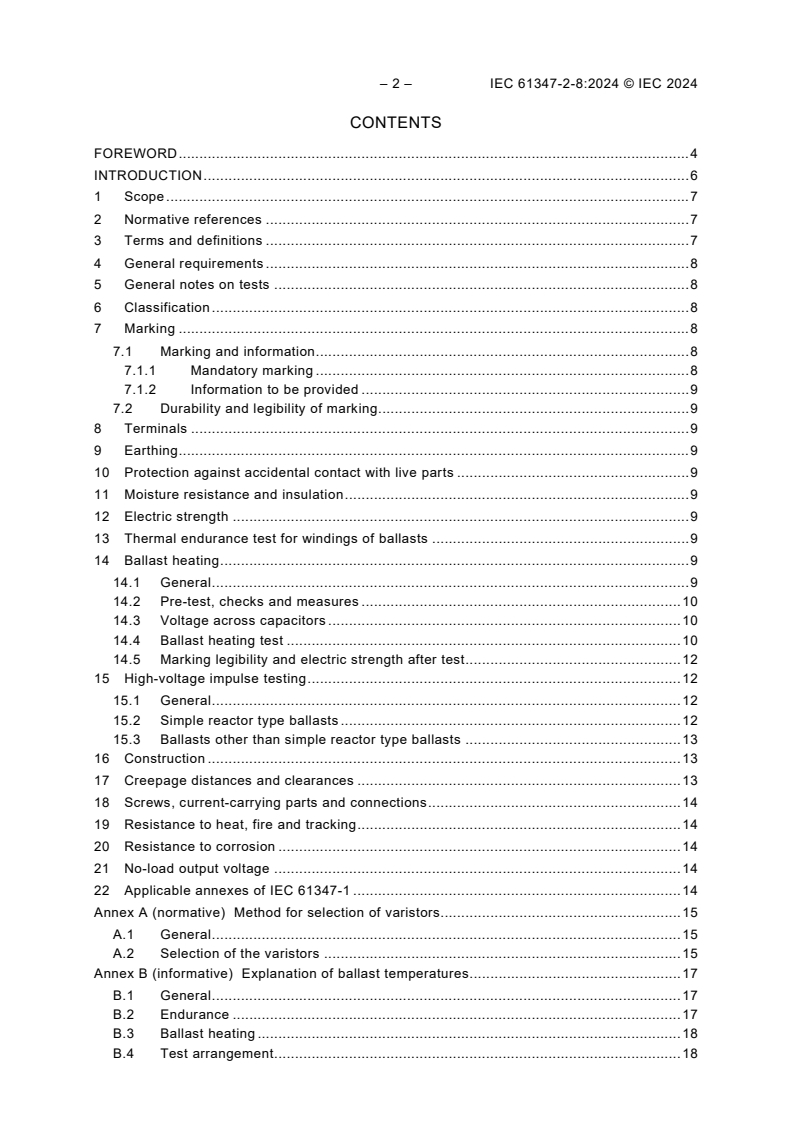
– 2 – IEC 61347-2-8:2024 © IEC 2024
CONTENTS
FOREWORD . 4
INTRODUCTION . 6
1 Scope . 7
2 Normative references . 7
3 Terms and definitions . 7
4 General requirements . 8
5 General notes on tests . 8
6 Classification . 8
7 Marking . 8
7.1 Marking and information . 8
7.1.1 Mandatory marking . 8
7.1.2 Information to be provided . 9
7.2 Durability and legibility of marking . 9
8 Terminals . 9
9 Earthing . 9
10 Protection against accidental contact with live parts . 9
11 Moisture resistance and insulation . 9
12 Electric strength . 9
13 Thermal endurance test for windings of ballasts . 9
14 Ballast heating . 9
14.1 General . 9
14.2 Pre-test, checks and measures . 10
14.3 Voltage across capacitors . 10
14.4 Ballast heating test . 10
14.5 Marking legibility and electric strength after test . 12
15 High-voltage impulse testing . 12
15.1 General . 12
15.2 Simple reactor type ballasts . 12
15.3 Ballasts other than simple reactor type ballasts . 13
16 Construction . 13
17 Creepage distances and clearances . 13
18 Screws, current-carrying parts and connections . 14
19 Resistance to heat, fire and tracking . 14
20 Resistance to corrosion . 14
21 No-load output voltage . 14
22 Applicable annexes of IEC 61347-1 . 14
Annex A (normative) Method for selection of varistors. 15
A.1 General . 15
A.2 Selection of the varistors . 15
Annex B (informative) Explanation of ballast temperatures . 17
B.1 General . 17
B.2 Endurance . 17
B.3 Ballast heating . 18
B.4 Test arrangement . 18
Annex C (informative) Schedule of more onerous requirements . 20
Bibliography . 21
Figure A.1 – Test circuit for electromagnetic controlgear, for lamps with integral
starting devices. 16
Figure B.1 – Test hood for ballast heating test . 19
Figure B.2 – Test corner for ballast heating . 19
Table 1 – Abnormal conditions – Capacitor test voltages . 10
Table 2 – Maximum temperatures . 11
Table 3 – Limiting temperatures of ballast windings under abnormal operating
conditions and at 110 % of rated voltage for ballasts subjected to an endurance test
duration of 30 days . 12
– 4 – IEC 61347-2-8:2024 © IEC 2024
INTERNATIONAL ELECTROTECHNICAL COMMISSION
____________
CONTROLGEAR FOR ELECTRIC LIGHT SOURCES – SAFETY –
Part 2-8: Particular requirements – Ballasts for fluorescent lamps
FOREWORD
1) The International Electrotechnical Commission (IEC) is a worldwide organization for standardization comprising
all national electrotechnical committees (IEC National Committees). The object of IEC is to promote international
co-operation on all questions concerning standardization in the electrical and electronic fields. To this end and
in addition to other activities, IEC publishes International Standards, Technical Specifications, Technical Reports,
Publicly Available Specifications (PAS) and Guides (hereafter referred to as "IEC Publication(s)"). Their
preparation is entrusted to technical committees; any IEC National Committee interested in the subject dealt with
may participate in this preparatory work. International, governmental and non-governmental organizations liaising
with the IEC also participate in this preparation. IEC collaborates closely with the International Organization for
Standardization (ISO) in accordance with conditions determined by agreement between the two organizations.
2) The formal decisions or agreements of IEC on technical matters express, as nearly as possible, an international
consensus of opinion on the relevant subjects since each technical committee has representation from all
interested IEC National Committees.
3) IEC Publications have the form of recommendations for international use and are accepted by IEC National
Committees in that sense. While all reasonable efforts are made to ensure that the technical content of IEC
Publications is accurate, IEC cannot be held responsible for the way in which they are used or for any
misinterpretation by any end user.
4) In order to promote international uniformity, IEC National Committees undertake to apply IEC Publications
transparently to the maximum extent possible in their national and regional publications. Any divergence between
any IEC Publication and the corresponding national or regional publication shall be clearly indicated in the latter.
5) IEC itself does not provide any attestation of conformity. Independent certification bodies provide conformity
assessment services and, in some areas, access to IEC marks of conformity. IEC is not responsible for any
services carried out by independent certification bodies.
6) All users should ensure that they have the latest edition of this publication.
7) No liability shall attach to IEC or its directors, employees, servants or agents including individual experts and
members of its technical committees and IEC National Committees for any personal injury, property damage or
other damage of any nature whatsoever, whether direct or indirect, or for costs (including legal fees) and
expenses arising out of the publication, use of, or reliance upon, this IEC Publication or any other IEC
Publications.
8) Attention is drawn to the Normative references cited in this publication. Use of the referenced publications is
indispensable for the correct application of this publication.
9) IEC draws attention to the possibility that the implementation of this document may involve the use of (a)
patent(s). IEC takes no position concerning the evidence, validity or applicability of any claimed patent rights in
respect thereof. As of the date of publication of this document, IEC had not received notice of (a) patent(s), which
may be required to implement this document. However, implementers are cautioned that this may not represent
the latest information, which may be obtained from the patent database available at https://patents.iec.ch. IEC
shall not be held responsible for identifying any or all such patent rights.
IEC 61347-2-8 has been prepared by subcommittee 34C: Auxiliaries for lamps, of IEC technical
committee 34: Lighting. It is an International Standard.
This second edition cancels and replaces the first edition published in 2000 and
Amendment 1:2006. This edition constitutes a technical revision.
This edition includes the following significant technical changes with respect to the previous
edition:
a) introduction of dated references where appropriate;
b) alignment of clause numbers with those of IEC 61347-1.
The text of this International Standard is based on the following documents:
Draft Report on voting
34C/1583/CDV 34C/1591/RVC
Full information on the voting for its approval can be found in the report on voting indicated in
the above table.
The language used for the development of this International Standard is English.
This document was drafted in accordance with ISO/IEC Directives, Part 2, and developed in
accordance with ISO/IEC Directives, Part 1 and ISO/IEC Directives, IEC Supplement, available
at www.iec.ch/members_experts/refdocs. The main document types developed by IEC are
described in greater detail at www.iec.ch/publications.
This document is intended to be used in conjunction with IEC 61347-1:2015 and
IEC 61347-1:2015/AMD1:2017. Where the requirements of any of the clauses of
IEC 61347-1:2015 and IEC61347-1:2015/AMD1:2017 are referred to in this document by the
phrase "IEC 61347-1:2015, Clause n and IEC 61347-1:2015/AMD1:2017, Clause n apply", this
phrase is interpreted as meaning that all the requirements of the clause in question of
IEC 61347-1:2015 and IEC 61347-1:2015/AMD1:2017 apply, except any which are clearly
inapplicable to the specific type of controlgear covered by this document.
NOTE In this document, the following print type is used:
– compliance statements: in italic type.
A list of all parts in the IEC 61347 series, published under the general title Controlgear for
electric light sources – Safety, can be found on the IEC website.
Future documents in this series will carry the new general title as cited above. Titles of existing
documents in this series will be updated at the time of the next edition.
The committee has decided that the contents of this document will remain unchanged until the
stability date indicated on the IEC website under webstore.iec.ch in the data related to the
specific document. At this date, the document will be
• reconfirmed,
• withdrawn, or
• revised.
– 6 – IEC 61347-2-8:2024 © IEC 2024
INTRODUCTION
The technical requirements in this document compared to IEC 61347-2-8:2000 and
IEC 61347-2-8:2000/AMD1:2006 are essentially unchanged. Nevertheless, a new edition of this
document could not be avoided, as without the introduction of dated references to
IEC 61347-1:2015 and IEC 61347-1:2015/AMD1:2017, the fourth edition of IEC 61347-1:—
would have been implicitly applicable due to the undated nature of the references to
IEC 61347-1 in IEC 61347-2-8:2000 and IEC 61347-2-12:2000/AMD1:2006.
This document, in referring to any of the clauses of IEC 61347-1:2015 and
IEC 61347-1:2015/AMD1:2017, specifies the extent to which such a clause is applicable.
Additional requirements are also included, as necessary.
___________
Fourth edition under preparation. Stage at the time of publication IEC FDIS 61347-1:2024.
CONTROLGEAR FOR ELECTRIC LIGHT SOURCES – SAFETY –
Part 2-8: Particular requirements – Ballasts for fluorescent lamps
1 Scope
This part of IEC 61347 specifies safety requirements for ballasts, excluding resistance types,
for use on AC supplies up to 1 000 V at 50 Hz or 60 Hz, associated with fluorescent lamps with
or without pre-heated cathodes operated with or without a starter or starting device and having
rated powers, dimensions and characteristics as specified in IEC 60081 and IEC 60901.
This document applies to complete ballasts and to their component parts such as reactors,
transformers and capacitors. Ballasts for conventional operation of lamps at mains frequency
are covered, while AC supplied electronic ballasts for high-frequency operation are excluded.
NOTE 1 AC supplied electronic ballasts for high-frequency operation are specified in IEC 61347-2-3.
NOTE 2 Performance requirements are the subject of IEC 60921.
2 Normative references
The following documents are referred to in the text in such a way that some or all of their content
constitutes requirements of this document. For dated references, only the edition cited applies.
For undated references, the latest edition of the referenced document (including any
amendments) applies.
IEC 60317-0-1:2013, Specifications for particular types of winding wires – Part 0-1: General
requirements – Enamelled round copper wire
IEC 60317-0-1:2013/AMD1:2019
IEC 61347-1:2015, Lamp controlgear – Part 1: General and safety requirements
IEC 61347-1:2015/AMD1:2017
3 Terms and definitions
For the purposes of this document, the terms and definitions given in IEC 61347-1 and the
following apply.
ISO and IEC maintain terminology databases for use in standardization at the following
addresses:
• IEC Electropedia: available at https://www.electropedia.org/
• ISO Online browsing platform: available at https://www.iso.org/obp
3.1
rated temperature rise of the ballast winding
∆t
temperature rise assigned by the manufacturer under the conditions specified in IEC 61347-2-8
Note 1 to entry: The specifications for the supply and mounting conditions of the ballast are given in
IEC 61347-1:2015, Annex H.
– 8 – IEC 61347-2-8:2024 © IEC 2024
4 General requirements
IEC 61347-1:2015, Clause 4 applies, together with the following:
– For thermally protected ballasts IEC 61347-1:2015, Annex B applies.
– For capacitors and other components incorporated in ballasts, the appropriate IEC standard
applies.
NOTE Capacitors having a capacitance greater than 0,1 µF are covered by IEC 61048 and IEC 61049. Capacitors
having a capacitance less than or equal to 0,1 µF are specified in IEC 60384-14.
5 General notes on tests
IEC 61347-1:2015, Clause 5 applies, together with the following:
– The type test is carried out on one sample consisting of eight ballasts used for the purpose
of the type test. Seven ballasts are for the endurance test and one for all other tests. For
conditions of compliance for the endurance test, see Clause 13.
In addition, six ballasts are required for the high-voltage impulse testing according to
Clause 15 below, for ballasts intended for circuits in which high-voltage impulse occurs
within the ballast. There shall be no failure during the test.
– IEC 61347-1:2015, Annex H applies.
– In general, all the tests are carried out on each type of ballast or, where a range of similar
ballasts is involved, on each rated power in the range, or on a representative selection from
the range, as agreed with the manufacturer. A reduction in the number of samples for the
endurance test, according to Clause 13 and including the use of constant S other than 4 500,
as shown in IEC 61347-1:2015, Annex E, or even the omission of these tests, is allowed
when ballasts of the same construction but with different characteristics are submitted
together for approval, or when test reports from the manufacturer or other authority are
accepted by the testing station.
For information on requalification of products compliant with the previous edition of this
document, i.e. IEC 61347-2-8:2000 and IEC 61347-2-8:2000/AMD1:2006, refer to Annex C.
6 Classification
IEC 61347-1:2015, Clause 6 applies.
7 Marking
7.1 Marking and information
7.1.1 Mandatory marking
Ballasts, other than integral ballasts, shall be marked with the following:
– items a), b), e), f), g) and r) of IEC 61347-1:2015, 7.1 and IEC 61347-1:2015/AMD1:2017,
7.1;
– the peak value of the voltage produced, if the peak value exceeds 1 500 V, with connections
subjected to this voltage marked as such.
Pulse generated by a glow starter and ballast combination are exempt from this requirement.
7.1.2 Information to be provided
The following information, if applicable, shall be given either on the ballast, or be made available
in the manufacturer's catalogue or similar:
– items c), h), i), j), k), o), p) and q) of IEC 61347-1:2015, 7.1;
– in the case of a ballast consisting of more than one separate unit, the current controlling
inductive element(s), marked with the essential details of the other unit(s) or essential
capacitors;
– in the case of an inductive ballast used with a separate series capacitor other than a radio
interference suppression capacitor, repetition of the marking of rated voltage, capacitance
and tolerance.
Manufacturers may provide the rated temperature rise of the ballast winding following the
symbol ∆t, values increasing in multiples of 5 K, if available.
7.2 Durability and legibility of marking
IEC 61347-1:2015, 7.2 applies.
8 Terminals
IEC 61347-1:2015, Clause 8 and IEC 61347-1:2015/AMD1:2017, Clause 8 apply.
9 Earthing
IEC 61347-1:2015, Clause 9 applies.
10 Protection against accidental contact with live parts
IEC 61347-1:2015, Clause 10 and IEC 61347-1:2015/AMD1:2017, Clause 10 apply.
11 Moisture resistance and insulation
IEC 61347-1:2015, Clause 11 and IEC 61347-1:2015/AMD1:2017, Clause 11 apply.
12 Electric strength
IEC 61347-1:2015, Clause 12 applies.
13 Thermal endurance test for windings of ballasts
IEC 61347-1:2015, Clause 13 applies.
14 Ballast heating
14.1 General
Ballasts, including their mounting surfaces, shall not attain a temperature which would impair
safety which is checked by the following tests.
– 10 – IEC 61347-2-8:2024 © IEC 2024
14.2 Pre-test, checks and measures
Before the test, the following is checked and measured:
a) the ballast starts and operates the lamp(s) normally;
b) the resistance of each ballast winding is measured at the ambient temperature, if required.
14.3 Voltage across capacitors
At rated frequency, the voltage across a capacitor incorporated in a ballast shall comply with
the requirements given in items a) and b) below. Such requirements do not apply to the
capacitors in starters or starting devices or to those having a capacitance less than or equal to
0,1 µF (nominal). Neither do the requirements of item b) apply to self-healing capacitors.
a) Under normal conditions, when the ballast is tested at its rated supply voltage, the voltage
across the capacitor shall not exceed the rated voltage of the latter.
b) Under abnormal conditions (see 14.4) when the ballast is tested at 110 % of its rated supply
voltage, the voltage across the capacitor shall not be greater than the appropriate test
voltage of the capacitor given in Table 1.
Table 1 – Abnormal conditions – Capacitor test voltages
Designation Rated voltage Limiting voltage
U
n
Any Rated voltage of 240 V or less, 50 Hz or 60 Hz and maximum rated 1,25 U
n
temperature less than or equal to 50 °C
Non-self-healing Other ratings, 50 Hz or 60 Hz 1,50 U
n
Self-healing Other ratings, 50 Hz or 60 Hz 1,25 U
n
14.4 Ballast heating test
When the ballast is tested in accordance with the conditions of IEC 61347-1:2015, Annex H and
the information given in Annex B, the temperature shall not exceed the appropriate values given
in Table 2 for the tests under normal and abnormal conditions, if applicable.
NOTE Abnormal circuit conditions are detailed in IEC 60598-1:2020, Annex C.
Table 2 – Maximum temperatures
Maximum temperature
°C
Parts
Normal operation Normal operation Abnormal
at 100 % of rated at 106 % of rated operation at 110 %
voltage voltage of rated voltage
a
Ballast windings if ∆t is provided
Ballast windings with declared temperature
b
under abnormal conditions
Ballast case adjacent to capacitor, if any
(incorporated in ballast enclosure)
– without temperature declaration 50
– with indication of t t
c c
Parts made of
– wood-filled phenolic mouldings 110
– mineral-filled phenolic mouldings 145
– urea mouldings 90
– melamine mouldings 100
– laminated, resin bonded paper 110
– rubber 70
c
– thermoplastic materials
a
The measurement of the temperature rise of the ballast windings under normal conditions at 100 % of rated
voltage – i.e. verification of a declared value so as to provide information for luminaire design – is non-
mandatory and its measurement is only performed when marked on the ballast or otherwise required in the
catalogue.
b
This measurement is only mandatory for circuits which can produce abnormal conditions. The declared limiting
temperature of the ballast windings under abnormal conditions shall not be higher than the value which
corresponds to a number of days equal to at least two-thirds of the theoretical endurance test period (see
Table 3).
c
The temperature of thermoplastic material, other than that used for the insulation of the wiring, which provides
protection against contact with live parts or supporting such parts, is also measured. Values thus obtained
serve to establish the conditions of the test of IEC 61347-1:2015, 18.1.
If materials or manufacturing methods are used other than those indicated in Table 2, they shall
not be operated at temperatures higher than those which are proved to be permissible for those
materials.
The temperature in Table 2 shall not be exceeded when the ballast is operated at its maximum
declared ambient temperature, if any. Maximum ambient temperature for a ballast, if not
declared, shall be considered as the difference between the marked t and the measured ballast
w
winding temperature rise at 100 % rated voltage.
– 12 – IEC 61347-2-8:2024 © IEC 2024
Table 3 – Limiting temperatures of ballast windings under abnormal operating
conditions and at 110 % of rated voltage for ballasts subjected to an endurance test
duration of 30 days
Limiting temperature
Constant S
°C
S4,5 S5 S6 S8 S11 S16
For t =
90 171 161 147 131 119 110
w
95 178 168 154 138 125 115
100 186 176 161 144 131 121
105 194 183 168 150 137 126
110 201 190 175 156 143 132
115 209 198 181 163 149 137
120 217 205 188 169 154 143
125 224 212 195 175 160 149
130 232 220 202 182 166 154
135 240 227 209 188 172 160
140 248 235 216 195 178 166
145 256 242 223 201 184 171
150 264 250 230 207 190 177
The limiting temperatures specified in column S4,5 apply, unless otherwise indicated on the ballast.
For ballasts which are subjected to an endurance test duration of longer than 30 days, the
limiting temperatures shall be calculated using IEC 61347-1:2015, Clause 13, Equation (2), but
for an objective test life (in days) equal to two-thirds of the theoretical endurance test period.
Table 2 shall be read together with Table 3 where necessary.
14.5 Marking legibility and electric strength after test
After these heating tests, the ballast shall be allowed to cool to room temperature and shall
comply with the following conditions:
a) the ballast marking shall still be legible;
b) the ballast shall withstand without damage a voltage test according to Clause 12, the test
voltage, however, being reduced to 75 % of the values given in IEC 61347-1:2015,
Clause 12, but not less than 500 V.
15 High-voltage impulse testing
15.1 General
Ballasts marked in accordance with 7.1.2 with a rated temperature rise of the ballast winding
shall be subjected to the test either in 15.2 or 15.3 below according to their type.
The manufacturer shall declare to which test their product has been subjected.
15.2 Simple reactor type ballasts
From the six ballasts specified in Clause 5, three are subjected to the moisture resistance and
insulation test and the electric strength test specified in Clause 11 and Clause 12.
The remaining three ballasts are heated in an oven until they attain the temperature t marked
w
on the ballast.
Immediately following these pre-conditioning tests, all six samples shall withstand the high-
voltage impulse test.
The ballast under test, together with a variable resistor and a suitable circuit breaker with a
closing time (bounce time excluded) between 3 ms and 15 ms – for example, a vacuum switch
type H16 or VR312/412 – is connected to a DC current in such a way that, by adjusting the
current and operating the circuit breaker, voltage pulses will be induced in the ballast. The
current is then adjusted slowly, increasing so that the peak voltage marked on the ballast is
reached. The measurement of the voltage pulses is made directly at the ballast terminations
and in accordance with Annex A and Figure A.1.
WARNING – If electronic circuit breakers with a very short closing time are used, very high
induced pulse voltages can be generated. Measures shall be taken to avoid an electric shock.
The value of the DC current at which the starting voltage is reached is noted. The ballasts are
then operated with this current for 1 h and the current is interrupted during this time, 10 times
for 3 s within every minute.
Immediately after the test all six ballasts shall withstand the moisture resistance and insulation
test and the electric strength test specified in Clause 11 and Clause 12.
For testing circuits with series capacitors, the capacitor shall be short-circuited.
15.3 Ballasts other than simple reactor type ballasts
Without connection of the lamp on the output side of the ballast, the supply voltage is adjusted
in order to obtain the pulse voltage, generated by the starter and the ballast, of the marked
value on the ballast. Cathode heating windings of the ballast are loaded with dummy resistors.
Then, the ballast is operated under these conditions without a lamp for a period of 30 days.
The number of ballasts, before-test treatment and conditions after the test are the same as
those specified in 15.2.
Ballasts which are marked for exclusive use with an ignitor having a time delay device are
subjected to the same test, but for a period consisting of 250 on/off cycles, keeping an off period
of at least 2 min.
16 Construction
IEC 61347-1:2015, Clause 15 applies.
17 Creepage distances and clearances
IEC 61347-1:2015, Clause 16 and IEC 61347-1:2015/AMD1:2017, Clause 16 apply, together
with the following:
In open-core ballasts, enamel, or similar material which forms the insulation for a wire and
withstands the voltage test for grade 1 or grade 2 of IEC 60317-0-1:2013, Clause 13 is judged
to contribute 1 mm to the values given in IEC 61347-1:2015, Table 3 and Table 4 between
enamelled wires of different ballast windings or from enamelled wire to covers, iron cores, etc.
However, this applies only in the situation where creepage distances and clearances are not
less than 2 mm in addition to the enamelled layers.
– 14 – IEC 61347-2-8:2024 © IEC 2024
18 Screws, current-carrying parts and connections
IEC 61347-1:2015, Clause 17 applies.
19 Resistance to heat, fire and tracking
IEC 61347-1:2015, Clause 18, with the exception of 18.5, applies.
20 Resistance to corrosion
IEC 61347-1:2015, Clause 19 applies.
21 No-load output voltage
IEC 61347-1:2015, Clause 20 applies.
22 Applicable annexes of IEC 61347-1
The following annexes of IEC 61347-1:2015 apply:
– Annex A (normative) Test to establish whether a conductive part is a live part which may
cause an electric shock;
– Annex B (normative) Particular requirements for thermally protected lamp controlgear;
– Annex D (normative) Requirements for carrying out the heating tests of thermally protected
lamp controlgear;
– Annex E (normative) Use of constant S other than 4 500 in t tests;
w
– Annex F (normative) Draught-proof enclosure;
– Annex H (normative) Tests.
Annex A
(normative)
Method for selection of varistors
A.1 General
In order to avoid voltage variations during measurement of voltage pulses, a number of varistors
in series is connected in parallel to the ballast under test.
Given the energy involved, the smallest types of varistors are sufficient for this purpose.
The voltage built up within the ballast depends not only on its inductance, the DC current and
the capacitance C , but also on the quality of the vacuum switch, as part of the energy stored
in the ballast will be discharged via the spark occurring at the switch.
Therefore, it is necessary to select the varistors together with the switch used for the circuit.
Because of the fact that the varistors have tolerances which may add or compensate
themselves, an individual selection is necessary for each type of ballast to be tested.
A.2 Selection of the varistors
The ballast current is first adjusted so that the voltage across C is approximately 15 % to 20 %
higher than the foreseen test voltage.
The voltage is then reduced to the intended value by means of varistors connected in series.
It is advisable to take two or three high-voltage varistors to cover the greatest part of the test
voltage and to use one or two varistors of lower voltage to cover the rest of the test voltage.
The fine adjustment of the test voltage can then be made by varying the current through the
ballast.
Approximate values for the voltage of the single varistors can be chosen from the voltage
current characteristics given in the relevant varistor data sheets (e.g. voltage value at
I = 10 mA).
– 16 – IEC 61347-2-8:2024 © IEC 2024
Key
1 ammeter for measuring the DC current
2 electrostatic voltmeter with a self-capacitance not exceeding 30 pF for measuring the pulse voltage
3 protection device for power supply
4 supply for switch control: optional
C = 0,66 μF
C = 5 000 pF
C = 50 pF
D = Diode ZD22
D = Diode IN4004
D = Diode (6 pieces) BYV96E
P test sample
adjustable resistor (resistance of approximately 100 Ω)
R
R adjustable resistor: R ≥ ballast resistance × 20
2 2
S vacuum switch
Va varistors
Figure A.1 – Test circuit for electromagnetic controlgear,
for lamps with integral starting devices
Annex B
(informative)
Explanation of ballast temperatures
B.1 General
NOTE This Annex B does not introduce any new proposal but reflects the current state of the requirements.
The object of ballast temperature requirements is to verify that the ballast functions safely
during its intended life.
Ballast life is determined by the quality of the wire insulation connected with the ballast
construction.
The thermal behaviour of a ballast is thus characterized by the following aspects:
a) endurance;
b) ballast heating;
c) test arrangement.
The following explanation applies to coil type ballasts.
B.2 Endurance
The starting point is the claimed ballast winding temperature t , denoting the temperature which
w
gives a life expectancy of at least 10 years' continuous operation at that temperature. The
relation between ballast winding temperature and ballast life can be calculated from the
following equation:
log L= log L +S ( − )
(B.1)
o
TT
w
where
L is the objective test life in days, 30 days being the standard but the manufacturer may ask
for a longer testing time at a related lower temperature;
L = 3 652 days (10 years);
o
T is the theoretical test temperature (t/°C + 273) K; t being the theoretical ballast winding test
temperature in °C;
T is the rated maximum operating temperature (t /°C + 273) K;
w w
S is the constant depending on the design of the ballast and the ballast winding insulation
used. If no claim is made to the contrary, S is taken to be 4 500 but a manufacturer may
claim the use of other values if this is justified by the relevant tests.
Consequently, the endurance test can be carried out in a much shorter time than 10 years at a
related higher ballast winding temperature. The standard endurance test period is 30 days, but
longer test durations, up to 120 days, are permitted.
– 18 – IEC 61347-2-8:2024 © IEC 2024
B.3 Ballast heating
For ballasts designed to be built into a luminaire, it should be checked that the assigned ballast
winding temperature (t ) in the luminaire is not exceeded under normal operating conditions, in
w
accordance with the luminaire standard.
Moreover, under abnormal operating conditions, such as a short-circuited starter in a
fluorescent lamp circuit, the luminaire is checked to see that the relevant limit which shall be
marked on the ballast is not exceeded. This limit is specified as the temperature corresponding
to a life of two-thirds of the test time for the ballast endurance test. This requirement is based
on and derived from the tables with limiting temperatures and theoretical test temperatures for
a ballast subject to an endurance test duration of 30 days and based on the assumption that a
t 90 ballast is comparable in requirements to a ballast without temperature marking, and with
w
layers separated by paper.
The above information means that the limiting temperature under abnormal conditions is for
example the temperature corresponding to a 20-day life span for a ballast subjected to a 30-day
endurance test. This relation is based on the traditional limits for the limiting temperature of
ballast windings and the objective test temperature for the endurance test. However, the
manufacturer is free to mark a lower temperature if the manufacturer so wishes.
Verification in the luminaire is based on the limiting values marked on the ballast. This implies
that if a manufacturer has elected to use a longer endurance test, at a correspondingly lower
temperature, then the maximum permissible temperature under abnormal conditions is
correspondingly reduced.
B.4 Test arrangement
Originally, ballast temperatures were checked on a ballast in a test arrangement which was a
simulation of a batten luminaire (see Figure B.1), modified several times to improve
reproducibility. The latest test arrangement is with the ballast lying on wooden supports (see
IEC 61347-1:2015, Figure H.1). Practice has shown, however, little or no correlation between
the temperatures measured on the ballast in that test arrangement and the actual temperatures
when the ballast was built into a particular luminaire. For this reason, measurement of ballast
heating in this test arrangement has been dropped and replaced by a much more realistic
measurement based on the maximum permitted ballast winding temperature t .
w
The ballast heating test has thus been modified to represent the worst conditions in the
luminaire permitted by the ballast manufacturer through the claimed value of t . Ballast parts
w
are then checked with the ballast operating in an oven until the marked ballast winding
temperature is reached.
Consequently, verification that the ball
...