

IEC 63173-2:2022
(Main)Maritime navigation and radiocommunication equipment and systems - Data interfaces - Part 2: Secure communication between ship and shore (SECOM)
General Information
- Abstract
IEC 63173-2:2022 the scope of secure communication between ship and shore (SECOM) includes interfaces (APIs) for data exchange (information services), information security measures to enable secure communication and interfaces for service discoverability. SECOM provides technical interoperability, where the same service interface is used for exchanging the information regardless of its operational use, up to the level of exchanging information securely online. Although designed for IHO S-100 based products, SECOM is technically payload agnostic and applicable also for other types of data.
Communication between SECOM information services for data exchange relies on IP based web services. The "last mile" links between a SECOM information service and the end-user application is not defined in this document, thus the communication technology between the vendor API and a ship/shore system can be non-IP based as well as IP based. The informative Annex D describes one such implementation of this. This allows different solutions between the service and shore/ship’s system/applications.
SECOM does not define physical layer or link layer for transport of data between SECOM information services, but requires that the transport supports IP communication. SECOM is applicable for both public (governmental) and private (business) services. SECOM is applicable for ship-shore and shore-ship communication, and can be used for ship-ship communication.
- Status
- Published
- Publication Date
- 29-May-2022
- Technical Committee
- TC 80 - Maritime navigation and radiocommunication equipment and systems
- Drafting Committee
- WG 17 - TC 80/WG 17
- Current Stage
- PPUB - Publication issued
- Start Date
- 30-May-2022
- Completion Date
- 10-Jun-2022
Buy Documents
IEC 63173-2:2022 - Maritime navigation and radiocommunication equipment and systems - Data interfaces - Part 2: Secure communication between ship and shore (SECOM) Released:5/30/2022
Overview
IEC 63173-2:2022 is an international standard established by the International Electrotechnical Commission (IEC) focusing on maritime navigation and radiocommunication equipment and systems. This part of the IEC 63173 series defines secure communication between ship and shore (SECOM) through standardized data interfaces (APIs). SECOM ensures secure, reliable data exchange by specifying information services with robust information security measures and service discoverability features. Although primarily designed for IHO S-100 based products, SECOM is payload-agnostic, making it suitable for various types of maritime data.
This standard leverages IP-based web services for communication between information services. It does not mandate specific physical or link layer protocols but requires support for IP transport, enabling flexibility in integrating diverse ship-to-shore and shore-to-ship communication technologies. SECOM also supports private and public service implementations and can be applied for ship-to-ship communication.
Key Topics
- Information Service Interfaces: SECOM defines standardized APIs for data upload, download, subscription management, and acknowledgments to facilitate interoperable maritime data exchange.
- Information Security Measures: The standard incorporates digital signatures, encryption, and Public Key Infrastructure (PKI) to ensure the confidentiality, integrity, and authenticity of exchanged data.
- SECOM PKI: A dedicated PKI framework supports certificate management, revocation lists (CRL), and online certificate status protocols (OCSP), enhancing trust and security in data communications.
- Communication Channel Security: SECOM mandates secure transfer protocols with authentication procedures while leaving the underlying transport technologies flexible.
- Service Discoverability: Interfaces are provided for discovering available SECOM services, facilitating seamless interaction between ship and shore applications.
- Data Protection: The standard includes guidelines on data compression, packaging, authentication, encryption algorithms, and key management, ensuring end-to-end protection.
- Error Handling: Detailed error case definitions support robust error detection and handling to maintain communication reliability.
Applications
IEC 63173-2:2022 serves as a foundational standard for maritime data exchange systems requiring secure and interoperable communication between ships and shore-based systems. Key applications include:
- Maritime Navigation Systems: Secure transmission of navigational data such as weather updates, route plans, and safety information.
- Radiocommunication Equipment: Encryption and secure exchange of messages between vessels and coastal authorities.
- Port and Cargo Management: Secure data sharing of cargo information and logistics updates in real-time.
- Maritime Security: Implementation of trusted communication channels for monitoring, tracking, and incident management.
- Ship-to-Ship Communication: Secure peer-to-peer data exchange enhancing cooperative maritime operations.
The standard’s flexibility in supporting both public government services and private business applications makes it highly adaptable for modern maritime digital ecosystems.
Related Standards
- IHO S-100 Series: SECOM is primarily designed to complement the IHO S-100 framework for hydrographic and marine geospatial data.
- IEC 61162 Series: Related to maritime navigation and radiocommunication protocols, complementing SECOM’s secure communication approach.
- ISO/IEC 27000 Series: For overarching information security management practices applicable to maritime data communications.
- ITU Maritime Communication Standards: These standards intersect with SECOM regarding ship-shore communication requirements.
Keywords: IEC 63173-2, SECOM, maritime communication standard, ship-to-shore secure data exchange, maritime navigation security, maritime radiocommunication, information security maritime, maritime data interfaces, ship shore communication protocol, maritime PKI, secure maritime data transfer.
Buy Documents
IEC 63173-2:2022 - Maritime navigation and radiocommunication equipment and systems - Data interfaces - Part 2: Secure communication between ship and shore (SECOM) Released:5/30/2022
Get Certified
Connect with accredited certification bodies for this standard

DNV
DNV is an independent assurance and risk management provider.

Lloyd's Register
Lloyd's Register is a global professional services organisation specialising in engineering and technology.

FSC International
Forest Stewardship Council certification.
Sponsored listings
Frequently Asked Questions
IEC 63173-2:2022 is a standard published by the International Electrotechnical Commission (IEC). Its full title is "Maritime navigation and radiocommunication equipment and systems - Data interfaces - Part 2: Secure communication between ship and shore (SECOM)". This standard covers: IEC 63173-2:2022 the scope of secure communication between ship and shore (SECOM) includes interfaces (APIs) for data exchange (information services), information security measures to enable secure communication and interfaces for service discoverability. SECOM provides technical interoperability, where the same service interface is used for exchanging the information regardless of its operational use, up to the level of exchanging information securely online. Although designed for IHO S-100 based products, SECOM is technically payload agnostic and applicable also for other types of data. Communication between SECOM information services for data exchange relies on IP based web services. The "last mile" links between a SECOM information service and the end-user application is not defined in this document, thus the communication technology between the vendor API and a ship/shore system can be non-IP based as well as IP based. The informative Annex D describes one such implementation of this. This allows different solutions between the service and shore/ship’s system/applications. SECOM does not define physical layer or link layer for transport of data between SECOM information services, but requires that the transport supports IP communication. SECOM is applicable for both public (governmental) and private (business) services. SECOM is applicable for ship-shore and shore-ship communication, and can be used for ship-ship communication.
IEC 63173-2:2022 the scope of secure communication between ship and shore (SECOM) includes interfaces (APIs) for data exchange (information services), information security measures to enable secure communication and interfaces for service discoverability. SECOM provides technical interoperability, where the same service interface is used for exchanging the information regardless of its operational use, up to the level of exchanging information securely online. Although designed for IHO S-100 based products, SECOM is technically payload agnostic and applicable also for other types of data. Communication between SECOM information services for data exchange relies on IP based web services. The "last mile" links between a SECOM information service and the end-user application is not defined in this document, thus the communication technology between the vendor API and a ship/shore system can be non-IP based as well as IP based. The informative Annex D describes one such implementation of this. This allows different solutions between the service and shore/ship’s system/applications. SECOM does not define physical layer or link layer for transport of data between SECOM information services, but requires that the transport supports IP communication. SECOM is applicable for both public (governmental) and private (business) services. SECOM is applicable for ship-shore and shore-ship communication, and can be used for ship-ship communication.
IEC 63173-2:2022 is classified under the following ICS (International Classification for Standards) categories: 47.020.70 - Navigation and control equipment. The ICS classification helps identify the subject area and facilitates finding related standards.
IEC 63173-2:2022 is available in PDF format for immediate download after purchase. The document can be added to your cart and obtained through the secure checkout process. Digital delivery ensures instant access to the complete standard document.
Standards Content (Sample)
IEC 63173-2 ®
Edition 1.0 2022-05
INTERNATIONAL
STANDARD
NORME
INTERNATIONALE
colour
inside
Maritime navigation and radiocommunication equipment and systems –
Data interfaces –
Part 2: Secure communication between ship and shore (SECOM)
Matériels et systèmes de navigation et de radiocommunication maritimes –
Interfaces de données –
Partie 2: Communications sécurisées entre le navire et la terre (SECOM)
All rights reserved. Unless otherwise specified, no part of this publication may be reproduced or utilized in any form
or by any means, electronic or mechanical, including photocopying and microfilm, without permission in writing from
either IEC or IEC's member National Committee in the country of the requester. If you have any questions about IEC
copyright or have an enquiry about obtaining additional rights to this publication, please contact the address below or
your local IEC member National Committee for further information.
Droits de reproduction réservés. Sauf indication contraire, aucune partie de cette publication ne peut être reproduite
ni utilisée sous quelque forme que ce soit et par aucun procédé, électronique ou mécanique, y compris la photocopie
et les microfilms, sans l'accord écrit de l'IEC ou du Comité national de l'IEC du pays du demandeur. Si vous avez des
questions sur le copyright de l'IEC ou si vous désirez obtenir des droits supplémentaires sur cette publication, utilisez
les coordonnées ci-après ou contactez le Comité national de l'IEC de votre pays de résidence.
IEC Secretariat Tel.: +41 22 919 02 11
3, rue de Varembé info@iec.ch
CH-1211 Geneva 20 www.iec.ch
Switzerland
About the IEC
The International Electrotechnical Commission (IEC) is the leading global organization that prepares and publishes
International Standards for all electrical, electronic and related technologies.
About IEC publications
The technical content of IEC publications is kept under constant review by the IEC. Please make sure that you have the
latest edition, a corrigendum or an amendment might have been published.
IEC publications search - webstore.iec.ch/advsearchform IEC Products & Services Portal - products.iec.ch
The advanced search enables to find IEC publications by a Discover our powerful search engine and read freely all the
variety of criteria (reference number, text, technical publications previews. With a subscription you will always
committee, …). It also gives information on projects, replaced have access to up to date content tailored to your needs.
and withdrawn publications.
Electropedia - www.electropedia.org
IEC Just Published - webstore.iec.ch/justpublished
The world's leading online dictionary on electrotechnology,
Stay up to date on all new IEC publications. Just Published
containing more than 22 300 terminological entries in English
details all new publications released. Available online and
and French, with equivalent terms in 19 additional languages.
once a month by email.
Also known as the International Electrotechnical Vocabulary
(IEV) online.
IEC Customer Service Centre - webstore.iec.ch/csc
If you wish to give us your feedback on this publication or
need further assistance, please contact the Customer Service
Centre: sales@iec.ch.
A propos de l'IEC
La Commission Electrotechnique Internationale (IEC) est la première organisation mondiale qui élabore et publie des
Normes internationales pour tout ce qui a trait à l'électricité, à l'électronique et aux technologies apparentées.
A propos des publications IEC
Le contenu technique des publications IEC est constamment revu. Veuillez vous assurer que vous possédez l’édition la
plus récente, un corrigendum ou amendement peut avoir été publié.
Recherche de publications IEC - IEC Products & Services Portal - products.iec.ch
webstore.iec.ch/advsearchform Découvrez notre puissant moteur de recherche et consultez
La recherche avancée permet de trouver des publications IEC gratuitement tous les aperçus des publications. Avec un
en utilisant différents critères (numéro de référence, texte, abonnement, vous aurez toujours accès à un contenu à jour
comité d’études, …). Elle donne aussi des informations sur adapté à vos besoins.
les projets et les publications remplacées ou retirées.
Electropedia - www.electropedia.org
IEC Just Published - webstore.iec.ch/justpublished
Le premier dictionnaire d'électrotechnologie en ligne au
Restez informé sur les nouvelles publications IEC. Just
monde, avec plus de 22 300 articles terminologiques en
Published détaille les nouvelles publications parues.
anglais et en français, ainsi que les termes équivalents dans
Disponible en ligne et une fois par mois par email.
19 langues additionnelles. Egalement appelé Vocabulaire
Electrotechnique International (IEV) en ligne.
Service Clients - webstore.iec.ch/csc
Si vous désirez nous donner des commentaires sur cette
publication ou si vous avez des questions contactez-nous:
sales@iec.ch.
IEC 63173-2 ®
Edition 1.0 2022-05
INTERNATIONAL
STANDARD
NORME
INTERNATIONALE
colour
inside
Maritime navigation and radiocommunication equipment and systems –
Data interfaces –
Part 2: Secure communication between ship and shore (SECOM)
Matériels et systèmes de navigation et de radiocommunication maritimes –
Interfaces de données –
Partie 2: Communications sécurisées entre le navire et la terre (SECOM)
INTERNATIONAL
ELECTROTECHNICAL
COMMISSION
COMMISSION
ELECTROTECHNIQUE
INTERNATIONALE
ICS 47.020.70 ISBN 978-2-8322-3802-8
– 2 – IEC 63173-2:2022 © IEC 2022
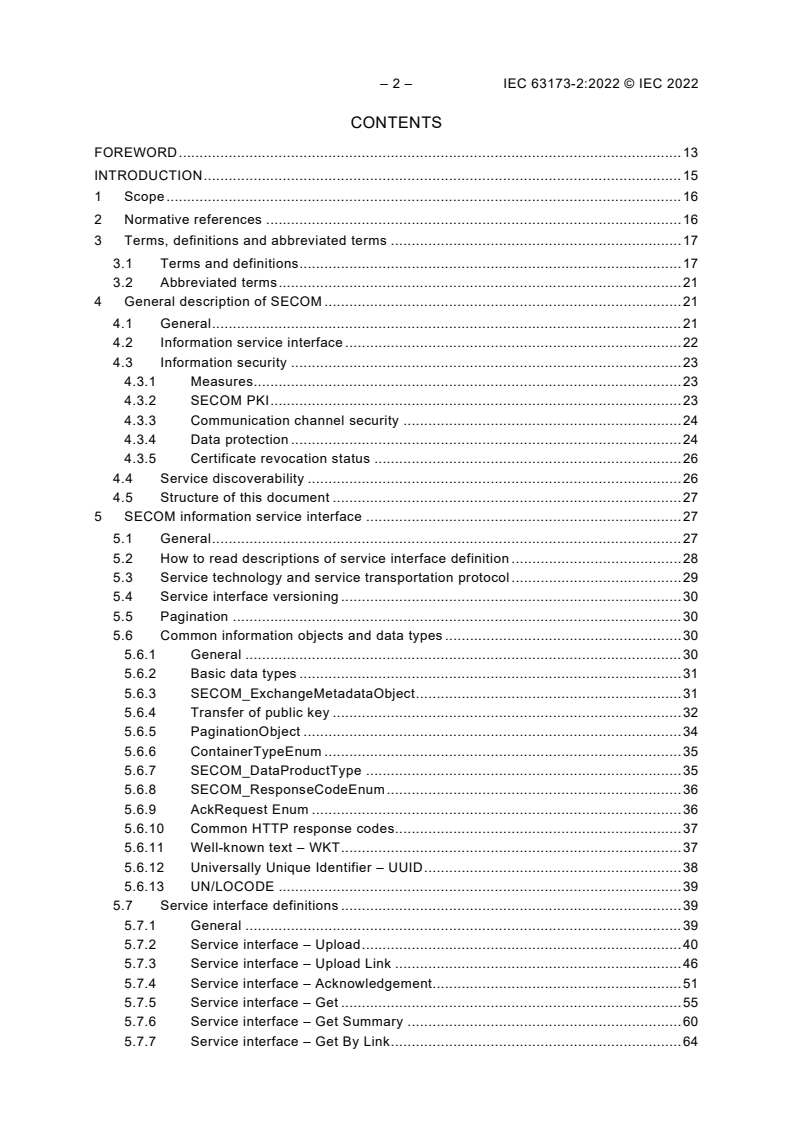
CONTENTS
FOREWORD . 13
INTRODUCTION . 15
1 Scope . 16
2 Normative references . 16
3 Terms, definitions and abbreviated terms . 17
3.1 Terms and definitions . 17
3.2 Abbreviated terms . 21
4 General description of SECOM . 21
4.1 General . 21
4.2 Information service interface . 22
4.3 Information security . 23
4.3.1 Measures. 23
4.3.2 SECOM PKI . 23
4.3.3 Communication channel security . 24
4.3.4 Data protection . 24
4.3.5 Certificate revocation status . 26
4.4 Service discoverability . 26
4.5 Structure of this document . 27
5 SECOM information service interface . 27
5.1 General . 27
5.2 How to read descriptions of service interface definition . 28
5.3 Service technology and service transportation protocol . 29
5.4 Service interface versioning . 30
5.5 Pagination . 30
5.6 Common information objects and data types . 30
5.6.1 General . 30
5.6.2 Basic data types . 31
5.6.3 SECOM_ExchangeMetadataObject . 31
5.6.4 Transfer of public key . 32
5.6.5 PaginationObject . 34
5.6.6 ContainerTypeEnum . 35
5.6.7 SECOM_DataProductType . 35
5.6.8 SECOM_ResponseCodeEnum . 36
5.6.9 AckRequest Enum . 36
5.6.10 Common HTTP response codes. 37
5.6.11 Well-known text – WKT . 37
5.6.12 Universally Unique Identifier – UUID . 38
5.6.13 UN/LOCODE . 39
5.7 Service interface definitions . 39
5.7.1 General . 39
5.7.2 Service interface – Upload . 40
5.7.3 Service interface – Upload Link . 46
5.7.4 Service interface – Acknowledgement. 51
5.7.5 Service interface – Get . 55
5.7.6 Service interface – Get Summary . 60
5.7.7 Service interface – Get By Link . 64
5.7.8 Service interface – Access. 66
5.7.9 Service interface – Access Notification . 69
5.7.10 Service interface – Subscription . 71
5.7.11 Service interface – Remove Subscription . 76
5.7.12 Service interface – Subscription Notification . 79
5.7.13 Service interface – Capability . 81
5.7.14 Service interface – Ping . 84
5.7.15 Service interface – EncryptionKey . 86
5.7.16 Service interface – PublicKey . 92
6 SECOM communication channel security . 96
6.1 General . 96
6.2 Secure transfer . 96
6.2.1 Secure communication channel . 96
6.2.2 Authentication procedure . 97
7 SECOM data protection . 97
7.1 General . 97
7.2 Data compression and packaging . 98
7.3 Data authentication and signing . 98
7.3.1 General . 98
7.3.2 Data formats and standards for digital signatures, keys and certificates . 98
7.3.3 Creation of digital signature . 99
7.3.4 Creation of envelope signature . 100
7.3.5 Verification of digital signature . 101
7.3.6 Verification of envelope signature . 102
7.3.7 Example of commands for data authentication . 102
7.4 Data encryption. 103
7.4.1 General . 103
7.4.2 Encryption algorithm . 103
7.5 Creation and transfer of encryption key . 103
7.5.1 General . 103
7.5.2 SECOM encryption key management . 104
7.5.3 Generate encryption key . 105
7.5.4 Sign the protected encryption key . 105
7.5.5 Transfer of the encryption key . 105
7.5.6 Example . 106
8 SECOM PKI . 106
8.1 General . 106
8.2 Scheme . 107
8.2.1 General . 107
8.2.2 Scheme administrator . 107
8.2.3 Data servers . 107
8.2.4 Data clients . 107
8.2.5 Procedure . 108
8.3 Generation of public and private key . 108
8.4 Certificate signing request . 109
8.5 Certificate revocation . 109
8.5.1 General . 109
8.5.2 CRL – Certificate revocation list. 109
8.5.3 OCSP – Online certificate status protocol . 109
– 4 – IEC 63173-2:2022 © IEC 2022
8.6 SECOM PKI service interface . 110
8.6.1 General . 110
8.6.2 Service interface – CSR . 110
8.6.3 Service interface – GetPublicKey . 113
8.6.4 Service interface – CRL . 115
8.6.5 Service interface – OCSP . 116
8.6.6 Service interface – Revoke . 119
9 SECOM service discovery service interface . 121
9.1 General . 121
9.2 Service interface – Search service . 121
9.2.1 Specification . 121
9.2.2 Data exchange model . 122
9.2.3 REST design . 124
10 SECOM error cases . 125
10.1 Error cases . 125
10.2 General . 126
10.3 Message integrity . 126
10.4 Data integrity . 126
10.5 Transport confidentiality . 126
10.6 Data protection . 127
10.7 Service identity . 127
10.8 Client identity . 127
10.9 Client authorization . 128
10.10 Bandwidth optimization . 128
10.11 Large message transfer . 128
10.12 Closed loop communication . 129
10.13 Service discoverability . 130
10.14 Information push . 130
10.15 Information pull . 130
10.16 Subscribe to data . 131
10.17 Service information . 131
10.18 Service condition . 131
11 Test methods and expected results . 132
11.1 General . 132
11.2 Communication channel security test . 132
11.3 Data protection test . 133
11.3.1 Data Compression and packaging. 133
11.3.2 Data authentication and signature . 133
11.3.3 Encryption . 133
11.3.4 Digital signature test . 133
11.4 SECOM ship/shore test . 133
11.4.1 General . 133
11.4.2 Prerequisites SECOM ship/shore EUT . 136
11.4.3 Upload data . 136
11.4.4 Download data . 137
11.5 SECOM Information Service test . 139
11.5.1 General . 139
11.5.2 Prerequisites SECOM information service EUT . 140
11.5.3 Access. 140
11.5.4 Access notification . 141
11.5.5 Acknowledgement. 141
11.5.6 Capability . 142
11.5.7 EncryptionKey . 143
11.5.8 EncryptionKey Notification . 143
11.5.9 Get . 144
11.5.10 Get By Link . 145
11.5.11 Get Summary . 146
11.5.12 Get Public Key . 147
11.5.13 Upload Public Key . 147
11.5.14 Ping . 148
11.5.15 Subscription . 148
11.5.16 Subscription Notification . 149
11.5.17 Remove Subscription . 149
11.5.18 Upload . 150
11.5.19 Upload Link . 151
11.6 SECOM PKI Service test . 152
11.6.1 Prerequisites PKI EUT . 152
11.6.2 CRL . 153
11.6.3 OCSP . 153
11.6.4 Revoke . 154
11.6.5 CSR . 154
11.6.6 GetPublicKey . 154
11.7 SECOM Service Discovery test . 155
11.7.1 General . 155
11.7.2 Prerequisites Service Discovery EUT . 155
11.7.3 Search service – By geometry . 155
11.7.4 Search service – Without specified search criteria . 156
Annex A (normative) REST service interface definitions . 157
A.1 Purpose . 157
A.2 SECOM information service REST interface definition . 157
A.3 SECOM PKI service REST interface definition . 157
A.4 SECOM discovery service REST interface definition . 157
Annex B (informative) Operational use cases and profiles . 158
B.1 Purpose . 158
B.2 Use cases and service interface profiles . 158
B.2.1 UC-1 Ship shares route plan with service providing enhanced
monitoring . 158
B.2.2 UC-2 Pilot routes . 159
B.2.3 UC-3 Route optimization . 160
B.2.4 UC-4 Enhanced monitoring service requests route plan from/for ship for
monitoring . 161
B.2.5 UC-5 Discover service instance to consume . 162
B.2.6 UC-6 Chart (ENC) updates . 163
B.2.7 UC-7 navigational warning service . 164
B.2.8 UC-8 Updates for detailed bathymetry and tidal and water level
forecasts . 166
Annex C (informative) Message exchange patterns . 167
C.1 Purpose . 167
– 6 – IEC 63173-2:2022 © IEC 2022
C.2 Message exchange pattern . 167
C.2.1 Generic message exchange patterns . 167
C.2.2 Alternative and error sequences . 170
Annex D (informative) Guidance on implementation . 171
D.1 Purpose . 171
D.2 On ship . 172
D.3 On shore . 173
D.4 Service composition . 174
D.5 Private side security. 175
D.6 SECOM PKI . 176
D.6.1 General . 176
D.6.2 Structure and Functionality . 176
D.6.3 Identity management . 177
D.6.4 Public Key Infrastructure. 180
D.6.5 Authentication and authorization for web services. 185
D.6.6 Profile "Basic Requirements" . 186
D.7 SECOM service discovery . 186
D.7.1 Example 1: geometry combined with serviceType search . 186
D.7.2 Example 2: Search with AND/OR condition . 188
Annex E (informative) Use of white list . 190
E.1 Purpose . 190
E.2 Authorization to access data . 190
E.3 Access control list . 191
E.4 Authorization based on predefined rules or list . 191
E.5 Manually updated list . 192
E.6 Rule based handling on request to information (rule based authorization) . 192
E.7 Rule based request for information . 192
E.8 Procedure when receiving "Not authorized" . 192
Annex F (informative) Test and simulators . 193
F.1 Purpose . 193
F.2 Manual testing . 193
F.3 Ship and shore equipment . 193
F.4 SECOM information service equipment . 194
F.5 SECOM PKI equipment . 194
F.6 SECOM Service Discovery equipment. 195
Bibliography . 196
Figure 1 – Overview of SECOM . 22
Figure 2 – Secure communication channel . 24
Figure 3 – Illustration of what parts of the message are protected by the two signatures . 25
Figure 4 – Envelope and data validation . 26
Figure 5 – Service definition model for the service interface definitions . 28
Figure 6 – Example in C# of conversion from PEM format to minified public key . 33
Figure 7 – Example of a public key in PEM format converted to a single line string . 33
Figure 8 – Example in C# of conversion from minified public key to PEM format . 34
Figure 9 – Example of a minified public key string restored to the original PEM format . 34
Figure 10 – UUID version and variant . 38
Figure 11 – Upload interface UML diagram . 41
Figure 12 – Sequence diagram for upload signed unclassified data with
acknowledgement . 45
Figure 13 – Update link interface UML diagram . 47
Figure 14 – Sequence diagram for Upload link to large data . 51
Figure 15 – Acknowledgement interface UML diagram . 52
Figure 16 – Sequence diagram for Acknowledgement interface . 55
Figure 17 – Get interface UML diagram. 56
Figure 18 – Sequence diagram for Get interface . 59
Figure 19 – Sequence diagram for Get interface and classified data . 60
Figure 20 – Get Summary interface UML diagram . 61
Figure 21 – Sequence diagram for Get Summary interface . 64
Figure 22 – Get By Link interface in UML . 64
Figure 23 – Sequence diagram for Get By Link interface . 66
Figure 24 – Access interface UML diagram . 67
Figure 25 – Sequence diagram for Request Access and Access Notification interface . 69
Figure 26 – Access Notification interface UML diagram. 70
Figure 27 – Subscribe interface UML diagram . 72
Figure 28 – Sequence diagram for Subscribe interface . 74
Figure 29 – Operational sequence diagram for Subscription interfaces . 75
Figure 30 – Sequence diagram for Subscription interfaces with external subscription
request . 76
Figure 31 – Remove Subscription interface UML diagram . 77
Figure 32 – Sequence diagram for Remove Subscription interface . 78
Figure 33 – Subscription Notification interface UML diagram . 79
Figure 34 – Sequence diagram for Subscription Notification interface . 81
Figure 35 – Capability interface UML diagram . 82
Figure 36 – Sequence diagram for Capability interface . 84
Figure 37 – Ping interface UML diagram . 85
Figure 38 – Check status on service . 86
Figure 39 – Encryption Key interface UML diagram . 87
Figure 40 – Operational sequence diagram for EncryptionKey upload interface . 91
Figure 41 – Operational sequence diagram for EncryptionKey notification interface . 92
Figure 42 – PublicKey interface UML diagram . 93
Figure 43 – Operational sequence diagram for PublicKey interface . 95
Figure 44 – Principle for service authentication . 97
Figure 45 – Sequence for SECOM encryption key management . 104
Figure 46 – Alternative sequence for SECOM encryption key management . 105
Figure 47 – CSR interface UML diagram . 111
Figure 48 – Operational sequence diagram for CSR . 112
Figure 49 – GetPublicKey interface UML diagram . 113
Figure 50 – Operational sequence diagram for GetPublicKey . 115
Figure 51 – GetCRL interface UML diagram . 115
Figure 52 – Operational sequence diagram for CRL . 116
– 8 – IEC 63173-2:2022 © IEC 2022
Figure 53 – GetOCSP interface UML diagram . 117
Figure 54 – Operational sequence diagram for OCSP . 119
Figure 55 – PostRevoke interface UML diagram . 119
Figure 56 – Operational sequence diagram for Revoke . 121
Figure 57 – Search service UML information diagram . 122
Figure C.1 – Message Exchange Pattern – ONE_WAY . 167
Figure C.2 – Message Exchange Pattern – REQUEST_CALLBACK . 168
Figure C.3 – Message exchange pattern – REQUEST_RESPONSE . 168
Figure C.4 – Message exchange pattern – PUBLISH_SUBSCRIBE (Provider
nominates) . 169
Figure C.5 – Message exchange pattern – PUBLISH_SUBSCRIBE (Consumer request) . 169
Figure C.6 – Error sequence; Incorrect uploaded message . 170
Figure C.7 – Error sequence; Unauthorized upload of message . 170
Figure C.8 – Error sequence; Unauthorized subscription request . 170
Figure D.1 – Overview of SECOM . 171
Figure D.2 – Overview of certificate usage . 172
Figure D.3 – Deployment example for SECOM on ship . 173
Figure D.4 – Deployment example for SECOM on shore . 174
Figure D.5 – Service composition. 175
Figure D.6 – Structure of MIR within MCP . 176
Figure D.7 – Hierarchical X.509 PKI Structure . 181
Figure D.8 – Request find service with geometry and query . 187
Figure D.9 – Response from service registry . 188
Figure D.10 – Response from service registry . 189
Figure F.1 – Manual testing . 193
Figure F.2 – Overview of test equipment for ship and shore equipment . 194
Figure F.3 – Overview of test equipment for SECOM information service equipment . 194
Figure F.4 – Overview of test equipment for SECOM PKI equipment . 195
Figure F.5 – Overview of test equipment for SECOM service discovery equipment . 195
Table 1 – Read instructions for tables in service interface definitions . 29
Table 2 – SECOM Service interface versioning . 30
Table 3 – Basic data types . 31
Table 4 – SECOM_ExchangeMetadataObject . 32
Table 5 – DigitalSignatureValueObject . 32
Table 6 – PaginationObject . 35
Table 7 – ContainerTypeEnum . 35
Table 8 – SECOM_DataProductType . 35
Table 9 – SECOM_ResponseCodeEnum . 36
Table 10 – AckRequest Enum . 36
Table 11 – Common HTTP codes. 37
Table 12 – Supported WKT geometric objects . 37
Table 13 – UUID variants . 38
Table 14 – UUID versions . 39
...