


ISO/IEC 14776-326:2002
(Main)Information technology - Small computer system interface (SCSI) - Part 326: Reduced block commands (RBC)
Information technology - Small computer system interface (SCSI) - Part 326: Reduced block commands (RBC)
Specifies the functional requirements for the SCSI Reduced Block Command set (RBC). RBC permits SCSI block logical units, such as flexible disks, rigid disks, optical disks, etc., to be attached to computers, and it provides the definition for their use. An implementation guide for RBC devices using SBP-2 is also provided. The Reduced Block Command set is designed to provide very efficient initiator-to-device operation of input/output logical units by an operating system. The contents of the corrigendum of December 2009 have been included in this copy.
General Information
- Status
- Published
- Publication Date
- 27-Aug-2002
- Technical Committee
- ISO/IEC JTC 1/SC 25 - Interconnection of information technology equipment
- Current Stage
- DELPUB - Deleted Publication
- Start Date
- 08-Sep-2015
- Completion Date
- 14-Feb-2026
Relations
- Effective Date
- 05-Sep-2023
- Effective Date
- 05-Sep-2023
Overview
ISO/IEC 14776-326:2002, "Information technology - Small Computer System Interface (SCSI) - Part 326: Reduced Block Commands (RBC)," defines the Reduced Block Command (RBC) set for SCSI logical block devices. The standard specifies functional requirements for attaching block devices (flexible disks, rigid disks, optical disks, etc.) to computer systems and describes how operating systems and initiators perform efficient initiator-to-device I/O. This edition incorporates the corrigendum published in 2009 and includes an implementation guide for RBC devices using SBP-2.
Key topics and requirements
- RBC device model: definition of removable-medium devices, logical block organization, reservations and command usage.
- Core RBC commands: command descriptions and required behavior for operations such as FORMAT UNIT, READ(10), READ CAPACITY, WRITE(10), VERIFY, SYNCHRONIZE CACHE, and START STOP UNIT.
- Mode pages and parameters: structure and usage of mode parameter lists and the RBC device parameters page.
- SPC-2 implementation: required SPC-2 (SCSI Primary Commands - 2) commands and restrictions for RBC devices, including INQUIRY, REQUEST SENSE, MODE SENSE/SELECT, TEST UNIT READY and WRITE BUFFER behaviors.
- Asynchronous event notification: handling unit attention, deferred errors, information exception conditions and event status notifications (power, media and device busy class events).
- SBP-2 guidance (Annex A): normative implementation guidance for RBC over SBP-2, covering configuration ROM, status block and unsolicited status support for serial bus environments.
- Compatibility and efficiency: emphasis on providing an efficient, reduced command set suitable for simple block devices and OS-level I/O optimization.
Applications and who uses this standard
- Storage device manufacturers: firmware and hardware teams implementing SCSI block devices (removable and non-removable) to ensure SCSI compliance.
- Device firmware and driver developers: implementers of device command handlers, mode pages, power/media event reporting and reservation behavior.
- Operating system and kernel developers: implementers of SCSI initiator stacks and block device drivers that interact with RBC devices.
- System integrators and test labs: interoperability testing, conformance verification and certification of SCSI-compatible storage products.
- Protocol implementers using SBP-2: developers building RBC devices over IEEE 1394/Serial Bus environments can follow Annex A guidance.
Related standards
- SPC-2 (SCSI Primary Commands - 2): referenced for required base command behavior and restrictions.
- ISO/IEC 14776 (SCSI family): other parts that define broader SCSI command sets and device models.
- SBP-2 implementation documents: normative guidance included in Annex A for serial bus protocols.
Keywords: ISO/IEC 14776-326, SCSI, Reduced Block Commands, RBC, SBP-2, SPC-2, logical block device, SCSI commands, storage firmware, device drivers.
Get Certified
Connect with accredited certification bodies for this standard

BSI Group
BSI (British Standards Institution) is the business standards company that helps organizations make excellence a habit.

NYCE
Mexican standards and certification body.
Sponsored listings
Frequently Asked Questions
ISO/IEC 14776-326:2002 is a standard published by the International Electrotechnical Commission (IEC). Its full title is "Information technology - Small computer system interface (SCSI) - Part 326: Reduced block commands (RBC)". This standard covers: Specifies the functional requirements for the SCSI Reduced Block Command set (RBC). RBC permits SCSI block logical units, such as flexible disks, rigid disks, optical disks, etc., to be attached to computers, and it provides the definition for their use. An implementation guide for RBC devices using SBP-2 is also provided. The Reduced Block Command set is designed to provide very efficient initiator-to-device operation of input/output logical units by an operating system. The contents of the corrigendum of December 2009 have been included in this copy.
Specifies the functional requirements for the SCSI Reduced Block Command set (RBC). RBC permits SCSI block logical units, such as flexible disks, rigid disks, optical disks, etc., to be attached to computers, and it provides the definition for their use. An implementation guide for RBC devices using SBP-2 is also provided. The Reduced Block Command set is designed to provide very efficient initiator-to-device operation of input/output logical units by an operating system. The contents of the corrigendum of December 2009 have been included in this copy.
ISO/IEC 14776-326:2002 is classified under the following ICS (International Classification for Standards) categories: 35.200 - Interface and interconnection equipment. The ICS classification helps identify the subject area and facilitates finding related standards.
ISO/IEC 14776-326:2002 has the following relationships with other standards: It is inter standard links to ISO/IEC 14776-326:2002/COR1:2009, ISO/IEC 14776-326:2015. Understanding these relationships helps ensure you are using the most current and applicable version of the standard.
ISO/IEC 14776-326:2002 is available in PDF format for immediate download after purchase. The document can be added to your cart and obtained through the secure checkout process. Digital delivery ensures instant access to the complete standard document.
Standards Content (Sample)
ISO/IEC 14776-326
Edition 1.0 2002-08
INTERNATIONAL
STANDARD
Information technology – Small computer system interface (SCSI) –
Part 326: Reduced block commands (RBC)
All rights reserved. Unless otherwise specified, no part of this publication may be reproduced or utilized in any form
or by any means, electronic or mechanical, including photocopying and microfilm, without permission in writing from
either IEC or IEC's member National Committee in the country of the requester.
If you have any questions about ISO/IEC copyright or have an enquiry about obtaining additional rights to this
publication, please contact the address below or your local IEC member National Committee for further information.
IEC Central Office
3, rue de Varembé
CH-1211 Geneva 20
Switzerland
Email: inmail@iec.ch
Web: www.iec.ch
About the IEC
The International Electrotechnical Commission (IEC) is the leading global organization that prepares and publishes
International Standards for all electrical, electronic and related technologies.
About IEC publications
The technical content of IEC publications is kept under constant review by the IEC. Please make sure that you have the
latest edition, a corrigenda or an amendment might have been published.
ƒ Catalogue of IEC publications: www.iec.ch/searchpub
The IEC on-line Catalogue enables you to search by a variety of criteria (reference number, text, technical committee,…).
It also gives information on projects, withdrawn and replaced publications.
ƒ IEC Just Published: www.iec.ch/online_news/justpub
Stay up to date on all new IEC publications. Just Published details twice a month all new publications released. Available
on-line and also by email.
ƒ Electropedia: www.electropedia.org
The world's leading online dictionary of electronic and electrical terms containing more than 20 000 terms and definitions
in English and French, with equivalent terms in additional languages. Also known as the International Electrotechnical
Vocabulary online.
ƒ Customer Service Centre: www.iec.ch/webstore/custserv
If you wish to give us your feedback on this publication or need further assistance, please visit the Customer Service
Centre FAQ or contact us:
Email: csc@iec.ch
Tel.: +41 22 919 02 11
Fax: +41 22 919 03 00
ISO/IEC 14776-326
Edition 1.0 2002-08
INTERNATIONAL
STANDARD
Information technology – Small computer system interface (SCSI) –
Part 326: Reduced block commands (RBC)
INTERNATIONAL
ELECTROTECHNICAL
COMMISSION
PRICE CODE
R
ICS 35.200 ISBN 2-8318-6509-3
– 2 – 14776-326 © ISO/IEC:2002(E)
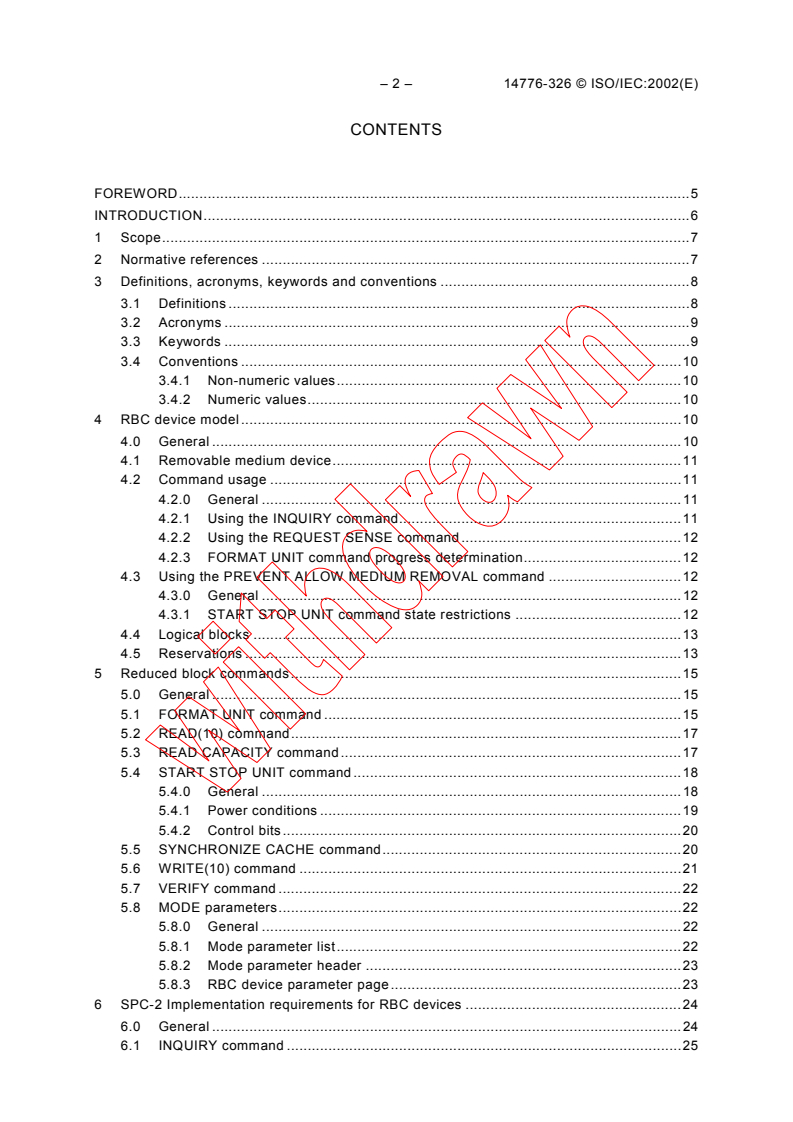
CONTENTS
FOREWORD.5
INTRODUCTION.6
1 Scope.7
2 Normative references.7
3 Definitions, acronyms, keywords and conventions .8
3.1 Definitions.8
3.2 Acronyms.9
3.3 Keywords.9
3.4 Conventions.10
3.4.1 Non-numeric values.10
3.4.2 Numeric values.10
4 RBC device model.10
4.0 General.10
4.1 Removable medium device.11
4.2 Command usage.11
4.2.0 General.11
4.2.1 Using the INQUIRY command.11
4.2.2 Using the REQUEST SENSE command .12
4.2.3 FORMAT UNIT command progress determination.12
4.3 Using the PREVENT ALLOW MEDIUM REMOVAL command .12
4.3.0 General.12
4.3.1 START STOP UNIT command state restrictions .12
4.4 Logical blocks.13
4.5 Reservations.13
5 Reduced block commands.15
5.0 General.15
5.1 FORMAT UNIT command .15
5.2 READ(10) command.17
5.3 READ CAPACITY command.17
5.4 START STOP UNIT command .18
5.4.0 General.18
5.4.1 Power conditions.19
5.4.2 Control bits.20
5.5 SYNCHRONIZE CACHE command.20
5.6 WRITE(10) command.21
5.7 VERIFY command.22
5.8 MODE parameters.22
5.8.0 General.22
5.8.1 Mode parameter list.22
5.8.2 Mode parameter header.23
5.8.3 RBC device parameter page.23
6 SPC-2 Implementation requirements for RBC devices .24
6.0 General.24
6.1 INQUIRY command.25
14776-326 © ISO/IEC:2002(E) – 3 –
6.1.0 General.25
6.1.1 INQUIRY vital product data pages .26
6.2 MODE SELECT(6) command.26
6.2.0 General.26
6.2.1 Save pages (SP) bit support .27
6.3 MODE SENSE(6) command.27
6.4 PREVENT ALLOW MEDIUM REMOVAL .27
6.5 REQUEST SENSE command.28
6.6 TEST UNIT READY command .28
6.7 WRITE BUFFER command.29
6.7.0 General.29
6.7.1 Download Microcode and save mode (101b).29
6.7.2 Download Microcode with offsets and save mode (111b) .29
7 Asynchronous event notification for RBC devices .30
7.0 General.30
7.1 Unit attention.30
7.1.0 General.30
7.1.1 Power condition change notification.30
7.2 Deferred errors.31
7.3 Information exception condition notification .31
7.4 Event status notification.31
7.4.0 General.31
7.4.1 Event status sense information.31
7.4.2 POWER MANAGEMENT CLASS INFORMATION field .32
7.4.3 MEDIA CLASS EVENT INFORMATION field.33
7.4.4 DEVICE BUSY CLASS EVENT INFORMATION values .34
7.4.5 Event status retention.35
7.4.6 Removable medium device initial response .35
Annex A (normative) RBC device implementation requirements for SBP-2 .36
A.1 SBP-2 definitions.36
A.2 Acronyms .37
A.3 SBP-2 storage model (informative) .38
A.3.0 General.38
A.3.1 Model configuration .38
A.3.2 Reconnect/Power reset support (normative) .39
A.4 Configuration ROM support (normative).40
A.4.0 General.40
A.4.1 Unit Directory – Command_Set_Spec_ID .40
A.4.2 Unit Directory – Command_Set.40
A.4.3 Unit Directory – Logical_Unit_Number .40
A.5 Security support (normative).41
A.6 Status block support (normative) .41
A.7 Unsolicited status support (normative).41
A.7.0 General.41
A.7.1 Unit attention condition.42
A.7.2 Event status retention.42
– 4 – 14776-326 © ISO/IEC:2002(E)
Figure A.1 – Mass storage interface block diagram .38
Table 1 – RBC direct access commands that are allowed in the presence of various
reservations.14
Ta
ble 2 − Reduced Block Command set.15
Table 3 − FORMAT UNIT command .16
Table 4 – READ(10) Command Descriptor Block.17
Table 5 − READ CAPACITY Command Descriptor Block.17
Table 6 − READ CAPACITY data .18
Table 7 − START STOP UNIT Command Descriptor Block.18
Table 8 − POWER CONDITIONS .19
Table 9 − START STOP control bit definitions.20
Table 10 – SYNCHRONIZE CACHE Command Descriptor Block.20
Table 11 − WRITE(10) Command Descriptor Block .21
Table 12 − VERIFY Command Descriptor Block .22
Table 13 − Mode parameter list.23
Table 14 − RBC Device Parameter's page format .23
Table 15 − Required SPC-2 commands.25
Table 16 − Standard Inquiry data format .25
Table 17 − MODE SELECT(6) Command Descriptor Block.26
Table 18 − MODE SENSE(6) Command Descriptor Block .27
Table 19 − FAILURE PREDICTION ASCQ XY definitions.28
Table 20 − WRITE BUFFER Command Descriptor Block.29
Table 21 – Asynchronous Event conditions .30
Table 22 − Power condition sense code and qualifier values.30
Table 23 – Event status ASCQ values .31
Table 24 – EVENT STATUS INFORMATION field format .32
Table 25 – POWER MANAGEMENT CLASS INFORMATION field format.32
Table 26 – POWER MANAGEMENT CLASS EVENT field .32
Table 27 – POWER MANAGEMENT CLASS STATUS field .33
Table 28 – MEDIA CLASS INFORMATION field format .33
Table 29 − MEDIA CLASS EVENT field.33
Table 30 – DEVICE BUSY CLASS INFORMATION field format .34
Table 31 – DEVICE BUSY CLASS EVENT field .34
Table 32 – DEVICE BUSY CLASS STATUS field .34
14776-326 © ISO/IEC:2002(E) – 5 –
INFORMATION TECHNOLOGY –
SMALL COMPUTER SYSTEM INTERFACE (SCSI) –
Part 326: Reduced Block Commands (RBC)
FOREWORD
1) ISO (International Organization for Standardization) and IEC (International Electrotechnical Commission) form the
specialized system for worldwide standardization. National bodies that are members of ISO or IEC participate in
the development of International Standards through technical committees established by the respective
organization to deal with particular fields of technical activity. ISO and IEC technical committees collaborate in
fields of mutual interest. Other international organizations, governmental and non-governmental, in liaison with
ISO and IEC, also take part in the work.
2) In the field of information technology, ISO and IEC have established a joint technical committee, ISO/IEC JTC 1.
Draft International Standards adopted by the joint technical committee are circulated to national bodies for voting.
Publication as an International Standard requires approval by at least 75 % of the national bodies casting a vote.
3) Attention is drawn to the possibility that some of the elements of this International Standard may be the subject of
patent rights. ISO and IEC shall not be held responsible for identifying any or all such patent rights.
International Standard ISO/IEC 14776-326 was prepared by subcommittee 25: Intercon-
nection of information technology equipment, of ISO/IEC joint technical committee 1: Infor-
mation technology.
This publication has been drafted in accordance with the ISO/IEC Directives, Part 2.
The contents of the corrigendum of November 2009 have been included in this copy.
– 6 – 14776-326 © ISO/IEC:2002(E)
INTRODUCTION
This part of ISO/IEC 14776 specifies the functional requirements for the SCSI Reduced Block
Command set (RBC). RBC permits SCSI block logical units, such as flexible disks, rigid disks,
optical disks, etc., to be attached to computers, and it provides the definition for their use.
The Reduced Block Command set is designed to provide very efficient initiator-to-device
operation of input/output logical units by an operating system.
Annex A contains an implementation guide for RBC devices using SBP-2.
14776-326 © ISO/IEC:2002(E) – 7 –
INFORMATION TECHNOLOGY –
SMALL COMPUTER SYSTEM INTERFACE (SCSI) –
Part 326: Reduced Block Commands (RBC)
1 Scope
This part of ISO/IEC 14776 defines a Reduced Block Command set for logical block devices.
The Reduced Block Commands, along with the required SPC-2 commands and their
restrictions described in this standard, fully specify the complete command set for RBC logical
block devices.
The purpose of this standard is to provide a command set of reduced requirements and
options from SCSI Block Commands (SBC) for block devices (see ISO/IEC 14776-321). The
reduced command set is intended to more closely match the functionality required for simple
block logical units. The specified commands place no restrictions on device performance. The
basic focus of this command set is to enable the command and control of rigid disks and
removable media devices attached to Serial Bus and utilizing SCSI Serial Bus Protocol 2
(SBP-2) (ISO/IEC 14776-232).
2 Normative references
The following referenced documents are indispensable for the application of this document.
For dated references, only the edition cited applies. For undated references, the latest edition
of the referenced document, including any amendments, applies.
The provisions of the referenced specifications other than ISO/IEC, IEC, ISO and ITU
documents, as identified in this clause, are valid within the context of this International
Standard. The reference to such a specification within this International Standard does not
give it any further status within ISO or IEC. In particular, it does not give the referenced
specification the status of an International Standard.
ISO/IEC 13213:1994, Information technology – Microprocessor systems – Control and status
register (CSR) architecture for microcomputer buses
ISO/IEC 14776-232:2001, Information technology – Small Computer System Interface
(SCSI) – Part 232: Serial Bus Protocol-2 (SBP-2)
ISO/IEC 14776-321:2002, Information technology – Small Computer System Interface-3
(SCSI-3) – Part 321: Block commands (SBC)
ISO/IEC 14776-362:2006, Information technology – Small Computer System Interface
(SCSI) – Part 362: Multimedia commands-2 (MMC-2)
ISO/IEC 14776-412:2006, Information technology – Small Computer System Interface
(SCSI) – Part 412: Architecture model-2 (SAM-2)
ISO/IEC 14776-452:2005, Information technology – Small Computer System Interface
)
(SCSI) – Part 452: Primary commands-2 (SPC-2)
IEEE 1394:1995, High Performance Serial Bus
IEEE 1394A:2000, High Performance Serial Bus Amendment 1
– 8 – 14776-326 © ISO/IEC:2002(E)
3 Definitions, acronyms, keywords and conventions
3.1 Definitions
For the purpose of this document the following terms and definitions apply.
3.1.1
additional sense code
field in the sense data (see definition in ISO/IEC 14776-452)
3.1.2
additional sense code qualifier
field in the sense data (see definition in ISO/IEC 14776-452)
3.1.3
byte
eight bits of data
3.1.4
command descriptor block
structure of up to 16 bytes in length used to communicate a command from an initiator to a
device
3.1.5
event field
byte 0 of the sense data INFORMATION field (see Table 24 for the Event Status
INFORMATION field format) when the sense code indicates EVENT STATUS NOTIFICATION
(38h)
3.1.6
logical unit
part of the target that is an instance of a device model, for example, mass storage, CD-ROM
or printer. In devices that implement one or more logical units, the device type of the logical
units may differ
3.1.7
sense data
data describing an error or exceptional device condition that a device delivers to an initiator
(see definition in ISO/IEC 14776-452)
3.1.8
sense key
field in the sense data (see definition in ISO/IEC 14776-452)
3.1.9
status
response information sent from a device to an initiator upon completion of each command
3.1.10
unit attention condition
state that a logical unit maintains while it has asynchronous status information to report to one
or more initiators
3.1.11
vendor-specific
an item (for example, a bit, field, code value, etc.) which is not defined by this standard and
may be vendor defined
14776-326 © ISO/IEC:2002(E) – 9 –
3.2 Acronyms
The following abbreviations are used in this standard:
ASC Additional Sense Code
ASCQ Additional Sense Code Qualifier
CDB Command Descriptor Block
RBC Reduced Block Commands (this standard)
SPC-2 SCSI Primary Commands 2
3.3 Keywords
Several keywords are used to differentiate levels of requirements and options, as follows:
3.3.1
expected
keyword used to describe the behavior of the hardware or software in the design models
assumed by this standard. Other hardware and software design models may also be
implemented
3.3.2
ignored
keyword that describes bits, bytes, quadlets, or fields whose values are not checked by the
recipient
3.3.3
mandatory
keyword that indicates items required to be implemented as defined by this standard
3.3.4
may
keyword that indicates flexibility of choice with no implied preference
3.3.5
optional
keyword that describes features which are not required to be implemented by this standard.
However, if any optional feature defined by this standard is implemented, it shall be
implemented as defined
3.3.6
reserved
keyword used to describe objects – bits, bytes and fields – or the code values assigned to
these objects in cases where either the object or the code value is set aside for future
standardization. Usage and interpretation may be specified by future extensions to this or
other standards. A reserved object shall be zeroed or, upon development of a future standard,
set to a value specified by such a standard. The recipient of a reserved object shall not check
its value. The recipient of a defined object shall check its value and reject reserved code
values
3.3.7
shall
keyword that indicates a mandatory requirement. Designers are required to implement all
such mandatory requirements to assure interoperability with other products conforming to this
standard
– 10 – 14776-326 © ISO/IEC:2002(E)
3.4 Conventions
The following conventions are used.
3.4.1 Non-numeric values
Lowercase is used for words having the normal English meaning. Certain words and terms
used in this standard have a specific meaning beyond the normal English meaning. These
words and terms are defined either in Clause 3 or in the text where they first appear.
Listed items in RBC do not represent any priority. Any priority is explicitly indicated. Formal
lists (for example, (a) red; (b) blue; (c) green) connoted by letters are in an arbitrary order.
Formal lists (for example, (1) red; (2) blue; (3) green) connoted by numbers are in a required
sequential order.
If a conflict arises between text, tables or figures, the order of precedence is as follows: text;
tables; figures. Not all the tables or figures are fully described in the text. Tables show data
format and values. Notes and IMPLEMENTATION notes do not constitute any requirements
for implementations.
a) The names of abbreviations, commands and acronyms are in all uppercase, for example
TEST UNIT READY command.
b) Fields containing only one bit are usually referred to as the "NAME" bit instead of the
"NAME" field.
c) Fields are shown in capital letters, for example LOGICAL BLOCK ADDRESS.
3.4.2 Numeric values
The ISO/IEC convention of numbering is used (i.e., the thousands and higher multiples are
separated by a space, and a comma is used as the decimal point, as in 65 536 or 0,5).
a) Decimal numbers are represented by Arabic numerals without subscripts or by their
English names, for example 42, or twelve.
b) Hexadecimal numbers are represented by digits from the character set 0 – 9 and A – F
followed by lower-case h, for example 2Ah.
c) Binary numbers are represented by digits from the character set 0 and 1, followed by
lower-case b, for example 0010 1010b.
d) The most significant bit of a binary quantity is shown on the left side and represents the
highest algebraic value position in the quantity.
e) For the sake of legibility, binary and hexadecimal numbers are separated into groups of
four digits separated by spaces.
4 RBC device model
4.0 General
RBC logical units store blocks of data for later retrieval. Each block of data is stored at a
unique location. Initiators issue WRITE commands to store the blocks of data (write
operations) and READ commands to retrieve the blocks of data (read operations). Other
commands issued by the initiator may also cause write and read operations to occur. A write
operation causes one or more blocks of data to be written on the medium. A read operation
causes one or more blocks of data to be read from the medium. A verify operation confirms
that one or more blocks of data were correctly written and may be read without error from the
medium.
Blocks of data are stored by a process that causes localized changes or transitions within the
medium. The changes made to the medium to store the blocks of data may be volatile (i.e. not
retained through off/on power cycles) or non-volatile (retained through off/on power cycles).
The medium may be divided in parts that are used for data blocks, parts that are reserved for
14776-326 © ISO/IEC:2002(E) – 11 –
defect management, and parts that are reserved for use by the target for the management of
the logical unit.
4.1 Removable medium device
The medium in a RBC device may be removable (for example, used in a floppy disk drive) or
non-removable (for example, used in a fixed disk drive). Typically, removable medium is
contained within a cartridge (or jacket) to prevent damage to the recording surfaces.
A removable medium has an attribute of being mounted or de-mounted on a suitable transport
mechanism. A removable medium is mounted when the device/media combination is capable
of performing write or read operations and the initiator is informed of this status. A removable
medium is de-mounted at any other time (for example, during loading, unloading, or storage).
Initiators may determine whether a RBC removable medium device is capable of performing
read or write operations by one of three methods:
a) Enabling AERC in the device and examining the event information transmitted from the
device.
b) Issuing a TEST UNIT READY command and examining the returned status information.
c) Issuing a MODE SENSE command for Mode Page 06h (see 5.8.3) and examining the
state of the READD or WRITED bits in byte 11. If the READD bit is set to one, then the
media is not readable. If the WRITED bit is set to one, then the media is not writable.
Until the RBC removable medium device and media are ready to be accessed, a READ(10)
command shall cause the device to return status of CHECK CONDITION (02h), sense key of
NOT READY (02h), and an ASC of LOGICAL UNIT NOT READY (04h). The ASCQ shall
reflect the current state of the device/media.
When the device becomes ready, a unit attention condition shall be established. The sense
key field shall be set to UNIT ATTENTION (06h), and the ASC/ASCQ to EVENT STATUS
NOTIFICATION/MEDIA CLASS EVENT (38h/04h). The EVENT field contained within the
SENSE DATA INFORMATION field shall be set to NEW MEDIA READY FOR ACCESS (02h).
When the unit attention condition is delivered to the initiator, the status field shall be set to
CHECK CONDITION(02h).
4.2 Command usage
4.2.0 General
RBC devices are not required to support the REQUEST SENSE command or the SEND
DIAGNOSTIC command. Devices which do not provide the Auto Sense function,
Asynchronous Event Reporting, or the GET EVENT STATUS NOTIFICATION (see MMC-2 for
definition) command shall implement the REQUEST SENSE command.
All SENSE KEY, ADDITIONAL SENSE CODE and ADDITIONAL SENSE CODE QUALIFIER
names and values contained in this standard are defined in ISO/IEC 14776-452. No additional
or alternative meaning is intended by the use of such names and values in this standard.
4.2.1 Using the INQUIRY command
The INQUIRY command may be used by an initiator to determine the configuration of a logical
unit. RBC devices return information that includes type and standard version. The device may
also return the vendor identification number, model number and other vendor specific
information. It is recommended that devices provide the capability to return this information
upon completing power-on initialization. A device may take more time to return certain
portions of this information, especially if the information must be retrieved from the medium.
– 12 – 14776-326 © ISO/IEC:2002(E)
4.2.2 Using the REQUEST SENSE command
Whenever a command completes with CHECK CONDITION status and AUTOSENSE Data is
not provided, the initiator that received the error status should issue a REQUEST SENSE
command to acquire the sense data describing the cause of the condition. If the initiator
issues a command other than REQUEST SENSE, the sense data is lost.
Devices may be required to support the REQUEST SENSE command if they are unable to
provide command progress information by any other method.
4.2.3 FORMAT UNIT command progress determination
The FORMAT UNIT command requires IMMEDIATE bit support because it may consume
significantly more time to complete than normal read or write commands. If the IMMEDIATE
bit is one, the device is required to return status as soon as the command descriptor block is
validated. The device then completes the format operation. Initiators may determine the
progress of the format operation in several ways.
RBC devices may provide format progress information using one of three methods. The first
two mechanisms return data in the Event Status Notification format described in 7. 4 .
The first mechanism is progress reporting via Asynchronous Event Reporting. If the initiator
and device support this feature, the RBC device initiates progress reporting.
The second mechanism is progress reporting via the GET EVENT STATUS NOTIFICATION
command (see ISO/IEC 14776-362 for command definitions). Following the return of GOOD
status, the initiator may poll the device for command progress by issuing a GET EVENT
STATUS NOTIFICATION command. The returned data contains progress information as
defined in 7.4 .
The third mechanism is progress reporting via the PROGRESS INDICATION field in the
sense-key specific bytes of REQUEST SENSE command sense data. See the SPC standard
(ANSI X3.301:1997) for a description of this method.
4.3 Using the PREVENT ALLOW MEDIUM REMOVAL command
4.3.0 General
The PREVENT ALLOW MEDIUM REMOVAL command allows an initiator to restrict the de-
mounting of the medium. This is useful in maintaining system integrity. If the removable
medium device implements cache memory, the command allows the initiator to ensure that all
logical blocks of the medium contain the most recent data prior to permitting de-mounting of
the removable medium.
If the initiator issues a START STOP UNIT command to eject the cartridge and the removable
medium device is prevented from de-mounting by the PREVENT ALLOW MEDIUM REMOVAL
command, the START STOP UNIT command is rejected by the device.
When set to one, the RMB bit in the standard INQUIRY command data indicates the
PREVENT ALLOW MEDIUM REMOVAL command is not being supported.
4.3.1 START STOP UNIT command state restrictions
A removable medium device shall be in either prevent state 00b or 10b in order to
successfully execute a START STOP UNIT command with the POWER CONDITIONS field set
to the Sleep state (5).
If a removable medium device, in either prevent state 01b or 11b, receives a START STOP
UNIT command with the POWER CONDITIONS field set to the Sleep state (5), the device
14776-326 © ISO/IEC:2002(E) – 13 –
shall respond with status set to CHECK CONDITION (02h), the sense key to ILLEGAL
REQUEST (05h) and the ASC/ASCQ to ILLEGAL POWER CONDITION REQUEST (2Ch/05h).
A removable medium device in the Sleep State shall eject the media without causing the
media to spin up in accordance with the PREVENT/ALLOW MEDIUM REMOVAL command
requirements.
Refer to 5.4.1 for a description of the POWER CONDITIONS field values.
4.4 Logical Blocks
Data are addressed on the RBC device in a group referred to as a Logical Block. This is a
common attribute of RBC devices in that they are block addressable only.
Blocks of data are stored on the medium along with additional information that the medium
controller uses to manage the storage and retrieval of the blocks. The format of the additional
information is defined by other standards or is vendor specific and is hidden from the
application client during normal read or write operations.
The address of the first logical block is zero. The address of the last logical block is [n-1],
where [n] is the number of logical blocks available on the medium. A READ CAPACITY
command may be issued to determine the value of [n-1]. If a command is issued that requests
access to a logical block not within the capacity of the medium, the command is terminated
with a status of CHECK CONDITION (02h), a sense key of ILLEGAL REQUEST (05h) and an
ASC/ASCQ of LOGICAL BLOCK ADDRESS OUT OF RANGE (21h/00h).
The number of bytes of data contained in a logical block is known as the block length. Each
logical block has a block length associated with it. The block length is almost always greater
than one byte and is typically (but by no means always) a multiple of 512 bytes. In addition, a
logical block does not necessarily bear any relation to the physical block size of the storage
medium.
The LOGICAL BLOCK SIZE field in the RBC Device Parameters MODE SENSE page (see
Table 14) describes the block length that is used on the medium. A MODE SELECT command
may be used to set the logical block size, if the field is changeable.
The default NUMBER OF LOGICAL BLOCKS value may be obtained by requesting the Default
MODE SENSE data for the RBC Device Parameters MODE SENSE page. The current
NUMBER OF LOGICAL BLOCKS value may be obtained by requesting the saved MODE
SENSE data for this page.
The location of a logical block on the medium does not necessarily have a relationship to the
location of any other logical block. However, in a typical logical unit the logical blocks are
located in an ascending order. The time to access the logical block at address [x] and then
the logical block at address [x+1] need not be less than time to access [x] and then [x+100].
4.5 Reservations
If the bus protocol does not inherently provide the ability to reserve and release access to a
device, then this function may be supported by the RESERVE and RELEASE commands.
Reservation restrictions are placed on commands as a result of access qualifiers associated
with the type of reservation.
The details of what commands are allowed under what types of reservations are described in
Table 1. For the reservation restrictions placed on commands for the Reserve/Release
management method see Table 1 column [A]. For the reservation restrictions placed on
– 14 – 14776-326 © ISO/IEC:2002(E)
commands for the Persistent Reservations management method, see the columns under (B)
in Table 1. In Table 1 the following key words are used:
allowed: Commands issued by initiators not holding the reservation or by initiators not
registered when a registrants only persistent reservation is present should
complete normally.
conflict: Commands issued by initiators not holding the reservation or by initiators not
registered when a registrants only persistent reservation is present shall not be
performed and the device server shall terminate the command with a
RESERVATION CONFLICT status.
Commands from initiators holding a reservation should complete normally. The behavior of
commands from registered initiators when a registrants only persistent reservation is present
is specified in Table 1.
A command that does not explicitly write the medium shall be checked for reservation
conflicts before the command enters the current task state for the first time. Once the
command has entered the current task state, it shall not be terminated with a RESERVATION
CONFLICT due to a subsequent reservation.
A command that explicitly writes the medium shall be checked for reservation conflicts, before
the device server modifies the medium or cache as a result of the command. Once the
command has modified the medium, it shall not be terminated with a RESERVATION
CONFLICT due to a subsequent reservation. For each command, this standard,
ISO/IEC 14776-452, or a related command standard defines the conditions that result in
RESERVATION CONFLICT. Depending on the particular command standard the conditions
are defined in that standard’s device model clause or in the clauses that define the specific
commands.
Table 1 – RBC direct access commands that are allowed in the presence
of various reservations
Addressed LU has this type of persistent reservation
held by another Initiator
Addressed
(B)
LU is
reserved by
From any Initiator From From Initiator not
Command
another registered registered
Initiator Initiator
Write Excl Write Excl Excl
(A) (RO all
Excl Access – RO Access
types)
– RO
FORMAT UNIT Conflict Conflict Conflict Allowed Conflict Conflict
READ(10) Conflict Allowed Conflict Allowed Allowed Conflict
READ CAPACITY Allowed Allowed Allowed Allowed Allowed Allowed
START STOP UNIT
Start = 0 and Power Allowed Allowed Allowed Allowed Allowed Allowed
Condition = 0
START STOP UNIT
Start = 1 or Power Conflict Conflict Conflict Allowed Conflict Conflict
Condition <>0
VERIFY(10) Conflict Allowed Conflict Allowed Allowed Conflict
WRITE(10) Conflict Conflict Conflict Allowed Conflict Conflict
14776-326 © ISO/IEC:2002(E) – 15 –
5 Reduced block commands
5.0 General
The Reduced Block Command set (RBC) for block device logical units is shown in Table 2.
The SCSI Primary Commands 2 (see ISO/IEC 14776-452: SCSI SPC-2) required for RBC
device implementations are also shown in Table 2. Support is indicated for fixed or removable
drives.
Table 2 − Reduced Block Command set
Command Support
Command name OpCode Reference
Fixed Removable
FORMAT UNIT 04h O O RBC
a
INQUIRY 12h M M SPC-2
a
MODE SELECT(6) 15h M M SPC-2
a
MODE SENSE(6) 1Ah M M SPC-2
a
PERSISTENT RESERVE IN 5Eh O O SPC-2
a
PERSISTENT RESERVE OUT 5Fh O O SPC-2
a
PREVENT/ALLOW MEDIUM REMOVAL 1Eh N/A M SPC-2
READ(10) 28h M M RBC
READ CAPACITY 25h M M RBC
a
RELEASE(6) 17h O O SPC-2
a
REQUEST SENSE 03h O O SPC-2
a
RESERVE(6) 16h O O SPC-2
START STOP UNIT 1Bh M M RBC
SYNCHRONIZE CACHE 35h O O RBC
a
TEST UNIT READY 00h M M SPC-2
VERIFY(10) 2Fh M M RBC
WRITE(10) 2Ah M M RBC
a
WRITE BUFFER 3Bh M O SPC-2
NOTE 1 Command Support key:
M = support is mandatory;
N/A = not applicable;
O = support is optional.
NOTE 2 SPC-2 = ISO/IEC 14776-452.
a
See clause 6, in ISO/IEC 14776-452, implementation requirements for RBC devices.
The CONTROL byte (the last byte of the CDB) shall be set to zero.
5.1 FORMAT UNIT command
This command (see Table 3) formats the media into addressable logical blocks. This
command is optional for both fixed and removable medium devices. An Initiator shall examine
the state of the FORMATD bit in the MODE SENSE RBC Device Parameters page (Table 14)
to determine whether the device supports this command.
– 16 – 14776-326 © ISO/IEC:2002(E)
Table 3 − FORMAT UNIT command
Bit
7 6 5 4 3 2 1 0
Byte
0 OPERATION CODE (04h)
1 Reserved
PERCENT/
2 Reserved IMMED PROGRESS INCREMENT
TIME
3 Reserved
4 Reserved
5 CONTROL = 00h
An IMMEDIATE (IMMED) bit value of zero indicates that status shall be returned after the
format operation has completed. An IMMED bit value of one indicates that this device shall
return status as soon as the command descriptor block has been validated.
The PROGRESS bit indicates whether the initiator is requesting periodic format progress
updates. If this bit is set to zero, no progress report shall be generated. If the PROGRESS bit
is set to one then the device shall generate format progress based upon the values of the
PERCENT/TIME and the INCREMENT bit. Refer to 4.2.3 for a description of the progress
reporting mechanisms for the format operation.
The PERCENT/TIME bit and INCREMENT bit determine the method used to report format
progress, whether in a percentage of completion or in total elapsed time.
If the PERCENT/TIME bit is zero, format progress shall be reported in total time elapsed. If
the PERCENT/TIME bit is set to one, format progress shall be reported in percentage of
completion.
The INCREMENT bit specifies the granularity of progress reported. When set to zero, the
device reports progress in 5 % or 5 s increments,
...
Questions, Comments and Discussion
Ask us and Technical Secretary will try to provide an answer. You can facilitate discussion about the standard in here.
Loading comments...