

IEC 62920:2026
(Main)Photovoltaic power generating systems - EMC requirements and test methods for power conversion equipment
- Abstract
IEC 62920:2026 specifies electromagnetic compatibility (EMC) requirements for power conversion equipment (PCE) (e.g. DC to DC, DC to AC and AC to DC) for use in photovoltaic (PV) power systems with or without electrical energy storage devices.
PCE covered by this document can be grid-interactive, which is termed as a grid connected power converter (GCPC), or stand-alone. It can be supplied by single or multiple photovoltaic modules grouped in various array configurations. The PCE can be intended for use in conjunction with batteries or other forms of energy storage and therefore a uni-or bidirectional.
This document covers not only PCE connected to a public low voltage AC mains network or other low voltage AC mains installation, but also PCE connected to a medium or high voltage AC network with or without step-down power transformers. Requirements for the PCE connected to a medium or high voltage AC network are specified in this document. However, some requirements relevant to grid interconnection are addressed with other standards specifying power quality or their own grid codes in some countries.
This document provides test methods and test conditions for PCE at a test site, but not for photovoltaic modules and other balance of system components.
This second edition cancels and replaces the first edition published in 2017 and Amendment 1:2021. This edition includes the following significant technical changes with respect to the previous edition:
a) PCE with radio functionality is added in the scope;
b) operating conditions for tests are revised to cover wired and wireless communications;
c) immunity requirements for antenna ports are added;
d) the surge test is added in the immunity requirements for wired and wireless network ports of class B PCE;
e) performance criteria are revised to cover wired and wireless communications;
f) current limits are added in the table of disturbance limits at the DC power port for class A PCE to cover requirements of the measurement of common mode current when artificial networks are used as voltage probes;
g) limits of conducted common mode disturbance at the antenna port are added;
h) conditional measurement methods and limits of conducted common mode (asymmetric mode) disturbance at ports other than power ports are added;
electromagnetic radiation disturbance limits above 1 GHz are added;
i) an annex for the rational conditional measurement methods and limits of conducted common mode (asymmetric mode) disturbance at ports other than power ports is added.
- Status
- Published
- Publication Date
- 29-Oct-2026
- Technical Committee
- TC 82 - Solar photovoltaic energy systems
- Drafting Committee
- WG 6 - Balance-of-system components
- Current Stage
- PPUB - Publication issued - 60 Publication
- Start Date
- 30-Oct-2026
- Due Date
- 30-Oct-2026
- Completion Date
- 30-Oct-2026

IEC 62920:2026 is the IEC International Standard for electromagnetic compatibility (EMC) requirements and test methods for power conversion equipment (PCE) used in photovoltaic (PV) power generating systems. It specifies how PCE is classified, tested, and reported for both immunity and emission performance, so manufacturers, test labs, and buyers can assess whether a converter is suitable for a given PV installation.
The standard applies to PCE used with or without electrical energy storage devices, including grid connected power converters (GCPC) and stand-alone equipment. It also covers PCE with radio functionality, while keeping intentional radio transmissions under the relevant radio regulations.
What does IEC 62920:2026 specify?
IEC 62920:2026 specifies EMC requirements for PCE such as DC to DC, DC to AC, and AC to DC converters in PV power systems. It covers equipment connected to low voltage AC mains, as well as equipment connected to medium or high voltage AC networks, with or without step-down power transformers.
The document also gives the test methods and test conditions used to evaluate the PCE at a test site. It applies to the PCE itself, not to PV modules or other balance of system components.
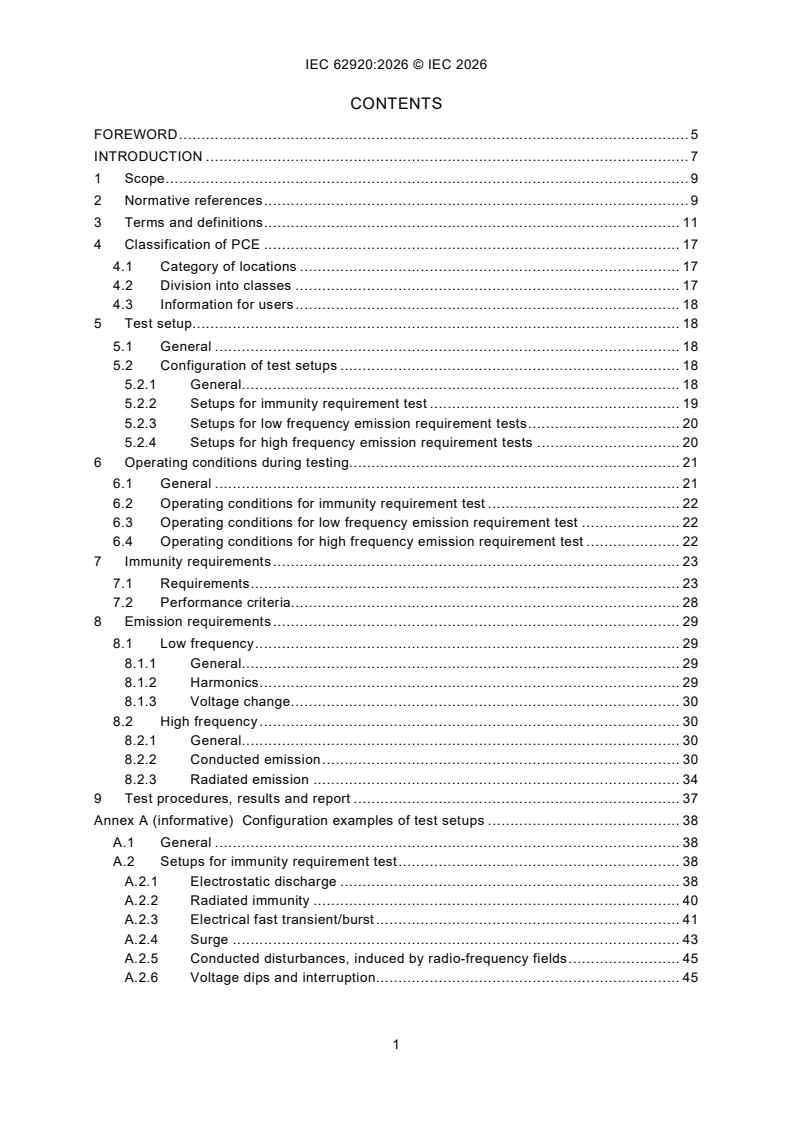
The standard is organized into nine clauses and five annexes:
| Part | What it covers |
|---|---|
| Clause 1 | Scope |
| Clause 2 | Normative references |
| Clause 3 | Terms and definitions |
| Clause 4 | Classification of PCE |
| Clause 5 | Test setup |
| Clause 6 | Operating conditions during testing |
| Clause 7 | Immunity requirements |
| Clause 8 | Emission requirements |
| Clause 9 | Test procedures, results and report |
| Annex A | Configuration examples of test setups |
| Annex B | Example test circuits for low frequency emission tests |
| Annex C | Examples of standardized conducted disturbance test setups |
| Annex D | Alternative test setups for high-power PCE |
| Annex E | Rationale for conditional conducted common mode measurement methods and limits |
What are the key requirements of IEC 62920:2026?
IEC 62920:2026 combines location-based classification, defined operating modes, and port-specific EMC limits. In practice, a manufacturer must decide the intended installation class, set up the right test configuration, run the correct tests at the right operating point, and document the results clearly.
Classification and user information
Clause 4 divides PCE into two equipment classes for EMC purposes. Class A PCE is suitable for commercial and light-industrial locations or industrial locations, while Class B PCE is suitable for residential locations.
This matters because the class determines the immunity and emission limits that apply. The manufacturer or supplier must inform the user of the class by labelling or in the accompanying documentation, and equipment not suitable for residential use must carry a residential warning.
Test setup and power supplies
Clause 5 requires test setups that represent the intended use of the PCE. The standard allows testing with or without PV modules or storage devices, but only the PCE itself is under test.
This means the laboratory may use suitable AC or DC power supplies to simulate the PV source or storage device, provided they are stable and do not influence the EMC result. Auxiliary power ports also have to be connected as needed so the equipment operates as intended.
Operating modes during testing
Clause 6 defines three operating modes: standby, feed into AC grid or discharge from storage, and charge storage from PV modules or AC grid. The standard then assigns different tests to different modes.
For example, electrostatic discharge is applied in standby and operating modes, while radiated RF immunity, electrical fast transient/burst, and surge are applied in operating modes. Conducted RF immunity and voltage dips or interruptions are also checked under operating modes, and the test report must record the operating point that gives the worst case result.
Immunity requirements
Clause 7 sets separate immunity tables for Class A and Class B PCE, including different requirements for enclosure ports, AC power ports, DC power ports, signal and control ports, wired network ports, and antenna ports. The tables also cover performance criteria that explain what counts as acceptable behaviour during a disturbance.
In practice, this means the PCE must either continue operating normally, show only temporary disturbance that recovers, or meet the allowed behaviour for the specific criterion being used. The report has to state the chosen acceptance criteria and how the PCE behaved during each test.
Emission requirements
Clause 8 covers both low frequency and high frequency emissions. Low frequency emission testing addresses harmonics and voltage change, while high frequency emission testing covers conducted and radiated disturbances.
A practical point is that the emission limits are port-specific. The standard includes different treatment for AC power ports, DC power ports, and ports other than power ports, and it also extends radiated disturbance limits above 1 GHz.
Conducted emissions on communication and antenna ports
Clause 6 and Clause 8 work together for ports other than power ports. For wired network ports, signal and control ports, and antenna ports, the standard uses conditional measurement methods that separate the communication function from the power conversion function.
That matters because PCE with communication modules can create disturbance from both the converter and the communication interface. Annex E explains the rationale for measuring under these conditions and for applying the limits to common mode, or asymmetric mode, disturbance.
What terms does IEC 62920:2026 define?
- Power conversion equipment (PCE) - an electrical device that converts one form of electrical power to another in terms of voltage, current, frequency, phase, or number of phases.
- Grid connected power converter (GCPC) - PCE that is grid-interactive and connected to the AC network.
- Electrical energy storage device - a device that can absorb electrical energy, store it for a period, and release it later.
- Port - the physical interface between the PCE and the external electromagnetic environment.
- Wired network port - a connection point for voice, data, or signalling networks such as LAN or xDSL.
- Antenna port - a port for connection of an antenna used for intentional transmission or reception of RF energy.
- High power electronic equipment and system (HPE) - one or more PCE with a combined rated power greater than 75 kVA, or a system containing such equipment.
- PCE with radio functionality - PCE that includes one or more radio devices or plug-in radio modules for control or data exchange.
Who uses IEC 62920:2026?
IEC 62920:2026 is used by manufacturers of PV inverters, converters, storage-coupled power conversion systems, and related control equipment. It is also used by EMC test laboratories, certification bodies, and technical teams that prepare type tests or compliance files.
Quality managers, buyers, and system integrators use it to compare equipment classes, installation suitability, and the scope of EMC testing. Installers and project engineers use the location classes and user information requirements when selecting equipment for residential, commercial, light-industrial, or industrial sites.
What changed in IEC 62920:2026 from the previous edition?
IEC 62920:2026 cancels and replaces IEC 62920:2017 and Amendment 1:2021. The standard states these significant technical changes:
- PCE with radio functionality is added in the scope.
- Test operating conditions are revised for wired and wireless communications.
- Immunity requirements for antenna ports are added.
- Surge testing is added for wired and wireless network ports of Class B PCE.
- Performance criteria are revised for wired and wireless communications.
- Current limits are added for the DC power port table for Class A PCE.
- Limits for conducted common mode disturbance at the antenna port are added.
- Conditional measurement methods and limits for ports other than power ports are added.
- Radiated disturbance limits above 1 GHz are added.
- Annex E is added to explain the rationale for the conditional measurement methods and limits.
Which standards are used with IEC 62920:2026?
IEC 62920:2026 relies on several IEC and CISPR standards for vocabulary, EMC limits, and test methods. The main ones are:
- IEC 61000-3-2 and IEC 61000-3-12 - harmonic current emission limits.
- IEC 61000-3-3 and IEC 61000-3-11 - voltage change, voltage fluctuation, and flicker limits.
- IEC 61000-4-2, -4-3, -4-4, -4-5, -4-6, -4-11, and -4-34 - the immunity test methods used in Clause 7.
- IEC 61000-4-7 and IEC 61000-4-15 - harmonic and flicker measurement support.
- IEC 61000-6-3, IEC 61000-6-4, and IEC 61000-6-8 - generic emission standards used in classification and location concepts.
- IEC 62109-1 and IEC TS 61836 - vocabulary and product terminology for PV power conversion systems.
- CISPR 11 and CISPR 32 - emission measurement concepts, including the treatment of conducted disturbance and conditional methods for ports other than power ports.
- CISPR 16-1-1, 16-1-2, 16-1-4, 16-1-6, 16-2-1, and 16-2-3 - measuring apparatus, coupling networks, antennas, and conducted/radiated measurement methods.
What does the IEC 62920:2026 document contain?
IEC 62920:2026 contains the full EMC test framework for PV PCE: classification, test setup, operating conditions, immunity requirements, emission requirements, and reporting rules. It also includes worked examples of setups and circuits for wall-mounted PCE, low frequency emission measurements, and standardized conducted disturbance arrangements.
Annex D gives alternative setups for high-power PCE, which is useful when laboratory current capacity is not enough for the intended test. Annex E explains why conducted common mode measurement is handled differently for wired network ports, signal and control ports, and antenna ports on PCE.
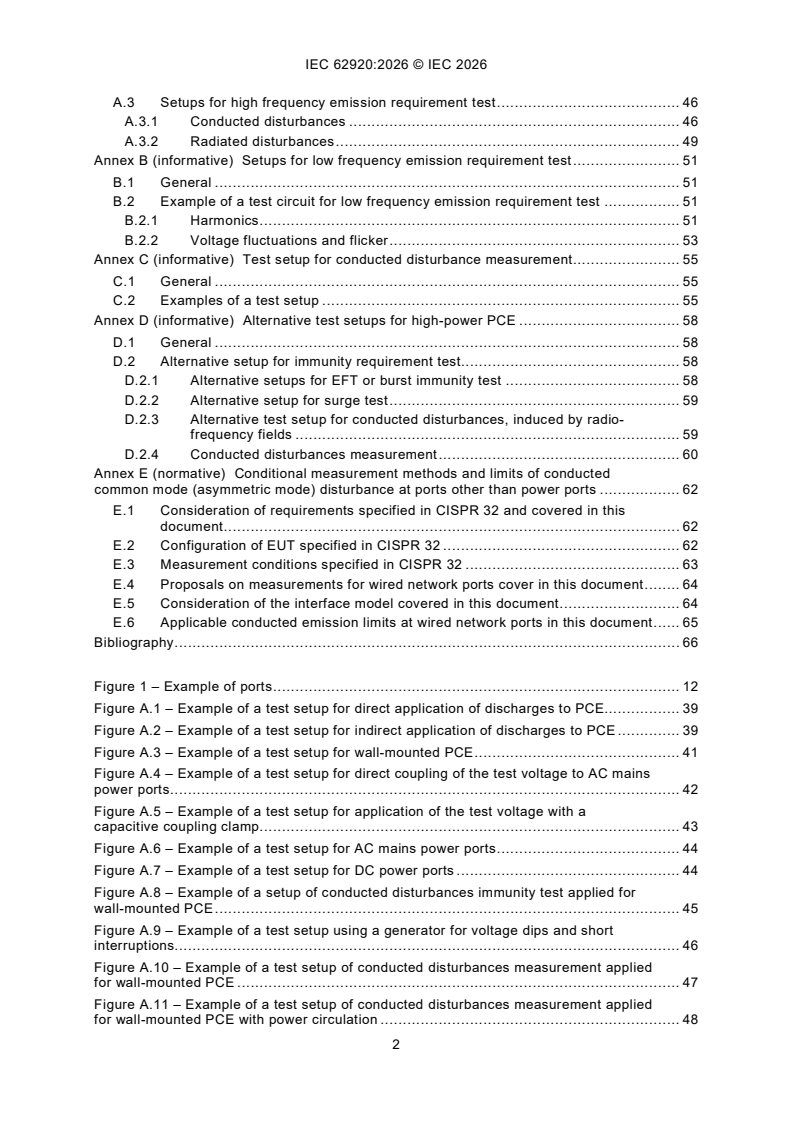
The document also includes many figures showing example port types, immunity setups, low frequency circuits, and radiated or conducted emission arrangements. Table-based requirements define the actual limits, test conditions, and measurement distances used to judge compliance.
Relations
- Effective Date
- 05-Sep-2023
- Effective Date
- 05-Sep-2023
Get Certified
Connect with accredited certification bodies for this standard

DNV
DNV is an independent assurance and risk management provider.

Lloyd's Register
Lloyd's Register is a global professional services organisation specialising in engineering and technology.
DNV Energy Systems
Energy and renewable energy certification.
Sponsored listings
Frequently Asked Questions
IEC 62920:2026 is a standard published by the International Electrotechnical Commission (IEC). Its full title is "Photovoltaic power generating systems - EMC requirements and test methods for power conversion equipment". This standard covers: IEC 62920:2026 specifies electromagnetic compatibility (EMC) requirements for power conversion equipment (PCE) (e.g. DC to DC, DC to AC and AC to DC) for use in photovoltaic (PV) power systems with or without electrical energy storage devices. PCE covered by this document can be grid-interactive, which is termed as a grid connected power converter (GCPC), or stand-alone. It can be supplied by single or multiple photovoltaic modules grouped in various array configurations. The PCE can be intended for use in conjunction with batteries or other forms of energy storage and therefore a uni-or bidirectional. This document covers not only PCE connected to a public low voltage AC mains network or other low voltage AC mains installation, but also PCE connected to a medium or high voltage AC network with or without step-down power transformers. Requirements for the PCE connected to a medium or high voltage AC network are specified in this document. However, some requirements relevant to grid interconnection are addressed with other standards specifying power quality or their own grid codes in some countries. This document provides test methods and test conditions for PCE at a test site, but not for photovoltaic modules and other balance of system components. This second edition cancels and replaces the first edition published in 2017 and Amendment 1:2021. This edition includes the following significant technical changes with respect to the previous edition: a) PCE with radio functionality is added in the scope; b) operating conditions for tests are revised to cover wired and wireless communications; c) immunity requirements for antenna ports are added; d) the surge test is added in the immunity requirements for wired and wireless network ports of class B PCE; e) performance criteria are revised to cover wired and wireless communications; f) current limits are added in the table of disturbance limits at the DC power port for class A PCE to cover requirements of the measurement of common mode current when artificial networks are used as voltage probes; g) limits of conducted common mode disturbance at the antenna port are added; h) conditional measurement methods and limits of conducted common mode (asymmetric mode) disturbance at ports other than power ports are added; electromagnetic radiation disturbance limits above 1 GHz are added; i) an annex for the rational conditional measurement methods and limits of conducted common mode (asymmetric mode) disturbance at ports other than power ports is added.
IEC 62920:2026 specifies electromagnetic compatibility (EMC) requirements for power conversion equipment (PCE) (e.g. DC to DC, DC to AC and AC to DC) for use in photovoltaic (PV) power systems with or without electrical energy storage devices. PCE covered by this document can be grid-interactive, which is termed as a grid connected power converter (GCPC), or stand-alone. It can be supplied by single or multiple photovoltaic modules grouped in various array configurations. The PCE can be intended for use in conjunction with batteries or other forms of energy storage and therefore a uni-or bidirectional. This document covers not only PCE connected to a public low voltage AC mains network or other low voltage AC mains installation, but also PCE connected to a medium or high voltage AC network with or without step-down power transformers. Requirements for the PCE connected to a medium or high voltage AC network are specified in this document. However, some requirements relevant to grid interconnection are addressed with other standards specifying power quality or their own grid codes in some countries. This document provides test methods and test conditions for PCE at a test site, but not for photovoltaic modules and other balance of system components. This second edition cancels and replaces the first edition published in 2017 and Amendment 1:2021. This edition includes the following significant technical changes with respect to the previous edition: a) PCE with radio functionality is added in the scope; b) operating conditions for tests are revised to cover wired and wireless communications; c) immunity requirements for antenna ports are added; d) the surge test is added in the immunity requirements for wired and wireless network ports of class B PCE; e) performance criteria are revised to cover wired and wireless communications; f) current limits are added in the table of disturbance limits at the DC power port for class A PCE to cover requirements of the measurement of common mode current when artificial networks are used as voltage probes; g) limits of conducted common mode disturbance at the antenna port are added; h) conditional measurement methods and limits of conducted common mode (asymmetric mode) disturbance at ports other than power ports are added; electromagnetic radiation disturbance limits above 1 GHz are added; i) an annex for the rational conditional measurement methods and limits of conducted common mode (asymmetric mode) disturbance at ports other than power ports is added.
IEC 62920:2026 is classified under the following ICS (International Classification for Standards) categories: 27.160 - Solar energy engineering. The ICS classification helps identify the subject area and facilitates finding related standards.
IEC 62920:2026 has the following relationships with other standards: It is inter standard links to IEC 62920:2017/AMD1:2021, IEC 62920:2017. Understanding these relationships helps ensure you are using the most current and applicable version of the standard.
IEC 62920:2026 is available in PDF format for immediate download after purchase. The document can be added to your cart and obtained through the secure checkout process. Digital delivery ensures instant access to the complete standard document.
Standards Content (Sample)
Contents
- 1 Scope
- 2 Normative references
- 3 Terms and definitions
- 3.1 photovoltaic power generating system
- 3.2 power conversion equipment
- 3.3 photovoltaic module
- 3.4 electrical energy storage device
- 3.5 port
- 3.6 enclosure port
- 3.7 AC mains power port
- 3.8 auxiliary AC power port
- 3.9 DC power port
- 3.10 auxiliary DC power port
- 3.11 signal and control port
- 3.12 wired network port
- 3.13 antenna port
- 3.14 HPE
- 3.15 low voltage
- 3.16 high voltage
- 3.17 medium voltage
- 3.18 small equipment under test
- 3.19 medium equipment under test
- 3.20 residential location
- 3.21 commercial and light-industrial location
- 3.22 industrial location
- 3.23 PCE-MV
- 3.24 artificial mains network
- 3.25 DC-AN
- 3.26 PCE with radio functionality
- 3.27 radio device
- 3.28 radio module
- 3.29 radio transmitter
- 3.30 radio receiver
- 3.31 rated power
- 3.32 coupling/decoupling network
- 3.33 open-area test site
- 3.34 SAC
- 3.35 fully anechoic room
- 3.36 absorber-lined OATS/SAC
- 4 Classification of PCE
- 4.1 Category of locations
- 4.2 Division into classes
- 4.3 Information for users
- 5 Test setup
- 5.1 General
- 5.2 Configuration of test setups
- 6 Operating conditions during testing
- 6.1 General
- 6.2 Operating conditions for immunity requirement test
- 6.3 Operating conditions for low frequency emission requirement test
- 6.4 Operating conditions for high frequency emission requirement test
- 7 Immunity requirements
- 7.1 Requirements
- 3 V/m
- 3 V/m
- 10 V/m
- 3 V/m
- 7.2 Performance criteria
- 8 Emission requirements
- 8.1 Low frequency
- 8.2 High frequency
- 9 Test procedures, results and report
- Annex A
- Annex B
- Annex C
- Annex D
- Annex E
- Bibliography
INTRODUCTION Background Power conversion equipment (PCE) is indispensable for solar photovoltaic power energy systems in order to convert the DC electric power energy generated by solar photovoltaic modules into AC or DC electric power, and to feed the AC power energy into the AC mains network or loads. PCE consists of DC to DC, DC to AC or AC to DC converters and forms systems with or without DC-coupled electrical energy storage devices. Manufacturers of PCE ensure the performance and reliability of PCE. Electromagnetic compatibility (EMC) is one aspect of performance which must be ensured wherever PCE is used in or exposed to an electromagnetic environment.
IEC Guide 107 specifies that TC 77 and CISPR, which are called EMC committees, have responsibility for the development of basic, product family and generic standards on EMC requirements, and product committees must use the emission limits developed by EMC committees and must refer to basic immunity standards for the specification of test techniques. However, when the EMC standards which are developed by TC 77 and CISPR are not considered suitable for a particular product or electromagnetic environment, product committees must seek their assistance and advice for any change in either the emission limits or measurement requirements, or both. Product committees are responsible for selecting the appropriate immunity test items and levels for their products as well as for defining the relevant performance criteria for the evaluation of the immunity test results. Consequently, product committees, such as TC 22, TC 26, TC 9, and TC 69, have their own EMC standard to define EMC requirements and test methods for their particular types of products. TC 82 also has the responsibility to consider EMC requirements for PCE applying to the solar photovoltaic power energy systems, and TC 82 has taken action as follows to develop its own product EMC standards:
a) selection of the immunity test items in accordance with EMC environments for the solar photovoltaic power energy systems; b) supplement of generic standards with a detailed description of test conditions and test set up; c) development of the conditional limits and alternative test methods in terms of installation environmental and operational conditions; d) development of appropriate requirements and test method for high power equipment. In 2017, TC 82 published IEC 62920 (ed.1.0) and covered the minimum EMC requirements for PCE applying to solar photovoltaic power energy systems in consideration with the abovementioned items. Following the state-of-the-art technology as well as the latest market needs, IEC 62920:2017 is amended to extend its scope by taking into account the following technical items:
- DC to DC power conversion equipment used in photovoltaic power energy systems;
- electrical energy storage devices connected to DC power ports of PCE used in photovoltaic power energy systems;
- 5 m antenna distance of radiated disturbance measurements for the medium size PCE.
Maintenance of IEC 62920:2017 and IEC 62920:2017/AMD1:2017 For the purpose of keeping the consistency with EMC basic standards and considering market needs, TC 82 started the maintenance of IEC 62920:2017 and IEC 62920:2017/AMD1:2017 for the development of ed.2.0 in November 2021.
This document covers the following items:
- PCE with radio functionality is added in the scope;
- normative references are updated;
- some terms and definitions are updated or deleted;
- terms and definitions relevant to radio functionality are added;
- the classification of PCE is revised to introduce the location classes;
- the configurations of test setups are revised to cover the operation of the wired and wireless functions;
- setups for high frequency emission requirement test are updated to keep the consistency with EMC basic standards, such as CISPR 16-1-2 and CISPR 16-2-3;
- operating conditions for tests are revised to cover wired and wireless communications;
- immunity requirements for antenna ports are added;
- the surge test is added in the immunity requirements for wired and wireless network ports of class B PCE;
- immunity requirements regarding IEC 61000-4-3 are revised to fill the gap of frequency range;
- performance criteria are revised to cover wired and wireless communications;
- current limits are added in the table of disturbance limits at the DC power port for class A PCE to cover requirements of the measurement of common mode current when artificial networks are used as voltage probes;
- limits of conducted common mode disturbance at the antenna port are added;
- conditional measurement methods and limits of conducted common mode (asymmetric mode) disturbance at ports other than power ports are added;
- electromagnetic radiation disturbance limits above 1 GHz are added;
- an annex for the rational conditional measurement methods and limits of conducted common mode (asymmetric mode) disturbance at ports other than power ports is added.
1 Scope
This document specifies electromagnetic compatibility (EMC) requirements for power conversion equipment (PCE) (e.g. DC to DC, DC to AC and AC to DC) for use in photovoltaic (PV) power systems with or without electrical energy storage devices. PCE covered by this document can be grid-interactive, which is termed as a grid connected power converter (GCPC), or stand-alone. It can be supplied by single or multiple photovoltaic modules grouped in various array configurations. The PCE can be intended for use in conjunction with batteries or other forms of energy storage and therefore a uni- or bidirectional. This document covers not only PCE connected to a public low voltage AC mains network or other low voltage AC mains installation, but also PCE connected to a medium or high voltage AC network with or without step-down power transformers. Requirements for the PCE connected to a medium or high voltage AC network are specified in this document. However, some requirements relevant to grid interconnection are addressed with other standards specifying power quality or their own grid codes in some countries. This document provides test methods and test conditions for PCE at a test site, but not for photovoltaic modules and other balance of system components.
PCE which incorporates either radio transmit or receive, or both functions, as wireless communication functions, is included in the scope of this document as PCE with radio functionality. However, the emission requirements in this document are not intended to be applicable to the intentional transmissions from a radio transmitter as defined by the ITU including their spurious emissions.
When compliance with EMC requirements at the test site cannot be shown due to technical reasons of the test site, PCE can be assessed in situ. However, only high frequency emission requirements for in situ assessment are specified in CISPR 11.
2 Normative references
The following documents are referred to in the text in such a way that some or all of their content constitutes requirements of this document. For dated references, only the edition cited applies. For undated references, the latest edition of the referenced document (including any amendments) applies.
IEC 60050-195:2021, International Electrotechnical Vocabulary (IEV) - Part 195: Earthing and protection against electric shock IEC 60050-485:2020, International Electrotechnical Vocabulary (IEV) - Part 485: Fuel cell technologies IEC 60050-601:1985, International Electrotechnical Vocabulary (IEV) - Part 601: Generation, transmission and distribution of electricity - General IEC TS 61836:2025, Solar photovoltaic energy systems - Terms, definitions and symbols IEC 61000-3-2:2018, Electromagnetic compatibility (EMC) - Part 3-2: Limits - Limits for harmonic current emissions (equipment input current ≤ 16 A per phase) IEC 61000-3-2:2018/AMD1:2020 IEC 61000-3-2:2018/AMD2:2024
IEC 61000-3-3:2013, Electromagnetic compatibility (EMC) - Part 3-3: Limits - Limitation of voltage changes, voltage fluctuations and flicker in public low-voltage supply systems, for equipment with rated current ≤ 16 A per phase and not subject to conditional connection IEC 61000-3-3:2013/AMD1:2017 IEC 61000-3-3:2013/AMD2:2021 IEC 61000-3-11:2017, Electromagnetic compatibility (EMC) - Part 3-11: Limits - Limitation of voltage changes, voltage fluctuations and flicker in public low-voltage supply systems - Equipment with rated current ≤ 75 A and subject to conditional connection IEC 61000-3-12:2011, Electromagnetic compatibility (EMC) - Part 3-12: Limits - Limits for harmonic currents produced by equipment connected to public low-voltage systems with input current > 16 A and ≤ 75 A per phase IEC 61000-3-12:2011/AMD1:2021 IEC 61000-4-2, Electromagnetic compatibility (EMC) - Part 4-2: Testing and measurement techniques - Electrostatic discharge immunity test IEC 61000-4-3, Electromagnetic compatibility (EMC) - Part 4-3: Testing and measurement techniques - Radiated, radio-frequency, electromagnetic field immunity test IEC 61000-4-4:2012, Electromagnetic compatibility (EMC) - Part 4-4: Testing and measurement techniques - Electrical fast transient/burst immunity test IEC 61000-4-5:2014, Electromagnetic compatibility (EMC) - Part 4-5: Testing and measurement techniques - Surge immunity test IEC 61000-4-5:2014/AMD1:2017 IEC 61000-4-6:2023, Electromagnetic compatibility (EMC) - Part 4-6: Testing and measurement techniques - Immunity to conducted disturbances, induced by radio-frequency fields IEC 61000-4-7:2002, Electromagnetic compatibility (EMC) - Part 4-7: Testing and measurement techniques - General guide on harmonics and interharmonics measurements and instrumentation, for power supply systems and equipment connected thereto IEC 61000-4-11:2020, Electromagnetic compatibility (EMC) - Part 4-11: Testing and measurement techniques - Voltage dips, short interruptions and voltage variations immunity tests for equipment with input current up to 16 A per phase IEC 61000-4-15, Electromagnetic compatibility (EMC) - Part 4-15: Testing and measurement techniques - Flickermeter - Functional and design specifications IEC 61000-4-34:2005, Electromagnetic compatibility (EMC) - Part 4-34: Testing and measurement techniques - Voltage dips, short interruptions and voltage variations immunity tests for equipment with input current more than 16 A per phase IEC 61000-4-34:2005/AMD1:2009 IEC 61000-4-34:2005/AMD2:2025 IEC 61000-6-3:2026, Electromagnetic compatibility (EMC) - Part 6-3: Generic standards - Emission standard for equipment in residential locations IEC 61000-6-4:2018, Electromagnetic compatibility (EMC) - Part 6-4: Generic standards - Emission standard for industrial environments IEC 61000-6-8:2020, Electromagnetic compatibility (EMC) - Part 6-8: Generic standards - Emission standard for professional equipment in commercial and light-industrial locations
IEC 62109-1:2010, Safety of power converters for use in photovoltaic power systems - Part 1:
General requirements CISPR 11:2024, Industrial, scientific and medical equipment - Radio-frequency disturbance characteristics - Limits and methods of measurement CISPR 16-1-1:2019, Specification for radio disturbance and immunity measuring apparatus and methods - Part 1-1: Radio disturbance and immunity measuring apparatus - Measuring apparatus CISPR 16-1-2:2014, Specification for radio disturbance and immunity measuring apparatus and methods - Part 1-2: Radio disturbance and immunity measuring apparatus - Coupling devices for conducted disturbance measurements CISPR 16-1-2:2014/AMD1:2017 CISPR 16-1-4:2025, Specification for radio disturbance and immunity measuring apparatus and methods - Part 1-4: Radio disturbance and immunity measuring apparatus - Antennas and test sites for radiated disturbance measurements CISPR 16-1-6:2014, Specification for radio disturbance and immunity measuring apparatus and methods - Part 1-6: Radio disturbance and immunity measuring apparatus - EMC antenna calibration CISPR 16-1-6 2014/AMD1:2017 CISPR 16-1-6 2014/AMD2:2022 CISPR 16-2-1:2014, Specification for radio disturbance and immunity measuring apparatus and methods - Part 2-1: Methods of measurement of disturbances and immunity - Conducted disturbance measurements CISPR 16-2-1:2014/AMD1:2017 CISPR 16-2-3:2016, Specification for radio disturbance and immunity measuring apparatus and methods - Part 2-3: Methods of measurement of disturbances and immunity - Radiated disturbance measurements CISPR 16-2-3:2016/AMD1:2019 CISPR 16-2-3:2016/AMD2:2023 CISPR 32:2015, Electromagnetic compatibility of multimedia equipment - Emission requirements CISPR 32:2015/AMD1:2019
3 Terms and definitions
For the purposes of this document, the terms and definitions given in IEC 60050-195, IEC 60050-485, IEC 60050-601, IEC 60050-713, IEC 61000-6-3, IEC 61000-6-4, IEC TS 61836, IEC 62109-1 and the following apply.
ISO and IEC maintain terminology databases for use in standardization at the following addresses:
- IEC Electropedia: available at https://www.electropedia.org/
- ISO Online browsing platform: available at https://www.iso.org/obp
3.1 photovoltaic power generating system
PV system electric power generating system which uses the photovoltaic effect to convert solar power into electricity
3.2 power conversion equipment
PCE electrical device converting one form of electrical power to another form of electrical power with respect to voltage, current, frequency, phase and the number of phases [SOURCE: IEC 62109-1:2010, 3.66, modified – "one kind of electrical power from a voltage or current source into another kind of electrical power" has been replaced with "one form of electrical power to another form of electrical power", "with respect to voltage, current and frequency" has been replaced by "with respect to voltage, current, frequency, phase and the number of phases". The note has been deleted.]
3.3 photovoltaic module
PV module basic DC power unit consisting of interconnected photovoltaic cells protected from the environment [SOURCE: IEC TS 61836:2025, 3.1.44, modified – The notes to entry have been deleted.]
3.4 electrical energy storage device
device that is able to absorb electrical energy, to store it for a certain amount of time and to release electrical energy during which energy conversion processes can be included
3.5 port
physical interface of the PCE with the external electromagnetic environment Note 1 to entry: See Figure 1 for examples of ports.
Figure 1 – Example of ports
3.6 enclosure port
physical boundary of the PCE product which electromagnetic fields can radiate through or impinge on
3.7 AC mains power port
port used to connect to a public low voltage AC mains power distribution network or other low voltage AC mains installation
3.8 auxiliary AC power port
additional low voltage AC power port for purposes other than feeding in AC power
3.9 DC power port
port used to connect a local low voltage DC power generating system or electrical energy storage devices
3.10 auxiliary DC power port
additional low voltage DC power port for purposes other than supplying DC power for the DC to AC conversion or electrical energy storage devices
3.11 signal and control port
port intended for the interconnection of components of PCE, or between PCE and local auxiliary equipment, and used in accordance with relevant functional specifications Note 1 to entry: Examples include RS-232, Universal Serial Bus (USB), High-Definition Multimedia Interface (HDMI), IEEE standard 1394 ("Fire Wire") and control pilot.
[SOURCE: CISPR 32:2015 and CISPR 32:2015/AMD1:2019, 3.1.30, modified – The slash has been replaced with "and" in the term; "an EUT" has been replaced with "PCE"; "EUT and local AE" has been replaced by "PCE and local auxiliary equipment"; "(for example for the maximum length of cable connected to it)" has been deleted; "waveguide ports used for interconnecting MME" has been replaced with “control pilot” in the note to entry.]
3.12 wired network port
point to connection for voice, data and signalling transfers intended to interconnect widely dispersed systems by direct connection to a single-user or multi-user communication network Note 1 to entry: Examples include CATV, PSTN, ISDN, xDSL, LAN and similar networks. These ports can support screened or unscreened cables and can also carry AC or DC power where this is an integral part of the telecommunication specification.
3.13 antenna port
port for connection of an antenna used for intentional transmission and/or reception of radiated RF energy [SOURCE: CISPR 32:2015, 3.1.3, modified – "other than a broadcast receiver tuner port" has been deleted.]
3.14 HPE
high power electronic equipment and system one or more power conversion equipment with a combined rated power greater than 75 kVA, or a system containing such equipment
3.15 low voltage
LV voltage not exceeding a conventionally adopted limit Note 1 to entry: For AC, the conventionally adopted limit is 1 000 V. Note 2 to entry: For DC, the conventionally adopted limit is 1 500 V. [SOURCE: IEC 60050-195:2021, 195-05-25]
3.16 high voltage
HV voltage exceeding the conventionally adopted limit for low voltage [SOURCE: IEC 60050-195:2021, 195-05-26]
3.17 medium voltage
MV any set of voltage levels lying between low and high voltage [SOURCE: IEC 60050-601:1985, 601-01-28, modified – The note has been deleted.]
3.18 small equipment under test
small EUT equipment under test, either positioned on a table top or standing on the floor, which, including its cables, fits in a cylindrical volume of 1,5 m in diameter and 1,5 m height (as measured from the floor) Note 1 to entry: At an OATS or in a SAC, the radiated emission measurement distance of 3 m shall only be used for small EUT.
[SOURCE: CISPR 16-2-3:2016/AMD1:2019, 3.1.35, modified – "including its cables," has been moved to follow "which"; "(2,0 m)" after "1,5 m" in both diameter and height has been deleted; "measured from the floor with a measurement distance of 3 m (5 m) at an OATS/SAC" has been replaced with "(as measured from the floor)"; the note to entry has been added.]
3.19 medium equipment under test
medium EUT equipment under test, either positioned on a table top or standing on the floor, which, including its cables, fits in a cylindrical volume of 2,0 m in diameter and 2,0 m height (as measured from the floor) Note 1 to entry: At an OATS or in a SAC, the radiated emission measurement distance of 5 m shall only be used for medium EUT.
3.20 residential location
area of land designated for domestic dwellings where the mains power within these locations is directly connected to the low-voltage public mains network Note 1 to entry: Examples of residential locations are: houses, apartments, farm buildings housing people. Note 2 to entry: A dwelling can be a single building, separate building or a separate section of a larger building. Note 3 to entry: Within these locations, it is expected to operate a radio receiver within a distance of 10 m from the equipment.
Note 4 to entry: Domestic dwellings are places for one or more people to live. [SOURCE: IEC 61000-6-3:2026, 3.1.21]
3.21 commercial and light-industrial location
location which is not residential in accordance with 3.20, where the mains supply is directly connected to the low-voltage public network or connected to a dedicated DC source which is intended to interface between the equipment and the low-voltage public mains network Note 1 to entry: Examples of commercial or light-industrial locations are:
...