

IEC 61892-7:2014
(Main)Mobile and fixed offshore units - Electrical installations - Part 7: Hazardous areas
General Information
- Abstract
IEC 61892-7:2014 contains provisions for hazardous areas classification and choice of electrical installation in hazardous areas in mobile and fixed offshore units, including pipelines, pumping or 'pigging' stations, compressor stations and exposed location single buoy moorings, used in the offshore petroleum industry for drilling, processing and for storage purposes. It applies to all installations, whether permanent, temporary, transportable or hand-held, to AC installations up to and including 35 000 V and DC installations up to and including 1 500 V. (AC and DC voltages are nominal values). This standard does not apply to electrical installations in rooms used for medical purposes, or in tankers. This edition includes the following significant technical changes with respect to the previous edition.
a) The EPL (Explosion Protection Level) concept has been introduced.
b) The requirements to installations in hazardous area has been rewritten, based on the requirements of IEC 60079-14:2013.
- Status
- Published
- Publication Date
- 10-Dec-2014
- Drafting Committee
- MT 18 - TC 18/MT 18
- Current Stage
- DELPUB - Deleted Publication
- Start Date
- 09-Apr-2019
- Completion Date
- 28-Aug-2026
Overview
IEC 61892-7:2014 is a critical international standard developed by the International Electrotechnical Commission (IEC) that addresses the electrical installations in hazardous areas of mobile and fixed offshore units. Specifically designed for the offshore petroleum industry, this standard governs electrical safety protocols relating to drilling, processing, and storage operations in potentially explosive environments. Its scope encompasses a wide variety of offshore units including pipelines, pumping and pigging stations, compressor stations, and single buoy moorings.
This standard applies to both alternating current (AC) installations up to 35,000 volts and direct current (DC) installations up to 1,500 volts, covering permanent, temporary, transportable, and hand-held installations in hazardous zones. Notably, IEC 61892-7:2014 introduces the Explosion Protection Level (EPL) concept and aligns installation requirements with IEC 60079-14:2013, reflecting the latest advancements in hazardous area electrical safety.
Key Topics
Hazardous Area Classification
The standard includes comprehensive rules for classifying hazardous areas around offshore units. This classification depends on factors such as sources of release, zone types (Zone 0, 1, and 2), and the relative density of gases or vapors.Explosion Protection Level (EPL)
Introduction of the EPL concept guides selection and installation of electrical equipment based on the expected level of explosion risk-Ga, Gb, and Gc-for various hazardous zones.Electrical System Requirements
IEC 61892-7 outlines the design and distribution of electrical power systems in offshore installations, including earth fault detection, electrical protection strategies, and emergency switch-off procedures to minimize ignition risks.Protection from Incendive Sparking
The standard provides detailed guidance on preventing dangerous sparking from live parts, static electricity, electromagnetic radiation, and mechanical components, ensuring safe operation in explosive environments.Equipment Selection & Conformity Assurance
It specifies procedures for selecting suitable electrical equipment according to hazard zones and EPLs, including criteria for repaired or second-hand equipment, and emphasizes the need for certification compliance and personnel qualifications.Cable and Conduit Systems
Guidelines for cable construction, installation, earthing, and jointing within hazardous areas are defined to prevent ignition sources from electrical faults or physical damage.
Applications
IEC 61892-7:2014 is essential for ensuring electrical safety in offshore petroleum facilities operating in hazardous areas such as:
Mobile Offshore Drilling Units (MODUs)
Implementation of IEC 61892-7 helps engineers and operators classify hazardous zones on drilling platforms and select appropriate electrical equipment to mitigate explosion risks.Fixed Offshore Platforms
Fixed units handling petroleum processing and storage benefit from the standard’s provisions, increasing safety for personnel and assets by controlling ignition sources.Pumping and Compressor Stations
These critical components of offshore infrastructure rely on IEC 61892-7 to guide installation and maintenance of electrical systems in classified hazardous environments.Single Buoy Moorings and Pipelines
Electrical installations in exposed locations like single buoy moorings and pipeline stations are designed per the standard to withstand harsh offshore conditions while minimizing explosive hazards.
Related Standards
IEC 60079 Series
IEC 61892-7 adopts requirements from IEC 60079-14:2013 related to electrical installations in explosive atmospheres, ensuring harmonized practices across industry standards.IEC 61892 Parts 1-6 & 8
This standard is part of the IEC 61892 series which covers various aspects of electrical installations for mobile and fixed offshore units, including general requirements, system design, machinery, cables, and instrumentation.International Maritime Organization (IMO) Codes
Although IEC 61892-7 excludes medical rooms and tankers, compliance with IMO regulations complements safety management of offshore electrical installations.
Keywords
IEC 61892-7, hazardous areas, offshore electrical installations, explosion protection level, electrical safety standard, offshore petroleum industry, hazardous zone classification, offshore drilling electrical installations, explosion-proof electrical equipment, IEC electrical standards, offshore platform safety, electrical equipment certification, cable protection hazardous areas.
By adhering to IEC 61892-7:2014, offshore operators enhance safety and reliability of electrical systems in hazardous environments, reducing risks associated with explosion and fire in the challenging conditions of offshore petroleum operations. This standard forms a cornerstone in achieving compliance, operational safety, and equipment reliability in the offshore electrical domain.
Relations
- Effective Date
- 11-Mar-2026
- Effective Date
- 05-Sep-2023
- Effective Date
- 05-Sep-2023
Get Certified
Connect with accredited certification bodies for this standard

DNV
DNV is an independent assurance and risk management provider.

Lloyd's Register
Lloyd's Register is a global professional services organisation specialising in engineering and technology.

FSC International
Forest Stewardship Council certification.
Sponsored listings
Frequently Asked Questions
IEC 61892-7:2014 is a standard published by the International Electrotechnical Commission (IEC). Its full title is "Mobile and fixed offshore units - Electrical installations - Part 7: Hazardous areas". This standard covers: IEC 61892-7:2014 contains provisions for hazardous areas classification and choice of electrical installation in hazardous areas in mobile and fixed offshore units, including pipelines, pumping or 'pigging' stations, compressor stations and exposed location single buoy moorings, used in the offshore petroleum industry for drilling, processing and for storage purposes. It applies to all installations, whether permanent, temporary, transportable or hand-held, to AC installations up to and including 35 000 V and DC installations up to and including 1 500 V. (AC and DC voltages are nominal values). This standard does not apply to electrical installations in rooms used for medical purposes, or in tankers. This edition includes the following significant technical changes with respect to the previous edition. a) The EPL (Explosion Protection Level) concept has been introduced. b) The requirements to installations in hazardous area has been rewritten, based on the requirements of IEC 60079-14:2013.
IEC 61892-7:2014 contains provisions for hazardous areas classification and choice of electrical installation in hazardous areas in mobile and fixed offshore units, including pipelines, pumping or 'pigging' stations, compressor stations and exposed location single buoy moorings, used in the offshore petroleum industry for drilling, processing and for storage purposes. It applies to all installations, whether permanent, temporary, transportable or hand-held, to AC installations up to and including 35 000 V and DC installations up to and including 1 500 V. (AC and DC voltages are nominal values). This standard does not apply to electrical installations in rooms used for medical purposes, or in tankers. This edition includes the following significant technical changes with respect to the previous edition. a) The EPL (Explosion Protection Level) concept has been introduced. b) The requirements to installations in hazardous area has been rewritten, based on the requirements of IEC 60079-14:2013.
IEC 61892-7:2014 is classified under the following ICS (International Classification for Standards) categories: 47.020.60 - Electrical equipment of ships and of marine structures. The ICS classification helps identify the subject area and facilitates finding related standards.
IEC 61892-7:2014 has the following relationships with other standards: It is inter standard links to EN ISO 15138:2018, IEC 61892-7:2019, IEC 61892-7:2007. Understanding these relationships helps ensure you are using the most current and applicable version of the standard.
IEC 61892-7:2014 is available in PDF format for immediate download after purchase. The document can be added to your cart and obtained through the secure checkout process. Digital delivery ensures instant access to the complete standard document.
Standards Content (Sample)
IEC 61892-7 ®
Edition 3.0 2014-12
INTERNATIONAL
STANDARD
NORME
INTERNATIONALE
colour
inside
Mobile and fixed offshore units – Electrical installations –
Part 7: Hazardous areas
Unités mobiles et fixes en mer – Installations électriques –
Partie 7: Emplacements dangereux
All rights reserved. Unless otherwise specified, no part of this publication may be reproduced or utilized in any form
or by any means, electronic or mechanical, including photocopying and microfilm, without permission in writing from
either IEC or IEC's member National Committee in the country of the requester. If you have any questions about IEC
copyright or have an enquiry about obtaining additional rights to this publication, please contact the address below or
your local IEC member National Committee for further information.
Droits de reproduction réservés. Sauf indication contraire, aucune partie de cette publication ne peut être reproduite
ni utilisée sous quelque forme que ce soit et par aucun procédé, électronique ou mécanique, y compris la photocopie
et les microfilms, sans l'accord écrit de l'IEC ou du Comité national de l'IEC du pays du demandeur. Si vous avez des
questions sur le copyright de l'IEC ou si vous désirez obtenir des droits supplémentaires sur cette publication, utilisez
les coordonnées ci-après ou contactez le Comité national de l'IEC de votre pays de résidence.
IEC Central Office Tel.: +41 22 919 02 11
3, rue de Varembé Fax: +41 22 919 03 00
CH-1211 Geneva 20 info@iec.ch
Switzerland www.iec.ch
About the IEC
The International Electrotechnical Commission (IEC) is the leading global organization that prepares and publishes
International Standards for all electrical, electronic and related technologies.
About IEC publications
The technical content of IEC publications is kept under constant review by the IEC. Please make sure that you have the
latest edition, a corrigenda or an amendment might have been published.
IEC Catalogue - webstore.iec.ch/catalogue Electropedia - www.electropedia.org
The stand-alone application for consulting the entire The world's leading online dictionary of electronic and
bibliographical information on IEC International Standards, electrical terms containing more than 30 000 terms and
Technical Specifications, Technical Reports and other definitions in English and French, with equivalent terms in 14
documents. Available for PC, Mac OS, Android Tablets and additional languages. Also known as the International
iPad. Electrotechnical Vocabulary (IEV) online.
IEC publications search - www.iec.ch/searchpub IEC Glossary - std.iec.ch/glossary
The advanced search enables to find IEC publications by a More than 55 000 electrotechnical terminology entries in
variety of criteria (reference number, text, technical English and French extracted from the Terms and Definitions
committee,…). It also gives information on projects, replaced clause of IEC publications issued since 2002. Some entries
and withdrawn publications. have been collected from earlier publications of IEC TC 37,
77, 86 and CISPR.
IEC Just Published - webstore.iec.ch/justpublished
Stay up to date on all new IEC publications. Just Published IEC Customer Service Centre - webstore.iec.ch/csc
details all new publications released. Available online and If you wish to give us your feedback on this publication or
also once a month by email. need further assistance, please contact the Customer Service
Centre: csc@iec.ch.
A propos de l'IEC
La Commission Electrotechnique Internationale (IEC) est la première organisation mondiale qui élabore et publie des
Normes internationales pour tout ce qui a trait à l'électricité, à l'électronique et aux technologies apparentées.
A propos des publications IEC
Le contenu technique des publications IEC est constamment revu. Veuillez vous assurer que vous possédez l’édition la
plus récente, un corrigendum ou amendement peut avoir été publié.
Catalogue IEC - webstore.iec.ch/catalogue Electropedia - www.electropedia.org
Application autonome pour consulter tous les renseignements
Le premier dictionnaire en ligne de termes électroniques et
bibliographiques sur les Normes internationales,
électriques. Il contient plus de 30 000 termes et définitions en
Spécifications techniques, Rapports techniques et autres
anglais et en français, ainsi que les termes équivalents dans
documents de l'IEC. Disponible pour PC, Mac OS, tablettes
14 langues additionnelles. Egalement appelé Vocabulaire
Android et iPad.
Electrotechnique International (IEV) en ligne.
Recherche de publications IEC - www.iec.ch/searchpub
Glossaire IEC - std.iec.ch/glossary
Plus de 55 000 entrées terminologiques électrotechniques, en
La recherche avancée permet de trouver des publications IEC
en utilisant différents critères (numéro de référence, texte, anglais et en français, extraites des articles Termes et
comité d’études,…). Elle donne aussi des informations sur les Définitions des publications IEC parues depuis 2002. Plus
projets et les publications remplacées ou retirées. certaines entrées antérieures extraites des publications des
CE 37, 77, 86 et CISPR de l'IEC.
IEC Just Published - webstore.iec.ch/justpublished
Service Clients - webstore.iec.ch/csc
Restez informé sur les nouvelles publications IEC. Just
Published détaille les nouvelles publications parues. Si vous désirez nous donner des commentaires sur cette
Disponible en ligne et aussi une fois par mois par email. publication ou si vous avez des questions contactez-nous:
csc@iec.ch.
IEC 61892-7 ®
Edition 3.0 2014-12
INTERNATIONAL
STANDARD
NORME
INTERNATIONALE
colour
inside
Mobile and fixed offshore units – Electrical installations –
Part 7: Hazardous areas
Unités mobiles et fixes en mer – Installations électriques –
Partie 7: Emplacements dangereux
INTERNATIONAL
ELECTROTECHNICAL
COMMISSION
COMMISSION
ELECTROTECHNIQUE
PRICE CODE
INTERNATIONALE
CODE PRIX XC
ICS 47.020.60 ISBN 978-2-8322-1986-7
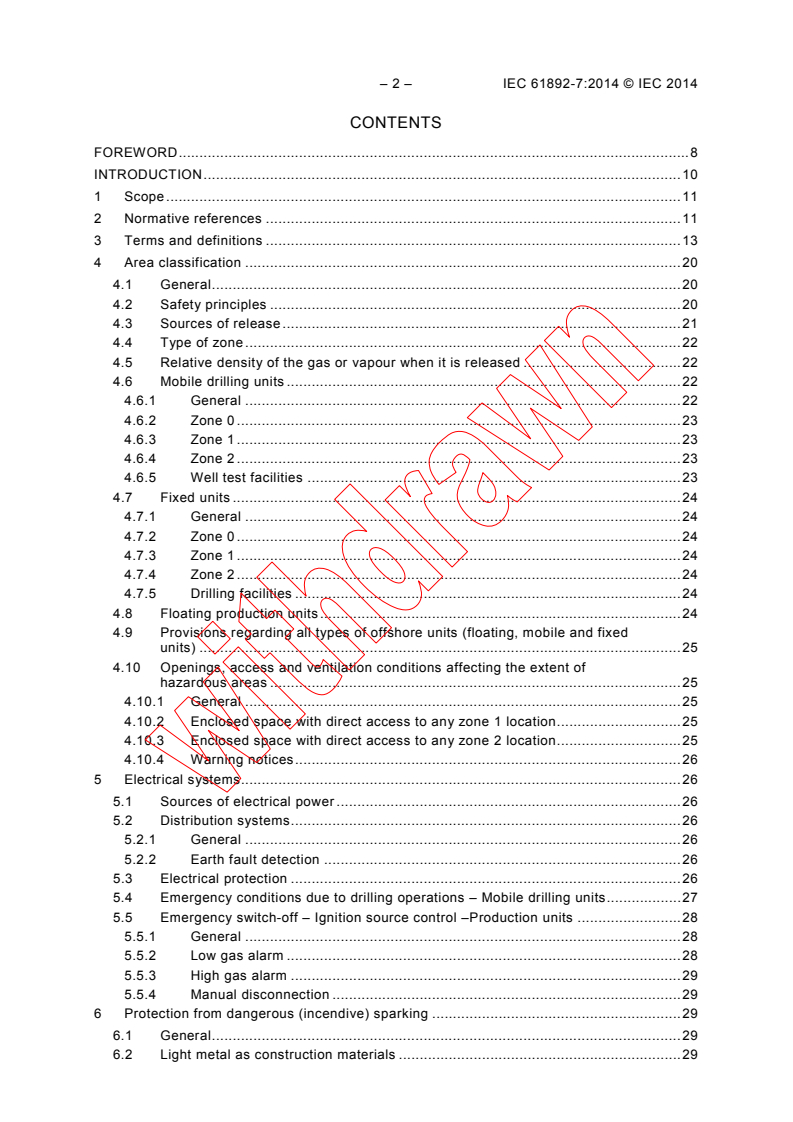
– 2 – IEC 61892-7:2014 © IEC 2014
CONTENTS
FOREWORD . 8
INTRODUCTION . 10
1 Scope . 11
2 Normative references . 11
3 Terms and definitions . 13
4 Area classification . 20
4.1 General . 20
4.2 Safety principles . 20
4.3 Sources of release . 21
4.4 Type of zone . 22
4.5 Relative density of the gas or vapour when it is released . 22
4.6 Mobile drilling units . 22
4.6.1 General . 22
4.6.2 Zone 0 . 23
4.6.3 Zone 1 . 23
4.6.4 Zone 2 . 23
4.6.5 Well test facilities . 23
4.7 Fixed units . 24
4.7.1 General . 24
4.7.2 Zone 0 . 24
4.7.3 Zone 1 . 24
4.7.4 Zone 2 . 24
4.7.5 Drilling facilities . 24
4.8 Floating production units . 24
4.9 Provisions regarding all types of offshore units (floating, mobile and fixed
units) . 25
4.10 Openings, access and ventilation conditions affecting the extent of
hazardous areas . 25
4.10.1 General . 25
4.10.2 Enclosed space with direct access to any zone 1 location . 25
4.10.3 Enclosed space with direct access to any zone 2 location . 25
4.10.4 Warning notices . 26
5 Electrical systems . 26
5.1 Sources of electrical power . 26
5.2 Distribution systems . 26
5.2.1 General . 26
5.2.2 Earth fault detection . 26
5.3 Electrical protection . 26
5.4 Emergency conditions due to drilling operations – Mobile drilling units . 27
5.5 Emergency switch-off – Ignition source control –Production units . 28
5.5.1 General . 28
5.5.2 Low gas alarm . 28
5.5.3 High gas alarm . 29
5.5.4 Manual disconnection . 29
6 Protection from dangerous (incendive) sparking . 29
6.1 General . 29
6.2 Light metal as construction materials . 29
6.3 Dangers from live parts . 29
6.4 Dangers from exposed and extraneous conductive parts . 29
6.4.1 General . 29
6.4.2 System with earthed neutral . 30
6.4.3 System with isolated or impedance earthed neutral . 30
6.4.4 Systems in zone 0 . 30
6.4.5 SELV and PELV systems . 30
6.4.6 Electrical separation . 30
6.4.7 Non Ex electrical equipment above hazardous areas . 30
6.5 Potential equalization . 31
6.5.1 General . 31
6.5.2 Temporary bonding . 31
6.6 Static electricity . 32
6.7 Cathodically protected metallic parts . 32
6.8 Electromagnetic radiation. 32
6.9 Danger from mechanical parts . 32
7 Assurance of conformity of equipment . 33
7.1 Equipment with certificates according to IEC standards . 33
7.1.1 General . 33
7.1.2 IEC standards . 33
7.1.3 Equipment without certificates according to IEC standards . 33
7.2 Selection of repaired, second hand or existing equipment . 33
7.3 Qualifications of personnel . 33
8 Selection of equipment (excluding cables and conduits) . 34
8.1 General . 34
8.2 Information requirements . 34
8.3 Zones . 34
8.4 Relationship between equipment protection levels (EPLs) and zones . 34
8.5 Selection of equipment according to EPLs . 34
8.5.1 General . 34
8.5.2 Relationship between EPLs and types of protection . 35
8.5.3 Equipment for use in locations requiring EPL 'Ga' . 35
8.5.4 Equipment for use in locations requiring EPL ‘Gb’. 35
8.5.5 Equipment for use in locations requiring EPL ‘Gc’ . 36
8.6 Selection according to equipment grouping . 36
8.7 Selection according to the ignition temperature of the gas or vapour and
ambient temperature . 36
8.7.1 General . 36
8.7.2 Gas or vapour . 37
8.8 Selection of radiating equipment . 37
8.9 Selection of ultrasonic equipment . 37
8.10 Selection to cover external influences . 37
8.11 Selection of transportable, portable and personal equipment . 38
8.11.1 Transportable and portable equipment . 38
8.11.2 Personal equipment . 38
8.12 RFID tags . 39
9 Cable system – General . 39
9.1 Cables . 39
9.2 Connections . 39
– 4 – IEC 61892-7:2014 © IEC 2014
9.3 Jointing . 40
9.4 Cable system . 40
9.4.1 Construction . 40
9.4.2 Earthing of metallic covering . 40
9.5 Conduit systems . 40
9.6 Cable and conduit systems . 41
9.6.1 Zone 0, EPL 'Ga' . 41
9.6.2 Cable and conduit systems for zone 1 and 2, EPL, ‘Gb’ and ‘Gc’ . 41
9.7 Installation requirements . 42
9.7.1 Circuits traversing a hazardous area . 42
9.7.2 Terminations . 42
9.7.3 Unused cores . 42
10 Cable entry systems and blanking elements . 42
10.1 General . 42
10.2 Connections of cables to equipment . 42
10.3 Selection of cable glands . 43
10.4 Additional entries other than Ex ’d’ or Ex ’nR’ . 44
10.5 Unused openings . 44
10.6 Additional requirements for type of protection 'd' – Flameproof enclosures . 44
10.6.1 General . 44
10.6.2 Selection of cable glands . 45
10.7 Additional requirements for type of protection 'nR' – Restricted breathing
enclosure . 45
11 Rotating electrical machines . 45
11.1 Type of protection 'd' – Flameproof enclosures . 45
11.2 Type of protection 'e' – Increased safety . 45
11.3 Type of protection 'p' – Pressurized enclosures . 45
11.4 Type of protection 'nA' – Non-sparking . 45
11.5 Ex protected permanent magnet motor . 46
12 Electric heating systems . 46
12.1 General . 46
12.2 Temperature monitoring . 46
12.3 Limiting temperature . 46
12.4 Safety device . 46
12.5 Electrical trace heating systems . 47
13 Additional requirements for type of protection 'd' – Flameproof enclosures . 47
13.1 General . 47
13.2 Solid obstacles . 48
13.3 Protection of flameproof joints. 48
13.4 Conduit systems . 49
14 Additional requirements for type of protection ‘e’ – Increased safety . 49
14.1 General . 49
14.2 Maximum dissipated power of terminal box enclosures . 49
14.3 Conductor terminations . 50
14.4 Maximum number of conductors in relation to the cross-section and the
permissible continuous current . 50
15 Additional requirements for type of protection 'i' – Intrinsic safety . 50
15.1 Introductory remark . 50
15.2 Earthing of intrinsically safe circuits . 51
15.3 Earthing of conducting screens . 52
15.4 Cable braid bonding . 52
15.5 Verification of intrinsically safe circuits . 52
15.6 Simple apparatus . 52
16 Additional requirements for pressurized enclosures . 53
16.1 General . 53
16.2 Type of protection 'p'. 53
16.2.1 General . 53
16.2.2 Ducting . 54
16.2.3 Action to be taken on failure of pressurization . 54
16.2.4 Multiple pressurized enclosures with a common safety device . 56
16.2.5 Purging . 57
16.2.6 Protective gas. 57
17 Pressurized rooms . 57
17.1 General . 57
17.2 Doors . 58
17.3 Inlets and outlets . 58
17.4 Clean air supply . 58
17.4.1 Source of clean air . 58
17.4.2 Minimum flow rate . 58
17.5 Purging . 58
17.5.1 General . 58
17.5.2 Sequence of operations of the purging safety devices . 59
17.5.3 Enclosures within the room . 59
17.6 Safety devices . 59
17.6.1 General . 59
17.6.2 Safety devices based on type of protection . 60
17.7 Failure of the pressurization system . 60
17.8 Pressurized room in a hazardous area . 60
General . 60
17.8.2 Preventing the explosive atmosphere from entering an open door . 60
17.9 Gas detection . 61
17.10 Action when pressurization system fails . 61
17.10.1 Type of protection 'px'. 61
17.10.2 Type of protection 'py'. 61
17.10.3 Re-energizing the room . 62
17.11 Marking . 62
18 Analyser houses . 62
19 Additional requirements for type of protection 'n' . 62
20 Additional requirements for type of protection 'o'– Oil immersion . 63
21 Additional requirements for type of protection 'q' – Powder filling . 63
22 Additional requirements for type of protection 'm' – Encapsulation . 63
23 Additional requirements for type of protection 'op' – Optical radiation . 63
24 Ventilation . 63
24.1 General . 63
24.2 Ventilation of spaces containing electrical apparatus . 64
24.3 Ventilation of other hazardous spaces. 64
25 Ventilation requirements for battery compartments . 64
– 6 – IEC 61892-7:2014 © IEC 2014
25.1 General . 64
25.2 Ventilation requirements . 64
25.3 Natural ventilation . 66
25.4 Forced ventilation . 67
25.5 Fans and ducts . 67
26 Inspection, maintenance, repair and overhaul . 67
26.1 Initial inspection . 67
26.2 In-service inspection . 67
26.3 Isolation of apparatus . 68
26.4 Precautions concerning the use of ignition sources . 68
26.5 Repair and overhaul . 68
26.6 Personnel qualifications . 68
27 Documentation . 68
Annex A (informative) Examples of sources of release – Process plant . 71
A.1 General . 71
A.2 Sources giving a continuous grade of release . 71
A.3 Sources giving a primary grade of release . 71
A.4 Sources giving a secondary grade of release . 71
Annex B (informative) Schematic approach to the classification of hazardous areas . 72
Annex C (informative) Hazardous area data sheets and symbols . 74
C.1 Hazardous area classification data sheet . 74
C.2 Symbols for hazardous area classification drawings . 74
Annex D (informative) Introduction of an alternative risk assessment method
encompassing equipment protection levels for Ex equipment . 78
D.1 General . 78
D.2 Historical background . 78
D.3 Risk assessment . 79
D.3.1 Gases (Group II) . 79
D.3.2 EPL 'Ga' . 79
D.3.3 EPL 'Gb' . 79
D.3.4 EPL 'Gc' . 79
D.4 Risk of ignition protection afforded . 79
Annex E (informative) Electrical installations in extremely low ambient temperature . 81
E.1 General . 81
E.2 Cables . 81
E.3 Electrical trace heating systems . 81
E.4 Lighting systems . 81
E.4.1 General . 81
E.4.2 Emergency lights . 81
E.5 Electrical rotating machines . 81
E.6 Explosion protected equipment . 81
Annex F (informative) Installation in explosive atmospheres – Safety signs and plates
for hazardous areas . 83
F.1 Objectives . 83
F.2 General . 83
Bibliography . 85
Figure B.1 – Schematic approach to the classification of hazardous areas . 73
Figure C.1 – Preferred symbols for hazardous area zones . 77
Figure F.1 – Examples of an “Ex” safety warning sign for hazardous area installation . 84
Table 1 – Electrical protection . 26
Table 2 – Equipment protection levels (EPLs) where only zones are assigned . 34
Table 3 – Relationship between types of protection and EPLs . 35
Table 4 – Relationship between gas/vapour subdivision and equipment group . 36
Table 5 – Relationship between gas or vapour ignition temperature and temperature
class of equipment . 37
Table 6 – Selection of glands, adapters and blanking elements type of protection
according to the enclosure type of protection . 43
Table 7 – Minimum distance of obstruction from the flameproof flange joints related to
the gas group of the hazardous area . 48
Table 8 – Determination of type of protection (with no flammable release within the
enclosure) . 53
Table 9 – Use of spark and particle barriers . 54
Table 10 – Summary of protection requirements for enclosures without an internal
source of release . 55
Table 11 – Required safety devices for each type of protection . 60
Table 12 – Values for current I when charging with IU or U charging profiles . 65
Table C.1 – Hazardous area classification data sheet – Part I: Flammable material list
and characteristics – Sheet: 1/1 . 75
Table C.2 – Hazardous area classification data sheet – Part II: List of sources of
release – Sheet: 1/1 . 76
Table D.1 – Traditional relationship of EPLs to zones (no additional risk assessment) . 79
Table D.2 – Description of ignition protection provided . 80
– 8 – IEC 61892-7:2014 © IEC 2014
INTERNATIONAL ELECTROTECHNICAL COMMISSION
____________
MOBILE AND FIXED OFFSHORE UNITS –
ELECTRICAL INSTALLATIONS –
Part 7: Hazardous areas
FOREWORD
1) The International Electrotechnical Commission (IEC) is a worldwide organization for standardization comprising
all national electrotechnical committees (IEC National Committees). The object of IEC is to promote
international co-operation on all questions concerning standardization in the electrical and electronic fields. To
this end and in addition to other activities, IEC publishes International Standards, Technical Specifications,
Technical Reports, Publicly Available Specifications (PAS) and Guides (hereafter referred to as “IEC
Publication(s)”). Their preparation is entrusted to technical committees; any IEC National Committee interested
in the subject dealt with may participate in this preparatory work. International, governmental and non-
governmental organizations liaising with the IEC also participate in this preparation. IEC collaborates closely
with the International Organization for Standardization (ISO) in accordance with conditions determined by
agreement between the two organizations.
2) The formal decisions or agreements of IEC on technical matters express, as nearly as possible, an international
consensus of opinion on the relevant subjects since each technical committee has representation from all
interested IEC National Committees.
3) IEC Publications have the form of recommendations for international use and are accepted by IEC National
Committees in that sense. While all reasonable efforts are made to ensure that the technical content of IEC
Publications is accurate, IEC cannot be held responsible for the way in which they are used or for any
misinterpretation by any end user.
4) In order to promote international uniformity, IEC National Committees undertake to apply IEC Publications
transparently to the maximum extent possible in their national and regional publications. Any divergence
between any IEC Publication and the corresponding national or regional publication shall be clearly indicated in
the latter.
5) IEC itself does not provide any attestation of conformity. Independent certification bodies provide conformity
assessment services and, in some areas, access to IEC marks of conformity. IEC is not responsible for any
services carried out by independent certification bodies.
6) All users should ensure that they have the latest edition of this publication.
7) No liability shall attach to IEC or its directors, employees, servants or agents including individual experts and
members of its technical committees and IEC National Committees for any personal injury, property damage or
other damage of any nature whatsoever, whether direct or indirect, or for costs (including legal fees) and
expenses arising out of the publication, use of, or reliance upon, this IEC Publication or any other IEC
Publications.
8) Attention is drawn to the Normative references cited in this publication. Use of the referenced publications is
indispensable for the correct application of this publication.
9) Attention is drawn to the possibility that some of the elements of this IEC Publication may be the subject of
patent rights. IEC shall not be held responsible for identifying any or all such patent rights.
International Standard IEC 61892-7 has been prepared by IEC technical committee 18:
Electrical installations of ships and of mobile and fixed offshore units.
This third edition cancels and replaces the second edition published in 2007. This edition
constitutes a technical revision.
This edition includes the following significant technical changes with respect to the previous
edition.
a) The EPL (Explosion Protection Level) concept has been introduced.
b) The requirements to installations in hazardous area has been rewritten, based on the
requirements of IEC 60079-14:2013.
The text of this standard is based on the following documents:
FDIS Report on voting
18/1432/FDIS 18/1446/RVD
Full information on the voting for the approval of this standard can be found in the report on
voting indicated in the above table.
This publication has been drafted in accordance with the ISO/IEC Directives, Part 2.
A list of all parts of the IEC 61892 series, under the general title Mobile and fixed offshore
units – Electrical installations, can be found on the IEC website.
The committee has decided that the contents of this publication will remain unchanged until
the stability date indicated on the IEC web site under "http://webstore.iec.ch" in the data
related to the specific publication. At this date, the publication will be
• reconfirmed,
• withdrawn,
• replaced by a revised edition, or
• amended.
IMPORTANT – The 'colour inside' logo on the cover page of this publication indicates
that it contains colours which are considered to be useful for the correct
understanding of its contents. Users should therefore print this document using a
colour printer.
– 10 – IEC 61892-7:2014 © IEC 2014
INTRODUCTION
IEC 61892 forms a series of International Standards intended to ensure safety in the design,
selection, installation, maintenance and use of electrical equipment for the generation,
storage, distribution and utilization of electrical energy for all purposes in offshore units which
are used for the exploration or production of petroleum resources.
This part of IEC 61892 also incorporates and co-ordinates, as far as possible, existing rules. It
forms a code of interpretation, where applicable, of the requirements laid down by the
International Maritime Organization, and constitutes a guide for future regulations which may
be prepared and a statement of practice for offshore unit owners, constructors and
appropriate organizations.
IEC 60079-14 has been used as reference document. Clauses related to gas, vapour and
liquid have been used, where suitable, for offshore purposes. Additional text is added to meet
offshore requirements
...