

IEC 60641-1:2007
(Main)Pressboard and presspaper for electrical purposes - Part 1: Definitions and general requirements
General Information
- Abstract
This part of IEC 60641 contains definitions related to a classification of, and the general requirements to be fulfilled by, pressboard and presspaper for electrical purposes. The main changes with respect to the previous edition are: the kind of surface finish shall no longer be specified in the standard, fixed nominal thicknesses have been replaced by preferred thicknesses, types B.6 and P.6 have been replaced, but the designations have been kept and types B.7 and P.7 have been deleted.
- Status
- Published
- Publication Date
- 13-Nov-2007
- Technical Committee
- TC 15 - Solid electrical insulating materials
- Drafting Committee
- MT 14 - TC 15/MT 14
- Current Stage
- PPUB - Publication issued
- Start Date
- 14-Nov-2007
- Completion Date
- 28-Aug-2026
Buy Documents
IEC 60641-1:2007 - Pressboard and presspaper for electrical purposes - Part 1: Definitions and general requirements Released:11/14/2007

IEC 60641-1:2007 - Pressboard and presspaper for electrical purposes - Part 1: Definitions and general requirements Released:11/14/2007
Overview
IEC 60641-1:2007 - Pressboard and presspaper for electrical purposes - Part 1: Definitions and general requirements defines the classification, composition and general supply requirements for pressboard and presspaper used as electrical insulating materials. It sets out terms and definitions (for example pressboard, presspaper, calendered, pre-compressed, glazed), preferred thickness ranges, machineability expectations and marking/packaging requirements. This edition clarifies material categories and updates provisions from the previous edition (e.g., surface finish is no longer specified; fixed nominal thicknesses replaced by preferred thicknesses).
Key topics and requirements
- Classification: Types of pressboard and presspaper are grouped by composition and functional properties (see IEC 60641-1 Table 1). Examples include high-purity sulphate pulp types and cotton-containing mixtures.
- Composition: Materials shall be made entirely from vegetable fibres of high chemical purity and be free from extraneous material or adhesives. Reference to “sulphate wood pulp” includes equivalent modern pulps with comparable degree of polymerization.
- Dimensions (preferred thicknesses):
- Presspaper (mm): 0.075, 0.10, 0.13, 0.15, 0.18, 0.20, 0.25, 0.30, 0.40, 0.50, 0.60, 0.80
- Pressboard (mm): 0.8, 1.0, 1.5, 2.0, 2.5, 3.0, 4.0, 5.0, 6.0, 7.0, 8.0
- Machineability: Pressboard must be sheared; materials ≤ 3.0 mm should be punchable without ragged edges, following manufacturer recommendations.
- Finish and supply: Surface finish is agreed between purchaser and supplier. Packing must protect material during transport/storage and consignments must be legibly marked with manufacturer, type, nominal thickness, sheet size/roll width and weight.
- Editorial changes: Types B.6/P.6 replaced (designations retained) and B.7/P.7 deleted; surface finish removal; preferred thicknesses introduced.
Applications and users
IEC 60641-1 is relevant for:
- Manufacturers of pressboard and presspaper wanting to meet international definitions and general specification practices.
- Transformer, capacitor and motor designers selecting insulating materials (e.g., high-density presspaper for capacitors, mouldable pressboard for shaped components).
- Procurement and quality assurance teams specifying material type, thickness, marking and packaging for electrical equipment.
- Test labs and standards specialists cross-referencing material classification prior to application-specific testing (see IEC 60641-3 for detailed material specifications).
Practical applications include insulation in transformers, capacitors, oil-immersed equipment, hermetic motors and general electrical apparatus where mechanical strength, ageing resistance and dielectric properties are required.
Related standards
- IEC 60641-3 (all subparts) - Specifications for individual materials; referenced for tolerances and detailed material requirements.
Keywords: IEC 60641-1, pressboard, presspaper, electrical insulating materials, classification, preferred thickness, machineability, composition, transformer insulation.
Buy Documents
IEC 60641-1:2007 - Pressboard and presspaper for electrical purposes - Part 1: Definitions and general requirements Released:11/14/2007
IEC 60641-1:2007 - Pressboard and presspaper for electrical purposes - Part 1: Definitions and general requirements Released:11/14/2007
Get Certified
Connect with accredited certification bodies for this standard

IMQ S.p.A. (Certification)
Italian electrical product certification.

SLG Prüf- und Zertifizierungs GmbH
German testing and certification body.

UL Solutions
Global safety science company with testing, inspection and certification.
Sponsored listings
Frequently Asked Questions
IEC 60641-1:2007 is a standard published by the International Electrotechnical Commission (IEC). Its full title is "Pressboard and presspaper for electrical purposes - Part 1: Definitions and general requirements". This standard covers: This part of IEC 60641 contains definitions related to a classification of, and the general requirements to be fulfilled by, pressboard and presspaper for electrical purposes. The main changes with respect to the previous edition are: the kind of surface finish shall no longer be specified in the standard, fixed nominal thicknesses have been replaced by preferred thicknesses, types B.6 and P.6 have been replaced, but the designations have been kept and types B.7 and P.7 have been deleted.
This part of IEC 60641 contains definitions related to a classification of, and the general requirements to be fulfilled by, pressboard and presspaper for electrical purposes. The main changes with respect to the previous edition are: the kind of surface finish shall no longer be specified in the standard, fixed nominal thicknesses have been replaced by preferred thicknesses, types B.6 and P.6 have been replaced, but the designations have been kept and types B.7 and P.7 have been deleted.
IEC 60641-1:2007 is classified under the following ICS (International Classification for Standards) categories: 29.035.10 - Paper and board insulating materials. The ICS classification helps identify the subject area and facilitates finding related standards.
IEC 60641-1:2007 is available in PDF format for immediate download after purchase. The document can be added to your cart and obtained through the secure checkout process. Digital delivery ensures instant access to the complete standard document.
Standards Content (Sample)
IEC 60641-1
Edition 2.0 2007-11
INTERNATIONAL
STANDARD
Specification for pressboard and presspaper for electrical purposes –
Part 1: Definitions and general requirements
All rights reserved. Unless otherwise specified, no part of this publication may be reproduced or utilized in any form
or by any means, electronic or mechanical, including photocopying and microfilm, without permission in writing from
either IEC or IEC's member National Committee in the country of the requester.
If you have any questions about IEC copyright or have an enquiry about obtaining additional rights to this publication,
please contact the address below or your local IEC member National Committee for further information.
IEC Central Office
3, rue de Varembé
CH-1211 Geneva 20
Switzerland
Email: inmail@iec.ch
Web: www.iec.ch
About the IEC
The International Electrotechnical Commission (IEC) is the leading global organization that prepares and publishes
International Standards for all electrical, electronic and related technologies.
About IEC publications
The technical content of IEC publications is kept under constant review by the IEC. Please make sure that you have the
latest edition, a corrigenda or an amendment might have been published.
ƒ Catalogue of IEC publications: www.iec.ch/searchpub
The IEC on-line Catalogue enables you to search by a variety of criteria (reference number, text, technical committee,…).
It also gives information on projects, withdrawn and replaced publications.
ƒ IEC Just Published: www.iec.ch/online_news/justpub
Stay up to date on all new IEC publications. Just Published details twice a month all new publications released. Available
on-line and also by email.
ƒ Electropedia: www.electropedia.org
The world's leading online dictionary of electronic and electrical terms containing more than 20 000 terms and definitions
in English and French, with equivalent terms in additional languages. Also known as the International Electrotechnical
Vocabulary online.
ƒ Customer Service Centre: www.iec.ch/webstore/custserv
If you wish to give us your feedback on this publication or need further assistance, please visit the Customer Service
Centre FAQ or contact us:
Email: csc@iec.ch
Tel.: +41 22 919 02 11
Fax: +41 22 919 03 00
IEC 60641-1
Edition 2.0 2007-11
INTERNATIONAL
STANDARD
Specification for pressboard and presspaper for electrical purposes –
Part 1: Definitions and general requirements
INTERNATIONAL
ELECTROTECHNICAL
COMMISSION
PRICE CODE
H
ICS 29.035.10 ISBN 2-8318-9367-4
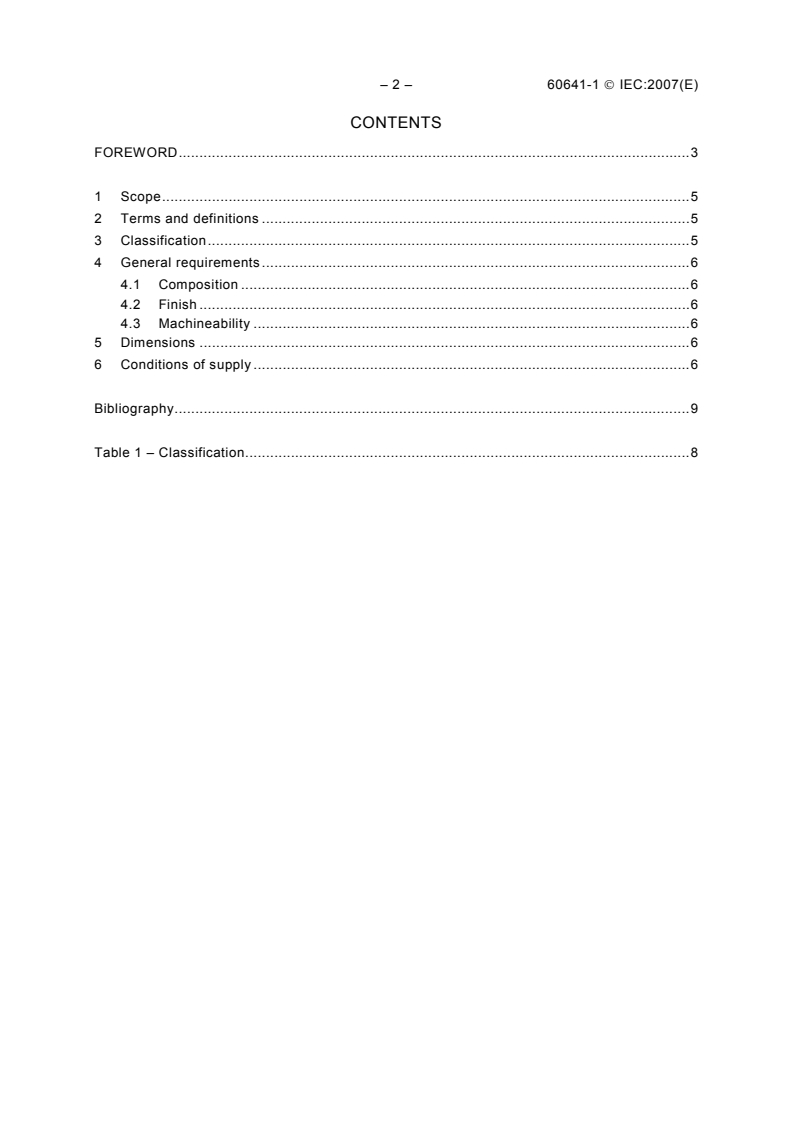
– 2 – 60641-1 © IEC:2007(E)
CONTENTS
FOREWORD.3
1 Scope.5
2 Terms and definitions .5
3 Classification.5
4 General requirements .6
4.1 Composition .6
4.2 Finish .6
4.3 Machineability .6
5 Dimensions .6
6 Conditions of supply .6
Bibliography.9
Table 1 – Classification.8
60641-1 © IEC:2007(E) – 3 –
INTERNATIONAL ELECTROTECHNICAL COMMISSION
____________
SPECIFICATION FOR PRESSBOARD AND PRESSPAPER FOR
ELECTRICAL PURPOSES –
Part 1: Definitions and general requirements
FOREWORD
1) The International Electrotechnical Commission (IEC) is a worldwide organization for standardization comprising
all national electrotechnical committees (IEC National Committees). The object of IEC is to promote
international co-operation on all questions concerning standardization in the electrical and electronic fields. To
this end and in addition to other activities, IEC publishes International Standards, Technical Specifications,
Technical Reports, Publicly Available Specifications (PAS) and Guides (hereafter referred to as “IEC
Publication(s)”). Their preparation is entrusted to technical committees; any IEC National Committee interested
in the subject dealt with may participate in this preparatory work. International, governmental and non-
governmental organizations liaising with the IEC also participate in this preparation. IEC collaborates closely
with the International Organization for Standardization (ISO) in accordance with conditions determined by
agreement between the two organizations.
2) The formal decisions or agreements of IEC on technical matters express, as nearly as possible, an international
consensus of opinion on the relevant subjects since each technical committee has representation from all
interested IEC National Committees.
3) IEC Publications have the form of recommendations for international use and are accepted by IEC National
Committees in that sense. While all reasonable efforts are made to ensure that the technical content of IEC
Publications is accurate, IEC cannot be held responsible for the way in which they are used or for any
misinterpretation by any end user.
4) In order to promote international uniformity, IEC National Committees undertake to apply IEC Publications
transparently to the maximum extent possible in their national and regional publications. Any divergence
between any IEC Publication and the corresponding national or regional publication shall be clearly indicated in
the latter.
5) IEC provides no marking procedure to indicate its approval and cannot be rendered responsible for any
equipment declared to be in conformity with an IEC Publication.
6) All users should ensure that they have the latest edition of this publication.
7) No liability shall attach to IEC or its directors, employees, servants or agents including individual experts and
members of its technical committees and IEC National Committees for any personal injury, property damage or
other damage of any nature whatsoever, whether direct or indirect, or for costs (including legal fees) and
expenses arising out of the publication, use of, or reliance upon, this IEC Publication or any other IEC
Publications.
8) Attention is drawn to the Normative references cited in this publication. Use of the referenced publications is
indispensable for the correct application of this publication.
9) Attention is drawn to the possibility that some of the elements of this IEC Publication may be the subject of
patent rights. IEC shall not be held responsible for identifying any or all such patent rights.
International Standard IEC 60641-1 has been prepared by IEC technical committee 15: Solid
electrical insulating materials.
This second edition cancels and replaces the first edition published in 1979 and amendment 1
(1993). This edition constitutes a technical revision.
The main changes with respect to the previous edition are listed below:
– the kind of surface finish shall no longer be specified in the standard;
– fixed nominal thicknesses have been replaced by preferred thicknesses;
– types B.6 and P.6 have been replaced, but the designations have been kept;
– types B.7 and P.7 have been deleted.
– 4 – 60641-1 © IEC:2007(E)
The text of this standard is based on the following documents:
CDV Rep
...
IEC 60641-1
Edition 2.0 2007-11
INTERNATIONAL
STANDARD
NORME
INTERNATIONALE
Pressboard and presspaper for electrical purposes –
Part 1: Definitions and general requirements
Carton comprimé et papier comprimé à usages électriques –
Partie 1: Définitions et exigences générales
All rights reserved. Unless otherwise specified, no part of this publication may be reproduced or utilized in any form or by
any means, electronic or mechanical, including photocopying and microfilm, without permission in writing from either IEC or
IEC's member National Committee in the country of the requester.
If you have any questions about IEC copyright or have an enquiry about obtaining additional rights to this publication,
please contact the address below or your local IEC member National Committee for further information.
Droits de reproduction réservés. Sauf indication contraire, aucune partie de cette publication ne peut être reproduite
ni utilisée sous quelque forme que ce soit et par aucun procédé, électronique ou mécanique, y compris la photocopie
et les microfilms, sans l'accord écrit de la CEI ou du Comité national de la CEI du pays du demandeur.
Si vous avez des questions sur le copyright de la CEI ou si vous désirez obtenir des droits supplémentaires sur cette
publication, utilisez les coordonnées ci-après ou contactez le Comité national de la CEI de votre pays de résidence.
IEC Central Office
3, rue de Varembé
CH-1211 Geneva 20
Switzerland
Email: inmail@iec.ch
Web: www.iec.ch
About the IEC
The International Electrotechnical Commission (IEC) is the leading global organization that prepares and publishes
International Standards for all electrical, electronic and related technologies.
About IEC publications
The technical content of IEC publications is kept under constant review by the IEC. Please make sure that you have the
latest edition, a corrigenda or an amendment might have been published.
ƒ Catalogue of IEC publications: www.iec.ch/searchpub
The IEC on-line Catalogue enables you to search by a variety of criteria (reference number, text, technical committee,…).
It also gives information on projects, withdrawn and replaced publications.
ƒ IEC Just Published: www.iec.ch/online_news/justpub
Stay up to date on all new IEC publications. Just Published details twice a month all new publications released. Available
on-line and also by email.
ƒ Electropedia: www.electropedia.org
The world's leading online dictionary of electronic and electrical terms containing more than 20 000 terms and definitions
in English and French, with equivalent terms in additional languages. Also known as the International Electrotechnical
Vocabulary online.
ƒ Customer Service Centre: www.iec.ch/webstore/custserv
If you wish to give us your feedback on this publication or need further assistance, please visit the Customer Service
Centre FAQ or contact us:
Email: csc@iec.ch
Tel.: +41 22 919 02 11
Fax: +41 22 919 03 00
A propos de la CEI
La Commission Electrotechnique Internationale (CEI) est la première organisation mondiale qui élabore et publie des
normes internationales pour tout ce qui a trait à l'électricité, à l'électronique et aux technologies apparentées.
A propos des publications CEI
Le contenu technique des publications de la CEI est constamment revu. Veuillez vous assurer que vous possédez
l’édition la plus récente, un corrigendum ou amendement peut avoir été publié.
ƒ Catalogue des publications de la CEI: www.iec.ch/searchpub/cur_fut-f.htm
Le Catalogue en-ligne de la CEI vous permet d’effectuer des recherches en utilisant différents critères (numéro de référence,
texte, comité d’études,…). Il donne aussi des informations sur les projets et les publications retirées ou remplacées.
ƒ Just Published CEI: www.iec.ch/online_news/justpub
Restez informé sur les nouvelles publications de la CEI. Just Published détaille deux fois par mois les nouvelles
publications parues. Disponible en-ligne et aussi par email.
ƒ Electropedia: www.electropedia.org
Le premier dictionnaire en ligne au monde de termes électroniques et électriques. Il contient plus de 20 000 termes et
définitions en anglais et en français, ainsi que les termes équivalents dans les langues additionnelles. Egalement appelé
Vocabulaire Electrotechnique International en ligne.
ƒ Service Clients: www.iec.ch/webstore/custserv/custserv_entry-f.htm
Si vous désirez nous donner des commentaires sur cette publication ou si vous avez des questions, visitez le FAQ du
Service clients ou contactez-nous:
Email: csc@iec.ch
Tél.: +41 22 919 02 11
Fax: +41 22 919 03 00
IEC 60641-1
Edition 2.0 2007-11
INTERNATIONAL
STANDARD
NORME
INTERNATIONALE
Pressboard and presspaper for electrical purposes –
Part 1: Definitions and general requirements
Carton comprimé et papier comprimé à usages électriques –
Partie 1: Définitions et exigences générales
INTERNATIONAL
ELECTROTECHNICAL
COMMISSION
COMMISSION
ELECTROTECHNIQUE
PRICE CODE
INTERNATIONALE
J
CODE PRIX
ICS 29.035.10 ISBN 2-8318-9589-8
– 2 – 60641-1 © IEC:2007
CONTENTS
FOREWORD.3
1 Scope.5
2 Terms and definitions .5
3 Classification.5
4 General requirements .6
4.1 Composition .6
4.2 Finish .6
4.3 Machineability .6
5 Dimensions .6
6 Conditions of supply .6
Bibliography.9
Table 1 – Classification.8
60641-1 © IEC:2007 – 3 –
INTERNATIONAL ELECTROTECHNICAL COMMISSION
____________
PRESSBOARD AND PRESSPAPER
FOR ELECTRICAL PURPOSES –
Part 1: Definitions and general requirements
FOREWORD
1) The International Electrotechnical Commission (IEC) is a worldwide organization for standardization comprising
all national electrotechnical committees (IEC National Committees). The object of IEC is to promote
international co-operation on all questions concerning standardization in the electrical and electronic fields. To
this end and in addition to other activities, IEC publishes International Standards, Technical Specifications,
Technical Reports, Publicly Available Specifications (PAS) and Guides (hereafter referred to as “IEC
Publication(s)”). Their preparation is entrusted to technical committees; any IEC National Committee interested
in the subject dealt with may participate in this preparatory work. International, governmental and non-
governmental organizations liaising with the IEC also participate in this preparation. IEC collaborates closely
with the International Organization for Standardization (ISO) in accordance with conditions determined by
agreement between the two organizations.
2) The formal decisions or agreements of IEC on technical matters express, as nearly as possible, an international
consensus of opinion on the relevant subjects since each technical committee has representation from all
interested IEC National Committees.
3) IEC Publications have the form of recommendations for international use and are accepted by IEC National
Committees in that sense. While all reasonable efforts are made to ensure that the technical content of IEC
Publications is accurate, IEC cannot be held responsible for the way in which they are used or for any
misinterpretation by any end user.
4) In order to promote international uniformity, IEC National Committees undertake to apply IEC Publications
transparently to the maximum extent possible in their national and regional publications. Any divergence
between any IEC Publication and the corresponding national or regional publication shall be clearly indicated in
the latter.
5) IEC provides no marking procedure to indicate its approval and cannot be rendered responsible for any
equipment declared to be in conformity with an IEC Publication.
6) All users should ensure that they have the latest edition of this publication.
7) No liability shall attach to IEC or its directors, employees, servants or agents including individual experts and
members of its technical committees and IEC National Committees for any personal injury, property damage or
other damage of any nature whatsoever, whether direct or indirect, or for costs (including legal fees) and
expenses arising out of the publication, use of, or reliance upon, this IEC Publication or any other IEC
Publications.
8) Attention is drawn to the Normative references cited in this publication. Use of the referenced publications is
indispensable for the correct application of this publication.
9) Attention is drawn to the possibility that some of the elements of this IEC Publication may be the subject of
patent rights. IEC shall not be held responsible for identifying any or all such patent rights.
International Standard IEC 60641-1 has been prepared by IEC technical committee 15: Solid
electrical insulating materials.
This second edition cancels and replaces the first edition published in 1979 and amendment 1
(1993). This edition constitutes a technical revision.
The main changes with respect to the previous edition are listed below:
– the kind of surface finish shall no longer be specified in the standard;
– fixed nominal thicknesses have been replaced by preferred thicknesses;
– types B.6 and P.6 have been replaced, but the designations have been kept;
– types B.7 and P.7 have been deleted.
– 4 – 60641-1 © IEC:2007
This bilingual version, published in 2008-01, corresponds to the English version.
The text of this standard is based on the following documents:
CDV Report on voting
15/352/CDV 15/388/RVC
Full information on the voting for the approval of this standard can be found in the report on
voting indicated in the above table.
The French version of this standard has not been voted upon.
This publication has been drafted in accordance with the ISO/IEC Directives, Part 2.
A list of all the parts in the IEC 60641 series, under the general title Pressboard and
presspaper for electrical purposes, can be found on the IEC website.
The committee has decided that the contents of this publication will remain unchanged until
the maintenance result date indicated on the IEC web site under "http://webstore.iec.ch" in
the data related to the specific publication. At this date, the publication will be
• reconfirmed,
• withdrawn,
• replaced by a revised edition, or
• amended.
60641-1 © IEC:2007 – 5 –
PRESSBOARD AND PRESSPAPER
FOR ELECTRICAL PURPOSES –
Part 1: Definitions and general requirements
1 Scope
This part of IEC 60641 contains definitions related to a classification of, and the general
requirements to be fulfilled by, pressboard and presspaper for electrical purposes.
2 Terms and definitions
2.1
pressboard
board normally made on an intermittent board machine from pulp made entirely from
vegetable origin of high chemical purity. It is characterized by its relatively high density, even
thickness, surface smoothness, high mechanical strength, flexibility, ageing resistance and
electrical insulating properties. The surface may be smooth or textured
2.2
presspaper
multilayer paper made by a continuous process from pulp entirely from vegetable origin and of
high chemical purity. It is characterized by its density, even thickness, surface smoothness,
high mechanical strength, ageing resistance and electrical insulating properties
2.3
calendered
pressboard or presspaper, which is subsequently treated with a calender
2.4
pre-compressed
pressboard to which heat has been applied during pressing
2.5
glazed
pressboard or presspaper to which lustre has been imparted. The lustre may be imparted by
any appropriate drying or mechanical finishing process
Based on ISO vocabulary of paper terms.
3 Classification
Based on compositions and properties, this standard covers the types of pressboard or
presspaper shown in Table 1. To the description of the types, some examples of known
applications are added without implying any kind of restriction on other possible applications.
– 6 – 60641-1 © IEC:2007
4 General requirements
4.1 Composition
All types of pressboard and presspaper covered by this standard shall be made entirely from
vegetable fibres. All types shall be free from extraneous material and adhesive and shall,
where necessary, contain a suitable dyestuff.
NOTE The absence of contaminants such as metallic, inorganic and organic particles indicates the
immaculateness of the material.
Many of the types listed in Table 1 are specified as made from "sulphate wood pulp". This raw
material is used in order to enable appropriate chemical purity and mechanical properties to
be achieved (excluding, for example, mechanical pulps).
Advances in pulp technology have enabled the requisite properties to be obtained by more
environmentally satisfactory processes, which cannot be described as "the sulphate process".
The term "sulphate wood pulp" in Table 1 is intended to include such materials.
In order to give satisfactory performance, it is necessary for the pulp to have a high degree of
polymerisation (DP) similar to that of unbleached sulphate pulp of high quality, and to be
unbleached. The pulp must be capable of similar properties to sulphate pulp in all other
respects.
4.2 Finish
Pressboard or presspaper shall have a finish as agreed between purchaser and supplier.
4.3 Machineability
All pressboard shall be capable of being sheared. Pressboard and presspaper of a thickness
of 3,0 mm or less shall also be capable of being punched without showing ragged edges. The
operation shall be carried out in accordance with the recommendations of the manufacturer.
5 Dimensions
Thickness
The preferred nominal thickness (in millimetres) of the pressboard and presspaper shall be
one of the following:
Presspaper: 0,075 - 0,10 - 0,13 - 0,15 - 0,18 - 0,20 - 0,25 - 0,30 - 0,40 - 0,50 - 0,60 - 0,80
Pressboard: 0,8 - 1,0 - 1,5 - 2,0 - 2,5 - 3,0 - 4,0 - 5,0 - 6,0 - 7,0 - 8,0
Other thicknesses are possible. The tolerances on thickness are to be found in IEC 60641-3.
6 Conditions of supply
The pressboard and presspaper shall be placed in a packing which ensures adequate
protection during transport, handIing and storage.
60641-1 © IEC:2007 – 7 –
A consignment of pressboard or presspaper shall be legibly and indelibly marked with the
following information.
a) Manufacturer’s name or trademark, if any.
b) Type of pressboard or presspaper as given in Table 1
c) Nominal thickness.
d) Sheet size or roll width.
e) Weight (net/gross)
– 8 – 60641-1 © IEC:2007
Table 1 – Classification
Pressboard Presspaper
Examples of
application
Basic type Subdivisions Basic type Subdivisions
B0. Pessboard of B0.1 100 % sulphate P0. High density P0.1 100 % sulphate Capacitors and
particularly high wood pulp presspaper of wood pulp hermetic motors
chemical purity particularly high
B0.2 100 % cotton P0.2 100 % cotton
chemical purity
B0.3 Mixture of sul- P0.3 Mixture of sul-
phate wood pulp phate wood pulp
and cotton and cotton
P1. Low density P1.1 100 % sulphate Capacitors
presspaper of wood pulp
particularly high
P1.2 100 % cotton
chemical purity
P1.3 Mixture of sul-
and of high oil
phate wood pulp
absorption.
and cotton
B2. Pessboard B2.1 100 % sulphate P2. Presspaper of P2.1 100 % sulphate Transformers
characterized wood pulp high density wood pulp
by high and high
B2.2 100 % cotton P2.2 100 % cotton
chemical purity chemical purity
B2.3 Mixture of sul- P2.3 Mixture of sul-
phate wood pulp phate wood pulp
and cotton and cotton
B2.4 Mixture of cotton P2.4 Mixture of cotton
and jute hemp and jute hemp
B3. Pre- B3.1 100 % sulphate Transformers
compressed wood pulp
pressboard, a
B3.2 100 % cotton
very hard and
B3.3 Mixture of
...