

IEC 61000-4-14:1999+AMD1:2001+AMD2:2009 CSV
(Main)Electromagnetic compatibility (EMC) - Part 4-14: Testing and measurement techniques - Voltage fluctuation immunity test for equipment with input current not exceeding 16 A per phase
General Information
- Abstract
IEC 61000-4-14:1999+A1:2001+A2:2009 applies to electrical and/or electronic equipment that have a rated input current up to 16 A per phase. Aims to establish a reference for evaluating the immunity of electric and/or electronic equipment when subjected to positive and negative low amplitude voltage fluctuations. Only conducted phenomena are considered, including immunity tests for equipment connected to public and industrial power supply networks. Has the status of a Basic EMC publication. This consolidated version consists of the first edition (1999), its amendment 1 (2001) and its amendment 2 (2009). Therefore, no need to order amendment in addition to this publication.
- Status
- Published
- Publication Date
- 11-Aug-2009
- Technical Committee
- SC 77A - EMC - Low frequency phenomena
- Current Stage
- PPUB - Publication issued
- Start Date
- 12-Aug-2009
- Completion Date
- 12-Aug-2009
Buy Documents
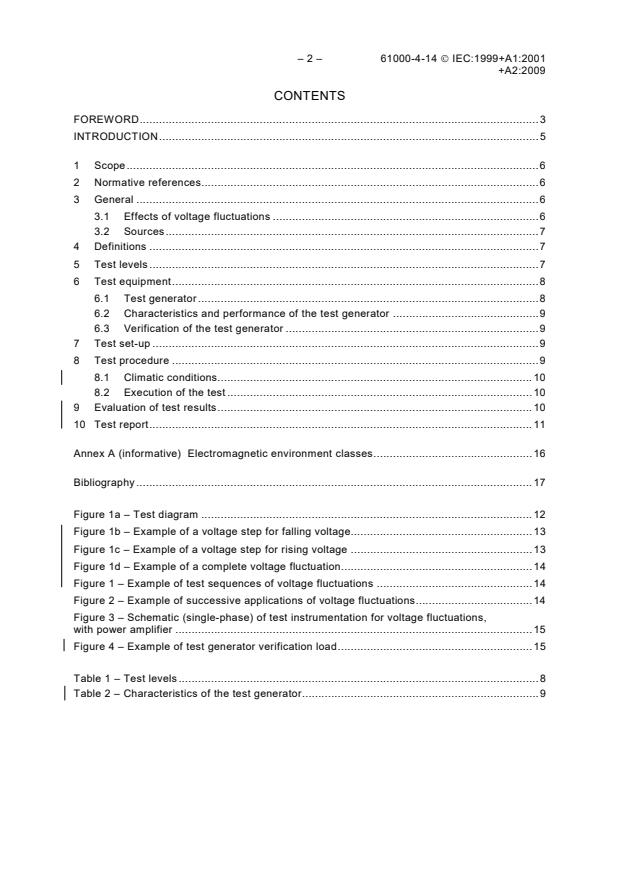
IEC 61000-4-14:1999+AMD1:2001+AMD2:2009 CSV - Electromagnetic compatibility (EMC) - Part 4-14: Testing and measurement techniques - Voltage fluctuation immunity test for equipment with input current not exceeding 16 A per phase
Overview
IEC 61000-4-14:1999+AMD1:2001+AMD2:2009 consolidated version is an international standard developed by the International Electrotechnical Commission (IEC) as part of its widely adopted Electromagnetic Compatibility (EMC) series. This standard addresses voltage fluctuation immunity testing for electrical and electronic equipment with a rated input current up to 16 A per phase, connected to public or industrial AC power supply networks.
The purpose of IEC 61000-4-14 is to establish reproducible test methods and reference criteria for evaluating equipment immunity against positive and negative low-amplitude voltage fluctuations. As a Basic EMC publication, it supports product, product-family, and generic EMC standards by providing standardized testing protocols.
Key Topics
- Scope: Applies to electrical and electronic equipment with input current not exceeding 16 A per phase. Only conducted phenomena (not radiated) are considered.
- Test Aim: Evaluates equipment performance when subjected to step voltage fluctuations (both increases and decreases), simulating the kinds of disturbances typically encountered in public and industrial power supply environments.
- Test Classes:
- Class 1: Highly protected or sensitive environments (e.g., labs, technological equipment) - no test normally required.
- Class 2: Public network environments (typical consumer or light industrial environments).
- Class 3: Heavily disturbed industrial environments (with large motors, welding plants, or rapid load changes).
- Test Procedures:
- Equipment is subjected to repetitive step voltage changes, simulating real-world disturbances.
- Test sequences are prescribed, including periods, durations, and phase details.
- Performance is recorded and evaluated against pre-defined criteria.
Applications
IEC 61000-4-14 provides significant practical value for:
- Electrical and Electronic Manufacturers: Ensures equipment is not vulnerable to common power line disturbances, improving product robustness and reliability.
- Testing Laboratories: Offers standardized immunity test procedures, enabling reproducibility and global comparability of test results.
- Product Certification Bodies: Provides clear reference criteria for compliance marking and product approvals in regulated markets.
- Design Engineers: Assists in the design stage by offering immunity test requirements, supporting EMC compliance from the outset.
- Industrial Facilities: Helps assess the resilience of automation systems, control equipment, and other sensitive electronics to voltage fluctuations that may occur on-site.
This standard is especially relevant for products intended for connection to AC distribution networks up to 16 A per phase, including consumer appliances, IT equipment, control devices, and industrial automation products.
Related Standards
- IEC 61000-4-1: Overview of immunity tests and general guidance for EMC immunity testing.
- IEC 61000-4-11: Voltage dips, short interruptions, and voltage variation immunity tests-complementary to the voltage fluctuation scenarios covered in IEC 61000-4-14.
- IEC 61000-2-2: Compatibility levels for low-frequency conducted disturbances and public low-voltage supply systems.
- IEC 61000-2-4: Compatibility levels in industrial plants for low-frequency conducted disturbances.
- IEC 60068-1: General environmental testing guidance, referenced for lab conditions.
Summary
IEC 61000-4-14:1999+AMD1:2001+AMD2:2009 is a fundamental publication for anyone involved in EMC immunity testing of electrical and electronic equipment intended for network operation. By applying this standard, manufacturers and test houses can ensure that products are robust against typical voltage fluctuations, supporting international compliance and market access. For the latest guidance and industry best practices, always consult the most recent edition and related standards as referenced by the IEC.
Buy Documents
IEC 61000-4-14:1999+AMD1:2001+AMD2:2009 CSV - Electromagnetic compatibility (EMC) - Part 4-14: Testing and measurement techniques - Voltage fluctuation immunity test for equipment with input current not exceeding 16 A per phase
Get Certified
Connect with accredited certification bodies for this standard

ANCE
Mexican certification and testing association.

Intertek Slovenia
Intertek testing, inspection, and certification services in Slovenia.

LNE (Laboratoire National de Métrologie et d'Essais)
French national laboratory for metrology and testing.
Sponsored listings
Frequently Asked Questions
IEC 61000-4-14:1999+AMD1:2001+AMD2:2009 CSV is a standard published by the International Electrotechnical Commission (IEC). Its full title is "Electromagnetic compatibility (EMC) - Part 4-14: Testing and measurement techniques - Voltage fluctuation immunity test for equipment with input current not exceeding 16 A per phase". This standard covers: IEC 61000-4-14:1999+A1:2001+A2:2009 applies to electrical and/or electronic equipment that have a rated input current up to 16 A per phase. Aims to establish a reference for evaluating the immunity of electric and/or electronic equipment when subjected to positive and negative low amplitude voltage fluctuations. Only conducted phenomena are considered, including immunity tests for equipment connected to public and industrial power supply networks. Has the status of a Basic EMC publication. This consolidated version consists of the first edition (1999), its amendment 1 (2001) and its amendment 2 (2009). Therefore, no need to order amendment in addition to this publication.
IEC 61000-4-14:1999+A1:2001+A2:2009 applies to electrical and/or electronic equipment that have a rated input current up to 16 A per phase. Aims to establish a reference for evaluating the immunity of electric and/or electronic equipment when subjected to positive and negative low amplitude voltage fluctuations. Only conducted phenomena are considered, including immunity tests for equipment connected to public and industrial power supply networks. Has the status of a Basic EMC publication. This consolidated version consists of the first edition (1999), its amendment 1 (2001) and its amendment 2 (2009). Therefore, no need to order amendment in addition to this publication.
IEC 61000-4-14:1999+AMD1:2001+AMD2:2009 CSV is classified under the following ICS (International Classification for Standards) categories: 33.100.20 - Immunity. The ICS classification helps identify the subject area and facilitates finding related standards.
IEC 61000-4-14:1999+AMD1:2001+AMD2:2009 CSV is available in PDF format for immediate download after purchase. The document can be added to your cart and obtained through the secure checkout process. Digital delivery ensures instant access to the complete standard document.
Standards Content (Sample)
IEC 61000-4-14 ®
Edition 1.2 2009-08
INTERNATIONAL
STANDARD
NORME
INTERNATIONALE
BASIC EMC PUBLICATION
PUBLICATION FONDAMENTALE EN CEM
Electromagnetic compatibility (EMC) –
Part 4-14: Testing and measurement techniques – Voltage fluctuation immunity
test for equipment with input current not exceeding 16 A per phase
Compatibilité électromagnétique (CEM) –
Partie 4-14: Techniques d'essai et de mesure – Essai d’immunité aux
fluctuations de tension pour le matériel dont le courant d’entrée est inférieur ou
égal à 16 A par phase
IEC 61000-4-14:1999+A1:2001+A2:2009
All rights reserved. Unless otherwise specified, no part of this publication may be reproduced or utilized in any form or by
any means, electronic or mechanical, including photocopying and microfilm, without permission in writing from either IEC or
IEC's member National Committee in the country of the requester.
If you have any questions about IEC copyright or have an enquiry about obtaining additional rights to this publication,
please contact the address below or your local IEC member National Committee for further information.
Droits de reproduction réservés. Sauf indication contraire, aucune partie de cette publication ne peut être reproduite
ni utilisée sous quelque forme que ce soit et par aucun procédé, électronique ou mécanique, y compris la photocopie
et les microfilms, sans l'accord écrit de la CEI ou du Comité national de la CEI du pays du demandeur.
Si vous avez des questions sur le copyright de la CEI ou si vous désirez obtenir des droits supplémentaires sur cette
publication, utilisez les coordonnées ci-après ou contactez le Comité national de la CEI de votre pays de résidence.
IEC Central Office
3, rue de Varembé
CH-1211 Geneva 20
Switzerland
Email: inmail@iec.ch
Web: www.iec.ch
About the IEC
The International Electrotechnical Commission (IEC) is the leading global organization that prepares and publishes
International Standards for all electrical, electronic and related technologies.
About IEC publications
The technical content of IEC publications is kept under constant review by the IEC. Please make sure that you have the
latest edition, a corrigenda or an amendment might have been published.
Catalogue of IEC publications: www.iec.ch/searchpub
The IEC on-line Catalogue enables you to search by a variety of criteria (reference number, text, technical committee,…).
It also gives information on projects, withdrawn and replaced publications.
IEC Just Published: www.iec.ch/online_news/justpub
Stay up to date on all new IEC publications. Just Published details twice a month all new publications released. Available
on-line and also by email.
Electropedia: www.electropedia.org
The world's leading online dictionary of electronic and electrical terms containing more than 20 000 terms and definitions
in English and French, with equivalent terms in additional languages. Also known as the International Electrotechnical
Vocabulary online.
Customer Service Centre: www.iec.ch/webstore/custserv
If you wish to give us your feedback on this publication or need further assistance, please visit the Customer Service
Centre FAQ or contact us:
Email: csc@iec.ch
Tel.: +41 22 919 02 11
Fax: +41 22 919 03 00
A propos de la CEI
La Commission Electrotechnique Internationale (CEI) est la première organisation mondiale qui élabore et publie des
normes internationales pour tout ce qui a trait à l'électricité, à l'électronique et aux technologies apparentées.
A propos des publications CEI
Le contenu technique des publications de la CEI est constamment revu. Veuillez vous assurer que vous possédez
l’édition la plus récente, un corrigendum ou amendement peut avoir été publié.
Catalogue des publications de la CEI: www.iec.ch/searchpub/cur_fut-f.htm
Le Catalogue en-ligne de la CEI vous permet d’effectuer des recherches en utilisant différents critères (numéro de référence,
texte, comité d’études,…). Il donne aussi des informations sur les projets et les publications retirées ou remplacées.
Just Published CEI: www.iec.ch/online_news/justpub
Restez informé sur les nouvelles publications de la CEI. Just Published détaille deux fois par mois les nouvelles
publications parues. Disponible en-ligne et aussi par email.
Electropedia: www.electropedia.org
Le premier dictionnaire en ligne au monde de termes électroniques et électriques. Il contient plus de 20 000 termes et
définitions en anglais et en français, ainsi que les termes équivalents dans les langues additionnelles. Egalement appelé
Vocabulaire Electrotechnique International en ligne.
Service Clients: www.iec.ch/webstore/custserv/custserv_entry-f.htm
Si vous désirez nous donner des commentaires sur cette publication ou si vous avez des questions, visitez le FAQ du
Service clients ou contactez-nous:
Email: csc@iec.ch
Tél.: +41 22 919 02 11
Fax: +41 22 919 03 00
IEC 61000-4-14 ®
Edition 1.2 2009-08
INTERNATIONAL
STANDARD
NORME
INTERNATIONALE
BASIC EMC PUBLICATION
PUBLICATION FONDAMENTALE EN CEM
Electromagnetic compatibility (EMC) –
Part 4-14: Testing and measurement techniques – Voltage fluctuation immunity
test for equipment with input current not exceeding 16 A per phase
Compatibilité électromagnétique (CEM) –
Partie 4-14: Techniques d'essai et de mesure – Essai d’immunité aux
fluctuations de tension pour le matériel dont le courant d’entrée est inférieur ou
égal à 16 A par phase
INTERNATIONAL
ELECTROTECHNICAL
COMMISSION
COMMISSION
ELECTROTECHNIQUE
PRICE CODE
INTERNATIONALE
CODE PRIX CD
ICS 33.100.20 ISBN 2-8318-1049-3
– 2 – 61000-4-14 IEC:1999+A1:2001
+A2:2009
CONTENTS
FOREWORD . 3
INTRODUCTION . 5
1 Scope . 6
2 Normative references. 6
3 General . 6
3.1 Effects of voltage fluctuations . 6
3.2 Sources . 7
4 Definitions . 7
5 Test levels . 7
6 Test equipment . 8
6.1 Test generator . 8
6.2 Characteristics and performance of the test generator . 9
6.3 Verification of the test generator . 9
7 Test set-up . 9
8 Test procedure . 9
8.1 Climatic conditions. 10
8.2 Execution of the test . 10
9 Evaluation of test results . 10
10 Test report . 11
Annex A (informative) Electromagnetic environment classes . 16
Bibliography . 17
Figure 1a – Test diagram . 12
Figure 1b – Example of a voltage step for falling voltage. 13
Figure 1c – Example of a voltage step for rising voltage . 13
Figure 1d – Example of a complete voltage fluctuation . 14
Figure 1 – Example of test sequences of voltage fluctuations . 14
Figure 2 – Example of successive applications of voltage fluctuations . 14
Figure 3 – Schematic (single-phase) of test instrumentation for voltage fluctuations,
with power amplifier . 15
Figure 4 – Example of test generator verification load . 15
Table 1 – Test levels . 8
Table 2 – Characteristics of the test generator . 9
61000-4-14 IEC:1999+A1:2001 – 3 –
+A2:2009
INTERNATIONAL ELECTROTECHNICAL COMMISSION
____________
ELECTROMAGNETIC COMPATIBILITY (EMC) –
Part 4-14: Testing and measurement techniques –
Voltage fluctuation immunity test for equipment
with input current not exceeding 16 A per phase
FOREWORD
1) The International Electrotechnical Commission (IEC) is a worldwide organization for standardization comprising
all national electrotechnical committees (IEC National Committees). The object of IEC is to promote
international co-operation on all questions concerning standardization in the electrical and electronic fields. To
this end and in addition to other activities, IEC publishes International Standards, Technical Specifications,
Technical Reports, Publicly Available Specifications (PAS) and Guides (hereafter referred to as “IEC
Publication(s)”). Their preparation is entrusted to technical committees; any IEC National Committee interested
in the subject dealt with may participate in this preparatory work. International, governmental and non-
governmental organizations liaising with the IEC also participate in this preparation. IEC collaborates closely
with the International Organization for Standardization (ISO) in accordance with conditions determined by
agreement between the two organizations.
2) The formal decisions or agreements of IEC on technical matters express, as nearly as possible, an international
consensus of opinion on the relevant subjects since each technical committee has representation from all
interested IEC National Committees.
3) IEC Publications have the form of recommendations for international use and are accepted by IEC National
Committees in that sense. While all reasonable efforts are made to ensure that the technical content of IEC
Publications is accurate, IEC cannot be held responsible for the way in which they are used or for any
misinterpretation by any end user.
4) In order to promote international uniformity, IEC National Committees undertake to apply IEC Publications
transparently to the maximum extent possible in their national and regional publications. Any divergence
between any IEC Publication and the corresponding national or regional publication shall be clearly indicated in
the latter.
5) IEC provides no marking procedure to indicate its approval and cannot be rendered responsible for any
equipment declared to be in conformity with an IEC Publication.
6) All users should ensure that they have the latest edition of this publication.
7) No liability shall attach to IEC or its directors, employees, servants or agents including individual experts and
members of its technical committees and IEC National Committees for any personal injury, property damage or
other damage of any nature whatsoever, whether direct or indirect, or for costs (including legal fees) and
expenses arising out of the publication, use of, or reliance upon, this IEC Publication or any other IEC
Publications.
8) Attention is drawn to the Normative references cited in this publication. Use of the referenced publications is
indispensable for the correct application of this publication.
9) Attention is drawn to the possibility that some of the elements of this IEC Publication may be the subject of
patent rights. IEC shall not be held responsible for identifying any or all such patent rights.
International Standard IEC 61000-4-14 has been prepared by subcommittee 77A: Low fre-
quency phenomena, of IEC technical committee 77: Electromagnetic compatibility.
This standard forms part 4-14 of IEC 61000 series. It has the status of basic EMC publication
in accordance with IEC Guide 107.
This consolidated version of IEC 61000-4-14 consists of the first edition (1999) [documents
77A/263/FDIS and 77A/268/RVD], its amendment 1 (2001) [documents 77B/291+293/FDIS and
77B/298+300/RVD] and its amendment 2 (2009) [documents 77A/669/CDV and 77A/685/RVC].
The technical content is therefore identical to the base edition and its amendments and has
been prepared for user convenience.
It bears the edition number 1.2.
– 4 – 61000-4-14 IEC:1999+A1:2001
+A2:2009
A vertical line in the margin shows where the base publication has been modified by
amendments 1 and 2.
The committee has decided that the contents of the base publication and its amendments will
remain unchanged until the maintenance result date indicated on the IEC web site under
"http://webstore.iec.ch" in the data related to the specific publication. At this date,
the publication will be
• reconfirmed,
• withdrawn,
• replaced by a revised edition, or
• amended.
61000-4-14 IEC:1999+A1:2001 – 5 –
+A2:2009
INTRODUCTION
IEC 61000 is published in separate parts according to the following structure:
Part 1: General
General considerations (introduction, fundamental principles)
Definitions, terminology
Part 2: Environment
Description of the environment
Classification of the environment
Compatibility levels
Part 3: Limits
Emission limits
Immunity limits (insofar as these limits do not fall under the responsibility of the product
committees)
Part 4: Testing and measurement techniques
Measurement techniques
Testing techniques
Part 5: Installation and mitigation guidelines
Installation guidelines
Mitigation methods and devices
Part 6: Generic standards
Part 9: Miscellaneous
Each part is further subdivided into several parts, published either as International Standards,
or as technical reports, some of which have already been published as sections. Others will be
published with the part number followed by a dash and a second number identifying the
subdivision (example 61000-6-1).
– 6 – 61000-4-14 IEC:1999+A1:2001
+A2:2009
ELECTROMAGNETIC COMPATIBILITY (EMC) –
Part 4-14: Testing and measurement techniques –
Voltage fluctuation immunity test for equipment
with input current not exceeding 16 A per phase
1 Scope
This part of IEC 61000 is a basic electromagnetic compatibility (EMC) publication. It considers
immunity tests for electrical and/or electronic equipment in their electromagnetic environment.
Only conducted phenomena are considered, including immunity tests for equipment connected
to public and industrial power supply networks.
This part aims to establish a reference for evaluating the immunity of electric and electronic
equipment when subjected to positive and negative low amplitude voltage fluctuations.
The voltage fluctuations considered by this standard do not include flicker, which is a
physiological phenomenon due to lighting luminance fluctuations.
This standard applies to electrical and/or electronic equipment that have a rated input current
up to 16 A per phase. It does not apply to electrical and/or electronic equipment connected to
d.c. or a.c. 400 Hz distribution networks. Tests concerning these networks will be covered by
other IEC standards.
The immunity test levels required for a specific electromagnetic environment, together with the
performance criteria, are indicated in the product, product family or generic standards as
applicable. However, most product groups do not have a history of being susceptible to voltage
fluctuations. Consequently, testing for these phenomena is often not required.
2 Normative references
The following referenced documents are indispensable for the application of this document. For
dated references, only the edition cited applies. For undated references, the latest edition of
the referenced document (including any amendments) applies.
IEC 60050(161), International Electrotechnical Vocabulary (IEV) – Chapter 161: Electro-
magnetic compatibility
IEC 60068-1, Environmental testing – Part 1: General and guidance
IEC 61000-2-4, Electromagnetic compatibility (EMC) – Part 2: Environment – Section 4:
Compatibility levels in industrial plants for low-frequency conducted disturbances
3 General
3.1 Effects of voltage fluctuations
Electrical and electronic equipment may be affected by voltage fluctuations. Examples of these
effects include the following:
– degradation of performances in equipment using storage devices (e.g. capacitors);
– loss of function in control systems;
61000-4-14 IEC:1999+A1:2001 – 7 –
+A2:2009
– instability of internal voltages and currents in equipment;
– increased ripple.
3.2 Sources
There is a significant number of domestic appliances in the low-voltage network. However,
fluctuations caused by these appliances are not generally significant.
Fluctuations are mainly produced by
a) continuously but randomly varying large loads such as:
1) resistance welding machines;
2) rolling mills;
3) large motors with varying loads;
4) arc furnaces;
5) arc welding plant;
b) single on/off switching of loads (e.g. motors);
c) step voltage changes (due to tap voltage regulators of transformers).
These industrially produced fluctuations can affect a large number of consumers. Such
equipment operates continuously or infrequently. The public supply network impedance has
wide variations, consequently the transmission of the disturbances will be different for different
networks.
4 Definitions
For the purpose of this part of IEC 61000, the following definitions and terms apply. They are
applicable only to the field of voltage fluctuations; not all of them are included in
IEC 60050(161).
4.1
immunity
ability of a device, equipment or system to perform without degradation of performance in the
presence of an electromagnetic disturbance [IEV 161-01-20]
4.2
voltage fluctuations
series of voltage changes or a cyclic variation of the voltage envelope [IEV 161-08-05]
5 Test levels
This test may apply to all equipment intended for connection to public networks, industrial
networks and electricity plants that are likely to be sensitive to this type of disturbance.
It can be assumed that step voltage changes are the most disturbing type of voltage
fluctuations.
The equipment under test (EUT) is initially operated using a steady supply voltage and is then
subjected to repetitive step voltage changes according to figure 1a.
The initial voltage is set to
U , U – 10 % U , U + 10 % U
n n n n n
NOTE U is the nominal voltage.
n
– 8 – 61000-4-14 IEC:1999+A1:2001
+A2:2009
The magnitude of the voltage steps is chosen as follows:
Class 1: no test required.
Class 2: ∆U = 8 % U for equipment intended for connection to public networks or other lightly
n
disturbed networks. This test level is specified for class 2.
Class 3: ∆U = 12 % U for equipment connected to heavily disturbed networks (i.e. industrial
n
networks). This test level is specified for class 3.
Classes 1, 2 and 3 are defined in annex A.
Table 1 gives the test levels for the different initial voltages:
U , U – 10 % U , U + 10 % U
n n n n n
Table 1 – Test levels
U
Class U – 10 % U U + 10 % U
n n n n n
1 No test required
2 ∆U = ±8 % U ∆U = +8 % U ∆U = –8 % U
n n n
∆U = ±12 % U ∆U = +12 % U ∆U = –12 % U
n n n
x x x x
NOTE The levels for class "x" are open.
The repetition period T and the duration t of the voltage fluctuations are specified as T = 5 s
and t = 2 s (see Figure 1d).
The changes from the initial voltage to the test voltage, or from the test voltage back to the
initial voltage are achieved through five successive voltage steps in five consecutive cycles of
the mains supply, see Figure 1d. Each voltage step is of ΔU/5 and occurs over π/2 radians of
the period of the nominal frequency, f , (e.g. 5 ms for 50 Hz) see Figure 1b and Figure 1c.
n
For falling voltage changes, the voltage step begins at phase angle φ = 270° and finishes at
φ = 360°, see Figure 1b.
For rising voltage changes, the voltage step begins at phase angle φ = 180° and finishes at
φ = 270°, see Figure 1c.
x is an open test level. This value may be defined by the product standard in order to cover
situations other than the normal operating conditions of the network.
All of the levels can be proposed by the product committee, but for equipment for use in public
supply systems, the values shall not be lower than those specified for class 2.
NOTE The upper and lower voltage operation limits defined by the product manufacturer should not be exceeded.
6 Test equipment
6.1 Test generator
The generator used for the test shall have provisions to prevent the emission of heavy
disturbances which, if injected into the power supply network, may influence the test results.
61000-4-14 IEC:1999+A1:2001 – 9 –
+A2:2009
6.2 Characteristics and performance of the test generator
Table 2 – Characteristics of the test generator
Output voltage capability U ± 15 %
n
Voltage accuracy
±1 %
Zero crossing accuracy 250 µs at zero voltage crossover
The generator shall be able to supply enough current
Output current capability
according to the type of EUT in the test voltage range.
Overshoot/undershoot of the actual voltage Less than 5 % of the change in voltage
Voltage rise (and fall) time during switching Under 1 ms
Maximum interphase error (three-phase power supply) 2,5°
Frequency accuracy 2,5 % of f (50 Hz or 60 Hz)
n
NOTE The generator with a power amplifier specified in IEC 61000-4-11 is suitable for this test. An over-
voltage capability of U + 15 % is necessary.
n
6.3 Verification of the test generator
Test generators with different output power capabilities may be used.
The test generator shall be verified that it complies with the characteristics and specifications
listed in Table 2.
Performance of the test generator shall be verified with a resistive load drawing an r.m.s.
current of no more than the output capability of the generator. For example, a 230 V/16 A
generator shall be verified with a 14,3 Ω load.
In addition, the generator’s output current capability shall be verified as being able to provide a
crest factor of at least 3 when U is applied to a single phase load drawing an r.m.s. current of
n
no more than the output capability of the generator. Each output phase of the generator shall
be verified in turn. An example of a suitable 230 V/16 A verification load is given in Figure 4.
7 Test set-up
Figure 3 shows the test configuration for mains supply simulation.
Waveform generators and power amplifiers may be used.
Tests on three-phase EUT are carried out using three synchronised generators.
8 Test procedure
Before starting the test of a given equipment, a test plan shall be prepared.
It is recommended that the test plan include the following:
– description of the EUT;
– information on possible connections (plugs, terminals, etc.) and corresponding cables and
peripherals;
– input power port of the EUT;
– representative operational modes of the EUT for the test;
– 10 – 61000-4-14 IEC:1999+A1:2001
+A2:2009
– performance criteria used and defined in the technical specifications;
– description of the test set-up.
If the actual operating signal sources are not available to the EUT, they may be simulated.
For each test, any degradation of performance shall be recorded. The monitoring equipment
should be capable of displaying the status of the operational mode of the EUT during and after
the tests. After each group of tests, a full functional check shall be performed.
8.1 Climatic conditions
Unless otherwise specified by the committee responsible for the generic or product standard,
the climatic conditions in the laboratory shall be within any limits specified for the operation of
the EUT and the test equipment by their respective manufacturers.
Tests shall not be performed if the relative humidity is so high as to cause condensation on the
EUT or the test equipment.
NOTE Where it is considered that there is sufficient evidence to demonstrate that the effects of the phenomenon
covered by this standard are influenced by climatic conditions, this should be brought to the attention of the
committee responsible for this standard.
8.2 Execution of the test
The EUT shall be tested for each selected combination of test level and duration with a series
of three sequences of voltage fluctuations, with intervals of two times 60 s minimum between
the voltage fluctuation sequences (see figure 2). Each representative mode of operation shall
be tested.
The test duration shall be determined by the product committee.
In the case of a three-phase apparatus, all three phases shall be tested at the same time. The
voltage steps are made phase by phase at the same phase angle, ϕ, and not simultaneously on
the three phases.
9 Evaluation of test results
The test results shall be classified in terms of the loss of function or degradation of
performance of the equipment under test, relative to a performance level defined by its
manufacturer or the requestor of the test, or agreed between the manufacturer and the
purchaser of the product. The recommended classification is as follows:
a) normal performance within limits specified by the manufacturer, requestor or purchaser;
b) temporary loss of function or degradation of performance which ceases after the
disturbance ceases, and from which the equipment under test recovers its normal
performance, without operator intervention;
c) temporary loss of function or degradation of performance, the correction of which requires
operator intervention;
d) loss of function or degradation of performance which is not recoverable, owing to damage
to hardware or software, or loss of data.
The manufacturer’s specification may define effects on the EUT which may be considered
insignificant, and therefore acceptable.
61000-4-14 IEC:1999+A1:2001 – 11 –
+A2:2009
This classification may be used as a guide in formulating performance criteria, by committees
responsible for generic, product and product-family standards, or as a framework for the
agreement on performance criteria between the manufacturer and the purchaser, for example
where no suitable generic, product or product-family standard exists.
10 Test report
The test report shall contain all the information necessary to reproduce the test. In particular,
the following shall be recorded:
– the items specified in the test plan required by clause 8 of this standard;
– identification of the EUT and any associated equipment, for example, brand name, product
type, serial number;
– identification of the test equipment, for example, brand name, product type, serial number;
– any special environmental conditions in which the test was performed, for example, shielded
enclosure;
– any specific conditions necessary to enable the test to be performed;
– performance level defined by the manufacturer, requestor or purchaser;
– performance criterion specified in the generic, product or product-family standard;
– any effects on the EUT observed during or after the application of the test disturbance, and
the duration for which these effects persist;
– the rationale for the pass/fail decision (based on the performance criterion specified in the
generic, product or product-family standard, or agreed between the manufacturer and the
purchaser);
– any specific conditions of use, for example cable length or type, shielding or grounding, or
EUT operating conditions, which are required to achieve compliance.
– 12 – 61000-4-14 IEC:1999+A1:2001
+A2:2009
Initial
Class 2 Class 3
voltage
∆U = + 12 %
∆U = +8 %
U
n t
U
n
∆U = – 8 %
∆U = –12 %
U
n
t
U – 10 % U
n n
∆U = 12 %
∆U = 8 %
U – 10 % U
n
U + 10 % U
n n
∆U = 8 %
U + 10 % U ∆U = 12 %
U
n n
n
t
See figures 1b and 1c
IEC 239/99
Figure 1a – Test diagram
61000-4-14 IEC:1999+A1:2001 – 13 –
+A2:2009
Test voltage
ϕ = 270°
Test voltage
Transition from higher
∆U × 2
to lower voltage
IEC 671/09
NOTE ΔU is r.m.s., this figure shows instantaneous voltage.
Figure 1b – Example of a voltage step for falling voltage
Test voltage
ϕ = 270°
Test voltage
Transition from lower
∆U × 2
to higher voltage
IEC 672/09
NOTE ΔU is r.m.s., this figure shows instantaneous voltage.
Figure 1c – Example of a voltage step for rising voltage
– 14 – 61000-4-14 IEC:1999+A1:2001
+A2:2009
Initial
voltage
5 periods
t = 2 s ± 0,2 s 5 periods
T = 5 s ± 0,5 s
IEC 673/09
Figure 1d – Example of a complete voltage fluctuation
Figure 1 – Example of test sequences of voltage fluctuations
U + 10 % U
n n
Minimum
5 s
60 s 60 s
5 s
5 s
U
n
5 s
60 s 60 s
U − 10 % U
n n
Minimum
IEC 242/99
Figure 2 – Example of successive applications of voltage fluctuations
∆U
61000-4-14 IEC:1999+A1:2001 – 15 –
+A2:2009
One or
three
phases
Controller
Power
Waveform
amplifier
generator
Power
Voltmeter
E U T
supply
Oscilloscope
Neutral
IEC 243/99
Figure 3 – Schematic (single-phase) of test instrumentation for voltage fluctuations,
with power amplifier
R
a
L
x
B
G
+
R
C
N
IEC 674/09
Components
G Test generator
B Bridge rectifier
C 11 000 µF ± 20 % electrolytic capacitor
R 61 Ω ± 1 % resistor
R Additional resistor.
a
NOTE R shall be selected so that the total series resistance (sum of the additional resistor R , the wiring
a a
resistance R , the internal resistance of two conducting diodes R and the internal resistance of the
wire diodes
capacitor R ) is 92 mΩ (±10 %).
C
Figure 4 – Example of test generator verification load
– 16 – 61000-4-14 IEC:1999+A1:2001
+A2:2009
Annex A
(informative)
Electromagnetic environment classes
The following classes of electromagnetic environment have been summarised from
IEC 61000-2-4.
Class 1
Class 1 applies to protected supplies and has compatibility levels lower than public network
levels. It relates to the use of equipment which is very sensitive to disturbances in the power
supply, for instance the instrumentation of technological laboratories, some automation and
protection equipment, some computers, etc.
NOTE 1 Class 1 environments normally contain equipment which requires protection by such apparatus as
uninterruptible power supplies (UPS), filters or surge suppressers.
NOTE 2 In some cases, highly sensitive equipment may require compatibility levels lower than the ones relevant
to class 1 environments. The compatibility levels are then to be agreed upon case by case.
Class 2
Class 2 applies to points of common coupling (PCCs for consumer systems) and in-plant points
of common coupling (IPCs) in the industrial environment in general. The compatibility levels in
this class are identical to those of public networks; therefore, components designed for
application in public networks may be used in this class of industrial environment.
Class 3
Class 3 applies only to IPCs in industrial environments. It has higher compatibility levels than
those of class 2 for some disturbance phenomena. For instance, this class should be
considered when any of the following conditions are met:
– a major part of the load is fed through converters;
– welding machines are present;
– large motors are frequently started;
– loads vary rapidly.
NOTE The supply to highly disturbing loads, such as arc-furnaces and large converters which are generally
supplied from a segregated bus-bar, frequently has disturbance levels in excess of class 3 (harsh environment). In
such special situations, the compatibility levels should be agreed upon.
The class applicable for new plants and extensions of existing plants should relate to the type
of equipment and process under consideration.
61000-4-14 IEC:1999+A1:2001 – 17 –
+A2:2009
Bibliography
IEC 61000-2-1, Electromagnetic compatibility (EMC) – Part 2: Environment – Section 1:
Description of the environment – Electromagnetic environment for low-frequency conducted
disturbances and signalling in power supply systems
IEC 61000-2-2, Electromagnetic compatibility (EMC) – Part 2-2: Environment – Compatibility
levels for low-frequency conducted disturbances and signalling in public low-voltage power
supply systems
IEC 61000-4-1, Electromagnetic compatibility (EMC) – Part 4-1: Testing and measurement
techniques – Overview of immunity tests – Basic EMC publication
IEC 61000-4-11, Electromagnetic compatibility (EMC) – Part 4-11: Testing and measurement
techniques – Voltage dips, short interruptions and voltage variation immunity tests – Basic
EMC publication
___________
– 18 – 61000-4-14 © CEI:1999+A1:2001
+A2:2009
SOMMAIRE
AVANT-PROPOS . 19
INTRODUCTION . 21
1 Domaine d’application . 22
2 Références normatives . 22
3 Généralités . 23
3.1 Effets des fluctuations de tension. 23
3.2 Sources . 23
4 Définitions . 23
5 Niveaux d’essai . 24
6 Matériel d’essai . 25
6.1 Générateur d’essai . 25
6.2 Caractéristiques et performances du générateur d’essai . 25
6.3 Vérification des caractéristiques du générateur d’essai . 25
7 Installation d’essai . 26
8 Procédure d’essai . 26
8.1 Conditions climatiques . 26
8.2 Exécution de l’essai . 27
9 Evaluation des résultats d’essai . 27
10 Rapport d’essai . 27
Annexe A (informative) Classes d’environnement électromagnétique . 32
Bibliographie . 33
Figure 1a – Diagramme d’essai . 28
Figure 1b – Exemple d’un échelon de tension pour tension décroissante . 29
Figure 1c – Exemple d’un échelon de tension pour tension croissante . 29
Figure 1d – Exemple de fluctuation de tension complète . 30
Figure 1 – Exemple de séquences d’essais de fluctuations de tension . 30
Figure 2 – Exemple d’applications successives de fluctuations de tension . 30
Figure 3 – Schéma (monophasé) de l’instrumentation d’essai pour les fluctuations de
tension, avec amplificateur de puissance . 31
Figure 4 – Exemple de charge pour vérification du générateur d’essai . 31
Tableau 1 – Niveaux d’essai . 24
Tableau 2 – Caractéristiques du générateur d’essai . 25
61000-4-14 © CEI:1999+A1:2001 – 19 –
+A2:2009
COMMISSION ÉLECTROTECHNIQUE INTERNATIONALE
____________
COMPATIBILITÉ ÉLECTROMAGNÉTIQUE (CEM) –
Partie 4-14: Techniques d'essai et de mesure –
Essai d’immunité aux fluctuations de tension pour le matériel dont
le courant d’entrée est inférieur ou égal à 16 A par phase
AVANT-PROPOS
1) La Commission Electrotechnique Internationale (CEI) est une organisation mondiale de normalisation composée
de l'ensemble des comités électrotechniques nationaux (Comités nationaux de la CEI). La CEI a pour objet de
favoriser la coopération internationale pour toutes les questions de normalisation dans les domaines de
l'électricité et de l'électronique. A cet effet, la CEI – entre autres activités – publie des Normes internationales,
des Spécifications techniques, des Rapports techniques, des Spécifications accessibles au public (PAS) et des
Guides (ci-après dénommés "Publication(s) de la CEI"). Leur élaboration est confiée à des comités d'études,
aux travaux desquels tout Comité national intéressé par le sujet traité peut participer. Les organisations
internationales, gouvernementales et non gouvernementales, en liaison avec la CEI, participent également aux
travaux. La CEI collabore étroitement avec l'Organisation Internationale de Normalisation (ISO), selon des
conditions fixées par accord entre les deux organisations.
2) Les décisions ou accords officiels de la CEI concernant les questions techniques représentent, dans la mesure
du possible, un accord international sur les sujets étudiés, étant donné que les Comités nationaux de la CEI
intéressés sont représentés dans chaque comité d’études.
3) Les Publications de la CEI se présentent sous la forme de recommandations internationales et sont agréées
comme telles par les Comités nationaux de la CEI. Tous les efforts raisonnables sont entrepris afin que la CEI
s'assure de l'exactitude du contenu technique de ses publications; la CEI ne peut pas être tenue responsable de
l'éventuelle mauvaise utilisation ou interprétation qui en est faite par un quelconque utilisateur final.
4) Dans le but d'encourager l'uniformité internationale, les Comités nationaux de la CEI s'engagent, dans toute la
mesure possible, à appliquer de façon transparente les Publications de la CEI dans leurs publications
nationales et régionales. Toutes divergences entre toutes Publications de la CEI et toutes publications
nationales ou régionales correspondantes doivent être indiquées en termes clairs dans ces dernières.
5) La CEI n’a prévu aucune procédure de marquage valant indication d’approbation et n'engage pas sa
responsabilité pour les équipements déclarés conformes à une de ses Publications.
6) Tous les utilisateurs doivent s'assurer qu'ils sont en possession de la dernière édition de cette publication.
7) Aucune responsabilité ne doit être imputée à la CEI, à ses administrateurs, employés, auxiliaires ou
mandataires, y compris ses experts particuliers et les membres de ses comités d'études et des Comités
nationaux de la CEI, pour tout préjudice causé en cas de dommages corporels et matériels, ou de tout autre
dommage de quelque nature que ce soit, directe ou indirecte, ou pour supporter les coûts (y compris les frais
de justice) et les dépenses découlant de la publication ou de l'utilisation de cette Publication de la CEI ou de
toute autre Publication de la CEI, ou au crédit qui lui est accordé.
8) L'attention est attirée sur les références normatives citées dans cette publication. L'utilisation de publications
référencées est obligatoire pour une application correcte de la présente publication.
9) L’attention est attirée sur le fait que certains des éléments de la présente Publication de la CEI peuvent faire
l’objet de droits de propriété intellectuelle ou de droits analogues. La CEI ne saurait être tenue pour
responsable de ne pas avoir identifié de tels droits de propriété et de ne pas avoir signalé leur existence.
La Norme internationale CEI 61000-4-14 a été établie par le sous-comité 77A: Phénomènes
basse fréquence, du comité d’études 77 de la CEI: Compatibilité électromagnétique.
Cette norme constitue la partie 4-14 de la série CEI 61000. Elle a le statut de publication
fondamentale en CEM conformément au Guide 107 de la CEI.
La présente version consolidée de la CEI 61000-4-14 comprend la première édition (1999)
[documents 77A/263/FDIS et 77A/268/RVD], son amendement 1 (2001) [documents
77B/291+293/FDIS et 77B/298+300/RVD] et son amendement 2 (2009) [documents
77A/669/CDV et 77A/685/RVC].
Le contenu technique de cette version consolidée est donc identique à celui de l'édition de
base et à ses amendements; cette version a été préparée par commodité pour l'utilisateur.
– 20 – 61000-4-14 © CEI:1999+A1:2001
+A2:2009
Elle porte le numéro d'édition 1.2.
Une ligne verticale dans la marge indique où la publication de base a été modifiée par les
amendements 1 et 2.
Le comité a décidé que le contenu de la publication de base et de ses amendements ne sera
pas modifié avant la date de maintenance indiquée sur le site web de la CEI sous
"http://webstore.iec.ch" dans les données relatives à la publication recherchée. A cette date,
la publication sera
• reconduite,
• supprimée,
• remplacée par une édition
...