

IEC PAS 61850-90-28:2026
(Main)Communication networks and systems for power utility automation - Part 90-28: Specification for subscriber IED to validate received GOOSE and SV messages
- Abstract
IEC PAS 61850-90-28:2026, which is a Publicly Available Specification, specifies the expected behavior and associated documentation related to the validation of received GOOSE and SV messages. It considers engineering rules and guidance to ensure that the communication configuration process is well designed for this validation. Conformance statements related to this validation are also considered.
This document considers subscribers claiming conformance to latest editions of the IEC 61850 series in combination with publishers claiming conformance to any previous version and revision of the IEC 61850 series.
- Status
- Published
- Publication Date
- 13-Oct-2026
- Technical Committee
- TC 57 - Power systems management and associated information exchange
- Drafting Committee
- WG 10 - Power system IED communication and associated data models
- Current Stage
- PPUB - Publication issued - 60 Publication
- Start Date
- 14-Oct-2026
- Due Date
- 25-Sep-2026
- Completion Date
- 25-Sep-2026
Buy Documents
iecpas61850-90-28{ed1.0}en - IEC PAS 61850-90-28:2026 - Communication networks and systems for power utility automation - Part 90-28: Specification for subscriber IED to validate received GOOSE and SV messages
IEC PAS 61850-90-28:2026 is an IEC Publicly Available Specification for power utility automation. It specifies the expected behavior and related documentation for validating received GOOSE and SV messages in subscriber IEDs, and it sets out the engineering guidance and conformance statements needed to make that validation practical.
What does IEC PAS 61850-90-28:2026 specify?
IEC PAS 61850-90-28:2026 specifies how a subscriber IED validates received GOOSE and SV messages, and how that validation is documented, engineered and tested. It is written for subscriber IEDs that claim conformance to the latest editions of the IEC 61850 series, while publishers may claim conformance to any previous version and revision of the IEC 61850 series.
The document is organized from the general scope through terms, validation principles, use cases, engineering considerations, message parameters, supervision and data model preliminaries, then PIXIT entries and test material. Its main clauses cover:
- scope and namespace information
- normative references
- terms and abbreviations
- validation principles and use cases
- engineering process considerations
- message parameters and validation
- handling, supervision and loss detection
- logical node preliminaries and data semantics
- PIXIT entries
- conformance statements and abstract test cases in Annexes C and D
| Annex | What it covers |
|---|---|
| Annex C | Conformance statements for GOOSE and SV message validation |
| Annex D | Abstract test cases for GoCB and SVCB subscribers |
What are the key requirements of IEC PAS 61850-90-28:2026?
IEC PAS 61850-90-28:2026 focuses on filtering, validation, supervision and testability. In practice, the standard is about making sure a subscriber IED accepts only the messages it expects, reports configuration problems clearly, and exposes enough state for testing and diagnostics.
Clause 7 requires efficient filtering at the communication layer. The subscriber IED shall use the destination multicast MAC address and APPID for filtering, and unexpected GOOSE and SV messages shall be rejected before application processing. This matters because it keeps invalid or irrelevant traffic from affecting protection or control functions.
Clause 7 requires only fully validated data to reach the application layer. Messages that do not match the expected subscription are not to be forwarded for application processing, and the user should be informed when validation affects the subscription state. In practice, this means validation is not only a network function - it is also part of operational diagnosis.
Clause 7 requires common validation rules and documented exceptions. The same major validation rules shall be implemented in all subscriber IEDs, while any additional rules used by a specific IED shall be documented in PIXIT. This gives buyers and test labs a way to compare implementations and to know what extra checks a device performs.
Clause 9 requires system-level engineering awareness. Any GoCB or SVCB change made by an IED Configuration Tool shall be considered by the System Configuration Tool (SCT), and the SCT shall know the subscriber IEDs for each publisher. The SCL file carries this through the
<IEDName>elements underGSEControlandSampledValueControl, so configuration tools can keep publisher and subscriber settings aligned.Clause 10 defines the validation points for GOOSE and SV messages. For Layer 2 traffic, the standard covers destination MAC address, source MAC address, priority tagging/Virtual LAN, Ethertype, APPID and APDU length. For GOOSE APDU and SV APDU content, it covers fields such as
gocbRef,datSet,goID,stNum,sqNum,confRev,ndsCom,numDatSetEntries,svID,smpCnt,smpSynch,smpRate,smpModandgmIdentity. This means validation is not limited to network headers - it also checks whether the payload matches the expected control block and dataset.Clause 10.5 points to replay protection, and security handling is tied to IEC 62351-6:2020. Where security is not supported, the security-related reserved fields are ignored according to the conformance statements; where security is supported, IEC 62351-6 applies. That lets implementations separate normal validation from security-enabled deployments without changing the validation concept.
Clause 11 requires supervision of active subscriptions. The document strongly recommends implementing LGOS and LSVS for GoCB and SVCB subscriptions, and SimSt when simulated messages can be processed. It also defines subscription state machines and the loss-of-publisher behavior, so a device can show whether a subscription is active, waiting, misconfigured or timed out.
Clause 12 adds the logical node preliminaries needed for diagnostics. It defines logical node classes such as
LGOSExtandLSVSExt, and data object semantics such asSynChgCntandTmoutExpCnt. In practice, these objects give the subscriber a way to expose counters and states that operators and test systems can read.Clause 13 and Annex D make the document testable. PIXIT entries declare implementation behavior such as acceptance windows, timeout behavior and additional checks, while Annex D updates abstract test cases for conformance testing. This matters because the standard is designed not just as guidance, but as a basis for repeatable testing.
What terms does IEC PAS 61850-90-28:2026 define?
IEC PAS 61850-90-28:2026 defines the core message roles and error conditions used in validation. These definitions are important because the validation logic depends on whether a message is expected, simulated, missing or invalid.
- publisher - an entity that sends messages without being aware of the subscriber or subscribers.
- subscriber - an entity that receives and accepts expected messages while being aware of the publisher configuration.
- operational GOOSE or SV message - the normal GOOSE or SV message published by an IED in usual operation.
- simulated GOOSE or SV message - a GOOSE or SV message from a test entity for use in simulation mode, marked so it is distinct from operational traffic.
- missing GOOSE message - a GOOSE message that was expected but not received while the subscription is active.
- invalid SV message - an SV message that matches a configured SVCB subscription but contains the wrong configuration or an error.
- message filtering - the way an IED efficiently discards messages that do not correspond to an expected subscription.
- GOOSE control block (GoCB) - the control block used for GOOSE publication and subscription supervision.
- sampled value control block (SVCB) - the control block used for SV publication and subscription supervision.
Who uses IEC PAS 61850-90-28:2026?
IEC PAS 61850-90-28:2026 is used by people who design, configure, test and buy IEC 61850-based equipment in power utility automation. The document is especially relevant where subscriber behavior, supervision and commissioning need to be checked against a shared validation model.
Typical users include:
- subscriber IED vendors implementing GOOSE and SV validation
- publisher IED vendors whose message formats must be accepted by subscribers
- system configurator tool developers working with SCL, SCD and SED files
- commissioning and protection engineers checking that subscriptions match the intended system design
- diagnostic and supervision tool developers verifying deployed configurations
- conformance test labs and certification bodies using the PIXIT entries and abstract test cases
- buyers and quality managers comparing what a device validates and what it reports
Which standards are used with IEC PAS 61850-90-28:2026?
IEC PAS 61850-90-28:2026 is built on other parts of IEC 61850 and on the security part used for message protection. The introduction says the specification provides new requirements for configuration description, data model and abstract services, communication service mappings, and conformance testing.
| Reference | What it contributes |
|---|---|
| IEC 61850-6 | Configuration description language for communication in electrical substations related to IEDs |
| IEC 61850-7-1:2011 and AMD1:2020 | Basic communication structure - principles and models |
| IEC 61850-7-2:2010 and AMD1:2020 | Abstract communication service interface (ACSI) |
| IEC 61850-7-3 | Common data classes |
| IEC 61850-7-4 | Compatible logical node classes and data object classes |
| IEC 61850-8-1:2011 and AMD1:2020 | Mappings to MMS and to ISO/IEC 8802-3 |
| IEC 61850-9-2 | Sampled values over ISO/IEC 8802-3 |
| IEC 61850-10 | Conformance testing |
| IEC 62351-6:2020 | Security for IEC 61850 |
What does the IEC PAS 61850-90-28:2026 document contain?
IEC PAS 61850-90-28:2026 contains both descriptive material and implementation-oriented structures. It includes namespace tracking information, code component distribution details, engineering examples using SCL extracts, message parameter breakdowns for Layer 2 and routable GOOSE and SV, and replay protection guidance.
It also contains statechart figures for GoCB and SVCB subscription handling, class diagrams for the logical node packages, and tables that define data object names, diagnostic enumerations and PIXIT entries. Annex C turns the validation rules into conformance statements, and Annex D turns them into abstract test cases for GoCB and SVCB subscribers.
Buy Documents
iecpas61850-90-28{ed1.0}en - IEC PAS 61850-90-28:2026 - Communication networks and systems for power utility automation - Part 90-28: Specification for subscriber IED to validate received GOOSE and SV messages
Get Certified
Connect with accredited certification bodies for this standard

ANCE
Mexican certification and testing association.

Intertek Slovenia
Intertek testing, inspection, and certification services in Slovenia.

LNE (Laboratoire National de Métrologie et d'Essais)
French national laboratory for metrology and testing.
Sponsored listings
Frequently Asked Questions
IEC PAS 61850-90-28:2026 is a technical specification published by the International Electrotechnical Commission (IEC). Its full title is "Communication networks and systems for power utility automation - Part 90-28: Specification for subscriber IED to validate received GOOSE and SV messages". This standard covers: IEC PAS 61850-90-28:2026, which is a Publicly Available Specification, specifies the expected behavior and associated documentation related to the validation of received GOOSE and SV messages. It considers engineering rules and guidance to ensure that the communication configuration process is well designed for this validation. Conformance statements related to this validation are also considered. This document considers subscribers claiming conformance to latest editions of the IEC 61850 series in combination with publishers claiming conformance to any previous version and revision of the IEC 61850 series.
IEC PAS 61850-90-28:2026, which is a Publicly Available Specification, specifies the expected behavior and associated documentation related to the validation of received GOOSE and SV messages. It considers engineering rules and guidance to ensure that the communication configuration process is well designed for this validation. Conformance statements related to this validation are also considered. This document considers subscribers claiming conformance to latest editions of the IEC 61850 series in combination with publishers claiming conformance to any previous version and revision of the IEC 61850 series.
IEC PAS 61850-90-28:2026 is classified under the following ICS (International Classification for Standards) categories: 33.200 - Telecontrol. Telemetering. The ICS classification helps identify the subject area and facilitates finding related standards.
IEC PAS 61850-90-28:2026 is available in PDF format for immediate download after purchase. The document can be added to your cart and obtained through the secure checkout process. Digital delivery ensures instant access to the complete standard document.
Standards Content (Sample)
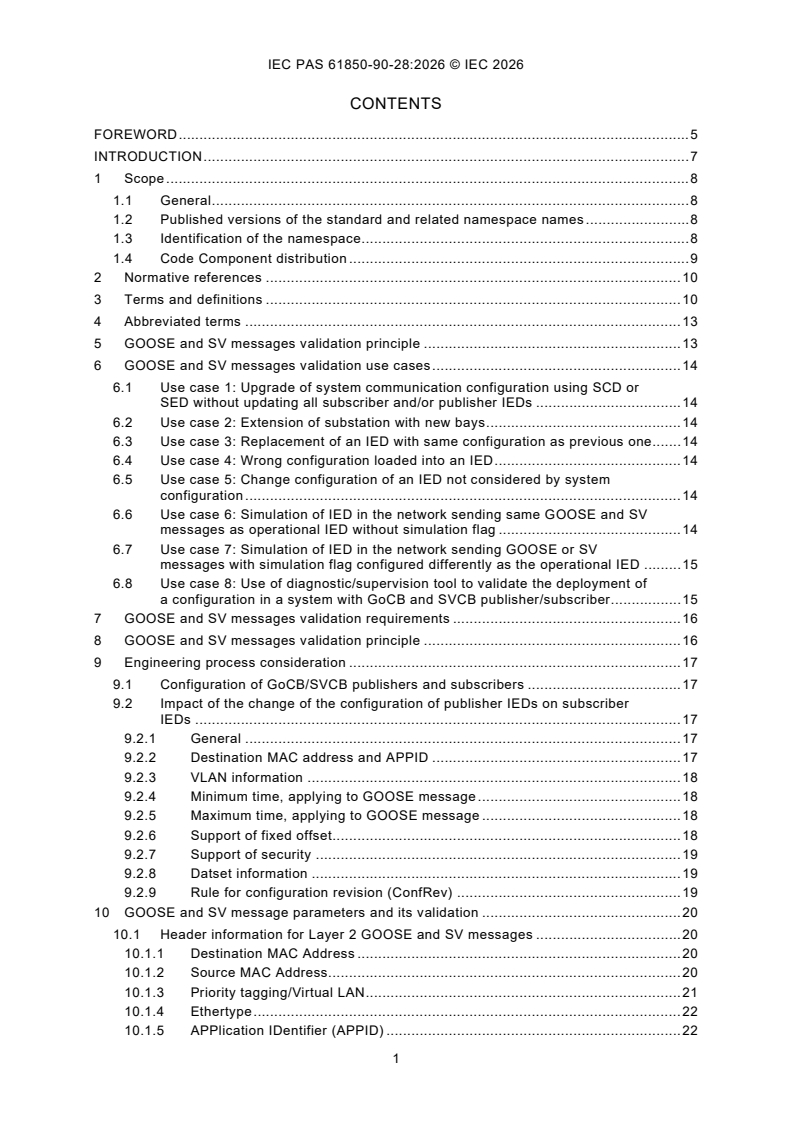
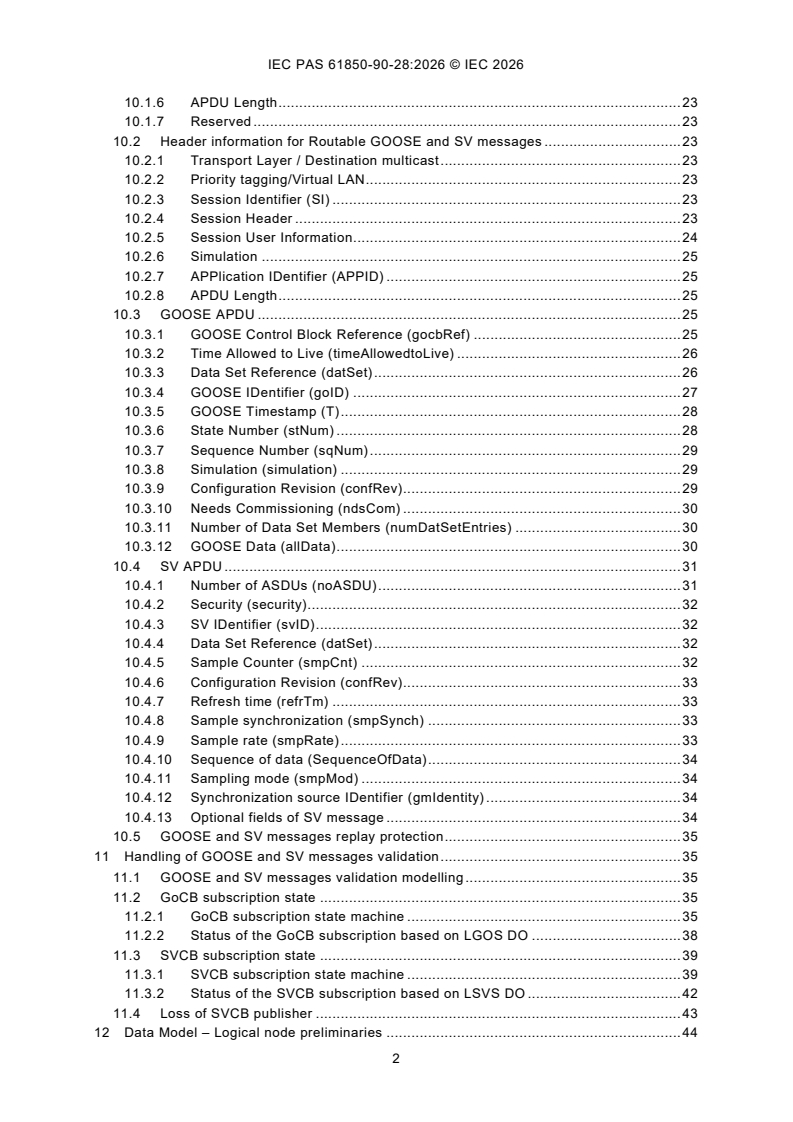
Contents
- 1 Scope
- 1.1 General
- 1.2 Published versions of the standard and related namespace names
- 1.3 Identification of the namespace
- 1.4 Code Component distribution
- 2 Normative references
- 3 Terms and definitions
- 3.1 publisher
- 3.2 subscriber
- 3.3 operational GOOSE or SV message
- 3.4 simulated GOOSE or SV message
- 3.5 duplicated GoCB/SVCB publisher
- 3.6 missing GOOSE message
- 3.7 double GOOSE message
- 3.8 out of order GOOSE message
- 3.9 no GOOSE message
- 3.10 invalid GOOSE message
- 3.11 missing SV message
- 3.12 double SV message
- 3.13 out of order SV message
- 3.14 no SV message
- 3.15 invalid SV message
- 3.16 message filtering
- 4 Abbreviated terms
- 5 GOOSE and SV messages validation principle
- 6 GOOSE and SV messages validation use cases
- 6.1 Use case 1: Upgrade of system communication configuration using SCD or SED
- 6.2 Use case 2: Extension of substation with new bays
- 6.3 Use case 3: Replacement of an IED with same configuration as previous one
- 6.4 Use case 4: Wrong configuration loaded into an IED
- 6.5 Use case 5: Change configuration of an IED not considered by system
- 6.6 Use case 6: Simulation of IED in the network sending same GOOSE and SV
- 6.7 Use case 7: Simulation of IED in the network sending GOOSE or SV messages
- 6.8 Use case 8: Use of diagnostic/supervision tool to validate the deployment of a
- 7 GOOSE and SV messages validation requirements
- 8 GOOSE and SV messages validation principle
- 9 Engineering process consideration
- 9.1 Configuration of GoCB/SVCB publishers and subscribers
- 9.2 Impact of the change of the configuration of publisher IEDs on subscriber IEDs
- 10 GOOSE and SV message parameters and its validation
- 10.1 Header information for Layer 2 GOOSE and SV messages
- 10.2 Header information for Routable GOOSE and SV messages
- 10.3 GOOSE APDU
- 10.4 SV APDU
- 10.5 GOOSE and SV messages replay protection
- 11 Handling of GOOSE and SV messages validation
- 11.1 GOOSE and SV messages validation modelling
- 11.2 GoCB subscription state
- 11.3 SVCB subscription state
- 11.4 Loss of SVCB publisher
- 12 Data Model – Logical node preliminaries
- 12.1 Logical node classes (LogicalNodes_90_28)
- 12.2 Data object name semantics and enumerations
- 13 PIXIT entries
- 13.1 General
- 13.2 PIXIT entries required for GOOSE message validation
- 13.3 PIXIT entries required for SV message validation
- Annex A
- Annex B
- Annex C
- Annex D
- Bibliography
INTRODUCTION GOOSE and SV messages carry critical data as measurements, trip signals, blocking signals, etc. which are exchanged between IEDs. Those messages could cause a mis-operation if they are processed when they should not be. Therefore, it becomes critical to make validation of those messages more resilient to ensure that data forwarded to the application are the expected ones.
Each vendor implements validation on different parameters of the GOOSE and SV messages. Therefore validation has to be harmonized. In addition, this will make commissioning easier. Issues caused by the engineering process or human error during operation is expected to be detected by subscriber IED.
Efficient filtering of messages is expected to be implemented to achieve expected timing performance.
IEDs must notify the user of any identified issues so they can be validated by testing. The aim of this Publicly Available Specification is to provide new requirements related to validation of GOOSE and SV messages for the IEC 61850 series:
- Part 6 for configuration description,
- Part 7-x for data model and abstract services,
- Part 8-1 and part 9-2 for specific communication service mappings,
- Part 10 for conformance testing Once this document has been published, the affected parts of the core standards will be updated with the results from this specification.
As it contains some description of the different parameters of the GOOSE and SV messages and some recommendations, this document could be used as a guideline for implementation too.
This document focuses on the validation and supervision of GOOSE and SV messages.
1 Scope
1.1 General
This of the IEC 61850 series, which is a Publicly Available Specification, specifies the expected behavior and associated documentation related to the validation of received GOOSE and SV messages. It considers engineering rules and guidance to ensure that the communication configuration process is well designed for this validation. Conformance statements related to this validation are also considered.
This document considers subscribers claiming conformance to latest editions of the IEC 61850 series in combination with publishers claiming conformance to any previous version and revision of the IEC 61850 series.
1.2 Published versions of the standard and related namespace names
Table 1 shows all tracking information of (Tr)IEC 61850-90-28:2024A namespace building-up. Table 1 – Tracking information of (Tr)IEC 61850-90-28:2024A namespace building-up Attribute Content Namespace IEC specific information Version of the UML model used for generating the document (informative) WG10build26 Date of the UML model used for generating the document (informative) 2026-08-05 Autogeneration software name and version(informative) j61850DocBuilder 02.06bbeta based on jCleanCim beta9.4 (derived from jCleanCim 02-02)
Table 2 provides a reference between all published editions, amendments or corrigenda of this document and the full name of the namespace.
Table 2 – Published version Edition Publication date Webstore Namespace Edition 1.0 2025-xx IEC PAS 61850-90-28:2025 (Tr)IEC 61850-90-28:2024
1.3 Identification of the namespace
The namespace associated with this document is an NSD (Namespace Definition) file as defined in IEC 61850-7-7.
NOTE The NSD files are distributed as a Full (complete machine-readable file) Code Component and as a Light (reduced machine-readable content version) Code Component.
Table 3 shows all attributes of (Tr)IEC 61850-90-28:2024A namespace.
Table 3 – Attributes of (Tr)IEC 61850-90-28:2024A namespace Attribute Content Namespace nameplate Namespace Identifier (Tr)IEC 61850-90-28 Version 2024 Revision A Release 2 Full Namespace Name (Tr)IEC 61850-90-28:2024A Full Code Component Name IEC_PAS_61850-90-28.NSD.2024A2.Full Light Code Component Name IEC_PAS_61850-90-28.NSD.2024A2.Light Namespace type transitional Namespace dependencies extends IEC 61850-7-4 version:2007 revision: B Namespace transitional status Future handling of namespace content The namespace (Tr)IEC 61850-90-28:2024A is considered as "transitional" since the models are expected to be included in further editions of IEC 61850. Extensions or modifications to the model may occur when the model is merged into the International Standard documents
1.4 Code Component distribution
Each Code Component is a ZIP package containing the electronic representation of the Code Component itself, with a file describing the content of the package (IECManifest.xml). The life cycle of a code component is not restricted to the life cycle of the related publication. The publication life cycle goes through two stages, Version (corresponding to an edition) and Revision (corresponding to an amendment). A third publication stage (Release) allows publication of Code Component in case of urgent fixes of InterOp Tissues, thus without need to publish an amendment.
Consequently new release(s) of the Code Component may be released, which supersede(s) the previous release, and will be distributed through the IEC TC 57 web site at:
http://www.iec.ch/tc57/supportdocuments.
The latest version/release of the document will be found by selecting the file for the code component with the highest value for VersionStateInfo e.g.
IEC_PAS_61850-90-28.NSD.{VersionStateInfo}.Light.{Light | Full}.zip. For conformance testing, implementations should always use the latest downloadable Code Components, as the Code Components may be subject to updates. See technical corrigenda and XSD history files.
When the Code Components associated with this document have a full version and a light version, the light version is freely accessible.
When the Code Components associated with this document have a full version only, the full version is freely accessible.
The freely accessible Code Components are available on the IEC website for download at https://www.iec.ch/tc57/supportdocuments, but the usage remains under the licensing conditions.
2 Normative references
The following documents, in whole or in part, are normative reference for this document and required for its application. For dated references, only the edition cited applies. For undated references, the latest edition of the referenced document (including any amendments) applies. IEC 61850-6, Communication networks and systems for power utility automation - Part 6:
Configuration description language for communication in electrical substations related to IEDs IEC 61850-7-1:2011, Communication networks and systems for power utility automation - Part 7-1: Basic communication structure - Principles and models IEC 61850-7-1:2011/AMD1:2020 IEC 61850-7-2:2010, Communication networks and systems for power utility automation - Part 7-2: Basic information and communication structure - Abstract communication service interface (ACSI) IEC 61850-7-2:2010/AMD1:2020 IEC 61850-7-3, Communication networks and systems for power utility automation - Part 7-3:
Basic communication structure - Common data classes IEC 61850-7-4, Communication networks and systems for power utility automation - Part 7-4:
Basic communication structure - Compatible logical node classes and data object classes IEC 61850-8-1:2011, Communication networks and systems for power utility automation - Part 8-1: Specific communication service mapping (SCSM) - Mappings to MMS (ISO 9506-1 and ISO 9506-2) and to ISO/IEC 8802-3 IEC 61850-8-1:2011/AMD1:2020 IEC 61850-9-2, Communication networks and systems for power utility automation - Part 9-2:
Specific communication service mapping (SCSM) - Sampled values over ISO/IEC 8802-3 IEC 61850-10, Communication networks and systems for power utility automation - Part 10:
Conformance testing IEC 62351-6:2020, Power systems management and associated information exchange - Data and communications security - Part 6: Security for IEC 61850
3 Terms and definitions
For the purpose of this document, the following terms and definitions apply. ISO and IEC maintain terminological databases for use in standardization at the following addresses:
- IEC Electropedia: available at http://www.electropedia.org/
- ISO Online browsing platform: available at http://www.iso.org/obp
3.1 publisher
entity that sends messages without considering and being aware of the subscriber(s) of this message
3.2 subscriber
entity that receives and accepts expected messages being aware of the publisher configuration of this message
3.3 operational GOOSE or SV message
GOOSE or SV message published by an IED in a usual context Note 1 to entry: This is the default kind of GOOSE and SV message.
3.4 simulated GOOSE or SV message
GOOSE or SV message published by a test entity to be used by subscriber operating in simulation mode instead of operational GOOSE or SV message Note 1 to entry: This message has to be distinct from operational message. To achieve that, it contains a simulation property in the message. Simulated GOOSE and SV messages are used in a non-operational context.
3.5 duplicated GoCB/SVCB publisher
GoCB or SVCB publisher which publishes duplicated GOOSE or SV messages with different source MAC Address
3.6 missing GOOSE message
GOOSE message which has not been received whereas subscription is active Note 1 to entry: It could be detected because it leads to a jump in the expected sequence of the subscriber. For example, latest received stNum is 'n' and latest received SqNum is 'm':
- subscriber receives stNum 'n'+1 and sqNum '1' OR
- subscriber receives stNum 'n'+2 and sqNum '0' OR
- subscriber receives stNum 'n' and sqNum 'm' + 2 … In case of missing GOOSE message, GoCB subscription shall remain active because GOOSE message is received before expiration timer.
3.7 double GOOSE message
two GOOSE messages which are identical, i.e. same header, same value of the simulation flag, same stNum and same sqNum Note 1 to entry: This issue could happen due to the network.
It could be detected if two consecutive GOOSE messages are received with the same state number and sequence number. In case of detection of double GOOSE messages, the second received GOOSE message shall be discarded but GoCB subscription shall remain active.
3.8 out of order GOOSE message
GOOSE message which is received out of the expected sequence Note 1 to entry: It could be detected because it leads to receive a GOOSE message out of acceptance window of the subscriber regarding stNum and sqNum.
For example, latest received stNum is 'n' and latest received SqNum is 'm':
- subscriber receives stNum 'n' and sqNum 'm-1' OR
- subscriber receives stNum 'n-1' and sqNum 'any' OR
- subscriber receives stNum 'n+5' and sqNum 'm' + 2 … In case of out of order GOOSE message, GOOSE message is accepted or not depending on acceptance window. GoCB subscription remains active until it leads to expiration timer.
3.9 no GOOSE message
situation where no GOOSE message is received at the startup of the subscription or at the end of the expiration timer Note 1 to entry: In case of no GOOSE message, GoCB subscription is inactive.
3.10 invalid GOOSE message
GOOSE message which corresponds to a configured GoCB subscription but has a wrong configuration or contains an error in the message Note 1 to entry: In case of invalid GOOSE message, GOOSE message shall be rejected and GoCB subscription remains in its current state.
3.11 missing SV message
SV message which is not received by the subscriber Note 1 to entry: It could be detected because it leads to a jump of smpCnt in the expected sequence of the subscriber whereas smpSynch does not change.
For example, latest received smpCnt is 'n' and smpSynch is 'm':
- subscriber receives smpCnt 'n'+x and smpSynch is 'm'.
In case of missing SV, SVCB subscription shall remain active because SV is received before expiration timer.
3.12 double SV message
two SV messages which are received with the same configuration, the same value of the simulation flag, the same smpCnt and the same smpSynch Note 1 to entry: This issue could happen due to the network.
It could be detected if two consecutive SV messages are received with the same sample counter and sample synchronization state. In case of detection of double SV messages, the second received SV message shall be discarded but SVCB subscription shall remain active.
3.13 out of order SV message
SV message which is received out of the expected sequence of smpCnt while the smpSynch and gmIdentity values remain unchanged Note 1 to entry: It could be detected because it leads to a discontinuity in the sequence of smpCnt. For example, latest received smpCnt is 'n', and smpSynch value is 1 or 2:
- subscriber receives smpCnt 'n-7' and same smpSynch and gmIdentity if relevant, OR
- subscriber receives smpCnt 'n+5' and same smpSynch and same gmIdentity if relevant. In case of out-of-order SV message, SV message is accepted or not depending on the acceptance window. The SVCB subscription remains active until it leads to an expiration timer.
3.14 no SV message
situation where no SV message is received at the startup of the subscription or at the end of the loss of SVCB publisher Note 1 to entry: In case of no SV message, SVCB subscription is inactive.
3.15 invalid SV message
SV message which corresponds to a configured SVCB subscription but has a wrong configuration or contains an error in the message Note 1 to entry: In case of invalid SV message, SV message shall be rejected and SVCB subscription remains in its current state.
3.16 message filtering
way for an IED to efficiently discard messages that do not correspond to an expected subscription
4 Abbreviated terms
APDU application protocol data unit DMAC destination MAC address GoCB GOOSE control block GOOSE generic object oriented substation events IED intelligent electronic device MAC Media Access Control MMS manufacturing message specification (ISO 9506) PICS protocol implementation conformance statement PIXIT protocol implementation extra information for testing SCL system configuration language (IEC 61850-6) SCD system configuration description SCT system configurator tool SED system exchange description SV sampled value SVCB sampled value control block TAL time allowed to live
5 GOOSE and SV messages validation principle
Validation of GOOSE and SV messages is essential:
- to avoid any function maloperation - to have a performant system - to detect and inform on any configuration issue GOOSE and SV messages subscription validation requires that - publisher IEDs shall be conformance tested, and - engineering tools used in the configuration workflow shall be conformance tested This document considers - subscriber IEDs and configuration tools claiming conformance to the latest editions of the IEC 61850 series, and - any publisher IEDs claiming conformance to any existing version of the IEC 61850 series NOTE There is no way for subscriber IEDs to identify the edition/revision of publisher IEDs from received GOOSE and SV messages. However, no specific implementation is required on the subscriber IED regarding the edition /revision of the publisher IED.
6 GOOSE and SV messages validation use cases
6.1 Use case 1: Upgrade of system communication configuration using SCD or SED
without updating all subscriber and/or publisher IEDs It may happen when:
- Last minute change has been applied in part of the system configuration
- Upgraded SCD has not been successfully applied by ICTs associated to the IEDs which configuration (publisher or subscriber) has been modified during the upgrade
6.2 Use case 2: Extension of substation with new bays
It may happen when:
- Adding new publisher IED to an existing subscriber
- Changing existing data set
- Adding new data member to GOOSE and SV data set
6.3 Use case 3: Replacement of an IED with same configuration as previous one
It may happen when:
- IED name is not changed
6.4 Use case 4: Wrong configuration loaded into an IED
It may happen when:
- Old configuration version is used in an IED
- Configuration of another IED is used. In that case, IED may duplicate multicast telegrams on the network. In addition, it may create IP communication problems due to multiple IEDs having same communication configuration This may result in unwanted behavior in subscriber IED if GOOSE or SV message is considered from wrong configured IED instead of expected IED.
Therefore, it is recommended to detect duplicated GoCB/SVCB publishers.
6.5 Use case 5: Change configuration of an IED not considered by system
configuration It may happen when:
- Configuration of publisher IED is changed from ICT without providing updated IID to SCT This may result in unwanted behavior in subscriber IED if unexpected data is considered by the application.
Therefore, it is recommended to use a system configuration tool for the configuration of GoCB and SVCB publisher and subscribers.
6.6 Use case 6: Simulation of IED in the network sending same GOOSE and SV
messages as operational IED without simulation flag It may happen that the IED used for simulation sends GOOSE or SV messages without simulation flag whereas it was expected to send them with simulation flag.
That would lead to:
- Subscriber IEDs in simulation inactive may receive duplicated GOOSE or SV messages, one from operational IED and another from simulated IED
- Subscriber IEDs in simulation active may receive duplicated GOOSE or SV messages, one from operational IED and another from simulated IED This may result in unwanted behavior in subscriber IED if GOOSE or SV message is considered from simulated IED instead of expected operational IED.
Therefore, it is recommended to detect duplicated GoCB and SVCB publisher.
6.7 Use case 7: Simulation of IED in the network sending GOOSE or SV messages
with simulation flag configured differently as the operational IED - Subscriber IEDs in simulation active receive wrong GOOSE or SV messages In that case, subscriber IED switches to simulated GOOSE or SV message, LGOS/LSVS.SimSt becomes true. However, LGOS/LSVS.St is FALSE to indicate that subscription is not active. User may be informed about the configuration issue.
6.8 Use case 8: Use of diagnostic/supervision tool to validate the deployment of a
configuration in a system with GoCB and SVCB publisher/subscriber A diagnostic/supervision tool can be used to verify that:
- The configuration used by the GoCB, respectively SVCB publisher
- The configuration expected by the GoCB, respectively SVCB subscribers match the configuration exposed in the deployed SCD file.
Steps:
...