

IEC TR 61850-90-13:2021
(Main)Communication networks and systems for power utility automation - Part 90-13: Deterministic networking technologies
General Information
- Abstract
IEC TR 61850-90-13:2021(E), which is a Technical Report, provides information, use cases, and guidance on whether and how to use deterministic networking technologies. Furthermore, this document comprises technology descriptions, provides guidance how to achieve compatibility and interoperability with existing technologies, and lays out migration paths. It will separate the problem statement from the possible solutions.
- Status
- Published
- Publication Date
- 02-Feb-2021
- Technical Committee
- TC 57 - Power systems management and associated information exchange
- Current Stage
- PPUB - Publication issued
- Start Date
- 03-Feb-2021
- Completion Date
- 01-Feb-2021
Overview - IEC TR 61850-90-13:2021 (Deterministic networking technologies)
IEC TR 61850-90-13:2021 is a Technical Report in the IEC 61850 series that explains deterministic networking for power utility automation. Rather than imposing mandatory rules, it provides information, use cases and guidance on whether and how to apply deterministic technologies (for example TSN, HSR, DetNet) to achieve predictable latency and jitter, interoperability with existing systems, and practical migration paths from today’s architectures.
Key topics and technical coverage
- Characteristics of determinism - definitions and treatment of deterministic latency and jitter and their impact on protection and control.
- Problem statement vs solutions - clear separation of current networking limitations and how deterministic networking can address them.
- Technology descriptions - coverage of deterministic HSR, IEEE 802.1 Time-Sensitive Networking (TSN), IETF DetNet and other relevant technologies.
- Support for IEC 61850 use cases - guidance for station bus, process bus, WAN-based protection/control, DER integration and multi-service networks.
- Design considerations - traffic patterns, time synchronization, QoS, classification, high-availability and redundancy strategies.
- Co-existence and interoperability - how deterministic networking can interwork with PRP/HSR, MPLS/IP/MPLS-TP, and with emerging approaches like SDN/NFV.
- Migration and brownfield options - practical transition paths, backward compatibility issues, and impacts on IED hardware, network tools and applications.
- Impact analysis - implications for application operation, IED changes and standard harmonization within IEC 61850 family.
Practical applications and intended users
IEC TR 61850-90-13 is especially relevant for:
- Utility network architects and substation engineers planning low-latency, high-reliability LANs and WANs.
- Protection and control engineers evaluating deterministic guarantees for fast tripping and distributed control loops.
- System integrators and equipment vendors designing TSN/HSR-capable switches, IEDs and migration solutions.
- Standards professionals and planners coordinating interoperability and harmonization across IEC 61850 profiles.
Typical applications include substation station and process buses, wide-area tele-protection, DER control, microgrids, and multi-service utility networks that require bounded latency and low jitter.
Related standards and references
- IEC 61850 family (e.g., IEC 61850-5, -9-2, IEC/IEEE 61850-9-3)
- Other IEC TRs in the 90-x series (90-1, 90-2, 90-4, 90-12)
- IEEE 802.1 TSN, IEC/IEEE 60802 profile, IETF DetNet, PRP/HSR and MPLS/IP/MPLS-TP
IEC TR 61850-90-13 is a practical, non-normative resource to evaluate deterministic networking options, helping utilities and suppliers plan interoperable, future-proof automation networks.
Get Certified
Connect with accredited certification bodies for this standard

ANCE
Mexican certification and testing association.

Intertek Slovenia
Intertek testing, inspection, and certification services in Slovenia.

LNE (Laboratoire National de Métrologie et d'Essais)
French national laboratory for metrology and testing.
Sponsored listings
Frequently Asked Questions
IEC TR 61850-90-13:2021 is a technical report published by the International Electrotechnical Commission (IEC). Its full title is "Communication networks and systems for power utility automation - Part 90-13: Deterministic networking technologies". This standard covers: IEC TR 61850-90-13:2021(E), which is a Technical Report, provides information, use cases, and guidance on whether and how to use deterministic networking technologies. Furthermore, this document comprises technology descriptions, provides guidance how to achieve compatibility and interoperability with existing technologies, and lays out migration paths. It will separate the problem statement from the possible solutions.
IEC TR 61850-90-13:2021(E), which is a Technical Report, provides information, use cases, and guidance on whether and how to use deterministic networking technologies. Furthermore, this document comprises technology descriptions, provides guidance how to achieve compatibility and interoperability with existing technologies, and lays out migration paths. It will separate the problem statement from the possible solutions.
IEC TR 61850-90-13:2021 is classified under the following ICS (International Classification for Standards) categories: 33.200 - Telecontrol. Telemetering. The ICS classification helps identify the subject area and facilitates finding related standards.
IEC TR 61850-90-13:2021 is available in PDF format for immediate download after purchase. The document can be added to your cart and obtained through the secure checkout process. Digital delivery ensures instant access to the complete standard document.
Standards Content (Sample)
IEC TR 61850-90-13 ®
Edition 1.0 2021-02
TECHNICAL
REPORT
colour
inside
Communication networks and systems for power utility automation –
Part 90-13: Deterministic networking technologies
All rights reserved. Unless otherwise specified, no part of this publication may be reproduced or utilized in any form
or by any means, electronic or mechanical, including photocopying and microfilm, without permission in writing from
either IEC or IEC's member National Committee in the country of the requester. If you have any questions about IEC
copyright or have an enquiry about obtaining additional rights to this publication, please contact the address below or
your local IEC member National Committee for further information.
IEC Central Office Tel.: +41 22 919 02 11
3, rue de Varembé info@iec.ch
CH-1211 Geneva 20 www.iec.ch
Switzerland
About the IEC
The International Electrotechnical Commission (IEC) is the leading global organization that prepares and publishes
International Standards for all electrical, electronic and related technologies.
About IEC publications
The technical content of IEC publications is kept under constant review by the IEC. Please make sure that you have the
latest edition, a corrigendum or an amendment might have been published.
IEC publications search - webstore.iec.ch/advsearchform IEC online collection - oc.iec.ch
The advanced search enables to find IEC publications by a Discover our powerful search engine and read freely all the
variety of criteria (reference number, text, technical publications previews. With a subscription you will always have
committee, …). It also gives information on projects, replaced access to up to date content tailored to your needs.
and withdrawn publications.
Electropedia - www.electropedia.org
IEC Just Published - webstore.iec.ch/justpublished
The world's leading online dictionary on electrotechnology,
Stay up to date on all new IEC publications. Just Published
containing more than 22 000 terminological entries in English
details all new publications released. Available online and once
and French, with equivalent terms in 18 additional languages.
a month by email.
Also known as the International Electrotechnical Vocabulary
(IEV) online.
IEC Customer Service Centre - webstore.iec.ch/csc
If you wish to give us your feedback on this publication or need
further assistance, please contact the Customer Service
Centre: sales@iec.ch.
IEC TR 61850-90-13 ®
Edition 1.0 2021-02
TECHNICAL
REPORT
colour
inside
Communication networks and systems for power utility automation –
Part 90-13: Deterministic networking technologies
INTERNATIONAL
ELECTROTECHNICAL
COMMISSION
ICS 33.200 ISBN 978-2-8322-9283-9
– 2 – IEC TR 61850-90-13:2021 © IEC:2021
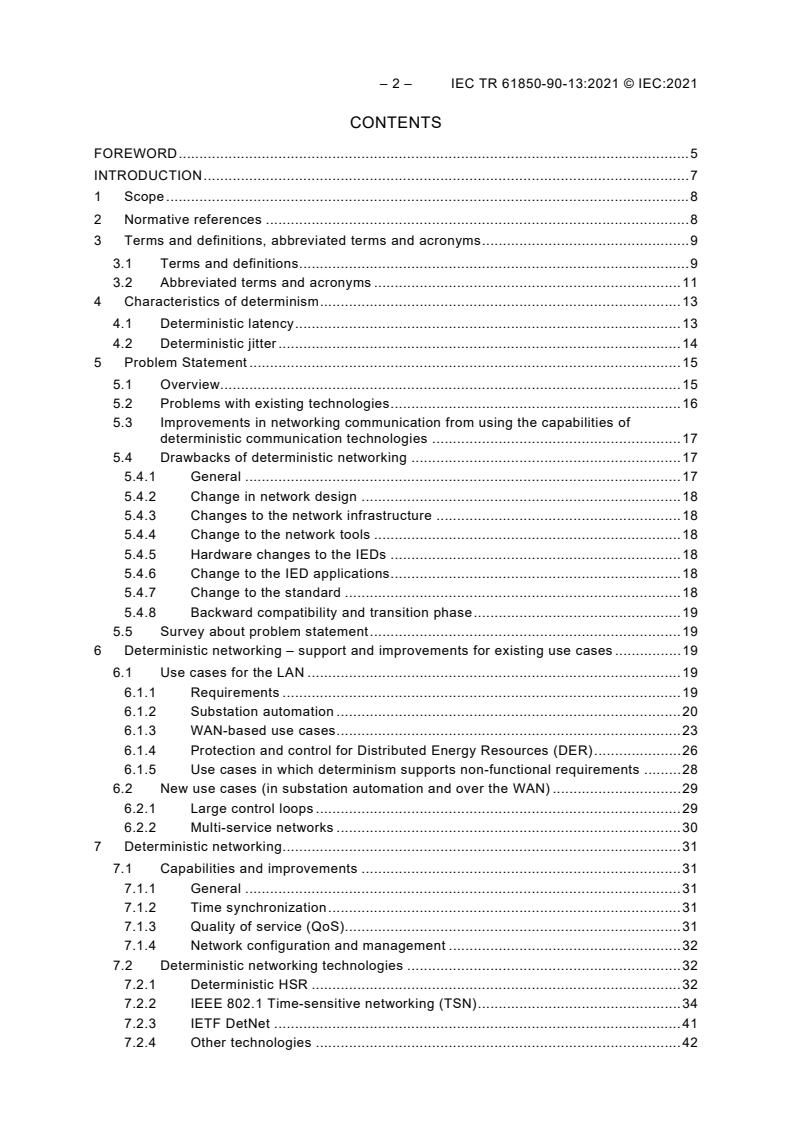
CONTENTS
FOREWORD . 5
INTRODUCTION . 7
1 Scope . 8
2 Normative references . 8
3 Terms and definitions, abbreviated terms and acronyms . 9
3.1 Terms and definitions . 9
3.2 Abbreviated terms and acronyms . 11
4 Characteristics of determinism . 13
4.1 Deterministic latency . 13
4.2 Deterministic jitter . 14
5 Problem Statement . 15
5.1 Overview. 15
5.2 Problems with existing technologies . 16
5.3 Improvements in networking communication from using the capabilities of
deterministic communication technologies . 17
5.4 Drawbacks of deterministic networking . 17
5.4.1 General . 17
5.4.2 Change in network design . 18
5.4.3 Changes to the network infrastructure . 18
5.4.4 Change to the network tools . 18
5.4.5 Hardware changes to the IEDs . 18
5.4.6 Change to the IED applications . 18
5.4.7 Change to the standard . 18
5.4.8 Backward compatibility and transition phase . 19
5.5 Survey about problem statement . 19
6 Deterministic networking – support and improvements for existing use cases . 19
6.1 Use cases for the LAN . 19
6.1.1 Requirements . 19
6.1.2 Substation automation . 20
6.1.3 WAN-based use cases . 23
6.1.4 Protection and control for Distributed Energy Resources (DER) . 26
6.1.5 Use cases in which determinism supports non-functional requirements . 28
6.2 New use cases (in substation automation and over the WAN) . 29
6.2.1 Large control loops . 29
6.2.2 Multi-service networks . 30
7 Deterministic networking . 31
7.1 Capabilities and improvements . 31
7.1.1 General . 31
7.1.2 Time synchronization . 31
7.1.3 Quality of service (QoS). 31
7.1.4 Network configuration and management . 32
7.2 Deterministic networking technologies . 32
7.2.1 Deterministic HSR . 32
7.2.2 IEEE 802.1 Time-sensitive networking (TSN) . 34
7.2.3 IETF DetNet . 41
7.2.4 Other technologies . 42
8 Co-existence and interoperability with existing and emerging technologies (and
how to address technology changes) . 47
8.1 Relation of TSN to technologies such as SDN (Software Defined Networking)
and NFV (Network Function Virtualization) . 47
8.2 Relation and interoperability to existing architectures for high-availability and
redundancy based on PRP/HSR . 48
8.3 Relation and interoperability to existing WAN-architectures based on MPLS
(IP/MPLS, MPLS-TP) . 48
8.4 Brownfield deployment options . 48
8.5 Migration path . 49
9 Design consideration for a future utility profile using deterministic networking
technologies . 50
9.1 IEC 61850 traffic patterns and protocols . 50
9.2 Non-IEC 61850 traffic patterns and protocols . 52
9.3 High-availability and reliability . 53
9.4 Deterministic traffic classification . 53
9.5 Conceptual model . 53
9.5.1 General . 53
9.5.2 Utility profile considerations using 802.1 TSN technologies . 54
9.5.3 Specific IEEE 802.1Q-2018 clauses and related amendments . 54
9.5.4 Time synchronization . 54
10 Harmonization of deterministic networking requirements. 54
10.1 IEC 61850-5 . 54
10.2 IEC 61850-9-2 . 54
10.3 IEC/IEEE 61850-9-3 . 54
10.4 IEC TR 61850-90-1 . 55
10.5 IEC/TR 61850-90-2 . 55
10.6 IEC TR 61850-90-4 . 55
10.7 IEC TR 61850-90-12 . 55
11 Impact on application operation . 55
11.1 Scope and dependencies . 55
11.2 Impact on existing applications . 56
11.3 Impact for new applications and application evolution . 56
Annex A (informative) Related work and liaisons . 57
A.1 IEC/IEEE 60802 TSN-Profile for industrial automation . 57
A.2 IEEE 802.24.1 Smart Grid TG . 58
A.3 IEC SEG8 . 58
A.4 Power utility automation and control applications using 5G technology . 58
Bibliography . 59
Figure 1 – Delay probability for hard- and soft-real-time system . 14
Figure 2 – Low jitter – jitter deterministic delay . 15
Figure 3 – Substation station bus, process bus and traffic example
(IEC TR 61850‑90‑4, Figure 11) . 20
Figure 4 – Substation with Deterministic Ethernet . 21
Figure 5 – Current differential tele-protection system (IEC TR 61850‑90‑12:2015) . 24
Figure 6 – Microgrid with renewable generation, storage and grid infeed . 26
Figure 7 – Multi-Service Networks. 30
– 4 – IEC TR 61850-90-13:2021 © IEC:2021
Figure 8 – Precise sending in HSR . 33
Figure 9 – TSN Components . 34
Figure 10 – Fully Distributed Model . 38
Figure 11 – Hybrid Model . 39
Figure 12 – Central Model . 40
Figure 13 – Topology of a WAN network using VSN . 44
Figure 14 – Frame Structure . 45
Figure 15 – Mapping data in a single EtherCAT DLPDU . 46
Figure 16 – Brownfield configuration options . 49
Figure 17 – GOOSE protocol time/space chart (Source IEC TR 61850-90-4) . 52
Table 1 – Transfer time requirements of IEC 61850-5 . 19
Table 2 – Station bus communication specifics in today's substations and possible
benefits / improvements with TSN . 23
Table 3 – Process bus communication specifics in today's substations and possible
benefits / improvements with TSN . 23
Table 4 – Latency requirements for protection schemes . 25
Table 5 – IEEE 802.1 Qcc Configuration Models . 36
Table 6 – DetNet documents . 42
Table 7 – Traffic type characteristics of IEC 61850 protocols . 51
Table 8 – Traffic type characteristics of non-IEC 61850 protocols . 53
INTERNATIONAL ELECTROTECHNICAL COMMISSION
____________
COMMUNICATION NETWORKS AND
SYSTEMS FOR POWER UTILITY AUTOMATION –
Part 90-13: Deterministic networking technologies
FOREWORD
1) The International Electrotechnical Commission (IEC) is a worldwide organization for standardization comprising
all national electrotechnical committees (IEC National Committees). The object of IEC is to promote international
co-operation on all questions concerning standardization in the electrical and electronic fields. To this end and
in addition to other activities, IEC publishes International Standards, Technical Specifications, Technical Reports,
Publicly Available Specifications (PAS) and Guides (hereafter referred to as "IEC Publication(s)"). Their
preparation is entrusted to technical committees; any IEC National Committee interested in the subject dealt with
may participate in this preparatory work. International, governmental and non-governmental organizations liaising
with the IEC also participate in this preparation. IEC collaborates closely with the International Organization for
Standardization (ISO) in accordance with conditions determined by agreement between the two organizations.
2) The formal decisions or agreements of IEC on technical matters express, as nearly as possible, an international
consensus of opinion on the relevant subjects since each technical committee has representation from all
interested IEC National Committees.
3) IEC Publications have the form of recommendations for international use and are accepted by IEC National
Committees in that sense. While all reasonable efforts are made to ensure that the technical content of IEC
Publications is accurate, IEC cannot be held responsible for the way in which they are used or for any
misinterpretation by any end user.
4) In order to promote international uniformity, IEC National Committees undertake to apply IEC Publications
transparently to the maximum extent possible in their national and regional publications. Any divergence between
any IEC Publication and the corresponding national or regional publication shall be clearly indicated in the latter.
5) IEC itself does not provide any attestation of conformity. Independent certification bodies provide conformity
assessment services and, in some areas, access to IEC marks of conformity. IEC is not responsible for any
services carried out by independent certification bodies.
6) All users should ensure that they have the latest edition of this publication.
7) No liability shall attach to IEC or its directors, employees, servants or agents including individual experts and
members of its technical committees and IEC National Committees for any personal injury, property damage or
other damage of any nature whatsoever, whether direct or indirect, or for costs (including legal fees) and
expenses arising out of the publication, use of, or reliance upon, this IEC Publication or any other IEC
Publications.
8) Attention is drawn to the Normative references cited in this publication. Use of the referenced publications is
indispensable for the correct application of this publication.
9) Attention is drawn to the possibility that some of the elements of this IEC Publication may be the subject of patent
rights. IEC shall not be held responsible for identifying any or all such patent rights.
The main task of IEC technical committees is to prepare International Standards. However, a
technical committee may propose the publication of a Technical Report when it has collected
data of a different kind from that which is normally published as an International Standard, for
example "state of the art".
IEC TR 61850-90-13, which is a technical report, has been prepared by IEC technical
committee 57: Power systems management and associated information exchange.
The text of this Technical Report is based on the following documents:
Draft TR Report on voting
57/2236/DTR 57/2301/RVDTR
Full information on the voting for the approval of this Technical Report can be found in the
report on voting indicated in the above table.
– 6 – IEC TR 61850-90-13:2021 © IEC:2021
This document has been drafted in accordance with the ISO/IEC Directives, Part 2.
A list of all parts in the IEC 61850 series, published under the general title Communication
networks and systems for power utility automation, can be found on the IEC website.
The committee has decided that the contents of this document will remain unchanged until the
stability date indicated on the IEC website under "http://webstore.iec.ch" in the data related to
the specific document. At this date, the document will be
• reconfirmed,
• withdrawn,
• replaced by a revised edition, or
• amended.
IMPORTANT – The 'colour inside' logo on the cover page of this publication indicates
that it contains colours which are considered to be useful for the correct understanding
of its contents. Users should therefore print this document using a colour printer.
INTRODUCTION
Deterministic networking technologies enable applications that require bounded communication
delays regardless of network load or reconfiguration. They allow traffic of different time-
criticality to share the same physical medium. Deterministic network technologies are based on
the pre-allocation of resources using for example scheduling, traffic shaping and the pre-
emption of low priority messages to guarantee the timely delivery of high-priority traffic.
Power automation and control is an industry domain where deterministic networking is needed
to support existing use cases and applications (requiring real-time communication), and to
enable new developments. This networking is currently being provided by SDH networks or
dedicated (for protection communications) Ethernet networks; however significant drives
(economic and political) are now emerging to use "converged" Ethernet networks.
In this document the term WAN is used for the inter-substation communication networks, with
the driving force usually being the desire of a utility to use the same network infrastructure for
IT as well as for operational tasks such as inter-substation protection communications.
The term LAN is used for the intra-substation communication networks. Converged networks
are those supporting mixed traffic (e.g. process data, configuration management, voice and
video surveillance data) in the same network being used for critical power automation
applications. In the same way that using public transportation to get from A to B in a timely
(deterministic) manner requires the ability to be guaranteed a seat at a particular time, using a
communication network for the deterministic delivery of data also requires the guarantee of
access at a particular time. This document identifies, describes, and discusses the known
technologies to address this determinism issue.
Summary:
Clause 5 describes the problem (with non-deterministic networks);
Clause 6 provides use cases;
Clause 7 lists deterministic networking technologies;
Clause 8 discusses interoperability issues;
Clause 9 suggests changes to the IEC 61850 standards needed to support determinism;
Annex A lists some related works and liaisons.
– 8 – IEC TR 61850-90-13:2021 © IEC:2021
COMMUNICATION NETWORKS AND
SYSTEMS FOR POWER UTILITY AUTOMATION –
Part 90-13: Deterministic Networking Technologies
1 Scope
This part of IEC 61850, which is a Technical Report, provides information, use cases, and
guidance on whether and how to use deterministic networking technologies. Furthermore, this
document comprises technology descriptions, provides guidance how to achieve compatibility
and interoperability with existing technologies, and lays out migration paths. It will separate the
problem statement from the possible solutions.
2 Normative references
The following documents are referred to in the text in such a way that some or all of their content
constitutes requirements of this document. For dated references, only the edition cited applies.
For undated references, the latest edition of the referenced document (including any
amendments) applies.
IEC 60834-1:1999, Teleprotection equipment of power systems – Performance and testing –
Part 1: Command systems
IEC 60870-5-104:2006, Telecontrol equipment and systems – Part 5-104: Transmission
protocols – Network access for IEC 60870-5-101 using standard transport profiles
IEC/IEEE 61588:2009, Precision clock synchronization protocol for networked measurement
and control systems
IEC 61850 (all parts), Communication networks and systems for power utility automation
IEC 61850-5:2013, Communication networks and systems for power utility automation – Part 5:
Communication requirements for functions and device models
IEC 61850-6:2009, Communication networks and systems for power utility automation – Part 6:
Configuration description language for communication in electrical substations related to IEDs
IEC 61850-8-1:2011, Communication networks and systems for power utility automation –
Part 8-1: Specific communication service mapping (SCSM) – Mappings to MMS (ISO 9506-1
and ISO 9506-2) and to ISO/IEC 8802-3
IEC 61850-9-2, Communication networks and systems for power utility automation – Part 9-2:
Specific communication service mapping (SCSM) – Sampled values over ISO/IEC 8802-3
IEC/IEEE 60802, Time-sensitive networking profile for industrial automation
IEC/IEEE 61850-9-3-2016, IEC/IEEE International Standard – Communication networks and
systems for power utility automation – Part 9-3: Precision time protocol profile for power utility
automation
IEC TR 61850-90-1:2010, Communication networks and systems for power utility automation –
Part 90-1: Use of IEC 61850 for the communication between substations
IEC TR 61850-90-2:2016, Communication networks and systems for power utility automation –
Part 90-2: Using IEC 61850 for communication between substations and control centres
IEC TR 61850-90-4:2020, Communication networks and systems for power utility automation –
Part 90-4: Network engineering guidelines
IEC TR 61850-90-5:2012, Communication networks and systems for power utility automation –
Part 90-5: Use of IEC 61850 to transmit synchrophasor information according to IEEE C37.118
IEC TR 61850-90-12:2020, Communication networks and systems for power utility automation
– Part 90-12: Wide area network engineering guidelines
IEC 62351-7:2017, Power systems management and associated information exchange – Data
and communications security – Part 7: Network and System Management (NSM) data object
models
IEC 62439-3:2016, Industrial communication networks – High availability automation networks
– Part 3: Parallel Redundancy Protocol (PRP) and High-availability Seamless Redundancy
(HSR)
IEEE 802.1AS, IEEE Standard for Local and Metropolitan Area Networks – Timing and
Synchronization for Time-Sensitive Applications, available at http://www.ieee.org
IEEE 802.1Q, IEEE Standard for Local and metropolitan area networks – Bridges and Bridged
Networks; available at
IEEE 802.1Qcc-2018, IEEE Standard for Local and Metropolitan Area Networks – Bridges and
Bridged Networks – Amendment 31: Stream Reservation Protocol (SRP) Enhancements and
Performance Improvements
IEEE 802.3-2018, IEEE Standard for Ethernet
IEEE C37.94-2017, IEEE Standard for N times 64 kbps Optical Fiber Interfaces between
Teleprotection and Multiplexer Equipment
IEEE C37.118.1-2011, IEEE Standard for Synchrophasor Measurements for Power Systems
3 Terms and definitions, abbreviated terms and acronyms
3.1 Terms and definitions
For the purposes of this document, the following terms and definitions apply.
ISO and IEC maintain terminological databases for use in standardization at the following
addresses:
• IEC Electropedia: available at http://www.electropedia.org/
• ISO Online browsing platform: available at http://www.iso.org/obp
3.1.1
Centralized Network Configuration
CNC
logical component that configures network resources on behalf of TSN applications (users)
– 10 – IEC TR 61850-90-13:2021 © IEC:2021
3.1.2
Centralized User Configuration
CUC
logical component that discovers and configures application (user) resources in end stations;
the CUC exchanges information with the CNC in order to configure TSN features on behalf of
its end stations
3.1.3
convergence
heterogeneous applications running on devices connected to the same physical network (LAN,
WAN, or combination of both) which are able to exchange data, within the defined QoS
parameters derived from application requirements
3.1.4
deterministic jitter
property of a system to change its output in response to a change of its input after a guaranteed
minimum delay and before a guaranteed maximum delay, under error-free conditions
3.1.5
deterministic latency
property of a system to change its output in response to a change of its input within a guaranteed
maximum delay, under error-free conditions
3.1.6
deterministic networking
predictable network behaviour which can be characterized by bounded latency, nearly zero jitter
and extremely low data loss rates
3.1.7
DetNet
IETF Deterministic Networking (DetNet) Working Group
3.1.8
end station
device attached to a local area network (LAN) or wide area network (WAN), which acts as a
source of, and/or destination for, traffic carried on the LAN or WAN
Note 1 to entry: The term end-station is used in relation to time-sensitive networking.
3.1.9
EtherCAT
Ethernet fieldbus system according to the type 12 specifications of IEC 61158 (all parts)
3.1.10
hard real time
property of a system with a deterministic latency
3.1.11
jitter
time variation of an expected occurrence with respect to a defined period
3.1.12
Listener
end station that is the destination, the receiver of a Stream
3.1.13
Pdelay
measure of the time from when a message is transmitted from one device to when the same
part of the same message is received by the other device and vice versa as defined in
IEC/IEEE 61588 and IEEE 802.1AS-2020
3.1.14
pre-emption
suspension of the transmission of a pre-emptible frame to allow one or more express frames to
be transmitted before transmission of the pre-emptible frame is resumed
3.1.15
process data
data object containing application objects designated to be transferred cyclically or acyclically
for the purpose of processing
3.1.16
project
system part with ownership of a set of IEDs, typically those located in one substation, and
handled by one system configuration tool
3.1.17
soft real-time
property of a system whose latency is a probabilistic function with a low probability to exceed
defined upper and lower bounds under error-free conditions
3.1.18
Stream
unidirectional flow of time-sensitive application data between from one source (Talker) to one
or more destinations (Listeners)
3.1.19
Talker
end station that is the source or producer of a Stream
3.1.20
traffic shaping
queue management technique in packet-based networks to administrate data rates and
bandwidth
3.1.21
TSN
series of Ethernet standards which is developed by the Time-Sensitive Networking task group
in the scope of IEEE 802.1
3.2 Abbreviated terms and acronyms
The following abbreviated terms and acronyms apply to this document.
– 12 – IEC TR 61850-90-13:2021 © IEC:2021
ARP Address Resolution Protocol
CIP Critical Infrastructure Protection
CNC Centralized Network Configuration
CUC Centralized User Configuration
DC Distributed Clocks
DDoS Distributed Denial of Service
DoS Denial of Service
DER Distributed Energy Resources
DL- Data-link layer (as a prefix)
DLL DL-layer
DLPDU DL-protocol-data-unit
ENI EtherCAT Network Information
ESI EtherCAT Slave Information
ESP Electronic Security Perimeter
FQTSS Forwarding and Queueing for Time-Sensitive Streams
GNSS Global Navigation Satellite System
GOOSE Generic Object Oriented Substation Event
HMI Human Machine Interface
HSR High-availability Seamless Redundancy
ID Identification
IED Intelligent Electronic Device – any programmable or configurable device in
the system
IERS International Earth Rotation and Reference Systems Service
IETF Internet Engineering Task Force
IP Internet Protocol
IPv4 Internet Protocol version 4
IPv6 Internet Protocol version 6
IS-IS Intermediate System to Intermediate System
IT Information Technology
LAN Local area network
LD Logical Device (IEC 61850)
MAC Media Access Control
MPLS Multiprotocol Label Switching
MSRP Multiple Stream Registration Protocol (MSRP)
NERC North American Electric Reliability Corporation
NFV Network Function Virtualization
OSI Open System Interconnect
PDF Portable Document Format
PMU Phasor Measurement Unit
PRP Parallel Redundancy Protocol
PTP Precision Time Protocol
QoS Quality of Service
RAS Remedial Action Scheme
RSTP Rapid Spanning Tree Protocol
SA Substation Automation
SCD System Configuration Description in the sense of 61850-6. Output of a
system tool of a project to configure the IEDs belonging to the project
(imported by IED tools).
SCL Substation Configuration description Language according to IEC 61850
SDH Synchronous Digital Hierarchy
SDN Software Defined Networking
SNMP Simple Network Management Protocol
SONET Synchronous Optical NETwork
SRP Stream Reservation Protocol
SP Synchrophasor
SPS Special Protection Schemes
SS Substation System
SV Sampled Values
SW Software
TAI International Atomic Time
TDM Time-division Multiplexing
TCP Transmission Control Protocol
TP Tele-Protection
TSN Time Sensitive Networking
UDP User Datagram Protocol
UNI User Network Interface
VLAN Virtual LAN
WAN Wide area network
XML eXtensible Markup Language
YANG Yet Another Next Generation, a modeling language for network
management
NOTE Abbreviated terms used for the identification of the common data classes and as names of the attributes are
specified in the specific clauses of this document and are not repeated here.
4 Characteristics of determinism
4.1 Deterministic latency
A system with a deterministic latency is characterized by a guaranteed maximum delay between
a change at its input and the reaction at its output, under error-free conditions.
Mathematically, the input to output delay of a system with a deterministic latency presents a
probability distribution function (pdf) that has an upper bound smaller than a given deadline, in
contrast to a non-deterministic system whose delay has a low, but non-zero probability, to
exceed the deadline under error-free conditions, see Figure 1.
– 14 – IEC TR 61850-90-13:2021 © IEC:2021
Figure 1 – Delay probability for hard- and soft-real-time system
Determinism is provided under all normal operating conditions, in particular, irrespective of the
network traffic, but not in case of any hardware failure. Redundancy can provide deterministic
behaviour in spite of a limited number of hardware failures.
A deterministic delay allows in particular to detect a hardware failure in case the deadline is not
met.
The basis of determinism is the exclusive, pre-allocation of resources (bandwidth, processing
power, buffers) for a given transmitted data item. Different networking methods exist for it, in
particular cyclic polling or time-triggered protocols.
In a network, each critical data item to be transmitted is assigned a given bandwidth, a delivery
bound and a maximum production rate. The receiver of the data is informed of the age of the
received data, and can take action if the deadline is expired. The network elements also need
this information to assign the resources.
Determinism therefore requires that the resources can be allocated. For instance, if the
transmission of a critical data takes 1 microsecond (100 bits at 100 Mbit/s) on the medium and
its deadline is 1 ms, at most 1 000 such messages can be transmitted, in reality less since the
propagation time is not included and other traffic (management, etc.) may share the medium.
Data can be grouped in critical sets with the same delivery bound and production rate.
4.2 Deterministic jitter
A jitter is defined as the deviation σ with respect to a fixed, mean value. A low-jitter system
exhibits a pdf that is a small, tall pulse around a defined mean delay, with a minimum delay
greater than zero and a maximum delay, see Figure 2.
Figure 2 – Low jitter – jitter deterministic delay
To achieve such a behaviour, the mean value must be respected. This may imply delaying
purposely the output (e.g. in air traffic control or manufacturing).
Low-jitter operation requires determinism, but it does not request a jitter-free transmission, if a
global time is available.
Low-jitter is the essence of streaming video or telephone over a packet-switched network.
5 Problem Statement
5.1 Overview
Deterministic networking technologies evolve and provide means to support and improve
existing use cases as well as opportunities to foster new applications. These use cases are
typically clustered into two application domains: Substation-LAN and WAN-based.
IEC 61850-5 and IEC TR 61850-90-12 identify communication requirements between
intelligent electronic devices within plants and substations in the power system, between such
stations (e.g. between substations for line protection) and between the plant or substation and
higher-level remote operating places (e.g. network control centre) and maintenance places.
Clause 11 of IEC 61850-5:2013 defines the performance requirements related to the different
messages used in IEC 61850-based substation networks. Additional requirements for
communication between substation and substation and control centres are specified in
IEC TR 61850‑90‑12:2020, Clause 5. These messages are classified using their type and
performance requirements. They also define requirements for data and communication quality
(Data Integrity, Reliability, Availability). Finally, they cover the communication system
requirements for performance, communication redundancy, failure recovery and recovery delay.
– 16 – IEC TR 61850-90-13:2021 © IEC:2021
The performance requirements of IEC 61850-5 and the recommendations in
IEC TR 61850‑90‑12 assume transfer delay under normal conditions without disturbed
communication (IEC 61850-5:2013, 11.1.2.1). These documents do not require bounded
latency and bounded jitter explicitly. Although, some applications could benefit from bounded
latency and bounded jitter under condition such as network congestion.
Installed substation networks meet the requirements of IEC 61850-5 and operate well with
current technology. This TR addresses technology change and future needs such as migration
to packet switching technology, digitization of substation and RAS, combined with Distributed
Generation, DER, upcoming new trends in the energy markets and society, significant
emergence of software for the integrated/centralized protection and substation automation
functions and OT/IT/Telecom/Security convergence. See Clause 6 for more detailed discussion
of the typical use cases.
5.2 Problems with existing technologies
For inter-substation WANs, the protection functions used by power utilities to protect their
critical assets are mostly using TDM communication networks with deterministic channel
latencies of a few milliseconds. In order to avoid maintaining these TDM networks that are being
phased out or for other reasons, many utilities are moving to packet-based networks. When this
migration is combined with the integration of inter-substation protection and RAS functions with
the corporate needs on a common communication platform, new problems arise. For such
migrations, since the protection fault-clearing times affect a transmission power line's power-
handling rating, the replacement Ethernet channel latency shall not be higher than that of the
original TDM channel.
Actual packet switching technologies face higher challenges than TDM technologies to meet
the latency requirements of the applications (e.g. the <5 ms specified in IEC TR 61850-90-12
for current differential protection). The difficulty to predict the latencies encountered as traffic
traverses a network is the major problem (queuing latencies) especially for networks carrying
other (IT) traffic.
A more challenging problem for some utilities is a requirement that the bidirectional latencies
of channels used for current-differential be symmetric, typically with an asymmetry below 0,4ms
(or even lower according to CIGRE recommendations [1] ). This requirement is needed only for
relays without an external timing source (e.g. GNSS, PTP) [2].
For Substation-LANs,
– Integration and convergence of networks in the substation over a single infrastructure, for
all types of traffic, is a trend for some utilities. It may lead to increased network loading,
impacting the need to prioritize protection function traffic.
– Protection function traffic, especially sampled values and some mission-critical GOOSE
messages, shall be continuously prioritized over the substation telecom network, even with
traffic fluctuations.
Present grid automation communication based on packet-switched networks exhibit a traffic-
dependent, variable latency. Every increase in non-critical traffic can increase the latency of
time-critical data. This makes it difficult to add new traffic to an existing network. Present
networks have insufficient control over the traffic, therefore the network engineers overprovision
the network. A proper network design and priority planning, as well as enhanced quality of
service mechanism can limit the effects to a level which is not critical anymore for usual
applications. Simulation tools offer only a limited support. Overprovisioning of network
bandwidth is one of the techniques currently used to increase the probability of delivery of
critical traffic by preventing network congestion. The overprovisioning of network bandwidth is
not an efficient resource usage. Utilities are looking for new ways to optimize the bandwidth
usage and minimize the overdesigning of their networks.
—————————
Numbers in square brackets refer to the Bibliography.
IEC TR 61850-90-4 and IEC TR 61850-90-12 recommend the use of VLANs and QoS
mechanisms for increasing the probability of meeting the communication requirements specified
in IEC 61850-5. These mechanisms do not guarantee that these requirements will be met in
case of network congestions that may impact the transmission of critical flows.
In large substations, the number of IEDs and the necessity of doing multicast filtering make the
configuration of the network and specifically the VLANs very complex. Today system-
engineering tools can support the design and configuration of substation networks.
5.3 Improvements in networking communication from using the capabilities of
deterministic communication technologies
The upcoming trends and future evolutions are bringing new use cases and operational modes
that will change the way the substation and its functions are seeing currently. On the other
hand, the current activities on the IEC 61850 exten
...