

IEC 60364-5-52:2009
(Main)Low-voltage electrical installations - Part 5-52: Selection and erection of electrical equipment - Wiring systems
General Information
- Abstract
IEC 60364-5-52:2009 deals with the selection and erection of wiring systems. This third edition cancels and replaces the second edition, published in 2001, and constitutes a technical revision. The main changes with respect to the previous edition are as follows:
- Subclause 521.4 introduces minor changes with regard to busbar trunking systems and powertrack systems.
- Subclause 523.6 introduces minor changes with regard to the sizing of cables where harmonic currents are present.
- A new sublause 523.9 concerning single-core cables with a metallic covering has been introduced.
- Clause 525 introduces changes in the maximum value of voltage drop permitted between the origin of the consumer's installation and the equipment which should not be greater than that given in the relevant annex.
- Clause 526 introduces minor changes to electrical connections including additional exceptions for inspection of connections and additional notes.
- Clause 528 introduces additional requirements with regard to proximity of underground power and telecommunication cables.
- Clause 529 introduces minor changes to selection and erection of wiring systems in relation to maintainability, including cleaning. The contents of the corrigendum of February 2011 have been included in this copy.
- Status
- Published
- Publication Date
- 21-Nov-2024
- Technical Committee
- TC 64 - Electrical installations and protection against electric shock
- Drafting Committee
- MT 2 - TC 64/MT 2
- Current Stage
- PPUB - Publication issued
- Start Date
- 20-Oct-2009
- Completion Date
- 31-Oct-2009
Buy Documents
IEC 60364-5-52:2009+AMD1:2024 CSV - Low-voltage electrical installations - Part 5-52: Selection and erection of electrical equipment - Wiring systems Released:11/22/2024
IEC 60364-5-52:2009 - Low-voltage electrical installations - Part 5-52: Selection and erection of electrical equipment - Wiring systems Released:10/20/2009
Overview
IEC 60364-5-52:2009 (Edition 3.1, consolidated 2024) is the International Electrotechnical Commission standard for the selection and erection of wiring systems in low-voltage electrical installations. It supersedes the 2001 edition and includes technical revisions and Amendment 1 (2024). The standard provides guidance and mandatory requirements for choosing wiring systems, sizing conductors, protecting against external influences, and ensuring safe, maintainable installation practice.
Key Topics
- Types of wiring systems: busbar trunking and powertrack systems, conduit, cable ducts, trays and ladders, multi-circuit arrangements and the use of flexible cables.
- External influences: ambient temperature, moisture/humidity, corrosive environments, mechanical impact, vibration, flora/fauna, solar and seismic effects - guidance for selecting appropriate cable types and installation methods.
- Current-carrying capacity and cable sizing: rules for conductor ampacity, groups of conductors, parallel conductors and variation of installation conditions along a route. Includes treatment of harmonic currents and a new subclause on single-core cables with metallic covering.
- Voltage drop: permitted maximum voltage drop between supply origin and equipment (see Clause 525 and relevant annexes).
- Electrical connections: requirements and inspection exceptions for terminations and connections (Clause 526).
- Fire safety and maintainability: selection/erection to minimise spread of fire, sealing penetrations, and requirements related to cleaning and maintainability (Clause 527, 529).
- Proximity to other services: siting considerations for electrical, telecommunications and other utilities, including underground cable proximity (Clause 528).
- Annexes: include methods of installation, tabulated current-carrying capacities, formulae, harmonic effects, conduit selection and voltage-drop examples - practical calculation aids for design and compliance.
Applications
IEC 60364-5-52 is used by:
- Electrical designers and engineers for cable selection, routing and sizing
- Installation contractors and site electricians for compliant erection methods and terminations
- Inspection bodies and authorities for verification and acceptance testing
- Specifiers and procurement teams for writing technical requirements for wiring systems
- Facility managers and consultants concerned with maintainability, cleaning, and fire safety
Practical use cases include designing distribution circuits, specifying busbar or cable trunking, assessing voltage drop and harmonics impact, and planning underground cable routes.
Related Standards
- Part of the IEC 60364 series (low-voltage electrical installations). Consult other parts of IEC 60364 for requirements on protection, selection of equipment and verification procedures, and check national adoptions for local modifications.
Keywords: IEC 60364-5-52, wiring systems, low-voltage electrical installations, cable sizing, current-carrying capacity, voltage drop, harmonics, busbar trunking, electrical connections, maintainability.
Relations
- Effective Date
- 09-Feb-2026
- Effective Date
- 09-Feb-2026
- Effective Date
- 09-Feb-2026
- Effective Date
- 09-Feb-2026
- Effective Date
- 09-Feb-2026
- Effective Date
- 09-Feb-2026
- Effective Date
- 05-Sep-2023
- Effective Date
- 05-Sep-2023
- Effective Date
- 05-Sep-2023
Buy Documents
IEC 60364-5-52:2009+AMD1:2024 CSV - Low-voltage electrical installations - Part 5-52: Selection and erection of electrical equipment - Wiring systems Released:11/22/2024
IEC 60364-5-52:2009 - Low-voltage electrical installations - Part 5-52: Selection and erection of electrical equipment - Wiring systems Released:10/20/2009
Get Certified
Connect with accredited certification bodies for this standard

DIBt (Deutsches Institut für Bautechnik)
German Institute for Building Technology.
DIN CERTCO
DIN Group product certification.

Kiwa BDA Testing
Building and construction product certification.
Sponsored listings
Frequently Asked Questions
IEC 60364-5-52:2009 is a standard published by the International Electrotechnical Commission (IEC). Its full title is "Low-voltage electrical installations - Part 5-52: Selection and erection of electrical equipment - Wiring systems". This standard covers: IEC 60364-5-52:2009 deals with the selection and erection of wiring systems. This third edition cancels and replaces the second edition, published in 2001, and constitutes a technical revision. The main changes with respect to the previous edition are as follows: - Subclause 521.4 introduces minor changes with regard to busbar trunking systems and powertrack systems. - Subclause 523.6 introduces minor changes with regard to the sizing of cables where harmonic currents are present. - A new sublause 523.9 concerning single-core cables with a metallic covering has been introduced. - Clause 525 introduces changes in the maximum value of voltage drop permitted between the origin of the consumer's installation and the equipment which should not be greater than that given in the relevant annex. - Clause 526 introduces minor changes to electrical connections including additional exceptions for inspection of connections and additional notes. - Clause 528 introduces additional requirements with regard to proximity of underground power and telecommunication cables. - Clause 529 introduces minor changes to selection and erection of wiring systems in relation to maintainability, including cleaning. The contents of the corrigendum of February 2011 have been included in this copy.
IEC 60364-5-52:2009 deals with the selection and erection of wiring systems. This third edition cancels and replaces the second edition, published in 2001, and constitutes a technical revision. The main changes with respect to the previous edition are as follows: - Subclause 521.4 introduces minor changes with regard to busbar trunking systems and powertrack systems. - Subclause 523.6 introduces minor changes with regard to the sizing of cables where harmonic currents are present. - A new sublause 523.9 concerning single-core cables with a metallic covering has been introduced. - Clause 525 introduces changes in the maximum value of voltage drop permitted between the origin of the consumer's installation and the equipment which should not be greater than that given in the relevant annex. - Clause 526 introduces minor changes to electrical connections including additional exceptions for inspection of connections and additional notes. - Clause 528 introduces additional requirements with regard to proximity of underground power and telecommunication cables. - Clause 529 introduces minor changes to selection and erection of wiring systems in relation to maintainability, including cleaning. The contents of the corrigendum of February 2011 have been included in this copy.
IEC 60364-5-52:2009 is classified under the following ICS (International Classification for Standards) categories: 13.260 - Protection against electric shock. Live working; 91.140.50 - Electricity supply systems. The ICS classification helps identify the subject area and facilitates finding related standards.
IEC 60364-5-52:2009 has the following relationships with other standards: It is inter standard links to EN 12255-12:2024, EN 378-3:2016+A1:2020, EN 378-3:2016, EN ISO 13631:2002, EN 1473:2021, EN 378-3:2008+A1:2012, IEC 60364-5-52:2009/AMD1:2024, IEC 60364-5-52:2009/COR1:2011, IEC 60364-5-52:2001. Understanding these relationships helps ensure you are using the most current and applicable version of the standard.
IEC 60364-5-52:2009 is available in PDF format for immediate download after purchase. The document can be added to your cart and obtained through the secure checkout process. Digital delivery ensures instant access to the complete standard document.
Standards Content (Sample)
IEC 60364-5-52 ®
Edition 3.1 2024-11
CONSOLIDATED VERSION
INTERNATIONAL
STANDARD
colour
inside
Low-voltage electrical installations –
Part 5-52: Selection and erection of electrical equipment – Wiring systems
All rights reserved. Unless otherwise specified, no part of this publication may be reproduced or utilized in any form
or by any means, electronic or mechanical, including photocopying and microfilm, without permission in writing from
either IEC or IEC's member National Committee in the country of the requester. If you have any questions about IEC
copyright or have an enquiry about obtaining additional rights to this publication, please contact the address below or
your local IEC member National Committee for further information.
IEC Secretariat Tel.: +41 22 919 02 11
3, rue de Varembé info@iec.ch
CH-1211 Geneva 20 www.iec.ch
Switzerland
About the IEC
The International Electrotechnical Commission (IEC) is the leading global organization that prepares and publishes
International Standards for all electrical, electronic and related technologies.
About IEC publications
The technical content of IEC publications is kept under constant review by the IEC. Please make sure that you have the
latest edition, a corrigendum or an amendment might have been published.
IEC publications search - webstore.iec.ch/advsearchform IEC Products & Services Portal - products.iec.ch
The advanced search enables to find IEC publications by a Discover our powerful search engine and read freely all the
variety of criteria (reference number, text, technical publications previews, graphical symbols and the glossary.
committee, …). It also gives information on projects, replaced With a subscription you will always have access to up to date
and withdrawn publications. content tailored to your needs.
IEC Just Published - webstore.iec.ch/justpublished
Electropedia - www.electropedia.org
Stay up to date on all new IEC publications. Just Published
The world's leading online dictionary on electrotechnology,
details all new publications released. Available online and once
containing more than 22 500 terminological entries in English
a month by email.
and French, with equivalent terms in 25 additional languages.
Also known as the International Electrotechnical Vocabulary
IEC Customer Service Centre - webstore.iec.ch/csc
(IEV) online.
If you wish to give us your feedback on this publication or need
further assistance, please contact the Customer Service
Centre: sales@iec.ch.
IEC 60364-5-52 ®
Edition 3.1 2024-11
CONSOLIDATED VERSION
INTERNATIONAL
STANDARD
colour
inside
Low-voltage electrical installations –
Part 5-52: Selection and erection of electrical equipment – Wiring systems
INTERNATIONAL
ELECTROTECHNICAL
COMMISSION
ICS 13.260, 91.140.50 ISBN 978-2-8327-0055-6
REDLINE VERSION – 2 – IEC 60364-5-52:2009+AMD1:2024 CSV
IEC 2024
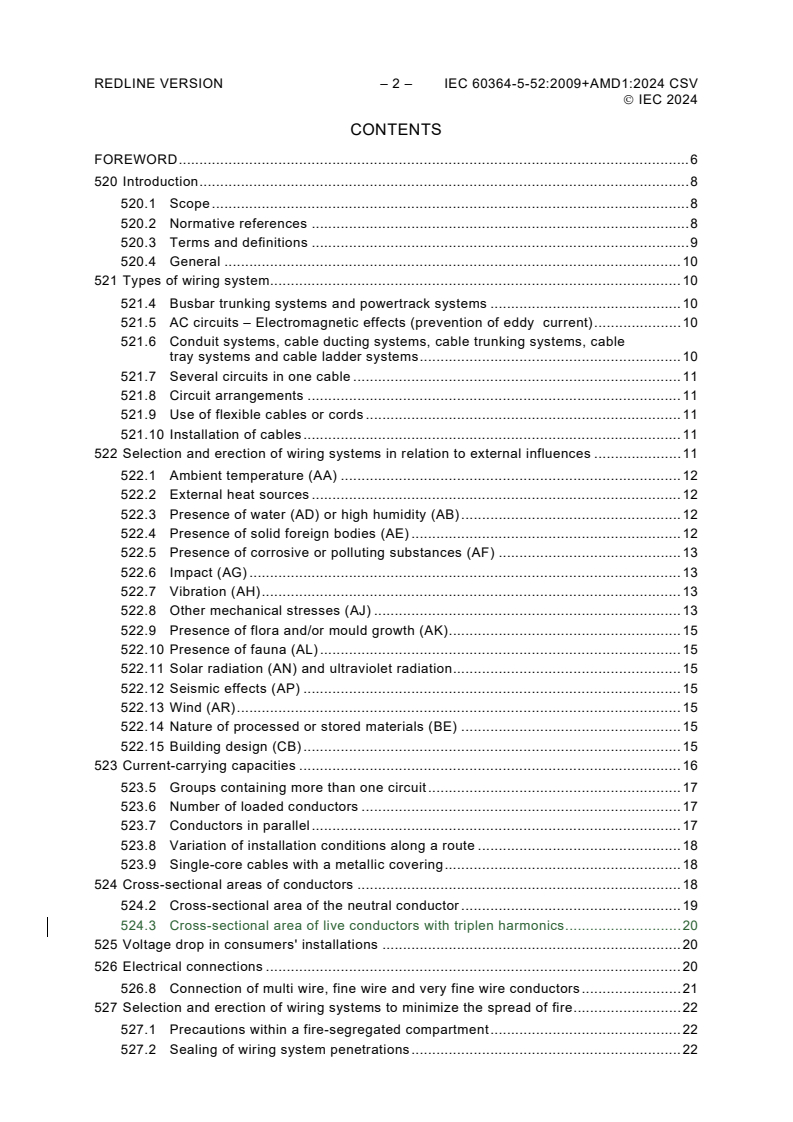
CONTENTS
FOREWORD . 6
520 Introduction . 8
520.1 Scope . 8
520.2 Normative references . 8
520.3 Terms and definitions . 9
520.4 General . 10
521 Types of wiring system. 10
521.4 Busbar trunking systems and powertrack systems . 10
521.5 AC circuits – Electromagnetic effects (prevention of eddy current) . 10
521.6 Conduit systems, cable ducting systems, cable trunking systems, cable
tray systems and cable ladder systems . 10
521.7 Several circuits in one cable . 11
521.8 Circuit arrangements . 11
521.9 Use of flexible cables or cords . 11
521.10 Installation of cables . 11
522 Selection and erection of wiring systems in relation to external influences . 11
522.1 Ambient temperature (AA) . 12
522.2 External heat sources . 12
522.3 Presence of water (AD) or high humidity (AB) . 12
522.4 Presence of solid foreign bodies (AE) . 12
522.5 Presence of corrosive or polluting substances (AF) . 13
522.6 Impact (AG) . 13
522.7 Vibration (AH) . 13
522.8 Other mechanical stresses (AJ) . 13
522.9 Presence of flora and/or mould growth (AK) . 15
522.10 Presence of fauna (AL) . 15
522.11 Solar radiation (AN) and ultraviolet radiation. 15
522.12 Seismic effects (AP) . 15
522.13 Wind (AR) . 15
522.14 Nature of processed or stored materials (BE) . 15
522.15 Building design (CB) . 15
523 Current-carrying capacities . 16
523.5 Groups containing more than one circuit . 17
523.6 Number of loaded conductors . 17
523.7 Conductors in parallel . 17
523.8 Variation of installation conditions along a route . 18
523.9 Single-core cables with a metallic covering . 18
524 Cross-sectional areas of conductors . 18
524.2 Cross-sectional area of the neutral conductor . 19
524.3 Cross-sectional area of live conductors with triplen harmonics . 20
525 Voltage drop in consumers' installations . 20
526 Electrical connections . 20
526.8 Connection of multi wire, fine wire and very fine wire conductors . 21
527 Selection and erection of wiring systems to minimize the spread of fire . 22
527.1 Precautions within a fire-segregated compartment . 22
527.2 Sealing of wiring system penetrations . 22
IEC 2024
528 Proximity of wiring systems to other services . 23
528.1 Proximity to electrical services . 23
528.2 Proximity of communications cables . 24
528.3 Proximity to non-electrical services . 24
529 Selection and erection of wiring systems in relation to maintainability, including
cleaning . 24
Annex A (normative) Methods of installations . 26
Annex B (informative) Current-carrying capacities . 35
Annex C (informative) Example of a method of simplification of the tables of
Clause 523 . 64
Annex D (informative) Formulae to express current-carrying capacities . 68
Annex E (normative) Effect of harmonic currents on balanced three-phase systems . 72
Annex F (informative) Selection of conduit systems . 78
Annex G (informative) Voltage drop in consumers’ installations . 79
Annex H (informative) Examples of configurations of parallel cables . 81
Annex I (informative) List of notes concerning certain countries . 84
Bibliography . 89
Figure H.52.1 – Special configuration for 6 parallel single-core cables in a flat plane
(see 523.7) . 81
Figure H.52.2 – Special configuration for 6 parallel single-core cables above each
other (see 523.7) . 81
Figure H.52.3 – Special configuration for 6 parallel single-core cables in trefoil (see
523.7) . 82
Figure H.52.4 – Special configuration for 9 parallel single-core cables in a flat plane
(see 523.7) . 82
Figure H.52.5 – Special configuration for 9 parallel single-core cables above each
other (see 523.7) . 82
Figure H.52.6 – Special configuration for 9 parallel single-core cables in trefoil (see
523.7) . 83
Figure H.52.7 – Special configuration for 12 parallel single-core cables in a flat plane
(see 523.7) . 83
Figure H.52.8 – Special configuration for 12 parallel single-core cables above each
other (see 523.7) . 83
Figure H.52.9 – Special configuration for 12 parallel single-core cables in trefoil (see
523.7) . 83
Table 52.1 – Maximum operating temperatures for types of insulation . 16
Table 52.2 – Minimum cross-sectional area of conductors . 19
Table A.52.1 – Methods of installation in relation to conductors and cables . 26
Table A.52.2 – Erection of wiring systems . 27
Table A.52.3 – Examples of methods of installation providing instructions for obtaining
current-carrying capacity . 28
Table B.52.1 – Installation reference methods forming basis of tabulated current-
carrying capacities . 40
Table B.52.2 – Current-carrying capacities in amperes for methods of installation in
Table B.52.1 – PVC insulation/two loaded conductors, copper or aluminium –
Conductor temperature: 70 °C, ambient temperature: 30 °C in air, 20 °C in ground . 42
REDLINE VERSION – 4 – IEC 60364-5-52:2009+AMD1:2024 CSV
IEC 2024
Table B.52.3 – Current-carrying capacities in amperes for methods of installation in
Table B.52.1 – XLPE or EPR insulation, two loaded conductors/copper or aluminium –
Conductor temperature: 90 °C, ambient temperature: 30 °C in air, 20 °C in ground . 43
Table B.52.4 – Current-carrying capacities in amperes for methods of installation in
Table B.52.1 – PVC insulation, three loaded conductors/copper or aluminium –
Conductor temperature: 70 °C, ambient temperature: 30 °C in air, 20 °C in ground . 44
Table B.52.5 – Current-carrying capacities in amperes for methods of installation in
Table B.52.1 – XLPE or EPR insulation, three loaded conductors/copper or aluminium
– Conductor temperature: 90 °C, ambient temperature: 30 °C in air, 20 °C in ground . 45
Table B.52.6 – Current-carrying capacities in amperes for installation method C of
Table B.52.1 – Mineral insulation, copper conductors and sheath – PVC covered or
bare exposed to touch (see note 2) – Metallic sheath temperature: 70 °C, reference
ambient temperature: 30 °C . 46
Table B.52.7 – Current-carrying capacities in amperes for installation method C of
Table B.52.1 – Mineral insulation, copper conductors and sheath – Bare cable not
exposed to touch and not in contact with combustible material Metallic sheath
temperature: 105 °C, reference ambient temperature: 30 °C . 47
Table B.52.8 – Current-carrying capacities in amperes for installation methods E, F
and G of Table B.52.1 – Mineral insulation, copper conductors and sheath/PVC
covered or bare exposed to touch (see note 2) – Metallic sheath temperature: 70 °C,
reference ambient temperature: 30 °C . 48
Table B.52.9 – Current-carrying capacities in amperes for installation methods E, F
and G of Table B.52.1 – Mineral insulation, copper conductors and sheath – Bare
cable not exposed to touch (see note 2) – Metallic sheath temperature: 105 °C,
reference ambient temperature: 30 °C . 49
Table B.52.10 – Current-carrying capacities in amperes for installation methods E, F
and G of Table B.52.1 – PVC insulation, copper conductors – Conductor temperature:
70 °C, reference ambient temperature: 30 °C . 50
Table B.52.11 – Current-carrying capacities in amperes for installation methods E, F
and G of Table B.52.1 – PVC insulation, aluminium conductors – Conductor
temperature: 70 °C, reference ambient temperature: 30 °C . 51
Table B.52.12 – Current-carrying capacities in amperes for installation methods E, F
and G of Table B.52.1 – XLPE or EPR insulation, copper conductors – Conductor
temperature: 90 °C, reference ambient temperature: 30 °C . 52
Table B.52.13 – Current-carrying capacities in amperes for installation methods E, F
and G of Table B.52.1 – XLPE or EPR insulation. aluminium conductors – Conductor
temperature: 90 °C, reference ambient temperature: 30 °C . 53
Table B.52.14 – Correction factor for ambient air temperatures other than 30 °C to be
applied to the current-carrying capacities for cables in the air . 54
Table B.52.15 – Correction factors for ambient ground temperatures other than 20 °C
to be applied to the current-carrying capacities for cables in ducts in the ground . 55
Table B.52.16 – Correction factors for cables buried direct in the ground or in buried
ducts for soil thermal resistivities other than 2,5 K∙m/W to be applied to the current-
carrying capacities for reference method D . 55
Table B.52.17 – Reduction factors for one circuit or one multi-core cable or for a group
of more than one circuit, or more than one multi-core cable, to be used with current-
carrying capacities of Tables B.52.2 to B.52.13 . 56
Table B.52.18 – Reduction factors for more than one circuit, cables laid directly in the
ground – Installation method D2 in Tables B.52.2 to B.52.5 – Single-core or multi-core
cables . 57
Table B.52.19 – Reduction factors for more than one circuit, cables laid in ducts in the
ground – Installation method D1 in Tables B.52.2 to B.52.5 . 58
IEC 2024
Table B.52.20 – Reduction factors for group of more than one multi-core cable to be
applied to reference current-carrying capacities for multi-core cables in free air –
Method of installation E in Tables B.52.8 to B.52.13 . 60
Table B.52.21 – Reduction factors for groups of one or more circuits of single-core
cables to be applied to reference current-carrying capacity for one circuit of single-core
cables in free air – Method of installation F in Tables B.52.8 to B.52.13 . 62
Table C.52.1 – Current-carrying capacity in amperes . 65
Table C.52.2 – Current-carrying capacities in amperes . 66
Table C.52.3– Reduction factors for groups of several circuits or of several multi-core
cables (to be used with current-carrying capacities of Table C.52.1) . 67
Table D.52.1 – Table of coefficients and exponents . 69
Table E.52.1 – Reduction factors for harmonic currents in four-core and five-core
cables . 75
Table F.52.1 – Suggested characteristics for conduit (classification according to
IEC 61386) . 78
Table G.52.1 – Voltage drop . 79
REDLINE VERSION – 6 – IEC 60364-5-52:2009+AMD1:2024 CSV
IEC 2024
INTERNATIONAL ELECTROTECHNICAL COMMISSION
____________
LOW-VOLTAGE ELECTRICAL INSTALLATIONS –
Part 5-52: Selection and erection of electrical equipment –
Wiring systems
FOREWORD
1) The International Electrotechnical Commission (IEC) is a worldwide organization for standardization comprising
all national electrotechnical committees (IEC National Committees). The object of IEC is to promote
international co-operation on all questions concerning standardization in the electrical and electronic fields. To
this end and in addition to other activities, IEC publishes International Standards, Technical Specifications,
Technical Reports, Publicly Available Specifications (PAS) and Guides (hereafter referred to as "IEC
Publication(s)"). Their preparation is entrusted to technical committees; any IEC National Committee interested
in the subject dealt with may participate in this preparatory work. International, governmental and non-
governmental organizations liaising with the IEC also participate in this preparation. IEC collaborates closely
with the International Organization for Standardization (ISO) in accordance with conditions determined by
agreement between the two organizations.
2) The formal decisions or agreements of IEC on technical matters express, as nearly as possible, an international
consensus of opinion on the relevant subjects since each technical committee has representation from all
interested IEC National Committees.
3) IEC Publications have the form of recommendations for international use and are accepted by IEC National
Committees in that sense. While all reasonable efforts are made to ensure that the technical content of IEC
Publications is accurate, IEC cannot be held responsible for the way in which they are used or for any
misinterpretation by any end user.
4) In order to promote international uniformity, IEC National Committees undertake to apply IEC Publications
transparently to the maximum extent possible in their national and regional publications. Any divergence
between any IEC Publication and the corresponding national or regional publication shall be clearly indicated in
the latter.
5) IEC itself does not provide any attestation of conformity. Independent certification bodies provide conformity
assessment services and, in some areas, access to IEC marks of conformity. IEC is not responsible for any
services carried out by independent certification bodies.
6) All users should ensure that they have the latest edition of this publication.
7) No liability shall attach to IEC or its directors, employees, servants or agents including individual experts and
members of its technical committees and IEC National Committees for any personal injury, property damage or
other damage of any nature whatsoever, whether direct or indirect, or for costs (including legal fees) and
expenses arising out of the publication, use of, or reliance upon, this IEC Publication or any other IEC
Publications.
8) Attention is drawn to the Normative references cited in this publication. Use of the referenced publications is
indispensable for the correct application of this publication.
9) IEC draws attention to the possibility that the implementation of this document may involve the use of (a)
patent(s). IEC takes no position concerning the evidence, validity or applicability of any claimed patent rights in
respect thereof. As of the date of publication of this document, IEC had not received notice of (a) patent(s),
which may be required to implement this document. However, implementers are cautioned that this may not
represent the latest information, which may be obtained from the patent database available at
https://patents.iec.ch. IEC shall not be held responsible for identifying any or all such patent rights.
This consolidated version of the official IEC Standard and its amendment has been
prepared for user convenience.
IEC 60364-5-52 edition 3.1 contains the third edition (2009-10) [documents 64/1685/FDIS
and 64/1705/RVD], its corrigendum 1 (2011-02) and its amendment 1 (2024-11)
[documents 64/2675/FDIS and 64/2703/RVD].
In this Redline version, a vertical line in the margin shows where the technical content
is modified by amendment 1. Additions are in green text, deletions are in strikethrough
red text. A separate Final version with all changes accepted is available in this
publication.
IEC 2024
International Standard IEC 60364-5-52 has been prepared by IEC technical committee 64:
Electrical installations and protection against electric shock.
This third edition cancels and replaces the second edition, published in 2001, and constitutes
a technical revision.
The main changes with respect to the previous edition are as follows:
• Subclause 521.4 introduces minor changes with regard to busbar trunking systems and
powertrack systems.
• Subclause 523.6 introduces minor changes with regard to the sizing of cables where
harmonic currents are present.
• A new sublause 523.9 concerning single-core cables with a metallic covering has been
introduced.
• Clause 525 introduces changes in the maximum value of voltage drop permitted between
the origin of the consumer's installation and the equipment which should not be greater
than that given in the relevant annex.
• Clause 526 introduces minor changes to electrical connections including additional
exceptions for inspection of connections and additional notes.
• Clause 528 introduces additional requirements with regard to proximity of underground
power and telecommunication cables.
• Clause 529 introduces minor changes to selection and erection of wiring systems in
relation to maintainability, including cleaning.
This publication has been drafted in accordance with the ISO/IEC Directives, Part 2.
The reader’s attention is drawn to the fact that Annex I lists all of the “in-some-country”
clauses on differing practices of a less permanent nature relating to the subject of this
standard.
A list of all the parts in the IEC 602364 series, under the general title Low-voltage electrical
installations, can be found on the IEC website.
Future standards in this series will carry the new general title as cited above. Titles of existing
standards in this series will be updated at the time of the next edition.
The committee has decided that the contents of this document and its amendment will remain
unchanged until the stability date indicated on the IEC website under webstore.iec.ch in the
data related to the specific document. At this date, the document will be
• reconfirmed,
• withdrawn, or
• revised.
IMPORTANT – The 'colour inside' logo on the cover page of this publication indicates
that it contains colours which are considered to be useful for the correct
understanding of its contents. Users should therefore print this document using a
colour printer.
REDLINE VERSION – 8 – IEC 60364-5-52:2009+AMD1:2024 CSV
IEC 2024
LOW-VOLTAGE ELECTRICAL INSTALLATIONS –
Part 5-52: Selection and erection of electrical equipment –
Wiring systems
520 Introduction
520.1 Scope
Part 5-52 of IEC 60364 deals with the selection and erection of wiring systems.
NOTE 1 This standard also applies in general to protective conductors, while IEC 60364-5-54 contains further
requirements for those conductors.
NOTE 2 Guidance on Part 5-52 of IEC 60364 is given in IEC 61200-52.
520.2 Normative references
The following referenced documents are indispensable for the application of this document.
For dated references, only the edition cited applies. For undated references, the latest edition
of the referenced document (including any amendments) applies.
IEC 60228, Conductors of insulated cables
IEC 60287 (all parts), Electric cables – Calculation of the current rating
IEC 60287-2-1, Electric cables – Calculation of the current rating – Part 2-1: Thermal
resistance –Calculation of thermal resistance
IEC 60287-3-1, Electric cables – Calculation of the current rating – Part 3-1: Sections on
operating conditions – Reference operating conditions and selection of cable type
IEC 60332-1-1, Tests on electric and optical fibre cables under fire conditions – Part 1-1: Test
for vertical flame propagation for a single insulated wire or cable – Apparatus
IEC 60332-1-2, Tests on electric and optical fibre cables under fire conditions – Part 1-2: Test
for vertical flame propagation for a single insulated wire or cable – Procedure for 1 kW pre-
mixed flame
IEC 60364-1:2005, Low-voltage electrical installations – Part 1: Fundamental principles,
assessment of general characteristics, definitions
IEC 60364-4-41:2005, Low-voltage electrical installations – Part 4-41: Protection for safety –
Protection against electric shock
IEC 60364-4-42, Electrical installations of buildings – Part 4-42: Protection for safety –
Protection against thermal effects
———————
A consolidated edition 1.2 exists (2006) that includes IEC 60287-2-1 (1994) and its amendments 1 and 2 (1999
and 2006).
A consolidated edition 1.1 exists (1999) that includes IEC 60287-3-1 (1995) and its amendment 1 (1999).
IEC 2024
IEC 60364-4-43:2023, Low-voltage electrical installations – Part 4-43: Protection for safety –
Protection against overcurrent
IEC 60364-5-54, Electrical installations of buildings – Part 5-54: Selection and erection of
electrical equipment – Earthing arrangements, protective conductors and protective bonding
conductors
IEC 60439-2, Low-voltage switchgear and controlgear assemblies – Part 2: Particular
requirements for busbar trunking systems (busways)
IEC 60449, Voltage bands for electrical installations of buildings
IEC 60502 (all parts), Power cables with extruded insulation and their accessories for rated
voltages from 1 kV (U = 1,2 kV) up to 30 kV (U = 36 kV)
m m
IEC 60529, Degrees of protection provided by enclosures (IP Code)
IEC 60570, Electrical supply track systems for luminaires
IEC 60702 (all parts), Mineral insulated cables and their terminations with a rated voltage not
exceeding 750 V
IEC 60947-7 (all parts 7), Low-voltage switchgear and controlgear – Part 7: Ancillary
equipment
IEC 60998 (all parts), Connecting devices for low-voltage circuits for household and similar
purposes
IEC 61084 (all parts), Cable trunking and ducting systems for electrical installations
IEC 61386 (all parts), Conduit systems for cable management
IEC 61534 (all parts), Powertrack systems
IEC 61537, Cable management – Cable tray systems and cable ladder systems
ISO 834 (all parts), Fire-resistance tests – Elements of building construction
520.3 Terms and definitions
For the purposes of this document the following terms and definitions apply.
520.3.1
wiring system
assembly made up of bare or insulated conductors or cables or busbars and the parts which
secure and if necessary enclose the cables or busbars
520.3.2
busbar
low impedance conductor to which several electric circuits can be separately connected
[IEV 605-02-01]
———————
A consolidated edition 3.1 exists (2005) that includes IEC 60439-2 (1995) and its amendment 1 (2005).
A consolidated edition 2.1 exists (2001) that includes IEC 60529 (1989) and its amendment 1 (1999).
REDLINE VERSION – 10 – IEC 60364-5-52:2009+AMD1:2024 CSV
IEC 2024
520.4 General
Consideration shall be given to the application of the fundamental principles of IEC 60364-1
as it applies to
– cables and conductors,
– their termination and/or jointing,
– their associated supports or suspensions, and
– their enclosure or methods of protection against external influences.
521 Types of wiring system
521.1 The method of installation of a wiring system (excluding systems covered by 521.4) in
relation to the type of conductor or cable used shall be in accordance with Table A.52.1,
provided the external influences are taken into account according to Clause 522.
521.2 The method of installation of a wiring system (excluding systems covered by 521.4) in
relation to the situation concerned shall be in accordance with Table A.52.2. Other methods of
installation of cables, conductors and busbars not included in Table A.52.2 are permitted,
provided that they fulfil the requirements of this part.
521.3 Examples of wiring systems (excluding systems covered by 521.4) together with
reference to the method of installation to be used to obtain current-carrying capacity are
shown in Table A.52.3.
NOTE Table A.52.3 gives the reference method of installation where it is considered that the same current-
carrying capacities can safely be used. It is not implied that all these items are necessarily recognized in national
rules of all countries or that other methods of installation are prohibited.
521.4 Busbar trunking systems and powertrack systems
Busbar trunking systems shall comply with IEC 60439-2 and powertrack systems shall comply
with the IEC 61534 series. Busbar trunking systems and powertrack systems shall be selected
and installed in accordance with manufacturers’ instructions, taking account of external
influences.
521.5 AC circuits – Electromagnetic effects (prevention of eddy current)
521.5.1 Conductors of a.c. circuits installed in ferromagnetic enclosures shall be arranged
so that all conductors of each circuit, including the protective conductor of each circuit, are
contained in the same enclosure. Where such conductors enter a ferrous enclosure, they shall
be arranged such that the conductor are only collectively surrounded by ferromagnetic
materials.
521.5.2 Single-core cables armoured with steel wire or steel tape shall not be used for a.c.
circuits.
NOTE The steel wire or steel tape armour of a single-core cable is regarded as a ferromagnetic enclosure. For
single-core wire armoured cables, the use of aluminium armour is recommended.
521.6 Conduit systems, cable ducting systems, cable trunking systems, cable tray
systems and cable ladder systems
Several circuits are allowed in the same conduit system, separated compartment of cable
ducting system or cable trunking system provided all conductors are insulated for the highest
nominal voltage present.
Conduit systems shall comply with the IEC 61386 series, cable trunking or ducting systems
shall comply with the IEC 61084 series and cable tray and cable ladder systems shall comply
with IEC 61537.
IEC 2024
NOTE Guidance on the selection of conduit systems is given in Annex F.
521.7 Several circuits in one cable
Several circuits are allowed in the same cable provided all conductors are insulated for the
highest nominal voltage present.
521.8 Circuit arrangements
521.8.1 Conductors of a circuit shall not be distributed over different multi-core cables,
conduits, cable ducting systems or cable trunking systems. This is not required where a
number of multi-core cables, forming one circuit, are installed in parallel. Where multi-core
cables are installed in parallel, each cable shall contain one conductor of each phase and the
neutral if any.
521.8.2 The use of a common neutral conductor for several main circuits is not permitted.
However, single-phase a.c. final circuits may be formed from one line conductor and the
neutral conductor of one multi-phase a.c. circuit with only one neutral conductor provided that
the arrangement of the circuits remains recognizable. This multi-phase circuit shall be
isolated by means of an isolating device according to 536.2.2 which isolates all live
conductors.
NOTE For the allocation of a common protective conductor for several circuits, see IEC 60364-5-54.
521.8.3 Where several circuits are terminated in a single junction box the terminals for each
circuit shall be separated by insulating partitions, except for connecting devices in accordance
with the IEC 60998 series, and terminal blocks in accordance with IEC 60947-7.
521.9 Use of flexible cables or cords
521.9.1 A flexible cable may be used for fixed wiring where the provisions of this standard
are met.
521.9.2 Equipment that is intended to be moved in use shall be connected by flexible cables
or cords, except equipment supplied by contact rails.
521.9.3 Stationary equipment which is moved temporarily for the purpose of connecting,
cleaning etc., e.g. cookers or flush-mounting units for installations in false floors, shall be
connected with flexible cables or cords.
521.9.4 Flexible conduit systems may be used to protect flexible insulated conductors.
521.10 Installation of cables
Insulated conductors (non-sheathed) for fixed wiring shall be enclosed in conduit, cable
ducting system or cable trunking system. This requirement does not apply to a protective
conductor complying with IEC 60364-5-54.
522 Selection and erection of wiring systems in relation to external influences
The installation method selected shall be such that protection against the expected external
influences is ensured in all appropriate parts of the wiring system. Particular care shall be
taken at changes in direction and where wiring enters into equipment.
NOTE The external influences categorized in Table 51A of IEC 60364-5-51 which are of significance to wiring
systems are included in this clause.
REDLINE VERSION – 12 – IEC 60364-5-52:2009+AMD1:2024 CSV
IEC 2024
522.1 Ambient temperature (AA)
522.1.1 Wiring systems shall be selected and erected so as to be suitable for any
temperature between the highest and the lowest local ambient temperature and to ensure that
the limiting temperature in normal operation (see Table 52.1) and the limiting temperature in
case of a fault will not be exceeded.
NOTE “Limiting temperature” means maximum continuous operating temperature.
522.1.2 Wiring system components including cables and wiring accessories shall only be
installed or handled at temperatures within the limits stated in the relevant product standard
or as given by the manufacturer.
522.2 External heat sources
522.2.1 In order to avoid the harmful effects of heat from external sources, one or more of
the following methods or an equally effective method shall be used to protect wiring systems:
– heat shielding;
– placing sufficiently far from the source of heat;
– selecting of the wiring system components with due regard for the additional temperature
rise which may occur;
– local reinforcement of insulating material e.g. by heat-resisting insulated sleeving.
NOTE Heat from external sources may be radiated, convected or conducted, e.g.
– from hot water systems,
– from plant, appliances and luminaires,
– from manufacturing processes,
– through heat conducting materials,
– from solar gain of the wiring system or its surrounding medium.
522.3 Presence of water (AD) or high humidity (AB)
522.3.1 Wiring systems shall be selected and erected so that no damage is caused by
condensation or ingress of water. The completed wiring system shall comply with the IP
degree of protection relevant to the particular location.
NOTE In general, the sheaths and insulation of cables for fixed installations may be regarded, when intact, as
proof against penetration by moisture. Special considerations apply to cables liable to frequent splashing,
immersion or submersion.
522.3.2 Where water may collect or condensation may form in wiring systems, provision
shall be made for its escape.
522.3.3 Where wiring systems may be subjected to waves (AD6), protection against mecha-
nical damage shall be afforded by one or more of the methods of 522.6, 522.7 and 522.8.
522.4 Presence of solid foreign bodies (AE)
522.4.1 Wiring systems shall be selected and erected so as to minimize the danger arising
from the ingress of solid foreign bodies. The completed wiring system shall comply with the IP
degree of protection relevant to the particular location.
522.4.2 In a location where dust in significant quantity is present (AE4), additional
precautions shall be taken to prevent the accumulation of dust or other substances in
quantities which could adversely affect the heat dissipation from the wiring system.
NOTE A wiring system which facilitates the removal of dust may be necessary (see Clause 529).
IEC 2024
522.5 Presence of corrosive or polluting substances (AF)
522.5.1 Where the presence of corrosive or polluting substances, including water, is likely to
give rise to corrosion or deterioration, parts of the wiring system likely to be affected shall be
suitably protected or manufactured from a material resistant to such substances.
NOTE Suitable protection for application during erection may include protective tapes, paints or grease. These
measures should be coordinated with the manufacturer.
522.5.2 Dissimilar metals, liable to initiate electrolytic action, shall not be placed in contact
with each other unless special arrangements are made to avoid the consequences of such
contact.
522.5.3 Materials liable to cause mutual or individual deterioration or hazardous degradation
shall not be placed in contact with each other.
522.6 Impact (AG)
522.6.1 Wiring systems shall be selected and erected so as to minimize the damage arising
from mechanical stress, e.g. by impact, penetration or compression during installation, use or
maintenance.
522.6.2 In fixed installations where impacts of medium severity (AG2) or high severity (AG3)
can occur, protection shall be afforded by
– the mechanical characteristics of the wiring system, or
– the location selected, or
– the provision of additional local or general mechanical protection, or
– by any combination of the above.
NOTE 1 Examples are areas where the floor is likely to be penetrated and areas used by forklift trucks.
NOTE 2 Additional mechanical protection may be achieved by using suitable cable trunking/ducting or conduit
systems.
522.6.3 A cable installed under a floor or above a ceiling shall be run in such a position that
it is not liable to be damaged by contact with the floor or the ceiling or their fixings.
522.6.4 The degree protection of electrical equipment shall be maintained after installation
of the cables and conductors.
522.7 Vibration (AH)
522.7.1 Wiring systems supported by or fixed to structures of equipment subject to vibration
of medium severity (AH2) or high severity (AH3) shall be suitable for such conditions,
particularly where cables and cable connections are concerned.
NOTE Special attention should be paid to connections to vibrating equipment. Local measures may be adopted
such as flexible wiring systems.
522.7.2 The fixed installation of suspended current-using equipment, e.g. luminaires, shall
be connected by cable with flexible cores. Where no vibration or movement can be expected,
cable with non-flexible core may be used.
522.8 Other mechanical stresses (AJ)
522.8.1 Wiring systems shall be selected and erected so as to avoid during installation, use
or maintenance, damage to cables and insulated conductors and their terminations.
REDLINE VERSION – 14 – IEC 60364-5-52:2009+AMD1:2024 CSV
IEC 2024
The use of lubricants containing silicone oi
...
IEC 60364-5-52 ®
Edition 3.0 2009-10
INTERNATIONAL
STANDARD
NORME
INTERNATIONALE
Low-voltage electrical installations –
Part 5-52: Selection and erection of electrical equipment – Wiring systems
Installations électriques à basse tension –
Partie 5-52: Choix et mise en œuvre des matériels électriques – Canalisations
All rights reserved. Unless otherwise specified, no part of this publication may be reproduced or utilized in any form or by
any means, electronic or mechanical, including photocopying and microfilm, without permission in writing from either IEC or
IEC's member National Committee in the country of the requester.
If you have any questions about IEC copyright or have an enquiry about obtaining additional rights to this publication,
please contact the address below or your local IEC member National Committee for further information.
Droits de reproduction réservés. Sauf indication contraire, aucune partie de cette publication ne peut être reproduite
ni utilisée sous quelque forme que ce soit et par aucun procédé, électronique ou mécanique, y compris la photocopie
et les microfilms, sans l'accord écrit de la CEI ou du Comité national de la CEI du pays du demandeur.
Si vous avez des questions sur le copyright de la CEI ou si vous désirez obtenir des droits supplémentaires sur cette
publication, utilisez les coordonnées ci-après ou contactez le Comité national de la CEI de votre pays de résidence.
IEC Central Office
3, rue de Varembé
CH-1211 Geneva 20
Switzerland
Email: inmail@iec.ch
Web: www.iec.ch
About the IEC
The International Electrotechnical Commission (IEC) is the leading global organization that prepares and publishes
International Standards for all electrical, electronic and related technologies.
About IEC publications
The technical content of IEC publications is kept under constant review by the IEC. Please make sure that you have the
latest edition, a corrigenda or an amendment might have been published.
ƒ Catalogue of IEC publications: www.iec.ch/searchpub
The IEC on-line Catalogue enables you to search by a variety of criteria (reference number, text, technical committee,…).
It also gives information on projects, withdrawn and replaced publications.
ƒ IEC Just Published: www.iec.ch/online_news/justpub
Stay up to date on all new IEC publications. Just Published details twice a month all new publications released. Available
on-line and also by email.
ƒ Electropedia: www.electropedia.org
The world's leading online dictionary of electronic and electrical terms containing more than 20 000 terms and definitions
in English and French, with equivalent terms in additional languages. Also known as the International Electrotechnical
Vocabulary online.
ƒ Customer Service Centre: www.iec.ch/webstore/custserv
If you wish to give us your feedback on this publication or need further assistance, please visit the Customer Service
Centre FAQ or contact us:
Email: csc@iec.ch
Tel.: +41 22 919 02 11
Fax: +41 22 919 03 00
A propos de la CEI
La Commission Electrotechnique Internationale (CEI) est la première organisation mondiale qui élabore et publie des
normes internationales pour tout ce qui a trait à l'électricité, à l'électronique et aux technologies apparentées.
A propos des publications CEI
Le contenu technique des publications de la CEI est constamment revu. Veuillez vous assurer que vous possédez
l’édition la plus récente, un corrigendum ou amendement peut avoir été publié.
ƒ Catalogue des publications de la CEI: www.iec.ch/searchpub/cur_fut-f.htm
Le Catalogue en-ligne de la CEI vous permet d’effectuer des recherches en utilisant différents critères (numéro de référence,
texte, comité d’études,…). Il donne aussi des informations sur les projets et les publications retirées ou remplacées.
ƒ Just Published CEI: www.iec.ch/online_news/justpub
Restez informé sur les nouvelles publications de la CEI. Just Published détaille deux fois par mois les nouvelles
publications parues. Disponible en-ligne et aussi par email.
ƒ Electropedia: www.electropedia.org
Le premier dictionnaire en ligne au monde de termes électroniques et électriques. Il contient plus de 20 000 termes et
définitions en anglais et en français, ainsi que les termes équivalents dans les langues additionnelles. Egalement appelé
Vocabulaire Electrotechnique International en ligne.
ƒ Service Clients: www.iec.ch/webstore/custserv/custserv_entry-f.htm
Si vous désirez nous donner des commentaires sur cette publication ou si vous avez des questions, visitez le FAQ du
Service clients ou contactez-nous:
Email: csc@iec.ch
Tél.: +41 22 919 02 11
Fax: +41 22 919 03 00
IEC 60364-5-52 ®
Edition 3.0 2009-10
INTERNATIONAL
STANDARD
NORME
INTERNATIONALE
Low-voltage electrical installations –
Part 5-52: Selection and erection of electrical equipment – Wiring systems
Installations électriques à basse tension –
Partie 5-52: Choix et mise en œuvre des matériels électriques – Canalisations
INTERNATIONAL
ELECTROTECHNICAL
COMMISSION
COMMISSION
ELECTROTECHNIQUE
PRICE CODE
INTERNATIONALE
XC
CODE PRIX
ICS 13.260; 91.140.50 ISBN 978-2-88910-175-7
– 2 – 60364-5-52 © IEC:2009
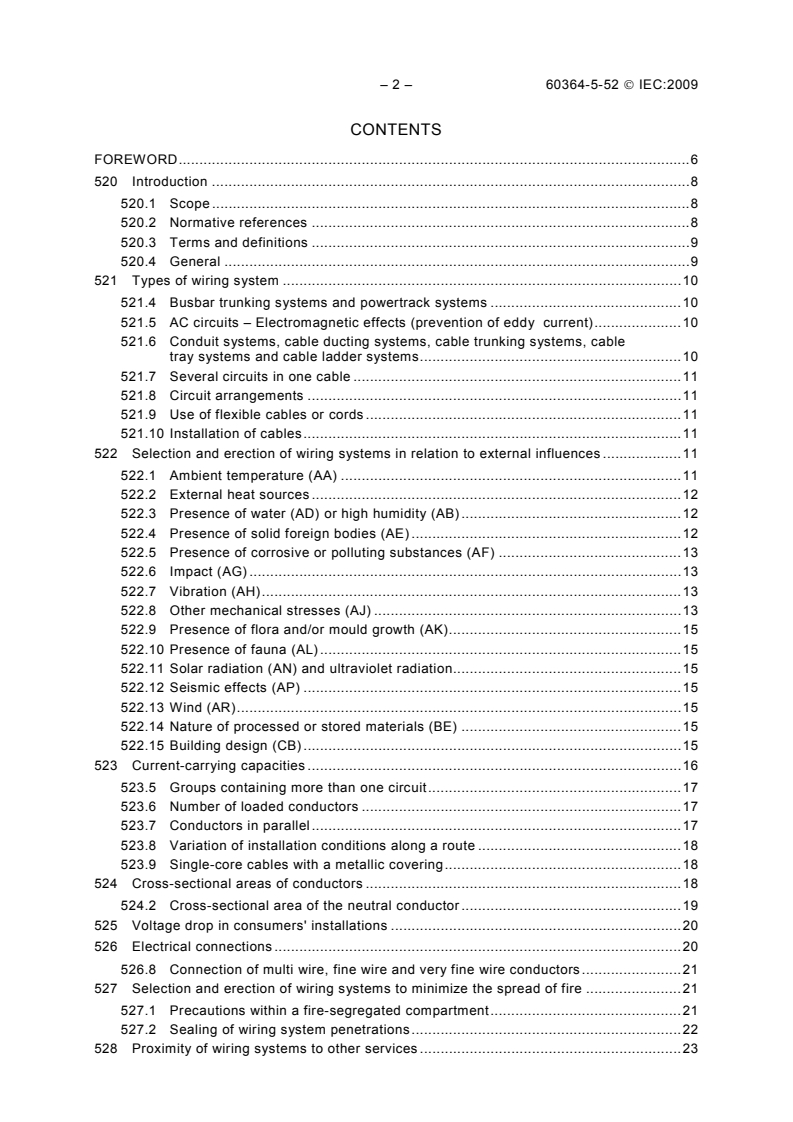
CONTENTS
FOREWORD.6
520 Introduction .8
520.1 Scope .8
520.2 Normative references .8
520.3 Terms and definitions .9
520.4 General .9
521 Types of wiring system .10
521.4 Busbar trunking systems and powertrack systems .10
521.5 AC circuits – Electromagnetic effects (prevention of eddy current).10
521.6 Conduit systems, cable ducting systems, cable trunking systems, cable
tray systems and cable ladder systems.10
521.7 Several circuits in one cable .11
521.8 Circuit arrangements .11
521.9 Use of flexible cables or cords .11
521.10 Installation of cables.11
522 Selection and erection of wiring systems in relation to external influences .11
522.1 Ambient temperature (AA) .11
522.2 External heat sources .12
522.3 Presence of water (AD) or high humidity (AB).12
522.4 Presence of solid foreign bodies (AE) .12
522.5 Presence of corrosive or polluting substances (AF) .13
522.6 Impact (AG) .13
522.7 Vibration (AH).13
522.8 Other mechanical stresses (AJ) .13
522.9 Presence of flora and/or mould growth (AK).15
522.10 Presence of fauna (AL) .15
522.11 Solar radiation (AN) and ultraviolet radiation.15
522.12 Seismic effects (AP) .15
522.13 Wind (AR).15
522.14 Nature of processed or stored materials (BE) .15
522.15 Building design (CB) .15
523 Current-carrying capacities .16
523.5 Groups containing more than one circuit.17
523.6 Number of loaded conductors .17
523.7 Conductors in parallel.17
523.8 Variation of installation conditions along a route .18
523.9 Single-core cables with a metallic covering.18
524 Cross-sectional areas of conductors .18
524.2 Cross-sectional area of the neutral conductor .19
525 Voltage drop in consumers' installations .20
526 Electrical connections .20
526.8 Connection of multi wire, fine wire and very fine wire conductors.21
527 Selection and erection of wiring systems to minimize the spread of fire .21
527.1 Precautions within a fire-segregated compartment.21
527.2 Sealing of wiring system penetrations.22
528 Proximity of wiring systems to other services .23
60364-5-52 © IEC:2009 – 3 –
528.1 Proximity to electrical services.23
528.2 Proximity of communications cables .23
528.3 Proximity to non-electrical services.23
529 Selection and erection of wiring systems in relation to maintainability, including
cleaning.24
Annex A (normative) Methods of installations.25
Annex B (informative) Current-carrying capacities .34
Annex C (informative) Example of a method of simplification of the tables of
Clause 523 .63
Annex D (informative) Formulae to express current-carrying capacities .67
Annex E (normative) Effect of harmonic currents on balanced three-phase systems .71
Annex F (informative) Selection of conduit systems .73
Annex G (informative) Voltage drop in consumers’ installations .74
Annex H (informative) Examples of configurations of parallel cables .76
Annex I (informative) List of notes concerning certain countries .79
Bibliography.84
Figure H.52.1 – Special configuration for 6 parallel single-core cables in a flat plane
(see 523.7) .76
Figure H.52.2 – Special configuration for 6 parallel single-core cables above each
other (see 523.7) .76
Figure H.52.3 – Special configuration for 6 parallel single-core cables in trefoil (see
523.7) .77
Figure H.52.4 – Special configuration for 9 parallel single-core cables in a flat plane
(see 523.7) .77
Figure H.52.5 – Special configuration for 9 parallel single-core cables above each
other (see 523.7) .77
Figure H.52.6 – Special configuration for 9 parallel single-core cables in trefoil (see
523.7) .78
Figure H.52.7 – Special configuration for 12 parallel single-core cables in a flat plane
(see 523.7) .78
Figure H.52.8 – Special configuration for 12 parallel single-core cables above each
other (see 523.7) .78
Figure H.52.9 – Special configuration for 12 parallel single-core cables in trefoil (see
523.7) .78
Table 52.1 – Maximum operating temperatures for types of insulation .16
Table 52.2 – Minimum cross-sectional area of conductors .19
Table A.52.1 – Methods of installation in relation to conductors and cables .25
Table A.52.2 – Erection of wiring systems.26
Table A.52.3 – Examples of methods of installation providing instructions for obtaining
current-carrying capacity .27
Table B.52.1 – Schedule of reference methods of installation which form the basis of
the tabulated current-carrying capacities.39
Table B.52.2 – Current-carrying capacities in amperes for methods of installation in
Table B.52.1 – PVC insulation/two loaded conductors, copper or aluminium –
Conductor temperature: 70 °C, ambient temperature: 30 °C in air, 20 °C in ground.41
– 4 – 60364-5-52 © IEC:2009
Table B.52.3 – Current-carrying capacities in amperes for methods of installation in
Table B.52.1 – XLPE or EPR insulation, two loaded conductors/copper or aluminium –
Conductor temperature: 90 °C, ambient temperature: 30 °C in air, 20 °C in ground.42
Table B.52.4 – Current-carrying capacities in amperes for methods of installation in
Table B.52.1 – PVC insulation, three loaded conductors/copper or aluminium –
Conductor temperature: 70 °C, ambient temperature: 30 °C in air, 20 °C in ground.43
Table B.52.5 – Current-carrying capacities in amperes for methods of installation in
Table B.52.1 – XLPE or EPR insulation, three loaded conductors/copper or aluminium
– Conductor temperature: 90 °C, ambient temperature: 30 °C in air, 20 °C in ground.44
Table B.52.6 – Current-carrying capacities in amperes for installation method C of
Table B.52.1 – Mineral insulation, copper conductors and sheath – PVC covered or
bare exposed to touch (see note 2) Metallic sheath temperature: 70 °C, reference
ambient temperature: 30 °C .45
Table B.52.7 – Current-carrying capacities in amperes for installation method C of
Table B.52.1 – Mineral insulation, copper conductors and sheath – Bare cable not
exposed to touch and not in contact with combustible material Metallic sheath
temperature: 105 °C, reference ambient temperature: 30 °C .46
Table B.52.8 – Current-carrying capacities in amperes for installation methods E, F
and G of Table B.52.1 – Mineral insulation, copper conductors and sheath/PVC
covered or bare exposed to touch (see note 2) Metallic sheath temperature: 70 °C,
reference ambient temperature: 30 °C .47
Table B.52.9 – Current-carrying capacities in amperes for installation methods E, F
and G of Table B.52.1 – Mineral insulation, copper conductors and sheath – Bare
cable not exposed to touch (see note 2) Metallic sheath temperature: 105 °C,
reference ambient temperature: 30 °C .48
Table B.52.10 – Current-carrying capacities in amperes for installation methods E, F
and G of Table B.52.1 – PVC insulation, copper conductors – Conductor temperature:
70 °C, reference ambient temperature: 30 °C.49
Table B.52.11 – Current-carrying capacities in amperes for installation methods E, F
and G of Table B.52.1 – PVC insulation, aluminium conductors – Conductor
temperature: 70 °C, reference ambient temperature: 30 °C .50
Table B.52.12 – Current-carrying capacities in amperes for installation methods E, F
and G of Table B.52.1 – XLPE or EPR insulation, copper conductors – Conductor
temperature: 90 °C, reference ambient temperature: 30 °C .51
Table B.52.13 – Current-carrying capacities in amperes for installation methods E, F
and G of Table B.52.1 – XLPE or EPR insulation. aluminium conductors Conductor
temperature: 90 °C, reference ambient temperature: 30 °C .52
Table B.52.14 – Correction factor for ambient air temperatures other than 30 °C to be
applied to the current-carrying capacities for cables in the air .53
Table B.52.15 – Correction factors for ambient ground temperatures other than 20 °C
to be applied to the current-carrying capacities for cables in ducts in the ground .54
Table B.52.16 – Correction factors for cables buried direct in the ground or in buried
ducts for soil thermal resistivities other than 2,5 K·m/W to be applied to the current-
carrying capacities for reference method D .54
Table B.52.17 – Reduction factors for one circuit or one multi-core cable or for a group
of more than one circuit, or more than one multi-core cable, to be used with current-
carrying capacities of Tables B.52.2 to B.52.13 .55
Table B.52.18 – Reduction factors for more than one circuit, cables laid directly in the
ground – Installation method D2 in Tables B.52.2 to B.52.5 – Single-core or multi-core
cables.56
Table B.52.19 – Reduction factors for more than one circuit, cables laid in ducts in the
ground – Installation method D1 in Tables B.52.2 to B.52.5 .57
60364-5-52 © IEC:2009 – 5 –
Table B.52.20 – Reduction factors for group of more than one multi-core cable to be
applied to reference current-carrying capacities for multi-core cables in free air –
Method of installation E in Tables B.52.8 to B.52.13 .59
Table B.52.21 – Reduction factors for groups of one or more circuits of single-core
cables to be applied to reference current-carrying capacity for one circuit of single-core
cables in free air – Method of installation F in Tables B.52.8 to B.52.13.61
Table C.52.1 – Current-carrying capacity in amperes.64
Table C.52.2 – Current-carrying capacities in amperes .65
Table C.52.3 – Reduction factors for groups of several circuits or of several multi-core
cables (to be used with current-carrying capacities of Table C.52.1) .66
Table D.52.1 – Table of coefficients and exponents .68
Table E.52.1 – Reduction factors for harmonic currents in four-core and five-core
cables.72
Table F.52.1 – Suggested characteristics for conduit (classification according to
IEC 61386) .73
Table G.52.1 – Voltage drop .74
– 6 – 60364-5-52 © IEC:2009
INTERNATIONAL ELECTROTECHNICAL COMMISSION
____________
LOW-VOLTAGE ELECTRICAL INSTALLATIONS –
Part 5-52: Selection and erection of electrical equipment –
Wiring systems
FOREWORD
1) The International Electrotechnical Commission (IEC) is a worldwide organization for standardization comprising
all national electrotechnical committees (IEC National Committees). The object of IEC is to promote
international co-operation on all questions concerning standardization in the electrical and electronic fields. To
this end and in addition to other activities, IEC publishes International Standards, Technical Specifications,
Technical Reports, Publicly Available Specifications (PAS) and Guides (hereafter referred to as “IEC
Publication(s)”). Their preparation is entrusted to technical committees; any IEC National Committee interested
in the subject dealt with may participate in this preparatory work. International, governmental and non-
governmental organizations liaising with the IEC also participate in this preparation. IEC collaborates closely
with the International Organization for Standardization (ISO) in accordance with conditions determined by
agreement between the two organizations.
2) The formal decisions or agreements of IEC on technical matters express, as nearly as possible, an international
consensus of opinion on the relevant subjects since each technical committee has representation from all
interested IEC National Committees.
3) IEC Publications have the form of recommendations for international use and are accepted by IEC National
Committees in that sense. While all reasonable efforts are made to ensure that the technical content of IEC
Publications is accurate, IEC cannot be held responsible for the way in which they are used or for any
misinterpretation by any end user.
4) In order to promote international uniformity, IEC National Committees undertake to apply IEC Publications
transparently to the maximum extent possible in their national and regional publications. Any divergence
between any IEC Publication and the corresponding national or regional publication shall be clearly indicated in
the latter.
5) IEC itself does not provide any attestation of conformity. Independent certification bodies provide conformity
assessment services and, in some areas, access to IEC marks of conformity. IEC is not responsible for any
services carried out by independent certification bodies.
6) All users should ensure that they have the latest edition of this publication.
7) No liability shall attach to IEC or its directors, employees, servants or agents including individual experts and
members of its technical committees and IEC National Committees for any personal injury, property damage or
other damage of any nature whatsoever, whether direct or indirect, or for costs (including legal fees) and
expenses arising out of the publication, use of, or reliance upon, this IEC Publication or any other IEC
Publications.
8) Attention is drawn to the Normative references cited in this publication. Use of the referenced publications is
indispensable for the correct application of this publication.
9) Attention is drawn to the possibility that some of the elements of this IEC Publication may be the subject of
patent rights. IEC shall not be held responsible for identifying any or all such patent rights.
International Standard IEC 60364-5-52 has been prepared by IEC technical committee 64:
Electrical installations and protection against electric shock.
This third edition cancels and replaces the second edition, published in 2001, and constitutes
a technical revision.
The main changes with respect to the previous edition are as follows:
• Subclause 521.4 introduces minor changes with regard to busbar trunking systems and
powertrack systems.
• Subclause 523.6 introduces minor changes with regard to the sizing of cables where
harmonic currents are present.
• A new sublause 523.9 concerning single-core cables with a metallic covering has been
introduced.
60364-5-52 © IEC:2009 – 7 –
• Clause 525 introduces changes in the maximum value of voltage drop permitted between
the origin of the consumer's installation and the equipment which should not be greater
than that given in the relevant annex.
• Clause 526 introduces minor changes to electrical connections including additional
exceptions for inspection of connections and additional notes.
• Clause 528 introduces additional requirements with regard to proximity of underground
power and telecommunication cables.
• Clause 529 introduces minor changes to selection and erection of wiring systems in
relation to maintainability, including cleaning.
The text of this standard is based on the following documents:
FDIS Report on voting
64/1685/FDIS 64/1705/RVD
Full information on the voting for the approval of this standard can be found in the report on
voting indicated in the above table.
This publication has been drafted in accordance with the ISO/IEC Directives, Part 2.
The reader’s attention is drawn to the fact that Annex I lists all of the “in-some-country”
clauses on differing practices of a less permanent nature relating to the subject of this
standard.
A list of all the parts in the IEC 602364 series, under the general title Low-voltage electrical
installations, can be found on the IEC website.
Future standards in this series will carry the new general title as cited above. Titles of existing
standards in this series will be updated at the time of the next edition.
The committee has decided that the contents of this publication will remain unchanged until
the maintenance result date indicated on the IEC web site under "http://webstore.iec.ch" in
the data related to the specific publication. At this date, the publication will be
• reconfirmed,
• withdrawn,
• replaced by a revised edition, or
• amended.
The contents of the corrigendum of February 2011 have been included in this copy.
– 8 – 60364-5-52 © IEC:2009
LOW-VOLTAGE ELECTRICAL INSTALLATIONS –
Part 5-52: Selection and erection of electrical equipment –
Wiring systems
520 Introduction
520.1 Scope
Part 5-52 of IEC 60364 deals with the selection and erection of wiring systems.
NOTE 1 This standard also applies in general to protective conductors, while IEC 60364-5-54 contains further
requirements for those conductors.
NOTE 2 Guidance on Part 5-52 of IEC 60364 is given in IEC 61200-52.
520.2 Normative references
The following referenced documents are indispensable for the application of this document.
For dated references, only the edition cited applies. For undated references, the latest edition
of the referenced document (including any amendments) applies.
IEC 60228, Conductors of insulated cables
IEC 60287 (all parts), Electric cables – Calculation of the current rating
IEC 60287-2-1, Electric cables – Calculation of the current rating – Part 2-1: Thermal
resistance –Calculation of thermal resistance
IEC 60287-3-1, Electric cables – Calculation of the current rating – Part 3-1: Sections on
operating conditions – Reference operating conditions and selection of cable type
IEC 60332-1-1, Tests on electric and optical fibre cables under fire conditions – Part 1-1: Test
for vertical flame propagation for a single insulated wire or cable – Apparatus
IEC 60332-1-2, Tests on electric and optical fibre cables under fire conditions – Part 1-2: Test
for vertical flame propagation for a single insulated wire or cable – Procedure for 1 kW pre-
mixed flame
IEC 60364-1:2005, Low-voltage electrical installations – Part 1: Fundamental principles,
assessment of general characteristics, definitions
IEC 60364-4-41:2005, Low-voltage electrical installations – Part 4-41: Protection for safety –
Protection against electric shock
IEC 60364-4-42, Electrical installations of buildings – Part 4-42: Protection for safety –
Protection against thermal effects
———————
A consolidated edition 1.2 exists (2006) that includes IEC 60287-2-1 (1994) and its amendments 1 and 2 (1999
and 2006).
A consolidated edition 1.1 exists (1999) that includes IEC 60287-3-1 (1995) and its amendment 1 (1999).
60364-5-52 © IEC:2009 – 9 –
IEC 60364-5-54, Electrical installations of buildings – Part 5-54: Selection and erection of
electrical equipment – Earthing arrangements, protective conductors and protective bonding
conductors
IEC 60439-2, Low-voltage switchgear and controlgear assemblies – Part 2: Particular
requirements for busbar trunking systems (busways)
IEC 60449, Voltage bands for electrical installations of buildings
IEC 60502 (all parts), Power cables with extruded insulation and their accessories for rated
voltages from 1 kV (U = 1,2 kV) up to 30 kV (U = 36 kV)
m m
IEC 60529, Degrees of protection provided by enclosures (IP Code)
IEC 60570, Electrical supply track systems for luminaires
IEC 60702 (all parts), Mineral insulated cables and their terminations with a rated voltage not
exceeding 750 V
IEC 60947-7 (all parts 7), Low-voltage switchgear and controlgear – Part 7: Ancillary
equipment
IEC 60998 (all parts), Connecting devices for low-voltage circuits for household and similar
purposes
IEC 61084 (all parts), Cable trunking and ducting systems for electrical installations
IEC 61386 (all parts), Conduit systems for cable management
IEC 61534 (all parts), Powertrack systems
IEC 61537, Cable management – Cable tray systems and cable ladder systems
ISO 834 (all parts), Fire-resistance tests – Elements of building construction
520.3 Terms and definitions
For the purposes of this document the following terms and definitions apply.
520.3.1
wiring system
assembly made up of bare or insulated conductors or cables or busbars and the parts which
secure and if necessary enclose the cables or busbars
520.3.2
busbar
low impedance conductor to which several electric circuits can be separately connected
[IEV 605-02-01]
520.4 General
Consideration shall be given to the application of the fundamental principles of IEC 60364-1
as it applies to
———————
A consolidated edition 3.1 exists (2005) that includes IEC 60439-2 (1995) and its amendment 1 (2005).
A consolidated edition 2.1 exists (2001) that includes IEC 60529 (1989) and its amendment 1 (1999).
– 10 – 60364-5-52 © IEC:2009
– cables and conductors,
– their termination and/or jointing,
– their associated supports or suspensions, and
– their enclosure or methods of protection against external influences.
521 Types of wiring system
521.1 The method of installation of a wiring system (excluding systems covered by 521.4) in
relation to the type of conductor or cable used shall be in accordance with Table A.52.1,
provided the external influences are taken into account according to Clause 522.
521.2 The method of installation of a wiring system (excluding systems covered by 521.4) in
relation to the situation concerned shall be in accordance with Table A.52.2. Other methods of
installation of cables, conductors and busbars not included in Table A.52.2 are permitted,
provided that they fulfil the requirements of this part.
521.3 Examples of wiring systems (excluding systems covered by 521.4) together with
reference to the method of installation to be used to obtain current-carrying capacity are
shown in Table A.52.3.
NOTE Table A.52.3 gives the reference method of installation where it is considered that the same current-
carrying capacities can safely be used. It is not implied that all these items are necessarily recognized in national
rules of all countries or that other methods of installation are prohibited.
521.4 Busbar trunking systems and powertrack systems
Busbar trunking systems shall comply with IEC 60439-2 and powertrack systems shall comply
with the IEC 61534 series. Busbar trunking systems and powertrack systems shall be selected
and installed in accordance with manufacturers’ instructions, taking account of external
influences.
521.5 AC circuits – Electromagnetic effects (prevention of eddy current)
521.5.1 Conductors of a.c. circuits installed in ferromagnetic enclosures shall be arranged
so that all conductors of each circuit, including the protective conductor of each circuit, are
contained in the same enclosure. Where such conductors enter a ferrous enclosure, they shall
be arranged such that the conductor are only collectively surrounded by ferromagnetic
materials.
521.5.2 Single-core cables armoured with steel wire or steel tape shall not be used for a.c.
circuits.
NOTE The steel wire or steel tape armour of a single-core cable is regarded as a ferromagnetic enclosure. For
single-core wire armoured cables, the use of aluminium armour is recommended.
521.6 Conduit systems, cable ducting systems, cable trunking systems, cable tray
systems and cable ladder systems
Several circuits are allowed in the same conduit system, separated compartment of cable
ducting system or cable trunking system provided all conductors are insulated for the highest
nominal voltage present.
Conduit systems shall comply with the IEC 61386 series, cable trunking or ducting systems
shall comply with the IEC 61084 series and cable tray and cable ladder systems shall comply
with IEC 61537.
NOTE Guidance on the selection of conduit systems is given in Annex F.
60364-5-52 © IEC:2009 – 11 –
521.7 Several circuits in one cable
Several circuits are allowed in the same cable provided all conductors are insulated for the
highest nominal voltage present.
521.8 Circuit arrangements
521.8.1 Conductors of a circuit shall not be distributed over different multi-core cables,
conduits, cable ducting systems or cable trunking systems. This is not required where a
number of multi-core cables, forming one circuit, are installed in parallel. Where multi-core
cables are installed in parallel, each cable shall contain one conductor of each phase and the
neutral if any.
521.8.2 The use of a common neutral conductor for several main circuits is not permitted.
However, single-phase a.c. final circuits may be formed from one line conductor and the
neutral conductor of one multi-phase a.c. circuit with only one neutral conductor provided that
the arrangement of the circuits remains recognizable. This multi-phase circuit shall be
isolated by means of an isolating device according to 536.2.2 which isolates all live
conductors.
NOTE For the allocation of a common protective conductor for several circuits, see IEC 60364-5-54.
521.8.3 Where several circuits are terminated in a single junction box the terminals for each
circuit shall be separated by insulating partitions, except for connecting devices in accordance
with the IEC 60998 series, and terminal blocks in accordance with IEC 60947-7.
521.9 Use of flexible cables or cords
521.9.1 A flexible cable may be used for fixed wiring where the provisions of this standard
are met.
521.9.2 Equipment that is intended to be moved in use shall be connected by flexible cables
or cords, except equipment supplied by contact rails.
521.9.3 Stationary equipment which is moved temporarily for the purpose of connecting,
cleaning etc., e.g. cookers or flush-mounting units for installations in false floors, shall be
connected with flexible cables or cords.
521.9.4 Flexible conduit systems may be used to protect flexible insulated conductors.
521.10 Installation of cables
Insulated conductors (non-sheathed) for fixed wiring shall be enclosed in conduit, cable
ducting system or cable trunking system. This requirement does not apply to a protective
conductor complying with IEC 60364-5-54.
522 Selection and erection of wiring systems in relation to external influences
The installation method selected shall be such that protection against the expected external
influences is ensured in all appropriate parts of the wiring system. Particular care shall be
taken at changes in direction and where wiring enters into equipment.
NOTE The external influences categorized in Table 51A of IEC 60364-5-51 which are of significance to wiring
systems are included in this clause.
522.1 Ambient temperature (AA)
522.1.1 Wiring systems shall be selected and erected so as to be suitable for any
temperature between the highest and the lowest local ambient temperature and to ensure that
– 12 – 60364-5-52 © IEC:2009
the limiting temperature in normal operation (see Table 52.1) and the limiting temperature in
case of a fault will not be exceeded.
NOTE “Limiting temperature” means maximum continuous operating temperature.
522.1.2 Wiring system components including cables and wiring accessories shall only be
installed or handled at temperatures within the limits stated in the relevant product standard
or as given by the manufacturer.
522.2 External heat sources
522.2.1 In order to avoid the harmful effects of heat from external sources, one or more of
the following methods or an equally effective method shall be used to protect wiring systems:
– heat shielding;
– placing sufficiently far from the source of heat;
– selecting of the wiring system components with due regard for the additional temperature
rise which may occur;
– local reinforcement of insulating material e.g. by heat-resisting insulated sleeving.
NOTE Heat from external sources may be radiated, convected or conducted, e.g.
– from hot water systems,
– from plant, appliances and luminaires,
– from manufacturing processes,
– through heat conducting materials,
– from solar gain of the wiring system or its surrounding medium.
522.3 Presence of water (AD) or high humidity (AB)
522.3.1 Wiring systems shall be selected and erected so that no damage is caused by
condensation or ingress of water. The completed wiring system shall comply with the IP
degree of protection relevant to the particular location.
NOTE In general, the sheaths and insulation of cables for fixed installations may be regarded, when intact, as
proof against penetration by moisture. Special considerations apply to cables liable to frequent splashing,
immersion or submersion.
522.3.2 Where water may collect or condensation may form in wiring systems, provision
shall be made for its escape.
522.3.3 Where wiring systems may be subjected to waves (AD6), protection against mecha-
nical damage shall be afforded by one or more of the methods of 522.6, 522.7 and 522.8.
522.4 Presence of solid foreign bodies (AE)
522.4.1 Wiring systems shall be selected and erected so as to minimize the danger arising
from the ingress of solid foreign bodies. The completed wiring system shall comply with the IP
degree of protection relevant to the particular location.
522.4.2 In a location where dust in significant quantity is present (AE4), additional
precautions shall be taken to prevent the accumulation of dust or other substances in
quantities which could adversely affect the heat dissipation from the wiring system.
NOTE A wiring system which facilitates the removal of dust may be necessary (see Clause 529).
60364-5-52 © IEC:2009 – 13 –
522.5 Presence of corrosive or polluting substances (AF)
522.5.1 Where the presence of corrosive or polluting substances, including water, is likely to
give rise to corrosion or deterioration, parts of the wiring system likely to be affected shall be
suitably protected or manufactured from a material resistant to such substances.
NOTE Suitable protection for application during erection may include protective tapes, paints or grease. These
measures should be coordinated with the manufacturer.
522.5.2 Dissimilar metals, liable to initiate electrolytic action, shall not be placed in contact
with each other unless special arrangements are made to avoid the consequences of such
contact.
522.5.3 Materials liable to cause mutual or individual deterioration or hazardous degradation
shall not be placed in contact with each other.
522.6 Impact (AG)
522.6.1 Wiring systems shall be selected and erected so as to minimize the damage arising
from mechanical stress, e.g. by impact, penetration or compression during installation, use or
maintenance.
522.6.2 In fixed installations where impacts of medium severity (AG2) or high severity (AG3)
can occur, protection shall be afforded by
– the mechanical characteristics of the wiring system, or
– the location selected, or
– the provision of additional local or general mechanical protection, or
– by any combination of the above.
NOTE 1 Examples are areas where the floor is likely to be penetrated and areas used by forklift trucks.
NOTE 2 Additional mechanical protection may be achieved by using suitable cable trunking/ducting or conduit
systems.
522.6.3 A cable installed under a floor or above a ceiling shall be run in such a position that
it is not liable to be damaged by contact with the floor or the ceiling or their fixings.
522.6.4 The degree protection of electrical equipment shall be maintained after installation
of the cables and conductors.
522.7 Vibration (AH)
522.7.1 Wiring systems supported by or fixed to structures of equipment subject to vibration
of medium severity (AH2) or high severity (AH3) shall be suitable for such conditions,
particularly where cables and cable connections are concerned.
NOTE Special attention should be paid to connections to vibrating equipment. Local measures may be adopted
such as flexible wiring systems.
522.7.2 The fixed installation of suspended current-using equipment, e.g. luminaires, shall
be connected by cable with flexible cores. Where no vibration or
...