

IEC 62359:2010
(Main)Ultrasonics - Field characterization - Test methods for the determination of thermal and mechanical indices related to medical diagnostic ultrasonic fields
General Information
- Abstract
IEC 62359:2010 is applicable to medical diagnostic ultrasound fields. It establishes:
- parameters related to thermal and non-thermal exposure aspects of diagnostic ultrasonic fields;
- methods for the determination of an exposure parameter relating to temperature rise in theoretical tissue-equivalent models, resulting from absorption of ultrasound;
- methods for the determination of an exposure parameter appropriate to certain non-thermal effects.
This second edition cancels and replaces the first edition, published in 2005. It constitutes a technical revision. Major changes with respect to the previous edition include the following:
- The methods of determination set out in the first edition of this standard were based on those contained in the American standard for Real-Time Display of Thermal and Mechanical Acoustic Output Indices on Diagnostic Ultrasound Equipment (ODS) and were intended to yield identical results. While this second edition also follows the ODS in principal and uses the same basic formulae and assumptions (see Annex A), it contains a few significant modifications which deviate from the ODS.
- One of the primary issues dealt with in preparing this second edition of IEC 62359 was "missing" TI equations. In Edition 1 there were not enough equations to make complete "at-surface" and "below-surface" summations for TIS and TIB in combined-operating modes. Thus major changes with respect to the previous edition are related to the introduction of new calculations of thermal indices to take into account both "at-surface" and "below-surface" thermal effects. The contents of the corrigendum of March 2011 have been included in this copy.
- Status
- Published
- Publication Date
- 28-Sep-2017
- Technical Committee
- TC 87 - Ultrasonics
- Drafting Committee
- WG 8 - TC 87/WG 8
- Current Stage
- PPUB - Publication issued
- Start Date
- 27-Oct-2010
- Completion Date
- 15-Oct-2010
Buy Documents

IEC 62359:2010+AMD1:2017 CSV - Ultrasonics - Field characterization - Test methods for the determination of thermal and mechanical indices related to medical diagnostic ultrasonic fields Released:9/29/2017
IEC 62359:2010 - Ultrasonics - Field characterization - Test methods for the determination of thermal and mechanical indices related to medical diagnostic ultrasonic fields Released:10/27/2010

IEC 62359:2010+AMD1:2017 CSV - Ultrasonics - Field characterization - Test methods for the determination of thermal and mechanical indices related to medical diagnostic ultrasonic fields Released:9/29/2017
Overview
IEC 62359:2010 (Edition 2, consolidated with Corrigendum 2011 and Amendment 2017) is an international standard for ultrasonics field characterization that specifies test methods to determine exposure indices for medical diagnostic ultrasound. The standard defines procedures for calculating the Thermal Index (TI) and Mechanical Index (MI) - parameters that describe potential thermal and non‑thermal (mechanical) effects of diagnostic ultrasonic fields on tissue. It is applicable to a broad range of medical diagnostic ultrasound equipment and supports safety and compliance activities.
Key technical topics and requirements
- Definitions and symbols: standardized terminology and notation for ultrasonic field metrics.
- TI and MI determination: test methods for calculating the thermal index (including soft‑tissue TI and bone TI - TIS and TIB) and the mechanical index using measured acoustic quantities.
- Scanning vs non‑scanning modes: distinct procedures for non‑scanning and scanning operation, and for combined‑operating modes where multiple outputs are active. Edition 2 addresses previously “missing” TI equations by introducing calculations that consider both at‑surface and below‑surface thermal effects.
- Attenuated intensity metrics: Amendment 2017 adds methods to determine attenuated spatial‑peak temporal‑average intensity (I_spta,α) and attenuated spatial‑peak pulse‑average intensity (I_sppa,α) at specified beam positions.
- Annexes for guidance: Annex A (rationale and index models), Annex B (guidance for output power measurements), Annex C (transducer self‑heating), Annex D (interpretation of TI and MI), Annex E (differences from Edition 1), and Annex F (intensity determinations).
Practical applications
- Medical device manufacturers: use IEC 62359 to design, test and label ultrasound equipment with standardized TI and MI estimations for safety displays and documentation.
- Test laboratories and QA teams: implement the measurement and calculation methods to verify acoustic output and demonstrate compliance during product development and production testing.
- Regulatory and conformity assessment: supports compliance with safety standards (for example, IEC 60601‑2‑37 references TI/MI requirements) and provides objective metrics for risk assessment.
- Clinical engineers and hospital physicists: interpret device‑reported TI/MI values and incorporate exposure indices into operational safety practices and training.
Who should use this standard
- Ultrasound transducer and system manufacturers
- Independent acoustic testing laboratories
- Regulatory bodies and notified bodies assessing medical ultrasound devices
- Clinical safety officers and biomedical engineering teams
Related standards and notes
- IEC 60601‑2‑37 (particular requirements for ultrasound equipment) - IEC 62359 methods support compliance.
- The standard follows principles similar to the American ODS (Real‑Time Display of Thermal and Mechanical Acoustic Output Indices) but includes specific deviations and expanded TI equations.
Note: TI and MI are practical safety indices but have limitations; they are indicators for exposure assessment and should be used alongside clinical judgment and applicable prudence statements.
Relations
- Effective Date
- 05-Sep-2023
- Effective Date
- 05-Sep-2023
- Effective Date
- 05-Sep-2023
Buy Documents
IEC 62359:2010+AMD1:2017 CSV - Ultrasonics - Field characterization - Test methods for the determination of thermal and mechanical indices related to medical diagnostic ultrasonic fields Released:9/29/2017
IEC 62359:2010 - Ultrasonics - Field characterization - Test methods for the determination of thermal and mechanical indices related to medical diagnostic ultrasonic fields Released:10/27/2010
IEC 62359:2010+AMD1:2017 CSV - Ultrasonics - Field characterization - Test methods for the determination of thermal and mechanical indices related to medical diagnostic ultrasonic fields Released:9/29/2017
Get Certified
Connect with accredited certification bodies for this standard

BSMI (Bureau of Standards, Metrology and Inspection)
Taiwan's standards and inspection authority.
Sponsored listings
Frequently Asked Questions
IEC 62359:2010 is a standard published by the International Electrotechnical Commission (IEC). Its full title is "Ultrasonics - Field characterization - Test methods for the determination of thermal and mechanical indices related to medical diagnostic ultrasonic fields". This standard covers: IEC 62359:2010 is applicable to medical diagnostic ultrasound fields. It establishes: - parameters related to thermal and non-thermal exposure aspects of diagnostic ultrasonic fields; - methods for the determination of an exposure parameter relating to temperature rise in theoretical tissue-equivalent models, resulting from absorption of ultrasound; - methods for the determination of an exposure parameter appropriate to certain non-thermal effects. This second edition cancels and replaces the first edition, published in 2005. It constitutes a technical revision. Major changes with respect to the previous edition include the following: - The methods of determination set out in the first edition of this standard were based on those contained in the American standard for Real-Time Display of Thermal and Mechanical Acoustic Output Indices on Diagnostic Ultrasound Equipment (ODS) and were intended to yield identical results. While this second edition also follows the ODS in principal and uses the same basic formulae and assumptions (see Annex A), it contains a few significant modifications which deviate from the ODS. - One of the primary issues dealt with in preparing this second edition of IEC 62359 was "missing" TI equations. In Edition 1 there were not enough equations to make complete "at-surface" and "below-surface" summations for TIS and TIB in combined-operating modes. Thus major changes with respect to the previous edition are related to the introduction of new calculations of thermal indices to take into account both "at-surface" and "below-surface" thermal effects. The contents of the corrigendum of March 2011 have been included in this copy.
IEC 62359:2010 is applicable to medical diagnostic ultrasound fields. It establishes: - parameters related to thermal and non-thermal exposure aspects of diagnostic ultrasonic fields; - methods for the determination of an exposure parameter relating to temperature rise in theoretical tissue-equivalent models, resulting from absorption of ultrasound; - methods for the determination of an exposure parameter appropriate to certain non-thermal effects. This second edition cancels and replaces the first edition, published in 2005. It constitutes a technical revision. Major changes with respect to the previous edition include the following: - The methods of determination set out in the first edition of this standard were based on those contained in the American standard for Real-Time Display of Thermal and Mechanical Acoustic Output Indices on Diagnostic Ultrasound Equipment (ODS) and were intended to yield identical results. While this second edition also follows the ODS in principal and uses the same basic formulae and assumptions (see Annex A), it contains a few significant modifications which deviate from the ODS. - One of the primary issues dealt with in preparing this second edition of IEC 62359 was "missing" TI equations. In Edition 1 there were not enough equations to make complete "at-surface" and "below-surface" summations for TIS and TIB in combined-operating modes. Thus major changes with respect to the previous edition are related to the introduction of new calculations of thermal indices to take into account both "at-surface" and "below-surface" thermal effects. The contents of the corrigendum of March 2011 have been included in this copy.
IEC 62359:2010 is classified under the following ICS (International Classification for Standards) categories: 17.140.50 - Electroacoustics. The ICS classification helps identify the subject area and facilitates finding related standards.
IEC 62359:2010 has the following relationships with other standards: It is inter standard links to IEC 62359:2010/AMD1:2017, IEC 62359:2010/COR1:2011, IEC 62359:2005. Understanding these relationships helps ensure you are using the most current and applicable version of the standard.
IEC 62359:2010 is available in PDF format for immediate download after purchase. The document can be added to your cart and obtained through the secure checkout process. Digital delivery ensures instant access to the complete standard document.
Standards Content (Sample)
IEC 62359 ®
Edition 2.1 2017-09
CONSOLIDATED VERSION
INTERNATIONAL
STANDARD
colour
inside
Ultrasonics – Field characterization –
Test methods for the determination of thermal and mechanical indices related
to medical diagnostic ultrasonic fields
All rights reserved. Unless otherwise specified, no part of this publication may be reproduced or utilized in any form
or by any means, electronic or mechanical, including photocopying and microfilm, without permission in writing from
either IEC or IEC's member National Committee in the country of the requester. If you have any questions about IEC
copyright or have an enquiry about obtaining additional rights to this publication, please contact the address below or
your local IEC member National Committee for further information.
IEC Central Office Tel.: +41 22 919 02 11
3, rue de Varembé Fax: +41 22 919 03 00
CH-1211 Geneva 20 info@iec.ch
Switzerland www.iec.ch
About the IEC
The International Electrotechnical Commission (IEC) is the leading global organization that prepares and publishes
International Standards for all electrical, electronic and related technologies.
About IEC publications
The technical content of IEC publications is kept under constant review by the IEC. Please make sure that you have the
latest edition, a corrigenda or an amendment might have been published.
IEC Catalogue - webstore.iec.ch/catalogue Electropedia - www.electropedia.org
The stand-alone application for consulting the entire The world's leading online dictionary of electronic and
bibliographical information on IEC International Standards, electrical terms containing 20 000 terms and definitions in
Technical Specifications, Technical Reports and other English and French, with equivalent terms in 16 additional
documents. Available for PC, Mac OS, Android Tablets and languages. Also known as the International Electrotechnical
iPad. Vocabulary (IEV) online.
IEC publications search - www.iec.ch/searchpub IEC Glossary - std.iec.ch/glossary
The advanced search enables to find IEC publications by a 65 000 electrotechnical terminology entries in English and
variety of criteria (reference number, text, technical French extracted from the Terms and Definitions clause of
committee,…). It also gives information on projects, replaced IEC publications issued since 2002. Some entries have been
and withdrawn publications. collected from earlier publications of IEC TC 37, 77, 86 and
CISPR.
IEC Just Published - webstore.iec.ch/justpublished
Stay up to date on all new IEC publications. Just Published IEC Customer Service Centre - webstore.iec.ch/csc
details all new publications released. Available online and If you wish to give us your feedback on this publication or
also once a month by email. need further assistance, please contact the Customer Service
Centre: csc@iec.ch.
IEC 62359 ®
Edition 2.1 2017-09
CONSOLIDATED VERSION
INTERNATIONAL
STANDARD
colour
inside
Ultrasonics – Field characterization –
Test methods for the determination of thermal and mechanical indices related
to medical diagnostic ultrasonic fields
INTERNATIONAL
ELECTROTECHNICAL
COMMISSION
ICS 17.140.50 ISBN 978-2-8322-4885-0
IEC 62359 ®
Edition 2.1 2017-09
CONSOLIDATED VERSION
REDLINE VERSION
colour
inside
Ultrasonics – Field characterization –
Test methods for the determination of thermal and mechanical indices related
to medical diagnostic ultrasonic fields
– 2 – IEC 62359:2010+AMD1:2017 CSV
IEC 2017
CONTENTS
FOREWORD. 4
INTRODUCTION . 6
INTRODUCTION to Amendment . 6
1 Scope . 7
2 Normative references . 7
3 Terms and definitions . 8
4 List of symbols . 27
5 Test methods for determining the mechanical index and the thermal index . 29
5.1 General . 29
5.2 Determination of mechanical index . 30
5.2.1 Determination of attenuated peak-rarefactional acoustic pressure . 30
5.2.2 Calculation of mechanical index . 30
5.3 Determination of thermal index – general . 30
5.4 Determination of thermal index in non-scanning mode . 30
5.4.1 Determination of soft tissue thermal index for non-scanning modes . 30
5.4.2 Determination of bone thermal index, TIB, for non-scanning modes . 32
5.5 Determination of thermal index in scanning modes . 33
5.5.1 Determination of soft tissue thermal index for scanning modes . 33
5.5.2 Determination of bone thermal index for scanning modes . 33
5.6 Calculations for combined-operating mode . 34
5.6.1 Acoustic working frequency . 34
5.6.2 Thermal index . 34
5.6.3 Mechanical index . 35
5.7 Summary of measured quantities for index determination . 35
Annex A (informative) Rationale and derivation of index models . 37
Annex B (informative) Guidance notes for measurement of output power in combined
modes, scanning modes and in 1 cm × 1 cm windows . 59
Annex C (informative) The contribution of transducer self-heating to the temperature
rise occurring during ultrasound exposure . 66
Annex D (informative) Guidance on the interpretation of TI and MI . 67
Annex E (informative) Differences from IEC 62359 Edition 1 . 69
Annex F (informative) Rationale and determination of maximum non-attenuated and
attenuated spatial-peak temporal-average intensity and spatial-peak pulse-average
intensity values . 72
Bibliography . 83
Figure 1 – Schematic diagram of the different planes and lines in an ultrasonic field
(modified from IEC 61828 and IEC 62127-1) . 12
Figure A.1 – Focusing transducer with a f-number of about 7 . 44
Figure A.2 – Strongly focusing transducer with a low f-number of about 1 . 45
Figure A.3 – Focusing transducer (f-number ≈ 10) with severe undulations close to the
transducer . 45
Figure A.4 – Focusing transducer . 52
Figure A.5 – Focusing transducer with smaller aperture than that of Figure A.4 . 52
Figure A.6 – Focusing transducer with a weak focus near zbp . 53
IEC 2017
Figure A.7 – Weakly focusing transducer . 53
Figure B.1 – Example of curved linear array in scanning mode . 61
Figure B.2 – Suggested 1 cm × 1 cm square-aperture mask . 64
Figure B.3 – Suggested orientation of transducer, mask aperture and RFB target . 64
Figure B.4 – Suggested orientation of transducer and 1 cm-square RFB target . 65
Table 1 – Summary of combination formulae for each of the THERMAL INDEX categories . 35
Table 2 – Summary of the acoustic quantities required for the determination of the
indices . 36
Table A.1 – Thermal index categories and models . 43
Table A.2 – Consolidated thermal index formulae . 49
Table E.1 – Summary of differences . 71
– 4 – IEC 62359:2010+AMD1:2017 CSV
IEC 2017
INTERNATIONAL ELECTROTECHNICAL COMMISSION
____________
ULTRASONICS –
FIELD CHARACTERIZATION –
TEST METHODS FOR THE DETERMINATION OF THERMAL
AND MECHANICAL INDICES RELATED TO
MEDICAL DIAGNOSTIC ULTRASONIC FIELDS
FOREWORD
1) The International Electrotechnical Commission (IEC) is a worldwide organization for standardization comprising
all national electrotechnical committees (IEC National Committees). The object of IEC is to promote
international co-operation on all questions concerning standardization in the electrical and electronic fields. To
this end and in addition to other activities, IEC publishes International Standards, Technical Specifications,
Technical Reports, Publicly Available Specifications (PAS) and Guides (hereafter referred to as “IEC
Publication(s)”). Their preparation is entrusted to technical committees; any IEC National Committee interested
in the subject dealt with may participate in this preparatory work. International, governmental and non-
governmental organizations liaising with the IEC also participate in this preparation. IEC collaborates closely
with the International Organization for Standardization (ISO) in accordance with conditions determined by
agreement between the two organizations.
2) The formal decisions or agreements of IEC on technical matters express, as nearly as possible, an international
consensus of opinion on the relevant subjects since each technical committee has representation from all
interested IEC National Committees.
3) IEC Publications have the form of recommendations for international use and are accepted by IEC National
Committees in that sense. While all reasonable efforts are made to ensure that the technical content of IEC
Publications is accurate, IEC cannot be held responsible for the way in which they are used or for any
misinterpretation by any end user.
4) In order to promote international uniformity, IEC National Committees undertake to apply IEC Publications
transparently to the maximum extent possible in their national and regional publications. Any divergence
between any IEC Publication and the corresponding national or regional publication shall be clearly indicated in
the latter.
5) IEC itself does not provide any attestation of conformity. Independent certification bodies provide conformity
assessment services and, in some areas, access to IEC marks of conformity. IEC is not responsible for any
services carried out by independent certification bodies.
6) All users should ensure that they have the latest edition of this publication.
7) No liability shall attach to IEC or its directors, employees, servants or agents including individual experts and
members of its technical committees and IEC National Committees for any personal injury, property damage or
other damage of any nature whatsoever, whether direct or indirect, or for costs (including legal fees) and
expenses arising out of the publication, use of, or reliance upon, this IEC Publication or any other IEC
Publications.
8) Attention is drawn to the Normative references cited in this publication. Use of the referenced publications is
indispensable for the correct application of this publication.
9) Attention is drawn to the possibility that some of the elements of this IEC Publication may be the subject of
patent rights. IEC shall not be held responsible for identifying any or all such patent rights.
This consolidated version of the official IEC Standard and its amendment has been prepared
for user convenience.
IEC 62359 edition 2.1 contains the second edition (2010-10) [documents 87/445/FDIS and
87/453/RVD] and its corrigendum 1 (2011-03), and its amendment 1 (2017-09) [documents
87/661/FDIS and 87/665/RVD].
In this Redline version, a vertical line in the margin shows where the technical content is
modified by amendment 1. Additions are in green text, deletions are in strikethrough red text.
A separate Final version with all changes accepted is available in this publication.
IEC 2017
International standard IEC 62359 has been prepared by IEC technical committee 87:
Ultrasonics.
This second edition It constitutes a technical revision.
Major changes with respect to the previous edition include the following:
• The methods of determination set out in the first edition of this standard were based on
those contained in the American standard for Real–Time Display of Thermal and
Mechanical Acoustic Output Indices on Diagnostic Ultrasound Equipment (ODS) and were
intended to yield identical results. While this second edition also follows the ODS in
principal and uses the same basic formulae and assumptions (see Annex A), it contains a
few significant modifications which deviate from the ODS.
• One of the primary issues dealt with in preparing this second edition of IEC 62359 was
“missing” TI equations. In Edition 1 there were not enough equations to make complete
“at-surface” and “below-surface” summations for TIS and TIB in combined-operating
modes. Thus major changes with respect to the previous edition are related to the
introduction of new calculations of thermal indices to take into account both "at-surface"
and "below-surface" thermal effects.
For the specific technical changes involved please see Annex E.
This publication has been drafted in accordance with the ISO/IEC Directives, Part 2.
This standard may be used to support the requirements of IEC 60601-2-37.
In this particular standard, the following print types are used:
– requirements, compliance with which can be tested, and definitions: in roman type
– notes, explanations, advice, introductions, general statements, exceptions, and references: in smaller type
– test specifications: in italic type
– words in bold are defined terms in Clause 3
The committee has decided that the contents of the base publication and its amendment will
remain unchanged until the stability date indicated on the IEC web site under
"http://webstore.iec.ch" in the data related to the specific publication. At this date, the
publication will be
• reconfirmed,
• withdrawn,
• replaced by a revised edition, or
• amended.
IMPORTANT – The 'colour inside' logo on the cover page of this publication indicates
that it contains colours which are considered to be useful for the correct
understanding of its contents. Users should therefore print this document using a
colour printer.
– 6 – IEC 62359:2010+AMD1:2017 CSV
IEC 2017
INTRODUCTION
Medical diagnostic ultrasonic equipment is widely used in clinical practice for imaging and
monitoring purposes. Equipment normally operates at frequencies in the low megahertz
frequency range and comprises an ultrasonic transducer acoustically coupled to the patient
and associated electronics. There is an extremely wide range of different types of systems in
current clinical practice.
The ultrasound entering the patient interacts with the patient's tissue, and this interaction can
be considered in terms of both thermal and non-thermal effects. The purpose of this
International standard is to specify methods of determining thermal and non-thermal exposure
indices that can be used to help in assessing the hazard caused by exposure to a particular
ultrasonic field used for medical diagnosis or monitoring. It is recognised that these indices
have limitations, and knowledge of the indices at the time of an examination is not sufficient in
itself to make an informed clinical risk assessment. It is intended that these limitations will be
addressed in future revisions of this standard and as scientific understanding increases. While
such increases remain pending, several organizations have published prudent-use
statements.
Under certain conditions specified in IEC 60601-2-37, these indices are displayed on medical
ultrasonic equipment intended for these purposes.
INTRODUCTION to Amendment
The second edition of IEC 62359 was published in 2010. Since then,
IEC 60601-2-37:2007/AMD1:2015 has been published and calls for provision of attenuated
spatial peak temporal average intensity, I , and attenuated spatial peak pulse
spta,α
average intensity, I , at specific spatial maximum points in the ultrasonic field on the
sppa,α
beam axis. No IEC standard describes the determination of these quantities at these specific
positions. IEC 62359 for determining the thermal indices currently uses similar values at other
positions, therefore, the determination of attenuated spatial peak temporal average
intensity, I , and attenuated spatial peak pulse average intensity, I , has been
spta,α sppa,α
added as an annex in this amendment.
Additionally, references to newly published collateral standards have been updated.
IEC 2017
ULTRASONICS –
FIELD CHARACTERIZATION –
TEST METHODS FOR THE DETERMINATION OF THERMAL
AND MECHANICAL INDICES RELATED TO
MEDICAL DIAGNOSTIC ULTRASONIC FIELDS
1 Scope
This International standard is applicable to medical diagnostic ultrasound fields.
This standard establishes
– parameters related to thermal and non-thermal exposure aspects of diagnostic ultrasonic
fields;
– methods for the determination of an exposure parameter relating to temperature rise in
theoretical tissue-equivalent models, resulting from absorption of ultrasound;
– methods for the determination of an exposure parameter appropriate to certain non-
thermal effects.
NOTE 1 In Clause 3 of this standard, SI units are used (per ISO/IEC Directives, Part 2, ed. 5, Annex I b) in the
Notes below definitions of certain parameters, such as beam areas and intensities; it may be convenient to use
decimal multiples or submultiples in practice. Users must take care of decimal prefixes used in combination with
the units when using and calculating numerical data. For example, beam area may be specified in cm and
2 2
intensities in W/cm or mW/cm .
NOTE 2 Underlying calculations have been done from 0,25 MHz to 15 MHz for MI and 0,5 MHz to 15 MHz for TI.
NOTE 3 The thermal indices are steady state estimates based on the acoustic output power required to produce
-1 -1 )
a 1°C temperature rise in tissue conforming to the “homogeneous tissue 0,3 dBcm MHz attenuation model” [1]
and may not be appropriate for radiation force imaging, or similar techniques that employ pulses or pulse bursts of
sufficient duration to create a significant transient temperature rise.[2]
2 Normative references
The following referenced documents are indispensable for the application of this document.
For dated references, only the edition cited applies. For undated references, the latest edition
of the referenced document (including any amendments) applies.
IEC 60601-2-37:2007, Medical electrical equipment – Part 2-37: Particular requirements for
the basic safety and essential performance of ultrasonic medical diagnostic and monitoring
equipment
IEC 60601-2-37:2007/AMD1:2015
IEC 61157:2007, Standard means for the reporting of the acoustic output of medical
diagnostic ultrasonic equipment
IEC 61157:2007/AMD1:2013
IEC 61161:2006 2013, Ultrasonics – Power measurement – Radiation force balances and
performance requirements
IEC 61828:2001, Ultrasonics – Focusing transducers – Definitions and measurement methods
for the transmitted fields
___________
1)
Figures in square brackets refer to Bibliography.
– 8 – IEC 62359:2010+AMD1:2017 CSV
IEC 2017
IEC 62127-1:2007, Ultrasonics – Hydrophones – Part 1: Measurement and characterization of
medical ultrasonic fields up to 40 MHz
IEC 62127-1:2007/AMD1:2013
IEC 62127-2:2007, Ultrasonics – Hydrophones – Part 2: Calibration for ultrasonic fields up to
40 MHz
IEC 62127-3:2007, Ultrasonics – Hydrophones – Part 3: Properties of hydrophones for
ultrasonic fields up to 40 MHz
3 Terms and definitions
For the purposes of this document, the terms and definitions given in IEC 60601-2-37, IEC
62127-1:2007, IEC 62127-2:2007, IEC 62127-3:2007, IEC 61157:2007 and IEC 61161:2006
(several of which are repeated below for convenience) apply. Several of these are repeated
below for convenience and others are listed because they have been modified for application
to this standard.
NOTE Units below definitions are given is SI units as per ISO/IEC Directives, Part 2, ed. 5, Annex I b). Users
must be alert to possible need to convert units when using this standard in situations where data are received in
units that are different from those used in the SI system.
3.1
acoustic attenuation coefficient
α
coefficient intended to account for ultrasonic attenuation of tissue between the external
transducer aperture and a specified point
NOTE 1 A linear dependence on frequency is assumed.
-1 -1
NOTE 2 Acoustic attenuation coefficient is expressed in decibels per metre per hertz (dB m Hz ).
3.2
acoustic absorption coefficient
µo
coefficient intended to account for ultrasonic absorption of tissue in the region of interest
NOTE 1 A linear dependence on frequency is assumed.
-1 -1
NOTE 2 Acoustic absorption coefficient is expressed in neper per metre per hertz (Np m Hz ).
3.3
acoustic repetition period
arp
time interval between corresponding points of consecutive cycles for continuous wave
systems, pulses or scans, depending on the current operating mode
NOTE 1 The acoustic repetition period is equal to the pulse repetition period for non-automatic scanning
systems and to the scan repetition period for automatic scanning systems.
NOTE 2 For continuous wave modes, the acoustic repetition period is the time interval between corresponding
points of consecutive cycles
NOTE 3 For combined operating modes where transmit pulsing of the constituent modes may be interrupted,
the arp determination should take into account non-pulsing time to calculate an average period.
NOTE 2 4 The acoustic repetition period is expressed in seconds (s).
[IEC 62127-1:2007, definition 3.2, modified]
IEC 2017
3.4
acoustic working frequency
frequency of an acoustic signal based on the observation of the output of a hydrophone
placed in an acoustic field at the position corresponding to the spatial-peak temporal-peak
acoustic pressure on the beam axis, beyond the break-point depth, corresponding to
depth of maximum pulse-intensity integral z .
pii
NOTE 1 The signal is analysed using either the zero-crossing acoustic-working frequency technique or a
spectrum analysis method. Specific acoustic-working frequencies are defined in 3.4.1 and 3.4.2.
NOTE 2 For pulsed waveforms the acoustic-working frequency shall be measured at the position of maximum
pulse-pressure-squared integral depth for peak pulse-intensity integral.
NOTE 3 Acoustic frequency is expressed in hertz (Hz).
[IEC 62127-1:2007, definition 3.3, modified]
3.4.1
zero-crossing acoustic-working frequency
f
awf
number of consecutive half-cycles (irrespective of polarity) divided by twice the time between
the commencement of the first half-cycle and the end of the n-th half-cycle
NOTE 1 Any half-cycle in which the waveform shows evidence of phase change shall not be counted.
NOTE 2 The measurement should be performed at terminals in the receiver, that are as close as possible to the
receiving transducer (hydrophone) and, in all cases, before rectification.
NOTE 3 This frequency is determined according to the procedure specified in IEC/TR 60854 [3].
NOTE 4 This frequency is intended for continuous-wave systems only.
3.4.2
arithmetic-mean acoustic-working frequency
f
awf
arithmetic mean of the most widely separated frequencies f and f , within the range of three
1 2
times f , at which the magnitude of the acoustic pressure spectrum is 3 dB below the peak
magnitude
NOTE 1 This frequency is intended for pulse-wave systems only.
NOTE 2 It is assumed that f < f .
1 2
NOTE 3 If f is not found within the range < 3 f , f is to be understood as the lowest frequency above this range
2 1 2
at which the spectrum magnitude is -3 dB from the peak magnitude.
3.5
attenuated bounded-square output power
P (z)
1x1,α
The maximum value of the attenuated output power passing through any one square
centimeter of the plane perpendicular to the beam axis at depth z
NOTE 1 At z = 0 (the transducer surface) P (z) becomes the bounded-square output power, that is, at z = 0,
1x1,α
P = P .
1x1,α 1x1
NOTE 2 Attenuated bounded-square output power is expressed in watts (W).
3.6
attenuated output power
P (z)
α
value of the acoustic output power after attenuation, at a specified distance from the
external transducer aperture, and given by
(-α z f /10dB)
awf
P (z) = P 10 (1)
α
– 10 – IEC 62359:2010+AMD1:2017 CSV
IEC 2017
where
α is the acoustic attenuation coefficient;
z is the distance from the external transducer aperture to the point of interest;
f is the acoustic working frequency;
awf
P is the output power measured in water.
NOTE 1 Attenuated output power is expressed in watts (W).
NOTE 2 In the case of stand-offs the P should represent the output power emanating from the stand-off.
3.7
attenuated peak-rarefactional acoustic pressure
p (z)
r,α
value of the peak-rarefactional acoustic pressure after attenuation, on a plane
perpendicular to the beam axis at a specified distance z from the external transducer
aperture, and given by
(-α z f /20dB)
awf
p (z) = p (z) 10 (2)
r , α r
where
α is the acoustic attenuation coefficient;
z is the distance from the external transducer aperture along the beam axis to the
plane containing the point of interest;
f is the acoustic working frequency;
awf
p (z) is the peak-rarefactional acoustic pressure measured in water.
r
NOTE Attenuated peak-rarefactional acoustic pressure is expressed in pascals (Pa).
3.8
attenuated pulse-intensity integral
pii (z)
α
value of the pulse-intensity integral after attenuation, on a plane perpendicular to the beam
axis at a specified distance z from the external transducer aperture, and given by
(-α z f /10dB)
awf
pii (z) = pii 10 (3)
α
where
α is the acoustic attenuation coefficient;
z is the distance from the external transducer aperture along the beam axis to the
plane containing the point of interest;
f is the acoustic working frequency;
awf
pii is the pulse-intensity integral measured in water.
–2
NOTE 1 Attenuated pulse-intensity integral is expressed in joules per metre squared, (J m ).
NOTE 2 For measurement purposes of this standard, pii is equivalent to 1/(ρc) times the attenuated pulse-
α
z, with ρc denoting the characteristic acoustic impedance of pure water.
pressure-squared integral at depth
3.9
attenuated spatial-average temporal-average intensity
I (z)
sata,α
value of the spatial-average temporal-average intensity after attenuation, on a plane
perpendicular to the beam axis at a specified distance z from the external transducer
aperture, and given by
(-α z f /10dB)
awf
I (z) = I 10 (4)
sata , α sata
IEC 2017
where
α is the acoustic attenuation coefficient;
z is the distance from the external transducer aperture along the beam axis to the
plane containing the point of interest;
f is the acoustic working frequency;
awf
I is the spatial-average temporal-average intensity, at a specified distance z
sata
measured in water.
–2
NOTE Attenuated spatial-average temporal-average intensity is expressed in watts per metre squared, (W m ).
3.10
attenuated spatial-peak temporal-average intensity
I (z)
spta,α
value of the spatial-peak temporal-average intensity after attenuation, on a plane
perpendicular to the beam axis at a specified distance z from the external transducer
aperture, and given by
(-α z f /10dB)
awf
I (z) = I 10 (5)
spta , α spta
where
α is the acoustic attenuation coefficient;
z is the distance from the external transducer aperture along the beam axis to the
plane containing the point of interest;
f is the acoustic working frequency;
awf
I is the spatial-peak temporal-average intensity, at a specified distance z measured in
spta
water.
–2
NOTE Attenuated spatial-peak temporal-average intensity is expressed in watts per metre squared, (W m ).
3.11
attenuated temporal-average intensity
I (z)
ta,α
value of the temporal-average intensity after attenuation, on a plane perpendicular to the
beam axis at a specified distance z from the external transducer aperture, and given by
(-α z f /10dB)
awf
I (z) = I (z) 10 (6)
ta , α ta
where
α is the acoustic attenuation coefficient;
z is the distance from the external transducer aperture along the beam axis to the
plane containing the point of interest;
f is the acoustic working frequency;
awf
I (z) is the temporal-average intensity measured in water.
ta
–2
NOTE Attenuated temporal-average intensity is expressed in watts per metre squared, (W m ).
3.12
beam area
A (z)
b
area in a specified plane perpendicular to the beam axis consisting of all points at which the
pulse-pressure-squared integral is greater than a specified fraction of the maximum value
of the pulse-pressure-squared integral in that plane
– 12 – IEC 62359:2010+AMD1:2017 CSV
IEC 2017
NOTE 1 If the position of the plane is not specified, it is the plane passing through the point corresponding to the
spatial-peak temporal-peak acoustic pressure in the whole acoustic field.
NOTE 2 In a number of cases, the term pulse-pressure-squared integral is replaced everywhere in the above
definition by any linearly related quantity, e.g.:
a) in the case of a continuous wave signal the term pulse-pressure-squared integral is replaced by mean square
acoustic pressure as defined in IEC 61689 [4];
b) in cases where signal synchronisation with the scanframe is not available, the term pulse-pressure-squared
integral may be replaced by temporal average intensity.
NOTE 3 Some specified levels are 0,25 and 0,01 for the -6 dB and -20 dB beam areas, respectively.
NOTE 4 Beam area is expressed in metres squared (m ).
[IEC 62127-1:2007, definition 3.7, modified]
3.13
beam- axis
straight line that passes through the beam centrepoints of two planes perpendicular to the line
which connects the point of maximal pulse-pressure-squared integral with the centre of the
external transducer aperture
NOTE 1 See Figure 1.
NOTE 2 The location of the first plane is the location of the plane containing the maximum pulse-pressure-
squared integral or, alternatively, is one containing a single main lobe which is in the focal Fraunhofer zone. The
location of the second plane is as far as is practicable from the first plane and parallel to the first with the same two
orthogonal scan lines (x and y axes) used for the first plane.
NOTE 3 In a number of cases, the term pulse-pressure-squared integral is replaced in the above definition by
any linearly related quantity, e.g.:
a) in the case of a continuous wave signal the term pulse-pressure-squared integral is replaced by mean square
acoustic pressure as defined in IEC 61689,
b) in cases where signal synchronisation with the scan frame is not available the term pulse-pressure-squared
integral may be replaced by temporal average intensity.
[IEC 62127-1:2007, definition 3.8]
External transducer
Elevation axis (y)
aperture plane (xy)
Azimuth axis (x)
Beam area plane (xy)
Beamwidth axis
Azimuth plane
scan plane (xz)
Elevation direction (y)
Elevation plane (yz)
Beam axis (z)
Azimuth direction (x)
IEC 2143/10
Figure 1 – Schematic diagram of the different planes and lines in an ultrasonic field
(modified from IEC 61828 and IEC 62127-1)
IEC 2017
3.14
beam centrepoint
position determined by the 2D centroid of a set of pulse-pressure-squared integrals
measured over the -6dB beam-area in a specified plane
NOTE Methods for determining 2D centroids are described in Annex B and C of IEC 61828.
3.15
beamwidth midpoint
linear average of the coordinates of the locations midway between each pair of points
determining a beamwidth in a specified plane
NOTE The average is taken over as many beamwidth levels given in B.2 of IEC 61828 as signal level permits.
[IEC 62127-1:2007, definition 3.10, modified]
3.16
beamwidth
w6, w12, w20
greatest distance between two points on a specified axis perpendicular to the beam axis
where the pulse-pressure-squared integral falls below its maximum on the specified axis by
a specified amount
NOTE 1 In a number of cases, the term pulse-pressure-squared integral is replaced in the above definition by
any linearly related quantity, e.g.:
a) in the case of a continuous wave signal the term pulse-pressure-squared integral is replaced by mean square
acoustic pressure as defined in IEC 61689 [4],
b) in cases where signal synchronisation with the scan frame is not available the term pulse-pressure-squared
integral may be replaced by temporal average intensity.
NOTE 2 Commonly used beamwidths are specified at –6 dB, –12 dB and –20 dB levels below the maximum. The
decibel calculation implies taking 10 times the logarithm to the base of 10 of the ratios of the integrals.
NOTE 3 Beamwidth is expressed in metres (m).
[IEC 62127-1:2007, definition 3.11]
3.17
bone thermal index
TIB
thermal index for applications, such as foetal (second and third trimester) or neonatal
cephalic (through the fontanelle), in which the ultrasound beam passes through soft tissue
and a focal region is in the immediate vicinity of bone
NOTE 1 See 5.4.2 and 5.5.2 for methods of determining the bone thermal index.
NOTE 2 See Annex A for rationale and derivation notes.
3.18
bounded-square output power
P1x1
maximum value of the time average acoustic output power emitted from any one-centimetre
square region of the active area of the transducer, the one-centimetre square region having
1 cm dimensions in the x- and y-directions
NOTE 1 The side of the 1 cm × 1 cm square should be aligned with the azimuth axis in accordance with Figure
1. See A.4.1.4 and Annex B for more detail.
NOTE 2 Bounded-square output power is expressed in watts (W).
– 14 – IEC 62359:2010+AMD1:2017 CSV
IEC 2017
3.19
break-point depth
z
bp
closest distance, to the solid surface of the transducer or the enclosure of any stand-off path,
used during a search to determine below-surface TIS and TIB acoustic working frequency
and intensity parameters (such as attenuated spatial-peak temporal-average intensity)
z = 1,5 x D (7)
bp eq
where D is the equivalent aperture diameter for non-scanning modes.
eq
NOTE 1 Specifically, for the mechanical index: the search should continue till the depth z . Reasonable care
MI
should be taken not to go so close to the transducer face as to risk the integrity of the hydrophone or the validity of
the measurement.
NOTE 2 For scanning modes, D is calculated using the output beam area of one ultrasonic scan line use the
eq
non-scanning mode D value calculation [Equation (8)]. Do this using the output beam area of one ultrasonic
eq
scan line; the central scan line, corresponding to the beam axis (i.e. the line where pii, MI, and f are measured).
awf
NOTE 3 See Annex A for rationale and derivation notes.
NOTE 4 Breakpoint depth is expressed in metres (m).
3.20
combined-operating mode
mode of operation of an equipment that combines more than one discrete-operating mode
[IEC 61157:2007, definition 3.17.1]
3.21
cranial-bone thermal index
TIC
thermal index for applications, such as paediatric and adult cranial applications, in which the
ultrasound beam passes through bone near the beam entrance into the body, such as
paediatric and adult cranial or neonatal cephalic applications
NOTE 1 See 5.4.2.1 and 5.5.2.1 for methods of determining the cranial bone thermal index.
NOTE 2 See Annex A for rationale and derivation notes.
3.22
default setting
specific state of control that the ultrasonic medical diagnostic ultrasonic equipment will
enter upon power-up, new patient selection or change from non-foetal to foetal applications
3.23
depth for mechanical index
z
MI
depth on the beam axis from the external transducer aperture to the plane of maximum
attenuated pulse-intensity integral (piiα) pulse-pressure-squared-integral (ppsi )
α
NOTE 1 Because z may occur closer to the transducer than the break-point depth z , use of ppsi rather than
MI bp α
pii is technically more appropriate. If z is larger than z , then z and z are equal.
α ppsi,α bp ppsi,α pii,α
NOTE 2 Depth for mechanical index is expressed in metres (m).
3.24
depth for peak maximum pulse- intensity integral
zpii
depth on the beam axis from the external transducer aperture to the plane of maximum
pulse-intensity integral (pii) as approximated by the pulse-pressure-squared integral
(ppsi)
IEC 2017
depth z on the beam axis and beyond the break-point depth z from the external
bp
transduscer aperture to the plane of maximum pulse-intensity integral (pii) as
approximated by the pulse-pressure-squared integral (ppsi)
NOTE 1 Depth for peak pulse-intensity integral maximum pii is expressed in metres (m).
NOTE 2 Depth for maximum pii is termed "depth for peak pulse-intensity integral" in
IEC 60601-2-37:2007/AMD1:2015.
NOTE 3 At this depth the acoustic working frequency is determined.
3.25
depth for TIB
zb,ns for non-scanning modes
for non-scanning modes, the distance along the beam axis from the external transducer
aperture to the plane where the product of attenuated output power and attenuated
spatial-peak temporal-average intensity is a maximum over the distance range equal to, or
greater than, the break-point depth, zbp
NOTE 1 Depth for TIB is expressed in metres (m).
NOTE 2 See Annex A for rationale and derivation notes.
3.26
depth for TIS
zs,ns for non-scanning modes
for non-scanning modes, the distance along the beam axis from the external transducer
aperture to the plane at which the lower value of the attenuated output power and the
product of the attenuated spatial-peak temporal-average intensity and 1 cm is maximized
over the distance range equal to, or greater than, the break-point depth, zbp
NOTE 1 In this standard, the restricted definition of spatial-peak temporal-average intensity from IEC 62127-1,
relating to a specified plane, is used where spatial-peak temporal-average intensity is replaced by attenuated
spatial-peak temporal-average intensity.
NOTE 2 Depth for TIS is expressed in metres (m).
NOTE 3 See Annex A for rationale and derivation notes.
3.27
Discrete-perating discrete-operating mode
mode of operation of ultrasonic medical diagnostic ultrasonic equipment in which the
purpose of the excitation of the ultrasonic transducer or ultrasonic transducer element
group is to utilize only one diagnostic methodology
[IEC 61157:2007, definition 3.17.2, modified]
3.28
equivalent aperture diameter
D
eq
diameter of a circle whose area is the output beam area and the area A of which is the –
12 dB output beam area A for non-scanning modes and the –12 dB scanned aperture
ob
area A for scanning modes, given by
sa
4 4
D = A
D = A (8)
eq
eq ob
π
π
where A is the output beam area.
ob
NOTE 1 This formula gives the diameter of a circle whose area is the –12 dB output beam area. It is used in the
calculation of the cranial-bone thermal index and the soft tissue thermal index. Equation (8) is used in the
calculation of the cranial-bone thermal index; for non-scanning modes with A = A and for scanning modes
ob
with A = A .
sa
– 16 – IEC 62359:2010+AMD1:2017 CSV
IEC 2017
NOTE 2 Equation (8) with A = A is also used in calculating the break-point depth.
ob
NOTE 2 3 Equivalent aperture diameter is expressed in metres (m).
3.29
equivalent beam area
A (z)
eq
area of the acoustic beam at the distance z in terms of power and intensity and given by
P (z) P
α
A (z) = =
(9)
eq
I (z) I
spta ,α spta
where
P (z) is the attenuated output power, at the distance z;
α
I (z) is the attenuated spatial-peak temporal-average intensity, at the distance z;
spta, α
P is the output power;
I is the spatial-peak temporal-average intensity, at the distance z; and
spta
z is the distance from the external transducer aperture to the specified point.
NOTE Equivalent beam area is expressed in metres squared (m ).
3.30
equivalent beam diameter
d (z)
eq
diameter of the acoustic beam at the distance z in terms of the equivalent beam area and
given by
d (z) = A (z) (10)
eq eq
π
where
A (z) is the equivalent beam area;
eq
z is the distance from the external transducer aperture to the specified point.
NOTE Equivalent beam diameter is expressed in metres (m).
3.31
external transducer aperture
part of the surface of the ultrasonic transducer or ultrasonic transducer element group
assembly that emits ultrasonic radiation into the propagation medium
NOTE 1 This surface is assumed to be either directly in contact with the patient or in contact with a water or liquid
path to the patient. See Figure 1.
NOTE 2 The ultrasonic transducer element group is usually offset from this surface by a lens, matching layers
and possibly fluid.
[IEC 62127-1:2007, definition 3.27, modified]
3.32
mechanical index
MI
mechanical index is given by
−1/2
p (z ) f
r,α MI awf
MI = (11)
C
MI
where
IEC 2017
-!/2
C = 1 MPa·MHz
MI
pr,α(z ) is the attenuated peak-rarefaction
...
IEC 62359 ®
Edition 2.0 2010-10
INTERNATIONAL
STANDARD
NORME
INTERNATIONALE
colour
inside
Ultrasonics – Field characterization – Test methods for the determination of
thermal and mechanical indices related to medical diagnostic ultrasonic fields
Ultrasons – Caractérisation du champ – Méthodes d'essai pour la détermination
d'indices thermique et mécanique des champs d'ultrasons utilisés pour le
diagnostic médical
All rights reserved. Unless otherwise specified, no part of this publication may be reproduced or utilized in any form or by
any means, electronic or mechanical, including photocopying and microfilm, without permission in writing from either IEC or
IEC's member National Committee in the country of the requester.
If you have any questions about IEC copyright or have an enquiry about obtaining additional rights to this publication,
please contact the address below or your local IEC member National Committee for further information.
Droits de reproduction réservés. Sauf indication contraire, aucune partie de cette publication ne peut être reproduite
ni utilisée sous quelque forme que ce soit et par aucun procédé, électronique ou mécanique, y compris la photocopie
et les microfilms, sans l'accord écrit de la CEI ou du Comité national de la CEI du pays du demandeur.
Si vous avez des questions sur le copyright de la CEI ou si vous désirez obtenir des droits supplémentaires sur cette
publication, utilisez les coordonnées ci-après ou contactez le Comité national de la CEI de votre pays de résidence.
IEC Central Office
3, rue de Varembé
CH-1211 Geneva 20
Switzerland
Email: inmail@iec.ch
Web: www.iec.ch
About the IEC
The International Electrotechnical Commission (IEC) is the leading global organization that prepares and publishes
International Standards for all electrical, electronic and related technologies.
About IEC publications
The technical content of IEC publications is kept under constant review by the IEC. Please make sure that you have the
latest edition, a corrigenda or an amendment might have been published.
ƒ Catalogue of IEC publications: www.iec.ch/searchpub
The IEC on-line Catalogue enables you to search by a variety of criteria (reference number, text, technical committee,…).
It also gives information on projects, withdrawn and replaced publications.
ƒ IEC Just Published: www.iec.ch/online_news/justpub
Stay up to date on all new IEC publications. Just Published details twice a month all new publications released. Available
on-line and also by email.
ƒ Electropedia: www.electropedia.org
The world's leading online dictionary of electronic and electrical terms containing more than 20 000 terms and definitions
in English and French, with equivalent terms in additional languages. Also known as the International Electrotechnical
Vocabulary online.
ƒ Customer Service Centre: www.iec.ch/webstore/custserv
If you wish to give us your feedback on this publication or need further assistance, please visit the Customer Service
Centre FAQ or contact us:
Email: csc@iec.ch
Tel.: +41 22 919 02 11
Fax: +41 22 919 03 00
A propos de la CEI
La Commission Electrotechnique Internationale (CEI) est la première organisation mondiale qui élabore et publie des
normes internationales pour tout ce qui a trait à l'électricité, à l'électronique et aux technologies apparentées.
A propos des publications CEI
Le contenu technique des publications de la CEI est constamment revu. Veuillez vous assurer que vous possédez
l’édition la plus récente, un corrigendum ou amendement peut avoir été publié.
ƒ Catalogue des publications de la CEI: www.iec.ch/searchpub/cur_fut-f.htm
Le Catalogue en-ligne de la CEI vous permet d’effectuer des recherches en utilisant différents critères (numéro de référence,
texte, comité d’études,…). Il donne aussi des informations sur les projets et les publications retirées ou remplacées.
ƒ Just Published CEI: www.iec.ch/online_news/justpub
Restez informé sur les nouvelles publications de la CEI. Just Published détaille deux fois par mois les nouvelles
publications parues. Disponible en-ligne et aussi par email.
ƒ Electropedia: www.electropedia.org
Le premier dictionnaire en ligne au monde de termes électroniques et électriques. Il contient plus de 20 000 termes et
définitions en anglais et en français, ainsi que les termes équivalents dans les langues additionnelles. Egalement appelé
Vocabulaire Electrotechnique International en ligne.
ƒ Service Clients: www.iec.ch/webstore/custserv/custserv_entry-f.htm
Si vous désirez nous donner des commentaires sur cette publication ou si vous avez des questions, visitez le FAQ du
Service clients ou contactez-nous:
Email: csc@iec.ch
Tél.: +41 22 919 02 11
Fax: +41 22 919 03 00
IEC 62359 ®
Edition 2.0 2010-10
INTERNATIONAL
STANDARD
NORME
INTERNATIONALE
colour
inside
Ultrasonics – Field characterization – Test methods for the determination of
thermal and mechanical indices related to medical diagnostic ultrasonic fields
Ultrasons – Caractérisation du champ – Méthodes d'essai pour la détermination
d'indices thermique et mécanique des champs d'ultrasons utilisés pour le
diagnostic médical
INTERNATIONAL
ELECTROTECHNICAL
COMMISSION
COMMISSION
ELECTROTECHNIQUE
PRICE CODE
INTERNATIONALE
XB
CODE PRIX
ICS 17.140.50 ISBN 978-2-88912-181-6
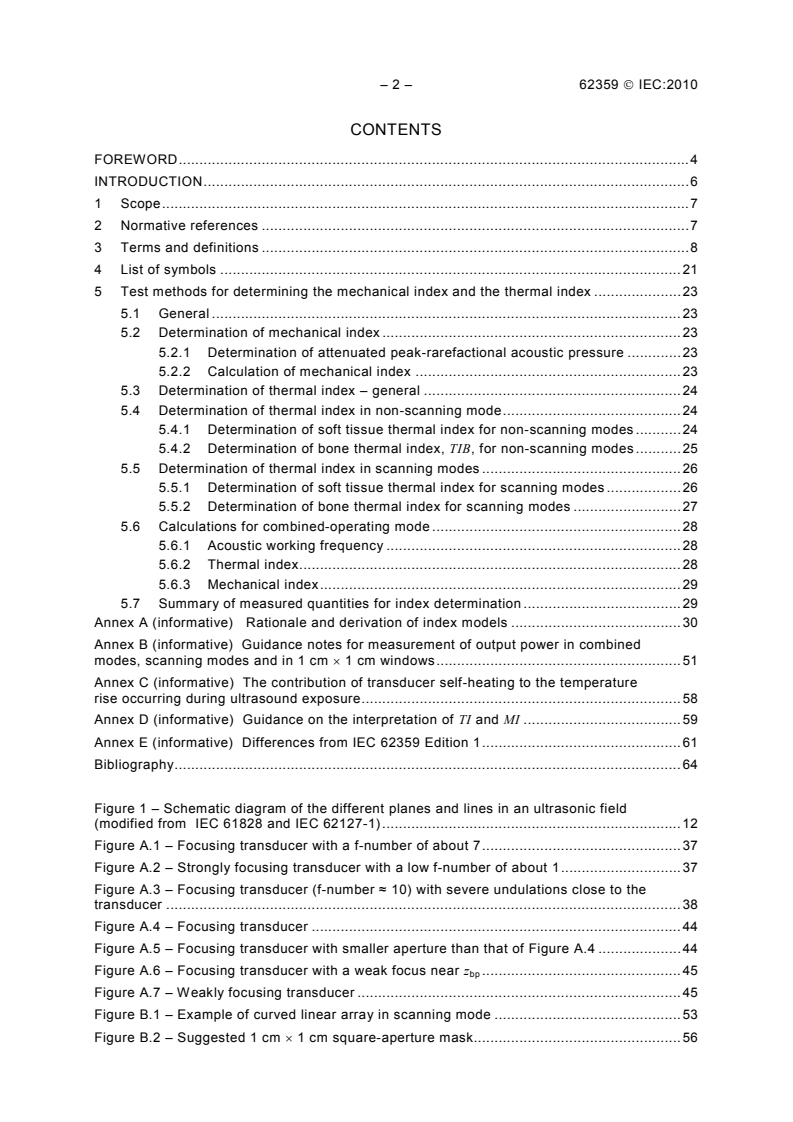
– 2 – 62359 IEC:2010
CONTENTS
FOREWORD . 4
INTRODUCTION . 6
1 Scope . 7
2 Normative references . 7
3 Terms and definitions . 8
4 List of symbols . 21
5 Test methods for determining the mechanical index and the thermal index . 23
5.1 General . 23
5.2 Determination of mechanical index . 23
5.2.1 Determination of attenuated peak-rarefactional acoustic pressure . 23
5.2.2 Calculation of mechanical index . 23
5.3 Determination of thermal index – general . 24
5.4 Determination of thermal index in non-scanning mode . 24
5.4.1 Determination of soft tissue thermal index for non-scanning modes . 24
5.4.2 Determination of bone thermal index, TIB, for non-scanning modes . 25
5.5 Determination of thermal index in scanning modes . 26
5.5.1 Determination of soft tissue thermal index for scanning modes . 26
5.5.2 Determination of bone thermal index for scanning modes . 27
5.6 Calculations for combined-operating mode . 28
5.6.1 Acoustic working frequency . 28
5.6.2 Thermal index . 28
5.6.3 Mechanical index . 29
5.7 Summary of measured quantities for index determination . 29
Annex A (informative) Rationale and derivation of index models . 30
Annex B (informative) Guidance notes for measurement of output power in combined
modes, scanning modes and in 1 cm × 1 cm windows . 51
Annex C (informative) The contribution of transducer self-heating to the temperature
rise occurring during ultrasound exposure . 58
Annex D (informative) Guidance on the interpretation of TI and MI . 59
Annex E (informative) Differences from IEC 62359 Edition 1 . 61
Bibliography . 64
Figure 1 – Schematic diagram of the different planes and lines in an ultrasonic field
(modified from IEC 61828 and IEC 62127-1) . 12
Figure A.1 – Focusing transducer with a f-number of about 7 . 37
Figure A.2 – Strongly focusing transducer with a low f-number of about 1 . 37
Figure A.3 – Focusing transducer (f-number ≈ 10) with severe undulations close to the
transducer . 38
Figure A.4 – Focusing transducer . 44
Figure A.5 – Focusing transducer with smaller aperture than that of Figure A.4 . 44
Figure A.6 – Focusing transducer with a weak focus near z . 45
bp
Figure A.7 – Weakly focusing transducer . 45
Figure B.1 – Example of curved linear array in scanning mode . 53
Figure B.2 – Suggested 1 cm × 1 cm square-aperture mask. 56
62359 IEC:2010 – 3 –
Figure B.3 – Suggested orientation of transducer, mask aperture and RFB target . 56
Figure B.4 – Suggested orientation of transducer and 1 cm-square RFB target . 57
Table 1 – Summary of combination formulae for each of the THERMAL INDEX categories . 28
Table 2 – Summary of the acoustic quantities required for the determination of the
indices . 29
Table A.1 – Thermal index categories and models . 36
Table A.2 – Consolidated thermal index formulae . 41
Table E.1 – Summary of differences . 63
– 4 – 62359 IEC:2010
INTERNATIONAL ELECTROTECHNICAL COMMISSION
____________
ULTRASONICS –
FIELD CHARACTERIZATION –
TEST METHODS FOR THE DETERMINATION OF THERMAL
AND MECHANICAL INDICES RELATED TO
MEDICAL DIAGNOSTIC ULTRASONIC FIELDS
FOREWORD
1) The International Electrotechnical Commission (IEC) is a worldwide organization for standardization comprising
all national electrotechnical committees (IEC National Committees). The object of IEC is to promote
international co-operation on all questions concerning standardization in the electrical and electronic fields. To
this end and in addition to other activities, IEC publishes International Standards, Technical Specifications,
Technical Reports, Publicly Available Specifications (PAS) and Guides (hereafter referred to as “IEC
Publication(s)”). Their preparation is entrusted to technical committees; any IEC National Committee interested
in the subject dealt with may participate in this preparatory work. International, governmental and non-
governmental organizations liaising with the IEC also participate in this preparation. IEC collaborates closely
with the International Organization for Standardization (ISO) in accordance with conditions determined by
agreement between the two organizations.
2) The formal decisions or agreements of IEC on technical matters express, as nearly as possible, an international
consensus of opinion on the relevant subjects since each technical committee has representation from all
interested IEC National Committees.
3) IEC Publications have the form of requirements for international use and are accepted by IEC National
Committees in that sense. While all reasonable efforts are made to ensure that the technical content of IEC
Publications is accurate, IEC cannot be held responsible for the way in which they are used or for any
misinterpretation by any end user.
4) In order to promote international uniformity, IEC National Committees undertake to apply IEC Publications
transparently to the maximum extent possible in their national and regional publications. Any divergence
between any IEC Publication and the corresponding national or regional publication shall be clearly indicated in
the latter.
5) IEC itself does not provide any attestation of conformity. Independent certification bodies provide conformity
assessment services and, in some areas, access to IEC marks of conformity. IEC is not responsible for any
services carried out by independent certification bodies.
6) All users should ensure that they have the latest edition of this publication.
7) No liability shall attach to IEC or its directors, employees, servants or agents including individual experts and
members of its technical committees and IEC National Committees for any personal injury, property damage or
other damage of any nature whatsoever, whether direct or indirect, or for costs (including legal fees) and
expenses arising out of the publication, use of, or reliance upon, this IEC Publication or any other IEC
Publications.
8) Attention is drawn to the Normative references cited in this publication. Use of the referenced publications is
indispensable for the correct application of this publication.
9) Attention is drawn to the possibility that some of the elements of this IEC Publication may be the subject of
patent rights. IEC shall not be held responsible for identifying any or all such patent rights.
International standard IEC 62359 has been prepared by IEC technical committee 87:
Ultrasonics.
This second edition cancels and replaces the first edition, published in 2005. It constitutes a
technical revision.
Major changes with respect to the previous edition include the following:
• The methods of determination set out in the first edition of this standard were based on
those contained in the American standard for Real–Time Display of Thermal and
Mechanical Acoustic Output Indices on Diagnostic Ultrasound Equipment (ODS) and were
intended to yield identical results. While this second edition also follows the ODS in
principal and uses the same basic formulae and assumptions (see Annex A), it contains a
few significant modifications which deviate from the ODS.
62359 IEC:2010 – 5 –
• One of the primary issues dealt with in preparing this second edition of IEC 62359 was
“missing” TI equations. In Edition 1 there were not enough equations to make complete
“at-surface” and “below-surface” summations for TIS and TIB in combined-operating
modes. Thus major changes with respect to the previous edition are related to the
introduction of new calculations of thermal indices to take into account both "at-surface"
and "below-surface" thermal effects.
For the specific technical changes involved please see Annex E.
The text of this standard is based on the following documents:
FDIS Report on voting
87/445/FDIS 87/453/RVD
Full information on the voting for the approval of this standard can be found in the report on
voting indicated in the above table.
This publication has been drafted in accordance with the ISO/IEC Directives, Part 2.
This standard may be used to support the requirements of IEC 60601-2-37.
In this particular standard, the following print types are used:
– requirements, compliance with which can be tested, and definitions: in roman type
– notes, explanations, advice, introductions, general statements, exceptions, and references: in smaller type
– test specifications: in italic type
– words in bold are defined terms in Clause 3
The committee has decided that the contents of this amendment and the base publication will
remain unchanged until the stability date indicated on the IEC web site under
"http://webstore.iec.ch" in the data related to the specific publication. At this date, the
publication will be
• reconfirmed,
• withdrawn,
• replaced by a revised edition, or
• amended.
The contents of the corrigendum of March 2011 have been included in this copy.
IMPORTANT – The 'colour inside' logo on the cover page of this publication indicates
that it contains colours which are considered to be useful for the correct
understanding of its contents. Users should therefore print this document using a
colour printer.
– 6 – 62359 IEC:2010
INTRODUCTION
Medical diagnostic ultrasonic equipment is widely used in clinical practice for imaging and
monitoring purposes. Equipment normally operates at frequencies in the low megahertz
frequency range and comprises an ultrasonic transducer acoustically coupled to the patient
and associated electronics. There is an extremely wide range of different types of systems in
current clinical practice.
The ultrasound entering the patient interacts with the patient's tissue, and this interaction can
be considered in terms of both thermal and non-thermal effects. The purpose of this
International standard is to specify methods of determining thermal and non-thermal exposure
indices that can be used to help in assessing the hazard caused by exposure to a particular
ultrasonic field used for medical diagnosis or monitoring. It is recognised that these indices
have limitations, and knowledge of the indices at the time of an examination is not sufficient in
itself to make an informed clinical risk assessment. It is intended that these limitations will be
addressed in future revisions of this standard and as scientific understanding increases. While
such increases remain pending, several organizations have published prudent-use
statements.
Under certain conditions specified in IEC 60601-2-37, these indices are displayed on medical
ultrasonic equipment intended for these purposes.
62359 IEC:2010 – 7 –
ULTRASONICS –
FIELD CHARACTERIZATION –
TEST METHODS FOR THE DETERMINATION OF THERMAL
AND MECHANICAL INDICES RELATED TO
MEDICAL DIAGNOSTIC ULTRASONIC FIELDS
1 Scope
This International standard is applicable to medical diagnostic ultrasound fields.
This standard establishes
– parameters related to thermal and non-thermal exposure aspects of diagnostic ultrasonic
fields;
– methods for the determination of an exposure parameter relating to temperature rise in
theoretical tissue-equivalent models, resulting from absorption of ultrasound;
– methods for the determination of an exposure parameter appropriate to certain non-
thermal effects.
NOTE 1 In Clause 3 of this standard, SI units are used (per ISO/IEC Directives, Part 2, ed. 5, Annex I b) in the
Notes below definitions of certain parameters, such as beam areas and intensities; it may be convenient to use
decimal multiples or submultiples in practice. Users must take care of decimal prefixes used in combination with
the units when using and calculating numerical data. For example, beam area may be specified in cm and
2 2
intensities in W/cm or mW/cm .
NOTE 2 Underlying calculations have been done from 0,25 MHz to 15 MHz for MI and 0,5 MHz to 15 MHz for TI.
NOTE 3 The thermal indices are steady state estimates based on the acoustic output power required to produce
-1 -1
1)
a 1°C temperature rise in tissue conforming to the “homogeneous tissue 0,3 dBcm MHz attenuation model” [1 ]
and may not be appropriate for radiation force imaging, or similar techniques that employ pulses or pulse bursts of
sufficient duration to create a significant transient temperature rise. [2]
2 Normative references
The following referenced documents are indispensable for the application of this document.
For dated references, only the edition cited applies. For undated references, the latest edition
of the referenced document (including any amendments) applies.
IEC 60601-2-37, Medical electrical equipment – Part 2-37: Particular requirements for the
basic safety and essential performance of ultrasonic medical diagnostic and monitoring
equipment
IEC 61157:2007, Standard means for the reporting of the acoustic output of medical
diagnostic ultrasonic equipment
IEC 61161:2006, Ultrasonics – Power measurement – Radiation force balances and
performance requirements
IEC 61828:2001, Ultrasonics – Focusing transducers – Definitions and measurement methods
for the transmitted fields
IEC 62127-1:2007, Ultrasonics – Hydrophones – Part 1: Measurement and characterization of
medical ultrasonic fields up to 40 MHz
___________
1)
Figures in square brackets refer to Bibliography.
– 8 – 62359 IEC:2010
IEC 62127-2:2007, Ultrasonics – Hydrophones – Part 2: Calibration for ultrasonic fields up to
40 MHz
IEC 62127-3:2007, Ultrasonics – Hydrophones – Part 3: Properties of hydrophones for
ultrasonic fields up to 40 MHz
3 Terms and definitions
For the purposes of this document, the terms and definitions given in IEC 62127-1:2007,
IEC 62127-2:2007, IEC 62127-3:2007, IEC 61157:2007 and IEC 61161:2006 (several of which
are repeated below for convenience) apply.
NOTE Units below definitions are given is SI units as per ISO/IEC Directives, Part 2, ed. 5, Annex I b). Users
must be alert to possible need to convert units when using this standard in situations where data are received in
units that are different from those used in the SI system.
3.1
acoustic attenuation coefficient
a
coefficient intended to account for ultrasonic attenuation of tissue between the external
transducer aperture and a specified point
NOTE 1 A linear dependence on frequency is assumed.
-
-1 1
NOTE 2 Acoustic attenuation coefficient is expressed in decibels per metre per hertz (dB m Hz ).
3.2
acoustic absorption coefficient
m
o
coefficient intended to account for ultrasonic absorption of tissue in the region of interest
NOTE 1 A linear dependence on frequency is assumed.
-
-1 1
NOTE 2 Acoustic absorption coefficient is expressed in neper per metre per hertz (Np m Hz ).
3.3
acoustic repetition period
arp
time interval between corresponding points of consecutive cycles for continuous wave
systems
NOTE 1 The acoustic repetition period is equal to the pulse repetition period for non-automatic scanning
systems and to the scan repetition period for automatic scanning systems.
NOTE 2 The acoustic repetition period is expressed in seconds (s).
[IEC 62127-1:2007, definition 3.2, modified]
3.4
acoustic working frequency
frequency of an acoustic signal based on the observation of the output of a hydrophone
placed in an acoustic field at the position corresponding to the spatial-peak temporal-peak
acoustic pressure
NOTE 1 The signal is analysed using either the zero-crossing acoustic-working frequency technique or a
spectrum analysis method. Specific acoustic-working frequencies are defined in 3.4.1 and 3.4.2.
NOTE 2 For pulsed waveforms the acoustic-working frequency shall be measured at the position of maximum
pulse-pressure-squared integral.
NOTE 3 Acoustic frequency is expressed in hertz (Hz).
[IEC 62127-1:2007, definition 3.3, modified]
62359 IEC:2010 – 9 –
3.4.1
zero-crossing acoustic-working frequency
f
awf
number of consecutive half-cycles (irrespective of polarity) divided by twice the time between
the commencement of the first half-cycle and the end of the n-th half-cycle
NOTE 1 Any half-cycle in which the waveform shows evidence of phase change shall not be counted.
NOTE 2 The measurement should be performed at terminals in the receiver, that are as close as possible to the
receiving transducer (hydrophone) and, in all cases, before rectification.
NOTE 3 This frequency is determined according to the procedure specified in IEC/TR 60854 [3].
NOTE 4 This frequency is intended for continuous-wave systems only.
3.4.2
arithmetic-mean acoustic-working frequency
f
awf
arithmetic mean of the most widely separated frequencies f and f , within the range of three
1 2
times f , at which the magnitude of the acoustic pressure spectrum is 3 dB below the peak
magnitude
NOTE 1 This frequency is intended for pulse-wave systems only.
NOTE 2 It is assumed that f < f .
1 2
NOTE 3 If f is not found within the range < 3 f , f is to be understood as the lowest frequency above this range
2 1 2
at which the spectrum magnitude is -3 dB from the peak magnitude.
3.5
attenuated bounded-square output power
P (z)
1x1,α
The maximum value of the attenuated output power passing through any one square
centimeter of the plane perpendicular to the beam axis at depth z
NOTE 1 At z = 0 (the transducer surface) P (z) becomes the bounded-square output power, that is, at z = 0,
1x1,α
P = P .
1x1,α 1x1
NOTE 2 Attenuated bounded-square output power is expressed in watts (W).
3.6
attenuated output power
P (z)
α
value of the acoustic output power after attenuation, at a specified distance from the
external transducer aperture, and given by
(-a z f /10dB)
awf
P (z) = P 10 (1)
a
where
a is the acoustic attenuation coefficient;
z is the distance from the external transducer aperture to the point of interest;
f is the acoustic working frequency;
awf
P is the output power measured in water.
NOTE 1 Attenuated output power is expressed in watts (W).
NOTE 2 In the case of stand-offs the P should represent the output power emanating from the stand-off.
3.7
attenuated peak-rarefactional acoustic pressure
p (z)
r,a
value of the peak-rarefactional acoustic pressure after attenuation, at a specified distance
from the external transducer aperture, and given by
– 10 – 62359 IEC:2010
(-a z f /20dB)
awf
p (z) = p (z) 10 (2)
r , α r
where
a is the acoustic attenuation coefficient;
z is the distance from the external transducer aperture to the point of interest;
f is the acoustic working frequency;
awf
p (z) is the peak-rarefactional acoustic pressure measured in water.
r
NOTE Attenuated peak-rarefactional acoustic pressure is expressed in pascals (Pa).
3.8
attenuated pulse-intensity integral
pii (z)
a
value of the pulse-intensity integral after attenuation, at a specified distance from the
external transducer aperture, and given by
(-a z f /10dB)
awf
pii (z) = pii 10 (3)
a
where
a is the acoustic attenuation coefficient;
z is the distance from the external transducer aperture to the point of interest;
f is the acoustic working frequency;
awf
pii is the pulse-intensity integral measured in water.
–2
NOTE Attenuated pulse-intensity integral is expressed in joules per metre squared, (J m ).
3.9
attenuated spatial-average temporal-average intensity
I (z)
sata,a
value of the spatial-average temporal-average intensity after attenuation, at a specified
distance from the external transducer aperture, and given by
(-a z f /10dB)
awf
I (z) = I 10 (4)
sata ,α sata
where
a is the acoustic attenuation coefficient;
z is the distance from the external transducer aperture to the point of interest;
f is the acoustic working frequency;
awf
I is the spatial-average temporal-average intensity, at a specified distance z
sata
measured in water.
–2
NOTE Attenuated spatial-average temporal-average intensity is expressed in watts per metre squared, (W m ).
3.10
attenuated spatial-peak temporal-average intensity
I (z)
spta,a
value of the spatial-peak temporal-average intensity after attenuation, at a specified
distance from the external transducer aperture, and given by
(-a z f /10dB)
awf
I (z) = I 10 (5)
spta ,α spta
where
62359 IEC:2010 – 11 –
a is the acoustic attenuation coefficient;
z is the distance from the external transducer aperture to the point of interest;
f is the acoustic working frequency;
awf
I is the spatial-peak temporal-average intensity, at a specified distance z measured in
spta
water.
–2
NOTE Attenuated spatial-peak temporal-average intensity is expressed in watts per metre squared, (W m ).
3.11
attenuated temporal-average intensity
I (z)
ta,a
value of the temporal-average intensity after attenuation, at a specified distance from the
external transducer aperture, and given by
(-a z f /10dB)
awf
I (z) = I (z) 10 (6)
ta ,α ta
where
a is the acoustic attenuation coefficient;
z is the distance from the external transducer aperture to the point of interest;
f is the acoustic working frequency;
awf
I (z) is the temporal-average intensity measured in water.
ta
–2
NOTE Attenuated temporal-average intensity is expressed in watts per metre squared, (W m ).
3.12
beam area
A (z)
b
area in a specified plane perpendicular to the beam axis consisting of all points at which the
pulse-pressure-squared integral is greater than a specified fraction of the maximum value
of the pulse-pressure-squared integral in that plane
NOTE 1 If the position of the plane is not specified, it is the plane passing through the point corresponding to the
spatial-peak temporal-peak acoustic pressure in the whole acoustic field.
NOTE 2 In a number of cases, the term pulse-pressure-squared integral is replaced everywhere in the above
definition by any linearly related quantity, e.g.:
a) in the case of a continuous wave signal the term pulse-pressure-squared integral is replaced by mean square
acoustic pressure as defined in IEC 61689 [4];
b) in cases where signal synchronisation with the scanframe is not available, the term pulse-pressure-squared
integral may be replaced by temporal average intensity.
NOTE 3 Some specified levels are 0,25 and 0,01 for the -6 dB and -20 dB beam areas, respectively.
NOTE 4 Beam area is expressed in metres squared (m ).
[IEC 62127-1:2007, definition 3.7, modified]
3.13
beam axis
straight line that passes through the beam centrepoints of two planes perpendicular to the line
which connects the point of maximal pulse-pressure-squared integral with the centre of the
external transducer aperture
NOTE 1 See Figure 1.
NOTE 2 The location of the first plane is the location of the plane containing the maximum pulse-pressure-
squared integral or, alternatively, is one containing a single main lobe which is in the focal Fraunhofer zone. The
location of the second plane is as far as is practicable from the first plane and parallel to the first with the same two
orthogonal scan lines (x and y axes) used for the first plane.
– 12 – 62359 IEC:2010
NOTE 3 In a number of cases, the term pulse-pressure-squared integral is replaced in the above definition by
any linearly related quantity, e.g.:
a) in the case of a continuous wave signal the term pulse-pressure-squared integral is replaced by mean square
acoustic pressure as defined in IEC 61689,
b) in cases where signal synchronisation with the scan frame is not available the term pulse-pressure-squared
integral may be replaced by temporal average intensity.
[IEC 62127-1:2007, definition 3.8]
External transducer
Elevation axis (y)
aperture plane (xy)
Azimuth axis (x)
Beam area plane (xy)
Beamwidth axis
Azimuth plane
scan plane (xz)
Elevation direction (y)
Elevation plane (yz)
Beam axis (z)
Azimuth direction (x)
IEC 2143/10
Figure 1 – Schematic diagram of the different planes and lines in an ultrasonic field
(modified from IEC 61828 and IEC 62127-1)
3.14
beam centrepoint
position determined by the 2D centroid of a set of pulse-pressure-squared integrals
measured over the -6dB beam-area in a specified plane
NOTE Methods for determining 2D centroids are described in Annex B and C of IEC 61828.
3.15
beamwidth midpoint
linear average of the coordinates of the locations midway between each pair of points
determining a beamwidth in a specified plane
NOTE The average is taken over as many beamwidth levels given in B.2 of IEC 61828 as signal level permits.
[IEC 62127-1:2007, definition 3.10, modified]
3.16
beamwidth
w , w , w
6 12 20
greatest distance between two points on a specified axis perpendicular to the beam axis
where the pulse-pressure-squared integral falls below its maximum on the specified axis by
a specified amount
NOTE 1 In a number of cases, the term pulse-pressure-squared integral is replaced in the above definition by
any linearly related quantity, e.g.:
62359 IEC:2010 – 13 –
a) in the case of a continuous wave signal the term pulse-pressure-squared integral is replaced by mean square
acoustic pressure as defined in IEC 61689 [4],
b) in cases where signal synchronisation with the scan frame is not available the term pulse-pressure-squared
integral may be replaced by temporal average intensity.
NOTE 2 Commonly used beamwidths are specified at –6 dB, –12 dB and –20 dB levels below the maximum. The
decibel calculation implies taking 10 times the logarithm to the base of 10 of the ratios of the integrals.
NOTE 3 Beamwidth is expressed in metres (m).
[IEC 62127-1:2007, definition 3.11]
3.17
bone thermal index
TIB
thermal index for applications, such as foetal (second and third trimester) or neonatal
cephalic (through the fontanelle), in which the ultrasound beam passes through soft tissue
and a focal region is in the immediate vicinity of bone
NOTE 1 See 5.4.2 and 5.5.2 for methods of determining the bone thermal index.
NOTE 2 See Annex A for rationale and derivation notes.
3.18
bounded-square output power
P
1x1
maximum value of the time average acoustic output power emitted from any one-centimetre
square region of the active area of the transducer, the one-centimetre square region having
1 cm dimensions in the x- and y-directions
NOTE 1 The side of the 1 cm × 1 cm square should be aligned with the azimuth axis in accordance with Figure
1. See A.4.1.4 and Annex B for more detail.
NOTE 2 Bounded-square output power is expressed in watts (W).
3.19
break-point depth
z
bp
closest distance, to the solid surface of the transducer or the enclosure of any stand-off path,
used during a search to determine below-surface TIS and TIB
z = 1,5 x D (7)
bp eq
where D is the equivalent aperture diameter.
eq
NOTE 1 Specifically, for the mechanical index: the search should continue till the depth z . Reasonable care
MI
should be taken not to go so close to the transducer face as to risk the integrity of the hydrophone or the validity of
the measurement.
NOTE 2 For scanning modes, D is calculated using the output beam area of one ultrasonic scan line; the
eq
central scan line, corresponding to the beam axis (i.e. the line where pii MI, and f are measured).
, awf
NOTE 3 See Annex A for rationale and derivation notes.
NOTE 4 Breakpoint depth is expressed in metres (m).
3.20
combined-operating mode
mode of operation of an equipment that combines more than one discrete-operating mode
[IEC 61157:2007, definition 3.17.1]
3.21
cranial-bone thermal index
TIC
– 14 – 62359 IEC:2010
thermal index for applications, such as paediatric and adult cranial applications, in which the
ultrasound beam passes through bone near the beam entrance into the body
NOTE 1 See 5.4.2.1 and 5.5.2.1 for methods of determining the cranial bone thermal index.
NOTE 2 See Annex A for rationale and derivation notes.
3.22
default setting
specific state of control that the ultrasonic diagnostic equipment will enter upon power-up,
new patient selection or change from non-foetal to foetal applications
3.23
depth for mechanical index
z
MI
depth on the beam axis from the external transducer aperture to the plane of maximum
attenuated pulse-intensity integral (pii )
a
NOTE Depth for mechanical index is expressed in metres (m).
3.24
depth for peak pulse-intensity integral
z
pii
depth on the beam axis from the external transducer aperture to the plane of maximum
pulse-intensity integral (pii) as approximated by the pulse-pressure-squared integral
(ppsi)
NOTE Depth for peak pulse-intensity integral is expressed in metres (m).
3.25
depth for TIB
z for non-scanning modes
b,ns
for non-scanning modes, the distance along the beam axis from the external transducer
aperture to the plane where the product of attenuated output power and attenuated
spatial-peak temporal-average intensity is a maximum over the distance range equal to, or
greater than, the break-point depth, z
bp
NOTE 1 Depth for TIB is expressed in metres (m).
NOTE 2 See Annex A for rationale and derivation notes.
3.26
depth for TIS
z for non-scanning modes
s,ns
for non-scanning modes, the distance along the beam axis from the external transducer
aperture to the plane at which the lower value of the attenuated output power and the
product of the attenuated spatial-peak temporal-average intensity and 1 cm is maximized
over the distance range equal to, or greater than, the break-point depth, z
bp
NOTE 1 In this standard, the restricted definition of spatial-peak temporal-average intensity from IEC 62127-1,
relating to a specified plane, is used where spatial-peak temporal-average intensity is replaced by attenuated
spatial-peak temporal-average intensity.
NOTE 2 Depth for TIS is expressed in metres (m).
NOTE 3 See Annex A for rationale and derivation notes.
3.27
Discrete-perating mode
mode of operation of ultrasonic diagnostic equipment in which the purpose of the excitation
of the ultrasonic transducer or ultrasonic transducer element group is to utilize only one
diagnostic methodology
[IEC 61157:2007, definition 3.17.2, modified]
62359 IEC:2010 – 15 –
3.28
equivalent aperture diameter
D
eq
diameter of a circle whose area is the output beam area and given by
D = A (8)
eq ob
π
where A is the output beam area.
ob
NOTE 1 This formula gives the diameter of a circle whose area is the –12 dB output beam area. It is used in the
calculation of the cranial-bone thermal index and the soft tissue thermal index.
NOTE 2 Equivalent aperture diameter is expressed in metres (m).
3.29
equivalent beam area
A (z)
eq
area of the acoustic beam at the distance z in terms of power and intensity and given by
P (z) P
α
( )
A z = = (9)
eq
I (z) I
spta ,a spta
where
P (z) is the attenuated output power, at the distance z;
a
I (z) is the attenuated spatial-peak temporal-average intensity, at the distance z;
spta, a
P is the output power;
I is the spatial-peak temporal-average intensity, at the distance z; and
spta
z is the distance from the external transducer aperture to the specified point.
NOTE Equivalent beam area is expressed in metres squared (m ).
3.30
equivalent beam diameter
d (z)
eq
diameter of the acoustic beam at the distance z in terms of the equivalent beam area and
given by
d (z) = A (z) (10)
eq eq
π
where
A (z) is the equivalent beam area;
eq
z is the distance from the external transducer aperture to the specified point.
NOTE Equivalent beam diameter is expressed in metres (m).
3.31
external transducer aperture
part of the surface of the ultrasonic transducer or ultrasonic transducer element group
assembly that emits ultrasonic radiation into the propagation medium
NOTE 1 This surface is assumed to be either directly in contact with the patient or in contact with a water or liquid
path to the patient. See Figure 1.
NOTE 2 The ultrasonic transducer element group is usually offset from this surface by a lens, matching layers
and possibly fluid.
– 16 – 62359 IEC:2010
[IEC 62127-1:2007, definition 3.27, modified]
3.32
mechanical index
MI
mechanical index is given by
−1/2
p (z ) f
r,α MI awf
MI = (11)
C
MI
where
-!/2
C = 1 MPa·MHz
MI
p (z ) is the attenuated peak-rarefactional acoustic pressure at the depth z
r,α MI MI
f is the acoustic-working frequency.
awf
NOTE 1 See Annex A for rationale and derivation notes.
3.33
medical diagnostic ultrasonic equipment (or system)
combination of the ultrasound instrument console and the transducer assembly making up
a complete diagnostic system
[IEC 61157:2007, definition 3.15]
NOTE For the purpose of this standard, medical diagnostic ultrasonic equipment (or system) means
electrical equipment that is intended for in vivo ultrasonic examination and monitoring for obtaining a medical
diagnosis.
3.34
non-scanning mode
mode of operation of ultrasonic diagnostic equipment that involves a sequence of
ultrasonic pulses which give rise to ultrasonic scan lines that follow the same acoustic path
[IEC 62127-1:2007, definition 3.39.4, modified]
3.35
output beam area
A
ob
area of the ultrasonic beam derived from the -12 dB beam area at the external transducer
aperture
NOTE 1 For reasons of measurement accuracy, the –12 dB output beam area may be derived from
measurements at a distance chosen to be as close as possible to the face of the transducer, and, if possible, no
more than 1 mm from the face.
NOTE 2 For contact transducers, this area can be taken as the geometrical area of the ultrasonic transducer or
ultrasonic transducer element group.
NOTE 3 The output beam area is expressed in metres squared (m ).
NOTE 4 Methodology for finding the beam area using the pulse-pressure-squared integral for focused fields is
described in clauses 6.2 and 6.3 of IEC 61828.
[IEC 62127-1:2007, definition 3.40]
3.36
output beam dimensions
X , Y
ob ob
dimensions of the ultrasonic beam (–12 dB beamwidth) in specified directions perpendicular
to each other and in a direction normal to the beam axis and at the external transducer
aperture
62359 IEC:2010 – 17 –
NOTE 1 For reasons of measurement accuracy, the –12 dB output beam dimensions may be derived from
measurements at a distance chosen to be as close as possible to the face of the transducer and, if possible, no
more than 1 mm from the face.
NOTE 2 For contact transducers, these dimensions can be taken as the geometrical dimensions of the ultrasonic
transducer or ultrasonic transducer element group.
NOTE 3 Output beam dimensions are expressed in metres (m).
NOTE 4 Methodology for finding the beam area using the pulse-pressure-squared integral for focused fields is
described in 6.2 and 6.3 of IEC 61828.
[IEC 62127-1:2007, definition 3.41, modified]
3.37
output power
P
time-average ultrasonic power emitted by an ultrasonic transducer into an approximately
free field under specified conditions in a specified medium, preferably water
[IEC 61161:2006, definition 3.3]
NOTE 1 "time-average" means averaged over an integral multiple of the temporal periodicity.
NOTE 2 Output power is expressed in watts (W).
3.38
peak-rarefactional acoustic pressure
p
r
maximum of the modulus of the negative instantaneous acoustic pressure in an acoustic
field or in a specified plane during an acoustic repetition period
NOTE 1 Peak-rarefactional acoustic pressure is expressed as a positive number.
NOTE 2 P
...
IEC 62359 ®
Edition 2.1 2017-09
CONSOLIDATED VERSION
INTERNATIONAL
STANDARD
NORME
INTERNATIONALE
colour
inside
Ultrasonics – Field characterization – Test methods for the determination of
thermal and mechanical indices related to medical diagnostic ultrasonic fields
Ultrasons – Caractérisation du champ – Méthodes d'essai pour la détermination
d'indices thermique et mécanique des champs d'ultrasons utilisés pour le
diagnostic médical
All rights reserved. Unless otherwise specified, no part of this publication may be reproduced or utilized in any form
or by any means, electronic or mechanical, including photocopying and microfilm, without permission in writing from
either IEC or IEC's member National Committee in the country of the requester. If you have any questions about IEC
copyright or have an enquiry about obtaining additional rights to this publication, please contact the address below or
your local IEC member National Committee for further information.
Droits de reproduction réservés. Sauf indication contraire, aucune partie de cette publication ne peut être reproduite
ni utilisée sous quelque forme que ce soit et par aucun procédé, électronique ou mécanique, y compris la photocopie
et les microfilms, sans l'accord écrit de l'IEC ou du Comité national de l'IEC du pays du demandeur. Si vous avez des
questions sur le copyright de l'IEC ou si vous désirez obtenir des droits supplémentaires sur cette publication, utilisez
les coordonnées ci-après ou contactez le Comité national de l'IEC de votre pays de résidence.
IEC Central Office Tel.: +41 22 919 02 11
3, rue de Varembé info@iec.ch
CH-1211 Geneva 20 www.iec.ch
Switzerland
About the IEC
The International Electrotechnical Commission (IEC) is the leading global organization that prepares and publishes
International Standards for all electrical, electronic and related technologies.
About IEC publications
The technical content of IEC publications is kept under constant review by the IEC. Please make sure that you have the
latest edition, a corrigenda or an amendment might have been published.
IEC Catalogue - webstore.iec.ch/catalogue Electropedia - www.electropedia.org
The stand-alone application for consulting the entire The world's leading online dictionary of electronic and
bibliographical information on IEC International Standards, electrical terms containing 21 000 terms and definitions in
Technical Specifications, Technical Reports and other English and French, with equivalent terms in 16 additional
documents. Available for PC, Mac OS, Android Tablets and languages. Also known as the International Electrotechnical
iPad. Vocabulary (IEV) online.
IEC publications search - webstore.iec.ch/advsearchform IEC Glossary - std.iec.ch/glossary
The advanced search enables to find IEC publications by a 67 000 electrotechnical terminology entries in English and
variety of criteria (reference number, text, technical French extracted from the Terms and Definitions clause of
committee,…). It also gives information on projects, replaced IEC publications issued since 2002. Some entries have been
and withdrawn publications. collected from earlier publications of IEC TC 37, 77, 86 and
CISPR.
IEC Just Published - webstore.iec.ch/justpublished
Stay up to date on all new IEC publications. Just Published IEC Customer Service Centre - webstore.iec.ch/csc
details all new publications released. Available online and If you wish to give us your feedback on this publication or
also once a month by email. need further assistance, please contact the Customer Service
Centre: sales@iec.ch.
A propos de l'IEC
La Commission Electrotechnique Internationale (IEC) est la première organisation mondiale qui élabore et publie des
Normes internationales pour tout ce qui a trait à l'électricité, à l'électronique et aux technologies apparentées.
A propos des publications IEC
Le contenu technique des publications IEC est constamment revu. Veuillez vous assurer que vous possédez l’édition la
plus récente, un corrigendum ou amendement peut avoir été publié.
Catalogue IEC - webstore.iec.ch/catalogue Electropedia - www.electropedia.org
Application autonome pour consulter tous les renseignements
Le premier dictionnaire en ligne de termes électroniques et
bibliographiques sur les Normes internationales,
électriques. Il contient 21 000 termes et définitions en anglais
Spécifications techniques, Rapports techniques et autres
et en français, ainsi que les termes équivalents dans 16
documents de l'IEC. Disponible pour PC, Mac OS, tablettes
langues additionnelles. Egalement appelé Vocabulaire
Android et iPad.
Electrotechnique International (IEV) en ligne.
Recherche de publications IEC -
Glossaire IEC - std.iec.ch/glossary
webstore.iec.ch/advsearchform
67 000 entrées terminologiques électrotechniques, en anglais
La recherche avancée permet de trouver des publications IEC et en français, extraites des articles Termes et Définitions des
en utilisant différents critères (numéro de référence, texte, publications IEC parues depuis 2002. Plus certaines entrées
comité d’études,…). Elle donne aussi des informations sur les antérieures extraites des publications des CE 37, 77, 86 et
projets et les publications remplacées ou retirées. CISPR de l'IEC.
IEC Just Published - webstore.iec.ch/justpublished Service Clients - webstore.iec.ch/csc
Restez informé sur les nouvelles publications IEC. Just Si vous désirez nous donner des commentaires sur cette
Published détaille les nouvelles publications parues. publication ou si vous avez des questions contactez-nous:
Disponible en ligne et aussi une fois par mois par email. sales@iec.ch.
IEC 62359 ®
Edition 2.1 2017-09
CONSOLIDATED VERSION
INTERNATIONAL
STANDARD
NORME
INTERNATIONALE
colour
inside
Ultrasonics – Field characterization – Test methods for the determination of
thermal and mechanical indices related to medical diagnostic ultrasonic fields
Ultrasons – Caractérisation du champ – Méthodes d'essai pour la détermination
d'indices thermique et mécanique des champs d'ultrasons utilisés pour le
diagnostic médical
INTERNATIONAL
ELECTROTECHNICAL
COMMISSION
COMMISSION
ELECTROTECHNIQUE
INTERNATIONALE
ICS 17.140.50 ISBN 978-2-8322-4885-0
IEC 62359 ®
Edition 2.1 2017-09
CONSOLIDATED VERSION
REDLINE VERSION
VERSION REDLINE
colour
inside
Ultrasonics – Field characterization – Test methods for the determination of
thermal and mechanical indices related to medical diagnostic ultrasonic fields
Ultrasons – Caractérisation du champ – Méthodes d'essai pour la détermination
d'indices thermique et mécanique des champs d'ultrasons utilisés pour le
diagnostic médical
– 2 – IEC 62359:2010+AMD1:2017 CSV
IEC 2017
CONTENTS
FOREWORD. 4
INTRODUCTION . 6
INTRODUCTION to Amendment . 6
1 Scope . 7
2 Normative references . 7
3 Terms and definitions . 8
4 List of symbols . 27
5 Test methods for determining the mechanical index and the thermal index . 29
5.1 General . 29
5.2 Determination of mechanical index . 30
5.2.1 Determination of attenuated peak-rarefactional acoustic pressure . 30
5.2.2 Calculation of mechanical index . 30
5.3 Determination of thermal index – general . 30
5.4 Determination of thermal index in non-scanning mode . 30
5.4.1 Determination of soft tissue thermal index for non-scanning modes . 30
5.4.2 Determination of bone thermal index, TIB, for non-scanning modes . 32
5.5 Determination of thermal index in scanning modes . 33
5.5.1 Determination of soft tissue thermal index for scanning modes . 33
5.5.2 Determination of bone thermal index for scanning modes . 33
5.6 Calculations for combined-operating mode . 34
5.6.1 Acoustic working frequency . 34
5.6.2 Thermal index . 34
5.6.3 Mechanical index . 35
5.7 Summary of measured quantities for index determination . 35
Annex A (informative) Rationale and derivation of index models . 37
Annex B (informative) Guidance notes for measurement of output power in combined
modes, scanning modes and in 1 cm × 1 cm windows . 59
Annex C (informative) The contribution of transducer self-heating to the temperature
rise occurring during ultrasound exposure . 66
Annex D (informative) Guidance on the interpretation of TI and MI . 67
Annex E (informative) Differences from IEC 62359 Edition 1 . 69
Annex F (informative) Rationale and determination of maximum non-attenuated and
attenuated spatial-peak temporal-average intensity and spatial-peak pulse-average
intensity values . 72
Bibliography . 83
Figure 1 – Schematic diagram of the different planes and lines in an ultrasonic field
(modified from IEC 61828 and IEC 62127-1) . 12
Figure A.1 – Focusing transducer with a f-number of about 7 . 44
Figure A.2 – Strongly focusing transducer with a low f-number of about 1 . 45
Figure A.3 – Focusing transducer (f-number ≈ 10) with severe undulations close to the
transducer . 45
Figure A.4 – Focusing transducer . 52
Figure A.5 – Focusing transducer with smaller aperture than that of Figure A.4 . 52
Figure A.6 – Focusing transducer with a weak focus near zbp . 53
IEC 2017
Figure A.7 – Weakly focusing transducer . 53
Figure B.1 – Example of curved linear array in scanning mode . 61
Figure B.2 – Suggested 1 cm × 1 cm square-aperture mask . 64
Figure B.3 – Suggested orientation of transducer, mask aperture and RFB target . 64
Figure B.4 – Suggested orientation of transducer and 1 cm-square RFB target . 65
Table 1 – Summary of combination formulae for each of the THERMAL INDEX categories . 35
Table 2 – Summary of the acoustic quantities required for the determination of the
indices . 36
Table A.1 – Thermal index categories and models . 43
Table A.2 – Consolidated thermal index formulae . 49
Table E.1 – Summary of differences . 71
– 4 – IEC 62359:2010+AMD1:2017 CSV
IEC 2017
INTERNATIONAL ELECTROTECHNICAL COMMISSION
____________
ULTRASONICS –
FIELD CHARACTERIZATION –
TEST METHODS FOR THE DETERMINATION OF THERMAL
AND MECHANICAL INDICES RELATED TO
MEDICAL DIAGNOSTIC ULTRASONIC FIELDS
FOREWORD
1) The International Electrotechnical Commission (IEC) is a worldwide organization for standardization comprising
all national electrotechnical committees (IEC National Committees). The object of IEC is to promote
international co-operation on all questions concerning standardization in the electrical and electronic fields. To
this end and in addition to other activities, IEC publishes International Standards, Technical Specifications,
Technical Reports, Publicly Available Specifications (PAS) and Guides (hereafter referred to as “IEC
Publication(s)”). Their preparation is entrusted to technical committees; any IEC National Committee interested
in the subject dealt with may participate in this preparatory work. International, governmental and non-
governmental organizations liaising with the IEC also participate in this preparation. IEC collaborates closely
with the International Organization for Standardization (ISO) in accordance with conditions determined by
agreement between the two organizations.
2) The formal decisions or agreements of IEC on technical matters express, as nearly as possible, an international
consensus of opinion on the relevant subjects since each technical committee has representation from all
interested IEC National Committees.
3) IEC Publications have the form of recommendations for international use and are accepted by IEC National
Committees in that sense. While all reasonable efforts are made to ensure that the technical content of IEC
Publications is accurate, IEC cannot be held responsible for the way in which they are used or for any
misinterpretation by any end user.
4) In order to promote international uniformity, IEC National Committees undertake to apply IEC Publications
transparently to the maximum extent possible in their national and regional publications. Any divergence
between any IEC Publication and the corresponding national or regional publication shall be clearly indicated in
the latter.
5) IEC itself does not provide any attestation of conformity. Independent certification bodies provide conformity
assessment services and, in some areas, access to IEC marks of conformity. IEC is not responsible for any
services carried out by independent certification bodies.
6) All users should ensure that they have the latest edition of this publication.
7) No liability shall attach to IEC or its directors, employees, servants or agents including individual experts and
members of its technical committees and IEC National Committees for any personal injury, property damage or
other damage of any nature whatsoever, whether direct or indirect, or for costs (including legal fees) and
expenses arising out of the publication, use of, or reliance upon, this IEC Publication or any other IEC
Publications.
8) Attention is drawn to the Normative references cited in this publication. Use of the referenced publications is
indispensable for the correct application of this publication.
9) Attention is drawn to the possibility that some of the elements of this IEC Publication may be the subject of
patent rights. IEC shall not be held responsible for identifying any or all such patent rights.
This consolidated version of the official IEC Standard and its amendment has been prepared
for user convenience.
IEC 62359 edition 2.1 contains the second edition (2010-10) [documents 87/445/FDIS and
87/453/RVD] and its corrigendum 1 (2011-03), and its amendment 1 (2017-09) [documents
87/661/FDIS and 87/665/RVD].
In this Redline version, a vertical line in the margin shows where the technical content is
modified by amendment 1. Additions are in green text, deletions are in strikethrough red text.
A separate Final version with all changes accepted is available in this publication.
IEC 2017
International standard IEC 62359 has been prepared by IEC technical committee 87:
Ultrasonics.
This second edition It constitutes a technical revision.
Major changes with respect to the previous edition include the following:
• The methods of determination set out in the first edition of this standard were based on
those contained in the American standard for Real–Time Display of Thermal and
Mechanical Acoustic Output Indices on Diagnostic Ultrasound Equipment (ODS) and were
intended to yield identical results. While this second edition also follows the ODS in
principal and uses the same basic formulae and assumptions (see Annex A), it contains a
few significant modifications which deviate from the ODS.
• One of the primary issues dealt with in preparing this second edition of IEC 62359 was
“missing” TI equations. In Edition 1 there were not enough equations to make complete
“at-surface” and “below-surface” summations for TIS and TIB in combined-operating
modes. Thus major changes with respect to the previous edition are related to the
introduction of new calculations of thermal indices to take into account both "at-surface"
and "below-surface" thermal effects.
For the specific technical changes involved please see Annex E.
This publication has been drafted in accordance with the ISO/IEC Directives, Part 2.
This standard may be used to support the requirements of IEC 60601-2-37.
In this particular standard, the following print types are used:
– requirements, compliance with which can be tested, and definitions: in roman type
– notes, explanations, advice, introductions, general statements, exceptions, and references: in smaller type
– test specifications: in italic type
– words in bold are defined terms in Clause 3
The committee has decided that the contents of the base publication and its amendment will
remain unchanged until the stability date indicated on the IEC web site under
"http://webstore.iec.ch" in the data related to the specific publication. At this date, the
publication will be
• reconfirmed,
• withdrawn,
• replaced by a revised edition, or
• amended.
IMPORTANT – The 'colour inside' logo on the cover page of this publication indicates
that it contains colours which are considered to be useful for the correct
understanding of its contents. Users should therefore print this document using a
colour printer.
– 6 – IEC 62359:2010+AMD1:2017 CSV
IEC 2017
INTRODUCTION
Medical diagnostic ultrasonic equipment is widely used in clinical practice for imaging and
monitoring purposes. Equipment normally operates at frequencies in the low megahertz
frequency range and comprises an ultrasonic transducer acoustically coupled to the patient
and associated electronics. There is an extremely wide range of different types of systems in
current clinical practice.
The ultrasound entering the patient interacts with the patient's tissue, and this interaction can
be considered in terms of both thermal and non-thermal effects. The purpose of this
International standard is to specify methods of determining thermal and non-thermal exposure
indices that can be used to help in assessing the hazard caused by exposure to a particular
ultrasonic field used for medical diagnosis or monitoring. It is recognised that these indices
have limitations, and knowledge of the indices at the time of an examination is not sufficient in
itself to make an informed clinical risk assessment. It is intended that these limitations will be
addressed in future revisions of this standard and as scientific understanding increases. While
such increases remain pending, several organizations have published prudent-use
statements.
Under certain conditions specified in IEC 60601-2-37, these indices are displayed on medical
ultrasonic equipment intended for these purposes.
INTRODUCTION to Amendment
The second edition of IEC 62359 was published in 2010. Since then,
IEC 60601-2-37:2007/AMD1:2015 has been published and calls for provision of attenuated
spatial peak temporal average intensity, I , and attenuated spatial peak pulse
spta,α
average intensity, I , at specific spatial maximum points in the ultrasonic field on the
sppa,α
beam axis. No IEC standard describes the determination of these quantities at these specific
positions. IEC 62359 for determining the thermal indices currently uses similar values at other
positions, therefore, the determination of attenuated spatial peak temporal average
intensity, I , and attenuated spatial peak pulse average intensity, I , has been
spta,α sppa,α
added as an annex in this amendment.
Additionally, references to newly published collateral standards have been updated.
IEC 2017
ULTRASONICS –
FIELD CHARACTERIZATION –
TEST METHODS FOR THE DETERMINATION OF THERMAL
AND MECHANICAL INDICES RELATED TO
MEDICAL DIAGNOSTIC ULTRASONIC FIELDS
1 Scope
This International standard is applicable to medical diagnostic ultrasound fields.
This standard establishes
– parameters related to thermal and non-thermal exposure aspects of diagnostic ultrasonic
fields;
– methods for the determination of an exposure parameter relating to temperature rise in
theoretical tissue-equivalent models, resulting from absorption of ultrasound;
– methods for the determination of an exposure parameter appropriate to certain non-
thermal effects.
NOTE 1 In Clause 3 of this standard, SI units are used (per ISO/IEC Directives, Part 2, ed. 5, Annex I b) in the
Notes below definitions of certain parameters, such as beam areas and intensities; it may be convenient to use
decimal multiples or submultiples in practice. Users must take care of decimal prefixes used in combination with
the units when using and calculating numerical data. For example, beam area may be specified in cm and
2 2
intensities in W/cm or mW/cm .
NOTE 2 Underlying calculations have been done from 0,25 MHz to 15 MHz for MI and 0,5 MHz to 15 MHz for TI.
NOTE 3 The thermal indices are steady state estimates based on the acoustic output power required to produce
-1 -1 )
a 1°C temperature rise in tissue conforming to the “homogeneous tissue 0,3 dBcm MHz attenuation model” [1]
and may not be appropriate for radiation force imaging, or similar techniques that employ pulses or pulse bursts of
sufficient duration to create a significant transient temperature rise.[2]
2 Normative references
The following referenced documents are indispensable for the application of this document.
For dated references, only the edition cited applies. For undated references, the latest edition
of the referenced document (including any amendments) applies.
IEC 60601-2-37:2007, Medical electrical equipment – Part 2-37: Particular requirements for
the basic safety and essential performance of ultrasonic medical diagnostic and monitoring
equipment
IEC 60601-2-37:2007/AMD1:2015
IEC 61157:2007, Standard means for the reporting of the acoustic output of medical
diagnostic ultrasonic equipment
IEC 61157:2007/AMD1:2013
IEC 61161:2006 2013, Ultrasonics – Power measurement – Radiation force balances and
performance requirements
IEC 61828:2001, Ultrasonics – Focusing transducers – Definitions and measurement methods
for the transmitted fields
___________
1)
Figures in square brackets refer to Bibliography.
– 8 – IEC 62359:2010+AMD1:2017 CSV
IEC 2017
IEC 62127-1:2007, Ultrasonics – Hydrophones – Part 1: Measurement and characterization of
medical ultrasonic fields up to 40 MHz
IEC 62127-1:2007/AMD1:2013
IEC 62127-2:2007, Ultrasonics – Hydrophones – Part 2: Calibration for ultrasonic fields up to
40 MHz
IEC 62127-3:2007, Ultrasonics – Hydrophones – Part 3: Properties of hydrophones for
ultrasonic fields up to 40 MHz
3 Terms and definitions
For the purposes of this document, the terms and definitions given in IEC 60601-2-37, IEC
62127-1:2007, IEC 62127-2:2007, IEC 62127-3:2007, IEC 61157:2007 and IEC 61161:2006
(several of which are repeated below for convenience) apply. Several of these are repeated
below for convenience and others are listed because they have been modified for application
to this standard.
NOTE Units below definitions are given is SI units as per ISO/IEC Directives, Part 2, ed. 5, Annex I b). Users
must be alert to possible need to convert units when using this standard in situations where data are received in
units that are different from those used in the SI system.
3.1
acoustic attenuation coefficient
α
coefficient intended to account for ultrasonic attenuation of tissue between the external
transducer aperture and a specified point
NOTE 1 A linear dependence on frequency is assumed.
-1 -1
NOTE 2 Acoustic attenuation coefficient is expressed in decibels per metre per hertz (dB m Hz ).
3.2
acoustic absorption coefficient
µo
coefficient intended to account for ultrasonic absorption of tissue in the region of interest
NOTE 1 A linear dependence on frequency is assumed.
-1 -1
NOTE 2 Acoustic absorption coefficient is expressed in neper per metre per hertz (Np m Hz ).
3.3
acoustic repetition period
arp
time interval between corresponding points of consecutive cycles for continuous wave
systems, pulses or scans, depending on the current operating mode
NOTE 1 The acoustic repetition period is equal to the pulse repetition period for non-automatic scanning
systems and to the scan repetition period for automatic scanning systems.
NOTE 2 For continuous wave modes, the acoustic repetition period is the time interval between corresponding
points of consecutive cycles
NOTE 3 For combined operating modes where transmit pulsing of the constituent modes may be interrupted,
the arp determination should take into account non-pulsing time to calculate an average period.
NOTE 2 4 The acoustic repetition period is expressed in seconds (s).
[IEC 62127-1:2007, definition 3.2, modified]
IEC 2017
3.4
acoustic working frequency
frequency of an acoustic signal based on the observation of the output of a hydrophone
placed in an acoustic field at the position corresponding to the spatial-peak temporal-peak
acoustic pressure on the beam axis, beyond the break-point depth, corresponding to
depth of maximum pulse-intensity integral z .
pii
NOTE 1 The signal is analysed using either the zero-crossing acoustic-working frequency technique or a
spectrum analysis method. Specific acoustic-working frequencies are defined in 3.4.1 and 3.4.2.
NOTE 2 For pulsed waveforms the acoustic-working frequency shall be measured at the position of maximum
pulse-pressure-squared integral depth for peak pulse-intensity integral.
NOTE 3 Acoustic frequency is expressed in hertz (Hz).
[IEC 62127-1:2007, definition 3.3, modified]
3.4.1
zero-crossing acoustic-working frequency
f
awf
number of consecutive half-cycles (irrespective of polarity) divided by twice the time between
the commencement of the first half-cycle and the end of the n-th half-cycle
NOTE 1 Any half-cycle in which the waveform shows evidence of phase change shall not be counted.
NOTE 2 The measurement should be performed at terminals in the receiver, that are as close as possible to the
receiving transducer (hydrophone) and, in all cases, before rectification.
NOTE 3 This frequency is determined according to the procedure specified in IEC/TR 60854 [3].
NOTE 4 This frequency is intended for continuous-wave systems only.
3.4.2
arithmetic-mean acoustic-working frequency
f
awf
arithmetic mean of the most widely separated frequencies f and f , within the range of three
1 2
times f , at which the magnitude of the acoustic pressure spectrum is 3 dB below the peak
magnitude
NOTE 1 This frequency is intended for pulse-wave systems only.
NOTE 2 It is assumed that f < f .
1 2
NOTE 3 If f is not found within the range < 3 f , f is to be understood as the lowest frequency above this range
2 1 2
at which the spectrum magnitude is -3 dB from the peak magnitude.
3.5
attenuated bounded-square output power
P (z)
1x1,α
The maximum value of the attenuated output power passing through any one square
centimeter of the plane perpendicular to the beam axis at depth z
NOTE 1 At z = 0 (the transducer surface) P (z) becomes the bounded-square output power, that is, at z = 0,
1x1,α
P = P .
1x1,α 1x1
NOTE 2 Attenuated bounded-square output power is expressed in watts (W).
3.6
attenuated output power
P (z)
α
value of the acoustic output power after attenuation, at a specified distance from the
external transducer aperture, and given by
(-α z f /10dB)
awf
P (z) = P 10 (1)
α
– 10 – IEC 62359:2010+AMD1:2017 CSV
IEC 2017
where
α is the acoustic attenuation coefficient;
z is the distance from the external transducer aperture to the point of interest;
f is the acoustic working frequency;
awf
P is the output power measured in water.
NOTE 1 Attenuated output power is expressed in watts (W).
NOTE 2 In the case of stand-offs the P should represent the output power emanating from the stand-off.
3.7
attenuated peak-rarefactional acoustic pressure
p (z)
r,α
value of the peak-rarefactional acoustic pressure after attenuation, on a plane
perpendicular to the beam axis at a specified distance z from the external transducer
aperture, and given by
(-α z f /20dB)
awf
p (z) = p (z) 10 (2)
r , α r
where
α is the acoustic attenuation coefficient;
z is the distance from the external transducer aperture along the beam axis to the
plane containing the point of interest;
f is the acoustic working frequency;
awf
p (z) is the peak-rarefactional acoustic pressure measured in water.
r
NOTE Attenuated peak-rarefactional acoustic pressure is expressed in pascals (Pa).
3.8
attenuated pulse-intensity integral
pii (z)
α
value of the pulse-intensity integral after attenuation, on a plane perpendicular to the beam
axis at a specified distance z from the external transducer aperture, and given by
(-α z f /10dB)
awf
pii (z) = pii 10 (3)
α
where
α is the acoustic attenuation coefficient;
z is the distance from the external transducer aperture along the beam axis to the
plane containing the point of interest;
f is the acoustic working frequency;
awf
pii is the pulse-intensity integral measured in water.
–2
NOTE 1 Attenuated pulse-intensity integral is expressed in joules per metre squared, (J m ).
NOTE 2 For measurement purposes of this standard, pii is equivalent to 1/(ρc) times the attenuated pulse-
α
z, with ρc denoting the characteristic acoustic impedance of pure water.
pressure-squared integral at depth
3.9
attenuated spatial-average temporal-average intensity
I (z)
sata,α
value of the spatial-average temporal-average intensity after attenuation, on a plane
perpendicular to the beam axis at a specified distance z from the external transducer
aperture, and given by
(-α z f /10dB)
awf
I (z) = I 10 (4)
sata , α sata
IEC 2017
where
α is the acoustic attenuation coefficient;
z is the distance from the external transducer aperture along the beam axis to the
plane containing the point of interest;
f is the acoustic working frequency;
awf
I is the spatial-average temporal-average intensity, at a specified distance z
sata
measured in water.
–2
NOTE Attenuated spatial-average temporal-average intensity is expressed in watts per metre squared, (W m ).
3.10
attenuated spatial-peak temporal-average intensity
I (z)
spta,α
value of the spatial-peak temporal-average intensity after attenuation, on a plane
perpendicular to the beam axis at a specified distance z from the external transducer
aperture, and given by
(-α z f /10dB)
awf
I (z) = I 10 (5)
spta , α spta
where
α is the acoustic attenuation coefficient;
z is the distance from the external transducer aperture along the beam axis to the
plane containing the point of interest;
f is the acoustic working frequency;
awf
I is the spatial-peak temporal-average intensity, at a specified distance z measured in
spta
water.
–2
NOTE Attenuated spatial-peak temporal-average intensity is expressed in watts per metre squared, (W m ).
3.11
attenuated temporal-average intensity
I (z)
ta,α
value of the temporal-average intensity after attenuation, on a plane perpendicular to the
beam axis at a specified distance z from the external transducer aperture, and given by
(-α z f /10dB)
awf
I (z) = I (z) 10 (6)
ta , α ta
where
α is the acoustic attenuation coefficient;
z is the distance from the external transducer aperture along the beam axis to the
plane containing the point of interest;
f is the acoustic working frequency;
awf
I (z) is the temporal-average intensity measured in water.
ta
–2
NOTE Attenuated temporal-average intensity is expressed in watts per metre squared, (W m ).
3.12
beam area
A (z)
b
area in a specified plane perpendicular to the beam axis consisting of all points at which the
pulse-pressure-squared integral is greater than a specified fraction of the maximum value
of the pulse-pressure-squared integral in that plane
– 12 – IEC 62359:2010+AMD1:2017 CSV
IEC 2017
NOTE 1 If the position of the plane is not specified, it is the plane passing through the point corresponding to the
spatial-peak temporal-peak acoustic pressure in the whole acoustic field.
NOTE 2 In a number of cases, the term pulse-pressure-squared integral is replaced everywhere in the above
definition by any linearly related quantity, e.g.:
a) in the case of a continuous wave signal the term pulse-pressure-squared integral is replaced by mean square
acoustic pressure as defined in IEC 61689 [4];
b) in cases where signal synchronisation with the scanframe is not available, the term pulse-pressure-squared
integral may be replaced by temporal average intensity.
NOTE 3 Some specified levels are 0,25 and 0,01 for the -6 dB and -20 dB beam areas, respectively.
NOTE 4 Beam area is expressed in metres squared (m ).
[IEC 62127-1:2007, definition 3.7, modified]
3.13
beam- axis
straight line that passes through the beam centrepoints of two planes perpendicular to the line
which connects the point of maximal pulse-pressure-squared integral with the centre of the
external transducer aperture
NOTE 1 See Figure 1.
NOTE 2 The location of the first plane is the location of the plane containing the maximum pulse-pressure-
squared integral or, alternatively, is one containing a single main lobe which is in the focal Fraunhofer zone. The
location of the second plane is as far as is practicable from the first plane and parallel to the first with the same two
orthogonal scan lines (x and y axes) used for the first plane.
NOTE 3 In a number of cases, the term pulse-pressure-squared integral is replaced in the above definition by
any linearly related quantity, e.g.:
a) in the case of a continuous wave signal the term pulse-pressure-squared integral is replaced by mean square
acoustic pressure as defined in IEC 61689,
b) in cases where signal synchronisation with the scan frame is not available the term pulse-pressure-squared
integral may be replaced by temporal average intensity.
[IEC 62127-1:2007, definition 3.8]
External transducer
Elevation axis (y)
aperture plane (xy)
Azimuth axis (x)
Beam area plane (xy)
Beamwidth axis
Azimuth plane
scan plane (xz)
Elevation direction (y)
Elevation plane (yz)
Beam axis (z)
Azimuth direction (x)
IEC 2143/10
Figure 1 – Schematic diagram of the different planes and lines in an ultrasonic field
(modified from IEC 61828 and IEC 62127-1)
IEC 2017
3.14
beam centrepoint
position determined by the 2D centroid of a set of pulse-pressure-squared integrals
measured over the -6dB beam-area in a specified plane
NOTE Methods for determining 2D centroids are described in Annex B and C of IEC 61828.
3.15
beamwidth midpoint
linear average of the coordinates of the locations midway between each pair of points
determining a beamwidth in a specified plane
NOTE The average is taken over as many beamwidth levels given in B.2 of IEC 61828 as signal level permits.
[IEC 62127-1:2007, definition 3.10, modified]
3.16
beamwidth
w6, w12, w20
greatest distance between two points on a specified axis perpendicular to the beam axis
where the pulse-pressure-squared integral falls below its maximum on the specified axis by
a specified amount
NOTE 1 In a number of cases, the term pulse-pressure-squared integral is replaced in the above definition by
any linearly related quantity, e.g.:
a) in the case of a continuous wave signal the term pulse-pressure-squared integral is replaced by mean square
acoustic pressure as defined in IEC 61689 [4],
b) in cases where signal synchronisation with the scan frame is not available the term pulse-pressure-squared
integral may be replaced by temporal average intensity.
NOTE 2 Commonly used beamwidths are specified at –6 dB, –12 dB and –20 dB levels below the maximum. The
decibel calculation implies taking 10 times the logarithm to the base of 10 of the ratios of the integrals.
NOTE 3 Beamwidth is expressed in metres (m).
[IEC 62127-1:2007, definition 3.11]
3.17
bone thermal index
TIB
thermal index for applications, such as foetal (second and third trimester) or neonatal
cephalic (through the fontanelle), in which the ultrasound beam passes through soft tissue
and a focal region is in the immediate vicinity of bone
NOTE 1 See 5.4.2 and 5.5.2 for methods of determining the bone thermal index.
NOTE 2 See Annex A for rationale and derivation notes.
3.18
bounded-square output power
P1x1
maximum value of the time average acoustic output power emitted from any one-centimetre
square region of the active area of the transducer, the one-centimetre square region having
1 cm dimensions in the x- and y-directions
NOTE 1 The side of the 1 cm × 1 cm square should be aligned with the azimuth axis in accordance with Figure
1. See A.4.1.4 and Annex B for more detail.
NOTE 2 Bounded-square output power is expressed in watts (W).
– 14 – IEC 62359:2010+AMD1:2017 CSV
IEC 2017
3.19
break-point depth
z
bp
closest distance, to the solid surface of the transducer or the enclosure of any stand-off path,
used during a search to determine below-surface TIS and TIB acoustic working frequency
and intensity parameters (such as attenuated spatial-peak temporal-average intensity)
z = 1,5 x D (7)
bp eq
where D is the equivalent aperture diameter for non-scanning modes.
eq
NOTE 1 Specifically, for the mechanical index: the search should continue till the depth z . Reasonable care
MI
should be taken not to go so close to the transducer face as to risk the integrity of the hydrophone or the validity of
the measurement.
NOTE 2 For scanning modes, D is calculated using the output beam area of one ultrasonic scan line use the
eq
non-scanning mode D value calculation [Equation (8)]. Do this using the output beam area of one ultrasonic
eq
scan line; the central scan line, corresponding to the beam axis (i.e. the line where pii, MI, and f are measured).
awf
NOTE 3 See Annex A for rationale and derivation notes.
NOTE 4 Breakpoint depth is expressed in metres (m).
3.20
combined-operating mode
mode of operation of an equipment that combines more than one discrete-operating mode
[IEC 61157:2007, definition 3.17.1]
3.21
cranial-bone thermal index
TIC
thermal index for applications, such as paediatric and adult cranial applications, in which the
ultrasound beam passes through bone near the beam entrance into the body, such as
paediatric and adult cranial or neonatal cephalic applications
NOTE 1 See 5.4.2.1 and 5.5.2.1 for methods of determining the cranial bone thermal index.
NOTE 2 See Annex A for rationale and derivation notes.
3.22
default setting
specific state of control that the ultrasonic medical diagnostic ultrasonic equipment will
enter upon power-up, new patient selection or change from non-foetal to foetal applications
3.23
depth for mechanical index
z
MI
depth on the beam axis from the external transducer aperture to the plane of maximum
attenuated pulse-intensity integral (piiα) pulse-pressure-squared-integral (ppsi )
α
NOTE 1 Because z may occur closer to the transducer than the break-point depth z , use of ppsi rather than
MI bp α
pii is technically more appropriate. If z is larger than z , then z and z are equal.
α ppsi,α bp ppsi,α pii,α
NOTE 2 Depth for mechanical index is expressed in metres (m).
3.24
depth for peak maximum pulse- intensity integral
zpii
depth on the beam axis from the external transducer aperture to the plane of maximum
pulse-intensity integral (pii) as approximated by the pulse-pressure-squared integral
(ppsi)
IEC 2017
depth z on the beam axis and beyond the break-point depth z from the external
bp
transduscer aperture to the plane of maximum pulse-intensity integral (pii) as
approximated by the pulse-pressure-squared integral (ppsi)
NOTE 1 Depth for peak pulse-intensity integral maximum pii is expressed in metres (m).
NOTE 2 Depth for maximum pii is termed "depth for peak pulse-intensity integral" in
IEC 60601-2-37:2007/AMD1:2015.
NOTE 3 At this depth the acoustic working frequency is determined.
3.25
depth for TIB
zb,ns for non-scanning modes
for non-scanning modes, the distance along the beam axis from the external transducer
aperture to the plane where the product of attenuated output power and attenuated
spatial-peak temporal-average intensity is a maximum over the distance range equal to, or
greater than, the break-point depth, zbp
NOTE 1 Depth for TIB is expressed in metres (m).
NOTE 2 See Annex A for rationale and derivation notes.
3.26
depth for TIS
zs,ns for non-scanning modes
for non-scanning modes, the distance along the beam axis from the external transducer
aperture to the plane at which the lower value of the attenuated output power and the
product of the attenuated spatial-peak temporal-average intensity and 1 cm is maximized
over the distance range equal to, or greater than
...