

IEC 61010-1:2010
(Main)Safety requirements for electrical equipment for measurement, control, and laboratory use - Part 1: General requirements
General Information
- Abstract
IEC 61010-1:2010 specifies general safety requirements for the following types of electrical equipment and their accessories, wherever they are intended to be used.
a) Electrical test and measurement equipment
b) Electrical industrial process-control equipment c) Electrical laboratory equipment
This third edition cancels and replaces the second edition published in 2001. It constitutes a technical revision. This edition includes the following significant changes from the second edition, as well as numerous other changes.
- The scope of the standard has been expanded to include all locations where these products may be used, so that both professional and non-professional versions of these products are within the scope.
- The requirements for testing and measuring circuits (in various subclauses and the entirety of Clause 16) have been removed and included in a particular standard IEC 61010-2-030.
- Insulation requirements (6.7) have been completely rewritten.
- Additional requirements for protection against mechanical HAZARDS (Clause 7) have been included.
- Surface temperature limits (Clause 10) have been modified to conform to the limits of EN 563.
- Radiation requirements (Clause 12) have been modified, and take into account a distinction between intended emission and unintended emission.
- Requirements for reasonably foreseeable misuse and ergonomic aspects have been added (Clause 16).
- A new clause (Clause 17) has been added to deal with HAZARDS and environments not covered by the standard, along with a new informative annex (Annex J) dealing with RISK assessment.
- A new informative annex (Annex E) addresses methods of reducing the POLLUTION DEGREE of a micro-environment.
- Requirements for the qualification of coatings for protection against POLLUTION have been added (Annex H).
- A new informative annex (Annex I) has been added to further explain how to determine the WORKING VOLTAGE of a MAINS CIRCUIT.
The contents of the corrigendum 1 of May 2011, the interpretation sheet 1 of February 2013 and the corrigendum 2 of October 2013 have been included in this copy.
- Status
- Published
- Publication Date
- 09-Jan-2017
- Technical Committee
- TC 66 - Safety of measuring, control and laboratory equipment
- Drafting Committee
- WG 1 - TC 66/WG 1
- Current Stage
- PPUB - Publication issued
- Start Date
- 10-Jun-2010
- Completion Date
- 31-May-2010
Buy Documents
IEC 61010-1:2010 - Safety requirements for electrical equipment for measurement, control, and laboratory use - Part 1: General requirements Released:6/10/2010

IEC 61010-1:2010+AMD1:2016 CSV - Safety requirements for electrical equipment for measurement, control, and laboratory use - Part 1: General requirements Released:1/10/2017
Overview
IEC 61010-1:2010 is an international standard published by the International Electrotechnical Commission (IEC) that sets general safety requirements for electrical equipment used in measurement, control, and laboratory environments. This third edition, which consolidates amendments up to 2016, provides essential guidelines to ensure the safe design, manufacture, and operation of a wide range of electrical devices commonly employed in professional and non-professional settings.
This standard covers three main categories of equipment:
- Electrical test and measurement equipment
- Electrical industrial process-control equipment
- Electrical laboratory equipment
IEC 61010-1:2010 replaces the second edition from 2001 and introduces expanded scope, improved protection measures against hazards, and updated testing and ergonomic requirements. It aims to ensure safety for users and operators by addressing electrical, mechanical, thermal, and radiation hazards associated with these devices.
Key Topics
The standard addresses critical safety aspects, including:
- Scope and applicability: Defines equipment covered and exclusions, including computing devices and special environmental conditions.
- Protection against electric shock: Covers insulation, protective barriers, protective bonding, and limits for accessible parts in normal and fault conditions to minimize shock risk.
- Insulation requirements: Completely revised to enhance reliability under normal and single fault conditions, focusing on mains and secondary circuits.
- Mechanical hazards: New and expanded requirements to safeguard against injuries from moving parts and mechanical failures.
- Surface temperature limits: Modified to comply with EN 563 to prevent burns and thermal injuries.
- Radiation safety: Differentiates between intended and unintended emissions to control exposure risks.
- Ergonomics and misuse: Introduces guidelines for minimizing user errors and enhancing usability, addressing foreseeable misuse scenarios.
- Testing procedures: Updated test methods including procedures for voltage testers, insulation resistance, and single fault conditions to ensure equipment safety compliance.
- Risk assessment: New informative annexes guide manufacturers on identifying and mitigating risks through environmental pollution degrees and coating qualifications for protection.
- Marking and documentation: Specifies requirements for clear and durable markings, warning labels, and comprehensive documentation to inform safe installation, operation, and maintenance.
Applications
IEC 61010-1:2010 is applicable to a broad spectrum of electrical equipment used in various fields:
- Laboratory instrumentation: Ensures safety for electrical analytical instruments, bench meters, and research devices.
- Industrial process control systems: Applies to controllers, sensors, and test equipment used in manufacturing automation and process monitoring.
- Test and measurement instruments: Covers handheld testers, voltage testers, oscilloscopes, and calibration tools used by professionals and technicians.
- Educational and non-professional devices: Expands coverage to ensure consumer-level safety for instruments used in training, education, and light industrial use.
By adhering to these requirements, manufacturers can achieve compliance with international safety regulations, reduce liability, and promote end-user safety. The standard supports regulatory conformity for electrical equipment sold and used worldwide.
Related Standards
IEC 61010-1:2010 forms part of a series dedicated to safety in electrical measurement, control, and laboratory equipment. Key related standards include:
- IEC 61010-2 series: Particular standards addressing specific equipment types and detailed safety requirements, e.g., IEC 61010-2-030 for testing and measuring circuits.
- EN 563: European standard harmonized for surface temperature limits, referenced for thermal safety compliance.
- IEC 60529: Protection against ingress of solids and liquids, relevant for enclosure requirements.
- IEC 60065: Safety rules for audio, video and similar electronic apparatus; useful for interfacing devices and integrated systems.
- ISO 12100: General principles for risk assessment and risk reduction, complementing the risk-focused clauses of IEC 61010-1.
Manufacturers and safety engineers should integrate these standards with IEC 61010-1 to establish comprehensive compliance frameworks and ensure holistic product safety.
Keywords: IEC 61010-1, electrical equipment safety, measurement and control safety standards, laboratory electrical equipment, insulation requirements, protection against electric shock, mechanical hazards, risk assessment, test and measurement safety, industrial process-control safety, electrical equipment certification.
Relations
- Effective Date
- 25-Aug-2026
- Effective Date
- 25-Aug-2026
- Effective Date
- 25-Aug-2026
- Effective Date
- 25-Aug-2026
- Effective Date
- 25-Aug-2026
- Effective Date
- 25-Aug-2026
- Referred By
EN ISO 13958:2015 - Concentrates for haemodialysis and related therapies (ISO 13958:2014) - Effective Date
- 25-Aug-2026
- Effective Date
- 25-Aug-2026
- Effective Date
- 25-Aug-2026
- Effective Date
- 25-Aug-2026
- Effective Date
- 25-Aug-2026
- Effective Date
- 25-Aug-2026
- Effective Date
- 25-Aug-2026
- Effective Date
- 05-Sep-2023
- Effective Date
- 05-Sep-2023
Buy Documents
IEC 61010-1:2010 - Safety requirements for electrical equipment for measurement, control, and laboratory use - Part 1: General requirements Released:6/10/2010
IEC 61010-1:2010+AMD1:2016 CSV - Safety requirements for electrical equipment for measurement, control, and laboratory use - Part 1: General requirements Released:1/10/2017
Get Certified
Connect with accredited certification bodies for this standard

ECOCERT
Organic and sustainability certification.

Eurofins Food Testing Global
Global leader in food, environment, and pharmaceutical product testing.

IMP NDT d.o.o.
Non-destructive testing services. Radiography, ultrasonic, magnetic particle, penetrant, visual inspection.
Sponsored listings
Frequently Asked Questions
IEC 61010-1:2010 is a standard published by the International Electrotechnical Commission (IEC). Its full title is "Safety requirements for electrical equipment for measurement, control, and laboratory use - Part 1: General requirements". This standard covers: IEC 61010-1:2010 specifies general safety requirements for the following types of electrical equipment and their accessories, wherever they are intended to be used. a) Electrical test and measurement equipment b) Electrical industrial process-control equipment c) Electrical laboratory equipment This third edition cancels and replaces the second edition published in 2001. It constitutes a technical revision. This edition includes the following significant changes from the second edition, as well as numerous other changes. - The scope of the standard has been expanded to include all locations where these products may be used, so that both professional and non-professional versions of these products are within the scope. - The requirements for testing and measuring circuits (in various subclauses and the entirety of Clause 16) have been removed and included in a particular standard IEC 61010-2-030. - Insulation requirements (6.7) have been completely rewritten. - Additional requirements for protection against mechanical HAZARDS (Clause 7) have been included. - Surface temperature limits (Clause 10) have been modified to conform to the limits of EN 563. - Radiation requirements (Clause 12) have been modified, and take into account a distinction between intended emission and unintended emission. - Requirements for reasonably foreseeable misuse and ergonomic aspects have been added (Clause 16). - A new clause (Clause 17) has been added to deal with HAZARDS and environments not covered by the standard, along with a new informative annex (Annex J) dealing with RISK assessment. - A new informative annex (Annex E) addresses methods of reducing the POLLUTION DEGREE of a micro-environment. - Requirements for the qualification of coatings for protection against POLLUTION have been added (Annex H). - A new informative annex (Annex I) has been added to further explain how to determine the WORKING VOLTAGE of a MAINS CIRCUIT. The contents of the corrigendum 1 of May 2011, the interpretation sheet 1 of February 2013 and the corrigendum 2 of October 2013 have been included in this copy.
IEC 61010-1:2010 specifies general safety requirements for the following types of electrical equipment and their accessories, wherever they are intended to be used. a) Electrical test and measurement equipment b) Electrical industrial process-control equipment c) Electrical laboratory equipment This third edition cancels and replaces the second edition published in 2001. It constitutes a technical revision. This edition includes the following significant changes from the second edition, as well as numerous other changes. - The scope of the standard has been expanded to include all locations where these products may be used, so that both professional and non-professional versions of these products are within the scope. - The requirements for testing and measuring circuits (in various subclauses and the entirety of Clause 16) have been removed and included in a particular standard IEC 61010-2-030. - Insulation requirements (6.7) have been completely rewritten. - Additional requirements for protection against mechanical HAZARDS (Clause 7) have been included. - Surface temperature limits (Clause 10) have been modified to conform to the limits of EN 563. - Radiation requirements (Clause 12) have been modified, and take into account a distinction between intended emission and unintended emission. - Requirements for reasonably foreseeable misuse and ergonomic aspects have been added (Clause 16). - A new clause (Clause 17) has been added to deal with HAZARDS and environments not covered by the standard, along with a new informative annex (Annex J) dealing with RISK assessment. - A new informative annex (Annex E) addresses methods of reducing the POLLUTION DEGREE of a micro-environment. - Requirements for the qualification of coatings for protection against POLLUTION have been added (Annex H). - A new informative annex (Annex I) has been added to further explain how to determine the WORKING VOLTAGE of a MAINS CIRCUIT. The contents of the corrigendum 1 of May 2011, the interpretation sheet 1 of February 2013 and the corrigendum 2 of October 2013 have been included in this copy.
IEC 61010-1:2010 is classified under the following ICS (International Classification for Standards) categories: 19.080 - Electrical and electronic testing; 71.040.10 - Chemical laboratories. Laboratory equipment. The ICS classification helps identify the subject area and facilitates finding related standards.
IEC 61010-1:2010 has the following relationships with other standards: It is inter standard links to EN ISO 12643-1:2023, EN ISO 18113-3:2024, EN ISO 23500-4:2024, EN ISO 18113-3:2011, EN ISO 18113-5:2011, EN ISO 18086:2017, EN ISO 13958:2015, EN ISO 18086:2020, EN ISO 15197:2015, EN ISO 23500-4:2019, EN ISO 15197:2013, EN ISO 18113-5:2024, EN ISO 20857:2013, IEC 61010-1:2010/AMD1:2016, IEC 61010-1:2010/COR1:2011. Understanding these relationships helps ensure you are using the most current and applicable version of the standard.
IEC 61010-1:2010 is available in PDF format for immediate download after purchase. The document can be added to your cart and obtained through the secure checkout process. Digital delivery ensures instant access to the complete standard document.
Standards Content (Sample)
IEC 61010-1 ®
Edition 3.0 2010-06
INTERNATIONAL
STANDARD
NORME
INTERNATIONALE
colour
inside
GROUP SAFETY PUBLICATION
PUBLICATION GROUPÉE DE SÉCURITÉ
Safety requirements for electrical equipment for measurement, control, and
laboratory use –
Part 1: General requirements
Règles de sécurité pour appareils électriques de mesurage, de régulation et
de laboratoire –
Partie 1: Exigences générales
All rights reserved. Unless otherwise specified, no part of this publication may be reproduced or utilized in any form or by
any means, electronic or mechanical, including photocopying and microfilm, without permission in writing from either IEC or
IEC's member National Committee in the country of the requester.
If you have any questions about IEC copyright or have an enquiry about obtaining additional rights to this publication,
please contact the address below or your local IEC member National Committee for further information.
Droits de reproduction réservés. Sauf indication contraire, aucune partie de cette publication ne peut être reproduite
ni utilisée sous quelque forme que ce soit et par aucun procédé, électronique ou mécanique, y compris la photocopie
et les microfilms, sans l'accord écrit de la CEI ou du Comité national de la CEI du pays du demandeur.
Si vous avez des questions sur le copyright de la CEI ou si vous désirez obtenir des droits supplémentaires sur cette
publication, utilisez les coordonnées ci-après ou contactez le Comité national de la CEI de votre pays de résidence.
IEC Central Office
3, rue de Varembé
CH-1211 Geneva 20
Switzerland
Email: inmail@iec.ch
Web: www.iec.ch
About the IEC
The International Electrotechnical Commission (IEC) is the leading global organization that prepares and publishes
International Standards for all electrical, electronic and related technologies.
About IEC publications
The technical content of IEC publications is kept under constant review by the IEC. Please make sure that you have the
latest edition, a corrigenda or an amendment might have been published.
ƒ Catalogue of IEC publications: www.iec.ch/searchpub
The IEC on-line Catalogue enables you to search by a variety of criteria (reference number, text, technical committee,…).
It also gives information on projects, withdrawn and replaced publications.
ƒ IEC Just Published: www.iec.ch/online_news/justpub
Stay up to date on all new IEC publications. Just Published details twice a month all new publications released. Available
on-line and also by email.
ƒ Electropedia: www.electropedia.org
The world's leading online dictionary of electronic and electrical terms containing more than 20 000 terms and definitions
in English and French, with equivalent terms in additional languages. Also known as the International Electrotechnical
Vocabulary online.
ƒ Customer Service Centre: www.iec.ch/webstore/custserv
If you wish to give us your feedback on this publication or need further assistance, please visit the Customer Service
Centre FAQ or contact us:
Email: csc@iec.ch
Tel.: +41 22 919 02 11
Fax: +41 22 919 03 00
A propos de la CEI
La Commission Electrotechnique Internationale (CEI) est la première organisation mondiale qui élabore et publie des
normes internationales pour tout ce qui a trait à l'électricité, à l'électronique et aux technologies apparentées.
A propos des publications CEI
Le contenu technique des publications de la CEI est constamment revu. Veuillez vous assurer que vous possédez
l’édition la plus récente, un corrigendum ou amendement peut avoir été publié.
ƒ Catalogue des publications de la CEI: www.iec.ch/searchpub/cur_fut-f.htm
Le Catalogue en-ligne de la CEI vous permet d’effectuer des recherches en utilisant différents critères (numéro de référence,
texte, comité d’études,…). Il donne aussi des informations sur les projets et les publications retirées ou remplacées.
ƒ Just Published CEI: www.iec.ch/online_news/justpub
Restez informé sur les nouvelles publications de la CEI. Just Published détaille deux fois par mois les nouvelles
publications parues. Disponible en-ligne et aussi par email.
ƒ Electropedia: www.electropedia.org
Le premier dictionnaire en ligne au monde de termes électroniques et électriques. Il contient plus de 20 000 termes et
définitions en anglais et en français, ainsi que les termes équivalents dans les langues additionnelles. Egalement appelé
Vocabulaire Electrotechnique International en ligne.
ƒ Service Clients: www.iec.ch/webstore/custserv/custserv_entry-f.htm
Si vous désirez nous donner des commentaires sur cette publication ou si vous avez des questions, visitez le FAQ du
Service clients ou contactez-nous:
Email: csc@iec.ch
Tél.: +41 22 919 02 11
Fax: +41 22 919 03 00
IEC 61010-1 ®
Edition 3.0 2010-06
INTERNATIONAL
STANDARD
NORME
INTERNATIONALE
colour
inside
GROUP SAFETY PUBLICATION
PUBLICATION GROUPÉE DE SÉCURITÉ
Safety requirements for electrical equipment for measurement, control, and
laboratory use –
Part 1: General requirements
Règles de sécurité pour appareils électriques de mesurage, de régulation et
de laboratoire –
Partie 1: Exigences générales
INTERNATIONAL
ELECTROTECHNICAL
COMMISSION
COMMISSION
ELECTROTECHNIQUE
PRICE CODE
INTERNATIONALE
XH
CODE PRIX
ICS 19.080; 71.040.10 ISBN 978-2-88910-987-6
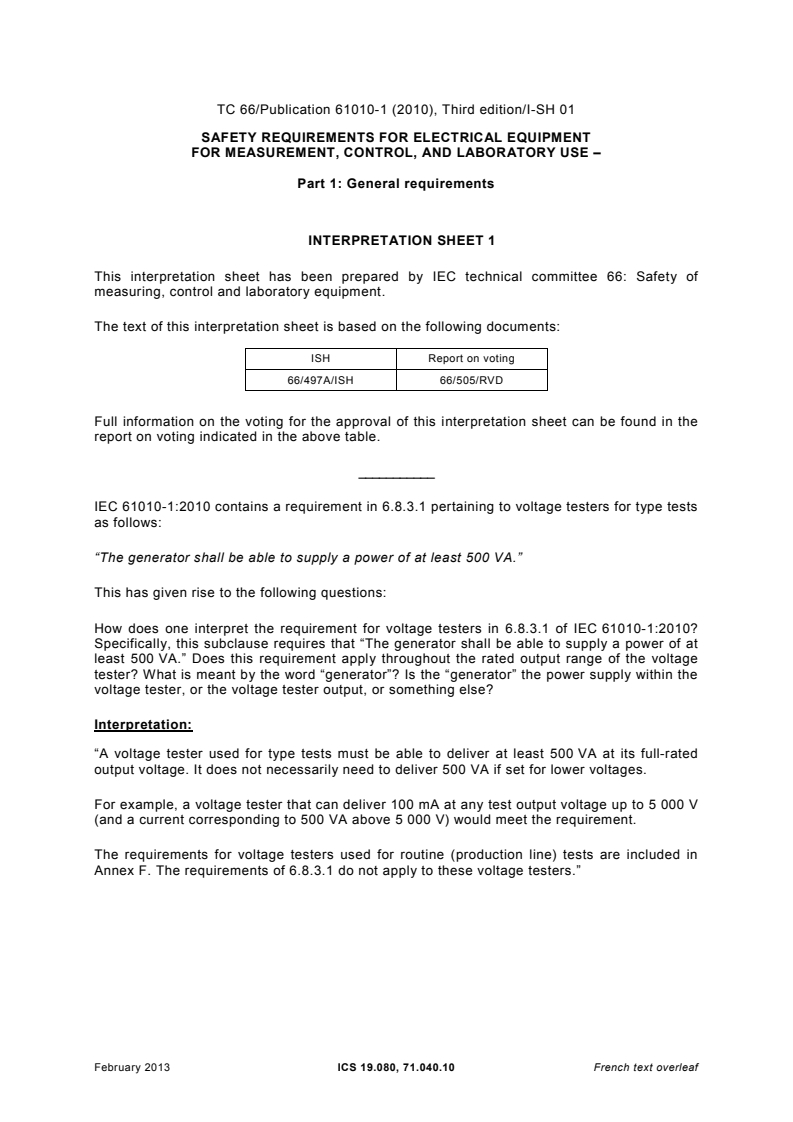
TC 66/Publication 61010-1 (2010), Third edition/I-SH 01
SAFETY REQUIREMENTS FOR ELECTRICAL EQUIPMENT
FOR MEASUREMENT, CONTROL, AND LABORATORY USE –
Part 1: General requirements
INTERPRETATION SHEET 1
This interpretation sheet has been prepared by IEC technical committee 66: Safety of
measuring, control and laboratory equipment.
The text of this interpretation sheet is based on the following documents:
ISH Report on voting
66/497A/ISH 66/505/RVD
Full information on the voting for the approval of this interpretation sheet can be found in the
report on voting indicated in the above table.
___________
as follows:
“The generator shall be able to supply a power of at least 500 VA.”
This has given rise to the following questions:
How does one interpret the requirement for voltage testers in 6.8.3.1 of IEC 61010-1:2010?
Specifically, this subclause requires that “The generator shall be able to supply a power of at
least 500 VA.” Does this requirement apply throughout the rated output range of the voltage
tester? What is meant by the word “generator”? Is the “generator” the power supply within the
voltage tester, or the voltage tester output, or something else?
Interpretation:
“A voltage tester used for type tests must be able to deliver at least 500 VA at its full-rated
output voltage. It does not necessarily need to deliver 500 VA if set for lower voltages.
For example, a voltage tester that can deliver 100 mA at any test output voltage up to 5 000 V
(and a current corresponding to 500 VA above 5 000 V) would meet the requirement.
The requirements for voltage testers used for routine (production line) tests are included in
Annex F. The requirements of 6.8.3.1 do not apply to these voltage testers.”
February 2013 ICS 19.080, 71.040.10 French text overleaf
– 2 – 61010-1 © IEC:2010
CONTENTS
FOREWORD.10
INTRODUCTION.13
1 Scope and object.14
1.1 Scope.14
1.1.1 Equipment included in scope .14
1.1.2 Equipment excluded from scope .14
1.1.3 Computing equipment.15
1.2 Object .15
1.2.1 Aspects included in scope .15
1.2.2 Aspects excluded from scope .15
1.3 Verification .15
1.4 Environmental conditions .16
1.4.1 Normal environmental conditions.16
1.4.2 Extended environmental conditions .16
2 Normative references .16
3 Terms and definitions .18
3.1 Equipment and states of equipment.18
3.2 Parts and accessories .19
3.3 Quantities.19
3.4 Tests.20
3.5 Safety terms.20
3.6 Insulation .22
4 Tests .23
4.1 General .23
4.2 Sequence of tests .24
4.3 Reference test conditions .24
4.3.1 Environmental conditions.24
4.3.2 State of equipment .24
4.4 Testing in SINGLE FAULT CONDITION .26
4.4.1 General .26
4.4.2 Application of fault conditions .26
4.4.3 Duration of tests .28
4.4.4 Conformity after application of fault conditions.29
5 Marking and documentation.30
5.1 Marking .30
5.1.1 General .30
5.1.2 Identification.30
5.1.3 MAINS supply .30
5.1.4 Fuses .32
5.1.5 TERMINALS, connections and operating devices.33
5.1.6 Switches and circuit-breakers .33
5.1.7 Equipment protected by DOUBLE INSULATION or REINFORCED
INSULATION.34
5.1.8 Field-wiring TERMINAL boxes .34
5.2 Warning markings .34
5.3 Durability of markings.34
61010-1 © IEC:2010 – 3 –
5.4 Documentation .35
5.4.1 General .35
5.4.2 Equipment RATINGS.35
5.4.3 Equipment installation .36
5.4.4 Equipment operation.36
5.4.5 Equipment maintenance and service .37
5.4.6 Integration into systems or effects resulting from special conditions .37
6 Protection against electric shock .37
6.1 General .37
6.1.1 Requirements .37
6.1.2 Exceptions.38
6.2 Determination of ACCESSIBLE parts.38
6.2.1 General .38
6.2.2 Examination .38
6.2.3 Openings above parts that are HAZARDOUS LIVE .39
6.2.4 Openings for pre-set controls .39
6.3 Limit values for ACCESSIBLE parts.39
6.3.1 Levels in NORMAL CONDITION.39
6.3.2 Levels in SINGLE FAULT CONDITION.40
6.4 Primary means of protection.43
6.4.1 General .43
6.4.2 ENCLOSURES and PROTECTIVE BARRIERS.43
6.4.3 BASIC INSULATION .43
6.4.4 Impedance.43
6.5 Additional means of protection in case of SINGLE FAULT CONDITIONS .43
6.5.1 General .43
6.5.2 PROTECTIVE BONDING.44
6.5.3 SUPPLEMENTARY INSULATION and REINFORCED INSULATION .47
6.5.4 PROTECTIVE IMPEDANCE .47
6.5.5 Automatic disconnection of the supply .48
6.5.6 Current- or voltage-limiting device .48
6.6 Connections to external circuits.48
6.6.1 General .48
6.6.2 TERMINALS for external circuits.49
6.6.3 Circuits with TERMINALS which are HAZARDOUS LIVE.49
6.6.4 TERMINALS for stranded conductors .49
6.7 Insulation requirements .50
6.7.1 The nature of insulation .50
6.7.2 Insulation for MAINS CIRCUITS of OVERVOLTAGE CATEGORY II with a
nominal supply voltage up to 300 V .52
6.7.3 Insulation for secondary circuits derived from MAINS CIRCUITS of
OVERVOLTAGE CATEGORY II up to 300 V .56
6.8 Procedure for voltage tests.61
6.8.1 General .61
6.8.2 Humidity preconditioning .62
6.8.3 Test procedures .63
6.9 Constructional requirements for protection against electric shock.63
6.9.1 General .63
6.9.2 Insulating materials .64
– 4 – 61010-1 © IEC:2010
6.9.3 Colour coding .64
6.10 Connection to the MAINS supply source and connections between parts of
equipment .64
6.10.1 MAINS supply cords.64
6.10.2 Fitting of non-detachable MAINS supply cords.65
6.10.3 Plugs and connectors .66
6.11 Disconnection from supply source .67
6.11.1 General .67
6.11.2 Exceptions.67
6.11.3 Requirements according to type of equipment .67
6.11.4 Disconnecting devices .68
7 Protection against mechanical HAZARDS.69
7.1 General .69
7.2 Sharp edges.69
7.3 Moving parts .69
7.3.1 General .69
7.3.2 Exceptions.69
7.3.3 RISK assessment for mechanical HAZARDS to body parts .70
7.3.4 Limitation of force and pressure.71
7.3.5 Gap limitations between moving parts .72
7.4 Stability .74
7.5 Provisions for lifting and carrying.75
7.5.1 General .75
7.5.2 Handles and grips.75
7.5.3 Lifting devices and supporting parts .75
7.6 Wall mounting .76
7.7 Expelled parts .76
8 Resistance to mechanical stresses .76
8.1 General .76
8.2 ENCLOSURE rigidity tests .77
8.2.1 Static test .77
8.2.2 Impact test .77
8.3 Drop test .79
8.3.1 Equipment other than HAND-HELD EQUIPMENT and DIRECT PLUG-IN
EQUIPMENT .79
8.3.2 HAND-HELD EQUIPMENT and DIRECT PLUG-IN EQUIPMENT.79
9 Protection against the spread of fire .79
9.1 General .79
9.2 Eliminating or reducing the sources of ignition within the equipment.81
9.3 Containment of fire within the equipment, should it occur .81
9.3.1 General .81
9.3.2 Constructional requirements .81
9.4 Limited-energy circuit .84
9.5 Requirements for equipment containing or using flammable liquids .85
9.6 Overcurrent protection.85
9.6.1 General .85
9.6.2 PERMANENTLY CONNECTED EQUIPMENT .86
9.6.3 Other equipment.86
10 Equipment temperature limits and resistance to heat.86
61010-1 © IEC:2010 – 5 –
10.1 Surface temperature limits for protection against burns .86
10.2 Temperatures of windings .87
10.3 Other temperature measurements .87
10.4 Conduct of temperature tests .88
10.4.1 General .88
10.4.2 Temperature measurement of heating equipment .88
10.4.3 Equipment intended for installation in a cabinet or a wall.88
10.5 Resistance to heat .89
10.5.1 Integrity of CLEARANCES and CREEPAGE DISTANCES.89
10.5.2 Non-metallic ENCLOSURES .89
10.5.3 Insulating material .89
11 Protection against HAZARDS from fluids .90
11.1 General .90
11.2 Cleaning.90
11.3 Spillage .91
11.4 Overflow.91
11.5 Battery electrolyte .91
11.6 Specially protected equipment.91
11.7 Fluid pressure and leakage .91
11.7.1 Maximum pressure .91
11.7.2 Leakage and rupture at high pressure .92
11.7.3 Leakage from low-pressure parts.92
11.7.4 Overpressure safety device .93
12 Protection against radiation, including laser sources, and against sonic and
ultrasonic pressure .93
12.1 General .93
12.2 Equipment producing ionizing radiation .93
12.2.1 Ionizing radiation .93
12.2.2 Accelerated electrons .94
12.3 Ultraviolet (UV) radiation .94
12.4 Microwave radiation .95
12.5 Sonic and ultrasonic pressure .95
12.5.1 Sound level .95
12.5.2 Ultrasonic pressure .95
12.6 Laser sources.96
13 Protection against liberated gases and substances, explosion and implosion .96
13.1 Poisonous and injurious gases and substances .96
13.2 Explosion and implosion.96
13.2.1 Components .96
13.2.2 Batteries and battery charging .97
13.2.3 Implosion of cathode ray tubes .97
14 Components and subassemblies .97
14.1 General .97
14.2 Motors.99
14.2.1 Motor temperatures .99
14.2.2 Series excitation motors .99
14.3 Overtemperature protection devices .99
14.4 Fuse holders .99
14.5 MAINS voltage selection devices .100
– 6 – 61010-1 © IEC:2010
14.6 MAINS transformers tested outside equipment.100
14.7 Printed wiring boards.100
14.8 Circuits or components used as TRANSIENT OVERVOLTAGE limiting devices . 100
15 Protection by interlocks .101
15.1 General .101
15.2 Prevention of reactivating.101
15.3 Reliability .101
16 HAZARDS resulting from application.101
16.1 REASONABLY FORESEEABLE MISUSE.101
16.2 Ergonomic aspects .102
17 RISK assessment .102
Annex A (normative) Measuring circuits for touch current (see 6.3). 104
Annex B (normative) Standard test fingers (see 6.2) .107
Annex C (normative) Measurement of CLEARANCES and CREEPAGE DISTANCES .109
Annex D (normative) Parts between which insulation requirements are specified (see
6.4 and 6.5.3) .113
Annex E (informative) Guideline for reduction of POLLUTION DEGREES .116
Annex F (normative) ROUTINE TESTS.117
Annex G (informative) Leakage and rupture from fluids under pressure . 119
Annex H (normative) Qualification of conformal coatings for protection against
POLLUTION .124
Annex I (informative) Line-to-neutral voltages for common MAINS supply systems . 127
Annex J (informative) RISK assessment .128
Annex K (normative) Insulation requirements not covered by 6.7 . 132
Annex L (informative) Index of defined terms .153
Bibliography.155
Figure 1 – Measurements through openings in ENCLOSURES.39
Figure 2 – Maximum duration of short-term ACCESSIBLE voltages in SINGLE FAULT
CONDITION (see 6.3.2 a)) .41
Figure 3 – Capacitance level versus voltage in NORMAL CONDITION and SINGLE FAULT
CONDITION (see 6.3.1 c) and 6.3.2 c)) .42
Figure 4 – Acceptable arrangement of protective means against electric shock .44
Figure 5 – Examples of binding screw assemblies .46
Figure 6 – Distance between conductors on an interface between two layers.54
Figure 7 – Distance between adjacent conductors along an interface of two inner
layers .54
Figure 8 – Distance between adjacent conductors located between the same two
layers .55
Figure 9 – Detachable MAINS supply cords and connections .65
Figure 10 – Impact test using a sphere .78
Figure 11 – Flow chart to explain the requirements for protection
against the spread of fire .80
Figure 12 – Baffle .83
Figure 13 – Area of the bottom of an ENCLOSURE to be constructed as specified in
9.3.2 c) 1) .83
61010-1 © IEC:2010 – 7 –
Figure 14 – Ball-pressure test apparatus .90
Figure 15 – Flow chart for conformity options 14.1 a), b), c) and d).98
Figure A.1 – Measuring circuit for a.c. with frequencies up to 1 MHz and for d.c. .104
Figure A.2 – Measuring circuits for sinusoidal a.c. with frequencies up to 100 Hz and
for d.c. .105
Figure A.3 – Current measuring circuit for electrical burns . 106
Figure A.4 – Current measuring circuit for wet contact . 106
Figure B.1 – Rigid test finger .107
Figure B.2 – Jointed test finger .108
Figure C.1 – Examples of methods of measuring CLEARANCES and CREEPAGE DISTANCES.112
Figures D.1a) to d) – Protection between HAZARDOUS LIVE circuits and ACCESSIBLE
parts .114
Figures D.1e) to h) – Protection between HAZARDOUS LIVE circuits and circuits which
ACCESSIBLE external TERMINALS .114
Figures D.2 a) and D.2 b) – Protection between a HAZARDOUS LIVE internal circuit and
an ACCESSIBLE part which is not bonded to other ACCESSIBLE parts.115
Figures D.2 c) and D.2 d) – Protection between a HAZARDOUS LIVE primary circuit and
circuits which have ACCESSIBLE external TERMINALS.115
Figure D.3 – Protection of external ACCESSIBLE TERMINALS of two HAZARDOUS LIVE
circuits.115
Figure G.1 – Conformity verification process (see G.2) .120
Figure H.1 – Test sequence and conformity .126
Figure J.1 – Iterative process of RISK assessment and RISK reduction .128
Figure J.2 – RISK reduction .129
Figure K.1 – Distance between conductors on an interface between two layers . 136
Figure K.2 – Distance between adjacent conductors along an interface of an inner
layer .137
Figure K.3 – Distance between adjacent conductors located between the same two
layers .138
Figure K.4 – Example of recurring peak voltage . 150
Table 1 – Symbols .32
Table 2 – Tightening torque for binding screw assemblies .46
Table 3 – Multiplication factors for CLEARANCES of equipment RATED for operation at
altitudes up to 5 000 m .50
TABLE 4 – CLEARANCES and CREEPAGE DISTANCES for MAINS CIRCUITS of OVERVOLTAGE
CATEGORY II up to 300 V .52
Table 5 – Test voltages for solid insulation in MAINS CIRCUITS of OVERVOLTAGE
CATEGORY II up to 300 V.53
Table 6 – CLEARANCES and test voltages for secondary circuits derived from MAINS
CIRCUITS of OVERVOLTAGE CATEGORY II up to 300 V .57
Table 7 – CREEPAGE DISTANCES for secondary circuits .58
Table 8 − Minimum values for distance or thickness (see 6.7.3.4.2 to 6.7.3.4.4) .60
Table 9 – Distances between TERMINALS and foil.61
Table 10 – Correction factors according to test site altitude for test voltages for
CLEARANCES .62
Table 11 – Values for physical tests on cord anchorages .66
– 8 – 61010-1 © IEC:2010
Table 12 – Protective measures against mechanical HAZARDS to body parts.71
Table 13 – Minimum maintained gaps to prevent crushing for different body parts .73
Table 14 – Maximum gaps to prevent access for different body parts.74
Table 15 – Impact energy levels, test height and corresponding IK codes .79
Table 16 – Acceptable perforation of the bottom of an ENCLOSURE .82
Table 17 – Limits of maximum available current.84
Table 18 – Values for overcurrent protection devices.85
Table 19 – Surface temperature limits in NORMAL CONDITION.87
Table 20 – Maximum temperatures for insulation material of windings .87
Table 21 – Impulse withstand voltages for OVERVOLTAGECATEGORY II .100
Table C.1 – Dimensions of X.109
Table E.1 – Environmental situations .116
Table E.2 – Reduction of POLLUTION DEGREES .116
Table F.1 – Test voltages for ROUTINE TESTS of MAINS CIRCUITS .118
Table G.1 – Test pressures for equipment with pressures above 14 Mpa . 122
Table H.1 – Test parameters, test conditions and test procedures . 125
Table I.1 – Line-to-neutral voltages for common MAINS supply systems .127
Table J.1 – Severity of harm .130
Table J.2 – Probability of harm .130
Table J.3 – RISK category .130
Table K.1 – Multiplication factors for CLEARANCES for equipment RATED for operation at
altitudes up to 5 000 m .133
Table K.2 – CLEARANCES and CREEPAGE DISTANCES for MAINS CIRCUITS of OVERVOLTAGE
CATEGORY II above 300 V .133
Table K.3 – CLEARANCES and CREEPAGE DISTANCES for MAINS CIRCUITS of OVERVOLTAGE
CATEGORY III .134
Table K.4 – CLEARANCES and CREEPAGE DISTANCES for MAINS CIRCUITS of OVERVOLTAGE
CATEGORY IV .134
Table K.5 – Test voltages for solid insulation in MAINS CIRCUITS of OVERVOLTAGE
CATEGORY II above 300 V .135
Table K.6 – Test voltages for solid insulation in MAINS CIRCUITS of OVERVOLTAGE
CATEGORY III .135
Table K.7 – Test voltages for solid insulation in MAINS CIRCUITS of OVERVOLTAGE
CATEGORY IV .135
Table K.8 – Test voltages for testing long-term stress of solid insulation in MAINS
CIRCUITS.136
Table K.9 – Minimum values for distance or thickness of solid insulation . 137
Table K.10 – CLEARANCES and test voltages for secondary circuits derived from MAINS
CIRCUITS of OVERVOLTAGE CATEGORY II above 300 V .140
Table K.11 – CLEARANCES and test voltages for secondary circuits derived from MAINS
CIRCUITS of OVERVOLTAGE CATEGORY III.141
Table K.12 – CLEARANCES and test voltages for secondary circuits derived from MAINS
CIRCUITS of OVERVOLTA
...
IEC 61010-1 ®
Edition 3.1 2017-01
CONSOLIDATED VERSION
INTERNATIONAL
STANDARD
NORME
INTERNATIONALE
colour
inside
Safety requirements for electrical equipment for measurement, control, and
laboratory use –
Part 1: General requirements
Règles de sécurité pour appareils électriques de mesurage, de régulation et de
laboratoire –
Partie 1: Exigences générales
All rights reserved. Unless otherwise specified, no part of this publication may be reproduced or utilized in any form
or by any means, electronic or mechanical, including photocopying and microfilm, without permission in writing from
either IEC or IEC's member National Committee in the country of the requester. If you have any questions about IEC
copyright or have an enquiry about obtaining additional rights to this publication, please contact the address below or
your local IEC member National Committee for further information.
Droits de reproduction réservés. Sauf indication contraire, aucune partie de cette publication ne peut être reproduite
ni utilisée sous quelque forme que ce soit et par aucun procédé, électronique ou mécanique, y compris la photocopie
et les microfilms, sans l'accord écrit de l'IEC ou du Comité national de l'IEC du pays du demandeur. Si vous avez des
questions sur le copyright de l'IEC ou si vous désirez obtenir des droits supplémentaires sur cette publication, utilisez
les coordonnées ci-après ou contactez le Comité national de l'IEC de votre pays de résidence.
IEC Central Office Tel.: +41 22 919 02 11
3, rue de Varembé Fax: +41 22 919 03 00
CH-1211 Geneva 20 info@iec.ch
Switzerland www.iec.ch
About the IEC
The International Electrotechnical Commission (IEC) is the leading global organization that prepares and publishes
International Standards for all electrical, electronic and related technologies.
About IEC publications
The technical content of IEC publications is kept under constant review by the IEC. Please make sure that you have the
latest edition, a corrigenda or an amendment might have been published.
IEC Catalogue - webstore.iec.ch/catalogue Electropedia - www.electropedia.org
The stand-alone application for consulting the entire The world's leading online dictionary of electronic and
bibliographical information on IEC International Standards, electrical terms containing 20 000 terms and definitions in
Technical Specifications, Technical Reports and other English and French, with equivalent terms in 16 additional
documents. Available for PC, Mac OS, Android Tablets and languages. Also known as the International Electrotechnical
iPad. Vocabulary (IEV) online.
IEC publications search - www.iec.ch/searchpub IEC Glossary - std.iec.ch/glossary
The advanced search enables to find IEC publications by a 65 000 electrotechnical terminology entries in English and
variety of criteria (reference number, text, technical French extracted from the Terms and Definitions clause of
committee,…). It also gives information on projects, replaced IEC publications issued since 2002. Some entries have been
and withdrawn publications. collected from earlier publications of IEC TC 37, 77, 86 and
CISPR.
IEC Just Published - webstore.iec.ch/justpublished
Stay up to date on all new IEC publications. Just Published IEC Customer Service Centre - webstore.iec.ch/csc
details all new publications released. Available online and If you wish to give us your feedback on this publication or
also once a month by email. need further assistance, please contact the Customer Service
Centre: csc@iec.ch.
A propos de l'IEC
La Commission Electrotechnique Internationale (IEC) est la première organisation mondiale qui élabore et publie des
Normes internationales pour tout ce qui a trait à l'électricité, à l'électronique et aux technologies apparentées.
A propos des publications IEC
Le contenu technique des publications IEC est constamment revu. Veuillez vous assurer que vous possédez l’édition la
plus récente, un corrigendum ou amendement peut avoir été publié.
Catalogue IEC - webstore.iec.ch/catalogue Electropedia - www.electropedia.org
Application autonome pour consulter tous les renseignements
Le premier dictionnaire en ligne de termes électroniques et
bibliographiques sur les Normes internationales,
électriques. Il contient 20 000 termes et définitions en anglais
Spécifications techniques, Rapports techniques et autres
et en français, ainsi que les termes équivalents dans 16
documents de l'IEC. Disponible pour PC, Mac OS, tablettes
langues additionnelles. Egalement appelé Vocabulaire
Android et iPad.
Electrotechnique International (IEV) en ligne.
Recherche de publications IEC - www.iec.ch/searchpub
Glossaire IEC - std.iec.ch/glossary
La recherche avancée permet de trouver des publications IEC
65 000 entrées terminologiques électrotechniques, en anglais
en utilisant différents critères (numéro de référence, texte,
et en français, extraites des articles Termes et Définitions des
comité d’études,…). Elle donne aussi des informations sur les
publications IEC parues depuis 2002. Plus certaines entrées
projets et les publications remplacées ou retirées.
antérieures extraites des publications des CE 37, 77, 86 et
CISPR de l'IEC.
IEC Just Published - webstore.iec.ch/justpublished
Restez informé sur les nouvelles publications IEC. Just Service Clients - webstore.iec.ch/csc
Published détaille les nouvelles publications parues. Si vous désirez nous donner des commentaires sur cette
Disponible en ligne et aussi une fois par mois par email. publication ou si vous avez des questions contactez-nous:
csc@iec.ch.
IEC 61010-1 ®
Edition 3.1 2017-01
CONSOLIDATED VERSION
INTERNATIONAL
STANDARD
NORME
INTERNATIONALE
colour
inside
Safety requirements for electrical equipment for measurement, control, and
laboratory use –
Part 1: General requirements
Règles de sécurité pour appareils électriques de mesurage, de régulation et de
laboratoire –
Partie 1: Exigences générales
INTERNATIONAL
ELECTROTECHNICAL
COMMISSION
COMMISSION
ELECTROTECHNIQUE
INTERNATIONALE
ICS 19.080; 71.040.10 ISBN 978-2-8322-3817-2
IEC 61010-1 ®
Edition 3.1 2017-01
CONSOLIDATED VERSION
REDLINE VERSION
VERSION REDLINE
colour
inside
Safety requirements for electrical equipment for measurement, control, and
laboratory use –
Part 1: General requirements
Règles de sécurité pour appareils électriques de mesurage, de régulation et de
laboratoire –
Partie 1: Exigences générales
TC 66/Publication 61010-1 (2010), Third edition/I-SH 01
SAFETY REQUIREMENTS FOR ELECTRICAL EQUIPMENT
FOR MEASUREMENT, CONTROL, AND LABORATORY USE –
Part 1: General requirements
INTERPRETATION SHEET 1
This interpretation sheet has been prepared by IEC technical committee 66: Safety of
measuring, control and laboratory equipment.
The text of this interpretation sheet is based on the following documents:
ISH Report on voting
66/497A/ISH 66/505/RVD
Full information on the voting for the approval of this interpretation sheet can be found in the
report on voting indicated in the above table.
___________
as follows:
“The generator shall be able to supply a power of at least 500 VA.”
This has given rise to the following questions:
How does one interpret the requirement for voltage testers in 6.8.3.1 of IEC 61010-1:2010?
Specifically, this subclause requires that “The generator shall be able to supply a power of at
least 500 VA.” Does this requirement apply throughout the rated output range of the voltage
tester? What is meant by the word “generator”? Is the “generator” the power supply within the
voltage tester, or the voltage tester output, or something else?
Interpretation:
“A voltage tester used for type tests must be able to deliver at least 500 VA at its full-rated
output voltage. It does not necessarily need to deliver 500 VA if set for lower voltages.
For example, a voltage tester that can deliver 100 mA at any test output voltage up to 5 000 V
(and a current corresponding to 500 VA above 5 000 V) would meet the requirement.
The requirements for voltage testers used for routine (production line) tests are included in
Annex F. The requirements of 6.8.3.1 do not apply to these voltage testers.”
February 2013 ICS 19.080, 71.040.10 French text overleaf
– 2 – IEC 61010-1:2010+AMD1:2016 CSV
IEC 2017
CONTENTS
FOREWORD . 10
INTRODUCTION . 13
1 Scope and object . 14
1.1 Scope . 14
1.1.1 Equipment included in scope . 14
1.1.2 Equipment excluded from scope . 14
1.1.3 Computing equipment . 15
1.2 Object . 15
1.2.1 Aspects included in scope . 15
1.2.2 Aspects excluded from scope . 15
1.3 Verification . 16
1.4 Environmental conditions . 16
1.4.1 Normal environmental conditions . 16
1.4.2 Extended environmental conditions . 16
2 Normative references . 16
3 Terms and definitions . 19
3.1 Equipment and states of equipment . 19
3.2 Parts and accessories . 19
3.3 Quantities . 20
3.4 Tests . 20
3.5 Safety terms . 21
3.6 Insulation . 22
4 Tests . 23
4.1 General . 23
4.2 Sequence of tests . 24
4.3 Reference test conditions . 24
4.3.1 Environmental conditions . 24
4.3.2 State of equipment . 24
4.4 Testing in SINGLE FAULT CONDITION . 26
4.4.1 General . 26
4.4.2 Application of fault conditions . 26
4.4.3 Duration of tests . 29
4.4.4 Conformity after application of fault conditions. 29
5 Marking and documentation . 30
5.1 Marking . 30
5.1.1 General . 30
5.1.2 Identification . 30
5.1.3 MAINS supply . 31
5.1.4 Fuses . 32
5.1.5 TERMINALS, connections and operating devices . 33
5.1.6 Switches and circuit-breakers . 33
5.1.7 Equipment protected by DOUBLE INSULATION or REINFORCED
INSULATION . 34
5.1.8 Field-wiring TERMINAL boxes . 34
5.2 Warning markings . 34
5.3 Durability of markings . 35
IEC 2017
5.4 Documentation . 35
5.4.1 General . 35
5.4.2 Equipment RATINGS . 35
5.4.3 Equipment installation . 36
5.4.4 Equipment operation. 36
5.4.5 Equipment maintenance and service . 37
5.4.6 Integration into systems or effects resulting from special conditions . 37
6 Protection against electric shock . 38
6.1 General . 38
6.1.1 Requirements . 38
6.1.2 Exceptions . 38
6.2 Determination of ACCESSIBLE parts . 38
6.2.1 General . 38
6.2.2 Examination . 39
6.2.3 Openings above parts that are HAZARDOUS LIVE . 39
6.2.4 Openings for pre-set controls . 39
6.3 Limit values for ACCESSIBLE parts. 40
6.3.1 Levels in NORMAL CONDITION . 40
6.3.2 Levels in SINGLE FAULT CONDITION. 40
6.4 Primary means of protection . 44
6.4.1 General . 44
6.4.2 ENCLOSURES and PROTECTIVE BARRIERS . 44
6.4.3 BASIC INSULATION . 44
6.4.4 Impedance. 44
6.5 Additional means of protection in case of SINGLE FAULT CONDITIONS . 44
6.5.1 General . 44
6.5.2 PROTECTIVE BONDING . 45
6.5.3 SUPPLEMENTARY INSULATION and REINFORCED INSULATION . 48
6.5.4 PROTECTIVE IMPEDANCE . 49
6.5.5 Automatic disconnection of the supply . 49
6.5.6 Current- or voltage-limiting device . 49
6.6 Connections to external circuits . 49
6.6.1 General . 49
6.6.2 TERMINALS for external circuits . 50
6.6.3 Circuits with TERMINALS which are HAZARDOUS LIVE . 50
6.6.4 TERMINALS for stranded conductors . 50
6.7 Insulation requirements . 51
6.7.1 The nature of insulation . 51
6.7.2 Insulation for MAINS CIRCUITS of OVERVOLTAGE CATEGORY II with a
nominal supply voltage up to 300 V . 53
6.7.3 Insulation for secondary circuits derived from MAINS CIRCUITS of
OVERVOLTAGE CATEGORY II up to 300 V . 57
6.8 Procedure for voltage tests . 63
6.8.1 General . 63
6.8.2 Humidity preconditioning . 64
6.8.3 Test procedures . 65
6.9 Constructional requirements for protection against electric shock . 66
6.9.1 General . 66
6.9.2 Insulating materials . 66
– 4 – IEC 61010-1:2010+AMD1:2016 CSV
IEC 2017
6.9.3 Colour coding . 66
6.10 Connection to the MAINS supply source and connections between parts of
equipment . 66
6.10.1 MAINS supply cords . 66
6.10.2 Fitting of non-detachable MAINS supply cords . 67
6.10.3 Plugs and connectors . 69
6.11 Disconnection from supply source . 69
6.11.1 General . 69
6.11.2 Exceptions . 69
6.11.3 Requirements according to type of equipment . 70
6.11.4 Disconnecting devices . 70
7 Protection against mechanical HAZARDS . 71
7.1 General . 71
7.2 Sharp edges . 71
7.3 Moving parts . 71
7.3.1 General . 71
7.3.2 Exceptions . 72
7.3.3 RISK assessment for mechanical HAZARDS to body parts . 72
7.3.4 Limitation of force and pressure. 73
7.3.5 Gap limitations between moving parts . 74
7.4 Stability . 76
7.5 Provisions for lifting and carrying. 77
7.5.1 General . 77
7.5.2 Handles and grips. 77
7.5.3 Lifting devices and supporting parts . 77
7.6 Wall mounting . 78
7.7 Expelled parts . 78
8 Resistance to mechanical stresses . 78
8.1 General . 78
8.2 ENCLOSURE rigidity tests . 79
8.2.1 Static test . 79
8.2.2 Impact test . 79
8.3 Drop test . 81
8.3.1 Equipment other than HAND-HELD EQUIPMENT and DIRECT PLUG-IN
EQUIPMENT . 81
8.3.2 HAND-HELD EQUIPMENT and DIRECT PLUG-IN EQUIPMENT . 81
9 Protection against the spread of fire . 81
9.1 General . 81
9.2 Eliminating or reducing the sources of ignition within the equipment . 83
9.3 Containment of fire within the equipment, should it occur . 83
9.3.1 General . 83
9.3.2 Constructional requirements . 83
9.4 Limited-energy circuit . 86
9.5 Requirements for equipment containing or using flammable liquids . 87
9.6 Overcurrent protection . 87
9.6.1 General . 87
9.6.2 PERMANENTLY CONNECTED EQUIPMENT . 88
9.6.3 Other equipment . 88
10 Equipment temperature limits and resistance to heat . 88
IEC 2017
10.1 Surface temperature limits for protection against burns . 88
10.2 Temperatures of windings . 89
10.3 Other temperature measurements . 89
10.4 Conduct of temperature tests . 90
10.4.1 General . 90
10.4.2 Temperature measurement of heating equipment . 90
10.4.3 Equipment intended for installation in a cabinet or a wall . 91
10.5 Resistance to heat . 91
10.5.1 Integrity of CLEARANCES and CREEPAGE DISTANCES . 91
10.5.2 Non-metallic ENCLOSURES . 91
10.5.3 Insulating material . 91
11 Protection against HAZARDS from fluids and solid foreign objects . 92
11.1 General . 92
11.2 Cleaning . 92
11.3 Spillage . 93
11.4 Overflow . 93
11.5 Battery electrolyte . 93
11.6 Specially protected Equipment RATED with a degree of ingress protection (IP
code) . 93
11.6.1 General . 94
11.6.2 Conditions for testing . 94
11.6.3 Protection against solid foreign objects (including dust) . 94
11.6.4 Protection against water . 95
11.7 Fluid pressure and leakage . 95
11.7.1 Maximum pressure . 95
11.7.2 Leakage and rupture at high pressure . 95
11.7.3 Leakage from low-pressure parts . 96
11.7.4 Overpressure safety device . 97
12 Protection against radiation, including laser sources, and against sonic and
ultrasonic pressure . 97
12.1 General . 97
12.2 Equipment producing ionizing radiation . 97
12.2.1 Ionizing radiation . 97
12.2.2 Accelerated electrons . 98
12.3 Ultraviolet (UV) Optical radiation . 98
12.4 Microwave radiation . 99
12.5 Sonic and ultrasonic pressure . 100
12.5.1 Sound level . 100
12.5.2 Ultrasonic pressure . 100
12.6 Laser sources. 101
13 Protection against liberated gases and substances, explosion and implosion . 101
13.1 Poisonous and injurious gases and substances . 101
13.2 Explosion and implosion . 101
13.2.1 Components . 101
13.2.2 Batteries and battery charging . 102
13.2.3 Implosion of cathode ray tubes . 102
14 Components and subassemblies . 102
14.1 General . 102
14.2 Motors . 104
– 6 – IEC 61010-1:2010+AMD1:2016 CSV
IEC 2017
14.2.1 Motor temperatures . 104
14.2.2 Series excitation motors . 104
14.3 Overtemperature protection devices . 104
14.4 Fuse holders . 104
14.5 MAINS voltage selection devices . 105
14.6 MAINS transformers tested outside equipment . 105
14.7 Printed wiring boards. 105
14.8 Circuits or components used as to limit TRANSIENT OVERVOLTAGES limiting
devices . 105
15 Protection by interlocks . 106
15.1 General . 106
15.2 Prevention of reactivating . 106
15.3 Reliability . 106
16 HAZARDS resulting from application . 107
16.1 REASONABLY FORESEEABLE MISUSE . 107
16.2 Ergonomic aspects . 107
17 RISK assessment . 107
Annex A (normative) Measuring circuits for touch current (see 6.3) . 109
Annex B (normative) Standard test fingers (see 6.2) . 112
Annex C (normative) Measurement of CLEARANCES and CREEPAGE DISTANCES . 114
Annex D (normative) Parts between which insulation requirements are specified (see
6.4 and 6.5.3) . 118
Annex E (informative) Guideline for reduction of POLLUTION DEGREES . 121
Annex F (normative) ROUTINE TESTS . 122
Annex G (informative) Leakage and rupture from fluids under pressure . 124
Annex H (normative) Qualification of conformal coatings for protection against
POLLUTION . 129
Annex I (informative) Line-to-neutral voltages for common MAINS supply systems . 132
Annex J (informative) RISK assessment . 134
Annex K (normative) Insulation requirements not covered by 6.7 . 137
Annex L (informative) Index of defined terms . 158
Bibliography . 160
Figure 1 – Measurements through openings in ENCLOSURES . 39
Figure 2 – Maximum duration of short-term ACCESSIBLE voltages in SINGLE FAULT
CONDITION (see 6.3.2 a)) . 42
Figure 3 – Capacitance level versus voltage in NORMAL CONDITION and SINGLE FAULT
CONDITION (see 6.3.1 c) and 6.3.2 c)) . 43
Figure 4 – Acceptable arrangement of protective means against electric shock . 45
Figure 5 – Examples of binding screw assemblies . 47
Figure 6 – Distance between conductors on an interface between two layers . 55
Figure 7 – Distance between adjacent conductors along an interface of two inner
layers . 56
Figure 8 – Distance between adjacent conductors located between the same two
layers . 57
Figure 9 – Detachable MAINS supply cords and connections . 67
IEC 2017
Figure 10 – Impact test using a sphere . 80
Figure 11 – Flow chart to explain the requirements for protection against the spread
of fire . 82
Figure 12 – Baffle . 85
Figure 13 – Area of the bottom of an ENCLOSURE to be constructed as specified in
9.3.2 c) 1) . 85
Figure 14 – Ball-pressure test apparatus . 92
Figure 15 – Flow chart for conformity options 14.1 a), b), c) and d) . 103
Figure 16 – Ratio between test pressure and maximum working pressure . 96
Figure A.1 – Measuring circuit for a.c. with frequencies up to 1 MHz and for d.c. . 109
Figure A.2 – Measuring circuits for sinusoidal a.c. with frequencies up to 100 Hz and
for d.c. . 110
Figure A.3 – Current measuring circuit for electrical burns . 111
Figure A.4 – Current measuring circuit for wet contact . 111
Figure B.1 – Rigid test finger . 112
Figure B.2 – Jointed test finger . 113
Figure C.1 – Examples of methods of measuring CLEARANCES and CREEPAGE DISTANCES . 117
Figures D.1a) to d) – Protection between HAZARDOUS LIVE circuits and ACCESSIBLE
parts . 119
Figures D.1e) to h) – Protection between HAZARDOUS LIVE circuits and circuits with
ACCESSIBLE external TERMINALS . 119
Figures D.2 a) and D.2 b) – Protection between a HAZARDOUS LIVE internal circuit and
an ACCESSIBLE part which is not bonded to other ACCESSIBLE parts . 120
Figures D.2 c) and D.2 d) – Protection between a HAZARDOUS LIVE primary circuit and
circuits which have ACCESSIBLE external TERMINALS . 120
Figure D.3 – Protection of external ACCESSIBLE TERMINALS of two HAZARDOUS LIVE
circuits . 120
Figure G.1 – Conformity verification process (see G.2) . 125
Figure H.1 – Test sequence and conformity . 131
Figure J.1 – Iterative process of RISK assessment and RISK reduction . 134
Figure J.2 – RISK reduction . 135
Figure K.1 – Distance between conductors on an interface between two layers . 141
Figure K.2 – Distance between adjacent conductors along an interface of an inner
layer . 142
Figure K.3 – Distance between adjacent conductors located between the same two
layers . 143
Figure K.4 – Example of recurring peak voltage . 155
Table 1 – Symbols . 32
Table 2 – Tightening torque for binding screw assemblies . 47
Table 3 – Multiplication factors for CLEARANCES of equipment RATED for operation at
altitudes up to 5 000 m . 52
TABLE 4 – CLEARANCES and CREEPAGE DISTANCES for MAINS CIRCUITS of OVERVOLTAGE
CATEGORY II up to 300 V . 54
Table 5 – Test voltages for solid insulation in MAINS CIRCUITS of OVERVOLTAGE
CATEGORY II up to 300 V . 54
– 8 – IEC 61010-1:2010+AMD1:2016 CSV
IEC 2017
Table 6 – CLEARANCES and test voltages for secondary circuits derived from MAINS
CIRCUITS of OVERVOLTAGE CATEGORY II up to 300 V . 59
Table 7 – CREEPAGE DISTANCES for secondary circuits . 60
Table 8 − Minimum values for distance or thickness (see 6.7.3.4.2 to 6.7.3.4.4) . 62
Table 9 – Distances between TERMINALS and foil . 63
Table 10 – Correction factors according to test site altitude for test voltages for
CLEARANCES . 64
Table 11 – Values for physical tests on cord anchorages . 68
Table 12 – Protective measures against mechanical HAZARDS to body parts. 73
Table 13 – Minimum maintained gaps to prevent crushing for different body parts . 75
Table 14 – Maximum gaps to prevent access for different body parts . 76
Table 15 – Impact energy levels, test height and corresponding IK codes . 81
Table 16 – Acceptable perforation of the bottom of an ENCLOSURE . 84
Table 17 – Limits of maximum available current . 86
Table 18 – Values for overcurrent protection devices . 87
Table 19 – Surface temperature limits in NORMAL CONDITION . 89
Table 20 – Maximum temperatures for insulation material of windings . 89
Table 21 – Impulse withstand voltages for OVERVOLTAGECATEGORY II . 105
Table 22 – Lamp or lamp systems considered photobiologically safe . 99
Table 23 – Lamp or lamp systems considered photobiologically safe under certain
conditions . 99
Table C.1 – Dimensions of X. 114
Table E.1 – Environmental situations . 121
Table E.2 – Reduction of POLLUTI
...