

IEC TS 61200-101:2018
(Main)Electrical installation guide - Part 101: Application guidelines on extra-low-voltage direct current electrical installations not intended to be connected to a public distribution network
General Information
- Abstract
IEC TS 61200-101:2018(E) applies to individual DC low-voltage electrical installations entirely supplied by local power sources, and not intended to be connected to a public distribution network and having a nominal voltage lower or equal to 60 V DC within the extra-low-voltage limit. This document also applies to DC installations according to use cases TIER 2 and TIER 3 of the World Bank defined in ESMAP 008/15 Report.
This document does not apply to shared or collective electrical installations which are covered in IEC 61200-102.
- Status
- Published
- Publication Date
- 22-Nov-2018
- Technical Committee
- TC 64 - Electrical installations and protection against electric shock
- Drafting Committee
- WG 46 - TC 64/WG 46
- Current Stage
- PPUB - Publication issued
- Start Date
- 23-Nov-2018
- Completion Date
- 19-Dec-2018
Buy Documents

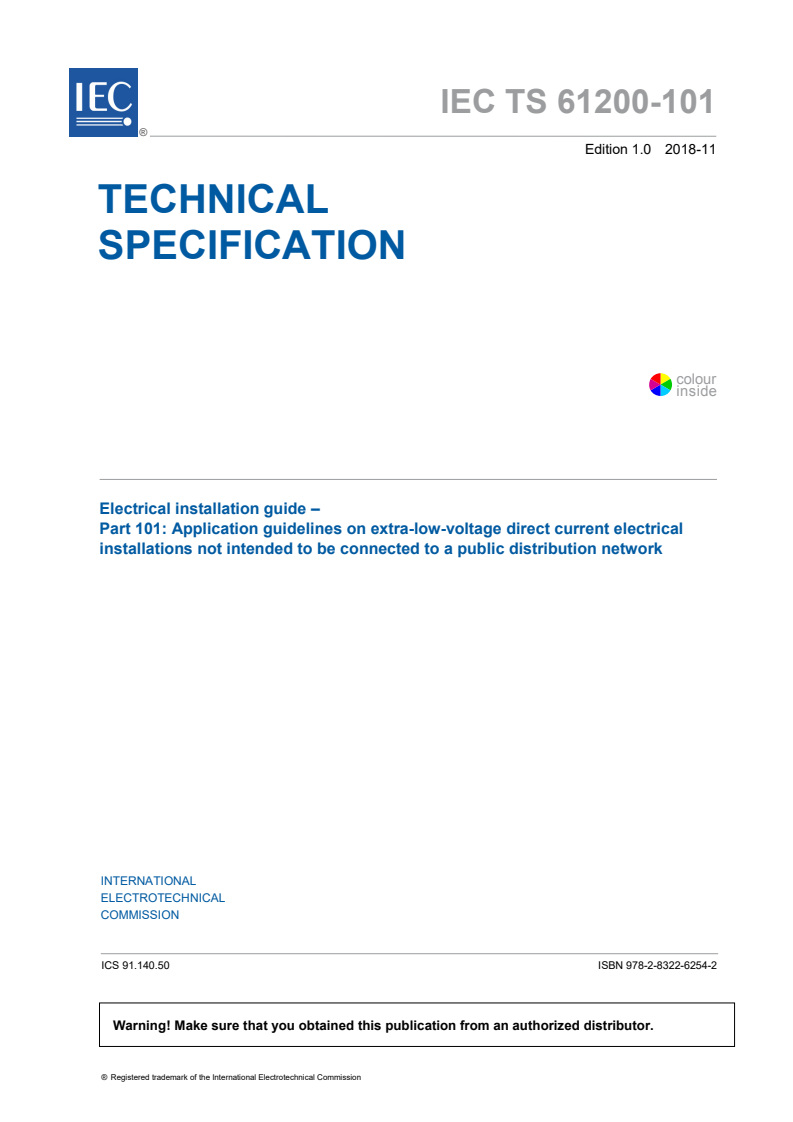
IEC TS 61200-101:2018 - Electrical installation guide - Part 101: Application guidelines on extra-low-voltage direct current electrical installations not intended to be connected to a public distribution network Released:11/23/2018
Overview
IEC TS 61200-101:2018 is an international technical specification issued by the International Electrotechnical Commission (IEC) that provides practical application guidelines for extra-low-voltage direct current (DC) electrical installations not intended for connection to a public distribution network. This standard is crucial for designing and implementing safe and reliable DC electrical systems, particularly for installations entirely supplied by local power sources such as photovoltaic systems, wind turbines, and batteries. The scope includes installations with nominal voltages not exceeding 60 V DC, ensuring adherence to extra-low-voltage (ELV) and Safety Extra-Low Voltage (SELV) principles. It is especially relevant where local, off-grid energy access is needed, reflecting use cases identified by the World Bank (TIER 2 and TIER 3 energy access levels) and is not applicable to collective or shared installations covered by other standards.
Key Topics
The standard covers fundamental aspects essential for the safety and performance of extra-low-voltage DC electrical installations, including:
- Electrical Installation Concepts
- Structure and functions of a DC installation (supply, distribution, consumption)
- Typical sources: photovoltaic systems, wind turbines, storage batteries
- Nominal Voltage Selection
- Guidance on choosing appropriate voltage levels (≤60 V DC)
- Addressing voltage drop and current calculations for efficient installation
- Wiring and Cabling
- Recommended minimum cross-sectional areas for conductors
- Colour-coded polarity identification per IEC 60445
- Voltage drop limits and cable length considerations
- Protection Measures
- Requirements for protection against electric shock, including SELV systems
- Overcurrent protection devices and selection based on IEC 60898-2/3 and IEC 60269-3
- System Configuration
- Example architectures for lighting, socket-outlets, and critical loads
- Arcing
- Addressing risks associated with arcing in DC systems and suitable mitigation methods
Applications
IEC TS 61200-101:2018 is intended for use by electrical engineers, system designers, installers, and regulatory bodies focused on safe implementation of off-grid and stand-alone direct current systems. Its application areas include:
- Off-Grid Renewable Energy Systems
- Designing solar home systems or small community microgrids with DC supply
- Implementing wind or hybrid renewable installations for rural or remote energy access
- Residential and Commercial Installations
- Safe wiring for extra-low-voltage DC systems in residences, schools, or medical clinics not tied to the public grid
- Telecommunications and Monitoring
- Providing power for DC-operated telecom equipment, security, or monitoring installations
- Energy Storage Solutions
- Integration of batteries and storage units as primary or backup power sources
- Emerging Technologies
- Supporting installations with direct connection to modern DC appliances like LED lighting, fans, and electronics
The standard is particularly important for global electrification initiatives and for developing regions where decentralized, stand-alone power systems are being deployed to improve energy access.
Related Standards
For comprehensive compliance and best practices, the following related IEC standards should be referenced:
- IEC 60364 (all parts): General low-voltage electrical installation requirements
- IEC 60269-3: Low-voltage fuses for household or similar use
- IEC 60445: Identification of terminals and conductors
- IEC 60898-2 / 60898-3: Circuit-breakers for overcurrent protection in AC and DC systems
- IEC 61558-2-6: Safety isolating transformers and power supply units
- IEC 61200-102: Guidelines for shared or collective low-voltage DC installations (not covered by this document)
- IEC 60906-3: SELV plugs and socket-outlets for household use
By applying IEC TS 61200-101:2018, stakeholders ensure safer and more effective extra-low-voltage DC electrical installations, supporting broader access to reliable energy in diverse environments.
Buy Documents
IEC TS 61200-101:2018 - Electrical installation guide - Part 101: Application guidelines on extra-low-voltage direct current electrical installations not intended to be connected to a public distribution network Released:11/23/2018
Get Certified
Connect with accredited certification bodies for this standard

DIBt (Deutsches Institut für Bautechnik)
German Institute for Building Technology.
DIN CERTCO
DIN Group product certification.

Aboma Certification B.V.
Specialized in construction, metal, and transport sectors.
Sponsored listings
Frequently Asked Questions
IEC TS 61200-101:2018 is a technical specification published by the International Electrotechnical Commission (IEC). Its full title is "Electrical installation guide - Part 101: Application guidelines on extra-low-voltage direct current electrical installations not intended to be connected to a public distribution network". This standard covers: IEC TS 61200-101:2018(E) applies to individual DC low-voltage electrical installations entirely supplied by local power sources, and not intended to be connected to a public distribution network and having a nominal voltage lower or equal to 60 V DC within the extra-low-voltage limit. This document also applies to DC installations according to use cases TIER 2 and TIER 3 of the World Bank defined in ESMAP 008/15 Report. This document does not apply to shared or collective electrical installations which are covered in IEC 61200-102.
IEC TS 61200-101:2018(E) applies to individual DC low-voltage electrical installations entirely supplied by local power sources, and not intended to be connected to a public distribution network and having a nominal voltage lower or equal to 60 V DC within the extra-low-voltage limit. This document also applies to DC installations according to use cases TIER 2 and TIER 3 of the World Bank defined in ESMAP 008/15 Report. This document does not apply to shared or collective electrical installations which are covered in IEC 61200-102.
IEC TS 61200-101:2018 is classified under the following ICS (International Classification for Standards) categories: 91.140.50 - Electricity supply systems. The ICS classification helps identify the subject area and facilitates finding related standards.
IEC TS 61200-101:2018 is available in PDF format for immediate download after purchase. The document can be added to your cart and obtained through the secure checkout process. Digital delivery ensures instant access to the complete standard document.
Standards Content (Sample)
SLOVENSKI STANDARD
01-marec-2024
Vodilo za električne inštalacije – 101. del: Smernice za uporabo enosmernih
električnih inštalacij male napetosti, ki niso predvidene za priključitev na javno
distribucijsko omrežje (IEC TS 61200-101:2018)
Electrical installation guide - Part 101: Application guidelines on extra-low-voltage direct
current electrical installations not intended to be connected to a public distribution
network (IEC TS 61200-101:2018)
Ta slovenski standard je istoveten z: IEC TS 61200-101:2018
ICS:
91.140.50 Sistemi za oskrbo z elektriko Electricity supply systems
2003-01.Slovenski inštitut za standardizacijo. Razmnoževanje celote ali delov tega standarda ni dovoljeno.
IEC TS 61200-101 ®
Edition 1.0 2018-11
TECHNICAL
SPECIFICATION
colour
inside
Electrical installation guide –
Part 101: Application guidelines on extra-low-voltage direct current electrical
installations not intended to be connected to a public distribution network
INTERNATIONAL
ELECTROTECHNICAL
COMMISSION
ICS 91.140.50 ISBN 978-2-8322-6254-2
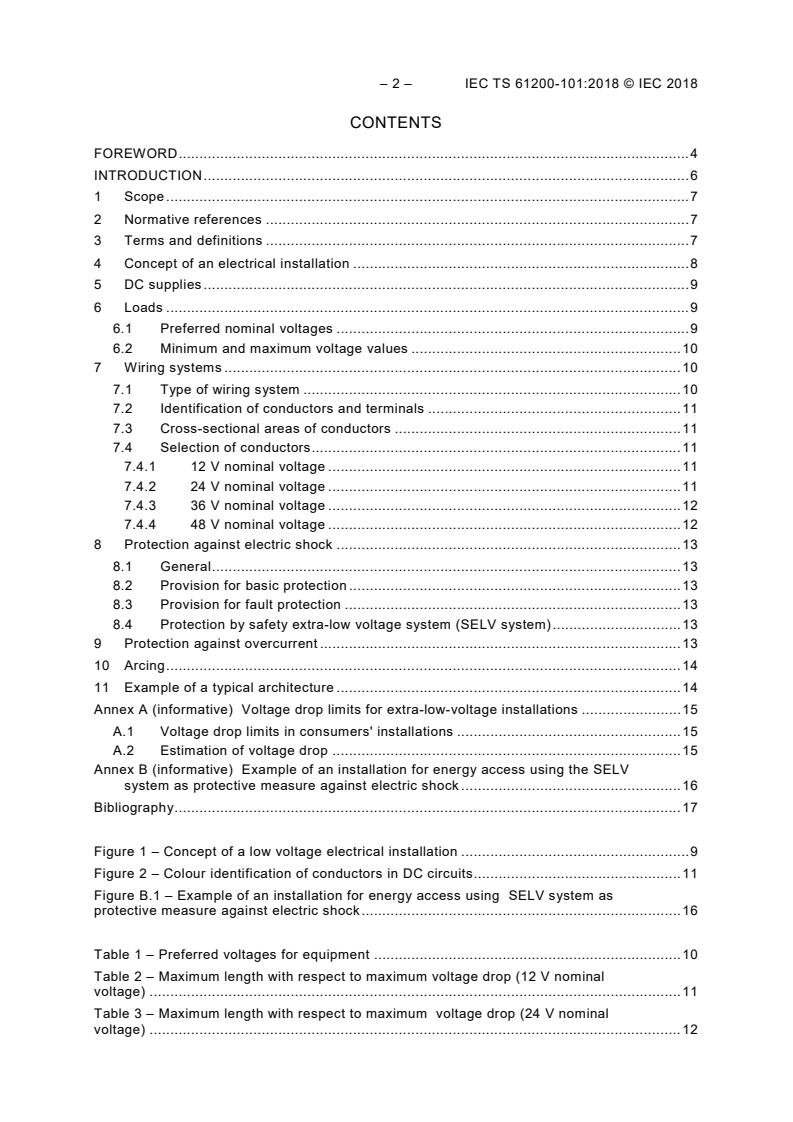
– 2 – IEC TS 61200-101:2018 © IEC 2018
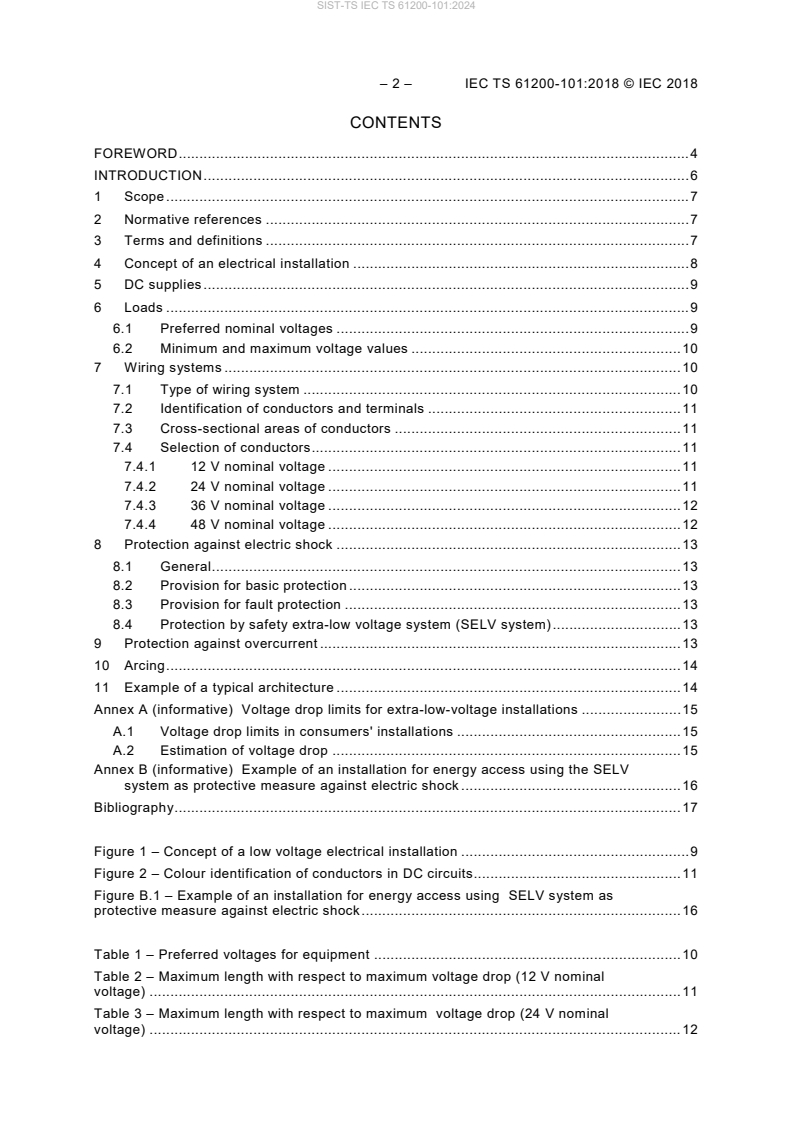
CONTENTS
FOREWORD . 4
INTRODUCTION . 6
1 Scope . 7
2 Normative references . 7
3 Terms and definitions . 7
4 Concept of an electrical installation . 8
5 DC supplies . 9
6 Loads . 9
6.1 Preferred nominal voltages . 9
6.2 Minimum and maximum voltage values . 10
7 Wiring systems . 10
7.1 Type of wiring system . 10
7.2 Identification of conductors and terminals . 11
7.3 Cross-sectional areas of conductors . 11
7.4 Selection of conductors . 11
7.4.1 12 V nominal voltage . 11
7.4.2 24 V nominal voltage . 11
7.4.3 36 V nominal voltage . 12
7.4.4 48 V nominal voltage . 12
8 Protection against electric shock . 13
8.1 General . 13
8.2 Provision for basic protection . 13
8.3 Provision for fault protection . 13
8.4 Protection by safety extra-low voltage system (SELV system) . 13
9 Protection against overcurrent . 13
10 Arcing . 14
11 Example of a typical architecture . 14
Annex A (informative) Voltage drop limits for extra-low-voltage installations . 15
A.1 Voltage drop limits in consumers' installations . 15
A.2 Estimation of voltage drop . 15
Annex B (informative) Example of an installation for energy access using the SELV
system as protective measure against electric shock . 16
Bibliography . 17
Figure 1 – Concept of a low voltage electrical installation . 9
Figure 2 – Colour identification of conductors in DC circuits . 11
Figure B.1 – Example of an installation for energy access using SELV system as
protective measure against electric shock . 16
Table 1 – Preferred voltages for equipment . 10
Table 2 – Maximum length with respect to maximum voltage drop (12 V nominal
voltage) . 11
Table 3 – Maximum length with respect to maximum voltage drop (24 V nominal
voltage) . 12
Table 4 – Maximum length with respect to maximum voltage drop (36 V nominal
voltage) . 12
Table 5 – Maximum length with respect to maximum voltage drop (48 V nominal
voltage) . 12
Table A.1 – Maximum voltage drops . 15
– 4 – IEC TS 61200-101:2018 © IEC 2018
INTERNATIONAL ELECTROTECHNICAL COMMISSION
____________
ELECTRICAL INSTALLATION GUIDE –
Part 101: Application guidelines on extra-low-voltage
direct current electrical installations not intended to be
connected to a public distribution network
FOREWORD
1) The International Electrotechnical Commission (IEC) is a worldwide organization for standardization comprising
all national electrotechnical committees (IEC National Committees). The object of IEC is to promote
international co-operation on all questions concerning standardization in the electrical and electronic fields. To
this end and in addition to other activities, IEC publishes International Standards, Technical Specifications,
Technical Reports, Publicly Available Specifications (PAS) and Guides (hereafter referred to as "IEC
Publication(s)"). Their preparation is entrusted to technical committees; any IEC National Committee interested
in the subject dealt with may participate in this preparatory work. International, governmental and non-
governmental organizations liaising with the IEC also participate in this preparation. IEC collaborates closely
with the International Organization for Standardization (ISO) in accordance with conditions determined by
agreement between the two organizations.
2) The formal decisions or agreements of IEC on technical matters express, as nearly as possible, an international
consensus of opinion on the relevant subjects since each technical committee has representation from all
interested IEC National Committees.
3) IEC Publications have the form of recommendations for international use and are accepted by IEC National
Committees in that sense. While all reasonable efforts are made to ensure that the technical content of IEC
Publications is accurate, IEC cannot be held responsible for the way in which they are used or for any
misinterpretation by any end user.
4) In order to promote international uniformity, IEC National Committees undertake to apply IEC Publications
transparently to the maximum extent possible in their national and regional publications. Any divergence
between any IEC Publication and the corresponding national or regional publication shall be clearly indicated in
the latter.
5) IEC itself does not provide any attestation of conformity. Independent certification bodies provide conformity
assessment services and, in some areas, access to IEC marks of conformity. IEC is not responsible for any
services carried out by independent certification bodies.
6) All users should ensure that they have the latest edition of this publication.
7) No liability shall attach to IEC or its directors, employees, servants or agents including individual experts and
members of its technical committees and IEC National Committees for any personal injury, property damage or
other damage of any nature whatsoever, whether direct or indirect, or for costs (including legal fees) and
expenses arising out of the publication, use of, or reliance upon, this IEC Publication or any other IEC
Publications.
8) Attention is drawn to the Normative references cited in this publication. Use of the referenced publications is
indispensable for the correct application of this publication.
9) Attention is drawn to the possibility that some of the elements of this IEC Publication may be the subject of
patent rights. IEC shall not be held responsible for identifying any or all such patent rights.
The main task of IEC technical committees is to prepare International Standards. In
exceptional circumstances, a technical committee may propose the publication of a technical
specification when
• the required support cannot be obtained for the publication of an International Standard,
despite repeated efforts, or
• the subject is still under technical development or where, for any other reason, there is the
future but no immediate possibility of an agreement on an International Standard.
Technical specifications are subject to review within three years of publication to decide
whether they can be transformed into International Standards.
IEC TS 61200-101, which is a Technical Specification, has been prepared by IEC technical
committee 64: Electrical installations and protection against electric shock.
The text of this Technical Specification is based on the following documents:
Draft TS Report on voting
64/2284/DTS 64/2338/RVDTS
Full information on the voting for the approval of this technical specification can be found in
the report on voting indicated in the above table.
This document has been drafted in accordance with the ISO/IEC Directives, Part 2.
A list of all parts in the IEC 61200 series, published under the general title Electrical
installation guide, can be found on the IEC website.
The committee has decided that the contents of this document will remain unchanged until the
stability date indicated on the IEC website under "http://webstore.iec.ch" in the data related to
the specific document. At this date, the document will be
• reconfirmed,
• withdrawn,
• replaced by a revised edition, or
• amended.
A bilingual version of this publication may be issued at a later date.
IMPORTANT – The 'colour inside' logo on the cover page of this publication indicates
that it contains colours which are considered to be useful for the correct
understanding of its contents. Users should therefore print this document using a
colour printer.
– 6 – IEC TS 61200-101:2018 © IEC 2018
INTRODUCTION
Many people in the world who still have no access to electricity would benefit from access to
electrical power. This can now be achieved with distributed electrical sources using renewable
energy.
Many of these electrical sources using renewable energy generate direct current (e.g.
photovoltaic system, wind turbines) and supply from these renewable energies is not
constant: photovoltaic panels do not operate at night and wind turbines require wind for
generating electrical energy. Therefore, the use of storage units becomes a necessity.
Manufacturers of stationary secondary batteries have been investing a lot in these
technologies and prices will soon become affordable to those people in need of access to
electricity.
In addition, new technologies, such as light emitting diodes (LEDs) and/or other electronic
equipment use direct current and connecting these types of current-using equipment to
electricity sources using renewable energy through DC electrical installations is more and
more realistic. For changing DC voltage, DC/DC converters are available.
All requirements and recommendations in this document comply with
IEC 60364 (all parts) [1] .
The voltage is limited to 60 V DC taking into account environmental conditions and use cases.
—————————
Numbers in square brackets refer to the Bibliography.
ELECTRICAL INSTALLATION GUIDE –
Part 101: Application guidelines on extra-low-voltage
direct current electrical installations not intended to be
connected to a public distribution network
1 Scope
This part of IEC 61200 applies to individual DC low-voltage electrical installations entirely
supplied by local power sources, and not intended to be connected to a public distribution
network and having a nominal voltage lower or equal to 60 V DC within the extra-low-voltage
limit.
This document also applies to DC installations according to use cases TIER 2 and TIER 3 of
the World Bank defined in ESMAP 008/15 Report [2].
This document does not apply to shared or collective electrical installations which are covered
in IEC 61200-102 [3].
2 Normative references
The following documents are referred to in the text in such a way that some or all of their
content constitutes requirements of this document. For dated references, only the edition
cited applies. For undated references, the latest edition of the referenced document (including
any amendments) applies.
IEC 60269-3, Low-voltage fuses – Part 3: Supplementary requirements for fuses for use by
unskilled persons (fuses mainly for household or similar applications) – Examples of
standardized systems of fuses A to F
IEC 60445, Basic and safety principles for man-machine interface, marking and identification
– Identification of equipment terminals, conductor terminations and conductors
...
IEC TS 61200-101 ®
Edition 1.0 2018-11
TECHNICAL
SPECIFICATION
colour
inside
Electrical installation guide –
Part 101: Application guidelines on extra-low-voltage direct current electrical
installations not intended to be connected to a public distribution network
All rights reserved. Unless otherwise specified, no part of this publication may be reproduced or utilized in any form
or by any means, electronic or mechanical, including photocopying and microfilm, without permission in writing from
either IEC or IEC's member National Committee in the country of the requester. If you have any questions about IEC
copyright or have an enquiry about obtaining additional rights to this publication, please contact the address below or
your local IEC member National Committee for further information.
IEC Central Office Tel.: +41 22 919 02 11
3, rue de Varembé info@iec.ch
CH-1211 Geneva 20 www.iec.ch
Switzerland
About the IEC
The International Electrotechnical Commission (IEC) is the leading global organization that prepares and publishes
International Standards for all electrical, electronic and related technologies.
About IEC publications
The technical content of IEC publications is kept under constant review by the IEC. Please make sure that you have the
latest edition, a corrigenda or an amendment might have been published.
IEC Catalogue - webstore.iec.ch/catalogue Electropedia - www.electropedia.org
The stand-alone application for consulting the entire The world's leading online dictionary of electronic and
bibliographical information on IEC International Standards, electrical terms containing 21 000 terms and definitions in
Technical Specifications, Technical Reports and other English and French, with equivalent terms in 16 additional
documents. Available for PC, Mac OS, Android Tablets and languages. Also known as the International Electrotechnical
iPad. Vocabulary (IEV) online.
IEC publications search - webstore.iec.ch/advsearchform IEC Glossary - std.iec.ch/glossary
The advanced search enables to find IEC publications by a 67 000 electrotechnical terminology entries in English and
variety of criteria (reference number, text, technical French extracted from the Terms and Definitions clause of
committee,…). It also gives information on projects, replaced IEC publications issued since 2002. Some entries have been
and withdrawn publications. collected from earlier publications of IEC TC 37, 77, 86 and
CISPR.
IEC Just Published - webstore.iec.ch/justpublished
Stay up to date on all new IEC publications. Just Published IEC Customer Service Centre - webstore.iec.ch/csc
details all new publications released. Available online and If you wish to give us your feedback on this publication or
also once a month by email. need further assistance, please contact the Customer Service
Centre: sales@iec.ch.
IEC TS 61200-101 ®
Edition 1.0 2018-11
TECHNICAL
SPECIFICATION
colour
inside
Electrical installation guide –
Part 101: Application guidelines on extra-low-voltage direct current electrical
installations not intended to be connected to a public distribution network
INTERNATIONAL
ELECTROTECHNICAL
COMMISSION
ICS 91.140.50 ISBN 978-2-8322-6254-2
– 2 – IEC TS 61200-101:2018 © IEC 2018
CONTENTS
FOREWORD . 4
INTRODUCTION . 6
1 Scope . 7
2 Normative references . 7
3 Terms and definitions . 7
4 Concept of an electrical installation . 8
5 DC supplies . 9
6 Loads . 9
6.1 Preferred nominal voltages . 9
6.2 Minimum and maximum voltage values . 10
7 Wiring systems . 10
7.1 Type of wiring system . 10
7.2 Identification of conductors and terminals . 11
7.3 Cross-sectional areas of conductors . 11
7.4 Selection of conductors . 11
7.4.1 12 V nominal voltage . 11
7.4.2 24 V nominal voltage . 11
7.4.3 36 V nominal voltage . 12
7.4.4 48 V nominal voltage . 12
8 Protection against electric shock . 13
8.1 General . 13
8.2 Provision for basic protection . 13
8.3 Provision for fault protection . 13
8.4 Protection by safety extra-low voltage system (SELV system) . 13
9 Protection against overcurrent . 13
10 Arcing . 14
11 Example of a typical architecture . 14
Annex A (informative) Voltage drop limits for extra-low-voltage installations . 15
A.1 Voltage drop limits in consumers' installations . 15
A.2 Estimation of voltage drop . 15
Annex B (informative) Example of an installation for energy access using the SELV
system as protective measure against electric shock . 16
Bibliography . 17
Figure 1 – Concept of a low voltage electrical installation . 9
Figure 2 – Colour identification of conductors in DC circuits . 11
Figure B.1 – Example of an installation for energy access using SELV system as
protective measure against electric shock . 16
Table 1 – Preferred voltages for equipment . 10
Table 2 – Maximum length with respect to maximum voltage drop (12 V nominal
voltage) . 11
Table 3 – Maximum length with respect to maximum voltage drop (24 V nominal
voltage) . 12
Table 4 – Maximum length with respect to maximum voltage drop (36 V nominal
voltage) . 12
Table 5 – Maximum length with respect to maximum voltage drop (48 V nominal
voltage) . 12
Table A.1 – Maximum voltage drops . 15
– 4 – IEC TS 61200-101:2018 © IEC 2018
INTERNATIONAL ELECTROTECHNICAL COMMISSION
____________
ELECTRICAL INSTALLATION GUIDE –
Part 101: Application guidelines on extra-low-voltage
direct current electrical installations not intended to be
connected to a public distribution network
FOREWORD
1) The International Electrotechnical Commission (IEC) is a worldwide organization for standardization comprising
all national electrotechnical committees (IEC National Committees). The object of IEC is to promote
international co-operation on all questions concerning standardization in the electrical and electronic fields. To
this end and in addition to other activities, IEC publishes International Standards, Technical Specifications,
Technical Reports, Publicly Available Specifications (PAS) and Guides (hereafter referred to as "IEC
Publication(s)"). Their preparation is entrusted to technical committees; any IEC National Committee interested
in the subject dealt with may participate in this preparatory work. International, governmental and non-
governmental organizations liaising with the IEC also participate in this preparation. IEC collaborates closely
with the International Organization for Standardization (ISO) in accordance with conditions determined by
agreement between the two organizations.
2) The formal decisions or agreements of IEC on technical matters express, as nearly as possible, an international
consensus of opinion on the relevant subjects since each technical committee has representation from all
interested IEC National Committees.
3) IEC Publications have the form of recommendations for international use and are accepted by IEC National
Committees in that sense. While all reasonable efforts are made to ensure that the technical content of IEC
Publications is accurate, IEC cannot be held responsible for the way in which they are used or for any
misinterpretation by any end user.
4) In order to promote international uniformity, IEC National Committees undertake to apply IEC Publications
transparently to the maximum extent possible in their national and regional publications. Any divergence
between any IEC Publication and the corresponding national or regional publication shall be clearly indicated in
the latter.
5) IEC itself does not provide any attestation of conformity. Independent certification bodies provide conformity
assessment services and, in some areas, access to IEC marks of conformity. IEC is not responsible for any
services carried out by independent certification bodies.
6) All users should ensure that they have the latest edition of this publication.
7) No liability shall attach to IEC or its directors, employees, servants or agents including individual experts and
members of its technical committees and IEC National Committees for any personal injury, property damage or
other damage of any nature whatsoever, whether direct or indirect, or for costs (including legal fees) and
expenses arising out of the publication, use of, or reliance upon, this IEC Publication or any other IEC
Publications.
8) Attention is drawn to the Normative references cited in this publication. Use of the referenced publications is
indispensable for the correct application of this publication.
9) Attention is drawn to the possibility that some of the elements of this IEC Publication may be the subject of
patent rights. IEC shall not be held responsible for identifying any or all such patent rights.
The main task of IEC technical committees is to prepare International Standards. In
exceptional circumstances, a technical committee may propose the publication of a technical
specification when
• the required support cannot be obtained for the publication of an International Standard,
despite repeated efforts, or
• the subject is still under technical development or where, for any other reason, there is the
future but no immediate possibility of an agreement on an International Standard.
Technical specifications are subject to review within three years of publication to decide
whether they can be transformed into International Standards.
IEC TS 61200-101, which is a Technical Specification, has been prepared by IEC technical
committee 64: Electrical installations and protection against electric shock.
The text of this Technical Specification is based on the following documents:
Draft TS Report on voting
64/2284/DTS 64/2338/RVDTS
Full information on the voting for the approval of this technical specification can be found in
the report on voting indicated in the above table.
This document has been drafted in accordance with the ISO/IEC Directives, Part 2.
A list of all parts in the IEC 61200 series, published under the general title Electrical
installation guide, can be found on the IEC website.
The committee has decided that the contents of this document will remain unchanged until the
stability date indicated on the IEC website under "http://webstore.iec.ch" in the data related to
the specific document. At this date, the document will be
• reconfirmed,
• withdrawn,
• replaced by a revised edition, or
• amended.
A bilingual version of this publication may be issued at a later date.
IMPORTANT – The 'colour inside' logo on the cover page of this publication indicates
that it contains colours which are considered to be useful for the correct
understanding of its contents. Users should therefore print this document using a
colour printer.
– 6 – IEC TS 61200-101:2018 © IEC 2018
INTRODUCTION
Many people in the world who still have no access to electricity would benefit from access to
electrical power. This can now be achieved with distributed electrical sources using renewable
energy.
Many of these electrical sources using renewable energy generate direct current (e.g.
photovoltaic system, wind turbines) and supply from these renewable energies is not
constant: photovoltaic panels do not operate at night and wind turbines require wind for
generating electrical energy. Therefore, the use of storage units becomes a necessity.
Manufacturers of stationary secondary batteries have been investing a lot in these
technologies and prices will soon become affordable to those people in need of access to
electricity.
In addition, new technologies, such as light emitting diodes (LEDs) and/or other electronic
equipment use direct current and connecting these types of current-using equipment to
electricity sources using renewable energy through DC electrical installations is more and
more realistic. For changing DC voltage, DC/DC converters are available.
All requirements and recommendations in this document comply with
IEC 60364 (all parts) [1] .
The voltage is limited to 60 V DC taking into account environmental conditions and use cases.
—————————
Numbers in square brackets refer to the Bibliography.
ELECTRICAL INSTALLATION GUIDE –
Part 101: Application guidelines on extra-low-voltage
direct current electrical installations not intended to be
connected to a public distribution network
1 Scope
This part of IEC 61200 applies to individual DC low-voltage electrical installations entirely
supplied by local power sources, and not intended to be connected to a public distribution
network and having a nominal voltage lower or eq
...