

IEC 62847:2016
(Main)Railway applications - Rolling stock - Electrical connectors - Requirements and test methods
General Information
- Abstract
IEC 62847:2016 retains IEC 61984:2008 as the minimum performance requirements for railway rolling stock electrical connectors and identifies additional terms, test methods and performance requirements for single-pole and multipole connectors with rated voltages up to 1 000 V, rated currents up to 125 A per contact and frequencies below 3 MHz used for indoor and outdoor applications in railway rolling stock.
- Status
- Published
- Publication Date
- 23-Feb-2016
- Technical Committee
- TC 9 - Electrical equipment and systems for railways
- Drafting Committee
- PT 62847 - TC 9/PT 62847
- Current Stage
- PPUB - Publication issued
- Start Date
- 24-Feb-2016
- Completion Date
- 15-Mar-2016
Overview
IEC 62847:2016 is a crucial international standard developed by the International Electrotechnical Commission (IEC) covering railway applications, specifically addressing rolling stock electrical connectors. This standard outlines detailed requirements and test methods for electrical connectors used in rolling stock, focusing on both single-pole and multipole connectors with rated voltages up to 1,000 V and rated currents up to 125 A per contact. It caters to connectors used in environments with frequencies below 3 MHz and applicable for both indoor and outdoor railway applications.
Importantly, IEC 62847:2016 builds upon the minimum performance requirements of IEC 61984:2008, enhancing the specification by integrating terms, test protocols, and performance benchmarks tailored to the demanding conditions of railway rolling stock operations. This standard ensures safety, reliability, durability, and interoperability of electrical connectors critical for railway systems.
Key Topics
Electrical Ratings and Classification
Defines electrical ratings including voltage, current, and frequency limits alongside categorization according to application severity and connector location on rolling stock.Connector Requirements
Sets forth stringent criteria such as marking and identification, protection against incorrect mating, electric shock protection, earthing provisions, and mechanical design safeguards including polarization and fixing of live parts.Durability and Environmental Resistance
Addresses resistance to aging, corrosion, UV radiation, chemically active substances, ozone, and temperature variations ensuring connectors perform reliably over time.Mechanical and Electrical Performance
Includes requirements for mechanical strength, vibration and shock resistance, degree of protection (IP rating), dielectric strength, and tests related to temperature rise.Electromagnetic Compatibility (EMC)
Establishes specifications for minimization of electromagnetic interference ensuring connector functionality in complex railway electrical environments.Test Methods
Comprehensive testing framework covering raw materials, mechanical operation, temperature rise, dielectric performance, corrosion, UV and ozone resistance, and fluid contamination.
Applications
IEC 62847:2016 is essential for manufacturers, designers, and suppliers involved in the development and deployment of electrical connectors in railway rolling stock. Its applications include:
Rolling Stock Manufacturing
Guiding connector design and selection to meet safety and performance standards.Railway Vehicle Maintenance and Upgrades
Ensuring connectors comply with international requirements for safe retrofit and repair.Component Testing and Certification
Providing test methodologies and criteria for certification bodies to validate connector performance.Interoperable System Integration
Facilitating compatibility between different connector systems across railway vehicles and infrastructure.
Overall, the standard supports enhanced safety, operational reliability, and long-term sustainability in railway electrical systems, helping stakeholders meet rigorous regulatory and operational demands.
Related Standards
IEC 61984:2008 - Connectors - Safety requirements and tests, serving as the baseline performance document referenced by IEC 62847.
IEC 60512 Series - Tests on electromechanical components, referenced for testing connector fluid resistance and durability.
ISO 1431-1 - Rubber resistance to ozone, applied for material endurance testing.
ISO 4892-2:2013 - Plastics exposure to artificial weathering, relevant for UV resistance testing.
Other IEC Electrotechnical Standards - Related to electromagnetic compatibility (EMC), electrical safety, and mechanical testing protocols.
By aligning with these related standards, IEC 62847:2016 integrates railway-specific requirements within the broader framework of international electrical connector standards, ensuring comprehensive compliance and performance assurance.
Keywords: IEC 62847, railway electrical connectors, rolling stock connectors, electrical connector standards, railway applications, connector test methods, electrical safety, electrical connector durability, multipole connectors, connector performance testing, IEC standards railway
Get Certified
Connect with accredited certification bodies for this standard

IRIS Certification (UNIFE)
International Railway Industry Standard certification.

TÜV SÜD Rail GmbH
TÜV SÜD railway certification services.

Bureau Veritas Railway Certification
Railway and transportation certification.
Sponsored listings
Frequently Asked Questions
IEC 62847:2016 is a standard published by the International Electrotechnical Commission (IEC). Its full title is "Railway applications - Rolling stock - Electrical connectors - Requirements and test methods". This standard covers: IEC 62847:2016 retains IEC 61984:2008 as the minimum performance requirements for railway rolling stock electrical connectors and identifies additional terms, test methods and performance requirements for single-pole and multipole connectors with rated voltages up to 1 000 V, rated currents up to 125 A per contact and frequencies below 3 MHz used for indoor and outdoor applications in railway rolling stock.
IEC 62847:2016 retains IEC 61984:2008 as the minimum performance requirements for railway rolling stock electrical connectors and identifies additional terms, test methods and performance requirements for single-pole and multipole connectors with rated voltages up to 1 000 V, rated currents up to 125 A per contact and frequencies below 3 MHz used for indoor and outdoor applications in railway rolling stock.
IEC 62847:2016 is classified under the following ICS (International Classification for Standards) categories: 45.060.01 - Railway rolling stock in general. The ICS classification helps identify the subject area and facilitates finding related standards.
IEC 62847:2016 is available in PDF format for immediate download after purchase. The document can be added to your cart and obtained through the secure checkout process. Digital delivery ensures instant access to the complete standard document.
Standards Content (Sample)
IEC 62847 ®
Edition 1.0 2016-02
INTERNATIONAL
STANDARD
NORME
INTERNATIONALE
colour
inside
Railway applications – Rolling stock – Electrical connectors – Requirements
and test methods
Applications ferroviaires – Matériel roulant – Connecteurs électriques –
Exigences et méthodes d'essai
All rights reserved. Unless otherwise specified, no part of this publication may be reproduced or utilized in any form
or by any means, electronic or mechanical, including photocopying and microfilm, without permission in writing from
either IEC or IEC's member National Committee in the country of the requester. If you have any questions about IEC
copyright or have an enquiry about obtaining additional rights to this publication, please contact the address below or
your local IEC member National Committee for further information.
Droits de reproduction réservés. Sauf indication contraire, aucune partie de cette publication ne peut être reproduite
ni utilisée sous quelque forme que ce soit et par aucun procédé, électronique ou mécanique, y compris la photocopie
et les microfilms, sans l'accord écrit de l'IEC ou du Comité national de l'IEC du pays du demandeur. Si vous avez des
questions sur le copyright de l'IEC ou si vous désirez obtenir des droits supplémentaires sur cette publication, utilisez
les coordonnées ci-après ou contactez le Comité national de l'IEC de votre pays de résidence.
IEC Central Office Tel.: +41 22 919 02 11
3, rue de Varembé Fax: +41 22 919 03 00
CH-1211 Geneva 20 info@iec.ch
Switzerland www.iec.ch
About the IEC
The International Electrotechnical Commission (IEC) is the leading global organization that prepares and publishes
International Standards for all electrical, electronic and related technologies.
About IEC publications
The technical content of IEC publications is kept under constant review by the IEC. Please make sure that you have the
latest edition, a corrigenda or an amendment might have been published.
IEC Catalogue - webstore.iec.ch/catalogue Electropedia - www.electropedia.org
The stand-alone application for consulting the entire The world's leading online dictionary of electronic and
bibliographical information on IEC International Standards, electrical terms containing 20 000 terms and definitions in
Technical Specifications, Technical Reports and other English and French, with equivalent terms in 15 additional
documents. Available for PC, Mac OS, Android Tablets and languages. Also known as the International Electrotechnical
iPad. Vocabulary (IEV) online.
IEC publications search - www.iec.ch/searchpub IEC Glossary - std.iec.ch/glossary
The advanced search enables to find IEC publications by a 65 000 electrotechnical terminology entries in English and
variety of criteria (reference number, text, technical French extracted from the Terms and Definitions clause of
committee,…). It also gives information on projects, replaced IEC publications issued since 2002. Some entries have been
and withdrawn publications. collected from earlier publications of IEC TC 37, 77, 86 and
CISPR.
IEC Just Published - webstore.iec.ch/justpublished
Stay up to date on all new IEC publications. Just Published IEC Customer Service Centre - webstore.iec.ch/csc
details all new publications released. Available online and If you wish to give us your feedback on this publication or
also once a month by email. need further assistance, please contact the Customer Service
Centre: csc@iec.ch.
A propos de l'IEC
La Commission Electrotechnique Internationale (IEC) est la première organisation mondiale qui élabore et publie des
Normes internationales pour tout ce qui a trait à l'électricité, à l'électronique et aux technologies apparentées.
A propos des publications IEC
Le contenu technique des publications IEC est constamment revu. Veuillez vous assurer que vous possédez l’édition la
plus récente, un corrigendum ou amendement peut avoir été publié.
Catalogue IEC - webstore.iec.ch/catalogue Electropedia - www.electropedia.org
Application autonome pour consulter tous les renseignements
Le premier dictionnaire en ligne de termes électroniques et
bibliographiques sur les Normes internationales,
électriques. Il contient 20 000 termes et définitions en anglais
Spécifications techniques, Rapports techniques et autres
et en français, ainsi que les termes équivalents dans 15
documents de l'IEC. Disponible pour PC, Mac OS, tablettes
langues additionnelles. Egalement appelé Vocabulaire
Android et iPad.
Electrotechnique International (IEV) en ligne.
Recherche de publications IEC - www.iec.ch/searchpub
Glossaire IEC - std.iec.ch/glossary
La recherche avancée permet de trouver des publications IEC 65 000 entrées terminologiques électrotechniques, en anglais
en utilisant différents critères (numéro de référence, texte, et en français, extraites des articles Termes et Définitions des
comité d’études,…). Elle donne aussi des informations sur les publications IEC parues depuis 2002. Plus certaines entrées
projets et les publications remplacées ou retirées. antérieures extraites des publications des CE 37, 77, 86 et
CISPR de l'IEC.
IEC Just Published - webstore.iec.ch/justpublished
Service Clients - webstore.iec.ch/csc
Restez informé sur les nouvelles publications IEC. Just
Published détaille les nouvelles publications parues. Si vous désirez nous donner des commentaires sur cette
Disponible en ligne et aussi une fois par mois par email. publication ou si vous avez des questions contactez-nous:
csc@iec.ch.
IEC 62847 ®
Edition 1.0 2016-02
INTERNATIONAL
STANDARD
NORME
INTERNATIONALE
colour
inside
Railway applications – Rolling stock – Electrical connectors – Requirements
and test methods
Applications ferroviaires – Matériel roulant – Connecteurs électriques –
Exigences et méthodes d'essai
INTERNATIONAL
ELECTROTECHNICAL
COMMISSION
COMMISSION
ELECTROTECHNIQUE
INTERNATIONALE
ICS 45.060 ISBN 978-2-8322-3207-1
– 2 – IEC 62847:2016 © IEC 2016
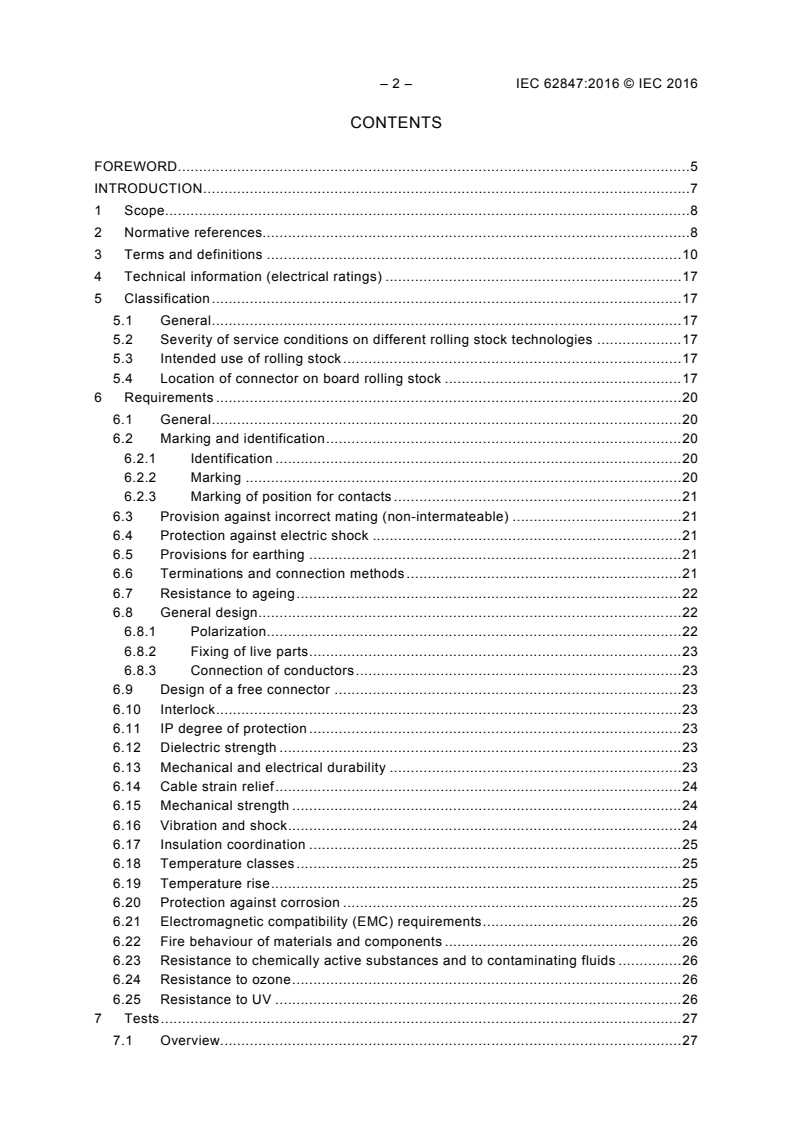
CONTENTS
FOREWORD . 5
INTRODUCTION . 7
1 Scope . 8
2 Normative references. 8
3 Terms and definitions . 10
4 Technical information (electrical ratings) . 17
5 Classification . 17
5.1 General . 17
5.2 Severity of service conditions on different rolling stock technologies . 17
5.3 Intended use of rolling stock . 17
5.4 Location of connector on board rolling stock . 17
6 Requirements . 20
6.1 General . 20
6.2 Marking and identification . 20
6.2.1 Identification . 20
6.2.2 Marking . 20
6.2.3 Marking of position for contacts . 21
6.3 Provision against incorrect mating (non-intermateable) . 21
6.4 Protection against electric shock . 21
6.5 Provisions for earthing . 21
6.6 Terminations and connection methods . 21
6.7 Resistance to ageing . 22
6.8 General design . 22
6.8.1 Polarization . 22
6.8.2 Fixing of live parts . 23
6.8.3 Connection of conductors . 23
6.9 Design of a free connector . 23
6.10 Interlock . 23
6.11 IP degree of protection . 23
6.12 Dielectric strength . 23
6.13 Mechanical and electrical durability . 23
6.14 Cable strain relief . 24
6.15 Mechanical strength . 24
6.16 Vibration and shock . 24
6.17 Insulation coordination . 25
6.18 Temperature classes . 25
6.19 Temperature rise . 25
6.20 Protection against corrosion . 25
6.21 Electromagnetic compatibility (EMC) requirements . 26
6.22 Fire behaviour of materials and components . 26
6.23 Resistance to chemically active substances and to contaminating fluids . 26
6.24 Resistance to ozone . 26
6.25 Resistance to UV . 26
7 Tests . 27
7.1 Overview. 27
7.1.1 General . 27
7.1.2 Preconditioning and preparation . 27
7.1.3 Test conditions . 27
7.2 Test schedule . 29
7.3 Tests on raw materials . 36
7.4 Visual examination . 36
7.5 Durability of marking . 37
7.6 Interlock . 37
7.7 Protection against electric shock . 37
7.8 Temperature rise . 37
7.9 Mechanical operation . 38
7.10 Vibration and shock . 38
7.11 Measurement of clearances and creepage distances. 39
7.12 Dielectric strength . 39
7.13 Resistance between accessible metal parts and the protective earthing
contact . 39
7.14 Corrosion test . 40
7.15 Ozone resistance (ISO 1431-1) . 40
7.16 Resistance to UV (ISO 4892-2:2013) . 40
7.17 Resistance to fluids (IEC 60512-19-3:1997) . 40
Annex A (informative) Additional characteristics to be agreed by the manufacturer
and the user . 41
A.1 Additional information to be provided upon request of the user . 41
A.1.1 General . 41
A.1.2 Geometrical characteristics . 41
A.1.3 Electrical characteristics . 41
A.1.4 Environmental characteristics . 42
A.1.5 Mechanical characteristics . 42
A.2 Information for testing additional to that mentioned above . 42
Annex B (normative) Severity of the service conditions in different rolling stock
locations (mandatory) . 43
Annex C (informative) Severity of the service conditions in different rolling stock
locations (optional) . 44
Bibliography . 45
Figure 1 – Typical examples of connections . 11
Figure 2 – Multipole connectors . 12
Figure 3 – Typical connector locations on board rolling stock . 18
Figure 4 – Test sample for temperature rise test . 38
Table 1 – Example of typical connector locations on board rolling stock . 19
Table 2 – Preferred number of operating cycles . 24
Table 3 – Preferred test temperatures . 25
Table 4 – Plan of specimens required for tests . 27
Table 5 – Mechanical test group A . 29
Table 6 – Service life test group B . 30
Table 7 – Thermal test group C . 30
– 4 – IEC 62847:2016 © IEC 2016
Table 8 – Climatic test group D . 31
Table 9 – Degree of protection test group E. 33
Table 10 – Vibration and shock test group F . 34
Table 11 – Resistance to fluids test group G. 35
Table 12 – Shielding effectiveness test group H . 36
Table 13 – Tests on raw materials . 36
Table 14 – Test voltages . 39
Table B.1 – Minimum severity of service conditions in different rolling stock locations . 43
Table C.1 – Minimum severity of service conditions in different rolling stock locations . 44
INTERNATIONAL ELECTROTECHNICAL COMMISSION
____________
RAILWAY APPLICATIONS – ROLLING STOCK – ELECTRICAL
CONNECTORS – REQUIREMENTS AND TEST METHODS
FOREWORD
1) The International Electrotechnical Commission (IEC) is a worldwide organization for standardization comprising
all national electrotechnical committees (IEC National Committees). The object of IEC is to promote
international co-operation on all questions concerning standardization in the electrical and electronic fields. To
this end and in addition to other activities, IEC publishes International Standards, Technical Specifications,
Technical Reports, Publicly Available Specifications (PAS) and Guides (hereafter referred to as “IEC
Publication(s)”). Their preparation is entrusted to technical committees; any IEC National Committee interested
in the subject dealt with may participate in this preparatory work. International, governmental and non-
governmental organizations liaising with the IEC also participate in this preparation. IEC collaborates closely
with the International Organization for Standardization (ISO) in accordance with conditions determined by
agreement between the two organizations.
2) The formal decisions or agreements of IEC on technical matters express, as nearly as possible, an international
consensus of opinion on the relevant subjects since each technical committee has representation from all
interested IEC National Committees.
3) IEC Publications have the form of recommendations for international use and are accepted by IEC National
Committees in that sense. While all reasonable efforts are made to ensure that the technical content of IEC
Publications is accurate, IEC cannot be held responsible for the way in which they are used or for any
misinterpretation by any end user.
4) In order to promote international uniformity, IEC National Committees undertake to apply IEC Publications
transparently to the maximum extent possible in their national and regional publications. Any divergence
between any IEC Publication and the corresponding national or regional publication shall be clearly indicated in
the latter.
5) IEC itself does not provide any attestation of conformity. Independent certification bodies provide conformity
assessment services and, in some areas, access to IEC marks of conformity. IEC is not responsible for any
services carried out by independent certification bodies.
6) All users should ensure that they have the latest edition of this publication.
7) No liability shall attach to IEC or its directors, employees, servants or agents including individual experts and
members of its technical committees and IEC National Committees for any personal injury, property damage or
other damage of any nature whatsoever, whether direct or indirect, or for costs (including legal fees) and
expenses arising out of the publication, use of, or reliance upon, this IEC Publication or any other IEC
Publications.
8) Attention is drawn to the Normative references cited in this publication. Use of the referenced publications is
indispensable for the correct application of this publication.
9) Attention is drawn to the possibility that some of the elements of this IEC Publication may be the subject of
patent rights. IEC shall not be held responsible for identifying any or all such patent rights.
International Standard IEC 62847 has been prepared by IEC technical committee 9: Electrical
equipment and systems for railways.
EN 50467:2011 has served as a basis for the elaboration of this standard.
The text of this standard is based on the following documents:
FDIS Report on voting
9/2110/FDIS 9/2139/RVD
Full information on the voting for the approval of this standard can be found in the report on
voting indicated in the above table.
This publication has been drafted in accordance with the ISO/IEC Directives, Part 2.
– 6 – IEC 62847:2016 © IEC 2016
The committee has decided that the contents of this publication will remain unchanged until
the stability date indicated on the IEC website under "http://webstore.iec.ch" in the data
related to the specific publication. At this date, the publication will be
• reconfirmed,
• withdrawn,
• replaced by a revised edition, or
• amended.
IMPORTANT – The 'colour inside' logo on the cover page of this publication indicates
that it contains colours which are considered to be useful for the correct
understanding of its contents. Users should therefore print this document using a
colour printer.
INTRODUCTION
This International Standard provides performance requirements and tests for low-voltage
electrical connectors intended to be installed on board rolling stock, either inside or outside.
Safety requirements and tests for electrical connectors are already covered in general by
IEC 61984:2008. The additional requirements and testing of specific characteristics
demanded by rolling stock applications are set out in this International Standard. One goal of
this International Standard is to avoid retesting of electrical connectors already in compliance
with IEC 61984:2008 for those characteristics that have been assessed suitable also for use
on board rolling stock.
Among the additional requirements for use on board rolling stock, those that can be verified
by documentation of tests on the raw materials are distinguished from those to be assessed
by tests on the component.
Due to the wide spectrum of existing and future specific rolling stock applications of electrical
connectors, this International Standard does not select any particular geometric configuration
of connectors, nor establish any particular values for electrical ratings such as voltage and
current, or for any other characteristic. All such details should be selected and agreed
between the parties involved (e.g. manufacturer and user) depending on the electrical,
mechanical and environmental conditions expected in the intended use. Annexes A and C of
this International Standard provide guidance.
Upon agreement between the parties involved, this International Standard may be used in
conjunction with existing connector detail specifications for interchangeability purposes.
Specific standards based on this generic International Standard may be developed in the
future to address particular connector requirements and designs, for instance, to fix
dimensions for interchangeability and to set additional requirements for specific applications
that, due to complexity and variety, are left here to agreement between parties involved.
– 8 – IEC 62847:2016 © IEC 2016
RAILWAY APPLICATIONS – ROLLING STOCK – ELECTRICAL
CONNECTORS – REQUIREMENTS AND TEST METHODS
1 Scope
This International Standard retains IEC 61984:2008 as the minimum performance
requirements for railway rolling stock electrical connectors.
It identifies additional terms, test methods and performance requirements for single-pole and
multipole connectors with rated voltages up to 1 000 V, rated currents up to 125 A per contact
and frequencies below 3 MHz used for indoor and outdoor applications in railway rolling stock.
This International Standard does not cover:
• connectors with breaking capacity (CBCs) as defined in IEC 61984:2008, 3.2, because on
board rolling stock connectors are not intended to be operated (i.e. mated and unmated)
under load or when live, either by means of procedures or by the presence of interlocks,
as required by IEC 61991;
• non-rewirable connectors as defined in IEC 61984:2008, 3.5;
• automatic couplers, due to their additional mechanical complexity and the need for more
specific requirements and testing;
• inter-vehicle jumpers, as they are connector and cable assemblies whose characteristics
depend on those of both elements. Inter-vehicle connectors within the limits set in the
scope of this International Standard are therefore covered by the agreed choice of suitable
mechanical and environmental characteristics as defined by Annex B, and suggested by
Annex C.
This International Standard identifies the application levels for electrical connectors based on
a) the severity of the service conditions in different rolling stock technologies,
b) the intended use of the rolling stock,
c) the location of the connector in the rolling stock system.
This International Standard is not applicable to internal connections of electronic devices such
as connectors for printed boards and rack-and-panel connectors.
2 Normative references
The following documents, in whole or in part, are normatively referenced in this document and
are indispensable for its application. For dated references, only the edition cited applies. For
undated references, the latest edition of the referenced document (including any
amendments) applies.
IEC 60050-581, International Electrotechnical Vocabulary – Part 581: Electromechanical
components for electronic equipment (available at: http://www.electropedia.org)
IEC 60060-1:2010, High-voltage test techniques – Part 1: General definitions and test
requirements
IEC 60068-1, Environmental testing – Part 1: General and guidance
IEC 60068-2-70:1995, Environmental testing – Part 2-70: Tests – Test Xb: Abrasion of
markings and letterings caused by rubbing of fingers and hands
IEC 60309-1:1999, Plugs, socket-outlets and couplers for industrial purposes – Part 1:
General requirements
IEC 60352-2:2006, Solderless connections – Part 2: Crimped connections – General
requirements, test methods and practical guidance
IEC 60352-2:2006/AMD1:2013
IEC 60352-3, Solderless connections – Part 3: Solderless accessible insulation displacement
connections – General requirements, test methods and practical guidance
IEC 60352-4, Solderless connections – Part 4: Solderless non-accessible insulation
displacement connections – General requirements, test methods and practical guidance
IEC 60352-5, Solderless connections – Part 5: Press-in connections – General requirements,
test methods and practical guidance
IEC 60352-6, Solderless connections – Part 6: Insulation piercing connections – General
requirements, test methods and practical guidance
IEC 60352-7, Solderless connections – Part 7: Spring clamp connections – General
requirements, test methods and practical guidance
IEC 60417, Graphical symbols for use on equipment (available at: http://www.graphical-
symbols.info/equipment)
IEC 60512-1:2001, Connectors for electronic equipment – Tests and measurements – Part 1:
General
IEC 60512-1-1:2002, Connectors for electronic equipment – Tests and measurements –
Part 1-1: General examination – Test 1a: Visual examination
IEC 60512-4-1:2003, Connectors for electronic equipment – Tests and measurements –
Part 4-1: Voltage stress tests – Test 4a: Voltage proof
IEC 60512-5-1:2002, Connectors for electronic equipment – Tests and measurements –
Part 5-1: Current-carrying capacity tests –Test 5a: Temperature rise
IEC 60512-11-6:2002, Connectors for electronic equipment – Tests and measurements –
Part 11-6: Climatic tests – Test 11f: Corrosion, salt mist
IEC 60512-11-7:2003, Connectors for electronic equipment – Tests and measurements –
Part 11- 7: Climatic tests – Test 11g: Flowing mixed gas corrosion test
IEC 60512-13-5, Connectors for electronic equipment – Tests and measurements – Part 13-5:
Mechanical operation tests – Test 13e: Polarizing and keying method
IEC 60512-19-3:1997, Electromechanical components for electronic equipment – Basic testing
procedures and measuring methods – Part 19: Chemical resistance tests – Section 3: Test
19c – Fluid resistance
IEC 60512-23-3:2000, Electromechanical components for electronic equipment – Basic testing
procedures and measuring methods – Part 23-3: Test 23c: Shielding effectiveness of
connectors and accessories
– 10 – IEC 62847:2016 © IEC 2016
IEC 60512-23-4:2001, Connectors for electronic equipment – Tests and measurements –
Part 23-4: Screening and filtering tests – Test 23d: Transmission line reflections in the time
domain
IEC 60529:1989, Degrees of protection provided by enclosures (IP Code)
IEC 60529:1989/AMD1:1999
IEC 60529:1989/AMD2:2013
IEC 60664-1:2007,Insulation coordination for equipment within low-voltage systems – Part 1:
Principles, requirements and tests
IEC 60999-1:1999, Connecting devices – Electrical copper conductors – Safety requirements
for screw-type and screwless-type clamping units – Part 1: General requirements and
2 2
particular requirements for clamping units for conductors from 0,2 mm up to 35 mm
(included)
IEC 60999-2:2003, Connecting devices – Electrical copper conductors – Safety requirements
for screw-type and screwless-type clamping units – Part 2: Particular requirements for
2 2
clamping units for conductors above 35 mm up to 300 mm (included)
IEC 61210, Connecting devices – Flat quick-connect terminations for electrical copper
conductors – Safety requirements
IEC 61373:2010, Railway applications – Rolling stock equipment – Shock and vibration tests
IEC 61984:2008, Connectors – Safety requirements and tests
IEC 61991, Railway applications – Rolling stock – Protective provisions against electrical
hazards
IEC 62497-1:2010, Railway applications – Insulation coordination – Part 1: Basic
requirements – Clearances and creepage distances for all electrical and electronic equipment
ISO 1431-1:2012, Rubber, vulcanized or thermoplastic – Resistance to ozone cracking –
Part 1: Static and dynamic strain testing
ISO 4892-2:2013, Plastics – Methods of exposure to laboratory light sources – Part 2: Xenon-
arc lamps
3 Terms and definitions
For the purposes of this document, the terms and definitions given in IEC 60050-581:2008
and the following apply.
3.1
connection
two mated connectors or contacts
EXAMPLE See Figure 1.
IEC
IEC
a) Cable-to-cable connection b) Connection to apparatus
Figure 1 – Typical examples of connections
3.2
connector
component which terminates conductors for the purpose of providing connection to and
disconnection from a suitable mating component
Note 1 to entry: Connectors covered by this International Standard are not intended to be mated and unmated
under electrical load.
[SOURCE: IEC 60050-581:2008, 581-26-01]
3.3
free connector
connector for attachment to the free end of a wire or cable
[SOURCE: IEC 60050-581:2008, 581-26-10]
3.4
fixed connector
connector for attachment to a rigid surface
[SOURCE: IEC 60050-581:2008, 581-06-10]
3.5
enclosed connector
connector where protection against electric shock is provided by its enclosures
3.6
unenclosed connector
connector where protection against electric shock is provided by the enclosure of the
equipment in which the connector is mounted
Note 1 to entry: The protection against electrical shock is provided by e.g the enclosure of the equipment in which
the unenclosed connector is mounted in accordance with the applicable product standard.
3.7
inter-vehicle connector
connector intended to be assembled with proper cable to form a cable assembly for inter-
vehicle electrical connection
3.8
contact
conductive element in a connector (including means for cable termination) that mates with a
corresponding element to provide an electrical path
3.9
male contact
contact (including means for cable termination) designed for electrical engagement on its
outer surface and to enter a female contact, thus forming an electrical connection
– 12 – IEC 62847:2016 © IEC 2016
EXAMPLE Tab, pin, blade.
3.10
female contact
contact (including means for cable termination) designed for electrical engagement on its
inner surface, and to accept entry of a male contact, thus forming an electrical connection
EXAMPLE Receptacle, sleeve.
3.11
cable termination
any joining of cable to contact
EXAMPLE Crimp, insulation displacement, screwing, spring clamp.
3.12
multipole connector
connector with more than one contact
EXAMPLE See Figure 2.
1 2
3 4
5 5
IEC
Key
1 multiple cable seal 6 housing seal
2 male contact 7 multipole connector
3 female contact 8 multipole connection
4 single cable seal 9 cable
5 housing 10 conductor
Figure 2 – Multipole connectors
3.13
connector coding
device, either visual, or mechanical, or a combination of these, preventing connection of
connectors from the same family and having the same number of contacts but with different
coding
3.14
intended use
application conditions of connectors which are included within the permissible rated values
and environmental conditions and characteristic assigned by the manufacturer’s specification
3.15
interlock
device, either electrical or mechanical, which prevents the contacts of a connector from
becoming live before it is in proper engagement with its counterpart, and which either
prevents the connector from being withdrawn while its contacts are live or makes the contacts
dead before separation
[SOURCE: IEC 60309-1:1999, 2.9, modified - In the definition, "socket-outlet" has been
removed and "plug" has been replaced with "connector".]
3.16
cycle of mechanical operation
mating cycle
one insertion and one withdrawal of the connector halves
[SOURCE: IEC 61984:2008, 3.13]
3.17
clamping unit
part(s) of the terminal necessary for the mechanical clamping and the electrical connection of
the conductor(s), including the parts which are necessary to ensure the correct contact
pressure
[SOURCE: IEC 60999-1:1999, 3.1]
3.18
upper limiting temperature
ULT
maximum permissible temperature of a connector assigned by the manufacturer at which the
connector may still operate
Note 1 to entry: It takes into consideration the temperature rise due to heating of the contacts by current flow plus
the ambient temperature.
Note 2 to entry: This note applies to the French language only.
3.19
lower limiting temperature
LLT
minimum permissible temperature of a connector assigned by the manufacturer at which the
connector may still operate
Note 1 to entry: This note applies to the French language only.
3.20
clearance
shortest distance in air between two conductive parts
[SOURCE: IEC 62497-1:2010, 3.1]
3.21
creepage distance
shortest distance along the surface of the insulating material between two conductive parts
– 14 – IEC 62847:2016 © IEC 2016
[SOURCE: IEC 62497-1:2010, 3.2]
3.22
over voltage category
numeral defining a transient over voltage condition
3.23
pollution
any addition of foreign matter, solid, liquid, or gaseous (ionized gases), that can result in a
reduction of electrical strength or specific surface resistivity of the insulation
[SOURCE: IEC 60664-1:2007, 3.11]
3.24
pollution degree
numeral characterizing the expected pollution of the micro-environment
[SOURCE: IEC 60664-1:2007, 3.13]
3.25
rated voltage
value of voltage assigned by the manufacturer to the connector and to which operation and
performance characteristics are referred
Note 1 to entry: A connector may have more than one rated voltage value.
[SOURCE: IEC 60664-1:2007, 3.9, modified - In the definition, "component, device or
equipment" has been replaced with "connector".]
3.26
rated insulation voltage
r.m.s. withstand voltage value assigned by the manufacturer to the connector, characterizing
the specified (long term) withstand capability of its insulation
Note 1 to entry: The rated insulation voltage is not necessarily equal to the rated voltage which is primarily
related to functional performance.
[SOURCE: IEC 60664-1:2007, 3.9.1]
3.27
rated impulse voltage
impulse withstand voltage value assigned by the manufacturer to the connector,
characterizing the specified withstand capability of its insulation against transient over
voltages
[SOURCE: IEC 60664-1:2007, 3.9.2, modified - In the definition, "equipment or to a part of it"
has been replaced by "connector".]
3.28
impulse withstand voltage
highest peak value of impulse voltage, of prescribed form and polarity, which does not cause
breakdown of the insulation under specified conditions
Note 1 to entry: The impulse withstand voltage is equal to or higher than the rated impulse voltage.
[SOURCE: IEC 60664-1:2007, 3.8.1]
3.29
r.m.s. withstand voltage
power-frequency withstand voltage
highest r.m.s. value of a voltage which does not cause breakdown of the insulation under
specified conditions
[SOURCE: IEC 60664-1:2007, 3.8.2]
3.30
rated current
current value assigned by the manufacturer, which the connector can carry continuously
(without interruption) and simultaneously through all its contacts wired with the largest
specified conductor, preferably at an ambient temperature of 40 °C, without the upper limiting
temperature being exceeded
Note 1 to entry: If other ambient temperature values are used for the definition of the rated current, reference
shall be made by the manufacturer in the technical documentation to the derating curve as defined by IEC 60512-5-
2:2002, test 5b.
3.31
functional insulation
insulation between conductive parts which is necessary only for the proper functioning of the
equipment
[SOURCE: IEC 60664-1:2007, 3.17.1]
3.32
basic insulation
insulation applied to live parts to provide basic protection against electric shock
Note 1 to entry: Basic insulation does not necessarily include insulation used exclusively for functional purposes
(see IEC 61140:2001, 3.10.1).
[SOURCE: IEC 60664-1:2007, 3.17.2]
3.33
supplementary insulation
independent insulation applied in addition to basic insulation, in order to provide protection
against electric shock in the event of a failure of basic insulation
Note 1 to entry: See IEC 61140:2001, 3.10.2.
[SOURCE: IEC 60664-1:2007, 3.17.3]
3.34
double insulation
insulation comprising both basic insulation and supplementary insulation
Note 1 to entry: See IEC 61140:2001, 3.10.3.
[SOURCE: IEC 60664-1:2007, 3.17.4]
3.35
reinforced insulation
single insulation system applied to live parts, which provides a degree of protection against
electric shock equivalent to double insulation under the conditions specified in the relevant
standard
Note 1 to entry: A single insulation system does not imply that the insulation must be a homogeneous piece. It
may comprise several layers which cannot be tested separately as basic or supplementary insulation.
– 16 – IEC 62847:2016 © IEC 2016
[SOURCE: IEC 60664-1:2007, 3.17.5]
3.36
internal insulation
part of basic insulation providing the required clearance and creepage distances inside a
conducting housing or enclosure
3.37
protective conductor
conductor provided for purposes of safety, for example protection against electric shock,
applicable for electrically connecting any of the following parts:
• exposed conductive parts,
• extraneous conductive parts,
• main earthing terminal,
• earthed point of the source or artificial neutral
Note 1 to entry: A protective conductor is identified PE.
[SOURCE: IEC 60050-826:2004, 826-13-22, modified - Earthing parts are described in
addition to the original definition.]
3.38
rolling stock
general term covering all vehicles with or without motors
[SOURCE: IEC 60050-811:1991, 811-02-01]
3.39
vehicle
general term denoting any single item of rolling stock, e.g. a locomotive, a coach or a wagon
[SOURCE: IEC 60050-811:1991, 811-02-02]
3.40
vehicle compartment
compartment of vehicles in which people may enter during normal operation
[SOURCE: IEC 62498-1:2010, 3.2]
3.41
vehicle cubicle
enclosure for housing of mechanical, electrical and/or electronic equipment
[SOURCE: IEC 62498-1:2010, 3.3]
3.42
electrical operating area
room or location which serves primarily for the operation of electrical equipment and is
normally entered only by skilled persons or instructed persons
Note 1 to entry: Generally speaking an electrical operating area is any location (mainly inside the car body) where
electrical equipment operates.
Note 2 to entry: The above is the main function of this area but not the only one. In fact normally the area is not
kept secured and the protection against direct contact is achieved by other means (e.g. obstacles).
[SOURCE: IEC 61991:2000, 3.2.6]
3.43
closed electrical operating area
room or location which serves exclusively for the operation of electrical equipment and is kept
secure by a means appropriate to the voltage and location
Note 1 to entry: Access to such areas is permitted only to skilled persons and instructed persons.
Note 2 to entry: The definition of closed electrical operating area can be suitable for under floor or upper roof
cabinets. Generally speaking it is any location (inside or outside the car body) which is kept secured because of
the voltage that can assume the equipment inside it. Access to such areas is not allowed to ordinary persons.
[SOURCE: IEC 61991:2000, 3.2.1]
4 Technical information (electrical ratings)
For connectors that comply with this International Standard, no particular values have been
specified for electrical ratings such as voltage and current. Values shall be specified in
accordance with mechanical
...