

IEC 61753-131-03:2021
(Main)Fibre optic interconnecting devices and passive components - Performance standard - Part 131-03: Single-mode mechanical fibre splice for category OP – Outdoor protected environment
- Abstract
IEC 61753-131-03:2021 contains the minimum tests, test severities and measurement requirements which a mechanical fibre splice need to satisfy in order to be categorised as meeting the requirements of single-mode fibre splice for use in category OP (Outdoor protected) environments, as defined in IEC 61753-1. This document for mechanical splices defines the requirements for standard optical performance under a set of specified conditions. The standard contains a series or a set of tests and measurements with clearly stated conditions, severities and pass/fail criteria. The series of tests, commonly referred to as an operating service environment or performance category, is intended to be a basis to prove the product’s ability to satisfy the requirements of a specific application, market sector or user group. This first edition cancels and replaces IEC 61753-131-3 first edition published in 2010. This edition constitutes a technical revision. This edition includes the following significant technical changes with respect to the previous edition:
a) addition of definitions;
b) addition of IEC 60068-2-10 mould growth test and test severities for materials;
c) replacement of the IEC 61753 1:2007 category U tests and test severities by the IEC 61753‑1:2018 category OP tests;
d) addition of the requirement that dimensions are in accordance with IEC 61756-1;
e) addition of the bending moment test;
f) change of low temperature in cold test and change of temperature test to −25°C. If 40°C is required, the user can refer to category OP+.
- Status
- Published
- Publication Date
- 03-Oct-2021
- Technical Committee
- SC 86B - Fibre optic interconnecting devices and passive components
- Current Stage
- PPUB - Publication issued - 60 Publication
- Start Date
- 04-Oct-2021
- Due Date
- 22-Oct-2021
- Completion Date
- 22-Oct-2021
Buy Documents
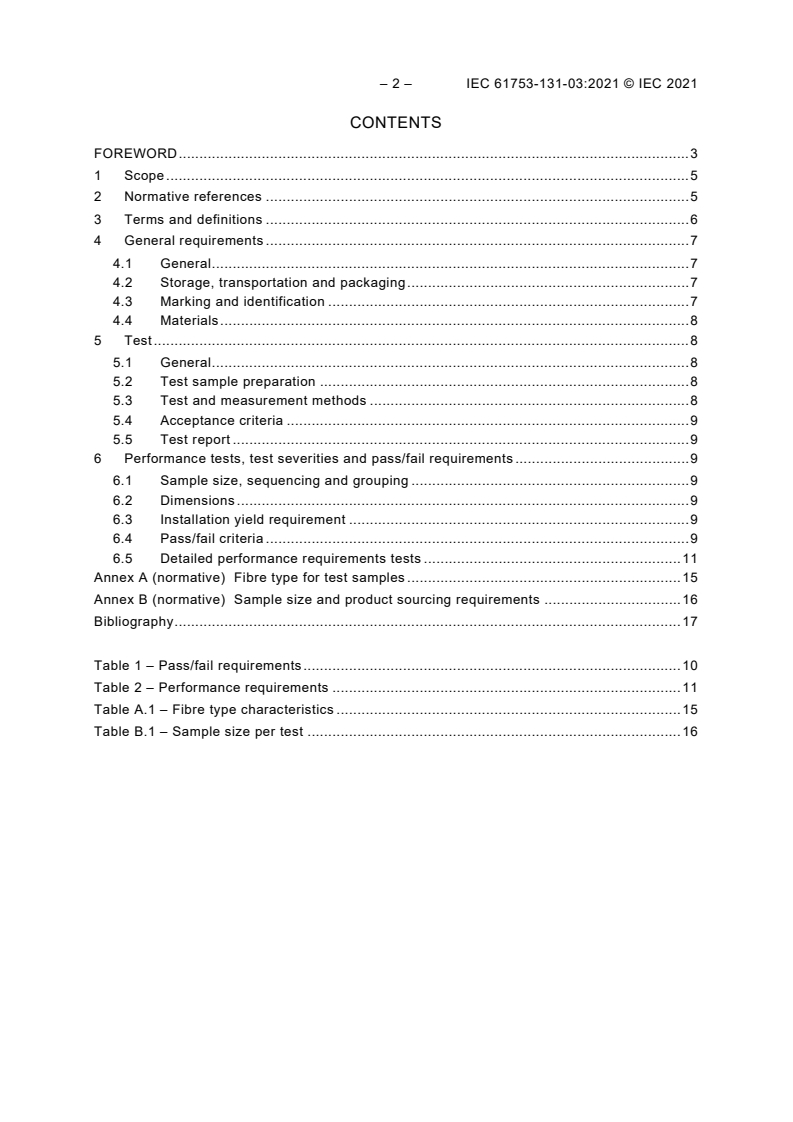
IEC 61753-131-03:2021 - Fibre optic interconnecting devices and passive components - Performance standard - Part 131-03: Single-mode mechanical fibre splice for category OP – Outdoor protected environment Released:10/4/2021
Overview
IEC 61753-131-03:2021 is an international standard published by the International Electrotechnical Commission (IEC) that defines performance requirements for single-mode mechanical fibre splices used in outdoor protected environments (category OP). It specifies the minimum testing procedures, severities, and measurement criteria needed for mechanical fibre splices to comply with the optical and environmental demands of such installations.
This standard updates and replaces the 2010 edition by including technical revisions such as new definitions, additional tests for mould growth, bending moment, and more stringent environmental conditions. It aligns test requirements with the latest IEC 61753-1:2018 category OP tests, ensuring robust and reliable fibre optic connections in outdoor applications protected from extreme weather.
Key Topics
- Scope and Application: Addresses single-mode mechanical fibre splices designed for category OP environments, ensuring standard optical performance and durability in outdoor protected settings.
- Testing Procedures: Includes comprehensive tests for vibration, fibre retention, torsion, bending moment, shock, cold and dry heat endurance, temperature variation, salt mist, dust infiltration, mould growth, and assembly/disassembly.
- Performance Criteria: Establishes pass/fail requirements with specific acceptance thresholds that mechanical splices must meet or exceed, based on optical loss and mechanical integrity.
- Material and Dimensions: Specifies that dimensions conform with IEC 61756-1 and introduces material requirements including mould growth resistance, aligned with IEC 60068-2-10.
- Environmental Conditions: Defines test severities such as low temperatures down to −25°C and other environmental stresses representative of outdoor protected applications.
- Test Sample Guidelines: Details sample preparation, size, sequencing, and sourcing to assure consistent and reliable test outcomes.
Applications
IEC 61753-131-03:2021 supports industries and sectors where high-performance fibre optic interconnections are critical under outdoor protected conditions, such as:
- Telecommunications: Ensuring mechanical fibre splices in outdoor protected environments like sealed enclosures or underground vaults meet strict performance standards.
- Data Centers and Network Infrastructure: Reliable fibre connection splices for outdoor paths sheltered from direct environmental exposure.
- Industrial Automation: Outdoor protected fibre optic linkages within industrial sites requiring robust and stable optical interconnections.
- Utilities and Smart Grid Systems: Fibre optic networks in protected external environments delivering critical control and monitoring data.
- Broadband and Access Networks: Service providers deploying fibre optics in outdoor protected environments with guaranteed splice performance and longevity.
By following this standard, manufacturers and users can ensure enhanced reliability, minimized optical loss, and greater mechanical and environmental resilience for outdoor single-mode mechanical fibre splices.
Related Standards
- IEC 61753-1: Defines categories of operating environments for fibre optic devices, including the category OP referenced in this standard.
- IEC 61756-1: Specifies dimensional requirements for fibre optic interconnecting devices and passive components.
- IEC 60068-2-10: Environmental testing for mould growth resistance of materials, incorporated in the testing framework.
- IEC 60793-2-50: Product specifications for single-mode optical fibres used in testing.
- IEC 61300 Series: Provides detailed basic test and measurement methods for fibre optic interconnecting devices, including vibration, torsion, shock, and temperature tests referenced in IEC 61753-131-03.
Adherence to IEC 61753-131-03:2021 ensures precise compliance with international benchmarks for optical performance, mechanical durability, and environmental endurance, making it vital for manufacturers, test labs, and network operators focused on outdoor protected fibre optic applications.
Relations
- Effective Date
- 05-Sep-2023
Buy Documents
IEC 61753-131-03:2021 - Fibre optic interconnecting devices and passive components - Performance standard - Part 131-03: Single-mode mechanical fibre splice for category OP – Outdoor protected environment Released:10/4/2021
Get Certified
Connect with accredited certification bodies for this standard

ANCE
Mexican certification and testing association.

Intertek Slovenia
Intertek testing, inspection, and certification services in Slovenia.

LNE (Laboratoire National de Métrologie et d'Essais)
French national laboratory for metrology and testing.
Sponsored listings
Frequently Asked Questions
IEC 61753-131-03:2021 is a standard published by the International Electrotechnical Commission (IEC). Its full title is "Fibre optic interconnecting devices and passive components - Performance standard - Part 131-03: Single-mode mechanical fibre splice for category OP – Outdoor protected environment". This standard covers: IEC 61753-131-03:2021 contains the minimum tests, test severities and measurement requirements which a mechanical fibre splice need to satisfy in order to be categorised as meeting the requirements of single-mode fibre splice for use in category OP (Outdoor protected) environments, as defined in IEC 61753-1. This document for mechanical splices defines the requirements for standard optical performance under a set of specified conditions. The standard contains a series or a set of tests and measurements with clearly stated conditions, severities and pass/fail criteria. The series of tests, commonly referred to as an operating service environment or performance category, is intended to be a basis to prove the product’s ability to satisfy the requirements of a specific application, market sector or user group. This first edition cancels and replaces IEC 61753-131-3 first edition published in 2010. This edition constitutes a technical revision. This edition includes the following significant technical changes with respect to the previous edition: a) addition of definitions; b) addition of IEC 60068-2-10 mould growth test and test severities for materials; c) replacement of the IEC 61753 1:2007 category U tests and test severities by the IEC 61753‑1:2018 category OP tests; d) addition of the requirement that dimensions are in accordance with IEC 61756-1; e) addition of the bending moment test; f) change of low temperature in cold test and change of temperature test to −25°C. If 40°C is required, the user can refer to category OP+.
IEC 61753-131-03:2021 contains the minimum tests, test severities and measurement requirements which a mechanical fibre splice need to satisfy in order to be categorised as meeting the requirements of single-mode fibre splice for use in category OP (Outdoor protected) environments, as defined in IEC 61753-1. This document for mechanical splices defines the requirements for standard optical performance under a set of specified conditions. The standard contains a series or a set of tests and measurements with clearly stated conditions, severities and pass/fail criteria. The series of tests, commonly referred to as an operating service environment or performance category, is intended to be a basis to prove the product’s ability to satisfy the requirements of a specific application, market sector or user group. This first edition cancels and replaces IEC 61753-131-3 first edition published in 2010. This edition constitutes a technical revision. This edition includes the following significant technical changes with respect to the previous edition: a) addition of definitions; b) addition of IEC 60068-2-10 mould growth test and test severities for materials; c) replacement of the IEC 61753 1:2007 category U tests and test severities by the IEC 61753‑1:2018 category OP tests; d) addition of the requirement that dimensions are in accordance with IEC 61756-1; e) addition of the bending moment test; f) change of low temperature in cold test and change of temperature test to −25°C. If 40°C is required, the user can refer to category OP+.
IEC 61753-131-03:2021 is classified under the following ICS (International Classification for Standards) categories: 33.180.20 - Fibre optic interconnecting devices. The ICS classification helps identify the subject area and facilitates finding related standards.
IEC 61753-131-03:2021 has the following relationships with other standards: It is inter standard links to IEC 61753-131-3:2010. Understanding these relationships helps ensure you are using the most current and applicable version of the standard.
IEC 61753-131-03:2021 is available in PDF format for immediate download after purchase. The document can be added to your cart and obtained through the secure checkout process. Digital delivery ensures instant access to the complete standard document.
Standards Content (Sample)
IEC 61753-131-03 ®
Edition 1.0 2021-10
INTERNATIONAL
STANDARD
NORME
INTERNATIONALE
Fibre optic interconnecting devices and passive components – Performance
standard –
Part 131-03: Single-mode mechanical fibre splice for category OP – Outdoor
protected environment
Dispositifs d’interconnexion et composants passifs fibroniques – Norme de
performance –
Partie 131-03: Épissure mécanique de fibres unimodales pour catégorie OP –
Environnement extérieur protégé
All rights reserved. Unless otherwise specified, no part of this publication may be reproduced or utilized in any form
or by any means, electronic or mechanical, including photocopying and microfilm, without permission in writing from
either IEC or IEC's member National Committee in the country of the requester. If you have any questions about IEC
copyright or have an enquiry about obtaining additional rights to this publication, please contact the address below or
your local IEC member National Committee for further information.
Droits de reproduction réservés. Sauf indication contraire, aucune partie de cette publication ne peut être reproduite ni
utilisée sous quelque forme que ce soit et par aucun procédé, électronique ou mécanique, y compris la photocopie et
les microfilms, sans l'accord écrit de l'IEC ou du Comité national de l'IEC du pays du demandeur. Si vous avez des
questions sur le copyright de l'IEC ou si vous désirez obtenir des droits supplémentaires sur cette publication, utilisez
les coordonnées ci-après ou contactez le Comité national de l'IEC de votre pays de résidence.
IEC Central Office Tel.: +41 22 919 02 11
3, rue de Varembé info@iec.ch
CH-1211 Geneva 20 www.iec.ch
Switzerland
About the IEC
The International Electrotechnical Commission (IEC) is the leading global organization that prepares and publishes
International Standards for all electrical, electronic and related technologies.
About IEC publications
The technical content of IEC publications is kept under constant review by the IEC. Please make sure that you have the
latest edition, a corrigendum or an amendment might have been published.
IEC publications search - webstore.iec.ch/advsearchform IEC online collection - oc.iec.ch
The advanced search enables to find IEC publications by a Discover our powerful search engine and read freely all the
variety of criteria (reference number, text, technical publications previews. With a subscription you will always have
committee, …). It also gives information on projects, replaced access to up to date content tailored to your needs.
and withdrawn publications.
Electropedia - www.electropedia.org
IEC Just Published - webstore.iec.ch/justpublished
The world's leading online dictionary on electrotechnology,
Stay up to date on all new IEC publications. Just Published
containing more than 22 000 terminological entries in English
details all new publications released. Available online and once
and French, with equivalent terms in 18 additional languages.
a month by email.
Also known as the International Electrotechnical Vocabulary
(IEV) online.
IEC Customer Service Centre - webstore.iec.ch/csc
If you wish to give us your feedback on this publication or need
further assistance, please contact the Customer Service
Centre: sales@iec.ch.
A propos de l'IEC
La Commission Electrotechnique Internationale (IEC) est la première organisation mondiale qui élabore et publie des
Normes internationales pour tout ce qui a trait à l'électricité, à l'électronique et aux technologies apparentées.
A propos des publications IEC
Le contenu technique des publications IEC est constamment revu. Veuillez vous assurer que vous possédez l’édition la
plus récente, un corrigendum ou amendement peut avoir été publié.
Recherche de publications IEC - Découvrez notre puissant moteur de recherche et consultez
webstore.iec.ch/advsearchform gratuitement tous les aperçus des publications. Avec un
La recherche avancée permet de trouver des publications IEC abonnement, vous aurez toujours accès à un contenu à jour
en utilisant différents critères (numéro de référence, texte, adapté à vos besoins.
comité d’études, …). Elle donne aussi des informations sur les
projets et les publications remplacées ou retirées. Electropedia - www.electropedia.org
Le premier dictionnaire d'électrotechnologie en ligne au monde,
IEC Just Published - webstore.iec.ch/justpublished
avec plus de 22 000 articles terminologiques en anglais et en
Restez informé sur les nouvelles publications IEC. Just
français, ainsi que les termes équivalents dans 16 langues
Published détaille les nouvelles publications parues.
additionnelles. Egalement appelé Vocabulaire
Disponible en ligne et une fois par mois par email.
Electrotechnique International (IEV) en ligne.
Service Clients - webstore.iec.ch/csc
Si vous désirez nous donner des commentaires sur cette
publication ou si vous avez des questions contactez-nous:
sales@iec.ch.
IEC online collection - oc.iec.ch
IEC 61753-131-03 ®
Edition 1.0 2021-10
INTERNATIONAL
STANDARD
NORME
INTERNATIONALE
Fibre optic interconnecting devices and passive components – Performance
standard –
Part 131-03: Single-mode mechanical fibre splice for category OP – Outdoor
protected environment
Dispositifs d’interconnexion et composants passifs fibroniques – Norme de
performance –
Partie 131-03: Épissure mécanique de fibres unimodales pour catégorie OP –
Environnement extérieur protégé
INTERNATIONAL
ELECTROTECHNICAL
COMMISSION
COMMISSION
ELECTROTECHNIQUE
INTERNATIONALE
ICS 33.180.20 ISBN 978-2-8322-1029-3
– 2 – IEC 61753-131-03:2021 © IEC 2021
CONTENTS
FOREWORD . 3
1 Scope . 5
2 Normative references . 5
3 Terms and definitions . 6
4 General requirements . 7
4.1 General . 7
4.2 Storage, transportation and packaging . 7
4.3 Marking and identification . 7
4.4 Materials . 8
5 Test . 8
5.1 General . 8
5.2 Test sample preparation . 8
5.3 Test and measurement methods . 8
5.4 Acceptance criteria . 9
5.5 Test report . 9
6 Performance tests, test severities and pass/fail requirements . 9
6.1 Sample size, sequencing and grouping . 9
6.2 Dimensions . 9
6.3 Installation yield requirement . 9
6.4 Pass/fail criteria . 9
6.5 Detailed performance requirements tests . 11
Annex A (normative) Fibre type for test samples . 15
Annex B (normative) Sample size and product sourcing requirements . 16
Bibliography . 17
Table 1 – Pass/fail requirements . 10
Table 2 – Performance requirements . 11
Table A.1 – Fibre type characteristics . 15
Table B.1 – Sample size per test . 16
INTERNATIONAL ELECTROTECHNICAL COMMISSION
____________
FIBRE OPTIC INTERCONNECTING DEVICES AND
PASSIVE COMPONENTS – PERFORMANCE STANDARD –
Part 131-03: Single-mode mechanical fibre splice
for category OP – Outdoor protected environment
FOREWORD
1) The International Electrotechnical Commission (IEC) is a worldwide organization for standardization comprising
all national electrotechnical committees (IEC National Committees). The object of IEC is to promote
international co-operation on all questions concerning standardization in the electrical and electronic fields. To
this end and in addition to other activities, IEC publishes International Standards, Technical Specifications,
Technical Reports, Publicly Available Specifications (PAS) and Guides (hereafter referred to as “IEC
Publication(s)”). Their preparation is entrusted to technical committees; any IEC National Committee interested
in the subject dealt with may participate in this preparatory work. International, governmental and non-
governmental organizations liaising with the IEC also participate in this preparation. IEC collaborates closely
with the International Organization for Standardization (ISO) in accordance with conditions determined by
agreement between the two organizations.
2) The formal decisions or agreements of IEC on technical matters express, as nearly as possible, an international
consensus of opinion on the relevant subjects since each technical committee has representation from all
interested IEC National Committees.
3) IEC Publications have the form of recommendations for international use and are accepted by IEC National
Committees in that sense. While all reasonable efforts are made to ensure that the technical content of IEC
Publications is accurate, IEC cannot be held responsible for the way in which they are used or for any
misinterpretation by any end user.
4) In order to promote international uniformity, IEC National Committees undertake to apply IEC Publications
transparently to the maximum extent possible in their national and regional publications. Any divergence
between any IEC Publication and the corresponding national or regional publication shall be clearly indicated in
the latter.
5) IEC itself does not provide any attestation of conformity. Independent certification bodies provide conformity
assessment services and, in some areas, access to IEC marks of conformity. IEC is not responsible for any
services carried out by independent certification bodies.
6) All users should ensure that they have the latest edition of this publication.
7) No liability shall attach to IEC or its directors, employees, servants or agents including individual experts and
members of its technical committees and IEC National Committees for any personal injury, property damage or
other damage of any nature whatsoever, whether direct or indirect, or for costs (including legal fees) and
expenses arising out of the publication, use of, or reliance upon, this IEC Publication or any other IEC
Publications.
8) Attention is drawn to the Normative references cited in this publication. Use of the referenced publications is
indispensable for the correct application of this publication.
9) Attention is drawn to the possibility that some of the elements of this IEC Publication may be the subject of
patent rights. IEC shall not be held responsible for identifying any or all such patent rights.
IEC 61753-131-03 has been prepared by subcommittee 86B: Fibre optic interconnecting
devices and passive components, of IEC technical committee 86: Fibre optics. It is an
International Standard.
This first edition cancels and replaces IEC 61753-131-3 first edition published in 2010. This
edition constitutes a technical revision.
This edition includes the following significant technical changes with respect to the previous
edition:
a) addition of definitions;
b) addition of IEC 60068-2-10 mould growth test and test severities for materials;
c) replacement of the IEC 61753-1:2007 category U tests and test severities by the
IEC 61753-1:2018 category OP tests;
– 4 – IEC 61753-131-03:2021 © IEC 2021
d) addition of the requirement that dimensions are in accordance with IEC 61756-1;
e) addition of the bending moment test;
f) change of low temperature in cold test and change of temperature test to −25°C. If 40°C is
required, the user can refer to category OP+.
The text of this International Standard is based on the following documents:
Draft Report on voting
86B/4500/FDIS 86B/4524/RVD
Full information on the voting for its approval can be found in the report on voting indicated in
the above table.
The language used for the development of this International Standard is English.
This document was drafted in accordance with ISO/IEC Directives, Part 2, and developed in
accordance with ISO/IEC Directives, Part 1 and ISO/IEC Directives, IEC Supplement,
available at www.iec.ch/members_experts/refdocs. The main document types developed by
IEC are described in greater detail at www.iec.ch/standardsdev/publications.
A list of all parts in the IEC 61753 series, published under the general title Fibre optic
interconnecting devices and passive components – Performance standard, can be found on
the IEC website.
The committee has decided that the contents of this document will remain unchanged until the
stability date indicated on the IEC website under webstore.iec.ch in the data related to the
specific document. At this date, the document will be
• reconfirmed,
• withdrawn,
• replaced by a revised edition, or
• amended.
FIBRE OPTIC INTERCONNECTING DEVICES AND
PASSIVE COMPONENTS – PERFORMANCE STANDARD –
Part 131-03: Single-mode mechanical fibre splice
for category OP – Outdoor protected environment
1 Scope
This part of IEC 61753 contains the minimum tests, test severities and measurement
requirements which a mechanical fibre splice need to satisfy in order to be categorised as
meeting the requirements of single-mode fibre splice for use in category OP (Outdoor
protected) environments, as defined in IEC 61753-1.
This document for mechanical splices defines the requirements for standard optical
performance under a set of specified conditions. The standard contains a series or a set of
tests and measurements with clearly stated conditions, severities and pass/fail criteria. The
series of tests, commonly referred to as an operating service environment or performance
category, is intended to be a basis to prove the product’s ability to satisfy the requirements of
a specific application, market sector or user group.
2 Normative references
The following documents are referred to in the text in such a way that some or all of their
content constitutes requirements of this document. For dated references, only the edition
cited applies. For undated references, the latest edition of the referenced document (including
any amendments) applies.
IEC 60068-2-10, Environmental testing – Part 2-10: Tests – Test J and guidance: Mould
growth
IEC 60793-2-50, Optical fibres – Part 2-50: Product specifications – Sectional specification for
class B single-mode fibres
IEC 61073-1, Fibre optic interconnecting devices and passive components – Mechanical
splices and fusion splice protectors for optical fibres and cables – Part 1: Generic
specification
IEC 61300 (all parts), Fibre optic interconnecting devices and passive components – Basic
test and measurement procedures
IEC 61300-1, Fibre optic interconnecting devices and passive components – Basic test and
measurement procedures – Part 1: General and guidance
IEC 61300-2-1, Fibre optic interconnecting devices and passive components – Basic test and
measurement procedures – Part 2-1: Tests – Vibration (sinusoidal)
IEC 61300-2-4, Fibre optic interconnecting devices and passive components – Basic test and
measurement procedures – Part 2-4: Tests – Fibre or cable retention
IEC 61300-2-5, Fibre optic interconnecting devices and passive components – Basic test and
measurement procedures – Part 2-5: Tests – Torsion
– 6 – IEC 61753-131-03:2021 © IEC 2021
IEC 61300-2-7, Fibre optic interconnecting devices and passive components – Basic test and
measurement procedures – Part 2-7: Tests – Bending moment
IEC 61300-2-9, Fibre optic interconnecting devices and passive components – Basic test and
measurement procedures – Part 2-9: Tests – Shock
IEC 61300-2-17, Fibre optic interconnecting devices and passive components – Basic test
and measurement procedures – Part 2-17: Tests – Cold
IEC 61300-2-18, Fibre optic interconnecting devices and passive components – Basic test
and measurement procedures – Part 2-18: Tests – Dry heat – High temperature endurance
IEC 61300-2-22, Fibre optic interconnecting devices and passive components – Basic test
and measurement procedures – Part 2-22: Tests – Change of temperature
IEC 61300-2-26, Fibre optic interconnecting devices and passive components – Basic test
and measurement procedures – Part 2-26: Tests – Salt mist
IEC 61300-2-27, Fibre optic interconnecting devices and passive components – Basic test
and measurement procedures – Part 2-27: Tests – Dust – Laminar flow
IEC 61300-2-33, Fibre optic interconnecting devices and passive components – Basic test
and measurement procedures – Part 2-33: Tests – Assembly and disassembly of fibre optic
mechanical splices, fibre management systems and closures
IEC 61300-2-46, Fibre optic interconnecting devices and passive components – Basic test
and measurement procedures – Part 2-46: Tests – Damp heat, cyclic
IEC 61300-3-3, Fibre optic interconnecting devices and passive components – Basic test and
measurement procedures – Part 3-3: Examinations and measurements – Active monitoring of
changes in attenuation and return loss
IEC 61300-3-4, Fibre optic interconnecting devices and passive components – Basic test and
measurement procedures – Part 3-4: Examinations and measurements – Attenuation
IEC 61300-3-6, Fibre optic interconnecting devices and passive components – Basic test and
measurement procedures – Part 3-6: Examinations and measurements – Return Loss
IEC 61300-3-7, Fibre optic interconnecting devices and passive components – Basic test and
measurement procedures – Part 3-7: Examinations and measurements – Wavelength
dependence of attenuation and return loss of single mode components
IEC 61300-3-28, Fibre optic interconnecting devices and passive components – Basic test
and measurement procedures – Part 3-28: Examinations and measurements – Transient loss
IEC 61753-1, Fibre optic interconnecting devices and passive components – Performance
standard – Part 1: General and guidance
IEC 61756-1, Fibre optic interconnecting devices and passive components – Interface
standard for fibre management systems – Part 1: General and guidance
3 Terms and definitions
For the purposes of this document, the terms and definitions given in IEC 61073-1 apply.
ISO and IEC maintain terminological databases for use in standardization at the following
addresses:
• IEC Electropedia: available at http://www.electropedia.org/
• ISO Online browsing platform: available at http://www.iso.org/obp
4 General requirements
4.1 General
A product that has been shown to meet all the requirements of this performance standard can
be declared as conforming to this performance standard. Products having the same
classification from one manufacturer that satisfy this performance standard, will operate within
the boundaries set by the performance standard. There is no guarantee that products from
different manufacturers, having the same classification and which conform to the same
performance standard, will provide an equivalent level of performance when they are used
together.
Conformance to IEC environmental policy according to IEC Guide 109 and concerning the
need to reduce the impact on the natural environment of fibre management system products
during all phases of their life – from acquiring materials to manufacturing, distribution, use,
and end-of-life treatment (i.e. re-use, recycling – recovery and disposal) are not part of this
document, but will be covered in the generic specification.
Conformance to a performance standard demonstrates that a product has passed a design
verification test. It is not a guarantee of lifetime assured performance or reliability. Reliability
testing are the subject of a separate test schedule, where the tests and severities selected
are such that they are truly representative of the requirements of this reliability test
programme. Consistency of manufacture is maintained using a recognised quality assurance
programme whilst the reliability of product is evaluated using the procedures recommended in
IEC 62005 series.
Tests and measurements are selected from IEC 61300 (all parts).
4.2 Storage, transportation and packaging
The classes of environmental conditions and their severities to which the mechanical splice
can be exposed during transportation are defined in IEC 60721-3-1 and IEC 60721-3-2.
Normal transportation time is considered to be 30 days or less.
The product, in its original packaging, shall be suitable for normal public or commercial
transportation and storage in weather protected non-temperature controlled storage
environments and after installation meet the requirements as specified in Table 1 and Table 2.
4.3 Marking and identification
Marking of the packaging of the mechanical splice shall be according to IEC 61073-1.
Product marking and identification shall survive the storage and transportation.
Each product and test sample should contain the following information at the minimum:
– manufacturer’s identification mark or logo;
– product designation, model or type;
– one of the following: lot number, batch number, date (at least month and year) of
production or serial number;
– expiry date (at least year) if the product contains components with a limited shelf life.
– 8 – IEC 61753-131-03:2021 © IEC 2021
4.4 Materials
For all applicable materials, a material safety data sheet shall be made available upon
request.
All materials that are likely to come in contact with personnel shall meet appropriate health
and safety regulations.
The materials of the mechanical splice shall be compatible with the other materials or
solvents that are likely to come into contact with them, for example cable filling compounds
and degreasing agents. Exposure to these solvents shall not adversely affect the product’s
performance.
Polymeric materials shall not support mould growth causing mechanical degradation of the
materials. Mould growth shall be tested according to IEC 60068-2-10 Test Variant 1,
Severity 1. The effect of mould growth shall be determined first by a visual rating based on
examination per IEC 60068-2-10. When a rating 0 is obtained, the material is considered
fungus resistant and no further testing is required. When a rating 1 or 2 is obtained, the effect
of mould growth shall be evaluated by measuring a suitable property (e.g. tensile strength at
yield and elongation at yield for thermoplastic polymers, a compression set, a Shore A
hardness for elastic materials, or any other test which checks a relevant property) both before
and after exposure of the material slabs. The average change in mechanical characteristics of
the tested material slabs shall be less than 20 %. A rating of more than 2 is not allowed.
Metallic elements shall be corrosion resistant. Dissimilar metals shall not be used in contact
with each other unless they are suitably finished to prevent electrolytic corrosion.
Materials which are not specified or which are not specifically described are left to the
discretion of the manufacturer.
5 Test
5.1 General
The mechanical and environmental performance of a fibre splice is vital to the optical cabling
system. The purpose of testing is to demonstrate that the mechanical splice remains
functional under defined environmental conditions, without irreversible or reversible failures.
Optical performance testing is accomplished by subjecting the test sample to a number of
mechanical and environmental conditions and measuring any optical performance deviations
at prescribed intervals during and after completion of each test.
5.2 Test sample preparation
The test samples are prepared by making a mechanical splice between identical fibres.
Optical test samples shall be installed according to the manufacturer’s installation instructions.
The fibres for the optical test samples are single-mode fibres as described in Annex A. The
length of the fibres shall be at least 2 m on both sides of the mechanical splice. For each fibre
construction (primary and buffered), a number of test samples will be prepared as defined in
Table B.1.
5.3 Test and measurement methods
All tests and measurements shall be selected from IEC 61300 (all parts).
All changes in attenuation values refer to the ± deviation from the original value of the
transmitted power at the start of the test.
No deviation from the specified test method is allowed.
Unless otherwise specified, tests shall be carried out under standard atmospheric conditions
according to IEC 61300-1.
5.4 Acceptance criteria
A product will have met the requirements of this document provided no failures occur in any
test. The pass/fail criteria for mechanical splices are specified in Table 1.
Consecutive testing on the same sample is allowed. In the event of a failure occurring, the
test shall be repeated using a sample size double that of the original and the failed test shall
be re-done. When the samples fail again the test shall be reported as a failure.
5.5 Test report
Conformance to a performance standard shall be supported by a test report. The test report
shall clearly demonstrate that the tests were carried out in accordance with the requirements
of the performance standard and provide full details of the tests together with a pass/fail
declaration. An analysis of the cause of the failure shall be undertaken and any corrective
actions taken shall be described.
If design changes are made, an assessment should be carried out to determine whether full or
partial requalification should be done.
6 Performance tests, test severities and pass/fail requirements
6.1 Sample size, sequencing and grouping
The sample size to be used for the tests are defined in Table B.1 in Annex B. All samples
shall be subjected to criterion test 1 and criterion test 2 at the start and at the end of each test.
Samples for tests 2 to 14 are randomly selected from the samples of the installation test 1
meeting the optical performance criteria of criterion test 1 and criterion test 2 in Table 1.
There is no defined sequence in which tests 2 to 14 in Table 2 are carried out.
6.2 Dimensions
Dimensions shall meet the interface requirements for mechanical splices as defined in
IEC 61756-1.
6.3 Installation yield requirement
The success rate or yield of installation of mechanical splices depends on many variables (e.g.
installer skills, ambient conditions, condition of tools). Typically, no feedback is given on the
optical performance when a mechanical splice is made on site. Therefore, a small percentage
of the installed splices might not meet the expected performance level (see test 1 in Table 2).
6.4 Pass/fail criteria
The pass/fail criteria and requirements are given in Table 1.
– 10 – IEC 61753-131-03:2021 © IEC 2021
Table 1 – Pass/fail requirements
No. Examinations Requirement Details
and
measurements
Criterion 1 Attenuation Attenuation per splice: Method: IEC 61300-3-4, insertion method.
≤ 0,25 dB max. Grade B
Launch conditions: Launch fibre length ≥ 2 m. Only
the fundamental mode shall
≤ 0,50 dB max. Grade C
propagate at the mechanical
splice and at the detector.
Wavelengths: 1 310 nm ± 30 nm
1 550 nm ± 30 nm
1 625 nm ± 30 nm
Source stability: less than ± 0,01 dB over the
measuring period or at least 1 h
Detector linearity: Within ± 0,01 dB over the
dynamic range to be measured.
Criterion 2 Return loss Return loss per splice: Method: IEC 61300-3-6, method 1
≥ 60 dB Grade 1 Launch conditions: Launch fibre length ≥ 2 m. Only
the fundamental mode shall
≥ 45 dB Grade 2
propagate at the mechanical
splice and at the detector.
≥ 35 dB Grade 3
Source type: LD
Wavelengths: 1 310 nm ± 30 nm
1 550 nm ± 30 nm
1 625 nm ± 30 nm
Source stability: less than± 0,05 dB over the
measuring period or at least 1 h.
Detector linearity: Within ± 0,05 dB over the
dynamic range to be measured.
Criterion 3 Active During the test the Method: IEC 61300-3-3, method 1
monitoring of change in attenuation
a
Launch conditions: Launch fibre length ≥ 2 m. Only
change in shall be ≤ 0,2 dB .
a
the fundamental mode shall
attenuation
During the test the
propagate at the mechanical
and return loss
return loss shall meet
splice and at the detector
the relevant return loss
Wavelengths: 1 310 nm ± 30 nm
grade listed in test 2.
1 550 nm ± 30 nm
1 625 nm ± 30 nm
Source stability: Within ± 0,05 dB over the
measuring period
Detector linearity: Within ± 0,05 dB over the
dynamic range to be measured
a
Criterion 4 Transient loss During the test the Method: IEC 61300-3-28
change in attenuation
a Launch condition:
Launch fibre length ≥ 2 m. Only
shall be ≤ 0,5 dB .
the fundamental mode shall
propagate at the mechanical
splice and at the detector
Wavelength: 1 550 nm ± 30 nm
Source stability: Within ± 0,05 dB over the
measuring period
Detector linearity: Within ± 0,05 dB over the
dynamic range to be measured
a
The change in attenuation values refer to the ± deviation from the original value of the transmitted power at
the start of the test.
6.5 Detailed performance requirements tests
The detailed performance tests are given in Table 2.
Table 2 – Performance requirements
No. Test Requirement Details
1 Installation yield 100 splices will be made. Method: IEC 61300-3-4, insertion method
A minimum of 97 % shall IEC 61300-3-6, method 1.
meet the maximum
Launch fibre length: ≥ 2 m. Only the fundamental mode
attenuation requirement
shall propagate at the mechanical
of criterion 1.
splice and at the detector.
A minimum of 97 % shall
Source type: LD.
meet the return loss
requirement of criterion 2.
Launch conditions: The wavelength of the source shall
be longer than cut-off wavelength
of the fibre.
Source stability: less than ± 0,01 dB over the
measuring period or at least 1 h.
Detector linearity: ± 0,01 dB over the dynamic range
to be measured.
LD source central 1 310 nm ± 30 nm
wavelengths:
1 550 nm ± 30 nm
1 625 nm ± 30 nm
2 Wavelength The attenuation shall Method: IEC 61300-3-7, test sample
dependence of meet the requirements of configuration according to
attenuation criterion 1 over the IEC 61300-3-4 cut-back method or
wavelength range. insertion method.
Launch fibre length: ≥ 2 m. Only the fundamental mode
shall propagate at the mechanical
splice and at the detector.
Source type: Unpolarized broadband light
source with spectral power
≥ -35 dBm/nm.
Launch conditions: The wavelength of the source shall
be longer than the cut-off
wavelength of the fibre.
Source stability: less than ± 0,05 dB over the
measuring period or at least 1 h.
Wavelength range 1 260 nm to 1 625 nm
Detector linearity: ± 0,05 dB over the dynamic range
to be measured.
3 Bending moment Before and after the test, Method: IEC 61300-2-7
the attenuation and return
Load: 2,0 N ± 0,2 N
loss shall meet the
requirements of
Duration: 10 s
criterion 1 and criterion 2.
4 Vibration Before and after the test, Method: IEC 61300-2-1
(Sinusoidal) the attenuation and return
Frequency range: 10 Hz to 55 Hz to 10 Hz
loss shall meet the
requirements of
Constant vibration 0,75 mm
criterion 1 and criterion 2.
amplitude:
During test, transient loss
Number of sweeps per 15 (10 Hz to 55 Hz to 10 Hz)
shall meet the
axis:
requirements of
criterion 4.
Number of axes: 3 mutually perpendicular axes
– 12 – IEC 61753-131-03:2021 © IEC 2021
No. Test Requirement Details
5 Shock Before and after the test, Method: IEC 61300-2-9
the attenuation and return
Acceleration force: Components: 5 000 m/s
loss shall meet the
requirements of
Duration shock: 1 ms half sine pulse.
criterion 1 and criterion 2.
Number of axes: 3 main axes, perpendicular to each
other.
Number of shocks: 2 per axis (one in each direction).
6 Torsion Before and after the test, Method: IEC 61300-2-5
the attenuation and return
Magnitude of the load: 2,0 N ± 0,5 N for primary and
loss shall meet the
buffered fibres.
requirements of
criterion 1 and criterion 2.
Rate of load
0,1 N/s
application:
Load application 25 cm ± 5 cm from end of device
point:
Measurement rate: Measurements shall be made after
the torsion has been maintained at
its maximum level for at least 3 s.
Number of cycles:
10 cycles at +180° and −180°
7 Fibre or cable Before and after the test, Method: IEC 61300-2-4
retention the attenuation and return
Magnitude of the load: 5,0 N ± 0,5 N for buffered fibres.
loss shall meet the
requirements of
2,0 N ± 0,5 N for primary coated
criterion 1 and criterion 2.
fibres.
Load application
25 cm ± 5 cm from the end of
point:
device
Load rate: 0,5 N/s for primary and secondary
coated fibre.
Duration of the load: 60 s
8 Assembly and Test only required for Method: IEC 61300-2-33
disassembly of re-usable mechanical
Conditioning between After each re-entry of the
splices splices.
each installation mechanical splice, the splice shall
Before and after the test, age by 1 temperature cycle
the attenuation and return
(–25 °C to +70 °C) as specified in
loss shall meet the
test 16.
requirements of
Number of re-entries: 5
criterion 1 and criterion 2.
9 Cold Before and after the test, Method: IEC 61300-2-17
the attenuation and return
Pre-conditioning Standard atmospheric conditions
loss shall meet the
procedure: for 2 h.
requirements of
criterion 1 and criterion 2.
a
Temperature :
–25 °C ± 2 °C
During the test, the
Duration of the 96 h
maximum allowed change
exposure:
in attenuation and return
loss shall meet the
Maximum sampling 1 h
requirements of
interval during the
criterion 3.
test:
No. Test Requirement Details
10 Dry heat Before and after the test, Method: IEC 61300-2-18
the attenuation and return
Pre-conditioning Standard atmospheric conditions
loss shall meet the
procedure: for 2 h.
requirements of
criterion 1 and criterion 2.
Temperature: +70 °C ± 2 °C
During the test, the
Duration of the 96 h
maximum allowed change
exposure:
in attenuation and return
loss shall meet the
Maximum sampling 1 h
requirements of
interval during the
criterion 3.
test:
Recovery procedure: Allow specimen to recover at room
temperature during 2 h.
11 Damp heat, cyclic Before and after the test, Method: IEC 61300-2-46
the attenuation and return
Pre-conditioning Standard atmospheric conditions
loss shall meet the
procedure: for 2 h.
requirements of
criterion 1 and criterion 2.
High temperature: +55 °C ± 2 °C
During the test, the
Low temperature: +25 °C ± 2 °C
maximum allowed change
in attenuation and return
Humidity: > 90 %RH
loss shall meet the
requirements of Number of cycles: 6
criterion 3.
Duration of each 24 h
cycle:
Maximum sampling 15 min
interval during the
test:
Allow specimen to recover at room
Recovery procedure:
temperature during 2 h.
12 Change of Before and after the test, Method: IEC 61300-2-22
temperature the attenuation and return
Pre-conditioning Standard atmospheric conditions
loss shall meet the
procedure: for 2 h.
requirements of
criterion 1 and criterion 2.
High temperature: +70 °C ± 2 °C
During the test, the
Low temperature: –25 °C ± 2 °C
maximum allowed change
in attenuation and return
Number of cycles: 12
loss shall meet the
requirements of
Rate of temperature 1 °C/min
criterion 3. change:
Duration at extreme 1 h
temperatures:
Maximum sampling 15 min
interval during the
test:
13 Dust - Laminar flow Before and after the test, Method: IEC 61300-2-27
the attenuation and return
Preconditioning Standard atmospheric conditions
loss shall meet the
procedure: for 2 h.
requirements of criterion
1 and criterion 2.
Dust type: Talc
Dust particle
< 150 µm
diameter:
3 3
Dust concentration: 10,6 g/m ± 7,1 g/m
Test duration: 10 min
Recovery procedure: Allow specimen to recover at room
temperature during 2 h
– 14 – IEC 61753-131-03:2021 © IEC 2021
No. Test Requirement Details
14 Salt mist Before and after the test, Method: IEC 61300-2-26
the attenuation and return
Preconditioning Standard atmospheric conditions
loss shall meet the
procedure: for 2 h.
requirements of
criterion 1 and criterion 2.
Temperature: +35 °C ± 2 °C
No significant difference
Salt solution (NaCl) 5 % ± 1 %
in visual aspect shall be
concentration:
noticed.
pH: Between 6,5 and 7,2
Test duration: 96 h
Recovery procedure: Allow specimen to recover at room
temperature during 2 h.
Annex A
(normative)
Fibre type for test samples
Table A.1 – Fibre type characteristics
Fibre type: Dispersion unshifted - IEC 60793-2-50 sub-category B-652.D
Proof stress strain:
≥ 1%
Mode field diameter at 1 310 nm: Nominal value between 9,0 μm and 9,2 μm
Tolerance ± 0,4 μm
Core-cladding concentricity error
≤ 0,6 µm
Cladding non-circularity ≤ 1,0%
Cabled fibre cut off wavelength:
≤ 1 260 nm
Cladding diameter: 125,0 µm ± 0,7 µm
1 625 nm bending loss performance: ≤ 0,1 dB for 100 turns on 30 mm mandrel radius
Primary coating diameter - uncoloured:
245 µm ± 10 µm
Primary coating diameter - coloured: 250 µm ± 15 µm
Secondary coating diameter:
900 µm ± 100 µm
Mechanical splices that were qualified with IEC 60793-2-50 sub-category B-652.D fibres are
automatically qualified for use with all IEC 60793-2-50 sub-category B-657 fibres and all
IEC 60793-2-10 sub-category A1 multimode fibres.
– 16 – IEC 61753-131-03:2021 © IEC 2021
Annex B
(normative)
Sample size and product sourcing requirements
Table B.1 – Sample size per test
No. Test Sample size Sourcing
1 Installation yield 100 New
2 Wavelength dependence of attenuation 10 1
3 Bending moment 4 1
4 Vibration (sinusoidal) 4 1
5 Shock 4 1
6 Torsion 4 1
7 Fibre or cable retention 4 1
8 Assembly and disassembly 4 1
9 Cold 4 1
10 Dry heat 4 1
11 Damp heat, cyclic 4 1
12 Change of temperature 4 1
13 Dust - Laminar flow 4 1
14 Salt mist 4 1
There is no mandatory sequence defined for test 3 to test 14. Samples for tests 2 to 14 shall be randomly
selected from the samples of test 1 that meet the optical performance criteria of criterion test 1 and criterion test
2 in Table 1.
Bibliography
IEC 60721-3-1, Classification of environmental conditions – Part 3-1: Classification of groups
of environmental parameters and their severities – Storage
IEC 60721-3-2, Classification of environmental conditions – Part 3.2: Classification of groups of
environmental parameters and their severities – Transportation and handling
IEC 62005 (all parts), Fibre optic interconnecting devices and passive components –
Reliability
IEC Guide 109, Environmental aspects – Inclusion in electrotechnical product standards
___________
– 18 – IEC 61753-131-03:2021 © IEC 2021
SOMMAIRE
AVANT-PROPOS . 19
1 Domaine d'application . 21
2 Références normatives . 21
3 Termes et définitions . 23
4 Exigences générales . 23
4.1 Généralités . 23
4.2 Stockage, transport et emballage . 23
4.3 Marquage et identification . 24
4.4 Matériaux . 24
5 Essai . 24
5.1 Généralités . 24
5.2 Préparation des échantillons d’essai . 25
5.3 Méthodes d’essai et de mesure . 25
5.4 Critères d’acceptation . 25
5.5 Rapport d'essai . 25
6 Essais de performance, sévérité des essais et exigences d'acceptation/de rejet . 25
6.1 Nombre d'échantillons, groupement et ordre de réalisation . 25
6.2 Dimensions .
...