

IEC 61466-2:1998
(Main)Composite string insulator units for overhead lines with a nominal voltage greater than 1 000 V - Part 2: Dimensional and electrical characteristics
General Information
- Abstract
Is applicable to composite string insulators with a specified mechanical load (SML) of 40 kN and 70 kN for a.c. overhead distribution lines with a nominal voltage greater than 1 000 V and a frequency not greater than 100 Hz. It also applies to insulators of similar design used in substations or on electric traction lines.
- Status
- Published
- Publication Date
- 08-May-2018
- Technical Committee
- TC 36 - Insulators
- Drafting Committee
- MT 10 - TC 2/MT 10
- Current Stage
- PPUB - Publication issued
- Start Date
- 19-Aug-1998
- Completion Date
- 31-Aug-1998
Buy Documents
IEC 61466-2:1998 - Composite string insulator units for overhead lines with a nominal voltage greater than 1 000 V - Part 2: Dimensional and electrical characteristics Released:8/19/1998
IEC 61466-2:1998+AMD1:2002 CSV - Composite string insulator units for overhead lines with a nominal voltage greater than 1 000 V - Part 2: Dimensional and electrical characteristics Released:2/18/2002

IEC 61466-2:1998+AMD1:2002+AMD2:2018 CSV - Composite string insulator units for overhead lines with a nominal voltage greater than 1 000 V - Part 2: Dimensional and electrical characteristics Released:5/9/2018
Overview
IEC 61466-2:1998 defines the dimensional and electrical characteristics of composite string insulator units used for overhead lines with nominal voltages greater than 1,000 V AC and a frequency not exceeding 100 Hz. This standard applies to insulators with specified mechanical loads (SML) typically at 40 kN and 70 kN, and is also relevant for units of similar design deployed in substations or on electric traction lines, including railway applications.
Composite string insulators play a crucial role in maintaining the reliability and safety of high-voltage overhead power transmission and distribution networks. The standard provides a framework for specifying the mechanical strength, creepage and arcing distances, and electrical withstand capabilities, essential for performance and interoperability.
Key Topics
IEC 61466-2 covers the following primary aspects of composite string insulator units for overhead lines:
- Mechanical Load Ratings: Specifies standard SML values, ensuring insulators withstand mechanical stresses encountered in service.
- Dimensional Characteristics:
- Minimum creepage distance
- Minimum arcing distance
- Maximum diameter of the insulating part
- Type of end fittings (coupling types standardized in IEC 61466-1)
- Electrical Characteristics:
- Standardized lightning impulse withstand voltages (BIL)
- Wet power frequency withstand voltages, aligning with IEC 60071-1 recommendations
- Designation and Marking: Standardized insulator designation based on SML, end fitting types, impulse withstand voltage, and creepage distance.
- Tolerances: Strict requirements where specified values are seen as absolute minima or maxima with no deviations allowed.
- Field Control and Arc Protection: Guidance for using field control and arc protection devices for higher voltage applications, with considerations for arcing distances in these scenarios.
Applications
IEC 61466-2 is essential for professionals involved in the transmission and distribution of electrical power, including manufacturers, utilities, and engineering consultants. Key practical applications include:
- Overhead Power Lines: Defines the requirements for composite insulators used in medium and high-voltage transmission and distribution systems, ensuring mechanical and electrical integrity.
- Substations: Applies to composite string insulators of similar design used in substations, supporting a safe and reliable high-voltage environment.
- Electric Traction Lines: Relevant for electric railway systems where similar composite insulator designs are used, aligning electrical and mechanical standards for traction infrastructure.
- Pollution Performance: Creepage distances specified are suitable for environments with normal pollution. For areas with high pollution or unique environmental conditions, consult IEC 60815-3 for design adaptation.
- Standardized Product Procurement: Enables specifiers and buyers to confidently select compliant insulator products, ensuring compatibility and safety across multiple applications.
Related Standards
The following international standards are referenced or closely related to IEC 61466-2:
- IEC 61466-1: Composite string insulator units for overhead lines above 1,000 V - Standard strength classes and end fittings.
- IEC 61109: Composite insulators for AC overhead lines above 1,000 V - Definitions, test methods, and acceptance criteria.
- IEC 60071-1 & IEC 60071-2: Insulation coordination for electrical equipment - definitions, principles, and application guide.
- IEC TS 60815-3: Selection and dimensioning of high-voltage insulators in polluted conditions – Part 3: Polymer insulators for AC systems.
Practical Value
Implementing IEC 61466-2 brings multiple benefits:
- Promotes international uniformity and mutual acceptance of insulator products.
- Facilitates safe, reliable operation of overhead lines and substations.
- Supports design and procurement decisions with clear, measurable criteria for mechanical and electrical performance.
- Assists in managing pollution risks and adapting to environmental challenges in various field conditions.
Composite string insulator units designed and selected in line with IEC 61466-2 can help utilities and operators achieve compliance, safety, and operational efficiency in their overhead HV networks.
Relations
- Effective Date
- 05-Sep-2023
- Effective Date
- 05-Sep-2023
Buy Documents
IEC 61466-2:1998 - Composite string insulator units for overhead lines with a nominal voltage greater than 1 000 V - Part 2: Dimensional and electrical characteristics Released:8/19/1998
IEC 61466-2:1998+AMD1:2002 CSV - Composite string insulator units for overhead lines with a nominal voltage greater than 1 000 V - Part 2: Dimensional and electrical characteristics Released:2/18/2002
IEC 61466-2:1998+AMD1:2002+AMD2:2018 CSV - Composite string insulator units for overhead lines with a nominal voltage greater than 1 000 V - Part 2: Dimensional and electrical characteristics Released:5/9/2018
Get Certified
Connect with accredited certification bodies for this standard

IMQ S.p.A. (Certification)
Italian electrical product certification.

SLG Prüf- und Zertifizierungs GmbH
German testing and certification body.

UL Solutions
Global safety science company with testing, inspection and certification.
Sponsored listings
Frequently Asked Questions
IEC 61466-2:1998 is a standard published by the International Electrotechnical Commission (IEC). Its full title is "Composite string insulator units for overhead lines with a nominal voltage greater than 1 000 V - Part 2: Dimensional and electrical characteristics". This standard covers: Is applicable to composite string insulators with a specified mechanical load (SML) of 40 kN and 70 kN for a.c. overhead distribution lines with a nominal voltage greater than 1 000 V and a frequency not greater than 100 Hz. It also applies to insulators of similar design used in substations or on electric traction lines.
Is applicable to composite string insulators with a specified mechanical load (SML) of 40 kN and 70 kN for a.c. overhead distribution lines with a nominal voltage greater than 1 000 V and a frequency not greater than 100 Hz. It also applies to insulators of similar design used in substations or on electric traction lines.
IEC 61466-2:1998 is classified under the following ICS (International Classification for Standards) categories: 29.080.10 - Insulators; 29.240.20 - Power transmission and distribution lines. The ICS classification helps identify the subject area and facilitates finding related standards.
IEC 61466-2:1998 has the following relationships with other standards: It is inter standard links to IEC 61466-2:1998/AMD2:2018, IEC 61466-2:1998/AMD1:2002. Understanding these relationships helps ensure you are using the most current and applicable version of the standard.
IEC 61466-2:1998 is available in PDF format for immediate download after purchase. The document can be added to your cart and obtained through the secure checkout process. Digital delivery ensures instant access to the complete standard document.
Standards Content (Sample)
NORME
CEI
INTERNATIONALE
IEC
61466-2
INTERNATIONAL
Première édition
STANDARD
First edition
1998-08
Isolateurs composites destinés
aux lignes aériennes de tension nominale
supérieure à 1 000 V –
Partie 2:
Caractéristiques dimensionnelles
et électriques
Composite string insulator units
for overhead lines with a nominal voltage
greater than 1 000 V –
Part 2:
Dimensional and electrical characteristics
Numéro de référence
Reference number
CEI / IEC 61466-2:1998
Numéros des publications Numbering
Depuis le 1er janvier 1997, les publications de la CEI As from 1 January 1997 all IEC publications are
sont numérotées à partir de 60 000. issued with a designation in the 60 000 series.
Publications consolidées Consolidated publications
Les versions consolidées de certaines publications de Consolidated versions of some IEC publications
la CEI incorporant les amendements sont disponibles. including amendments are available. For example,
Par exemple, les numéros d’édition 1.0, 1.1 et 1.2 edition numbers 1.0, 1.1 and 1.2 refer, respectively, to
indiquent respectivement la publication de base, la the base publication, the base publication incor-
publication de base incorporant l’amendement 1, et porating amendment 1 and the base publication
la publication de base incorporant les amendements 1 incorporating amendments 1 and 2.
et 2.
Validité de la présente publication Validity of this publication
Le contenu technique des publications de la CEI est The technical content of IEC publications is kept under
constamment revu par la CEI afin qu'il reflète l'état constant review by the IEC, thus ensuring that the
actuel de la technique. content reflects current technology.
Des renseignements relatifs à la date de re- Information relating to the date of the reconfirmation of
confirmation de la publication sont disponibles dans the publication is available in the IEC catalogue.
le Catalogue de la CEI.
Les renseignements relatifs à des questions à l’étude et Information on the subjects under consideration and
des travaux en cours entrepris par le comité technique work in progress undertaken by the technical com-
qui a établi cette publication, ainsi que la liste des mittee which has prepared this publication, as well as
publications établies, se trouvent dans les documents the list of publications issued, is to be found at the
ci-dessous: following IEC sources:
• «Site web» de la CEI* • IEC web site*
• Catalogue des publications de la CEI • Catalogue of IEC publications
Publié annuellement et mis à jour régulièrement Published yearly with regular updates
(Catalogue en ligne)* (On-line catalogue)*
• Bulletin de la CEI • IEC Bulletin
Disponible à la fois au «site web» de la CEI* Available both at the IEC web site* and
et comme périodique imprimé as a printed periodical
Terminologie, symboles graphiques Terminology, graphical and letter
et littéraux symbols
En ce qui concerne la terminologie générale, le lecteur For general terminology, readers are referred to
se reportera à la CEI 60050: Vocabulaire Electro- IEC 60 050: International Electrotechnical Vocabulary
technique International (VEI). (IEV).
Pour les symboles graphiques, les symboles littéraux For graphical symbols, and letter symbols and signs
et les signes d'usage général approuvés par la CEI, le approved by the IEC for general use, readers are
lecteur consultera la CEI 60027: Symboles littéraux à referred to publications IEC 60027: Letter symbols to
utiliser en électrotechnique, la CEI 60417: Symboles be used in electrical technology, IEC 60417: Graphical
graphiques utilisables sur le matériel. Index, relevé et symbols for use on equipment. Index, survey and
compilation des feuilles individuelles, et la CEI 60617: compilation of the single sheets and IEC 60617:
Symboles graphiques pour schémas. Graphical symbols for diagrams.
* Voir adresse «site web» sur la page de titre. * See web site address on title page.
NORME
CEI
INTERNATIONALE
IEC
61466-2
INTERNATIONAL
Première édition
STANDARD
First edition
1998-08
Isolateurs composites destinés
aux lignes aériennes de tension nominale
supérieure à 1 000 V –
Partie 2:
Caractéristiques dimensionnelles
et électriques
Composite string insulator units
for overhead lines with a nominal voltage
greater than 1 000 V –
Part 2:
Dimensional and electrical characteristics
IEC 1998 Droits de reproduction réservés Copyright - all rights reserved
Aucune partie de cette publication ne peut être reproduite ni No part of this publication may be reproduced or utilized in
utilisée sous quelque forme que ce soit et par aucun any form or by any means, electronic or mechanical,
procédé, électronique ou mécanique, y compris la photo- including photocopying and microfilm, without permission in
copie et les microfilms, sans l'accord écrit de l'éditeur. writing from the publisher.
International Electrotechnical Commission 3, rue de Varembé Geneva, Switzerland
Telefax: +41 22 919 0300 e-mail: inmail@iec.ch IEC web site http: //www.iec.ch
CODE PRIX
Commission Electrotechnique Internationale
PRICE CODE G
International Electrotechnical Commission
Pour prix, voir catalogue en vigueur
For price, see current catalogue
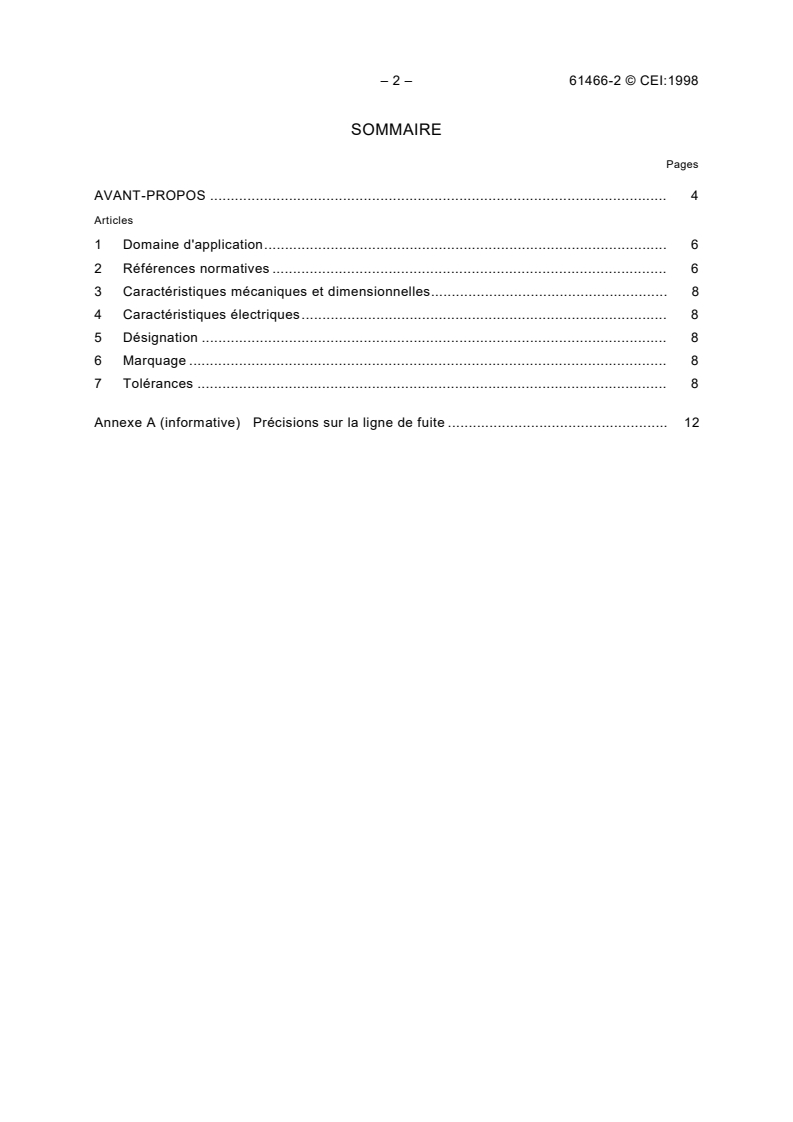
– 2 – 61466-2 © CEI:1998
SOMMAIRE
Pages
AVANT-PROPOS . 4
Articles
1 Domaine d'application. 6
2 Références normatives . 6
3 Caractéristiques mécaniques et dimensionnelles. 8
4 Caractéristiques électriques. 8
5 Désignation . 8
6 Marquage . 8
7 Tolérances . 8
Annexe A (informative) Précisions sur la ligne de fuite . 12
61466-2 © IEC:1998 – 3 –
CONTENTS
Page
FOREWORD . 5
Clause
1 Scope. 7
2 Normative references . 7
3 Mechanical and dimensional characteristics . 9
4 Electrical characteristics . 9
5 Designation . 9
6 Marking . 9
7 Tolerances . 9
Annex A (informative) Information on creepage distance . 13
– 4 – 61466-2 © CEI:1998
COMMISSION ÉLECTROTECHNIQUE INTERNATIONALE
––––––––––
ISOLATEURS COMPOSITES DESTINÉS AUX LIGNES AÉRIENNES
DE TENSION NOMINALE SUPÉRIEURE À 1 000 V –
Partie 2: Caractéristiques dimensionnelles et électriques
AVANT-PROPOS
1) La CEI (Commission Electrotechnique Internationale) est une organisation mondiale de normalisation composée
de l'ensemble des comités électrotechniques nationaux (Comités nationaux de la CEI). La CEI a pour objet de
favoriser la coopération internationale pour toutes les questions de normalisation dans les domaines de
l'électricité et de l'électronique. A cet effet, la CEI, entre autres activités, publie des Normes internationales.
Leur élaboration est confiée à des comités d'études, aux travaux desquels tout Comité national intéressé par le
sujet traité peut participer. Les organisations internationales, gouvernementales et non gouvernementales, en
liaison avec la CEI, participent également aux travaux. La CEI collabore étroitement avec l'Organisation
Internationale de Normalisation (ISO), selon des conditions fixées par accord entre les deux organisations.
2) Les décisions ou accords officiels de la CEI concernant les questions techniques représentent, dans la mesure
du possible un accord international sur les sujets étudiés, étant donné que les Comités nationaux intéressés
sont représentés dans chaque comité d’études.
3) Les documents produits se présentent sous la forme de recommandations internationales. Ils sont publiés
comme normes, rapports techniques ou guides et agréés comme tels par les Comités nationaux.
4) Dans le but d'encourager l'unification internationale, les Comités nationaux de la CEI s'engagent à appliquer de
façon transparente, dans toute la mesure possible, les Normes internationales de la CEI dans leurs normes
nationales et régionales. Toute divergence entre la norme de la CEI et la norme nationale ou régionale
correspondante doit être indiquée en termes clairs dans cette dernière.
5) La CEI n’a fixé aucune procédure concernant le marquage comme indication d’approbation et sa responsabilité
n’est pas engagée quand un matériel est déclaré conforme à l’une de ses normes.
6) L’attention est attirée sur le fait que certains des éléments de la présente Norme internationale peuvent faire
l’objet de droits de propriété intellectuelle ou de droits analogues. La CEI ne saurait être tenue pour
responsable de ne pas avoir identifié de tels droits de propriété et de ne pas avoir signalé leur existence.
La Norme internationale CEI 61466-2 a été établie par le sous-comité 36B: Isolateurs pour
lignes aériennes, du comité d’études 36 de la CEI: Isolateurs.
Le texte de cette norme est issu des documents suivants:
FDIS Rapport de vote
36B/179/FDIS 36B/183/RVD
Le rapport de vote indiqué dans le tableau ci-dessus donne toute information sur le vote ayant
abouti à l'approbation de cette norme.
L’annexe A est donnée uniquement à titre d’information.
61466-2 © IEC:1998 – 5 –
INTERNATIONAL ELECTROTECHNICAL COMMISSION
–––––––––––
COMPOSITE STRING INSULATOR UNITS FOR OVERHEAD LINES
WITH A NOMINAL VOLTAGE GREATER THAN 1 000 V –
Part 2: Dimensional and electrical characteristics
FOREWORD
1) The IEC (International Electrotechnical Commission) is a worldwide organization for standardization comprising
all national electrotechnical committees (IEC National Committees). The object of the IEC is to promote
international co-operation on all questions concerning standardization in the electrical and electronic fields. To
this end and in addition to other activities, the IEC publishes International Standards. Their preparation is
entrusted to technical committees; any IEC National Committee interested in the subject dealt with may
participate in this preparatory work. International, governmental and non-governmental organizations liaising
with the IEC also participate in this preparation. The IEC collaborates closely with the International Organization
for Standardization (ISO) in accordance with conditions determined by agreement between the two
organizations.
2) The formal decisions or agreements of the IEC on technical matters express, as nearly as possible, an
international consensus of opinion on the relevant subjects since each technical committee has representation
from all interested National Committees.
3) The documents produced have the form of recommendations for international use and are published in the form
of standards, technical reports or guides and they are accepted by the National Committees in that sense.
4) In order to promote international unification, IEC National Committees undertake to apply IEC International
Standards transparently to the maximum extent possible in their national and regional standards. Any
divergence between the IEC Standard and the corresponding national or regional standard shall be clearly
indicated in the latter.
5) The IEC provides no marking procedure to indicate its approval and cannot be rendered responsible for any
equipment declared to be in conformity with one of its standards.
6) Attention is drawn to the possibility that some of the elements of this International Standard may be the subject
of patent rights. The IEC shall not be held responsible for identifying any or all such patent rights.
International Standard IEC 61466-2 has been prepared by subcommittee 36B: Insulators for
overhead lines, of IEC technical committee 36: Insulators.
The text of this standard is based on the following documents:
FDIS Report on voting
36B/179/FDIS 36B/183/RVD
Full information on the voting for the approval of this standard can be found in the report on
voting indicated in the above table.
Annex A is for information only.
– 6 – 61466-2 © CEI:1998
ISOLATEURS COMPOSITES DESTINÉS AUX LIGNES AÉRIENNES
DE TENSION NOMINALE SUPÉRIEURE À 1 000 V –
Partie 2: Caractéristiques dimensionnelles et électriques
1 Domaine d'application
Cette partie de la CEI 61466 s'applique aux isolateurs composites de charge mécanique
spécifiée (CMS) de 40 kN et 70 kN destinés aux lignes aériennes à courant alternatif de
tension nominale supérieure à 1 000 V et de fréquence inférieure ou égale à 100 Hz.
Elle est également applicable à des isolateurs similaires utilisés dans les postes de
transformation et sur les lignes de traction.
Cette norme s’applique aux éléments de chaîne d’isolateurs de type composite dont les
extrémités sont conformes
...
NORME CEI
INTERNATIONALE IEC
61466-2
INTERNATIONAL
Edition 1.1
STANDARD
2002-02
Edition 1:1998 consolidée par l'amendement 1:2002
Edition 1:1998 consolidated with amendment 1:2002
Isolateurs composites destinés aux lignes aériennes
de tension nominale supérieure à 1 000 V –
Partie 2:
Caractéristiques dimensionnelles et électriques
Composite string insulator units for overhead lines
with a nominal voltage greater than 1 000 V –
Part 2:
Dimensional and electrical characteristics
Numéro de référence
Reference number
CEI/IEC 61466-2:1998+A1:2002
Numérotation des publications Publication numbering
Depuis le 1er janvier 1997, les publications de la CEI As from 1 January 1997 all IEC publications are
sont numérotées à partir de 60000. Ainsi, la CEI 34-1 issued with a designation in the 60000 series. For
devient la CEI 60034-1. example, IEC 34-1 is now referred to as IEC 60034-1.
Editions consolidées Consolidated editions
Les versions consolidées de certaines publications de la The IEC is now publishing consolidated versions of its
CEI incorporant les amendements sont disponibles. Par publications. For example, edition numbers 1.0, 1.1
exemple, les numéros d’édition 1.0, 1.1 et 1.2 indiquent and 1.2 refer, respectively, to the base publication,
respectivement la publication de base, la publication de the base publication incorporating amendment 1 and
base incorporant l’amendement 1, et la publication de the base publication incorporating amendments 1
base incorporant les amendements 1 et 2. and 2.
Informations supplémentaires Further information on IEC publications
sur les publications de la CEI
Le contenu technique des publications de la CEI est The technical content of IEC publications is kept
constamment revu par la CEI afin qu'il reflète l'état under constant review by the IEC, thus ensuring that
actuel de la technique. Des renseignements relatifs à the content reflects current technology. Information
cette publication, y compris sa validité, sont dispo- relating to this publication, including its validity, is
nibles dans le Catalogue des publications de la CEI available in the IEC Catalogue of publications
(voir ci-dessous) en plus des nouvelles éditions, (see below) in addition to new editions, amendments
amendements et corrigenda. Des informations sur les and corrigenda. Information on the subjects under
sujets à l’étude et l’avancement des travaux entrepris consideration and work in progress undertaken by the
par le comité d’études qui a élaboré cette publication, technical committee which has prepared this
ainsi que la liste des publications parues, sont publication, as well as the list of publications issued,
également disponibles par l’intermédiaire de: is also available from the following:
• Site web de la CEI (www.iec.ch) • IEC Web Site (www.iec.ch)
• Catalogue des publications de la CEI • Catalogue of IEC publications
Le catalogue en ligne sur le site web de la CEI The on-line catalogue on the IEC web site
(www.iec.ch/catlg-f.htm) vous permet de faire des (www.iec.ch/catlg-e.htm) enables you to search
recherches en utilisant de nombreux critères, by a variety of criteria including text searches,
comprenant des recherches textuelles, par comité technical committees and date of publication. On-
d’études ou date de publication. Des informations line information is also available on recently
en ligne sont également disponibles sur les issued publications, withdrawn and replaced
nouvelles publications, les publications rempla- publications, as well as corrigenda.
cées ou retirées, ainsi que sur les corrigenda.
• IEC Just Published
• IEC Just Published
Ce résumé des dernières publications parues
This summary of recently issued publications
(www.iec.ch/JP.htm) est aussi disponible par
(www.iec.ch/JP.htm) is also available by email.
courrier électronique. Veuillez prendre contact
Please contact the Customer Service Centre (see
avec le Service client (voir ci-dessous) pour plus
below) for further information.
d’informations.
• Service clients
• Customer Service Centre
Si vous avez des questions au sujet de cette
If you have any questions regarding this
publication ou avez besoin de renseignements
publication or need further assistance, please
supplémentaires, prenez contact avec le Service
contact the Customer Service Centre:
clients:
Email: custserv@iec.ch
Email: custserv@iec.ch
Tél: +41 22 919 02 11
Tel: +41 22 919 02 11
Fax: +41 22 919 03 00
Fax: +41 22 919 03 00
.
NORME CEI
INTERNATIONALE IEC
61466-2
INTERNATIONAL
Edition 1.1
STANDARD
2002-02
Edition 1:1998 consolidée par l'amendement 1:2002
Edition 1:1998 consolidated with amendment 1:2002
Isolateurs composites destinés aux lignes aériennes
de tension nominale supérieure à 1 000 V –
Partie 2:
Caractéristiques dimensionnelles et électriques
Composite string insulator units for overhead lines
with a nominal voltage greater than 1 000 V –
Part 2:
Dimensional and electrical characteristics
IEC 2002 Droits de reproduction réservés Copyright - all rights reserved
Aucune partie de cette publication ne peut être reproduite ni No part of this publication may be reproduced or utilized in any
utilisée sous quelque forme que ce soit et par aucun procédé, form or by any means, electronic or mechanical, including
électronique ou mécanique, y compris la photocopie et les photocopying and microfilm, without permission in writing from
microfilms, sans l'accord écrit de l'éditeur. the publisher.
International Electrotechnical Commission, 3, rue de Varembé, PO Box 131, CH-1211 Geneva 20, Switzerland
Telephone: +41 22 919 02 11 Telefax: +41 22 919 03 00 E-mail: inmail@iec.ch Web: www.iec.ch
CODE PRIX
CB
Commission Electrotechnique Internationale
PRICE CODE
International Electrotechnical Commission
Международная Электротехническая Комиссия
Pour prix, voir catalogue en vigueur
For price, see current catalogue
– 2 – 61466-2 © CEI:1998+A1:2002
SOMMAIRE
AVANT-PROPOS .4
1 Domaine d'application.6
2 Références normatives .6
3 Caractéristiques mécaniques et dimensionnelles.6
4 Caractéristiques électriques.8
5 Désignation .8
6 Marquage .8
7 Tolérances .8
8 Dispositifs de contrôle de champ et de protection contre les arcs .8
Annexe A (informative) Précisions sur la ligne de fuite.12
Tableau 1 – Désignation et caractéristiques des isolateurs composites.10
61466-2 © IEC:1998+A1:2002 – 3 –
CONTENTS
FOREWORD.5
1 Scope.7
2 Normative references .7
3 Mechanical and dimensional characteristics .7
4 Electrical characteristics .9
5 Designation .9
6 Marking .9
7 Tolerances .9
8 Field control and arc protection devices .9
Annex A (informative) Information on creepage distance.13
Table 1 – Designation and characteristics of composite insulators .11
– 4 – 61466-2 © CEI:1998+A1:2002
COMMISSION ÉLECTROTECHNIQUE INTERNATIONALE
––––––––––
ISOLATEURS COMPOSITES DESTINÉS AUX LIGNES AÉRIENNES
DE TENSION NOMINALE SUPÉRIEURE À 1 000 V –
Partie 2: Caractéristiques dimensionnelles et électriques
AVANT-PROPOS
1) La CEI (Commission Electrotechnique Internationale) est une organisation mondiale de normalisation composée
de l'ensemble des comités électrotechniques nationaux (Comités nationaux de la CEI). La CEI a pour objet de
favoriser la coopération internationale pour toutes les questions de normalisation dans les domaines de
l'électricité et de l'électronique. A cet effet, la CEI, entre autres activités, publie des Normes internationales.
Leur élaboration est confiée à des comités d'études, aux travaux desquels tout Comité national intéressé par le
sujet traité peut participer. Les organisations internationales, gouvernementales et non gouvernementales, en
liaison avec la CEI, participent également aux travaux. La CEI collabore étroitement avec l'Organisation
Internationale de Normalisation (ISO), selon des conditions fixées par accord entre les deux organisations.
2) Les décisions ou accords officiels de la CEI concernant les questions techniques représentent, dans la mesure
du possible, un accord international sur les sujets étudiés, étant donné que les Comités nationaux intéressés
sont représentés dans chaque comité d’études.
3) Les documents produits se présentent sous la forme de recommandations internationales. Ils sont publiés
comme normes, spécifications techniques, rapports techniques ou guides et agréés comme tels par les Comités
nationaux.
4) Dans le but d'encourager l'unification internationale, les Comités nationaux de la CEI s'engagent à appliquer de
façon transparente, dans toute la mesure possible, les Normes internationales de la CEI dans leurs normes
nationales et régionales. Toute divergence entre la norme de la CEI et la norme nationale ou régionale
correspondante doit être indiquée en termes clairs dans cette dernière.
5) La CEI n’a fixé aucune procédure concernant le marquage comme indication d’approbation et sa responsabilité
n’est pas engagée quand un matériel est déclaré conforme à l’une de ses normes.
6) L’attention est attirée sur le fait que certains des éléments de la présente Norme internationale peuvent faire
l’objet de droits de propriété intellectuelle ou de droits analogues. La CEI ne saurait être tenue pour
responsable de ne pas avoir identifié de tels droits de propriété et de ne pas avoir signalé leur existence.
La Norme internationale CEI 61466-2 a été établie par le sous-comité 36B: Isolateurs pour
lignes aériennes, du comité d’études 36 de la CEI: Isolateurs.
La présente version consolidée de la CEI 61466-2 comprend la première édition (1998)
[documents 36B/179/FDIS et 36B/183/RVD] et son amendement 1 (2002) [documents
36B/202/FDIS et 36B/204/RVD].
Le contenu technique de cette version consolidée est donc identique à celui de l'édition de
base et à son amendement; cette version a été préparée par commodité pour l'utilisateur.
Elle porte le numéro d'édition 1.1.
Une ligne verticale dans la marge indique où la publication de base a été modifiée par
l'amendement 1.
L’annexe A est donnée uniquement à titre d’information.
Le comité a décidé que le contenu de la publication de base et de ses amendements ne sera
pas modifié avant 2004-06. A cette date, la publication sera
• reconduite;
• supprimée;
• remplacée par une édition révisée, ou
• amendée.
61466-2 © IEC:1998+A1:2002 – 5 –
INTERNATIONAL ELECTROTECHNICAL COMMISSION
–––––––––––
COMPOSITE STRING INSULATOR UNITS FOR OVERHEAD LINES
WITH A NOMINAL VOLTAGE GREATER THAN 1 000 V –
Part 2: Dimensional and electrical characteristics
FOREWORD
1) The IEC (International Electrotechnical Commission) is a worldwide organization for standardization comprising
all national electrotechnical committees (IEC National Committees). The object of the IEC is to promote
international co-operation on all questions concerning standardization in the electrical and electronic fields. To
this end and in addition to other activities, the IEC publishes International Standards. Their preparation is
entrusted to technical committees; any IEC National Committee interested in the subject dealt with may
participate in this preparatory work. International, governmental and non-governmental organizations liaising
with the IEC also participate in this preparation. The IEC collaborates closely with the International Organization for
Standardization (ISO) in accordance with conditions determined by agreement between the two organizations.
2) The formal decisions or agreements of the IEC on technical matters express, as nearly as possible, an
international consensus of opinion on the relevant subjects since each technical committee has representation
from all interested National Committees.
3) The documents produced have the form of recommendations for international use and are published in the form
of standards, technical specifications, technical reports or guides and they are accepted by the National
Committees in that sense.
4) In order to promote international unification, IEC National Committees undertake to apply IEC International
Standards transparently to the maximum extent possible in their national and regional standards. Any
divergence between the IEC Standard and the corresponding national or regional standard shall be clearly
indicated in the latter.
5) The IEC provides no marking procedure to indicate its approval and cannot be rendered responsible for any
equipment declared to be in conformity with one of its standards.
6) Attention is drawn to the possibility that some of the elements of this International Standard may be the subject
of patent rights. The IEC shall not be held responsible for identifying any or all such patent rights.
International Standard IEC 61466-2 has been prepared by subcommittee 36B: Insulators for overhead lines, of
IEC technical committee 36: Insulators.
International Standard IEC 61466-2 has been prepared by subcommittee 36B: Insulators for
overhead lines, of IEC technical committee 36: Insulators.
This consolidated version of IEC 61466-2 consists of the first edition (1998) [documents
36B/179/FDIS and 36B/183/RVD] and its amendment 1 (2002) [documents 36B/202/FDIS and
36B/204/RVD].
The technical content is therefore identical to the base edition and its amendment and has
been prepared for user convenience.
It bears the edition number 1.1.
A vertical line in the margin shows where the base publication has been modified by
amendment 1.
Annex A is for information only.
The committee has decided that the contents of the base publication and its amendments will
remain unchanged until 2004-06. At this date, the publication will be
• reconfirmed;
• withdrawn;
• replaced by a revised edition, or
• amended.
– 6 – 61466-2 © CEI:1998+A1:2002
ISOLATEURS COMPOSITES DESTINÉS AUX LIGNES AÉRIENNES
DE TENSION NOMINALE SUPÉRIEURE À 1 000 V –
Partie 2: Caractéristiques dimensionnelles et électriques
1 Domaine d'application
Cette partie de la CEI 61466 s'applique aux isolateurs composites de suspension de charge
mécanique spécifiée (CMS) de 40 kN à 210 kN, destinés aux lignes aériennes en courant alter-
natif de tension nominale supérieure à 1 000 V et de fréquence inférieure ou égale à 100 Hz.
Elle est également applicable à des isolateurs similaires utilisés dans les postes de trans-
formation ou pour des applications ferroviaires.
Cette norme s’applique aux éléments de chaîne d’isolateurs de type composite dont les
extrémités sont conformes à la CEI 61466-1.
Cette norme prescrit les valeurs spécifiées des caractéristiques électriques et dimensionnelles
des isolateurs
...
IEC 61466-2 ®
Edition 1.2 2018-05
CONSOLIDATED VERSION
INTERNATIONAL
STANDARD
NORME
INTERNATIONALE
colour
inside
Composite string insulator units for overhead lines with a nominal voltage
greater than 1 000 V –
Part 2: Dimensional and electrical characteristics
Isolateurs composites destinés aux lignes aériennes de tension nominale
supérieure à 1 000 V –
Partie 2: Caractéristiques dimensionnelles et électriques
All rights reserved. Unless otherwise specified, no part of this publication may be reproduced or utilized in any form
or by any means, electronic or mechanical, including photocopying and microfilm, without permission in writing from
either IEC or IEC's member National Committee in the country of the requester. If you have any questions about IEC
copyright or have an enquiry about obtaining additional rights to this publication, please contact the address below or
your local IEC member National Committee for further information.
Droits de reproduction réservés. Sauf indication contraire, aucune partie de cette publication ne peut être reproduite
ni utilisée sous quelque forme que ce soit et par aucun procédé, électronique ou mécanique, y compris la photocopie
et les microfilms, sans l'accord écrit de l'IEC ou du Comité national de l'IEC du pays du demandeur. Si vous avez des
questions sur le copyright de l'IEC ou si vous désirez obtenir des droits supplémentaires sur cette publication, utilisez
les coordonnées ci-après ou contactez le Comité national de l'IEC de votre pays de résidence.
IEC Central Office Tel.: +41 22 919 02 11
3, rue de Varembé info@iec.ch
CH-1211 Geneva 20 www.iec.ch
Switzerland
About the IEC
The International Electrotechnical Commission (IEC) is the leading global organization that prepares and publishes
International Standards for all electrical, electronic and related technologies.
About IEC publications
The technical content of IEC publications is kept under constant review by the IEC. Please make sure that you have the
latest edition, a corrigenda or an amendment might have been published.
IEC Catalogue - webstore.iec.ch/catalogue Electropedia - www.electropedia.org
The stand-alone application for consulting the entire The world's leading online dictionary of electronic and
bibliographical information on IEC International Standards, electrical terms containing 21 000 terms and definitions in
Technical Specifications, Technical Reports and other English and French, with equivalent terms in 16 additional
documents. Available for PC, Mac OS, Android Tablets and languages. Also known as the International Electrotechnical
iPad. Vocabulary (IEV) online.
IEC publications search - webstore.iec.ch/advsearchform IEC Glossary - std.iec.ch/glossary
The advanced search enables to find IEC publications by a 67 000 electrotechnical terminology entries in English and
variety of criteria (reference number, text, technical French extracted from the Terms and Definitions clause of
committee,…). It also gives information on projects, replaced IEC publications issued since 2002. Some entries have been
and withdrawn publications. collected from earlier publications of IEC TC 37, 77, 86 and
CISPR.
IEC Just Published - webstore.iec.ch/justpublished
Stay up to date on all new IEC publications. Just Published IEC Customer Service Centre - webstore.iec.ch/csc
details all new publications released. Available online and If you wish to give us your feedback on this publication or
also once a month by email. need further assistance, please contact the Customer Service
Centre: sales@iec.ch.
A propos de l'IEC
La Commission Electrotechnique Internationale (IEC) est la première organisation mondiale qui élabore et publie des
Normes internationales pour tout ce qui a trait à l'électricité, à l'électronique et aux technologies apparentées.
A propos des publications IEC
Le contenu technique des publications IEC est constamment revu. Veuillez vous assurer que vous possédez l’édition la
plus récente, un corrigendum ou amendement peut avoir été publié.
Catalogue IEC - webstore.iec.ch/catalogue Electropedia - www.electropedia.org
Application autonome pour consulter tous les renseignements
Le premier dictionnaire en ligne de termes électroniques et
bibliographiques sur les Normes internationales,
électriques. Il contient 21 000 termes et définitions en anglais
Spécifications techniques, Rapports techniques et autres
et en français, ainsi que les termes équivalents dans 16
documents de l'IEC. Disponible pour PC, Mac OS, tablettes
langues additionnelles. Egalement appelé Vocabulaire
Android et iPad.
Electrotechnique International (IEV) en ligne.
Recherche de publications IEC -
Glossaire IEC - std.iec.ch/glossary
webstore.iec.ch/advsearchform
67 000 entrées terminologiques électrotechniques, en anglais
La recherche avancée permet de trouver des publications IEC et en français, extraites des articles Termes et Définitions des
en utilisant différents critères (numéro de référence, texte, publications IEC parues depuis 2002. Plus certaines entrées
comité d’études,…). Elle donne aussi des informations sur les antérieures extraites des publications des CE 37, 77, 86 et
projets et les publications remplacées ou retirées. CISPR de l'IEC.
IEC Just Published - webstore.iec.ch/justpublished Service Clients - webstore.iec.ch/csc
Restez informé sur les nouvelles publications IEC. Just Si vous désirez nous donner des commentaires sur cette
Published détaille les nouvelles publications parues. publication ou si vous avez des questions contactez-nous:
Disponible en ligne et aussi une fois par mois par email. sales@iec.ch.
IEC 61466-2 ®
Edition 1.2 2018-05
CONSOLIDATED VERSION
INTERNATIONAL
STANDARD
NORME
INTERNATIONALE
colour
inside
Composite string insulator units for overhead lines with a nominal voltage
greater than 1 000 V –
Part 2: Dimensional and electrical characteristics
Isolateurs composites destinés aux lignes aériennes de tension nominale
supérieure à 1 000 V –
Partie 2: Caractéristiques dimensionnelles et électriques
INTERNATIONAL
ELECTROTECHNICAL
COMMISSION
COMMISSION
ELECTROTECHNIQUE
INTERNATIONALE
ICS 29.080.10; 29.240.20 ISBN 978-2-8322-5715-9
IEC 61466-2 ®
Edition 1.2 2018-05
CONSOLIDATED VERSION
REDLINE VERSION
VERSION REDLINE
colour
inside
Composite string insulator units for overhead lines with a nominal voltage
greater than 1 000 V –
Part 2: Dimensional and electrical characteristics
Isolateurs composites destinés aux lignes aériennes de tension nominale
supérieure à 1 000 V –
Partie 2: Caractéristiques dimensionnelles et électriques
– 2 – IEC 61466-2:1998+AMD1:2002
+AMD2:2018 CSV © IEC 2018
CONTENTS
FOREWORD . 3
INTRODUCTION to Amendment 2 . 5
1 Scope . 6
2 Normative references . 6
3 Mechanical and dimensional characteristics . 7
4 Electrical characteristics . 7
5 Designation . 7
6 Marking . 7
7 Tolerances . 7
8 Field control and arc protection devices . 8
Annex A (informative) Information on creepage distance . 11
Table 1 – Designation and characteristics of composite insulators . 8
+AMD2:2018 CSV © IEC 2018
INTERNATIONAL ELECTROTECHNICAL COMMISSION
–––––––––––
COMPOSITE STRING INSULATOR UNITS FOR OVERHEAD LINES
WITH A NOMINAL VOLTAGE GREATER THAN 1 000 V –
Part 2: Dimensional and electrical characteristics
FOREWORD
1) The International Electrotechnical Commission (IEC) is a worldwide organization for standardization comprising
all national electrotechnical committees (IEC National Committees). The object of IEC is to promote
international co-operation on all questions concerning standardization in the electrical and electronic fields. To
this end and in addition to other activities, IEC publishes International Standards, Technical Specifications,
Technical Reports, Publicly Available Specifications (PAS) and Guides (hereafter referred to as “IEC
Publication(s)”). Their preparation is entrusted to technical committees; any IEC National Committee interested
in the subject dealt with may participate in this preparatory work. International, governmental and non-
governmental organizations liaising with the IEC also participate in this preparation. IEC collaborates closely
with the International Organization for Standardization (ISO) in accordance with conditions determined by
agreement between the two organizations.
2) The formal decisions or agreements of IEC on technical matters express, as nearly as possible, an international
consensus of opinion on the relevant subjects since each technical committee has representation from all
interested IEC National Committees.
3) IEC Publications have the form of recommendations for international use and are accepted by IEC National
Committees in that sense. While all reasonable efforts are made to ensure that the technical content of IEC
Publications is accurate, IEC cannot be held responsible for the way in which they are used or for any
misinterpretation by any end user.
4) In order to promote international uniformity, IEC National Committees undertake to apply IEC Publications
transparently to the maximum extent possible in their national and regional publications. Any divergence
between any IEC Publication and the corresponding national or regional publication shall be clearly indicated in
the latter.
5) IEC itself does not provide any attestation of conformity. Independent certification bodies provide conformity
assessment services and, in some areas, access to IEC marks of conformity. IEC is not responsible for any
services carried out by independent certification bodies.
6) All users should ensure that they have the latest edition of this publication.
7) No liability shall attach to IEC or its directors, employees, servants or agents including individual experts and
members of its technical committees and IEC National Committees for any personal injury, property damage or
other damage of any nature whatsoever, whether direct or indirect, or for costs (including legal fees) and
expenses arising out of the publication, use of, or reliance upon, this IEC Publication or any other IEC
Publications.
8) Attention is drawn to the Normative references cited in this publication. Use of the referenced publications is
indispensable for the correct application of this publication.
9) Attention is drawn to the possibility that some of the elements of this IEC Publication may be the subject of
patent rights. IEC shall not be held responsible for identifying any or all such patent rights.
This consolidated version of the official IEC Standard and its amendments has been prepared
for user convenience.
IEC 61466-2 edition 1.2 contains the first edition (1998-08) [documents 36B/179/FDIS and
36B/183/RVD], its amendment 1 (2002-01) [documents 36B/202/FDIS and 36B/204/RVD] and its
amendment 2 (2018-05) [documents 36/427/FDIS and 36/429/RVD].
In this Redline version, a vertical line in the margin shows where the technical content is
modified by amendments 1 and 2. Additions are in green text, deletions are in strikethrough red
text. A separate Final version with all changes accepted is available in this publication.
– 4 – IEC 61466-2:1998+AMD1:2002
+AMD2:2018 CSV © IEC 2018
International Standard IEC 61466-2 has been prepared by subcommittee 36B: Insulators for
overhead lines, of IEC technical committee 36: Insulators.
Annex A is for information only.
The committee has decided that the contents of the base publication and its amendments will
remain unchanged until the stability date indicated on the IEC web site under
"http://webstore.iec.ch" in the data related to the specific publication. At this date, the
publication will be
• reconfirmed,
• withdrawn,
• replaced by a revised edition, or
• amended.
IMPORTANT – The 'colour inside' logo on the cover page of this publication indicates that it
contains colours which are considered to be useful for the correct understanding of its
contents. Users should therefore print this document using a colour printer.
+AMD2:2018 CSV © IEC 2018
INTRODUCTION to Amendment 2
Amendment 2 implements the introduction of UHV (ultra-high voltage) applications and the
relevant characteristics of composite insulators.
– 6 – IEC 61466-2:1998+AMD1:2002
+AMD2:2018 CSV © IEC 2018
COMPOSITE STRING INSULATOR UNITS FOR OVERHEAD LINES
WITH A NOMINAL VOLTAGE GREATER THAN 1 000 V –
Part 2: Dimensional and electrical characteristics
1 Scope
This part of IEC 61466 is applicable to composite string insulators units with a specified
mechanical load (SML) of 40 kN and 70 kN to 600 kN for AC overhead distribution lines with a
nominal voltage greater than 1 000 V and a frequency not greater than 100 Hz.
It also applies to insulators of similar design used in substations or on electric traction lines for
railway applications.
This standard applies to string insulator units of composite type with couplings fittings in
accordance with IEC 61466-1.
This standard prescribes specified specifies values for electrical and dimensional
characteristics of for composite string insulators units for overhead distribution lines with a
highest minimum lightning impulse withstand voltage (BIL) level of 325 kV up to 3 100 kV and a
specified mechanical load (SML) of 40 kN and 70 kN to 600 kN.
NOTE General definitions and methods of testing are given in IEC 61109.
2 Normative references
The following normative documents contain provisions which, through reference in this text,
constitute provisions of this part of IEC 61466. At the time of publication, the editions indicated
were valid. All normative documents are subjected to revision, and parties to agreements
based on this part of IEC 61466 are encouraged to investigate the possibility of applying the
most recent editions of the normative documents indicated below. Members of IEC and ISO
maintain registers of currently valid International Standards.
IEC 60071-1:1993, Insulation co-ordination – Part 1: Definitions, principles and rules
IEC 60071-2:1976, Insulation co-ordination – Part 2: Application guide
IEC TS 60815-3, Selection and dimensioning of high-voltage insulators intended for use in
polluted conditions – Part 3: Polymer insulators for a.c. systems
IEC 61109:1992, Composite insulators for a.c. overhead lines with a nominal voltage greater
than 1 000 V – Definitions, test methods and acceptance criteria
IEC 61466-1:1997, Composite string insulator units for overhead lines with a nominal voltage
greater than 1 000 V – Part 1: Standard strength classes and end fittings
+AMD2:2018 CSV © IEC 2018
3 Mechanical and dimensional characteristics
Composite string insulator units are standardized by the following mechanical and dimensional
characteristics:
– specified mechanical load (SML) – which are dealt with in IEC 61466-1
– type of couplings
– minimum creepage distance – for which values are given in table 1
– minimum arcing distance
– maximum diameter of insulating part
Table 1 gives a minimum creepage distance for each insulator along with the highest voltage
for equipment based on a specific creepage distance of 16 mm/kV (phase/phase). This voltage
is given for information only. Other values of specific creepage distance may be required.
Further information on composite insulator creepage distances can be found in annex A.
4 Electrical characteristics
Composite string insulator units are standardized by the standard lightning impulse withstand
voltage, for which values are given in table 1.
The wet power frequency withstand voltage shall be that given in IEC 60071-1, unless
otherwise stipulated by national regulations or practice.
NOTE – General definitions, principles, rules and application guidelines for insulation co-ordination are given in
IEC 60071-1 and IEC 60071-2.
5 Designation
Composite insulators are designated in table 1 as follows:
– by the letters CS followed by a number indicating the specified mechanical load (SML) in
kilonewtons (kN);
– the letters X and Z, representing the couplings in accordance with IEC 61466-1;
– the two numbers separated by a solidus indicate the standard lightning impulse withstand voltage
and the minimum creepage distance.
6 Marking
The insulator shall be marked in accordance with IEC 61466-1.
7 Tolerances
The dimensions given in table 1 are the absolute minima or maxima; hence no tolerances are
applicable. The dimensions and tolerances of insulators supplied in compliance with this
standard shall be shown on the manufacturer’s drawing.
– 8 – IEC 61466-2:1998+AMD1:2002
+AMD2:2018 CSV © IEC 2018
8 Field control and arc protection devices
For higher system voltages field control devices may be necessary. When such devices are
fitted on the insulators, the arcing distance in Table 1 shall be determined considering their
presence. If separate arc protection devices are used, the required additional striking distance
can be extrapolated.
Table 1 – Designation and characteristics of composite insulators
1)
Designation Possible Standard Minimum Minimum Maximum Highest voltage
specified lightning creepage arcing diameter of for equipment
mechanical impulse distance distance insulating based on
loads withstand part 16 mm/kV
2)
(SML) voltage specific
creepage
3)
distance
kN kV mm mm mm kV
CMS(SML)XZ- 60/195 40/70 60 195 100 200 12
CMS(SML)XZ- 75/195 40/70 75 195 125 200 12
CMS(SML)XZ- 75/280 40/70 75 280 125 200 17,5
CMS(SML)XZ- 95/195 40/70 95 195 160 200 12
CMS(SML)XZ- 95/280 40/70 95 280 160 200 17,5
CMS(SML)XZ- 95/385 40/70 95 385 160 200
CMS(SML)XZ- 125/385 40/70 125 385 210 200 24
CMS(SML)XZ- 145/385 40/70 145 385 240 200 24
CMS(SML)XZ- 145/580 40/70 145 580 240 200 36
CMS(SML)XZ- 170/580 70 170 580 285 200 36
CMS(SML)XZ- 250/835 70 250 835 440 200 52
CMS(SML)XZ- 325/1160 70 325 1160 580 200 72,5
NOTE 1 – SML is the chosen specified mechanical failing load. XZ is the coupling code in accordance with IEC 61466-
1.
NOTE 2 – The withstand voltages and insulating distances are given for insulators alone and do not take into
account arcing or corona control devices which may be mounted on the insulators.
NOTE 3 – This column is given for information only. For supplementary information on creepage distance, see
annex A.
Specified mechanical Standard Minimum Minimum dry Highest voltage for
loads (SML) lightning creepage arcing equipment based on
a d c
Designation (typical values in impulse distance distance 27,8 mm/kV unified
white area) withstand specific creepage
b d
voltage distance
kN kV mm mm kV
CS(SML)(XZ)-
40 70 100 120 160 210 60 195 100 12
60-195
CS(SML)(XZ)-
40 70 100 120 160 210 75 195 125 12
75-195
CS(SML)(XZ)-
40 70 100 120 160 210 75 280 125 17,5
75-280
CS(SML)(XZ)-
40 70 100 120 160 210 95 195 160 12
95-195
CS(SML)(XZ)-
40 70 100 120 160 210 95 280 160 17,5
95-280
+AMD2:2018 CSV © IEC 2018
Specified mechanical Standard Minimum Minimum dry Highest voltage for
loads (SML) lightning creepage arcing equipment based on
a d c
Designation (typical values in impulse distance distance 27,8 mm/kV unified
white area) withstand specific creepage
b d
voltage distance
kN kV mm mm kV
CS(SML)(XZ)-
40 70 100 120 160 210 95 385 160 24
95-385
CS(SML)(XZ)-
40 70 100 120 160 210 125 385 210 24
125-385
CS(SML)(XZ)-
40 70 100 120 160 210 145 385 240 24
145-385
CS(SML)(XZ)-
40 70 100 120 160 210 145 580 240 36
145-580
CS(SML)(XZ)-
40 70 100 120 160 210 170 580 285 36
170-580
CS(SML)(XZ)-
40 70 100 120 160 210 250 835 435 52
250-835
CS(SML)(XZ)-
40 70 100 120 160 210 325 1 160 570 72,5
325-1160
CS(SML)(XZ)-
40 70 100 120 160 210 450 1 970 815 123
450-1970
CS(SML)(XZ)-
40 70 100 120 160 210 450 2 320 815 145
450-2320
CS(SML)(XZ)-
40 70 100 120 160 210 550 1 970 1 005 123
550-1970
CS(SML)(XZ)-
40 70 100 120 160 210 550 2 320 1 005 145
550-2320
CS(SML)(XZ)-
40 70 100 120 160 210 550 2 720 1 005 170
550-2720
CS(SML)(XZ)-
40 70 100 120 160 210 650 2 320 1 195 145
650-2320
CS(SML)(XZ)-
40 70 100 120 160 210 650 2 720 1 195 170
650-2720
CS(SML)(XZ)-
40 70 100 120 160 210 650 3 920 1 195 245
650-3920
CS(SML)(XZ)-
40 70 100 120 160 210 750 2 720 1 395 170
750-2720
CS(SML)(XZ)-
70 100 120 160 210 300 750 3 920 1 395 245
750-3920
CS(SML)(XZ)-
70 100 120 160 210 300 850 3 920 1 585 245
850-3920
CS(SML)(XZ)-
70 100 120 160 210 300 950 3 920 1 775 245
950-3920
CS(SML)(XZ)-
70 100 120 160 210 300 1050 3 920 1 970 245
1050-3920
CS(SML)(XZ)-
160 210 300 400 1050 4 800 2 100 300
1050-4800
CS(SML)(XZ)-
160 210 300 400 1175 5 795 2 400 362
1175-5795
CS(SML)(XZ)- 16
210 300 400 550 600 1425 6 720 2 800 420
1425-6720 0
CS(SML)(XZ)- e
210 300 400 550 600 1550 8 800 3 800 550
1550-8800
CS(SML)(XZ)- 16 e
210 300 400 550 600 1800 8 800 550
4 000
1800-8800
– 10 – IEC 61466-2:1998+AMD1:2002
+AMD2:2018 CSV © IEC 2018
Specified mechanical Standard Minimum Minimum dry Highest voltage for
loads (SML) lightning creepage arcing equipment based on
a d c
Designation (typical values in impulse distance distance 27,8 mm/kV unified
white area) withstand specific creepage
b d
voltage distance
kN kV mm mm kV
CS(SML)(XZ)- 16
e
210 300 400 550 600 2100 12 800 5 500 800
2100-12800 0
CS(SML)(XZ)- 16
e
210 300 400 550 600 2550 17 600 6 500 1 100
2550-17600
CS(SML)(XZ)- 16 e
210 300 400 550 600 2700 19 200 8 000 1 200
2700-19200
CS(SML)(XZ)- 16 e
210 300 400 550 600 2900 19 200 1 200
8 000
2900-19200 0
CS(SML)(XZ)- 16 e
210 300 400 550 600 3100 19 200 8 500 1 200
3100-19200 0
a
The letters CS followed by a number indicating the specified mechanical load (SML) in kN (XZ) are the coupling code
letters in accordance with IEC 61466-1, followed by the lightning impulse withstand voltage (BIL) in kV and the creepage
distance in mm, for examples, CS(160)(CC)-550-2480.
b
When using arc protection devices, greater values of lightning impulse withstand voltage for the insulator may be specified
by the customer, for voltage levels of U > 245 kV the switching withstand voltage becomes the dominating design
m
criterion.
c
The minimum arcing distance is specified considering conductor-structure gap characteristics, rather than a maximum
section length (distance between couplings), because the diversity of end fitting types and materials makes it impractical, at
the time of publication of this document, to standardize the section length.
d
This column is given for information only and the values refer to “light” polluted environment. For supplementary information
on creepage distance see IEC 60815-3 and Annex A.
e
These figures are indicative for normal altitude (< 1 000 m) and not considering switching impulse strength. Thus these
values can be higher or lower if proven by the applicable withstand tests of the specific string or set configuration
considering grading and power arc protection devices, especially for different switching withstand voltage ratings.
+AMD2:2018 CSV © IEC 2018
Annex A
(informative)
Information on creepage distance
Table 1 gives values of the highest voltage for equipment U based on a unified specific
m
creepage distance of 16 27,8 mm/kV (phase/phase line to earth). Experience to date indicates
that this unified specific creepage distance is satisfactory for areas where pollution
performance is not considered to be a critical factor. The user will need to consider any change
of creepage distance (increase or even decrease) necessary to ensure adequate performance
for the environmental conditions (e.g. pollution level, exposure time, wetting conditions, etc.)
encountered in each area of application. Creepage distance for composite insulators shall be
designed in accordance with IEC TS 60815-3.
At the time of preparation of this standard, insufficient information was available to give
guidance on the specific creepage distances and different housing materials appropriate to
composite insulators for the various environmental conditions to ensure a satisfactory
1)
performance. This work is currently being undertaken at CIGRE with the objective of
)
including their recommendations in a future revision of IEC 60815 .
The guidance currently available in IEC 60815, both for specific creepage distance and for
shape parameters, is directed specifically to the application of glass and ceramic insulators
and cannot be used to directly define design criteria for composite insulators.
––––––––––––
–––––––––––
)
Conférence internationale des grands réseaux électriques à haute tension.
2)
IEC 60815:1986, Guide for the selection of insulators in respect of polluted conditions
– 12 – IEC 61466-2:1998+AMD1:2002
+AMD2:2018 CSV © IEC 2018
SOMMAIRE
AVANT-PROPOS . 13
INTRODUCTION à l'Amendement 2 . 15
1 Domaine d'application . 16
2 Références normatives . 16
3 Caractéristiques mécaniques et dimensionnelles. 17
4 Caractéristiques électriques . 17
5 Désignation . 17
6 Marquage . 17
7 Tolérances . 17
8 Dispositifs de contrôle de champ et de protection contre les arcs . 18
Annexe A (informative) Précisions sur la ligne de fuite . 21
Tableau 1 – Désignation et caractéristiques des isolateurs composites . 18
+AMD2:2018 CSV © IEC 2018
COMMISSION ÉLECTROTECHNIQUE INTERNATIONALE
–––––––––––
ISOLATEURS COMPOSITES DESTINÉS AUX LIGNES AÉRIENNES
DE TENSION NOMINALE SUPÉRIEURE À 1 000 V –
Partie 2: Caractéristiques dimensionnelles et électriques
AVANT-PROPOS
1) La Commission Electrotechnique Internationale (IEC) est une organisation mondiale de normalisation composée
de l'ensemble des comités électrotechniques nationaux (Comités nationaux de l’IEC). L’IEC a pour objet de
favoriser la coopération internationale pour toutes les questions de normalisation dans les domaines de
l'électricité et de l'électronique. A cet effet, l’IEC – entre autres activités – publie des Normes internationales,
des Spécifications techniques, des Rapports techniques, des Spécifications accessibles au public (PAS) et des
Guides (ci-après dénommés "Publication(s) de l’IEC"). Leur élaboration est confiée à des comités d'études, aux
travaux desquels tout Comité national intéressé par le sujet traité peut participer. Les organisations
internationales, gouvernementales et non gouvernementales, en liaison avec l’IEC, participent également aux
travaux. L’IEC collabore étroitement avec l'Organisation Internationale de Normalisation (ISO), selon des
conditions fixées par accord entre les deux organisations.
2) Les décisions ou accords officiels de l’IEC concernant les questions techniques représentent, dans la mesure
du possible, un accord international sur les sujets étudiés, étant donné que les Comités nationaux de l’IEC
intéressés sont représentés dans chaque comité d’études.
3) Les Publications de l’IEC se présentent sous la forme de recommandations internationales et sont agréées
comme telles par les Comités nationaux de l’IEC. Tous les efforts raisonnables sont entrepris afin que l’IEC
s'assure de l'exactitude du contenu technique de ses publications; l’IEC ne peut pas être tenue responsable de
l'éventuelle mauvaise utilisation ou interprétation qui en est faite par un quelconque utilisateur final.
4) Dans le but d'encourager l'uniformité internationale, les Comités nationaux de l’IEC s'engagent, dans toute la
mesure possible, à appliquer de façon transparente les Publications de l’IEC dans leurs publications nationales
et régionales. Toutes divergences entre toutes Publications de l’IEC et toutes publications nationales ou
régionales correspondantes doivent être indiquées en termes clairs dans ces dernières.
5) L’IEC elle-même ne fournit aucune attestation de conformité. Des organismes de certification indépendants
fournissent des services d'évaluation de conformité et, dans certains secteurs, accèdent aux marques de
conformité de l’IEC. L’IEC n'est responsable d'aucun des services effectués par les organismes de certification
indépendants.
6) Tous les utilisateurs doivent s'assurer qu'ils sont en possession de la dernière édition de cette publication.
7) Aucune responsabilité ne doit être imputée à l’IEC, à ses administrateurs, employés, auxiliaires ou mandataires,
y compris ses experts particuliers et les membres de ses comités d'études et des Comités nationaux de l’IEC,
pour tout préjudice causé en cas de dommages corporels et matériels, ou de tout autre dommage de quelque
nature que ce soit, directe ou indirecte, ou pour supporter les coûts (y compris les frais de justice) et les
dépenses découlant de la publication ou de l'utilisation de cette Publication de l’IEC ou de toute autre
Publication de l’IEC, ou au crédit qui lui est accordé.
8) L'attention est attirée sur les références normatives citées dans cette publication. L'utilisation de publications
référencées est obligatoire pour une application correcte de la présente publication.
9) L’attention est attirée sur le fait que certains des éléments de la présente Publication de l’IEC peuvent faire
l’objet de droits de brevet. L’IEC ne saurait être tenue pour responsable de ne pas avoir identifié de tels droits
de brevets et de ne pas avoir signalé leur existence.
Cette version consolidée de la Norme IEC officielle et de ses amendements a été préparée pour
la commodité de l'utilisateur.
L'IEC 61466-2 édition 1.2 contient la deuxième édition (1998-08) [documents 36B/179/FDIS et
36B/183/RVD], son amendement 1 (2002-01) [documents 36B/202/FDIS et 36B/204/RVD] et son
amendement 2 (2018-05) [documents 36/427/FDIS et 36/429/RVD].
Dans cette version Redline, une ligne verticale dans la marge indique où le contenu technique
est modifié par les amendements 1 et 2. Les ajouts sont en vert, les suppressions sont en
rouge, barrées. Une version Finale avec toutes les modifications acceptées est disponible dans
cette publication.
– 14 – IEC 61466-2:1998+AMD1:2002
+AMD2:2018 CSV © IEC 2018
La Norme internationale IEC 61466-2 a été établie par le sous-comité 36B: Isolateurs pour
lignes aériennes, du comité d’études 36 de l’IEC: Isolateurs.
L’annexe A est donnée uniquement à titre d’information.
Le comité a décidé que le contenu de la publication de base et de ses amendements ne sera
pas modifié avant la date de stabilité indiquée sur le site web de l’IEC sous
"http://webstore.iec.ch" dans les données relatives à la publication recherchée. A cette date, la
publication sera
• reconduite,
• supprimée,
• remplacée par une édition révisée, ou
• amendée.
IMPORTANT – Le logo "colour inside" qui se trouve sur la page de couverture de cette
publication indique qu'elle contient des couleurs qui sont considérées comme utiles à
une bonne compréhension de son contenu. Les utilisateurs devraient, par conséquent,
imprimer cette publication en utilisant une imprimante couleur.
+AMD2:2018 CSV © IEC 2018
INTRODUCTION à l'Amendement 2
L'Amendement 2 met en œuvre l'introduction des applications UHT (ultra haute tension) et les
caractéristiques correspondantes des isolateurs composites.
– 16 – IEC 61466-2:1998+AMD1:2002
+AMD2:2018 CSV © IEC 2018
ISOLATEURS COMPOSITES DESTINÉS AUX LIGNES AÉRIENNES
DE TENSION NOMINALE SUPÉRIEURE À 1 000 V –
Partie 2: Caractéristiques dimensionnelles et électriques
1 Domaine d'application
Cette partie de l’IEC 61466 s'applique aux isolateurs composites de suspension de charge
mécanique spécifiée (CMS) de 40 kN et 70 kN à 600 kN, destinés aux lignes aériennes à en
courant alternatif de tension nominale supérieure à 1 000 V et de fréquence inférieure ou égale
à 100 Hz.
Elle est également applicable à des isolateurs similaires utilisés dans les postes de
transformation et sur les lignes de traction ou pour des applications ferroviaires.
Cette norme s’applique aux éléments de chaîne d’isolateurs de type composite dont les
extrémités sont conformes à l’IEC 61466-1.
Cette norme prescrit spécifie les valeurs spécifiées des caractéristiques électriques et
dimensionnelles des isolateurs composites pour lignes aériennes de distribution, de tension de
tenue aux chocs de foudre minimale (BIL, basic insulation level) n'excédant pas 325 kV
pouvant atteindre 3 100 kV et de charge mécanique spécifiée (CMS) de 40 kN et 70 kN à 600
kN.
NOTE Les définitions générales et les méthodes d'essai sont présentées dans l’IEC 61109.
2 Références normatives
Les documents normatifs suivants contiennent des dispositions qui, par la suite de la référence
qui y est faite, constituent des dispositions valables pour la présente partie de l’IEC 61466. Au
moment de la publication, les éditions indiquées étaient en vigueur. Tout document normatif
est sujet à révision et les parties prenantes aux accords fondés sur la présente partie de la
IEC 61466 sont invitées à rechercher la possibilité d'appliquer les éditions plus récentes des
documents normatifs indiqués ci-après. Les membres de l’IEC et de l'ISO possèdent le registre
des Normes internationales en vigueur.
IEC 60071-1:1993, Coordination de l'isolement – Partie 1: Définitions, principes et règles
IEC 60071-2:1976, Coordination de l'isolement – Partie 2: Guide d'application
IEC TS 60815-3, Selection and dimensioning of high-voltage insulators intended for use in
polluted conditions – Part 3: Polymer insulators for a.c. systems (disponible en anglais
seulement)
IEC 61109:1992, Isolateurs composites destinés aux lignes aériennes à courant alternatif de
tension nominale supérieure à 1 000 V – Définitions, méthodes d'essai et critères d'acceptation
IEC 61466-1:1997, Isolateurs composites destinés aux lignes aériennes de tension nominale
supérieure à 1 000 V – Partie 1: Classes mécaniques et accrochages d'extrémité
+AMD2:2018 CSV © IEC 2018
3 Caractéristiques mécaniques et dimensionnelles
Les isolateurs composites sont normalisés par les caractéristiques mécaniques et
dimensionnelles suivantes :
– la charge mécanique spécifiée (CMS) – qui sont traités dans l’IEC 61466-1
– le type d'accrochage d'extrémité
– la ligne de fuite minimale – pour lesquels des valeurs sont données au
tableau 1.
– la distance d'arc minimale
– le diamètre maximal de la partie isolante
Le tableau 1 donne une ligne de fuite minimale pour chaque isolateur, ainsi que la tension la
plus élevée pour le matériel, basée sur une ligne de fuite spécifique de 16 mm/kV
(phase/phase). Cette tension est donnée uniquement à titre indicatif. D’autres valeurs de ligne
de fuite spécifique peuvent être requises. Des informations complémentaires sur la ligne de
fuite des isolateurs composites se trouvent en annexe A.
4 Caractéristiques électriques
Les isolateurs composites sont normalisés par la tension de tenue aux chocs de foudre, dont
les valeurs correspondantes sont indiquées dans le tableau 1.
La tension de tenue sous pluie doit être celle donnée par l’IEC 60071-1, sauf stipulation
contraire par les règles ou pratiques nationales.
NOTE – Les définitions générales, les principes et les règles ainsi que le guide d'application relatif à la coordination
de l'isolement sont indiqués dans l’IEC 60071-1 et l’IEC 60071-2.
5 Désignation
La désignation des isolateurs composites, indiquée dans le tableau 1, se compose:
– des lettres CS suivies d'un nombre indiquant la valeur de la charge mécanique spécifiée
(CMS), en kilonewtons (kN);
– des lettres X et Z, correspondant au type d'accrochage d'extrémité selon l’IEC 61466-1;
– de deux chiffres séparés par une barre de fraction correspondant d'une part à la tension
normalisée de tenue aux chocs de foudre, d'autre part à la ligne de fuite minimale.
6 Marquage
L'isolateur doit être marqué conformément à l’IEC 61466-1.
7 Tolérances
Les dimensions indiquées dans le tableau 1 sont des valeurs minimales ou maximales: en
conséquence, aucune tolérance ne peut leur être appliquée. Les dimensions et tolérances des
isolateurs fabriqués selon cette norme doivent être mentionnées sur les plans du fabricant.
– 18 – IEC 61466-2:1998+AMD1:2002
+AMD2:2018 CSV © IEC 2018
8 Dispositifs de contrôle de champ et de protection contre les arcs
Pour des tensions de système plus élevées, des dispositifs de contrôle de champ peuvent être
nécessaires. Quand de tels dispositifs équipent les isolateurs, la distance d’arc dans le
Tableau 1 doit être déterminée en tenant compte de leur présence. Cependant, si des
dispositifs séparés de protection contre les arcs sont utilisés, la distance d'amorçage
supplémentaire exigée peut être extrapolée.
Tableau 1 – Désignation et caractéristiques des isolateurs composites
1)
Désignation Charges Tension Ligne de Distance Diamètre Tension la plus
mécaniques normalisée fuite d'arc maximal de élevée pour le
spécifiées de tenue minimale minimale la partie matériel, basée
possibles aux chocs isolante sur une ligne de
2)
(CMS) de foudre fuite spécifique de
3)
16 mm/kV
kN kV mm mm mm kV
CMS(SML)XZ- 60/195 40/70 60 195 100 200 12
CMS(SML)XZ- 75/195 40/70 75 195 125 200 12
CMS(SML)XZ- 75/280 40/70 75 280 125 200 17,5
CMS(SML)XZ- 95/195 40/70 95 195 160 200 12
CMS(SML)XZ- 95/280 40/70 95 280 160 200 17,5
CMS(SML)XZ- 95/385 40/70 95 385 160 200 24
CMS(SML)XZ- 125/385 40/70 125 385 210 200 24
CMS(SML)XZ- 145/385 40/70 145 385 240 200
CMS(SML)XZ- 145/580 40/70 145 580 240 200 36
CMS(SML)XZ- 170/580 70 170 580 285 200 36
CMS(SML)XZ- 250/835 70 250 835 440 200 52
CMS(SML)XZ- 325/1160 70 325 1160 580 200 72,5
NOTE 1 – CMS est la charge mécanique spécifiée choisie. XZ sont les lettres relatives au type d'accrochage
d'extrémité conformément à l’IEC 61466-1.
NOTE 2 – Les tensions de tenue et les distances d'isolement sont données pour des isolateurs non équipés et ne
tiennent pas compte des dispositifs de protection contre les arcs de puissance ou l'effet couronne qui peuvent être
montés sur les isolateurs.
NOTE 3 – Cette colonne est donnée à titre indicatif. Pour des compléments d'information sur la ligne de fuite, voir
l’annexe A.
Charges Tension Ligne de Distance Tension la plus élevée pour
mécaniques normalisée fuite d'arc à sec le matériel, basée sur une
c
spécifiées (CMS) de tenue aux minimale minimale ligne de fuite spécifique
a
Désignation d
d
(valeurs types dans chocs de unifiée de 27,8 mm/kV
b
les zones sur fond foudre
blanc)
kN kV mm mm kV
CS(SML)(XZ)-
40 70 100 120 160 210 60 195 100 12
60-195
CS(SML)(XZ)-
40 70 100 120 160 210 75 195 125 12
75-195
CS(SML)(XZ)-
40 70 100 120 160 210 75 280 125 17,5
75-280
CS(SML)(XZ)-
40 70 100 120 160 210 95 195 160 12
95-195
+AMD2:2018 CSV © IEC 2018
Charges Tension Ligne de Distance Tension la plus élevée pour
mécaniques normalisée fuite d'arc à sec le matériel, basée sur une
c
spécifiées (CMS) de tenue aux minimale minimale ligne de fuite spécifique
a
Désignation d
d
(valeurs types dans chocs de unifiée de 27,8 mm/kV
b
les zones sur fond foudre
blanc)
kN kV mm mm kV
CS(SML)(XZ)-
40 70 100 120 160 210 95 280 160 17,5
95-280
CS(SML)(XZ)-
40 70 100 120 160 210 95 385 160 24
95-385
CS(SML)(XZ)-
40 70 100 120 160 210 125 385 210 24
125-385
CS(SML)(XZ)-
40 70 100 120 160 210 145 385 240 24
145-385
CS(SML)(XZ)-
40 70 100 120 160 210 145 580 240 36
145-580
CS(SML)(XZ)-
40 70 100 120 160 210 170 580 285 36
170-580
CS(SML)(XZ)-
40 70 100 120 160 210 250 835 435 52
250-835
CS(SML)(XZ)-
40 70 100 120 160 210 325 1 160 570 72,5
325-1160
CS(SML)(XZ)-
40 70 100 120 160 210 450 1 970 815 123
450-1970
CS(SML)(XZ)-
40 70 100 120 160 210 450 2 320 815 145
450-2320
CS(SML)(XZ)-
40 70 100 120 160 210 550 1 970 1 005 123
550-1970
CS(SML)(XZ)-
40 70 100 120 160 210 550 2 320 1 005 145
550-2320
CS(SML)(XZ)-
40 70 100 120 160 210 550 2 720 1 005 170
550-2720
CS(SML)(XZ)-
40 70 100 120 160 210 650 2 320 1 195 145
650-2320
CS(SML)(XZ)-
40 70 100 120 160 210 650 2 720 1 195 170
650-2720
CS(SML)(XZ)-
40 70 100 120 160 210 650 3 920 1 195 245
650-3920
CS(SML)(XZ)-
40 70 100 120 160 210 750 2 720 1 395 170
750-2720
CS(SML)(XZ)-
70 100 120 160 210 300 750 3 920 1 395 245
750-3920
CS(SML)(XZ)-
70 100 120 160 210 300 850 3 920 1 585 245
850-3920
CS(SML)(XZ)-
70 100 120 160 210 300 950 3 920 1 775 245
950-3920
CS(SML)(XZ)-
70 100 120 160 210 300 1050 3 920 1 970 245
1050-3920
CS(SML)(XZ)-
160 210 300 400 1
...