

IEC TS 61340-6-2:2023
(Main)Electrostatics - Part 6-2: Electrostatic control in healthcare, commercial and public facilities - Public spaces and office areas
General Information
- Abstract
IEC TS 61340-6-2:2023 applies to the interior design of public places, retail and office areas such as, but not limited to staircases, offices, meeting rooms, auditoriums, airports, train stations, shopping centres, restaurants and theatres. This document includes guidelines for architects, interior designers and facility managers.
Hazards, nuisances and other problems associated with electrostatic phenomena and the principles of their control are outlined. This document includes requirements and recommendations for materials, and products used to control static electricity.
The handling of electrostatic sensitive components is described in IEC 61340-5-1 and the avoidance of hazards due to static electricity in explosive atmospheres is presented in IEC TS 60079-32-1. The requirements for electrostatic control in healthcare facilities are specified in IEC 61340-6-1. The guidance in this document is not intended to replace or supersede the requirements of the aforementioned standards and technical specification, but can be used in association with them to establish appropriate electrostatic control measures.
These guidelines do not replace or supersede any requirements for personnel safety specified in other standards or codes of practice.
- Status
- Published
- Publication Date
- 23-Oct-2023
- Technical Committee
- TC 101 - Electrostatics
- Drafting Committee
- WG 16 - TC 101/WG 16
- Current Stage
- PPUB - Publication issued
- Start Date
- 24-Oct-2023
- Completion Date
- 25-Aug-2023
Overview
IEC TS 61340-6-2:2023 - "Electrostatics - Part 6-2: Electrostatic control in healthcare, commercial and public facilities - Public spaces and office areas" provides guidance for controlling static electricity in interior spaces such as staircases, offices, meeting rooms, auditoriums, airports, train stations, shopping centres, restaurants and theatres. The Technical Specification outlines the hazards and nuisances caused by electrostatic phenomena and gives requirements and recommendations for materials, products and design measures to reduce risks in public and office environments.
Key topics and technical requirements
- Electrostatic fundamentals: triboelectrification, charge retention, induction, conduction and electrostatic discharge (ESD).
- Hazards and nuisances: electrostatic shocks to people, EMI/ESD effects on electronic and audiovisual equipment, electrostatic attraction/repulsion affecting contamination, and ignition risks for flammable substances.
- Control strategies:
- Passive methods: material selection (conductive, dissipative, insulating classifications), grounding and equipotential bonding.
- Active methods: humidity control, active ionization and other methods to neutralize charge.
- Design and implementation:
- Integrating electrostatic control into building and interior design.
- Defining responsibilities for selection, operation and maintenance of control measures.
- Qualification, acceptance testing and verification procedures for installed systems.
- Technical requirements: electrical safety considerations, material classification and guidance for selecting materials and products used to control static electricity.
- Measurement and testing: references to established test methods for resistivity and charge dissipation (see normative references in the standard).
Applications and who should use it
This technical specification is intended for professionals involved in the design, specification and management of public and commercial interiors, including:
- Architects and interior designers - when selecting floor coverings, furnishings and finishes to mitigate electrostatic effects.
- Facility managers and building engineers - for operational controls (humidity, ionization), grounding strategies and acceptance testing.
- AV/IT planners and system integrators - to reduce EMI/ESD risks to equipment in public spaces and open-plan offices.
- Health & safety teams - to understand electrostatic hazards and coordinate with other safety codes.
Related standards
This document complements (and does not replace) other IEC standards and technical specifications such as:
- IEC 61340-5-1 (handling of electrostatic-sensitive components)
- IEC 61340-6-1 (electrostatic control in healthcare facilities)
- IEC TS 60079-32-1 (electrostatic hazards in explosive atmospheres)
- Measurement/test standards in the IEC 61340‑2 and IEC 61340‑4 series, and textile test methods (ISO 18080).
Keywords: IEC TS 61340-6-2:2023, electrostatic control, public spaces, office areas, ESD, electrostatic discharge, electrostatic attraction, grounding, ionization, material selection.
Get Certified
Connect with accredited certification bodies for this standard

IMQ S.p.A. (Certification)
Italian electrical product certification.

SLG Prüf- und Zertifizierungs GmbH
German testing and certification body.

UL Solutions
Global safety science company with testing, inspection and certification.
Sponsored listings
Frequently Asked Questions
IEC TS 61340-6-2:2023 is a technical specification published by the International Electrotechnical Commission (IEC). Its full title is "Electrostatics - Part 6-2: Electrostatic control in healthcare, commercial and public facilities - Public spaces and office areas". This standard covers: IEC TS 61340-6-2:2023 applies to the interior design of public places, retail and office areas such as, but not limited to staircases, offices, meeting rooms, auditoriums, airports, train stations, shopping centres, restaurants and theatres. This document includes guidelines for architects, interior designers and facility managers. Hazards, nuisances and other problems associated with electrostatic phenomena and the principles of their control are outlined. This document includes requirements and recommendations for materials, and products used to control static electricity. The handling of electrostatic sensitive components is described in IEC 61340-5-1 and the avoidance of hazards due to static electricity in explosive atmospheres is presented in IEC TS 60079-32-1. The requirements for electrostatic control in healthcare facilities are specified in IEC 61340-6-1. The guidance in this document is not intended to replace or supersede the requirements of the aforementioned standards and technical specification, but can be used in association with them to establish appropriate electrostatic control measures. These guidelines do not replace or supersede any requirements for personnel safety specified in other standards or codes of practice.
IEC TS 61340-6-2:2023 applies to the interior design of public places, retail and office areas such as, but not limited to staircases, offices, meeting rooms, auditoriums, airports, train stations, shopping centres, restaurants and theatres. This document includes guidelines for architects, interior designers and facility managers. Hazards, nuisances and other problems associated with electrostatic phenomena and the principles of their control are outlined. This document includes requirements and recommendations for materials, and products used to control static electricity. The handling of electrostatic sensitive components is described in IEC 61340-5-1 and the avoidance of hazards due to static electricity in explosive atmospheres is presented in IEC TS 60079-32-1. The requirements for electrostatic control in healthcare facilities are specified in IEC 61340-6-1. The guidance in this document is not intended to replace or supersede the requirements of the aforementioned standards and technical specification, but can be used in association with them to establish appropriate electrostatic control measures. These guidelines do not replace or supersede any requirements for personnel safety specified in other standards or codes of practice.
IEC TS 61340-6-2:2023 is classified under the following ICS (International Classification for Standards) categories: 17.220.99 - Other standards related to electricity and magnetism; 29.020 - Electrical engineering in general. The ICS classification helps identify the subject area and facilitates finding related standards.
IEC TS 61340-6-2:2023 is available in PDF format for immediate download after purchase. The document can be added to your cart and obtained through the secure checkout process. Digital delivery ensures instant access to the complete standard document.
Standards Content (Sample)
IEC TS 61340-6-2 ®
Edition 1.0 2023-10
TECHNICAL
SPECIFICATION
Electrostatics –
Part 6-2: Electrostatic control in healthcare, commercial and public facilities –
Public spaces and office areas
All rights reserved. Unless otherwise specified, no part of this publication may be reproduced or utilized in any form
or by any means, electronic or mechanical, including photocopying and microfilm, without permission in writing from
either IEC or IEC's member National Committee in the country of the requester. If you have any questions about IEC
copyright or have an enquiry about obtaining additional rights to this publication, please contact the address below or
your local IEC member National Committee for further information.
IEC Secretariat Tel.: +41 22 919 02 11
3, rue de Varembé info@iec.ch
CH-1211 Geneva 20 www.iec.ch
Switzerland
About the IEC
The International Electrotechnical Commission (IEC) is the leading global organization that prepares and publishes
International Standards for all electrical, electronic and related technologies.
About IEC publications
The technical content of IEC publications is kept under constant review by the IEC. Please make sure that you have the
latest edition, a corrigendum or an amendment might have been published.
IEC publications search - webstore.iec.ch/advsearchform IEC Products & Services Portal - products.iec.ch
The advanced search enables to find IEC publications by a Discover our powerful search engine and read freely all the
variety of criteria (reference number, text, technical publications previews. With a subscription you will always have
committee, …). It also gives information on projects, replaced access to up to date content tailored to your needs.
and withdrawn publications.
Electropedia - www.electropedia.org
IEC Just Published - webstore.iec.ch/justpublished
The world's leading online dictionary on electrotechnology,
Stay up to date on all new IEC publications. Just Published
containing more than 22 300 terminological entries in English
details all new publications released. Available online and once
and French, with equivalent terms in 19 additional languages.
a month by email.
Also known as the International Electrotechnical Vocabulary
(IEV) online.
IEC Customer Service Centre - webstore.iec.ch/csc
If you wish to give us your feedback on this publication or need
further assistance, please contact the Customer Service
Centre: sales@iec.ch.
IEC TS 61340-6-2 ®
Edition 1.0 2023-10
TECHNICAL
SPECIFICATION
Electrostatics –
Part 6-2: Electrostatic control in healthcare, commercial and public facilities –
Public spaces and office areas
INTERNATIONAL
ELECTROTECHNICAL
COMMISSION
ICS 17.220.99; 29.020 ISBN 978-2-8322-7624-2
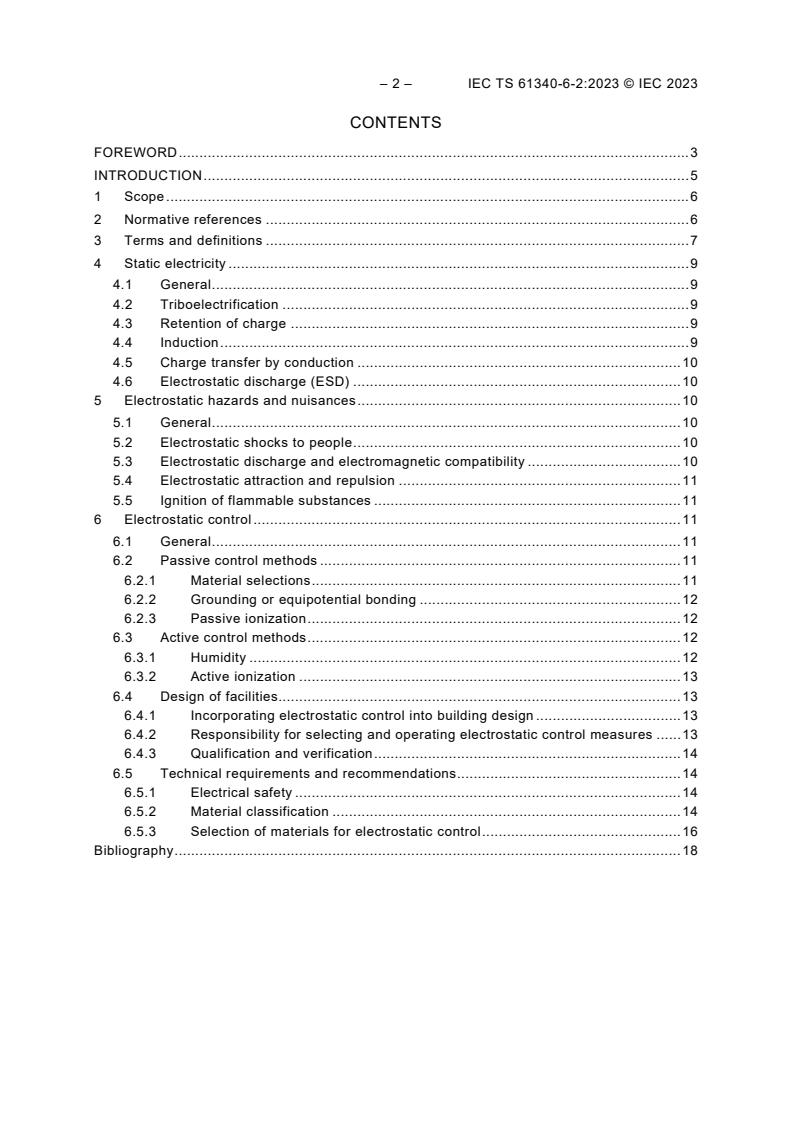
– 2 – IEC TS 61340-6-2:2023 © IEC 2023
CONTENTS
FOREWORD . 3
INTRODUCTION . 5
1 Scope . 6
2 Normative references . 6
3 Terms and definitions . 7
4 Static electricity . 9
4.1 General . 9
4.2 Triboelectrification . 9
4.3 Retention of charge . 9
4.4 Induction . 9
4.5 Charge transfer by conduction . 10
4.6 Electrostatic discharge (ESD) . 10
5 Electrostatic hazards and nuisances . 10
5.1 General . 10
5.2 Electrostatic shocks to people . 10
5.3 Electrostatic discharge and electromagnetic compatibility . 10
5.4 Electrostatic attraction and repulsion . 11
5.5 Ignition of flammable substances . 11
6 Electrostatic control . 11
6.1 General . 11
6.2 Passive control methods . 11
6.2.1 Material selections . 11
6.2.2 Grounding or equipotential bonding . 12
6.2.3 Passive ionization . 12
6.3 Active control methods . 12
6.3.1 Humidity . 12
6.3.2 Active ionization . 13
6.4 Design of facilities. 13
6.4.1 Incorporating electrostatic control into building design . 13
6.4.2 Responsibility for selecting and operating electrostatic control measures . 13
6.4.3 Qualification and verification . 14
6.5 Technical requirements and recommendations . 14
6.5.1 Electrical safety . 14
6.5.2 Material classification . 14
6.5.3 Selection of materials for electrostatic control . 16
Bibliography . 18
INTERNATIONAL ELECTROTECHNICAL COMMISSION
____________
ELECTROSTATICS –
Part 6-2: Electrostatic control in healthcare, commercial
and public facilities – Public spaces and office areas
FOREWORD
1) The International Electrotechnical Commission (IEC) is a worldwide organization for standardization comprising
all national electrotechnical committees (IEC National Committees). The object of IEC is to promote international
co-operation on all questions concerning standardization in the electrical and electronic fields. To this end and
in addition to other activities, IEC publishes International Standards, Technical Specifications, Technical Reports,
Publicly Available Specifications (PAS) and Guides (hereafter referred to as “IEC Publication(s)”). Their
preparation is entrusted to technical committees; any IEC National Committee interested in the subject dealt with
may participate in this preparatory work. International, governmental and non-governmental organizations liaising
with the IEC also participate in this preparation. IEC collaborates closely with the International Organization for
Standardization (ISO) in accordance with conditions determined by agreement between the two organizations.
2) The formal decisions or agreements of IEC on technical matters express, as nearly as possible, an international
consensus of opinion on the relevant subjects since each technical committee has representation from all
interested IEC National Committees.
3) IEC Publications have the form of recommendations for international use and are accepted by IEC National
Committees in that sense. While all reasonable efforts are made to ensure that the technical content of IEC
Publications is accurate, IEC cannot be held responsible for the way in which they are used or for any
misinterpretation by any end user.
4) In order to promote international uniformity, IEC National Committees undertake to apply IEC Publications
transparently to the maximum extent possible in their national and regional publications. Any divergence between
any IEC Publication and the corresponding national or regional publication shall be clearly indicated in the latter.
5) IEC itself does not provide any attestation of conformity. Independent certification bodies provide conformity
assessment services and, in some areas, access to IEC marks of conformity. IEC is not responsible for any
services carried out by independent certification bodies.
6) All users should ensure that they have the latest edition of this publication.
7) No liability shall attach to IEC or its directors, employees, servants or agents including individual experts and
members of its technical committees and IEC National Committees for any personal injury, property damage or
other damage of any nature whatsoever, whether direct or indirect, or for costs (including legal fees) and
expenses arising out of the publication, use of, or reliance upon, this IEC Publication or any other IEC
Publications.
8) Attention is drawn to the Normative references cited in this publication. Use of the referenced publications is
indispensable for the correct application of this publication.
9) IEC draws attention to the possibility that the implementation of this document may involve the use of (a)
patent(s). IEC takes no position concerning the evidence, validity or applicability of any claimed patent rights in
respect thereof. As of the date of publication of this document, IEC had not received notice of (a) patent(s), which
may be required to implement this document. However, implementers are cautioned that this may not represent
the latest information, which may be obtained from the patent database available at https://patents.iec.ch. IEC
shall not be held responsible for identifying any or all such patent rights.
IEC TS 61340-6-2 has been prepared by IEC technical committee 101: Electrostatics. It is a
Technical Specification.
The text of this Technical Specification is based on the following documents:
Draft Report on voting
101/682/DTS 101/695/RVDTS
Full information on the voting for its approval can be found in the report on voting indicated in
the above table.
The language used for the development of this Technical Specification is English.
– 4 – IEC TS 61340-6-2:2023 © IEC 2023
This document was drafted in accordance with ISO/IEC Directives, Part 2, and developed in
accordance with ISO/IEC Directives, Part 1 and ISO/IEC Directives, IEC Supplement, available
at www.iec.ch/members_experts/refdocs. The main document types developed by IEC are
described in greater detail at www.iec.ch/publications.
A list of all parts in the IEC 61340 series, published under the general title Electrostatics, can
be found on the IEC website.
The committee has decided that the contents of this document will remain unchanged until the
stability date indicated on the IEC website under webstore.iec.ch in the data related to the
specific document. At this date, the document will be
• reconfirmed,
• withdrawn,
• replaced by a revised edition, or
• amended.
INTRODUCTION
This document provides guidance on how to control static electricity in office areas and public
places. Static electricity can be the source of the following hazards and nuisances:
• electrostatic shocks to people;
• electromagnetic interference (EMI) or electrostatic discharge (ESD) disruption or damage
to electronic equipment, audiovisual systems, computers and mobile devices such as
telephones, tablet computers, laptop computers;
• contamination caused by electrostatic attraction (ESA) or electrostatic repulsion (ESR) of
airborne pathogens;
• ignition of flammable gases, vapours, liquids, aerosols, combustible flyings, powders and
dusts.
Adequate electrostatic control can eliminate these hazards and nuisances, or at least reduce
involved risk to tolerable levels. Electrostatic controls can be established in many different ways.
– 6 – IEC TS 61340-6-2:2023 © IEC 2023
ELECTROSTATICS –
Part 6-2: Electrostatic control in healthcare, commercial
and public facilities – Public spaces and office areas
1 Scope
This part of IEC 61340 applies to the interior design of public places, retail and office areas
such as, but not limited to staircases, offices, meeting rooms, auditoriums, airports, train
stations, shopping centres, restaurants and theatres. This document includes guidelines for
architects, interior designers and facility managers.
Hazards, nuisances and other problems associated with electrostatic phenomena and the
principles of their control are outlined. This document includes requirements and
recommendations for materials, and products used to control static electricity.
The handling of electrostatic sensitive components is described in IEC 61340-5-1 [1] and the
avoidance of hazards due to static electricity in explosive atmospheres is presented in
IEC TS 60079-32-1 [2]. The requirements for electrostatic control in healthcare facilities are
specified in IEC 61340-6-1 [3]. The guidance in this document is not intended to replace or
supersede the requirements of the aforementioned standards and technical specification, but
can be used in association with them to establish appropriate electrostatic control measures.
These guidelines do not replace or supersede any requirements for personnel safety specified
in other standards or codes of practice.
2 Normative references
The following documents are referred to in the text in such a way that some or all of their content
constitutes requirements of this document. For dated references, only the edition cited applies.
For undated references, the latest edition of the referenced document (including any
amendments) applies.
IEC 61340-2-1, Electrostatics – Part 2-1: Measurement methods – Ability of materials and
products to dissipate static electric charge
IEC 61340-2-3, Electrostatics – Part 2-3: Methods of test for determining the resistance and
resistivity of solid materials used to avoid electrostatic charge accumulation
IEC 61340-4-1, Electrostatics – Part 4-1: Standard test methods for specific applications –
Electrical resistance of floor coverings and installed floors
IEC 61340-4-5, Electrostatics – Part 4-5: Standard test methods for specific applications –
Methods for characterizing the electrostatic protection of footwear and flooring in combination
with a person
ISO 18080-2, Textiles – Test methods for evaluating the electrostatic propensity of fabrics –
Part 2: Test method using rotary mechanical friction
___________
Numbers in square brackets refer to the Bibliography.
ISO 18080-3, Textiles – Test methods for evaluating the electrostatic propensity of fabrics –
Part 3: Test method using manual friction
ISO 18080-4, Textiles – Test methods for evaluating the electrostatic propensity of fabrics –
Part 4: Test method using horizontal mechanical friction
EN 1149-3:2004, Protective clothing – Electrostatic properties – Part 3: Test methods for
measurement of charge decay
3 Terms and definitions
For the purposes of this document, the following terms and definitions apply.
ISO and IEC maintain terminology databases for use in standardization at the following
addresses:
• IEC Electropedia: available at https://www.electropedia.org/
• ISO Online browsing platform: available at https://www.iso.org/obp
3.1
acceptance testing
testing used to determine if systems or products meet specified requirements when installed or
before first use
Note 1 to entry: Acceptance testing can be the same as testing used for qualification or can be simpler testing more
appropriate for use in a facility rather than a controlled testing laboratory.
3.2
conductor
object providing a sufficiently high conductivity so that potential differences over any parts of it
are not sufficiently large as to be of practical significance
3.3
electromagnetic compatibility
EMC
ability of an equipment or system to function satisfactorily in its electromagnetic environment
without introducing intolerable electromagnetic disturbances to anything in that environment
3.4
electromagnetic interference
EMI
degradation of the performance of a device, equipment or system caused by an electromagnetic
disturbance
Note 1 to entry: Disturbance and interference are cause and effect respectively.
3.5
electrostatic attraction
ESA
effect of the force on charged or polarized particles caused by an electrostatic field
Note 1 to entry: The electrostatic force between oppositely charged objects or between charged objects and
polarized objects can cause the objects to move towards each other, which can result in the increased deposition of
particles onto charged surfaces.
3.6
electrostatic conductive material
material providing a sufficiently high conductivity so that potential differences over any parts of
it are not sufficiently large as to be of practical significance
– 8 – IEC TS 61340-6-2:2023 © IEC 2023
3.7
electrostatic discharge
ESD
transfer of electric charge between bodies of different electric potential in proximity or through
direct contact
3.8
electrostatic dissipative material
material which allows charge to migrate over its surface or through its volume, or both, in a time
that is short compared to the timescale of the actions creating the charge or that will cause an
electrostatic problem
3.9
electrostatic insulating material
material with very low mobility of charge so that any charge on the surface will remain there for
a long time
3.10
ESD ground
terminal used to connect parts to ground for ESD control purposes
Note 1 to entry: Protective earth or functional ground can be used as ESD ground.
Note 2 to entry: Equipment ground is one form of protective earth.
3.11
electrostatic repulsion
ESR
movement of charged particles away from objects charged to the same polarity
Note 1 to entry: Charged particles repelled from one surface can cause contamination of nearby surfaces.
3.12
functional ground
terminal used to connect parts to ground for reasons other than safety
Note 1 to entry: A functional ground can be a ground rod, stake or a separate wiring system that is bonded to the
AC ground at the main service panel.
Note 2 to entry: In the absence of a dedicated functional ground, a protective earth can be used as a functional
ground.
3.13
grounding
electrical connection of conductors, usually with ESD ground, to allow dissipation of charge and
eliminate the possibility of voltage build-up
Note 1 to entry: In this document grounding means either equipotential bonding or grounding.
Note 2 to entry: In this document ground and grounding are synonymous with earth and earthing.
3.14
isolated conductor
non-grounded conductor
3.15
low charging material
material with a tendency to minimize charge generation when contacting and rubbing against
other materials
Note 1 to entry: As contact electrification and triboelectric charging are dependent on the nature of both contacting
surfaces and the local environment, materials qualified as low charging under specific test conditions are not
necessarily low charging under all possible conditions.
Note 2 to entry: Low charging material pairs are generally electrostatic conductive, electrostatic dissipative or
slowly dissipative materials.
3.16
protective earth
terminal used to connect parts to earth for safety reasons
Note 1 to entry: Protective earth is also known as equipment grounding conductor.
3.17
qualification
process of evaluating test data or system or product data sheets to ensure that systems,
materials or finished products meet specified requirements
3.18
slowly dissipative material
material with a tendency to dissipate charge faster than an electrostatic insulating material but
slower than an electrostatic dissipative material
Note 1 to entry: Slowly dissipative materials, in general, have a tendency to minimize charge generation when
contacting and rubbing against other materials.
4 Static electricity
4.1 General
Electrostatic charge generation, charge transfer and electrostatic discharge are briefly
described in this document. The fundamental principles of electrostatic phenomena including
charge generation, retention and dissipation, and electrostatic discharges are explained in more
detail in IEC TR 61340-1 [4].
4.2 Triboelectrification
All materials have positive and negative charges in their atoms. When two materials touch,
charge is transferred from one material to the other at the points of contact. When they separate,
a net positive charge remains on one surface and a net negative charge remains on the other
surface. The quantity of charge is increased by the separation velocity and the size of the
contact area. The size of the contact area is affected by contact pressure. Additional rubbing
also increases the effective contact area. Substances subject to triboelectrification can be
solid/solid, liquid/liquid, and solid/liquid. Such solids include dust, and the liquids include mists.
4.3 Retention of charge
After separation in the charging process, electrostatic charges will re-combine either directly or
via earth unless they are prevented from doing so. If charge is on an electrostatic insulating
material, it is retained by virtue of the resistance of the material itself. To retain charge on an
electrostatic conductive or electrostatic dissipative material it shall be isolated from other
electrostatic conductive or electrostatic dissipative materials and from earth.
4.4 Induction
There are electric fields and electrostatic forces around charged objects. A conductor or
electrostatic dissipative material introduced into this field changes the distribution of the electric
field in its vicinity and at the same time there is a redistribution of charges in the material under
the influence of the field, which creates an electric potential (voltage) on the material.
– 10 – IEC TS 61340-6-2:2023 © IEC 2023
4.5 Charge transfer by conduction
Whenever an electrostatic conductive or electrostatic dissipative object touches another
electrostatic conductive or electrostatic dissipative object, the total charge is shared between
them. If the potential difference between the two objects is large enough, an electrostatic
discharge (see 4.6) can occur, which can transfer charge between the objects without physical
contact occurring.
4.6 Electrostatic discharge (ESD)
An electrostatic discharge (ESD) occurs when two objects at different voltages either touch, or
approach close enough for the breakdown field strength to be exceeded between them.
A typical example of an ESD is a discharge between a person’s finger and a metal handle.
5 Electrostatic hazards and nuisances
5.1 General
The use of synthetic materials such as electrostatic insulating polymers has increased
incidences of electrostatic hazards and nuisances during recent decades. Floorings, furnishings
and textiles are often made of electrostatic insulating polymers.
Commonly used synthetic materials can result in triboelectrification or charging by induction,
and charge accumulation causing electrostatic hazards.
Combinations of electrostatic insulating materials and conductors (e.g. metals) can create
isolated conductors that can accumulate charge and create electrostatic hazards.
5.2 Electrostatic shocks to people
The most unpleasant electrostatic shocks to people occur typically in indoor areas when the
outdoor temperature is low and heating decreases indoor relative humidity. Other conditions
that lower the relative humidity of the environment can also increase the occurrence of
electrostatic shocks.
ESD is typically characterized as an annoying phenomenon, but the discharge energy can also
be high enough to cause painful sensations. The discharge to or from the human body is
generally not considered dangerous, although it can result in involuntary movements, which can
lead to accidents.
The risk of electrostatic shock can be reduced to tolerable levels by choice of materials,
grounding of electrostatic conductive or electrostatic dissipative objects such as mobile
equipment and personnel, or by active control measures.
NOTE Electrostat
...