


IEC 60851-5:1996/AMD1:1997
(Amendment)Amendment 1 - Methods of test for winding wires - Part 5: Electrical properties
General Information
- Abstract
- Status
- Published
- Publication Date
- 05-Mar-1997
- Technical Committee
- TC 55 - Winding wires
- Drafting Committee
- WG 1 - TC 55/WG 1
- Current Stage
- DELPUB - Deleted Publication
- Start Date
- 25-Jul-2008
- Completion Date
- 28-Aug-2026

Relations
- Effective Date
- 05-Sep-2023
- Effective Date
- 05-Sep-2023
Get Certified
Connect with accredited certification bodies for this standard

IMQ S.p.A. (Certification)
Italian electrical product certification.

SLG Prüf- und Zertifizierungs GmbH
German testing and certification body.

UL Solutions
Global safety science company with testing, inspection and certification.
Sponsored listings
Frequently Asked Questions
IEC 60851-5:1996/AMD1:1997 is a standard published by the International Electrotechnical Commission (IEC). Its full title is "Amendment 1 - Methods of test for winding wires - Part 5: Electrical properties". This standard covers: Amendment 1 - Methods of test for winding wires - Part 5: Electrical properties
Amendment 1 - Methods of test for winding wires - Part 5: Electrical properties
IEC 60851-5:1996/AMD1:1997 is classified under the following ICS (International Classification for Standards) categories: 29.060.10 - Wires. The ICS classification helps identify the subject area and facilitates finding related standards.
IEC 60851-5:1996/AMD1:1997 has the following relationships with other standards: It is inter standard links to IEC 60851-5:1996, IEC 60851-5:2008. Understanding these relationships helps ensure you are using the most current and applicable version of the standard.
IEC 60851-5:1996/AMD1:1997 is available in PDF format for immediate download after purchase. The document can be added to your cart and obtained through the secure checkout process. Digital delivery ensures instant access to the complete standard document.
Standards Content (Sample)
NORME
CEI
INTERNATIONALE
IEC
851-5
INTERNATIONAL
STANDARD
AMENDEMENT 1
AMENDMENT 1
1997-03
Amendement 1
Fils de bobinage – Méthodes d'essai –
Partie 5:
Propriétés électriques
Amendment 1
Winding wires – Test methods –
Part 5:
Electrical properties
IEC 1997 Droits de reproduction réservés Copyright - all rights reserved
International Electrotechnical Commission 3, rue de Varembé Geneva, Switzerland
Telefax: +41 22 919 0300 e-mail: inmail@iec.ch IEC web site http: //www.iec.ch
CODE PRIX
Commission Electrotechnique Internationale
PRICE CODE B
International Electrotechnical Commission
Pour prix, voir catalogue en vigueur
For price, see current catalogue
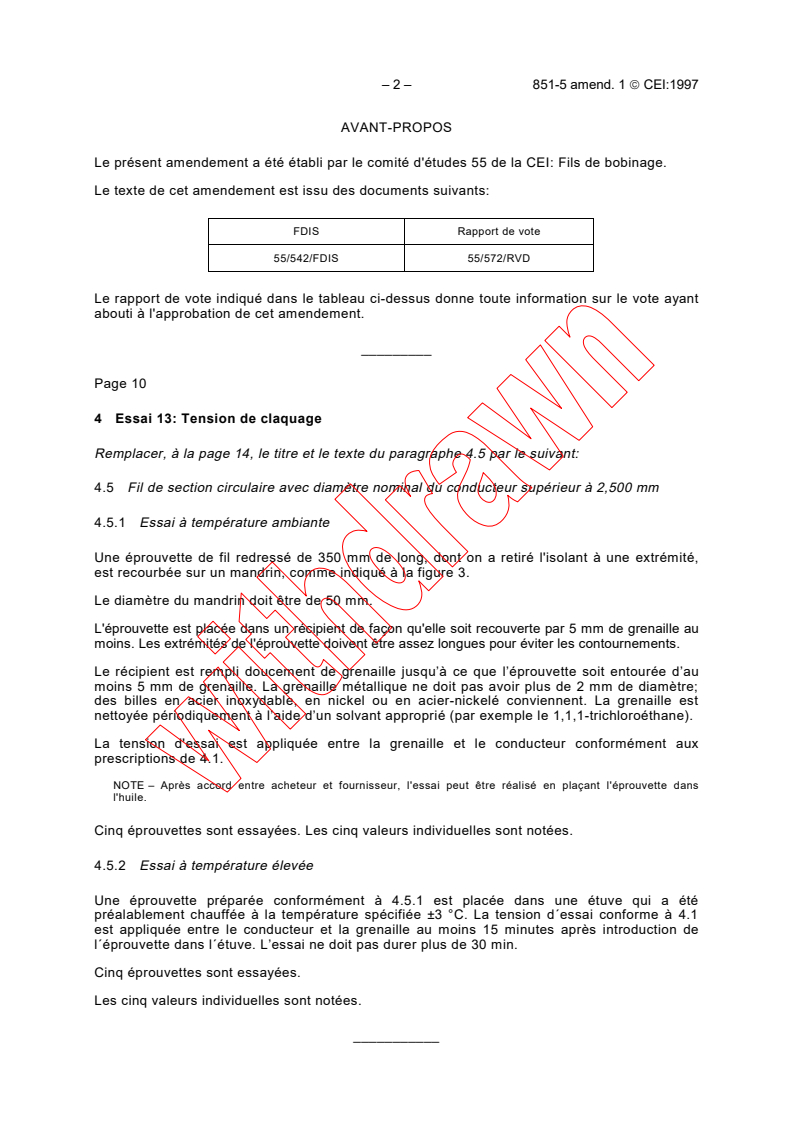
– 2 – 851-5 amend. 1 CEI:1997
AVANT-PROPOS
Le présent amendement a été établi par le comité d'études 55 de la CEI: Fils de bobinage.
Le texte de cet amendement est issu des documents suivants:
FDIS Rapport de vote
55/542/FDIS 55/572/RVD
Le rapport de vote indiqué dans le tableau ci-dessus donne toute information sur le vote ayant
abouti à l'approbation de cet amendement.
_________
Page 10
4 Essai 13: Tension de claquage
Remplacer, à la page 14, le titre et le texte du paragraphe 4.5 par le suivant:
4.5 Fil de section circulaire avec diamètre nominal du conducteur supérieur à 2,500 mm
4.5.1 Essai à température ambiante
Une éprouvette de fil redressé de 350 mm de long, dont on a retiré l'isolant à une extrémité,
est recourbée sur un mandrin, comme indiqué à la figure 3.
Le diamètre du mandrin doit être de 50 mm.
L'éprouvette est placée dans un récipient de façon qu'elle soit recouverte par 5 mm de grenaille au
moins. Les extrémités de l'éprouvette doivent être assez longues pour éviter les contournements.
Le récipient est rempli doucement de grenaille jusqu’à ce que l’éprouvette soit entourée d’au
moins 5 mm de grenaille. La grenaille métallique ne doit pas avoir plus de 2 mm de diamètre;
des billes en acier inoxydable, en nickel ou en acier-nickelé conviennent. La grenaille est
nettoyée périodiquement à l’aide d’un solvant approprié (par exemple le 1,1,1-trichloroéthane).
La tension d'essai est appliquée entre la grenaille et le conducteur conformément aux
prescriptions de 4.1.
NOTE – Après accord entre acheteur et fournisseur, l'essai peut être réalisé en plaçant l'éprouvette dans
l'huile.
Cinq éprouvettes sont essayées. Les cinq valeurs individuelles sont notées.
4.5.2 Essai à température élevée
Une éprouvette préparée conformément à 4.5.1 est placée dans une étuve qui a été
préalablement chauffée à
...