

IEC TS 61496-4-3:2015
(Main)Safety of machinery - Electro-sensitive protective equipment - Part 4-3: Particular requirements for equipment using vision based protective devices (VBPD) - Additional requirements when using stereo vision techniques (VBPDST)
General Information
- Abstract
IEC TS 61496-4-3:2015(E) specifies requirements for the design, construction and testing of electro-sensitive protective equipment (ESPE) designed specifically to detect persons or parts of persons as part of a safety-related system, employing vision-based protective devices (VBPDs) using stereo vision techniques (VBPDST) for the sensing function. Special attention is directed to features which ensure that an appropriate safety-related performance is achieved.
This publication is to be read in conjunction with IEC 61496-1:2012.
- Status
- Published
- Publication Date
- 18-May-2015
- Technical Committee
- TC 44 - Safety of machinery - Electrotechnical aspects
- Drafting Committee
- MT 61496-4 - TC 44/MT 61496-4
- Current Stage
- DELPUB - Deleted Publication
- Start Date
- 28-Sep-2022
- Completion Date
- 30-Nov-2018
Buy Documents

IEC TS 61496-4-3:2015 - Safety of machinery - Electro-sensitive protective equipment - Part 4-3: Particular requirements for equipment using vision based protective devices (VBPD) - Additional requirements when using stereo vision techniques (VBPDST)


IEC TS 61496-4-3:2015 - Safety of machinery - Electro-sensitive protective equipment - Part 4-3: Particular requirements for equipment using vision based protective devices (VBPD) - Additional requirements when using stereo vision techniques (VBPDST) Released:5/19/2015
Overview
IEC TS 61496-4-3:2015 - "Safety of machinery - Electro-sensitive protective equipment - Part 4-3" - sets out particular requirements for electro-sensitive protective equipment (ESPE) that use vision-based protective devices (VBPDs) employing stereo vision techniques (VBPDST). The Technical Specification focuses on the design, construction and testing of VBPDST intended to detect persons or parts of persons as part of a safety-related system, with special attention to achieving appropriate safety-related performance. It is intended to be read in conjunction with IEC 61496-1:2012.
Key topics and technical requirements
- Sensing function and detection capability: requirements for how stereo vision systems detect human body parts and form detection zones (including volume-based zones).
- Types of ESPE and performance levels: classification and expected behavior under normal and fault conditions.
- Design requirements: fault detection, integrity of VBPDST detection capability, mechanical construction, wavelength and radiation intensity considerations.
- Environmental and interference requirements: ambient temperature, humidity, ambient light intensity, light and pollution interference, manual interference and optical occlusion.
- Testing and verification: type testing, functional tests, performance under fault conditions, environmental tests, and verification of optical performance (test pieces, test plans and test conditions).
- Tolerance zones and distance calculations: methods for calculating minimum distances and tolerance zones (annexes provide calculation examples and guidance).
- Documentation and marking: required marking for safe use and accompanying documents for installation and maintenance.
- Normative and informative annexes: include optional functions, catalogue of single faults, examples for positioning and probability of detection, and physics principles relevant for contrast and imaging.
Practical applications and users
Who uses IEC TS 61496-4-3:2015:
- Machine builders and integrators deploying vision-based safety systems (robot cells, automated manufacturing, material handling).
- Safety engineers and functional safety assessors specifying ESPE for personnel protection.
- Test labs and certification bodies performing type testing and conformity assessment of VBPDST.
- Component and system designers of stereo vision safety devices ensuring compliance with industry standards.
Practical uses:
- Designing, validating and commissioning stereo vision safety devices for presence detection at guarded openings, access zones and hazardous machine areas.
- Developing test plans to verify detection capability, immunity to optical interference and environmental robustness.
- Determining minimum safe distances and tolerance zones to support safe installation and risk reduction.
Related standards
- IEC 61496-1:2012 - general requirements for electro-sensitive protective equipment (to be read alongside this TS).
- Other IEC/ISO standards on machine safety and functional safety may be relevant when integrating VBPDST into complete safety systems.
Keywords: IEC TS 61496-4-3:2015, electro-sensitive protective equipment, ESPE, vision based protective devices, VBPD, stereo vision, VBPDST, safety of machinery, detection zone, tolerance zone, type testing, light interference.
Relations
- Effective Date
- 05-Sep-2023
Buy Documents
IEC TS 61496-4-3:2015 - Safety of machinery - Electro-sensitive protective equipment - Part 4-3: Particular requirements for equipment using vision based protective devices (VBPD) - Additional requirements when using stereo vision techniques (VBPDST)
IEC TS 61496-4-3:2015 - Safety of machinery - Electro-sensitive protective equipment - Part 4-3: Particular requirements for equipment using vision based protective devices (VBPD) - Additional requirements when using stereo vision techniques (VBPDST) Released:5/19/2015
Get Certified
Connect with accredited certification bodies for this standard

IMQ S.p.A. (Certification)
Italian electrical product certification.

SLG Prüf- und Zertifizierungs GmbH
German testing and certification body.

UL Solutions
Global safety science company with testing, inspection and certification.
Sponsored listings
Frequently Asked Questions
IEC TS 61496-4-3:2015 is a technical specification published by the International Electrotechnical Commission (IEC). Its full title is "Safety of machinery - Electro-sensitive protective equipment - Part 4-3: Particular requirements for equipment using vision based protective devices (VBPD) - Additional requirements when using stereo vision techniques (VBPDST)". This standard covers: IEC TS 61496-4-3:2015(E) specifies requirements for the design, construction and testing of electro-sensitive protective equipment (ESPE) designed specifically to detect persons or parts of persons as part of a safety-related system, employing vision-based protective devices (VBPDs) using stereo vision techniques (VBPDST) for the sensing function. Special attention is directed to features which ensure that an appropriate safety-related performance is achieved. This publication is to be read in conjunction with IEC 61496-1:2012.
IEC TS 61496-4-3:2015(E) specifies requirements for the design, construction and testing of electro-sensitive protective equipment (ESPE) designed specifically to detect persons or parts of persons as part of a safety-related system, employing vision-based protective devices (VBPDs) using stereo vision techniques (VBPDST) for the sensing function. Special attention is directed to features which ensure that an appropriate safety-related performance is achieved. This publication is to be read in conjunction with IEC 61496-1:2012.
IEC TS 61496-4-3:2015 is classified under the following ICS (International Classification for Standards) categories: 13.110 - Safety of machinery; 29.260.99 - Other electrical equipment for working in special conditions. The ICS classification helps identify the subject area and facilitates finding related standards.
IEC TS 61496-4-3:2015 has the following relationships with other standards: It is inter standard links to IEC TS 61496-4-3:2022. Understanding these relationships helps ensure you are using the most current and applicable version of the standard.
IEC TS 61496-4-3:2015 is available in PDF format for immediate download after purchase. The document can be added to your cart and obtained through the secure checkout process. Digital delivery ensures instant access to the complete standard document.
Standards Content (Sample)
IEC TS 61496-4-3 ®
Edition 1.0 2015-05
TECHNICAL
SPECIFICATION
colour
inside
Safety of machinery – Electro-sensitive protective equipment –
Part 4-3: Particular requirements for equipment using vision based protective
devices (VBPD) – Additional requirements when using stereo vision techniques
(VBPDST)
All rights reserved. Unless otherwise specified, no part of this publication may be reproduced or utilized in any form
or by any means, electronic or mechanical, including photocopying and microfilm, without permission in writing from
either IEC or IEC's member National Committee in the country of the requester. If you have any questions about IEC
copyright or have an enquiry about obtaining additional rights to this publication, please contact the address below or
your local IEC member National Committee for further information.
IEC Central Office Tel.: +41 22 919 02 11
3, rue de Varembé Fax: +41 22 919 03 00
CH-1211 Geneva 20 info@iec.ch
Switzerland www.iec.ch
About the IEC
The International Electrotechnical Commission (IEC) is the leading global organization that prepares and publishes
International Standards for all electrical, electronic and related technologies.
About IEC publications
The technical content of IEC publications is kept under constant review by the IEC. Please make sure that you have the
latest edition, a corrigenda or an amendment might have been published.
IEC Catalogue - webstore.iec.ch/catalogue Electropedia - www.electropedia.org
The stand-alone application for consulting the entire The world's leading online dictionary of electronic and
bibliographical information on IEC International Standards, electrical terms containing more than 30 000 terms and
Technical Specifications, Technical Reports and other definitions in English and French, with equivalent terms in 15
documents. Available for PC, Mac OS, Android Tablets and additional languages. Also known as the International
iPad. Electrotechnical Vocabulary (IEV) online.
IEC publications search - www.iec.ch/searchpub IEC Glossary - std.iec.ch/glossary
The advanced search enables to find IEC publications by a More than 60 000 electrotechnical terminology entries in
variety of criteria (reference number, text, technical English and French extracted from the Terms and Definitions
committee,…). It also gives information on projects, replaced clause of IEC publications issued since 2002. Some entries
and withdrawn publications. have been collected from earlier publications of IEC TC 37,
77, 86 and CISPR.
IEC Just Published - webstore.iec.ch/justpublished
Stay up to date on all new IEC publications. Just Published IEC Customer Service Centre - webstore.iec.ch/csc
details all new publications released. Available online and If you wish to give us your feedback on this publication or
also once a month by email. need further assistance, please contact the Customer Service
Centre: csc@iec.ch.
IEC TS 61496-4-3 ®
Edition 1.0 2015-05
TECHNICAL
SPECIFICATION
colour
inside
Safety of machinery – Electro-sensitive protective equipment –
Part 4-3: Particular requirements for equipment using vision based protective
devices (VBPD) – Additional requirements when using stereo vision techniques
(VBPDST)
INTERNATIONAL
ELECTROTECHNICAL
COMMISSION
ICS 13.110; 29.260.99 ISBN 978-2-8322-2611-7
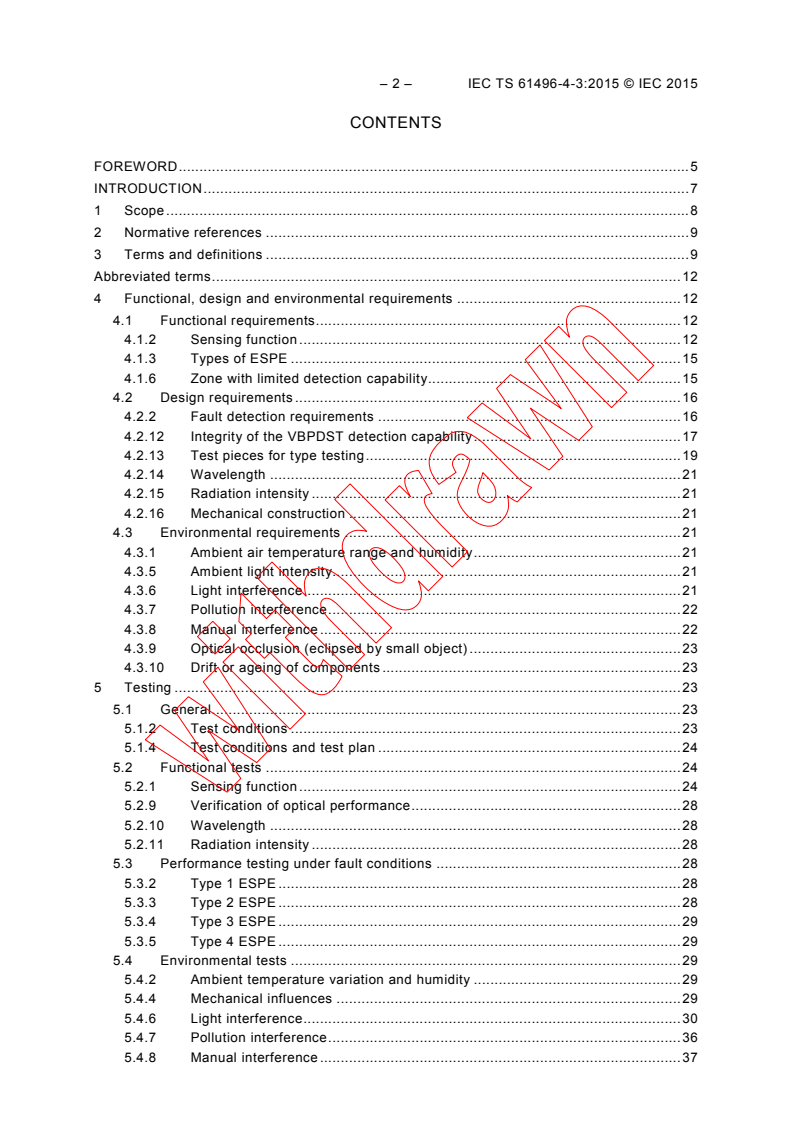
– 2 – IEC TS 61496-4-3:2015 © IEC 2015
CONTENTS
FOREWORD . 5
INTRODUCTION . 7
1 Scope . 8
2 Normative references . 9
3 Terms and definitions . 9
Abbreviated terms . 12
4 Functional, design and environmental requirements . 12
4.1 Functional requirements . 12
4.1.2 Sensing function . 12
4.1.3 Types of ESPE . 15
4.1.6 Zone with limited detection capability . 15
4.2 Design requirements . 16
4.2.2 Fault detection requirements . 16
4.2.12 Integrity of the VBPDST detection capability . 17
4.2.13 Test pieces for type testing . 19
4.2.14 Wavelength . 21
4.2.15 Radiation intensity . 21
4.2.16 Mechanical construction . 21
4.3 Environmental requirements . 21
4.3.1 Ambient air temperature range and humidity . 21
4.3.5 Ambient light intensity. 21
4.3.6 Light interference . 21
4.3.7 Pollution interference . 22
4.3.8 Manual interference . 22
4.3.9 Optical occlusion (eclipsed by small object) . 23
4.3.10 Drift or ageing of components . 23
5 Testing . 23
5.1 General . 23
5.1.2 Test conditions . 23
5.1.4 Test conditions and test plan . 24
5.2 Functional tests . 24
5.2.1 Sensing function . 24
5.2.9 Verification of optical performance . 28
5.2.10 Wavelength . 28
5.2.11 Radiation intensity . 28
5.3 Performance testing under fault conditions . 28
5.3.2 Type 1 ESPE . 28
5.3.3 Type 2 ESPE . 28
5.3.4 Type 3 ESPE . 29
5.3.5 Type 4 ESPE . 29
5.4 Environmental tests . 29
5.4.2 Ambient temperature variation and humidity . 29
5.4.4 Mechanical influences . 29
5.4.6 Light interference . 30
5.4.7 Pollution interference . 36
5.4.8 Manual interference . 37
5.4.9 Optical occlusion . 37
6 Marking for identification and for safe use . 38
6.1 General . 38
7 Accompanying documents . 38
Annex A (normative) Optional functions of the ESPE . 40
A.9 Setting the detection zone and/or other safety-related parameters . 40
A.9.1 Functional requirements . 40
A.9.2 Verification . 40
A.10 Selection of multiple detection zones . 41
A.10.1 Functional requirements . 41
A.10.2 Verification . 41
Annex B (normative) Catalogue of single faults affecting the electrical equipment of
the ESPE, to be applied as specified in 5.3 . 42
B.7 Imaging sensor . 42
Annex AA (informative) The positioning of VBPDST employing a volume as a
detection zone in respect of parts of the human body . 43
AA.1 Calculation of distances for electro-sensitive protective equipment employing
vision based protective devices (VBPDST) . 43
AA.1.1 General . 43
AA.1.2 Calculation of the overall minimum distance S . 43
o
AA.1.3 Vision based protective devices with a detection capability > 40 mm and
≤ 55 mm . 44
AA.1.4 Vision based protective devices with a detection capability > 55 mm and
≤ 200 mm . 45
AA.1.5 Examples of detection zone and tolerance zone . 45
AA.2 Application examples for body detection of a VBPDST employing a volume
as a detection zone . 49
Annex BB (informative) Relationship between position accuracy and tolerance zones
for VBPDST . 51
BB.1 Probability of detection . 51
BB.2 Tolerance zone related to probability . 52
BB.3 Determination of tolerance zone for systems not providing object distance
information . 52
BB.4 Determination of tolerance zone for systems providing distance information . 53
BB.5 Tolerance zone related to systematic interferences . 54
BB.6 Adding the tolerance zone on the outer border of the detection zone . 54
Annex CC (informative) Basic principles of physics for contrast of convex
homogeneous bodies . 56
CC.1 Illumination on a surface element . 56
CC.2 Brightness of a surface element . 58
Bibliography . 63
Figure 1 – Image planes in imaging device of a VBPDST . 10
Figure 2 – 3D view of a vision based protective device using stereo vision techniques
(VBPDST) . 13
Figure 3 – 2D view of a vision based protective device using stereo vision techniques
(VBPDST) . 14
Figure 4 – Examples for periodic surface structures on the background . 28
Figure 5 – Test setup for indirect light interference on the background. 34
– 4 – IEC TS 61496-4-3:2015 © IEC 2015
Figure 6 – Test setup for VBPDST of identical design with PAPT . 35
Figure 7 – Test setup for direct light interference on the sensing device . 36
Figure AA.1 – Minimum distance S – Example 1 . 45
Figure AA.2 – Overall minimum distance S without tolerance zone – Example 1 . 46
o
Figure AA.3 – Overall minimum distance S including tolerance zone – Example 1 . 46
o
Figure AA.4 – Minimum distance S – Example 2 . 47
Figure AA.5 – Overall minimum distance S without tolerance zone – Example 2 . 48
o
Figure AA.6 – Overall minimum distance S including tolerance zone – Example 2 . 48
o
Figure AA.7 – Application example for body detection of a VBPDST employing a
volume as a detection zone . 50
Figure BB.1 – Relationship between test piece position and the probability of detection . 51
Figure BB.2 – Example for measurement of the probability of detection . 52
Figure BB.3 – Relationship between detection zone and tolerance zone . 54
Figure BB.4 – Overall minimum distance S including tolerance zone . 55
o
Figure CC.1 – Illumination model – Sphere illuminated by a point source . 57
Figure CC.2 – Illumination model – Sphere illuminated by a half-Ulbricht sphere . 57
Figure CC.3 – Brightness of a surface element of a sphere in spherical coordinates . 58
Figure CC.4 – Brightness distribution in an image of a sphere . 58
Figure CC.5 – Grey value profile over a sphere with low contrast for a typical imaging
contrast (Modulation Transfer Function) . 59
Figure CC.6 – Grey value profile over a sphere with the same colour as the
background . 59
Figure CC.7 – Grey value profile over a sphere in front of a background that is half as
bright . 60
Figure CC.8 – Grey value profile over a sphere in front of a background that is twice as
bright . 60
Figure CC.9 – Grey value profile over a sphere by low contrast . 61
Figure CC.10 – Grey value profile over the sphere from Figure CC.9 but with the
direction to the imaging device changed by 10° . 61
Figure CC.11 – Grey value profile over a small sphere that results in an image that is 5
pixels in diameter . 62
Table 1 – Verification of detection capability requirements (see also 4.2.12) . 25
Table 2 – Overview of light interference tests. 30
INTERNATIONAL ELECTROTECHNICAL COMMISSION
____________
SAFETY OF MACHINERY –
ELECTRO-SENSITIVE PROTECTIVE EQUIPMENT –
Part 4-3: Particular requirements for equipment using
vision based protective devices (VBPD) –
Additional requirements when using stereo
vision techniques (VBPDST)
FOREWORD
1) The International Electrotechnical Commission (IEC) is a worldwide organization for standardization comprising
all national electrotechnical committees (IEC National Committees). The object of IEC is to promote
international co-operation on all questions concerning standardization in the electrical and electronic fields. To
this end and in addition to other activities, IEC publishes International Standards, Technical Specifications,
Technical Reports, Publicly Available Specifications (PAS) and Guides (hereafter referred to as “IEC
Publication(s)”). Their preparation is entrusted to technical committees; any IEC National Committee interested
in the subject dealt with may participate in this preparatory work. International, governmental and non-
governmental organizations liaising with the IEC also participate in this preparation. IEC collaborates closely
with the International Organization for Standardization (ISO) in accordance with conditions determined by
agreement between the two organizations.
2) The formal decisions or agreements of IEC on technical matters express, as nearly as possible, an international
consensus of opinion on the relevant subjects since each technical committee has representation from all
interested IEC National Committees.
3) IEC Publications have the form of recommendations for international use and are accepted by IEC National
Committees in that sense. While all reasonable efforts are made to ensure that the technical content of IEC
Publications is accurate, IEC cannot be held responsible for the way in which they are used or for any
misinterpretation by any end user.
4) In order to promote international uniformity, IEC National Committees undertake to apply IEC Publications
transparently to the maximum extent possible in their national and regional publications. Any divergence
between any IEC Publication and the corresponding national or regional publication shall be clearly indicated in
the latter.
5) IEC itself does not provide any attestation of conformity. Independent certification bodies provide conformity
assessment services and, in some areas, access to IEC marks of conformity. IEC is not responsible for any
services carried out by independent certification bodies.
6) All users should ensure that they have the latest edition of this publication.
7) No liability shall attach to IEC or its directors, employees, servants or agents including individual experts and
members of its technical committees and IEC National Committees for any personal injury, property damage or
other damage of any nature whatsoever, whether direct or indirect, or for costs (including legal fees) and
expenses arising out of the publication, use of, or reliance upon, this IEC Publication or any other IEC
Publications.
8) Attention is drawn to the Normative references cited in this publication. Use of the referenced publications is
indispensable for the correct application of this publication.
9) Attention is drawn to the possibility that some of the elements of this IEC Publication may be the subject of
patent rights. IEC shall not be held responsible for identifying any or all such patent rights.
The main task of IEC technical committees is to prepare International Standards. In
exceptional circumstances, a technical committee may propose the publication of a technical
specification when
• the required support cannot be obtained for the publication of an International Standard,
despite repeated efforts, or
• the subject is still under technical development or where, for any other reason, there is the
future but no immediate possibility of an agreement on an International Standard.
Technical specifications are subject to review within three years of publication to decide
whether they can be transformed into International Standards.
– 6 – IEC TS 61496-4-3:2015 © IEC 2015
IEC TS 61496-4-3, which is a technical specification, has been prepared by IEC technical
committee 44: Safety of machinery – Electrotechnical aspects.
The text of this technical specification is based on the following documents:
Enquiry draft Report on voting
44/711/DTS 44/722/RVC
Full information on the voting for the approval of this technical specification can be found in
the report on voting indicated in the above table.
This publication has been drafted in accordance with the ISO/IEC Directives, Part 2.
This part is to be used in conjunction with IEC 61496-1:2012.
This part supplements or modifies the corresponding clauses in IEC 61496-1:2012 to specify
particular requirements for the design, construction and testing of electro-sensitive protective
equipment (ESPE) for the safeguarding of machinery, employing vision based protective
devices (VBPD) using stereo vision techniques (VBPDST) for the sensing function.
Where a particular clause or subclause of Part 1 is not mentioned in this Part 4-3, that clause
or subclause applies as far as is reasonable. Where this part states "addition", "modification"
or "replacement", the relevant text of Part 1 shall be adapted accordingly.
Clauses and subclauses which are additional to those of Part 1 are numbered sequentially,
following on the last available number in Part 1.Terminological entries (in Clause 3) which are
additional to those in Part 1 are numbered starting from 3.4301. Additional annexes are
lettered from AA onwards.
A list of all parts in the IEC 61496 series, published under the general title Safety of
machinery – Electro-sensitive protective equipment, can be found on the IEC website.
The committee has decided that the contents of this publication will remain unchanged until
the stability date indicated on the IEC web site under "http://webstore.iec.ch" in the data
related to the specific publication. At this date, the publication will be
• transformed into an International standard,
• reconfirmed,
• withdrawn,
• replaced by a revised edition, or
• amended.
A bilingual version of this publication may be issued at a later date.
IMPORTANT – The 'colour inside' logo on the cover page of this publication indicates
that it contains colours which are considered to be useful for the correct
understanding of its contents. Users should therefore print this document using a
colour printer.
INTRODUCTION
An electro-sensitive protective equipment (ESPE) is applied to machinery presenting a risk of
personal injury. It provides protection by causing the machine to revert to a safe condition
before a person can be placed in a hazardous situation.
The working group responsible for drafting this technical specification was concerned that,
due to the complexity of the technology, there are many issues that are highly dependent on
analysis and expertise in specific test and measurement techniques. In order to provide a high
level of confidence, independent review by relevant expertise is required. They considered
that if this high level of confidence could not be established these devices would not be
suitable for use in safety related applications.
– 8 – IEC TS 61496-4-3:2015 © IEC 2015
SAFETY OF MACHINERY –
ELECTRO-SENSITIVE PROTECTIVE EQUIPMENT –
Part 4-3: Particular requirements for equipment using
vision based protective devices (VBPD) –
Additional requirements when using stereo
vision techniques (VBPDST)
1 Scope
Replacement:
This part of IEC 61496 specifies requirements for the design, construction and testing of
electro-sensitive protective equipment (ESPE) designed specifically to detect persons or parts
of persons as part of a safety-related system, employing vision-based protective devices
(VBPDs) using stereo vision techniques (VBPDST) for the sensing function. Special attention
is directed to features which ensure that an appropriate safety-related performance is
achieved. An ESPE may include optional safety-related functions, the requirements for which
are given in Annex A of IEC 61496-1:2012 and this Technical Specification.
This part of IEC 61496 does not specify the dimensions or configurations of the detection
zone and its disposition in relation to hazardous parts for any particular application, nor what
constitutes a hazardous state of any machine. It is restricted to the functioning of the ESPE
and how it interfaces with the machine.
The detection principle is based on the evaluation of images from different viewing points
(stereoscopic view) for the determination of distance information. This distance information is
used to determine the location of an object(s).
– This part of IEC 61496 is limited to vision based ESPEs with distances (stereo base) and
directions between the different imaging devices fixed during manufacture.
– It is limited to vision based ESPEs, with a minimum distance from the sensing device to
the detection zone of 4 times of the stereo base.
– It is limited to vision based ESPEs that can detect objects with at least 5 pixel diameter in
the image plane.
– It is limited to vision based ESPEs that do not require human intervention for detection.
– It is limited to vision based ESPEs that detect objects entering into or being present in a
detection zone(s).
– It is limited to VBPDSTs employing radiation at wavelengths within the range 400 nm to
1 500 nm.
– This part of IEC 61496 does not address those aspects required for complex classification
or differentiation of the object detected.
– This part of IEC 61496 does not consider the aspects of a moving ESPE installation.
Additional requirements and tests can apply in the following cases:
– Use of multi-spectral (colour) techniques;
– Setups other than as shown in Figures of 4.1.2 (e.g. changing backgrounds, horizontal
orientation of the optical axis with respect to the floor);
– Intended for outdoor applications.
This technical specification is relevant for VBPDSTs having a stated detection capability up to
200 mm.
This technical specification may be relevant to applications other than those for the protection
of persons or parts of persons like arm or fingers (in the range 14 mm to 200 mm), for
example the protection of machinery or products from mechanical damage. In those
applications, additional requirements can be necessary, for example when the materials that
are to be recognized by the sensing function have different properties from those of persons.
This technical specification does not deal with EMC emission requirements.
2 Normative references
Addition:
IEC 60825-1:2014, Safety of laser products – Part 1 – Equipment classification and
requirements
IEC 61496-1:2012, Safety of machinery – Electro-sensitive protective equipment – Part 1:
General requirements and tests
IEC 62471, Photobiological safety of lamps and lamp systems
ISO 13855:2010, Safety of machinery – Positioning of safeguards with respect to the
approach speeds of parts of the human body
ISO 20471, High visibility clothing – Test methods and requirements
3 Terms and definitions
Replacement:
3.3
detection capability
ability to detect the specified test pieces (see 4.2.13) in the specified detection zone
Note 1 to entry: Detection capability is measured by the size of an object that can be detected. An increase in
detection capability means that a smaller object can be detected.
[SOURCE: IEC 61496-1:2012, 3.3, modified – text changed to make more relevant to vision
based sensors.]
3.4
detection zone,
three-dimensional volume (for example, in the shape of a pyramid or cone) within which a
specified test piece will be detected by the VBPDST
3.5
electro-sensitive protective equipment
ESPE
Addition:
Note 3 to entry: Illumination unit(s), if applicable, is/are part(s) of the sensing device.
Additional definitions:
– 10 – IEC TS 61496-4-3:2015 © IEC 2015
3.4301
minimum detection zone
lowest dimension of the detection zone for a test piece moving with maximum speed
Note 1 to entry: This is the lowest dimension that ensures the integrity of the detection capability.
3.4302
evaluation images, pl
set of images which are used by the detection algorithms
SEE: Figure 1.
Optics
Imaging sensor
Scene
Data pre
processing - if
applicable
Evaluation image
Image in sensor plane
IEC
Figure 1 – Image planes in imaging device of a VBPDST
3.4303
image,
snapshot representation of the scene in different planes of the VBPDST in form of a two
dimensional pixel matrix
3.4304
vision based protective device using stereo vision techniques
VBPDST
VBPD with two or more imaging devices using stereo vision techniques
3.4305
imaging sensor
opto-electronic device which produces electrical signals representing the characteristics of an
image
SEE: Figure 1.
3.4306
imaging device
combination of an imaging sensor, optics and the processing unit (if applicable)
SEE: Figure 1.
Note 1 to entry: The imaging devices are part of the sensing device.
3.4307
operating distance
distance measured along the z-axis of the sensing device coordinate system
3.4308
pixel,
smallest light sensitive element of an imaging sensor
3.4309
pixel,
area of the smallest element that can be distinguished from its neighbouring elements
3.4310
ambient illumination technique
AIT
technique that relies on scene lighting for illumination and contrast to obtain range
measurements
3.4311
pattern projection technique
PAPT
technique that uses a special projection to enhance the contrast of a scene
3.4312
sensing device coordinate system
coordinate system oriented to the sensing device
Note 1 to entry: Typically the z-axis is parallel to the optical axis of one imaging device.
3.4313
tolerance zone
zone outside of and adjacent to the detection zone within which the specified test piece is
detected with a probability of detection lower than the required probability within the detection
zone
Note 1 to entry: The tolerance zone is necessary to achieve the required probability of detection of the specified
test piece within the detection zone. For explanation of the concept of probability of detection and the tolerance
zone, see Annex BB.
3.4314
user coordinate system
coordinate system that may be configured by the user
3.4315
zone with limited detection capability
volume between the detection zone and the front of the sensing device in which the stated
detection capability is not achieved
3.4316
stereo base
distance between the entrance pupils of two imaging devices
Note 1 to entry: The expression baseline is often used as synonym for stereo base.
3.4317
position accuracy
accuracy in three dimensions of the position of an object as measured by VBPDST
Addition:
– 12 – IEC TS 61496-4-3:2015 © IEC 2015
Abbreviated terms
AIT Ambient illumination technique
BTP Black test piece
GB Grey background
GTP Grey test piece
lx Lux
LC Low contrast
OD Operating distance
P1 Position 1 of the light source
P2 Position 2 of the light source
PAPT Pattern projection techniques
PTZ Tolerance zone related to probability
RRTP Retro-reflective test piece
STZ Tolerance zone related to systematic influences
TTC Typical test condition (test condition for normal operation tests)
TI Typical illumination (illumination used for normal operation tests)
VBPDST Vision based protective devices using stereo vision techniques
WTP White test piece
4 Functional, design and environmental requirements
This clause of Part 1 is applicable except as follows:
4.1 Functional requirements
Replacement:
4.1.2 Sensing function
The detection zone shall begin at the border of the zone with limited detection capability and
end at the maximum operating distance (see Figure 2 and Figure 3).
Object(s) in the zone with limited detection capability shall not reduce the detection capability
within the detection zone. Any reduction of the detection capability shall be detected and the
VBPDST shall go to lock-out condition (see 4.2.2.4).
IEC
Key
1 - Maximum operating distance 4 - Sensing device 7 - Detection zone
2 - User coordinate system 5 - Zone with limited detection 8 - Tolerance zone
capability
3 - Sensing device coordinate 6 - Stereo base 9 - Stereo field of view
system
NOTE The figure shows a system with parallel axes and a maximum operating distance on a plane perpendicular
to the axes.
Figure 2 – 3D view of a vision based protective device using
stereo vision techniques (VBPDST)
– 14 – IEC TS 61496-4-3:2015 © IEC 2015
X
s
Z
s
Zu
X
u
IEC
Key
1- Maximum operating distance 4- Sensing device 7- Detection zone
2- User coordinate system 5- Zone with limited detection 8- Tolerance zone
capability
3- Sensing device coordinate system 6- Stereo base 9- Stereo field of view
NOTE This figure shows a system with parallel axes and a maximum operating distance on a plane perpendicular
to the axes.
Figure 3 – 2D view of a vision based protective device using
stereo vision techniques (VBPDST)
Additional functional requirements:
4.1.2.1 General
The sensing function shall be effective over the detection zone. No adjustment of the
detection zone or detection capability shall be possible without the use of a security measure
(e.g. key, keyword, or tool).
The VBPDST shall respond by giving appropriate output signal(s) when a test piece is present
anywhere within the detection zone whether static or moving with respect to the VBPDST.
The supplier shall specify the limits of detection capability. The supplier shall take into
account worst case scenario considering all influences listed in this technical specification
including, for example:
– signal-to-noise ratio;
– light intensity in the image in sensor plane (see Figure 1);
– contrast on the image in sensor plane;
– position of the image in sensor plane;
4.1.2.2 Optical performance
The VBPDST shall be designed and constructed to:
a) limit the possibility of malfunction during exposure to extraneous radiation in the range of
400 nm to 1 500 nm;
b) limit the effects of environmental influences (temperature, vibration and bumps, dust,
moisture, ambient light, extraneous reflections, changing illumination, shadows on
background, background reflectivity);
c) limit the misalignment at which normal operation is possible.
4.1.3 Types of ESPE
Replacement:
In this part of IEC 61496, only a type 3 ESPE is considered. It is the responsibility of the
machine supplier and/or the user to prescribe if this type is suitable for a particular
application.
The type 3 ESPE shall fulfil the fault detection requirements of 4.2.2.4 of this part of
IEC 61496. In normal operation, the output circuit of each of at least two output signal
switching devices (OSSDs) of the type 3 ESPE shall go to the OFF-state when the sensing
device is actuated, or when the power is removed from the device.
Addition:
4.1.6 Zone with limited detection capability
A zone between the optical window and the beginning of the detection zone is referred to as a
zone with limited detection capability. In order to ensure that no hazard can arise in a
particular application due to the presence of objects in the zone between the optical window
and the detection zone, its dimensions and appropriate information for use shall be provided
by the supplier.
– 16 – IEC TS 61496-4-3:2015 © IEC 2015
4.2 Design requirements
4.2.2 Fault detection requirements
4.2.2.2 Particular requirements for a type 1 ESPE
This subclause of Part 1 is not applicable.
4.2.2.3 Particular requirements for a type 2 ESPE
This subclause of Part 1 is not applicable.
4.2.2.4 Particular requirements for a type 3 ESPE
Replacement:
A single fault in the sensing device resulting in a complete loss of the stated VBPDST
detection capability shall cause the ESPE to go to a lock-out condition within the specified
response time.
A single fault resulting in a deterioration of the stated VBPDST detection capability shall
cause the ESPE to go to the lock-out condition within a time period of 5 s following the
occurrence of that fault.
NOTE Examples of deterioration of the VBPDST detection capability include:
– increase of the minimum detectable object size;
– increase in the minimum detectable contrast;
– decrease of position accuracy.
A single fault resulting in an increase in response time beyond the specified value or
preventing at least one OSSD going to the OFF-state shall cause the ESPE to go to a lock-out
condition immediately, i.e. within the response time, or immediately upon any of the following
demand events where fault detection requires a change in state:
– on actuation of the sensing function;
– on switch off/on;
– on reset of the start interlock or the restart interlock, if provided (see Clauses A.5 and A.6
of IEC 61496-1:2012).
It shall not be possible for the ESPE to achieve a reset from a lock-out condition, for example,
by interruption and restoration of the mains power supply or by any other means, when the
fault which initiated the lock-out condition is still present.
In cases where a single fault which does not cause a failure to danger of the ESPE is not
detected, the occurrence of one additional fault shall not cause a failure to danger.
For verification of this requirement, see 5.3.4.
4.2.2.5 Particular requirements for a type 4 ESPE
This subclause of Part 1 is not applicable.
Additional design requirements:
4.2.12 Integrity of the VBPDST detection capability
4.2.12.1 General
The design of the VBPDST shall ensure that the detection capability is not degraded below
the limits specified by the supplier and in this Technical Specification by any of, but not
limited to, the following:
a) low contrast between an object and background on the evaluation images;
b) the position of the object within the detection zone;
c) the number of objects within the detection zone;
d) the size of object(s) within the detection zone;
e) auto-adjustment of optical and electrical characteristics;
f) properties/limitations of optical and electrical components;
g) accuracy of object position in image(s);
h) at the limits of alignment and/or adjustment;
i) ageing of components;
j) performance and limitations of the optical components;
k) component tolerances;
l) changing of internal and external references to ensure the detection capability;
m) environmental conditions specified in 4.3.
If a single fault, which under normal operating conditions (see 5.1.2.1) would not result in a
loss of the stated VBPDST detection capability but, when occurring with a combination of the
above conditions, would result in such a loss, that fault together with that combination of
conditions (as determined to be relevant during the analysis of the design) shall be
considered as a single fault and the VBPDST shall respond to such a single fault as required
in 4.2.2.4.
4.2.12.2 Object detection at low contrast
At low contrast the test piece shall be detected when the VBPDST is in normal operation.
NOTE A physical contrast results in a difference of intensity that is detected. For more information, see Annex CC.
4.2.12.3 Object detection at high contrast
At high contrast the test piece shall be detected when the VBPDST is in normal operation.
NOTE A high contrast results from a big difference of the diffuse reflectance value and/or lighting variation
between the background and the test piece. The contrast could be higher than the dynamic range of the imaging
sensor.
4.2.12.4 Minimum detection zone
The supplier shall specify the minimum detection zone(s). The supplier shall take into account
worst case conditions including, for example:
– response time;
– minimum diameter of the test piece;
– maximum speed of the test piece.
4.2.12.5 Response time
Objects of the minimum detectable size that are either stationary or moving within the
detection zone at any speed up to 1,6 m/s shall be detected by the ESPE within the specified
response time. The supplier shall specify the maximum response time. The supplier shall take
– 18 – IEC TS 61496-4-3:2015 © IEC 2015
into account worst case conditions including, for example, frame rate, evaluation time,
minimum diameter of the test piece, maximum speed of the test piece, number of objects in
the detection zone and the values of the minimum detection zone, as well as environmental
influences. Where the supplier states that a VBPDST can be used to detect objects moving at
speeds greater than 1,6 m/s, the requirements shall be met at any speed up to and including
the stated maximum speed.
4.2.12.6 Detection zone(s) and tolerance zone(s)
The supplier shall define values up to 200 mm as the minimum detectable object size of the
VBPDST within the detection zone. The minimum detectable object size may be distance
dependent.
The test pieces (see 4.2.13) shall be detected with a minimum probability of detection of
...
IEC TS 61496-4-3 ®
Edition 1.0 2015-05
TECHNICAL
SPECIFICATION
colour
inside
Safety of machinery – Electro-sensitive protective equipment –
Part 4-3: Particular requirements for equipment using vision based protective
devices (VBPD) – Additional requirements when using stereo vision techniques
(VBPDST)
All rights reserved. Unless otherwise specified, no part of this publication may be reproduced or utilized in any form
or by any means, electronic or mechanical, including photocopying and microfilm, without permission in writing from
either IEC or IEC's member National Committee in the country of the requester. If you have any questions about IEC
copyright or have an enquiry about obtaining additional rights to this publication, please contact the address below or
your local IEC member National Committee for further information.
IEC Central Office Tel.: +41 22 919 02 11
3, rue de Varembé Fax: +41 22 919 03 00
CH-1211 Geneva 20 info@iec.ch
Switzerland www.iec.ch
About the IEC
The International Electrotechnical Commission (IEC) is the leading global organization that prepares and publishes
International Standards for all electrical, electronic and related technologies.
About IEC publications
The technical content of IEC publications is kept under constant review by the IEC. Please make sure that you have the
latest edition, a corrigenda or an amendment might have been published.
IEC Catalogue - webstore.iec.ch/catalogue Electropedia - www.electropedia.org
The stand-alone application for consulting the entire The world's leading online dictionary of electronic and
bibliographical information on IEC International Standards, electrical terms containing more than 30 000 terms and
Technical Specifications, Technical Reports and other definitions in English and French, with equivalent terms in 15
documents. Available for PC, Mac OS, Android Tablets and additional languages. Also known as the International
iPad. Electrotechnical Vocabulary (IEV) online.
IEC publications search - www.iec.ch/searchpub IEC Glossary - std.iec.ch/glossary
The advanced search enables to find IEC publications by a More than 60 000 electrotechnical terminology entries in
variety of criteria (reference number, text, technical English and French extracted from the Terms and Definitions
committee,…). It also gives information on projects, replaced clause of IEC publications issued since 2002. Some entries
and withdrawn publications. have been collected from earlier publications of IEC TC 37,
77, 86 and CISPR.
IEC Just Published - webstore.iec.ch/justpublished
Stay up to date on all new IEC publications. Just Published IEC Customer Service Centre - webstore.iec.ch/csc
details all new publications released. Available online and If you wish to give us your feedback on this publication or
also once a month by email. need further assistance, please contact the Customer Service
Centre: csc@iec.ch.
IEC TS 61496-4-3 ®
Edition 1.0 2015-05
TECHNICAL
SPECIFICATION
colour
inside
Safety of machinery – Electro-sensitive protective equipment –
Part 4-3: Particular requirements for equipment using vision based protective
devices (VBPD) – Additional requirements when using stereo vision techniques
(VBPDST)
INTERNATIONAL
ELECTROTECHNICAL
COMMISSION
ICS 13.110; 29.260.99 ISBN 978-2-8322-2611-7
– 2 – IEC TS 61496-4-3:2015 © IEC 2015
CONTENTS
FOREWORD . 5
INTRODUCTION . 7
1 Scope . 8
2 Normative references . 9
3 Terms and definitions . 9
Abbreviated terms . 12
4 Functional, design and environmental requirements . 12
4.1 Functional requirements . 12
4.1.2 Sensing function . 12
4.1.3 Types of ESPE . 15
4.1.6 Zone with limited detection capability . 15
4.2 Design requirements . 16
4.2.2 Fault detection requirements . 16
4.2.12 Integrity of the VBPDST detection capability . 17
4.2.13 Test pieces for type testing . 19
4.2.14 Wavelength . 21
4.2.15 Radiation intensity . 21
4.2.16 Mechanical construction . 21
4.3 Environmental requirements . 21
4.3.1 Ambient air temperature range and humidity . 21
4.3.5 Ambient light intensity. 21
4.3.6 Light interference . 21
4.3.7 Pollution interference . 22
4.3.8 Manual interference . 22
4.3.9 Optical occlusion (eclipsed by small object) . 23
4.3.10 Drift or ageing of components . 23
5 Testing . 23
5.1 General . 23
5.1.2 Test conditions . 23
5.1.4 Test conditions and test plan . 24
5.2 Functional tests . 24
5.2.1 Sensing function . 24
5.2.9 Verification of optical performance . 28
5.2.10 Wavelength . 28
5.2.11 Radiation intensity . 28
5.3 Performance testing under fault conditions . 28
5.3.2 Type 1 ESPE . 28
5.3.3 Type 2 ESPE . 28
5.3.4 Type 3 ESPE . 29
5.3.5 Type 4 ESPE . 29
5.4 Environmental tests . 29
5.4.2 Ambient temperature variation and humidity . 29
5.4.4 Mechanical influences . 29
5.4.6 Light interference . 30
5.4.7 Pollution interference . 36
5.4.8 Manual interference . 37
5.4.9 Optical occlusion . 37
6 Marking for identification and for safe use . 38
6.1 General . 38
7 Accompanying documents . 38
Annex A (normative) Optional functions of the ESPE . 40
A.9 Setting the detection zone and/or other safety-related parameters . 40
A.9.1 Functional requirements . 40
A.9.2 Verification . 40
A.10 Selection of multiple detection zones . 41
A.10.1 Functional requirements . 41
A.10.2 Verification . 41
Annex B (normative) Catalogue of single faults affecting the electrical equipment of
the ESPE, to be applied as specified in 5.3 . 42
B.7 Imaging sensor . 42
Annex AA (informative) The positioning of VBPDST employing a volume as a
detection zone in respect of parts of the human body . 43
AA.1 Calculation of distances for electro-sensitive protective equipment employing
vision based protective devices (VBPDST) . 43
AA.1.1 General . 43
AA.1.2 Calculation of the overall minimum distance S . 43
o
AA.1.3 Vision based protective devices with a detection capability > 40 mm and
≤ 55 mm . 44
AA.1.4 Vision based protective devices with a detection capability > 55 mm and
≤ 200 mm . 45
AA.1.5 Examples of detection zone and tolerance zone . 45
AA.2 Application examples for body detection of a VBPDST employing a volume
as a detection zone . 49
Annex BB (informative) Relationship between position accuracy and tolerance zones
for VBPDST . 51
BB.1 Probability of detection . 51
BB.2 Tolerance zone related to probability . 52
BB.3 Determination of tolerance zone for systems not providing object distance
information . 52
BB.4 Determination of tolerance zone for systems providing distance information . 53
BB.5 Tolerance zone related to systematic interferences . 54
BB.6 Adding the tolerance zone on the outer border of the detection zone . 54
Annex CC (informative) Basic principles of physics for contrast of convex
homogeneous bodies . 56
CC.1 Illumination on a surface element . 56
CC.2 Brightness of a surface element . 58
Bibliography . 63
Figure 1 – Image planes in imaging device of a VBPDST . 10
Figure 2 – 3D view of a vision based protective device using stereo vision techniques
(VBPDST) . 13
Figure 3 – 2D view of a vision based protective device using stereo vision techniques
(VBPDST) . 14
Figure 4 – Examples for periodic surface structures on the background . 28
Figure 5 – Test setup for indirect light interference on the background. 34
– 4 – IEC TS 61496-4-3:2015 © IEC 2015
Figure 6 – Test setup for VBPDST of identical design with PAPT . 35
Figure 7 – Test setup for direct light interference on the sensing device . 36
Figure AA.1 – Minimum distance S – Example 1 . 45
Figure AA.2 – Overall minimum distance S without tolerance zone – Example 1 . 46
o
Figure AA.3 – Overall minimum distance S including tolerance zone – Example 1 . 46
o
Figure AA.4 – Minimum distance S – Example 2 . 47
Figure AA.5 – Overall minimum distance S without tolerance zone – Example 2 . 48
o
Figure AA.6 – Overall minimum distance S including tolerance zone – Example 2 . 48
o
Figure AA.7 – Application example for body detection of a VBPDST employing a
volume as a detection zone . 50
Figure BB.1 – Relationship between test piece position and the probability of detection . 51
Figure BB.2 – Example for measurement of the probability of detection . 52
Figure BB.3 – Relationship between detection zone and tolerance zone . 54
Figure BB.4 – Overall minimum distance S including tolerance zone . 55
o
Figure CC.1 – Illumination model – Sphere illuminated by a point source . 57
Figure CC.2 – Illumination model – Sphere illuminated by a half-Ulbricht sphere . 57
Figure CC.3 – Brightness of a surface element of a sphere in spherical coordinates . 58
Figure CC.4 – Brightness distribution in an image of a sphere . 58
Figure CC.5 – Grey value profile over a sphere with low contrast for a typical imaging
contrast (Modulation Transfer Function) . 59
Figure CC.6 – Grey value profile over a sphere with the same colour as the
background . 59
Figure CC.7 – Grey value profile over a sphere in front of a background that is half as
bright . 60
Figure CC.8 – Grey value profile over a sphere in front of a background that is twice as
bright . 60
Figure CC.9 – Grey value profile over a sphere by low contrast . 61
Figure CC.10 – Grey value profile over the sphere from Figure CC.9 but with the
direction to the imaging device changed by 10° . 61
Figure CC.11 – Grey value profile over a small sphere that results in an image that is 5
pixels in diameter . 62
Table 1 – Verification of detection capability requirements (see also 4.2.12) . 25
Table 2 – Overview of light interference tests. 30
INTERNATIONAL ELECTROTECHNICAL COMMISSION
____________
SAFETY OF MACHINERY –
ELECTRO-SENSITIVE PROTECTIVE EQUIPMENT –
Part 4-3: Particular requirements for equipment using
vision based protective devices (VBPD) –
Additional requirements when using stereo
vision techniques (VBPDST)
FOREWORD
1) The International Electrotechnical Commission (IEC) is a worldwide organization for standardization comprising
all national electrotechnical committees (IEC National Committees). The object of IEC is to promote
international co-operation on all questions concerning standardization in the electrical and electronic fields. To
this end and in addition to other activities, IEC publishes International Standards, Technical Specifications,
Technical Reports, Publicly Available Specifications (PAS) and Guides (hereafter referred to as “IEC
Publication(s)”). Their preparation is entrusted to technical committees; any IEC National Committee interested
in the subject dealt with may participate in this preparatory work. International, governmental and non-
governmental organizations liaising with the IEC also participate in this preparation. IEC collaborates closely
with the International Organization for Standardization (ISO) in accordance with conditions determined by
agreement between the two organizations.
2) The formal decisions or agreements of IEC on technical matters express, as nearly as possible, an international
consensus of opinion on the relevant subjects since each technical committee has representation from all
interested IEC National Committees.
3) IEC Publications have the form of recommendations for international use and are accepted by IEC National
Committees in that sense. While all reasonable efforts are made to ensure that the technical content of IEC
Publications is accurate, IEC cannot be held responsible for the way in which they are used or for any
misinterpretation by any end user.
4) In order to promote international uniformity, IEC National Committees undertake to apply IEC Publications
transparently to the maximum extent possible in their national and regional publications. Any divergence
between any IEC Publication and the corresponding national or regional publication shall be clearly indicated in
the latter.
5) IEC itself does not provide any attestation of conformity. Independent certification bodies provide conformity
assessment services and, in some areas, access to IEC marks of conformity. IEC is not responsible for any
services carried out by independent certification bodies.
6) All users should ensure that they have the latest edition of this publication.
7) No liability shall attach to IEC or its directors, employees, servants or agents including individual experts and
members of its technical committees and IEC National Committees for any personal injury, property damage or
other damage of any nature whatsoever, whether direct or indirect, or for costs (including legal fees) and
expenses arising out of the publication, use of, or reliance upon, this IEC Publication or any other IEC
Publications.
8) Attention is drawn to the Normative references cited in this publication. Use of the referenced publications is
indispensable for the correct application of this publication.
9) Attention is drawn to the possibility that some of the elements of this IEC Publication may be the subject of
patent rights. IEC shall not be held responsible for identifying any or all such patent rights.
The main task of IEC technical committees is to prepare International Standards. In
exceptional circumstances, a technical committee may propose the publication of a technical
specification when
• the required support cannot be obtained for the publication of an International Standard,
despite repeated efforts, or
• the subject is still under technical development or where, for any other reason, there is the
future but no immediate possibility of an agreement on an International Standard.
Technical specifications are subject to review within three years of publication to decide
whether they can be transformed into International Standards.
– 6 – IEC TS 61496-4-3:2015 © IEC 2015
IEC TS 61496-4-3, which is a technical specification, has been prepared by IEC technical
committee 44: Safety of machinery – Electrotechnical aspects.
The text of this technical specification is based on the following documents:
Enquiry draft Report on voting
44/711/DTS 44/722/RVC
Full information on the voting for the approval of this technical specification can be found in
the report on voting indicated in the above table.
This publication has been drafted in accordance with the ISO/IEC Directives, Part 2.
This part is to be used in conjunction with IEC 61496-1:2012.
This part supplements or modifies the corresponding clauses in IEC 61496-1:2012 to specify
particular requirements for the design, construction and testing of electro-sensitive protective
equipment (ESPE) for the safeguarding of machinery, employing vision based protective
devices (VBPD) using stereo vision techniques (VBPDST) for the sensing function.
Where a particular clause or subclause of Part 1 is not mentioned in this Part 4-3, that clause
or subclause applies as far as is reasonable. Where this part states "addition", "modification"
or "replacement", the relevant text of Part 1 shall be adapted accordingly.
Clauses and subclauses which are additional to those of Part 1 are numbered sequentially,
following on the last available number in Part 1.Terminological entries (in Clause 3) which are
additional to those in Part 1 are numbered starting from 3.4301. Additional annexes are
lettered from AA onwards.
A list of all parts in the IEC 61496 series, published under the general title Safety of
machinery – Electro-sensitive protective equipment, can be found on the IEC website.
The committee has decided that the contents of this publication will remain unchanged until
the stability date indicated on the IEC web site under "http://webstore.iec.ch" in the data
related to the specific publication. At this date, the publication will be
• transformed into an International standard,
• reconfirmed,
• withdrawn,
• replaced by a revised edition, or
• amended.
A bilingual version of this publication may be issued at a later date.
IMPORTANT – The 'colour inside' logo on the cover page of this publication indicates
that it contains colours which are considered to be useful for the correct
understanding of its contents. Users should therefore print this document using a
colour printer.
INTRODUCTION
An electro-sensitive protective equipment (ESPE) is applied to machinery presenting a risk of
personal injury. It provides protection by causing the machine to revert to a safe condition
before a person can be placed in a hazardous situation.
The working group responsible for drafting this technical specification was concerned that,
due to the complexity of the technology, there are many issues that are highly dependent on
analysis and expertise in specific test and measurement techniques. In order to provide a high
level of confidence, independent review by relevant expertise is required. They considered
that if this high level of confidence could not be established these devices would not be
suitable for use in safety related applications.
– 8 – IEC TS 61496-4-3:2015 © IEC 2015
SAFETY OF MACHINERY –
ELECTRO-SENSITIVE PROTECTIVE EQUIPMENT –
Part 4-3: Particular requirements for equipment using
vision based protective devices (VBPD) –
Additional requirements when using stereo
vision techniques (VBPDST)
1 Scope
Replacement:
This part of IEC 61496 specifies requirements for the design, construction and testing of
electro-sensitive protective equipment (ESPE) designed specifically to detect persons or parts
of persons as part of a safety-related system, employing vision-based protective devices
(VBPDs) using stereo vision techniques (VBPDST) for the sensing function. Special attention
is directed to features which ensure that an appropriate safety-related performance is
achieved. An ESPE may include optional safety-related functions, the requirements for which
are given in Annex A of IEC 61496-1:2012 and this Technical Specification.
This part of IEC 61496 does not specify the dimensions or configurations of the detection
zone and its disposition in relation to hazardous parts for any particular application, nor what
constitutes a hazardous state of any machine. It is restricted to the functioning of the ESPE
and how it interfaces with the machine.
The detection principle is based on the evaluation of images from different viewing points
(stereoscopic view) for the determination of distance information. This distance information is
used to determine the location of an object(s).
– This part of IEC 61496 is limited to vision based ESPEs with distances (stereo base) and
directions between the different imaging devices fixed during manufacture.
– It is limited to vision based ESPEs, with a minimum distance from the sensing device to
the detection zone of 4 times of the stereo base.
– It is limited to vision based ESPEs that can detect objects with at least 5 pixel diameter in
the image plane.
– It is limited to vision based ESPEs that do not require human intervention for detection.
– It is limited to vision based ESPEs that detect objects entering into or being present in a
detection zone(s).
– It is limited to VBPDSTs employing radiation at wavelengths within the range 400 nm to
1 500 nm.
– This part of IEC 61496 does not address those aspects required for complex classification
or differentiation of the object detected.
– This part of IEC 61496 does not consider the aspects of a moving ESPE installation.
Additional requirements and tests can apply in the following cases:
– Use of multi-spectral (colour) techniques;
– Setups other than as shown in Figures of 4.1.2 (e.g. changing backgrounds, horizontal
orientation of the optical axis with respect to the floor);
– Intended for outdoor applications.
This technical specification is relevant for VBPDSTs having a stated detection capability up to
200 mm.
This technical specification may be relevant to applications other than those for the protection
of persons or parts of persons like arm or fingers (in the range 14 mm to 200 mm), for
example the protection of machinery or products from mechanical damage. In those
applications, additional requirements can be necessary, for example when the materials that
are to be recognized by the sensing function have different properties from those of persons.
This technical specification does not deal with EMC emission requirements.
2 Normative references
Addition:
IEC 60825-1:2014, Safety of laser products – Part 1 – Equipment classification and
requirements
IEC 61496-1:2012, Safety of machinery – Electro-sensitive protective equipment – Part 1:
General requirements and tests
IEC 62471, Photobiological safety of lamps and lamp systems
ISO 13855:2010, Safety of machinery – Positioning of safeguards with respect to the
approach speeds of parts of the human body
ISO 20471, High visibility clothing – Test methods and requirements
3 Terms and definitions
Replacement:
3.3
detection capability
ability to detect the specified test pieces (see 4.2.13) in the specified detection zone
Note 1 to entry: Detection capability is measured by the size of an object that can be detected. An increase in
detection capability means that a smaller object can be detected.
[SOURCE: IEC 61496-1:2012, 3.3, modified – text changed to make more relevant to vision
based sensors.]
3.4
detection zone,
three-dimensional volume (for example, in the shape of a pyramid or cone) within which a
specified test piece will be detected by the VBPDST
3.5
electro-sensitive protective equipment
ESPE
Addition:
Note 3 to entry: Illumination unit(s), if applicable, is/are part(s) of the sensing device.
Additional definitions:
– 10 – IEC TS 61496-4-3:2015 © IEC 2015
3.4301
minimum detection zone
lowest dimension of the detection zone for a test piece moving with maximum speed
Note 1 to entry: This is the lowest dimension that ensures the integrity of the detection capability.
3.4302
evaluation images, pl
set of images which are used by the detection algorithms
SEE: Figure 1.
Optics
Imaging sensor
Scene
Data pre
processing - if
applicable
Evaluation image
Image in sensor plane
IEC
Figure 1 – Image planes in imaging device of a VBPDST
3.4303
image,
snapshot representation of the scene in different planes of the VBPDST in form of a two
dimensional pixel matrix
3.4304
vision based protective device using stereo vision techniques
VBPDST
VBPD with two or more imaging devices using stereo vision techniques
3.4305
imaging sensor
opto-electronic device which produces electrical signals representing the characteristics of an
image
SEE: Figure 1.
3.4306
imaging device
combination of an imaging sensor, optics and the processing unit (if applicable)
SEE: Figure 1.
Note 1 to entry: The imaging devices are part of the sensing device.
3.4307
operating distance
distance measured along the z-axis of the sensing device coordinate system
3.4308
pixel,
smallest light sensitive element of an imaging sensor
3.4309
pixel,
area of the smallest element that can be distinguished from its neighbouring elements
3.4310
ambient illumination technique
AIT
technique that relies on scene lighting for illumination and contrast to obtain range
measurements
3.4311
pattern projection technique
PAPT
technique that uses a special projection to enhance the contrast of a scene
3.4312
sensing device coordinate system
coordinate system oriented to the sensing device
Note 1 to entry: Typically the z-axis is parallel to the optical axis of one imaging device.
3.4313
tolerance zone
zone outside of and adjacent to the detection zone within which the specified test piece is
detected with a probability of detection lower than the required probability within the detection
zone
Note 1 to entry: The tolerance zone is necessary to achieve the required probability of detection of the specified
test piece within the detection zone. For explanation of the concept of probability of detection and the tolerance
zone, see Annex BB.
3.4314
user coordinate system
coordinate system that may be configured by the user
3.4315
zone with limited detection capability
volume between the detection zone and the front of the sensing device in which the stated
detection capability is not achieved
3.4316
stereo base
distance between the entrance pupils of two imaging devices
Note 1 to entry: The expression baseline is often used as synonym for stereo base.
3.4317
position accuracy
accuracy in three dimensions of the position of an object as measured by VBPDST
Addition:
– 12 – IEC TS 61496-4-3:2015 © IEC 2015
Abbreviated terms
AIT Ambient illumination technique
BTP Black test piece
GB Grey background
GTP Grey test piece
lx Lux
LC Low contrast
OD Operating distance
P1 Position 1 of the light source
P2 Position 2 of the light source
PAPT Pattern projection techniques
PTZ Tolerance zone related to probability
RRTP Retro-reflective test piece
STZ Tolerance zone related to systematic influences
TTC Typical test condition (test condition for normal operation tests)
TI Typical illumination (illumination used for normal operation tests)
VBPDST Vision based protective devices using stereo vision techniques
WTP White test piece
4 Functional, design and environmental requirements
This clause of Part 1 is applicable except as follows:
4.1 Functional requirements
Replacement:
4.1.2 Sensing function
The detection zone shall begin at the border of the zone with limited detection capability and
end at the maximum operating distance (see Figure 2 and Figure 3).
Object(s) in the zone with limited detection capability shall not reduce the detection capability
within the detection zone. Any reduction of the detection capability shall be detected and the
VBPDST shall go to lock-out condition (see 4.2.2.4).
IEC
Key
1 - Maximum operating distance 4 - Sensing device 7 - Detection zone
2 - User coordinate system 5 - Zone with limited detection 8 - Tolerance zone
capability
3 - Sensing device coordinate 6 - Stereo base 9 - Stereo field of view
system
NOTE The figure shows a system with parallel axes and a maximum operating distance on a plane perpendicular
to the axes.
Figure 2 – 3D view of a vision based protective device using
stereo vision techniques (VBPDST)
– 14 – IEC TS 61496-4-3:2015 © IEC 2015
X
s
Z
s
Zu
X
u
IEC
Key
1- Maximum operating distance 4- Sensing device 7- Detection zone
2- User coordinate system 5- Zone with limited detection 8- Tolerance zone
capability
3- Sensing device coordinate system 6- Stereo base 9- Stereo field of view
NOTE This figure shows a system with parallel axes and a maximum operating distance on a plane perpendicular
to the axes.
Figure 3 – 2D view of a vision based protective device using
stereo vision techniques (VBPDST)
Additional functional requirements:
4.1.2.1 General
The sensing function shall be effective over the detection zone. No adjustment of the
detection zone or detection capability shall be possible without the use of a security measure
(e.g. key, keyword, or tool).
The VBPDST shall respond by giving appropriate output signal(s) when a test piece is present
anywhere within the detection zone whether static or moving with respect to the VBPDST.
The supplier shall specify the limits of detection capability. The supplier shall take into
account worst case scenario considering all influences listed in this technical specification
including, for example:
– signal-to-noise ratio;
– light intensity in the image in sensor plane (see Figure 1);
– contrast on the image in sensor plane;
– position of the image in sensor plane;
4.1.2.2 Optical performance
The VBPDST shall be designed and constructed to:
a) limit the possibility of malfunction during exposure to extraneous radiation in the range of
400 nm to 1 500 nm;
b) limit the effects of environmental influences (temperature, vibration and bumps, dust,
moisture, ambient light, extraneous reflections, changing illumination, shadows on
background, background reflectivity);
c) limit the misalignment at which normal operation is possible.
4.1.3 Types of ESPE
Replacement:
In this part of IEC 61496, only a type 3 ESPE is considered. It is the responsibility of the
machine supplier and/or the user to prescribe if this type is suitable for a particular
application.
The type 3 ESPE shall fulfil the fault detection requirements of 4.2.2.4 of this part of
IEC 61496. In normal operation, the output circuit of each of at least two output signal
switching devices (OSSDs) of the type 3 ESPE shall go to the OFF-state when the sensing
device is actuated, or when the power is removed from the device.
Addition:
4.1.6 Zone with limited detection capability
A zone between the optical window and the beginning of the detection zone is referred to as a
zone with limited detection capability. In order to ensure that no hazard can arise in a
particular application due to the presence of objects in the zone between the optical window
and the detection zone, its dimensions and appropriate information for use shall be provided
by the supplier.
– 16 – IEC TS 61496-4-3:2015 © IEC 2015
4.2 Design requirements
4.2.2 Fault detection requirements
4.2.2.2 Particular requirements for a type 1 ESPE
This subclause of Part 1 is not applicable.
4.2.2.3 Particular requirements for a type 2 ESPE
This subclause of Part 1 is not applicable.
4.2.2.4 Particular requirements for a type 3 ESPE
Replacement:
A single fault in the sensing device resulting in a complete loss of the stated VBPDST
detection capability shall cause the ESPE to go to a lock-out condition within the specified
response time.
A single fault resulting in a deterioration of the stated VBPDST detection capability shall
cause the ESPE to go to the lock-out condition within a time period of 5 s following the
occurrence of that fault.
NOTE Examples of deterioration of the VBPDST detection capability include:
– increase of the minimum detectable object size;
– increase in the minimum detectable contrast;
– decrease of position accuracy.
A single fault resulting in an increase in response time beyond the specified value or
preventing at least one OSSD going to the OFF-state shall cause the ESPE to go to a lock-out
condition immediately, i.e. within the response time, or immediately upon any of the following
demand events where fault detection requires a change in state:
– on actuation of the sensing function;
– on switch off/on;
– on reset of the start interlock or the restart interlock, if provided (see Clauses A.5 and A.6
of IEC 61496-1:2012).
It shall not be possible for the ESPE to achieve a reset from a lock-out condition, for example,
by interruption and restoration of the mains power supply or by any other means, when the
fault which initiated the lock-out condition is still present.
In cases where a single fault which does not cause a failure to danger of the ESPE is not
detected, the occurrence of one additional fault shall not cause a failure to danger.
For verification of this requirement, see 5.3.4.
4.2.2.5 Particular requirements for a type 4 ESPE
This subclause of Part 1 is not applicable.
Additional design requirements:
4.2.12 Integrity of the VBPDST detection capability
4.2.12.1 General
The design of the VBPDST shall ensure that the detection capability is not degraded below
the limits specified by the supplier and in this Technical Specification by any of, but not
limited to, the following:
a) low contrast between an object and background on the evaluation images;
b) the position of the object within the detection zone;
c) the number of objects within the detection zone;
d) the size of object(s) within the detection zone;
e) auto-adjustment of optical and electrical characteristics;
f) properties/limitations of optical and electrical components;
g) accuracy of object position in image(s);
h) at the limits of alignment and/or adjustment;
i) ageing of components;
j) performance and limitations of the optical components;
k) component tolerances;
l) changing of internal and external references to ensure the detection capability;
m) environmental conditions specified in 4.3.
If a single fault, which under normal operating conditions (see 5.1.2.1) would not result in a
loss of the stated VBPDST detection capability but, when occurring with a combination of the
above conditions, would result in such a loss, that fault together with that combination of
conditions (as determined to be relevant during the analysis of the design) shall be
considered as a single fault and the VBPDST shall respond to such a single fault as required
in 4.2.2.4.
4.2.12.2 Object detection at low contrast
At low contrast the test piece shall be detected when the VBPDST is in normal operation.
NOTE A physical contrast results in a difference of intensity that is detected. For more information, see Annex CC.
4.2.12.3 Object detection at high contrast
At high contrast the test piece shall be detected when the VBPDST is in normal operation.
NOTE A high contrast results from a big difference of the diffuse reflectance value and/or lighting variation
between the background and the test piece. The contrast could be higher than the dynamic range of the imaging
sensor.
4.2.12.4 Minimum detection zone
The supplier shall specify the minimum detection zone(s). The supplier shall take into account
worst case conditions including, for example:
– response time;
– minimum diameter of the test piece;
– maximum speed of the test piece.
4.2.12.5 Response time
Objects of the minimum detectable size that are either stationary or moving within the
detection zone at any speed up to 1,6 m/s shall be detected by the ESPE within the specified
response time. The supplier shall specify the maximum response time. The supplier shall take
– 18 – IEC TS 61496-4-3:2015 © IEC 2015
into account worst case conditions including, for example, frame rate, evaluation time,
minimum diameter of the test piece, maximum speed of the test piece, number of objects in
the detection zone and the values of the minimum detection zone, as well as environmental
influences. Where the supplier s
...