

IEC 62477-1:2022
(Main)Safety requirements for power electronic converter systems and equipment - Part 1: General
General Information
- Abstract
IEC 62477-1:2022 applies to power electronic converter systems (PECS), any specified accessories, and their components for electronic power conversion and electronic power switching, including the means for their control, protection, monitoring and measurement, such as with the main purpose of converting electric power, with rated system voltages not exceeding 1 000 V AC or 1 500 V DC.
This document also applies to PECS which intentionally emit or receive radio waves for the purpose of radio communication.
This document can also be used as a reference standard for product committees producing product standards for:
• adjustable speed electric power drive systems (PDS);
• standalone uninterruptible power systems (UPS);
• low voltage stabilized DC power supplies;
• bidirectional power converters.
For PECS and their specified accessories for which no product standard exists, this document provides minimum requirements for safety aspects.
This document has the status of a group safety publication in accordance with IEC Guide 104 for power electronic converter systems for solar, wind, tidal, wave, fuel cell or similar energy sources.
According to IEC Guide 104, one of the responsibilities of technical committees is, wherever applicable, to make use of basic safety publications and/or group safety publications in the preparation of their product standards.
Guidance for use of this group safety publication for product committees is given in Annex S.
This document
• establishes a common terminology for safety aspects relating to PECS,
• establishes minimum requirements for the coordination of safety aspects of interrelated parts within a PECS,
• establishes a common basis for minimum safety requirements for the PECS portion of products that contain PECS,
• specifies requirements to reduce risks of fire, electric shock, thermal, energy and mechanical hazards, during use and operation and, where specifically stated, during service and maintenance, and
• specifies minimum requirements to reduce risks with respect to PECS designed as pluggable and permanently connected equipment, whether it consists of a system of interconnected units or independent units, subject to installing, operating and maintaining the PECS in the manner prescribed by the manufacturer.
This document does not cover
• telecommunications apparatus other than power supplies to such apparatus,
• functional safety aspects as covered by, for example, IEC 61508 (all parts), and
• electrical equipment and systems for railways applications and electric vehicles.
The contents of the corrigendum of April 2024 have been included in this copy.
- Status
- Published
- Publication Date
- 19-May-2022
- Technical Committee
- TC 22 - Power electronic systems and equipment
- Drafting Committee
- MT 9 - TC 22/MT 9
- Current Stage
- PPUB - Publication issued
- Start Date
- 20-May-2022
- Completion Date
- 10-Jun-2022
Overview
IEC 62477-1:2022 is an international standard published by the International Electrotechnical Commission (IEC) that sets forth safety requirements for power electronic converter systems (PECS) and equipment. It applies to PECS, their components, and specified accessories involved in electronic power conversion and switching with rated system voltages up to 1,000 V AC or 1,500 V DC. This standard also covers PECS that intentionally emit or receive radio waves for communication purposes.
This standard serves as a group safety publication, providing foundational safety principles and minimum requirements applicable across various PECS applications, especially when product-specific standards do not exist. It is designed to guide safety aspects related to electronic power converters used in industries such as renewable energy (solar, wind), adjustable speed drives, uninterruptible power supplies, stabilized DC power supplies, and bidirectional converters.
Key Topics
IEC 62477-1:2022 covers a comprehensive range of safety considerations essential for the design, installation, operation, and maintenance of power electronic converter systems:
Terminology and Scope Definition: Establishes consistent safety-related terminology and sets the scope for PECS rated voltages and functionalities.
Protection Against Hazards: Detailed requirements for mitigating risks related to:
- Electric shock (both direct and indirect contact)
- Fire and thermal hazards, including components and circuitry that pose fire risks
- Mechanical hazards, such as rotating parts or sharp edges
- Environmental stresses and excessive acoustic noise
- Electrical energy hazards during normal operation and maintenance
Fault and Abnormal Condition Handling: Requirements for short-circuit withstand, overload protection, backup protection coordination, and safe operation under fault conditions.
Insulation and Protective Measures: Specifications for insulation systems, protection classes, and compatibility with residual current-operated protective devices (RCDs).
Wiring and Connections: Guidelines on conductor insulation, splices, terminal identification, field wiring, and interconnection strategies to ensure safe electrical and mechanical integrity.
Enclosure and Component Safety: Standards for enclosures to withstand mechanical stresses, UV exposure, and thermal limits, including requirements for handles, strain relief, and material suitability.
Electromagnetic Compatibility (EMC): Requirements to limit electromagnetic fields that PECS emit or are exposed to, ensuring safe and interference-free operation.
Testing and Verification: Prescribes visual, mechanical, electrical, fault simulation, material, environmental, hydrostatic pressure, and EMC tests to verify compliance.
Information and Marking: Guidelines for product labeling, installation instructions, safety warnings, maintenance information, and marking of control devices to facilitate safe and informed use.
Applications
IEC 62477-1:2022 is relevant for manufacturers, designers, safety engineers, and certification bodies involved with:
Adjustable Speed Electric Drive Systems: Ensuring safe power conversion and control in industrial motors and drives.
Uninterruptible Power Supplies (UPS): Providing safety for standalone systems stabilizing power for critical applications.
Low-Voltage DC Power Supplies: Safeguarding stabilized DC supplies used in diverse electronic equipment.
Bidirectional Power Converters: Addressing safety in converters used for energy storage, regenerative braking, and DC grid applications.
Renewable Energy Systems: Offering safety frameworks for PECS in solar, wind, tidal, wave, fuel cell, and similar renewable energy sources.
Radio-Communicating PECS: Covering converters that utilize radio waves for communication, emphasizing safe emissions and immunity requirements.
Related Standards
For comprehensive safety and functionality, IEC 62477-1:2022 should be used alongside:
IEC 61508 - Functional safety of electrical/electronic systems, addressing safety lifecycle and reliability beyond the physical safety requirements covered by IEC 62477-1.
Product-Specific Standards: Such as IEC standards dedicated to UPS systems, electric drives, solar inverters, and battery storage systems.
Electromagnetic Compatibility Standards: For managing interference and ensuring compatibility with other equipment and communication systems.
IEC Guide 104: Which classifies this document as a group safety publication and guides its use by product committees in developing or enhancing product safety standards.
IEC 62477-1:2022 is a critical standard for ensuring the safe design, manufacturing, and deployment of power electronic converter systems across industries, supporting innovation while maintaining rigorous safety and reliability requirements. By aligning with this standard, stakeholders can reduce risks associated with fire, electric shock, mechanical hazards, and electromagnetic interference in PECS.
Relations
- Effective Date
- 04-Mar-2026
- Effective Date
- 12-Apr-2024
- Effective Date
- 05-Sep-2023
- Effective Date
- 05-Sep-2023
Get Certified
Connect with accredited certification bodies for this standard

IMQ S.p.A. (Certification)
Italian electrical product certification.

SLG Prüf- und Zertifizierungs GmbH
German testing and certification body.

UL Solutions
Global safety science company with testing, inspection and certification.
Sponsored listings
Frequently Asked Questions
IEC 62477-1:2022 is a standard published by the International Electrotechnical Commission (IEC). Its full title is "Safety requirements for power electronic converter systems and equipment - Part 1: General". This standard covers: IEC 62477-1:2022 applies to power electronic converter systems (PECS), any specified accessories, and their components for electronic power conversion and electronic power switching, including the means for their control, protection, monitoring and measurement, such as with the main purpose of converting electric power, with rated system voltages not exceeding 1 000 V AC or 1 500 V DC. This document also applies to PECS which intentionally emit or receive radio waves for the purpose of radio communication. This document can also be used as a reference standard for product committees producing product standards for: • adjustable speed electric power drive systems (PDS); • standalone uninterruptible power systems (UPS); • low voltage stabilized DC power supplies; • bidirectional power converters. For PECS and their specified accessories for which no product standard exists, this document provides minimum requirements for safety aspects. This document has the status of a group safety publication in accordance with IEC Guide 104 for power electronic converter systems for solar, wind, tidal, wave, fuel cell or similar energy sources. According to IEC Guide 104, one of the responsibilities of technical committees is, wherever applicable, to make use of basic safety publications and/or group safety publications in the preparation of their product standards. Guidance for use of this group safety publication for product committees is given in Annex S. This document • establishes a common terminology for safety aspects relating to PECS, • establishes minimum requirements for the coordination of safety aspects of interrelated parts within a PECS, • establishes a common basis for minimum safety requirements for the PECS portion of products that contain PECS, • specifies requirements to reduce risks of fire, electric shock, thermal, energy and mechanical hazards, during use and operation and, where specifically stated, during service and maintenance, and • specifies minimum requirements to reduce risks with respect to PECS designed as pluggable and permanently connected equipment, whether it consists of a system of interconnected units or independent units, subject to installing, operating and maintaining the PECS in the manner prescribed by the manufacturer. This document does not cover • telecommunications apparatus other than power supplies to such apparatus, • functional safety aspects as covered by, for example, IEC 61508 (all parts), and • electrical equipment and systems for railways applications and electric vehicles. The contents of the corrigendum of April 2024 have been included in this copy.
IEC 62477-1:2022 applies to power electronic converter systems (PECS), any specified accessories, and their components for electronic power conversion and electronic power switching, including the means for their control, protection, monitoring and measurement, such as with the main purpose of converting electric power, with rated system voltages not exceeding 1 000 V AC or 1 500 V DC. This document also applies to PECS which intentionally emit or receive radio waves for the purpose of radio communication. This document can also be used as a reference standard for product committees producing product standards for: • adjustable speed electric power drive systems (PDS); • standalone uninterruptible power systems (UPS); • low voltage stabilized DC power supplies; • bidirectional power converters. For PECS and their specified accessories for which no product standard exists, this document provides minimum requirements for safety aspects. This document has the status of a group safety publication in accordance with IEC Guide 104 for power electronic converter systems for solar, wind, tidal, wave, fuel cell or similar energy sources. According to IEC Guide 104, one of the responsibilities of technical committees is, wherever applicable, to make use of basic safety publications and/or group safety publications in the preparation of their product standards. Guidance for use of this group safety publication for product committees is given in Annex S. This document • establishes a common terminology for safety aspects relating to PECS, • establishes minimum requirements for the coordination of safety aspects of interrelated parts within a PECS, • establishes a common basis for minimum safety requirements for the PECS portion of products that contain PECS, • specifies requirements to reduce risks of fire, electric shock, thermal, energy and mechanical hazards, during use and operation and, where specifically stated, during service and maintenance, and • specifies minimum requirements to reduce risks with respect to PECS designed as pluggable and permanently connected equipment, whether it consists of a system of interconnected units or independent units, subject to installing, operating and maintaining the PECS in the manner prescribed by the manufacturer. This document does not cover • telecommunications apparatus other than power supplies to such apparatus, • functional safety aspects as covered by, for example, IEC 61508 (all parts), and • electrical equipment and systems for railways applications and electric vehicles. The contents of the corrigendum of April 2024 have been included in this copy.
IEC 62477-1:2022 is classified under the following ICS (International Classification for Standards) categories: 29.200 - Rectifiers. Convertors. Stabilized power supply. The ICS classification helps identify the subject area and facilitates finding related standards.
IEC 62477-1:2022 has the following relationships with other standards: It is inter standard links to EN ISO/ASTM 52938-1:2025, IEC 62477-1:2022/COR1:2024, IEC 62477-1:2012/AMD1:2016, IEC 62477-1:2012. Understanding these relationships helps ensure you are using the most current and applicable version of the standard.
IEC 62477-1:2022 is available in PDF format for immediate download after purchase. The document can be added to your cart and obtained through the secure checkout process. Digital delivery ensures instant access to the complete standard document.
Standards Content (Sample)
IEC 62477-1 ®
Edition 2.0 2022-05
INTERNATIONAL
STANDARD
NORME
INTERNATIONALE
colour
inside
GROUP SAFETY PUBLICATION
PUBLICATION GROUPÉE DE SÉCURITÉ
Safety requirements for power electronic converter systems and equipment –
Part 1: General
Exigences de sécurité applicables aux systèmes et matériels électroniques de
conversion de puissance –
Partie 1: Généralités
All rights reserved. Unless otherwise specified, no part of this publication may be reproduced or utilized in any form
or by any means, electronic or mechanical, including photocopying and microfilm, without permission in writing from
either IEC or IEC's member National Committee in the country of the requester. If you have any questions about IEC
copyright or have an enquiry about obtaining additional rights to this publication, please contact the address below or
your local IEC member National Committee for further information.
Droits de reproduction réservés. Sauf indication contraire, aucune partie de cette publication ne peut être reproduite
ni utilisée sous quelque forme que ce soit et par aucun procédé, électronique ou mécanique, y compris la photocopie
et les microfilms, sans l'accord écrit de l'IEC ou du Comité national de l'IEC du pays du demandeur. Si vous avez des
questions sur le copyright de l'IEC ou si vous désirez obtenir des droits supplémentaires sur cette publication, utilisez
les coordonnées ci-après ou contactez le Comité national de l'IEC de votre pays de résidence.
IEC Secretariat Tel.: +41 22 919 02 11
3, rue de Varembé info@iec.ch
CH-1211 Geneva 20 www.iec.ch
Switzerland
About the IEC
The International Electrotechnical Commission (IEC) is the leading global organization that prepares and publishes
International Standards for all electrical, electronic and related technologies.
About IEC publications
The technical content of IEC publications is kept under constant review by the IEC. Please make sure that you have the
latest edition, a corrigendum or an amendment might have been published.
IEC publications search - webstore.iec.ch/advsearchform IEC Products & Services Portal - products.iec.ch
The advanced search enables to find IEC publications by a Discover our powerful search engine and read freely all the
variety of criteria (reference number, text, technical publications previews. With a subscription you will always
committee, …). It also gives information on projects, replaced have access to up to date content tailored to your needs.
and withdrawn publications.
Electropedia - www.electropedia.org
IEC Just Published - webstore.iec.ch/justpublished
The world's leading online dictionary on electrotechnology,
Stay up to date on all new IEC publications. Just Published
containing more than 22 300 terminological entries in English
details all new publications released. Available online and
and French, with equivalent terms in 19 additional languages.
once a month by email.
Also known as the International Electrotechnical Vocabulary
(IEV) online.
IEC Customer Service Centre - webstore.iec.ch/csc
If you wish to give us your feedback on this publication or
need further assistance, please contact the Customer Service
Centre: sales@iec.ch.
A propos de l'IEC
La Commission Electrotechnique Internationale (IEC) est la première organisation mondiale qui élabore et publie des
Normes internationales pour tout ce qui a trait à l'électricité, à l'électronique et aux technologies apparentées.
A propos des publications IEC
Le contenu technique des publications IEC est constamment revu. Veuillez vous assurer que vous possédez l’édition la
plus récente, un corrigendum ou amendement peut avoir été publié.
Recherche de publications IEC - IEC Products & Services Portal - products.iec.ch
webstore.iec.ch/advsearchform Découvrez notre puissant moteur de recherche et consultez
La recherche avancée permet de trouver des publications IEC gratuitement tous les aperçus des publications. Avec un
en utilisant différents critères (numéro de référence, texte, abonnement, vous aurez toujours accès à un contenu à jour
comité d’études, …). Elle donne aussi des informations sur adapté à vos besoins.
les projets et les publications remplacées ou retirées.
Electropedia - www.electropedia.org
IEC Just Published - webstore.iec.ch/justpublished
Le premier dictionnaire d'électrotechnologie en ligne au
Restez informé sur les nouvelles publications IEC. Just
monde, avec plus de 22 300 articles terminologiques en
Published détaille les nouvelles publications parues.
anglais et en français, ainsi que les termes équivalents dans
Disponible en ligne et une fois par mois par email.
19 langues additionnelles. Egalement appelé Vocabulaire
Electrotechnique International (IEV) en ligne.
Service Clients - webstore.iec.ch/csc
Si vous désirez nous donner des commentaires sur cette
publication ou si vous avez des questions contactez-nous:
sales@iec.ch.
IEC 62477-1 ®
Edition 2.0 2022-05
INTERNATIONAL
STANDARD
NORME
INTERNATIONALE
colour
inside
GROUP SAFETY PUBLICATION
PUBLICATION GROUPÉE DE SÉCURITÉ
Safety requirements for power electronic converter systems and equipment –
Part 1: General
Exigences de sécurité applicables aux systèmes et matériels électroniques de
conversion de puissance –
Partie 1: Généralités
INTERNATIONAL
ELECTROTECHNICAL
COMMISSION
COMMISSION
ELECTROTECHNIQUE
INTERNATIONALE
ICS 29.200 ISBN 978-2-8322-2199-0
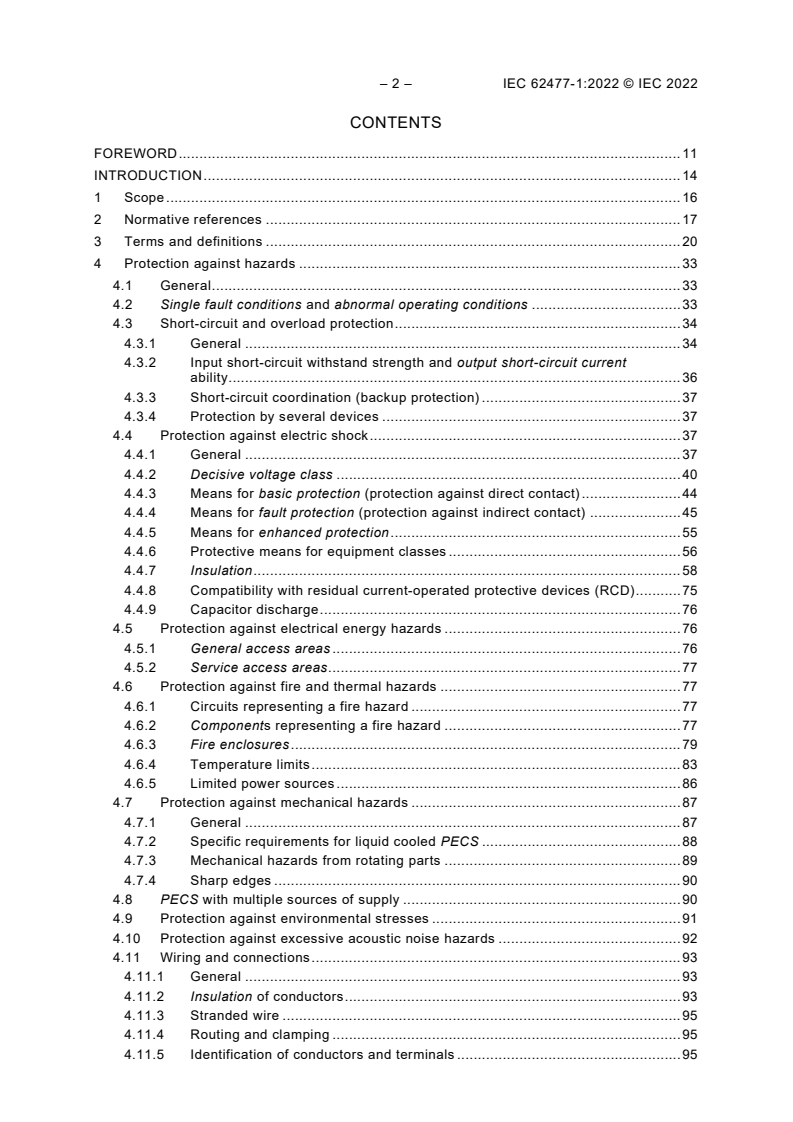
– 2 – IEC 62477-1:2022 © IEC 2022
CONTENTS
FOREWORD . 11
INTRODUCTION . 14
1 Scope . 16
2 Normative references . 17
3 Terms and definitions . 20
4 Protection against hazards . 33
4.1 General . 33
4.2 Single fault conditions and abnormal operating conditions . 33
4.3 Short-circuit and overload protection . 34
4.3.1 General . 34
4.3.2 Input short-circuit withstand strength and output short-circuit current
ability . 36
4.3.3 Short-circuit coordination (backup protection) . 37
4.3.4 Protection by several devices . 37
4.4 Protection against electric shock . 37
4.4.1 General . 37
4.4.2 Decisive voltage class . 40
4.4.3 Means for basic protection (protection against direct contact) . 44
4.4.4 Means for fault protection (protection against indirect contact) . 45
4.4.5 Means for enhanced protection . 55
4.4.6 Protective means for equipment classes . 56
4.4.7 Insulation . 58
4.4.8 Compatibility with residual current-operated protective devices (RCD) . 75
4.4.9 Capacitor discharge . 76
4.5 Protection against electrical energy hazards . 76
4.5.1 General access areas . 76
4.5.2 Service access areas . 77
4.6 Protection against fire and thermal hazards . 77
4.6.1 Circuits representing a fire hazard . 77
4.6.2 Components representing a fire hazard . 77
4.6.3 Fire enclosures . 79
4.6.4 Temperature limits . 83
4.6.5 Limited power sources . 86
4.7 Protection against mechanical hazards . 87
4.7.1 General . 87
4.7.2 Specific requirements for liquid cooled PECS . 88
4.7.3 Mechanical hazards from rotating parts . 89
4.7.4 Sharp edges . 90
4.8 PECS with multiple sources of supply . 90
4.9 Protection against environmental stresses . 91
4.10 Protection against excessive acoustic noise hazards . 92
4.11 Wiring and connections . 93
4.11.1 General . 93
4.11.2 Insulation of conductors . 93
4.11.3 Stranded wire . 95
4.11.4 Routing and clamping . 95
4.11.5 Identification of conductors and terminals . 95
4.11.6 Splices and connections . 96
4.11.7 Accessible connections . 96
4.11.8 Interconnections between parts of the PECS . 97
4.11.9 Supply connections. 97
4.11.10 Field wiring terminals and internal terminals . 99
4.11.11 Means for shield connection of shielded wire or shielded cable . 101
4.12 Enclosures . 101
4.12.1 General . 101
4.12.2 Handles and manual controls . 102
4.12.3 Cast metal . 102
4.12.4 Sheet metal . 103
4.12.5 Stability requirement for enclosure. 105
4.12.6 Strain relief . 106
4.12.7 Polymeric enclosure stress relief . 106
4.12.8 Polymeric enclosure UV resistance . 106
4.13 Components . 106
4.13.1 General . 106
4.13.2 PTC thermistors . 107
4.13.3 Mains supply cords . 107
4.13.4 Capacitors and RC units bridging insulation . 107
4.13.5 Wound components . 107
4.13.6 Plug and socket-outlets . 108
4.14 Protection against electromagnetic fields . 108
5 Test requirements . 108
5.1 General . 108
5.1.1 Test objectives and classification . 108
5.1.2 Selection of test samples . 108
5.1.3 Sequence of tests . 108
5.1.4 Earthing conditions . 109
5.1.5 General conditions for tests . 109
5.1.6 Compliance . 110
5.1.7 Test overview . 110
5.2 Test specifications . 112
5.2.1 Visual inspection (type test and routine test) . 112
5.2.2 Mechanical tests . 112
5.2.3 Electrical tests . 121
5.2.4 Abnormal operation and simulated faults tests . 141
5.2.5 Material tests . 148
5.2.6 Environmental tests (type tests) . 153
5.2.7 Hydrostatic pressure test (type test, routine test) . 157
5.2.8 Electromagnetic fields (EMF) . 158
6 Information and marking requirements . 158
6.1 General . 158
6.2 Information for selection . 160
6.2.1 General . 160
6.2.2 Instructions and markings pertaining to accessories . 162
6.3 Information for installation and commissioning . 162
6.3.1 General . 162
6.3.2 Mechanical considerations . 162
– 4 – IEC 62477-1:2022 © IEC 2022
6.3.3 Environment . 162
6.3.4 Handling and mounting . 162
6.3.5 Enclosure temperature. 163
6.3.6 Open type PECS . 163
6.3.7 Connections . 163
6.3.8 Commissioning . 165
6.3.9 Protection requirements . 165
6.4 Information for intended use . 167
6.4.1 General . 167
6.4.2 Adjustment . 167
6.4.3 Labels, signs, symbols and signals . 168
6.4.4 Hot surfaces . 170
6.4.5 Control and device marking . 170
6.5 Supplementary information . 170
6.5.1 Maintenance . 170
6.5.2 Capacitor discharge . 171
6.5.3 Auto restart/bypass connection . 171
6.5.4 Other hazards . 171
6.5.5 PECS with multiple sources of supply . 171
6.5.6 Replaceable fuses in neutral of single-phase PECS . 171
Annex A (normative) Additional information for protection against electric shock . 173
A.1 General . 173
A.2 Protection by means of DVC As . 173
A.3 Protection by means of protective impedance . 173
A.4 Protection by using limited voltages . 174
A.5 Evaluation of the working voltage of circuits . 175
A.5.1 General . 175
A.5.2 Classification of the working voltage . 175
A.5.3 AC working voltage . 176
A.5.4 DC working voltage. 176
A.5.5 Pulsating working voltage . 177
A.6 The concept of protective means according to 4.4 . 178
A.6.1 General . 178
A.6.2 Examples of the use of elements of protective means . 178
Annex B (informative) Considerations for the reduction of the pollution degree . 180
B.1 General . 180
B.2 Factors influencing the pollution degree . 180
B.3 Reduction of influencing factors . 180
Annex C (informative) Symbols referred to in this document . 181
C.1 Symbols used . 181
C.2 Determination of contrast . 182
Annex D (normative) Evaluation of clearance and creepage distances . 184
D.1 Measurement . 184
D.2 Relationship of measurement to pollution degree . 184
D.3 Examples . 185
Annex E (normative) Altitude correction for clearances . 191
E.1 Correction factor for clearances at altitudes above 2 000 m . 191
E.2 Test voltages for verifying clearances at different altitudes . 191
Annex F (normative) Clearance and creepage distance determination for frequencies
greater than 30 kHz . 193
F.1 General influence of the frequency on the withstand characteristics . 193
F.2 Clearance . 193
F.2.1 General . 193
F.2.2 Clearance for inhomogenous fields . 194
F.2.3 Clearance for approximately homogenous fields . 195
F.3 Creepage distance . 196
F.4 Solid insulation . 197
F.4.1 General . 197
F.4.2 Approximately uniform field distribution without air gaps or voids . 197
F.4.3 Other cases . 198
Annex G (informative) Cross-sections of round conductors . 199
Annex H (informative) Guidelines for RCD compatibility . 200
H.1 Selection of RCD type . 200
H.2 Fault current waveforms . 201
Annex I (informative) Examples of overvoltage category reduction . 204
I.1 General . 204
I.2 Protection to the surroundings (see 4.4.7.2) . 204
I.2.1 Circuits connected to mains supply (see 4.4.7.2.3) . 204
I.2.2 Circuits connected to the non-mains supply (see 4.4.7.2.4) . 207
I.2.3 Protection between circuits (see 4.4.7.2.7) . 207
I.3 Functional insulation (see 4.4.7.3) . 208
I.4 Further examples . 208
I.5 Circuits with multiple supplies (see 4.4.7.2.1) . 209
Annex J (informative) Burn thresholds for touchable surfaces . 210
J.1 General . 210
J.2 Burn thresholds. 210
Annex K (informative) Table of electrochemical potentials . 214
Annex L (informative) Measuring instrument for touch current measurements . 215
L.1 Measuring instrument 1 . 215
L.2 Measuring instrument 2 . 215
L.3 Measuring instrument 3 . 216
Annex M (normative) Test probes for determining access . 217
Annex N (informative) Guidance regarding short-circuit current. 220
N.1 General . 220
N.2 Coordination of short-circuit current . 221
N.2.1 General . 221
N.2.2 Conditional short-circuit current (I ) and minimum required prospective
cc
short-circuit current (I ) . 221
cp, mr
N.2.3 Short-time withstand current (I ) . 223
cw
N.3 Guidance for specification of short-circuit current and short-circuit protective
device . 224
N.3.1 General . 224
N.3.2 Example 1: Two or more PECS with different ratings . 225
N.3.3 Specification of I . 226
cc
N.3.4 Specification of I . 226
cw
– 6 – IEC 62477-1:2022 © IEC 2022
N.3.5 Example 2: One PECS with more than one rating . 227
N.3.6 Additional explanation on terms, definitions and specifications . 228
N.4 Short-circuit rating and single fault conditions testing . 229
N.4.1 General . 229
N.4.2 Exemption from short-time withstand current testing . 231
N.5 Guideline for short-circuit analysis . 231
Annex O (informative) Guidelines for determination of clearance and creepage
distances . 232
O.1 Guideline for determination of clearances . 232
O.2 Guideline for determination of creepage distances . 233
O.3 Minimum spacings within solid insulation or similar . 233
Annex P (informative) Protection of persons against electromagnetic fields for
frequencies from 0 Hz up to 300 GHz . 235
P.1 General influence of electromagnetic fields to persons . 235
P.1.1 General . 235
P.1.2 Low-frequency electric fields effects (1 Hz to 100 kHz) . 235
P.1.3 Low-frequency magnetic fields effects (1 Hz to 100 kHz) . 235
P.1.4 Low-frequency electric and magnetic fields effects . 235
P.1.5 High-frequency electromagnetic fields effects (100 kHz to 300 GHz) . 235
P.1.6 Current knowledge on low-level effects . 236
P.1.7 Biological effects versus adverse health effects . 236
P.1.8 Influence of EMF on passive and active medical implants . 236
P.2 Requirements from ICNIRP LF guidelines against exposure to EMF . 236
P.2.1 Adoption of exposure limits from ICNIRP . 236
P.2.2 Limits of EMF exposure for transportation and storage . 238
P.3 Protection of persons against exposure of EMF . 238
P.3.1 General . 238
P.3.2 EMF requirements for general public access areas . 239
P.3.3 EMF requirements for general access areas, service access areas and
restricted access areas . 239
P.3.4 EMF requirements for transportation and storage . 239
P.4 Electromagnetic fields (EMF) test (type test) . 240
P.4.1 General test set up for EMF . 240
P.4.2 EMF test (type test) . 240
P.5 Electromagnetic fields (EMF) marking . 240
Annex Q (informative) Maximum disconnection times . 241
Annex R (informative) Risk assessment according to IEC Guide 116 . 242
R.1 General . 242
R.2 Risk assessment . 242
Annex S (informative) Guidance to product technical committees . 244
Bibliography . 245
Figure 1 – Protective means for protection against electric shock considering Class I
equipment and Class II equipment . 39
Figure 2 – Protective means for protection against electric shock considering Class III
equipment or accessible circuits of DVC As . 40
Figure 3 – Example of a PECS assembly and its associated protective equipotential
bonding. 47
Figure 4 – Example of a PECS assembly and its associated protective equipotential
bonding through direct metallic contact . 48
Figure 5 – Time-voltage zones for accessible circuits of DVC As and DVC B – DC
during single fault conditions . 52
Figure 6 – Time-voltage zones for accessible circuits of DVC As and DVC B – AC peak
during single fault conditions . 53
Figure 7 – Time-voltage zones for conductive accessible parts during single fault
conditions . 54
Figure 8 – Fire enclosure bottom openings below an unenclosed or partially enclosed
fire-hazardous component. 81
Figure 9 – Fire enclosure baffle construction. 82
Figure 10 – Example for interconnections within permanently connected PECS and
between parts of them . 93
Figure 11 – Example of cable as an arrangement of insulated conductors. 94
Figure 12 – Detachable mains supply cords and connections . 98
Figure 13 – Example for evaluation of wire bending space . 101
Figure 14 – Supported and unsupported enclosure parts . 103
Figure 15 – Impact test using a steel ball . 118
Figure 16 – Voltage test procedures . 127
Figure 17 – Partial discharge test procedure . 129
Figure 18 – Protective equipotential bonding impedance test for separate PECS with
power fed from the PECS with protection for the power cable . 134
Figure 19 – Protective equipotential bonding impedance test for sub-assembly with
accessible parts and with power fed from the PECS. 135
Figure 20 – Electric strength test instrument . 138
Figure 21 – Mandrel . 139
Figure 22 – Initial position of mandrel . 139
Figure 23 – Final position of mandrel . 139
Figure 24 – Position of metal foil on insulating material . 140
Figure 25 – Circuit for high-current arcing test . 148
Figure 26 – Test fixture for hot-wire ignition test . 150
Figure A.1 – Protection by DVC As with enhanced protection. 173
Figure A.2 – Protection by means of protective impedance . 174
Figure A.3 – Protection by using limited voltages . 174
Figure A.4 – Typical waveform for AC working voltage . 176
Figure A.5 – Typical waveform for DC working voltage . 176
Figure A.6 – Typical waveform for pulsating working voltage . 177
Figure D.1 – Example of measurements including a groove . 185
Figure D.2 – Example of measurements including a groove . 185
Figure D.3 – Example of measurements including a groove . 185
Figure D.4 – Example of measurements including a rib . 186
Figure D.5 – Example of measurements providing protection of type 2 . 186
Figure D.6 – Example of measurements providing protection of type 1 . 186
Figure D.7 – Example of measurements providing protection of type 1 . 187
Figure D.8 – Example of measurements providing protection of type 1 . 187
Figure D.9 – Example of measurements including a barrier (cemented joint) . 187
– 8 – IEC 62477-1:2022 © IEC 2022
Figure D.10 – Example of measurements including a barrier . 188
Figure D.11 – Example of measurements including a gap . 188
Figure D.12 – Example of measurements including a gap . 189
Figure D.13 – Example of measurements including an isolated conductive part . 189
Figure D.14 – Example of measurements in inner layer of PWB . 189
Figure D.15 – Example of measurements on enclosure of insulating material to a part
inside . 190
Figure F.1 – Diagram for dimensioning of clearances . 194
Figure F.2 – Diagram for dimensioning of creepage distances . 196
Figure F.3 – Permissible field strength for dimensioning of solid insulation according to
Formula (F.1) . 198
Figure H.1 – Flow chart leading to selection of the RCD type upstream of a PECS . 200
Figure H.2 – Symbols for marking depending on the type of RCD . 201
Figure H.3 – Fault current waveforms in connections with power electronic converter
devices . 203
Figure I.1 – Basic protection evaluation for circuits connected to the origin of the
installation mains supply . 204
Figure I.2 – Basic protection evaluation for circuits connected to the mains supply . 205
Figure I.3 – Basic protection evaluation for single and three phase PECS not
permanently connected to the mains supply . 205
Figure I.4 – Basic protection evaluation for circuits connected to the origin of the
installation mains supply where internal SPDs are used . 205
Figure I.5 – Basic protection evaluation for circuits connected to the mains supply
where internal SPDs are used . 206
Figure I.6 – Example of enhanced protection evaluation for circuits connected to the
mains supply where internal SPDs are used . 206
Figure I.7 – Example of enhanced protection evaluation for circuits connected to the
mains supply where internal SPDs are used . 206
Figure I.8 –Example of enhanced protection evaluation for circuits connected to the
mains supply where internal SPDs are used . 207
Figure I.9 – Basic protection evaluation for circuits connected to the non-mains supply . 207
Figure I.10 – Basic protection evaluation for circuits connected to the the origin of the
installation non-mains supply . 207
Figure I.11 – Functional insulation evaluation within circuits affected by external
transients . 208
Figure I.12 – Basic protection evaluation for circuits connected to the mains supply . 208
Figure I.13 – Insulation evaluation for accessible circuit of DVC As . 208
Figure I.14 – PEC with mains supply and non-mains supply without galvanic isolation . 209
Figure I.15 – Transformer (basic protected) PEC inverter with SPD and transformer to
reduce impulse voltage for functional and basic protection . 209
Figure J.1 – Burn threshold spread when the skin is in contact with a hot smooth
surface made of bare (uncoated) metal . 210
Figure J.2 – Rise in the burn threshold spread from Figure J.1 for metals which are
coated by shellac varnish . 211
Figure J.3 – Rise in the burn threshold spread from Figure J.1 for metals coated with
the specific materials . 211
Figure J.4 – Burn threshold spread when the skin is in contact with a hot smooth
surface made of ceramics, glass and stone materials . 212
Figure J.5 – Burn threshold spread when the skin is in contact with a hot smooth
surface made of plastics . 213
Figure L.1 – Measuring instrument 1 . 215
Figure L.2 – Measuring instrument 2 . 215
Figure M.1 – Sphere 50 mm probe according to IEC 61032:1997, test probe A . 217
Figure M.2 – Jointed test finger according to IEC 61032:1997, test probe B . 218
Figure M.3 – Test rod 2,5 mm according to IEC 61032:1997, test probe C . 219
Figure M.4 – S
...