

IEC TR 61998:2015
(Main)Model and framework for standardization in multimedia equipment and systems
General Information
- Abstract
IEC TR 61998:2015(E) provides models and frameworks for the standardization of multimedia technology, being undertaken or to be undertaken by IEC as the result of the IEC PACT report. This second edition cancels and replaces the first edition published in 1999 and constitutes a technical revision. This edition includes the following significant technical changes with respect to the previous edition:
- the annexes describing various technologies have been deleted because their roles have ceased over the past two decades;
- TC 100 frameworks are described in more general form and from the viewpoint of the model of data usage and communication including the possible future technologies of TC 100.
- Status
- Published
- Publication Date
- 18-Nov-2015
- Technical Committee
- TC 100 - Audio, video and multimedia systems and equipment
- Drafting Committee
- MT 61998 - TC 100/MT 61998
- Current Stage
- PPUB - Publication issued
- Start Date
- 19-Nov-2015
- Completion Date
- 15-Feb-2016
Overview
IEC TR 61998:2015 - Model and framework for standardization in multimedia equipment and systems is a Technical Report from IEC TC 100 (Audio, video and multimedia systems and equipment). This second edition (2015) replaces the 1999 edition and provides high‑level models and frameworks to guide IEC standardization activities for multimedia technology. The report is based on the IEC PACT (President’s Advisory Committee on Future Technology) work and refocuses TC 100 frameworks to address data usage, communication and possible future multimedia technologies. Notably, legacy annexes describing specific technologies were removed because their roles have diminished over the past two decades.
Key topics and technical requirements
IEC TR 61998 defines a structured approach to multimedia standardization rather than prescriptive technical specifications. Major topics covered include:
- Generic model for multimedia systems
- Clarifies boundaries between AV and IT multimedia domains.
- Identifies objectives of standardization: interoperability, usability, safety, security, quality, identification, energy efficiency and environmental safeguards.
- Physical and logical connectivity
- Models for communication media, interchange/storage media, protocols, formats and interfaces needed for interoperability.
- Transferred data structure
- Layered views of data interchange and storage (presentation, file, logical/physical storage, physical media).
- Usability and user interfaces
- Models to ensure simplified, human-recognizable user‑system interfaces and accessibility.
- Security and safety
- Frameworks for protecting multimedia data and ensuring safe operation where multi‑sensory outputs are involved.
- Specific models
- Multimedia data creation, equipment structure, distribution and management, open systems interconnection with media, and application‑specific modeling.
- TC 100 frameworks
- Generalized models of TC 100 scope, user communication, networked models and environmental aspects to guide future standards work.
Practical applications and who uses this standard
IEC TR 61998 is a guidance document intended to support:
- Standards developers and IEC technical committees (especially TC 100) planning work items and defining scope.
- Manufacturers and system integrators of audio, video and multimedia equipment seeking to align product design with international standardization frameworks.
- Test laboratories and certification bodies that assess interoperability, safety and usability of multimedia systems.
- Policy makers and procurement specialists who need a framework to evaluate multimedia infrastructure, environmental impact and energy efficiency.
- Researchers and architects designing future multimedia systems and services who require a common vocabulary and layered models for data use and communication.
Related standards and context
- Prepared by IEC TC 100, the report aligns with IEC’s generic standardization processes and ISO/IEC Directives. It complements TC 100 normative standards by providing modeling and scoping guidance rather than technical requirements.
Keywords: IEC TR 61998, multimedia standardization, TC 100, interoperability, multimedia models, audio video systems, data interchange, user interfaces, security, standardization framework.
Relations
- Revises
IEC TR 61998:1999 - Model and framework for standardization in multimedia equipment and systems - Effective Date
- 05-Sep-2023
Get Certified
Connect with accredited certification bodies for this standard

ANCE
Mexican certification and testing association.

Intertek Slovenia
Intertek testing, inspection, and certification services in Slovenia.

LNE (Laboratoire National de Métrologie et d'Essais)
French national laboratory for metrology and testing.
Sponsored listings
Frequently Asked Questions
IEC TR 61998:2015 is a technical report published by the International Electrotechnical Commission (IEC). Its full title is "Model and framework for standardization in multimedia equipment and systems". This standard covers: IEC TR 61998:2015(E) provides models and frameworks for the standardization of multimedia technology, being undertaken or to be undertaken by IEC as the result of the IEC PACT report. This second edition cancels and replaces the first edition published in 1999 and constitutes a technical revision. This edition includes the following significant technical changes with respect to the previous edition: - the annexes describing various technologies have been deleted because their roles have ceased over the past two decades; - TC 100 frameworks are described in more general form and from the viewpoint of the model of data usage and communication including the possible future technologies of TC 100.
IEC TR 61998:2015(E) provides models and frameworks for the standardization of multimedia technology, being undertaken or to be undertaken by IEC as the result of the IEC PACT report. This second edition cancels and replaces the first edition published in 1999 and constitutes a technical revision. This edition includes the following significant technical changes with respect to the previous edition: - the annexes describing various technologies have been deleted because their roles have ceased over the past two decades; - TC 100 frameworks are described in more general form and from the viewpoint of the model of data usage and communication including the possible future technologies of TC 100.
IEC TR 61998:2015 is classified under the following ICS (International Classification for Standards) categories: 33.160.60 - Multimedia systems and teleconferencing equipment. The ICS classification helps identify the subject area and facilitates finding related standards.
IEC TR 61998:2015 has the following relationships with other standards: It is inter standard links to IEC TR 61998:1999. Understanding these relationships helps ensure you are using the most current and applicable version of the standard.
IEC TR 61998:2015 is available in PDF format for immediate download after purchase. The document can be added to your cart and obtained through the secure checkout process. Digital delivery ensures instant access to the complete standard document.
Standards Content (Sample)
IEC TR 61998 ®
Edition 2.0 2015-11
TECHNICAL
REPORT
Model and framework for standardization in multimedia equipment and systems
All rights reserved. Unless otherwise specified, no part of this publication may be reproduced or utilized in any form
or by any means, electronic or mechanical, including photocopying and microfilm, without permission in writing from
either IEC or IEC's member National Committee in the country of the requester. If you have any questions about IEC
copyright or have an enquiry about obtaining additional rights to this publication, please contact the address below or
your local IEC member National Committee for further information.
IEC Central Office Tel.: +41 22 919 02 11
3, rue de Varembé Fax: +41 22 919 03 00
CH-1211 Geneva 20 info@iec.ch
Switzerland www.iec.ch
About the IEC
The International Electrotechnical Commission (IEC) is the leading global organization that prepares and publishes
International Standards for all electrical, electronic and related technologies.
About IEC publications
The technical content of IEC publications is kept under constant review by the IEC. Please make sure that you have the
latest edition, a corrigenda or an amendment might have been published.
IEC Catalogue - webstore.iec.ch/catalogue Electropedia - www.electropedia.org
The stand-alone application for consulting the entire The world's leading online dictionary of electronic and
bibliographical information on IEC International Standards, electrical terms containing more than 30 000 terms and
Technical Specifications, Technical Reports and other definitions in English and French, with equivalent terms in 15
documents. Available for PC, Mac OS, Android Tablets and additional languages. Also known as the International
iPad. Electrotechnical Vocabulary (IEV) online.
IEC publications search - www.iec.ch/searchpub IEC Glossary - std.iec.ch/glossary
The advanced search enables to find IEC publications by a More than 60 000 electrotechnical terminology entries in
variety of criteria (reference number, text, technical English and French extracted from the Terms and Definitions
committee,…). It also gives information on projects, replaced clause of IEC publications issued since 2002. Some entries
and withdrawn publications. have been collected from earlier publications of IEC TC 37,
77, 86 and CISPR.
IEC Just Published - webstore.iec.ch/justpublished
Stay up to date on all new IEC publications. Just Published IEC Customer Service Centre - webstore.iec.ch/csc
details all new publications released. Available online and If you wish to give us your feedback on this publication or
also once a month by email. need further assistance, please contact the Customer Service
Centre: csc@iec.ch.
IEC TR 61998 ®
Edition 2.0 2015-11
TECHNICAL
REPORT
Model and framework for standardization in multimedia equipment and systems
INTERNATIONAL
ELECTROTECHNICAL
COMMISSION
ICS 33.160.60 ISBN 978-2-8322-2991-0
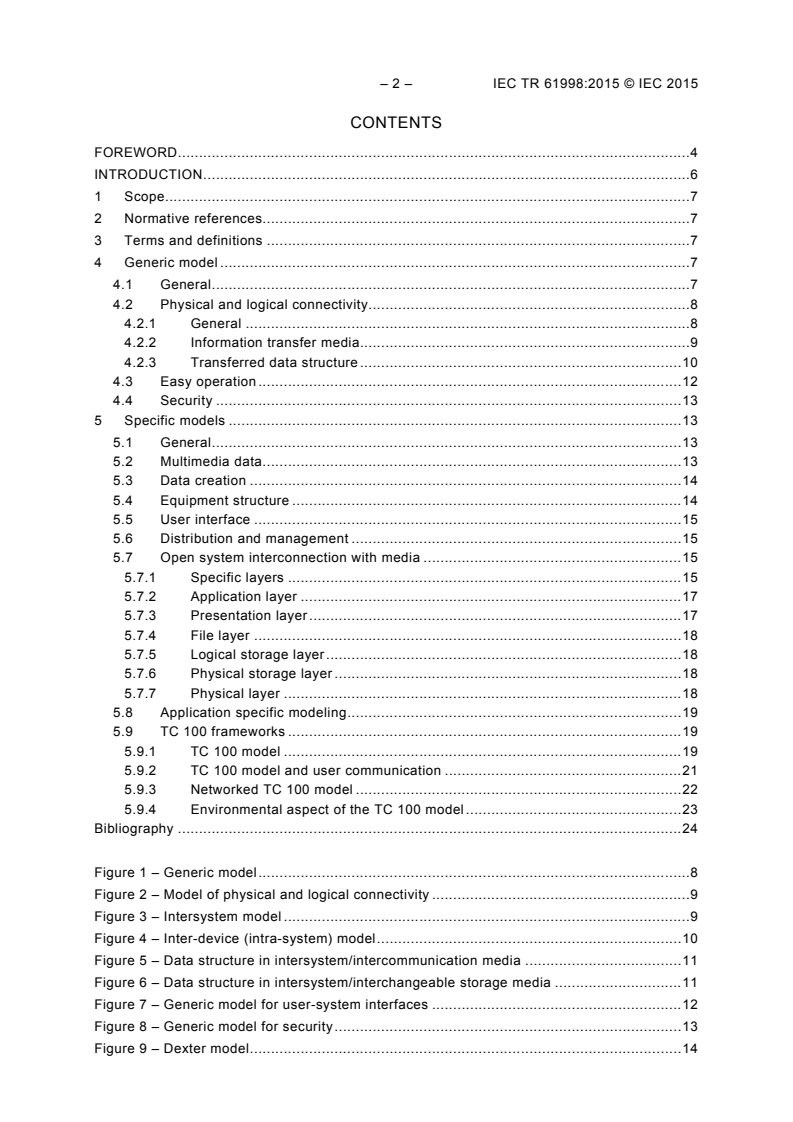
– 2 – IEC TR 61998:2015 © IEC 2015
CONTENTS
FOREWORD . 4
INTRODUCTION . 6
1 Scope . 7
2 Normative references. 7
3 Terms and definitions . 7
4 Generic model . 7
4.1 General . 7
4.2 Physical and logical connectivity . 8
4.2.1 General . 8
4.2.2 Information transfer media . 9
4.2.3 Transferred data structure . 10
4.3 Easy operation . 12
4.4 Security . 13
5 Specific models . 13
5.1 General . 13
5.2 Multimedia data . 13
5.3 Data creation . 14
5.4 Equipment structure . 14
5.5 User interface . 15
5.6 Distribution and management . 15
5.7 Open system interconnection with media . 15
5.7.1 Specific layers . 15
5.7.2 Application layer . 17
5.7.3 Presentation layer . 17
5.7.4 File layer . 18
5.7.5 Logical storage layer . 18
5.7.6 Physical storage layer . 18
5.7.7 Physical layer . 18
5.8 Application specific modeling . 19
5.9 TC 100 frameworks . 19
5.9.1 TC 100 model . 19
5.9.2 TC 100 model and user communication . 21
5.9.3 Networked TC 100 model . 22
5.9.4 Environmental aspect of the TC 100 model . 23
Bibliography . 24
Figure 1 – Generic model . 8
Figure 2 – Model of physical and logical connectivity . 9
Figure 3 – Intersystem model . 9
Figure 4 – Inter-device (intra-system) model . 10
Figure 5 – Data structure in intersystem/intercommunication media . 11
Figure 6 – Data structure in intersystem/interchangeable storage media . 11
Figure 7 – Generic model for user-system interfaces . 12
Figure 8 – Generic model for security . 13
Figure 9 – Dexter model . 14
Figure 10 – Systems and equipment model . 15
Figure 11 – Seven layer reference model and peer formats . 16
Figure 12 – Information interchange involving open systems for medium conversion . 17
Figure 13 – TC 100 model . 20
Figure 14 – TC 100 model and user communication . 22
Figure 15 – Networked TC 100 models . 23
– 4 – IEC TR 61998:2015 © IEC 2015
INTERNATIONAL ELECTROTECHNICAL COMMISSION
____________
MODEL AND FRAMEWORK FOR STANDARDIZATION
IN MULTIMEDIA EQUIPMENT AND SYSTEMS
FOREWORD
1) The International Electrotechnical Commission (IEC) is a worldwide organization for standardization comprising
all national electrotechnical committees (IEC National Committees). The object of IEC is to promote
international co-operation on all questions concerning standardization in the electrical and electronic fields. To
this end and in addition to other activities, IEC publishes International Standards, Technical Specifications,
Technical Reports, Publicly Available Specifications (PAS) and Guides (hereafter referred to as “IEC
Publication(s)”). Their preparation is entrusted to technical committees; any IEC National Committee interested
in the subject dealt with may participate in this preparatory work. International, governmental and non-
governmental organizations liaising with the IEC also participate in this preparation. IEC collaborates closely
with the International Organization for Standardization (ISO) in accordance with conditions determined by
agreement between the two organizations.
2) The formal decisions or agreements of IEC on technical matters express, as nearly as possible, an international
consensus of opinion on the relevant subjects since each technical committee has representation from all
interested IEC National Committees.
3) IEC Publications have the form of recommendations for international use and are accepted by IEC National
Committees in that sense. While all reasonable efforts are made to ensure that the technical content of IEC
Publications is accurate, IEC cannot be held responsible for the way in which they are used or for any
misinterpretation by any end user.
4) In order to promote international uniformity, IEC National Committees undertake to apply IEC Publications
transparently to the maximum extent possible in their national and regional publications. Any divergence
between any IEC Publication and the corresponding national or regional publication shall be clearly indicated in
the latter.
5) IEC itself does not provide any attestation of conformity. Independent certification bodies provide conformity
assessment services and, in some areas, access to IEC marks of conformity. IEC is not responsible for any
services carried out by independent certification bodies.
6) All users should ensure that they have the latest edition of this publication.
7) No liability shall attach to IEC or its directors, employees, servants or agents including individual experts and
members of its technical committees and IEC National Committees for any personal injury, property damage or
other damage of any nature whatsoever, whether direct or indirect, or for costs (including legal fees) and
expenses arising out of the publication, use of, or reliance upon, this IEC Publication or any other IEC
Publications.
8) Attention is drawn to the Normative references cited in this publication. Use of the referenced publications is
indispensable for the correct application of this publication.
9) Attention is drawn to the possibility that some of the elements of this IEC Publication may be the subject of
patent rights. IEC shall not be held responsible for identifying any or all such patent rights.
The main task of IEC technical committees is to prepare International Standards. However, a
technical committee may propose the publication of a technical report when it has collected
data of a different kind from that which is normally published as an International Standard, for
example "state of the art".
IEC TR 61998, which is a technical report, has been prepared by IEC technical committee 100:
Audio, video and multimedia systems and equipment.
This second edition cancels and replaces the first edition published in 1999 and constitutes a
technical revision.
This edition includes the following significant technical changes with respect to the previous
edition:
a) the annexes describing various technologies have been deleted because their roles have
ceased over the past two decades;
b) TC 100 frameworks are described in more general form and from the viewpoint of the
model of data usage and communication including the possible future technologies of
TC 100.
The text of this technical report is based on the following documents:
Enquiry draft Report on voting
100/2528/DTR 100/2576/RVC
Full information on the voting for the approval of this technical report can be found in the
report on voting indicated in the above table.
This publication has been drafted in accordance with the ISO/IEC Directives, Part 2.
The committee has decided that the contents of this publication will remain unchanged until
the stability date indicated on the IEC website under "http://webstore.iec.ch" in the data
related to the specific publication. At this date, the publication will be
• reconfirmed,
• withdrawn,
• replaced by a revised edition, or
• amended.
A bilingual version of this publication may be issued at a later date.
– 6 – IEC TR 61998:2015 © IEC 2015
INTRODUCTION
Multimedia technology covers a wide range of technical areas and involves a number of
technical elements. Most of the technical elements for multimedia are now being developed
and updated. IEC standardization activities on the multimedia technology, therefore, should
be carried out with enough discussions and clarifications on
• position and relationship of the technology to be standardized among the collection of
related technologies,
• scope and framework/guideline of the standardization,
• appropriate standardization organisation having the responsibility,
• schedule of the standardization,
• relationship between new work items and the existing standards on multimedia or single
medium technology.
These discussions should be based on appropriate multimedia technology models to create a
framework for multimedia standardization.
The first edition of this Technical Report was a snapshot of these discussions in IEC/TC 100
with consideration of the draft IEC PACT (President's Advisory Committee on Future
Technology) report which was a study and foreseer on future technology. After that, TC 100
had been engaged in standardization of audio, video and multimedia equipment and systems
for over ten years.
In 2010, TC 100/AGS (Advisory Group on Strategy) started to study future technology again
because some of ten years of progress of technology had reached beyond the IEC PACT
foreseer. The study was FT-TG (Future Technology Task Force) that studied the technology
forecast in the near future and resulted to raise Study Sessions in AGS to initiate the new
technology areas in TC 100. At the same time, the need to revise IEC TR 61998 was
recognized.
This new edition of this Technical Report is based on the IEC PACT report and redefines the
TC 100 system model to initiate the future TC 100 standardization work. This Technical
Report is expected to contribute as a guideline for IEC standardization experts and National
Committees interested in multimedia equipment and systems.
MODEL AND FRAMEWORK FOR STANDARDIZATION
IN MULTIMEDIA EQUIPMENT AND SYSTEMS
1 Scope
This Technical Report provides models and frameworks for the standardization of multimedia
technology, being undertaken or to be undertaken by IEC as the result of the IEC PACT report.
2 Normative references
Void.
3 Terms and definitions
For the purposes of this document, the following terms and definitions apply.
3.1
originator
entity, system or device that provides information or service, or container which includes
information or service
3.2
recipient
entity, system, operator or device that receives information or service, or container which
includes information or service
3.3
multimedia technology
systematic co-ordination of different single medium technologies
4 Generic model
4.1 General
The generic model clarifies AV and IT multimedia technology and its boundaries.
Standardization is in general required to obtain the following:
• physical and logical connectivity;
• usability and accessibility;
• identification;
• quality;
• safety and security;
• easy implementation;
• ecological considerations;
• energy efficiency;
• environmental safeguards.
The major purposes of multimedia standardization are:
– 8 – IEC TR 61998:2015 © IEC 2015
• physical and logical connectivity
Multimedia data interchange and distribution are based on communication media and
interchangeable storage media. Protocols, formats, interfaces, and other data structures
of the media are required to be standardized. The features of multimedia data, in
particular, make those standards more complicated than in the case of a single medium.
• usability and accessibility
Multimedia systems contain a number of basic single medium parts, each of which
requires appropriate interaction with any users or other systems. In order to realise
feasible and human-recognisable operation for the multimedia systems, simplified and
standardized user-system interfaces are essential.
• safety and security
Multimedia equipment and systems form or will form a basic and important infrastructure
of national and international activity. Some multimedia data are required to be highly
secured. Some systems are required to be strongly protected and besides their operation
should be comfortable and safe for operators whose sense organs need to access
concurrently to their corresponding media; visible, audible, and other sensible media. Safe
and secured environments should be implemented by being based on some guideline and
standards.
All the subjects to be standardized for this purpose can be modelled by the relationship
between an originator and a recipient as shown in Figure 1.
Originator Recipient
Relationship
IEC
Figure 1 – Generic model
Each multimedia technology for the relationship should be discussed along with appropriate
axes defined to describe corresponding features of the relationship.
4.2 Physical and logical connectivity
4.2.1 General
When considering physical and logical connectivity, as presented in Figure 2, an originator is
positioned to be an entity, system or device which provides information. A recipient should be
an entity, system or device which receives the information. They are reconnected with each
other by a relationship: information transfer. The information transfer can be carried out by
different types of information transfer media. Another aspect of the information transfer is a
structure of data to be transferred by the medium.
Information Information
originator recipient
Information
transfer
Information transfer media
(see 4.2.2)
Information data structure
(see 4.2.3)
IEC
Figure 2 – Model of physical and logical connectivity
4.2.2 Information transfer media
4.2.2.1 Intersystem model
The physical media for information transfer between systems are classified into:
• Broadcasting media
Broadcasting media support simultaneous information transfer to a number of recipients.
Examples of the wireless broadcasting media are BS, CS and terrestrial.
• Intercommunication media
Intercommunication media support information transfer between two or more systems at a
time. Examples of intercommunication media are Internet, WAN, LAN and any area
network.
• Interchangeable storage media
Interchangeable storage media (ISM), e.g., optical disks facilitate data transfer by allowing
the physical movement of the ISM from system to system. Large amounts of data transfer
can inexpensively and quickly be realised by using interchangeable storage media.
Flash memory, hard disk drive are classified as ISM.
They associate open systems as described in Figure 3.
Open system Open system
Inter-system
information
transfer media
IEC
Figure 3 – Intersystem model
– 10 – IEC TR 61998:2015 © IEC 2015
4.2.2.2 Inter-device (intra-system) model
Mechanisms for information interchange between devices or subsystems within a larger
system are referred to as interfaces. Examples of the interfaces are:
• computer and peripheral interface such as USB and Wi-Fi direct;
• monitor display interface such as DVI, DisplayPort, HDMI;
• consumer equipment interface employed, for instance, IR, Wi-Fi, Bluetooth , and NFC.
Devices or subsystems interact as shown in Figure 4.
Device
Device
Intra-system
information
transfer media
IEC
Figure 4 – Inter-device (intra-system) model
4.2.2.3 Boundary model
Some information transfer media can be used both between systems and between
devices/subsystems. Examples are:
• IR communication;
• LAN/WAN;
• Internet.
4.2.3 Transferred data structure
4.2.3.1 Data structure in intersystem/intercommunication media
Transferred data structures employed in intersystem/intercommunication environment may be
represented by the OSI layered model which was standardized by ISO/IEC 7498-1. The data
structure consists of seven layered protocols, semantic and syntactic behaviors of which are
defined and treated in corresponding peer-to-peer entities within communicating open
systems.
The top layer entities for application protocols provide services to their application itself within
an open system. Application data which are outside the scope of the OSI model can be
considered from the following points of view:
• Content
A major feature of multimedia systems is that multiple types of content data are supported
by the systems.
• Structure
Multiple types of content data are integrated into a structure which is appropriate for the
application. An instance of multimedia data structure modelling is shown in 5.1.
_______________
Bluetooth is the trade name of Bluetooth SIG.
This information is given for the convenience of users of this document and does not constitute an endorsement
by IEC of the product named. Equivalent products may be used if they can be shown to lead to the same results.
• Creation
The structured application data are sometimes created step by step. The data from each
step can be transferred between corresponding applications. Instances of modelling of
multimedia data creation are shown in 5.2.
Figure 5 shows the data structure in intersystem/intercommunication media.
Originator Recipient
Relationship
Relationship
Content
Creation
(incl. presentation)
Open system Open sysem
Peer-to-peer
protocols
OSI model
IEC
Figure 5 – Data structure in intersystem/intercommunication media
4.2.3.2 Data structure in intersystem/interchangeable storage media
Transferred data structure employed in an intersystem/interchangeable storage media (ISM)
environment can be represented similarly to the data in intersystem/intercommunication. ISM
are physically moved between systems to transfer the data on the storage media. To allow
open data transfer, the data formats and profiles on the media should be standardized as
relationships between systems. Logical structures such as volume and file are defined on
physical structures such as track and sector to configure a layered structure.
Application data on file structure should be treated in the same manner as those on
intersystem/telecommunication media, see Figure 6.
Open system Open system
Peer-to-peer formats
- Logical format
- Physical format
IEC
Figure 6 – Data structure in intersystem/interchangeable storage media
– 12 – IEC TR 61998:2015 © IEC 2015
Some detailed discussions of data structure modeling for open system interconnection with
media are shown in 5.6.
4.2.3.3 Data structure in inter-device model
Data structure in inter-device model is also modeled in a layered manner. As far as a display
monitor interface is concerned, for example, the type and dimensions of the connector and
cable should be considered in its physical layer.
4.3 Easy operation
Multimedia user-system interfaces are described as a relationship between a multimedia
system and an operator. Under this relationship, a system can provide information and
ser
...