

IEC TS 63181-1:2019
(Main)LCD multi-screen display terminals - Part 1: Conceptual model
General Information
- Abstract
IEC TS 63181-1:2019 specifies a conceptual model for LCD multi-screen display terminals. This document defines typical functional components to compose LCD multi-screen display terminals and describes the terminals' structure and signal flow. The document also clarifies signal processing in the terminals to create multi-screen sub-signals from a single video signal input.
- Status
- Published
- Publication Date
- 10-Dec-2019
- Technical Committee
- TC 100 - Audio, video and multimedia systems and equipment
- Drafting Committee
- PT 63181 - TC 100/PT 63181
- Current Stage
- PPUB - Publication issued
- Start Date
- 11-Dec-2019
- Completion Date
- 15-Jan-2020

Overview
IEC TS 63181-1:2019 is a technical specification developed by the International Electrotechnical Commission (IEC) that defines a conceptual model for LCD multi-screen display terminals. This document outlines the typical functional components involved in constructing multi-screen LCD display systems and details the structure and signal flow within these terminals. A key focus is on explaining how a single video signal input is processed and segmented into multiple sub-signals that are displayed across different LCD screens to create a unified, multi-screen display terminal.
This specification serves as a foundational guide for designing, implementing, and understanding LCD multi-screen terminals used in various industries such as transportation, security, commercial advertising, and safety monitoring.
Key Topics
Conceptual Model and Components
The standard identifies the essential components of an LCD multi-screen display terminal including:- LCD splicing screens: Composed of multiple LCD units forming an m-by-n matrix.
- Splicing processors: Devices that divide the original video signal into multiple sub-signals tailored to each LCD unit.
- Signal matrix: An intermediary switch that manages multiple input signals and routes them appropriately.
- Control software: Manages overall operation including display configurations, signal source switching, luminance, and user-defined display modes.
- Signal sources: Diverse video inputs such as DVD, VGA, DVI, HDMI, or camera feeds.
- Additional equipment: Includes cables and mounts designed for specific installation needs.
Signal Processing & Flow
The document clarifies how input video signals are processed and split to create coordinated multi-screen displays. This includes management of splicing processors that handle sub-signal extraction and assignment based on customer requirements.Terminology and Definitions
IEC TS 63181-1 provides clear terminology definitions including terms like optical gap, splicing deviation, and roam display, ensuring uniform understanding across stakeholders and manufacturers.Application Modes
Four key multi-screen display modes are outlined:- Full-screen display: Single input signal displayed across the entire splicing screen.
- Single-screen display: The splicing screen divided into independent sub-screens each showing separate signals.
- Combined-screen display: Multiple sub-screens are combined to show different contents independently yet within one splicing screen.
- Roaming display: Input signals can be moved and resized anywhere on the splicing screen dynamically.
Applications
IEC TS 63181-1 enables the design and deployment of LCD multi-screen terminals across a variety of practical scenarios:
Transport Information Systems
Real-time display of multi-capacity transport data such as schedules, updates, and alerts at terminals and stations.Financial and Security Displays
Wide-area displays showing dynamic financial data or security footage in environments requiring multi-view layouts.Commercial and Advertising Media
High-quality, large-scale displays for product promotion, advertising content, or media broadcasting over expansive LCD splicing screens.Emergency and Safety Monitoring
Real-time visual monitoring systems for fire protection, weather updates, maritime operations, traffic control, mining, energy, and safety management.Education and Multimedia Conferencing
Interactive displays for training environments, multimedia presentations, and video conferencing requiring flexible screen arrangements.
Related Standards
While IEC TS 63181-1 stands as an independent technical specification focusing on the conceptual framework of LCD multi-screen terminals, it harmonizes with other IEC publications and international standards concerning:
- Video signal transmission and processing protocols
- Display technologies and LCD specifications
- Signal matrix switching standards
- User interface and control software development for multimedia display units
For the latest updates and complementary standards, users are encouraged to consult the IEC Webstore and Electropedia, which provide comprehensive glossaries, terminologies, and access to related IEC and ISO standards relevant to electrotechnical and multimedia system design.
Keywords: IEC TS 63181-1, LCD multi-screen display terminals, splicing processors, signal matrix, control software, multi-screen display, video signal processing, full-screen display, single-screen display, combined-screen display, roaming display, LCD splicing screen, multimedia display standards.
Frequently Asked Questions
IEC TS 63181-1:2019 is a technical specification published by the International Electrotechnical Commission (IEC). Its full title is "LCD multi-screen display terminals - Part 1: Conceptual model". This standard covers: IEC TS 63181-1:2019 specifies a conceptual model for LCD multi-screen display terminals. This document defines typical functional components to compose LCD multi-screen display terminals and describes the terminals' structure and signal flow. The document also clarifies signal processing in the terminals to create multi-screen sub-signals from a single video signal input.
IEC TS 63181-1:2019 specifies a conceptual model for LCD multi-screen display terminals. This document defines typical functional components to compose LCD multi-screen display terminals and describes the terminals' structure and signal flow. The document also clarifies signal processing in the terminals to create multi-screen sub-signals from a single video signal input.
IEC TS 63181-1:2019 is classified under the following ICS (International Classification for Standards) categories: 31.120 - Electronic display devices. The ICS classification helps identify the subject area and facilitates finding related standards.
IEC TS 63181-1:2019 is available in PDF format for immediate download after purchase. The document can be added to your cart and obtained through the secure checkout process. Digital delivery ensures instant access to the complete standard document.
Standards Content (Sample)
IEC TS 63181-1 ®
Edition 1.0 2019-12
TECHNICAL
SPECIFICATION
colour
inside
LCD multi-screen display terminals –
Part 1: Conceptual model
All rights reserved. Unless otherwise specified, no part of this publication may be reproduced or utilized in any form
or by any means, electronic or mechanical, including photocopying and microfilm, without permission in writing from
either IEC or IEC's member National Committee in the country of the requester. If you have any questions about IEC
copyright or have an enquiry about obtaining additional rights to this publication, please contact the address below or
your local IEC member National Committee for further information.
IEC Central Office Tel.: +41 22 919 02 11
3, rue de Varembé info@iec.ch
CH-1211 Geneva 20 www.iec.ch
Switzerland
About the IEC
The International Electrotechnical Commission (IEC) is the leading global organization that prepares and publishes
International Standards for all electrical, electronic and related technologies.
About IEC publications
The technical content of IEC publications is kept under constant review by the IEC. Please make sure that you have the
latest edition, a corrigendum or an amendment might have been published.
IEC publications search - webstore.iec.ch/advsearchform Electropedia - www.electropedia.org
The advanced search enables to find IEC publications by a The world's leading online dictionary on electrotechnology,
variety of criteria (reference number, text, technical containing more than 22 000 terminological entries in English
committee,…). It also gives information on projects, replaced and French, with equivalent terms in 16 additional languages.
and withdrawn publications. Also known as the International Electrotechnical Vocabulary
(IEV) online.
IEC Just Published - webstore.iec.ch/justpublished
Stay up to date on all new IEC publications. Just Published IEC Glossary - std.iec.ch/glossary
details all new publications released. Available online and once 67 000 electrotechnical terminology entries in English and
a month by email. French extracted from the Terms and Definitions clause of IEC
publications issued since 2002. Some entries have been
IEC Customer Service Centre - webstore.iec.ch/csc collected from earlier publications of IEC TC 37, 77, 86 and
If you wish to give us your feedback on this publication or need CISPR.
further assistance, please contact the Customer Service
Centre: sales@iec.ch.
IEC TS 63181-1 ®
Edition 1.0 2019-12
TECHNICAL
SPECIFICATION
colour
inside
LCD multi-screen display terminals –
Part 1: Conceptual model
INTERNATIONAL
ELECTROTECHNICAL
COMMISSION
ICS 31.120 ISBN 978-2-8322-7720-1
– 2 – IEC TS 63181-1:2019 © IEC 2019
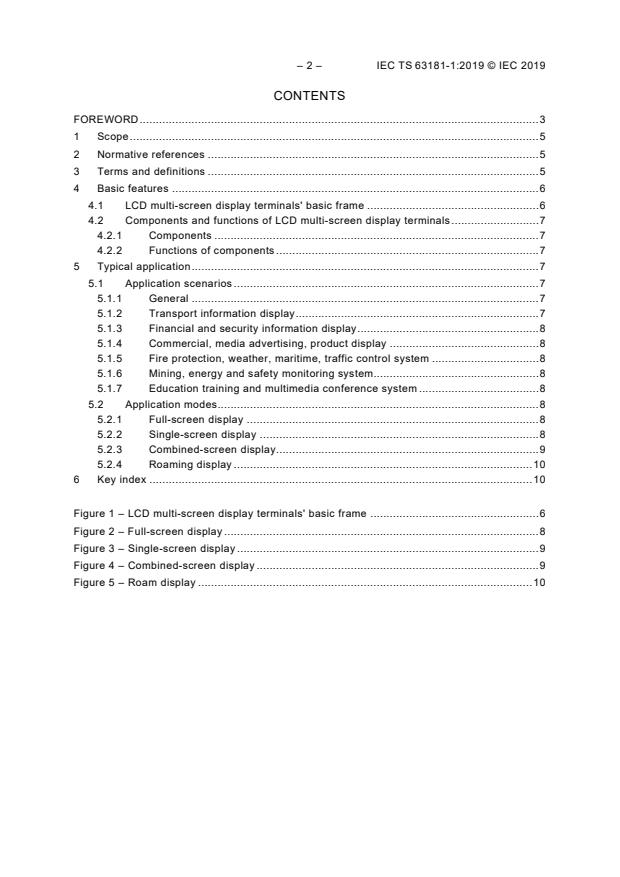
CONTENTS
FOREWORD . 3
1 Scope . 5
2 Normative references . 5
3 Terms and definitions . 5
4 Basic features . 6
4.1 LCD multi-screen display terminals' basic frame . 6
4.2 Components and functions of LCD multi-screen display terminals . 7
4.2.1 Components . 7
4.2.2 Functions of components . 7
5 Typical application . 7
5.1 Application scenarios . 7
5.1.1 General . 7
5.1.2 Transport information display . 7
5.1.3 Financial and security information display . 8
5.1.4 Commercial, media advertising, product display . 8
5.1.5 Fire protection, weather, maritime, traffic control system . 8
5.1.6 Mining, energy and safety monitoring system. 8
5.1.7 Education training and multimedia conference system . 8
5.2 Application modes. 8
5.2.1 Full-screen display . 8
5.2.2 Single-screen display . 8
5.2.3 Combined-screen display. 9
5.2.4 Roaming display . 10
6 Key index . 10
Figure 1 – LCD multi-screen display terminals' basic frame . 6
Figure 2 – Full-screen display . 8
Figure 3 – Single-screen display . 9
Figure 4 – Combined-screen display . 9
Figure 5 – Roam display . 10
INTERNATIONAL ELECTROTECHNICAL COMMISSION
____________
LCD MULTI-SCREEN DISPLAY TERMINALS –
Part 1: Conceptual model
FOREWORD
1) The International Electrotechnical Commission (IEC) is a worldwide organization for standardization comprising
all national electrotechnical committees (IEC National Committees). The object of IEC is to promote
international co-operation on all questions concerning standardization in the electrical and electronic fields. To
this end and in addition to other activities, IEC publishes International Standards, Technical Specifications,
Technical Reports, Publicly Available Specifications (PAS) and Guides (hereafter referred to as “IEC
Publication(s)”). Their preparation is entrusted to technical committees; any IEC National Committee interested
in the subject dealt with may participate in this preparatory work. International, governmental and non-
governmental organizations liaising with the IEC also participate in this preparation. IEC collaborates closely
with the International Organization for Standardization (ISO) in accordance with conditions determined by
agreement between the two organizations.
2) The formal decisions or agreements of IEC on technical matters express, as nearly as possible, an international
consensus of opinion on the relevant subjects since each technical committee has representation from all
interested IEC National Committees.
3) IEC Publications have the form of recommendations for international use and are accepted by IEC National
Committees in that sense. While all reasonable efforts are made to ensure that the technical content of IEC
Publications is accurate, IEC cannot be held responsible for the way in which they are used or for any
misinterpretation by any end user.
4) In order to promote international uniformity, IEC National Committees undertake to apply IEC Publications
transparently to the maximum extent possible in their national and regional publications. Any divergence
between any IEC Publication and the corresponding national or regional publication shall be clearly indicated in
the latter.
5) IEC itself does not provide any attestation of conformity. Independent certification bodies provide conformity
assessment services and, in some areas, access to IEC marks of conformity. IEC is not responsible for any
services carried out by independent certification bodies.
6) All users should ensure that they have the latest edition of this publication.
7) No liability shall attach to IEC or its directors, employees, servants or agents including individual experts and
members of its technical committees and IEC National Committees for any personal injury, property damage or
other damage of any nature whatsoever, whether direct or indirect, or for costs (including legal fees) and
expenses arising out of the publication, use of, or reliance upon, this IEC Publication or any other IEC
Publications.
8) Attention is drawn to the Normative references cited in this publication. Use of the referenced publications is
indispensable for the correct application of this publication.
9) Attention is drawn to the possibility that some of the elements of this IEC Publication may be the subject of
patent rights. IEC shall not be held responsible for identifying any or all such patent rights.
The main task of IEC technical commi
...