

IEC 62843:2013
(Main)Standard for N times 64 kilobit per second optical fiber interfaces between teleprotection and multiplexer equipment
General Information
- Abstract
IEC 62843:2013(E) describes the interconnection details for N (where N = 1, 2 12) times 64 kilobit per second connections of teleprotection equipment to digital multiplexers using optical fiber. Requirements for both physical connection and the communications timing are also included.
- Status
- Published
- Publication Date
- 17-Jan-2013
- Technical Committee
- TC 57 - Power systems management and associated information exchange
- Current Stage
- PPUB - Publication issued
- Start Date
- 18-Jan-2013
- Completion Date
- 15-Dec-2012
Overview
IEC 62843:2013 (also published as IEEE Std C37.94-2002) defines an optical-fiber interface for connecting teleprotection equipment to digital multiplexers at data rates of N × 64 kilobit/s (where N = 1…12). The standard specifies both the physical optical connection and the communications timing required to enable reliable, interoperable intra‑substation links over multimode fiber (50 µm or 62.5 µm) for distances up to 2 km.
Keywords: teleprotection, optical fiber interfaces, N×64 kb/s, multimode fiber, multiplexer, intra-substation communications, IEEE C37.94.
Key Topics and Technical Requirements
- Data rate and framing: Support for N times 64 kb/s channels (N = 1–12) with defined frame structure components such as header, overhead data, channel data and path frame alignment.
- Timing and synchronization: Requirements for clock frequency, unit interval (UI) definition, and handling of timing perturbations including jitter (>10 Hz) and wander (<10 Hz).
- Fault and alarm handling: Defined behavior for communication failure scenarios including loss of signal (LOS), signal failure actions, path “yellow” detection, and link failure response to ensure predictable protection behavior.
- Optical characteristics: Specifications for multimode optical fiber use (50 µm or 62.5 µm), transmitter output (level and wavelength considerations), receiver sensitivity and operating range, and recommended optical connectors.
- Physical connectors: Reference to connector detail standards such as IEC-60874-10-1 (BFOC/2.5 for multimode fiber), enabling consistent mechanical interoperability.
- Reliability metrics: Inclusion of operational parameters relevant to Bit Error Rate (BER), cyclic redundancy check (CRC) and alarm indication signal behavior (keywords aligned with industry practice).
Practical Applications
- Enables secure, EMI‑immune intra‑substation links between protective relays (teleprotection equipment) and multiplexer/transport equipment.
- Facilitates multi‑vendor interoperability, letting utilities mix teleprotection and multiplexer products while preserving the content of N×64 kb/s channels.
- Suited for power utilities, substation automation projects, and communications upgrades where reliable, low-latency protection channels are required over multimode fiber up to 2 km.
Who should use this standard
- Protection engineers and relay manufacturers specifying teleprotection interfaces.
- Multiplexer and transport equipment vendors implementing optical I/O for protection channels.
- System integrators and utilities responsible for substation communications and relay-to-multiplexer connectivity.
Related Standards
- IEEE Std C37.94-2002 (dual-logo publication)
- IEC 60874-10-1 (fiber connector detail specification)
- Annexes in IEC 62843 cover fiber optics guidance, harmonization with other standards, and bibliography for further reference.
This standard is essential for anyone designing or deploying optical links between teleprotection devices and multiplexers who requires clear guidance on physical interfaces, timing, fault responses and interoperability.
Get Certified
Connect with accredited certification bodies for this standard

ANCE
Mexican certification and testing association.

Intertek Slovenia
Intertek testing, inspection, and certification services in Slovenia.

LNE (Laboratoire National de Métrologie et d'Essais)
French national laboratory for metrology and testing.
Sponsored listings
Frequently Asked Questions
IEC 62843:2013 is a standard published by the International Electrotechnical Commission (IEC). Its full title is "Standard for N times 64 kilobit per second optical fiber interfaces between teleprotection and multiplexer equipment". This standard covers: IEC 62843:2013(E) describes the interconnection details for N (where N = 1, 2 12) times 64 kilobit per second connections of teleprotection equipment to digital multiplexers using optical fiber. Requirements for both physical connection and the communications timing are also included.
IEC 62843:2013(E) describes the interconnection details for N (where N = 1, 2 12) times 64 kilobit per second connections of teleprotection equipment to digital multiplexers using optical fiber. Requirements for both physical connection and the communications timing are also included.
IEC 62843:2013 is classified under the following ICS (International Classification for Standards) categories: 33.200 - Telecontrol. Telemetering. The ICS classification helps identify the subject area and facilitates finding related standards.
IEC 62843:2013 is available in PDF format for immediate download after purchase. The document can be added to your cart and obtained through the secure checkout process. Digital delivery ensures instant access to the complete standard document.
Standards Content (Sample)
IEC 62843
Edition 1.0 2013-01
™
IEEE Std C37.94
INTERNATIONAL
STANDARD
Standard for N times 64 kilobit per second optical fiber interfaces between
teleprotection and multiplexer equipment
All rights reserved. IEEE is a registered trademark in the U.S. Patent & Trademark Office, owned by the Institute of
Electrical and Electronics Engineers, Inc.
Unless otherwise specified, no part of this publication may be reproduced or utilized in any form or by any means,
electronic or mechanical, including photocopying and microfilm, without permission in writing from the IEC Central
Office.
Any questions about IEEE copyright should be addressed to the IEEE. Enquiries about obtaining additional rights to
this publication and other information requests should be addressed to the IEC or your local IEC member National
Committee.
IEC Central Office Institute of Electrical and Electronics Engineers, Inc.
3, rue de Varembé 3 Park Avenue
CH-1211 Geneva 20 New York, NY 10016-5997
Switzerland United States of America
Tel.: +41 22 919 02 11 stds.info@ieee.org
Fax: +41 22 919 03 00 www.ieee.org
info@iec.ch
www.iec.ch
About the IEC
The International Electrotechnical Commission (IEC) is the leading global organization that prepares and publishes
International Standards for all electrical, electronic and related technologies.
About IEC publications
The technical content of IEC publications is kept under constant review by the IEC. Please make sure that you have the
latest edition, a corrigenda or an amendment might have been published.
Useful links:
IEC publications search - www.iec.ch/searchpub Electropedia - www.electropedia.org
The advanced search enables you to find IEC publications The world's leading online dictionary of electronic and
by a variety of criteria (reference number, text, technical electrical terms containing more than 30 000 terms and
committee,…). definitions in English and French, with equivalent terms in
It also gives information on projects, replaced and additional languages. Also known as the International
withdrawn publications. Electrotechnical Vocabulary (IEV) on-line.
IEC Just Published - webstore.iec.ch/justpublished Customer Service Centre - webstore.iec.ch/csc
Stay up to date on all new IEC publications. Just Published If you wish to give us your feedback on this publication
details all new publications released. Available on-line and or need further assistance, please contact the
also once a month by email. Customer Service Centre: csc@iec.ch.
IEC 62843
Edition 1.0 2013-01
IEEE Std C37.94™
INTERNATIONAL
STANDARD
Standard for N times 64 kilobit per second optical fiber interfaces between
teleprotection and multiplexer equipment
INTERNATIONAL
ELECTROTECHNICAL
COMMISSION
PRICE CODE
R
ICS 33.200 ISBN 978-2-83220-566-2
IEEE Std C37.94-2002
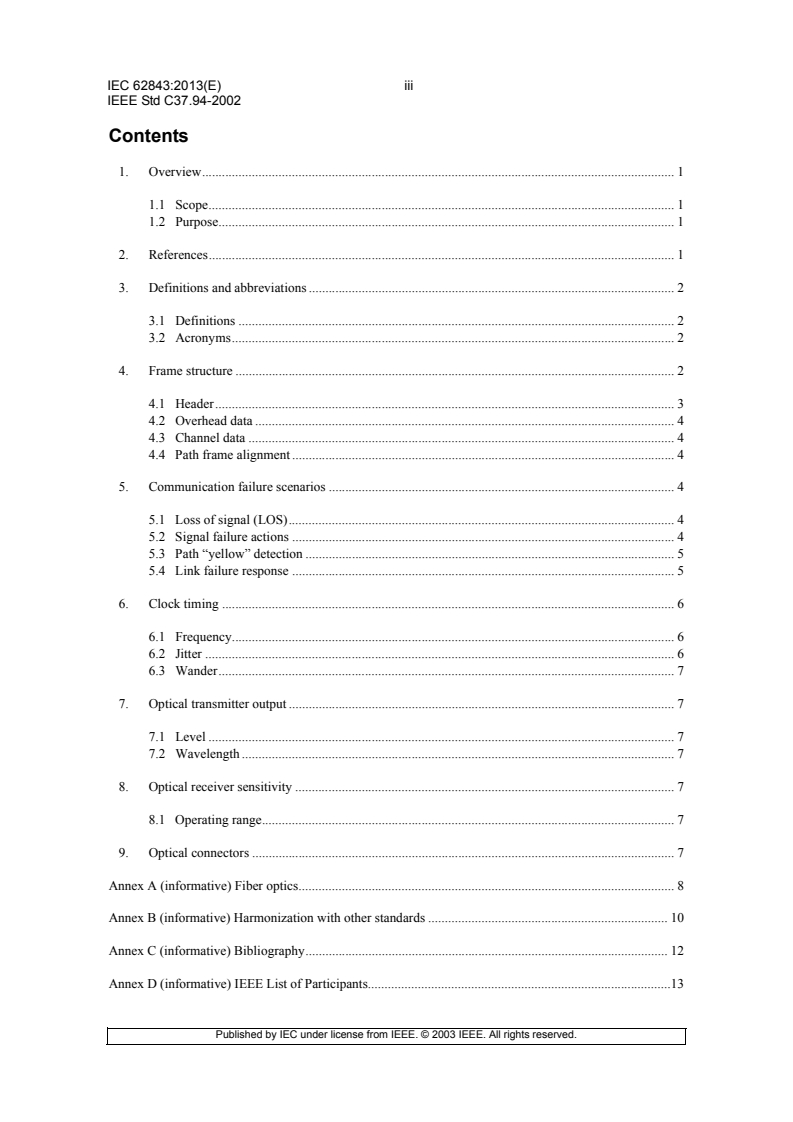
Contents
1. Overview. 1
1.1 Scope. 1
1.2 Purpose. 1
2. References. 1
3. Definitions and abbreviations . 2
3.1 Definitions . 2
3.2 Acronyms. 2
4. Frame structure . 2
4.1 Header. 3
4.2 Overhead data . 4
4.3 Channel data . 4
4.4 Path frame alignment . 4
5. Communication failure scenarios . 4
5.1 Loss of signal (LOS). 4
5.2 Signal failure actions . 4
5.3 Path “yellow” detection . 5
5.4 Link failure response . 5
6. Clock timing . 6
6.1 Frequency. 6
6.2 Jitter . 6
6.3 Wander. 7
7. Optical transmitter output . 7
7.1 Level . 7
7.2 Wavelength . 7
8. Optical receiver sensitivity . 7
8.1 Operating range. 7
9. Optical connectors . 7
Annex A (informative) Fiber optics. 8
Annex B (informative) Harmonization with other standards .10
Annex C (informative) Bibliography. 12
Annex D (informative) IEEE List of Participants.13
Published by IEC under license from IEEE. © 2003 IEEE. All rights reserved.
iv IEC 62843:2013(E)
IEEE Std C37.94-2002
Published by IEC under license from IEEE. © 2003 IEEE. All rights reserved.
IEEE Std C37.94-2002
STANDARD FOR N TIMES 64
KILOBIT PER SECOND OPTICAL FIBER
INTERFACES BETWEEN TELEPROTECTION
AND MULTIPLEXER EQUIPMENT
FOREWORD
1) The International Electrotechnical Commission (IEC) is a worldwide organization for standardization
comprising all national electrotechnical committees (IEC National Committees). The object of IEC is to
promote international co-operation on all questions concerning standardization in the electrical and
electronic fields. To this end and in addition to other activities, IEC publishes International Standards,
Technical Specifications, Technical Reports, Publicly Available Specifications (PAS) and Guides (hereafter
referred to as “IEC Publication(s)”). Their preparation is entrusted to technical committees; any IEC
National Committee interested in the subject dealt with may participate in this preparatory work.
International, governmental and non-governmental organizations liaising with the IEC also participate in
this preparation.
IEEE Standards documents are developed within IEEE Societies and Standards Coordinating Committees
of the IEEE Standards Association (IEEE-SA) Standards Board. IEEE develops its standards through a
consensus development process, which brings together volunteers representing varied viewpoints and
interests to achieve the final product. Volunteers are not necessarily members of IEEE and serve without
compensation. While IEEE administers the process and establishes rules to promote fairness in the
consensus development process, IEEE does not independently evaluate, test, or verify the accuracy of any
of the information contained in its standards. Use of IEEE Standards documents is wholly voluntary. IEEE
documents are made available for use subject to important notices and legal disclaimers (see http://
standards.ieee.org/IPR/disclaimers.html for more information).
IEC collaborates closely with IEEE in accordance with conditions determined by agreement between the
two organizations.
2) The formal decisions of IEC on technical matters express, as nearly as possible, an international
consensus of opinion on the relevant subjects since each technical committee has representation from all
interested IEC National Committees. The formal decisions of IEEE on technical matters, once consensus
within IEEE Societies and Standards Coordinating Committees has been reached, is determined by a
balanced ballot of materially interested parties who indicate interest in reviewing the proposed standard.
Final approval of the IEEE standards document is given by the IEEE Standards Association (IEEE-SA)
Standards Board.
3) IEC/IEEE Publications have the form of recommendations for international use and are accepted by IEC
National Committees/IEEE Societies in that sense. While all reasonable efforts are made to ensure that the
technical content of IEC/IEEE Publications is accurate, IEC or IEEE cannot be held responsible for the way
in which they are used or for any misinterpretation by any end user.
4) In order to promote international uniformity, IEC National Committees undertake to apply IEC Publications
(including IEC/IEEE Publications) transparently to the maximum extent possible in their national and
regional publications. Any divergence between any IEC/IEEE Publication and the corresponding national or
regional publication shall be clearly indicated in the latter.
5) IEC and IEEE do not provide any attestation of conformity. Independent certification bodies provide
conformity assessment services and, in some areas, access to IEC marks of conformity. IEC and IEEE are
not responsible for any services carried out by independent certification bodies.
6) All users should ensure that they have the latest edition of this publication.
7) No liability shall attach to IEC or IEEE or their directors, employees, servants or agents including individual
experts and members of technical committees and IEC National Committees, or volunteers of IEEE
Societies and the Standards Coordinating Committees of the IEEE Standards Association (IEEE-SA)
Standards Board, for any personal injury, property damage or other damage of any nature whatsoever,
whether direct or indirect, or for costs (including legal fees) and expenses arising out of the publication,
use of, or reliance upon, this IEC/IEEE Publication or any other IEC or IEEE Publications.
Published by IEC under license from IEEE. © 2003 IEEE. All rights reserved.
vi IEC 62843:2013(E)
IEEE Std C37.94-2002
8) Attention is drawn to the normative references cited in this publication. Use of the referenced publications
is indispensable for the correct application of this publication.
9) Attention is drawn to the possibility that implementation of this IEC/IEEE Publication may require use of
material covered by patent rights. By publication of this standard, no position is taken with respect to the
existence or validity of any patent rights in connection therewith. IEC or IEEE shall not be held responsible
for identifying Essential Patent Claims for which a license may be required, for conducting inquiries into the
legal validity or scope of Patent Claims or determining whether any licensing terms or conditions provided
in connection with submission of a Letter of Assurance, if any, or in any licensing agreements are
reasonable or non-discriminatory. Users of this standard are expressly advised that determination of the
validity of any patent rights, and the risk of infringement of such rights, is entirely their own responsibility.
International Standard IEC 62843/IEEE Std C37.94-2002 has been processed through IEC
technical committee 57: Power systems management and associated information
exchange, under the IEC/IEEE Dual Logo Agreement.
The text of this standard is based on the following documents:
IEEE Std FDIS Report on voting
C37.94-2002 57/1258/FDIS 57/1290/RVD
Full information on the voting for the approval of this standard can be found in the report
on voting indicated in the above table.
The IEC Technical Committee and IEEE Technical Committee have decided that the
contents of this publication will remain unchanged until the stability date indicated on the
IEC web site under "http://webstore.iec.ch" in the data related to the specific publication.
At this date, the publication will be
• reconfirmed,
• withdrawn,
• replaced by a revised edition, or
• amended.
Published by IEC under license from IEEE. © 2003 IEEE. All rights reserved.
IEEE Std C37.94-2002
IEEE Standard for N Times 64
Kilobit Per Second Optical Fiber
Interfaces Between Teleprotection
and Multiplexer Equipment
Sponsor
Power System Relaying Committee
and
Power System Communications Committee
of the
IEEE Power Engineering Society
Approved 21 January 2003
American National Standards Institute
Approved 12 September 2002
IEEE-SA Standards Board
Abstract: An optical interface for use between teleprotection and digital multiplexer equipment that
can operate at a data rate of N times 64 kilobit per second where N = 1, 2…12 is described.
Requirements for both physical connection and the communications timing are also included.
Keywords: alarm indication signal, bit error rate, cyclic redundancy check, loss of frame, loss of
signal, multimode optical fiber, multiplexer,remote defect indication, teleprotection, unit interval
Published by IEC under license from IEEE. © 2003 IEEE. All rights reserved.
viii IEC 62843:2013(E)
IEEE Std C37.94-2002
IEEE Introduction
(This introduction is not part of IEEE C37.94-2002, IEEE Standard for N times 64 Kilobit per Second Optical Fiber
Interfaces between Teleprotection and Multiplexer Equipment.)
Existing interface standards between teleprotection equipment and multiplexers are electrical only. These
low-energy signal interfaces are susceptible to intra-substation electromagnetic interference (EMI). The use
of dedicated optical fibers for the intra-substation communication links between teleprotection equipment
and multiplexers eliminates the data corruption common to electrical connections.
Published by IEC under license from IEEE. © 2003 IEEE. All rights reserved.
IEEE Std C37.94-2002
Standard for N Times 64
Kilobit Per Second Optical Fiber
Interfaces Between Teleprotection
and Multiplexer Equipment
1. Overview
1.1 Scope
This standard describes the interconnection details for N, where N = 1, 2…12, times 64 kilobit per second
connections of teleprotection equipment to digital multiplexers using optical fiber. Requirements for both
physical connection and the communications timing are also included.
1.2 Purpose
The purpose of this standard is to allow the interconnection of different vendors’ teleprotection equipment
with different vendors’ multiplexer equipment, without any restriction on the content of the
N times 64 kilobit per second data using up to 2 km of 50 or 62.5 micrometer multimode optical fiber.
2. References
The following standard contains provisions, which through reference in this text constitute provisions of this
standard. At the time of this publication, the editions indicated were valid. All standards are subject to
revision, and parties to agreements based on this stardard are encouraged to investigate the possibility of
applying the most recent editions of the standards indicated below. Members of the IEC and ISO maintain
registers of currently valid International Standards.
IEC-60874-10-1 (1997-06) Connectors for optical fibres and cables– Part 10-1: Detail specification for fibre
optic connector type BFOC/2.5 terminated to multimode fibre type A1.
IEC publications are available from the Sales Department of the International Electrotechnical Commission, Case Postale 131, 3, rue
de Varembé, CH-1211, Genève 20, Switzerland/Suisse (http://www.iec.ch/). IEC publications are also available in the United States
from the Sales Department, American National Standards Institute, 11 West 42nd Street, 13th Floor, New York, NY 10036, USA.
Published by IEC under license from IEEE. © 2003 IEEE. All rights reserved.
2 IEC 62843:2013(E)
IEEE Std C37.94-2002
3. Definitions and acronyms
3.1 Definitions
For the purposes of this standard, the following terms and definitions apply. The IEEE Authoritative
Dictionary of IEEE Standards Terms, Seventh Edition [B2] , should be used for terms not defined in this
clause.
3.1.1 jitter: A term used to describe perturbations in the timing of data bit transitions when the frequency of
the perturbations is greater than 10 Hz.
3.1.2 multimode optical fiber: An optical fiber that has a relatively large core, in which light bounces off
the walls of the core. This results in multiple signal paths through the fiber, which limits the maximum
signaling rate more and more as the fiber length increases.
3.1.3 multiplexer equipment: A device that allows the transmission of a number of different signals
simultaneously over a single channel or transmission facility.
3.1.4 teleprotection equipment: Equipment that provides the interface between the protective relay and a
communications circuit.
3.1.5 unit interval (UI): Time duration equal to the reciprocal of the bit rate.
3.1.6 wander: A term used to describe perturbations in the tim
...