

IEC 60335-2-31:1995
(Main)Safety of household and similar electrical appliances - Part 2: Particular requirements for range hoods
General Information
- Abstract
Deals with the safety of electric range hoods intended for installing above household cooking ranges, hobs and similar cooking appliances, their rated voltage being not more than 250 V. Note: -The cooking appliance may be supplied by electricity or other fuels, such as gas. Is to be used in conjunction with IEC 60335-1 (third edition).
- Status
- Published
- Publication Date
- 29-Jun-1999
- Technical Committee
- TC 61 - Safety of household and similar electrical appliances
- Current Stage
- DELPUB - Deleted Publication
- Start Date
- 21-Oct-2002
- Completion Date
- 28-Aug-2026
Overview
IEC 60335-2-31:1995 is an international safety standard developed by the International Electrotechnical Commission (IEC). It specifically addresses the safety of electric range hoods installed above household cooking ranges, hobs, and similar cooking appliances, operating at a rated voltage not exceeding 250 V. Applicable to both domestic and select non-domestic applications, this standard is to be used in conjunction with IEC 60335-1, the general standard for household electrical appliance safety. The document includes amendments, covering essential safety considerations for users, installers, and manufacturers.
Key Topics
Scope of Application:
IEC 60335-2-31 covers electric range hoods designed for residential use, as well as those used in public or semi-commercial environments (e.g., shops, light industry, farms) that may present hazards to the public.General and Specific Safety Requirements:
The standard details protection against access to live parts, marking and instructions, power input and current, heating, resistance to moisture, and abnormal operation conditions.Marking and Instructions:
- Appliances must be clearly marked with the maximum power rating of replaceable illumination lamps.
- Instructions must address adequate room ventilation when range hoods are used with gas or other fuel-burning appliances.
- Cleaning methods and frequency must be specified to mitigate fire risks.
- Installation instructions must specify the minimum safe distance from the hob, especially when installed above a gas appliance (usually at least 65 cm).
User and Maintenance Safety:
Provisions are made for safe user maintenance; detachable parts for cleaning must not expose hazardous wiring unless properly insulated.Special Notes:
The standard does not include appliances for industrial or commercial purposes or those operating in corrosive/explosive atmospheres. Special advisory notes address requirements for integrating with gas appliances, and compliance with national regulations regarding exhaust air discharge.
Applications
IEC 60335-2-31 offers practical value for:
Manufacturers and Designers:
Ensuring compliance when developing electric range hoods for domestic kitchens, and for products with similar functions in non-domestic environments. It helps guide design choices like insulation, mechanical durability, and safe installation requirements.Installers and Contractors:
Providing clear criteria for safe installation (e.g., minimum distances from cooking surfaces) and for compliance with both international and local regulations regarding exhaust and ventilation.Testing and Certification Bodies:
Offering a benchmark for conformity assessments and product certifications for range hoods meant for the international market.Regulatory Authorities:
Building a framework for national and local regulations tied to domestic kitchen appliance safety.
Related Standards
For full compliance and comprehensive safety, IEC 60335-2-31 should be used together with the following related standards:
IEC 60335-1: Safety of household and similar electrical appliances - General Requirements
The primary safety standard forming the basis for all appliances in the IEC 60335 series.IEC 60335-2-65: Particular requirements for air-cleaning appliances, especially relevant for range hoods featuring electrostatic filters.
IEC 60227 / IEC 60245: Standards on insulation of electrical cables, referenced for internal wiring safety compliance.
IEC 60050: International Electrotechnical Vocabulary, for terminology clarification.
Applicable National and Regional Regulations: Some countries may impose additional requirements for installation, ventilation, air discharge, and cleaning.
Conforming to IEC 60335-2-31 ensures safer, reliable, and internationally accepted electric range hoods for kitchens and similar environments. Proper implementation reduces risks of electric shock, fire, or accidental injury, enhancing overall household electrical safety.
Relations
- Effective Date
- 05-Sep-2023
- Effective Date
- 05-Sep-2023
Get Certified
Connect with accredited certification bodies for this standard

CIS Institut d.o.o.
Personal Protective Equipment (PPE) certification body. Notified Body NB-2890 for EU Regulation 2016/425 PPE.

Kiwa BDA Testing
Building and construction product certification.
Kmetijski inštitut Slovenije
Agricultural Institute of Slovenia. Soil testing, plant health, agricultural product analysis.
Sponsored listings
Frequently Asked Questions
IEC 60335-2-31:1995 is a standard published by the International Electrotechnical Commission (IEC). Its full title is "Safety of household and similar electrical appliances - Part 2: Particular requirements for range hoods". This standard covers: Deals with the safety of electric range hoods intended for installing above household cooking ranges, hobs and similar cooking appliances, their rated voltage being not more than 250 V. Note: -The cooking appliance may be supplied by electricity or other fuels, such as gas. Is to be used in conjunction with IEC 60335-1 (third edition).
Deals with the safety of electric range hoods intended for installing above household cooking ranges, hobs and similar cooking appliances, their rated voltage being not more than 250 V. Note: -The cooking appliance may be supplied by electricity or other fuels, such as gas. Is to be used in conjunction with IEC 60335-1 (third edition).
IEC 60335-2-31:1995 is classified under the following ICS (International Classification for Standards) categories: 13.120 - Domestic safety; 97.040.20 - Cooking ranges, working tables, ovens and similar appliances. The ICS classification helps identify the subject area and facilitates finding related standards.
IEC 60335-2-31:1995 has the following relationships with other standards: It is inter standard links to IEC 60335-2-31:1995/AMD1:1998, IEC 60335-2-31:2002. Understanding these relationships helps ensure you are using the most current and applicable version of the standard.
IEC 60335-2-31:1995 is available in PDF format for immediate download after purchase. The document can be added to your cart and obtained through the secure checkout process. Digital delivery ensures instant access to the complete standard document.
Standards Content (Sample)
NORME CEI
INTERNATIONALE IEC
60335-2-31
INTERNATIONAL
Edition 3.1
STANDARD
1999-06
Edition 3:1995 consolidée par l'amendement 1:1998
Edition 3:1995 consolidated with amendment 1:1998
Sécurité des appareils électrodomestiques
et analogues –
Partie 2-31:
Règles particulières pour les hottes de cuisine
Safety of household and similar
electrical appliances –
Part 2-31:
Particular requirements for range hoods
Numéro de référence
Reference number
CEI/IEC 60335-2-31:1995+A1:1998
Numéros des publications Numbering
Depuis le 1er janvier 1997, les publications de la CEI As from 1 January 1997 all IEC publications are
sont numérotées à partir de 60000. issued with a designation in the 60000 series.
Publications consolidées Consolidated publications
Les versions consolidées de certaines publications de Consolidated versions of some IEC publications
la CEI incorporant les amendements sont disponibles. including amendments are available. For example,
Par exemple, les numéros d’édition 1.0, 1.1 et 1.2 edition numbers 1.0, 1.1 and 1.2 refer, respectively, to
indiquent respectivement la publication de base, la the base publication, the base publication incor-
publication de base incorporant l’amendement 1, et la porating amendment 1 and the base publication
publication de base incorporant les amendements 1 incorporating amendments 1 and 2.
et 2.
Validité de la présente publication Validity of this publication
Le contenu technique des publications de la CEI est The technical content of IEC publications is kept
constamment revu par la CEI afin qu'il reflète l'état under constant review by the IEC, thus ensuring that
actuel de la technique. the content reflects current technology.
Des renseignements relatifs à la date de reconfir- Information relating to the date of the reconfirmation
mation de la publication sont disponibles dans le of the publication is available in the IEC catalogue.
Catalogue de la CEI.
Les renseignements relatifs à des questions à l’étude et Information on the subjects under consideration and
des travaux en cours entrepris par le comité technique work in progress undertaken by the technical
qui a établi cette publication, ainsi que la liste des committee which has prepared this publication, as well
publications établies, se trouvent dans les documents ci- as the list of publications issued, is to be found at the
dessous: following IEC sources:
• «Site web» de la CEI* • IEC web site*
• Catalogue des publications de la CEI • Catalogue of IEC publications
Publié annuellement et mis à jour Published yearly with regular updates
régulièrement (On-line catalogue)*
(Catalogue en ligne)*
• IEC Bulletin
• Bulletin de la CEI Available both at the IEC web site* and
Disponible à la fois au «site web» de la CEI* as a printed periodical
et comme périodique imprimé
Terminology, graphical and letter
Terminologie, symboles graphiques
symbols
et littéraux For general terminology, readers are referred to
En ce qui concerne la terminologie générale, le lecteur IEC 60050: International Electrotechnical Vocabulary
se reportera à la CEI 60050: Vocabulaire Electro- (IEV).
technique International (VEI).
For graphical symbols, and letter symbols and signs
Pour les symboles graphiques, les symboles littéraux approved by the IEC for general use, readers are
et les signes d'usage général approuvés par la CEI, le referred to publications IEC 60027: Letter symbols to
lecteur consultera la CEI 60027: Symboles littéraux à be used in electrical technology, IEC 60417: Graphical
utiliser en électrotechnique, la CEI 60417: Symboles symbols for use on equipment. Index, survey and
graphiques utilisables sur le matériel. Index, relevé et compilation of the single sheets and IEC 60617:
compilation des feuilles individuelles, et la CEI 60617: Graphical symbols for diagrams.
Symboles graphiques pour schémas.
* See web site address on title page.
* Voir adresse «site web» sur la page de titre.
NORME CEI
INTERNATIONALE IEC
60335-2-31
INTERNATIONAL
Edition 3.1
STANDARD
1999-06
Edition 3:1995 consolidée par l'amendement 1:1998
Edition 3:1995 consolidated with amendment 1:1998
Sécurité des appareils électrodomestiques
et analogues –
Partie 2-31:
Règles particulières pour les hottes de cuisine
Safety of household and similar
electrical appliances –
Part 2-31:
Particular requirements for range hoods
IEC 1999 Droits de reproduction réservés Copyright - all rights reserved
Aucune partie de cette publication ne peut être reproduite ni No part of this publication may be reproduced or utilized in
utilisée sous quelque forme que ce soit et par aucun procédé, any form or by any means, electronic or mechanical,
électronique ou mécanique, y compris la photo-copie et les including photocopying and microfilm, without permission in
microfilms, sans l'accord écrit de l'éditeur. writing from the publisher.
International Electrotechnical Commission 3, rue de Varembé Geneva, Switzerland
Telefax: +41 22 919 0300 e-mail: inmail@iec.ch IEC web site http://www.iec.ch
CODE PRIX
Commission Electrotechnique Internationale
M
PRICE CODE
International Electrotechnical Commission
Pour prix, voir catalogue en vigueur
For price, see current catalogue
©
– 2 – 60335-2-31 CEI:1995+A1:1998
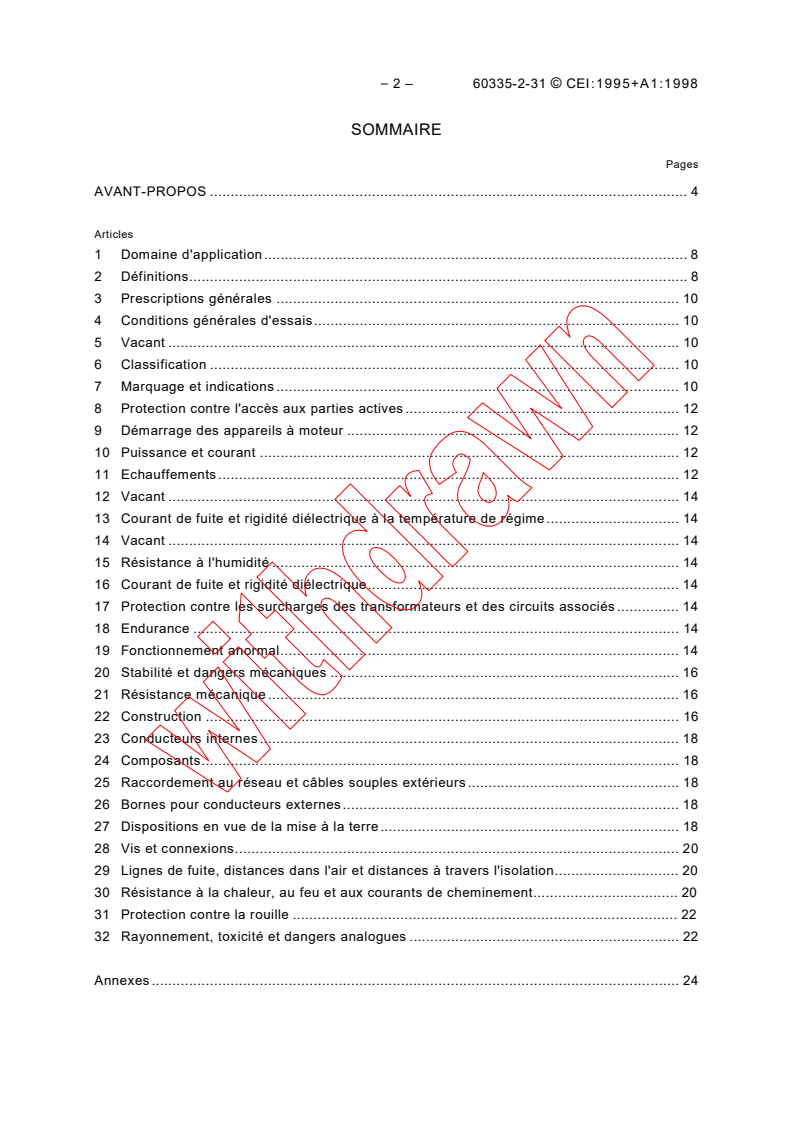
SOMMAIRE
Pages
AVANT-PROPOS . 4
Articles
1 Domaine d'application. 8
2 Définitions. 8
3 Prescriptions générales . 10
4 Conditions générales d'essais. 10
5 Vacant . 10
6 Classification .10
7 Marquage et indications . 10
8 Protection contre l'accès aux parties actives . 12
9 Démarrage des appareils à moteur . 12
10 Puissance et courant . 12
11 Echauffements . 12
12 Vacant . 14
13 Courant de fuite et rigidité diélectrique à la température de régime. 14
14 Vacant . 14
15 Résistance à l'humidité . 14
16 Courant de fuite et rigidité diélectrique. 14
17 Protection contre les surcharges des transformateurs et des circuits associés . 14
18 Endurance .14
19 Fonctionnement anormal. 14
20 Stabilité et dangers mécaniques . 16
21 Résistance mécanique . 16
22 Construction .16
23 Conducteurs internes . 18
24 Composants. 18
25 Raccordement au réseau et câbles souples extérieurs . 18
26 Bornes pour conducteurs externes. 18
27 Dispositions en vue de la mise à la terre. 18
28 Vis et connexions. 20
29 Lignes de fuite, distances dans l'air et distances à travers l'isolation. 20
30 Résistance à la chaleur, au feu et aux courants de cheminement. 20
31 Protection contre la rouille . 22
32 Rayonnement, toxicité et dangers analogues . 22
Annexes . 24
60335-2-31 © IEC:1995+A1:1998 – 3 –
CONTENTS
Page
FOREWORD . 5
Clause
1 Scope . 9
2 Definitions. 9
3 General requirement . 11
4 General conditions for the tests . 11
5 Void . 11
6 Classification .11
7 Marking and instructions . 11
8 Protection against access to live parts . 13
9 Starting of motor-operated appliances. 13
10 Power input and current . 13
11 Heating . 13
12 Void . 15
13 Leakage current and electric strength at operating temperature . 15
14 Void . 15
15 Moisture resistance. 15
16 Leakage current and electric strength . 15
17 Overload protection of transformers and associated circuits. 15
18 Endurance .15
19 Abnormal operation. 15
20 Stability and mechanical hazards . 17
21 Mechanical strength. 17
22 Construction .17
23 Internal wiring . 19
24 Components . 19
25 Supply connection and external flexible cords. 19
26 Terminals for external conductors . 19
27 Provision for earthing. 19
28 Screws and connections . 21
29 Creepage distances, clearances and distances through insulation . 21
30 Resistance to heat, fire and tracking . 21
31 Resistance to rusting . 23
32 Radiation, toxicity and similar hazards . 23
Annexes . 25
©
– 4 – 60335-2-31 CEI:1995+A1:1998
COMMISSION ÉLECTROTECHNIQUE INTERNATIONALE
___________
SÉCURITÉ DES APPAREILS ÉLECTRODOMESTIQUES
ET ANALOGUES –
Partie 2-31: Règles particulières pour les hottes de cuisine
AVANT-PROPOS
1) La CEI (Commission Électrotechnique Internationale) est une organisation mondiale de normalisation
composée de l'ensemble des comités électrotechniques nationaux (Comités nationaux de la CEI). La CEI a
pour objet de favoriser la coopération internationale pour toutes les questions de normalisation dans les
domaines de l'électricité et de l'électronique. A cet effet, la CEI, entre autres activités, publie des Normes
internationales. Leur élaboration est confiée à des comités d'études, aux travaux desquels tout Comité national
intéressé par le sujet traité peut participer. Les organisations internationales, gouvernementales et non
gouvernementales, en liaison avec la CEI, participent également aux travaux. La CEI collabore étroitement
avec l'Organisation Internationale de Normalisation (ISO), selon des conditions fixées par accord entre les
deux organisations.
2) Les décisions ou accords officiels de la CEI concernant les questions techniques représentent, dans la mesure
du possible, un accord international sur les sujets étudiés, étant donné que les Comités nationaux intéressés
sont représentés dans chaque comité d’études.
3) Les documents produits se présentent sous la forme de recommandations internationales. Ils sont publiés
comme normes, spécifications techniques, rapports techniques ou guides et agréés comme tels par les
Comités nationaux.
4) Dans le but d'encourager l'unification internationale, les Comités nationaux de la CEI s'engagent à appliquer de
façon transparente, dans toute la mesure possible, les Normes internationales de la CEI dans leurs normes
nationales et régionales. Toute divergence entre la norme de la CEI et la norme nationale ou régionale
correspondante doit être indiquée en termes clairs dans cette dernière.
5) La CEI n’a fixé aucune procédure concernant le marquage comme indication d’approbation et sa responsabilité
n’est pas engagée quand un matériel est déclaré conforme à l’une de ses normes.
6) L’attention est attirée sur le fait que certains des éléments de la présente Norme internationale peuvent faire
l’objet de droits de propriété intellectuelle ou de droits analogues. La CEI ne saurait être tenue pour
responsable de ne pas avoir identifié de tels droits de propriété et de ne pas avoir signalé leur existence.
La présente partie de la Norme internationale CEI 60335 a été établie par le comité
d'études 61 de la CEI: Sécurité des appareils électrodomestiques et analogues.
Elle constitue la troisième édition de la CEI 60335-2-31 et remplace la deuxième édition
(1988) et son amendement 1 (1990).
La présente version consolidée de la CEI 60335-2-31 est issue de la troisième édition
(1995) [documents 61/869/FDIS et 61/922/RVD] et de son amendement 1 (1998) [docu-
ments 61/1464/FDIS et 61/1517/RVD]. La version française de l'amendement 1 n'a pas été
soumise au vote.
Elle porte le numéro d'édition 3.1.
Une ligne verticale dans la marge indique où la publication de base a été modifiée par
l'amendement 1.
La présente partie 2 doit être utilisée conjointement avec la dernière édition de la
CEI 60335-1 et ses amendements. Elle a été établie sur la base de la troisième édition
(1991) de cette norme.
La présente partie 2 complète ou modifie les articles correspondants de la CEI 60335-1 de
façon à la transformer en norme CEI: Règles de sécurité pour les hottes électriques de
cuisine.
60335-2-31 © IEC:1995+A1:1998 – 5 –
INTERNATIONAL ELECTROTECHNICAL COMMISSION
___________
SAFETY OF HOUSEHOLD AND SIMILAR
ELECTRICAL APPLIANCES –
Part 2-31: Particular requirements for range hoods
FOREWORD
1) The IEC (International Electrotechnical Commission) is a worldwide organization for standardization comprising
all national electrotechnical committees (IEC National Committees). The object of the IEC is to promote
international co-operation on all questions concerning standardization in the electrical and electronic fields. To
this end and in addition to other activities, the IEC publishes International Standards. Their preparation is
entrusted to technical committees; any IEC National Committee interested in the subject dealt with may
participate in this preparatory work. International, governmental and non-governmental organizations liaising
with the IEC also participate in this preparation. The IEC collaborates closely with the International
Organization for Standardization (ISO) in accordance with conditions determined by agreement between the
two organizations.
2) The formal decisions or agreements of the IEC on technical matters express, as nearly as possible, an
international consensus of opinion on the relevant subjects since each technical committee has representation
from all interested National Committees.
3) The documents produced have the form of recommendations for international use and are published in the form
of standards, technical specifications, technical reports or guides and they are accepted by the National
Committees in that sense.
4) In order to promote international unification, IEC National Committees undertake to apply IEC International
Standards transparently to the maximum extent possible in their national and regional standards. Any
divergence between the IEC Standard and the corresponding national or regional standard shall be clearly
indicated in the latter.
5) The IEC provides no marking procedure to indicate its approval and cannot be rendered responsible for any
equipment declared to be in conformity with one of its standards.
6) Attention is drawn to the possibility that some of the elements of this International Standard may be the subject
of patent rights. The IEC shall not be held responsible for identifying any or all such patent rights.
This part of International Standard IEC 60335 has been prepared by IEC technical com-
mittee 61: Safety of household and similar electrical appliances.
It forms the third edition of IEC 60335-2-31 and replaces the second edition (1988) and its
amendment 1 (1990).
This consolidated version of IEC 60335-2-31 is based on the third edition (1995) [documents
61/869/FDIS and 61/922/RVD] and its amendment 1 (1998) [documents 61/1464/FDIS and
61/1517/RVD].
It bears the edition number 3.1.
A vertical line in the margin shows where the base publication has been modified by
amendment 1.
This part 2 is to be used in conjunction with the latest edition of IEC 60335-1 and its
amendments. It was established on the basis of the third edition (1991) of that standard.
This part 2 supplements or modifies the corresponding clauses in IEC 60335-1, so as to
convert that publication into the IEC standard: Safety requirements for electric range hoods.
©
– 6 – 60335-2-31 CEI:1995+A1:1998
Lorsqu'un paragraphe particulier de la partie 1 n'est pas mentionné dans cette partie 2, ce
paragraphe s'applique pour autant qu'il est raisonnable. Lorsque la présente norme spécifie
«addition», «modification» ou «remplacement», le texte correspondant de la partie 1 doit
être adapté en conséquence.
NOTE 1 – Les caractères d'imprimerie suivants sont employés
– prescriptions: caractères romains;
– modalités d'essai: caractères italiques;
– notes: petits caractères romains;
Les termes figurant en gras dans le texte sont définis à l'article 2. Lorsqu'une définition de la partie 1 concerne un
adjectif, l'adjectif et le nom associé figurent également en gras.
NOTE 2 – Les paragraphes complémentaires à ceux de la partie 1 sont numérotés à partir de 101.
Les différences complémentaires suivantes existent dans certains pays:
– Article 3: La composante continue dans le neutre des appareils est limitée (Australie).
– 7.12: Les mises en gardes doivent être portées sur la hotte (USA).
– 7.12.1: Des prescriptions complémentaires sont spécifiées pour les hottes de cuisine destinées à être placées
au-dessus de tables de cuisson à gaz (Suède).
– 8.2: L'isolation des conducteurs internes ne doit pas nécessairement être conforme aux CEI 60227
ou CEI 60245 (USA).
– 11.2: Des méthodes d'essai et des modes d'évaluation différents sont utilisés (USA).
– 19.101: Des méthodes d'essais et des modes d'évaluation différents sont utilisés (USA).
– 20.2: L'addition ne s'applique qu'aux filtres du type jetable (USA).
– 22.102: Le serrage de vis dans des fentes en trou de serrure est considéré comme un moyen de fixation
acceptable (USA).
– 22.103: Les parties situées derrière un filtre sont considérées comme étant des parties qui doivent être
nettoyées (Suède).
– 30.101: Une méthode différente d'évaluer les filtres est utilisée (USA).
60335-2-31 © IEC:1995+A1:1998 – 7 –
Where a particular subclause of part 1 is not mentioned in this part 2, that subclause applies
as far as is reasonable. Where this standard states "addition", "modification" or "replace-
ment", the relevant text in part 1 is to be adapted accordingly.
NOTE 1 – The following print types are used:
– requirements: in roman type;
– test specifications: in italic type;
– notes: in small roman type;
Words in bold in the text are defined in clause 2. When a definition of part 1 concerns an adjective, the adjective
and the associated noun are also in bold.
NOTE 2 – Subclauses which are additional to those in part 1 are numbered starting from 101.
The following additional differences exist in some countries:
– Clause 3: The d.c. component in the appliance neutral is limited (Australia).
– 7.12: Warnings are required to be marked on the range hood (USA).
– 7.12.1: Additional requirements are specified for range hoods intended to be placed above gas hobs (Sweden).
– 8.2: The insulation of internal wiring need not comply with IEC 60227 or IEC 60245 (USA).
– 11.2: Different test methods and methods of evaluation are used (USA).
– 19.101: Different test methods and methods of evaluation are used (USA).
– 20.2: The addition applies only to disposable type filters (USA).
– 22.102: Tightening of screws in key-hole slots is an acceptable means of fixing (USA).
– 22.103: Parts located behind a filter are considered to be parts which have to be cleaned (Sweden).
– 30.101: A different method of evaluating filters is used (USA).
©
– 8 – 60335-2-31 CEI:1995+A1:1998
SÉCURITÉ DES APPAREILS ÉLECTRODOMESTIQUES
ET ANALOGUES –
Partie 2-31: Règles particulières pour les hottes de cuisine
1 Domaine d'application
L'article de la partie 1 est remplacé par:
La présente norme traite de la sécurité des hottes de cuisine électriques prévues pour être
installées au-dessus de cuisinières, de tables de cuisson et d'appareils de cuisson analogues
et dont la tension assignée n'est pas supérieure à 250 V.
NOTE 1 – Les appareils de cuisson peuvent être alimentés à l'électricité ou avec d'autres combustibles tels que le
gaz.
Les appareils non destinés à un usage domestique normal mais qui néanmoins peuvent
constituer une source de danger pour le public, tels que les appareils destinés à être utilisés
par des usagers non avertis dans des magasins, chez des artisans et dans des fermes, sont
compris dans le domaine d'application de la présente norme.
Dans la mesure du possible, la présente norme traite des risques ordinaires présentés par les
appareils, qui sont rencontrés par tous individus à l'intérieur et autour de l'habitation.
Cette norme ne tient en général pas compte
– de l'utilisation des appareils par des jeunes enfants ou des personnes handicapées sans
surveillance;
– de l'emploi de l'appareil comme jouet par des jeunes enfants.
NOTE 2 – L'attention est attirée sur le fait que
– pour les appareils comportant des filtres électrostatiques, la CEI 60335-2-65 s'applique également;
– pour les appareils destinés à être utilisés dans des véhicules ou à bord de navires ou d'avions, des
prescriptions supplémentaires peuvent être nécessaires;
– pour les appareils destinés à être utilisés dans les pays tropicaux, des prescriptions spéciales peuvent être
nécessaires;
– dans de nombreux pays, des prescriptions supplémentaires sont imposées par les organismes nationaux de la
santé publique, par les organismes nationaux responsables de la protection des travailleurs, par les organismes
nationaux responsables du bâtiment et par des organismes similaires.
NOTE 3 – La présente norme ne s'applique pas
– aux appareils destinés aux usages industriels ou commerciaux;
– aux appareils destinés à être utilisés dans des locaux présentant des conditions particulières, telles que la
présence d'une atmosphère corrosive ou explosive (poussière, vapeur ou gaz).
2 Définitions
L'article de la partie 1 est applicable avec les exceptions suivantes:
2.2.9
Remplacement:
conditions de fonctionnement normal
la hotte de cuisine est mise en fonctionnement après avoir été installée suivant les
instructions mais non raccordée à un conduit
60335-2-31 © IEC:1995+A1:1998 – 9 –
SAFETY OF HOUSEHOLD AND SIMILAR
ELECTRICAL APPLIANCES –
Part 2-31: Particular requirements for range hoods
1 Scope
This clause of part 1 is replaced by:
This standard deals with the safety of electric range hoods intended for installing above
household cooking ranges, hobs and similar cooking appliances, their rated voltage being
not more than 250 V.
NOTE 1 – The cooking appliance may be supplied by electricity or other fuels, such as gas.
Appliances not intended for normal household use but which nevertheless may be a source of
danger to the public, such as appliances intended to be used by laymen in shops, in light
industry and on farms, are within the scope of this standard.
So far as is practicable, this standard deals with the common hazards presented by
appliances which are encountered by all persons in and around the home.
This standard does not in general take into account
– the use of appliances by young children or infirm persons without supervision;
– playing with the appliance by young children.
NOTE 2 – Attention is drawn to the fact that
– for appliances incorporating electrostatic air filters, IEC 60335-2-65 also applies;
– for appliances intended to be used in vehicles or on board ships or aircraft, additional requirements may be
necessary;
– for appliances intended to be used in tropical countries special requirements may be necessary;
– in many countries additional requirements are specified by the national health authorities, the national
authorities responsible for the protection of labour, the national authorities responsible for buildings and similar
authorities.
NOTE 3 – This standard does not apply to
– appliances intended for industrial or commercial purposes;
– appliances intended to be used in locations where special conditions prevail, such as the presence of a
corrosive or explosive atmosphere (dust, vapour or gas).
2 Definitions
This clause of part 1 is applicable except as follows:
2.2.9 Replacement:
normal operation
the range hood is operated after installation in accordance with the instructions except that it
is not connected to a duct
©
– 10 – 60335-2-31 CEI:1995+A1:1998
2.2.101
hotte de cuisine
appareil à moteur prévu pour récupérer l'air vicié au-dessus d'une table de cuisson
NOTE – L'air vicié peut passer à travers un filtre et être renvoyé dans la pièce ou être évacué hors de la pièce.
3 Prescriptions générales
L'article de partie 1 est applicable.
4 Conditions générales d'essais
L'article de la partie 1 est applicable.
5 Vacant
6 Classification
L'article de la partie 1 est applicable.
7 Marquage et indications
L'article de la partie 1 est applicable avec les exceptions suivantes:
7.1 Addition:
Les appareils doivent porter, sur ou près de la do
...